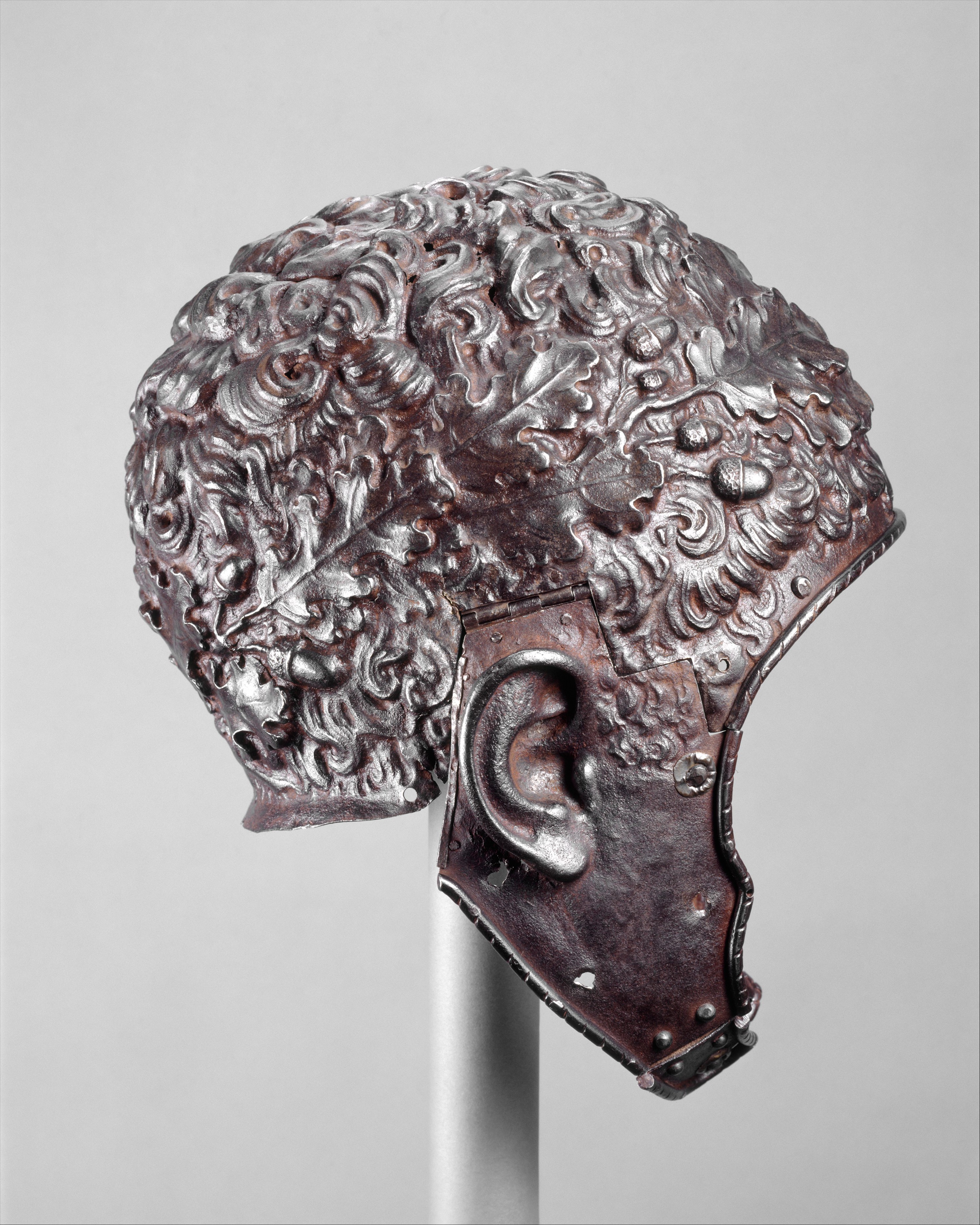
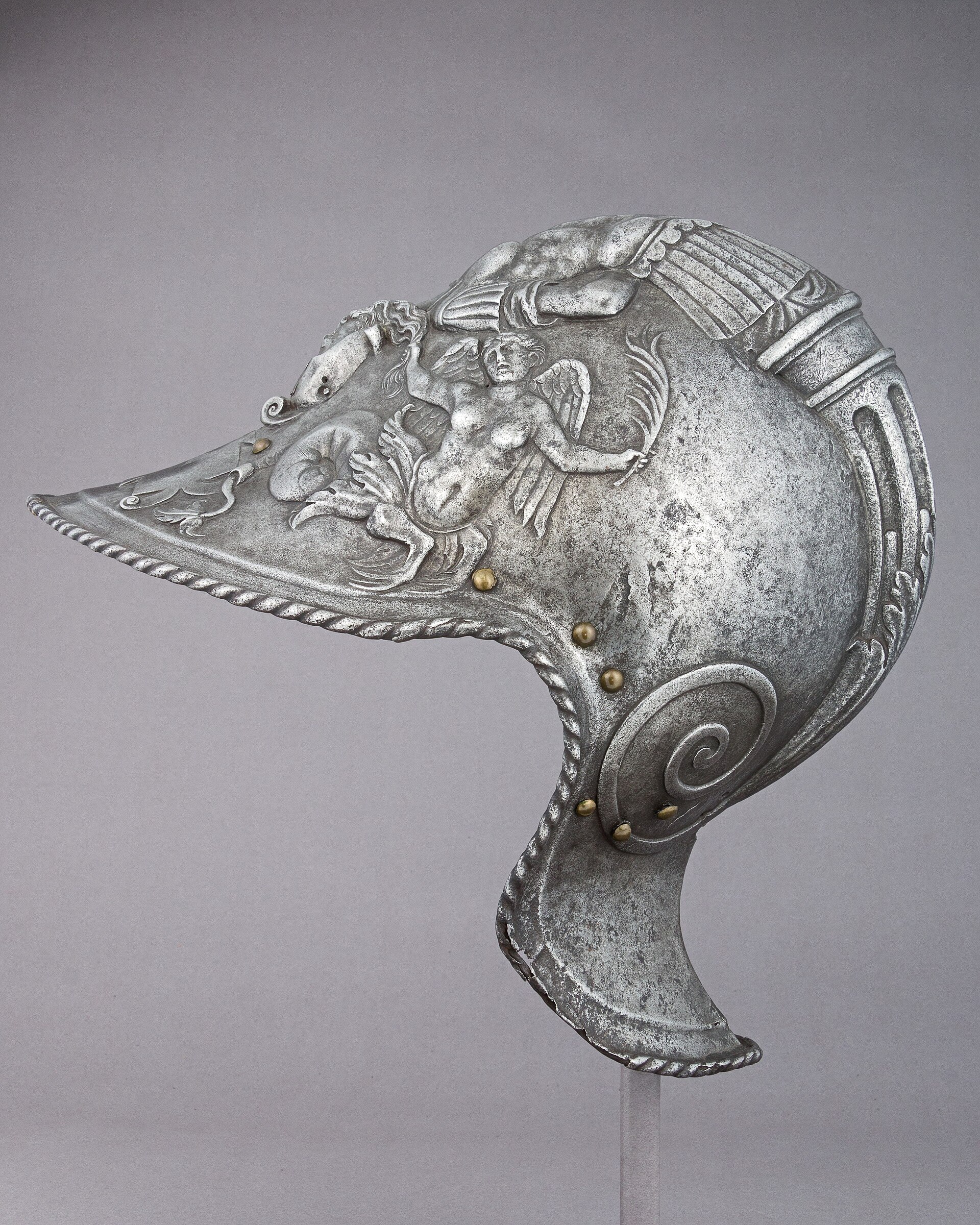
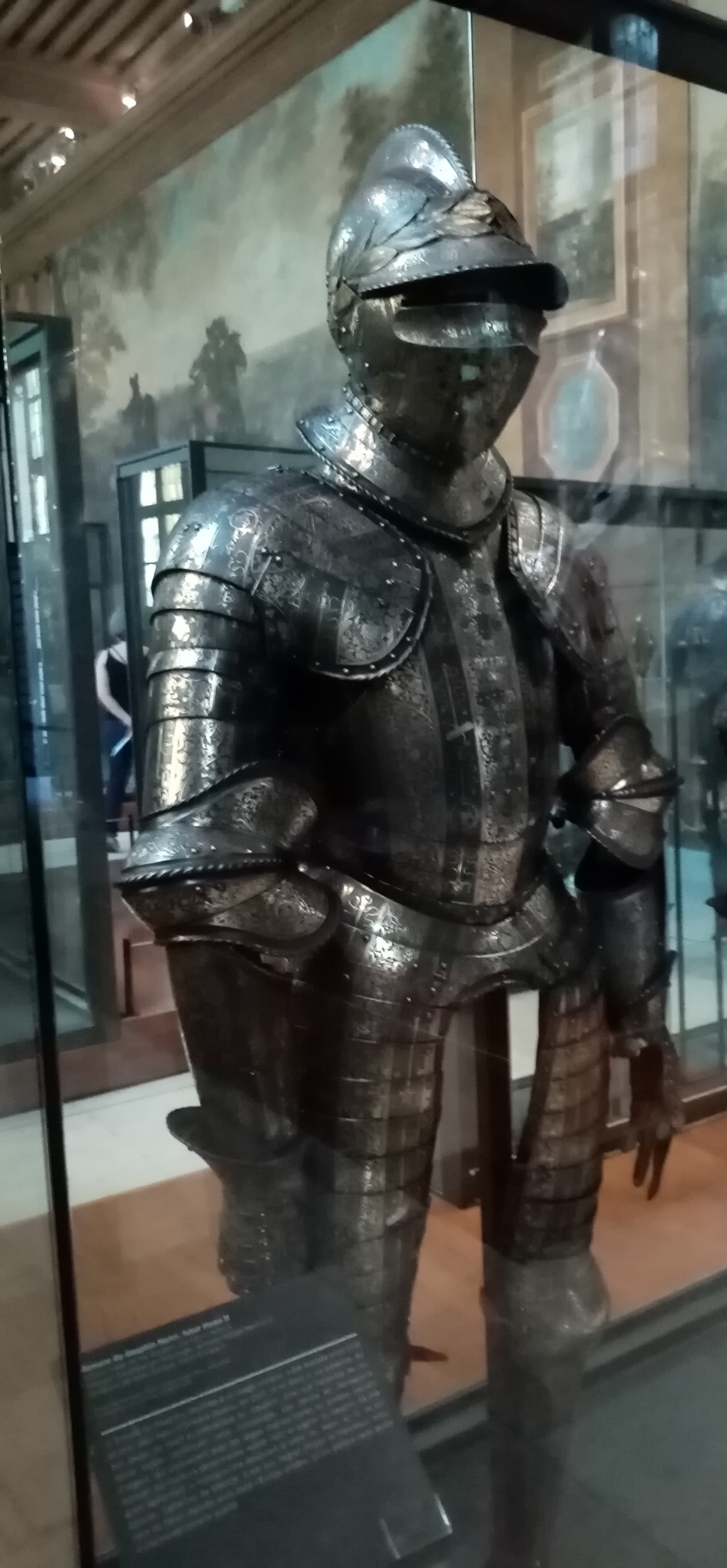
Helmet all'Antica
c. 1532-35 · Steel
Metropolitan Museum of Art, New York
 Italian, Milanese · 1510-1579
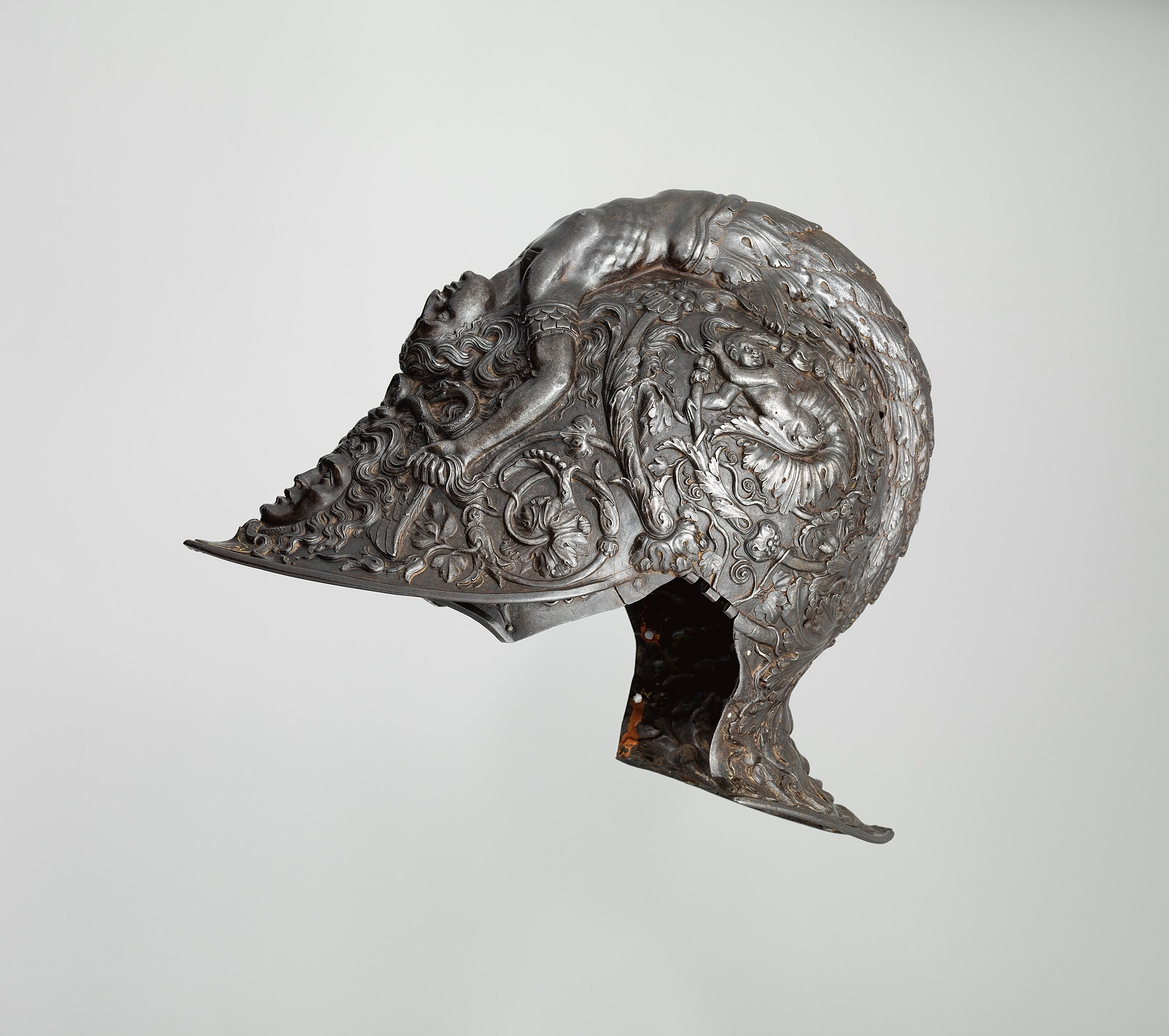
Burgonet, dated 1543 Steel, signed by Filippo Negroli alone; the last of his eight signed pieces and the only one in the United States. Metropolitan Museum of Art, accession 17.190.1720, Gift of J. Pierpont Morgan, 1917. The benchmark every other Negroli attribution on this page is measured against. No verified portrait. No securely identified likeness of this maker is known under a free licence. We do not publish a face we cannot verify.
Metropolitan Museum of Art, New York, Gift of J. Pierpont Morgan, 1917 (17.190.1720), CC0| Full name | Filippo Negroli, of the Negroli family of Milanese armorers |
|---|---|
| Worked as | Armorer, Embosser |
| Born | ca. 1510 (probable · Milan |
| Died | 1579-11-24 · Milan |
| Nationality | Italian, Milanese |
| Movement | Milanese Renaissance parade armor all'antica |
| In this archive | 1 artwork |
| Sources | 6 cited |
| Last verified |
About this page 1 artwork in the archive · Last verified · 6 sources cited
Filippo Negroli is the most celebrated armorer in the history of the craft, and until 1998 he had never been the subject of a monograph. He worked in Milan from the early 1530s, embossing steel into parade helmets, shields and cuirasses shaped as heads of curled hair, sea monsters, lions and mythological masks for Charles V, the dukes of Urbino and the crown of France. His reputation rests on eight signed pieces, all dated between 1532 and 1545, against which everything else bearing his name or his family's is now measured and mostly falls short.
He did not work alone. Filippo was the eldest of four brothers in a family firm headed by their father, itself one branch of a Milanese armorers' clan that runs back at least three generations before him; a cousin, Giovan Paolo Negroli, ran a separate workshop and left exactly one signed piece of his own. The single most important fact about the Negroli corpus is how small the secure part of it is, and how much of the rest rests on stylistic resemblance to that small part.
The reader should know one more thing that most short accounts leave out: Filippo did not die celebrated. He retired from armor-making in 1557, spent his last two decades as a maker of small metal trinkets called tremolanti, and his own testament records that he had been reduced to selling everything he owned because of poverty and blindness. He died in November 1579; his own testament lists the contents of his rooms as two beds, two tables, eight chairs and a few other items of modest value. The praise came from his contemporaries while he still worked; the poverty came after.
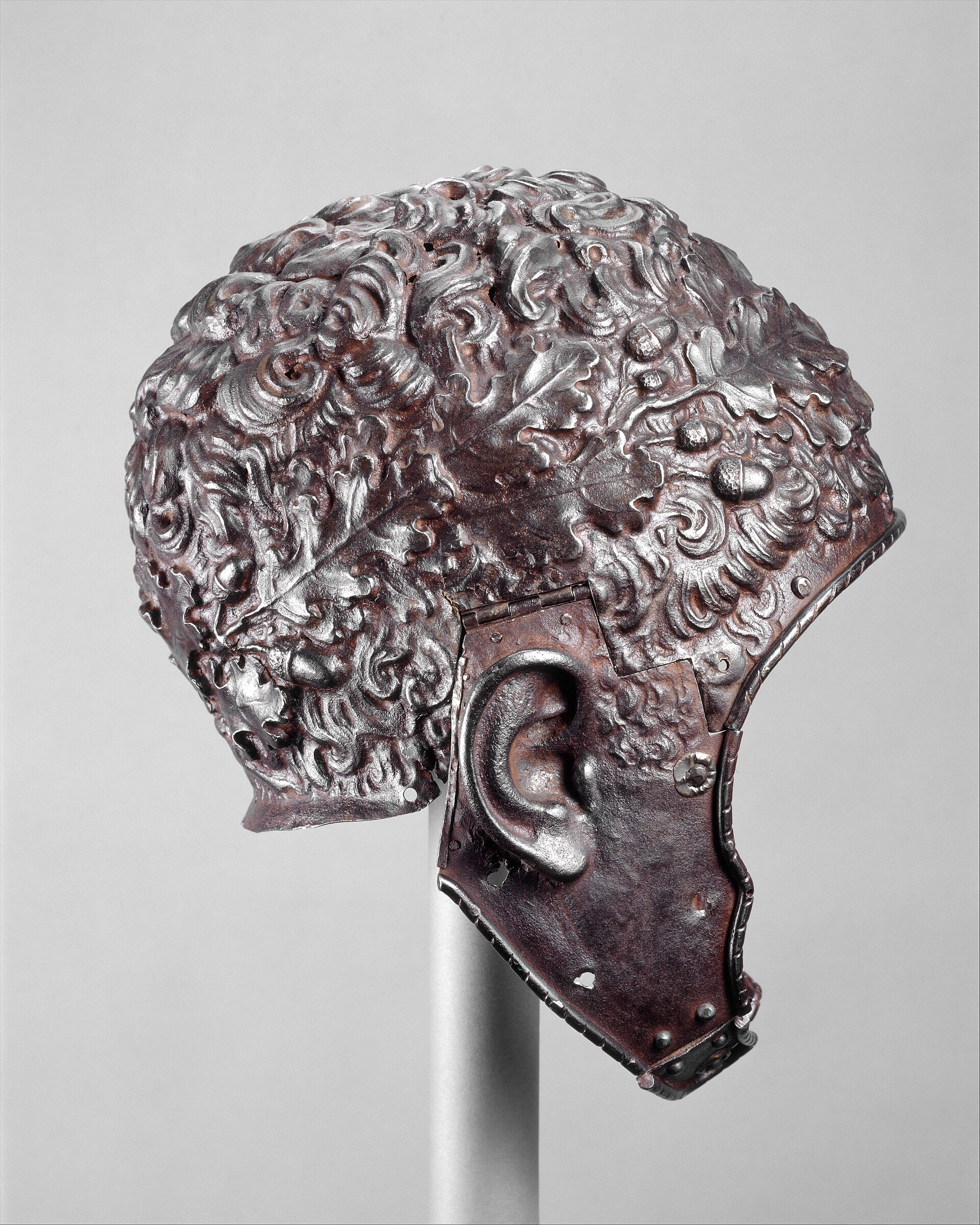
c. 1532-35 · Steel
Metropolitan Museum of Art, New York
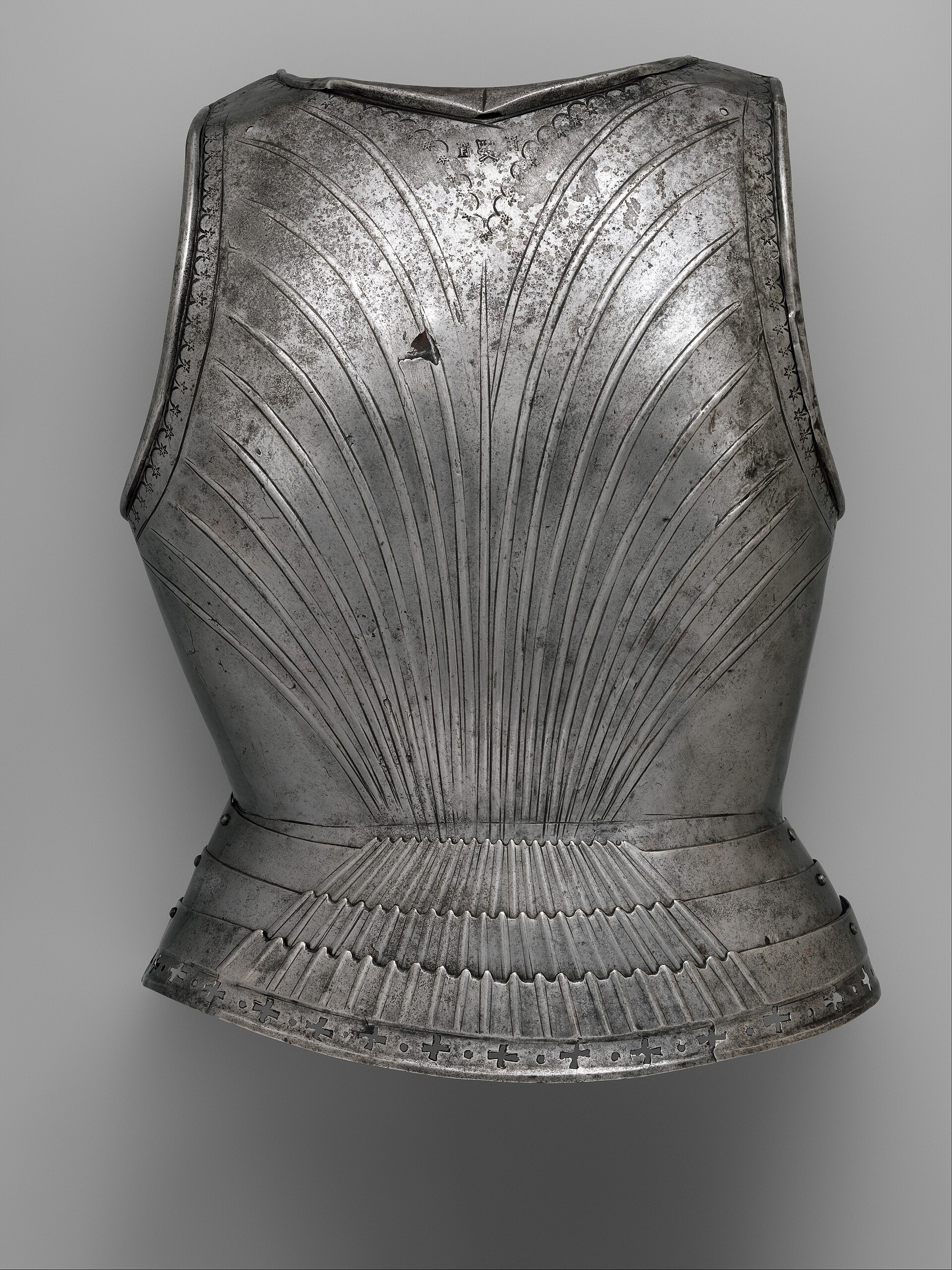
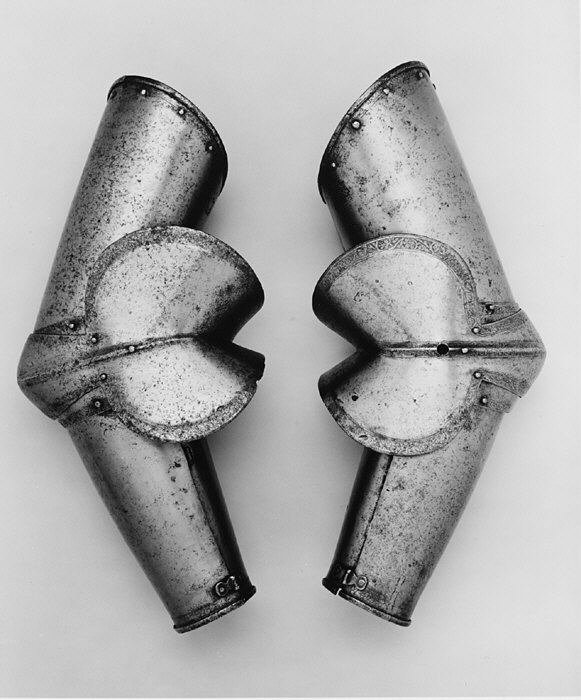
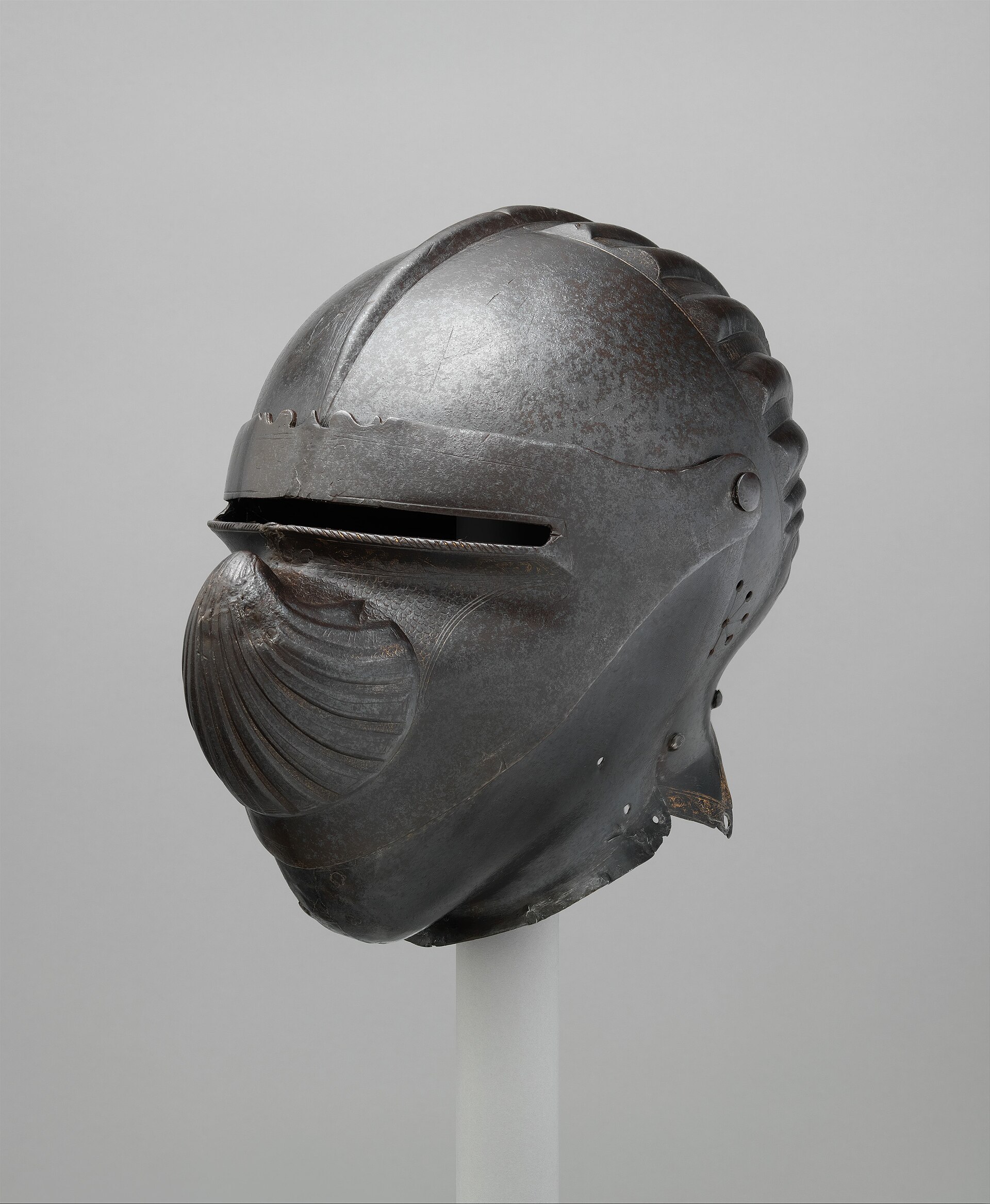
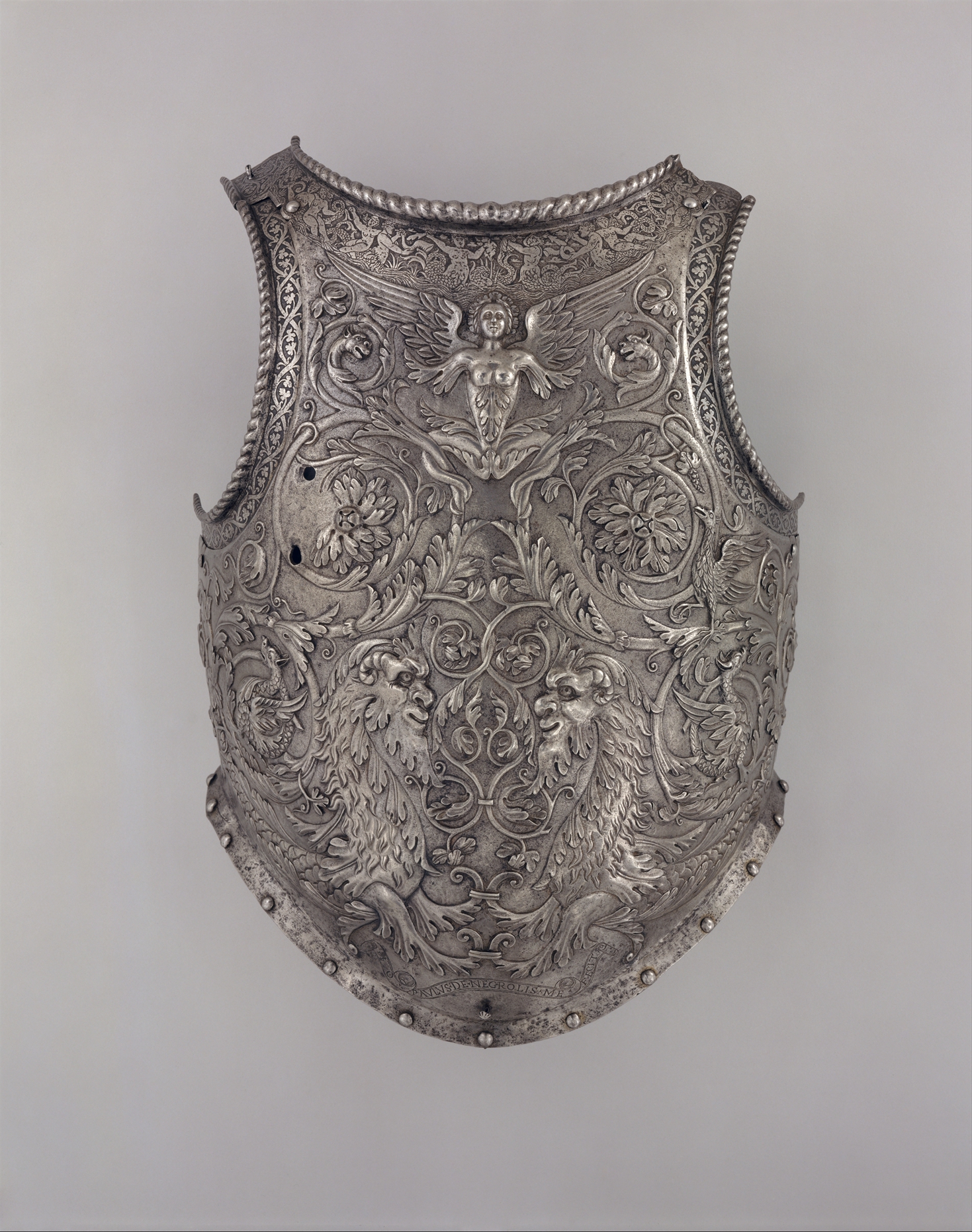
Gian Giacomo Negroli, Filippo's father, is born; he later heads the family workshop and dies in 1543.4
Gian Giacomo Negroli marries Veronica Arzoni; Filippo, their eldest son, is almost certainly born this year.1
Domenico Negroli, an independent master of an earlier generation of the same Milanese armorers' clan, dies.1
Filippo signs his earliest known work, a helmet for Francesco Maria della Rovere, duke of Urbino; the duke of Mantua's praise of it to Charles V prompts the emperor's own commission.1
Filippo makes a matching helmet and shield for Charles V, the first of five signed Negroli pieces to enter the Real Armeria, Madrid.1
Filippo signs a buffe, now at the Royal Armouries, Leeds, naming an unidentified brother, frater, as a collaborator.1
Filippo, with his brothers Giovan Battista and Francesco, completes the five-piece Masks Garniture for Charles V, his only surviving complete armor garniture and Francesco's earliest identified work as a damascener.1
The Medusa shield is made for Charles V, now in the Real Armeria, Madrid.1
Filippo signs a burgonet, now in the Metropolitan Museum, alone; his father Gian Giacomo dies the same year.14
Filippo signs a burgonet among his last dated works; documentary trace of the workshop's output falls away after this date.1
An unrecorded armorer makes a burgonet explicitly modeled after Filippo's designs, catalogued by the Metropolitan as made after Filippo Negroli, evidence of contemporary copying rather than forgery.4
Francesco Negroli, Filippo's damascener brother, leaves the joint family workshop.1
The Augsburg armorer Desiderius Helmschmid inscribes a parade shield made for Prince Philip of Spain with the word negrol, invoking Filippo's name on his own rival attempt at Filippo's specialty.1
Filippo retires from armor-making and becomes a maker of tremolanti.1
A household inventory and a dispute over materials for tremolanti are recorded in the Milanese notarial archive.1
Filippo's third testament records declining health and, in his own words, poverty caused by blindness.1
Filippo Negroli dies in Milan; the inventory of his household made immediately afterward describes two rooms with almost nothing in them.1
A dowry dispute between Filippo's widow, Bianca Reina, and his surviving brothers is finally settled.1
Giovan Battista Negroli, Filippo's brother, dies.1
Francesco Negroli, the last surviving brother, dies.1
Alois Primisser catalogues Filippo's 1532 helmet at Schloss Ambras, the first modern scholarly notice of a signed Negroli work.1
Antonio Martinez del Romero identifies the five signed Negroli works in the Real Armeria, Madrid, and correctly ties them to Charles V.1
Wendelin Boeheim publishes the first synthetic studies of the Negroli family, shaping all later scholarship while also introducing errors that take decades to correct.1
The Metropolitan Museum buys the Dino collection en bloc, including a helmet later catalogued as attributed to Filippo Negroli.3
Bruno Thomas and Ortwin Gamber publish the first comprehensive modern study of Milanese armorers, correcting much of Boeheim's account.1
The Metropolitan Museum mounts Heroic Armor of the Italian Renaissance: Filippo Negroli and His Contemporaries, still the only monographic study of the armorer.1
No documented public auction sale of a work signed by or firmly attributed to Filippo Negroli was found in the sources checked for this page. The corpus, on the evidence available, sits entirely inside roughly a dozen museum collections and moves, when it moves, by private or institutional purchase rather than at public auction with a published hammer price. The clearest sixteenth-century evidence of what his reputation was worth is not a price but a rival's own signature: in 1552 the Augsburg armorer Desiderius Helmschmid inscribed his own best relief-decorated shield with the word negrol, invoking Filippo's name as the standard he was trying to beat.
The material still changes hands occasionally, just not at auction as far as this record could establish. The Metropolitan Museum has bought four Negroli-circle objects illustrated on this page within the last three decades, most recently in 2014, without publishing a dealer, prior owner or price for any of them in the sources consulted.
| Institution | City | Holdings | Note |
|---|---|---|---|
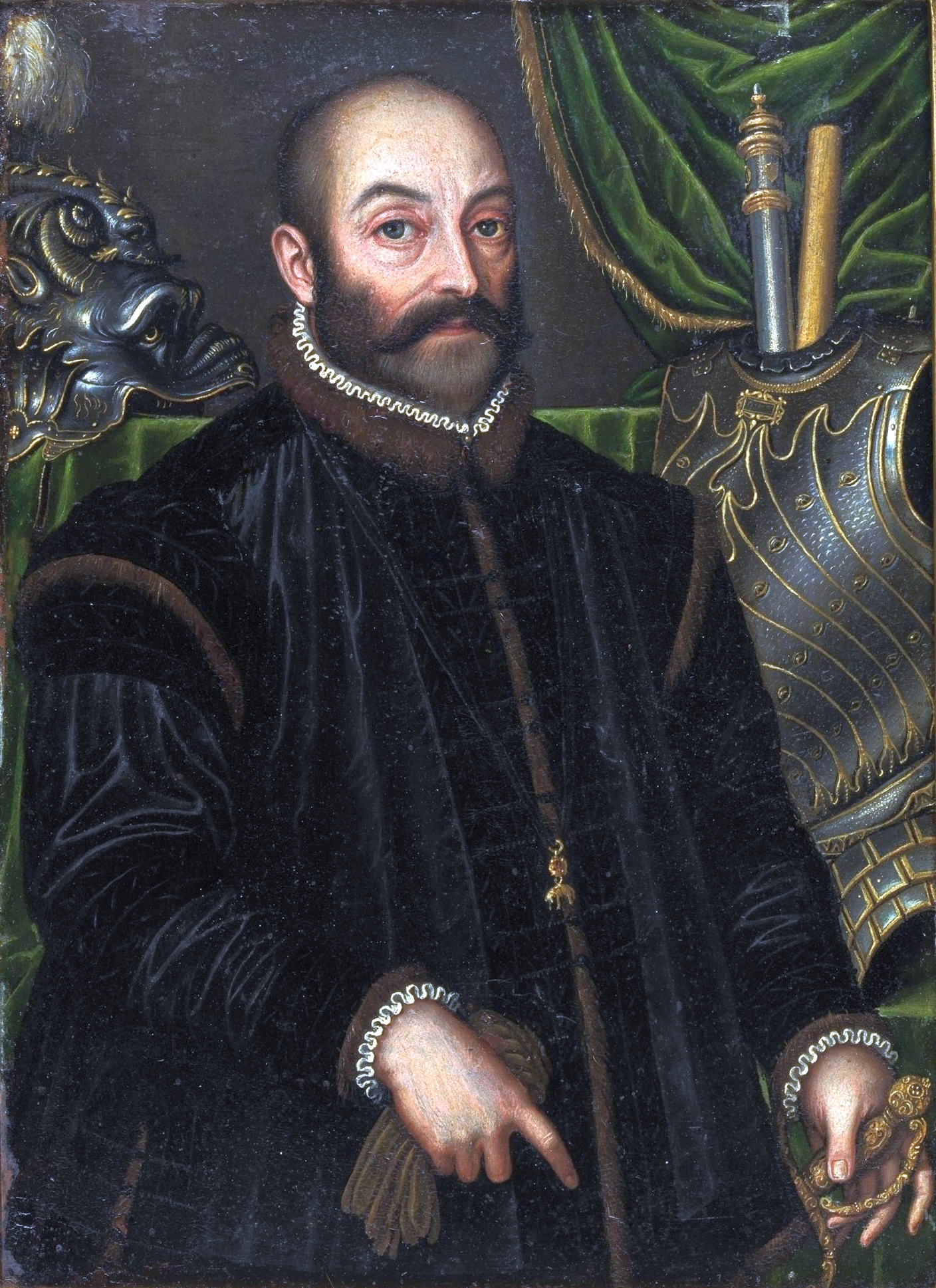
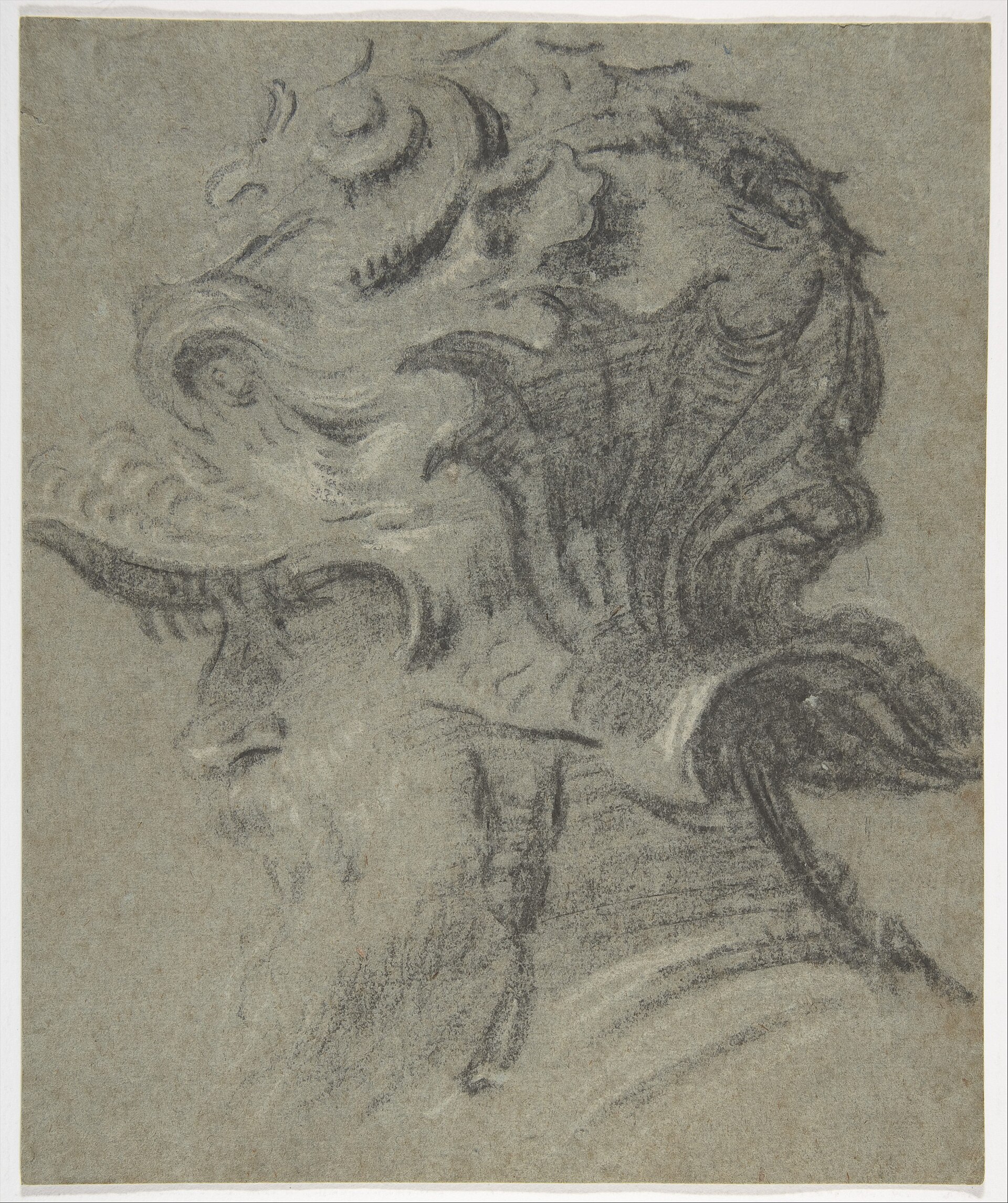
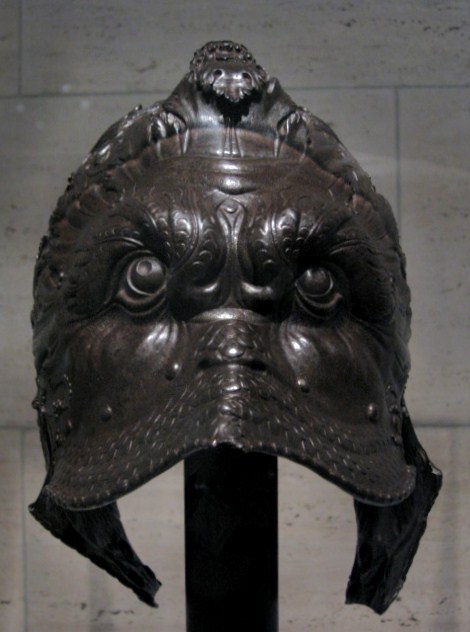
| Metropolitan Museum of Art | New York | Filippo's signed burgonet of 1543; the helmet attributed to Filippo Negroli that is the subject of this publication's own record on that object; Giovan Paolo Negroli's one signed breastplate and a close helmet attributed to him; a close helmet by Filippo's father Gian Giacomo; a backplate probably by his brother Francesco; a burgonet made after Filippo's designs; a drawing and a painted portrait connected to Guidobaldo II della Rovere's Negroli-made armor. | The largest and most varied Negroli-related holding illustrated on this page. |
| Real Armeria | Madrid | Five of Filippo's eight signed works, including the 1533 helmet and shield made for Charles V, the 1539 Masks Garniture and the 1541 Medusa shield. | |
| Kunsthistorisches Museum | Vienna | Filippo's earliest signed work, the 1532 helmet for Francesco Maria della Rovere; elements of the Fame Armor made for Guidobaldo II della Rovere; a lion-form helmet and Medusa shield once wrongly attributed to a later armorer, now accepted as Filippo's. | |
| Royal Armouries | Leeds | Filippo's signed buffe of 1538. | |
| Wallace Collection | London | Cheekpieces identified as belonging to Filippo's 1538 burgonet. | |
| National Gallery of Art | Washington, D.C. | A burgonet in the form of a dolphin mask, attributed to Giovan Paolo Negroli. | |
| State Hermitage Museum | St. Petersburg | A related, oak-wreathed curly-haired burgonet judged by the 1998 exhibition team to be by a different, less accomplished armorer working in the Negroli's design idiom rather than by Filippo himself. | Bought at the 1875 Fortuny estate sale by the Russian collector Alexander Basilewsky; its modern cheekpieces were apparently modeled on the Metropolitan's own attributed helmet. |
| Musee de l'Armee | Paris | A damascened armor made for the future Henry II of France, confirmed as the work of Francesco Negroli. | |
| Musee du Louvre | Paris | A cuirass attributed to Giovan Paolo Negroli. | |
| Museo Stibbert | Florence | A surviving fragment, pauldron lames, of Guidobaldo II della Rovere's Fame Armor. |
The Negroli were a Milanese armorers' clan documented back to a Giovanni Negroli in the mid-fifteenth century, whose sons split the family firm into a Milanese branch and a Roman branch after his...
The Negroli were a Milanese armorers' clan documented back to a Giovanni Negroli in the mid-fifteenth century, whose sons split the family firm into a Milanese branch and a Roman branch after his death. Domenico Negroli, of that earlier generation, ran his own well-established workshop in the last quarter of the fifteenth century; his marked work survives, including a pair of arm defenses now in the Metropolitan Museum, and he is probably the maker of two sallets thought to have been made for Philip the Handsome's marriage to Juana of Castile in 1496.
Filippo's own immediate family was smaller and better documented. His father, Gian Giacomo Negroli, married Veronica Arzoni in 1510, the year Filippo was almost certainly born; Filippo had three younger brothers, Giovan Battista, Francesco and Alessandro, and a sister, Susanna. Gian Giacomo died in 1543. A separate branch of the clan, headed by Filippo's cousin Giovan Paolo Negroli, ran its own workshop at the same time, producing work close enough in style to Filippo's that the two have been confused ever since. The family also reused first names across generations, so a Filippo, a Giovan Battista or a Giovan Paolo in an archival document does not automatically mean the master of this page; the 1998 archival research that first laid out this family tree in detail found the genealogy tangled for exactly that reason.
Filippo's authenticated oeuvre is eight signed and dated works, made between 1532 and 1545.
Filippo's authenticated oeuvre is eight signed and dated works, made between 1532 and 1545. The earliest is a helmet made in 1532 for Francesco Maria della Rovere, duke of Urbino, now in Vienna. Its fame reached the emperor directly: on November 9, 1532 the duke of Mantua wrote to Francesco Maria that he had praised the duke's two new helmets to Charles V, especially the curly-haired one, until the emperor asked to see them himself. The result, in 1533, was a matching helmet and shield made for Charles V and now in the Real Armeria, Madrid, the first of five signed Negroli pieces to enter that collection.
The rest of the eight: a buffe of 1538, now at the Royal Armouries, Leeds, whose signature names an unidentified 'frater' as a collaborator; the five-piece Masks Garniture of 1539, Filippo's only surviving complete armor garniture, made for Charles V and signed with the participation of two brothers; a Medusa shield of 1541, again for the emperor; a burgonet of 1543, now in the Metropolitan Museum, signed by Filippo alone; and a burgonet of 1545, among his last dated works. After 1545 there is almost no documentary trace of the workshop's output, though Filippo continued as an armorer until his retirement in 1557.
Beyond the eight signed pieces, the 1998 Metropolitan Museum exhibition team, examining and comparing every candidate object as a group, judged two further unsigned pieces attributable to Filippo...
Beyond the eight signed pieces, the 1998 Metropolitan Museum exhibition team, examining and comparing every candidate object as a group, judged two further unsigned pieces attributable to Filippo with confidence: the so-called Fame Armor made for Guidobaldo II della Rovere, with its monstrous helmet, dolphin-shaped pauldrons and a breastplate of two folded bat wings covered in eyes, and one other piece meeting the same standard of correspondence to the signed core. Two more works are known only as lost objects recorded in contemporary paintings.
The team also confirmed two unsigned but magnificently damascened armors, one made for the boy who became Henry II of France and one for Charles V, as the work of Filippo's brother Francesco, working in the same shop though not necessarily under Filippo's own hand. Everything else that earlier writers had assigned to Filippo, his workshop, or his cousin Giovan Paolo, a much larger body of material, was rejected by the 1998 team for lack of direct correspondence with this core. The effect was to shrink Filippo's secure oeuvre to a small, consistent group and to push the great majority of Negroli-style armor into lower, more hedged tiers of attribution.
Giovan Paolo Negroli, Filippo's cousin, ran his own workshop and produced work close enough to Filippo's in design and quality that the two are still sorted apart largely by inference.
Giovan Paolo Negroli, Filippo's cousin, ran his own workshop and produced work close enough to Filippo's in design and quality that the two are still sorted apart largely by inference. Giovan Paolo left exactly one signed piece: a breastplate now in the Metropolitan Museum, its design and prominent signature comparable to Filippo's own signing habit. Every other work assigned to him, including a close helmet with a monster's-head visor in the Metropolitan and a burgonet in the form of a dolphin mask now in the National Gallery of Art, Washington, rests on stylistic resemblance to that single signed breastplate: the acanthus scrolls, the turned-over leaf edges, the spiraling tendrils and the treatment of confronted monster figures recur across the group, and the 1998 team called this a meager foundation on which to reconstruct a whole oeuvre.
No birth or death date for Giovan Paolo was found in the sources consulted for this page; his working years are inferred only from the datable company he keeps.
Filippo's classically inspired work is described in period and modern sources with three overlapping terms: all'antica, meaning in the ancient style, the most general and most common...
Filippo's classically inspired work is described in period and modern sources with three overlapping terms: all'antica, meaning in the ancient style, the most general and most common sixteenth-century usage; alla romana, meaning in the Roman style, used for armor copied more literally from Roman models, such as the muscled cuirasses of the period; and all'eroica, meaning in the heroic style, for the more fantastical, mythological end of the same idea, epitomized by Filippo's own Fame Armor. None of these pieces were disguises. A prince who rode into a city wearing a helmet embossed as a Roman general's or a mythic hero's was citing a specific visual language that Renaissance humanists, educated in the classics, read as a claim: that he was heir to the statesmen and generals of ancient Rome, and embodied their virtues. For kings and captains who saw themselves this way, wearing Roman-style military equipment was a direct claim to dignity, power and legitimacy, in the same register as Michelangelo's Medici tomb figures cast as Roman generals.
The armor itself could not carry this weight and survive contact. The embossing process stretched and thinned the steel until, on the most ambitious pieces, it often cracked or broke through; these were objects for parade, procession and portraiture, not the field. Charles V's own working harnesses of the same years carried his personal devotional images, the Virgin and Child on the breastplate and Saint Barbara on the back, a pairing he used on all his armor from 1531 on. The all'antica pieces he also owned carried no such imagery: two different visual programs, for two different kinds of appearance, commissioned from the same workshop within a few years of each other.
Filippo's helmets and cuirasses were raised from single plates of steel, worked from the reverse into a pitch bed so the design stood proud on the face, then chased and refined with chisels and...
Filippo's helmets and cuirasses were raised from single plates of steel, worked from the reverse into a pitch bed so the design stood proud on the face, then chased and refined with chisels and punches from the front. This alone marked him out: Italian armorers of the fifteenth century built the equivalent decorative effects from separate applied pieces, and Filippo appears to have been the first in Italy to fashion whole helmets from one plate in the classical mode. His brother Francesco specialized in the companion technique of damascening, known as tausia: the surface crosshatched to key it, then inlaid with gold or silver leaf and burnished flush, sometimes finished with true fire-gilding, an amalgam of mercury and gold heated until the mercury burns off.
Metallographic sampling by Alan R. Williams, carried out for the 1998 exhibition by removing a sample one to two millimeters square from an inconspicuous point on each object, sampled three of Filippo's eight signed works (the ones accessible in the Metropolitan and Vienna) and found them consistently low- to medium-carbon steel, the hardest steel appearing in the best of the three. That is a deliberate choice as much as a technical one: after about 1510, Italian parade armor was very rarely given a hardening heat treatment at all, because reheating a piece for fire-gilding softens quenched steel, and Filippo's clients wanted the gilding more than the hardness. The signed group's consistency is also the yardstick against which weaker attributions are tested: the Metropolitan's own helmet catalogued as attributed to Filippo Negroli, sampled in three parts for the same study, returned two iron specimens where the three sampled signed works returned none, a discrepancy this publication's own record on that object leaves open rather than resolved.
Across his whole signed career, Filippo's most consistent patron was Charles V: the matching helmet and shield of 1533, the Masks Garniture of 1539, the Medusa shield of 1541 and the burgonet of 1545...
Across his whole signed career, Filippo's most consistent patron was Charles V: the matching helmet and shield of 1533, the Masks Garniture of 1539, the Medusa shield of 1541 and the burgonet of 1545 were all made for the emperor, all now in the Real Armeria, Madrid. The dukes of Urbino were his other major patrons: the 1532 helmet for Francesco Maria della Rovere, and for his son and successor Guidobaldo II a group of pieces including the Fame Armor. The French crown appears twice in the record, at one remove: Giovan Paolo Lomazzo, writing in 1584, credited Filippo's work to the era of Francis I, and the damascened armor confirmed as Francesco Negroli's, made for the boy who would become Henry II, survives in the Musee de l'Armee, Paris.
No commission price, contract sum, or period valuation for any of these pieces was found in the sources consulted for this page. What survives instead is testimony to how highly they were regarded: a foreign rival's decision to put Filippo's name, not his own, on his own best work.
In 1552 the Augsburg armorer Desiderius Helmschmid and the goldsmith Jorg Sigman made a parade shield for Prince Philip of Spain, the future Philip II, embossed with a hunting scene, a bull charging...
In 1552 the Augsburg armorer Desiderius Helmschmid and the goldsmith Jorg Sigman made a parade shield for Prince Philip of Spain, the future Philip II, embossed with a hunting scene, a bull charging a fallen warrior. On the warrior's own shield, an obviously insufficient defense within the image, is the word negrol. It is Desiderius's only known harness decorated in relief, made by a German armorer whose own family had helped build Augsburg into the leading German center for armor and who counted many of Filippo's own clients, Charles V among them, as customers. Putting Filippo's name on his own rival attempt at Filippo's specialty is not a forgery; it is closer to a signed acknowledgment of the standard being challenged, by the one contemporary craftsman in the best position to know how hard it was to meet.
Giorgio Vasari's Lives of the Artists, first published in 1550, names hundreds of painters, sculptors and architects and exactly one armorer: Filippo Negroli of Milan, chiseler of arms in iron with...
Giorgio Vasari's Lives of the Artists, first published in 1550, names hundreds of painters, sculptors and architects and exactly one armorer: Filippo Negroli of Milan, chiseler of arms in iron with leaves and figures. In the 1568 edition Vasari added, cryptically, that Filippo made things in copper that are so unusual that he achieved very great fame, possibly a reference to engravings, possibly to the tremolanti he made after retiring. Giovan Paolo Lomazzo, in his 1584 treatise on painting, sculpture and architecture, credited Filippo with reviving the chiseling of iron in the time of Francis I. The fullest contemporary praise came from the Milanese cleric Paolo Morigi, writing in his native city at the end of the century, and is given in full below as this page's closing quote.
After that, silence for nearly three hundred years: the 1998 exhibition catalogue notes plainly that Filippo Negroli had never before been the subject of any specialized research or serious monograph. The Gothic Revival's turn toward medieval and Renaissance collecting brought him back into view. Alois Primisser catalogued the 1532 helmet at Schloss Ambras in 1819 with a full transcription of the signature; Antonio Martinez del Romero identified the five signed pieces in the Real Armeria, Madrid in 1849 and correctly tied them to Charles V. The Viennese curator Wendelin Boeheim then wrote the first synthetic studies of the family between 1884 and 1889, drawing on new archival research from Milan and Simancas, work that shaped every later account and also introduced errors that took decades to correct.
Boeheim misread the variant Latin forms of Filippo's own signature as evidence of two different armorers, whom he called Giacomo Filippo and Filippo, a single craftsman split into two by a...
Boeheim misread the variant Latin forms of Filippo's own signature as evidence of two different armorers, whom he called Giacomo Filippo and Filippo, a single craftsman split into two by a philological slip. He also confused the Negroli with the Missaglia, a separate Milanese armorers' family whose actual surname was Negroni, a collision of names rather than a connection of workshops. And he attributed a lion-form helmet and a Medusa shield, both now in Vienna and both later accepted as Filippo's own work, to a different and later Milanese armorer, Lucio Piccinino, active a full generation afterward. Boeheim's authority was such that these errors persisted for decades in the standard literature.
Guy Francis Laking's early-twentieth-century survey of European armor shows how unevenly even a careful scholar could apply the growing body of evidence: he correctly recognized Giovan Paolo's authorship of the Metropolitan's signed breastplate, but called a closely related cuirass in the Louvre the undoubted work of Filippo Negroli, an attribution modern scholarship rejects, and left a comparable breastplate on the armor of Henry II as merely inspired by some Negroli model. The record was not put on a secure footing until Bruno Thomas and Ortwin Gamber's 1958 study, and not comprehensively resorted until the Metropolitan's own 1998 exhibition, which is why so much of this page rests on that single, quite recent, piece of scholarship.
Filippo abandoned armor-making in 1557 and spent his last two decades as a maker of tremolanti, small metalwork objects, possibly hatpins or decorative points for lacing clothing, that nonetheless...
Filippo abandoned armor-making in 1557 and spent his last two decades as a maker of tremolanti, small metalwork objects, possibly hatpins or decorative points for lacing clothing, that nonetheless involved his old skills with metal. A 1565 household inventory, appended to his second will, lists three canvas paintings, a variety of books including an illuminated volume and an illustrated architecture book, and thirty molds for making tremolanti. A dispute that same year with the Cantu brothers, apparently unrelated silver-leaf suppliers rather than Filippo's own siblings, over the supply of silver leaf for the trade survives in the Milanese notarial archive.
By his third testament, drawn September 1, 1570, his situation had worsened. He left his wife, Bianca Reina, a quarter of his real property and her jewelry and clothes, but the document also records, in his own words as preserved in the archive, that he had been forced to sell everything he owned to live, having suffered for a long time from serious illnesses and being reduced to such great poverty because of the blindness that afflicts him, in his own phrase. He died on November 24, 1579, at not quite seventy. The inventory of his household made immediately afterward, copied into notarial acts in 1584, lists two rooms whose contents amounted to two beds, two tables, eight chairs and a few other items of modest value. His estate, valued at 11,842 lire against debts of 1,233, passed to his two surviving brothers, Giovan Battista and Francesco, who divided a house and land at Cernusco between them; a dispute with his widow over her dowry was not settled until 1582.
No documented public auction sale of a work signed by or firmly attributed to Filippo Negroli was found in the sources checked for this page: a general search of Christie's and Sotheby's public...
No documented public auction sale of a work signed by or firmly attributed to Filippo Negroli was found in the sources checked for this page: a general search of Christie's and Sotheby's public results, and an attempt to consult a specialist price-archive site, LotSearch, which returned a bot block to both an automated fetch and the in-app browser and could not be reached by either route. On the evidence available, the corpus appears to sit entirely inside museum collections, roughly a dozen of them, and to move, when it moves at all, by private or institutional purchase rather than at auction with a published hammer price.
That does not mean the material has stopped changing hands. Four of the Negroli-circle objects illustrated on this page were acquired by the Metropolitan Museum within the last three decades: the drawing of a bearded man wearing Guidobaldo II's Negroli-made helmet, bought in 1998; the posthumous portrait of Guidobaldo II wearing a Negroli armor, bought in 2009; and a backplate probably by Francesco Negroli and a close helmet by Filippo's father Gian Giacomo, both bought in 2014, the two most recent purchases funded by an Arthur Ochs Sulzberger gift. No dealer, prior owner or price is published for any of the four in the sources consulted; the acquisitions themselves are the only public trace that the material still moves.
Armorer; Embosser. ca. 1510-1579.
Born ca. 1510 (probable; inferred from his father's marriage record of that year, cited below; no baptismal record was found in the sources consulted), Milan; died 1579-11-24, Milan.
Boeheim's two masters who were one man. Wendelin Boeheim, the pioneering Viennese curator who wrote the first synthetic studies of the Negroli in the 1880s, misread the variant Latin forms of Filippo's own signature across different works as proof of two separate armorers, whom he called Giacomo Filippo and Filippo. A single craftsman was split into two by a philological error.
Metropolitan Museum of Art (New York); Real Armeria (Madrid); Kunsthistorisches Museum (Vienna); Royal Armouries (Leeds); Wallace Collection (London); National Gallery of Art (Washington, D.C.).
No documented public auction sale of a work signed by or firmly attributed to Filippo Negroli was found in the sources checked for this page. The corpus, on the evidence available, sits entirely inside roughly a dozen museum collections and moves, when it moves, by private or institutional purchase rather than at public auction with a published hammer price.
Does the Metropolitan Museum's own published bibliography for its helmet attributed to Filippo Negroli (accession 04.3.202) correctly cite the 1875 Fortuny estate sale, lot 20? The 1998 exhibition catalogue's own research assigns that same lot number to a different, related oak-wreathed helmet now in the Hermitage, and treats the Metropolitan helmet's link to Fortuny as only a secondary, unlocated mention by Boeheim in 1889 of another helmet, probably the Metropolitan's, recently on the Paris art market.
The Metropolitan bought nearly 500 pieces of arms and armour sight unseen in April 1904 for just over $250,000.
12 min read
The Metropolitan's own record gives one of its helmets as 11 1/4 inches and 85 centimetres in the same line.
9 min read
In this archive the person who authenticated, acquired or won back an object is repeatedly the person who owned it, named it or...
8 min read
Of 257 published records, 156 carry an accepted attribution and two carry one the object itself documents.
10 min read
Across 291 objects the recurring names in a provenance line are dealers, not collectors.
9 min read
Thirty-two objects in this archive were bought on the income of six named endowment funds, and in every case the person named had...
10 min read
Last verified
One artwork and its story every Tuesday, with the picture: who owned it, what it made, and what closes soon in the exhibition calendar. No promotion, and nothing we cannot cite.
We send one email to confirm the address and keep nothing else. Every letter carries a one-click unsubscribe. How we handle your data.