Helmet all'Antica
Attributed to Filippo Negroli · ca. 1532-35 (the Museum's 2012 article gives ca. 1530-35)
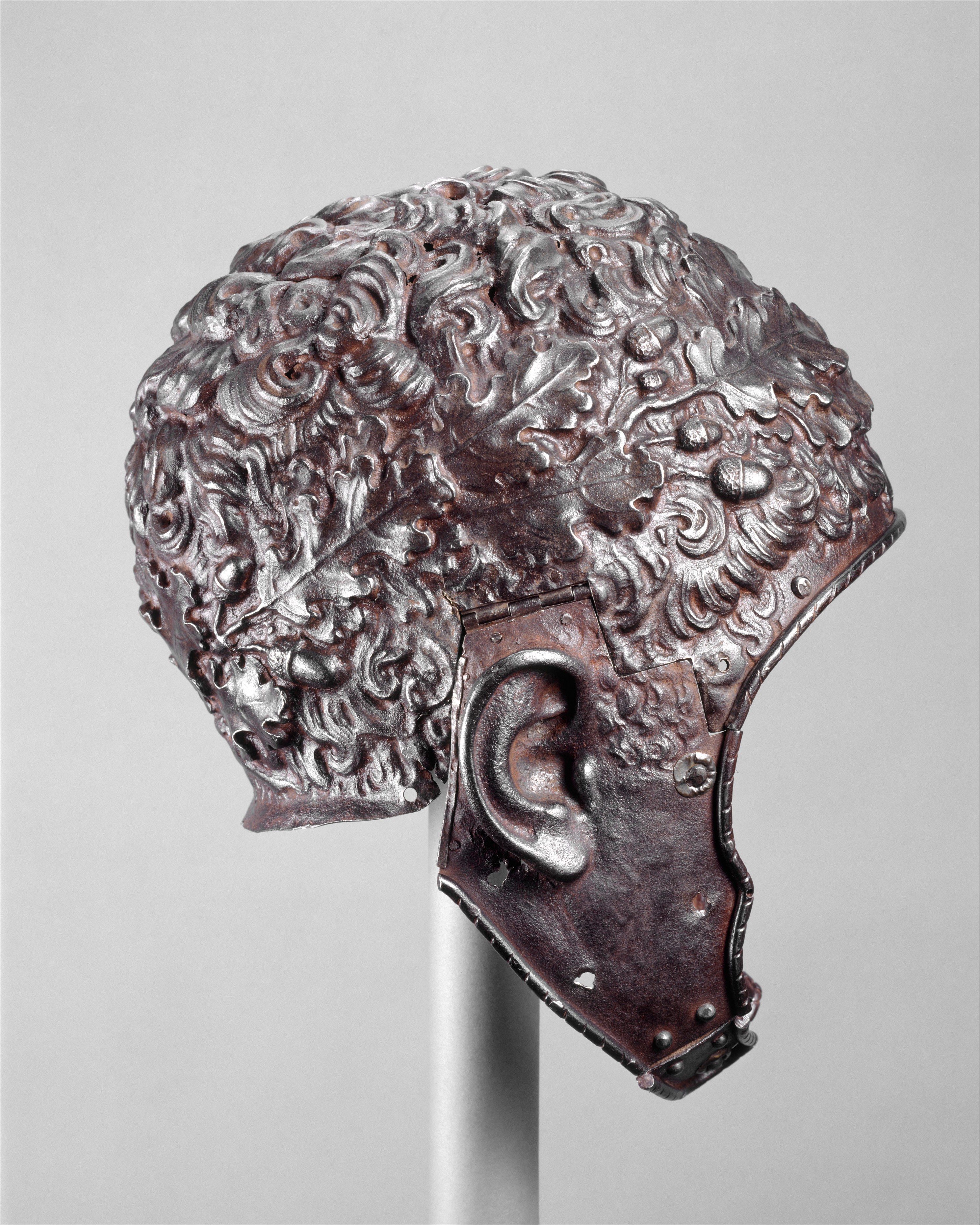
The record subject. Embossed steel worked as a head of tightly curled hair under a wreath of oak leaves, ca. 1532-35, Milan. The cheek-pieces are probably nineteenth-century restorations, and two of the three metallographic samples taken from the helmet came back iron rather than the medium-carbon steel found in signed Negroli work.
| Artist | Attributed to Filippo Negroli |
|---|---|
| Date | ca. 1532-35 (the Museum's 2012 article gives ca. 1530-35) |
| Medium | Steel, per the online record; steel, copper alloy and leather per the Museum's 2012 article |
| Dimensions | Online record: H. 11 1/4 in., printed as 85 cm; W. 20.9 cm; D. 22.7 cm; Wt. 964 g. The Museum's 2012 article: H. 12 3/4 in. (32.5 cm); Wt. 967 g. The figures do not agree and the metric height online is inconsistent with the imperial figure beside it. |
| Where it is now | Metropolitan Museum of Art, New York, Gallery 374last confirmed 4 August 2026 |
| Inventory number | 04.3.202 |
| Attribution | AttributedNot signed. Full note |
| Object type | Arms and armour |
| Period | Italian, Milan, second quarter of the sixteenth century |
| Inscriptions | None. The helmet carries no signature and no armourer's mark, which is why the attribution is an argument rather than a reading. |
| Owners on record | 6 links4 documented, 2 disputed |
| Sources | 6 cited |
About this record Last verified 26 August 2026 · 6 sources cited · Change log
On this page 12 sections
ContentsClose
A Milanese parade helmet of about 1532-35, embossed from steel as a head of tightly curled hair under a wreath of oak leaves, so that the wearer appeared as an ancient hero. The oak may be a pun on the name of the della Rovere, dukes of Urbino, though nothing documents the connection. It is attributed to Filippo Negroli and is not signed.
The Museum's own publications do not agree about it. The online record gives a height of 11 1/4 inches converted as 85 centimetres, a figure that is wrong by a factor of three on its own arithmetic; the Museum's 2012 article gives 12 3/4 inches and adds copper alloy and leather to a medium the website lists as steel alone. The metallography carried out for the Museum's 1998 Negroli exhibition sampled the helmet in three parts and found two of them iron, where every sampled armour signed by Filippo Negroli was steel. The cheek-pieces are, the Museum says, probably nineteenth-century restorations.
It came out of the estate sale of Eugene Piot at the Hotel Drouot in May 1890, lot 282, bought by the dealer Bachereau for the duc de Dino, and reached New York in April 1904 when the Metropolitan bought Dino's five hundred pieces sight unseen for just over 250,000 dollars - a purchase that founded the Department of Arms and Armor and that the Museum has since published as containing composites and outright fakes. The Museum's bibliography for this helmet begins with the posthumous sale of the painter and armour restorer Mariano Fortuny in 1875. Its provenance field does not.
Provenance
Each link is graded. Documented: a cited source supports it. Disputed: the identification is argued but not established. Unknown: no owner for that span, and the gap is not smoothed into a narrative. The grades in the glossary.
- ca. 1532-35 - unknownMade in Milan, attributed to Filippo Negrolidisputed
Not signed. The Museum's heading is 'Attributed to Filippo Negroli'; Pyhrr's 2012 article captions the same accession simply as Filippo Negroli. The 1998 exhibition catalogue placed it in the group attributed to Filippo rather than in the group of signed works. The oak wreath may be a canting reference to the della Rovere family, dukes of Urbino, whose name means oak, but no document connects the helmet to any member of that family.123
- unknown - 1875Mariano Fortuny y Marsal (possible)disputed
The first entry in the Museum's own bibliography for this object is the catalogue of the posthumous studio sale of Fortuny at the Hotel Drouot, Paris, 26-30 April 1875, cited at number 20; the Museum also cites Stephen V. Grancsay's article of November 1921, 'Fortuny as a Collector and Restorer of Ancient Arms and Armor', at pp. 236-237, fig. 4. Neither Fortuny nor the 1875 sale appears in the Museum's provenance field, which begins with Piot. Either the bibliography is wrong or the provenance is short by one owner - and that owner was a documented restorer of arms and armour, on a helmet whose cheek-pieces the Museum believes are nineteenth-century restorations.1
- by 1890 - 1890Eugene Piot, Parisdocumented
Piot died in 1890. The Museum's bibliography also records the helmet in Edouard de Beaumont's account of the retrospective armour display at the Trocadero, Gazette des Beaux-Arts, May 1878, p. 711 - twelve years before the sale.1
- 1890 - 1890Louis Bachereau, Paris, buying for the duc de Dinodocumented
Estate sale, Objets d'art de la Renaissance composant la collection de feu M. Eugene Piot, Hotel Drouot, Paris, 21-24 May 1890, lot 282, sold to Bachereau for Dino. Pyhrr describes what Bachereau bought as an important if somewhat damaged curly-haired burgonet of classical inspiration. Bachereau was Dino's principal supplier and sold him more than forty European helmets, including, the following year, the so-called Colbert helmet.12
- 1890 - 1904Charles Maurice Camille de Talleyrand-Perigord, duc de Dino (1843-1917), Parisdocumented
Catalogued as B.26, plate 9, in Baron Charles Alexander de Cosson's privately printed Le Cabinet d'Armes de Maurice de Talleyrand-Perigord, Duc de Dino (Paris, 1901), p. 31. Dino's collection of almost five hundred pieces was then reckoned the finest private armoury in Europe.12
- 1904 - presentMetropolitan Museum of Art, New Yorkdocumented
Bought in April 1904 as part of the whole Dino collection, Rogers Fund, accession 04.3.202. The Museum committed just over 250,000 dollars, the largest sum it had paid to that date for a single acquisition, and bought the collection sight unseen on the recommendation of a trustee, without reference to Dino's own catalogue. The purchase led to the appointment of Bashford Dean and, on 28 October 1912, to the founding of the Department of Arms and Armor. On view in Gallery 374 in 2026.12
Prices realised
| Date | Sale | Estimate | Result | Note |
|---|---|---|---|---|
| 21 May 1890 | Hotel Drouot, Paris Objets d'art de la Renaissance composant la collection de feu M. Eugene Piot, 21-24 May 1890, lot 282 | Hammer Not published With premium Not published FRF | Sold to the Paris dealer Louis Bachereau acting for the duc de Dino. No price for this lot appears in the sources consulted, and none should be inferred: Pyhrr publishes figures for several other Dino acquisitions - 25,000 francs for the Fountaine armour, about 40,000 francs for seven lots at another sale, 52,000 francs for a sword - and gives none for this helmet. Anyone who finds a figure for this lot should establish what charges it does or does not include before quoting it; this record makes no claim about Paris auction practice in 1890, having found no source for one. | |
| 1904-04 | Private treaty, Paris to New York Purchase en bloc of the collection of the duc de Dino | Hammer Not applicable With premium Not applicable USD | Just over 250,000 dollars for almost five hundred pieces - the largest sum the Metropolitan Museum had paid to that date for a single acquisition, and it was paid without anyone from the Museum having seen the collection. This is a total for the whole purchase and NOT a price for this object; no per-object allocation has been published. Not an auction: a negotiated purchase, so there is no hammer and no premium. |
Hammer is the price at which the bidding stopped; with premium adds the fee the house charges the buyer on top. Hammer price and buyer's premium in the glossary.
Technical evidence
| Attribution note | Not signed. The Museum's heading is 'Attributed to Filippo Negroli' and the 1998-99 Negroli exhibition placed it as catalogue no. 21 in the group ATTRIBUTED to Filippo rather than among the signed works; the Museum's own 2012 article by Stuart Pyhrr captions the same accession simply as Filippo Negroli, without the qualifier. Alan Williams's metallography for that exhibition sampled the helmet in three parts and found two of them iron, where the three sampled armours signed by Filippo Negroli gave no iron at all. The cheek-pieces are, on the Museum's own statement, probably nineteenth-century restorations, so at least part of what is on display is not sixteenth-century. |
|---|---|
| Medium (online record) | Steel.14 |
| Medium (Museum's 2012 article) | Steel, copper alloy and leather. The two Museum publications do not agree.2 |
| Dimensions (online record) | H. 11 1/4 in., given as 85 cm; W. 8 1/4 in. (20.9 cm); D. 9 in. (22.7 cm). 11 1/4 in. is 28.6 cm, so the metric height in the online record is internally inconsistent.14 |
| Dimensions (Museum's 2012 article) | H. 12 3/4 in. (32.5 cm). An inch and a half taller than the online record.2 |
| Weight | 2 lb 2 oz, given as 964 g online and 967 g in the 2012 article.124 |
| Metallography | Sampled in three parts for the 1998-99 exhibition; Williams's table lists the helmet by accession number and marks two of the three specimens iron. It does not record which parts of the helmet were sampled. The three armours SIGNED by Filippo Negroli that were sampled gave three specimens between them and no iron at all: one low-carbon steel and two medium-carbon steel.3 |
| Cheek-pieces | Probably nineteenth-century restorations, per the Museum's own overview.1 |
| Construction | Embossed from sheet steel in high relief to imitate a head of tightly curled hair under a wreath of oak leaves. The virtuoso plasticity of Milanese embossed parade armour raised the question Williams was engaged to answer: whether such work was done in soft iron or in the harder medium proper to armour.13 |
| Hardening | After the first decade of the sixteenth century Italian armour was very seldom hardened by heat treatment, which Williams connects to the spread of etched and gilt decoration: any reheating for fire-gilding softens quenched steel. Italian armourers' customers gave a higher priority to decoration than to hardness.3 |
| Catalogue numbers carried | Dino collection catalogue B.26 (de Cosson, 1901, p. 31, pl. 9); Heroic Armor of the Italian Renaissance (1998) catalogue no. 21; loan exhibition of 1953-54 no. 26.123 |
| Classification | Helmets. Burgonet, open-faced, made for parade.14 |
Images
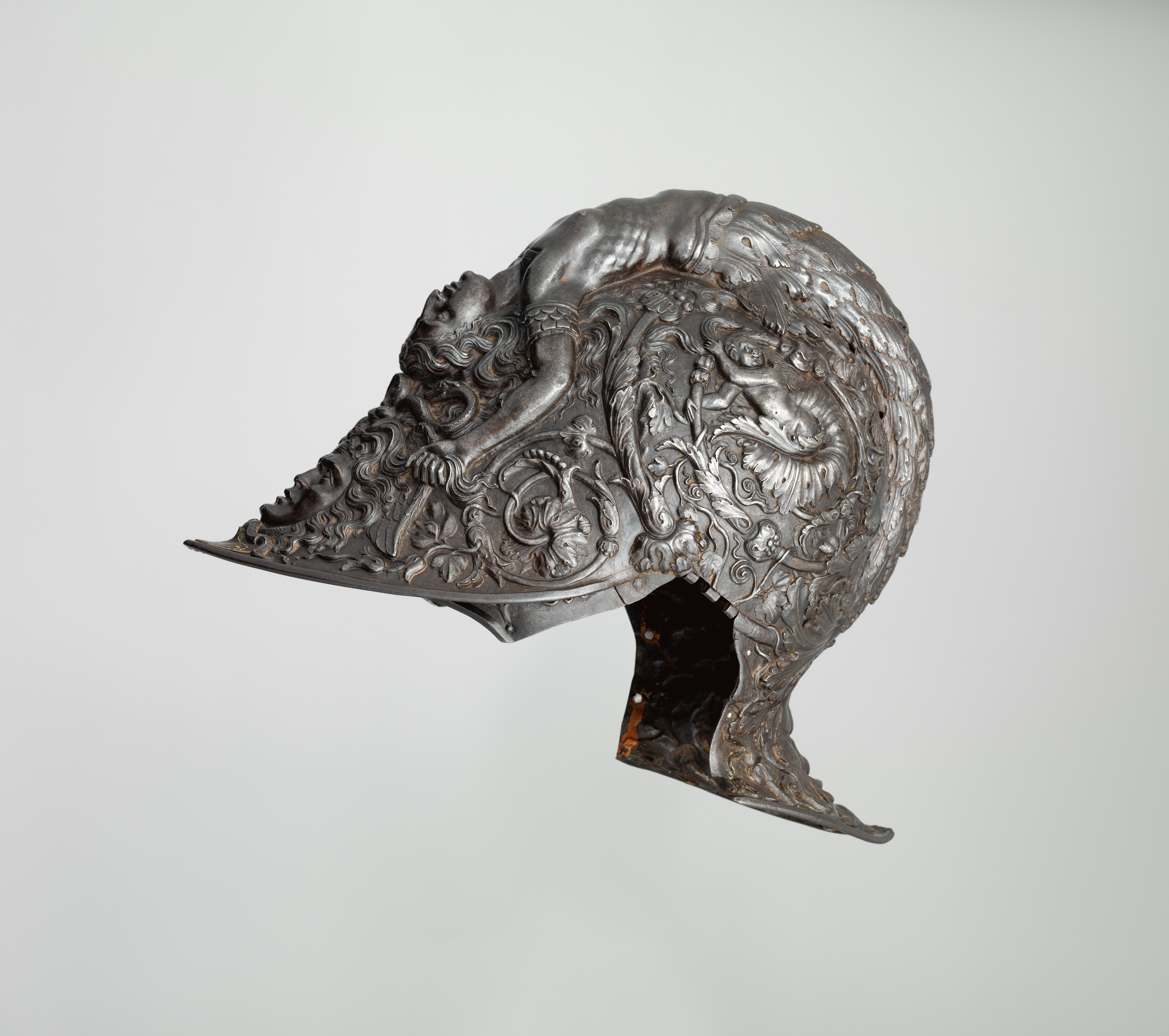
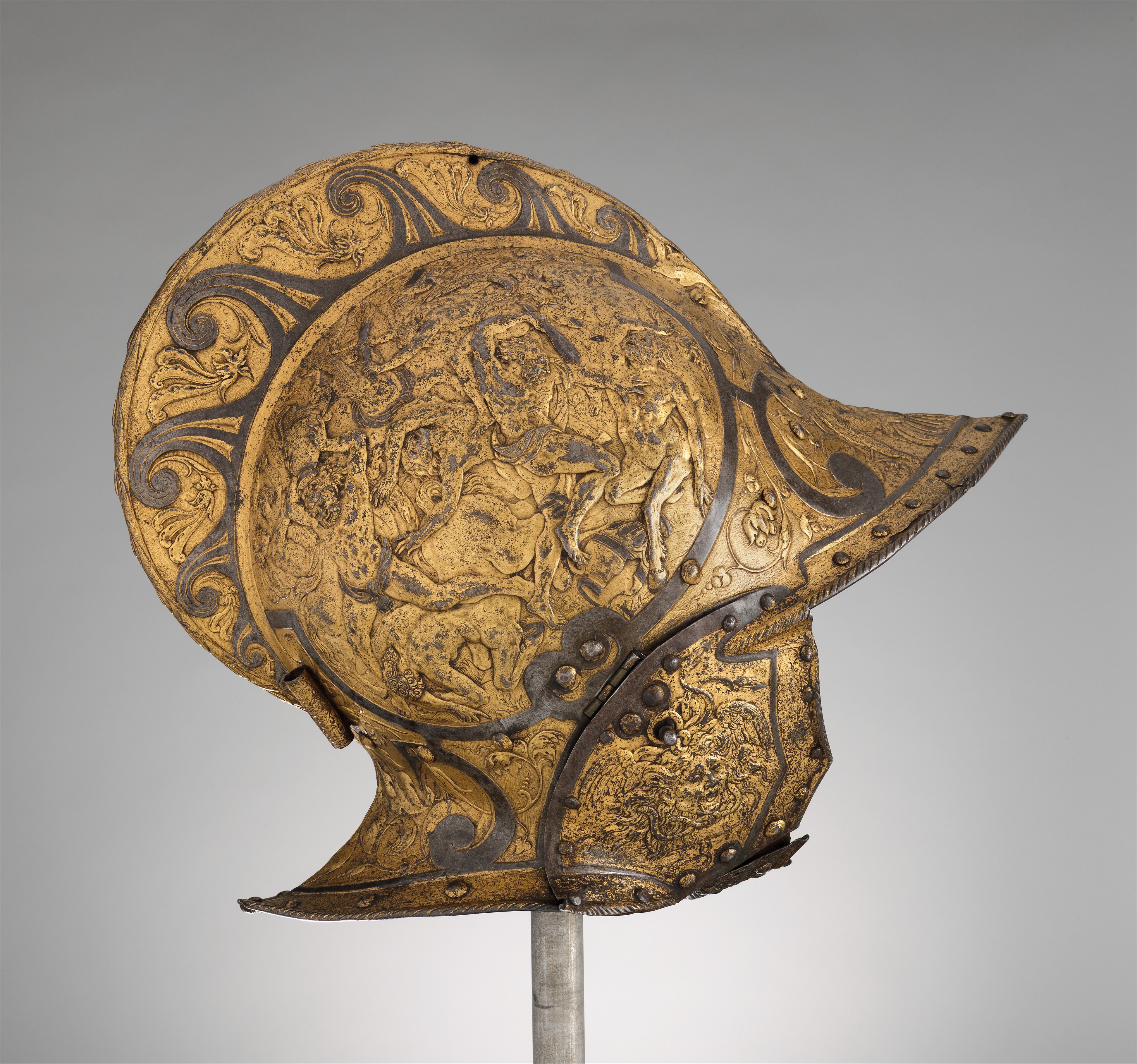
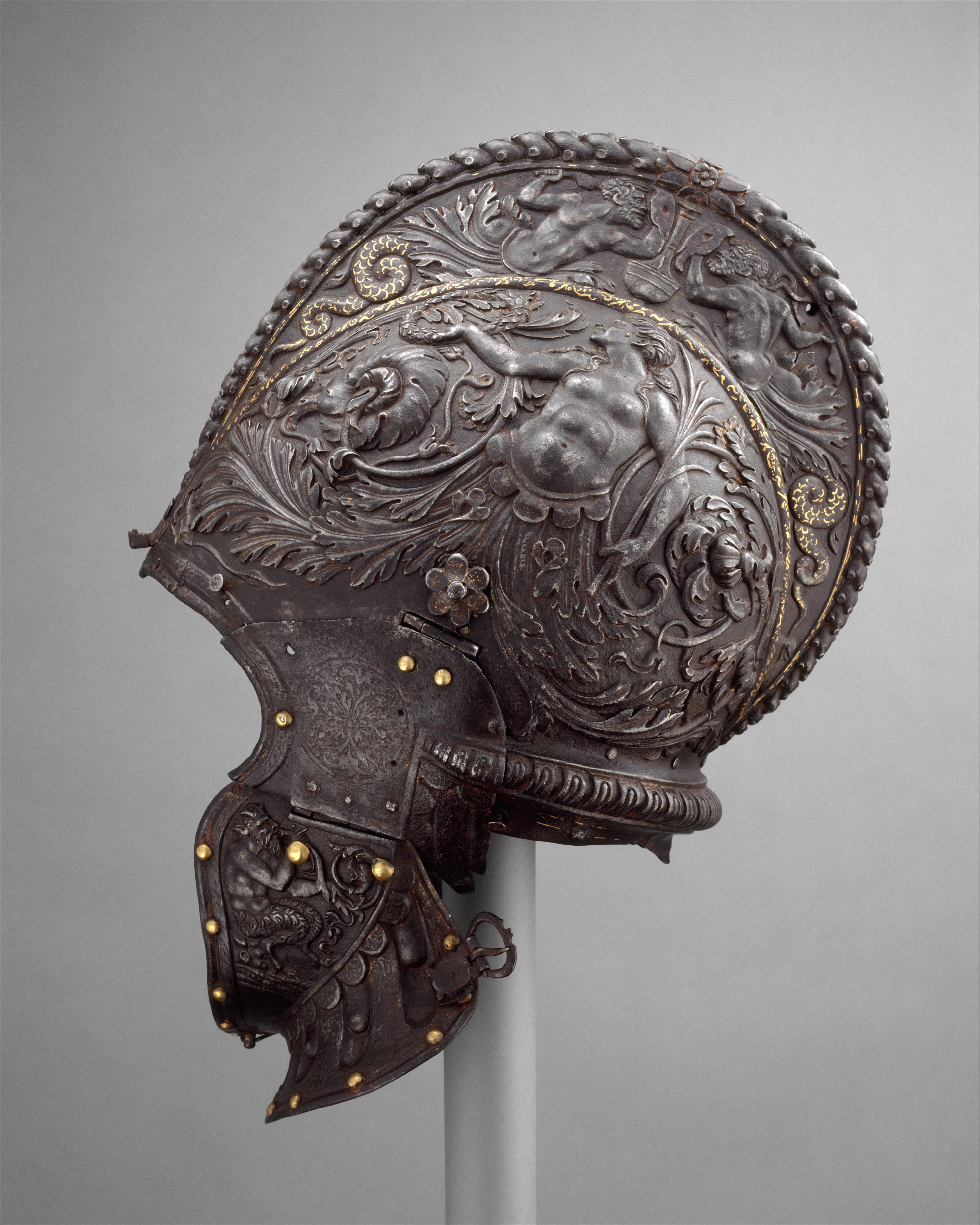
The record in full
Chapter 1The label carries three hedges
The Museum's entry for this helmet reads: Armorer, Attributed to Filippo Negroli.
The Museum's entry for this helmet reads: Armorer, Attributed to Filippo Negroli. The reference to the oak may indicate that the helmet was made for a member of the della Rovere family. The cheek-pieces are probably nineteenth-century restorations.
Three qualifications in three lines, and all three are load-bearing. The object is not signed, so the maker is an argument. The patron is an argument from a pun. And part of what a visitor looks at is not sixteenth-century at all. This is a good object, catalogued honestly, and every one of those hedges has evidence behind it that is worth setting out.
Chapter 2A head of curled hair under an oak wreath
The helmet is embossed from steel to resemble a human head with tightly curled hair, encircled by a wreath of oak leaves.
The helmet is embossed from steel to resemble a human head with tightly curled hair, encircled by a wreath of oak leaves. It is a burgonet, an open-faced helmet, made to be worn in a parade or a triumph rather than in a battle, and the effect it aims at is that the wearer appears as an ancient hero, perhaps a Roman emperor.
That is the whole programme of Milanese parade armour of the 1530s in one object. These helmets are not disguises; they are quotations. A commander riding into a city under an oak wreath is citing the corona civica, the Roman oak crown awarded for saving the life of a citizen, and he is citing it in a decade when the Italian wars had made the question of who saved which city a live one.
The oak also puns. Oak in Italian is rovere. The Museum's suggestion is that the wreath is a canting device for the della Rovere, dukes of Urbino, whose arms are an oak tree. The helmet was shown at the Palazzo Ducale in Urbino in 2004 in an exhibition on that dynasty, which is the Museum acting on its own suggestion. No document connects the object to any della Rovere.
Chapter 3The Negroli, and what a Negroli attribution is
The Negroli were a family of Milanese armourers, and Filippo, whose life the Museum gives as about 1510 to 1579, is the one whose name carries the highest premium in the history of the craft.
The Negroli were a family of Milanese armourers, and Filippo, whose life the Museum gives as about 1510 to 1579, is the one whose name carries the highest premium in the history of the craft. His reputation rests on embossed parade armour of extraordinary sculptural quality made in the years around 1530 to 1545.
In 1998 and 1999 the Museum mounted Heroic Armor of the Italian Renaissance: Filippo Negroli and His Contemporaries, organised by Stuart W. Pyhrr and Jose-A. Godoy, which set out to sort the surviving body of that work. The catalogue's own structure is the answer to what a Negroli attribution is worth. Its objects fall into groups: works signed by Filippo Negroli; works attributed to him; works possibly made in the Negroli workshop or by Milanese contemporaries; and works signed by or attributed to his brother Giovan Paolo.
This helmet is catalogue number 21, in the second group. The Museum's signed Filippo Negroli is a different object: the burgonet of 1543, accession 17.190.1720, which came in with the Morgan gift of 1917. When the same building holds a signed Negroli and an attributed one, the attributed one is being measured against something.
Chapter 4The metallurgy says something the label does not
For that exhibition the Museum invited Alan R.
For that exhibition the Museum invited Alan R. Williams to carry out metallographic examination on Negroli and related armours in New York and Vienna. A sample one to two millimetres square is taken where it leaves no visible damage, usually inside the turned rim of a plate, then polished and etched so the grain structure can be read under a microscope.
Williams's overall finding was that most of the specimens were steel, and that the hardest steel predominates in the best armours. Of the three armours signed by Filippo Negroli that were sampled, the three specimens gave one low-carbon steel and two medium-carbon steel, and no iron at all. Williams's conclusion on the master was blunt: Filippo Negroli used a medium-carbon steel, apparently the best that was then available.
This helmet was sampled in three parts. Two of the three came back iron.
That figure is per object. Williams's tabulation lists this helmet by its accession number, records that three parts were sampled, and marks two of them iron. What it does not record is which parts of the helmet those were. The group totals printed beside it - seven specimens across the three attributed armours, of which three are iron, three low-carbon steel and one medium-carbon - are given as sums, so an individual reading cannot be matched back to an individual plate from the published table alone.
There are two honest readings and this record does not choose between them. The first is that the iron samples came from the cheek-pieces, which the Museum believes are nineteenth-century restorations, in which case the metallurgy corroborates the restoration note and says nothing against the attribution. The second is that iron in a Negroli is a discrepancy with the signed group. Until the sampling locations are published, the number sits there unexplained.
Chapter 5The Museum's own measurements do not agree with each other
The online record gives the height as 11 1/4 inches, converted as 85 cm; the width 8 1/4 inches or 20.9 cm; the depth 9 inches or 22.7 cm; the weight 2 lb 2 oz or 964 g; and the medium as...
The online record gives the height as 11 1/4 inches, converted as 85 cm; the width 8 1/4 inches or 20.9 cm; the depth 9 inches or 22.7 cm; the weight 2 lb 2 oz or 964 g; and the medium as steel.
Pyhrr's 2012 article, published by the same museum, captions the same accession number as height 12 3/4 inches or 32.5 cm, weight 2 lb 2 oz or 967 g, and the medium as steel, copper alloy and leather.
Three problems follow. First, 11 1/4 inches is 28.6 cm, not 85 cm, so the metric figure in the online record cannot be right on its own terms. Second, the two Museum publications differ on the height by an inch and a half. Third, they differ on what the object is made of: the online record says steel, the 2012 article adds copper alloy and leather. A reader taking dimensions from the website for a comparison with another helmet would be working from a figure that is wrong by a factor of three.
This is not pedantry about a typographical slip. Dimensions are how a specialist tests whether two published photographs show the same object, and a museum's own record is where that test starts.
Chapter 6Piot, Bachereau, Dino
Eugene Piot, a French collector and antiquarian, owned the helmet at his death in 1890.
Eugene Piot, a French collector and antiquarian, owned the helmet at his death in 1890. His estate was sold at the Hotel Drouot in Paris from 21 to 24 May 1890 as Objets d'art de la Renaissance composant la collection de feu M. Eugene Piot, and this helmet was lot 282.
It was bought by the Paris dealer Bachereau, acting for a client. Pyhrr's account of that transaction is worth quoting in substance: at the Piot sale Bachereau bought for his client an important if somewhat damaged curly-haired burgonet of classical inspiration by the distinguished armourer Filippo Negroli of Milan. Somewhat damaged, in 1890, by the man who handled it.
The client was Charles Maurice Camille de Talleyrand-Perigord, duc de Dino, 1843 to 1917, who was assembling in France in the last two decades of the nineteenth century what was then reckoned the finest private collection of arms and armour in Europe. Bachereau was his principal supplier and sold him more than forty European helmets; the following year he sold Dino the so-called Colbert helmet, a French burgonet of about 1550 associated with Henry II, which Pyhrr calls arguably the most beautiful and important object in the Dino collection. In de Cosson's privately printed catalogue of the Dino armoury of 1901 this helmet is number B.26, plate 9.
Chapter 7Sight unseen, for just over 250,000 dollars
In April 1904 the Metropolitan Museum bought the Dino collection en bloc: almost five hundred pieces, mostly richly decorated European work of the fifteenth to seventeenth centuries.
In April 1904 the Metropolitan Museum bought the Dino collection en bloc: almost five hundred pieces, mostly richly decorated European work of the fifteenth to seventeenth centuries. It was the Museum's first important acquisition of arms and armour and it committed the largest sum the institution had paid to that date for a single acquisition, just over 250,000 dollars.
Pyhrr records what was not public at the time. The Museum bought the collection sight unseen, on the enthusiastic recommendation of one of its trustees, and without reference to Dino's own privately published catalogue. The local press greeted the purchase with considerable fanfare.
The purchase created the department. The Museum appointed as guest curator in 1904 a zoologist and arms enthusiast, Bashford Dean, 1867 to 1928; he became honorary curator in 1906, and the trustees established a permanent, paid Department of Arms and Armor on 28 October 1912. The Metropolitan's arms and armour collection, now among the largest and most encyclopaedic anywhere, was founded on a purchase nobody at the museum had examined.
Chapter 8Too good to be true
Pyhrr's appendix to that article is titled Too Good to Be True: Arms and Armor Fakes and Pastiches in the Dino Collection, and it is the reason this record exists in the form it does.Modern...
Pyhrr's appendix to that article is titled Too Good to Be True: Arms and Armor Fakes and Pastiches in the Dino Collection, and it is the reason this record exists in the form it does.
Modern scholarship, he writes, has revealed that some of the better-known and most frequently published Dino objects are composites or outright fakes, which has tarnished the reputation the collection once enjoyed. The armours took the worst of it: of the thirteen Dino armours, two have been deaccessioned and sold, and all but one of the remaining eleven are not deemed worthy of display.
De Cosson's 1901 catalogue gave no hint of any of this, apart from two objects - a bascinet and a sword - for which no date or place of origin was given and which were identified as modern imitations on a separate errata sheet found in only some copies. Dean complained that the catalogue made no mention of restorations, gave no weights or measurements, and did not reproduce armourers' marks, yet he generally accepted his older colleague's opinions. Guy Laking, reviewing the collection with Dean in 1906 and 1909, called it publicly the finest ever gathered, and illustrated a great many Dino objects in his five-volume survey.
The correspondence Pyhrr quotes shows the trade knew. Discussing an embossed Italian parade armour, Dean wrote of a suit that was largely false, of a gorget partly genuine and partly falsely restored, of arms, shoulders, tassets and helmet splendidly fashioned in old metal but lacking any trace of the damascening the genuine pieces carry, and of shoulder pieces that are not a pair which a restorer had done his best to make look alike. De Cosson's reply was that knowing what old Spitzer was, it did not surprise him extremely.
None of that is a charge against this helmet, which is not in that appendix and which the Museum displays. It is the standard of scepticism the object should be read under, and it comes from the Museum itself.
Chapter 9The owner the bibliography implies and the provenance omits
The Museum's provenance for this helmet begins with Piot and runs to Dino and then to the Museum.
The Museum's provenance for this helmet begins with Piot and runs to Dino and then to the Museum. Its bibliography for the same object begins somewhere else. The first entry is the catalogue of the posthumous studio sale of Mariano Fortuny at the Hotel Drouot, 26 to 30 April 1875, where the reference given is number 20. The seventh entry is Stephen V. Grancsay's article of November 1921 in the Museum's own Bulletin, titled Fortuny as a Collector and Restorer of Ancient Arms and Armor, cited at pages 236 to 237, figure 4.
A bibliography is a list of places where the object appears. If those two entries are correct, this helmet was in the collection of the Spanish painter Mariano Fortuny y Marsal, was sold at his posthumous sale in April 1875, and was discussed fifteen years after entering the Museum in an article specifically about Fortuny's activity as a restorer of arms and armour. None of that is in the provenance field.
Two possibilities. Either the bibliography is wrong, or the provenance is incomplete by one owner and fifteen years - an owner who was himself a restorer of armour, on an object whose cheek-pieces the Museum believes are nineteenth-century restorations. The Museum's own bibliography also records the helmet in the literature of the 1878 retrospective armour display at the Trocadero, in Edouard de Beaumont's account in the Gazette des Beaux-Arts, twelve years before the Piot sale.
This record does not resolve it. It records that the Museum's two fields disagree and that nobody appears to have reconciled them.
Chapter 10What it has done since
Bashford Dean published the helmet in the Museum's Catalogue of European Arms and Armor in 1905, a year after the purchase, at page 113, figure 49H.
Bashford Dean published the helmet in the Museum's Catalogue of European Arms and Armor in 1905, a year after the purchase, at page 113, figure 49H. Laking illustrated it in the fourth volume of A Record of European Armour and Arms through Seven Centuries, 1920-22, at page 142, figure 1229. Cripps-Day listed it in his Record of Armour Sales 1881-1924. Boccia and Coelho carried it in L'Arte dell'Armatura in Italia in 1967, and Mario Scalini in his 1987 Bargello study of Negroli heroic armour.
It travelled the United States in 1953 and 1954 in a loan exhibition of medieval and Renaissance arms and armour that went to Los Angeles, San Francisco and Pittsburgh, as number 26. It was in the 1998-99 Negroli exhibition in New York, and in I Della Rovere: Storia di una dinastia at the Palazzo Ducale in Urbino in 2004. It is on view in Gallery 374.
A hundred and twenty years after a museum bought it without looking at it, the object is still on the wall, still attributed rather than signed, still carrying cheek-pieces that are probably not its own, and still the best surviving statement of what a Milanese armourer thought a Roman hero looked like.
The artist
Filippo Negroli, of the Negroli family of Milanese armourers
Filippo Negroli is the most celebrated armourer in the history of the craft and one of the least documented. He worked in Milan in the second quarter of the sixteenth century, in a family firm, on embossed parade armour of a sculptural quality no other workshop matched; and the corpus given to him is small, contested, and sorted into tiers of confidence rather than settled.
The helmet on this page sits in the second tier. Understanding why requires knowing what the first tier looks like, which is why this dossier covers the family, the exhibition that sorted them, and the metallurgy that gave the sorting a physical test.
Exhibited
- 1953Loan Exhibition of Mediaeval and Renaissance Arms and Armor from the Metropolitan Museum of Art, no. 26Los Angeles County Museum of Art, then the California Palace of the Legion of Honor, San Francisco, then the Carnegie Institute, Pittsburgh, 1953-54
- 1998Heroic Armor of the Italian Renaissance: Filippo Negroli and his Contemporaries, 8 October 1998 - 17 January 1999Metropolitan Museum of Art, New York
- 2004I Della Rovere: Storia di una dinastia, 4 April - 3 October 2004Palazzo Ducale, Urbino
- 2026On view, Gallery 374Metropolitan Museum of Art, New York
Literature
- Hotel Drouot, Atelier de Fortuny, Oeuvre Posthume, Paris, 26-30 April 1875, no. 20 - cited by the Museum for this object; NOT read
- Edouard de Beaumont, 'Les Armures et les Armes Anciennes au Trocadero', Gazette des Beaux-Arts (May 1878), p. 711 - NOT read
- Paul Chevallier, Objets d'art de la Renaissance: Tableaux [Piot sale], Hotel Drouot, Paris, 21-24 May 1890, no. 282 - NOT read
- Charles Alexander de Cosson, Le Cabinet d'Armes de Maurice de Talleyrand-Perigord, Duc de Dino (Paris, 1901), p. 31, no. B 26, pl. 9 - NOT read
- Bashford Dean, Catalogue of European Arms and Armor (New York: MMA, 1905), p. 113, fig. 49H - NOT read
- Guy Francis Laking, A Record of European Armour and Arms Through Seven Centuries, IV (London, 1920-22), p. 142, fig. 1229 - NOT read
- Stephen V. Grancsay, 'Fortuny as a Collector and Restorer of Ancient Arms and Armor', Metropolitan Museum of Art Bulletin (November 1921), pp. 236-237, fig. 4 - NOT read; the single most useful item still to obtain for this record
- Francis Henry Cripps-Day, A Record of Armour Sales, 1881-1924 (London, 1925), p. 25 - NOT read
- Lionello G. Boccia and Eduardo T. Coelho, L'Arte dell'Armatura in Italia (Milan, 1967), p. 329 - NOT read
- Mario Scalini, Armature all'eroica dei Negroli, Specchio del Bargello 38 (Florence, 1987) - NOT read
- Stuart W. Pyhrr and Jose-A. Godoy, Heroic Armor of the Italian Renaissance: Filippo Negroli and His Contemporaries, exh. cat. (New York: MMA, 1998), cat. no. 21 - NOT read directly; the catalogue number and its placement come from Williams 1999
- Alan R. Williams, 'The Steel of the Negroli', Metropolitan Museum Journal 34 (1999) - READ in full
- Stuart W. Pyhrr, 'Armor for America: The Duc de Dino Collection', Metropolitan Museum Journal 47 (2012) - READ in full
Related works
| Work | Relation | Where it is |
|---|---|---|
| Burgonet, dated 1543 Filippo Negroli | The Museum's signed Negroli Gift of J. Pierpont Morgan, 1917. Steel, gold and textile, 1,871 g. One of the three signed Negroli armours Williams sampled; that group returned no iron. | Metropolitan Museum of Art, 17.190.1720 |
| Burgonet, the so-called Colbert helmet French, probably Paris, ca. 1550 | Sold to Dino by the same dealer, the following year Called by the Museum's curator arguably the most beautiful and important object in the Dino collection, and associated with Henry II of France; two hundred years in the Medici collections in Florence. | Metropolitan Museum of Art, 04.3.217 |
| Burgonet, Milan, ca. 1550-55 Unrecorded Milanese armourer | The tier below an attribution Williams's third category: possibly made in the Negroli workshop, or by Milanese contemporaries, after 1545. Sampled in six parts. | Metropolitan Museum of Art, 04.3.223 |
| Composed Armor Wolfgang Grosschedel and Franz Grosschedel | A documented composite from the same 1904 purchase Incorporates elements of the Cloud Bands garniture made in 1554 for the future Philip II of Spain, with other Augsburg pieces of about 1550 and later restorations. Bought by Dino at the Fountaine sale at Christie's in June 1884. | Metropolitan Museum of Art, 04.3.278 |
| Armor of Gonzalo Fernandez de Cordoba, duke of Sessa Italian, embossed parade armour | The Dino object Dean judged largely false Dean wrote to de Cosson that the breast, back and part of the gorget were genuine, the rest of the gorget falsely restored, and the arms, tassets and helmet splendidly fashioned in old metal with no trace of damascening. De Cosson replied that knowing what old Spitzer was, it did not surprise him. | Metropolitan Museum of Art, from the 1904 Dino purchase |
Open questions
- Which three parts of the helmet did Williams sample, and were the two iron specimens taken from the cheek-pieces the Museum believes are nineteenth-century restorations? The published table gives the result per object but not the location on the object, and the answer decides whether the metallurgy supports the attribution or complicates it.
- Was the helmet in Mariano Fortuny y Marsal's collection and sold at his posthumous sale on 26-30 April 1875 as number 20? The Museum's bibliography for this object begins there and its provenance field does not mention it.
- Which is correct, the online height of 11 1/4 in. or the 12 3/4 in. given in the Museum's own 2012 article - and where did the metric figure of 85 cm come from, given that 11 1/4 in. is 28.6 cm?
- Is the medium steel alone, as the online record says, or steel with copper alloy and leather, as the 2012 article says?
- Was the helmet made for a della Rovere? The oak wreath is a canting device on the family name and the Museum lent the object to the della Rovere exhibition at Urbino in 2004, but no document connects it to any member of the family.
- What did the helmet fetch at the Piot sale in May 1890, and what did Bachereau charge Dino for it? Pyhrr publishes figures for several other Dino purchases and not for this one.
- How much of the 250,000 dollars the Museum paid in 1904 is notionally attributable to this object? Dino's collection was bought en bloc and no item-level allocation is published.
Questions about this object
What is Helmet all'Antica?
Helmet all'Antica is an arms and armour, dated ca. 1532-35 (the Museum's 2012 article gives ca. 1530-35). Medium: Steel, per the online record; steel, copper alloy and leather per the Museum's 2012 article.
Who made Helmet all'Antica, and is the attribution settled?
The attribution to Attributed to Filippo Negroli is recorded here as attributed. Not signed. The Museum's heading is 'Attributed to Filippo Negroli' and the 1998-99 Negroli exhibition placed it as catalogue no. 21 in the group ATTRIBUTED to Filippo rather than among the signed works; the Museum's own 2012 article by Stuart Pyhrr captions the same accession simply as Filippo Negroli, without the qualifier. Alan Williams's metallography for that exhibition sampled the helmet in three parts and found two of them iron, where the three sampled armours signed by Filippo Negroli gave no iron at all. The cheek-pieces are, on the Museum's own statement, probably nineteenth-century restorations, so at least part of what is on display is not sixteenth-century.
Where is Helmet all'Antica now?
Metropolitan Museum of Art, New York, Gallery 374. Inventory number 04.3.202. Last confirmed 4 August 2026. Rogers Fund, 1904, from the Duc de Dino collection; on view 2026.
What has Helmet all'Antica sold for?
Hammer Not published; with premium, Not published. Hotel Drouot, Paris, 1890-05-21.
What is still unknown about Helmet all'Antica?
Which three parts of the helmet did Williams sample, and were the two iron specimens taken from the cheek-pieces the Museum believes are nineteenth-century restorations? The published table gives the result per object but not the location on the object, and the answer decides whether the metallurgy supports the attribution or complicates it.
Sources
- 1Metropolitan Museum of Art, collection record for Helmet all'Antica, Attributed to Filippo Negroli, accession 04.3.202. Overview, provenance, exhibition history and references tabs read 4 August 2026. metmuseum.org/art/...
- 2Stuart W. Pyhrr, 'Armor for America: The Duc de Dino Collection', Metropolitan Museum Journal 47 (2012), pp. 183-230, including Appendix 1, 'Too Good to Be True: Arms and Armor Fakes and Pastiches in the Dino Collection', and Appendix 2, the concordance of Dino catalogue numbers to Museum accession numbers. Full PDF downloaded from the Museum and read. metmuseum.org/met-publications/...
- 3Alan R. Williams, 'The Steel of the Negroli', Metropolitan Museum Journal 34 (1999), pp. 101-124. Metallographic examination carried out for the 1998-99 exhibition. Full PDF downloaded from the Museum and read. metmuseum.org/met-publications/...
- 4Metropolitan Museum of Art Collection API, object 21974: isPublicDomain true, medium 'Steel', dimensions 'H. 11 1/4 in. (85 cm); W. 8 1/4 in. (20.9 cm); D. 9 in. (22.7 cm); Wt. 2 lb. 2 oz. (964 g)', classification 'Helmets'. collectionapi.metmuseum.org/public/...
- 5Metropolitan Museum of Art, collection record for Burgonet, Filippo Negroli, dated 1543, accession 17.190.1720, Gift of J. Pierpont Morgan, 1917 - one of the three signed Negroli works sampled by Williams. collectionapi.metmuseum.org/public/...
- 6Metropolitan Museum of Art, collection record for Composed Armor, Wolfgang Grosschedel and Franz Grosschedel, ca. 1550-80, accession 04.3.278, Rogers Fund 1904 - a documented composite from the same purchase. collectionapi.metmuseum.org/public/...
Last verified 26 August 2026 · Published 4 August 2026
Change log
2 August 2026 - Record deepened to the house standard: narrative sections, technical evidence, artist dossier, related works and open questions added; provenance chain and auction results replaced with the researched versions; sources rebuilt.
4 August 2026 - Record created at the house standard: researched narrative, technical evidence, maker dossier, graded provenance chain, prices with hammer and premium separated, related works, open questions and sources.
26 August 2026 - Re-verified. Location unchanged (Met, Gallery 374, accession 04.3.202, on view). No new attribution scholarship, exhibition catalogue, conservation report, or technical study found since the 1998-99 exhibition and 1999/2012 Met Journal articles already cited. No litigation, sale, loan, or ownership dispute found. All 6 sources rechecked and resolve: the three metmuseum.org pages returned HTTP 429 on curl/WebFetch, confirmed as bot-blocking rather than dead links by loading them in a real browser (all three live and matching cited content); the three collectionapi.metmuseum.org endpoints returned clean 200s directly. No changes needed.