Two Objects Here Can Prove Who Made Them
Of 257 published records, 156 carry an accepted attribution and two carry one the object itself documents. Exactly one carries an attribution the holding museum has withdrawn. The distance between those three numbers is the subject.
Records in this piece: The Ardabil Carpet, The Archimedes Palimpsest, The Man with the Golden Helmet, Helmet all'Antica, Salvator Mundi
On this page 10 sections
ContentsClose
In short
- Across the 257 published records, this archive grades attribution seven ways: 156 accepted, 43 disputed, 39 unknown, 8 workshop, 8 attributed, 2 documented and 1 rejected.
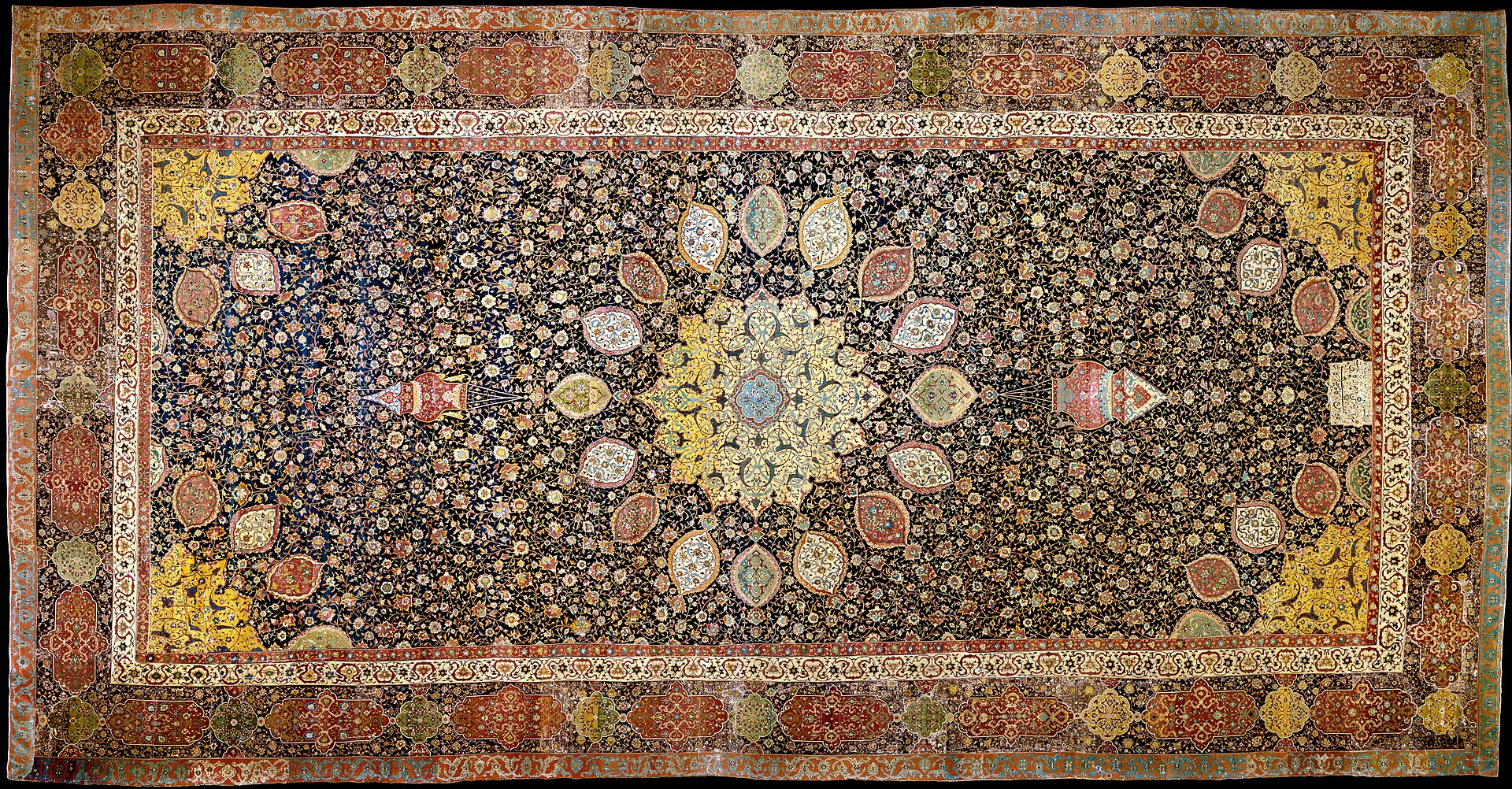
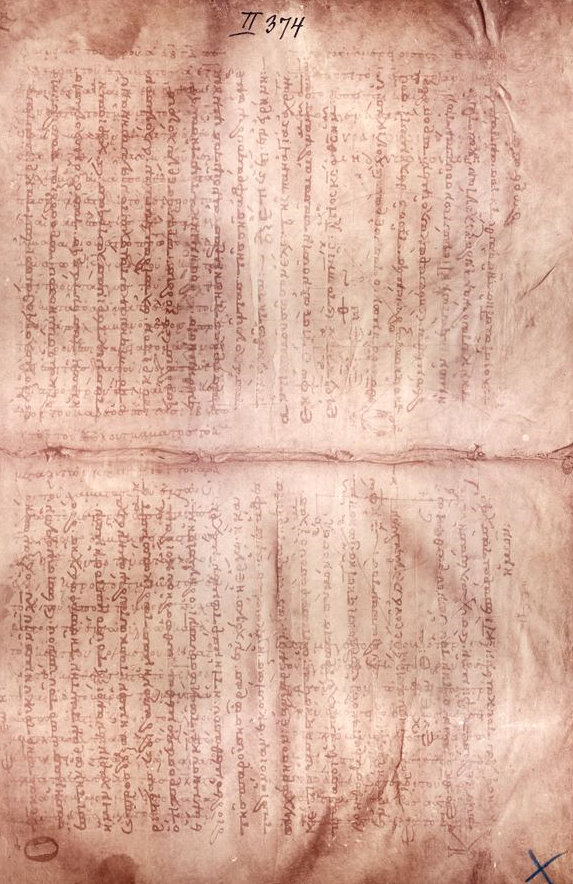
- Only two records carry an attribution the object documents itself. The Ardabil Carpet knots the name Maqsud of Kashan and the year 946 into its own field, and the Archimedes Palimpsest carries a colophon giving the scribe as Ioannes Myronas.
- Neither of those two is entirely clean. The palimpsest colophon is in a later hand than the manuscript it closes, and published sources give the date as 13 April and as 14 April 1229.
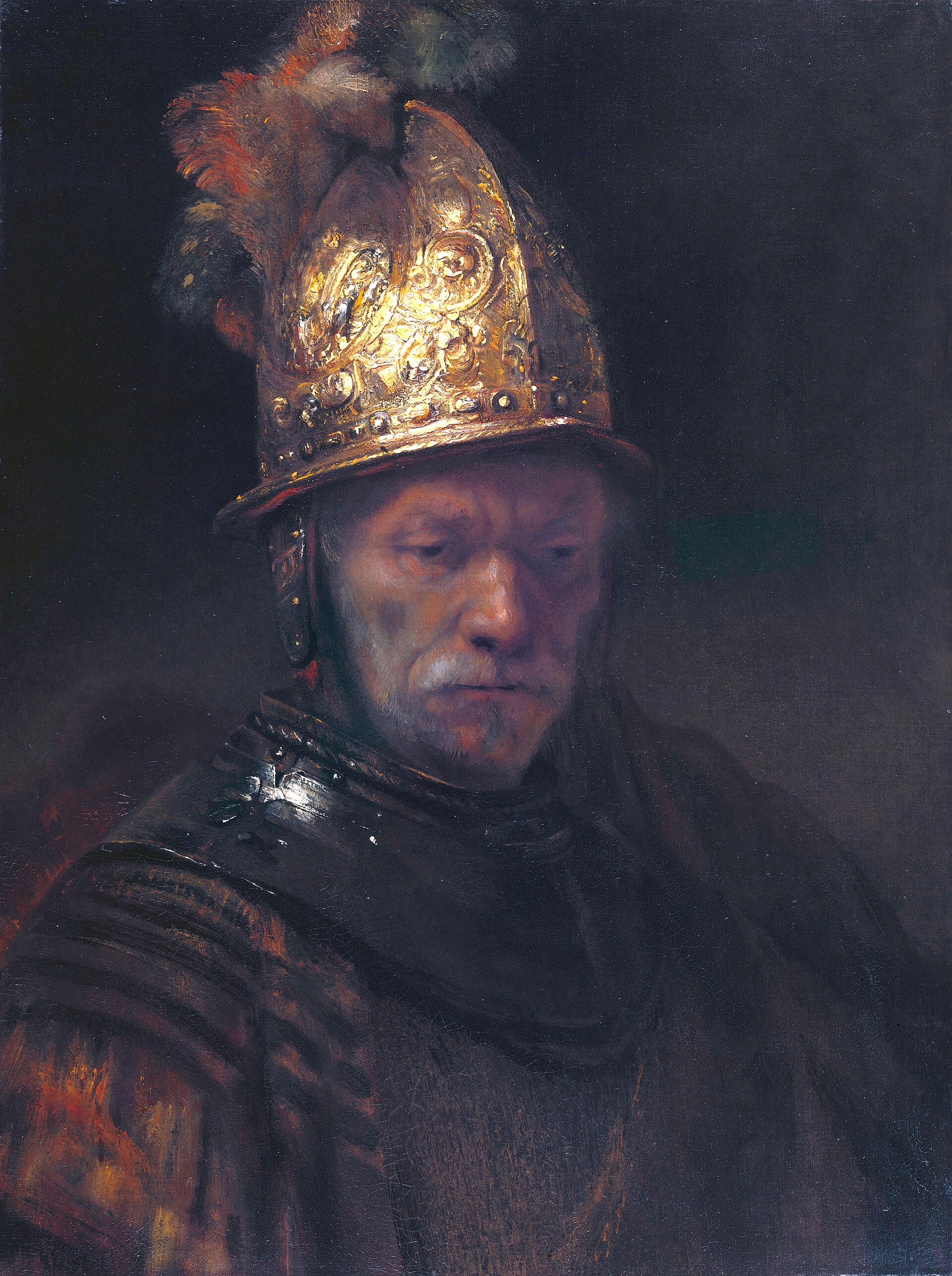
- Exactly one attribution in the archive has been withdrawn by the institution holding the object. Wilhelm von Bode bought The Man with the Golden Helmet as a Rembrandt in 1897, and the Gemaeldegalerie withdrew the attribution in 1986 after technical and art-historical examination.
- Withdrawal is rare in the record because a demoted object usually leaves the record, not because attributions are rarely wrong. The Berlin canvas kept its wall because the museum said plainly that it is not a fake.
- The question does not stay closed. On 2 September 2026 an AI analysis was reported as putting Rembrandt's hand in the Berlin picture at 96 per cent probability, and the museum's 1986 position is unchanged.
An attribution is a claim about a person, and almost none of them come from the object
Every record in this archive carries an attribution field with a graded status, and the grades divide 257 objects very unevenly. The largest group by far is accepted, at 156. Two records carry the grade documented.
The difference between those two words is the whole of connoisseurship. Accepted means the field agrees, sometimes for excellent reasons and sometimes because a powerful person said so early and nobody reopened it. Documented means a contemporary record, on or with the object, names the maker. One is a consensus. The other is evidence.
| Status | Records | What it means here |
|---|---|---|
| accepted | 156 | The field agrees on a named maker |
| disputed | 43 | Named authorities disagree in print |
| unknown | 39 | No maker is named and none can be |
| workshop | 8 | A shop or guild, not a hand |
| attributed | 8 | A named maker proposed, on style |
| documented | 2 | A contemporary record names the maker |
| rejected | 1 | The holder has withdrawn the name |
Two out of 257 is not a criticism of the field. It is a description of what survives. Contracts, colophons and signed inscriptions are rare, and the objects that carry them are correspondingly precious as evidence, well beyond their own entries.
The carpet signs itself, and gives the year
The Ardabil Carpet carries its maker's name and its date knotted into the pile, which is as close to a contemporary document as a textile can get. The V&A reads the panel as three lines in Persian nastaliq: two verses after Hafiz, then the signature. In the museum's translation the whole reads except for thy threshold, there is no refuge for me in all the world; except for this door, there is no resting-place for my head; the work of a servant of the court, Maqsud of Kashan. The year given is 946 in the Muslim calendar, 1539 to 1540.
Even here the claim needs care, and the V&A takes it. Maqsud is identified as the person in charge of production rather than as the weaver, which on a carpet of this size, roughly ten and a half metres by five and a third, is the only sensible reading: this is a workshop object and the name is a supervisor's. That is still worlds away from an attribution on style. It is a name that a contemporary put on the object, in the object.
It is also the earliest date written explicitly on any Persian carpet, which is why so much of the dating of Safavid weaving is hung on this one piece. A single documented object ends up carrying a whole field.
The prayer book names its scribe, and the day is still argued over
The second documented attribution here belongs to a manuscript nobody was looking at when the evidence was found. In 2002 John Lowden of the Courtauld Institute read a colophon at the foot of folio 1 verso of the Archimedes Palimpsest under ultraviolet light, and later imaging brought up the name of the scribe, Ioannes Myronas.
The detail I would not want to lose is that the note is in a different hand from the prayer book it closes, in a style suggesting the later thirteenth or fourteenth century, and its wording is consistent with a colophon without being explicit. The project's own history page gives the date as 13 April 1229. Other published accounts give 14 April 1229. We have not been able to reconcile them and we are not going to pick the one that reads better.
So the best-documented attribution in this archive after the carpet is a difficult reading of an erased page, in a later hand, whose date is disputed by a day. That is what documented looks like when you actually go and check it, and it is still enormously stronger than the alternative.
One hundred and fifty-six accepted attributions rest on agreement
Accepted is the commonest grade in this archive and the one that repays the most scepticism. It does not mean an attribution is unsupported; most of the 156 rest on decades of scholarship, technical examination and comparison, and would survive any challenge anyone is likely to bring. It means the support is a body of opinion rather than a document, and bodies of opinion move.
The way to test one is to ask when it was formed and by whom. An attribution that was settled by a single dominant figure and never revisited is a different object of trust from one that has been re-examined with materials analysis in the past twenty years. Both read identically on a wall label, which prints a name and a date and nothing about how either was arrived at.
Our own grading does not resolve this. It flags it, which is the honest limit of what a record can do from outside the laboratory.
Exactly one attribution here has been withdrawn
The Man with the Golden Helmet is the only record in this archive whose attribution status is rejected, and its history shows why that number is one rather than twenty. Wilhelm von Bode acquired the picture for Berlin in 1897 having identified it as by Rembrandt's own hand. Cornelis Hofstede de Groot and Abraham Bredius doubted it from the start, and Bode's endorsement carried the field anyway for most of a century.
Werner Sumowski reopened the question in 1957. The Rembrandt Research Project was founded in 1968, a Dutch commission examined the picture in West Berlin in 1984, and Jan Kelch announced the result in November 1985. The museum's own record now states that in 1986, following thorough investigation using technological and art-historical methods, the attribution was withdrawn once and for all and the picture was designated a work by Rembrandt's circle. It hangs as inventory 811A, catalogued 1650 to 1660, canvas, 67.5 by 50.7 centimetres.
Rejection is rare in a corpus like ours for a reason that has nothing to do with how often attributions are wrong. An object that loses a great name usually stops being lent, stops being photographed, stops being reproduced and drops out of the literature, so it never reaches an archive built on published evidence and free-licence plates. This picture is here because Berlin kept it on the wall and kept saying what it is. Kelch's own words were that it is not a fake and remains a great and masterly work. No new name has been adopted: Carel van den Pluym, Heyman Dullaert and Johann Ulrich Mayr have all been proposed, and the label reads anonymous.
Attributed is a weaker claim than accepted, and the catalogue says so
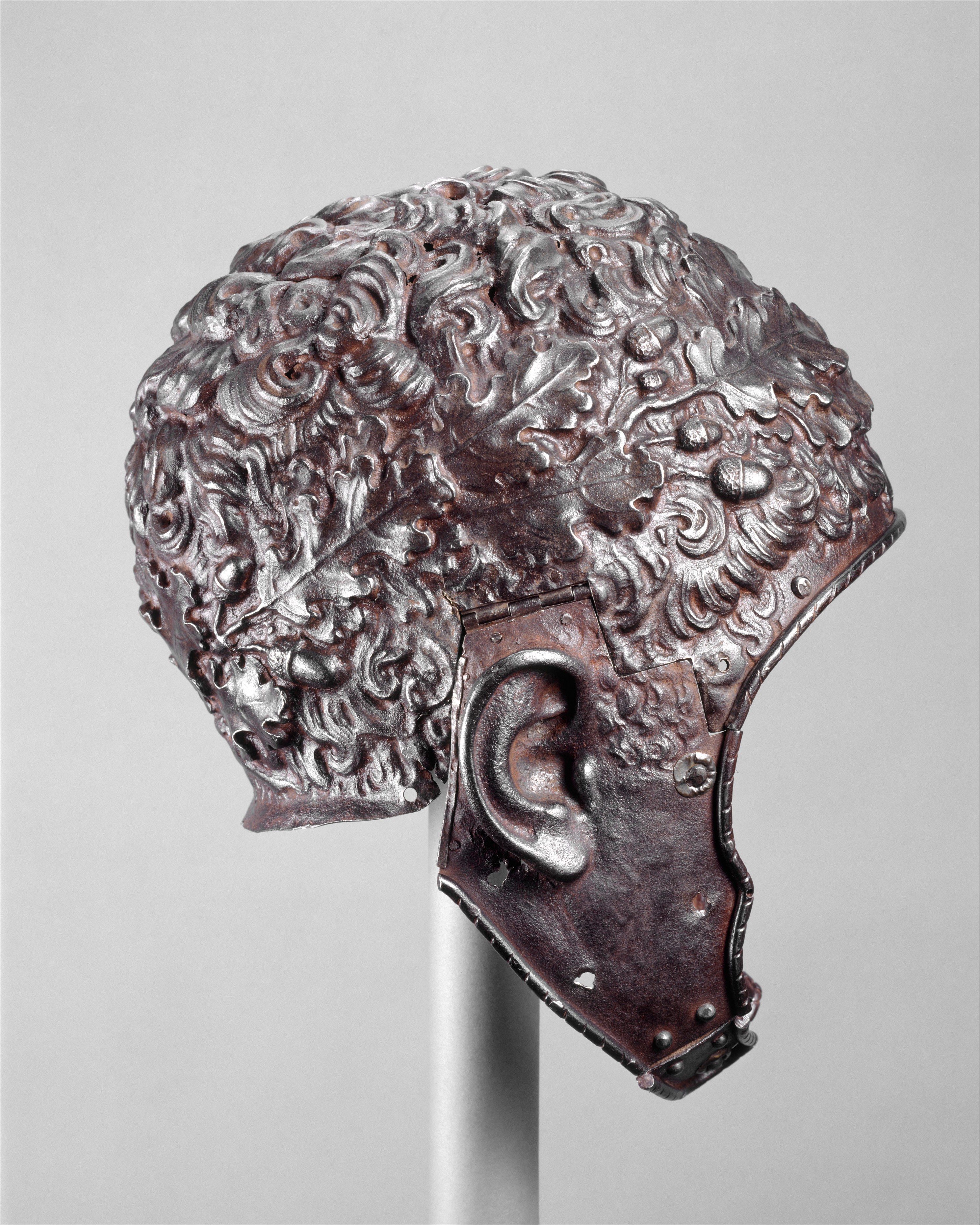
Eight records here carry the grade attributed, which is the field's way of naming a maker while declining to vouch for the name. The Metropolitan's helmet all'antica is a clean example: the museum heads it Attributed to Filippo Negroli, and the 1998 to 1999 Negroli exhibition placed it as catalogue number 21 within the group attributed to Filippo rather than among the signed works.
What makes this object useful is that the signed works exist to be compared with. Alan Williams sampled three signed Negroli pieces metallographically and found no iron at all in them, only low and medium carbon steels. That is the kind of test that can move an object between grades, and it only exists because a handful of Negroli helmets carry a signature. Two documented objects can discipline a hundred attributed ones.
The helmet also carries the ordinary complication. Its cheek-pieces, one of them visible in the plate with its finely modelled ear, are probably nineteenth-century restorations, so part of what a viewer reads as Negroli's work is somebody else's, three hundred years later.
The most expensive picture in this archive sits in the disputed column
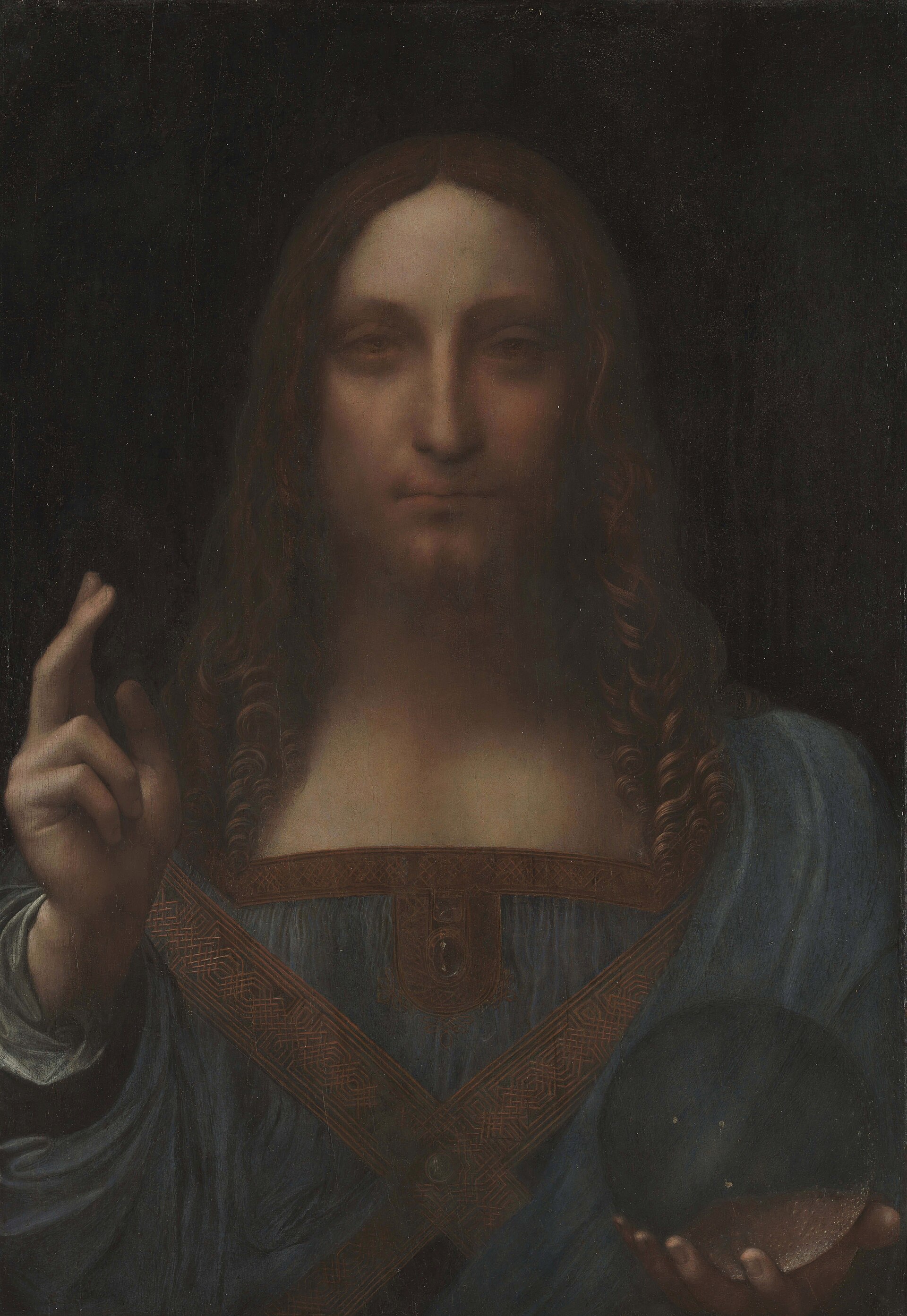
Salvator Mundi is graded disputed here, and its price is the reason the grade matters commercially rather than only academically. Christie's sold it in November 2017 as an autograph Leonardo for USD 450,312,500. The Louvre's own printed study of 2019 concluded the same. Carmen Bambach, Matthew Landrus, Frank Zoellner and the Prado's 2021 catalogue place it wholly or partly in the workshop.
Nothing about the object changed between those judgements. The panel is the same panel, cleaned and retouched by Dianne Dwyer Modestini, and the disagreement is entirely about what a group of specialists think the surface shows. That is what an attribution is when no document exists, and 43 records here are in the same condition.
A buyer is not pricing a fact in that situation. They are pricing the current distribution of expert opinion, which is a different asset and moves for different reasons.
The withdrawn attribution did not stay withdrawn quietly
On 2 September 2026 the journalist Christoph Droesser reported for Deutschlandfunk that an AI analysis now sees Rembrandt's hand in the Berlin picture with 96 per cent probability, and asked in the same breath whether AI can rewrite art history. The Berliner Zeitung followed on 4 September under the headline that AI holds the Goldhelm to be a Rembrandt and Berlin disagrees, with the standfirst that private IT specialists are now spectacularly calling serious Rembrandt research into question and that scepticism prevails at the Gemaeldegalerie. We reached that article's paywall and read no further into it.
Set that against what the museum's own catalogue says, which is that the attribution was withdrawn once and for all in 1986 after technological and art-historical investigation. The 1986 finding rests on examination of the physical object. The 2026 claim, on the reporting we could read, rests on image analysis.
I do not think this is an argument about whether machines can help with attribution; they demonstrably can, and pigment and dendrochronology data are already read by software. It is an argument about whether a probability computed from a photograph is the same kind of evidence as a laboratory report on a canvas. Our record keeps the status at rejected, because that is the position of the institution holding the object and the only one grounded in the object itself.
How to read an attribution line
Ask first whether the name comes from the object or from a person. That single question separates the two documented records in this archive from the other 255, and it is answerable from most catalogue entries in a minute.
Then ask when the current opinion was formed and whether anything has tested it since. An attribution settled in 1897 by a dominant scholar and never revisited is not equivalent to one confirmed by materials analysis in the past decade, though a wall label prints them the same way. Where a signed comparator exists, as with the Negroli helmets, ask whether anyone has run the comparison.
And treat a withdrawal as information rather than embarrassment. Berlin's is the only one in this corpus, it has held for forty years, and the museum has kept the picture on the wall throughout. That is an institution behaving well, and it is much rarer than the mistake it corrected.
Why this archive is free to read
We do this for everyone who loves art. The people who have studied it for years, and the people who just stopped to look. Iconotheca exists so that what we learn belongs to all of them.
Nobody pays us for this. No ads, no sponsors, no commercial interest. These works belong to all of us, and we would rather share them with as many people as we can than keep them to ourselves.
If it gave you something today, tell us to keep going. Follow us, leave a like, or write a positive comment. We read every one, and they are what keeps us going.
Questions
It means a contemporary record on or with the object names its maker, rather than a scholar proposing a name from style. Only two of 257 published records qualify: the Ardabil Carpet, which knots the name Maqsud of Kashan and the year 946 into its own field, and the Archimedes Palimpsest, whose colophon names the scribe Ioannes Myronas.
43 of 257 published records carry a disputed attribution, meaning named authorities disagree in print. A further 39 are graded unknown, where no maker is named and none can be, and 8 are graded attributed, where a name has been proposed on style.
Because an object that loses a great name usually stops being lent, photographed and published, so it drops out of archives built on published evidence. The Man with the Golden Helmet is here because the Gemaeldegalerie kept it on display and kept explaining the 1986 withdrawal.
The Gemaeldegalerie in Berlin, which holds it. Its own catalogue record states that in 1986, after investigation by technological and art-historical methods, the attribution was withdrawn once and for all and the painting was designated a work by Rembrandt's circle.
An AI analysis was reported on 2 September 2026 as putting Rembrandt's hand at 96 per cent probability, and the report was followed up in the German press on 4 September. The museum's catalogue position, based on examination of the physical painting, is unchanged.
Sources
- 1Iconotheca, records.json, the archive's own published corpus. The attribution status distribution across the 257 records carrying status published was measured directly on 9 September 2026: 156 accepted, 43 disputed, 39 unknown, 8 workshop, 8 attributed, 2 documented, 1 rejected. iconotheca.com/artworks
- 2Victoria and Albert Museum, collection record for The Ardabil Carpet, museum number 272-1893. Read for the inscription and the museum's own translation, the identification of Maqsud Kashani as the person in charge of production, the year 946, the dimensions, the knot density of some 5,300 knots per ten square centimetres, and the 1893 purchase from Vincent J. Robinson and Co. for GBP 1,750. collections.vam.ac.uk/item/...
- 3The Archimedes Palimpsest Project, 'The History of the Archimedes Manuscript'. Read for John Lowden's 2002 ultraviolet reading of the colophon on folio 1 verso and the date of 13 April 1229, and for the dating of the Archimedes undertext to the second half of the tenth century. archimedespalimpsest.org/about/...
- 4William Noel, 'Archimedes and Company', British Academy. Read for the colophon being in a later hand, its wording being consistent with a colophon without being explicit, the name Ioannes Myronas, and the date given there as 14 April 1229, which is the one-day divergence recorded in the text. thebritishacademy.ac.uk/documents/...
- 5Staatliche Museen zu Berlin, museum-digital object record for Der Mann mit dem Goldhelm, Gemaeldegalerie, inventory 811A. Read for the circle-of-Rembrandt attribution, the 1650 to 1660 dating, canvas, 67.5 by 50.7 cm, Wilhelm von Bode's 1897 acquisition as an autograph Rembrandt, and the museum's statement that the attribution was withdrawn once and for all in 1986 after investigation by technological and art-historical methods. smb.museum-digital.de/index.php
- 6Christoph Droesser, 'KI haelt den Mann mit dem Goldhelm fuer einen Rembrandt', 2 September 2026, the author's own posting of his Deutschlandfunk item. Read directly for the sentence reporting that an AI sees Rembrandt's hand with 96 per cent probability in a picture classed since 1986 as from Rembrandt's circle. droesser.net/2026/...
- 7Ingeborg Ruthe, 'KI haelt den Goldhelm fuer einen Rembrandt - Berlin widerspricht', Berliner Zeitung, 4 September 2026. Headline, standfirst, byline, publication date and the opening reference to the Deutschlandfunk report of 2 September were read; the remainder of the article is behind a paywall and was not read. berliner-zeitung.de/article/...
- 8The Metropolitan Museum of Art, collection record for the Helmet all'Antica, object 21974, accession 04.3.202, read through the Museum's public collection API on 9 September 2026. The artist prefix field returns the literal string 'Attributed to' against the artist name Filippo Negroli, with the date about 1532 to 1535, the medium steel, the culture Italian, Milan, and the credit line Rogers Fund, 1904. metmuseum.org/art/...
More in Attribution and Authenticity
The partA Hallmark Can Be Genuine, Legal and About a Different Object
The V and A catalogues a Paul de Lamerie ewer of 1736 as a duty dodger, hallmarked 1944.
Composite Names Three Different Objects, and Only One of Them Is a Fake
Fifty-seven records here use composite, pastiche or assembled, and the words are doing three incompatible jobs.
The Frame Has Its Own Provenance
Ten records carry evidence on a frame. Van Eyck's integral frames date the panels to 1410-1440; a 1970 loan label on a frame in Maine proves nothing...