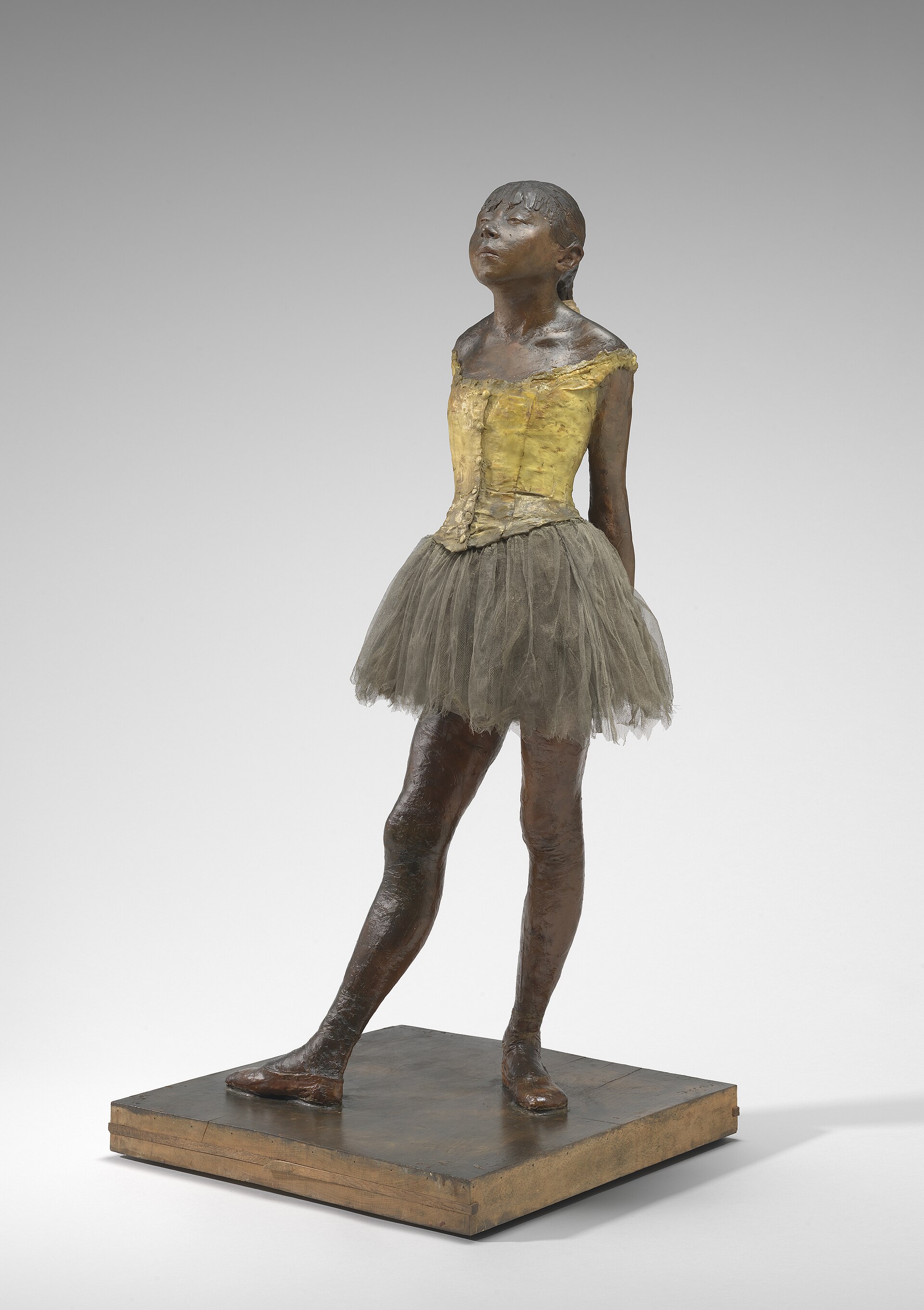
Little Dancer Aged Fourteen
1878-1881 · Pigmented beeswax
National Gallery of Art
 French · 1834-1917
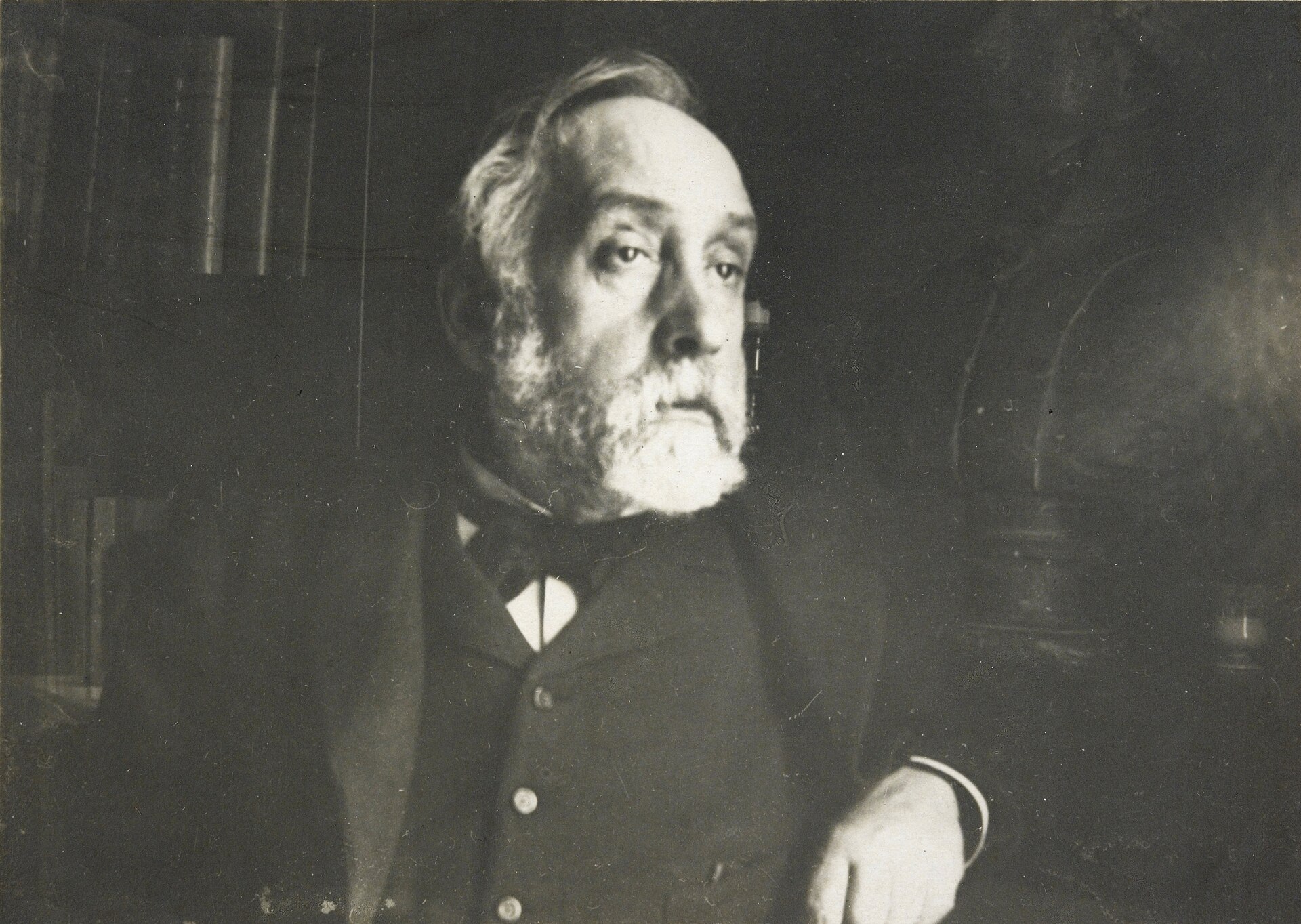
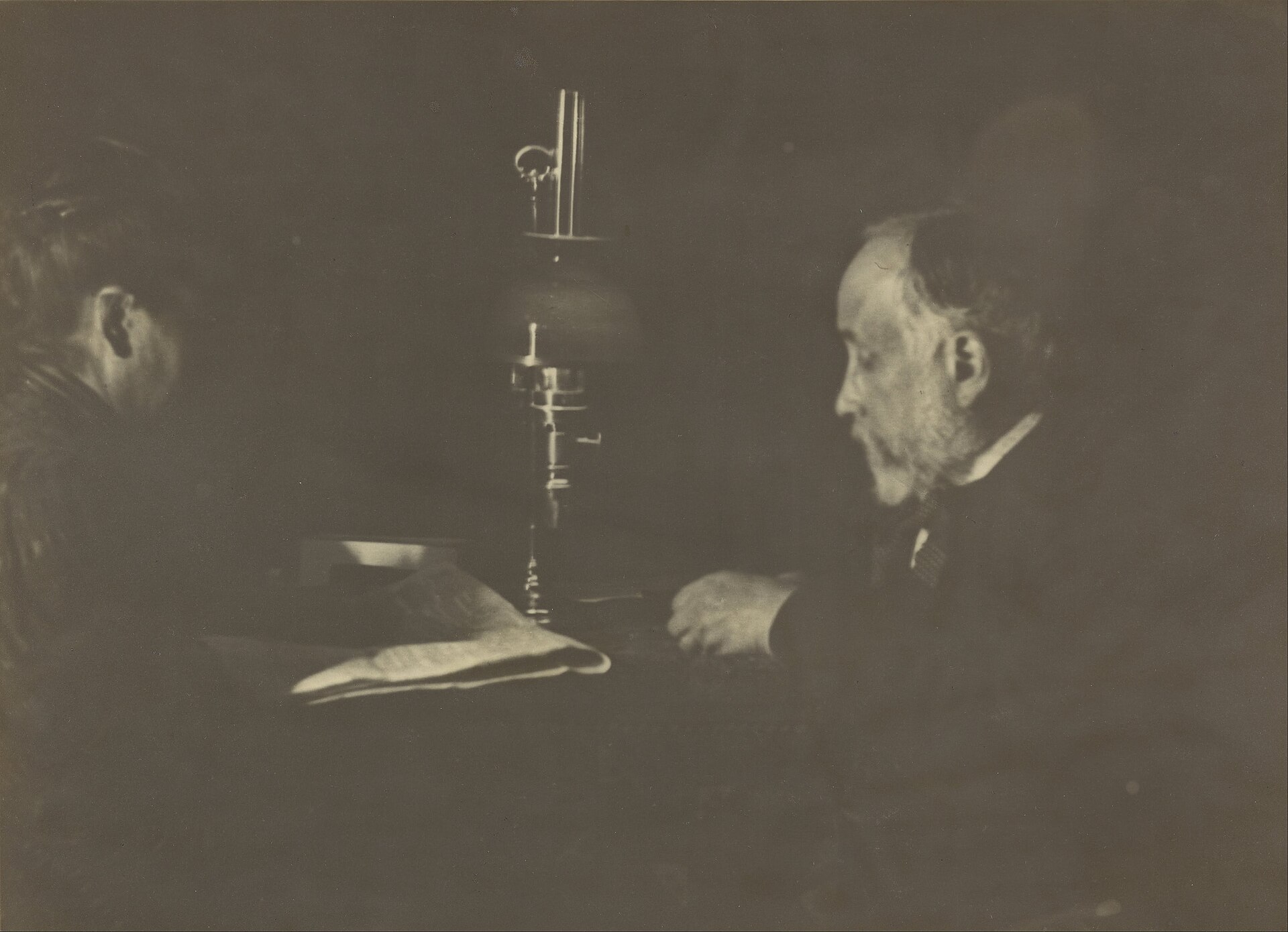
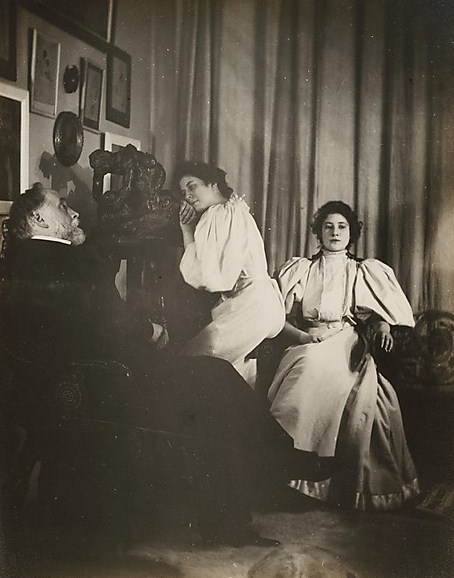
Degas photographed by Degas: Untitled (self-portrait in library), gelatin silver print, 4 11/16 by 6 9/16 in., probably autumn 1895, Harvard Art Museums / Fogg Museum, Richard and Ronay Menschel Fund for the Acquisition of Photographs, record identifier HUAM173196; no accession number is given on the Commons file record and none is asserted here. The identification is secure: it is catalogued by the holding museum as a photographic self-portrait, and it belongs to the concentrated burst of photography he undertook in the autumn of 1895, working indoors by lamplight with long exposures. He made almost no painted self-portraits after the 1850s, so this is close to the only likeness of him by his own hand in old age.
Harvard Art Museums / Fogg Museum, via Wikimedia Commons; licence verified as Public domain from extmetadata.LicenseShortName| Full name | Hilaire-Germain-Edgar De Gas, who signed himself Degas |
|---|---|
| Worked as | Painter, Pastellist, Draughtsman, Printmaker |
| Born | 19 July 1834 · 8 rue Saint-Georges, Paris |
| Died | 27 September 1917 · Paris |
| Nationality | French |
| Movement | Impressionism, a label he rejected |
| In this archive | 1 artwork |
| Sources | 44 cited |
| Last verified | 17 September 2026 |
About this page 1 artwork in the archive · Last verified 17 September 2026 · 44 sources cited
The Degas market is a posthumous market, and the paperwork that created it is dated. Between 26 March 1918 and 4 July 1919, in a Paris under bombardment, eight auctions dispersed the contents of his studio and his private collection. Frits Lugt, who was there for the trade and who compiled the standard reference on collectors' marks, recorded the totals: 10,827,828 francs across the eight sales, of which 8,649,573 francs for Degas's own work and 2,178,255 francs for the pictures he had bought. He called it the largest sum ever realised by an artist's studio, and second among art sales of any kind only to the Doucet sale at 13,844,460 francs. The four atelier sales of paintings, pastels and drawings alone put 1,523 lots through the room in fourteen months, and a fifth atelier sale disposed of the prints and monotypes. Most of what trades today passed through those five days of hammering, and most of it carries a red stamp instead of a signature.
The stamp is the single most misunderstood object in this artist's market. Two marks exist. The oval, Lugt 657, was struck in red on everything found in the studio in December 1917 by the ministerial officers who lifted the seals, which means it appears on drawings by Ingres and Delacroix that Degas merely owned. The second, Lugt 658, a small facsimile of the signature, was applied to the works by Degas that went into the atelier sales, in red on paintings, drawings and pastels and in black on prints. Neither mark is an opinion about quality, finish or intention. It records that an object was in a dead man's rooms and that a court officer saw it there. Degas signed when a work left the studio to be sold; a great deal of what is now framed and hung is work he was still arguing with.
The sculptures were never in the sales at all. Roughly 150 wax, clay and plastiline figures were found in the studio, most of them broken or slumping, and instead of consigning them the heirs signed a contract on 13 May 1918 with the Hebrard foundry to cast them in bronze. Every Degas bronze in every museum on earth descends from that contract, not from the artist. He had told a critic that nobody would ever see the wax experiments and that they would all be destroyed before he died, and that it would be better for his reputation. Sixty-nine of them survive; fifty-two are in Washington; and the objects made from them after his death set his auction record.
His parents marry: Auguste De Gas, a banker aged 24, and Marie Celestine Musson, whose family were established in New Orleans.19
Born 19 July at 8 rue Saint-Georges, Paris, the eldest of five children. He later drops the aristocratic-looking two-word spelling De Gas for Degas.1920
His mother dies. He is thirteen.19
Leaves the Lycee Louis-le-Grand and obtains permission to copy at the Louvre and the Bibliotheque Nationale.19
Enters the studio of Louis Lamothe, a pupil of Ingres. The classical training in line never leaves the work.19
Begins three years in Naples, Rome and Florence copying old masters and meeting Gustave Moreau.19
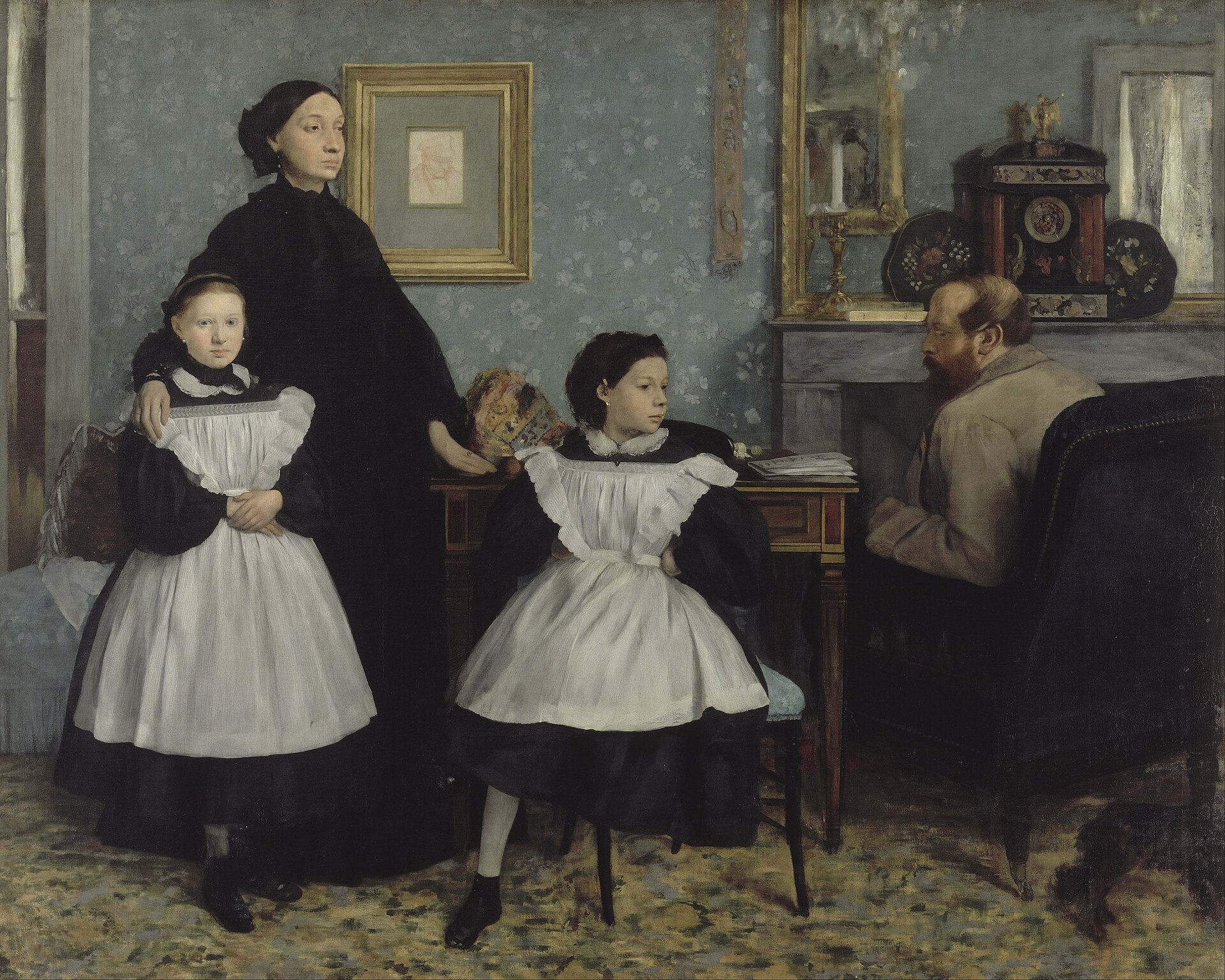
Begins The Bellelli Family, worked on until about 1867, and probably shown at the Salon of 1867. It is then unseen for fifty years.3031
Enlists in the National Guard on the outbreak of the Franco-Prussian War. During rifle training his eyesight is found to be defective; eye trouble is a constant worry for the rest of his life.20
October: travels to New Orleans with his brother Rene. Rene writes that Degas is worried about his delicate eyesight.1920
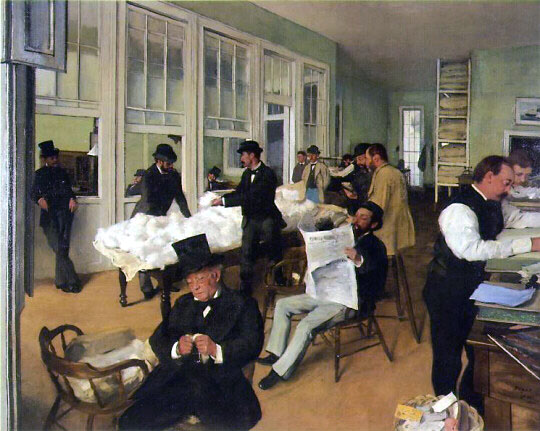
Paints A Cotton Office in New Orleans and returns to Paris in March. Writes to Tissot that he will remain in the ranks of the infirm until he passes into the ranks of the blind.1932
His father dies; Degas discovers that his brother Rene has run up enormous business debts. April: the first impressionist exhibition opens at Nadar's studio. He shows in all but one of the eight.1920
The family financial crisis bites. He sells his house and an inherited art collection to pay the debts, and begins making monotypes quickly for sale.1920
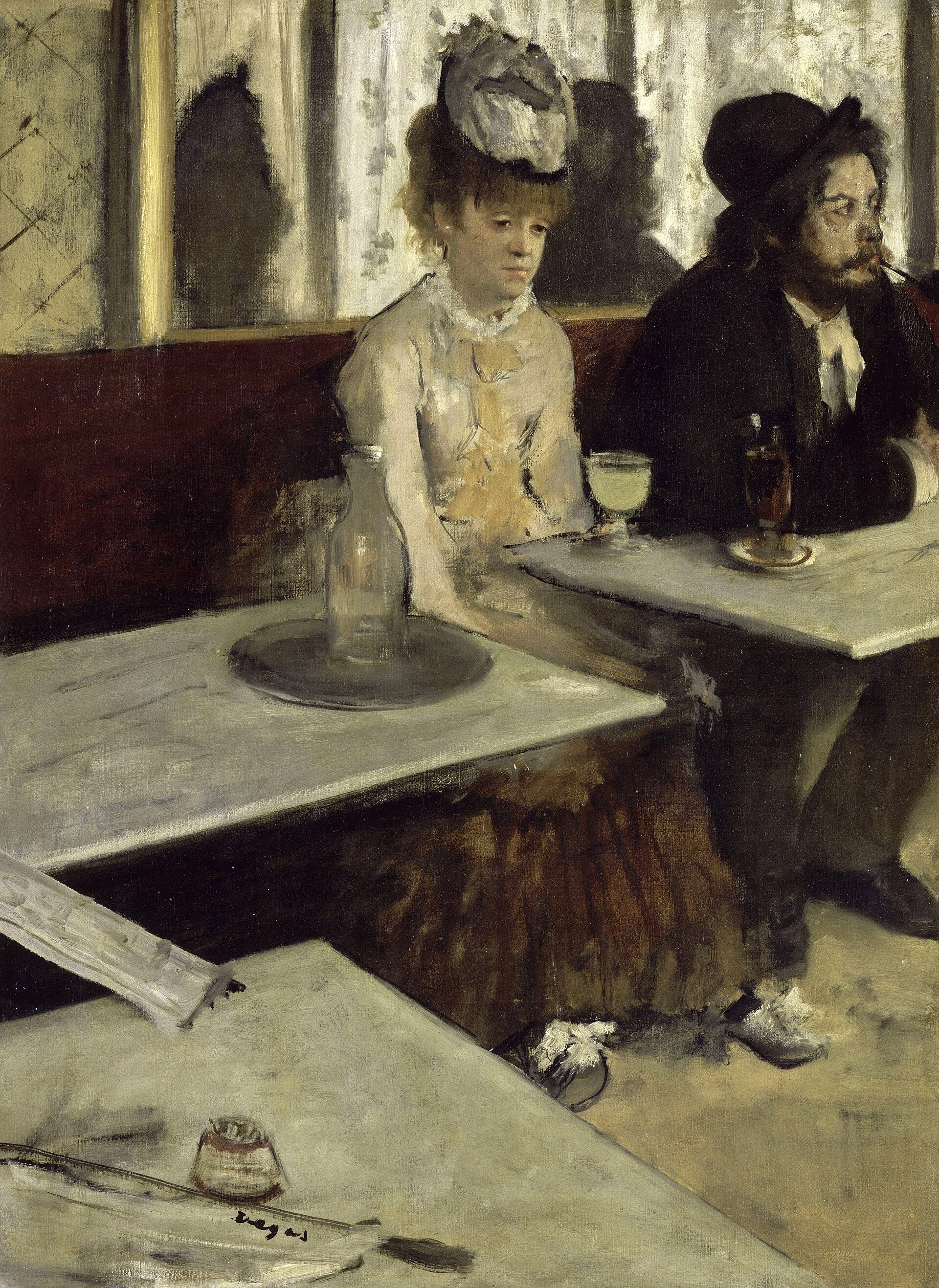
Shows A Cotton Office in New Orleans at the second impressionist exhibition. Paints L'Absinthe, which is bought the same year from the London dealer Charles Deschamps by the Brighton collector Captain Henry Hill.3233
Invites Mary Cassatt to exhibit in the third impressionist exhibition. Makes Les Choristes, the pastel later stolen from Marseille.1820
A five-member committee appointed by the mayor of Pau buys A Cotton Office in New Orleans for the town's museum for 2,000 francs, the only museum purchase of a Degas in the artist's lifetime.32
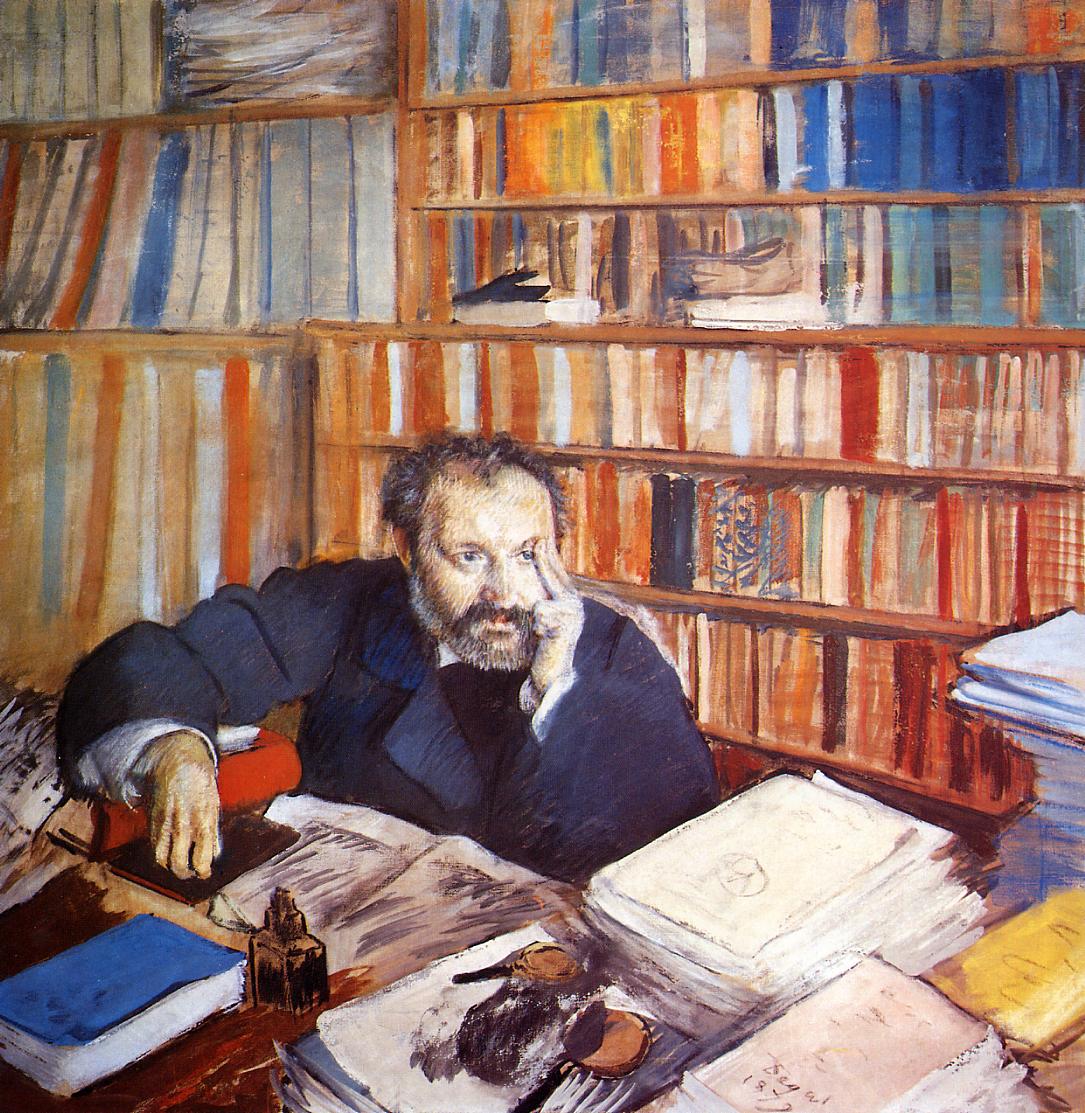
Works closely with Cassatt on printmaking. Paints the Portrait of Edmond Duranty in gouache with pastel on linen, one of the works that shows how far his supports had moved from oil on canvas.2025
Attends the trial of Emile Abadie and Michel Knobloch from the press benches and draws the defendants in a sketchbook. The vitrine for the Little Dancer is installed at the impressionist exhibition and the sculpture never arrives.11
Sixth impressionist exhibition: shows the wax Little Dancer Aged Fourteen, the only sculpture he ever exhibits, alongside the pastel Physionomie de criminel.611
Jules-Emile Boivin acquires Danseuse au repos, directly from the artist or through Durand-Ruel. It stays in the family until 1999 and becomes the most expensive Degas on paper.13
Sells the pastel Eloge du maquillage to the artist Julian Bastinos in Paris for 3,000 francs, recorded in a letter to the singer Jean-Baptiste Faure. The picture disappears for over a century.39
February: L'Absinthe is sold at auction in London after Henry Hill's death, to the Scottish dealer Alexander Reid acting for Arthur Kay, and is treated with derision.33
L'Absinthe is shown at the Grafton Gallery in London under that new title and becomes a public scandal among English critics. Kay sells it to a Paris dealer in April.33
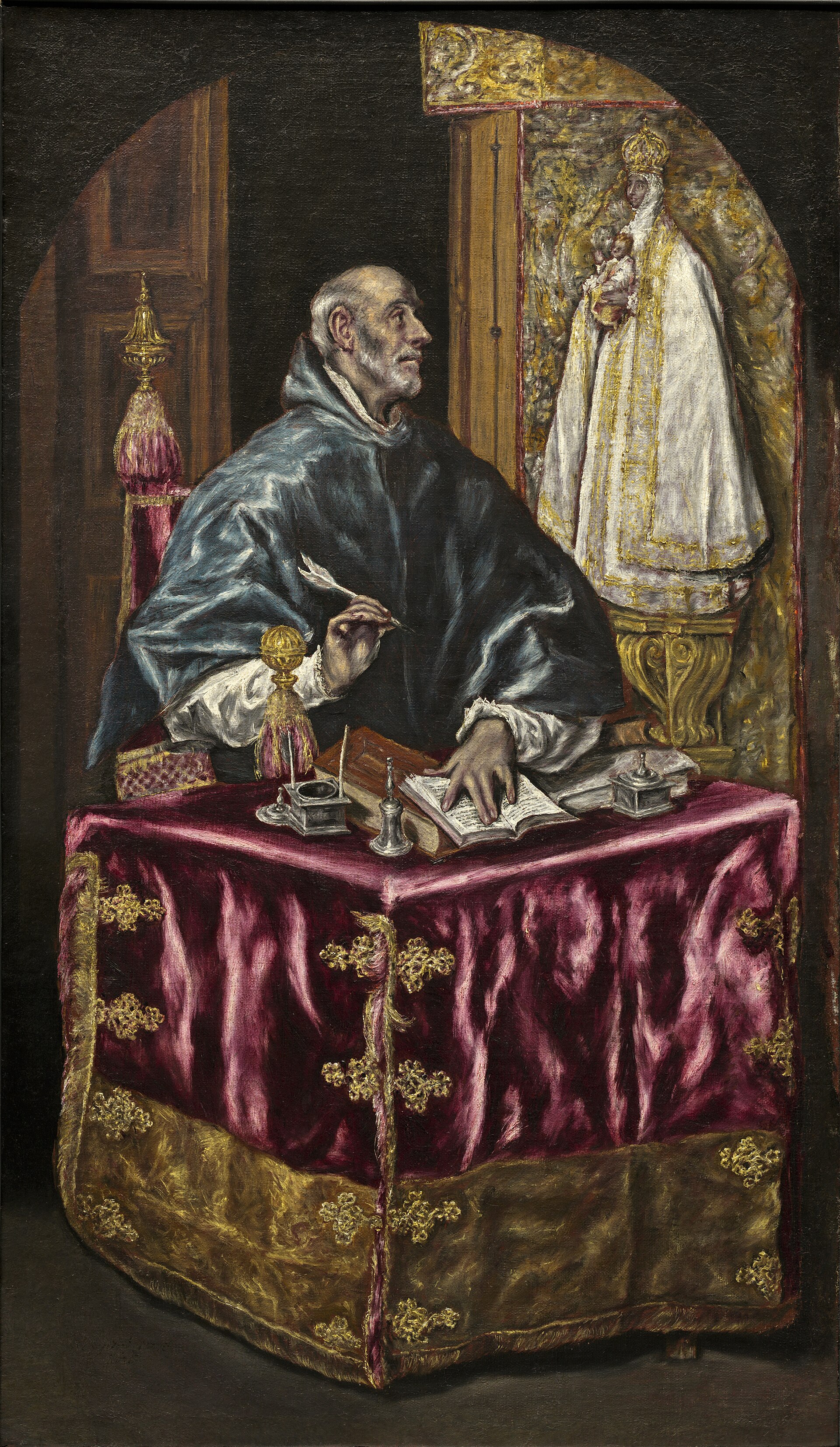
Durand-Ruel buys El Greco's Saint Ildefonso for Degas at the estate sale of Millet's widow, 24 to 25 April, for 2,000 francs, catalogued as L'Eveque. December: Degas supports the conviction of Alfred Dreyfus.519
Autumn: takes up photography intensively. 28 December: photographs the Halevys by lamplight and double-exposes two negatives by mistake.20
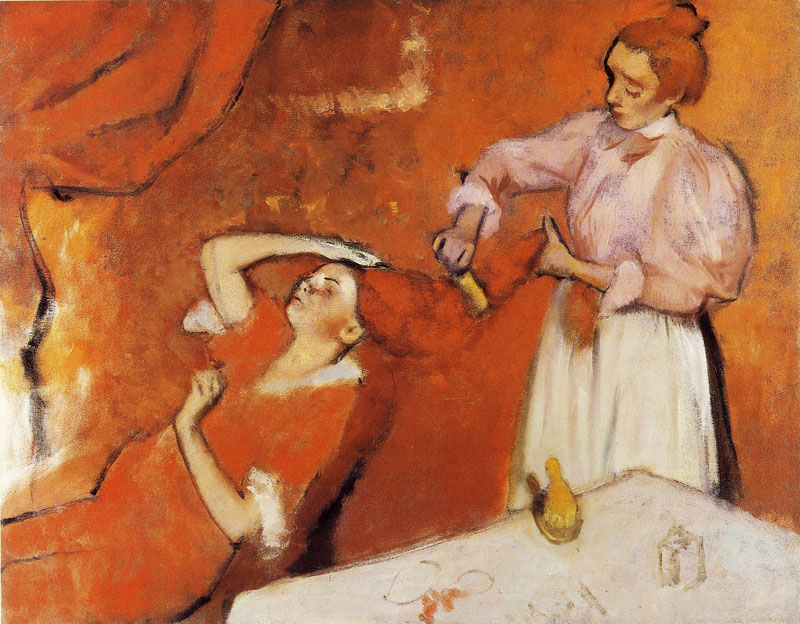
About this date paints Combing the Hair, which he leaves unfinished in the studio.4
His antisemitism during the Dreyfus affair alienates the Halevys and they break off contact.19
Refuses to contribute work to a Mallarme edition because the publisher supports Dreyfus.19
Dreyfus is exonerated. Degas's hostility is unchanged.19
At an Ingres exhibition he feels the surfaces with his fingertips, saying his eyes are too weak to see them.19
Evicted at 78, almost blind, when the building at 37 rue Victor-Masse is scheduled for demolition after more than twenty years. Moves to 6 boulevard de Clichy and effectively stops working.1920
Dies 27 September in Paris, aged 83, and is buried in the family vault in Montmartre cemetery; Monet and Mary Cassatt attend. December: the seals are lifted and the ministerial officers stamp the oval mark, Lugt 657, on every painting, drawing and print in the studio.119
26 to 27 March: the first sale of his private collection, 247 lots, 1,966,220 francs, with the Louvre paying 62,000 francs for a Manet pastel. Sir Charles Holmes bids for the National Gallery in disguise; John Maynard Keynes has secured a wartime Treasury grant of 20,000 pounds.1342
6 to 8 May: the first atelier sale, 336 lots, 5,602,400 francs. The Musee du Luxembourg buys The Bellelli Family for 400,000 francs; no pastel sells below 10,000 francs.130
13 May: the heirs contract with the Hebrard foundry to cast the studio sculptures in bronze, twenty-two casts of each figure. No sculpture is ever put into the auctions.69
November: three further sales. Prints from the collection on the 6th and 7th, 74,092 francs; the second part of the collection on the 15th and 16th, 137,941 francs; and Degas's own prints and 139 monotypes at the Galerie Manzi-Joyant on the 22nd and 23rd, 293,128 francs.138
11 to 13 December: the second atelier sale, 386 lots, 1,654,190 francs. Vollard, one of the sale's own experts, buys lot 200, Physionomie de criminel.112
7 to 9 April: the third atelier sale, 410 lots, 616,740 francs. 2 to 4 July: the fourth and last, 391 lots, 483,115 francs. The eight sales total 10,827,828 francs. Casting of the bronzes begins under Albino Palazzolo.19
May: the first series of bronzes, lettered A, is exhibited in Paris and bought by Louisine Havemeyer. The catalogue records the numbering scheme, 1 to 73 over A to T, that Hebrard actually used rather than the one in the contract.6
Louisine Havemeyer's bequest brings the largest private Degas holding in the world to the Metropolitan Museum of Art.41
Hebrard's records show 567 Degas casts sold, against the 1,606 the contract permitted.9
Andrew W. Mellon's El Greco Saint Ildefonso, from the Degas collection sale, enters the National Gallery of Art. The National Gallery in London buys the unfinished Combing the Hair from Henri Matisse's ownership.45
John Rewald publishes the first catalogue of the Degas bronzes and reports that the original waxes were destroyed in casting. Sir William Burrell gives his collection to Glasgow with a prohibition on lending abroad; he had bought at least twenty-four works by Degas and twenty-three come with the gift.73543
Paul-Andre Lemoisne begins publishing Degas et son oeuvre in four volumes, 1,466 numbers, the source of the L numbers still in use.27
Sixty-nine of the supposedly destroyed waxes reappear and are exhibited at Knoedler in New York with the help of Rewald and Ludwig Charell. Paul Mellon buys the entire group for 400,000 dollars. Archive letters show the National Gallery of Art had been approached about them in 1953.7
Eugenia Parry Janis publishes Degas Monotypes at the Fogg Art Museum, with a checklist of 321 monotypes of which she declares 141 missing.24
Hebrard's heirs exhibit the complete set of bronze modeles at the Lefevre Gallery in London. Their existence had been a foundry secret.9
The Norton Simon Art Foundation buys sixty-nine modeles. Three are missing from the set.910
The missing modele Horse trotting, the feet not touching the ground turns up at the foundry and is bought immediately.10
Philippe Brame and Theodore Reff publish the supplement to Lemoisne as a fifth volume.27
Daniel Searle buys Landscape with Smokestacks for 850,000 dollars.17
The Gutmann heirs sue Searle in the United States District Court for the Northern District of Illinois after a restitution request in 1995.17
August: the Landscape with Smokestacks case settles. Ownership is split; Searle gives his half to the Art Institute of Chicago, which buys the heirs' half at market value.17
28 June: Danseuse au repos makes 17.6 million pounds at Sotheby's London against an estimate of 5 to 7 million, then the highest price for any Degas.1315
3 November: the same pastel makes 37,042,500 dollars with premium at Sotheby's New York, a record for the artist and for any work on paper. The sale of 45 works totals 223,812,500 dollars.1314
Night of 30 to 31 December: Les Choristes is unscrewed from the wall of the Musee Cantini in Marseille, on loan from the Musee d'Orsay, on the closing day of the exhibition.18
The National Gallery of Art publishes Edgar Degas Sculpture by Suzanne Glover Lindsay, Daphne S. Barbour and Shelley G. Sturman, 412 pages, the technical catalogue of the surviving waxes.78
21 January: the Scottish Parliament passes the Burrell Collection (Lending and Borrowing) (Scotland) Act, lifting the 1944 ban on lending the collection abroad. Royal Assent 25 February.35
The Museum of Modern Art shows about 130 monotypes with some 50 related works in Edgar Degas: A Strange New Beauty, the first serious survey of the material in half a century.24
16 February: French customs officers searching a bus at a motorway rest area at Ferrieres-en-Brie find Les Choristes in a suitcase in the luggage compartment. No passenger claims it.18
17 September: Michel Schulman publishes a digital critical catalogue of the paintings, pastels and drawings, using MS numbers with a concordance to Lemoisne.28
Teresa Krasny of OpAL Art founds a project to update Lemoisne and the Brame and Reff supplement. In the same year an unnamed Barcelona collector buys a pastel listed as a fake Degas on Todocoleccion for 926 euros.2739
12 May: a Hebrard Petite danseuse from the Anne H. Bass collection makes 36 million dollars hammer and 41,610,000 with premium at Christie's New York, an auction record for Degas in any medium.16
28 May: Eloge du maquillage is presented at the Institut Francais in Madrid after authentication by Schulman's team; valuations reported run from 7 to 8 million euros to as much as 12 million. September: the Wildenstein Plattner Institute launches the first installment of the digital Degas catalogue raisonne. Late in the year the Norton Simon acquires a cast to fill one of the two remaining gaps in its modele set.10262739
July: the Musee d'Orsay pre-empts Physionomie de criminel and the related sketchbook at Christie's. May: the Wildenstein Plattner Institute formally assumes stewardship of the Degas digital catalogue raisonne project.1127
15 January: the Musee d'Orsay publishes its account of the Physionomie de criminel acquisition, linking the pastel directly to the reception of the Little Dancer. October: Sotheby's New York offers a Degas pastel reported at an estimate of 5 to 7 million dollars in the Magnum Opus collection sales.11
Three markets trade under this name and they behave differently. Posthumous bronzes hold the auction record. Signed two-dimensional work with lifetime provenance holds the top of the paper market. Stamped studio material, which is most of what exists, is broad, liquid and priced an order of magnitude below the other two. A buyer who does not know which of the three he is in will misread every comparable he finds.
The record is 36 million dollars hammer and 41,610,000 with premium, for a Petite danseuse de quatorze ans cast by Hebrard on a commission of August 1927, sold from the Anne H. Bass collection at Christie's New York on 12 May 2022 against an estimate of 20 to 30 million. The other eight-figure results for that composition, at Sotheby's in 2015 and again in June 2026, are set out in this publication's record on the object itself and are not repeated here. The point they make together is that the most valuable Degas at auction is an object made by a foundry from a mould, under a contract signed seven months after he died.
The two-dimensional top is pastel, not oil. Danseuse au repos of 1879 made 17.6 million pounds at Sotheby's London on 28 June 1999 and 37,042,500 dollars with premium at Sotheby's New York on 3 November 2008, and its provenance explains why: bought in 1885 by Jules-Emile Boivin either from the artist or through Durand-Ruel and held in that family for 114 years. It never touched an atelier sale and it is signed. The single evening of 12 May 2022 calibrates the tiers exactly, because the reporting separates hammer from premium in all three cases: bronze 36 million hammer, a signed 1887 pastel 7.5 million hammer, an oil of 1887 to 1890 2.4 million hammer.
Period prices are given here in francs as Lugt published them, which are prices of adjudication; he does not say whether the buyer's charge of the period is included and this record does not assume it. Modern figures separate hammer from premium wherever a source did so, and say when a source did not.
| Date | Sale | Work | Result | Note |
|---|---|---|---|---|
| 24 April 1894 | Hotel Drouot, Paris | El Greco, Saint Ildefonso, catalogued as L'Eveque; a purchase BY Degas, not of a Degas | Hammer FRF 2,000 With premium not published FRF | Estate sale of Jean-Francois Millet's widow, 24 to 25 April 1894, lot 261. Bought by Durand-Ruel for Degas. The same picture had made 500 francs at the Oudry sale at the Hotel Drouot on 16 to 17 April 1869. It is now National Gallery of Art 1937.1.83. |
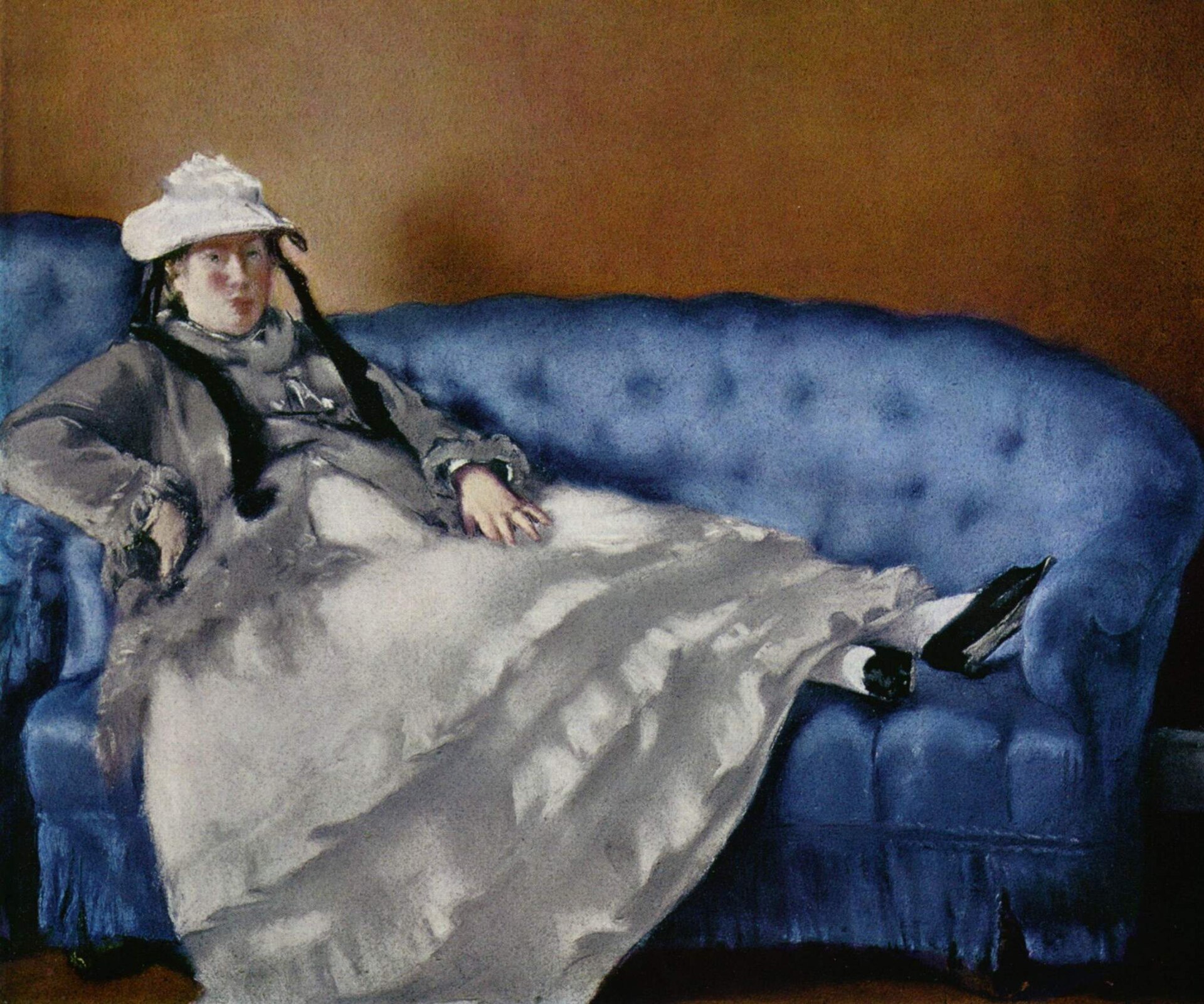
| 26 March 1918 | Galerie Georges Petit, Paris | Edouard Manet, Portrait de Mme Manet etendue sur un canape, pastel; from Degas's collection | Hammer FRF 62,000 With premium not published FRF | The highest price of the first collection sale, paid by the Musee du Louvre against an expert's expectation of 20,000 francs. The sale of 247 lots realised 1,966,220 francs while fighting was under way about a hundred kilometres from Paris. Ingres's La Famille Forestier made 18,100 francs and a study for the Grande Odalisque 14,000, the latter having made 850 francs in 1899. |
| 6 May 1918 | Galerie Georges Petit, Paris | The Bellelli Family, 1858-1867, oil on canvas, 200 x 253 cm | Hammer FRF 400,000 With premium not published FRF | First atelier sale. Bought immediately by the Musee du Luxembourg. The highest single price of the entire estate dispersal, for a picture that had been effectively unseen since about 1867. It went to the Jeu de Paume after the Luxembourg closed in 1947 and is now Musee d'Orsay RF 2210. |
| 6 May 1918 | Galerie Georges Petit, Paris | Pastels, first atelier sale: Trois danseuses, jupes bleues, corsages rouges; Deux danseuses, decor d'arbres; Au musee du Louvre | Hammer FRF 32,600; FRF 32,500; FRF 30,500 With premium not published FRF | The sale ran 336 lots, 113 paintings, 196 pastels and 27 drawings, for 5,602,400 francs. Lugt records that no pastel was knocked down below 10,000 francs, that the average ran between 15,000 and 16,000, and that the best passed 30,000. A gouache heightened with watercolour on a gold ground made 9,100 francs. |
| 22 November 1918 | Galerie Manzi-Joyant, Paris | Scenes de maisons closes, sixteen brothel monotypes sold as a single lot | Hammer FRF 8,500 With premium not published FRF | The print and monotype sale of 22 to 23 November 1918: 114 etchings, soft-grounds and aquatints, 64 lithographs and 139 monotypes, for 293,128 francs. Les repasseuses made 8,000 francs alone and La Fete de la patronne 7,000. Sixteen brothel scenes going out in one lot is an editorial decision taken by the experts on behalf of an estate. |
| 11 December 1918 | Galerie Georges Petit, Paris | Danseuses en scene, pastel; and Physionomie de criminel, lot 200 | Hammer FRF 35,000 for Danseuses en scene With premium not published FRF | Second atelier sale, 386 lots, 1,654,190 francs, and the high-water mark for a Degas pastel in the estate sales. Lot 200, Physionomie de criminel, was bought by Ambroise Vollard, who was also one of the sale's three experts. The price for lot 200 is not given in the sources consulted. |
| 2 July 1919 | Galerie Georges Petit, Paris | Maree montante, Plage a maree basse and Dunes au bord de la mer, three landscape pastels in one lot | Hammer FRF 20,000 With premium not published FRF | Fourth and last atelier sale, 391 lots, 483,115 francs; bought by Comiot. By this sale the drawings mostly ran between 500 and 2,000 francs and black impressions between 100 and 880, which is the earliest evidence of the price gap between signed and stamped Degas that still holds. |
| 1955 | M. Knoedler and Company, New York; private sale | Sixty-nine surviving original wax, clay and plastiline sculptures | Hammer not applicable With premium USD 400,000 reported USD | Bought as a single group by Paul Mellon after the waxes reappeared at Knoedler with the assistance of John Rewald and the collector Ludwig Charell. Most went to the National Gallery of Art. The figure is reported by ARTnews summarising the Gallery's systematic catalogue and is for the whole group, not for any one figure. |
| 28 June 1999 | Sotheby's, London | Danseuse au repos, 1879, pastel and gouache on joined paper, 59 x 64 cm, signed Degas lower right, Lemoisne 560 | Hammer not separated in sources With premium GBP 17,600,000 reported; about USD 27-28 m GBP | Lot 4. Estimate 5 to 7 million pounds. Then the highest price for any Degas. Reporting does not separate hammer from premium. Note a date conflict: the Sotheby's 2008 catalogue entry gives 28 June 1999, an agency report gives Monday 30 June 1999, and 28 June was the Monday. |
| 3 November 2008 | Sotheby's, New York | Danseuse au repos, 1879, the same sheet | Hammer not published With premium USD 37,042,500 USD | Impressionist and Modern Art Evening Sale, lot 14, estimate on request. A record for the artist and, at the time, for any work on paper sold at auction. The sale of 45 works totalled 223,812,500 dollars and also set records for Malevich at 60,002,500 and Munch at 38,162,500. Provenance: Jules-Emile Boivin, Paris, acquired 1885 from the artist or through Durand-Ruel, and by descent to the 1999 sale. |
| 12 May 2022 | Christie's, New York | Petite danseuse de quatorze ans, conceived circa 1879-81, cast by Hebrard on a commission of August 1927; bronze with muslin skirt and satin hair ribbon | Hammer USD 36,000,000 With premium USD 41,610,000 USD | The Collection of Anne H. Bass. Estimate 20 to 30 million. Sold to an anonymous telephone bidder. An auction record for Degas in any medium. The object is posthumous; the full cohort of casts and the disputes around them are set out in this publication's record on the Little Dancer Aged Fourteen. |
| 12 May 2022 | Christie's, New York | Danseuse attachant son chausson, 1887, pastel on buff paper | Hammer USD 7,500,000 With premium USD 8,900,000 USD | Same sale. Estimate 4 to 6 million. The cleanest recent hammer-and-premium data point for a signed Degas pastel of the mature period. |
| 12 May 2022 | Christie's, New York | Femme en peignoir bleu le torse decouvert, 1887-1890, oil | Hammer USD 2,400,000 With premium USD 2,900,000 USD | Same sale. Estimate 1.2 to 1.8 million. Pastel to oil in the same room on the same night ran roughly three to one, which is the inverse of the ratio most collectors assume. |
Hammer is the price at which the bidding stopped; with premium adds the fee the house charges the buyer on top. Hammer price and buyer's premium in the glossary.
| Institution | City | Holdings | Note |
|---|---|---|---|
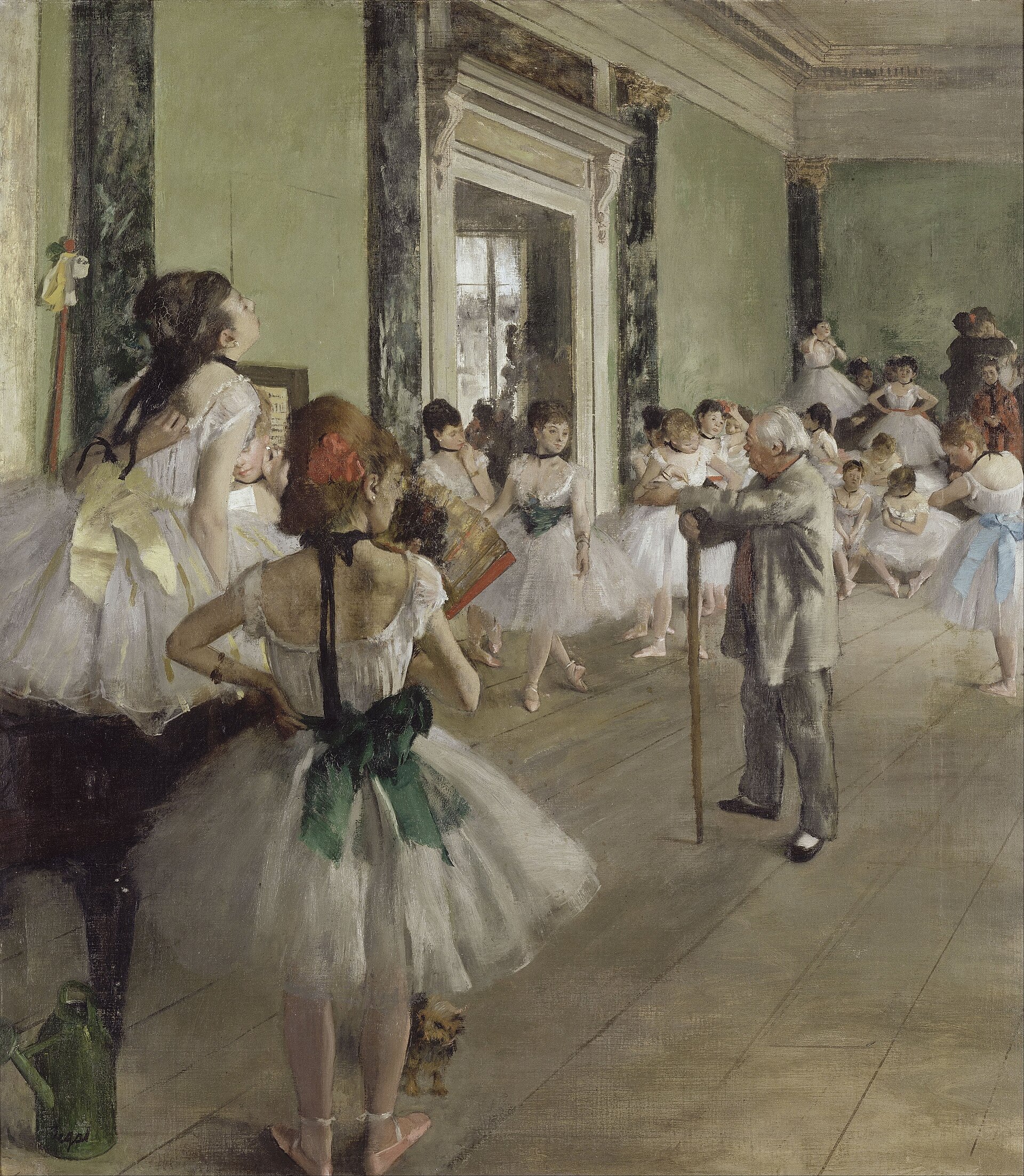
| Musee d'Orsay | Paris | The French state's accumulation across every medium, including some forty pastels, The Bellelli Family (RF 2210), The Ballet Class (RF 1976), Dance Class at the Opera (RF 1977) and L'Absinthe. | The Bellelli Family came from the first atelier sale of May 1918 by way of the Musee du Luxembourg and the Jeu de Paume. Physionomie de criminel and its sketchbook were pre-empted at Christie's in July 2025. Les Choristes, stolen in Marseille in 2009 and recovered in 2018, belongs here. Pastels rotate. |
| National Gallery of Art | Washington | Fifty-two of the sixty-nine surviving original sculptures, including the wax Little Dancer Aged Fourteen (1999.80.28), with paintings and works on paper. | From Paul Mellon's purchase of the whole group of waxes at Knoedler in 1956 for 400,000 dollars, given and bequeathed to the Gallery. The 2011 systematic catalogue by Lindsay, Barbour and Sturman, 412 pages, is the reference work for Degas sculpture and is published online. |
| Metropolitan Museum of Art | New York | The Havemeyer Degas, the largest private holding of the artist ever assembled, bequeathed by Louisine Havemeyer in 1929, including Woman Having Her Hair Combed (29.100.35) and Edition A of the Hebrard bronzes. | Louisine Havemeyer collected on Mary Cassatt's advice. Her pastels hang in deliberately subdued light at 68 to 70 degrees Fahrenheit and 50 per cent relative humidity, and Woman Having Her Hair Combed is one of the rare pastels that is almost always on view. |
| Norton Simon Museum | Pasadena | The sixty-nine bronze modeles bought from the Lefevre Gallery in 1977, plus a large Degas group across media. | The modeles are the intermediate generation from which the serial Hebrard bronzes were cast, so this is the closest a public collection outside Washington gets to the artist's own surfaces in three dimensions. Three were missing in 1977; one was recovered at the foundry in 1979 and one gap was filled by an acquisition in late 2024. |
| Burrell Collection | Glasgow | Twenty-three works by Degas, of at least twenty-four Sir William Burrell bought, including the Portrait of Edmond Duranty (35.232), gouache with pastel on linen, 1879. | Burrell's 1944 gift forbade lending abroad; a shipping magnate knew what sea transit did to objects. The prohibition was lifted only by the Burrell Collection (Lending and Borrowing) (Scotland) Act 2014. The collection reopened after refurbishment in 2022. |
| National Gallery | London | Sixteen works by Degas, including Combing the Hair (NG4865), After the Bath, Woman Drying Herself, and Beach Scene. | Combing the Hair was left unfinished in the studio and was bought after Degas's death by Henri Matisse; the Gallery bought it in 1937 from the Knapping Fund. The Gallery also holds the pictures Sir Charles Holmes brought back from the Degas collection sale of March 1918, which are by other artists but are part of this story. |
| Art Institute of Chicago | Chicago | A deep group of paintings, pastels and monotypes, including Landscape with Smokestacks (1998.915) and Ballet at the Paris Opera. | Landscape with Smokestacks entered the collection in 1998 as the settlement of the Gutmann restitution claim: half given by Daniel Searle, half bought from the heirs at market value, with a label recording the history. |
| Musee des beaux-arts de Pau | Pau | A Cotton Office in New Orleans, 1873 (878.1.2). | The only Degas bought by a museum in the artist's lifetime, for 2,000 francs in 1878, and the first impressionist painting acquired by any museum. Worth the detour for that fact alone. |
| Fitzwilliam Museum | Cambridge | Three of the surviving original sculptures. | Part of the dispersal of the Mellon group. A small but genuine sample of the waxes outside Washington. |
| J. Paul Getty Museum | Los Angeles | Degas photographs, including Louise Halevy Reading to Degas, about 1895, gelatin silver print, and After the Bath, Woman Drying Her Back, 1896. | The photographic work is small, concentrated in 1895 and 1896, and almost never on view; it is the least known part of the corpus and among the best documented. |
| Harvard Art Museums, Fogg Museum | Cambridge, Massachusetts | Degas photographs including the self-portrait in his library, probably autumn 1895, and the institutional home of the Janis monotype catalogue of 1968. | The Fogg published Degas Monotypes in 1968 and mounted the exhibition that established the monotypes as a body of work rather than a curiosity. |
| Bibliotheque de l'Institut national d'histoire de l'art | Paris | Degas monotypes, and digitised copies of the 1918 and 1919 sale catalogues. | The sale catalogues are the primary documents behind almost every Degas provenance line written since, and they are online. Anyone verifying a stamped work should read the actual lot entry rather than the citation of it. |
Degas died on 27 September 1917. The seals on his apartment and studio were lifted in December 1917 and the inventory was taken by the dealers Joseph Durand-Ruel and Ambroise Vollard, with Bernheim...
Degas died on 27 September 1917. The seals on his apartment and studio were lifted in December 1917 and the inventory was taken by the dealers Joseph Durand-Ruel and Ambroise Vollard, with Bernheim jeune, who between them acted as experts to every one of the sales that followed. What they found was two collections in one building: the artist's own unsold output, accumulated over fifty years, and a private collection of other men's pictures that the National Gallery in London describes as more than five thousand works of art.
The dispersal ran in eight parts. The private collection went first, on 26 and 27 March 1918, 247 lots of which 93 were paintings, for 1,966,220 francs. The first atelier sale followed on 6, 7 and 8 May 1918: 336 lots, 113 paintings, 196 pastels, 27 drawings, 5,602,400 francs. In November came three more, all in the same month: the collection's prints on the 6th and 7th, 333 lots for 74,092 francs; the second part of the collection on the 15th and 16th, 264 lots for 137,941 francs; and Degas's own etchings, soft-grounds, aquatints, lithographs and monotypes on the 22nd and 23rd at the Galerie Manzi-Joyant, 293,128 francs. The second atelier sale ran 11 to 13 December 1918, 386 lots for 1,654,190 francs; the third 7 to 9 April 1919, 410 lots for 616,740 francs; the fourth and last 2 to 4 July 1919, 391 lots for 483,115 francs.
The first collection sale opened while fighting was going on about a hundred kilometres from Paris. Lugt calls it the most important sale held since the war began. The National Gallery's director, Sir Charles Holmes, later wrote that a bomb fell close to the train that carried him to it.
One detail of the arithmetic is worth recording because it shows how these figures should be handled. Lugt gives the three collection sales as 1,966,220, 74,092 and 137,941 francs, which sum to 2,178,253. His own subtotal for the collection is 2,178,255, and his grand total of 10,827,828 uses the larger figure. Two francs, in a document that has been the trade's authority for a century. The five sales of Degas's own work do reconcile exactly to 8,649,573. This record reproduces Lugt's figures as published rather than correcting them, and notes the discrepancy.
These are the prices of adjudication as Lugt reports them. He does not state whether the buyer's charge of the period is included, and this record does not assume it either way.
Two marks, and confusing them costs money.
Two marks, and confusing them costs money. Lugt 657 is an oval stamped mark in red ink, 14.5 by 21 millimetres, found on both recto and verso. Lugt's own text is precise about how it got there: it was applied to all the paintings, drawings and prints found in the Degas studio, in December 1917, by the ministerial officers, at the lifting of the seals. Not by the artist. Not by an expert. By a court officer conducting an inventory of a dead man's estate.
The consequence follows immediately and is routinely missed. Degas owned thousands of works by other people. An Ingres drawing or a Delacroix watercolour that was in the studio in December 1917 could carry the same oval as a Degas pastel, because the officers were sealing an estate, not attributing pictures. The oval means the object was in that building on that date. It means nothing else.
Lugt 658 is the smaller mark, 8 by 18 millimetres, on the recto: a facsimile of the signature, applied to the works by Degas that passed into the atelier sales, sized to the sheet, and printed in red on paintings, drawings and pastels and in black on prints and impressions. Larger versions exist at 21 and 26 millimetres wide. This is the mark most auction catalogues mean when they write that a work is stamped with the signature.
What neither mark supplies is the artist's consent. Degas signed work that was leaving the studio for sale. What stayed was, by definition, what he had not released, and he was famous for reclaiming pictures from owners in order to rework them. The National Gallery in London says of its own Combing the Hair, bought after his death by Henri Matisse, that he probably planned to work further on it, that it was never completed, and that it remained in his studio. That picture is a masterpiece by common consent. It is also, on the only evidence that exists, unfinished, and the stamp on a lesser sheet certifies exactly the same thing: that Degas had not let go of it.
The stamps have been forged. Commercial firms sell Degas authentication for a fee. One such service, advertising two decades of experience, describes an early black atelier stamp and a later red estate stamp, which is not the arrangement Lugt records and should tell a buyer how much weight to place on a certificate. The same firm is right about the more important point, and says it plainly: a signature is never the sole ground on which a work can be authenticated, and even a genuine one is only a secondary supporting factor.
The market prices the distinction openly. A signed pastel with an unbroken chain from a lifetime sale sits at the top; a stamped sheet from the fourth atelier sale sits a long way below it. The provenance line that reads Vente Atelier Edgar Degas, Galerie Georges Petit, 4e et derniere vente, 2-4 juillet 1919 is a certificate of origin and a warning at the same time.
Durand-Ruel, Vollard and Bernheim jeune valued the estate, catalogued it, set the reserves and advised the heirs.
Durand-Ruel, Vollard and Bernheim jeune valued the estate, catalogued it, set the reserves and advised the heirs. They also bought at the sales. The Sotheby's catalogue entry for Physionomie de criminel, a pastel Degas had exhibited himself in 1881, gives the provenance without comment: the artist's estate, sold at the second atelier sale on 11 to 13 December 1918 as lot 200, then Ambroise Vollard, Paris.
Nothing about that was illegal or even unusual in 1918; the same firms had been Degas's dealers for decades and were the only people in Paris who could have run the sales at all. But it is a structural fact about the entire Degas corpus, and it belongs in any serious provenance file. The people who decided how the estate would be described, divided into lots and priced were also among the people bidding, and their opinions became the first published account of what Degas had made. The four atelier catalogues reproduce every work, which was remarkable for the period, and identify them by title only, with no descriptions. Those titles, invented in haste in 1918 by the men selling the pictures, are still in use.
From about 1890, as his own prices rose, Degas bought compulsively and talked about founding a museum.
From about 1890, as his own prices rose, Degas bought compulsively and talked about founding a museum. He held twenty paintings and eighty-eight drawings by Ingres, whose pupil Louis Lamothe had taught him; thirteen paintings and a very large body of drawings by Delacroix, many of them from Delacroix's own studio sale; two El Grecos; Manet in quantity, including paintings, drawings and an almost complete set of the prints; Cezanne, Gauguin, Van Gogh, Daumier, Corot, Mary Cassatt, Japanese prints and a great deal else. The National Gallery in London puts the collection at more than five thousand works of art.
The March 1918 sale is where those objects re-entered the world, and one of them can be followed line by line because the National Gallery of Art in Washington publishes the chain. Its Saint Ildefonso by El Greco was in the painter's own possession when he died in 1614, passed to his son, was presented to Carlos II in 1698, surfaced in Paris in the nineteenth century, made 500 francs at the Oudry sale at the Hotel Drouot on 16 and 17 April 1869 as Prelat ecrivant l'histoire de la Vierge, was owned by Jean-Francois Millet, made 2,000 francs at his widow's estate sale on 24 and 25 April 1894 as L'Eveque, and was bought there by Durand-Ruel for Degas. It went through the Degas collection sale on 26 and 27 March 1918, second day, number 2, as Saint Ildefonso ecrivant sous la dictee de la Vierge, then to Knoedler, and was sold on 7 February 1922 to Andrew W. Mellon. It has been in the National Gallery of Art since 1937.
The prices in that room have a shape. Lugt records a very large group of Delacroix drawings, 56 numbers, and 33 Ingres drawings. The best Delacroix, an Arabe a l'affut pastel, made 8,190 francs; three first thoughts for the Palais-Bourbon frieze made 4,000 francs together. Among the Ingres, La Famille Forestier made 18,100 francs and a study for the Grande Odalisque made 14,000 francs, having made 850 francs at the Coutan-Hauguet sale in 1899. A Daumier drawing, Le Tribunal, made 13,000 francs; a Mary Cassatt pastel 10,000. All of it was beaten by a single sheet: the Louvre paid 62,000 francs for Manet's pastel Portrait de Mme Manet etendue sur un canape, against an expert's expectation of 20,000.
The British acquisition from that sale is one of the best documented pieces of state art-buying of the twentieth century, and the National Gallery tells it against itself.
The British acquisition from that sale is one of the best documented pieces of state art-buying of the twentieth century, and the National Gallery tells it against itself. John Maynard Keynes, then at the Treasury, secured a special wartime grant of 20,000 pounds, which the Gallery's own modern equivalent puts at about 1.4 million pounds without stating the method used; this record repeats the figure and the caveat rather than the conversion. The director, Sir Charles Holmes, travelled by ferry and train to Paris to bid.
He shaved off his moustache and wore glasses so that he would not be recognised, on the reasoning that if the room knew a representative of the National Gallery was bidding, prices would rise. He came back with eight drawings and thirteen paintings, among them Gauguin's A Vase of Flowers of 1896 and Delacroix's Louis-Auguste Schwiter. Two large pictures had to be taken out of their frames and bundled together into a personal luggage case, and he paid the excess weight charge. At Charing Cross station he asked the staff for help, and the paintings crossed Trafalgar Square by cart, under lanterns.
Keynes bought for himself as well, including a Cezanne and a Delacroix, and the Cezanne became an object of pilgrimage for his Bloomsbury circle. The scholarly account of the episode is Anne Emberton's in History Today, which is worth naming for a reason beyond its content: its opening paragraph places the sale in the Galerie Roland Petit. The gallery was Georges Petit. Errors of this kind propagate through provenance literature, and a record that does not check them repeats them.
Degas was born on 19 July 1834 at 8 rue Saint-Georges in Paris, the eldest child of Auguste De Gas, a banker, and Marie Celestine Musson, whose family were in New Orleans.
Degas was born on 19 July 1834 at 8 rue Saint-Georges in Paris, the eldest child of Auguste De Gas, a banker, and Marie Celestine Musson, whose family were in New Orleans. His mother died when he was thirteen. He went to the Lycee Louis-le-Grand as a boarder, graduated in 1853, obtained permission to copy at the Louvre and the Bibliotheque Nationale, entered Louis Lamothe's studio in 1855 and spent 1856 to 1859 in Naples, Rome and Florence copying old masters. He was, in short, a rich young man being trained in the classical way, and he adopted the less grandiose one-word spelling of the family name as an adult.
In October 1872 he went with his brother Rene to New Orleans and stayed until March 1873. Out of that visit came A Cotton Office in New Orleans, oil on canvas, 73 by 92 centimetres. He had hoped to sell it to a cotton manufacturer and collector in Manchester and failed, the Panic of 1873 having damaged both the art market and the cotton trade. He showed it at the second impressionist exhibition in 1876. In 1878 a five-member committee appointed by the mayor of Pau bought it for the town's museum for 2,000 francs. It is the only work by Degas acquired by a museum in his lifetime, and the first impressionist painting acquired by any museum.
His father died in 1874, and Degas discovered that Rene had run up enormous business debts. To protect the family name he sold his house and an inherited art collection and paid them. The consequence for the work is direct and is the reason a great deal of it exists: from the mid-1870s Degas had to sell, and he produced monotypes and pastels quickly and in quantity because they could be made and sold fast. The National Gallery of Victoria's chronology dates the crisis to 1875 and the end of the trouble to 1880. The dealer-driven, market-facing Degas of the late 1870s is not a change of temperament. It is a debt being serviced.
He painted the ballet for forty years and the pictures are not about grace.
He painted the ballet for forty years and the pictures are not about grace. They are about labour, hierarchy and access: the class, the rehearsal, the wings, the exhausted girl scratching her back, the black-coated subscriber waiting in the corner of the frame. The dancers of the Paris Opera were working-class girls, and their mothers negotiated with the men who paid. This is the same eye that produced the laundresses and the milliners.
It is also the reason the corpus is so hard to catalogue. Degas repeated his subjects relentlessly, in different media, at different scales, with figures traced from one sheet to another and reversed, extended, cropped and reused. Titles were then attached in 1918 by men working through hundreds of lots in a few weeks. A record that says Danseuses and gives a date is describing an entire genus, not a specimen. This is the single largest practical risk in Degas provenance, and it is why every plate on this page names its holder and, where one exists, its accession number.
Degas is one of the two or three greatest pastellists in the history of the medium, and the way he achieved it is precisely the reason his best works can rarely be shown.
Degas is one of the two or three greatest pastellists in the history of the medium, and the way he achieved it is precisely the reason his best works can rarely be shown. The Metropolitan's conservator emerita Marjorie Shelley sets out the physics: unlike paint, in which pigment is surrounded by oil or water, a stick of pastel contains only a minimal amount of binder and stays powdery. Diderot's line, which she quotes, is still the best description of the problem, that the precious powder falls off as easily as scales from a butterfly's wings.
His method was to build in layers, which pastel does not naturally permit, and the enabling technology was a fixative he did not have to buy. Commercial fixatives dulled the tone and killed the matte surface he wanted. His friend Luigi Chialiva, a painter trained as an architect and, more to the point, a chemist, made him one that fixed a layer without altering the colour. Degas never covered a whole composition with it. He used it as a barrier in chosen areas, which both locked the underlying powder down and left a slightly roughened surface for the next layer to catch on. The Thyssen-Bornemisza's technical study of At the Milliner's confirms the layer-by-layer sequence directly from the object. The recipe has not been reconstructed; the Museum of Fine Arts in Boston says of Degas that he used processes that still elude explanation.
Everything else in his practice compounds the fragility. He chose cheap machine-made wood-pulp paper for its colour and its tooth, and tracing paper, which Anne Maheux notes had been commercially available in rolls since 1865 and which David Bomford points out is almost the wrong support for pastel because it has no texture to catch pigment. He extended compositions by gluing on strips: a band at the base of the National Gallery's After the Bath, Woman Drying Herself adds about an eighth to the picture; other works are enlarged by nearly a third. That National Gallery pastel is made of seven pieces of wove paper, and conservators established that he worked the two central panels first and added to them later, which means fixative had to be applied to the earliest segments in order to secure them before they were glued down. He did not do the mounting himself: it was probably done by the Paris framer known as Pere Lezin or by the specialist printmakers Adam-Dupre, and Bomford cites precise instructions from Degas to the colleur about adding strips to The Dance Lesson.
Then there is the colour itself. Shelley records that many of the new synthetic colorants available to him were not long-lived, that their presence in the Met's Woman Having Her Hair Combed was established by X-ray fluorescence, and that colours in the crimson family and the aniline-dyed papers he liked are fugitive. That is why the Met's pastel galleries are kept dim, and why the sheets are held between 68 and 70 degrees Fahrenheit at 50 per cent relative humidity. Boston states the rule of thumb baldly: pastels can rarely be exhibited, typically for only a few months per decade.
Three market conclusions follow and they are not soft. First, no Degas pastel can be conserved back: fixative cannot be applied now, because it darkens the colour and destroys the high-keyed brightness that is the point of the medium. Fading is permanent. Second, the mounts are a structural risk in their own right, because the recycled millboard has grown brittle and warped and can pull the paper apart; the Met has chosen not to separate its pastel from its backboard, on the ground that the mounting was part of Degas's conception. Third, exhibition history is not a virtue on a Degas pastel the way it is on an oil. A sheet with a long loan record has spent more of its life under light, and light is the only thing that has ever destroyed value in this medium at scale. On a Degas pastel, condition is not a discount line. It is most of the price.
Degas was the least conservative technician of his generation.
Degas was the least conservative technician of his generation. Where the other French impressionists stayed almost entirely with oil on canvas, he moved between oil, peinture a l'essence, pastel, gouache, distemper, watercolour, monotype and combinations of all of them.
Essence is oil paint with the drying oil blotted out and the remaining pigment thinned with turpentine, which gives a dry, matte, fast-drying film suited to paper and bristol board. He used it throughout, from early studies to the late Dancer Fastening Her Shoe in Cleveland, which sets four views of the same dancer together on one sheet in a composite that recalls the sequential photographs of Muybridge and Marey. He also wetted pastel and applied it with a brush, and he laid pastel over monotype in oil colours, so that a print supplied the tonal armature and the pastel supplied the surface.
The practical point for anyone reading a catalogue is that Degas's medium lines are long, specific and load-bearing. Portrait of Edmond Duranty in the Burrell Collection is gouache with pastel on linen. Landscape with Smokestacks in Chicago is pastel over monotype on textured cream wove paper, edge-mounted on board. Ballet at the Paris Opera in Chicago is pastel over monotype on cream laid paper. These are not curatorial fussiness. They are the difference between an object that can hang for years and an object that can be shown for weeks.
Degas worked in monotype over many years and treated the plate as a drawing surface.
Degas worked in monotype over many years and treated the plate as a drawing surface. Two manners: the dark-field, in which the plate is inked all over and the image wiped out of the ink; and the light-field, in which ink is brushed or ragged onto a clean plate. Neither produces an edition, which is the point of the medium and which Degas immediately attacked, by running the plate through the press a second and sometimes a third time. The residual ink yields a fainter image, called a cognate or ghost, and Degas then worked the cognate up in pastel, so that a technically inferior second pull became the ground for a new and independent work.
The scholarly base is Eugenia Parry Janis's Degas Monotypes: Essay, Catalogue and Checklist, published by the Fogg Art Museum at Harvard in 1968 with a checklist of 321 monotypes. Janis declared 141 of those 321 missing, which is 44 per cent of the catalogued corpus unlocated at the moment of cataloguing. The Museum of Modern Art assembled about 130 monotypes with some 50 related works for Edgar Degas: A Strange New Beauty in 2016, which was the first attempt in half a century to show the material as a body.
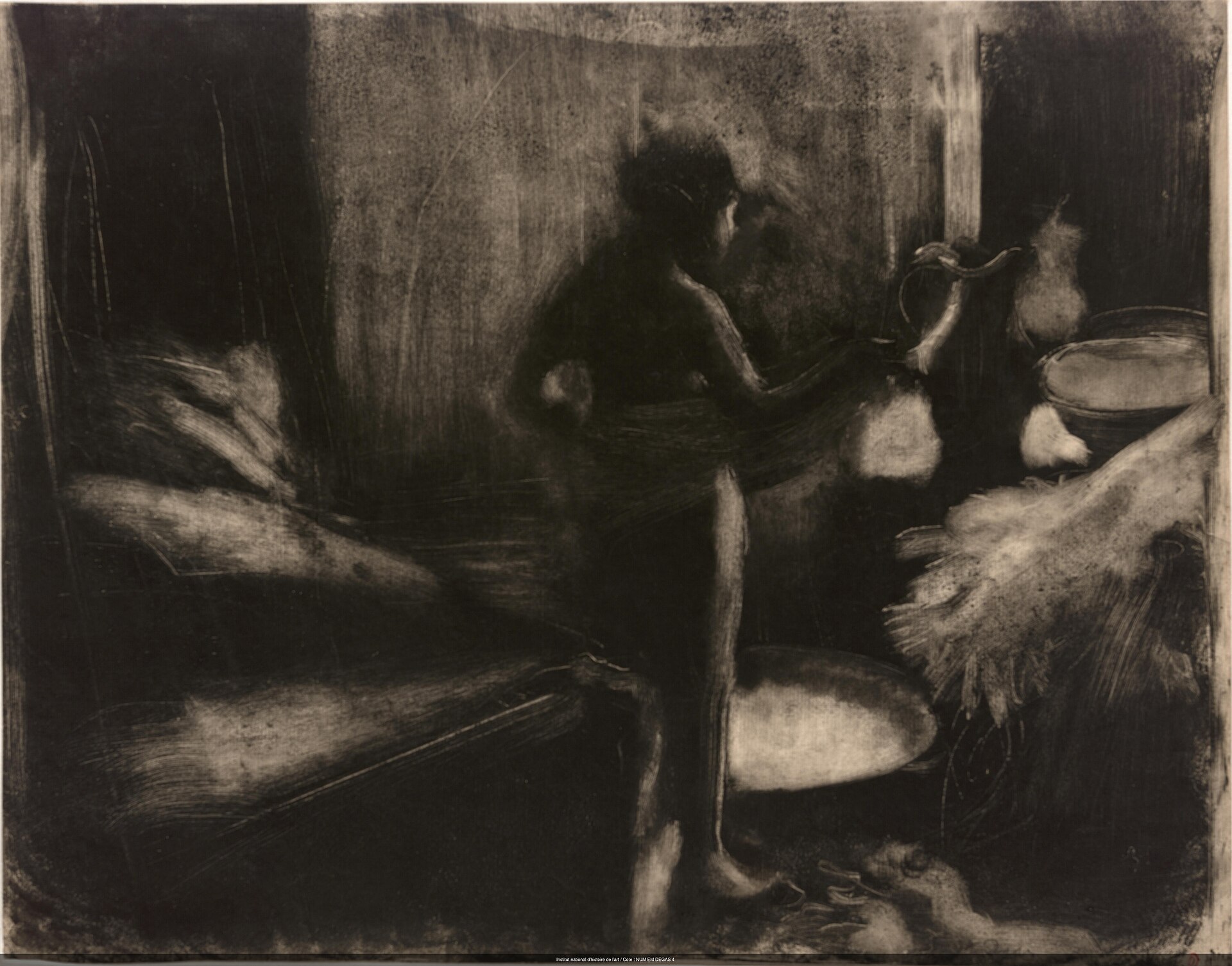
The commercial history is documented to the lot. The monotypes and prints were sold separately from the paintings and pastels, at the Galerie Manzi-Joyant on Friday 22 and Saturday 23 November 1918: 114 etchings, soft-grounds and aquatints, 64 lithographs and 139 monotypes, for 293,128 francs. Lugt names the top monotype prices: Les repasseuses at 8,000 francs, La Fete de la patronne at 7,000, La Toilette at 3,100, and one lot of sixteen brothel scenes, Scenes de maisons closes, sold together for 8,500 francs. Sixteen pictures in one lot is a decision about respectability, taken by the experts, at a moment when the family was disposing of an estate. A number of the erotic monotypes were destroyed before the sales; how many, and by whom, is not established here.
The monotypes matter to the wider corpus for a reason that has nothing to do with printmaking. A large proportion of the landscapes and many of the bathers are pastel over monotype, which means that the object a collector is buying as a Degas pastel began as a print. The tonal structure is not drawn. It is transferred.
In the autumn of 1895 Degas took up photography with the intensity he brought to everything, and one witness wrote that he abandoned himself entirely to it.
In the autumn of 1895 Degas took up photography with the intensity he brought to everything, and one witness wrote that he abandoned himself entirely to it. He worked indoors, at night, by lamplight, with long exposures, posing his friends and rearranging them for as long as it took. Malcolm Daniel's study assembles the eyewitness accounts from the journals of Daniel Halevy and Julie Manet.
The best known session took place on the evening of 28 December 1895 at the house of Louise and Ludovic Halevy. Degas lost track of which plate holders he had already used and double-exposed two negatives instead of exposing four, producing images in which bodies intersect at right angles and heads surface out of other heads. The results are extraordinary and they were an accident.
Two of his photographs are reproduced on this page: a self-portrait made in his library, probably in the autumn of 1895, now at Harvard, and Louise Halevy Reading to Degas, about 1895, at the Getty. The second is worth pausing on, because within two years he would not be in that room. The photographs are also the only reliable likenesses of him from the period; he made almost no painted self-portraits after the 1850s.
Degas had no programme, no manifesto and no mysticism.
Degas had no programme, no manifesto and no mysticism. What he did have was a set of documented intellectual commitments, and one picture states them without ambiguity.
In 1880 he sat in the press area at the trial of Emile Abadie and two other young men accused of murder, one of them Michel Knobloch, and drew the defendants in a sketchbook. Abadie had already been convicted the previous year for three killings, one of them of an old woman who sold newspapers not far from Degas's apartment, and he had appeared as a walk-on in a stage adaptation of Zola's L'Assommoir, a coincidence which the Paris press treated as evidence of the thing itself. Out of the sketchbook came Physionomie de criminel, a pastel of the two accused in profile in the dock.
Caroline Corbeau-Parsons, the Musee d'Orsay's curator of drawings and painting, describes what he did between sketch and pastel: he retouched the defendants' features to make them conform to the stereotypes of criminality, low receding foreheads, receding chins, small eyes, aquiline noses, and set them in profile according to the conventions of criminal anthropology and phrenology. Knobloch's pupils are tinged with the same red Degas used for his hair, the colour of a fox. This is the biological determinism of Lombroso and his followers, and Degas was interested in it.
He hung that pastel at the sixth impressionist exhibition in 1881 alongside the wax Little Dancer Aged Fourteen, and the Orsay's reading of the pairing is the strongest available explanation of why the wax was received as it was. The girl was another working-class model in whose features, in Douglas Druick's phrase, Degas highlighted the signs of atavism; and the glass case she stood in echoes the railing of the dock in front of Abadie and Knobloch. This record's separate file on the Little Dancer records the abuse the critics gave her, the flower of precocious depravity and the hateful promise of every vice. It is now clear that they were reading the room as Degas had arranged it.
That is the whole of his intellectual position as it can be evidenced: a naturalist chronicler of the contemporary world, a classicist by training who thought drawing was the discipline, a reader of the period's determinist science, and a man with no recorded interest in anything beyond the visible. The absence of a hidden programme in Degas is not a gap in the research. It is the finding.
In December 1894 Degas supported the conviction of Alfred Dreyfus.
In December 1894 Degas supported the conviction of Alfred Dreyfus. By 1897 his antisemitism had made him impossible for the Halevys, the family he had been closest to for thirty years and had photographed two years earlier, and they broke off contact. In 1898 Julie Manet recorded his entrenched antisemitism in her journal. In 1899 he refused to contribute to an edition of Mallarme because the publisher supported Dreyfus. When Dreyfus was exonerated in 1906 his hostility was unchanged. He broke with his Jewish friends and did not repair it.
This belongs on the page for two reasons, neither of them moralising. The first is evidentiary: this is one of the very few areas where Degas's opinions are documented rather than inferred, and a page that omits it is choosing to be less accurate about the man than the sources allow. The second is practical, and concerns provenance. Degas's own dispersal happened in 1918, before the period that generates most twentieth-century restitution claims, and his patronage in the 1890s ran heavily to Catholic and conservative circles rather than to the Jewish collecting families whose losses dominate the Klimt or Schiele markets. But the works themselves passed through exactly the same European collections as everything else, and at least one Degas has been the subject of a landmark Nazi-era claim. His politics did not protect his pictures from the history that followed.
Eight sales dispersed the paintings, pastels, drawings, prints and monotypes.
Eight sales dispersed the paintings, pastels, drawings, prints and monotypes. Not one of them included a sculpture. The Metropolitan's Clare Vincent records that more than 150 pieces of sculpture were found in the studio, most of them wax, clay and plastiline, and nearly all in some stage of deterioration; the National Gallery of Art's catalogue says more than one hundred, all dusty, some fallen apart. Instead of consigning them the heirs signed a contract with the Hebrard foundry, dated 13 May 1918, authorising reproduction in bronze.
The terms are specific. Each edition was limited to twenty casts for sale, plus one for Adrien Hebrard, head of the foundry, and one for the heirs: twenty-two in all. The foundry took a share of net sales. All the bronzes were to be stamped Degas. The contract set out a method for marking individual casts which was not, in fact, the method used. What Hebrard actually did, as recorded in the catalogue of the first exhibition of the bronzes in Paris in 1921, was to give each sculpture a number from 1 to 73 and each series of casts a letter from A to T, so that a bronze reads as a number over a letter, 40/A for the first cast of sculpture 40. The set for the Degas family was marked HER.D and the set for Hebrard HER. The founder's seal reads CIRE PERDUE A.-A. HEBRARD inside a rectangle. In practice number 73, the Little Dancer, was not numbered.
The casting was the work of one man, Albino Palazzolo, 1883 to 1973, who devised a variation on lost-wax that preserved rather than consumed the originals by making expendable duplicate waxes to be melted in their stead. Albert Bartholome, a sculptor and Degas's old friend, prepared and restored the figures before casting. Casting began in 1919. The Schoolgirl was left out of the initial editions and has its own casting history.
Two figures should sit side by side. The contract permitted 1,606 casts, twenty-two of each of seventy-three figures. The Nelson-Atkins catalogue records that by 1936 Hebrard's books showed 567 Degas casts sold. Hebrard cast piecemeal, to demand, rather than completing editions. So the word edition, applied to a Degas bronze, describes a permission and not a production run: most letters of most figures were never made, and the cohort a collector is buying into is far smaller and far less regular than twenty-two.
The counts of how many figures were cast do not agree and should not be smoothed. The Metropolitan says seventy-two figures were authorised and numbers ran 1 to 73. ARTnews, reporting the National Gallery of Art's catalogue, says the heirs contracted to cast 73. The National Gallery of Art and Arthur Beale give seventy-four figures cast; Patricia Failing gives seventy-three; the Nelson-Atkins computes 1,606 from seventy-three. Norton Simon bought sixty-nine modeles. This record reports the range and names each holder of it.
For a quarter of a century the standard account of the Degas bronzes was wrong, and the correction came out of a foundry basement.John Rewald published the first catalogue of the bronzes in 1944 and...
For a quarter of a century the standard account of the Degas bronzes was wrong, and the correction came out of a foundry basement.
John Rewald published the first catalogue of the bronzes in 1944 and reported that Degas's original mixed-media figures had been sacrificed in the lost-wax casting. In 1955, sixty-nine of the supposedly destroyed originals reappeared and were shown at Knoedler in New York with the assistance of Rewald and the French collector Ludwig Charell. Paul Mellon bought the entire group for 400,000 dollars, and most of it went to the National Gallery of Art in Washington, the museum his father had founded in 1937.
Suzanne Glover Lindsay's work for the National Gallery catalogue dismantles the discovery story. Letters in the Gallery's archive from Marlborough in London show that the museum was approached about the waxes as early as 1953, when Marlborough offered to put its chief curator John Walker in touch with an attorney acting for an unnamed benefactor interested in donating a set of wax models by Degas. Marlborough was a major seller of Degas bronzes in the early 1950s, had connections to Rewald, who advised Mellon, and to the Hebrard family; in 1952 it sold a bronze Little Dancer to the Tate whose previous owner was a relative of Puvis de Chavannes married to Nelly Hebrard. Lindsay concludes that the lifetime sculpture had been on the market for some years before 1955 and that public information about it may have been deliberately managed so as not to compromise the market in the bronzes. It is also unclear how or when the Hebrard family came to own the originals at all, since they were offered at Knoedler by the Hebrards and not by Degas's heirs.
The second correction was larger. Palazzolo had made master casts in bronze, called modeles, from which the serial bronzes were cast. Their existence was a foundry secret, unknown to scholarship until Palazzolo revealed it, and unknown to the market until 1976, when Hebrard's heirs exhibited the whole set at the Lefevre Gallery in London. The Norton Simon Art Foundation bought sixty-nine of them in 1977.
What that set proved is the fact every buyer of a Degas bronze now has to absorb. Except for the Little Dancer, the serial bronzes were not cast from Degas's wax. They were cast from a bronze intermediary. A cast taken from a cast is a surmoulage, which the trade normally refuses, and bronze shrinks about two per cent on cooling, so each generation is smaller than the last. Before 1976 a collector could believe that a lettered Hebrard bronze stood one step from the artist's hand. After 1976 it stood two, and the objects one step away were in Pasadena. Every serious Degas sculpture catalogue since has been written around that distinction.
The Norton Simon set was not complete. Three modeles were missing in 1977. One, Horse trotting, the feet not touching the ground, turned up at the foundry in 1979 and was bought at once. After Simon's death in 1993 the Foundation committed funds to buy serial casts of the two remaining gaps if suitable examples appeared. One did: Arabesque over the right leg, left arm in front, modelled in the mid to late 1880s and cast between 1919 and 1921, came on the market in late 2024 and was acquired as a fiftieth birthday present to the museum. Forty-eight years to fill two holes in a set of sixty-nine.
This publication's separate record on the Little Dancer Aged Fourteen covers the one figure that breaks the pattern, the two plasters Palazzolo took from the wax instead of a bronze master, Arthur Beale's argument that the Joslyn plaster is the true lost modele, and the contested Valsuani casts. That material is not repeated here.
There is no Degas authentication board and there never has been.
There is no Degas authentication board and there never has been. Attribution is done by named individuals, and the reference literature is a stack of books of different ages that do different jobs.
Paul-Andre Lemoisne's Degas et son oeuvre, four volumes published from 1946, is the foundation and the source of the L numbers still cited in every catalogue entry; it runs to 1,466 numbers covering paintings and pastels. A fifth volume, the supplement by Philippe Brame and Theodore Reff, followed in 1984. Lemoisne's limits are structural rather than scandalous: he was working before the technical study of Degas's supports and media existed, his datings for the undated majority rest on connoisseurship, and his catalogue takes as its raw material the 1918 and 1919 sale catalogues with their hastily invented titles. For the prints the authority is Loys Delteil in volume IX of Le Peintre-graveur illustre, published in 1919 and recommended by Lugt himself. For the monotypes it is Janis, 1968.
Two digital projects are now in the field and they are not the same thing. Michel Schulman, a Paris expert, published a digital critical catalogue of the paintings, pastels and drawings on 17 September 2019; it carries over 1,800 paintings and pastels and about 1,600 drawings, with about 3,300 exhibition records, 1,700 bibliographic references and more than 6,100 auction lots, uses MS numbers and provides a concordance to Lemoisne. Separately, a project founded in 2021 by Teresa Krasny of OpAL Art to update Lemoisne and the Brame and Reff supplement passed in 2025 to the Wildenstein Plattner Institute, which is publishing it as Edgar Degas: Catalogue Raisonne of Paintings and Works on Paper. The first installment, launched in September 2024, covers works in public collections in the United Kingdom and Ireland, with an introductory essay by Frances Fowle of the University of Edinburgh on the market for Degas in Britain and Ireland. The WPI publishes no total and states no attribution policy.
So the position a buyer actually faces is this: two live catalogues with different numbering systems and different scopes, neither complete, over an eighty-year-old foundation catalogue, with no body empowered to accept or reject anything. In that vacuum, commercial firms sell certificates. What carries weight in the room is a named scholar's written opinion, physical evidence, and a provenance that reaches an 1918 or 1919 lot number.
One case shows the whole machinery working. In 2021 a pastel listed on the Spanish auction site Todocoleccion as a fake Degas, opening at one euro, was bought by an unnamed Barcelona collector for 926 euros, about 1,000 dollars. Schulman, with the art historians Judith Urbano and Alvaro Pascual and the consultant Juan Arjona Rey, analysed the pigments and made X-rays and photographs in Madrid in July 2023, dated the work to the late nineteenth century, and checked that the signature was integrated in the surface rather than added later. They identified it as Eloge du maquillage of 1876, a brothel scene recorded as missing for decades, and reconstructed the chain from labels on the back: bought from Degas in Paris in 1887 by the artist Julian Bastinos for 3,000 francs, a transaction recorded in a letter from Degas to the opera singer Jean-Baptiste Faure; taken to Cairo in the 1910s and framed there; repatriated to Barcelona after Bastinos died in 1918; confiscated in 1934 as one of 150 works from the family collection and stored in the monastery of Pedralbes during the Spanish Civil War; recorded on a Francoist Ministry of National Education label as recovered from the enemy in January 1939; returned to the family in 1940 and sold to the banker Joan Llonch Salas on 13 September 1940 for 3,000 pesetas; last seen in public in a group show at the Barcelona gallery Gaspar in 1952. It was presented at the Institut Francais in Madrid on 28 May 2024. Valuations reported then ran from 7 to 8 million euros to as much as 12 million.
No committee ratified any of that. One expert with a laboratory and a stack of old labels moved an object from one euro to eight figures. That is the Degas authentication system, described accurately.
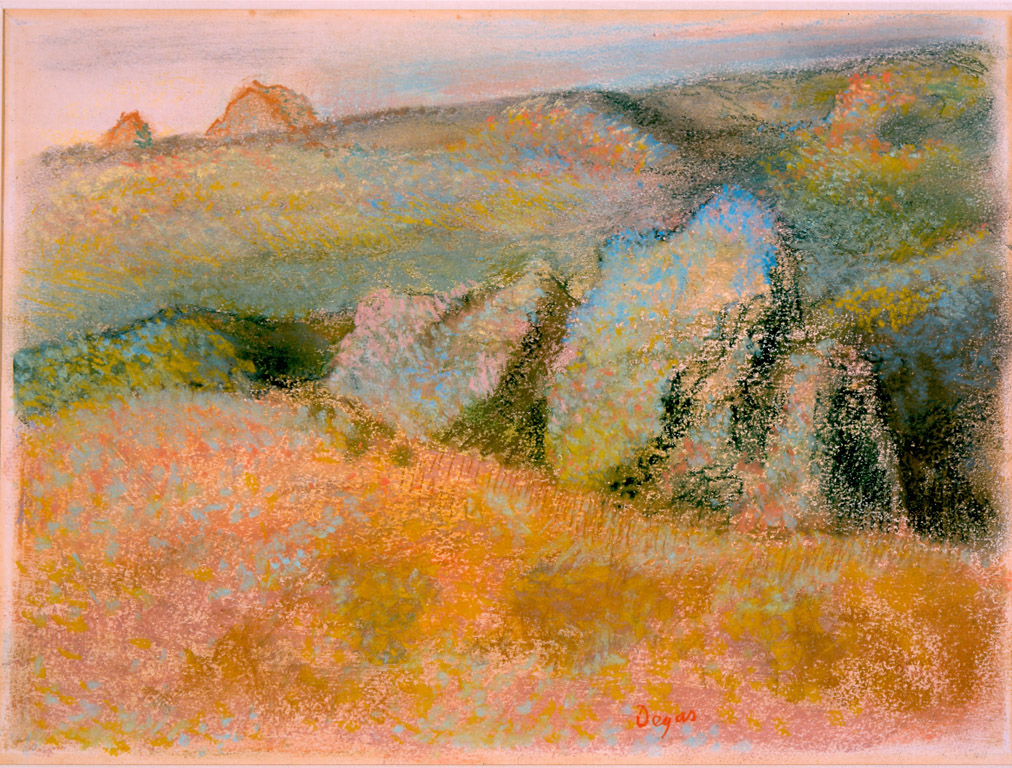
Landscape with Smokestacks, about 1890, pastel over monotype on textured cream wove paper edge-mounted on board, 317 by 416 millimetres, is the Degas that made American restitution law.
Landscape with Smokestacks, about 1890, pastel over monotype on textured cream wove paper edge-mounted on board, 317 by 416 millimetres, is the Degas that made American restitution law. The Dutch collectors Friedrich and Louise Gutmann acquired it in 1932 and sent it to Paris for safekeeping in 1939. It was taken during the war; both owners were murdered, Friedrich at Theresienstadt and Louise at Auschwitz. In 1987 Daniel Searle, an heir to a pharmaceutical fortune and a trustee of the Art Institute of Chicago, bought it for 850,000 dollars. The heirs, Lili Gutmann and her brothers Nick and Simon Goodman, asked for it back in 1995 and sued in 1996 in the United States District Court for the Northern District of Illinois.
The settlement of August 1998 is the model that most later American cases copy. Ownership was divided equally. Searle gave his half to the Art Institute; the museum bought the heirs' half at fair market value. The heirs had spent about 200,000 dollars on legal fees by then and received roughly 500,000. A label went up next to the picture recording what had happened. Nobody won outright, which is the point: the case established that a claim of this kind could be litigated in an American court against a domestic collector, and that the cost of defending one was high enough to make settlement rational.
The other cautionary object is Les Choristes, a pastel of 1877 showing the choral finale of the first act of Don Giovanni, about ten by thirteen inches, owned by the Musee d'Orsay. It was on loan to the Musee Cantini in Marseille and was taken on the night of 30 to 31 December 2009, the closing day of the exhibition. There was no sign of forced entry and it had been unscrewed from the wall; an inside job was suspected. On 16 February 2018 French customs officers made a random search of a public bus at a motorway rest area at Ferrieres-en-Brie in Seine-et-Marne and found it in a suitcase in the luggage compartment. No passenger claimed the bag. The Musee d'Orsay authenticated it quickly. The stated value was one million dollars, about 800,000 euros, although early French reports cited an insurance figure of 30 million euros and the low figure was disputed at the time.
Both cases point the same way for anyone doing diligence. A Degas is small, light, mounted on board and easy to move; it exists in dozens of near-identical siblings; and its title was probably invented by a dealer in 1918. Those four facts together are the reason a Degas file needs a lot number, an accession number and a photograph, not a name and a date.
The first tier is the posthumous bronze, and it holds the artist's auction record: 36 million dollars hammer, 41,610,000 dollars with premium, for a Petite danseuse de quatorze ans commissioned from...
The first tier is the posthumous bronze, and it holds the artist's auction record: 36 million dollars hammer, 41,610,000 dollars with premium, for a Petite danseuse de quatorze ans commissioned from Hebrard in August 1927, sold from the collection of Anne H. Bass at Christie's New York on 12 May 2022 against an estimate of 20 to 30 million. The same composition made about 15.8 million pounds at Sotheby's in 2015 and 25 million pounds at Sotheby's in June 2026. The commercial oddity of Degas is that his record is held by an object he did not make, made from a mould he did not authorise, by a foundry contracted seven months after his death.
The second tier is the two-dimensional work, where the top of the market is pastel rather than oil. Danseuse au repos of 1879, pastel and gouache on joined paper, 59 by 64 centimetres, signed Degas at the lower right, made 17.6 million pounds at Sotheby's London on 28 June 1999 against an estimate of 5 to 7 million, which was then the highest price paid for any Degas. The same sheet returned to Sotheby's New York on 3 November 2008 and made 37,042,500 dollars with premium, a record for the artist and, at the time, for any work on paper. Its provenance is the reason: acquired in 1885 by Jules-Emile Boivin either directly from the artist or through Durand-Ruel, and by descent in that family until 1999. It never went near the atelier sales, and it is signed.
The Anne Bass sale of May 2022 gives a clean three-point calibration of the second tier in one evening, because the reporting separates hammer from premium. The bronze made 36 million hammer and 41.6 million with fees. Danseuse attachant son chausson of 1887, pastel on buff paper, estimated 4 to 6 million, made 7.5 million hammer and 8.9 million with fees. Femme en peignoir bleu le torse decouvert of 1887 to 1890, in oil, estimated 1.2 to 1.8 million, made 2.4 million hammer and 2.9 million with fees. Pastel over oil, roughly three to one, in the same room on the same night.
The third tier is the stamped material: the drawings, the studies, the sheets from the third and fourth atelier sales. Lugt's own account of those two sales tells you why it behaves differently. By April 1919 the important things had gone, and the third sale's drawings ran from about 3,000 to 5,700 francs at the top with an average around 1,500 and a floor near 500; the fourth sale's black impressions ran from 100 to 880 francs. That relative structure has held for a century. It is a broad, deep, liquid market in objects that are unsigned, small, technically simple and made by an artist whose name carries nine figures at the top, which is the standard profile of an attackable market.
The historical prices are worth setting beside the modern ones because they show how fast the reputation was capitalised. The single highest price of the whole estate dispersal was not a dancer: the Musee du Luxembourg bought The Bellelli Family, 200 by 253 centimetres, painted between 1858 and 1867 and effectively unseen since, at the first atelier sale for 400,000 francs. At that same sale no pastel sold below 10,000 francs, the average ran between 15,000 and 16,000, and the top lots passed 30,000: Trois danseuses, jupes bleues, corsages rouges at 32,600 francs, Deux danseuses, decor d'arbres at 32,500, Au musee du Louvre at 30,500. Forty years earlier the town of Pau had bought A Cotton Office in New Orleans for 2,000 francs and that was the only museum purchase of his lifetime.
Two present-tense items. In July 2025 Physionomie de criminel was offered at Christie's and the Musee d'Orsay exercised the French state's right of pre-emption, taking both the pastel and the related sketchbook at the sale; the price has not been published in the sources consulted. The same pastel had been offered at Sotheby's London on 24 June 2015 as lot 33 with an estimate of 300,000 to 400,000 pounds. And in October 2026 Sotheby's New York offers the multi-part Magnum Opus collection from an anonymous seller, in which a Degas pastel is reported to carry an estimate of 5 to 7 million dollars; the house's own press release was not reachable and the figure here comes from trade reporting.
The holdings are unusually concentrated and unusually legible, because so much of the corpus entered public collections in a single generation through two channels: the 1918 and 1919 sales, and the...
The holdings are unusually concentrated and unusually legible, because so much of the corpus entered public collections in a single generation through two channels: the 1918 and 1919 sales, and the American collectors advised by Mary Cassatt.
Louisine Havemeyer, guided by Cassatt, built the largest private Degas holding in the world and left it to the Metropolitan Museum in 1929; the H. O. Havemeyer credit line runs through the Met's Degas galleries, and she also owned Edition A, the first and best of the Hebrard sets. Paul Mellon bought the sixty-nine surviving waxes in 1956 and gave them to Washington, where fifty-two of them are, alongside nineteen paintings and seventy-one works on paper. Norton Simon bought the sixty-nine bronze modeles in 1977 and has spent nearly fifty years completing the set. The Musee d'Orsay holds the French state's accumulation, including some forty pastels and the works pre-empted or bought at the estate sales.
Two constraints on access are worth knowing before planning a research trip. Pastels, everywhere, are shown for months rather than years, on the Boston rule of a few months per decade, and the Met's Degas pastels hang under deliberately subdued light. And the Burrell Collection in Glasgow, which received twenty-three works by Degas out of at least twenty-four that Sir William Burrell bought, among them the Portrait of Edmond Duranty, was for seventy years unable to lend any of them abroad, because Burrell, a shipping magnate who knew what sea transit did to objects, prohibited overseas loans in his 1944 gift. The prohibition was lifted only by an Act of the Scottish Parliament, the Burrell Collection (Lending and Borrowing) (Scotland) Act 2014, passed on 21 January 2014 and given Royal Assent on 25 February 2014, and even then only with the agreement of the Burrell trustees under a published code. A twentieth-century collector's shipping instincts became a statutory question, and the answer took an Act.
Painter; Pastellist; Draughtsman; Printmaker; Sculptor; Photographer. 1834-1917.
Born 19 July 1834, 8 rue Saint-Georges, Paris; died 27 September 1917, Paris; buried in the family vault, Montmartre cemetery.
The stamp is forgeable and is not an opinion. Both marks can be faked, and both are routinely over-read. Lugt 657 records only that an object was in the studio when the seals were lifted in December 1917, which is why it can appear on drawings by Ingres or Delacroix that Degas owned.
Musee d'Orsay (Paris); National Gallery of Art (Washington); Metropolitan Museum of Art (New York); Norton Simon Museum (Pasadena); Burrell Collection (Glasgow); National Gallery (London).
Three markets trade under this name and they behave differently. Posthumous bronzes hold the auction record.
What was the total of the three Degas collection sales? Lugt publishes 1,966,220, 74,092 and 137,941 francs, which sum to 2,178,253, but gives his own subtotal as 2,178,255 and computes the grand total of 10,827,828 from the larger figure.
Degas made one Little Dancer and never sold it. The 41.6 million dollars paid in 2022 was for a bronze cast a decade after his...
12 min read
Measured across 223 records, an inheritance link spans a median of 27 years against 14 for a purchase and 7 for a purchase at...
12 min read
Last verified 17 September 2026
One artwork and its story every Tuesday, with the picture: who owned it, what it made, and what closes soon in the exhibition calendar. No promotion, and nothing we cannot cite.
We send one email to confirm the address and keep nothing else. Every letter carries a one-click unsubscribe. How we handle your data.
