What the Opera Paid Marie van Goethem
The model for Degas's Little Dancer is documented in a payroll and two lines of his handwriting. The famous sentence about her face was written about two other drawings.
Records in this piece: Little Dancer Aged Fourteen, Girl with a Pearl Earring
On this page 7 sections
ContentsClose
In short
- The sentence most often quoted against her face was written about two other pictures. Huysmans's low foreheads and jutting jaws belong to two pastels called Criminal Physiognomies, which he listed among the drawn and painted works and closed off before he reached the wax. The critic who did read vice into her face is Paul Mantz in Le Temps of 23 April 1881.
- The only continuous record of her life is her employer's bookkeeping. An annual contract of 900 francs, a monthly salary of 75 francs, bonuses of 20 to 30 francs in her school years and 109 francs in May 1880, all of it in the AJ 13 series at the Archives nationales.
- An afternoon of posing paid her about what her mother earned in five or six evenings. A model's fee was five to six francs for a four-hour sitting, and her mother was paid one franc per performance as an additional dresser.
- Her dismissal in 1882 survives as a document and its cause does not. A note in Pluque's handwriting countersigned by Vaucorbeil records that she has been dismissed, and no cause is stated in it. The payroll goes further and shows no disciplinary measures for either sister for days missed or illness, and the cafes come from a newspaper paragraph whose entire argument is the word consequently.
- The Louvre still prints an 1864 birth date, and 1864 is the year of a sister who lived eighteen days. Marie Genevieve van Goethem was born on 7 June 1865, and our own record has the right date.
- The criminal reading of the sculpture is a modern argument, not a contemporary one. The National Gallery's own scholarly edition attributes it to Anthea Callen and Douglas Druick, says it is rarely questioned and then concludes that Degas apparently chose against those physiognomic signs in the finished figure.
- A comparison to a fictional character is now a database field. Kahane's sentence compares the mother to Mrs Cardinal, a character in Ludovic Halevy's novels, and Wikidata's entry for Marie van Goethem lists prostitute as one of three occupations, with no qualifier and no reference of any kind.
The most quoted sentence about her face was written about two other pictures
The phrase that has followed Marie van Goethem for more than a century, the low foreheads and the jutting jaws, was written by Joris-Karl Huysmans about two other pictures. In his account of the sixth impressionist exhibition, collected in L'Art Moderne in 1883, Huysmans works through what Degas had sent: a view of the wings, singers on stage, the dancer Becat. Then he writes, and the words are his own list-making, add two more sketches, criminal physiognomies, animal muzzles, with low foreheads, jutting jaws, short chins, shifty evasive eyes and a very astonishing nude woman at the end of a room, and you will have the list of the drawn or painted works brought by this artist.
The sentence is a full stop. Everything before it is drawing and paint. Only after it does he turn to the object, and he turns with an announcement: the interest of the exhibition this year is not in the drawn or painted work, it is entirely in a wax statue called Petite Danseuse de quatorze ans, in front of which the public, bewildered and as if embarrassed, flees. Two pages later he gives his verdict on it. This statuette, he writes, is the only truly modern attempt I know of, in sculpture.
The two works he had just listed are identifiable. The National Gallery's own scholarly edition names them as a pair of pastels, Criminal Physiognomies of 1880 and 1881, one in a private collection and one in the National Museum in Belgrade, which some critics of the day connected with recent murder trials. So the criminal vocabulary in that sentence was spent on two portraits of actual accused people before Huysmans reached the dancer at all.
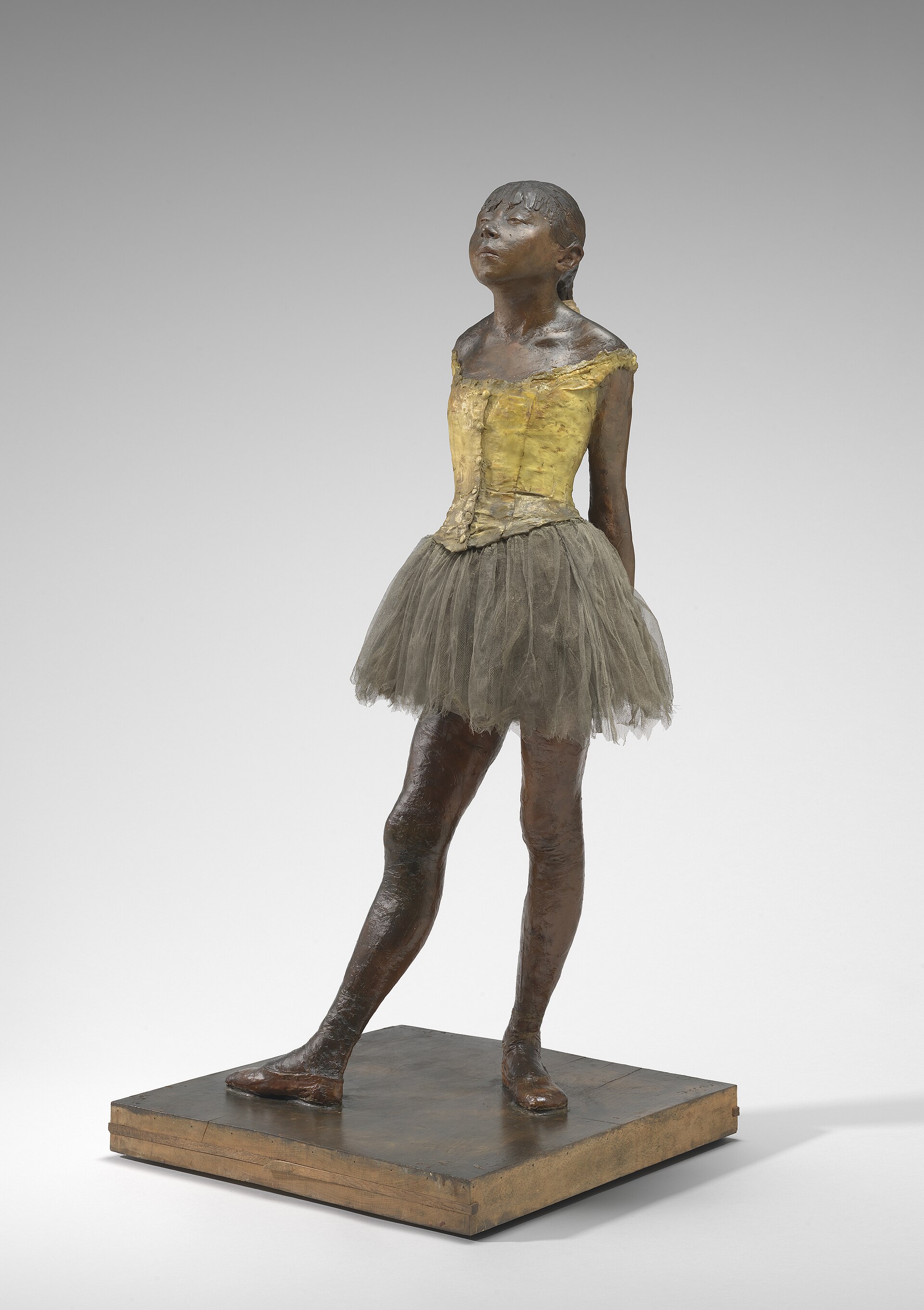
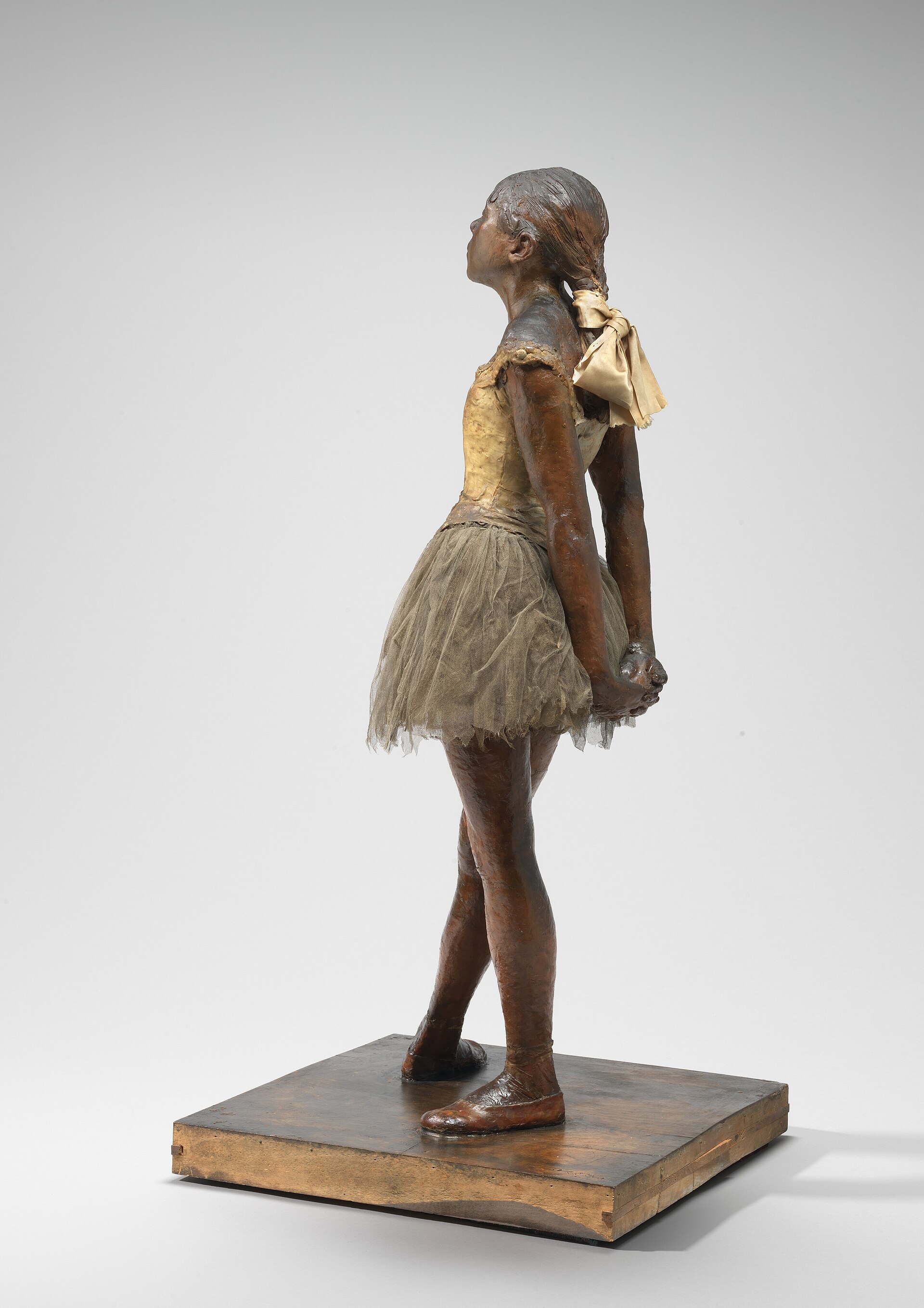
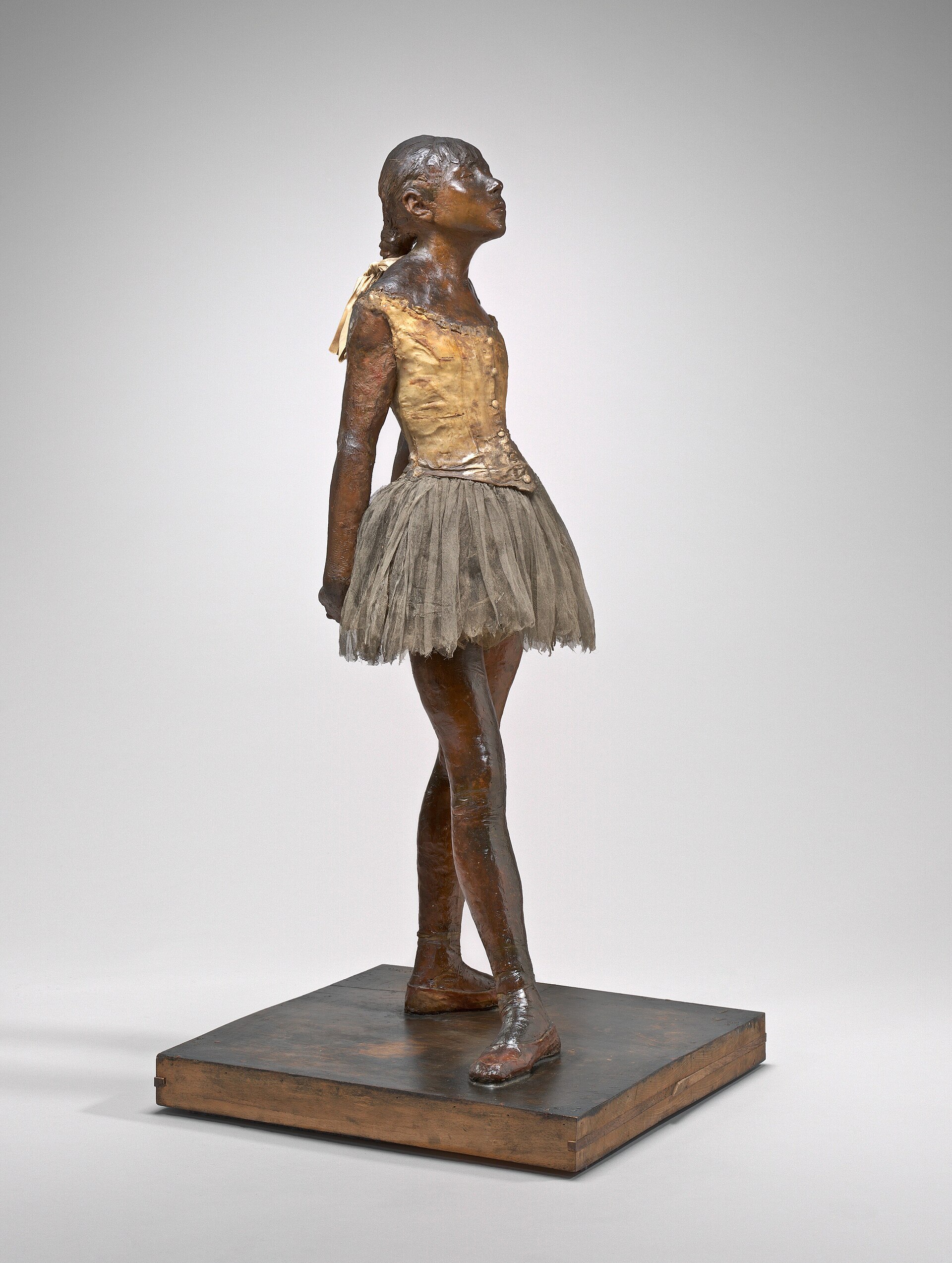
None of this means the wax escaped a physiognomic reading. It did not, and the honest version is more interesting than the misquotation. The critic who read vice into this girl's face is Paul Mantz, in Le Temps of 23 April 1881, and the National Gallery's edition calls his the most comprehensive physiognomic criminal account of the figure, quoting him on the arms whose blotches are truly horrible to see and on the face, or more appropriately, as he put it, her little muzzle, which projects with bestial effrontery, a face where all the vices imprint their detestable promise. Huysmans himself was not kind either: he describes her face as sickly and grey, drawn and old before its time.
The link between the wax and those two criminal pastels is a modern scholarly argument rather than a contemporary one. The National Gallery's edition attributes it to Anthea Callen and to Douglas Druick, initially with Peter Zegers. It says their arguments are rarely questioned and then questions them: apart from the forehead hidden under her bangs, the figure lacks the standard atavistic signs, and the same edition concludes that Degas apparently chose against such physiognomic signs in the finished figure. The name Cesare Lombroso, so often attached to this object in passing, does not occur once in Huysmans's book.
The only continuous record of her life is her employer's bookkeeping
The only continuous record of Marie van Goethem's life is not an artist's studio, it is the monthly bookkeeping of the Paris Opera, held at the Archives nationales in the AJ 13 series. Martine Kahane went through it, and what she brought out is a wage record. Marie and her younger sister entered the dance school in May and November 1878 respectively. As students they earned bonuses for appearing in some shows, Marie between 20 and 30 francs and her sister up to 20. In 1880 Marie was recruited into the ballet at the bottom of the scale, second set of quadrille, second section, second class, on an annual contract of 900 francs, which is 75 francs a month before bonuses.
Their mother appears in the same books, briefly, as an additional dresser: one evening performance in 1879 and six in 1880, paid one franc a performance. The contract of 1880 names her as Marie's guardian and lists her as Widow Van Goethem.
Set against that scale, what Degas paid for a sitting is not trivial and not generous either. Kahane takes her comparison from the notes Emile Zola gathered in 1885 for L'Oeuvre, where a model earns five to six francs for a four-hour sitting, and she concludes that Degas was paying a fair price. Five francs is five evenings of her mother's dressing work. It is also about two days of Marie's salaried month. The costs ran the other way too. Kahane lists what the examinations took out of the same money: tarlatan skirts at 15 francs, silk ribbons at 6 and artificial flowers at 6, with customary New Year gifts to the Opera's supporting staff reaching 47.80 francs for the quadrille sets, against a monthly salary that ran between 75 and 87 francs for quadrille dancers generally. Those last figures come from a newspaper of December 1881 rather than from the payroll.
| Payment | Figure | Where it comes from |
|---|---|---|
| Marie, annual contract from 1880 | 900 francs | Archives nationales, AJ 13 1005A |
| Marie, monthly salary under that contract | 75 francs | Archives nationales, AJ 13 1005A |
| Marie, bonuses as a school pupil from 1878 | 20 to 30 francs | Archives nationales, AJ 13 838, 842 |
| Charlotte, annual contract as a day student | 852 francs | Archives nationales, AJ 13 840, 841, 842, 905 |
| Marie, May 1880, salary and bonuses together | 109 francs | Archives nationales, AJ 13 840, 841, 842, 905 |
| Charlotte, May 1880, salary and bonuses together | 82 francs | Archives nationales, AJ 13 840, 841, 842, 905 |
| Their mother, additional dresser, per performance | 1 franc | Archives nationales, AJ 13 838, 842 |
| A model's fee for a four-hour sitting, recorded 1885 | 5 to 6 francs | Zola, Carnets d'enquete, page 252 |
One caution about the last line. Zola's figure was written down in 1885 and the sittings for this sculpture fall between 1878 and 1881, so it is a near comparison and not the same year. Zola himself notes in the same breath that the prices had gone up and that by then a model was paid 10 francs.
Her name survives twice in Degas's own handwriting
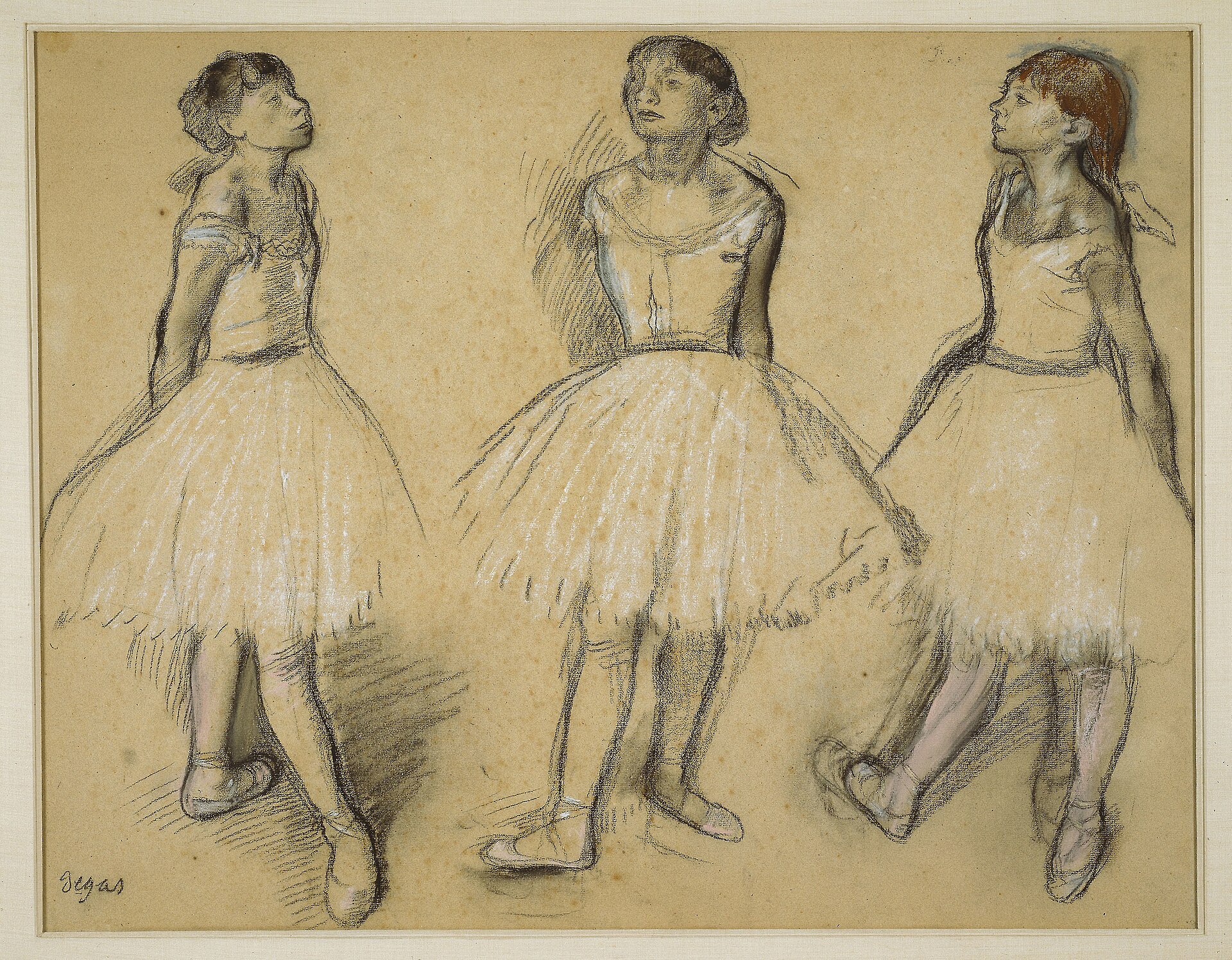
Two objects carry her name in the hand of the man who made the sculpture, and one of them is the reason anybody knows who she was. The first is a sheet in the Louvre, Quatre etudes d'une danseuse, RF 4646 in the Departement des Arts graphiques, charcoal with white heightening on pink paper, 0.49 by 0.32 m, dated about 1878 to 1879. At the top left, in pencil, it reads 36 rue de Douai Marie. The Louvre's own entry states plainly that the inscription in Degas's hand is what allowed the model to be identified.
The second is an address list. Kahane records that she was given permission to consult the two Degas notebooks then kept in the storage room of the Departement des Estampes at the Bibliotheque nationale that mention the Van Goethem girls, and her notes place the relevant one at the shelfmark Dc 327d. That is the whole of it. A street number on a drawing and a line in a working notebook, against an employer's ledger. Nothing in her own hand is known.
The street number is worth a line, because Kahane's essay prints two of them and then settles the matter itself. Her summary list of the family's successive addresses gives 35 rue de Douai for 1880. Everything else says 36: the 1880 contract, which she says allows the residence to be verified, the notebook entry and the inscription on the drawing. She writes that the contract agrees with the notebook. Three independent records against one line in a summary list, so 36 it is, and the Paris cadastre for that address describes a seven-storey house of cut stone with a single very dark staircase, an innkeeper and a hairdresser at street level, and among the tenants laundresses, a beer retailer and a Dame Van Gotten.
The dismissal is a document and the reason for it is an inference
Her dismissal from the Opera in 1882 exists as paper, and the cause of it does not. Kahane quotes the form of the record: in April, in Pluque's handwriting and countersigned by Vaucorbeil, a note states that Marie has been dismissed from the Opera. In June her name was crossed off the list. Effective in August she was no longer on the roster for a quadrille group. The shelfmark is AJ 13 905A at the Archives nationales.
What the note does not carry, on the evidence of the scholar who read it, is a stated cause. Immediately after quoting it Kahane turns to the employment rule for the ballet corps, which indicates penalties for mistakes, tardiness and absences during rehearsals and shows. That is the rule, not a finding about this dancer, and the two are easy to run together.
The same payroll that records what she earned also argues against the reason usually given. Kahane's own sentence is that the payroll records for either sister do not show any disciplinary measures for days missed or illnesses, and elsewhere she writes that at the Opera Marie and Charlotte were good employees who did not call attention to themselves. That converts the absenteeism story from a gap in the evidence into a claim the evidence contradicts.
The other candidate cause is a gossip paragraph. In L'Evenement of 10 February 1882, quoted by Kahane, a notice reads that Miss Van Goeuthen, fifteen years old, has an older sister who is supernumerary at the Opera and a younger sister in the Opera dance school, and consequently she frequents the Martyrs Tavern and the Rat Mort. The load-bearing word is consequently. The paragraph was written for the Opera's presentation of the ballet Namouna, in which each dancer got a few lines, and Kahane notes that Marie is the only one in it described as an artist's model. Kahane also records, a few sentences later, that Degas himself was a customer at both places.
Our own record for this object said she was dismissed for missing too many classes. That stated a cause the document does not give, and the line has been corrected in the same push as this article.
The Louvre still prints an 1864 birth date, and 1864 belongs to a sister who lived eighteen days
The Louvre's entry for the drawing that identified her gives her birth as 17 February 1864, and 1864 is the year of a different child. Kahane's reconstruction of the family from the civil registry is unambiguous: of five children born to the Van Goethem couple, three girls survived. A first Marie was born in Paris in 1864 and died eighteen days after her birth. The Marie of this story is her sister, Marie Genevieve, born on 7 June 1865. Kahane gives no month or day for the first child, so the year is what the two records have in common and the precise date on the Louvre's page matches nothing published. The page carries its own last-updated stamp of 24 May 2023, with a note that its contents do not necessarily take account of the latest data.
The consequence is not only genealogical. A birth in February 1864 makes the sitter more than a year older at every point in the story, which moves the reading of a sculpture whose title is an age. Our own record carries 7 June 1865 and is right, which is worth stating plainly because this archive is usually the thing being corrected.
The rest of the family, from the same source: a brother, Jean-Baptiste, born in Brussels in 1859 and dead in Paris in 1862; Antoinette, the eldest girl, born in Brussels in 1861; and the youngest, Louise Josephine, who quickly took the name Charlotte, born in Paris on 18 July 1870 and dead there on 17 January 1945. Charlotte stayed at the Opera and became a teacher there. Antoinette was an extra without a contract, paid by the performance.
What is printed about her that no document supports
The most damaging claim in circulation about Marie van Goethem rests, in the source it comes from, on a novel. Kahane's essay reaches a section headed Prostitution, and its opening move is a comparison: in 1882 the life of these young girls begins to resemble the novel about the Cardinals, and just like Mrs Cardinal, Mrs Van Goethem prostitutes her daughters. Mrs Cardinal is a character. Kahane has introduced the Cardinal novels in an earlier section as the work of Ludovic Halevy, a well-to-do theatre lover and backstage regular who took Degas along with him, and she says of those books that poverty, exploitation and prostitution are not mentioned in such an elegant novel.
What follows the comparison, as evidence, is the L'Evenement paragraph with its consequently. No document about Marie is cited in support of it. The claim has since hardened into structured data. Wikidata's entry for her, Q6763113, lists three occupations: ballet dancer, model and prostitute. All three are recorded the same way, as fields with no qualifier and no reference of any kind. The same entry gives her death as 7 December 1935, a date our own record declines to treat as established, and the only thing behind it there is a personal website. The girl these fields describe entered the Opera school at twelve and was fifteen in the year the claim is attached to.
Kahane is also the source of the reason no better evidence exists, and she gives it as a matter of record about the archives rather than about the family. She began at the civil registry, continued at the Opera museum library and spent her Saturdays in the reading room of the Archives nationales. Her account of the limit she hit is worth quoting as she put it: legal records for that particular period were never stored in the National Archives and instead immediately destroyed at the courthouse, and police records had long vanished. What the newspapers reported of Antoinette, that she was sentenced in 1882 to three months for stealing 700 francs from a patron at the Chat Noir and held at Saint-Lazare, therefore cannot be checked against a judgment. Neither can anything else of this kind, in either direction.
Everyone names her flatly, and the one hedge is the clause her citers drop
Every institution that holds one of these objects names Marie van Goethem as the model without qualification. The Art Institute of Chicago's description of its 1962.703 sheet calls her the model Marie van Goethem, seen in three views. The National Gallery of Art, which owns the sculpture, states in its own object text that Marie van Goethem, the model for the figure, was the daughter of a Belgian tailor and a laundress, then repeats the identification in its own published article on the wax. Our record does the same. So does Martine Kahane, who established nearly everything documented about her, in the introduction to her own essay: thanks to Degas's notes and his surviving studies, she writes, we know that the model for the little dancer was Marie Van Goethem, born in 1865.
The hedge exists, and it is one clause, later in the same essay. Introducing the family, Kahane calls Marie Genevieve the model, or one of the models, for the Little Dancer. Her reason is visible in her own closing pages, where she takes seriously the younger sister Charlotte's claim to have modelled for Degas too. That is a careful scholar leaving a door open in the middle of a piece of work whose whole purpose was to shut doors, and it is the clause that gets dropped when she is cited.
Set this beside the archive's other famous young woman. For the Vermeer in our records there is no name, no payroll, no wage and no inscription naming her, and the record's own point is sharper than an unsolved identification: it is a tronie rather than a portrait, a study of a head in exotic costume made for the open market, so the category itself means there may never have been a sitter to name. For Marie van Goethem there is a contract, a monthly figure, a dismissal note, a street number in the maker's pencil and a birth certificate, and the best scholarship on her still says one of the models. The difference between the two is not really a difference of knowledge about a person. It is a difference in how much of an employer's paperwork happened to survive.
Questions
Marie Genevieve van Goethem, born in Paris on 7 June 1865 to Belgian parents, a pupil and then a member of the corps de ballet at the Paris Opera. She was identified from an inscription in Degas's own hand, 36 rue de Douai Marie, on a drawing now in the Louvre as RF 4646. Martine Kahane, who established most of what is documented about her, writes more carefully that she was the model, or one of the models, for the sculpture.
From 1880 she held an annual contract with the Paris Opera of 900 francs, a monthly salary of 75 francs, with bonuses on top when she danced. In May 1880, salary and bonuses together, she was paid 109 francs. As a pupil from 1878 her bonuses ran between 20 and 30 francs; Kahane records no figure for the bonuses under the 1880 contract. The figures come from the Opera's monthly bookkeeping in the AJ 13 series at the Archives nationales. A model's fee for a four-hour sitting was five to six francs in a note Emile Zola made in 1885.
No document gives a reason. A note of April 1882 in Pluque's handwriting and countersigned by Vaucorbeil records that she has been dismissed, held at the Archives nationales as AJ 13 905A, and no cause is stated in it. Kahane adds that the payroll shows no disciplinary measures for either sister for days missed or illnesses, so absenteeism is not merely unproven but argued against. The often repeated story about Montmartre cafes comes from a newspaper paragraph of 10 February 1882 whose reasoning is that she had two sisters at the Opera and consequently frequented them.
No. The phrase about low foreheads and jutting jaws appears in his list of Degas's drawn and painted works, applied to two pastels of criminal physiognomies, and he closes that list before he reaches the sculpture. Of the wax itself he wrote that it is the only truly modern attempt he knew of in sculpture, though he was still harsh about the figure's face, which he called sickly and old before its time. The critic who gave the fullest criminal reading of her face was Paul Mantz in Le Temps of 23 April 1881.
Nothing that scholarship has confirmed. A death date of 7 December 1935 circulates, and our record for the sculpture treats it as unverified rather than established. Kahane reports that the legal records for the period were destroyed at the courthouse rather than archived and that police records had long vanished, which is why the trail stops where it does.
Sources
- 1Martine Kahane, 'Le modele', her section of Kahane, Delphine Pinasa, Wilfried Piollet and Sara Campbell, Enquete sur la Petite Danseuse de quatorze ans de Degas, in the authorised abbreviated English translation, read in full for the Archives nationales AJ 13 shelfmarks (838, 842, 840, 841, 905, 905A, 1005A), the annual contract of 900 francs and monthly 75 francs, the 20 to 30 franc bonuses, Charlotte's 852 franc contract, the May 1880 figures of 109 and 82 francs, the mother's 1 franc per performance as additional dresser, the examination costs and the 47.80 franc New Year gifts, the April 1882 dismissal note in Pluque's hand countersigned by Vaucorbeil, the L'Evenement notice of 10 February 1882 quoted verbatim, the Cardinal comparison and the Prostitution section, the family reconstruction including the first Marie who died at eighteen days and Marie Genevieve born 7 June 1865, the address list, the Dc 327d notebook shelfmark, and the author's own account of the destroyed legal and police records. Also used for her introduction stating flatly that the model for the little dancer was Marie Van Goethem born in 1865, for the payroll showing no disciplinary measures for either sister for days missed or illnesses, for the statement that the 1880 contract verifies the residence at 36 rue de Douai in agreement with the notebook, and for Antoinette's sentence in 1882 of three months for stealing 700 francs from a patron at the Chat Noir and her incarceration at Saint-Lazare. interarts.org/projects/...
- 2Joris-Karl Huysmans, L'Exposition des independants en 1881, in L'Art Moderne, Paris, 1883, pages 225 to 257, read in the scanned full text of a later edition where the passages sit at pages 250 to 252. Used for the list of drawn and painted works ending and you will have the list of the drawn or painted works brought by this artist, the two sketches of criminal physiognomies with low foreheads and jutting jaws, the turn to the wax statue called Petite Danseuse de quatorze ans, the description of the face as sickly and old before its time, the verdict that the statuette is the only truly modern attempt in sculpture he knows of, and the absence of any mention of Lombroso in the volume. archive.org/details/...
- 3Musee du Louvre, collections, Edgar Degas, Quatre etudes d'une danseuse, RF 4646 Recto, Departement des Arts graphiques, charcoal with white heightening on pink paper, 0.49 by 0.32 m, about 1878 to 1879, for the pencil inscription 36 rue de Douai Marie at the upper left, for the statement that the inscription in Degas's hand allowed the model to be identified, and for the birth date the entry gives as 17 fevrier 1864. collections.louvre.fr/en/...
- 4National Gallery of Art, Washington, Edgar Degas, Little Dancer Aged Fourteen, 1878 to 1881, accession 1999.80.28, for the materials, the dimensions of 98.9 by 34.7 by 35.2 cm and weight of 22.226 kg, the 1881 exhibition entry as number 12 catalogued Petite Danseuse de quatorze ans (statuette en cire), the provenance from the artist's heirs through the Hebrard foundry to Paul Mellon and the 1999 bequest, the X-radiography findings including the smaller preliminary head and the paintbrushes in the arms, and the bibliography listing the Kahane and others 1998 study in 48/14: La Revue du Musee d'Orsay number 7, pages 48 to 71. nga.gov/artworks/...
- 5Art Institute of Chicago, Edgar Degas, Three Studies of a Dancer in Fourth Position, 1879/80, accession 1962.703, charcoal and pastel with stumping and touches of brush and black wash on grayish-tan laid paper, 48 by 61.6 cm, signed recto lower left in black pastel, for the gallery's own description naming the sitter as the model Marie van Goethem in left profile, right profile and facing the viewer, and for the exhibition history including Degas and the Little Dancer at the Joslyn Art Museum in 1998. artic.edu/artworks/...
- 6Emile Zola, Carnets d'enquete, edited by Henri Mitterand, Paris, Plon, 1986, page 252, cited by Kahane and others for the fee of five to six francs for a four-hour sitting recorded while Zola was gathering material for L'Oeuvre in 1885, and for his note that prices had since risen to 10 francs. interarts.org/projects/...
- 7Wikidata, entity Q6763113, Marie van Goethem, read 27 September 2026 through the entity data endpoint. Property P106 occupation carries three values, ballet dancer (Q805221), model (Q4610556) and prostitute (Q14915751), none of them qualified or referenced to a document about her. Property P569 gives the birth as 7 June 1865 and P570 gives the death as 7 December 1935 without qualification. wikidata.org/wiki/...
- 8National Gallery of Art, 'Iconographic Interpretations', part of the scholarly online edition Modeling Movement: Degas's Dancers, read in a browser after direct fetches were refused. Used to identify the two works Huysmans listed as the pastels Criminal Physiognomies of 1880 and 1881, one in a private collection and one in the National Museum in Belgrade; for the attribution of the criminal reading of the wax to Anthea Callen and to Douglas Druick, initially with Peter Zegers, and the statement that their arguments are rarely questioned; for the edition's own conclusion that the figure lacks the standard atavistic signs and that Degas apparently chose against them in the finished figure; and for Paul Mantz's review in Le Temps of 23 April 1881, page 3, quoted there in French in note 7, on the blotched arms truly horrible to see and on her little muzzle projecting with bestial effrontery in a face where all the vices imprint their detestable promise. The same note 19 records that Mantz's word sauteuse is occasionally given erroneously as danseuse. nga.gov/research/...
- 9National Gallery of Art, 'Edgar Degas Only Made One Little Dancer. And It's Ours.', the gallery's own article on the wax, read in a browser. Used, with the object page, to establish that the National Gallery names Marie van Goethem as the model without qualification rather than leaving the identification open. nga.gov/stories/...
More in The Women Behind the Art
The partThe Publisher Was the Sitter
Truth sold her own cartes de visite, registered the copyright in her own name and left the photographer unnamed.
The Half That Was Not Sold
Vera Salomons inherited 57 of her father's Breguet watches. Her mother got the other seventy and they were auctioned.
The Picture Her Father Refused
The Peacock Room is built around a portrait of Christine Spartali that her own father declined to buy.