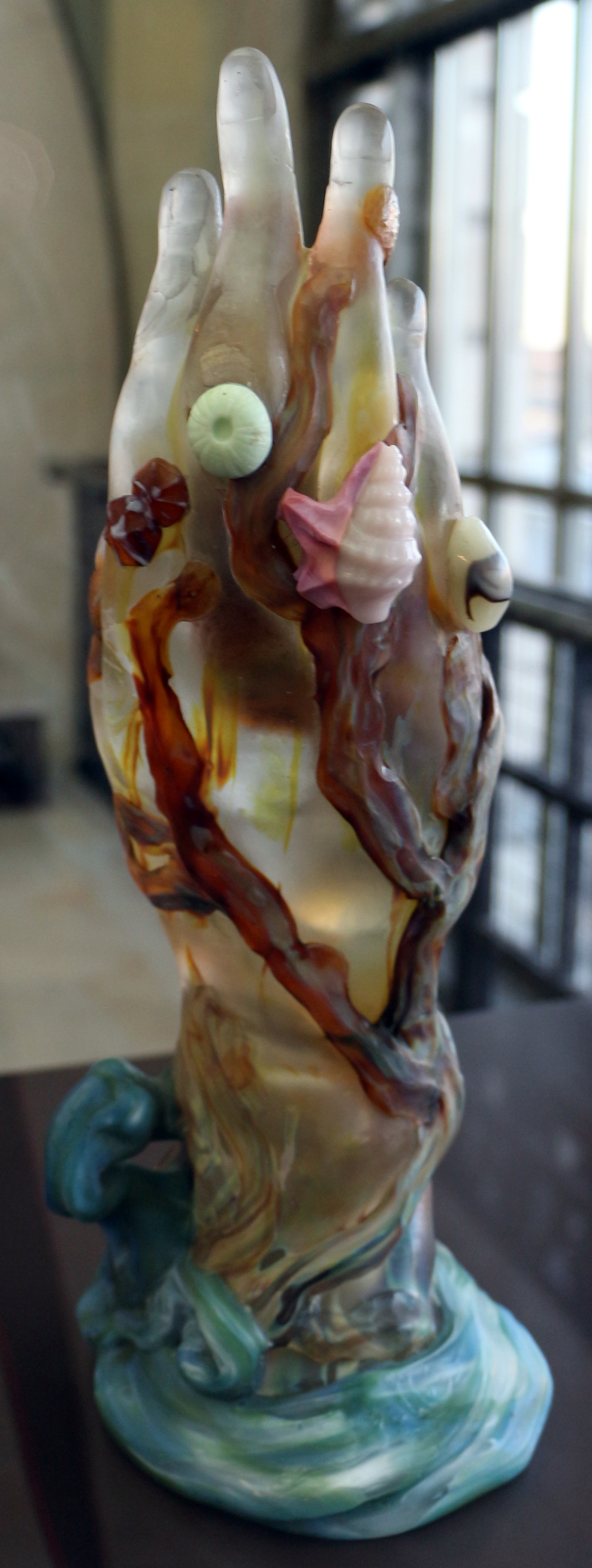
La Main aux algues et aux coquillages
1904 · Crystal
Musee d'Orsay
Museum · Musée d'Orsay · Founded 1900
Open, admission and hours confirmed 7 September 2026 · 22 sources
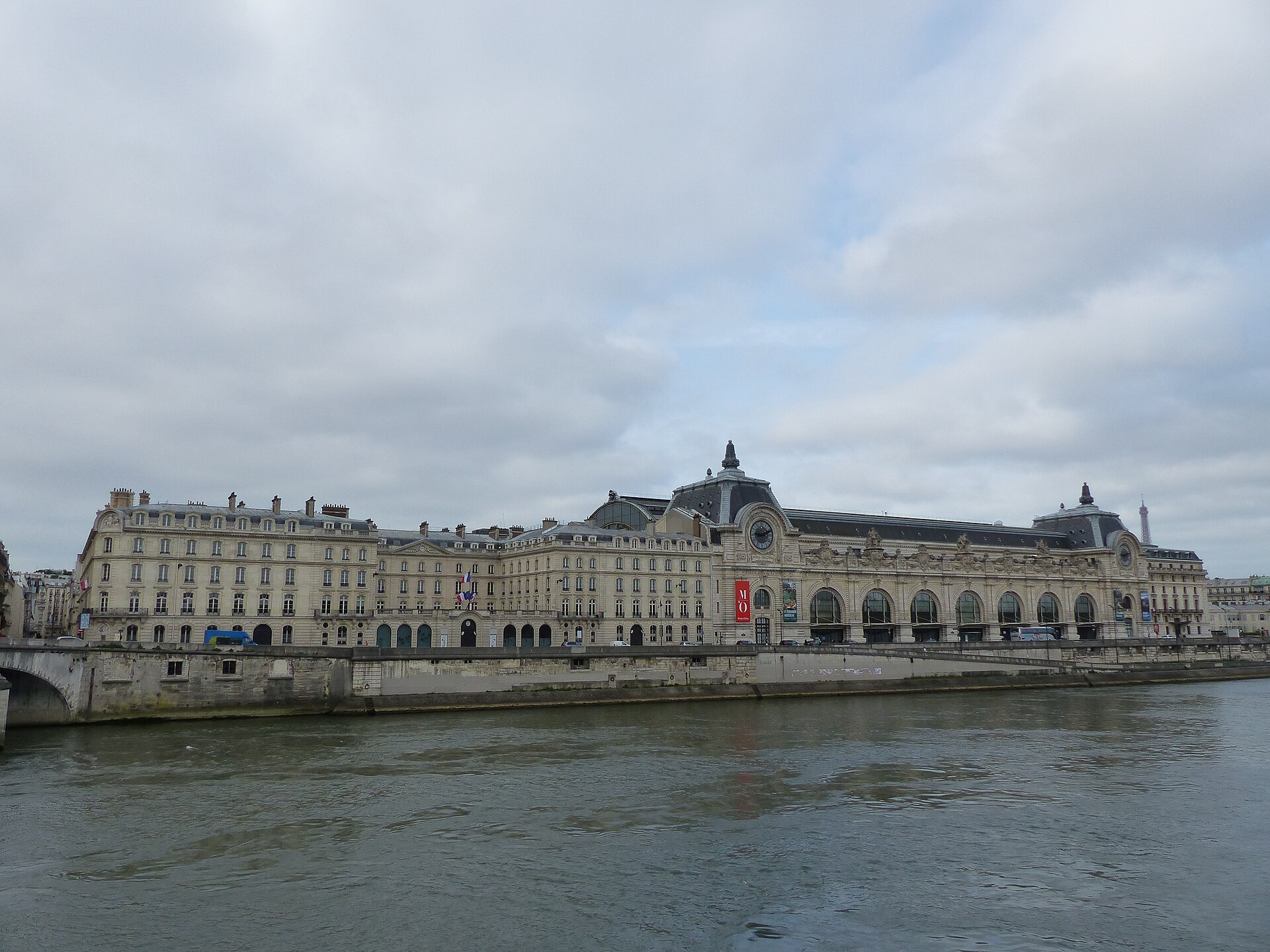
Everything made or shown in France, and much made elsewhere, between the 1848 revolutions and the outbreak of the First World War: painting first, but also sculpture, decorative arts, architecture, photography and early cinema, organised across three levels of a former railway station because the Louvre would not give up its early nineteenth-century Romantic paintings and a new museum had to start somewhere. The Impressionist and Post-Impressionist rooms on the top floor, under Laloux's original glazing, are what the building is chiefly known for, where Monet, Renoir, Degas, Cezanne, Van Gogh and Gauguin hang; the ground floor and middle-level terraces carry academic Salon painting, Realism, early Symbolism, sculpture, and the Art Nouveau and Ecole de Nancy decorative arts where this archive's own Galle hand is shown. Between 223 and 225 further works, depending on which of the museum's own counts is used, remain on its books as MNR: recovered after the Second World War, never claimed, and now the subject of a dedicated gallery and a new research unit rather than a settled footnote.
| Local name | Musée d'Orsay |
|---|---|
| Kind | Museum |
| Founded | 1900 as the Gare d'Orsay, built by Victor Laloux for the Exposition Universelle on the site of the burned-out Palais d'Orsay; opened as a museum on 9 December 1986, inaugurated by President Francois Mitterrand on 1 December 1986. |
| City and country |  Paris, France Paris, France |
| Address | Esplanade Valery Giscard d'Estaing, 75007 Paris, France |
| Website | musee-orsay.fr/en |
| Status | Open, confirmed 7 September 2026 |
| Record last verified | 7 September 2026 |
Prices and hours change. We take them from the institution's own pages and print the day we read them, and you can check the current position at the source we used. Confirm before you travel.
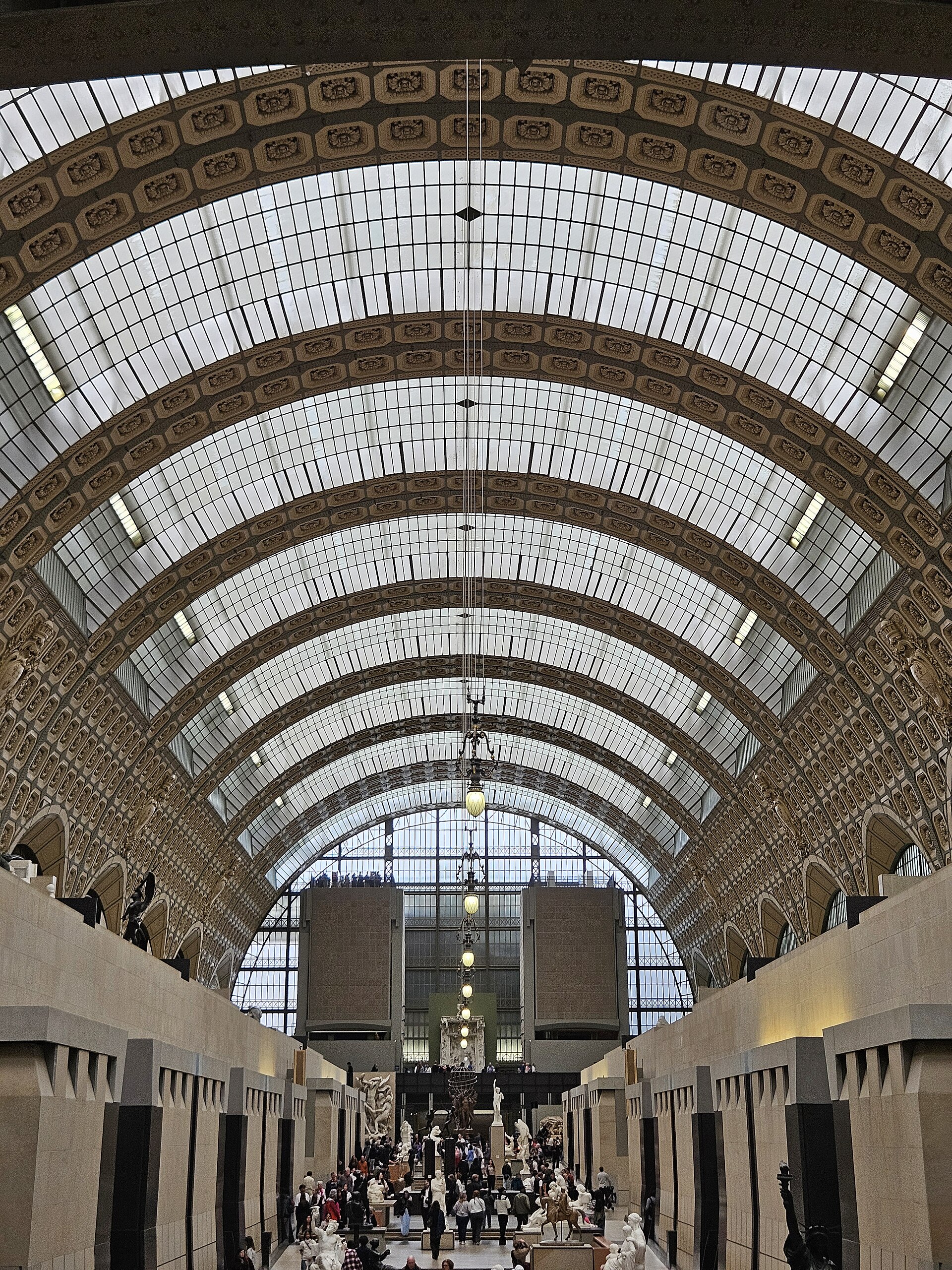
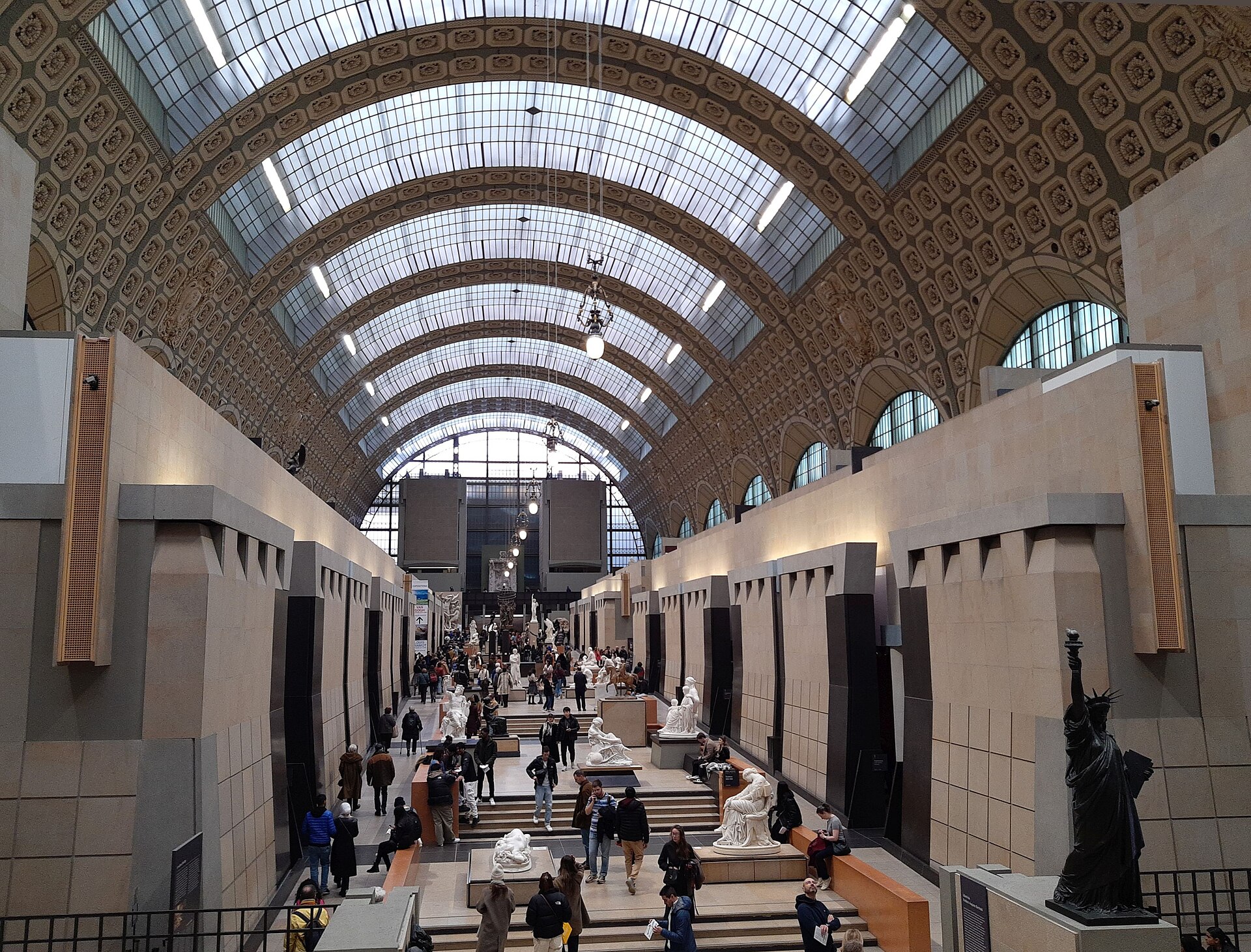
The former station's great hall: 138 metres long, 40 wide and 32 high, Victor Laloux's barrel-vaulted iron and glass roof kept intact and glazed over rather than vented, because the electric trains it served produced no smoke. Since Gae Aulenti's 1986 fit-out this has been the museum's central avenue, flanked by stone walls and lined with sculpture, the axis every other room in the building opens off. Some rooms off the nave are currently closed as part of the 2026-2028 renovation.
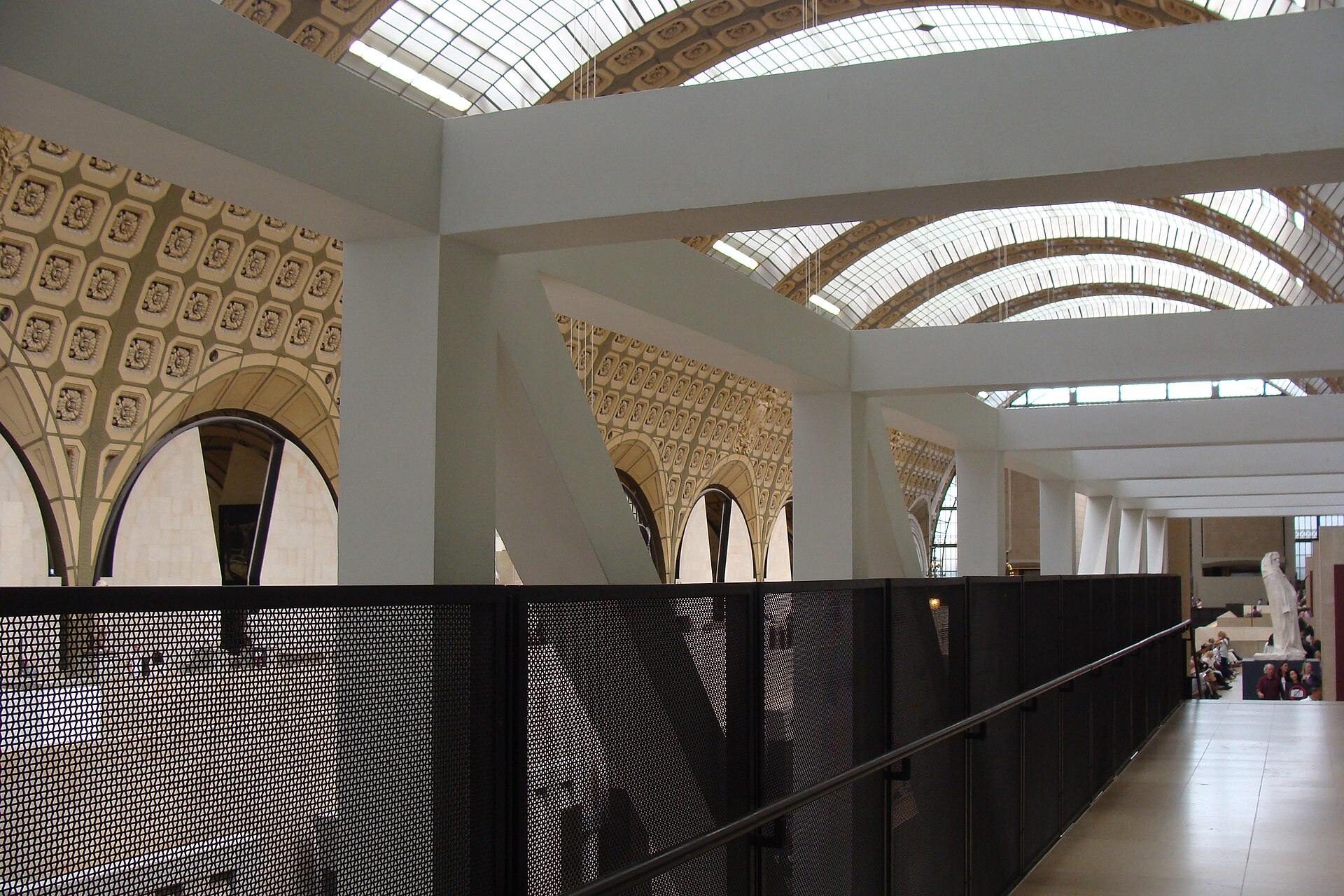
Terraces that overlook the central nave and lead into the second level of exhibition rooms, built by the ACT-Architecture team as part of the 1979-1986 conversion. This level carries sculpture, photography, early cinema, and the Art Nouveau and decorative arts collections, including the Ecole de Nancy holdings where this archive's own Emile Galle glass hand is shown, medium level, Room 63.
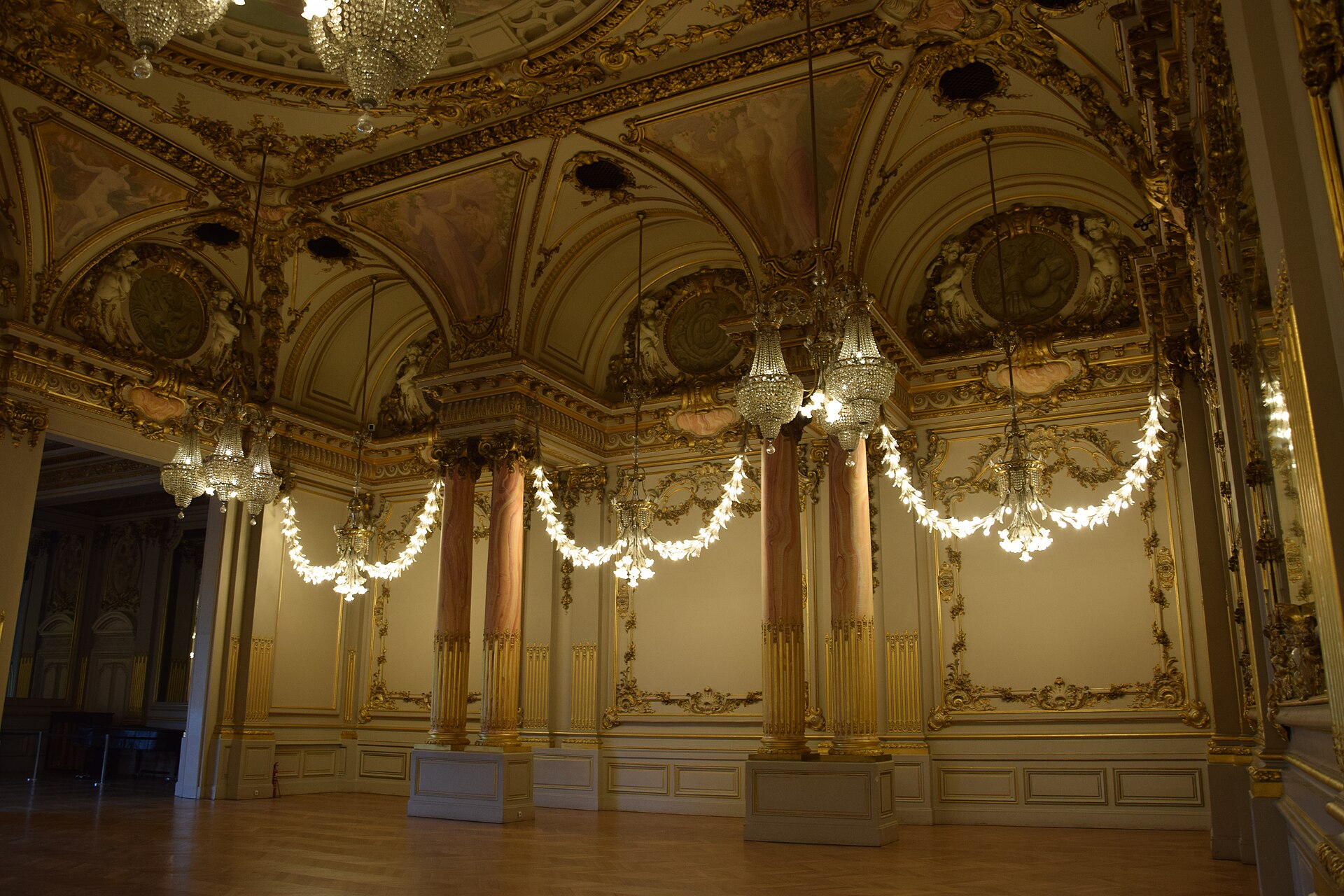
The former hotel's gilded ballroom, decorated for the 1900 opening with painted vaults and marble columns. The hotel closed on 1 January 1973, but not before the room had hosted one of the defining press conferences of the Fifth Republic, when Charles de Gaulle used it to announce his return to power. It is used today for the museum's own events and functions.
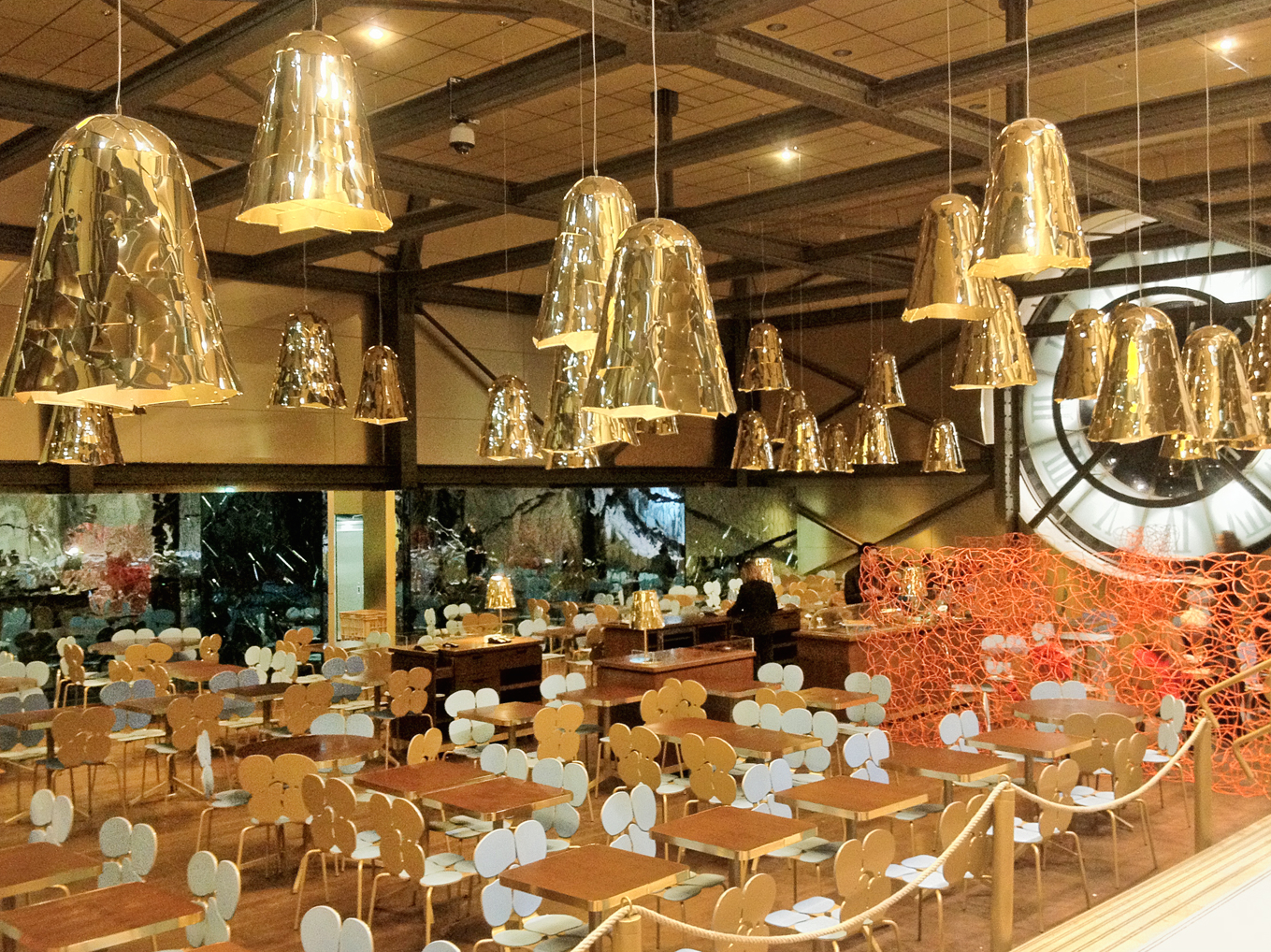
At the exit of the top-floor Impressionist galleries, a cafe fitted out by the Campana brothers with clusters of gilded bell-shaped pendant lamps, standing beside the great clock face on the museum's west facade. A summer-only rooftop terrace opens from the same exit, looking out over the Right Bank of the Seine.
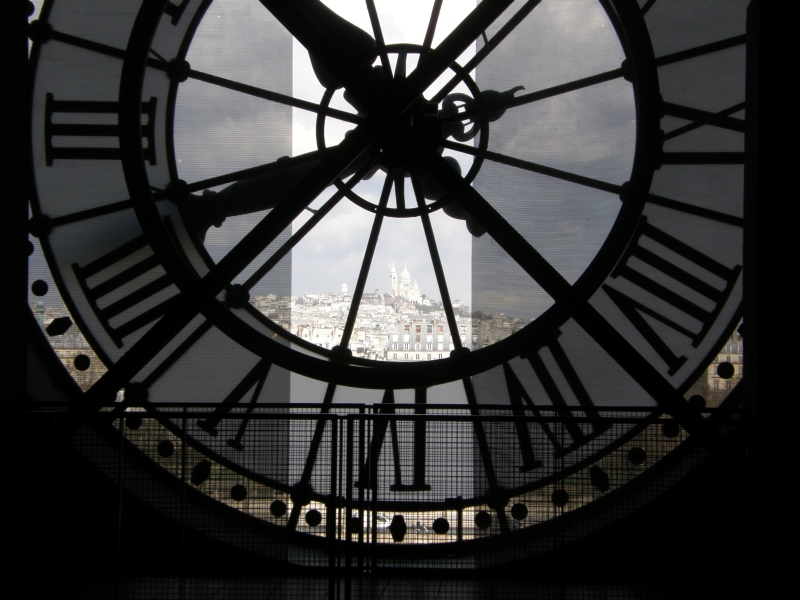
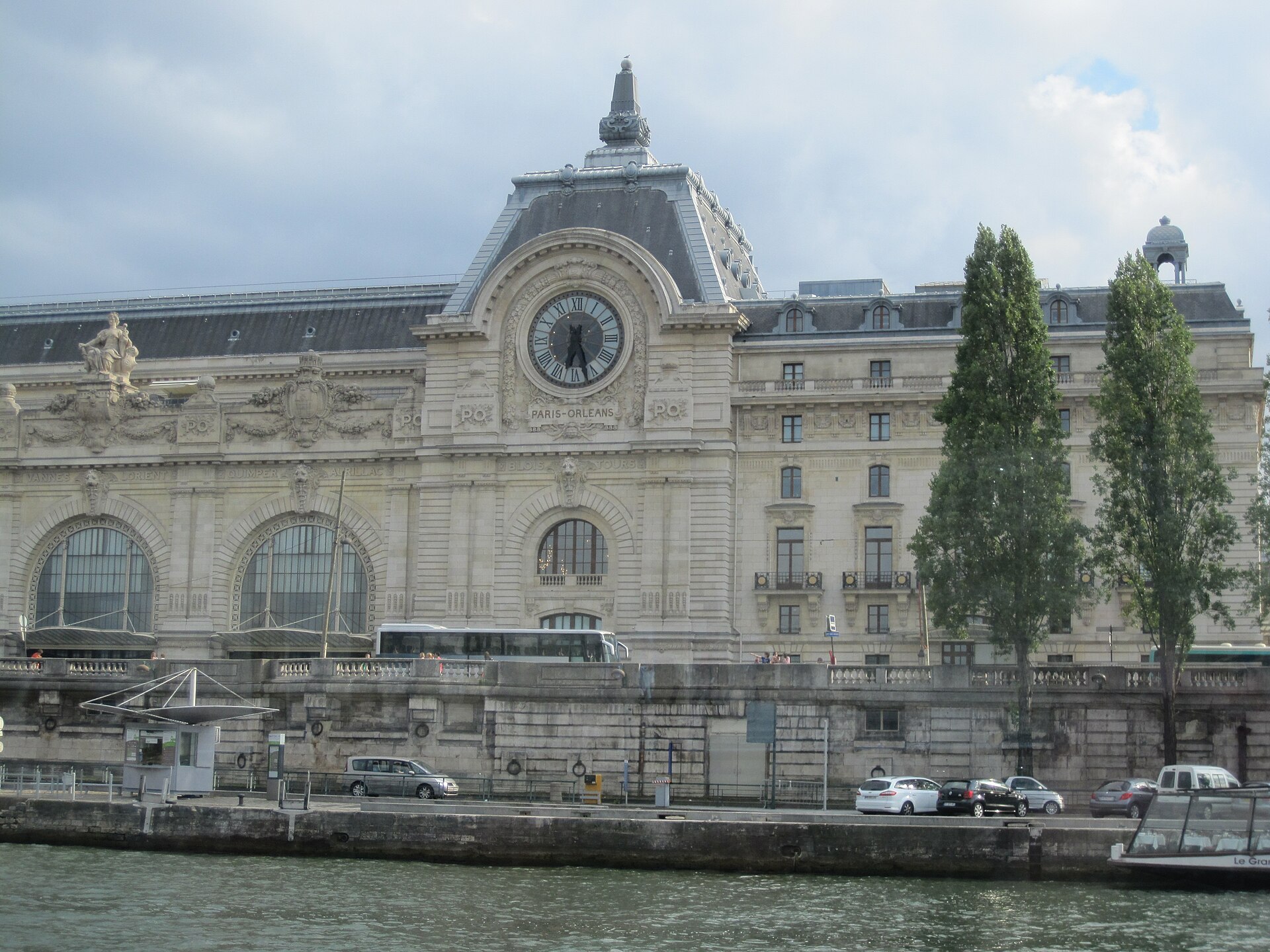
One of two monumental clocks Laloux built into the station's west facade, kept as a viewing point on the museum's upper level. Visitors look out through the transparent dial toward Montmartre and the Sacre-Coeur; it is one of the most photographed interior views in the building and a reminder, inside the galleries, that the structure was a railway terminus first.
This archive's own record here. A crystal hand rising from a modelled wave of blue-green seaweed with shells applied in high relief, signed but carrying no star: the starred signature was introduced in 1905, after Galle's death, to mark the industrial production his widow Henriette continued running, so an unstarred 1904 signature separates the man's own work from the firm's posthumous output. Given to the museum in 1990, and shown medium level, Room 63, which the museum's own display confirms.22
Full record in this archiveRejected by the 1863 Salon jury and shown instead at the Salon des Refuses, where it became the main attraction for the wrong reasons: a nude woman among clothed men, borrowed compositionally from a Raimondi engraving after Raphael, painted in the flat, high-contrast blocks contemporary critics called a 'mania for seeing in blocks'. Manet himself nicknamed it la partie carree.11
Painted in Arles in September 1888 after months of Van Gogh telling his brother Theo and the painter Emile Bernard he was haunted by the idea of a starry sky. Distinct from the more famous Starry Night at MoMA, painted months later from an asylum: the museum's own catalogue calls this Rhone view the calmer of the two, with a couple at the bottom of the canvas rather than a whirling, flame-shaped sky.12
Bought from Whistler by the French state in 1891 and now among the most reproduced portraits by an American artist anywhere outside the United States. Checked against the museum's own online collection on 6 August 2026, the record for this painting was marked 'Artwork not currently exhibited in the museum', with no reason or return date given.10
Renoir's most ambitious painting of the mid-1870s, shown at the 1877 Impressionist exhibition and bequeathed to the state in 1896 from Gustave Caillebotte's own collection. Also checked on 6 August 2026 and, like the Whistler, marked 'Artwork not currently exhibited in the museum' on the museum's own database, one of two defining Impressionist paintings off view the day this record was researched.13
The culmination of ten years of studies on the theme, showing three women gleaning wheat missed by the harvest, the meanest of the fields' work, staged in the foreground against a bright, prosperous harvest scene in the distance. Donated with a life interest reserved to the donor, Madame Pommery, in 1890.14
One of the first paintings of urban working men rather than peasants or country labourers, rejected by the 1875 Salon jury for its 'vulgar subject matter'; Caillebotte then showed it at the second Impressionist exhibition in 1876 and gave it to the state himself in 1894. The muscular precision of the planers' bodies borrows academic figure drawing for a subject academic painting would not touch.15
A bronze cast of Degas's wax original, patinated, dressed in a tulle tutu and satin ribbon, bought in 1931 through the generosity of Degas's own heirs and the Hebrard foundry family. This is a specific cast among roughly two dozen made from the original wax; it is a different physical object from the cast this archive's own separate record describes at the National Gallery of Art, and no relation is asserted between them.16
The museum's first permanent gallery for Nazi-looted art still unclaimed after eighty years: a rotating display of 13 works chosen from the roughly 223 to 225 MNR pieces on the Orsay's books, hung so visitors can read the backs of the frames, the stamps and inventory marks that trace how each piece left a private home.6
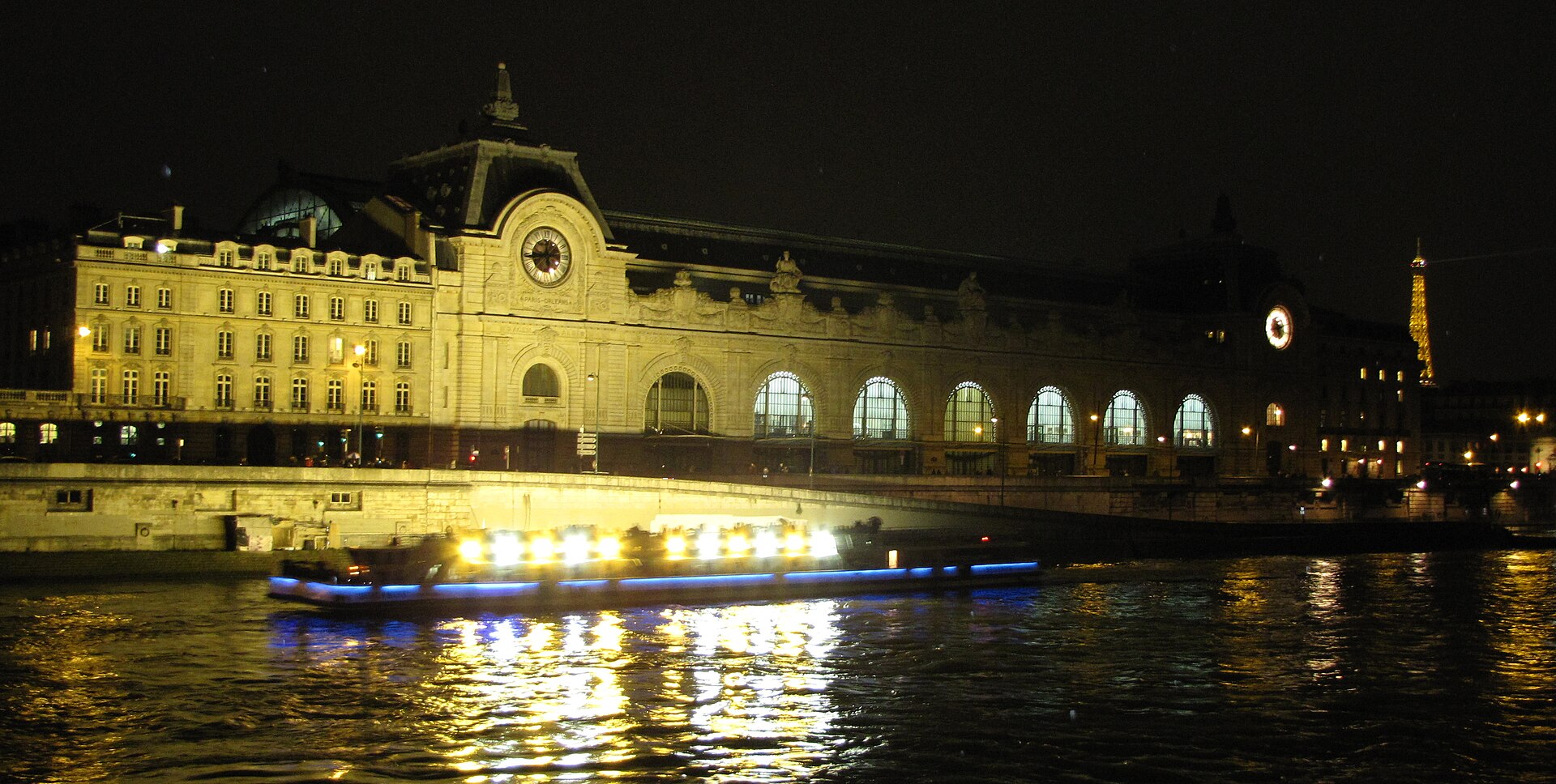
Before the station stood the Palais d'Orsay, built between 1810 and 1838 by Jean-Charles Bonnard and then Jacques Lacornee, home first to the Foreign Ministry and later to the Cour des Comptes and the Conseil d'Etat. It burned during the Paris Commune in 1871 and stood as blackened ruins for thirty years. The site goes back further still: the Rue de Lille traces the old garden of Queen Marguerite de Valois, sold off in lots after her death in 1615, and the Hotel de Salm, now the Palais de la Legion d'Honneur, rose next door between 1782 and 1788.
Ahead of the 1900 Exposition Universelle, the state handed the ruined site to the Compagnie des Chemins de fer d'Orleans, whose existing terminus at the Gare d'Austerlitz sat too far from the fairgrounds. In 1897 the company put the commission to three architects, Lucien Magne, Emile Benard and Victor Laloux; Laloux, fresh from the town hall at Tours, was chosen in 1898. Built in under two years, the station and its attached hotel opened on 14 July 1900. Laloux hid the iron skeleton behind an eclectic stone facade to satisfy an elegant neighbourhood, the Louvre on one bank and the Legion d'Honneur on the other, then let modernity run the interior: inclined ramps and freight lifts for luggage, passenger elevators, sixteen underground platforms, electric traction. Because the electric trains produced no smoke, Laloux could glaze the whole roof rather than vent it, and the resulting hall runs 138 metres long, 40 wide and 32 high, framed in 12,000 tonnes of ironwork under 35,000 square metres of glazing. The painter Edouard Detaille, seeing it in 1900, is recorded on the museum's own history page as remarking that the station looked more like a palace of fine arts than a place to catch a train. Eighty-six years later, it became exactly that.
For four decades the Gare d'Orsay did what it was built to do, heading the railway's south-western line while its hotel hosted political banquets alongside travellers. Electrification undid it: the platforms were too short for the longer trains the newly wired network demanded, and from 1939 the station was demoted to a suburban stop and, during the war, a parcel depot for prisoners' packages, then a reception point for returning deportees and prisoners of war at the Liberation.
What followed was a long improvisation. The empty hall stood in as a film set for Orson Welles's 1962 adaptation of Kafka's The Trial; the Renaud-Barrault theatre company used it as a temporary stage; Paris's auctioneers worked out of it while the old Hotel Drouot was rebuilt. The hotel itself closed on 1 January 1973, but not before its gilded Salle des Fetes had hosted one of the defining press conferences of the Fifth Republic, when Charles de Gaulle used the room to announce his return to power. By 1970 the whole site was slated for demolition and replacement with a modern hotel and conference block. A historical account of the episode credits President Georges Pompidou with issuing the initial order to halt the wrecking, part of a wider public reaction against the destruction that had just gutted the old Les Halles market halls nearby. The station was inscribed as a historic monument on 8 March 1973, the same year its hotel shut its doors.
It was Valery Giscard d'Estaing, president from 1974, who turned Pompidou's reprieve into an actual museum: the interministerial council took the formal decision to build one on 20 October 1977, the building was classified a historic monument the following year, and a public authority was created to see the project through. The esplanade in front of the museum today carries his name.
The brief itself was set by a turf dispute. Paris already had the Louvre for painting up to the mid-nineteenth century and the young Centre Pompidou, opened in 1977, for the twentieth. The original idea was for a new museum to cover the whole nineteenth century, but the Louvre would not give up its early Romantic paintings, so the dates that ended up defining the Musee d'Orsay's collection were political rather than art-historical: 1848, the year of revolutions across Europe, to 1914, the outbreak of the First World War. The other spur was practical: the old Musee du Jeu de Paume, which had been showing the Impressionists, had grown too small and too poorly secured for a collection whose popularity was climbing fast.
Six architectural teams competed for the conversion in 1979. The ACT-Architecture group of Renaud Bardon, Pierre Colboc and Jean-Paul Philippon won with a scheme that kept Laloux's shell intact while reinterpreting it: the nave became the museum's main spine, and the old glazed canopy over the platforms became the principal entrance. Three levels resulted. Ground-floor rooms run either side of the central nave; a middle level of terraces overlooks the nave and feeds the exhibition rooms; and an upper level was built above the old passenger vestibule, extending into the highest part of the former hotel on the Rue de Bellechasse. Separate spaces branch off these three: the Pavillon Amont, the glazed passages of the station's great west tympanum, the museum's own restaurant in the old hotel dining room, and Cafe Campana.
The interior design went to Gae Aulenti, an Italian architect better known until then for showrooms for Fiat and Olivetti than for museums, working with Italo Rota, the lighting consultant Piero Castiglioni and Richard Peduzzi on how the architecture itself would be presented. Aulenti's solution was a central avenue running the length of the old hall, flanked by walls faced in tan Burgundy limestone and lined with sculpture, a staged, processional space that, by one historical account, filled almost 183,000 square feet of permanent galleries, more than the Pompidou Centre held and roughly half of what the Louvre had before its own later expansion, all of it given over to a single half-century of art.
The museum opened to a genuinely divided press. Critics who disliked the central avenue called it too imperial, some reaching for the label neo-Mussolini to describe Aulenti's severe monumental stonework; others made the opposite complaint, that the architecture was so assertive it fought the paintings hung against it. The stone walls were criticised as a dull backdrop, and Aulenti's technique of drilling hanging-holes into them at seven-inch intervals, meant to give curators flexibility, struck some critics as leaving the walls looking machine-gunned. Her admirers made the same facts into virtues: the avenue imposed order on an unmanageably large volume, routed crowds cleanly, and the technical execution, acoustics, lighting and air-handling, met a standard the old Jeu de Paume never had.
A second argument ran alongside the first, over what the curators chose to hang rather than how. Directed by the museum's first head, the art historian Francoise Cachin, the initial display put officially approved Second Empire salon painting on the same footing as Delacroix, Courbet and the artists later judged the real innovators, and critics accused the museum of a false neutrality that left visitors no way to tell the two apart, and of failing to give the century the historical framing the appointment of the social historian Madeleine Reberioux as vice-president had seemed to promise. Defenders answered that a chronological hang lets a visitor watch the avant-garde's triumph for themselves, and that an art museum was never obliged to double as a course in nineteenth-century history. Successive rehangs since have quietly moved the collection toward the defenders' position without the argument itself ever being declared settled. The top-floor Impressionist and Post-Impressionist rooms, lit by Laloux's original overhead glazing, remain what the building is chiefly known for; this archive's own Galle glass hand is not among them, shown instead on the medium level, in the decorative-arts and Ecole de Nancy rooms the museum's own database gives as Room 63.
The museum is again mid-construction. From 10 March 2026 the Musee d'Orsay began renovating its public areas, a programme the museum states is meant to improve visitor comfort and cut the building's environmental footprint, expected to run to the summer of 2028. The museum insists it remains open throughout and that every collection and temporary exhibition stays accessible without change, and the practical evidence checked on 6 August 2026 backs that: the museum was open the day this record was researched, on its ordinary Thursday late-opening schedule of 9:30am to 9:45pm. But entry itself has been reorganised for the duration: a timed Quay entrance now serves visitors with a slotted ticket, and an untimed Forecourt entrance takes priority visitors, groups and anyone without a reservation, with visitors carrying luggage asked to use the Forecourt regardless. Between 10 June and 5 October 2026 the building work in the reception area stops the museum taking group bookings altogether.
The renovation has a visible cost on any single day's visit. Checked against the museum's own online collection database on 6 August 2026, two of the paintings named on the museum's own homepage as among its defining works, Whistler's Arrangement in Grey and Black No. 1, better known as Whistler's Mother, and Renoir's Bal du moulin de la Galette, were both marked Artwork not currently exhibited in the museum. Neither page gave a reason or a return date, and this record cannot say whether the gap is renovation, conservation, loan or ordinary rotation; it can only say what a visitor checking the collection online on that date would have found, which is that two of the museum's most reproduced paintings were not on the wall. The guide map the museum distributes during the works marks which rooms are currently closed for exactly this reason.
None of this has dented attendance. The Art Newspaper's annual survey of the world's most visited art museums put the Musee d'Orsay at 3.8 million visitors for 2025, describing the museum as having held firm against a backdrop in which the Centre Pompidou closed for its own refurbishment in September and the neighbouring Musee de l'Orangerie logged a small fall from a short closure of its own.
The most serious thing this museum currently says about itself is written on a wall in Room 10b, at the back of the nave on the ground floor: A qui appartiennent ces oeuvres, opened in May 2026 as the first permanent gallery in the museum's history given over to art the Nazis looted that has never been claimed back.
The scale behind that one room is set out on the museum's own MNR page. After the Second World War, Allied recovery teams found around 60,000 works and objects looted from France in Germany and Austria; about 45,000 went back to owners or heirs through the Commission de recuperation artistique before it was dissolved in 1949. Of the roughly 15,000 that stayed unclaimed, about 13,000 were sold off by the state between 1950 and 1953, and some 2,200, including around 1,000 paintings, were instead entrusted to the custody of French national museums under a special, provisional inventory known as MNR, Musees Nationaux Recuperation, pending an owner ever coming forward. Restitution has been slow and uneven: between 1954 and 1993 France returned only four MNR works nationwide, and it took a 1995 wave of publications exposing how many looted works still sat in French museums, followed by the 1998 Washington Conference at which forty-four states committed to provenance research, to restart the process in earnest. A decree of 27 January 1976 put MNR works by artists born between 1820 and 1870 under the Musee d'Orsay's care specifically, which is why the museum's own list today runs to 144 paintings, 26 sculptures and 53 drawings and pastels, 223 works by that count; reporting on the new gallery's opening gives a rounder figure of 225, a discrepancy this record notes rather than resolves. Fifteen have been returned from the Orsay's holding since 1994, most recently a Sisley and a Renoir given back to the heirs of Gregoire Schusterman in 2024.
The room itself rotates thirteen of those 223, or 225, works, chosen so that visitors can read the backs of the frames: the stamps, dealer labels and Nazi-era inventory numbers that trace how each piece moved out of a private home. Among them, according to reporting on the opening: a seascape from 1891 by the Belgian painter Alfred Stevens, bought in Paris in 1942 for Hitler's own collection and briefly earmarked for the museum he planned to build in his home town of Linz before being reassigned in 1943 to his Bavarian retreat, recovered after the war by Allied recovery teams and still without an identified prewar owner; a copy Degas made around 1879 of a Berlin ballroom scene, bought in 1919 by the Jewish collector Fernand Ochse, who was deported to Auschwitz and murdered; a Renoir portrait of the writer Alphonse Daudet's wife, sold to a museum in Cologne in November 1941 with no surviving record of who sold it; and a Cezanne a Louvre curator dismissed as a fake in the 1950s that recent research suggests may be genuine. The museum's chief sculpture curator and the gallery's co-curator, Francois Blanchetiere, told reporters the room was not built to fight antisemitism as such, but that the crimes behind these paintings carry no statute of limitations. The Orsay's head of provenance research, Ines Rotermund-Reynard, who now leads a six-strong Franco-German research unit the museum launched in April 2026, described occupied Paris as the richest art market in Europe and the reason Nazi buyers, official and private, arrived in such force.
This archive holds one object at the Musee d'Orsay: Emile Galle's La Main aux algues et aux coquillages, a crystal hand rising from a modelled wave of seaweed with shells applied in high relief, signed and dated to 1904, the year Galle died, and given to the museum in 1990. The museum's own display confirms the room this record already gives: medium level, Room 63, among the Art Nouveau and Ecole de Nancy holdings on the building's middle terraces rather than in the top-floor painting galleries.
The museum's own catalogue note adds context this record's summary does not currently carry. It states the piece was shown that same year at Nancy in a display case of Galle's own design titled The Depths of the Sea, and it reads the raised hand through several registers at once: the votive gestures of antiquity, medieval reliquary hands and Buddhist ritual, alongside an oral family tradition, reported by the museum without being endorsed by it, that the piece protested the sinking of Russian ships at Port Arthur during the Russo-Japanese War, then still being fought as Galle worked. The museum's caption also places the piece inside Galle's long habit of taking the sea as a subject, tying it to a well-known French poem on man and the ocean as a mirror for the self. None of that family-tradition claim is confirmed to the documentary standard the rest of this record holds itself to, and it is reported here as the museum's own reading rather than this archive's finding.
We publish no visitor-review prose and cite no aggregate star rating here; none was obtained to a standard this research trusts. What is cited instead is the museum's own published figures and named journalism. Two things sit side by side. The Musee d'Orsay held firm on 3.8 million visitors in 2025, a genuinely large number for a museum built around a single half-century of art, in a year when its Paris neighbours moved the other way: the Centre Pompidou closed for refurbishment and the Musee de l'Orangerie logged a small fall of its own. And the museum is, again, a building site: a 2026-2028 renovation of its public areas has reorganised its entrances, closed rooms on a rotating basis, and coincided with two of its most reproduced paintings, Whistler's Mother and Renoir's Bal du moulin de la Galette, both being off view on the day this record was checked. The building itself has also never fully settled its own argument with itself: the design that made it a museum in 1986 was controversial when unveiled and, by the accounts read for this record, has been managed through later rehangs rather than resolved.
Esplanade Valery Giscard d'Estaing, 75007 Paris, France.
General admission, bought online: EUR 16; Discounted admission: EUR 11; Late-opening rate, Thursdays from 6pm, bought online: EUR 12; Enfant & Cie, bought online: EUR 13; Under 18, and 18-25 year olds who are EU/EEA citizens or long-term EU residents: free. As confirmed 7 September 2026.
Monday closed; Tuesday 09:30-18:00; Wednesday 09:30-18:00; Thursday 09:30-21:45; Friday 09:30-18:00; Saturday 09:30-18:00; Sunday 09:30-18:00. Closed: 1 May. 25 December. As confirmed 7 September 2026.
Metro: Line 12, Solferino station, a short walk from the Forecourt entrance; RER: Line C, Musee d'Orsay station, which lets out close to the Quay entrance; Bus: Lines 63, 68, 69, 73, 83, 84, 87 and 94 stop nearby; Bicycle: Velib stations no. 7007 at 62 Rue de Lille and no. 7006 at 19 Quai Voltaire.
La Main aux algues et aux coquillages (Emile Galle, 1904); Le Dejeuner sur l'herbe (Edouard Manet, 1863); La Nuit etoilee (Starry Night Over the Rhone) (Vincent van Gogh, 1888); Arrangement en gris et noir n1 (Whistler's Mother) (James Abbott McNeill Whistler, 1871); Bal du moulin de la Galette (Auguste Renoir, 1876); Des glaneuses (The Gleaners) (Jean-Francois Millet, 1857).
1 record in this archive names Musee d'Orsay as the current location.
One artwork and its story every Tuesday, with the picture: who owned it, what it made, and what closes soon in the exhibition calendar. No promotion, and nothing we cannot cite.
We send one email to confirm the address and keep nothing else. Every letter carries a one-click unsubscribe. How we handle your data.