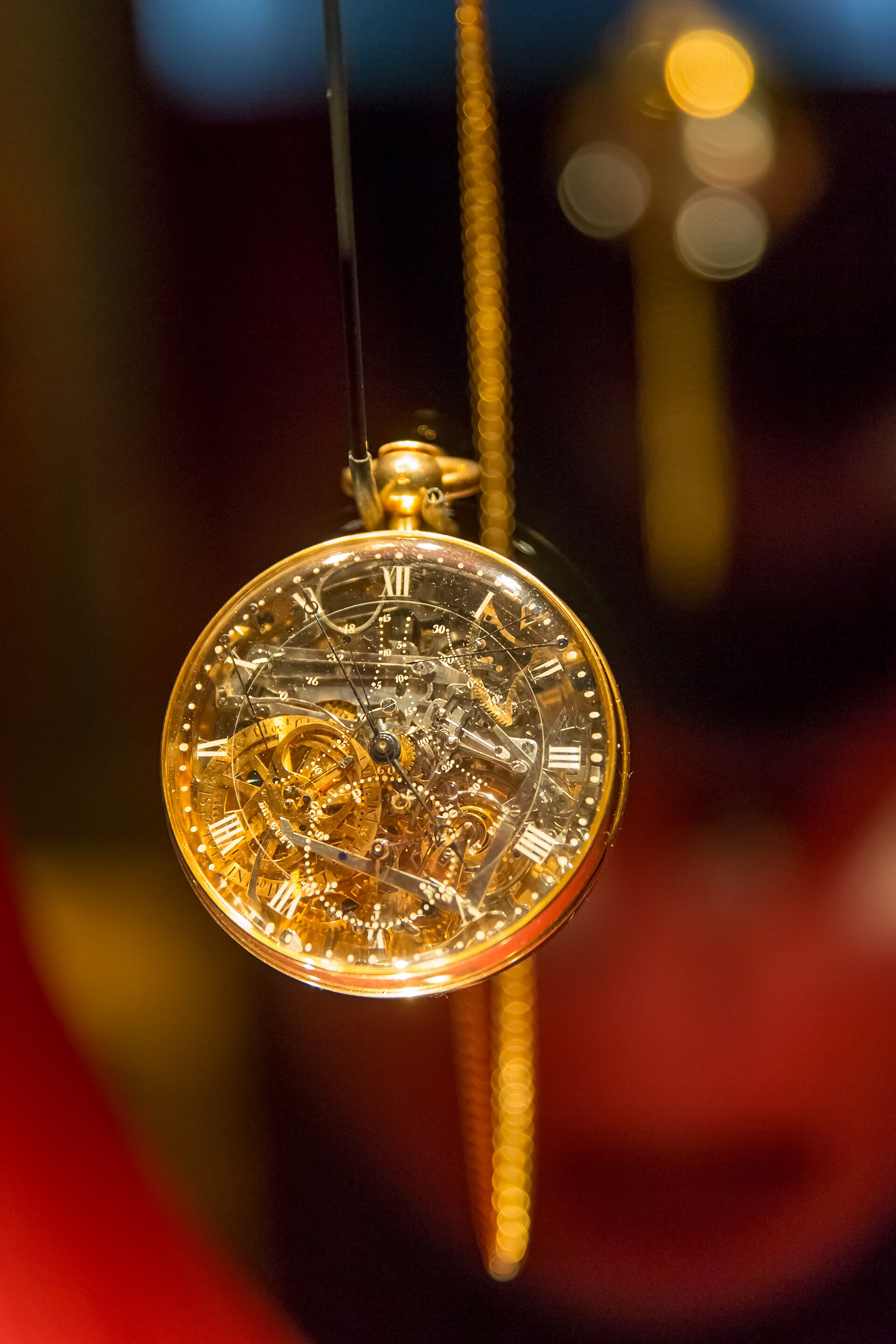
Breguet No. 160, the Marie-Antoinette
Ordered 1783 · Gold
L. A. Mayer Museum for Islamic Art, Jerusalem
 1747-1823
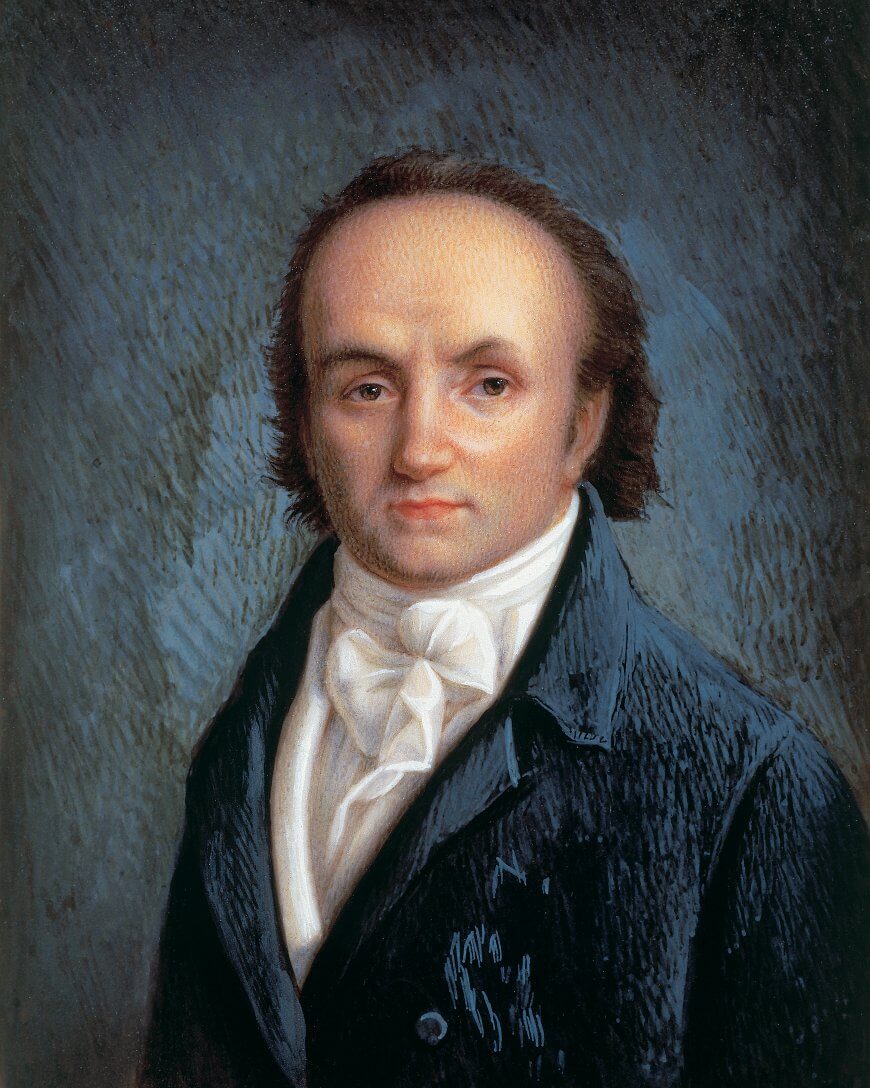
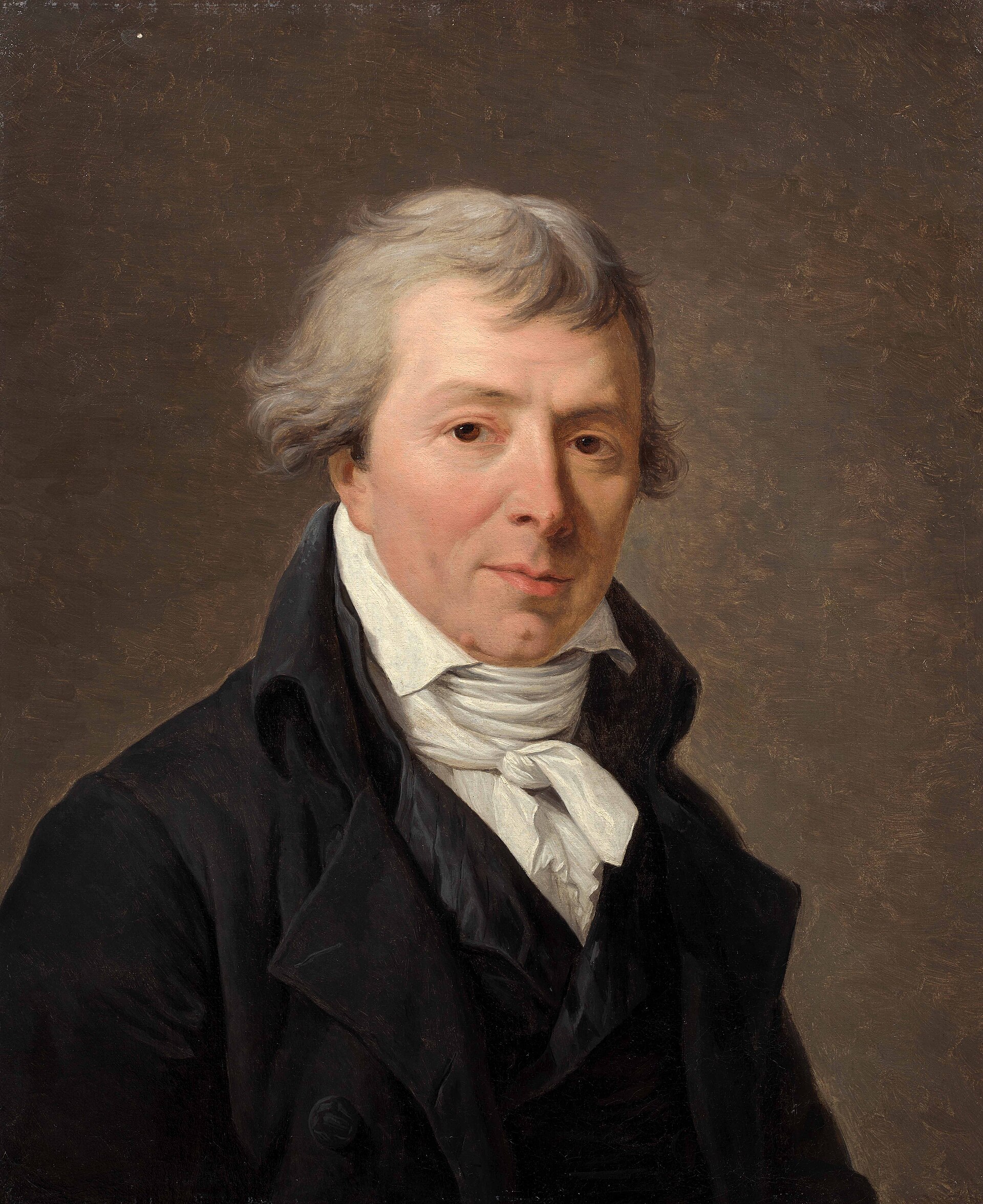
Abraham-Louis Breguet as a younger man, an anonymous painted portrait dated on the Wikimedia Commons file to about 1800. The file records its source as the Maison Breguet pages of the firm's own website, which is to say the identification is the one published by the house that holds his archives; the painter is not recorded and no holding institution is named. The identification is accepted here on that basis and the absence of a documented sitter record is stated rather than glossed.
Anonymous; file sourced from Montres Breguet, via Wikimedia Commons| Full name | Abraham-Louis Breguet, born at Neuchatel in the Prussian principality of Neuchatel, naturalised French |
|---|---|
| Worked as | Watchmaker and clockmaker, Inventor and patentee, Horloger de la Marine, Member of the Bureau des Longitudes |
| Born | 1747 · Neuchatel, then a principality held by the King of Prussia... |
| Died | 17 September 1823, aged 76 · Paris. Buried at Pere Lachaise, division 11 |
| Nationality | Born a subject of the King of Prussia at Neuchatel |
| Movement | Late Enlightenment French horology |
| In this archive | 1 artwork |
| Sources | 37 cited |
| Last verified | 17 September 2026 |
About this page 1 artwork in the archive · Last verified 17 September 2026 · 37 sources cited
Breguet is the name on which the whole practice of horological provenance was built, and the reason is not the watches. It is the paper. From the late 1780s his house kept production registers, sales registers and repair registers, and most of them survive. A Breguet object carries a number, and the number goes into a book that says what was made, what it cost to make, who bought it, on what date and for how much, and often who brought it back for repair thirty years later. No other field of decorative art has a maker's own serial archive of that continuity still in the hands of the firm that wrote it. In horology the archive is the provenance, and this is the archive that made that true.
The second thing to know is that the archive exists because the forgery problem was catastrophic from the beginning. Emmanuel Breguet, the family historian and the firm's heritage director, has put the scale of it in one sentence: there were more fake Breguet watches in the nineteenth century than authentic ones. Breguet answered it in his own lifetime by cutting a signature into the dial so fine that it cannot be seen except in raking light, and that secret signature is still the first thing a specialist looks for. He also answered it with the numbering, and the registers behind it, which is why the fraud problem and the provenance apparatus are the same story told from two ends.
The third thing is the one that a buyer needs and rarely gets straight. The firm trading as Breguet today owns the name, the archives and the museum, and it was bought by the Swatch Group in 1999. It has no continuity of ownership with Abraham-Louis Breguet beyond the name: the family sold the watchmaking business to an English foreman, Edward Brown, in 1870, and the Brown family sold it a century later. An object described as a Breguet may therefore be by the man, by the house he founded, by the house under the Browns, by the modern company, or by nobody at all. The registers are what separate those cases, and they only separate them if the number on the object and the entry in the book agree.
Platinum is recorded being mined in the Choco region of Spanish America by Antonio de Ulloa and Jorge Juan y Santacilia during the survey begun in 1735; Ulloa publishes in 1748. The metal Breguet will use for his self-winding weights is at this date a colonial curiosity that nobody in Europe can work.16
Born at Neuchatel, then a principality of the King of Prussia and not part of Switzerland as later constituted.13
Born at Neuchatel on 10 January, into a Protestant family which Fourier records as having been forced to leave France. Neuchatel is a principality held in personal union with the King of Prussia and does not join the Swiss Confederation until 12 September 1814.2829
His father, Jonas-Louis Breguet, negociant-cabaretier at Les Verrieres, dies aged thirty-nine.29
His mother remarries Joseph Tattet, a watchmaker of Les Verrieres and Paris. Fourier records that she thereby destined her son for the profession he afterwards practised.2829
Arrives in France at fifteen and is apprenticed to a watchmaker at Versailles, frequenting the workshops of Ferdinand Berthoud and Jean-Antoine Lepine. The abbe Joseph-Francois Marie teaches him mathematics in the same period.2829
Karl von Sickingen first renders platinum malleable. Chabaneau is still working on the problem in Spain in 1786. Breguet puts platinum into a production watch from about 1780, within a decade of the metal becoming workable at all.16
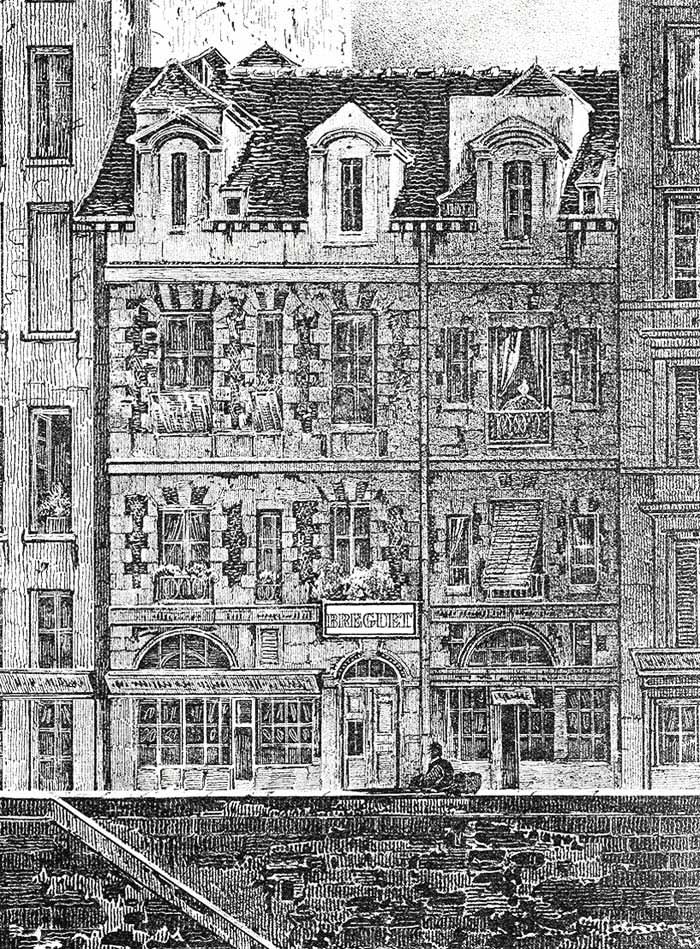
Opens his own workshop on the Quai de l'Horloge, Ile de la Cite, Paris. The firm counts its foundation from this year.13
Marries Cecile-Marie-Louise L'Huillier at Saint-Sulpice in Paris, aged 28. She dies on 13 May 1780.29
His son Antoine-Louis is born in August, on the sixteenth according to the Louvre and the thirteenth according to the Neuchatel genealogists.29
Develops the perpetuelle, the first commercially durable self-winding watch, with a platinum oscillating weight, twin mainspring barrels and a stop against overwinding.13
Louis Recordon obtains an English patent, 18 March, No. 1249, covering self-winding, a jump-seconds conversion and an escapement. Breguet self-winding watches are inscribed as sent to Recordon in London between 1780 and 1790.34
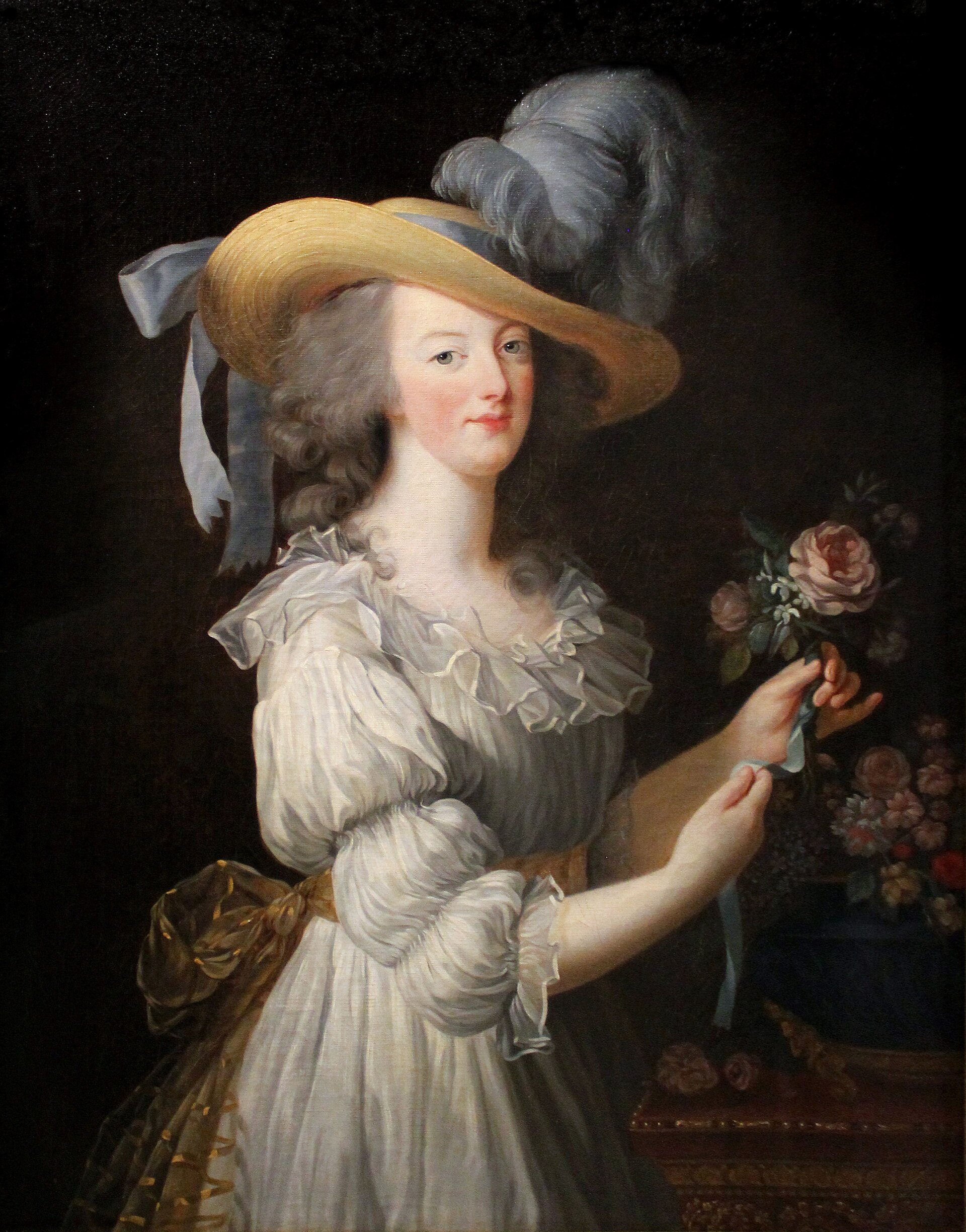
An officer of the Queen's Guard orders watch No. 160: every known complication, gold substituted for other metals wherever possible, no limit on time or price. The client's name is not established. Breguet also designs the hollow eccentric moon-tipped hands that carry his name.311
Begins engine-turning silver and gold dials. The guilloche pattern kills reflection and makes a small hand readable; the technique itself predates him.11
The surviving production registers begin. Records covering 1775 to 1787 were later lost in the Terror.1
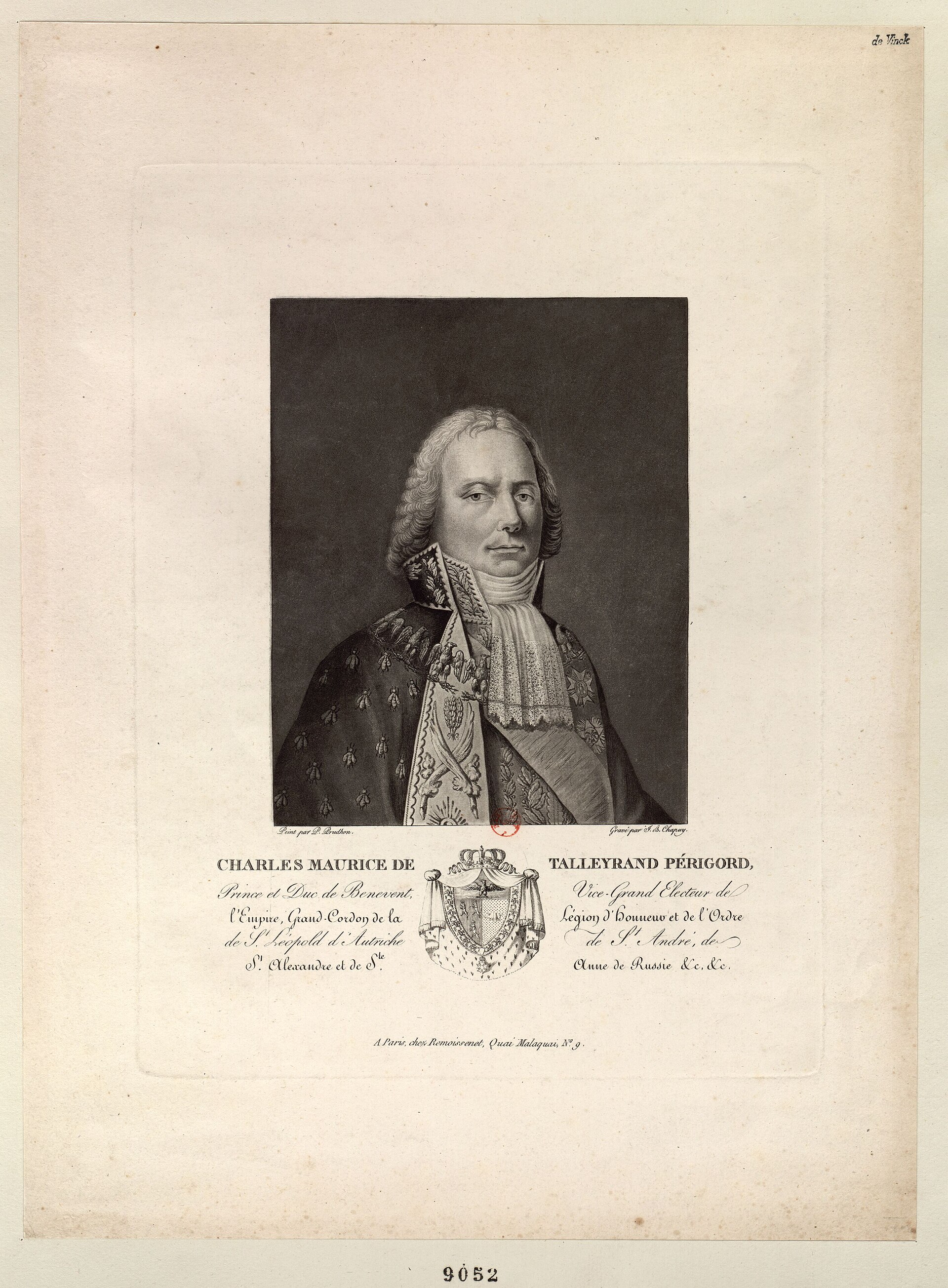
Invents the pare-chute: conical balance pivots in cupped bearings on light springs. Demonstrated by dropping a running watch on the floor at Talleyrand's house and passing it round the room. Fitted as standard to the perpetuelles from 1792.14
Naturalised French according to the Swiss historical dictionary and the French records; the Neuchatel genealogists give 1792.29
The sales registers become complete from this year; the oldest surviving repair book opens on 5 December 1791.1
Leaves Paris on 3 June for Switzerland, by way of Geneva to Neuchatel and Le Locle. Marie-Antoinette is executed on 16 October. Work on No. 160 is interrupted.313
Documentation covering the years 1775 to 1787 is lost during the Terror. Those twelve years of output have no register behind them.1
Returns to Paris and recovers the Quai de l'Horloge workshop. Introduces the secret signature, engraved into the dial and invisible except in oblique light, expressly to defeat counterfeiting. Conceives the sympathique.1113
The souscription watch: a simplified single-handed watch sold by subscription at 600 livres with a quarter paid in advance, financing standardised production. The montre a tact follows in the same years.13
Stands for the Academie des sciences in the section des arts mecaniques and is beaten by Lazare Carnot. Twenty years pass before he is elected.29
Exhibits a sympathique, a clock that resets, regulates and in developed versions winds its own watch overnight.13
Gold medal at the Exposition des produits de l'industrie francaise; a second follows in 1802, the year 10. The widely repeated gold medal of 1806 is not supported by that exposition's official jury report, which confirms his existing standing rather than awarding a new medal.29
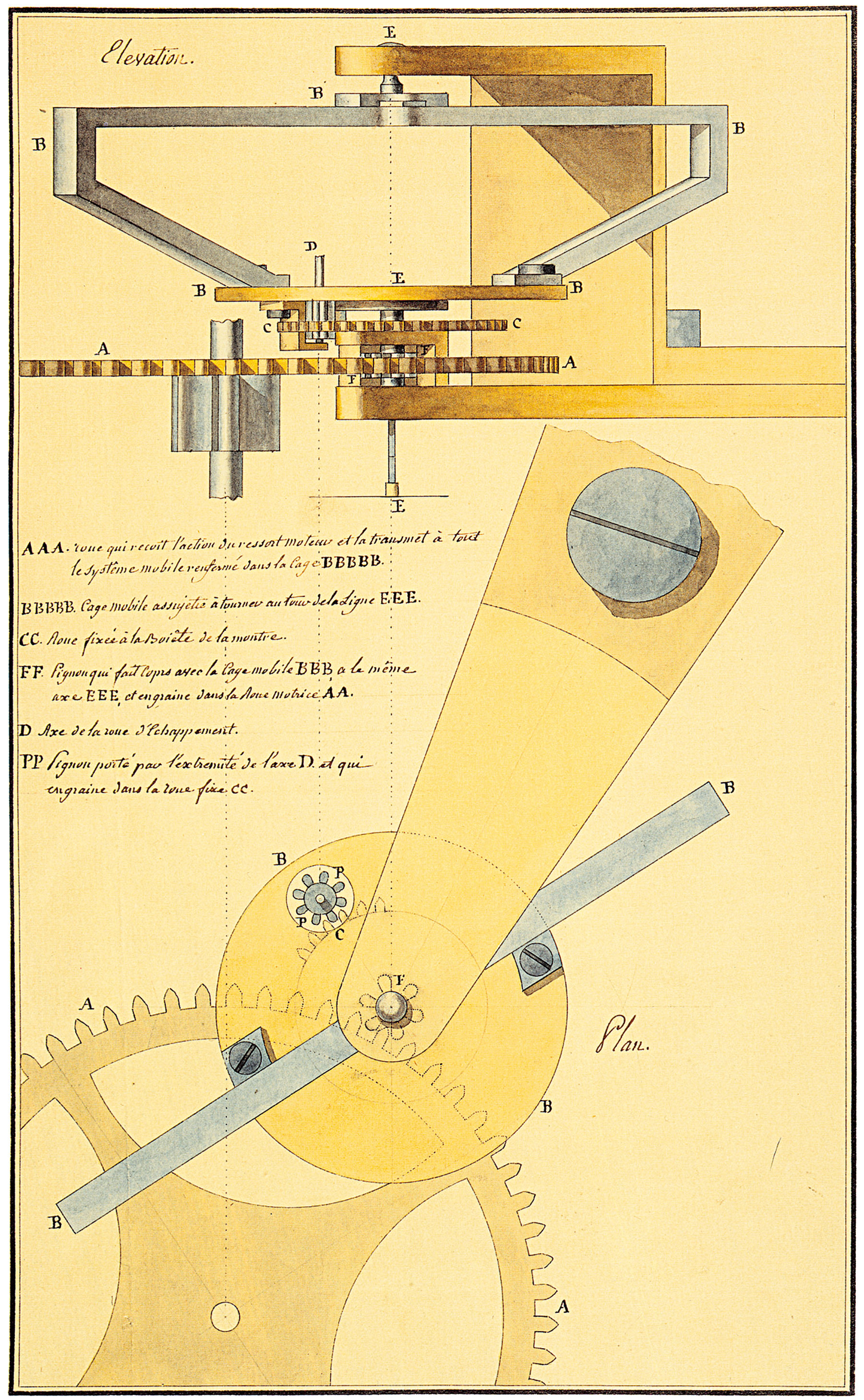
Deposits the complete technical file for the tourbillon, with a watercolour drawing, on 24 December, 3 Nivose year IX in the Republican calendar.12
The tourbillon patent is granted on 26 June, 7 Messidor year IX, by Jean-Antoine Chaptal as Minister of the Interior, for a term of ten years.12
The first tourbillon is commercialised, four years after the patent.12
The tourbillon is shown publicly at the National Exhibition of Industrial Products in Paris in September and October.12
The official jury report of the exposition lists him as article 440 under Machines de precision, address place Dauphine, and records that he is the first who, in France, treated fine watchmaking as a manufacture.29
The earliest certificate of authenticity the firm still holds. Purchasers receive documents called invoices carrying the buyer's name, the sale date, the description and the technical particulars down to diameter, thickness, dial type, case number, escapement type and weight, with operating instructions for complicated pieces.1
The Maison de Russie opens at St Petersburg; it closes in 1811 when Alexander I bans French imports. Tourbillon No. 1297 is sent to Recordon in London for George III on 29 June at 4,800 francs.2934
Breguet's first tourbillon, fitted into John Arnold's watch No. 11, is presented to John Roger Arnold on 30 August. The workshop ledger for the job names fourteen outworkers and totals 1,357 francs.21
Michel Weber works 725 hours on No. 160 at a recorded cost of 7,250 francs. The base movement is credited in the registers to a maker given as Prudhomme.3
Appointed Horloger de la Marine. Elected to the Bureau des Longitudes and made a member of the Legion of Honour.13
Elected to the Academie des sciences, section de mecanique, by royal ordinance of 21 March, only the second horologist to sit there after Ferdinand Berthoud.29
Publishes at Brest the Instructions sur l'usage des montres marines executees par Mr Breguet, 23 pages.28
Made a member of the Legion d'honneur; the dossier survives as Base Leonore LH//355/95. Serves on the jury of that year's exposition.29
Albertine Marat, sister of Jean-Paul Marat, supplies watch hands to the Breguet house in June, July, August and October, recorded in a manuscript Notte d'aiguilles sold at Giquello in Paris in January 2024 for 520 euros with fees. It is the only archival document found connecting the two families, and it postdates Marat's death by twenty-nine years.31
Dies in Paris on 17 September, aged 76. Thirty-five tourbillons have been sold since 1805. His son Antoine-Louis, then 47, inherits the house and turns it towards marine chronometers.1012
Joseph Fourier reads the Eloge historique de M. Breguet to the Academie royale des sciences on 5 June, records that a false use had been made of Breguet's name and that this gave him occasion to invent his method of engraving on enamel in extremely small characters, and announces that the unpublished treatise survives, is far advanced and will shortly be printed. The printed eulogy gives the death date as 26 September 1823, where every other authority gives 17 September.28
No. 160 is completed under Antoine-Louis Breguet on the modern firm's account, forty-four years after the order and four years after the death of Abraham-Louis Breguet. The holding museum gives 1820 and the firm's own Notice of 1887 gives 1802; all three dates are printed on this page.3
Antoine-Louis sells the business to his son Louis-Clement Breguet, who standardises production, then returns to unique pieces and sympathiques, and moves into scientific instruments and electricity.10
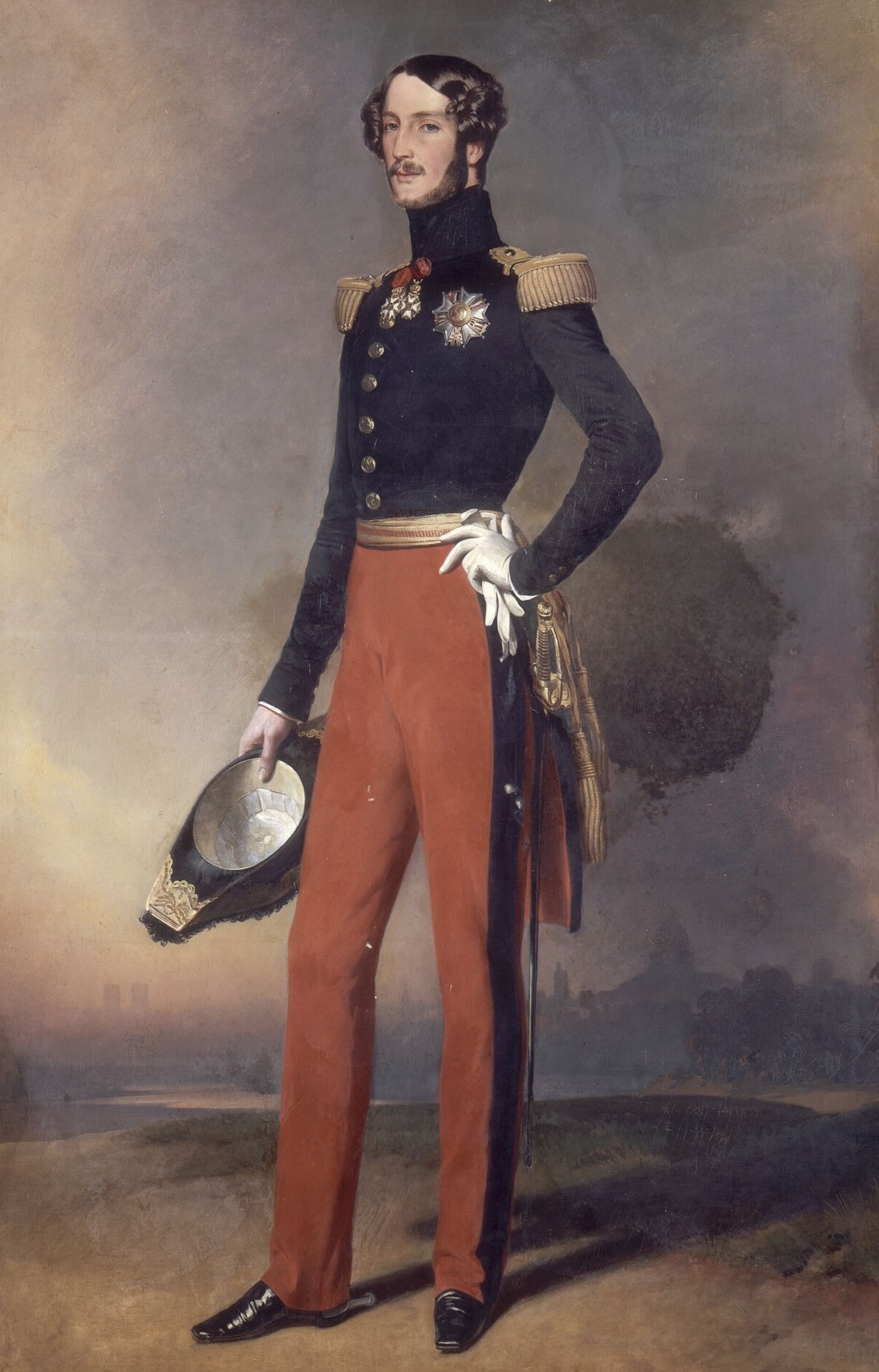
The Duc d'Orleans Sympathique, Breguet Nos. 128 and 5009, is made for Ferdinand Philippe, Duc d'Orleans, heir to the French throne. Twelve years after Abraham-Louis Breguet's death, so it is the successor house's work; Sotheby's records the register sale as 16 July 1836 at 10,000 francs, with 12,000 francs also in circulation.4
The repair books record on 11 March that the Marquis de La Groye of Provins brought in his perpetuelle repeating watch No. 160. The Marquis had died without issue on 4 October 1837, five months earlier.3
The Duc d'Orleans Sympathique is exhibited at the Exposition des Produits de l'Industrie in Paris.4
The watchmaking business is separated from the physics business and sold to Edward Brown, the English foreman of the workshop. The family retains the instrument side. The company is reorganised as Maison Breguet by 1881.10
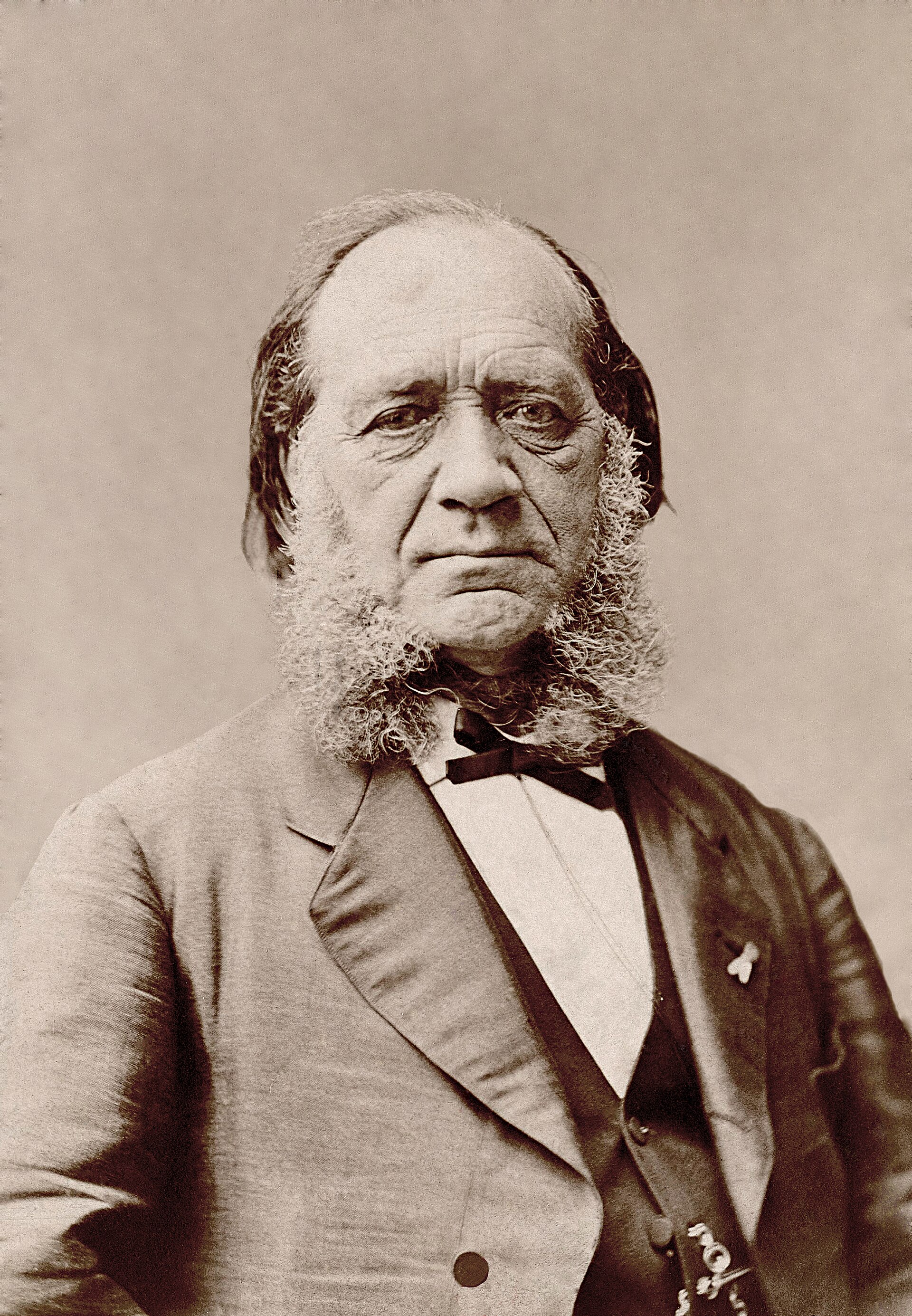
Nadar photographs Louis-Francois Breguet, the grandson, in Paris. The horological literature calls the same man Louis-Clement. He had sold the watchmaking side of the house to Edward Brown ten years earlier and kept the physics and instrument business.1018
The house sells No. 160 to Sir Spencer Brunton for 600 pounds, sixty years after it was finished.3
A Breguet house Notice dated 24 October records No. 160 as ordered in 1783 by an officer in the Marie-Antoinette Guards, completed in 1802 with work stopped from 1789 to 1795, at factory costs of 30,000 francs. Madame Breguet sells the watch to Sir Spencer Brunton for 600 pounds in the same year.19
No. 160 passes from the dealer and collector Murray Marks to Sir David Lionel Salomons, second baronet, in a chain that includes a Christie's sale of 22 June. Salomons assembles about 124 Breguet pieces.3
Sir David Salomons prints his catalogue of about 124 Breguet pieces, with the certificate practice, the numbering rule that no genuine Breguet carries 6 as a first figure, the diamond-point method of the secret signature, and his own encounter with a forged self-winding Breguet submitted to the firm for a certificate of genuineness.19
Salomons dies; the collection passes to his daughter Vera Bryce Salomons.3
The Brown family sells Breguet to the Chaumet brothers, Paris jewellers, after a century of ownership.10
No. 160 enters the L. A. Mayer Museum for Islamic Art in Jerusalem, founded by Vera Salomons in memory of the orientalist Leo Ary Mayer. In the same year the Duc d'Orleans Sympathique enters the Time Museum at Rockford, Illinois, as inventory 355.34
On the night of 15 to 16 April a single burglar takes 106 clocks and watches from the L. A. Mayer Museum, No. 160 among them, through a small window whose bars he bent, past an inoperative alarm. Reported dates range from 15 to 17 April.89
Investcorp acquires Breguet from Chaumet, returns the design to the founder's idiom and forms the Groupe Horloger Breguet.10
Breguet Sympathique No. 1 is offered at Antiquorum's Art of Breguet sale in Geneva on 14 April and makes 1,546,250 Swiss francs.4
The Art of Breguet, Habsburg in association with Antiquorum, Hotel des Bergues Geneva, 14 April, 204 lots. It mixes antique Breguet with new 1991 Montres Breguet product, including Sympathique No. 1, built by Francois-Paul Journe at Technique Horlogere Appliquee on commission from the brand. Prices are published for only 137 of the 204 lots.25
The Duc d'Orleans Sympathique is sold at Sotheby's New York, Masterpieces from the Time Museum, on 2 December, lot 22, for 5,777,500 dollars including premium. In the same year Nicolas G. Hayek buys Breguet for the Swatch Group.4610
Naaman Diller dies of cancer, having told his wife Nili Shamrat what he took in 1983 and where it is. Hayek commissions the modern firm to build a replica of No. 160.79
In August a lawyer acting for an unnamed woman arranges the return of a first group of the stolen objects to the museum. Reported payments are approximately 35,000 or about 40,000 dollars.9
The recovery of No. 160 becomes public. A further 43 watches and clocks are located in France and returned, joining pieces recovered earlier. The commonly cited total recovered is 96 of 106.79
The replica, No. 1160, is completed and shown, with 823 components and a presentation case made from an oak from the grounds of the Petit Trianon.37
The firm acquires the nearly finished chapters of Breguet's unpublished treatise on watchmaking for the archive.1
Patrizzi and Co sell the unpublished treatise in Geneva on 7 May as a single consolidated lot; Nicolas G. Hayek buys it for the Breguet Museum for 2,300,000 Swiss francs with no buyer's commission.32
The Duc d'Orleans Sympathique sells at Sotheby's New York on 4 December, sale N08882 lot 124, for 6,802,500 dollars including premium against an estimate in excess of 5 million dollars, an auction record for any clock.456
The four-minute tourbillon made for King George III, No. 1297, sells at Sotheby's on 14 July for about 1.6 million pounds.13
A specialist publication issues a formal correction clarifying that the Marie-Antoinette connection to No. 160 is legend rather than period documentation.19
Sympathique No. 1 sells at Phillips in Association with Bacs and Russo, Geneva, 10 May, lot 18, for 5,505,000 Swiss francs, a world record for anything called Breguet, and is bought by its own maker, Francois-Paul Journe. Sotheby's holds a 250th anniversary Breguet sale online in Geneva from 24 October to 9 November, publishing its estimates to everyone and its results to account holders.2427
The Breguet market is a pyramid with a very narrow top and a very wide, very dangerous base. At the top are unique objects with an intact original configuration and a documented first owner of consequence, and they trade in the millions of dollars. In the middle are the great complications and the tourbillons, in the high hundreds of thousands to low millions. At the base is the large body of good period Breguet, souscriptions, montres a tact, plain gold repeaters, trading in the tens of thousands, and that is where the forgeries are, because that is where buyers do not commission a certificate.
Three cautions apply to every reported figure. Published Breguet results are almost always premium-inclusive totals presented as prices; where a house publishes only that figure this record says hammer not published rather than implying a hammer. Currency and date are load-bearing and are usually dropped in secondary reporting; a Geneva result in Swiss francs and a New York result in dollars are not comparable without both dates and both rates. And the public price series is thin and repeats: the two highest clock prices ever recorded are the same object thirteen years apart, so a Breguet index built from auction results is an index of a handful of transactions.
The most useful number for a collector is not a price at all. It is the cohort: the other sympathiques, the other tourbillons of the same decade, the other pieces sold to the same first owner. The registers make that cohort recoverable in a way it is not for any comparable maker, and no price database attempts it.
| Date | Sale | Work | Result | Note |
|---|---|---|---|---|
| 1796-1797 | Retail, by subscription | The souscription watch | Hammer 600 livres, a quarter paid in advance With premium Not applicable Livres | The advance financed the production run. It is a manufacturing finance instrument as much as a price, and it marks the point at which the house moved from bespoke work to standardised production. |
| 1812-1815 | Workshop cost, from the production registers | Work by Michel Weber on No. 160 | Hammer 7,250 francs for 725 hours With premium Not applicable Francs | Ten francs an hour, recorded in the registers by named workman. It is the rarest kind of figure in decorative arts research, a labour cost attached to a named hand on a surviving object, and it is available because the production registers record the workers. |
| 1827 | Total build cost, from the registers | Watch No. 160 complete | Hammer 16,864 francs in one account; 17,000 francs and 30,000 francs also in circulation With premium Not applicable Francs | The three figures cannot be reconciled from the sources consulted. The 30,000 appears in tertiary sources as a factory cost. This record prints all three rather than averaging them, and treats the discrepancy as unresolved. |
| 1887 | Private sale by the firm | Watch No. 160 | Hammer GBP 600 With premium Not applicable GBP | Sold by the house to Sir Spencer Brunton, sixty years after completion. The house had kept the watch since 1827. |
| 14 April 1991 | Antiquorum, Geneva, The Art of Breguet | Breguet Sympathique No. 1: NOT by Abraham-Louis Breguet. A 1991 gold astronomical master clock with docking tourbillon wristwatch, built by Francois-Paul Journe at Technique Horlogere Appliquee on commission from Montres Breguet for this sale | Hammer Not published. DERIVED hammer CHF 1,400,000, see note With premium CHF 1,546,250 published as a single unlabelled figure; shown by reconstruction to be premium-inclusive CHF | Lot 204. Antiquorum publishes one figure per lot and does not label it. Reconstructing the 1991 schedule from all 137 published results in the sale as 15 per cent on the first CHF 125,000 of hammer and 10 per cent above gives a hammer of CHF 1,400,000; the schedule decomposes 135 of 137 results into hammers that are exact multiples of CHF 500 and is confirmed at the crossover by lot 53, which realised exactly CHF 143,750, or 125,000 times 1.15. THE HAMMER IS DERIVED and no printed 1991 premium schedule could be retrieved, because Antiquorum's terms pages return HTTP 500. This object is modern and must never be quoted as an antique Breguet comparandum. |
| 2 December 1999 | Sotheby's New York, Masterpieces from the Time Museum, lot 22 | The Duc d'Orleans Breguet Sympathique, Nos. 128 and 5009, 1835 | Hammer Not published With premium USD 5,777,500 total USD | POSTHUMOUS: Nos. 128 and 5009, delivered 1835 or 1836, twelve or thirteen years after Breguet's death; the work of the successor house under his son. Premium-inclusive total. Hammer not published in any source consulted. It held the auction record for a clock until the same object beat it in 2012. |
| 4 December 2012 | Sotheby's New York, Important Watches, sale N08882, lot 124 | The Duc d'Orleans Breguet Sympathique, Nos. 128 and 5009, 1835 | Hammer Not published With premium USD 6,802,500 total, against an estimate in excess of USD 5,000,000 USD | POSTHUMOUS: Nos. 128 and 5009, delivered 1835 or 1836, twelve or thirteen years after Breguet's death; the work of the successor house under his son. Premium-inclusive total; Sotheby's footnote states that pre-sale estimates do not include buyer's premium. An auction record for any clock and, at the time, the second-highest price for any timepiece at auction. Hammer not published. |
| 14 July 2020 | Sotheby's, London, The Collection of a Connoisseur, lot 28 | Four-minute tourbillon made for King George III, No. 1297, in original condition | Hammer Not published in the sources consulted With premium About GBP 1.6 million reported GBP | The reported figure is a rounded press number whose basis, hammer or total, is not stated in the sources consulted, and the lot page could not be opened for this record. THE YEAR: the sale is often dated 14 July 2021 in circulation, and that cannot be right. The United Kingdom export bar on this watch was announced on 29 January 2021 and deferred the licence decision to 28 April 2021, and a bar cannot precede the sale that triggered it. The sale is 2020. WHAT HAPPENED NEXT IS THE MORE IMPORTANT FACT: the watch was made the subject of a United Kingdom temporary export bar, valued at 2,000,000 pounds plus VAT of 400,000, on the third Waverley criterion, outstanding significance for the study of British collecting, horology and the social and political history of Britain and Europe. Its earlier provenance is given as Property of a Gentleman, Sotheby's, 9 November 1999, lot 78. |
| 10 May 2025 | Phillips in Association with Bacs and Russo, The Geneva Watch Auction: XXI, sale CH080225, Hotel President Geneva, lot 18 | Breguet Sympathique No. 1, the 1991 Journe ensemble commissioned by Montres Breguet: unique gold astronomical master clock of 255 mm with docking 18 carat gold tourbillon wristwatch of 36 mm | Hammer Not published With premium CHF 5,505,000, premium-inclusive CHF | Estimate in excess of CHF 1,000,000. Marked by Phillips as a world record. Bought by Francois-Paul Journe for his own brand museum, 3.56 times its 1991 premium-inclusive result of CHF 1,546,250 and about five and a half times the estimate. Sale total CHF 43,410,306. The highest auction price ever paid for anything called Breguet, for an object Abraham-Louis Breguet never touched. A rounded CHF 5,500,000 also circulates, including in the house's own caption. |
| 14 April 1991 | Antiquorum, Geneva, The Art of Breguet, lot 100 | Sympathique clock No. 257 with watch No. 4745, sold to Monsieur Francis Baring on 1 July 1845 for 9,000 francs. POSTHUMOUS: an 1845 sale is twenty-two years after Breguet's death, so this is a successor-house object and not his work | Hammer Not published. DERIVED hammer CHF 1,100,000, see note With premium CHF 1,216,250 published as a single unlabelled figure CHF | This clock is commonly offered as the genuine antique comparandum in place of the modern Sympathique No. 1. It fails the same test: it is period, but it is posthumous. The objects that can carry a lifetime claim are Nos. 46, 757, 421 with 3, 423 with 5, 758, 666 and 247, and they are set out in the sympathique section. Hammer derived on the reconstructed 1991 schedule and not published anywhere. |
| 14 May 2012 | Christie's Geneva, sale 1388, lot 230 | Breguet et Fils No. 2667, montre plate a deux mouvements sur le principe des chronometres | Hammer Not published With premium CHF 4,339,000, premium-inclusive CHF | Christie's own stated house record for Breguet. Estimate CHF 800,000 to 1,400,000. Lot 232 in the same sale, No. 4111, a montre plate a equation et a repetition, made CHF 2,547,000 against the same estimate band. A collectibles site reports the first as 4.7 million dollars at an unstated rate; keep the francs. |
| 16 May 2016 | Christie's Geneva, sale 1413, lot 123 | No. 217, montre perpetuelle a repetition a quantieme de mois et dates et equation, sold 1800 to General Moreau and resold 1817 to Charles-Louis Havas, founder of the agency that became Agence France-Presse | Hammer Not published With premium CHF 3,245,000, premium-inclusive CHF | Estimate CHF 600,000 to 1,200,000. The provenance is the point: a Napoleonic general and the founder of the modern news agency, in one object, with both transactions in the registers. |
| 11 November 2024 | Christie's Geneva, sale 23206, lot 58 | No. 3218, quantieme perpetuel with retrograde date, 18 carat white gold, catalogued as possibly unique and previously unrecorded | Hammer Not published With premium CHF 1,920,500, premium-inclusive CHF | Estimate CHF 100,000 to 200,000. The ratio matters more than the price: an object with no comparable is estimated an order of magnitude below what it makes, because there is no cohort to price it against. |
| 2015-05-11 and 2025-05-12 | Christie's Geneva, sale 1407 lot 243, then sale 23915 lot 110 | No. 2539, sold on 25 October 1813 to Princess Pauline Borghese, sister of Napoleon | Hammer Not published on either occasion With premium CHF 221,000 in 2015; CHF 201,600 in 2025. Both premium-inclusive CHF | Ten years apart, with an imperial provenance, and the nominal price in Swiss francs fell. Estimates were CHF 90,000 to 190,000 in 2015 and CHF 100,000 to 200,000 in 2025. The same effect appears on No. 1795 with case 4384, which made CHF 269,000 in November 2015 and was re-offered in 2025 with the low estimate cut by 40 per cent. |
| 1991 then 2014-05-12 | Antiquorum Geneva 1991 lot 31, then Christie's Geneva sale 1401 lot 294 | Chronometer No. 1176, montre garde-temps a tourbillon, case no. 1282, sold through the agent Moreau at St Petersburg to Comte S. Potocki | Hammer Not published With premium No price published in 1991; CHF 821,000 in 2014, premium-inclusive CHF | Estimated CHF 600,000 to 700,000 in 1991 with no price recorded, and CHF 600,000 to 1,000,000 in 2014. The same object, the same estimate band, twenty-three years apart, with a result the second time and none the first. |
| 12 May 2014 | Christie's Geneva, sale 1401, lot 290 | No. 3907, a souscription movement in a later silver and gold case | Hammer Not published With premium CHF 10,625, premium-inclusive CHF | Offered WITHOUT RESERVE at CHF 10,000 to 15,000. Christie's own lot essay states that according to the archives of Montres Breguet the watch was originally sold with a platinum case, and that the present silver and gold case and the enamel dial are later additions and not by Breguet. The archive contradicts the object, the house prints the contradiction, and the market prices it accordingly. It is the cleanest published example of what a register lookup is actually for. |
| 2 December 2025 | Bonhams, Fine Clocks, London New Bond Street, auction 31095, lot 54 | An 18 carat gold souscription watch, ruby cylinder escapement, No. 1309, sold to Jacques-Rose Recamier for 798 francs on 12 February 1804, with its Breguet certificate and numbered fitted red morocco box | Hammer Not published With premium GBP 76,600, premium-inclusive GBP | Against GBP 11,875 including premium for a souscription without certificate or box at Bonhams on 16 December 2015. The apparent multiple is not an index: one had its papers, its original numbered box and a named first owner and the other did not, and that is most of the difference. |
| 7 May 2010 | Patrizzi and Co, Geneva | The unpublished Breguet treatise: seven notebooks, 354 pages | Hammer Not published With premium CHF 2,300,000, about USD 2.1 million, with no buyer's commission charged CHF | Offered provisionally as seven lots at CHF 40,000 to 80,000 each, then consolidated into one to keep the archive intact. Bought by Nicolas G. Hayek for the Breguet Museum. The consignor is not named in any source reached here, and Salomons records the manuscripts as being in the firm's possession in 1921, so they left the company at some point and were bought back. |
Hammer is the price at which the bidding stopped; with premium adds the fee the house charges the buyer on top. Hammer price and buyer's premium in the glossary.
| Institution | City | Holdings | Note |
|---|---|---|---|
| L. A. Mayer Museum for Islamic Art | Jerusalem | Breguet No. 160, the Marie-Antoinette, and the surviving remainder of the Salomons collection, which numbered about 124 Breguet pieces when it was assembled. | Founded by Vera Bryce Salomons in memory of the orientalist Leo Ary Mayer; the watches arrived in 1974. 106 clocks and watches were stolen on the night of 15 to 16 April 1983 and the commonly cited recovery figure is 96 of them, between 2006 and 2008. Ten objects are still missing on that arithmetic. |
| Montres Breguet, Place Vendome | Paris | The archives: production registers from 1787, sales registers from 1787 and complete from 1791, repair registers from 5 December 1791 to the early 1970s, client correspondence, workshop notes, technical drawings, and the unfinished chapters of Breguet's treatise on watchmaking acquired in 2010. A museum is attached and its curator signs the certificates. | The single most important body of horological documentation in existence and not a public research collection. Access to it for a specific object is through the firm's heritage department. |
| Patek Philippe Museum | Geneva | Held the Duc d'Orleans Breguet Sympathique on loan from 2001 to 2005. | Recorded here as a documented exhibition venue in that object's chain rather than as a current holding. |
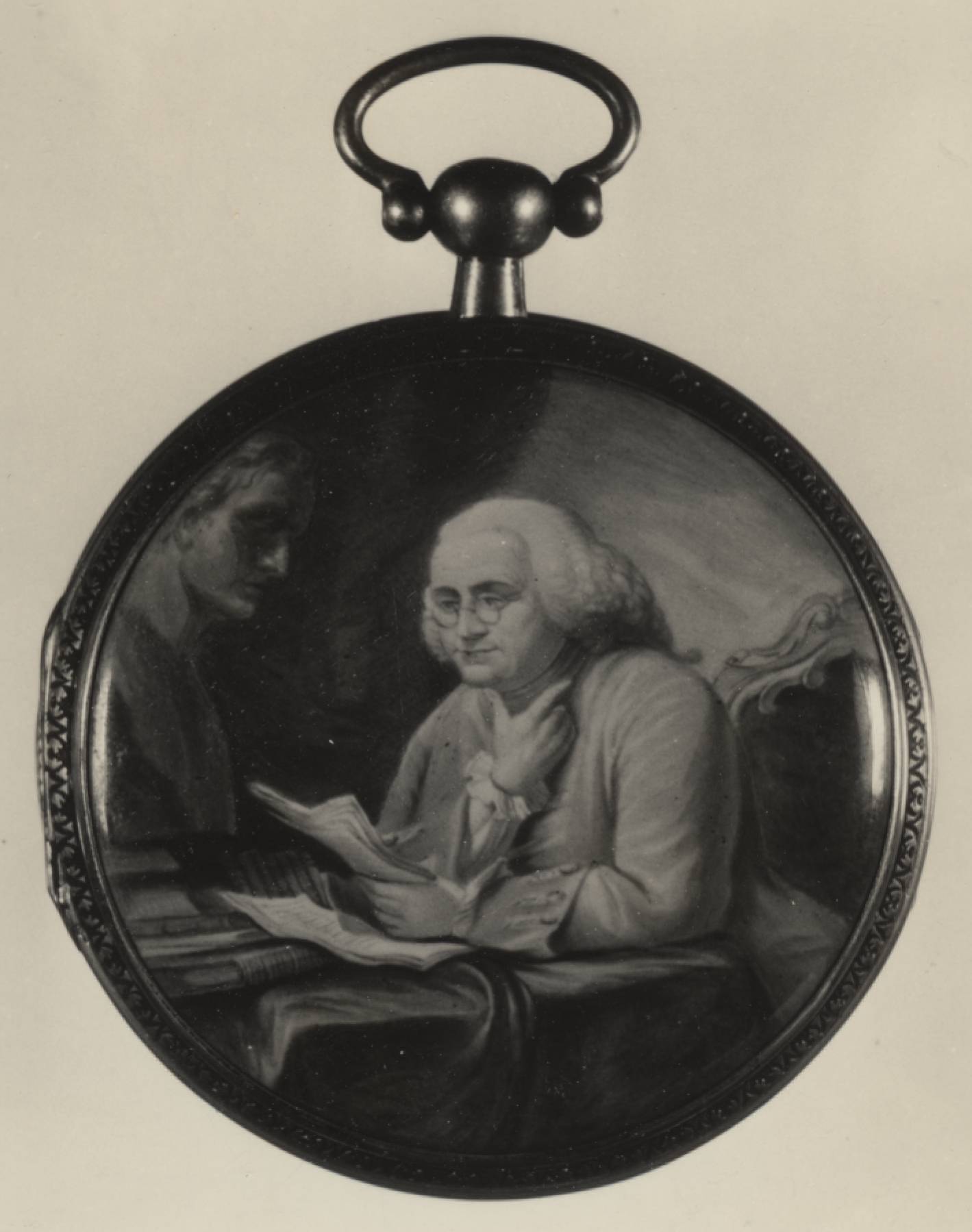
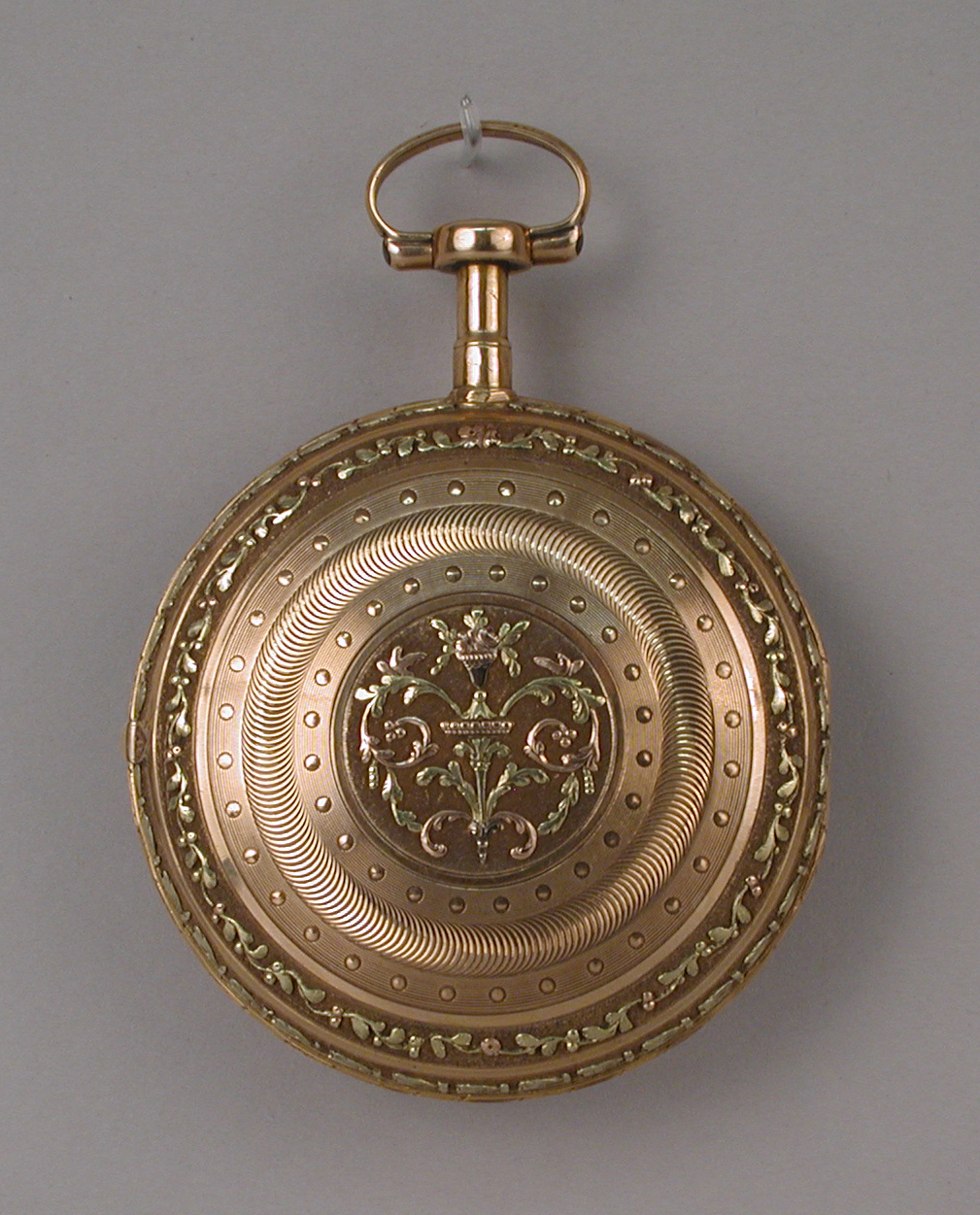
| The Walters Art Museum | Baltimore | An enamelled silver-gilt watch with a portrait of Benjamin Franklin after David Martin, catalogued as Breguet et Fils, about 1830, accession 58.147, 5.6 cm, from the William T. and Henry Walters collection and bequeathed by Henry Walters in 1931. | Useful precisely because it is not by Abraham-Louis Breguet: it is a house object of the sons' period, seven years after his death, and it is the clearest teaching example of what the signature does and does not carry. The museum publishes its images without copyright restriction, which is why this page can show it. |
| The British Museum | London | 63 Breguet objects, overwhelmingly the Ilbert collection bought privately in 1958 with funds from Gilbert Edgar after a Christie's sale of it was cancelled. Includes Breguet's first tourbillon fitted into John Arnold's watch No. 11, presented to John Roger Arnold on 30 August 1809, and Sympathique No. 757 made for Alexander I. | Also catalogues four objects explicitly typed as forgeries claimed to be by Breguet, which is why the counterfeiting section of this page can rest on institutional records rather than on trade anecdote. The record for the Arnold tourbillon prints Breguet's own workshop ledger naming fourteen outworkers. |
| Musee du Louvre | Paris | Fourteen Breguet objects in the department of objets d'art, eight of them from the Claudius Cote bequest of 1961, including souscription watches numbered 542, 947 and 1391 and a repeater signed for the Marine Royale. Five are displayed in the Richelieu wing. | Catalogued by Catherine Cardinal, Les montres et horloges de table du musee du Louvre, volume 2, 2000. Eleven of the fourteen arrived as bequests, one as a transfer and one has no mode recorded. None came by dation en paiement. |
| The Metropolitan Museum of Art | New York | Five Breguet objects, all released under CC0 with full-resolution downloads, including 17.101.14, catalogued as probably by an imitator, and a watch by Delaunoy, pupil of Breguet. | The Museum has not resolved an internal contradiction on one record, which is attributed to the firm of Breguet et Fils with a working life of 1816 to 1833 and dated about 1900. |
| Science Museum | London | Breguet material on display that is mostly not the museum's own: the Worshipful Company of Clockmakers' collection, on loan since 2015, much of it given by Sir David Salomons in 1924, including a one-minute tourbillon sold to the Princesse de Valencay in 1812 for 1,600 francs. | Hosted Breguet: The English Connection from 12 September 2023 to 8 September 2024, and showed No. 160 on loan in Versailles: Science and Splendour from 12 December 2024 to 21 April 2025. Anyone citing a Science Museum Breguet should check whether the object is museum property or Clockmakers' loan. |
| Mobilier national | Paris | GML 1302, a pendule sympathique, clock number 20 with watch number 48, bought by King Louis-Philippe on 23 August 1834 for 600 francs at that year's exposition and entered in the royal furniture journal on 27 December 1836. | Described as the only surviving example of the second-generation sympathique design. A state furniture collection rather than a museum, and rarely searched by horologists. POSTHUMOUS: sold in 1834, eleven years after Breguet's death, so it is the successor house's work. The clock and its watch were separated from 1905, the watch deposited at Malmaison under the number 695, and reunited only in 2010; the restoration was funded by Montres Breguet and carried out in its own workshops. |
| Royal Collection | Windsor and London | Sympathique No. 666, made for the Prince Regent and delivered in August 1814 at 11,500 francs, RCIN 2861. Its companion watch is given as No. 507 in one source and as No. 721 in Breguet's own caption. | One of the small group of sympathiques delivered inside Abraham-Louis Breguet's lifetime, and therefore one of the objects that can carry a claim to be his own work. The Royal Collection record has not been opened at first hand for this page and the details are reported. |
The Breguet archive is not one book. It is a set of parallel series, each answering a different question, and a specialist uses them against one another rather than singly.The production registers...
The Breguet archive is not one book. It is a set of parallel series, each answering a different question, and a specialist uses them against one another rather than singly.
The production registers record the construction of each piece: the dates, the costs, and the workers involved. They run from 1787 to the middle of the nineteenth century. The sales registers record the disposal of each numbered piece: the number, a description, the date of sale, the name of the buyer and the price paid. They have gaps between 1787 and 1790 and are complete from 1791 onwards to the present day. The repair registers are the third series and are the most useful of the three for provenance work, because a watch coming back for service records a later owner at a later date; the oldest surviving repair book opens on 5 December 1791 and the series runs to the beginning of the 1970s. Alongside them sit client correspondence, workshop notes, technical drawings, and the nearly finished chapters of the treatise on watchmaking that Breguet never published, which the firm acquired in 2010.
Two limits on that apparatus have to be stated plainly, because the trade tends not to. The first is that the archive begins in 1787 and the house opened in 1775. Documentation covering 1775 to 1787 was lost during the Terror in 1794. Twelve years of the founder's output, including the early perpetuelles and the first years of royal patronage, are outside the record entirely; for those years there is no register to check a number against, and an object of that period is authenticated on its physical evidence alone. The second is that the sales registers have gaps from 1787 to 1790. A number falling in that window may be genuine and unfindable at the same time, which is a different thing from being absent.
The registers are kept in Paris, at the firm's Place Vendome premises. They are the working instrument of the house's heritage department, not a public research collection, and access to them for an object is through the firm rather than through a reading room. That matters for a record: the primary document behind almost every Breguet provenance chain in the market is one an outside researcher cannot open for himself, and the citable form of it is a certificate issued by the company that owns the name. It is an unusually strong evidential base and an unusually closed one at the same time, and both facts belong in any entry that rests on it.
The firm issues two different documents and the difference is not decorative.
The firm issues two different documents and the difference is not decorative. For pieces made after 1989 the owner can obtain an archive extract, which reports what the modern production record holds. For pieces made before 1989 the document is a handwritten certificate of authenticity, compiled from the registers by the heritage department and signed by the curator of the Breguet museum and archives. It states the characteristics of the piece, the date of sale, and the name of the first owner.
The practice is older than the modern company. The earliest certificate of authenticity the firm still holds dates from 1808, when purchasers were given documents the house called invoices, carrying the buyer's name, the date of sale, the description of the piece, and the technical particulars down to diameter, thickness, dial type, case number, escapement type and total weight. Complicated pieces went out with operating instructions. In other words the object was sold with a specification sheet, and a surviving specification sheet is a period document that can be matched against the object in hand.
Now the limits, which are where a collector loses money. A certificate answers the question whether an object with this number is in the register and what the register says about it. It does not answer, and cannot answer, whether the physical object in front of the specialist is the object the register describes. The register entry is a description; the movement, the case, the dial and the hands are four separately survivable components, and a Breguet that has been recased, redialled or rebuilt around a genuine movement will still match a register entry on its number. The commonest way to be wrong about a Breguet is not to hold a total fake but to hold a partly genuine object whose certificate is entirely correct about a movement and silent about everything bolted to it.
Nor does a certificate settle authorship inside the workshop. Breguet ran a house, not a bench. The production registers name the workers involved in a piece, which is more than almost any comparable maker offers, and that is precisely how we know that individual named craftsmen did the work; the celebrated case is No. 160, where the surviving record credits a base movement to a maker recorded as Prudhomme and 725 hours of work between 1812 and 1815 to Michel Weber at a cost of 7,250 francs. A signature reading Breguet is a house signature. Where the register names the hands, the record should name them too, and where it does not, the honest formula is by the house of Breguet rather than by Breguet.
Two practical points follow for anyone writing an entry. Cite the certificate as a document with a date and a signatory, not as a fact; a certificate issued in 2004 and a certificate issued in 2024 rest on the same registers but on different readings of them, and the later one supersedes. And record the number as the object carries it, with its location: Breguet numbered the movement, and separately stamped the case, and a mismatch between the two is itself the finding.
The serial number is the key into the archive and it is also the first thing a cataloguer over-reads.
The serial number is the key into the archive and it is also the first thing a cataloguer over-reads. It is worth being precise about what the number does and does not do on its own.
What it does is index an entry. The registers are ordered by number, and a number produces a description, a date of sale, a buyer and a price. That is the whole of its evidential force, and it is a great deal more than any other maker of the period offers.
What it appears to do, and what a cataloguer should resist, is date the object by itself. The numbers cited on this page do fall broadly in order: No. 128 and No. 160 belong to the 1780s by commission, No. 1297 is the tourbillon made for George III, No. 5009 is the watch of the sympathique of 1835. But No. 160 was ordered in 1783 and finished decades later, on the modern firm's account in 1827, so its number records when the order was taken and not when the object existed. A number is a position in a queue, and this house had a forty-four year queue at least once. Whether the series is strictly chronological, whether numbers were reserved, and how the case numbering relates to the movement numbering are not established in the sources consulted here, and they are recorded as open questions rather than assumed.
Two practical rules follow. Record the number exactly as the object carries it, with its location: stamped on the movement, engraved on the case, cut into the dial beside the secret signature. And record every number the object carries, not the one the catalogue leads with. The Duc d'Orleans Sympathique is Nos. 128 and 5009, and a sale entry that gives only one of them has described half an object.
Abraham-Louis Breguet died on 17 September 1823.
Abraham-Louis Breguet died on 17 September 1823. Every object this page names has been checked against that date, and the result is set out here in one place rather than left for a reader to work out, because the distinction is the page's entire subject and getting it wrong anywhere is worse here than it would be anywhere else.
The rule. An object completed or sold before 17 September 1823 may be his own work, subject to everything this page says about etablissage and the named outworkers. An object completed or sold after that date is by the successor house, whatever it is signed: Breguet et Fils, then Breguet Neveu et Compagnie, then Maison Breguet under Edward Brown from 1870, then Chaumet, Investcorp and the Swatch Group. An object made since 1999 is by Montres Breguet SA. All three are genuinely Breguet. Only the first is by Breguet.
His own lifetime, on the dates the registers give. Watch No. 179, sold to Marie-Antoinette on 4 September 1792. The Experimental Type I No. 178, Paris 1792 to 1795. The souscription watches: No. 443 sold 12 March 1799, No. 258 delivered 11 August 1799, No. 729 sold 12 April 1801, No. 730 sold 10 July 1801, No. 1309 sold 12 February 1804, No. 1362 and No. 1436 of 1804, No. 1106 made 1804, No. 3185 and No. 3634 of 1818. No. 217, sold 1800 to General Moreau. No. 1188 of 1 August 1808 and No. 1297 of 29 June 1808, the George III tourbillon retailed by Recordon. No. 1176 of 12 February 1809. No. 1890, delivered 1809 to Comte Razoumoffsky. No. 1795 with case 4384, 1810. No. 2539, sold 25 October 1813 to Pauline Borghese. No. 2044 of 1807 and the carriage clock No. 2801 of about 1815, both signed Breguet et Fils in his lifetime, which is the signature's first trap. No. 2926, sold 1816 to Ouvrard. No. 1918, sold 13 February 1822. The marine pieces No. 106 delivered 11 January 1816, No. 104 sold 9 April 1818 to Captain Baudin and the Grande Horloge Marine No. 3219 U2 sold 7 December 1818. And the tourbillon fitted into Arnold's watch No. 11, presented 1809.
Begun in his lifetime and finished after it. Only one object, and it is the famous one. No. 160 was ordered in 1783. On the modern firm's account it was completed in 1827 under his son, four years after his death; the holding museum gives 1820, which is inside his lifetime; the firm's own Notice of 1887 gives 1802. On two of the three dates the most famous watch in the world was finished by somebody else.
The successor house, 1823 to 1970, every one of these posthumous. Marine chronometer No. 3199, sold to the Ministere de la Marine on 26 December 1823, three months after the funeral. No. 3787, sold 27 December 1823 to the Comte de Schouvaloff. No. 4084, sold 15 March 1824 to Lieutenant Texier. No. 3630, sold 31 August 1824. No. 4548, the perpetuelle montre a tact sold to King George IV on 3 July 1827. No. 3832, sold 30 August 1828 to the Comte d'Archinto. No. 4730, sold 31 December 1829 to Princess Bagration. The Walters Art Museum's enamelled watch of about 1830. No. 4851, sold 10 February 1831. No. 4653, built 1827 to 1831 for the Ministere de la Marine. The Mobilier national's sympathique, clock No. 20 with watch No. 48, sold to Louis-Philippe in 1834. The Duc d'Orleans sympathique, Nos. 128 and 5009, of 1835 or 1836. No. 4852 of 1841. Sympathique clock No. 257 with watch No. 4745, sold to Francis Baring on 1 July 1845. No. 3795, completed 1881. No. 472 and No. 1939, both completed 1924. No. 4054, sold 1939 to the Service Hydrographique. No. 3357, completed 1946. No. 4373, sold 14 April 1948 to Air France. No. 1039, the triple calendar wristwatch of 1952. Deck watch No. 2668, sold 1956 to the Marine Nationale. And the diving watch reference 1646 of 1965, made under the Brown family.
Montres Breguet SA and its commissions, modern. Sympathique No. 1, built in 1991 by Francois-Paul Journe at Technique Horlogere Appliquee on commission from the brand. The Jump Hour wristwatch No. 1 of 1991. The 2eme Tourbillon Squelette Sympathique No. 15 of about 1994. No. 1160, the replica of No. 160, commissioned 2004 and shown 2008. No. 2911, made as No. 5 for Nicolas G. Hayek in 2004.
Two consequences follow and both are uncomfortable. The highest auction price ever paid for anything called Breguet is for a 1991 object. And the two highest prices ever paid for a clock are for an object delivered twelve years after Breguet was buried. On the evidence of the saleroom, the market for this maker is very largely a market for work he did not do.
In 1795 Breguet began putting an invisible signature on his dials for the sole purpose of defeating forgery, and it remains the first physical test a specialist applies.
In 1795 Breguet began putting an invisible signature on his dials for the sole purpose of defeating forgery, and it remains the first physical test a specialist applies. It is engraved, not printed. The inscription is cut into the enamel or the metal of the dial with a fine point, historically by a diamond-point pantograph, an instrument with articulated arms that scales a master pattern down mechanically so the same hand-cut form can be reproduced at a size no hand could cut directly. Because the mark is an incision rather than a deposit, it has no colour of its own. It is the same material as the dial around it. In flat light it is not there.
To read it, the dial is turned under a raking or oblique light with a loupe until the incision catches, and the signature appears as a faint line drawing, conventionally between the centre of the dial and the six o'clock position, often accompanied by the serial number and, on the subscription watches, by the word Souscription. On enamel dials the mark is at its most fugitive. A dealer who has never seen one will look straight past it, and a photograph almost never shows it, which is why remote authentication of a Breguet dial is close to worthless.
What makes it diagnostic is not that a forger cannot copy it. It is that copying it correctly requires the same process. The modern shortcut is a tone-on-tone transfer, printed rather than engraved, which sits on the surface instead of in it and behaves quite differently under the loupe: a transfer has an edge and a thickness, an incision has neither. Restoration workshops that put the signature back on a relined dial engrave it dry-point, and the trade regards a hand-engraved replacement as a different thing again from an original pantograph cut. So the examination is not a yes-or-no on presence. It is a reading of how the mark was made, in what order relative to the enamel, and whether that method belongs to the date the object claims.
The signature is also a dating instrument in a small way. It begins in 1795, so its absence on a piece of the 1780s is not a defect; and the house has used it continuously since, so its presence on a modern piece proves nothing about the eighteenth century. The trap a cataloguer must avoid is treating a legible secret signature as an authentication. It is one of several agreements to be tested, on the same principle by which a set of London silver hallmarks is read: every element has to agree with every other element, and a single disagreement is the whole of the evidence.
The name is attached to a longer list of inventions than any other in horology, and the list is not evenly reliable.
The name is attached to a longer list of inventions than any other in horology, and the list is not evenly reliable. Sorting it is directly useful, because catalogue descriptions routinely credit Breguet with things he refined rather than originated, and a record that repeats the trade's shorthand imports the trade's error.
The tourbillon is his without qualification and is documented to the day. He deposited the complete technical file, with a watercolour drawing, on 24 December 1800, which the Republican calendar then in force dated 3 Nivose year IX. The patent was granted on 26 June 1801, 7 Messidor year IX, by Jean-Antoine Chaptal as Minister of the Interior, for a term of ten years. The device puts the escapement and balance in a carriage that rotates once a minute so that positional errors are repeated regularly and cancel one another rather than accumulating. It was not a working product in 1801: the first tourbillon was commercialised in 1805, it was shown publicly at the National Exhibition of Industrial Products in Paris in September and October 1806, and thirty-five examples were sold between 1805 and the year of his death in 1823. Thirty-five in eighteen years is the correct order of magnitude to hold in mind when a saleroom describes a tourbillon of this period as rare.
The pare-chute is his, dated to about 1790, and is the ancestor of every shock-protection system in use since. The balance staff is given conical pivot ends running in cupped bearings mounted on light springs, so a blow is taken by the spring rather than by the pivot; the analogy the period itself used was the leaf spring of a carriage. Breguet demonstrated it by dropping a watch on the floor at Talleyrand's house and passing it round the room still running, which is the best-attested piece of salesmanship in the trade's history and, unusually, a demonstration of a real physical property. It was fitted to the perpetuelles from 1792 and spread through the range in the early nineteenth century. Incabloc, introduced in 1934, is the descendant that generalised the idea to a mass market Breguet's version could not reach.
The perpetuelle, the self-winding watch, is his in development but not in first conception; self-winding work existed before him and the honest form is that from about 1780 he made the first commercially successful and durable version of it. His used a heavy oscillating weight, in platinum for density in the least space, twin mainspring barrels, and a stop that prevented overwinding.
The Breguet overcoil is the outer terminal curve raised above the plane of a flat balance spring so that the spring breathes concentrically. It bears his name and the attribution to him is standard, dated to before 1800; it is the one item on this list that a specialist should describe as attributed rather than documented on the sources available here, because the geometry was described by others and the naming convention is retrospective.
The guilloche dial is the clearest case of a technique he did not invent and did make his own. Engine turning was an established ornamental art before he applied it to dials in the mid-1780s, and it does a job that is not decorative: the cut pattern kills the reflection off a polished metal dial and makes a small hand readable. The trade calls a machine-turned dial a Breguet dial regardless of maker, and a record should not.
The same caution applies to Breguet hands, the slim shaft with a hollow eccentric moon near the tip, designed around 1783, and to Breguet numerals, the sloped Arabic figures he drew himself before the Revolution. Both entered the general vocabulary of watchmaking and are now made by everybody. A cataloguer writing Breguet hands is naming a shape, not an attribution, and where an object is described only in those terms it has not been described at all.
Two further inventions belong to him and matter to any object record because they are visible. The gong spring for repeating watches replaced the bell with a wire coiled inside the movement, which is why a Breguet repeater of the period is thin where its rivals are thick. And the montre a tact, from the later 1790s, has an external arrow on the case that the owner turned until it stopped, reading the hour by feeling studs on the band, so that the time could be taken without opening the watch in company. The echappement naturel, with two coupled escape wheels giving direct impulse and needing no oil on the impulse faces, is also his, developed in the early 1800s, and it survives in very small numbers.
Watch cases are gold or silver and everybody knows it.
Watch cases are gold or silver and everybody knows it. The materials that matter for authentication and for understanding what Breguet was doing are inside, where nobody looks, and two of them are worth setting out because they are the point at which this maker touches the wider extraction history of his century.
The first is platinum, and it is used for a purely mechanical reason. The perpetuelle winds itself by an oscillating weight, and the useful property of a self-winding weight is mass in the smallest possible volume, because the space inside a pocket watch is the whole design constraint. Breguet used platinum for the weight from about 1780 for exactly that reason: density in the least space. Nobody buying the watch could see it. It is the most exotic material in the object and it is invisible.
What makes that choice remarkable is the date. In 1780 platinum was barely a workable metal in Europe. The material came from one region, the Choco in what is now Colombia and was then Spanish America, where Antonio de Ulloa and Jorge Juan y Santacilia recorded it being mined during the survey they began in 1735; Ulloa published in 1748. Karl von Sickingen worked on it from 1772 and was the first to make it malleable, by alloying it with gold, dissolving the alloy in hot aqua regia, precipitating the platinum with ammonium chloride, igniting the salt and hammering the resulting powder until it cohered. Pierre-Francois Chabaneau was still working on the problem in Spain in 1786 under the patronage of Charles III. Breguet was therefore putting a metal into a production watch within a decade of anybody being able to work it at all, and sourcing it from a colonial extraction economy on the other side of the Atlantic. Who cut and washed the ore in the Choco, and under what conditions, is not established in the sources consulted for this record, and it is not asserted here; the record says what it can prove and leaves the rest in the open questions where it belongs.
The second is gold used structurally rather than decoratively, and No. 160 is the extreme case because the client instructed it. The order of 1783 specified that gold should replace other metals throughout wherever it could be substituted, and the watch as built has gold plates, gold bridges, gold wheels and a gold balance spring. A gold balance spring is not an ornament. It is a decision about a component whose elasticity governs the rate of the watch, taken because a patron had asked for gold rather than because gold was the right material, and it is the clearest surviving instance in horology of a client's instruction overriding a maker's judgement on a functional part.
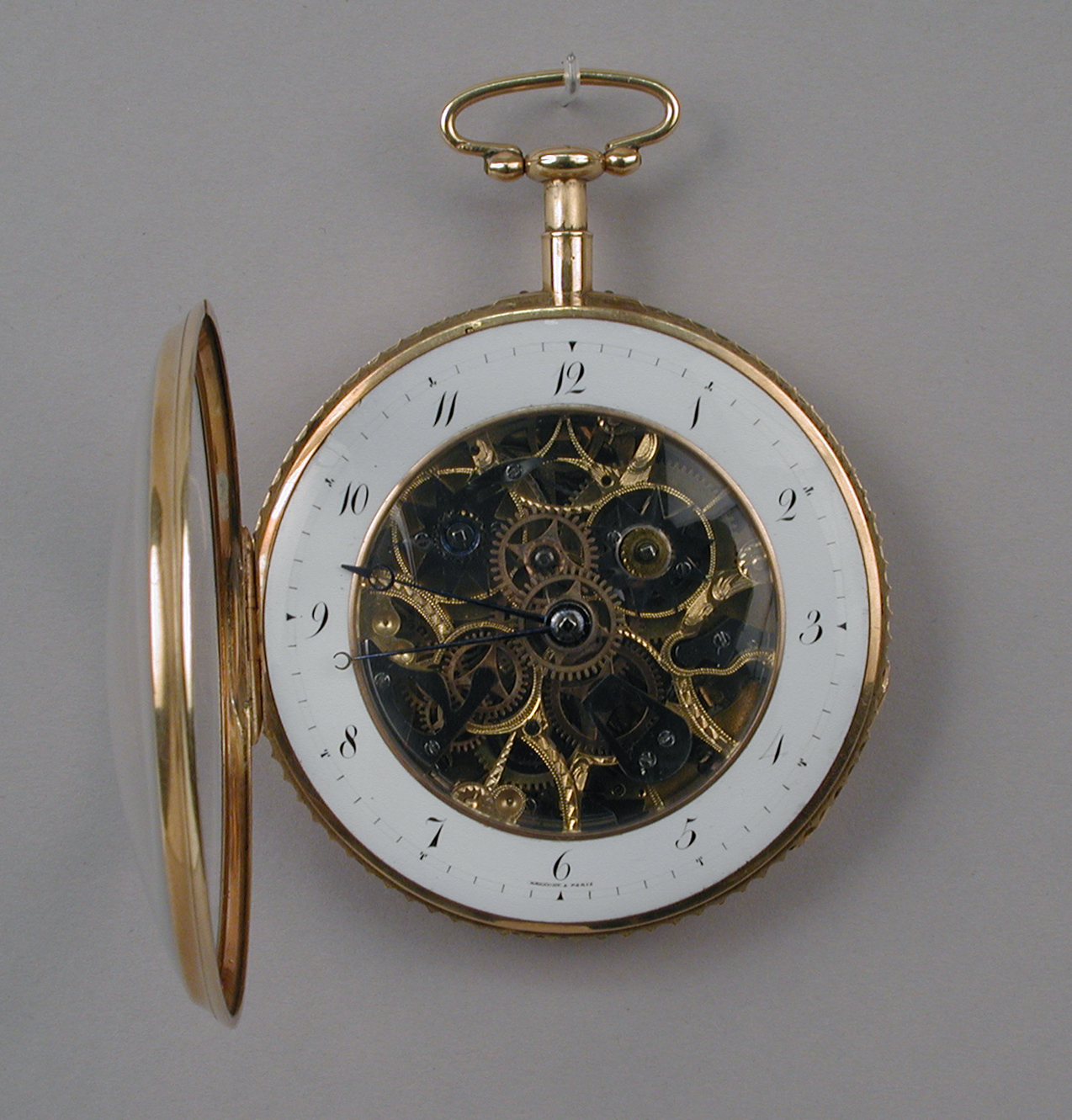
The rest of the material vocabulary is diagnostic in ordinary ways and should be recorded on any object. Sapphire for bearings, in No. 160 throughout. Rock crystal rather than glass for the front and back covers and for the second dial of No. 160. Enamel for dials, which is where the secret signature is cut and where a relined or replaced dial destroys the evidence. Blued steel or gold for the hands. Silver or gold, engine-turned, for the guilloche dials, powdered with silver after cutting. And on the sympathique, an entirely different material register: ormolu mounts on a red tortoiseshell Boulle-style case, which is cabinet-making rather than horology and is why a sympathique is catalogued and conserved by two different sets of specialists.
The most famous watch in the world is a commission the maker never delivered, to a client who was executed, finished by his son four years after his own death.
The most famous watch in the world is a commission the maker never delivered, to a client who was executed, finished by his son four years after his own death. It is the object on which every claim about the Breguet archive is tested, because the archive is very nearly all we have.
The order was placed in 1783. The house record identifies the client only as an officer of the Queen's Guard, and no source consulted here supplies a name from the register. The instruction was to build into one watch every complication then known, to use gold in place of other metals throughout wherever it could be substituted, and to accept no limit on either the time taken or the price. The watch is called the Marie-Antoinette on the strength of that intention. The tradition that identifies the officer as Count Hans Axel von Fersen the Younger, the Swedish soldier attached to the Queen, is repeated everywhere and is not the same thing as an archival identification; sources that name Fersen and sources that say the name is unknown are both in circulation, and this record does not choose between them. It is the single largest open question on the object.
The specification, as it was finally built, is the most complicated watch of its century: a minute repeater; a perpetual calendar giving day, date, month and the leap-year cycle; equation of time; a power reserve indication; a metallic thermometer; an independent centre seconds usable as a stopwatch; a small seconds; and self-winding by an oscillating weight. Plates, bridges and wheels are gold. The balance spring is gold. The bearings are sapphire. The dial is white enamel with a second dial in transparent rock crystal, and the front and back crystals are rock crystal rather than glass. It carries a double pare-chute.
The build ran across four political regimes. Work is recorded as having been interrupted by the Revolution and by Breguet's own flight from Paris in 1793. The registers record a base movement by a maker given as Prudhomme, and 725 hours of work by Michel Weber between 1812 and 1815 costing 7,250 francs. Marie-Antoinette was executed on 16 October 1793. Abraham-Louis Breguet died on 17 September 1823. The watch was completed in 1827, under the direction of his son Antoine-Louis Breguet, forty-four years after the order and thirty-four years after the death of the woman it is named for. That is the date the modern firm and the horological trade give. It is not the only date on the record: the holding museum gives 1820, and the Breguet house's own Notice of 24 October 1887, printed by Salomons in 1921, gives 1802 with the work stopped from 1789 to 1795. The three are set out and left unreconciled in a later section of this page. Both the client and the maker were dead before it ran.
The cost is given four ways. 16,864 francs appears in the horological literature; 17,070 francs is reported as the total from the ledgers; 17,000 francs is given by the firm as labour alone; and 30,000 francs is what the Breguet house's own Notice of 24 October 1887 calls the factory costs, printed by Salomons in 1921. The 30,000 is routinely repeated as a loose tertiary figure. It is not one: it is the firm's own nineteenth-century document, disagreeing with the firm's own modern accounting. All four are printed and none is averaged.
The ownership record after 1827 is thin and contains a genuine anomaly that the house itself publishes. The repair books record that on 11 March 1838 a Monsieur le marquis de La Groye of Provins brought in his perpetuelle repeating watch No. 160 for repair. The Marquis de La Groye died without issue on 4 October 1837, five months before the entry. Either the register records the piece under a dead man's name because the servant or executor who brought it in was known to the house by his master's name, or one of the two dates is wrong. It is the best single illustration available of what the Breguet registers are and are not: they are a business's working books, not a notarial record, and they carry the errors that business books carry.
The later chain is better documented and still not clean. The house retained the watch until 1887, when it was sold to Sir Spencer Brunton for 600 pounds; it passed to Brunton's brother; then to the dealer and collector Murray Marks; and then to Sir David Lionel Salomons, second baronet, the electrical engineer and Breguet collector, who assembled about 124 Breguet pieces and who is the reason so much of the maker's work reached one place. A Christie's sale of 22 June 1896 appears in the chain, and the sequence Marks-to-Salomons is dated in one source to 1896 and in the same source's table to a Marks tenure running to 1918, which cannot both be right. On Salomons's death in 1925 the collection passed to his daughter Vera Bryce Salomons, who left it to the museum she founded in Jerusalem in memory of the orientalist Leo Ary Mayer. The watch entered the L. A. Mayer Museum for Islamic Art in 1974.
On the night of 15 to 16 April 1983 a single burglar entered the L.
On the night of 15 to 16 April 1983 a single burglar entered the L. A. Mayer Museum for Islamic Art in Jerusalem and removed 106 clocks and watches, among them Breguet No. 160. It remains the largest theft of horology on record and, by value, one of the largest art thefts of the twentieth century.
The method was unglamorous and depended entirely on institutional failure. The museum's alarm was inoperative. The guard's routine was predictable. The thief bent the metal bars of a small window with hand tools, dismantled the larger pieces so they would pass through the opening, and loaded them into a waiting vehicle. There was no forced main entry, no confrontation, and no witness.
The date is reported inconsistently across the literature and the inconsistency is worth carrying rather than smoothing. The night of 15 to 16 April 1983 is the form given by the reference literature; 16 April 1983 and 17 April 1983 both appear in reputable coverage; and one horological account gives 15 April 1983. A burglary that begins on one night and is discovered on the next morning generates exactly this spread, and the record should say so rather than assert a day.
The thief was Naaman Diller, an Israeli burglar with a long record. He was not identified as the culprit for twenty-three years. He sold three of the 106 pieces and kept the rest, distributed among safe deposit boxes in Israel, Europe and the United States; when the objects were eventually recovered, several were found with his own handwritten notes and diagrams explaining how to dismantle, wind, oil and set them. Whatever the motive was, it was not liquidity. Diller died of cancer in 2004.
Before his death in 2004 Diller told his wife, Nili Shamrat, an Israeli living in Los Angeles, what he had done and where the objects were.
Before his death in 2004 Diller told his wife, Nili Shamrat, an Israeli living in Los Angeles, what he had done and where the objects were. In August 2006 a lawyer acting for an unnamed woman approached the museum and arranged the return of a first group of pieces; the sum paid is reported as approximately 35,000 dollars in one account and about 40,000 in another. The transaction was framed as a recovery, not a ransom, and the anonymity was part of the arrangement.
Breguet No. 160 was among the objects recovered, and the recovery became public in late 2007. A further group of 43 watches and clocks was located in France and returned afterwards, joining pieces recovered earlier. The commonly cited total is 96 of the 106 stolen objects; other accounts give 39 or 40 as the size of the first tranche, which is the source of most of the confusion in the numbers. The precise breakdown by tranche is not established in the sources consulted here.
Three points a record on the object has to be exact about. First, the watch was recovered intact and in running order, not as parts; the accounts describing the return of complete timepieces with the thief's servicing notes are describing whole objects. Second, nobody was prosecuted for the burglary: the thief was dead, and the investigation that identified his widow did so after the objects had already been returned by agreement. Third, the recovery was not a police triumph. It was the consequence of a deathbed confession and a negotiated handover through a lawyer, and the museum paid money to get its own property back. That is an uncomfortable fact and it is the central fact of the case.
The watch is again at the L. A. Mayer Museum for Islamic Art in Jerusalem. Figures of 30 million dollars are quoted for it, always as an estimate and never as a price; it has never been sold at auction and the museum is not a seller. Any record on No. 160 should treat the 30 million as journalism rather than valuation, and say what it is.
There is a coda that matters for anyone describing an object as the Marie-Antoinette. In 2004 Nicolas G. Hayek, then head of the Swatch Group, which had bought Breguet in 1999, commissioned the modern firm to build a replica; it was completed and shown in 2008 and carries the number 1160. It has 823 components and reproduces the complications, the gold plates and bridges, the gold cylindrical balance spring and the rock crystal dials. Its presentation case is made from an oak from the grounds of the Petit Trianon at Versailles. The replica was begun while the original was still missing and presumed unrecoverable, and it was finished after the original had come back, so for a few months in 2008 there were two Marie-Antoinettes and only one of them was old. A record has to state which object it is describing in its first line, and the number is the way to do it: 160 is the watch, 1160 is the replica.
The sympathique is the strangest thing Breguet designed, and the most expensive object ever sold under his name is one.
The sympathique is the strangest thing Breguet designed, and the most expensive object ever sold under his name is one. It is not one of his works. The clock the market knows was delivered twelve years after he died, and the period clock most often set beside it as the honest antique comparandum was sold twenty-two years after he died. Both are posthumous, and that is why this section opens with a date rather than with a mechanism. The idea is a clock and a watch built as one instrument. The watch is carried by day and set in a cradle on the clock at night; the clock then corrects the watch's rate, resets its hands, and in the developed versions winds it, so that a pocket watch is brought back to the accuracy of a stationary regulator every night without the owner touching it. Breguet conceived it in about 1795 and exhibited a version in 1798.
How many were made is contested, and the range is the finding. Montres Breguet says five by Abraham-Louis Breguet before 1823, plus one by Antoine-Louis Breguet in 1830. The Mobilier national, independently, says six up to 1830. Sotheby's said in 2012 that approximately twelve are known, on a breakdown that accounts for only nine. Phillips says only eleven were ever produced. SJX gives thirteen certain with a debated fourteenth, and elsewhere says eight were delivered in Breguet's lifetime, which cannot be squared with the five-or-six figures. George Daniels, in his autobiography, wrote only a half dozen or so, while a secondary site attributes about a dozen or so to him, which is a straight contradiction between the man and his summarisers. Helmut Mann accounted for ten in Alte Uhren in 1982, and two more were found afterwards. So the published census runs from five to fourteen depending on who is counting and whether the count is of lifetime pieces, of the whole production, or of survivors. This record prints the range with each figure attributed and picks none. It also expressly declines one number in circulation: a French encyclopaedia stub, flagged since April 2019 for having no references, gives about fifty second-generation sympathiques, and that is contradicted by the Mobilier national's statement that its own example is the only known survivor of that generation.
The Duc d'Orleans sympathique is the one the market knows, and it is posthumous. Sotheby's catalogues it as Breguet Nos. 128 and 5009 and dates it 1835 while recording the sale from the register as 16 July 1836; either way it is twelve or thirteen years after Breguet's death and it is the work of the house under his son. Sotheby's transcribes the register price as 10,000 francs; a figure of 12,000 francs also circulates, and this record prefers the transcription of the archive and notes the other. The object is an ormolu-mounted red tortoiseshell Boulle-style case with the Duc's crowned cypher, an eight-day movement with a Graham-type escapement, quarter striking on two bells and a gridiron pendulum, and an integral gold watch with a lever escapement and half-quarter repeating. The two numbers are the point: the clock and the watch are separately numbered in the registers, and the object is only complete when both are present and both agree. A sympathique clock separated from its own watch is a different and much lesser object, and the pairing is the first thing to check.
Its provenance is unusually clean for a clock of this date. It was made for Ferdinand Philippe, Duc d'Orleans, the eldest son of King Louis Philippe and heir to the French throne, who died in a carriage accident in 1842. It was exhibited at the Exposition des Produits de l'Industrie in Paris in 1839, a documented public appearance in the house's own city three or four years after it was made, depending on which of the two dates is taken. It descended in the family; it entered the Time Museum at Rockford, Illinois, in 1974 as inventory 355; it was sold in Sotheby's New York sale of Masterpieces from the Time Museum on 2 December 1999 as lot 22; and it was lent to the Patek Philippe Museum in Geneva from 2001 to 2005 before returning to the market. George Daniels discusses it in The Art of Breguet, 1975, at pages 289 to 291 and 356 to 360, which is the technical literature a record should cite for the mechanism.
The prices are the most useful published numbers in the whole field, and they need handling. At the Time Museum sale on 2 December 1999 it made 5,777,500 dollars. At Sotheby's New York on 4 December 2012, in the Important Watches sale N08882 as lot 124, it made 6,802,500 dollars against an estimate in excess of 5 million dollars, and set an auction record for any clock. Both figures are premium-inclusive totals. Sotheby's own footnote on the sale states that pre-sale estimates do not include buyer's premium, which is the clearest evidence that the published result does. Hammer is not published for either sale in any source consulted here, and this record does not infer one; on a lot of that size the difference between hammer and total at the prevailing rates is several hundred thousand dollars, so an entry that treats 6,802,500 as a hammer price has misreported the sale by more than most objects in this archive are worth.
Two comparanda belong beside it and BOTH need warnings, because the clock itself is posthumous and so is everything usually set against it. Breguet Sympathique No. 1, which made 1,546,250 Swiss francs at Antiquorum's Art of Breguet sale in Geneva on 14 April 1991, is not by Abraham-Louis Breguet and is not antique: it is a 1991 ensemble built by Francois-Paul Journe at Technique Horlogere Appliquee on commission from Montres Breguet. Sympathique clock No. 257 with watch No. 4745, lot 100 in the same sale, is period but was sold on 1 July 1845, twenty-two years after Breguet's death, so it too is successor-house work. And a Breguet four-minute tourbillon made for King George III, No. 1297, retailed in London by Louis Recordon and sent to him for the King on 29 June 1808 at 4,800 francs, sold at Sotheby's in London on 14 July 2020, in The Collection of a Connoisseur, lot 28, for a reported figure of about 1.6 million pounds whose basis is not stated. The sale is often dated 14 July 2021 in circulation, and that is impossible: the United Kingdom export bar on the watch was announced on 29 January 2021 and deferred the licence decision to 28 April 2021, and a bar cannot precede the sale that triggered it. The gap between a tourbillon at that level and a sympathique at nearly seven million dollars is the shape of the Breguet market in one comparison: complication rarity and royal provenance both pay, and the objects that combine an intact original pairing with an unbroken family descent pay most.
The objects that can actually carry a lifetime claim. If a record wants a sympathique made under Abraham-Louis Breguet, these are the candidates, and each is given here with both of its numbers where both are known, because a sympathique is a clock and its integral watch and an entry giving one number has described half an object. No. 46, commissioned in 1796 by Queen Maria Luisa of Spain and delivered in 1799. No. 757, sold to the Russian court, on a date that is disputed: one account gives it completed in 1803 and sold in 1810 for 8,000 francs, while the British Museum's acquisition note says sold to the Russian court on 31 December 1803 for 8,000 francs and its own production-date field says 1810; both readings are printed here and neither is chosen. Nos. 421 and 3, associated with Joseph Bonaparte, the clock of 1808. Nos. 423 and 5, for Tsar Alexander I, 1809. No. 758, for Sultan Mahmud II, delivered in 1812 or 1813 at 35,000 francs through the Ministry of Foreign Affairs. The experimental piece begun in 1812 associated with Louis Raby, now in the L. A. Mayer Museum. No. 666, for the Prince Regent, August 1814 at 11,500 francs, in the Royal Collection as RCIN 2861, whose companion watch is given as No. 507 in one source and as No. 721 in Breguet's own caption, a disagreement this record leaves standing. And No. 247, for Ferdinand VII, 1814.
The second-generation survivor, and a provenance of exactly the kind this archive exists for. The Mobilier national holds clock No. 20 with watch No. 48, inventory GML 1302, bought by Louis-Philippe on 23 August 1834 for 600 francs at that year's exposition and entered in the royal furniture journal on 27 December 1836. It is described as the only known surviving example of the second-generation design. The clock and its watch were SEPARATED from 1905, the watch deposited at Malmaison under the number 695, and the two were reunited only in 2010. For 105 years the French State held half an object in one place and half in another, under different inventory numbers, and nobody noticed. That is the failure mode this page warns about, committed by a national collection against its own holdings.
One structural fact belongs beside it, stated and not editorialised. The restoration of that State-owned clock was funded by Montres Breguet and carried out in its own workshops. The same company holds the registers, is the sole authenticator of antique Breguet, and has itself acquired about 250 pieces at auction since 2000. It is therefore, at once, the archive, the certifying authority, a conservator of public collections and one of the largest buyers in the market it certifies. No published source treats that as a conflict of interest, and this record does not assert one; it records the structure, and records that the criticism is absent from the literature rather than implying it exists.
Titles migrate, and in horology they migrate faster than usual because the trade names objects after their owners, their complications and their legends indiscriminately.
Titles migrate, and in horology they migrate faster than usual because the trade names objects after their owners, their complications and their legends indiscriminately. Listing the names is not pedantry; it is the cheapest available defence against version confusion, and this maker has produced one of the worst cases of it in the decorative arts.
Watch No. 160 is called the Marie-Antoinette. The Queen never ordered it, never saw it and was dead for thirty-four years before it was finished; the name records the intention of an unnamed officer of the Queen's Guard who placed the order in 1783. It is also called the Queen, and in the horological literature simply 160. Since 2008 there has also been No. 1160, the modern replica commissioned in 2004 by Nicolas G. Hayek and built by the current firm, which is also called the Marie-Antoinette and has been photographed and exhibited far more than the original. Any record, catalogue entry, insurance schedule or news report that says the Marie-Antoinette without a number is ambiguous, and the ambiguity is not academic: for a few months in 2008 both objects existed and only one of them was old.
The type names are the second layer and they are equally slippery. A perpetuelle is a self-winding watch, not a perpetual calendar, and the two are confused constantly in English-language descriptions. A souscription watch is named after the way it was sold rather than anything about the object. A montre a tact is named after the sense it was designed for. A sympathique is a clock and a watch that only make sense together. A tourbillon is a mechanism, but Breguet hands, Breguet numerals, a Breguet dial and a Breguet overcoil are shapes and techniques that anyone may make, and an object described only in those terms has not been identified at all.
The house names are the third layer and they are the ones that decide authorship. Breguet, Breguet et Fils, Breguet Neveu et Compagnie, Maison Breguet, and Breguet as a Swatch Group brand are five different businesses across two and a half centuries, and each of them signed objects Breguet. The signature is a company name. The date, from the registers, is the attribution.
Breguet is the most forged name in horology and has been since he was alive.
Breguet is the most forged name in horology and has been since he was alive. Emmanuel Breguet's assessment is that there were more fake Breguet watches in the nineteenth century than authentic ones, and that when the firm's heritage department is asked to authenticate a piece it often has to reply that the piece is a fake. That is the baseline a buyer should start from: on the open market, absent documentation, the prior probability that a signed Breguet of the classical period is wrong is not small.
The signatures are the first filter and they are counter-intuitive, because the giveaway is a signature that says too much. Watches signed Breguet a Paris are, generally speaking, all fake, and that includes those signed Breguet et Fils a Paris. Watches signed Spiral Breguet were not made by the house at all; the phrase refers to the overcoil balance spring, and its appearance on a dial or a movement is a third party advertising a Breguet feature, not the Breguet house signing its work. These were applied by other watchmakers to deceive their customers, and they are period fakes, which is why an early nineteenth-century case and an early nineteenth-century movement do not clear a piece.
The secret signature is the second filter and its failure modes are described above: a printed transfer where there should be an engraved incision, a dry-point re-engraving on a restored dial, or nothing at all on a dial of a date that should carry one.
The third filter is the archive, and it is the only one that is documentary rather than physical. The number on the movement is checked against the registers for a matching description, a date and a buyer. What defeats a forger here is not the number, which is easy to stamp, but the whole entry: the description in the book has to match the object in the hand in escapement, dial, case metal, size and complication, and the forger has to have chosen a number whose entry he has never read. Case stamps and precious metal hallmarks are checked in the same operation, since a French case of the period carries its own marks and those marks have to agree with the register date.
The structural weakness of the system, and it is worth stating because nobody in the trade says it, is that the register is not public. The check runs through the firm that owns the brand and sells new watches under it. There is no independent authentication board for Breguet of the kind that exists for some painters, no published census of surviving pieces, and no publicly searchable index of numbers. A collector's recourse if he disagrees with a heritage department opinion is to a second opinion from a dealer or a scholar, not to an appeal.
One category deserves separate treatment because it is not fraud and is often described as if it were. Breguet's own house sold pieces after his death under the same signature for a century and a half, and the modern company sells them now. A watch signed Breguet and made in 1830, 1880 or 1970 is a completely genuine Breguet and is not by Abraham-Louis Breguet. The Walters Art Museum's enamelled watch with the portrait of Benjamin Franklin, accession 58.147, is catalogued as Breguet et Fils and dated about 1830, seven years after the founder's death. Describing such an object as by Breguet is not wrong; describing it as by Abraham-Louis Breguet is. The distinction is the single most common error in dealer copy and in museum labels alike.
Breguet Sympathique No. 1 is routinely quoted as a comparandum beside the Duc d'Orleans clock, without qualification, as though it were an antique.
Breguet Sympathique No. 1 is routinely quoted as a comparandum beside the Duc d'Orleans clock, without qualification, as though it were an antique. It is not. It is a modern object: designed and built in 1991 by Francois-Paul Journe at Technique Horlogere Appliquee, commissioned by Montres Breguet for the Art of Breguet exhibition and auction, and consigned into that sale as new product standing among the antiques. A unique gold astronomical master clock of 255 millimetres, with moonphase, equation of time, thermometer, full calendar, remontoire and a visible chronometer escapement, its case form designed by the horological illustrator David Penney, together with a unique 18 carat gold astronomical wristwatch of 36 millimetres with a one-minute tourbillon that docks in the clock to be wound, set and regulated. It was the first and only one of Journe's proposed twenty clocks to be executed in gold. Phillips names the build team as Journe, Denis Flageollet and Dominique Mouret; a third name is given differently elsewhere in circulation, and this record follows the house release.
Then the fact that makes the correction worth promoting rather than quietly fixing. The highest price ever paid at auction for anything called Breguet is for an object Abraham-Louis Breguet never touched. Sympathique No. 1 made 5,505,000 Swiss francs at Phillips in Association with Bacs and Russo, The Geneva Watch Auction: XXI, sale CH080225 at the Hotel President Geneva, on 10 May 2025, lot 18, against an estimate in excess of 1,000,000 Swiss francs. Phillips marks it a world record. It was bought by Francois-Paul Journe himself, for his own brand museum: the maker buying back his own thirty-four-year-old commission at 3.56 times what it made when new. The multiple of five and a half that circulates is against the estimate in excess of 1,000,000 Swiss francs, not against the 1991 result, and the two must not be confused. The sale totalled 43,410,306 Swiss francs. A rounded figure of 5,500,000 also circulates, including in Phillips' own caption, and Revolution reports 5,500,000 all-in; the house results release gives 5,505,000 and this record follows it.
Do not confuse it with lot 100 of the same 1991 sale, which is the genuine antique: Sympathique clock No. 257 with watch No. 4745, sold to Monsieur Francis Baring on 1 July 1845 for 9,000 francs, which realised 1,216,250 Swiss francs.
The lesson is the one this page opens with, in its sharpest possible form. A price series that runs Breguet as a single line conflates three different businesses and one modern independent's commission: the workshop of 1775 to 1823, the successor firm under the son, the grandson and then the Browns, the modern Swatch Group brand, and, in this case, a 1991 object built by a third party for the brand. A record that quotes a Breguet auction record without saying which of those made the object has said nothing at all.
The Art of Breguet, held by Habsburg Fine Art Auctioneers in association with Antiquorum at the Hotel des Bergues in Geneva on Sunday 14 April 1991, is the single most important sale in the maker's...
The Art of Breguet, held by Habsburg Fine Art Auctioneers in association with Antiquorum at the Hotel des Bergues in Geneva on Sunday 14 April 1991, is the single most important sale in the maker's market history and the hardest to read. It ran to 204 lots in Swiss francs with a 480-page catalogue. It was a themed monographic sale rather than a single-owner collection, and it mixed genuine antique Breguet with brand-new 1991 Montres Breguet product made for the event: lot 176 was a Jump Hour wristwatch No. 1 from a limited series of 400 in platinum and 800 in yellow gold; lot 175 was a wristwatch sold on 16 November 1989. At least one lot was consigned on behalf of the Breguet Foundation, a unique set of two souscription watches at 750,000 Swiss francs. The only statement that the lots came from various owners is a bookseller's description of the catalogue and not an auction-house statement, and it is not attributed to the house here.
The sale total is not established and this record does not print one. Antiquorum's archive publishes a realised price for only 137 of the 204 lots. Those 137 sum to 12,312,550 Swiss francs, which is a floor and not a total. Thirty further lots carry no price and thirty-seven are absent from the listing entirely. A dealer description of over twelve million dollars circulates; it is in the wrong currency for the sale and is not publishable. The thirty no-price lots are recorded as no price published rather than as bought in, because a gap in a house's own data capture is not the same as an unsold lot.
Antiquorum publishes a single figure per lot and does not label it. That is a real obstacle, because on this page every other figure is stated as premium-inclusive. It can be solved arithmetically, and the method is set out here in full because it is reusable on any Antiquorum sale and nobody else publishes it.
Take all 137 published figures from the sale and test candidate premium schedules against them. A schedule of 15 per cent on the first 125,000 Swiss francs of hammer and 10 per cent on the balance above it decomposes 135 of the 137 into hammers that are exact multiples of 500 Swiss francs. A flat 15 per cent fails on 15 of the 137, including every major lot. The threshold is uniquely determined: at 125,000, ten of the eleven lots above 250,000 imply hammers that are exact multiples of 10,000, while at 100,000, 110,000, 120,000, 130,000, 150,000, 175,000, 180,000 and 200,000, none of the eleven do. There is a direct confirmation of the crossover in the sale itself: lot 53 realised exactly 143,750, which is 125,000 multiplied by 1.15.
On that reconstruction the figures decompose as follows. Lot 204, Sympathique No. 1, 1,546,250 implies a hammer of 1,400,000. Lot 100, Sympathique No. 257, 1,216,250 implies 1,100,000. Lot 10, clock No. 178 of General Bonaparte, 798,250 implies 720,000. Lot 8, Perpetuelle No. 5, 512,250 implies 460,000. Lot 119, Astronomical No. 1639, 446,250 implies 400,000. Lot 9, Perpetuelle No. 26, 336,250 implies 300,000. Lot 29, No. 1682 with case 4761, from the Rubinstein collection, 292,250 implies 260,000. Lot 11, Garde-temps No. 147 of Von Humboldt, 281,250 implies 250,000.
Every one of those hammer figures is DERIVED and none is published. The printed 1991 conditions of sale could not be retrieved, because Antiquorum's terms pages return an HTTP 500 error. The schedule fits 135 of 137 published results and has not been checked against any printed premium schedule. Two lots do not fit, lot 173 at 500,000 and lot 176 at 60,000, both round figures, which may indicate transactions outside the normal structure. Anyone quoting these hammers must carry that caveat with them. What the exercise establishes beyond doubt is the thing that matters most: the published Antiquorum figures are premium-inclusive totals, and treating them as hammer prices overstates every one of them.
Two habits ruin Breguet price reporting.
Two habits ruin Breguet price reporting. The first is quoting a single spectacular result. The second is assuming the line goes up. Neither survives the cohort.
At the top, among period pieces, Christie's holds the record. Breguet et Fils No. 2667, a montre plate a deux mouvements sur le principe des chronometres, sold in Geneva on 14 May 2012, sale 1388, lot 230, against an estimate of 800,000 to 1,400,000 Swiss francs, for 4,339,000. In the same sale lot 232, No. 4111, a montre plate a equation et a repetition, made 2,547,000 against the same estimate band. Both figures are premium-inclusive. A collectibles site reports the first as 4.7 million dollars and a trade paper gives the sale total in both dollars and francs at rates it does not state, which is precisely the conversion problem this page warns about: keep the francs.
Then the series since 2015, all Christie's Geneva unless stated, all premium-inclusive, hammer not published in any case. No. 217, a montre perpetuelle a repetition with month and date quantieme and equation, sold in 1800 to General Moreau and resold in 1817 to Charles-Louis Havas, founder of the agency that became Agence France-Presse: 16 May 2016, sale 1413, lot 123, estimate 600,000 to 1,200,000, realised 3,245,000. No. 3218, a quantieme perpetuel with retrograde date in 18 carat white gold, catalogued as possibly unique and previously unrecorded: 11 November 2024, sale 23206, lot 58, estimate 100,000 to 200,000, realised 1,920,500. That ratio is the finding, not the price. An object with no comparable is estimated by the house at an order of magnitude below what it makes, because there is no series to price it against, which is an argument for the cohort work this archive does. No. 1918, a montre garde-temps a tourbillon sold on 13 February 1822: 8 November 2021, sale 20043, lot 58, estimate 400,000 to 600,000, realised 1,230,000. No. 3832, half-quarter repeating, sold 30 August 1828 to the Comte d'Archinto: same sale, lot 57, estimate 300,000 to 600,000, realised 1,206,000.
Now the direction nobody publishes. Breguet No. 2539 was sold on 25 October 1813 to Princess Pauline Borghese, Napoleon's sister. It made 221,000 Swiss francs at Christie's Geneva on 11 May 2015, sale 1407, lot 243, against an estimate of 90,000 to 190,000. The same watch made 201,600 Swiss francs at Christie's Geneva on 12 May 2025, sale 23915, lot 110, against an estimate of 100,000 to 200,000. Ten years, an imperial provenance, and the nominal price in Swiss francs went down. The same effect is visible on No. 1795 with case 4384, a Turkish-market repeating watch sold in 1810, which made 269,000 at Christie's Geneva on 9 November 2015, sale 1410, lot 299, against 250,000 to 450,000, and was re-offered at Sotheby's in 2025 with the low estimate cut by 40 per cent to 150,000 to 300,000.
And the reverse case, which is the best price story in the field. Chronometer No. 1176, sold through the agent Moreau at St Petersburg to Comte S. Potocki, carried an estimate of 600,000 to 700,000 Swiss francs at Antiquorum in 1991 and has no price published. The same watch reappeared at Christie's Geneva on 12 May 2014, sale 1401, lot 294, catalogued as a montre garde-temps a tourbillon signed Breguet et Fils No. 1176, case number 1282, with the same Potocki provenance, against an estimate of 600,000 to 1,000,000, and realised 821,000 premium-inclusive. A watch that did not find a buyer at that estimate in 1991 made 821,000 all-in twenty-three years later. Same object, same estimate band, different room.
Below the seven figures the market is broad and legible. A selection, all Christie's, all premium-inclusive: No. 2911, the platinum automatic quarter repeating a toc made as No. 5 for Nicolas G. Hayek in 2004, 11 November 2024, sale 23206, lot 42, estimate 100,000 to 200,000, realised 630,000. The 2eme Tourbillon Squelette Sympathique No. 15, a gilt bronze eight-day table clock of about 1994, 10 May 2021, sale 20024, lot 72, estimate 75,000 to 110,000, realised 437,500. No. 2926, a montre repetition perpetuelle sold in 1816 to Ouvrard the Napoleonic financier, 16 May 2016, sale 1413, lot 125, estimate 120,000 to 220,000, realised 305,000. No. 195 with case 3759, a third-series montre perpetuelle, 10 May 2021, sale 20024, lot 159, realised 300,000. Breguet et Fils No. 2801, an Empire ormolu grande and petite sonnerie carriage clock of about 1815, Christie's New York, The Exceptional Sale, 28 April 2017, sale 14329, lot 5, estimate 150,000 to 200,000 dollars, realised 271,500 dollars. No. 1711, a montre a tact petite et plate pour portrait, 13 May 2024, sale 23037, lot 88, realised 189,000. No. 2458, a pendule de voyage a almanach sent to Breguet's Russian agent in 1809, 12 May 2025, sale 23915, lot 108, realised 151,200. Breguet et Fils No. 2044, a grande sonnerie sold in 1807, 16 May 2016, sale 1413, lot 126, realised 149,000. No. 1362, a souscription moyenne a tact sold in 1804, same sale, lot 124, realised 137,000.
Twentieth-century Breguet trades as a separate market again. No. 1039, an 18 carat gold triple calendar wristwatch with moonphase sold in 1952, made 1,187,500 Hong Kong dollars at Christie's Hong Kong on 23 November 2019, sale 17481, lot 2353, against an estimate of 1,000,000 to 1,600,000, and 1,651,000 Hong Kong dollars at Christie's Hong Kong on 26 November 2025, sale 23830, lot 2427, against 500,000 to 1,000,000. Christie's described the same watch's dial as pink in 2019 and as dore rose champagne in 2025, and both catalogues call the 18 carat gold buckle associated. That is a catalogue-history observation and not an authenticity allegation.
Almost everything written about Breguet concerns objects that change hands once a decade for seven figures.
Almost everything written about Breguet concerns objects that change hands once a decade for seven figures. The instruments at the other end of the range are documented to the same archive, carry the same registers and certificates, and cost less than a used car. They deserve the space.
Marine chronometers. The naval appointment of 1815 produced 78 marine watches and clocks between then and 1823, distributed through retailers in the port cities of Bordeaux, Le Havre and Brest, which is why the class exists in quantity at all. The 1991 Antiquorum sale offered fifteen marine lots in Swiss francs, all figures premium-inclusive: No. 3357, completed 1946 and sold 1959 to L. H. Dulles, estimate 150,000 to 200,000, realised 270,250; No. 4851, sold 10 February 1831 to Delaporte, estimate 35,000 to 45,000, realised 69,000; No. 1939, completed 1924 and sold 1928, estimate 55,000 to 65,000, realised 65,550; No. 4653, built 1827 to 1831 for the Ministere de la Marine, estimate 50,000 to 60,000, realised 63,250; No. 3199 model P, sold 26 December 1823 to the Ministere de la Marine, realised 57,500; No. 4084, sold 15 March 1824 to Lieutenant Texier, realised 52,900; the Grande Horloge Marine No. 3219 U2, sold 7 December 1818 to Ducom of Bordeaux, realised 46,000; No. 472, completed 1924 for Louis Dollfus, realised 39,100; No. 3795, completed 1881 and sold 1885, realised 23,000; deck watch No. 2668, sold 1956 to the Marine Nationale and the Aeronautique Navale, estimate 4,000 to 6,000, realised 14,950; and No. 4054, sold 1939 to the Service Hydrographique de la Marine, realised 11,500.
Four of the fifteen marine lots went unsold, including the most expensive by estimate: No. 1176 at 600,000 to 700,000, No. 3230 built 1818 to 1819 for Capitaine Baudin at 90,000 to 110,000, No. 3630 sold 31 August 1824 to Dumouchelle at 100,000 to 120,000, and No. 3787 sold 27 December 1823 to the Comte de Schouvaloff at 80,000 to 100,000. Stripping the 1946 outlier and the two naval deck watches, the working band for period marine chronometers in 1991 was roughly 39,000 to 69,000 Swiss francs.
Thirty-four years later the estimates tell the same story. In Sotheby's anniversary sale of 2025, whose results are gated but whose estimates are public: No. 104, a two-day double-boxed chronometer with twin barrels sold to Captain Charles Baudin on 9 April 1818, estimate 100,000 to 200,000 Swiss francs; Breguet et Fils No. 106, described as the first recorded Breguet marine chronometer sold, delivered to Ducom on 11 January 1816, estimate 30,000 to 60,000; No. 4852, an horloge marine a deux barillets sold in 1841, estimate 20,000 to 50,000; and No. 4373, a boxed mahogany split-seconds deck watch sold on 14 April 1948 to Air France, estimate 8,000 to 20,000. So the 2025 estimate band runs 20,000 to 200,000 Swiss francs for period marine chronometers and 8,000 to 20,000 for deck watches. A Breguet marine chronometer is an object a reader of this page could plausibly buy, and it is worth saying so out loud.
Souscription watches. The scheme was conceived between 1794 and 1796: a deliberately simple one-hand watch sold by advance subscription with a deposit of about 25 francs against the balance, to refinance the business after the return to Paris. Christie's states that of the 105 watches Breguet sold in 1798, forty were souscription models. Prices ran 550 to 900 francs from 1796; No. 1602 sold on 24 August 1805 for 984 francs less 60.
The modern range: Bonhams, Fine Clocks, London New Bond Street, 2 December 2025, auction 31095, lot 54, an 18 carat gold souscription with a ruby cylinder escapement, complete with its Breguet certificate and numbered fitted red morocco box, No. 1309, sold to Jacques-Rose Recamier for 798 francs on 12 February 1804, made 76,600 pounds including premium. Bonhams, 16 December 2015, auction 22790, lot 7, a gold key wind open face souscription with ruby cylinder, case, cuvette and movement all numbered 1835, about 1805, made 11,875 pounds including premium. The apparent multiple between those two points is not a price index: the 2025 watch had its certificate, its original numbered box and a named provenance, and the 2015 watch did not. In 1991 the same class ran from 34,500 Swiss francs for No. 258 delivered 11 August 1799 to Maleszewski, No. 443 sold 12 March 1799 to the Duc de Praslin and No. 1436 sold 2 October 1804, through 48,300 for No. 3634 sold in 1818 to the Comtesse Alexandrine de Laval, to 92,000 for No. 729 sold 12 April 1801 to Comte Woronzoff; No. 730, sold 10 July 1801 to Labensky, has no price published. Sotheby's 2025 estimates for the class run from 8,000 to 16,000 Swiss francs for No. 3185, sold in 1818 to the Duc de Frias, to 30,000 to 60,000 for the montre souscription a tact No. 1106 made in 1804 for Lord Lauderdale, offered without reserve.
Fourier told the Academie in 1826 what had happened, in a sentence that is the primary source for the whole subject: a false use was made of his name, which gave him occasion to invent a very...
Fourier told the Academie in 1826 what had happened, in a sentence that is the primary source for the whole subject: a false use was made of his name, which gave him occasion to invent a very remarkable process for engraving on enamel in extremely small characters. The forgery came first. The countermeasure came second.
What the maker's own house says now. Montres Breguet publishes authentication guidance stating that a great many fake Breguet pieces have been made since the founding of the house and that their number is far greater than that of genuine Breguet pieces; that any pocket watch numbered above 5500 can be considered fake; and that watches inscribed Spiral Breguet, reglage Breguet or Breguet Watch Case are not by Breguet, which never used those inscriptions. That text has been read at first hand on the house's own site. The house's site is often said to be closed to outside enquiry; it is not, and this text was read on it directly. Two further things on that page are worth having. The service explicitly carries out NO MONETARY VALUATION, so a Breguet certificate is a statement about identity and never about worth, which is the opposite of what the trade often implies when it cites one. And the house tells owners of watches inscribed Spiral Breguet, reglage Breguet or Breguet Watch Case that there is no need to consult it at all, which is a manufacturer declining to examine an object on the strength of its inscription alone. What can be said independently is that the numbering rule is old and was published by a collector in 1921 in a slightly different form: Salomons wrote that a new series began on reaching 5999, that consequently no genuine Breguet carries 6 as its first figure, and that many forgeries bear numbers above 6000, the intention being to deceive the customer but not the trade. The two rules disagree on where the ceiling falls, 5500 or 5999, and both are printed here.
Museums catalogue these as a formal object type, and that is the most solid evidence there is. The British Museum's record 1958,1201.860 is typed watch; forgery (contemporary) with a producer field reading Claimed to be by: Abraham Louis Breguet: a silver-cased verge watch of 1795 to 1805, signed Breguet a Paris on the back plate and Breguet A PARIS on the dial, from the Ilbert collection. Its curatorial comment states that famous watchmakers have always been vulnerable targets for fakers even during their lifetimes, and that Tompion and Breguet were copied extensively. Record 1958,1201.1191, a silver-cased lever watch with pedometer wind whose dial is signed A. Breguet, is assessed as a contemporary fake. The Metropolitan Museum's 17.101.14 carries the artist field Abraham-Louis Breguet (probably by an imitator). The Victoria and Albert Museum holds M.289-1919, an early nineteenth-century watch with a spurious Breguet A Paris signature, catalogued as such. Four separate national collections have made the same judgement in their own catalogues, and those records are public.
The trade does not withdraw them. It sells them with a formula. Bonhams' standing catalogue phrase is spuriously signed Breguet, and the objects change hands for three figures: a watch spuriously signed Breguet a Paris No. 8130 made 1,200 pounds including premium in June 2006; a 54 millimetre watch with a movement spuriously signed made 487.50 pounds in February 2012; an 18 carat gold key wind quarter repeating watch of about 1830 made 1,536 pounds in 2025; and a gilt and enamel key wind watch with chatelaine of about 1850 was estimated at 800 to 1,200 pounds in September 2025. No lot using that formula for a Breguet was found at Sotheby's or at Christie's. So the market's answer to a fake Breguet is disclosure and a small price, not destruction and not silence, and a buyer can acquire a documented period forgery openly for the price of a modern quartz watch.
A genuine split on the signature, which matters to anyone holding one. Emmanuel Breguet's position is that watches signed Breguet a Paris are, generally speaking, all fake, including those signed Breguet et Fils a Paris. A second position, held on collector forums and on an unattributed collector website, is that the rule holds for nineteenth-century watches but not for the eighteenth, where Breguet a Paris was a standard signature format; the example cited is a genuine Experimental Type I, No. 178, of Paris 1792 to 1795, whose movement is engraved BREGUET A PARIS No. 178. A reconciliation offered on the same forum is that genuine dials rarely carried a Paris and generally read Breguet alone, so the red flag is a Paris on the DIAL rather than on an eighteenth-century movement. This record cannot adjudicate. It records that the second position rests on an unattributed collector site whose About page names no author or institution, and on forum posts, while the first is held by the man who holds the archives.
The countermeasure is itself now forged. Salomons, who owned and studied about 124 Breguet pieces, wrote in 1921 that the secret signature was so difficult to execute properly that he had never heard of or seen a forgery of it. A hundred and one years later a specialist workshop writer reported the opposite: that he had personally had the unpleasant surprise of discovering false secret signatures on fake pocket watches. That is a single specialist-blog source and is flagged as one. If it is right, the anti-forgery device introduced in 1795 has itself been reproduced, which means the test that everyone applies first has become one more thing to test. The introduction date is itself unsettled: 1795 in the trade press and 1796 in the Antiquarian Horological Society's rendering, and Fourier in 1826 gives no date at all.
What the trade actually does with it is treat it as a catalogue descriptor rather than as a verdict: Christie's, in Live Auction 4880, lot 54, on 24 November 1992, described Breguet No. 2276 as having a white enamel dial signed at six Breguet et Fils with secret signature below the twelve, estimated it at 7,000 to 9,000 pounds and sold it at 7,000. Note also that Breguet's own authentication page, as reported, does not mention the secret signature at all: the company's stated screens are the serial number, the inscriptions and the archive lookup.
Salomons' other tell is orthographic and it survives ASCII. Breguet, he wrote, always spelt his name with no accent on either e, and most forgeries are known by the fact that the name is accented on them, though genuine watches occasionally carry an engraver's error. A misplaced accent is a cheaper test than a loupe.
And a rule that was wrong, corrected in public, which is how authentication folklore forms. On a collectors' forum in November 2005 a member stated that Breguet never made verge-escapement watches, then edited the post after another member pointed to Breguet mixte No. 898 in George Daniels' The Art of Breguet. A genuine Breguet with a verge escapement exists and the tidy rule was false. Tidy rules are how a real object gets condemned.
The richest modern Breguet case is not a fake watch.
The richest modern Breguet case is not a fake watch. It is a genuine watch with a fabricated ownership history, and the fabrication was published by the institution that held it.
Breguet tourbillon No. 2436 is a gold pocket watch of 1809 with a tourbillon and a constant-force escapement, in the State Hermitage Museum. Emmanuel Breguet checked the serial against the registers: the watch was originally sold in 1814 to Louis de Belmas, Bishop of Cambrai, for 2,000 francs, and resold in 1819 to the Prussian statesman Karl-August von Hardenberg for 3,000. The Hermitage's own expert, Larisa Yakovleva, constructed a different provenance, tying the watch to Nicholas II presenting it to a naval officer after the funeral of Alexander III in 1894. The case carries no imperial engraving and the Breguet archive holds no record of Romanov ownership. Meanwhile a Hermitage employee, Larisa Zavadskaya, removed the watch from storage in 2004 and pawned it for about 300 dollars; a Moscow collector bought it for 60,000 dollars and returned it without compensation on learning it was stolen. Nikolay Zavadsky received five years and a fine of about 250,000 dollars; the total Hermitage theft ran to 226 items and about 5 million dollars.
This has to be flagged hard. The theft and the conviction are corroborated in the general press, but the Breguet-specific part of the account, and the attribution of the invented provenance to a named curator, rest on a single journalist's account which this record could not corroborate elsewhere; the two publications that would corroborate it were behind a paywall gateway. It is reported here as a single-source account and should be treated as one until a second source is found. It is included because, if it holds, it is the exact failure this archive exists to catch: not a forged object, but a real object given a history that somebody wanted it to have.
The inverse case is worth setting beside it, because it shows what a forger will not do. A 1965 Breguet diving watch, reference 1646, with a black bakelite bezel, of which sixty were made, was brought to Breguet's own specialists at Place Vendome, who had never seen the model and initially suspected a crude fake precisely because it imitated nothing known. The archives then confirmed it, giving the period price of 595 francs and the name of the first owner. A forger copies something famous. This watch was suspect for copying nothing at all, and only the registers could clear it.
On the most forged name in horology, the following searches returned nothing, and each is recorded as not found rather than as does not exist.No published numeric ratio of fake to genuine Breguets.
On the most forged name in horology, the following searches returned nothing, and each is recorded as not found rather than as does not exist.
No published numeric ratio of fake to genuine Breguets. Only qualitative statements exist, from Salomons in 1921, from Emmanuel Breguet in 2022, and from the company's own guidance. The single hard screening number anyone publishes is the serial ceiling.
No criminal prosecution anywhere naming Breguet as the counterfeited mark. No customs or police seizure announcement naming Breguet: the United States Customs and Border Protection seizures at Louisville in 2026, 375 watches with a stated retail value of 54 million dollars and a second batch of 200 at 28 million, name only one other brand, and the Swiss destruction of 7,500 counterfeit watches at Koniz in October 2025 named no brands at all. No auction house withdrawal, rescission, refund or lawsuit over a Breguet. No civil litigation over a Breguet attribution.
Breguet's actual litigation record is trademark enforcement, not authenticity. Montres Breguet SA and others v Samsung Electronics, [2023] EWCA Civ 1478, concerned 23 marks across 30 watch-face applications with 157,715 downloads in the European Union; the appeal was dismissed. The quantum phase, in which Swatch claims 170 million dollars, had closing arguments on 26 June 2026 and the ruling is pending. A trade report gives 26 apps and about 160,000 downloads where the judgment gives 30 and 157,715; the judgment is the authority.
And the shape of the whole absence is the argument. No mainstream horological publication has an article on Breguet counterfeiting, on the secret signature as an anti-forgery device, or on the Spiral Breguet confusion. Sotheby's own guide to collecting Breguet, published on 27 October 2025, contains nothing on counterfeits, forgeries, the secret signature, the a Paris signature, the certificates or the archives. There is no encyclopaedia coverage of Breguet counterfeiting. The entire documented body of evidence on this subject sits in four places: museum catalogue records, the maker's own authentication page, auction-house disclaimer formulae, and collector forums. It is not in the horological press and it is not in the collecting guides, which is why a collector meets it for the first time when he is holding the object.
One live instance of the confusion, to close. The overcoil hairspring is sometimes called a Breguet spiral, which is a description of a spring. A dealer listing offers A Spiral Breguet Silver Pocket Watch, Circa 1900 and carries Spiral Breguet in its maker attribution field. Another marketplace runs listings styled Longines Spiral Breguet and diogene pocket watch spiral Breguet. A technical term for a component has become a maker's name inside the trade's own databases, which is exactly the process this archive exists to document, happening now, in machine-readable form.
Almost everything popularly known about Breguet's life descends from one book: Salomons, 1921.
Almost everything popularly known about Breguet's life descends from one book: Salomons, 1921. It is a valuable book and this record uses it heavily for what its author handled. It is also the earliest printed vector for several stories that have hardened into fact, and it is demonstrably unreliable in the surrounding detail, having Breguet spend the Terror in England working for George III, which nothing else supports. The safer base is Joseph Fourier's eulogy, read to the Academie royale des sciences on 5 June 1826 by the Academy's perpetual secretary, three years after the death, and the Swiss and French reference records.
He was born at Neuchatel on 10 January 1747, into a Protestant family which, Fourier records, had been forced to leave France: Huguenot refugees. Neuchatel at that date was not Swiss. It was a principality held in personal union with the King of Prussia from 1707, and it joined the Confederation as the twenty-first canton only on 12 September 1814, when Breguet was 67 and had been in Paris for nearly forty years. The habit of calling him a Swiss watchmaker is a retrospective nationality.
His father, Jonas-Louis Breguet, a negociant-cabaretier at Les Verrieres, died in 1758 at thirty-nine. His mother remarried in 1759 to Joseph Tattet, a watchmaker of Les Verrieres and Paris, and Fourier puts the consequence plainly: his mother, married a second time, destined her son for the profession he afterwards practised. He reached France in 1762 at fifteen and was apprenticed to a watchmaker at Versailles, frequenting the workshops of Ferdinand Berthoud and Jean-Antoine Lepine.
The abbe Joseph-Francois Marie taught him mathematics and Fourier is explicit about the debt: Marie remarked in him every indication of an easy and very singular intelligence and easily persuaded him to give himself ardently to the study of geometry, and Fourier calls him the generous man who protected his youth. What Fourier does not say is that Marie made the introduction at court. Marie held the chair of mathematics at the College Mazarin from 1762 and became sous-precepteur to the duc d'Angouleme in 1782, so he had court access from that date and the Louvre puts Breguet's introduction at court in 1784. The claim that Marie personally made it is chronologically consistent and rests on commercial literature rather than on Fourier.
He married in 1775, aged 28, at Saint-Sulpice in Paris, Cecile-Marie-Louise L'Huillier, daughter of a valet de chambre; she was born on 8 February 1752 and died on 13 May 1780. Their son Antoine-Louis was born in August 1776, on the sixteenth according to the Louvre and the thirteenth according to the Neuchatel genealogical society. Two other children died young. The dowry, which the commercial literature sometimes cites as the capital behind the workshop, is not stated in any source reachable for this record. He was naturalised French in 1790 according to the Swiss historical dictionary and the French records, and in 1792 according to the Neuchatel genealogists.
He died in Paris. The date is 17 September 1823 in the Swiss historical dictionary, the Louvre and the standard records, 7 September in the register of the Pere-Lachaise association, and 26 September in Fourier's printed eulogy, which has been checked against the Academy's own page scan and is not a transcription error. The official eulogy of a member of the Academie des sciences gives his death date nine days later than every modern authority, and no source consulted here explains it.
Breguet was born at Neuchatel in 1747, at that date a principality of the King of Prussia rather than part of Switzerland, and the Neuchatel origin is why he is described as Swiss in English sources...
Breguet was born at Neuchatel in 1747, at that date a principality of the King of Prussia rather than part of Switzerland, and the Neuchatel origin is why he is described as Swiss in English sources and as French in French ones. He went to Paris and trained in the trade there, in the circle of Ferdinand Berthoud and Jean-Antoine Lepine, and opened his own workshop on the Quai de l'Horloge on the Ile de la Cite in 1775. That address is the reason a modern Breguet reference is called Quai de l'Horloge, and the founding date of 1775 is the one the firm counts from.
The patronage came early and from the top: the Comte d'Artois, brother of Louis XVI, then the court, then the Queen. The Revolution nearly ended him. He left Paris on 3 June 1793 for Switzerland, going by way of Geneva to Neuchatel and then Le Locle, and returned in 1795 to recover the Quai de l'Horloge workshop. The exile is the reason for the gap in the middle of every long-running commission of the period, No. 160 included, and it is also why the archive begins where it does: the records for 1775 to 1787 were destroyed in the Terror in 1794.
What he built after the return is the modern watch business rather than a workshop. The souscription watch of 1796 to 1797 is the clearest evidence: a deliberately simplified, robust, single-handed watch sold by subscription at 600 livres with a quarter of the price paid in advance, which is a manufacturing finance scheme as much as a product, and which funded standardised production. The clientele that followed is the whole of Europe's ruling class and its bankers: Napoleon, Josephine, Caroline Murat as Queen of Naples, Talleyrand, Tsar Alexander I, George III and George IV, Wellington, the Duc de Praslin, the second Earl Spencer. He was appointed Horloger de la Marine in 1815, elected to the Bureau des Longitudes, and made a member of the Legion of Honour. He died on 17 September 1823 aged 76 and is buried at Pere Lachaise.
For a record on an object, three of those facts do real work. The 1775 opening and the 1787 start of the registers bracket the undocumentable early period. The 1793 to 1795 exile explains interrupted work and the destruction of the earliest papers. And the naval appointment of 1815 is why marine chronometers of the last decade carry an official character that domestic watches do not, and why the son's decade at the head of the house was spent largely on them.
The story is that Breguet had known Jean-Paul Marat as a fellow Neuchatel man, or had hidden him, and that Marat repaid it by obtaining the passport that let Breguet leave Paris in 1793.
The story is that Breguet had known Jean-Paul Marat as a fellow Neuchatel man, or had hidden him, and that Marat repaid it by obtaining the passport that let Breguet leave Paris in 1793. It is repeated everywhere. It is tradition, not archive, and it is worth separating what is documented from what is told.
Documented: Marat was born at Boudry in the Principality of Neuchatel on 24 May 1743 and died on 13 July 1793, so both men were subjects of the same Prussian-ruled principality. That is the whole of the independent documentation for a connection between them. The specialist Marat scholarship does not mention Breguet. Marat's sister Charlotte-Albertine did make watch hands for a living, which is attested by neighbours' testimony, but the Marat literature does not connect her to the Breguet house.
There is now one archival document, and it is from the wrong decade. At Giquello in Paris, in the sale of the Bernheim collection on 19 to 21 January 2024, lot 216 was a manuscript Notte d'aiguilles recording watch hands manufactured by Albertine Marat, 1760 to 1843, sister of the polemicist, and delivered to the Breguet house, dated June, July, August and October 1822. It was estimated at 60 to 80 euros and sold for 520 with fees. It proves a commercial relationship between the Marat family and the Breguet workshop twenty-nine years after Jean-Paul Marat's death. It proves nothing about a passport.
What Fourier said in 1826 corroborates the shape of the story and names nobody. Breguet, he wrote, was interested in a man as soon as that man was unfortunate or defeated, and to name everyone to whom he had offered asylum one would have to recite the labels of the most opposed parties; in the course of so many generous actions it was impossible for him to escape the dangers of civil dissension himself, and, uneasy about his fate, he took refuge outside France and became in his turn the object of the solicitudes and the benefits of friendship. In Restoration France in 1826, naming Marat in a public eulogy would have been unthinkable, so the reticence is suggestive. Reticence is not documentation.
The custodian of the archives hedges it too. Emmanuel Breguet's published formulation is that it is likely that Breguet obtained the passport with Marat's personal help. Neither the Dictionnaire historique de la Suisse nor the Louvre's exhibition chronology mentions Marat at all, and the omission by two of the most careful accounts is itself a finding. Salomons, in 1921, gives the fullest version, including Breguet disguising Marat as an old woman to get him past a hostile crowd, and gives no source for any of it.
The date matters for a reason nobody notices. If Breguet left Paris in June 1793, as the Swiss record has it, Marat was alive, though withdrawn from the Convention and ill. If he left in August, as one auction-house chronology following George Daniels has it, Marat had been dead for a month. Only the June version is compatible with the story at all. The unread specialist study is Alfred Chapuis with Claude Breguet, A.-L. Breguet pendant la Revolution francaise, Neuchatel, 1953, and anyone wanting to close this question should start there.
The standing matters for object records because it changes what the workshop was making and for whom, and because two of the honours are misreported.The Academie des sciences, 1816, section de...
The standing matters for object records because it changes what the workshop was making and for whom, and because two of the honours are misreported.
The Academie des sciences, 1816, section de mecanique, by royal ordinance of 21 March, on the intervention of Louis XVIII. He was only the second horologist ever to sit there, after Ferdinand Berthoud, and he was replaced on his death by Navier. What is left out of every brochure is that he had stood before and lost: in June 1796 he was a candidate in the section des arts mecaniques and was beaten by Lazare Carnot. Twenty years passed between the defeat and the election.
The Bureau des Longitudes is given as 1814, 1815 and 1817 by different authorities; the best-supported reading is 1815, as artiste adjoint, replacing Louis Berthoud, who had died in 1813, and taking over his title. Fourier confirms only the sequence, that he had already been called to the Bureau before the Academie election. The Bureau's own minutes are digitised and would settle it.
The Legion d'honneur in 1819. His dossier survives in the French national archives under Base Leonore reference LH//355/95 and was not opened for this record.
Horloger de la Marine du Roi, 1815, conferred at the Restoration, is the appointment that changed the product. Between 1815 and his death the firm sold 78 pieces described as marine watches or clocks, through selected retailers in Bordeaux, Le Havre and Brest; marine chronometers were made in quantity only from that year; and in 1817 he published at Brest a booklet of instructions for naval users. The signature form Breguet et Fils, Horloger de la Marine Royale dates from 1815 and is therefore a dating instrument on any object carrying it.
A correction on the expositions. Gold medals are documented at the Exposition des produits de l'industrie francaise in 1798 and in 1802. The widely repeated gold medal of 1806 is not supported by the official jury report of that exposition, which was read directly. Breguet appears there as article 440, chapter 19, Machines de precision, section 1, Horlogerie, with his address given as place Dauphine; the entry records that he obtained a gold medal at the exposition of the year 10 and concludes that he is worthy of his high reputation and of the distinction accorded to him in the year 10. The same report states its rule that exhibitors who had already won were not given new medals for the same objects, and it uses an explicit award verb where a medal is conferred, as at article 443 where the jury awards Monsieur Pons a silver medal of the first class. Breguet's entry contains no such verb. What 1806 documents is confirmation of standing, not a new award. The same report contains the sentence that best describes what he actually changed: Monsieur Breguet is the first who, in France, treated fine watchmaking as a manufacture.
He served on the jury of the expositions of 1819 and 1823, and jurors could not receive awards. The Conservatoire national des arts et metiers records him in the Societe d'encouragement pour l'industrie nationale from 1803 to 1823, on the council and on the committee for the mechanical arts.
Freemasonry: a searched absence. The Bibliotheque nationale's Fichier Bossu, the card index of French freemasons of about 1750 to 1850 running to 165,896 cards, returns nineteen hits on Breguet and every one is a substring match inside the surname Fabreguettes. There is no card for anyone of the name. No lodge is mentioned by the Swiss historical dictionary, by the French record of learned societies, by Fourier or by the Louvre. On the evidence available, there is nothing to the idea, and the absence of a hidden affiliation is the finding rather than a gap in it. What he did belong to is on the record and is entirely public: an academy, a bureau of longitudes, and a society for the encouragement of national industry.
Three mechanisms explain more about a Breguet object than any biography: how the work was subcontracted, how it was sold abroad, and what it cost.Etablissage, with the ledger printed.
Three mechanisms explain more about a Breguet object than any biography: how the work was subcontracted, how it was sold abroad, and what it cost.
Etablissage, with the ledger printed. The British Museum holds Breguet's first tourbillon, fitted into John Arnold's watch No. 11 and presented to John Roger Arnold in 1809, and its record prints Breguet's own workshop account for the job. Fourteen outworkers are named with their fees in francs: Renevier 300 for the escapement and tourbillon, Tavernier 100 for the case, Weber 342 for checking and assembly, Thevenon 15 for the hands, and so on, to a total of 1,357 francs including the Arnold movement valued at 336. That single document does more to explain what by Breguet means than any amount of prose. The house designed, specified, checked, assembled, signed and guaranteed; named individuals made the parts; and the register records who they were. Where a record can name them it should. No ebauche supplier to Abraham-Louis Breguet has been identified in any source reached here, and anyone asserting one should be asked for the document; the firm's Vallee de Joux connection is modern and dates from its move to Le Brassus in 1976.
Labour, and a conflict worth keeping. Salomons reports Breguet saying he could find only fifteen to twenty workmen in Paris capable of carrying out his work properly, and that no man received less than twenty francs a day. Against that, the registers record Michel Weber working 725 hours on No. 160 between 1812 and 1815 at a cost of 7,250 francs, which is ten francs an hour and would be far more than twenty francs a day at any ordinary working day. The two figures cannot both describe the same thing. One may be a day rate for employed hands and the other a piece price including materials or overhead. No source consulted resolves it and neither figure is adjusted here. No headcount for the workshop exists in any accessible source.
London, and a firm that never existed. There was no partnership styled Breguet, Recordon; that formulation is a modern error. What is documented is that English-market Breguets were retailed under the name of Louis Recordon alone. Edward Brown, then head of the Breguet house, wrote in 1895 that the books showed many self-winding watches inscribed as sent to Recordon in London between 1780 and 1790. Recordon held an English patent of 18 March 1780, No. 1249, covering self-winding, a jump-seconds conversion and an escapement, and later took over Josiah Emery's business, trading as Recordon, late Emery, from a Cockspur Street address given variously as 1795, 1797 or 1805 in different sources. The consequence for attribution is on the object: tourbillon No. 1297, made for George III, has its movement and dial signed Recordon, and only the tourbillon carriage is signed Breguet, par brevet d'invention. The archives record it sent to Recordon for the King of England on 29 June 1808 at 4,800 francs. It could pass as an English watch, which during the Continental System was the point.
Russia, briefly and then not at all. The Maison de Russie opened at St Petersburg in 1808 and closed in 1811 when Alexander I banned French imports; Breguet held the title Horloger de Sa Majeste et de la Marine imperiale de Russie. The agents named in the archives are Moreau in 1808 to 1809, Wenham in 1814, with Betancourt as intermediary in 1802, and an agent at Istanbul from 1811. Alexander I visited the Quai de l'Horloge in person on 2 April 1814. No figure for Russia's share of output was found, in contrast to England, for which Emmanuel Breguet gives roughly a tenth of production between 1800 and 1808 and up to thirty per cent of revenue after 1814.
Prices, with their dates, which is the only way they mean anything. Souscription watches at 550 to 900 francs from 1796. A montre a tact, No. 608, at 3,000 francs in 1800. Tourbillons: No. 1188 at 3,600 francs on 1 August 1808, No. 1297 at 4,800 francs on 29 June 1808, No. 1176 at 4,600 francs on 12 February 1809. Peak annual sales of 196 pieces in 1803. Nearly 230 clocks sold between the Revolution and his death. And on the cost of No. 160 there are now three figures with three different bases: 17,070 francs as the total from the ledgers, 17,000 francs for labour alone according to the firm, and 30,000 francs, which Salomons took from a Breguet house certificate of 24 October 1887 describing it as factory costs. The 30,000 is routinely repeated as a loose tertiary figure. It is not one: it is the firm's own nineteenth-century document, and it disagrees with the firm's own modern accounting.
The workshop building. Quai de l'Horloge on the Ile de la Cite, now number 39, with early seventeenth-century fabric, its rear facade onto what is now the Place Dauphine, which is why the 1806 jury report gives his address simply as place Dauphine. Salomons records the first known number as 51 and, about 1812, 79 quai de l'Horloge du Palais, most likely one building under successive renumberings. Breguet rented the attic floor from 1775 and came to own the whole of it. It was ransacked and cleared in 1794 and the workshops were back in 1796. The watchmaking business left it on the sale to Edward Brown in 1870. The building still stands. No commemorative plaque has been confirmed.
The modern certificate of authenticity is described earlier on this page from the firm's side.
The modern certificate of authenticity is described earlier on this page from the firm's side. Salomons describes the historic ones from the owner's side, having handled about 124 pieces and the papers that came with them, and his account is more useful than anything published since because it says where they fail.
The earliest were called Notices and the word Certificat came later. Both record the number of the notice or certificate itself, to whom the watch was sold, the date of sale and the price, with a description including size, weight, movement number, case number and details of the signature. The older notices add instructions for operating the watch; the later ones drop them. All but the very earliest carry a printed equation of time table at the head.
Then the part the trade does not repeat. Frequently, Salomons writes, the certificate and the watch do not agree, because the watch has been altered, and sometimes through carelessness by the person making the entry. He names the worst instance precisely: the blue enamel savonette a tact watches of 1801 to 1803, where three pieces in his own collection carry cross-entered case numbers. His explanation is mechanical rather than sinister. The movements were all alike and were sent out to have cases made; when they came back the entries were crossed by mistake. He adds that errors occur in many other certificates that are clearly oversights.
And one procedural fact with direct consequences for provenance work: when a replacement certificate is issued for a watch, it carries a new certificate number, not the original one, though it states that its contents are the same as the original. So a certificate number is not a stable identifier for an object across time, and two certificates with different numbers may describe one watch. Anyone building a chain on certificate numbers rather than on movement numbers will produce a duplicate.
Salomons' own experience of the authentication counter is the sharpest illustration on this page of what a certificate cannot do. He was shown, in London, a self-winding Breguet at 80 pounds which he judged a flagrant forgery. It came back to him days later through a dealer in antique jewellery at 135 pounds. Two months after that he was standing in Breguet's shop in Paris when somebody walked in and left the same watch to obtain a certificate of genuineness. His verdict on it was that the plates and perhaps one or two wheels were right, the case was a forgery and so was the escapement. He then gives the mechanism that makes such objects possible, and it is not one the modern literature discusses: in the course of manufacture many watches were started, advanced and then set aside; workmen took them away and finished them on their own account; parts were sold to dishonest persons who completed them differently and sold them as genuine. That is why part of the work may be right and part wrong, and it is why a certificate that matches a movement says nothing whatever about the case, the dial or the escapement bolted to it.
Marie-Antoinette never owned No. 160 and never saw it.
Marie-Antoinette never owned No. 160 and never saw it. She did own a Breguet, and it is nothing like the object that carries her name.
Salomons' catalogue records it as certificate No. 2496, watch No. 179, sold to the Queen on 4 September 1792 for 960 francs: a plain gold savonette case with no glass over the dial, a quarter repeater, uncompensated, with a verge escapement, an enamelled dial, steel hands and a fusee. She gave it to her brother-in-law the Comte d'Artois, afterwards Charles X, and he wore it until his death.
Set the two objects side by side. The watch named after the Queen was ordered in 1783 by an unnamed officer of her guard, took forty-four years, and cost tens of thousands of francs. The watch the Queen bought cost 960 francs, has a verge escapement, and was bought seven weeks before the monarchy fell. One of them is the most famous watch in the world and the other is a plain repeater with a good story, and only the second one was hers.
The naming problem around No. 160 has, meanwhile, been formally corrected by at least one specialist publication, which issued a correction in December 2024 clarifying that the Marie-Antoinette connection is legend rather than period documentation. The candidates in circulation for the 1783 commission are an officer of the queen's guard, which is the holding museum's own position and the wording of the firm's 1887 notice; Count Axel von Fersen; an anonymous admirer; and the naval minister de Castries. The name was withheld from the records at the time. A researcher has separately traced the Marie-Antoinette attribution itself back to Salomons, whose own source appears to have been a dealer's shop-window label of about 1920 to 1921.
And the completion date is now a three-way disagreement between parties who all have standing. The manufacturer and the trade consensus give 1827. The holding museum gives 1820. The Breguet house's own certificate of 24 October 1887, printed by Salomons in 1921, gives 1802, with the work stopped from 1789 to 1795. The 1802 date is usually dismissed as an encyclopaedia error. It is not: it descends from a Breguet document. Three dates, one object, and the firm disagrees with itself across 134 years.
Fourier told the Academie in 1826 both that Breguet had taken no care to describe or publish his inventions, and that a treatise existed.
Fourier told the Academie in 1826 both that Breguet had taken no care to describe or publish his inventions, and that a treatise existed. Breguet and his son had imposed on themselves that difficult task; the death of the first interrupted the work, but it was far advanced; the precious manuscripts survived; the friends of the sciences keenly desired their publication; and Fourier could announce that their expectation would shortly be fulfilled. He added that so far as he could judge after an attentive reading, the work would set the seal on Breguet's reputation.
It was not published, and the reason has a name. Salomons gives the account: the manuscript was entrusted to an employee, Louis Moinet, to arrange, and printer's directions already existed. Moinet set up on his own after Breguet's death and in due course published a large general treatise on clocks and watches under his own name. It was contended that this contained the whole of Breguet's notes. The Breguet family sued. Moinet died before judgment, but the court ordered the documents returned to Breguet's family, and Salomons records that it was generally recognised that the best part of the work originated with Abraham-Louis Breguet. He adds that George Brown had lately found the original manuscripts among the old documents in the firm's possession. One structural detail supports the story: Moinet's treatise divides its subject into civil and astronomical horology, which is exactly the division Breguet had planned.
The manuscripts came to auction in 2010. Patrizzi and Co in Geneva offered them on Friday 7 May 2010, provisionally as seven lots at 40,000 to 80,000 Swiss francs each, then consolidated them into a single lot to keep the archive intact. Nicolas G. Hayek bought them for the Breguet Museum for 2,300,000 Swiss francs, about 2.1 million dollars, with no buyer's commission. The consignor is not named in any source reached here, which leaves an open question: Salomons states the manuscripts were in the firm's possession in 1921, so they left the company at some point, most plausibly in the ownership changes of 1970, 1987 or 1999, and were bought back.
The contents are documented by the owner. Seven notebooks, 354 pages in all: preliminary observations and history, 24 pages; one-hand watches and the new repeater, 64; subscriptions and repeater mechanisms, 92; perpetuelles and their minute repeater, 28; equation of time, calendar and tourbillon, 52; maritime clocks and watches, 32; and marine chronometers, longitude watches and the overcoil, 62. The plan was two main chapters, civilian horology and horology dedicated to science. The press release announcing all this misstates Breguet's death year as 1832.
No part of it appears to have been published since. The complete article index of the Antiquarian Horological Society through December 2025 contains nothing on the manuscripts, and the bibliographic databases return nothing. Transcriptions were made and exhibited at a boutique in Zurich in 2010; that is the whole of the public access. Two hundred years after Fourier promised the horological world this book, it remains unpublished, and it is owned by the company that sells watches under the author's name.
His actual publications number exactly three: an essay on animal force and the principle of voluntary movement, written with Nicolas Gautherot, Paris, 1811; instructions on the use of the marine watches made by Monsieur Breguet, Brest, 1817, 23 pages; and a horlogerie pour l'usage civil issued by Breguet et Fils, undated in the national library record and dated by Salomons to 1822 or 1823.
The public holdings are more scattered and more legible than the trade suggests, and two national collections have made their Breguet material openly reusable.The British Museum holds the largest...
The public holdings are more scattered and more legible than the trade suggests, and two national collections have made their Breguet material openly reusable.
The British Museum holds the largest group, 63 objects, overwhelmingly from the Ilbert collection, bought privately in 1958 with funds given by Gilbert Edgar after a Christie's sale of it was cancelled. Its flagships are Breguet's first tourbillon fitted into John Arnold's watch No. 11, inscribed AN 1808 and presented to John Roger Arnold on 30 August 1809, and Sympathique No. 757 made for Alexander I, whose paired watch is a replica of the 1920s and not the original. It also catalogues four objects explicitly typed as forgeries claimed to be by Breguet, which is why this page can write about counterfeits from institutional records at all.
The Louvre holds fourteen, all in the department of objets d'art, eight of them from the Claudius Cote bequest of 1961, including souscription watches numbered 542, 947 and 1391 and a repeater signed for the Marine Royale; five are on display in the Richelieu wing. The Metropolitan Museum's Breguet group is this page's argument in a vitrine, and the count matters: on the Museum's own artist search there are FOUR objects and, as reported, not one is catalogued as autograph work by Abraham-Louis Breguet. 17.101.14 and 17.101.20a,b are given as probably by an imitator of him, 17.190.1007 as by an imitator of Breguet and made in La Chaux-de-Fonds, and 1979.498.1 as by the firm of Breguet et Fils of about 1900. The group is released CC0 with full-resolution downloads, and the Walters Art Museum three, also CC0, which is why this page could show an actual object at all before the licence test was corrected. The Frick holds three from the Edey bequest of 1999, including a double-dial desk watch showing decimal and traditional time. The Victoria and Albert holds four, among them the spuriously signed watch M.289-1919. The Science Museum in London shows Breguet material that is mostly not its own: it is the Worshipful Company of Clockmakers' collection, on loan since 2015, much of it given by Salomons himself in 1924, including a one-minute tourbillon sold to the Princesse de Valencay in 1812 for 1,600 francs.
The Mobilier national holds a pendule sympathique, GML 1302, clock number 20 with watch number 48, bought by King Louis-Philippe on 23 August 1834 for 600 francs at that year's exposition and entered in the royal furniture journal on 27 December 1836, described as the only surviving example of the second-generation design. The Royal Collection holds Sympathique No. 666, sold in 1814 to the Prince Regent. Topkapi Palace holds Sympathique No. 758, delivered to Sultan Mahmud II in 1812 to 1813 and valued at 35,000 francs. The Getty holds nothing, which was confirmed against its own interface with working control queries.
The L. A. Mayer Museum's own holding count is disputed even by the parties who should know it: 55 on the museum's own Hebrew page, 57 in the general reference literature, against about 124 pieces recorded in Salomons' hands. The gap of roughly seventy objects between what one collector assembled and what the museum now lists is not explained in any source consulted, and it sits uncomfortably beside a theft of 106 objects of which about 96 are said to have returned.
What the French state has done: nothing, and that is a documented nothing. The Ministry of Culture's complete list of national treasures refused an export certificate between 1993 and 2019, 249 numbered entries over 21 pages, was read in full. It contains no Breguet and no timepiece of any kind. Not one clock, watch, chronometer or regulator by anyone has been refused a French export certificate in that period. The nearest thing is a gilt-bronze clock by a bronzier inside a chateau ensemble refused in 2005. On dation en paiement the answer is equally precise: of the Louvre's fourteen Breguet records, eleven arrived as bequests, one as a transfer and one has no mode recorded, and none by dation; the national object database returns an empty dation field on all 31 of its Breguet records. There has been no acquisition campaign for a Breguet under the corporate patronage law of 2003.
The one positive is at the lower tier. Seven timepieces by or attributed to Breguet are protected as historic monuments, and every one of them is only inscrit and none is classe. The strongest is a double-barrel marine chronometer of 1815 on gimbals, now at the Musee des Confluences in Lyon, inscribed on 25 September 2007. Two of the seven records appear to be the same clock entered twice, with identical signature, height and condition note. The only objects carrying the Breguet name that reach the higher grade are nineteenth-century scientific instruments by the grandson: telegraphs, and the metallic thermometers that bear the family name.
Put together, the picture is unusual and worth stating. A maker whose objects sell for millions, whose archive is the strongest provenance instrument in the decorative arts, and whose name the French state has never once thought worth stopping at the border.
This page runs a long section on the French state having done nothing about Breguet: no export refusal among 249 national treasure cases from 1993 to 2019, no dation, only seven objects inscribed as...
This page runs a long section on the French state having done nothing about Breguet: no export refusal among 249 national treasure cases from 1993 to 2019, no dation, only seven objects inscribed as historic monuments and none classified. That remains true, and it is not the whole picture. The one documented state intervention on a Breguet object anywhere is British.
On 29 January 2021 the Department for Digital, Culture, Media and Sport announced a temporary export bar on the four-minute tourbillon made in 1808 for King George III, the watch this page discusses as No. 1297. The valuation was 2,000,000 pounds plus VAT of 400,000. The Reviewing Committee on the Export of Works of Art recommended deferral on the third Waverley criterion alone, outstanding significance for the study of British collecting, horology and the social and political history of Britain and Europe, and the licence decision was deferred to 28 April 2021, extendable to 28 September 2021 if a serious intention to raise the money were shown. The committee member Pippa Shirley and the Culture Minister Caroline Dinenage were quoted in support.
Three things in that notice matter beyond the fact of the bar. The valuation is a government figure arrived at for a licence decision, not a saleroom result, and it is therefore an independent price for a Breguet of the first rank: 2 million pounds, with the VAT stated separately, which is the kind of split this page insists on everywhere else and which the trade almost never publishes. The earlier provenance is given as Property of a Gentleman, Sotheby's, 9 November 1999, lot 78, which puts a second sale into the object's chain twenty-one years before the one this page records. And the notice cites the Breguet firm's certificate for the watch as No. 4178, issued in Paris on 29 June 1808, which is a different number from the watch's own 1297 and is direct official corroboration of the rule Salomons set out in 1921: a Breguet certificate carries its own serial, separate from the object's, and a chain built on certificate numbers will not match a chain built on movement numbers.
Whether the money was raised, and where the watch is now, is not established by this record. The absence section stands as written for France. It should never have stood without this beside it.
Breguet is the only watchmaker whose name became a common noun in two languages, and the literary record is worth getting right because the firm's own version of it is a marketing selection.Pushkin...
Breguet is the only watchmaker whose name became a common noun in two languages, and the literary record is worth getting right because the firm's own version of it is a marketing selection.
Pushkin uses it three times in Eugene Onegin, not once. In chapter one, stanza XV, a sleepless Breguet chimes Onegin his dinner. In chapter one, stanza XVII, the ringing of the Breguet tells him a new ballet has begun. And in chapter five, stanza XXXVI, which almost every account misses, the stomach is called our faithful Breguet. Pushkin wrote no authorial note on Breguet: his notes cover the Bolivar hat and the restaurateur Talon, and any claim of a Breguet footnote is false. In the standard public-domain English of 1881 the first passage appears as stanza XII because the translator renumbers, his note glosses the name as a slang term for a watch, and he drops the chapter five mention entirely; a Soviet edition instead glosses it specifically as a repeater, which the Russian word for the sound supports.
Stendhal is not in any of the novels. Complete texts of Le Rouge et le Noir, La Chartreuse de Parme, Lucien Leuwen and Armance return nothing. The passage everyone quotes is in the travel book Rome, Naples et Florence, in the Pavia section, and it is a complaint about the human body: Breguet makes a watch that does not go wrong for twenty years, and the miserable machine we live through goes wrong and produces pain at least once a week. Breguet's own site dates it to 1817; the verified text is the 1826 version.
Balzac uses it three times across eighteen volumes, and not in the places usually cited. Eugenie Grandet: the most delicious flat watch Breguet ever made. Le Pere Goriot: Delphine's gift to Rastignac, a Breguet watch with a note saying she wants him to think of her at every hour. La Rabouilleuse: the ratchet key Breguet had just invented. Cesar Birotteau, Illusions perdues, Le Cousin Pons, La Fille aux yeux d'or and Un debut dans la vie all return nothing.
Thackeray is in Vanity Fair chapter 30 and there is a textual trap. The 1848 first edition reads Breguet; the most widely circulated digital text prints Brequet, with a q, so a search of that file returns a false negative. Dumas uses it four times: twice in Le Comte de Monte-Cristo, where a magnificent Breguet carries its maker's name, the Paris hallmark and a count's coronet, and where Danglars' watch is called a masterpiece of Breguet; once in Les Freres corses, where a character gives away an excellent Breguet seven minutes before a fatal duel; and once in his memoirs, as a joke on the word movement. Hugo has it twice, once calling God a great Breguet and once observing that an official's conscience is like a Breguet watch, the flatter the better. Verne's mention is not in Around the World in Eighty Days, where the word does not occur in either language, but in a late novel of 1894. Merimee, Murger, Gautier and Gaboriau all use it, and after Pushkin there is a whole Russian line: Tolstoy, Herzen, Leskov, Nekrasov, Sukhovo-Kobylin, and a short story by Kuprin of 1897 titled simply with the name.
Breguet's own website lists ten literary mentions. It is a curated commercial selection and it omits Le Pere Goriot, La Rabouilleuse, Les Freres corses, Verne, Gautier, Gaboriau and the entire Russian tradition after Pushkin. Fame is manufactured, and here the manufacturer is still editing the record.
This is the section that decides how an object is described, and the ownership history is more broken than the brand's continuity suggests.Abraham-Louis Breguet died on 17 September 1823.
This is the section that decides how an object is described, and the ownership history is more broken than the brand's continuity suggests.
Abraham-Louis Breguet died on 17 September 1823. His son Antoine-Louis, then 47, inherited and ran the house for a decade, concentrating on marine chronometers, and sold it to his own son in 1833. Louis-Clement Breguet, the grandson, standardised production to lift volume, then returned to unique pieces and the sympathiques, and moved steadily into scientific instruments and electricity; he sat on the Bureau des Longitudes. In 1870 the watchmaking business was separated from the physics business and sold to Edward Brown, the English foreman of the workshop, and the family kept the instrument side. By 1881 the watch company was reorganised as Maison Breguet.
The Brown family held it for a century, through two world wars and the loss of the Russian market after 1917, and made slim watches, repeaters, travel clocks and, from the 1950s, the Type XX aviation chronograph. They sold in 1970 to the Chaumet brothers, Paris jewellers, who did not make the business grow. Investcorp acquired it in 1987, returned the design to the founder's idiom and expanded in Asia, and organised it as the Groupe Horloger Breguet across three entities including Nouvelle Lemania. In 1999 Nicolas G. Hayek bought it for the Swatch Group, where it sits at the top of the group's hierarchy. No purchase price is given in the source consulted.
The consequence for description is precise and unforgiving. The chain of ownership of the name runs Breguet family to 1870, Brown family to 1970, Chaumet to 1987, Investcorp to 1999, Swatch Group since. The man died in 1823. Everything after that is the name. So the correct register for an object is: by Abraham-Louis Breguet, where the registers place its manufacture in his lifetime and under his direction; by Breguet et Fils or by the house of Breguet for work of the sons' period; Maison Breguet or Breguet, Brown period for 1870 to 1970; and Breguet, modern for anything after. The archives are held by the current owner, which means the institution that certifies an object as by the founder is a subsidiary of a listed Swiss watch group with a commercial interest in the founder's name. That is not an allegation of bad faith. It is a structural fact about the evidence, and a diligence file that does not record it is incomplete.
Two objects carry most of the traffic on this maker, No.
Two objects carry most of the traffic on this maker, No. 160 and the Duc d'Orleans Sympathique, and both can be written off this page. The order of work is the same for either and for any other Breguet.
Take the number first, from the movement, and record where it is stamped and in what form. Take the case number separately and record whether it agrees. Take the dial and look for the secret signature in raking light, record whether it is present, where it sits, and whether the mark is an incision or a transfer. Record the signature on the dial and on the movement verbatim, including any a Paris, because that phrase alone disqualifies most of what carries it.
Then go to the paper. Establish whether a certificate or an archive extract exists, who signed it, on what date, and what it says the register holds: description, date of sale, first owner, price. Say plainly whether the certificate has been seen or is merely reported. Where the object falls before 1787, or in the 1787 to 1790 gap in the sales registers, say so and say what follows: an absent entry in that window is not evidence of a fake.
Then test the paper against the object. Escapement type, dial material, case metal, diameter, complication set. A register entry describing a piece the object is not is a stronger finding than a missing entry.
Then handle authorship honestly. Where the production registers name the workers, name them. Where they do not, the object is by the house. Where the date of manufacture falls after 17 September 1823, the object is not by Abraham-Louis Breguet however genuinely it is a Breguet.
Then the money. Give hammer and premium separately or say hammer not published. Give the currency and the date of the sale, unconverted. Give the underbidder where it is documented, because an underbidder establishes the depth of a price and a single bid does not.
And then the thing this archive exists for: where the object has been since. For No. 160 that means 1974 to 1983 at the museum, missing from April 1983, recovered by agreement in 2006 to 2008, back in Jerusalem. For the sympathique it means Rockford, then a saleroom, then Geneva on loan, then a saleroom again, then a private collection. In horology those chains are recoverable to a degree they are not for almost any other kind of object, and the reason is a set of books in Paris that a nineteenth-century business kept because it was tired of being copied.
Watchmaker and clockmaker; Inventor and patentee; Horloger de la Marine; Member of the Bureau des Longitudes; Proprietor of the house that still trades under his name. 1747-1823; workshop on the Quai de l'Horloge, Ile de la Cite, Paris, from 1775 until his death on 17 September 1823.
Born 1747, Neuchatel, then a principality held by the King of Prussia and not part of Switzerland as it is now understood; died 17 September 1823, aged 76, Paris. Buried at Pere Lachaise, division 11.
Period fakes, contemporary with the maker. Emmanuel Breguet states that there were more fake Breguet watches in the nineteenth century than authentic ones, and that the firm frequently has to tell owners seeking authentication that the piece is a fake. The forgery is therefore as old as the object type, and the ordinary tests for a modern fake, period case, period movement, correct wear, all pass on a period fake.
L. A. Mayer Museum for Islamic Art (Jerusalem); Montres Breguet, Place Vendome (Paris); Patek Philippe Museum (Geneva); The Walters Art Museum (Baltimore); The British Museum (London); Musee du Louvre (Paris).
The Breguet market is a pyramid with a very narrow top and a very wide, very dangerous base. At the top are unique objects with an intact original configuration and a documented first owner of consequence, and they trade in the millions of dollars.
Who ordered No. 160 in 1783. The firm's own Notice of 1887 says an officer in the Marie-Antoinette Guards and gives no name; the candidates in circulation are Count Axel von Fersen, an anonymous admirer and the naval minister de Castries.
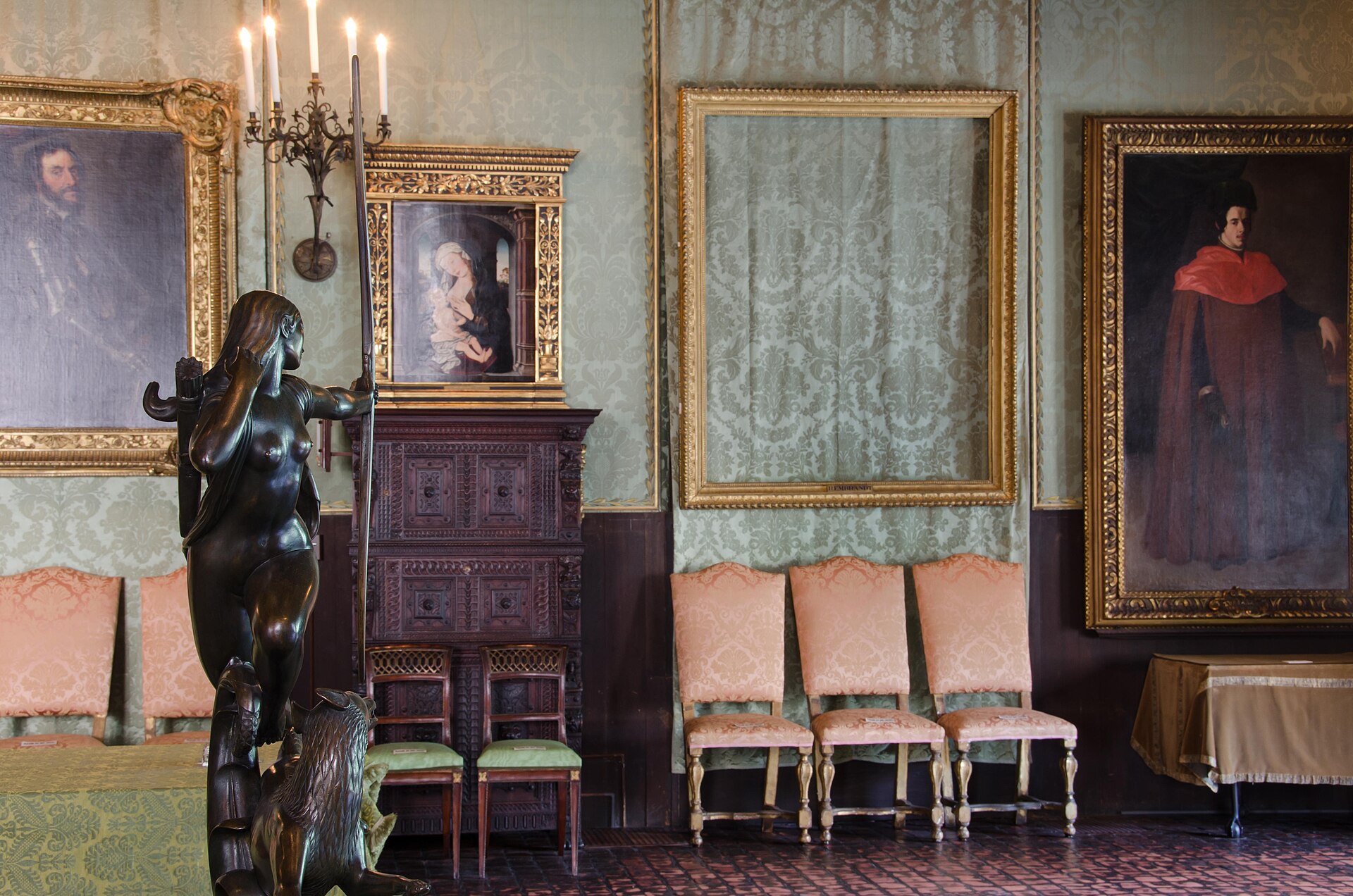
Four objects in this archive are unlocated. Every one still carries a live institutional record, and one of them still carries a...
10 min read
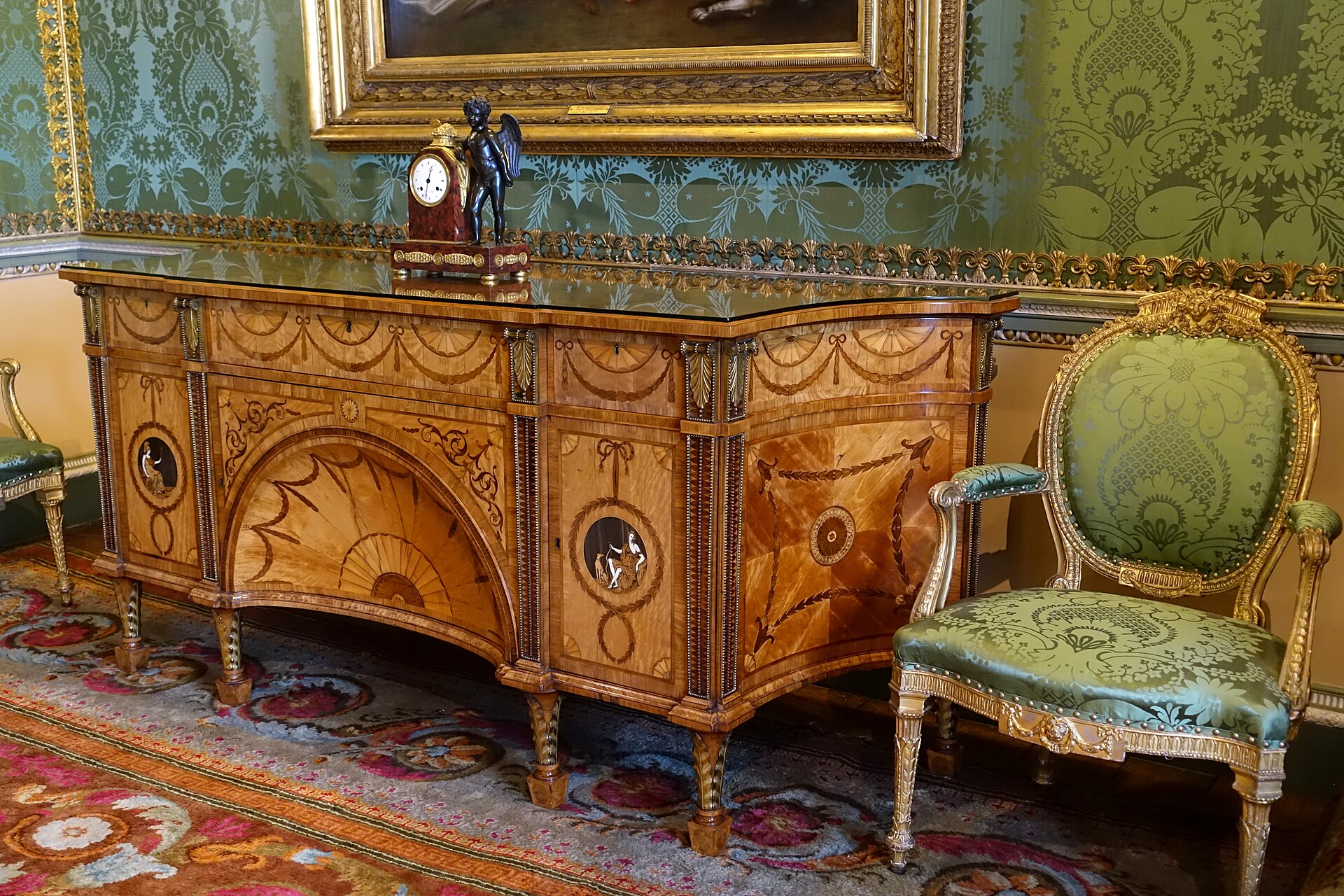
A maker's bill, workbook or memoir is the only provenance document that fixes date, cost and first owner at once.
10 min read
Ten objects in this archive were stolen, some twice. In no case does the thief appear as an owner.
11 min read
Last verified 17 September 2026
One artwork and its story every Tuesday, with the picture: who owned it, what it made, and what closes soon in the exhibition calendar. No promotion, and nothing we cannot cite.
We send one email to confirm the address and keep nothing else. Every letter carries a one-click unsubscribe. How we handle your data.