Armor Garniture, Probably of King Henry VIII of England
Royal Workshops at Greenwich (the Almain Armoury) · dated 1527
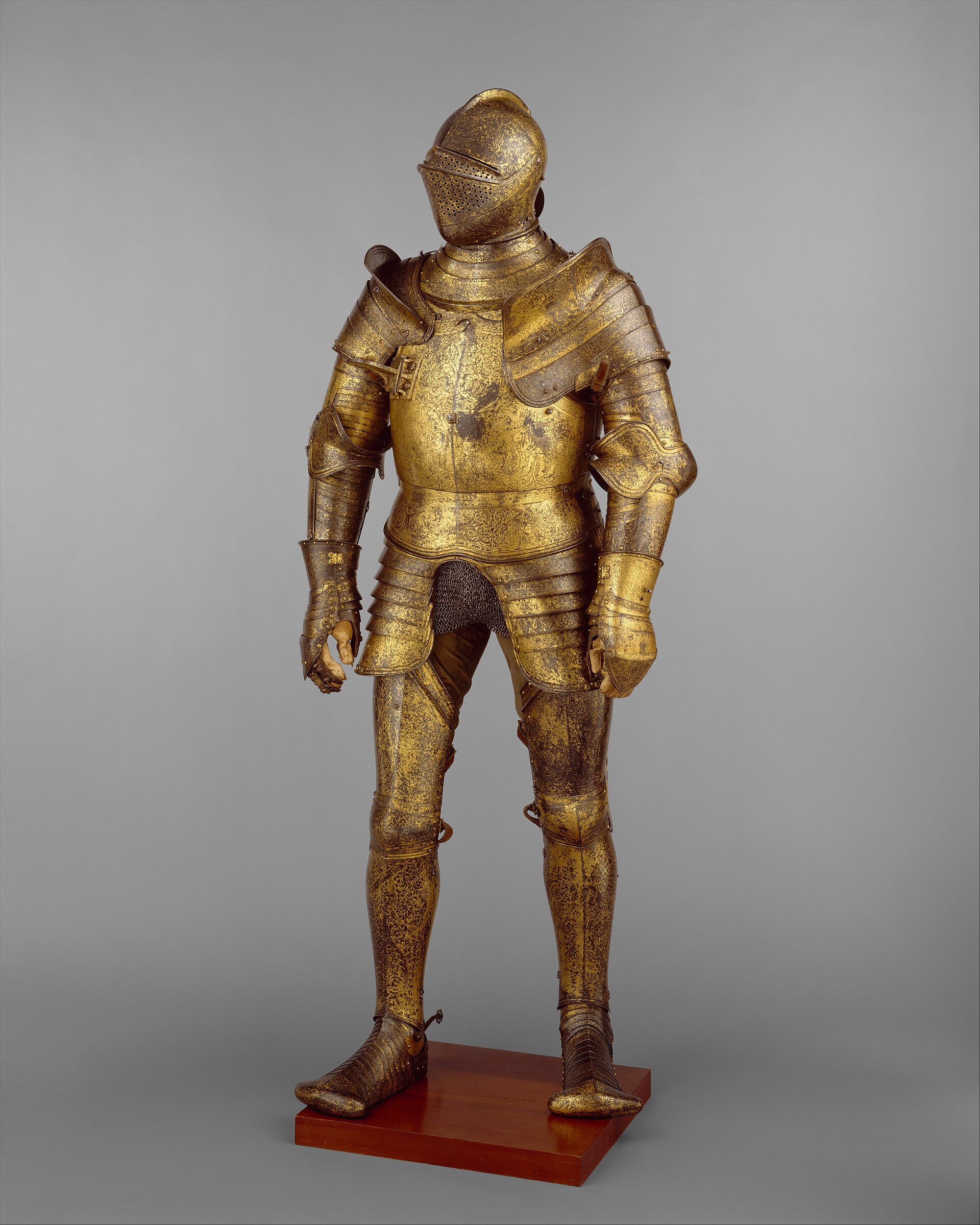
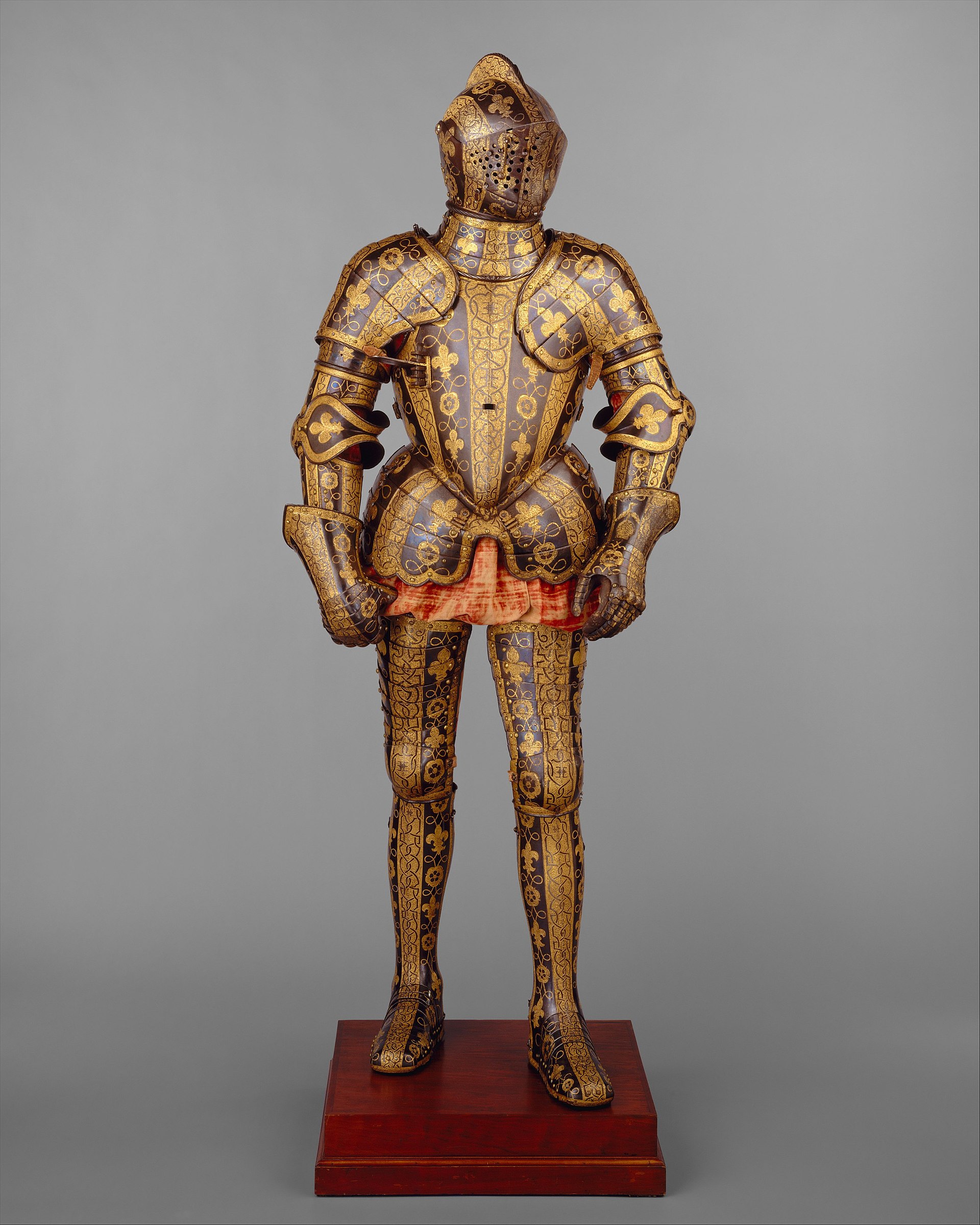
The record subject. Greenwich, dated 1527; steel etched and gilt over the whole surface; 185.4 cm overall, 28.45 kg. This is the file the museum's own collection API returns as the primary image for object 22741.
| Artist | Royal Workshops at Greenwich (the Almain Armoury) |
|---|---|
| Date | dated 1527 |
| Medium | Steel, etched and gilt, with gold, leather and copper alloys |
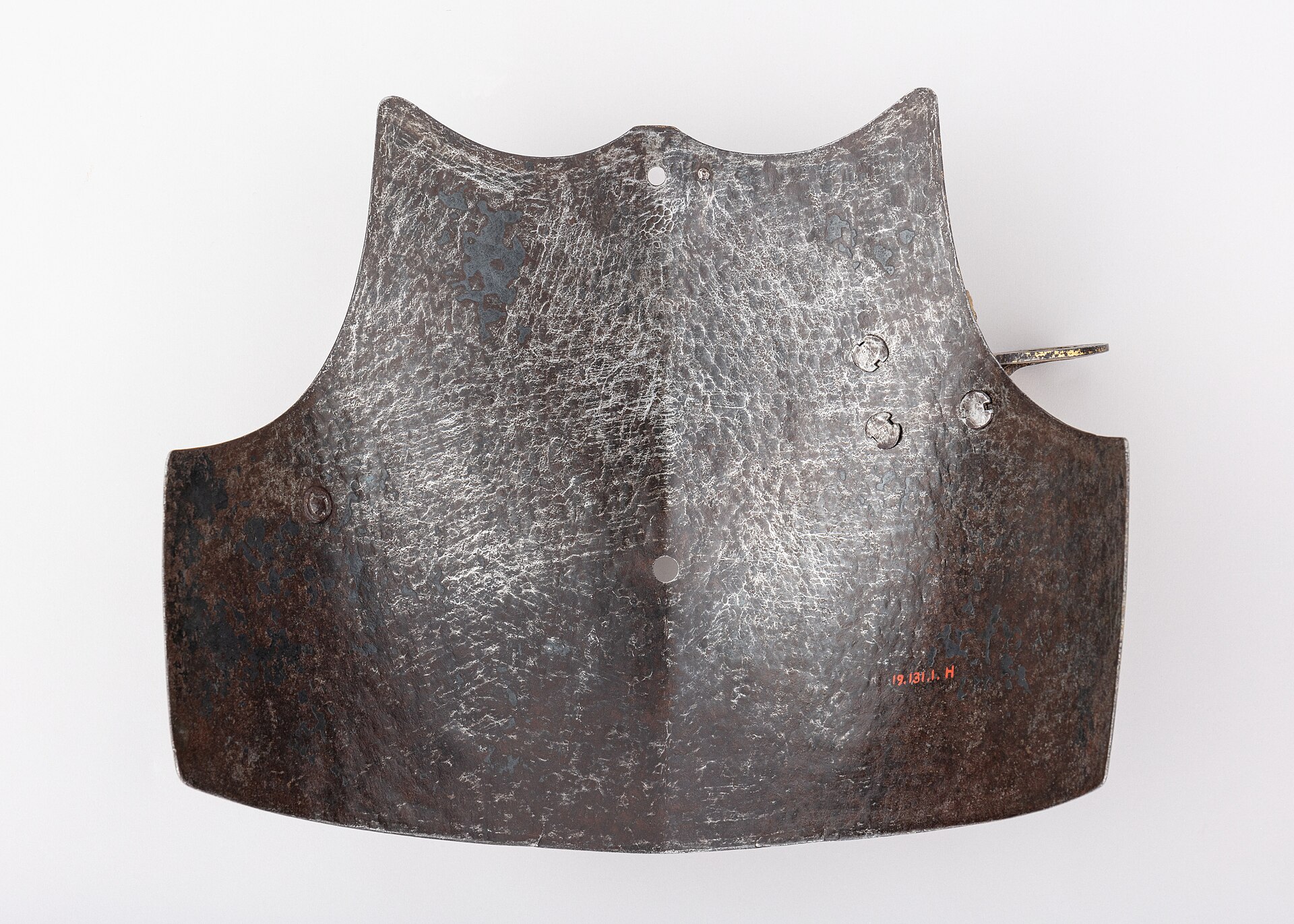
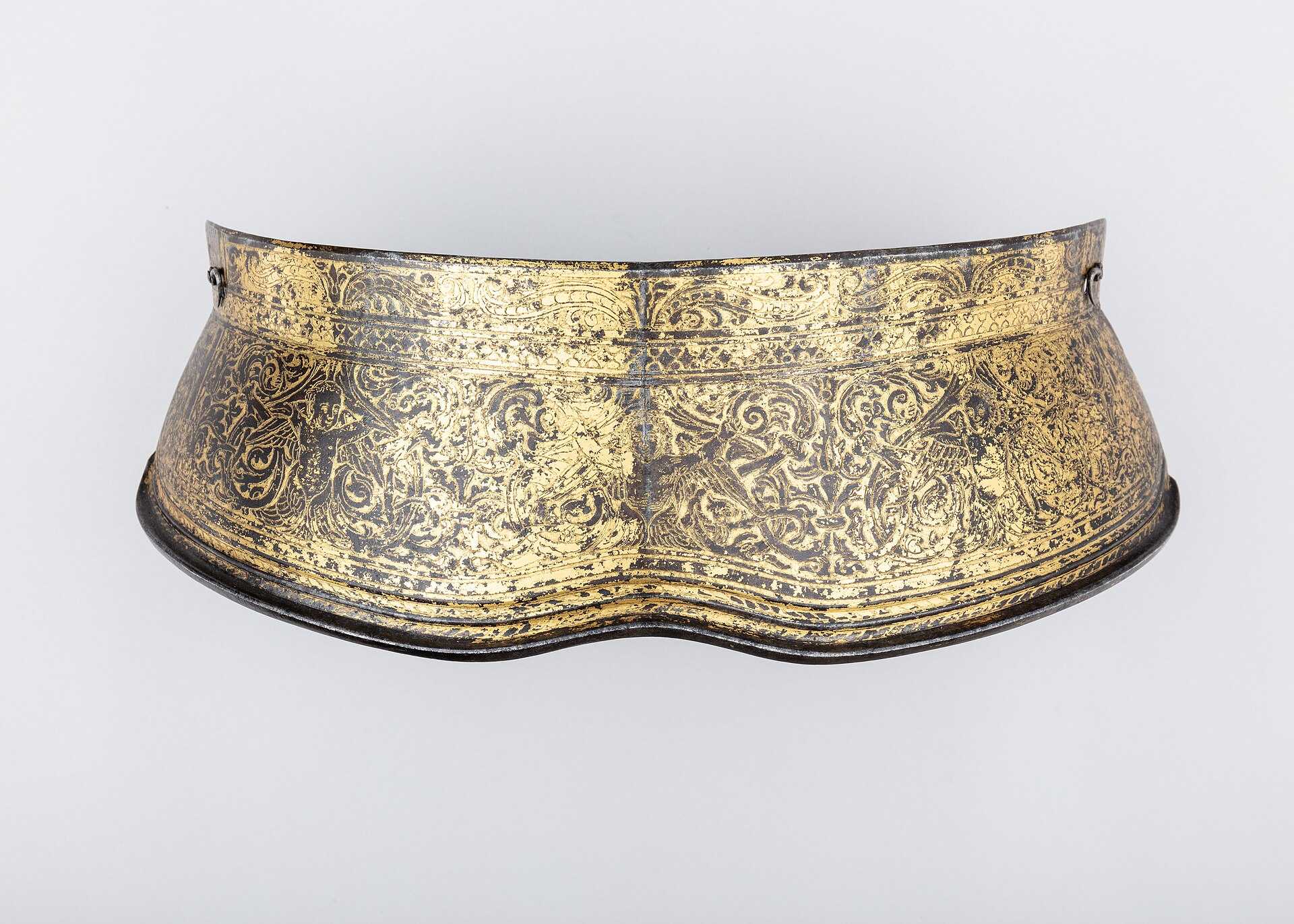
| Dimensions | Overall H. 185.4 cm (73 in.); weight 28.45 kg (62 lb 12 oz). Reinforcing breastplate (19.131.1h) with lance rest (19.131.1t), combined weight 3,324 g. Reinforcing abdominal plate (19.131.1u), weight 1,206 g. |
| Where it is now | The Metropolitan Museum of Art, New York, on view in Gallery 371last confirmed 4 August 2026 |
| Inventory number | 19.131.1a-r, t-w, .2a-f, l |
| Attribution | DisputedThe workshop is not in doubt: the garniture is dated 1527 in three places and is accepted as the earliest dated product of Henry VIII's Almain Armoury at Greenwich. Full note |
| Object type | Arms and armour |
| Period | English, Tudor, sixteenth century |
| Cases | Disputed attribution · Has a provenance gap |
| Inscriptions | The date 1527 is inscribed in three places: on the central plate of the backplate, on the lower lame of the fauld reinforce, and on the lower tace lame. |
| Owners on record | 7 links3 documented, 3 disputed, 1 unknown |
| Sources | 7 cited |
About this record Last verified 31 August 2026 · 7 sources cited · Change log
On this page 12 sections
ContentsClose
The earliest dated armour from Henry VIII's royal workshop at Greenwich, and the earliest Greenwich garniture: not a suit but a wardrobe of steel, built with exchange and reinforcing pieces so that one harness could be reassembled for the battlefield, for the tilt and for the tournament on foot. It carries the date 1527 three times over, and it is etched and gilt across its whole surface, which places it among the most expensive objects the Tudor court ever commissioned from its own craftsmen.
It has been catalogued under two different owners. It reached New York in 1919 as the armour of Galiot de Genouilhac, on a family tradition preserved by the ducs d'Uzes, and was published under that name for half a century. The Metropolitan now calls it probably Henry VIII's, made as a royal armour and given to a French ambassador. Both readings depend on the same undocumented century, and the museum's own title still says probably.
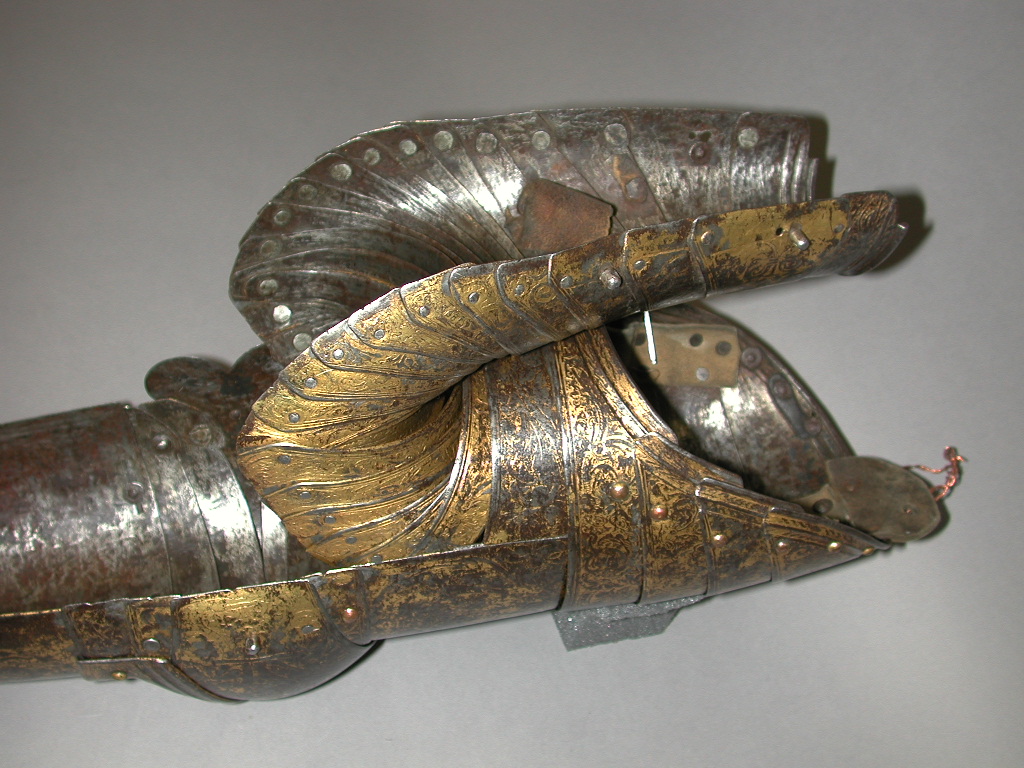
Some of what stands in Gallery 371 is not from 1527. Ten elements of the horse harness are flagged modern in the museum's own data, and the mail brayette shown with it came from a different donor in 1927. A record of this object that does not say so is describing a display, not an armour.
Provenance
Each link is graded. Documented: a cited source supports it. Disputed: the identification is argued but not established. Unknown: no owner for that span, and the gap is not smoothed into a narrative. The grades in the glossary.
- 1527 - 1527Royal Workshops at Greenwich, for Henry VIIIdocumented
Made at the Royal Almain Armoury at Greenwich and dated 1527 on the backplate, the fauld reinforce and the lower tace lame. The Greenwich workshop existed to arm the king and, occasionally, his allies; it did not take open commissions. That the object was made there in that year is the one part of its history that rests on the object itself rather than on testimony.124
- 1527 - 1532Francois de La Tour d'Auvergne, vicomte de Turennedisputed
The Metropolitan's reading is that Henry VIII presented the garniture to the vicomte de Turenne, who led a French embassy to London in 1527, the year of the Anglo-French treaty negotiations. The museum states this as belief, not record: its own catalogue text says the armour is believed to have been made for Henry VIII and presented by him. No contemporary document naming this armour and this recipient is cited in the museum entry.1
- 1532 - 1546Jacques Ricard de Genouillac, called Galiot de Genouilhac, Grand Master of the Artillery and Grand Ecuyer of Francedisputed
After Turenne's death in 1532 the armour presumably passed to his friend Galiot de Genouilhac. The museum's own word is presumably. This is the link on which the older attribution rests and it is the weakest in the chain: an inference drawn backwards from a nineteenth-century family tradition, not a transfer recorded at the time.1
- 1546 - 1878Undocumented; by descent in the Crussol family, ducs d'Uzes, if the tradition is correctunknown
Three hundred and thirty years are unaccounted for in the museum's published chain, which begins only in the nineteenth century. The Crussol d'Uzes descend from Galiot de Genouilhac, which is why the tradition is plausible, and the tradition is also the only reason anyone connected the armour to Genouilhac in the first place. That is a circle, and this record declines to close it.
- before 1878 - 1878Louis-Emmanuel de Crussol, duc d'Uzes, Chateau de Bonnelles, Seine-et-Oisedisputed
Given verbatim in the Metropolitan's provenance field as owner until his death in 1878, when the armour was bequeathed. The museum's text names the legatee with exactly the same name as the testator, which cannot be right as printed; either two men of the same name are being run together or a generation has dropped out of the record. Flagged here rather than silently corrected.1
- 1878 - 1917Louis-Emmanuel de Crussol, duc d'Uzes, Chateau de Bonnelles, Seine-et-Oisedocumented
The Metropolitan records this owner from 1878 until 1917, when the armour was sold to the museum. Bonnelles, in what was then Seine-et-Oise, was the Uzes seat where the armour was kept.1
- 1919 - presentThe Metropolitan Museum of Art, New Yorkdocumented
Accessioned in 1919, Purchase, William H. Riggs Gift and Rogers Fund. Bashford Dean, the museum's founding curator of arms and armour, published the acquisition in the Museum Bulletin in October 1919 under the title Gilded and Engraved Armor for Man and Horse. The museum's provenance field dates the sale to 1917 while the credit line and accession number date the acquisition to 1919; the two-year discrepancy is unexplained in the published record and falls across the last year of the First World War. The price has not been published in the sources consulted. Dean is the reason the museum has an arms and armour department at all: a Columbia zoologist who worked on fossil fishes and armoured Devonian placoderms, the only person ever to hold simultaneous curatorial appointments at the American Museum of Natural History and the Metropolitan, guest curator for the Duc de Dino collection, honorary curator from 1906 and founding curator of the department on 28 October 1912.127
Prices realised
This garniture has never been offered at public auction. It moved from the Crussol d'Uzes family to the Metropolitan Museum by private sale, and neither party published a figure. There is therefore no hammer price and no premium to separate, and this record does not derive one.
Technical evidence
| Attribution note | The workshop is not in doubt: the garniture is dated 1527 in three places and is accepted as the earliest dated product of Henry VIII's Almain Armoury at Greenwich. The owner is in doubt, and has been for ninety years. The armour entered the Metropolitan Museum in 1919 as the armour of Galiot de Genouilhac, Grand Master of the Artillery of France, on the strength of a family tradition in the house of Crussol, ducs d'Uzes. Stephen V. Grancsay published it under that name in 1937 and Helmut Nickel restudied it under that name in the Metropolitan Museum Journal in 1972. The museum now catalogues it as Probably of King Henry VIII, and reads it as a royal armour made at the king's own workshop and given to the French ambassador Francois de La Tour d'Auvergne, vicomte de Turenne, in 1527. On the museum's own audio guide the curator Stuart W. Pyhrr still calls it the so-called Genouilhac armor. The hedge in the title is the argument, not an accident. |
|---|---|
| Object type | Armour garniture for horse and man, with exchange and reinforcing pieces for the field and for two forms of the mounted tournament. Classified by the museum as Armor for Horse and Man.12 |
| Material and technique | Steel, etched and gilt over the whole surface, with gold, leather and copper alloys. Fire gilding, using a gold and mercury amalgam driven off over heat, is the period technique for this effect.12 |
| Dimensions and weight | Overall height 185.4 cm. Weight of the man's armour 28.45 kg. The reinforcing breastplate (19.131.1h) with its lance rest (19.131.1t) adds 3,324 g; the reinforcing abdominal plate (19.131.1u) adds a further 1,206 g.12 |
| Date inscribed | 1527, cut into the central plate of the backplate, the lower lame of the fauld reinforce and the lower tace lame. Three separate statements of the same year on three separate components.1 |
| Ventral plate | 19.131.1g, 23.5 by 22.9 cm, strapped to the chest beneath the breastplate to transfer weight off the shoulders. The Metropolitan records this feature on only one other armour in existence, the Greenwich harness of 1540 made for Henry VIII.12 |
| Surviving exchange pieces | A reinforcing breastplate with lance rest, for the field and for the mounted tournament with lances; a manifer, or left-hand gauntlet reinforce, for the same; and a right-hand locking gauntlet for the mounted tournament with swords, which closes over the sword grip so that it cannot be struck from the hand.1 |
| Modern components | Ten elements of the horse harness are flagged Modern in the museum's own element list: bit (19.131.2d), two stirrups (2e, 2f), reins (2h), right and left bridle straps (2i, 2j), lower and upper crinet straps (2k, 2m), lambrequin (2l) and tail strap (2n). The steel shaffron (2b), crinet (2c), saddle (2a) and saddle cloth (2g) are not so flagged.2 |
| Associated piece not from this harness | The museum's photographs as published on Wikimedia Commons carry the accession string 19.131.1a-r, t-w, .2a-c; 27.183.16, with a credit line recording a mail brayette given by Prince Albrecht Radziwill in 1927. The current object page does not carry 27.183.16 in its object number.5 |
| Element inventory | The garniture is catalogued in thirty-six separately measured components, plus a thirty-seventh row giving the overall height, from the helmet (19.131.1a) and colletin (1b) through the breastplate with taces and tassets (1c), the backplate with loin guard (1d), the shoulder, arm, thigh and shin defences, the riding gauntlets, the jousting bridle gauntlet (1n), the locking gauntlet (1m) and the sabatons with spurs (1q, 1r), to the horse defences and the saddle.2 |
| Photography and rights | The Metropolitan releases its photography of this object under CC0 and the collection API reports it as open access. That is what makes plates of it publishable here; the object's own age is irrelevant to the photographic copyright.25 |
| A withdrawn attribution | The Metropolitan's collection export of 27 March 2017, preserved in the metadata of the photographs the museum released to Wikimedia Commons, lists two makers with the roles Armorer and Designer: Made at the Royal Workshops at Greenwich, and Design of the decoration attributed to Hans Holbein the Younger. The museum's live catalogue entry in 2026 names the workshop only. The Holbein attribution was withdrawn at some point between those two dates without announcement.15 |
Images

The record in full
Chapter 1An armour that is not a suit but a wardrobe
What stands in Gallery 371 of the Metropolitan Museum is not a suit of armour in the sense a general reader means.
What stands in Gallery 371 of the Metropolitan Museum is not a suit of armour in the sense a general reader means. It is a garniture: a single harness built with a series of exchange and reinforcing plates so that the same body defence could be rebuilt for different work. Field service, the mounted tournament with lances, the mounted tournament with swords and lighter cavalry duty each demanded a different balance of weight and protection, and a garniture met all of them from one set of measurements taken off one man's body.
The exchange pieces that survive with it are a reinforcing breastplate with a lance rest, for the field or for running at the lists; a manifer, a heavy reinforce for the left hand and forearm, which is the hand a lance rider exposes; and a locking gauntlet for the right hand, which closes over the sword grip and holds it shut so that a blow cannot disarm the wearer. The Metropolitan calls it the earliest surviving Greenwich garniture, which makes it the point at which English royal armour stopped buying single harnesses and started building systems.
Nothing about that was cheap. The whole surface is etched and gilt, not a band or a border but the entire harness, in a period when gilding meant gold carried in mercury and driven off over a fire.
Chapter 3Whose armour is it
The garniture arrived in New York in 1919 as the armour of Galiot de Genouilhac, Grand Master of the Artillery and Grand Ecuyer of France, a soldier famous enough in his own century to have a Latin...
The garniture arrived in New York in 1919 as the armour of Galiot de Genouilhac, Grand Master of the Artillery and Grand Ecuyer of France, a soldier famous enough in his own century to have a Latin life printed in Paris in 1549. Stephen V. Grancsay published a monograph on it under that name for the museum in 1937. Helmut Nickel restudied it under that name in the Metropolitan Museum Journal in 1972, in a fifty-page article on the iconography of its decoration. For half a century the object was, in print, the Genouilhac armour.
The museum's present title is Armor Garniture, Probably of King Henry VIII of England. The reading behind it is that Henry had the garniture made at his own workshop and gave it in 1527 to Francois de La Tour d'Auvergne, vicomte de Turenne, who came to London that year at the head of a French embassy; that on Turenne's death in 1532 it passed to his friend Genouilhac; and that it then descended in the family of the ducs d'Uzes, who are Genouilhac's heirs, until they sold it. The museum's own wording marks every joint in that chain: believed to have been made, presumably passed.
Both readings rest on the same undocumented gap. There is no contract, no inventory entry and no gift roll cited in the museum record that names this armour and either man. What exists is a date stamped three times into the steel, a workshop that only worked for the king, and a nineteenth-century family tradition. The tradition is the sole origin of the name Genouilhac, and the tradition is also the only thing that puts the armour in Genouilhac's hands. On the museum's own audio guide the curator Stuart W. Pyhrr still says the so-called Genouilhac armor, and adds that the harness was certainly commissioned by Henry the Eighth, either for his personal use, or as a gift. The hedge has migrated from the owner to the purpose, and it has never been removed.
Chapter 4The workshop Henry VIII imported
Henry VIII founded the Royal Almain Armoury at Greenwich in 1515, at the Palace of Placentia, because he could not buy at home what his rivals were wearing.
Henry VIII founded the Royal Almain Armoury at Greenwich in 1515, at the Palace of Placentia, because he could not buy at home what his rivals were wearing. Maximilian I had a court workshop at Innsbruck; the emperor had sent Henry armours by Conrad Seusenhofer, and Henry admired them. England had no comparable tradition, so the king's agents went abroad and recruited: to Italy, to the German lands, to the Low Countries. The workshop took its name from the languages spoken inside it. Almain meant German, loosely, and covered the whole north European cohort of imported men.
The successive master workmen were Martin van Royne, Erasmus Kirkener, John Kelke and Jacob Halder, and Leslie Southwick's 2025 study for the Royal Armouries traces the office through the whole Tudor century, 1515 to 1603. The date on this object places it in the first generation, when the workshop was twelve years old and still proving itself. One of the recruits, the Flemish decorator Paul van Vrelant, is recorded submitting a silvered, engraved and gilded shaffron to the king as a sample of his work, which is how a craftsman applied for a job at the Tudor court.
The Metropolitan's catalogue text dates the foundation to 1515; the same museum's maker record gives the workshop's span as 1511 to the 1640s. Both figures are the museum's own. The discrepancy is not trivial, because 1511 is the date at which Netherlandish armourers first appear in English royal service and 1515 is the date of the Greenwich establishment proper, and running them together erases the difference between hiring a man and founding an institution.
Chapter 5The Almain Armourer's Album: what a workshop record can and cannot prove
The Greenwich workshop produced the single most valuable provenance instrument in European armour: a bound album of its own designs, annotated with the names of the men who ordered them.
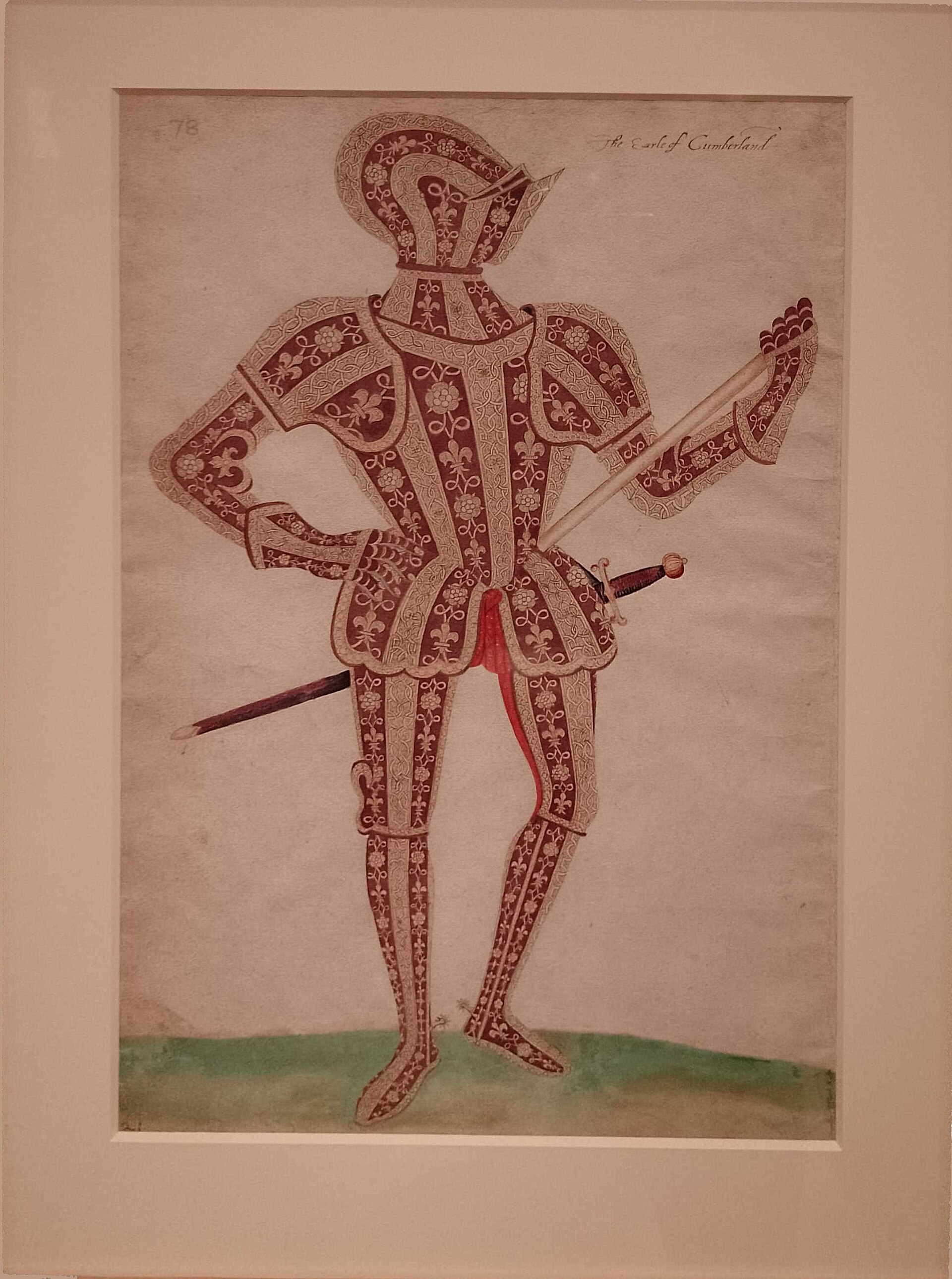
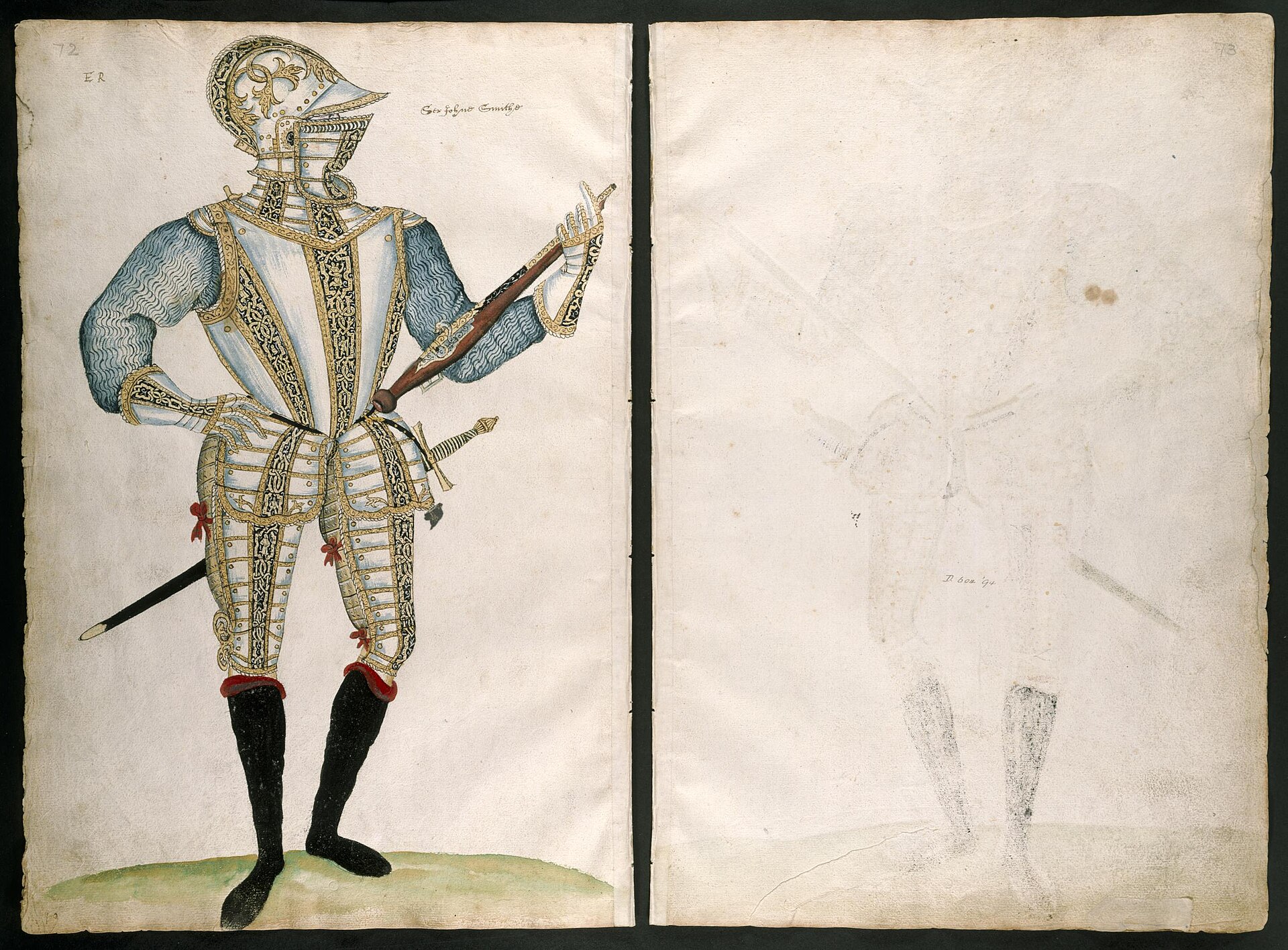
The Greenwich workshop produced the single most valuable provenance instrument in European armour: a bound album of its own designs, annotated with the names of the men who ordered them. It is known as the Almain Armourer's Album or the Jacobe Album, it is in the Victoria and Albert Museum, and it holds twenty-nine armour designs on fifty-six sheets plus one sheet of additional components. The drawings were stencilled, hand-coloured and annotated by Jacob Halder, master workman at Greenwich from 1576, with the names of the noblemen the armours were for: Robert Dudley, Earl of Leicester; Sir Christopher Hatton; Sir Henry Lee, Master of the Armoury from 1578; George Clifford, third Earl of Cumberland; Sir John Smythe.
Each design shows the wearer in cavalry armour, with facing sheets laying out the exchange pieces that convert the same harness for light cavalry, foot service or the tilt. It is, in effect, a manufacturer's record of who bought what, kept by the manufacturer, and it survives. Nothing comparable exists for Milan, Augsburg or Innsbruck. When a Greenwich armour of the Elizabethan period turns up in a collection, the album can identify it by matching the decoration to a named page, which converts a beautiful anonymous object into a documented one.
The album does not do that for this armour. The drawings run from about 1557 to about 1587 and Halder's tenure starts in 1576, two generations after 1527. There is no page for this garniture, and there is no equivalent album for the workshop's first decades. The instrument that would settle who ordered this harness is precisely the instrument the object predates. That absence is the reason the Genouilhac question has stayed open for ninety years, and it is worth stating plainly rather than allowing the album's fame to imply a documentation it cannot supply.
The album's own provenance is recorded and rarely quoted: the Victoria and Albert Museum bought it in 1894 from M. C. Stein of Paris for five thousand francs. The most important surviving document of English armour manufacture was in a Paris dealer's hands in the nineteenth century, and the museum paid a dealer's price for it.
Chapter 6The decoration, and what is being fought in it
The etched and gilt ornament is not pattern-filling.
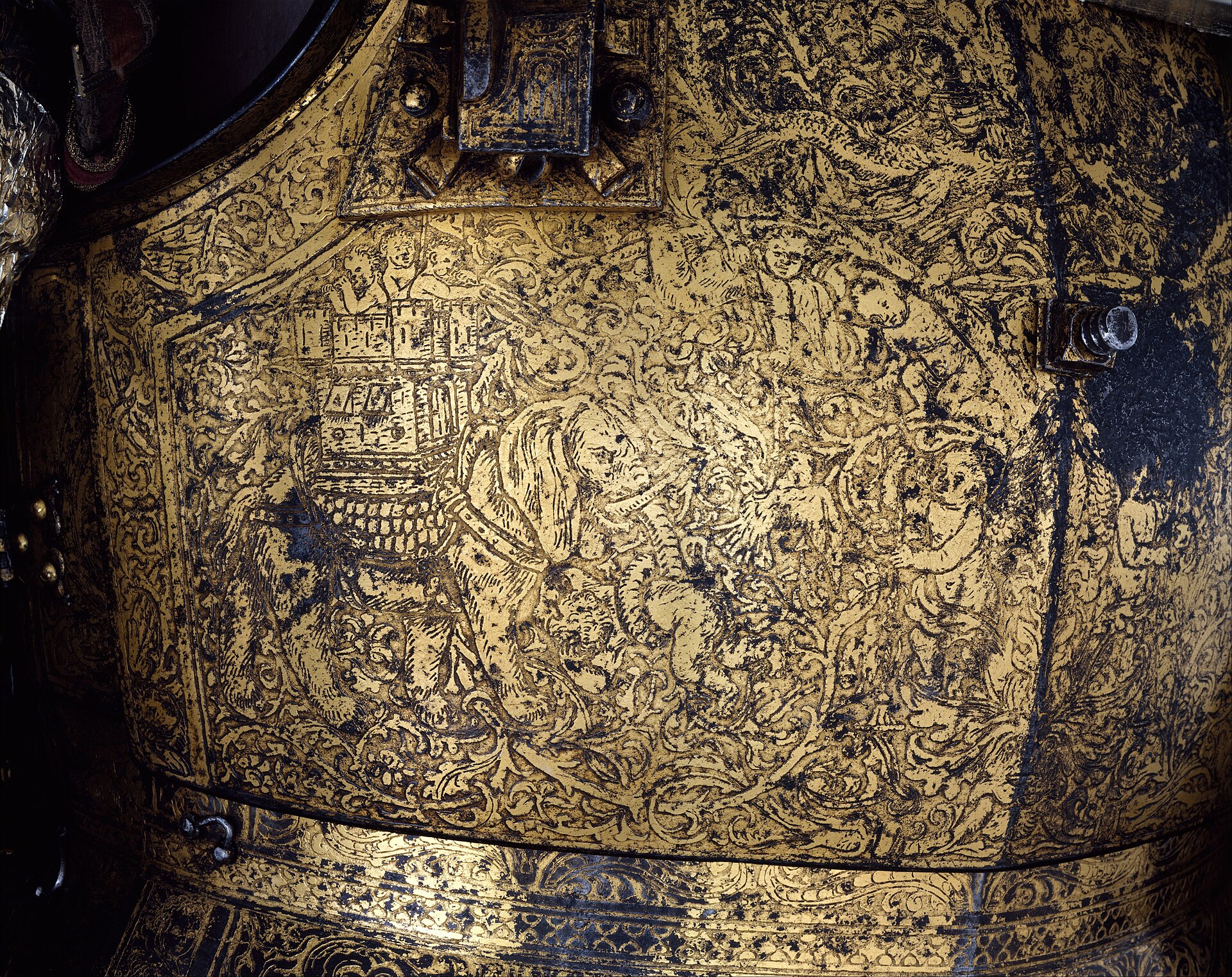
The etched and gilt ornament is not pattern-filling. The Metropolitan's own description of one section records a war elephant carrying a tower on its back with three putti inside it, one holding a standard and two blowing trumpets, fighting other putti through a jungle of Renaissance scrollwork, the elephant seizing an enemy putto in its trunk.
An elephant with a tower is the ancient image of the war beast that Hannibal and the Successor kings put into the field, transmitted to the sixteenth century through printed Livy and Pliny and through the emblem books, and read by an educated Tudor or French courtier as the emblem of disciplined force and of the prince who commands it. Putting it on a harness worn by, or given to, a man whose office was the artillery of France, and putting it in the hands of infant genii who fight a mock war in foliage, is a compliment and a joke at once: the machinery of war reduced to nursery scale and executed in gold. Helmut Nickel devoted his 1972 article to reading the whole programme, and that is where a reader who wants the full iconography should go.
There is a second thing to say about the decoration, and it is a fact about the museum rather than about the armour. The Metropolitan once attributed the design to Hans Holbein the Younger, who was in England in 1526-1528 and again from 1532, and it no longer does. The museum's own collection export of 27 March 2017, preserved in the metadata of the photographs it released to Wikimedia Commons, gives two makers for this object: Made at the Royal Workshops at Greenwich, and Design of the decoration attributed to Hans Holbein the Younger, with the roles Armorer and Designer. The museum's live catalogue entry in 2026 gives one maker, the workshop, and Holbein is gone from the field.
No withdrawal was announced, and nothing in the published record explains it. The armour is still illustrated in a 2025 Holbein volume, so the connection is alive in the literature while it has quietly left the catalogue. A reader working from the image files would credit Holbein; a reader working from the museum's website would not know the question had ever been asked. This record states both and follows the museum's current position, which is that the design is not attributed.
Chapter 7How it left France
The chain the museum publishes begins in the nineteenth century at the Chateau de Bonnelles in what was then Seine-et-Oise, the seat of the ducs d'Uzes.
The chain the museum publishes begins in the nineteenth century at the Chateau de Bonnelles in what was then Seine-et-Oise, the seat of the ducs d'Uzes. It has two entries, both naming Louis-Emmanuel de Crussol, duc d'Uzes: the first holding the armour until his death in 1878 and bequeathing it, the second holding it from 1878 until 1917 and selling it to the museum. A man cannot bequeath an object to himself. Either two men of the same name have been elided or a generation has fallen out of the record; the provenance field as published cannot be read literally, and this record flags it rather than quietly repairing it.
The second discrepancy is a date. The provenance field says the armour was sold to the Metropolitan in 1917. The credit line and the accession number say 1919, and Bashford Dean published the acquisition in the Museum Bulletin in October 1919. Two years separate the two statements, and they are the last two years of the First World War, when moving a crated armour for horse and man out of France and across the Atlantic was not a routine matter. Whether the gap represents a sale agreed in wartime and completed after the armistice, or an error in one of the two fields, is not resolved in the published record.
What is certain is that no export licence question arose. France in 1917 had no mechanism that would have stopped this, and the object left. When the Metropolitan bought its greatest French-owned armour, the modern apparatus of national treasure designation that now freezes an object in France for thirty months did not yet exist.
Chapter 8Bashford Dean, and the funds that were named instead of a price
The purchase was made on the William H. Riggs Gift and the Rogers Fund.
The purchase was made on the William H. Riggs Gift and the Rogers Fund. Riggs was an American collector resident in Paris who spent a lifetime buying European arms and who gave his collection to the Metropolitan; the fund carrying his name is what allowed a young department to buy at this level. The Rogers Fund was the museum's general acquisition endowment.
The curator was Bashford Dean, who is the reason the Metropolitan has an arms and armour department at all. Dean held a doctorate in zoology from Columbia, worked on fossil fishes and armoured Devonian placoderms, and was the only person ever to hold simultaneous curatorial appointments at the American Museum of Natural History and the Metropolitan Museum of Art. He organised the Duc de Dino collection for the museum as a guest curator, became honorary curator in 1906 and founding curator of the department on 28 October 1912. In the First World War he was commissioned a major in the Ordnance Corps and designed helmets for the United States Army; his preferred model was rejected because it looked too much like the German Stahlhelm.
The line from armoured fish to armoured men was not a joke to him, and it shaped the department. A collection assembled by a comparative anatomist thinks in terms of structure, articulation and mechanical solution, which is why the Metropolitan's arms and armour holdings read as a technical series rather than a display of trophies, and why the museum's own data on this garniture is an inventory of thirty-seven measured components rather than a description of an effect. Dean died in 1928; about half of his own collection of some eight hundred pieces came to the museum by bequest and by purchases funded by donors.
Chapter 9What in the display is not from 1527
Museum armour is assembled. Garnitures were made as sets with exchange pieces, later owners mixed pieces from different harnesses, and a great many nineteenth-century armours in public collections...
Museum armour is assembled. Garnitures were made as sets with exchange pieces, later owners mixed pieces from different harnesses, and a great many nineteenth-century armours in public collections are composites put together by dealers and restorers. This garniture is unusually coherent by that standard, but it is not untouched, and the museum's own data says so in a place most readers never look.
The Metropolitan's collection API lists the garniture element by element. Ten of those elements are labelled Modern in the museum's own field: the bit (19.131.2d), two stirrups (2e and 2f), the reins (2h), the right and left bridle straps (2i and 2j), the lower and upper crinet straps (2k and 2m), the lambrequin (2l) and the tail strap (2n). Every one is horse harness, which is exactly what perishes: leather, textile and small iron fittings do not survive four centuries when the steel does. The steel horse defences, the shaffron (2b) and the crinet (2c), together with the saddle (2a) and the saddle cloth (2g), are not flagged modern.
One further piece is not part of the 1527 harness at all. The museum's photographs as published on Wikimedia Commons carry an accession string that includes 27.183.16, with a credit line noting a mail brayette given by Prince Albrecht Radziwill in 1927. A brayette is the groin defence; this one arrived eight years after the armour, from a different donor, and was displayed with it. The museum's current object page no longer carries 27.183.16 in the object number. A reader looking at one of these photographs may therefore be looking at a component that reached New York separately and belongs to no documented Greenwich harness.
Chapter 10The catalogue history is the attribution history
Read in sequence, the bibliography of this object is a record of scholars changing their minds in public.
Read in sequence, the bibliography of this object is a record of scholars changing their minds in public. Bashford Dean announced it in 1919 as gilded and engraved armour for man and horse. Grancsay made it the subject of a museum monograph in 1937 under Genouilhac's name. In 1941 Charles R. Beard and Francis Henry Cripps-Day printed a piece called Claim and Counter-Claim in the privately produced Fragmenta Armamentaria, in a volume concerned with armour in the museum at Chartres; the Metropolitan still lists it in this object's bibliography. Cripps-Day returned to Greenwich armour as a subject in 1952. Nickel took the iconography apart in 1972, still under the French name.
The English reading hardened later and from the technical side. Ortwin Gamber wrote on the English royal court workshop and its first two master workmen in the Vienna yearbook. Ian Eaves wrote on the tournament armours of Henry VIII. Alan Williams and Anthony de Reuck published the metallurgy of Greenwich in a Royal Armouries monograph in 1995, and Williams returned to this armour in The Knight and the Blast Furnace in 2002. Pierre Terjanian set it against the Flemish armourers Henry recruited, in the Royal Armouries' 2009 Henry VIII volume. The Royal Armouries had already put it in the 1951 Tower of London exhibition of Greenwich work as number three. Leslie Southwick discussed it again in 2025.
Nobody has produced a document. What has happened instead is that the weight of technical argument, the ventral plate above all, has moved the object from a French soldier's name to an English king's without ever closing the gap that would let a cataloguer drop the word probably. That is an honest position and this record adopts it: the workshop is certain, the year is certain, the first owner is not.
Chapter 11Where it is now
The garniture is on view at the Metropolitan Museum in Gallery 371 and has been in near-continuous display since the department's early galleries.
The garniture is on view at the Metropolitan Museum in Gallery 371 and has been in near-continuous display since the department's early galleries. It has travelled recently and hard: to Houston in 2018-19 for Tudors to Windsors, and through the whole run of The Tudors: Art and Majesty in Renaissance England, which opened at the Metropolitan in October 2022, moved to Cleveland in February 2023 and closed at the Legion of Honor in San Francisco in September 2023.
Its photography is released under CC0, which is why this record can carry plates of it at all. That is not a small point for a category in which almost nothing is publishable: the object is out of copyright by four centuries and the fact is irrelevant, because the copyright that matters belongs to whoever took the photograph.
The artist
The Royal Almain Armoury at Greenwich
Greenwich is the only major European armour workshop that was created deliberately, from nothing, by a head of state who wanted to stop importing. It has no medieval guild behind it and no city tradition. Henry VIII founded it in 1515 at the Palace of Placentia because Maximilian I had a court workshop at Innsbruck and had sent him armours by Conrad Seusenhofer that England could not match. The king's agents recruited abroad; the men who came were German, Flemish and Italian; the workshop took its name from the languages they spoke. For roughly a century it made armour that stood beside Innsbruck, Augsburg and Milan, for the king and for the men the king chose to favour, and then it died with the object it made.
Exhibited
- 1889Exposition Universelle Internationale de 1889: Les Anciennes Armees Francaises, Exposition Retrospective Militaire du Ministere de la Guerre (not cited in the catalogue)Palais de la Guerre, Les Invalides, Paris
- 1900Exposition Universelle Internationale de 1900Palais des Armees de Terre et de Mer, Paris
- 1951Exhibition of Armour Made in the Royal Workshops at Greenwich, no. 3H. M. Tower of London
- 1970Masterpieces of Fifty Centuries, no. 247The Metropolitan Museum of Art, New York
- 2018Tudors to Windsors: British Royal Portraits from Holbein to WarholMuseum of Fine Arts, Houston
- 2022The Tudors: Art and Majesty in Renaissance England (New York, then Cleveland Museum of Art and the Legion of Honor, San Francisco, to September 2023)The Metropolitan Museum of Art, New York
Literature
- Bashford Dean, 'Gilded and Engraved Armor for Man and Horse', The Metropolitan Museum of Art Bulletin, October 1919, pp. 209-15.
- Stephen V. Grancsay, 'The Armor of Galiot de Genouilhac', The Metropolitan Museum of Art Papers 4, pp. 1-37, plates I-IV, VI-XXVII. (1937)
- Charles R. Beard and Francis Henry Cripps-Day, 'Claim and Counter-Claim', in Fragmenta Armamentaria vol. 5, printed privately, Frome, pp. 153-86. (1941)
- Tower of London Armouries, Exhibition of Armour Made in the Royal Workshops at Greenwich, HMSO, no. 3, plates III and XXXIIIb. (1951)
- Francis Henry Cripps-Day, An Introduction to the Study of Greenwich Armour, Fragmenta Armamentaria I.5, pp. 100-103. (1952)
- Helmut Nickel, 'A Harnes All Gilte: A Study of the Armor of Galiot de Genouilhac and the Iconography of Its Decoration', Metropolitan Museum Journal 5, pp. 75-124, figs. 1-69. (1972)
- Alan Williams and Anthony de Reuck, The Royal Armoury at Greenwich 1515-1649: A History of Its Technology, Royal Armouries Monograph 4, Leeds, pp. 70-71. (1995)
- Alan Williams, The Knight and the Blast Furnace: A History of the Metallurgy of Armour in the Middle Ages and the Early Modern Period, Brill, pp. 750-51. (2002)
- Pierre Terjanian, 'The King and the Armourers of Flanders', in Henry VIII: Arms and the Man 1509-2009, ed. Rimer, Richardson and Cooper, Royal Armouries, Leeds, pp. 151, 155-59, 214.
- Thom Richardson, 'Pieces of Advantage: Tournament Armour in Tudor England', in Tournaments: A Thousand Years of Chivalry, ed. Stefan Krause, Thomas Del Mar Ltd, London, pp. 120-23, 128. (2022)
- Leslie Southwick, 'Henry VIII's Almain Armoury at Greenwich and the Master Workmen to the Tudor Court, 1515-1603', Arms and Armour: Journal of the Royal Armouries 22, no. 1, pp. 67-130 (this armour at pp. 86, 89, fig. 10). (2025)
Related works
| Work | Relation | Where it is |
|---|---|---|
| Armor Garniture of George Clifford, third Earl of Cumberland Royal Workshops at Greenwich, under Jacob Halder | The Greenwich garniture that the Almain Armourer's Album does document, made 1586 The album carries Clifford's design page, which is why his armour can be named with certainty and this one cannot. The two harnesses stand in the same museum, fifty-nine years and one surviving workshop record apart. | The Metropolitan Museum of Art, New York, 32.130.6 |
| Field and tournament armour of Henry VIII, Greenwich, 1540 Royal Workshops at Greenwich | The only other armour known to the Metropolitan to have a ventral plate The shared hidden component is the strongest technical link between this garniture and the king's personal harnesses. | Royal Armouries, Leeds and the Tower of London |
| The Almain Armourer's Album (the Jacobe Album) Jacob Halder | The workshop's own record of its commissions, 1557-1587 Twenty-nine designs on fifty-six sheets plus one sheet of components. Bought by the museum in 1894 from M. C. Stein of Paris for 5,000 francs. It postdates this armour by two generations and does not record it. | Victoria and Albert Museum, London, D.586A/B-1894 |
| Ram's horn helmet by Conrad Seusenhofer Conrad Seusenhofer, Innsbruck | The surviving fragment of the Innsbruck armours Maximilian I sent to Henry VIII, which prompted the founding of Greenwich The rest of the Seusenhofer gift is lost. Henry founded his own workshop because he wanted what Innsbruck could make. | Royal Armouries, IV.22 |
| The silvered and engraved armour of Henry VIII Royal armourers, decoration associated with Paul van Vrelant | The generation of royal armour immediately before Greenwich reached maturity Claude Blair's 1965 study in Archaeologia remains the standard account. Van Vrelant is the Flemish decorator recorded submitting a silvered, engraved and gilded shaffron to Henry VIII as a work sample. | Royal Armouries, Tower of London |
| Elements of an Armor Garniture made for Henri I de Montmorency, Comte de Damville and Constable of France French | French royal armour of the following generation, for comparison with what France made for its own great officers Dated 1565, and displayed in the same gallery. If the 1527 garniture had been made in France, as some who assign it to Genouilhac have argued, this is the tradition it would belong to. | The Metropolitan Museum of Art, New York |
Open questions
- Who was the first owner? No document naming this armour and either Henry VIII, the vicomte de Turenne or Galiot de Genouilhac is cited in the museum record. The attribution has moved on technical argument alone.
- Was the garniture made for the king to wear and only later given away, or made from the outset as a diplomatic present? The museum's own curator states both possibilities and does not choose between them.
- Why does the Metropolitan's provenance field name Louis-Emmanuel de Crussol, duc d'Uzes, as both the testator who died in 1878 and the legatee who received the bequest? The chain as published cannot be read literally.
- Why does the provenance field date the sale to the museum to 1917 while the credit line and accession number date the acquisition to 1919? The gap spans the last year of the First World War and is unexplained in print.
- What did the Metropolitan pay, and to whom? No figure has been published in the sources consulted, and the split between the Riggs Gift and the Rogers Fund is not broken out.
- Where was the garniture between 1546 and the nineteenth century? The published chain begins at the Chateau de Bonnelles. Three hundred and thirty years are blank.
- When and why did the Metropolitan withdraw the Holbein attribution? Its own 2017 collection export gives Design of the decoration attributed to Hans Holbein the Younger; the live catalogue gives the workshop alone, with no published explanation.
- What did Charles R. Beard and Francis Henry Cripps-Day argue in Claim and Counter-Claim in 1941, and against whom? The piece sits in the museum's own bibliography for this object, in a volume about armour at Chartres, and has not been consulted for this record.
- Does the mail brayette given by Prince Albrecht Radziwill in 1927 still hang with the armour, and on what basis was it associated with it in the first place?
- What did Alan Williams's metallurgical sampling find? The Knight and the Blast Furnace treats this armour at pages 750-51 and would give hardness, slag inclusion and carbon data that no online source reproduces.
Questions about this object
What is Armor Garniture, Probably of King Henry VIII of England?
Armor Garniture, Probably of King Henry VIII of England is an arms and armour, dated dated 1527. Medium: Steel, etched and gilt, with gold, leather and copper alloys.
Who made Armor Garniture, Probably of King Henry VIII of England, and is the attribution settled?
The attribution to Royal Workshops at Greenwich (the Almain Armoury) is recorded here as disputed. The workshop is not in doubt: the garniture is dated 1527 in three places and is accepted as the earliest dated product of Henry VIII's Almain Armoury at Greenwich. The owner is in doubt, and has been for ninety years. The armour entered the Metropolitan Museum in 1919 as the armour of Galiot de Genouilhac, Grand Master of the Artillery of France, on the strength of a family tradition in the house of Crussol, ducs d'Uzes. Stephen V. Grancsay published it under that name in 1937 and Helmut Nickel restudied it under that name in the Metropolitan Museum Journal in 1972. The museum now catalogues it as Probably of King Henry VIII, and reads it as a royal armour made at the king's own workshop and given to the French ambassador Francois de La Tour d'Auvergne, vicomte de Turenne, in 1527. On the museum's own audio guide the curator Stuart W. Pyhrr still calls it the so-called Genouilhac armor. The hedge in the title is the argument, not an accident.
Where is Armor Garniture, Probably of King Henry VIII of England now?
The Metropolitan Museum of Art, New York, on view in Gallery 371. Inventory number 19.131.1a-r, t-w, .2a-f, l. Last confirmed 4 August 2026. Purchase, William H. Riggs Gift and Rogers Fund, 1919. Gallery location and object number read from the museum's own catalogue entry and collection API.
What is still unknown about Armor Garniture, Probably of King Henry VIII of England?
Who was the first owner? No document naming this armour and either Henry VIII, the vicomte de Turenne or Galiot de Genouilhac is cited in the museum record. The attribution has moved on technical argument alone.
Sources
- 1The Metropolitan Museum of Art, catalogue entry for Armor Garniture, Probably of King Henry VIII of England (reigned 1509-47), object 22741: curatorial text, inscription note, provenance field, exhibition history, the full reference bibliography, and the audio guide transcript for stop 4405 (Stuart W. Pyhrr and Donald J. La Rocca). Read in a browser on 4 August 2026; the page bot-blocks automated fetching with an HTTP 429 challenge. metmuseum.org/art/...
- 2The Metropolitan Museum of Art Collection API, object 22741: accession number, credit line, accession year, medium, dimensions and weights, gallery, open-access status, primary image file, and the element-by-element measurement list that flags which components are modern. collectionapi.metmuseum.org/public/...
- 3Victoria and Albert Museum, catalogue entry for The Almain Armourer's Album (the Jacobe Album), museum number D.586A/B-1894: Jacob Halder, Greenwich, 1557-1587, 29 designs on 56 sheets plus one sheet of additional components, acquired by the museum in 1894 from M. C. Stein of Paris for 5,000 francs. collections.vam.ac.uk/item/...
- 4Leslie Southwick, 'Henry VIII's Almain Armoury at Greenwich and the Master Workmen to the Tudor Court, 1515-1603', Arms and Armour 22, no. 1 (2025), pp. 67-130, DOI 10.1080/17416124.2024.2434783. Abstract, keywords and the full endnote apparatus read on the publisher's page; the body text is paywalled and is cited here only for what the open matter carries. tandfonline.com/doi/...
- 5Wikimedia Commons file page and wikitext for the Metropolitan's principal photograph of the garniture. Carries the CC0 release, the Met donation project, and, in the preserved metadata block, the museum's own raw collection export dated 27 March 2017: the accession string including the 1927 mail brayette given by Prince Albrecht Radziwill, and the two-maker attribution with the roles Armorer and Designer naming Hans Holbein the Younger for the design of the decoration. Primary for the licence and for the museum's 2017 catalogue state. Read from the Commons API on 4 August 2026. commons.wikimedia.org/wiki/...
- 6Wikipedia, 'Greenwich armour', for the Southwark interlude of 1516-1520, the survey of surviving Greenwich armours by collection, and the count of twenty-nine designs in the Halder album. Tertiary; flagged for replacement with Cripps-Day 1952 and the Royal Armouries monograph. en.wikipedia.org/wiki/...
- 7Wikipedia, 'Bashford Dean', for the biography of the Metropolitan's founding curator of arms and armour, the dual appointment with the American Museum of Natural History, the Duc de Dino purchase, the First World War helmet work and the division of his own collection after 1928. Tertiary; flagged for replacement with the 1933 Bashford Dean memorial catalogue and Donald J. La Rocca's 1996 Metropolitan Museum Journal article. en.wikipedia.org/wiki/...
_MET_DT753.jpg)
Last verified 31 August 2026 · Published 4 August 2026
Change log
4 August 2026 - Correction pass after adversarial review. The Holbein finding was inverted: the museum's own 2017 collection export attributes the design of the decoration to Holbein and the live catalogue no longer does, so the record now reports a withdrawn attribution rather than a metadata error. The 1878 bequest link regraded disputed to match its own note. Component count corrected. The V&A album number reduced to the one actually verified.
4 August 2026 - Record created at the house standard: researched narrative, technical evidence, maker dossier, graded provenance chain, prices with hammer and premium separated, related works, open questions and sources.
31 August 2026 - Re-verified against the Met's live Collection API (object 22741, metadataDate unchanged since before this record was written): gallery 371, accession string, credit line, classification and all 10 'Modern'-flagged component rows all still match exactly; the single constituent remains 'Armorer - Royal Workshops at Greenwich' with no restored Holbein designer credit. No new scholarship, exhibition, loan, or technical study found since 2026-08-04. All cited source URLs still resolve (two - metmuseum.org's own collection page and the Southwick 2025 Arms & Armour paper - remain bot/paywall-blocked exactly as the record already notes, not newly rotted). One pre-existing research gap flagged for a future editor, not actioned here: Eaves and Pyhrr, 'Fit for a King: Tudor and Stuart Armors at the Royal Workshops at Greenwich' (Scala, 14 April 2026) covers the Met's Greenwich armors including this one, but its content on the Genouilhac/Henry VIII attribution could not be confirmed from any publicly available excerpt, so it is not added to the literature list unverified. No content changes made.