Bronze statuette of a horse
Unrecorded Greek bronze caster · Late Hellenistic, late 2nd to 1st century BCE. Catalogued as about 480 to 470 BCE from 1923 until the 1970s.
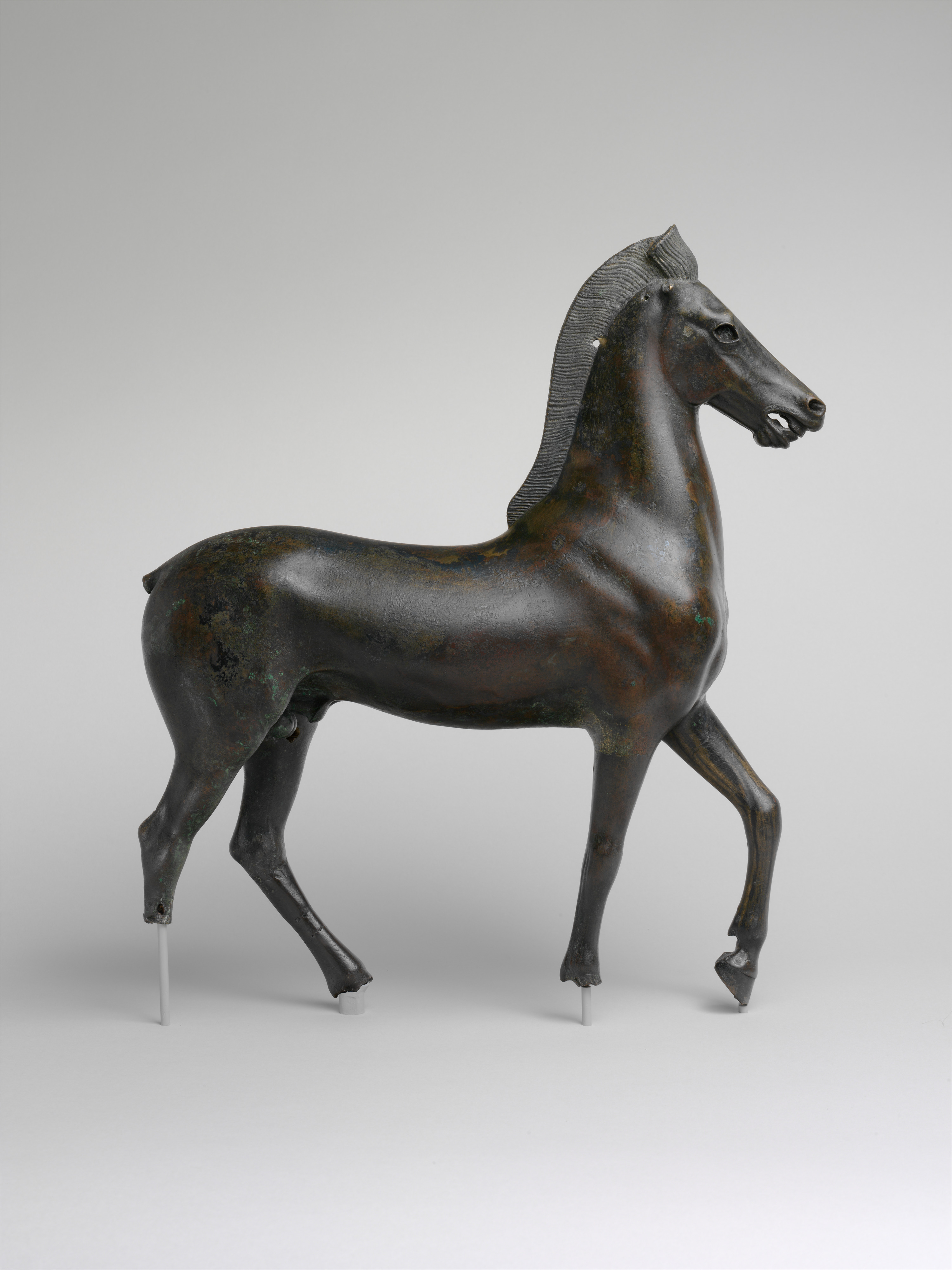
The record subject. Bronze, 40.2 cm high, Greek, catalogued by the Museum as Late Hellenistic. Bought as Early Classical in 1923, condemned as a modern forgery in 1967 and restored to antiquity by thermoluminescence.
| Artist | Unrecorded Greek bronze caster |
|---|---|
| Date | Late Hellenistic, late 2nd to 1st century BCE. Catalogued as about 480 to 470 BCE from 1923 until the 1970s. |
| Medium | Bronze, cast by the lost-wax process over a ceramic core with iron armature and chaplets |
| Dimensions | H. 40.2 cm (15 13/16 in.) |
| Where it is now | The Metropolitan Museum of Art, New York, Department of Greek and Roman Artlast confirmed 4 August 2026 |
| Inventory number | 23.69 |
| Attribution | AcceptedDeclared a modern forgery by the Museum's own Vice-Director in December 1967 and restored to antiquity by a thirteen-year technical re-examination. Full note |
| Object type | Sculpture |
| Period | Greek, Late Hellenistic |
| Cases | Has a provenance gap |
| Inscriptions | None recorded. An incised line runs from the muzzle to between the eyes; two small holes about 2 mm across and 10 mm deep sit 10 mm behind each ear, one containing material testing positive for iron and calcium carbonate. |
| Owners on record | 4 links2 documented, 1 disputed, 1 unknown |
| Sources | 5 cited |
About this record Last verified 8 September 2026 · 5 sources cited · Change log
On this page 10 sections
ContentsClose
A bronze horse forty centimetres high, bought by the Metropolitan Museum from a Paris dealer on 16 February 1923 and for forty years described as the most important single object in its classical collection. In December 1967 the Museum's own Vice-Director for Administration, Joseph V. Noble, stood up at the close of a public seminar on art forgery and announced that it was a fake made in Paris between 1918 and 1923. He published the case in the Museum's Bulletin the following February under the title The Forgery of Our Greek Bronze Horse, and ended it with the sentence: it is famous, but it is a fraud.
He was wrong, and the way in which he was wrong is the reason this record exists. The seam that started the investigation lay in a layer of pigmented wax applied to the bronze in the 1920s or 1930s, and it disappeared when the wax was removed with xylene. The iron wire he read in a gamma radiograph was an armature of a kind found in the Piraeus Kouros and the Delphi Charioteer. Thermoluminescence measurements on zircon grains separated from the ceramic core, published in Archaeometry in 1974, gave an age of 2250 plus or minus 210 years before present.
The horse is back on the Museum's books as an ancient bronze. It is not, however, back where it started: acquired as an Early Classical masterpiece of about 480 to 470 BCE, it is now catalogued as Late Hellenistic, late 2nd to 1st century BCE. The attribution moved twice, and only one of those moves is famous.
Provenance
Each link is graded. Documented: a cited source supports it. Disputed: the identification is argued but not established. Unknown: no owner for that span, and the gap is not smoothed into a narrative. The grades in the glossary.
- late 2nd to 1st century BCE -Unrecordeddocumented
Cast by the lost-wax process over a ceramic core. Thermoluminescence dating of the core gives 2250 plus or minus 210 years before present, which the measuring laboratory interprets as manufacture between about 500 BCE and 50 BCE with equal probability across that span. The Museum's stylistic date is late 2nd to 1st century BCE. No findspot, workshop or patron is recorded.13
- - 1923Unknownunknown
Nothing is recorded of the horse between its manufacture and its appearance with a Paris dealer. No excavation, collection, sale or export is documented in any source consulted.2
- before 1923 - 1923An unnamed dealer in Parisdisputed
Noble records only that the piece was bought on 16 February 1923 from a dealer in Paris. He is the primary source for the date and he names nobody. The city matters to his own argument, because he proposed that the horse had been made in Paris between 1918 and 1923, which would place manufacture and sale within five years and in the same city.2
- 1923 - presentThe Metropolitan Museum of Art, New Yorkdocumented
Purchased 16 February 1923, Fletcher Fund, accession 23.69. Removed from exhibition 15 September 1961 on Dietrich von Bothmer's instruction. Declared a forgery by Vice-Director Joseph V. Noble in December 1967 and in the Museum's Bulletin of February 1968. Submitted to the Museum's Conservation Department on 3 January 1968. Antiquity re-established by thermoluminescence published in 1974 and by the full technical report of 1981. Now catalogued as Greek, Late Hellenistic, and released as public domain under the Museum's open access programme.123
Prices realised
This object has never been sold at public auction. It was acquired privately from a dealer in Paris on 16 February 1923 and has been institutional property ever since. No purchase price has been published in the sources consulted, so there is no hammer and no premium to separate.
Technical evidence
| Attribution note | Declared a modern forgery by the Museum's own Vice-Director in December 1967 and restored to antiquity by a thirteen-year technical re-examination. The bronze alloy, the corrosion products, the ceramic core with its iron armature and chaplets, and the repair patches are all consistent with casting in classical antiquity, and thermoluminescence dating of the core gave 2250 plus or minus 210 years before present. The date has moved: acquired as Early Classical of about 480 to 470 BCE, the horse is now catalogued by the Museum as Late Hellenistic, late 2nd to 1st century BCE. No maker is named and none can be. |
|---|---|
| Support and process | Bronze, cast hollow in one piece by the lost-wax process over a ceramic core. No rivets and no welds. Wall thickness varies; the core was cut back in places; the legs are solid and carry armature; interior runs of bronze survive.3 |
| Dimensions | Height 40.2 cm (15 13/16 in.).1 |
| Alloy | Emission spectroscopy gave approximately 0.45 per cent lead and no zinc, consistent with ancient statuary bronze and inconsistent with modern alloys.3 |
| Corrosion | X-ray diffraction identified paratacamite and atacamite. Intergranular corrosion penetrates to a depth of at most about 0.25 mm. Mineral incrustation examined at the Smithsonian's Conservation Analytical Laboratory by R. M. Organ contained bornite and calcite.3 |
| Core material | Petrographic analysis by Frederick R. Matson: approximately equal parts clear quartz sand and a calcareous paste best termed a marl. A crude calcareous sand of a type abundant throughout the Mediterranean.3 |
| Armature and chaplets | Iron armature within the core and iron chaplets that penetrate a short distance into the core without traversing it, with the cut ends patched by small rectangular bronze plugs. Comparable internal iron supports are recorded in the Piraeus Kouros, the Delphi Charioteer, the serpent head from the Delphi tripod in Istanbul and a mirror support in the Metropolitan's own collection, accession 06.1144.3 |
| The disputed mould line | The seam that ran round the whole animal was in the pigmented black and green wax coating applied to the bronze in the 1920s or 1930s, and disappeared when the wax was removed with xylene in 1968. It marked the edges of the piece mould used to reproduce plaster casts for sale. What remains on the metal is a single incised line on the face, running from the nose to between the eyes, with no flange or step; the surrounding surface has been chased and filed, so it was deliberately preserved.3 |
| Radiography | First imaged 15 September 1967 by Radiography Inspection Inc. using conventional x-rays, which gave no clear image, then iridium-192 gamma radiography. The 1968 to 1981 re-examination added cobalt-60, caesium-137 and high-energy x-rays.23 |
| Lead isotopes | Isotopic ratios measured by Robert H. Brill and colleagues with I. Lynus Barnes and Thomas J. Murphy at the National Bureau of Standards match Mediterranean ore sources, most probably Italy and the Levant.3 |
| Thermoluminescence | Measurements initiated by Pieter Meyers and carried out with David W. Zimmerman and Marjorie P. Yuhas at the Laboratory for Space Physics, Washington University, St Louis. Accumulated doses of approximately 100,000 rads (zircon grains), 950 rads (fine fraction) and 625 rads (quartz). Zimmerman's improved zircon method gave 2250 plus or minus 210 years before present, one standard deviation, from three individual grains. Published in Archaeometry 16 (1974), pp. 19-30.3 |
| Fittings | Two holes about 2 mm across and 10 mm deep, 10 mm behind each ear, uncovered when the wax was removed. The right is filled with sandy accretion; the left contains material giving a positive microchemical test for iron and calcium carbonate, indicating a bridle trapping originally pinned in iron.3 |
| Current catalogue entry | Greek, Late Hellenistic, late 2nd to 1st century BCE; bronze; Fletcher Fund, 1923; accession 23.69; Department of Greek and Roman Art. The Museum's machine-readable record gives a date range of 115 BCE to 1 BCE and flags the object as public domain.1 |
Images
The record in full
Chapter 1The object is small, and that is the first surprise
The horse stands 40.2 centimetres high. Photographs of it, reproduced for decades in histories of Greek art, give no sense of that; it has the presence of a monument and the dimensions of a table...
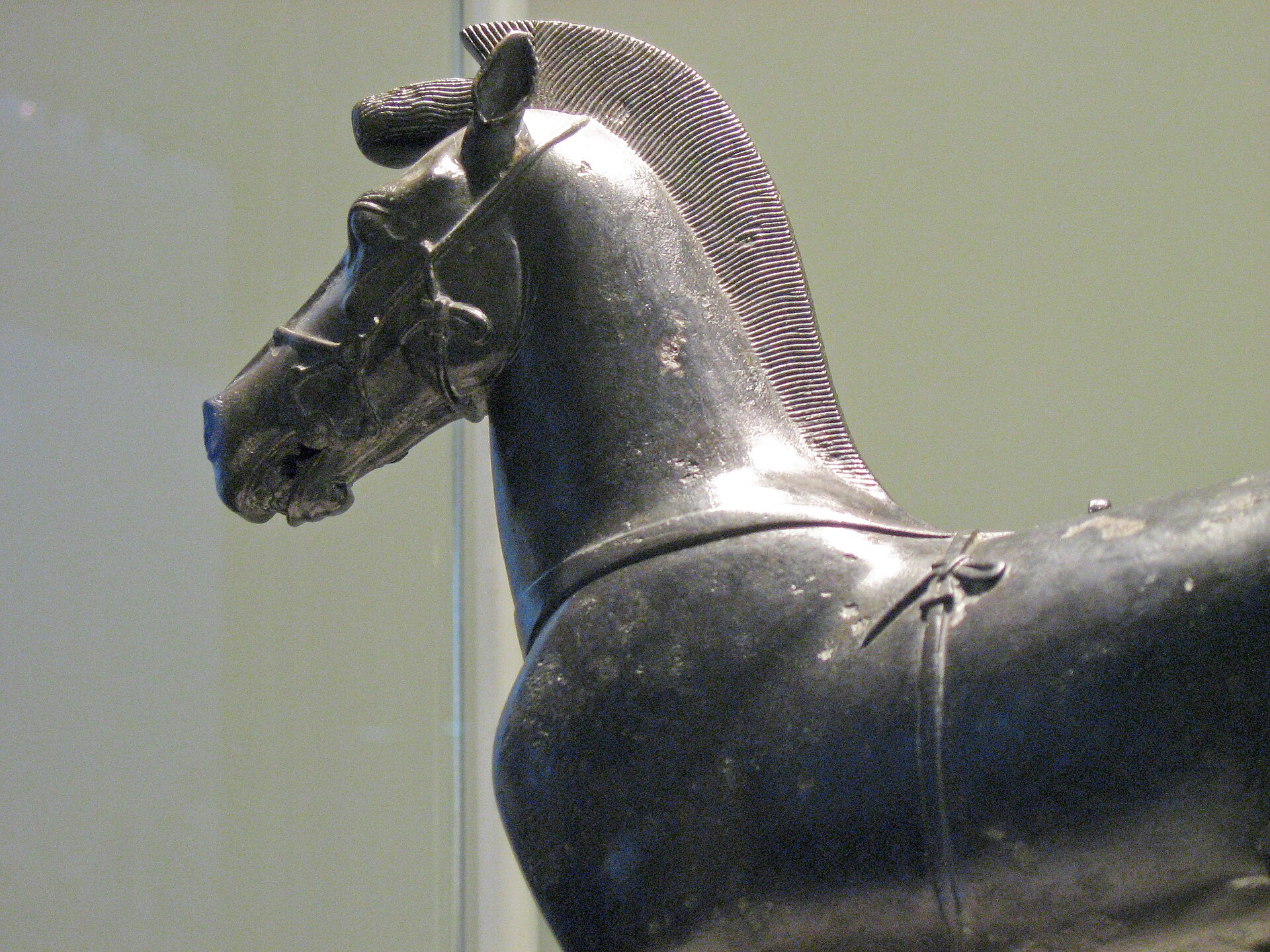
The horse stands 40.2 centimetres high. Photographs of it, reproduced for decades in histories of Greek art, give no sense of that; it has the presence of a monument and the dimensions of a table ornament. It is hollow, cast in one piece, with no rivets and no welds. The head is turned very slightly, the mane is cropped into a stiff upright crest, and a hole through the crest and a second hole deep in the forelock indicate fittings that no longer survive.
Two small round holes about two millimetres across and ten millimetres deep sit ten millimetres behind each ear. They were invisible for decades because they were filled with a thick coloured wax coating, and were only found when the wax was taken off with xylene in 1968. The right hole was packed with sandy accretion; material in the left tested positive for iron and calcium carbonate, which indicates that a bridle fitting was once pinned there in iron. That detail matters more than it looks, because the placing of the harness was one of the arguments used to condemn the horse.
Chapter 2How a bronze like this was actually made
A hollow Greek bronze of this size was built around a core of refractory material, modelled in wax over that core, invested in clay, fired so that the wax ran out, and filled with molten bronze.
A hollow Greek bronze of this size was built around a core of refractory material, modelled in wax over that core, invested in clay, fired so that the wax ran out, and filled with molten bronze. The core has to be held in place while the wax is gone and the metal is flowing, and it is held by iron pins driven through it, called chaplets. When the casting has cooled the chaplet ends are cut off flush and the small holes left behind are stopped with rectangular bronze patches.
Every one of those features is present on this horse, and every one of them was read in 1967 as evidence of fraud. Petrographic analysis of the core by Frederick R. Matson found it to be roughly equal parts clear quartz sand and a calcareous paste best described as a marl: a crude calcareous sand of a kind available almost anywhere around the Mediterranean, and the obvious material for the job. The iron chaplets penetrate a short distance into the core and do not pass through it, which is customary in hollow lost-wax casting and would be useless in the loosely bound sand core of a sand casting. The wall thickness varies. There is interior flashing where metal ran. The legs are solid and carry armature.
This is the ordinary technology of the classical bronze foundry, and it is worth stating plainly, because the case against the horse rested on the claim that it was the technology of a nineteenth-century French one.
Chapter 3Forty years as the most important object in the collection
The Museum bought the horse on 16 February 1923 from a dealer in Paris, on the Fletcher Fund.
The Museum bought the horse on 16 February 1923 from a dealer in Paris, on the Fletcher Fund. It was dated between 480 and 470 BCE, placed among the highest achievements of Early Classical Greek sculpture, and reproduced in scholarly works as such.
It was also, in a way that is now hard to imagine for an object of this kind, popular. Thousands of plaster casts of it were made and sold over the years at the Museum's sales desk and at Brentano's bookstores. Noble bought one for his own house in 1946, twenty-one years before he condemned the original. Those casts are the reason the case began, and the reason it collapsed, though nobody understood that until 1968.
Chapter 4One line on the face, seen in the summer of 1961
Noble described the moment precisely. He had walked past the horse a thousand times.
Noble described the moment precisely. He had walked past the horse a thousand times. In the summer of 1961, approaching it, he saw a line running from the tip of the nose up through the forelock, down the mane and back, up under the belly and all the way around. He recognised it as a casting fin: the seam where the sections of a piece mould meet and the metal oozes out, filed off afterwards and leaving a trace.
A genuine Greek bronze of this size would have been cast by the lost-wax process, which leaves no such seam. A seam of this kind belonged to sand casting, a process Noble understood to be unknown before the fourteenth century AD. He turned in a report on 25 August 1961. Dietrich von Bothmer, curator of Greek and Roman Art, went to Greece to look at the bronze horse at Olympia, the marble horses on the Acropolis and other comparanda, and wrote back with three words: remove the horse from exhibition. It came off display on 15 September 1961 and the investigation ran privately for the next six years.
Along the way Noble added stylistic objections. The hole in the mane, he argued, was too low for harness straps, which should tie right behind the ears. The deep hole in the forelock, he thought, was a forger's misunderstanding of the sockets on Acropolis marbles that held a bronze spike, a meniskos, to keep birds off.
Chapter 5The foundry in Greenpoint
The most persuasive piece of the case was assembled a month or so after von Bothmer returned.
The most persuasive piece of the case was assembled a month or so after von Bothmer returned. Noble and von Bothmer took a plaster cast of the horse to the Bedi Rassy Foundry in Greenpoint, Brooklyn, one of the few firms in the area still working in the French sand piece-mould process, and asked how they would cast it.
Mr Rassy laid the cast on its side in a bed of sand mixed with clay and indicated the level to which he would fill the mould. The line he drew with his hand followed exactly the line running around the body of the horse. Then, unprompted, he added that he would not do it that way; he would cast it hollow, with a core of the same sand and clay, held with iron wire about the thickness of coat-hanger wire, the protruding ends cut off and the holes covered with little bronze plugs.
Noble and von Bothmer went back to the Museum and counted the plugs. They were exactly where Rassy said they would be, on the head and back and along the sides. They had always been read as ancient repairs of casting bubbles. A young assistant curator, Brian Cook, suggested testing for the iron with a magnet on a string; by the spring of 1962 there was a chart of the points of magnetic attraction, and they coincided with the plugs.
It is a beautiful piece of reasoning and it is wrong, because the identical features are produced by the lost-wax process. Chaplets are iron. Chaplet holes are patched. The demonstration proved that a modern sand-caster would make a horse that looked like this one; it did not prove that only a modern sand-caster would.
Chapter 6Gamma rays, and a museum condemning its own masterpiece in its own Bulletin
On 15 September 1967 a firm called Radiography Inspection Inc., which normally inspected nine-inch steel plate on submarines, arrived in the Museum's north parking lot with a truckload of equipment.
On 15 September 1967 a firm called Radiography Inspection Inc., which normally inspected nine-inch steel plate on submarines, arrived in the Museum's north parking lot with a truckload of equipment. Conventional x-rays would not give a clear image through that much bronze, so they used iridium-192 and exposed by gamma rays. The film, developed in the truck, showed the cavity, the sand core, a faint line of extra density running the length of the animal, and white spots at the ends of transverse wires.
Noble read the faint line as an iron wire armature and called the shadowgraph the definitive proof of the forgery. He dated the object to Paris between 1918 and 1923 on the grounds that the sophisticated French sand-casting technique had been used and that the neoclassical stylisation of archaic form would not have been possible earlier. He insisted on the word forgery rather than pastiche because the legs and tail had been deliberately mutilated to simulate damage.
He announced it in November or December 1967 at the third of a series of four public seminars on art forgery held at the Museum, and printed it in February 1968 in the Museum's own Bulletin, in an issue devoted to forgery which the director Thomas Hoving opened with an essay called The Game of Duplicity. It is one of the few occasions on which a great museum has published a full technical indictment of its own most celebrated object under its own imprint. That is to the Museum's credit, and it is also why the reversal took thirteen years and left a permanent mark.
Chapter 7What was under the wax
The horse was submitted to the Museum's Conservation Department on 3 January 1968, three weeks after the announcement, for a full technical examination.
The horse was submitted to the Museum's Conservation Department on 3 January 1968, three weeks after the announcement, for a full technical examination. The first thing the conservators did was look at the mould lines.
The bronze turned out to be coated with thick opaque layers of black and green pigmented wax, of a type routinely applied to archaeological bronzes at the Museum and elsewhere in the 1920s and 1930s. The wax was removed with xylene. The mould lines went with it.
What remained was a single depressed line on the face, running up from the nose to between the eyes and stopping there, not continuing to the forelock as had been reported. The seam that Noble had seen running round the entire animal was in the wax, and it marked the edges of the piece mould made not for casting the bronze but for reproducing the plaster casts sold at the Museum's own sales desk. The horse was condemned on the evidence of its own souvenir industry.
The line that is genuinely on the metal is incised, with no flange and no step. Cyril S. Smith of MIT, the foundryman John Spring of the Modern Art Foundry and the Florentine master caster Bruno Bearzi all examined it and none considered it a mould mark. Bearzi pointed out that a piece which took months to make could have had such a line obliterated in minutes; the surfaces around it have been chased and filed, so it was deliberately kept. Comparable incised lines run down the faces of marble horse heads in the National Museum in Athens and the Agora Museum, where mould marks are impossible. It is a modelling line, put there by the sculptor.
Chapter 8Europe answers back
The counter-arguments began immediately and came mostly from people who had handled ancient bronzes.
The counter-arguments began immediately and came mostly from people who had handled ancient bronzes. Carl Bluemel, retired director of the Berlin State Museums, published a note in Die Weltkunst in 1968 titled, flatly, Das Bronzepferd in New York ist keine Faelschung. He pointed to iron armatures in the core of the bronze Kouros found at Piraeus, in the Charioteer at Delphi and in castings in Berlin, and argued that the armature Noble described was a sign of authenticity rather than the reverse. Bruno Bearzi said he had found iron supports in the Piraeus Kouros and other ancient castings. Internal iron supports have since been observed in the serpent head from the Delphi tripod in Istanbul and in a mirror support in the Metropolitan's own collection.
The revealing detail is what Bluemel and Claude Rolley did with the seam. Both accepted Noble's assertion that a fin existed in the metal, because it had been published by the Museum, and both then tried to explain how an ancient object could have one: Bluemel suggested casting in two soldered halves, Rolley a wax model built in two halves over a core. Neither could have known that there was no fin. A false observation, printed under an institutional imprint, generated a literature of ingenious explanations for a thing that was not there.
Chapter 9The metal, the corrosion and the ore
The re-examination ran on ten collaborators and took the object apart analytically.
The re-examination ran on ten collaborators and took the object apart analytically. Emission spectroscopy gave an alloy containing about 0.45 per cent lead and no zinc, a composition consistent with ancient practice and not with modern bronze. X-ray diffraction on the corrosion products identified paratacamite and atacamite, copper chlorides characteristic of long natural burial, with intergranular corrosion penetrating the metal to a depth of at most about a quarter of a millimetre. R. M. Organ at the Smithsonian's Conservation Analytical Laboratory found bornite and calcite in the mineral incrustation. Lead isotope work by Robert H. Brill and colleagues with the National Bureau of Standards placed the ore sources in the Mediterranean, most probably Italy and the Levant.
Radiography was repeated with iridium-192, cobalt-60, caesium-137 and high-energy x-rays. The internal structure it showed was an armature and chaplets, not coat-hanger wire.
None of this, on its own, settles the question, and the authors said so with unusual honesty in their opening paragraph: even where every traditionally understood property is consistent with an attribution, a sufficiently clever forger could have known and used the right materials in the right ways. Consistency with antiquity is not proof of antiquity. What was needed was an absolute date.
Chapter 10The sample that was taken before the gamma rays
Thermoluminescence dates fired ceramic. All ceramic contains traces of uranium, thorium and potassium; the energy released by their decay is trapped in the crystal lattice and released as light when...
Thermoluminescence dates fired ceramic. All ceramic contains traces of uranium, thorium and potassium; the energy released by their decay is trapped in the crystal lattice and released as light when the material is heated to around 500 degrees, and the accumulated dose divided by the dose rate gives an age. The ceramic core of a bronze is therefore datable, and its firing date is the date of the casting.
The horse should have been undatable. Gamma and x-ray radiography deliver an artificial radiation dose that is added to the natural one and cannot be distinguished from it, and this horse had been radiographed repeatedly. The examination was saved by an accident of sequence: a sizeable sample of core material had been extracted early, before most of the radiography was done. The radiographic dose that sample had received was calculated from the exposure records at about 15 rads, with the caveat that trial exposures may not all have been logged.
Pieter Meyers initiated the measurements and worked with David W. Zimmerman and Marjorie P. Yuhas at the Laboratory for Space Physics at Washington University in St Louis. They measured three different fractions separated from the core: zircon grains with very high internal radioactivity, large quartz particles with almost none, and fine-grained mineral particles in between. The accumulated doses came out at roughly 100,000 rads for the zircons, 625 rads for the quartz and 950 rads for the fine fraction. The inequality is itself the argument: the zircons had absorbed a dose several thousand times the estimated radiographic dose, which can only have come from their own internal radioactivity over a long period. The 325-rad gap between the fine fraction and the quartz is due to alpha radiation, and alpha radiation can only come from decay inside the core material itself.
Zimmerman's improved zircon technique gave an age of 2250 plus or minus 210 years before present, an average of measurements on three individual grains, with the uncertainty a reliable one-sigma estimate. His own statement of what that means is properly cautious: the results show only that the horse was probably made between about 500 BCE and 50 BCE, with, for practical purposes, equal probability for any time in that period. The results were published in Archaeometry in 1974 and set out in full in the Journal of the American Institute for Conservation in 1981, whose conclusion is that the thermoluminescence dating provides conclusive evidence that the horse cannot be a modern forgery.
Chapter 11Vindicated, and re-dated by seven centuries at the same time
The horse came back. What did not come back was the date.
The horse came back. What did not come back was the date. The Museum acquired it as Early Classical, about 480 to 470 BCE, and that is the attribution that made it the most important object in the classical collection. It is now catalogued as Greek, Late Hellenistic, late 2nd to 1st century BCE, with the Museum's machine-readable record giving a range of 115 BCE to 1 BCE.
The thermoluminescence result is the reason both statements can stand. A window of 500 to 50 BCE excludes a modern forger absolutely and excludes nothing else; within antiquity it is compatible with an Early Classical date and with a Hellenistic one, and it cannot choose between them. The choice was made on style, in the light of a better understanding of how thoroughly Hellenistic sculptors reused and quoted earlier manners. An object made in the first century BCE in a deliberate archaising idiom will look Early Classical to an eye trained to read style as chronology, which is exactly what happened in 1923.
There is a symmetry worth naming. In 1967 the horse was condemned because a technical observation was allowed to overrule the eye. In the 1970s it was re-dated because the eye, better informed, overruled a technical result that could not decide. Neither method is sovereign, and this object has been used to prove both propositions.
Chapter 12What the case actually establishes
Three things, and they are not the ones usually drawn from it.The first is that a conservation coating is evidence about conservators, not about makers.
Three things, and they are not the ones usually drawn from it.
The first is that a conservation coating is evidence about conservators, not about makers. Every observation Noble made about the seam was accurate as an observation. The seam existed; it simply belonged to a wax layer applied in the 1920s or 1930s for the purpose of taking moulds for the museum shop. A technical argument is only as good as its account of which layer it is looking at.
The second is that publication by an institution converts an assertion into a premise. Bluemel and Rolley, distinguished scholars both, spent their effort explaining a fin rather than asking whether it was there, because the Metropolitan Museum had printed that it was.
The third is that absolute dating answers one question and exactly one. Thermoluminescence told the Museum that the horse is ancient. It did not tell it, and cannot tell it, when in antiquity, or where, or by whom. The date on the label today rests on the same kind of stylistic judgement that produced the wrong date in 1923, and it is offered with the same confidence.
Joseph Noble's own standard, quoted by his director at the start of the very seminar series at which the horse was condemned, was Max Friedlaender's: it is an error to collect a forgery, but a sin to stamp a genuine piece with the seal of falsehood. The Museum did both to the same object, and then published the correction.
The artist
Unrecorded Greek bronze caster, late Hellenistic period
No maker is named for this horse and none can be. What can be described, in detail and from the object itself, is the workshop tradition that produced it, because the whole controversy turned on a claim about that tradition: that a Greek foundry could not have made a bronze in this way. The dossier below is therefore about the practice rather than the person, which is the honest form for an object whose only biography is metallurgical.
The relevant point about that practice is how narrow the surviving sample is. Large Greek bronzes were melted down in antiquity and after it, and the corpus that survives is essentially the accidents: shipwreck finds, buried hoards, and pieces that stayed hidden. When Joseph Noble asked whether any ancient bronze was known to have been made by a piece-mould process, and answered no, he was reporting the state of a very small dataset in 1967 and treating it as a law of nature.
Related works
| Work | Relation | Where it is |
|---|---|---|
| Bronze horse Unrecorded Greek bronze caster | The comparison Dietrich von Bothmer was sent to Greece to examine in 1961 Illustrated as figure 2 in Noble's 1968 Bulletin article and dated there to about 460 BCE. It is a different object and shares no material history with the Metropolitan's horse. | Archaeological Museum, Olympia |
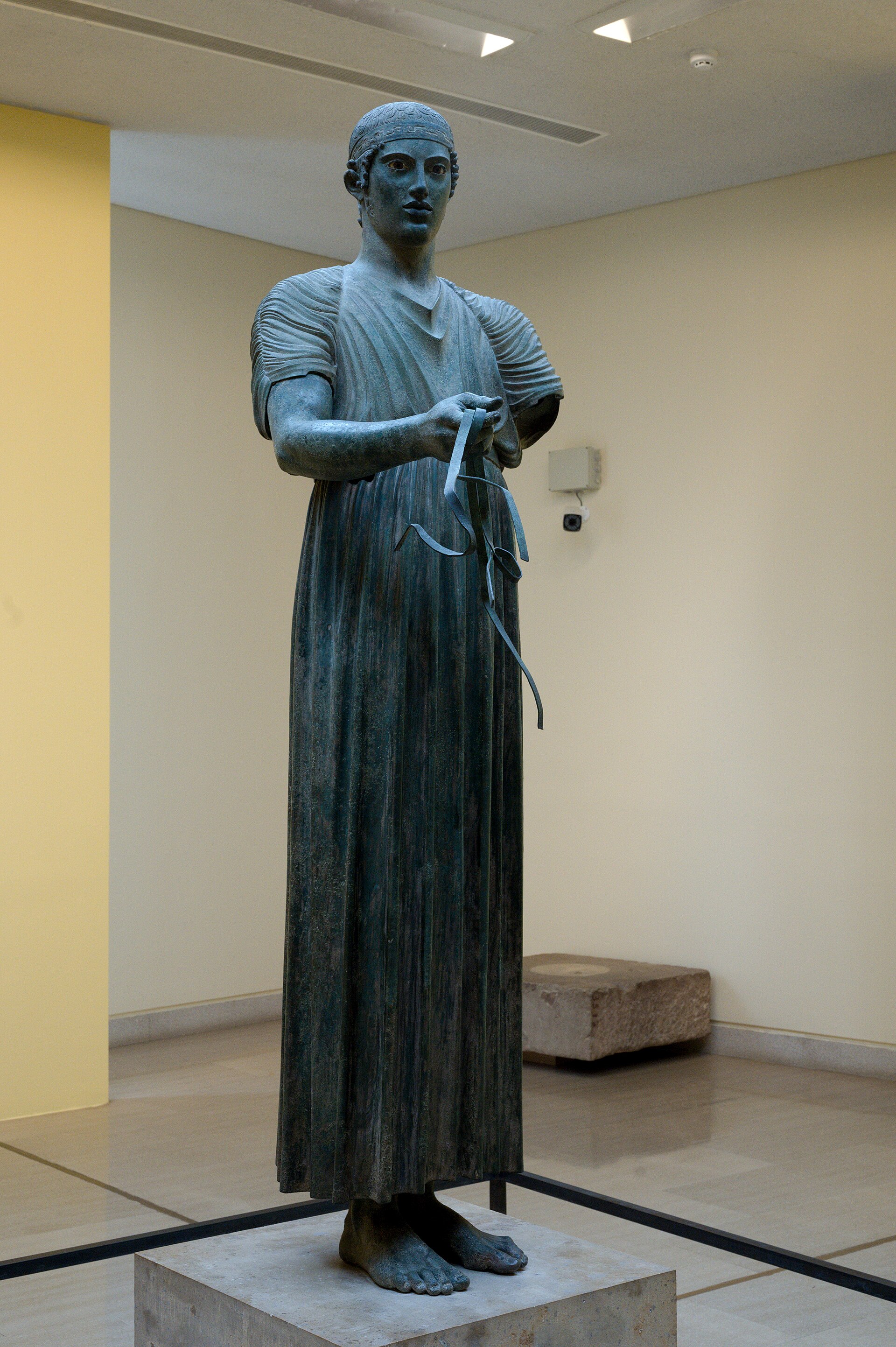
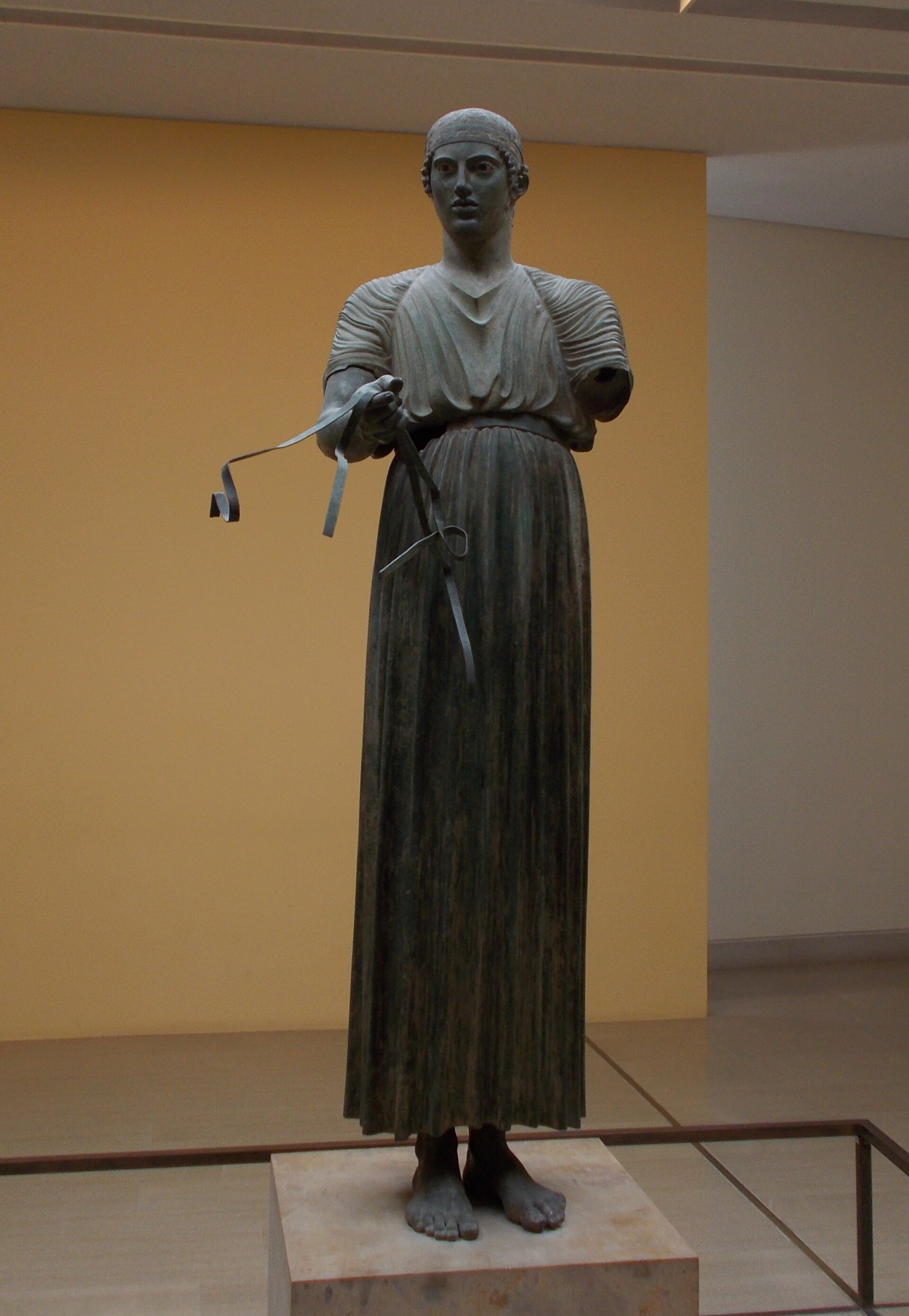
| The Piraeus Kouros Unrecorded Greek bronze caster | Cited by Carl Bluemel and Bruno Bearzi as an ancient bronze with an internal iron armature Bluemel's use of it in Die Weltkunst in 1968 was the central counter-argument to the claim that an iron armature indicated modern manufacture. | Archaeological Museum of Piraeus |
| The Charioteer of Delphi Unrecorded Greek bronze caster | Cited alongside the Piraeus Kouros as evidence of ancient iron armatures About 478 to 474 BCE. One of the very few surviving large Greek bronzes, and a standard reference point for classical casting practice. | Archaeological Museum of Delphi |
| Serpent head from the Delphi tripod Unrecorded Greek bronze caster | Illustrated in the 1981 technical report showing core material with the red iron oxide remains of an armature From the tripod dedicated at Delphi and later moved to Constantinople. | Archaeological Museum, Istanbul |
| The Etruscan terracotta warriors Modern forgers, Italy | The Metropolitan forgeries Joseph Noble helped expose, correctly, before he turned to the horse Acquired in 1916, 1917 and 1921 and shown to be modern. Noble's record on the warriors is the reason his verdict on the horse carried the weight it did. | The Metropolitan Museum of Art, New York |
Open questions
- Who was the Paris dealer, and what did the Museum pay on 16 February 1923? Noble's 1968 account gives the date and the city and nothing else, and no price appears in the sources consulted.
- Where was the horse found? No findspot is recorded in any source consulted, and the lead isotope work narrows the ore source to the Mediterranean without locating the object.
- On what date did the Museum publicly restore the attribution, and in what form? Secondary accounts refer to a panel in 1972, but the sources consulted here document only the publications of 1974 and 1981.
- What published argument supports the Late Hellenistic re-dating? The Museum's catalogue entry now gives late 2nd to 1st century BCE on stylistic grounds, and no specific study making that case has been identified.
- How many plaster casts were made, and where are they now? Thousands were sold at the Museum's sales desk and at Brentano's, and the piece mould taken for them is the direct cause of the 1967 misreading.
- Was the incised line on the face intended as a modelling guide, a stylistic convention or something else? It is deliberate and it is paralleled on marble horse heads in Athens, but its purpose is not established.
Questions about this object
What is Bronze statuette of a horse?
Bronze statuette of a horse is a sculpture, dated late Hellenistic, late 2nd to 1st century BCE. Catalogued as about 480 to 470 BCE from 1923 until the 1970s.. Medium: Bronze, cast by the lost-wax process over a ceramic core with iron armature and chaplets.
Who made Bronze statuette of a horse, and is the attribution settled?
The attribution to Unrecorded Greek bronze caster is recorded here as accepted. Declared a modern forgery by the Museum's own Vice-Director in December 1967 and restored to antiquity by a thirteen-year technical re-examination. The bronze alloy, the corrosion products, the ceramic core with its iron armature and chaplets, and the repair patches are all consistent with casting in classical antiquity, and thermoluminescence dating of the core gave 2250 plus or minus 210 years before present. The date has moved: acquired as Early Classical of about 480 to 470 BCE, the horse is now catalogued by the Museum as Late Hellenistic, late 2nd to 1st century BCE. No maker is named and none can be.
Where is Bronze statuette of a horse now?
The Metropolitan Museum of Art, New York, Department of Greek and Roman Art. Inventory number 23.69. Last confirmed 4 August 2026. Purchased 16 February 1923 from a dealer in Paris; Fletcher Fund, 1923.
What is still unknown about Bronze statuette of a horse?
Who was the Paris dealer, and what did the Museum pay on 16 February 1923? Noble's 1968 account gives the date and the city and nothing else, and no price appears in the sources consulted.
Sources
- 1The Metropolitan Museum of Art, Open Access collection record for accession 23.69, Bronze statuette of a horse, Greek, Late Hellenistic, late 2nd to 1st century BCE, Fletcher Fund 1923. Machine-readable object record giving title, culture, period, date range, medium, dimensions, credit line, department and public-domain status. collectionapi.metmuseum.org/public/...
- 2Joseph V. Noble, 'The Forgery of Our Greek Bronze Horse', in 'Art Forgery', The Metropolitan Museum of Art Bulletin, new series 26, no. 6 (February 1968), pp. 253-256; with Thomas P. F. Hoving, 'The Game of Duplicity', in the same issue. Primary source for the 1923 purchase date, the 1961 observation, the Bedi Rassy demonstration, the 1967 gamma radiography and the forgery announcement. resources.metmuseum.org/resources/...
- 3Kate C. Lefferts, Lawrence J. Majewski, Edward V. Sayre, Pieter Meyers, with R. M. Organ, C. S. Smith, Robert H. Brill, I. Lynus Barnes, Thomas J. Murphy and Frederick R. Matson, 'Technical Examination of the Classical Bronze Horse from The Metropolitan Museum of Art', Journal of the American Institute for Conservation 21, no. 1 (1981), pp. 1-42. The full re-examination, including the thermoluminescence results first published by Zimmerman, Yuhas and Meyers in Archaeometry 16 (1974), pp. 19-30. cool.culturalheritage.org/jaic/...
- 4The Metropolitan Museum of Art, public collection page for accession 23.69. Canonical museum record. Automated requests to this page returned HTTP 429 during research, so the catalogue data in this record was taken from the Museum's own Open Access API at source 1. metmuseum.org/art/...
- 5Wikipedia, 'Joseph V. Noble'. Tertiary source, used only for the statement that a panel found otherwise in 1972 and for Noble's role in exposing the Metropolitan's Etruscan terracotta warriors. Flagged for replacement with the finding aid for the Joseph V. Noble Records in the Metropolitan Museum Archives. en.wikipedia.org/wiki/...
Last verified 8 September 2026 · Published 4 August 2026
Change log
4 August 2026 - Record created at the house standard: researched narrative, technical evidence, maker dossier, graded provenance chain, prices with hammer and premium separated, related works, open questions and sources.
8 September 2026 - Re-verified. No change to location, attribution or ownership: still the Metropolitan Museum of Art, on view Gallery 164, Fletcher Fund 1923, object 23.69, Public Domain, dated late 2nd-1st century BCE (Late Hellenistic) per the Met's own current object page - unchanged since the thermoluminescence-vindication and restyling already in the record. No new scholarship found answering any of the six open questions (the Paris dealer and 1923 price, the findspot, the 1972/1974/1981 re-attribution sequence, the published basis for the Late Hellenistic re-dating, the number and whereabouts of the sales-desk plaster casts, the incised facial line). One lead checked and explicitly REJECTED rather than added: a web search surfaced a claim associating this object with the Mahdia shipwreck findspot off Tunisia - this could not be verified against any source naming accession 23.69 specifically, and the Mahdia wreck's own well-documented bronzes (a Hermes herm, an Eros, other figures recovered 1907) are a separate, already-distinct find; treating the two as the same object would have been exactly the comparandum-conflation error CLAUDE.md warns against, so the findspot open question stays open rather than being answered on an unverified claim. All 5 source URLs re-checked; both Met URLs resolve.