Epee du sacre des rois de France
Unrecorded medieval goldsmiths' workshops serving the French crown (pommel, guard and grip); blade replaced and scabbard restored in later centuries · Composite, 10th to 19th century (pommel c. 900-1100; guard c. 1100-1200; grip c. 1200-1400; blade 1700-1900; scabbard velvet remade 1804 and 1825)
Last verified 16 September 2026 · 11 sources cited · Change log
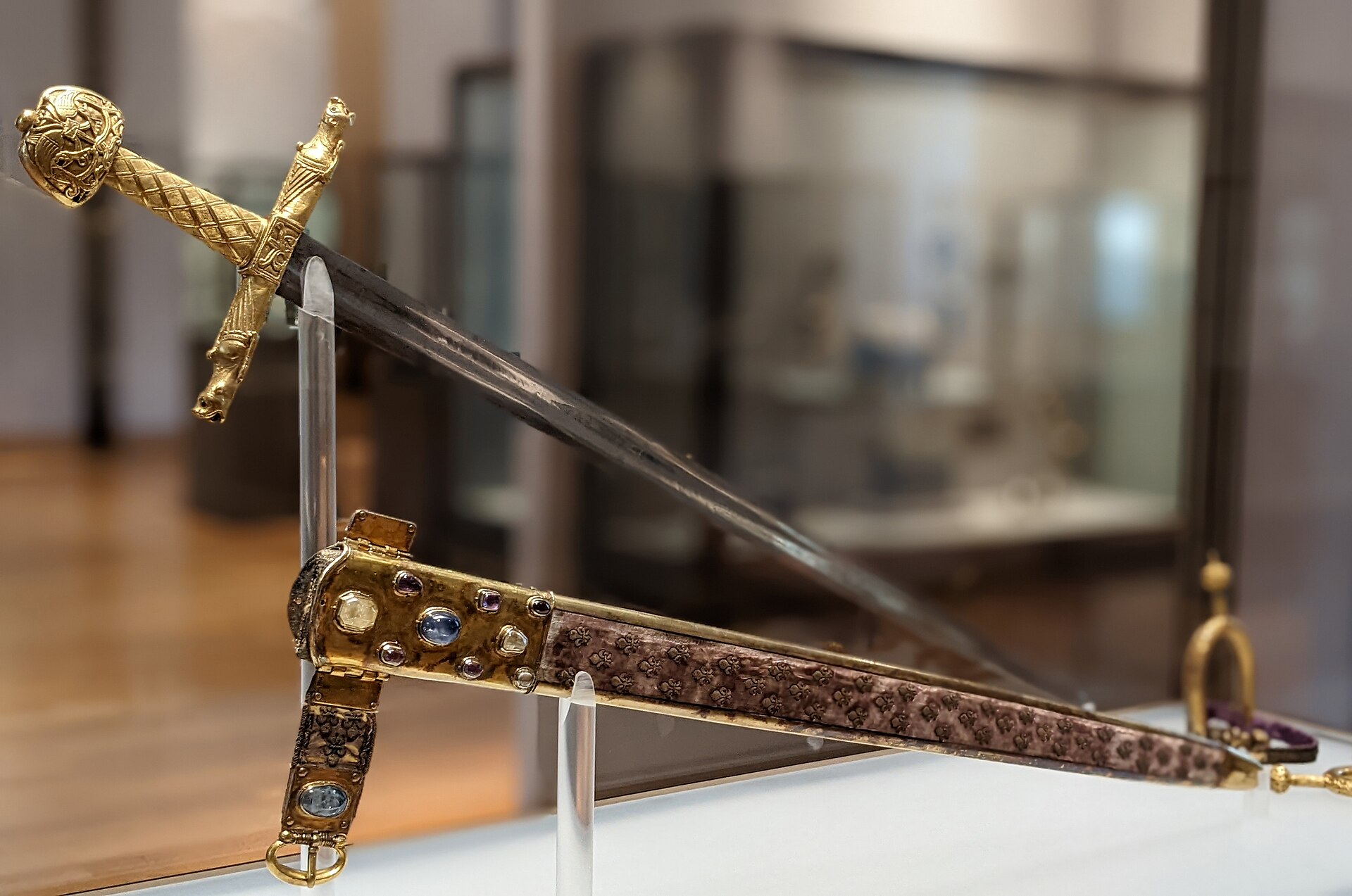
The record subject: MS 84, the coronation sword of the Kings of France, photographed at the Musee du Louvre. The file title itself names the Louvre accession number.
| Artist | Unrecorded medieval goldsmiths' workshops serving the French crown (pommel, guard and grip); blade replaced and scabbard restored in later centuries |
|---|---|
| Date | Composite, 10th to 19th century (pommel c. 900-1100; guard c. 1100-1200; grip c. 1200-1400; blade 1700-1900; scabbard velvet remade 1804 and 1825) |
| Medium | Gold with filigree work, lapis lazuli or dark glass beads (dragon eyes), diamonds; steel blade |
| Dimensions | Height 100.5 cm; width 22.6 cm (Musee du Louvre catalogue figures for MS 84; other reference works give differing totals, see open questions) |
| Where it is now | Musee du Louvre, Departement des Objets d'art, Paris, Richelieu wing, level 1, room 502 (Salle Suger), display case 30, MS 84last confirmed 16 September 2026 |
| Attribution | disputedTraditionally identified as the sword of Charlemagne (d. Full note |
| Object type | Arms and armour |
| Period | French royal regalia, Carolingian-Ottonian through the Bourbon Restoration (10th-19th century) |
| Cases | Disputed attribution · Seized, looted or confiscated · Has a provenance gap |
| Inscriptions | None documented in the sources consulted for this record. |
- Where it is now
- Musee du Louvre, Departement des Objets d'art, Paris, Richelieu wing, level 1, room 502 (Salle Suger), display case 30last confirmed 16 September 2026
- Attribution
- disputed
- Provenance
- 11 links9 documented, 2 unknown
- Sources
- 11 cited
- Last verified
- 16 September 2026Change log
On this page 9 sections
Joyeuse is the sword French kings used at their own coronations, the sacre, from at least Philip III in 1271 through Charles X in 1825, the last king of France ever crowned. It is not, and does not claim to be, the single unmodified sword of Charlemagne the tradition names it for: the Musee du Louvre's own catalogue dates its pommel to 900-1100, its guard to the 12th century, its grip to the 13th or 14th century, and its blade to 1700-1900, a composite built up over roughly a millennium in which no single component was made during Charlemagne's lifetime.
It survived the French Revolution when most of the rest of the Saint-Denis treasury did not, deposited at the Louvre on 5 December 1793. It was redecorated for Napoleon's coronation in 1804 and restored to its Bourbon appearance by the crown jeweler Bapst for Charles X's coronation in 1825, then returned to the Louvre for good by 1852. It is on display today in the museum's medieval Objets d'art rooms, alongside its own scabbard and the coronation spurs deposited with it on the same day in 1793.
The name and the association with Charlemagne are the oldest and best-documented parts of the object's story. The physical continuity with him is the part the museum's own dating does not support, and this record states that plainly rather than around it.
Provenance
Each link is graded. Documented: a cited source supports it. Disputed: the identification is argued but not established. Unknown: no owner for that span, and the gap is not smoothed into a narrative. The grades in the glossary.
- c. 900 - c. 1400Successive, unrecorded French royal goldsmiths' workshopsdocumented
The pommel, guard and grip are dated by the Musee du Louvre's own catalogue to three separate periods (900-1100, 1100-1200, 1200-1400 respectively), on stylistic grounds. No individual maker is named for any stage.14
- c. 1400 - 1271Treasury of the Abbey of Saint-Denis (regalia of the Kings of France)documented
The sword, under the name Joyeuse, is attested at the coronation of Philip III the Bold at Reims on 15 August 1271, the first coronation at which its use is confirmed by the sources consulted. An earlier claimed use under Philip Augustus in 1179 is not confirmed by a surviving ordo or eyewitness record consulted here.56
- 1271 - 1793Treasury of the Abbey of Saint-Denis (regalia of the Kings of France)documented
Listed in the Saint-Denis treasury inventory of 1634 and described, with an engraving, in Michel Felibien's 1706 history of the abbey. Sources describe the sword as present at every French coronation across this span, though not every individual coronation is separately documented in the sources consulted for this record.356
- 1793 - 1793French revolutionary statedocumented
Deposited at the Louvre museum on 5 December 1793, together with the scabbard and the coronation spurs, as part of the revolutionary dispersal of the Saint-Denis treasury. Most of the treasury's other regalia were melted for coin or sold in the same period; this group was preserved on grounds of artistic and historical interest.135
- 1793 - 1804Musee du Louvredocumented
Held at the Louvre in the years immediately following the 1793 deposit, prior to its display as part of the revived Charlemagne regalia for Napoleon's 1804 coronation.1
- 1804 - 1816Treasury of Notre-Dame Cathedral, Parisdocumented
Carried, but not worn, by Napoleon at his 1804 coronation; the scabbard was redecorated in green velvet with gold laurel leaves for the occasion. Kept at the Notre-Dame treasury through 1816.16
- 1816 - 1825unrecordedunknown
No source consulted for this record documents custody in this interval, though the sword was necessarily brought to Reims for Charles X's coronation in 1825.
- 1825 - 1825French crown / Reims Cathedraldocumented
Restored by the crown jeweler Jacques-Eberhard Bapst-Meniere, who removed Napoleon's scabbard changes and returned it to violet velvet strewn with fleurs-de-lis. Carried at Charles X's coronation on 29 May 1825, the last coronation of a King of France.511
- 1825 - 1848unrecordedunknown
No source consulted documents custody between the 1825 coronation and the sword's recorded presence at the Garde-Meuble by 1848.
- 1848 - 1852Garde-Meuble, Ministry of Financedocumented
Recorded at the state furniture and regalia store under the Ministry of Finance before its return to the Louvre.1
- 1852 - presentMusee du Louvre, Departement des Objets d'artdocumented
Returned to the Louvre in 1852 and has remained in the Objets d'art department since, currently displayed in the Richelieu wing, room 502 (Salle Suger), case 30.1
Technical evidence
| Attribution note | Traditionally identified as the sword of Charlemagne (d. 814) and used as such at French royal coronations from at least 1271. The Musee du Louvre's own catalogue dates the surviving object's four principal components to four different periods (pommel 900-1100, guard 1100-1200, grip 1200-1400, blade 1700-1900), none of which falls within Charlemagne's lifetime. Modern Louvre curatorial scholarship, principally the catalogue of the treasury of Saint-Denis by Blaise de Montesquiou-Fezensac and Danielle Gaborit-Chopin, treats the object as a composite assembled and reworked across roughly a millennium rather than a single artifact surviving unmodified from the 9th century. |
|---|---|
| Pommel | Gold, decorated with confronted birds in a style the Louvre's catalogue compares to Scandinavian ornament. Dated 900-1100 on stylistic grounds (the catalogue's own phrase is attribution d'apres style, attribution by style). No maker is named.14 |
| Guard (quillons) | Two gold quillons shaped as confronted, stylized winged dragons, with eyes set in lapis lazuli or dark glass. Dated to the 12th century, a distinct period and, on the evidence, a distinct workshop from the pommel.14 |
| Grip (fusee) | Gold hilt covered in a lattice of diamonds set in a lozenge pattern. Dated to the 13th or 14th century.14 |
| Blade | Steel. Dated by the Louvre's own catalogue to 1700-1900, meaning the blade fitted to the sword today is a later replacement rather than a medieval survival.1 |
| Scabbard (fourreau, MS 84 bis) | Separately accessioned. A gemstone-set plaque dated to the 13th century; the velvet covering was remade in green with gold laurel leaves for Napoleon's coronation in 1804, then replaced with violet velvet strewn with fleurs-de-lis by the crown jeweler Bapst for Charles X's coronation in 1825, the covering still on the object today.2511 |
| Materials, overall | Gold, filigree work, lapis lazuli or dark glass beads (the dragons' eyes), diamonds, steel.1 |
| Dimensions | Height 100.5 cm; width 22.6 cm, per the Musee du Louvre's own catalogue. Other reference works cite differing figures, including a total length near 105 cm with an 82.8 cm blade; this record follows the museum's own catalogue and flags the discrepancy rather than silently reconciling it.1 |
Images
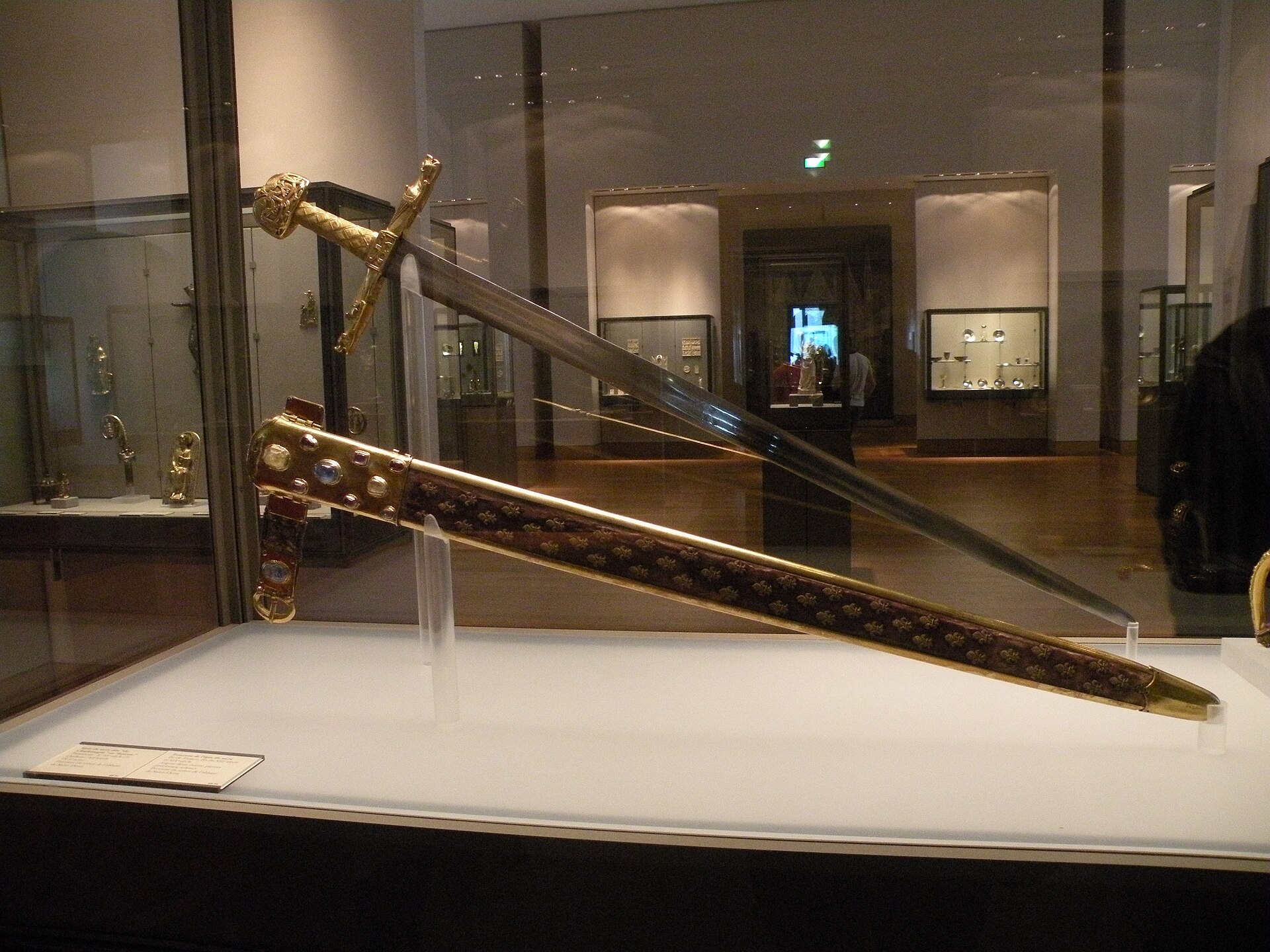
The record in full
What survives, physically
The object catalogued today as MS 84 in the Louvre's Departement des Objets d'art is a sword just over a metre in overall height by the museum's own measurement, of gold, filigree work, lapis lazuli or dark glass beads set as dragon eyes, and a steel blade. It is not, and does not claim to be, a single forging. It is an assembly: a pommel, a guard, a grip and a blade, each added in a different century, mounted together into the object that was carried at French royal coronations for over five hundred years.
The Louvre keeps the scabbard as a separate accession, MS 84 bis, and the coronation spurs as a third related object. All three came into the museum together, from the same source, on the same day in 1793, and are displayed together now.
The name, and the legend it borrows
Joyeuse is also, and first, the name of a sword in the chansons de geste, the medieval epic tradition that gave Roland his sword Durendal and gave Charlemagne his own blade a name and a set of marvellous properties: an embedded relic of the Holy Lance, a color said to change many times a day, a name meaning joyous. That sword belongs to poetry. Nothing in this record depends on it, and nothing about the physical object at the Louvre proves or requires that the epic tradition describes this exact blade.
What is documented is narrower and more interesting: French kings from at least the 13th century staged their own coronations around an actual sword kept at Saint-Denis and called it Joyeuse, deliberately invoking the legend. The invocation is the historical fact. It is a claim the monarchy attached to an object, not evidence that the object is the legend's sword.
Coronation sword of the kings of France
The French coronation ordo, the liturgical script for the sacre, already specifies by around 1200 that the king is to be made a knight before the anointing: the sword is carried into the cathedral bare and raised, and the archbishop girds it on the king along with spurs. The ordo used for Saint Louis, a manuscript of 1246, fixes this presentation of sword and spurs in the presence of the twelve peers of the realm. Some accounts push the sword's ceremonial use back to Philip Augustus in 1179, but that earlier use is not confirmed by a surviving ordo or eyewitness record consulted for this entry; it is a claim later writers make, not a documented event.
What is documented without dispute is its presence at the coronation of Philip III the Bold at Reims on 15 August 1271, the first coronation at which this specific sword, under the name Joyeuse, is attested. From that point the sources describe it as present at every subsequent coronation of a King of France through to the last one, Charles X's in 1825, a span of five and a half centuries.
In the treasury of Saint-Denis
Between coronations the sword was kept, with the rest of the regalia, in the treasury of the Basilica of Saint-Denis, the royal abbey north of Paris that also held the tombs of the kings of France. It is listed among the treasury's contents in the 1634 inventory. Michel Felibien's detailed history and inventory of the abbey, published in 1706, describes the regalia stored together in large wooden cabinets and includes an engraving in which Joyeuse appears at the left of the group.
The Revolution: what was destroyed, and what was not
The treasury did not survive the Revolution intact. From 1791 the new regime began redistributing and, in large part, destroying royal and ecclesiastical treasure: about a hundred pieces were set aside in September 1791 for the cabinet of medals at what became the Bibliotheque nationale, while a great many other objects, especially anything whose value lay chiefly in its precious metal, were melted down to strike coin or simply sold off. The Holy Ampulla used to anoint French kings was smashed by decree in 1793. The royal tombs at Saint-Denis themselves were opened and desecrated in 1793-1794, a separate and better-known episode of the same campaign to erase the physical signs of the monarchy.
Joyeuse escaped that fate. On 5 December 1793 it was deposited, with the scabbard and the coronation spurs, at the Louvre museum, spared on the same logic that preserved a smaller number of other regalia pieces judged to have artistic or historical interest worth keeping under the new regime's own museum project. Most of the treasury's other ceremonial objects were not so fortunate.
The composite object: what the Louvre's own catalogue says
This is the central fact about the object, and it is the Louvre's own published position, not a revisionist claim from outside. The museum's collections catalogue dates the sword's four principal elements separately: the pommel to 900-1100, on stylistic grounds, decorated with confronted birds in a manner the catalogue compares to Scandinavian ornament of the period; the guard, two gold quillons shaped as confronted, stylized winged dragons, to the 12th century; the grip, a gold fusee covered in a lattice of diamonds, to the 13th or 14th century; and the blade, in its present form, to 1700-1900.
Read plainly, that dating means no part of the object on display today was made during Charlemagne's lifetime. He died in 814. Even the earliest surviving element, the pommel, is dated a century or more after his death, into the late Carolingian to Ottonian-Romanesque period. The blade is later still, a product of the 18th or 19th century rather than a medieval survival at all. The sword the Louvre shows visitors cannot be, as a single unmodified artifact, the sword Charlemagne carried. It is a composite object built up and reworked across roughly a thousand years, of which the association with Charlemagne is the oldest and best-attested element and the physical continuity with him is the part that does not hold.
The modern basis for this component-by-component chronology is the catalogue of the treasury of Saint-Denis published by Blaise de Montesquiou-Fezensac and Danielle Gaborit-Chopin, issued in volumes through the 1970s and still the standard reference the Louvre's own database cites for this object. Gaborit-Chopin, a Louvre curator in the Objets d'art department, is the scholar most closely associated in the modern literature with establishing this treatment of the Saint-Denis regalia as assembled, composite objects rather than single-period survivals.
An older argument, now superseded
The composite reading is not new, though the Louvre's current dating supersedes an older debate about it. Early 20th-century writers on arms and armour disagreed sharply about the blade in particular: Martin Conway argued it could date as early as the 9th century, which would have supported a genuine Charlemagne attribution for at least that component, while Guy Laking, a keeper of the royal armoury in London, dated the same blade to the early 13th century instead. The Louvre's own current catalogue entry, dating the blade to 1700-1900, effectively resolves that older disagreement in neither writer's favor: both were arguing about a medieval blade that, on the museum's own present dating, is not the blade now on the sword at all. This detail is drawn from a tertiary encyclopedia source and would benefit from replacement with the primary Conway and Laking publications.
Napoleon's coronation, and the sword he did not wear
When Napoleon staged his imperial coronation at Notre-Dame in 1804, the ceremony's designer, the comte de Segur, initially scripted Joyeuse into the proceedings as part of a deliberately revived Charlemagne iconography. It was then decided that it would be inappropriate, on both political and costume grounds, for Napoleon himself to wear the sword; it was carried in the procession as an object of state rather than worn. The scabbard was redecorated for the occasion in green velvet embroidered with gold laurel leaves, and its fleur-de-lis ornament was covered over with other stonework, erasing the Bourbon symbolism for the length of the Empire. The sword and the rest of what was now presented as Charlemagne's regalia were kept afterward at the treasury of Notre-Dame from 1804 to 1816.
Restored for Charles X, 1825: the last coronation
For Charles X's coronation at Reims on 29 May 1825, the last coronation of a King of France, the crown jeweler Jacques-Eberhard Bapst-Meniere was commissioned to reverse Napoleon's changes to the scabbard: the green velvet and gold laurel leaves were removed and the scabbard was returned to violet velvet strewn with fleurs-de-lis, the covering that is still on the object today. The sword itself was carried in the ceremony; some accounts note that Charles X's actual investiture used a separate ceremonial sword for parts of the rite, with Joyeuse's role concentrated in the procession and presentation, though the sources consulted for this record do not fully reconcile the two roles. What is certain is that 1825 was the sword's last documented appearance at a coronation, because 1825 was the last coronation a King of France ever had.
From Reims back to the Louvre
The sword's custody in the years immediately after 1825 is not accounted for in the sources consulted for this record, a genuine gap rather than a documented quiet period. By 1848 it is recorded at the Garde-Meuble, the state furniture and regalia store, under the Ministry of Finance. It returned to the Louvre in 1852, joining the Objets d'art department where it has remained.
On display today
The sword, its scabbard and the coronation spurs are shown together in the Louvre's Richelieu wing, level 1, room 502, known as the Salle Suger, in display case 30, among the museum's medieval Objets d'art. The group has traveled for temporary exhibitions in recent decades, including the Louvre's own 1991 exhibition on the treasury of Saint-Denis, the Musee de Cluny's 2011 exhibition on the sword as an object type, Versailles's 2015-2016 exhibition on the death of the king, the Louvre's Petite Galerie program on the theater of power in 2017-2018, and a Versailles exhibition on the painter Hyacinthe Rigaud in 2020-2021, whose state portraits of Louis XIV include royal regalia of this kind.
Not to be confused with
Two other objects are routinely and wrongly folded into this one's story. The Reichsschwert, or Imperial Sword, kept in the Imperial Treasury at the Hofburg Palace in Vienna, is a genuinely separate coronation sword, used at the coronations of Holy Roman Emperors rather than French kings, and dated by its own scholarship to around 1198, made for Otto IV; it has no connection to Charlemagne despite sharing the general role of a dynastic coronation blade. Also in the Vienna treasury, kept at Aachen until the French Revolutionary Wars and moved via Paderborn and Hildesheim to Vienna by 1801, is a separate object historically associated with Charlemagne under the name Sabre of Charlemagne. It, too, is not this sword, and its provenance should never be blended with Joyeuse's.
Finally, and most importantly for a reader coming to this record from the epic tradition: the sword named Joyeuse in the chansons de geste, Charlemagne's marvellous companion weapon to Roland's Durendal, is a literary object with literary properties. The physical sword at the Louvre is what medieval and early modern French kings invoked when they used that name for their coronation sword. That invocation is documented history. It is not evidence that the literary sword and this catalogued museum object are, in any physical sense, the same thing.
The artist
Successive, largely unrecorded French royal goldsmiths' workshops (pommel, 10th-11th century; guard, 12th century; grip, 13th-14th century), with the blade replaced in the 18th or 19th century and the scabbard remade for Napoleon's coronation in 1804 and restored by the crown jeweler Bapst for Charles X's coronation in 1825
No single maker can be named for this object, and none of the sources consulted for this record supplies one. What the Louvre's own catalogue documents instead is a sequence: a pommel made by an unidentified goldsmith working in a style close to Scandinavian ornament of the 10th or 11th century, a guard added by a different workshop in the 12th century, a grip added by a further workshop in the 13th or 14th century, and a blade that in its present form dates only to the 18th or 19th century. The object was not made once by one hand. It was built up in stages, over roughly a thousand years, by workshops the surviving records do not name, and its identity as the sword of Charlemagne is a claim the French crown attached to that assemblage rather than a fact about any single workshop's original commission.
Related works
| Work | Relation | Where it is |
|---|---|---|
| Fourreau de l'epee du sacre (scabbard of the coronation sword) Unrecorded medieval workshop (13th-century plaque); velvet remade 1804 and 1825 | The sword's own separately accessioned scabbard, its velvet covering redecorated for Napoleon's coronation in 1804 and restored by the crown jeweler Bapst for Charles X's coronation in 1825 Displayed alongside the sword in room 502. | Musee du Louvre, Departement des Objets d'art, MS 84 bis |
| Eperons du sacre (coronation spurs) Unrecorded | Part of the same regalia group, presented with the sword in the pre-anointing knighting rite fixed by the coronation ordo used for Saint Louis in 1246 Also deposited at the Louvre on 5 December 1793 from the Saint-Denis treasury, the same day as the sword. | Musee du Louvre, Departement des Objets d'art |
| Reichsschwert (Imperial Sword) Unrecorded workshop, made for Otto IV | A different coronation sword entirely, made for the Holy Roman Emperor Otto IV around 1198; shares the general role of a dynastic coronation blade but has no documented connection to Charlemagne Named here specifically because it is routinely and wrongly confused with Joyeuse; their provenance should never be blended. | Imperial Treasury, Hofburg Palace, Vienna |
| Sabre of Charlemagne Unrecorded; Central Asian or steppe workmanship has been proposed for the blade | A separate object historically associated with Charlemagne, kept at Aachen until the French Revolutionary Wars, then moved via Paderborn and Hildesheim to Vienna by 1801 Not the same object as Joyeuse and never part of the French coronation regalia; the shared Charlemagne association is the reason to name it here, not evidence of a shared history. | Imperial Treasury, Hofburg Palace, Vienna |
Open questions
- No source consulted names the goldsmith or workshop responsible for any of the sword's four dated components (pommel, guard, grip, blade); all dating given is stylistic, not documentary.
- Whether the pommel, guard or grip incorporates any earlier, genuinely Carolingian material reworked into a later mount is not addressed in the sources consulted; the Louvre's own dating already places the earliest surviving component a century or more after Charlemagne's death in 814.
- The sword's custody between Charles X's coronation in 1825 and its documented presence at the Garde-Meuble by 1848 is not accounted for in any source consulted; this is a genuine gap, not a smoothed-over continuity.
- The exact date within the 1700-1900 range given for the current blade, and whether it replaced an earlier medieval blade in a single campaign or was replaced more than once, is not specified in the Louvre's published catalogue entry.
- Reported overall dimensions vary between sources: the Louvre's own catalogue gives height 100.5 cm and width 22.6 cm, while other reference works cite a total length near 105 cm with an 82.8 cm blade. This record follows the museum's own catalogue figures and flags the discrepancy rather than silently choosing one.
- Whether any coronation before Philip III's in 1271, such as the sometimes-claimed use under Philip Augustus in 1179, is documented by a surviving ordo or eyewitness account, or is a later retrospective claim, is not resolved in the sources consulted.
Questions about this object
What is Epee du sacre des rois de France?
Epee du sacre des rois de France is an arms and armour, dated composite, 10th to 19th century (pommel c. 900-1100; guard c. 1100-1200; grip c. 1200-1400; blade 1700-1900; scabbard velvet remade 1804 and 1825). Medium: Gold with filigree work, lapis lazuli or dark glass beads (dragon eyes), diamonds; steel blade.
Who made Epee du sacre des rois de France, and is the attribution settled?
The attribution to Unrecorded medieval goldsmiths' workshops serving the French crown (pommel, guard and grip); blade replaced and scabbard restored in later centuries is recorded here as disputed. Traditionally identified as the sword of Charlemagne (d. 814) and used as such at French royal coronations from at least 1271. The Musee du Louvre's own catalogue dates the surviving object's four principal components to four different periods (pommel 900-1100, guard 1100-1200, grip 1200-1400, blade 1700-1900), none of which falls within Charlemagne's lifetime. Modern Louvre curatorial scholarship, principally the catalogue of the treasury of Saint-Denis by Blaise de Montesquiou-Fezensac and Danielle Gaborit-Chopin, treats the object as a composite assembled and reworked across roughly a millennium rather than a single artifact surviving unmodified from the 9th century.
Where is Epee du sacre des rois de France now?
Musee du Louvre, Departement des Objets d'art, Paris, Richelieu wing, level 1, room 502 (Salle Suger), display case 30, MS 84. Last confirmed 16 September 2026. Entered the Louvre 5 December 1793 following the Revolutionary seizure of the treasury of the Abbey of Saint-Denis; displayed at the treasury of Notre-Dame 1804-1816; recorded at the Garde-Meuble under the Ministry of Finance by 1848; returned to the Louvre in 1852.
What is still unknown about Epee du sacre des rois de France?
No source consulted names the goldsmith or workshop responsible for any of the sword's four dated components (pommel, guard, grip, blade); all dating given is stylistic, not documentary.
Sources
- 1Musee du Louvre, collections database, 'Epee du sacre des rois de France', MS 84. collections.louvre.fr/en/...
- 2Musee du Louvre, collections database, 'Fourreau de l'epee du sacre', MS 84 bis. collections.louvre.fr/en/...
- 3Musee du Louvre, collections database, 'Eperons du sacre'. collections.louvre.fr/en/...
- 4Montesquiou-Fezensac, Blaise de, and Gaborit-Chopin, Danielle, Le Tresor de Saint-Denis, volume III (Planches et notices), Paris, A. et J. Picard, 1977. Cited via the Louvre's own bibliography for MS 84 and via the AGORHA/INHA bibliographic record. agorha.inha.fr/ark:/...
- 5Panorama de l'art, 'Epee du sacre des rois de France', analyse en images. panoramadelart.com/analyse/...
- 6Wikipedia (French), 'Joyeuse (epee)'. Tertiary source, flagged for replacement with primary Louvre and Saint-Denis treasury scholarship where relied upon. fr.wikipedia.org/wiki/...
- 7Wikipedia (English), 'Joyeuse'. Tertiary source, flagged for replacement; used here for the Napoleon 1804 staging detail (comte de Segur's decision that Napoleon should not wear the sword) and the Conway/Laking dating debate. en.wikipedia.org/wiki/...
- 8Wikipedia (English), 'Imperial Sword' (Reichsschwert). Tertiary source, flagged for replacement; used here only to confirm the Vienna sword's separate attribution to Otto IV, c. 1198. en.wikipedia.org/wiki/...
- 9Wikimedia Commons, File:Epee du sacre des rois de France, dite Joyeuse - Musee du Louvre Objets d'art MS 84.jpg. Photograph and upload by Shonagon, CC0 1.0. commons.wikimedia.org/wiki/...
- 10Wikimedia Commons, File:Joyeuse louvre.JPG. Photograph and upload by Chatsam, CC BY-SA 3.0. commons.wikimedia.org/wiki/...
- 11filsdeclovis.fr, 'Epee de Charlemagne: Joyeuse, le glaive du sacre'. Secondary blog source, flagged for replacement with a primary Bapst workshop or Louvre conservation record for the 1825 restoration detail. filsdeclovis.fr/epee-charlemagne-joyeuse


Last verified 16 September 2026 · Published 16 September 2026
Change log
16 September 2026 - Record created at the house standard: researched narrative, technical evidence, maker dossier, graded provenance chain, prices with hammer and premium separated, related works, open questions and sources.