Armor Garniture of George Clifford, Third Earl of Cumberland
Jacob Halder, Master Workman of the Royal Almain Armoury at Greenwich · 1586
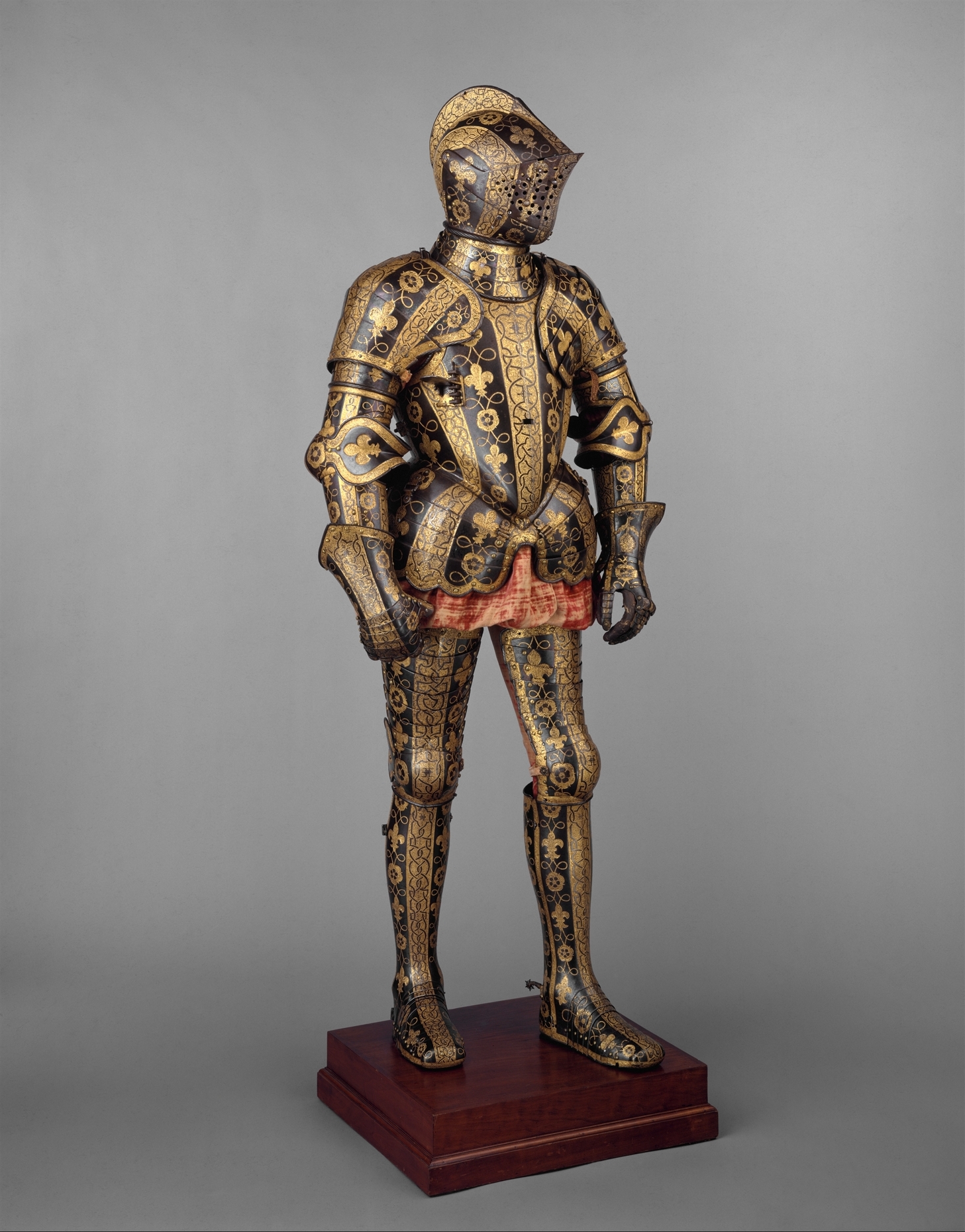
The garniture as mounted for display. Steel, blued, etched and gilt, 1586. Metropolitan Museum of Art, 32.130.6a-y; 36.98.1.
| Artist | Jacob Halder, Master Workman of the Royal Almain Armoury at Greenwich |
|---|---|
| Date | 1586 |
| Medium | Steel, blued (russeted) and etched, with gilt decoration; gold; leather straps and lining; textile |
| Dimensions | Overall height as mounted 176.5 cm (69.5 in); weight approximately 27.2 kg (60 lb) |
| Where it is now | Metropolitan Museum of Art, New York, Department of Arms and Armor, Gallery 371last confirmed |
| Inventory number | 32.130.6a-y (main garniture, acquired 1932); companion accession 36.98.1, a terminal lame of the grand guard, acquired separately via the Rogers Fund in 1936 and now catalogued and displayed with the main garniture |
| Attribution | AcceptedMade under Halder's direction at the royal Almain Armoury at Greenwich and dated 1586 by the Metropolitan Museum. Full note |
| Object type | Arms and armour |
| Period | English, Elizabethan, 16th century |
| Cases | Has a provenance gap |
| Inscriptions | No armorer's mark or signature on the armor itself. The corresponding workshop design drawing, in the Almain Armourer's Album at the Victoria and Albert Museum, is inscribed with Clifford's name and rank. |
| Owners on record | 7 links5 documented, 2 unknown |
| Sources | 16 cited |
About this record Last verified · 16 sources cited · Change log
On this page 10 sections
ContentsClose
A field-and-tournament garniture made in 1586 at the royal workshops at Greenwich for George Clifford, third Earl of Cumberland, a courtier who became Queen Elizabeth I's official Champion of the Accession Day tilts in 1590. It is decorated overall with Tudor roses, fleur-de-lis and the Queen's own cipher worked into love-knots, a program of loyalty rather than heraldry, and it survives more complete than almost any other product of the Greenwich armoury.
The garniture descended through Clifford's daughter, the diarist Lady Anne Clifford, into the Tufton family, Earls of Thanet and later Barons Hothfield, who held it at Appleby Castle in Westmorland into the twentieth century. It passed at an unrecorded date into the collection of the American financier Clarence Mackay, and the Metropolitan Museum bought it from the Munsey Fund in 1932. A companion piece, the terminal lame of the garniture's grand guard, followed in 1936 under a separate accession number.
This is a different object from the Museum's other Greenwich garniture, accession 19.131.1, probably made for Henry VIII around 1527: different owner, different reign, different decade of the Greenwich workshop's history, and a different, firmer chain of attribution.
Provenance
Each link is graded. Documented: a cited source supports it. Disputed: the identification is argued but not established. Unknown: no owner for that span, and the gap is not smoothed into a narrative. The grades in the glossary.
- 1586 - 1605George Clifford, Third Earl of Cumberlanddocumented
Made to Clifford's commission at the royal Almain Armoury, Greenwich, under Jacob Halder; used by Clifford during his years as a court jouster and, from 1590, as Queen Elizabeth I's Champion of the Accession Day tilts.157
- 1605 - 1676Lady Anne Clifford, later Countess of Dorset, Pembroke and Montgomerydocumented
Clifford's only surviving child. His will left his northern estates to his brother, but the armor itself is recorded in family papers as passing to Anne, who is stated to have kept and later bequeathed it.5
- 1676 -Anne Clifford's two daughtersdocumented
Anne Clifford's own family record states that she bequeathed the armor to her two daughters. Which daughter received which pieces, and how the garniture was later reunited, is not stated in the sources consulted.5
- - 1885Unknown, then the Tufton family, Earls of Thanet and Barons Hothfieldunknown
Anne Clifford's daughter Margaret married into the Tufton family, later Earls of Thanet, who inherited the Clifford barony through her and held Appleby Castle in Westmorland. No source consulted documents the armor's specific custody across this roughly two-century span; by 1885 it is recorded in print as being at Appleby Castle in the possession of Lord Hothfield.
- 1885 -Lord Hothfield, Appleby Castle, Westmorlanddocumented
Recorded in print in 1885 as the property of Lord Hothfield at Appleby Castle.5
- - 1932Clarence Hungerford Mackay, Harbor Hill, Roslyn, New Yorkunknown
The armor entered Mackay's collection, at the time the most valuable privately held collection of Renaissance arms and armor in North America, at an unrecorded date and by an unrecorded mechanism. No dealer, agent, date or price for the transfer from Hothfield was found in the sources consulted.
- 1932 - presentMetropolitan Museum of Art, New Yorkdocumented
Purchased from Clarence Mackay in 1932 using the Munsey Fund, established from publisher Frank A. Munsey's 1925 bequest to the Museum. The terminal lame of the grand guard, accession 36.98.1, followed separately via the Rogers Fund in 1936. Purchase price not published in the sources consulted.12
Technical evidence
| Attribution note | Made under Halder's direction at the royal Almain Armoury at Greenwich and dated 1586 by the Metropolitan Museum. The attribution rests on the surviving Greenwich workshop practice of the period: Halder personally annotated two of his own designs in the workshop's own record book with the words 'These peces were made by me Jacobe,' and the corresponding design for this exact garniture, made for George Clifford, survives in that same album. No armorer's mark of the kind used on Continental armor was applied at Greenwich; identification of Greenwich work rests on this album, on the distinctive house style, and on family or antiquarian tradition tying a surviving armor to a named owner. |
|---|---|
| Materials | Steel throughout, blued (russeted) and worked with etched decoration under fire-gilding; gold; leather arming straps and linings; textile.12 |
| Dimensions and weight | 176.5 cm (69.5 in) overall as mounted on its stand; approximately 27.2 kg (60 lb).2 |
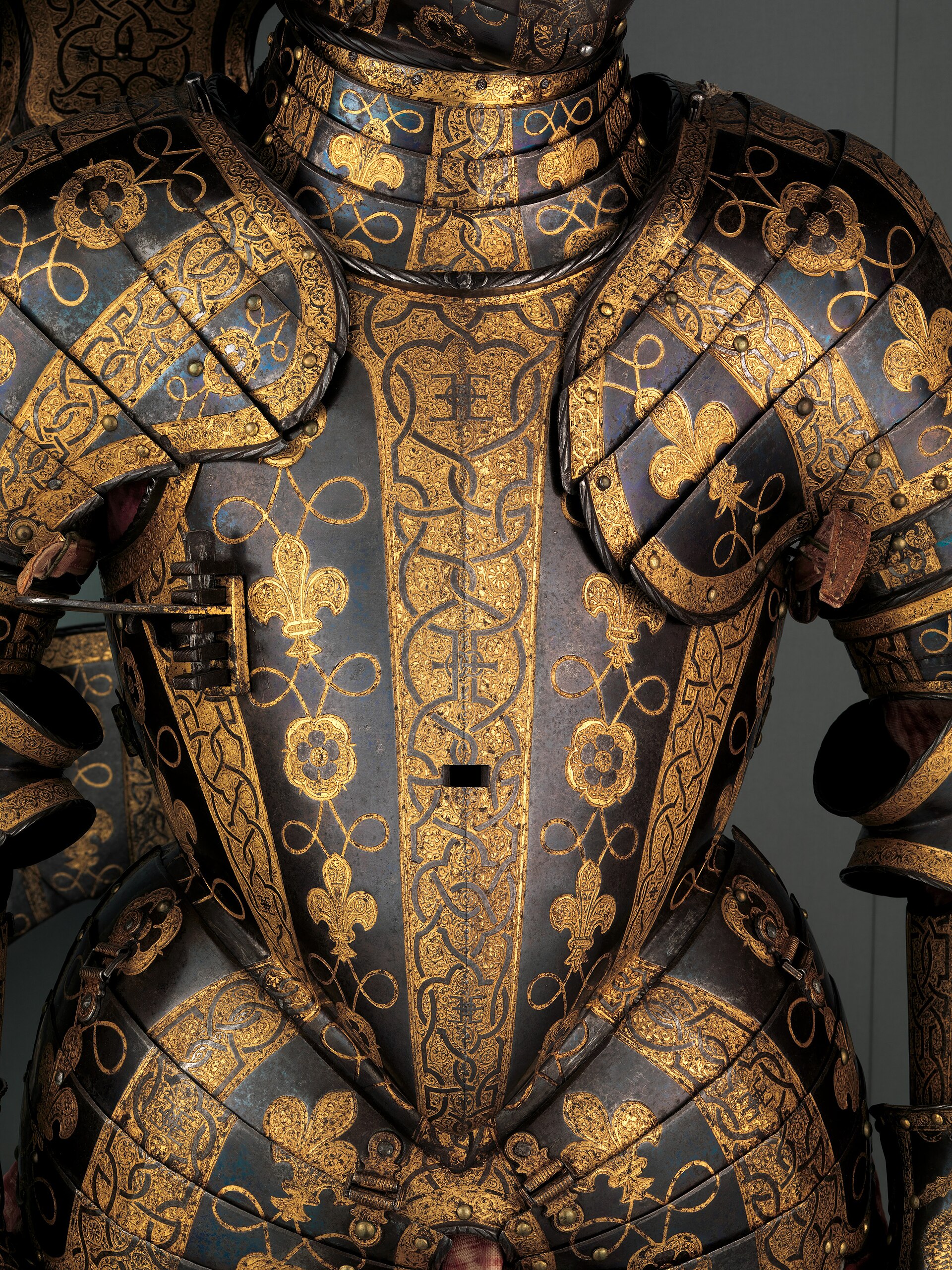
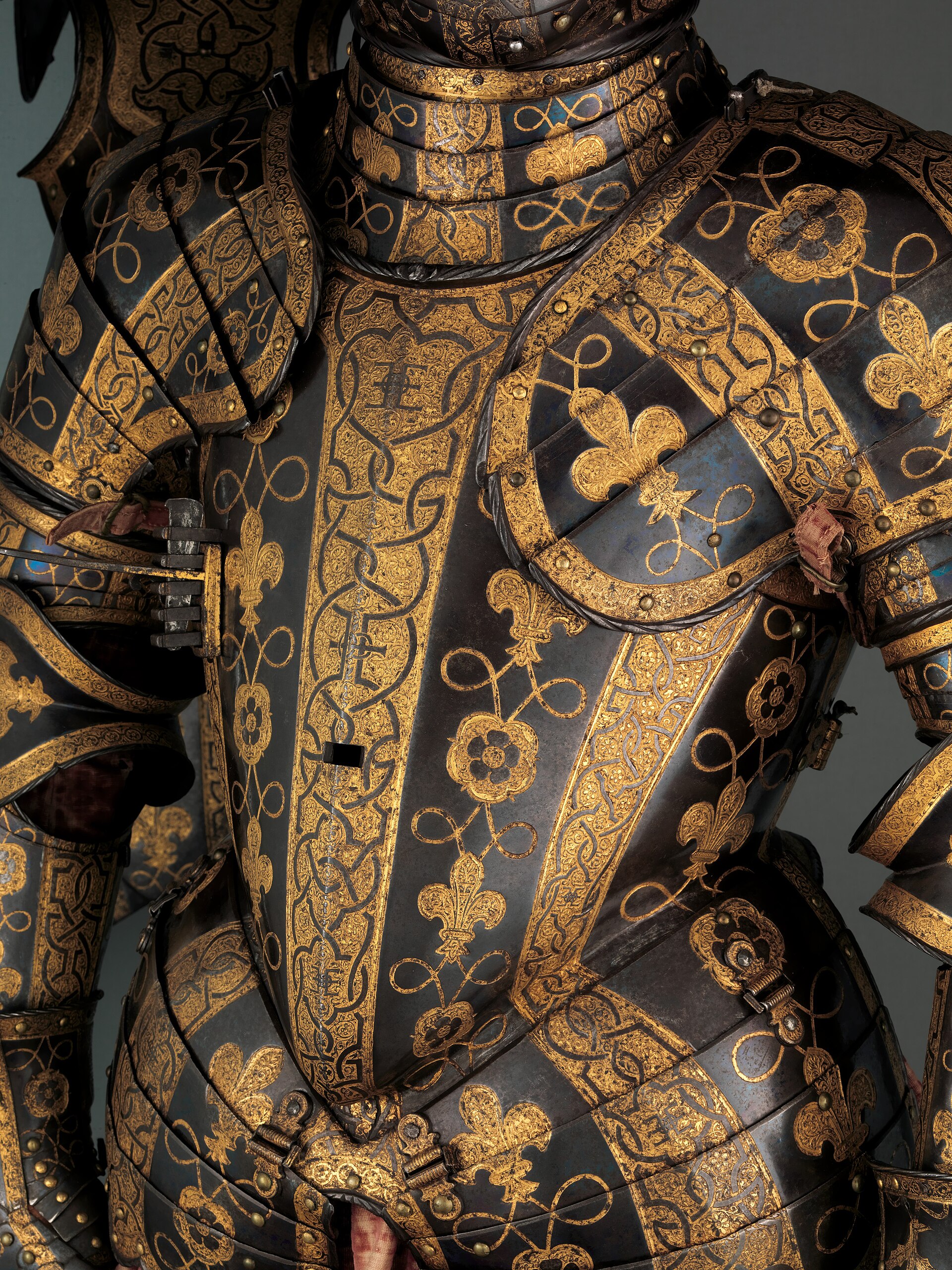
| Decoration technique | Broad bands of blued ground cut with etched scrollwork, fleur-de-lis, Tudor roses and love-knots, and fire-gilded so the dark steel and the gold contrast at a distance; the Queen's cipher, two E's back to back within a heart, is set at the center of the breastplate.13 |
| Garniture components | Close helmet, gorget, cuirass and tassets, full arm defenses and gauntlets, and leg armor to the sabatons, together with tilting exchange pieces including a grand guard, a manifer and a locking gauntlet.1 |
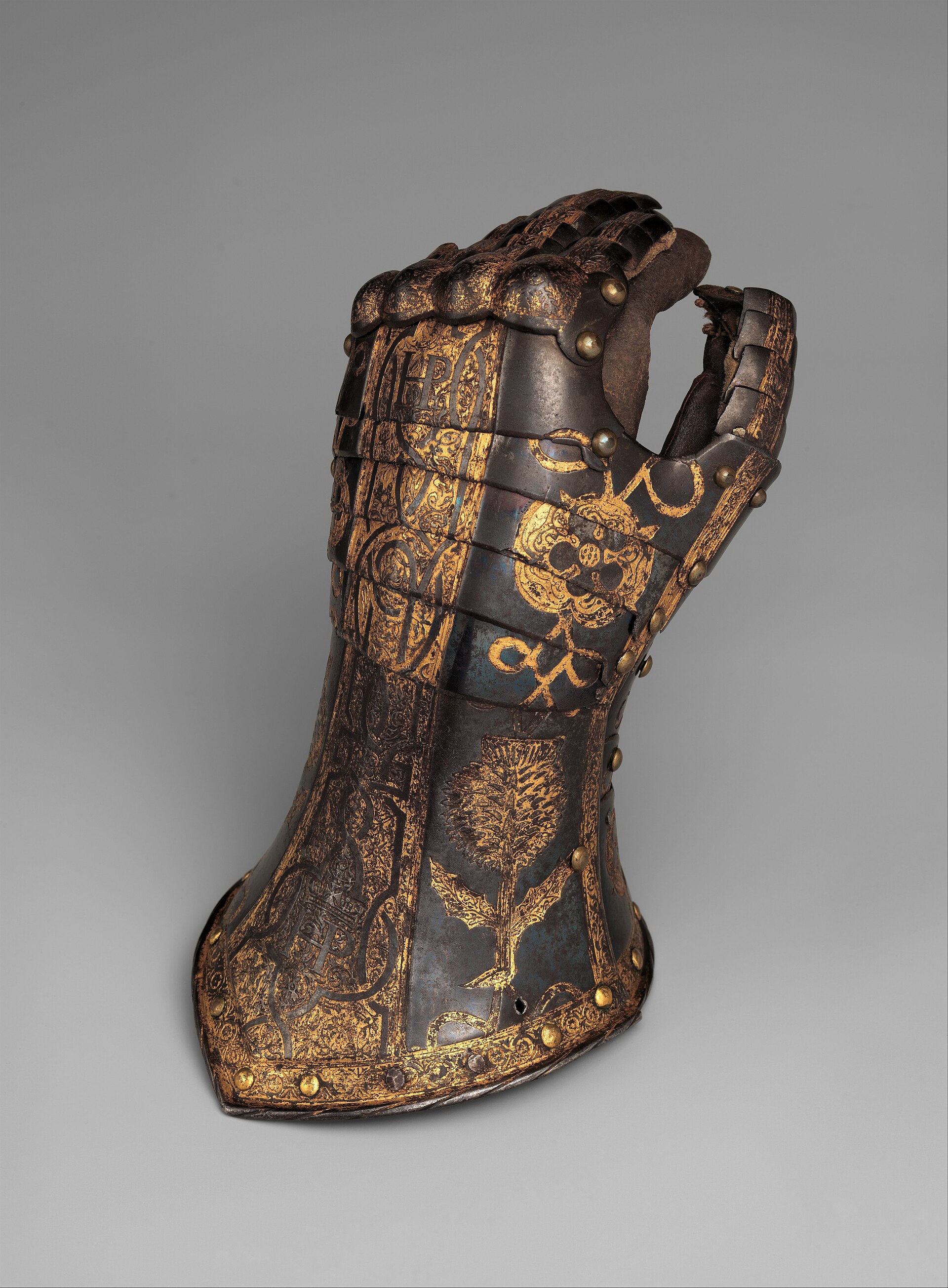
| The left gauntlet | Not original to the 1586 commission. It is from a different, closely similar Greenwich suit made roughly two decades later, and was substituted for the original left gauntlet at an unrecorded date.6 |
| Companion accession 36.98.1 | Terminal lame of the grand guard, the lowest articulated plate of the tilting shoulder defense, acquired separately from the main garniture via the Rogers Fund in 1936 and displayed as part of the same object.4 |
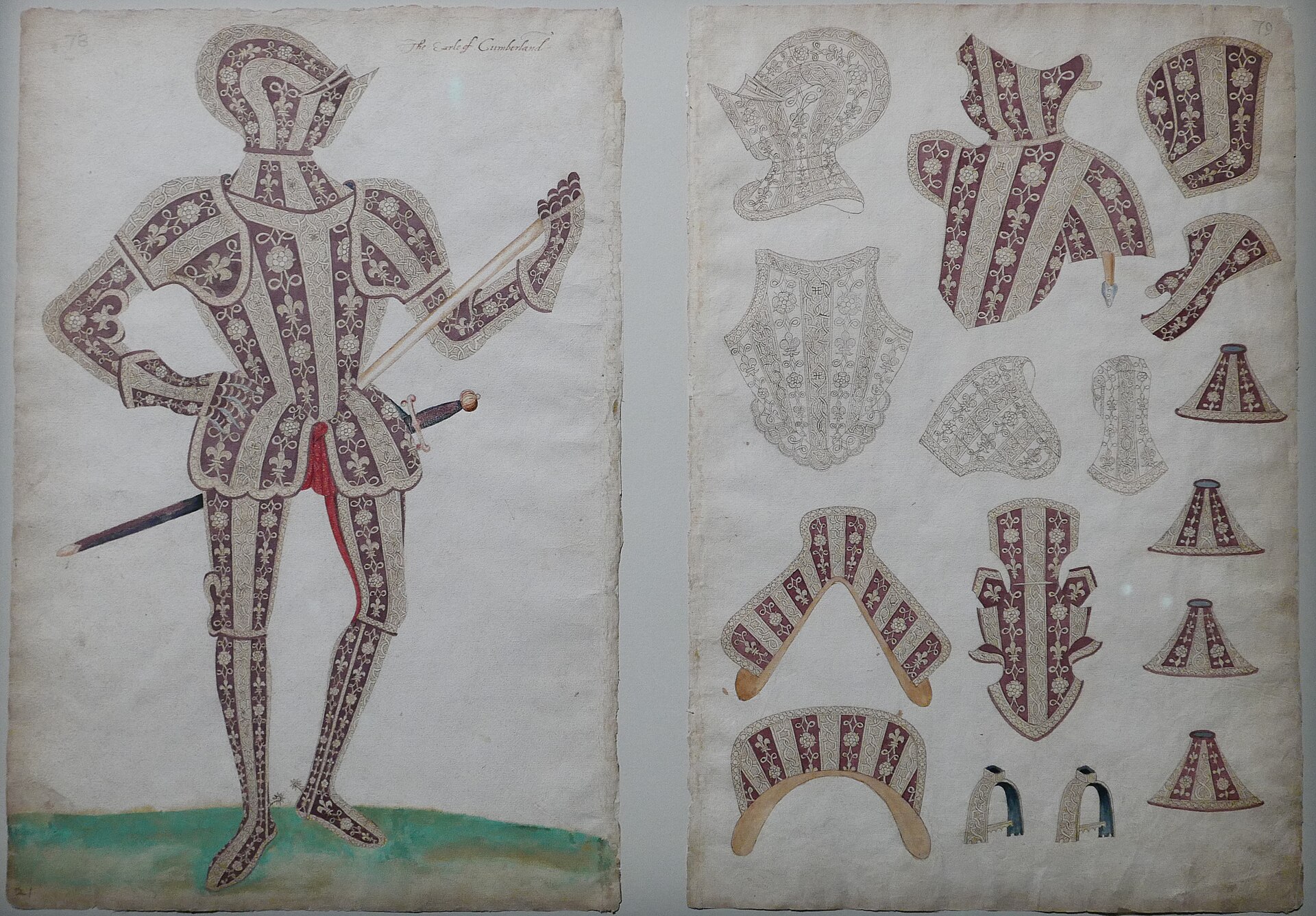
| The workshop design drawing | A double-page design for this exact garniture survives in the Almain Armourer's Album, Victoria and Albert Museum, museum number D.605&A-1894: the base harness on one leaf, the exchange and reinforcing pieces on the facing leaf, in the same decorative scheme of roses, fleur-de-lis and love-knots as the surviving steel.79 |
| Attribution basis | No armorer's mark appears on the steel. Attribution to Halder's Greenwich workshop and to 1586 rests on the surviving album drawing naming Clifford, on Halder's documented mastership of the armoury in that decade, and on the house decorative style, rather than on a signature on the object itself.17 |
Images
The record in full
Chapter 1What survives
The garniture as it stands today comprises a close helmet, gorget, cuirass with tassets, a full pair of arm defenses and gauntlets, and leg armor to the sabatons, together with the exchange and...
The garniture as it stands today comprises a close helmet, gorget, cuirass with tassets, a full pair of arm defenses and gauntlets, and leg armor to the sabatons, together with the exchange and reinforcing pieces that turned a field harness into a tilting harness: a grand guard for the left shoulder and chest, a manifer for the left hand, and a locking gauntlet. It is, by the Museum's own account and by comparison with what has come down from the same workshop, the most complete and best preserved of the surviving Greenwich garnitures.
Every visible steel surface is worked to the same program: broad bands of blued, or russeted, ground cut with etched scrollwork and picked out in fire-gilding, so that the dark steel and the gold read against each other at a distance, which is what a tournament armor was for. It was made to be seen from a gallery, not examined in a case, and the decoration is scaled for that.
Chapter 2How a garniture worked
A garniture is not a single suit of armor but a matched kit of exchangeable parts built around one core harness, so that a single decorative scheme could be reconfigured for the tilt, the tourney...
A garniture is not a single suit of armor but a matched kit of exchangeable parts built around one core harness, so that a single decorative scheme could be reconfigured for the tilt, the tourney (fighting on foot or on horseback with blunted weapons across a barrier), and the field. Greenwich under Halder specialized in exactly this kind of complex, expensive commission, and the Almain Armourer's Album records each patron's garniture as two facing pages: the base harness on one, the full spread of alternate and reinforcing pieces on the other.
This is why the Metropolitan's holding is split across two accession numbers. The bulk of the garniture entered the Museum in 1932; a further piece, the terminal lame of the grand guard, was acquired separately from a different source four years later and folded into the same object record. The two numbers describe one physical commission, not two different objects.
Chapter 3The decoration and what it declares
The scheme is not generic Tudor ornament.
The scheme is not generic Tudor ornament. It combines the Tudor rose and the French fleur-de-lis, then still quartered into the English royal arms, with the Queen's own cipher: two capital E's placed back to back and bound inside a heart at the center of the breastplate, the whole repeated across the harness inside a chain of love-knots. Read together, the motifs are a wearable declaration of loyalty to Elizabeth personally, not a general statement of rank or wealth, and they were legible as such to everyone watching a tilt who could read a badge or an impresa, which was the entire point of Accession Day pageantry.
This kind of decoration belongs to a documented and quite literal courtly practice, not a private or hidden meaning: wearing the sovereign's cipher and colors into the tiltyard was a public, understood act of political theater, performed in front of the court and, from the 1580s onward, in front of a paying public audience as well.
Chapter 4George Clifford and the Accession Day tilts
George Clifford, third Earl of Cumberland, inherited large northern estates in Westmorland and Yorkshire and became, by his own account and his contemporaries', an outstanding jouster at court.
George Clifford, third Earl of Cumberland, inherited large northern estates in Westmorland and Yorkshire and became, by his own account and his contemporaries', an outstanding jouster at court. The Accession Day tilts, held every 17 November to mark the anniversary of Elizabeth's accession, had grown by the 1580s from an informal courtly custom into the single largest fixed event of the court calendar, run by a Queen's Champion who organized the day and rode in it himself.
Sir Henry Lee of Ditchley held that office and effectively invented its modern form; he stood down at the 1590 tilt and Clifford succeeded him as the Queen's second Champion. The armor itself is dated 1586, four years before that formal succession, which means it was made for Clifford's existing career as a court jouster rather than commissioned for the ceremony of taking the office, and continued in use once he held it.
Chapter 5The evidence that he wore it
The clearest link between this specific armor and Clifford's own person is not documentary but visual: a large portrait miniature of Clifford by Nicholas Hilliard, now in the National Maritime...
The clearest link between this specific armor and Clifford's own person is not documentary but visual: a large portrait miniature of Clifford by Nicholas Hilliard, now in the National Maritime Museum, Greenwich (inventory MNT0193), painted around 1590 at the point of his appointment as Champion. It shows him in full tilting armor, in blued steel with gilded decoration, with the Queen's glove pinned to his hat as her favor, a story recorded of Clifford specifically: he retrieved a glove she had dropped and wore it from then on as a badge.
Cataloguers of the miniature and of the armor both read the harness in the portrait as this garniture, on the basis of the matching decoration rather than a documentary caption naming the object. That is a reasonable identification for a portrait of this quality and specificity, but it is connoisseurship, not a receipt, and this record treats it as such rather than as settled documentary proof that Clifford is shown in this exact suit on this exact occasion.
Chapter 6The cost of tilting
Clifford's own later biographer, using family papers kept by his daughter, records that his passion for horse racing, tilting and wagering was a direct and named cause of the decline of his estate.
Clifford's own later biographer, using family papers kept by his daughter, records that his passion for horse racing, tilting and wagering was a direct and named cause of the decline of his estate. A commission of this scale and quality, from the Crown's own armoury and finished in gold, sat inside a broader pattern of spending on tournament display, horses and stakes that his contemporaries and his own family explicitly blamed for his debts. He turned to privateering in part to cover the shortfall, with mixed results: a major prize taken in 1589 in partnership with the Queen was lost in a storm before it could be landed, and by 1591 he still owed the then very large sum of 6,800 pounds and was selling land to pay it.
He was also a founding name on the Crown's own charter: the royal charter of 31 December 1600 that incorporated the East India Company names George Clifford, Earl of Cumberland, first among the company's 215 founding members, and he sold the company his own ship, the Malice Scourge, which sailed as the Red Dragon on the Company's first voyage to the East Indies in 1601.
Chapter 7The design survives too
Halder kept, or had kept, a record of the armoury's major commissions in what is now called the Almain Armourer's Album, a set of pen, ink and watercolor designs compiled between about 1557 and 1587...
Halder kept, or had kept, a record of the armoury's major commissions in what is now called the Almain Armourer's Album, a set of pen, ink and watercolor designs compiled between about 1557 and 1587 and now in the Victoria and Albert Museum (museum number D.605&A-1894 for the Clifford design specifically). Clifford's page shows the full base harness on one leaf and the exchange pieces on the facing leaf, painted in the same decorative scheme of roses, fleur-de-lis and love-knots that appears on the surviving steel.
This is the strongest form of evidence Greenwich armor scholarship has: not a stylistic argument from decoration alone, but a workshop record naming the patron and showing the design, which can then be checked directly against a surviving object. Very few Elizabethan armors can be tied to their own commission drawing this closely, and this garniture is one of them.
Chapter 8A documented later substitution
The Museum's own account of the garniture notes that not every piece now displayed with it is original to the 1586 commission: the left gauntlet is not a match.
The Museum's own account of the garniture notes that not every piece now displayed with it is original to the 1586 commission: the left gauntlet is not a match. It comes from a different, closely similar Greenwich suit made a couple of decades later than the rest of the harness, and was at some point substituted for whatever the original left gauntlet had been, which is now lost or unidentified.
What is not established in the sources available to this record is when that substitution happened, who made it, or whether it happened before or after the garniture left the Clifford-Tufton family's hands. It is a genuine, acknowledged departure from the 1586 original, not a rumor, and it is recorded here as exactly that: a documented mismatch with an undocumented history.
Chapter 9From Clifford to Appleby Castle
Clifford died in October 1605, reconciled to his estranged wife Margaret Russell only shortly before the end, and was buried at Skipton.
Clifford died in October 1605, reconciled to his estranged wife Margaret Russell only shortly before the end, and was buried at Skipton. His only surviving child, Anne Clifford, later Countess of Dorset, Pembroke and Montgomery, spent much of her long life establishing her right to the Clifford inheritance against her father's will, which had left the northern estates to his brother; she eventually secured them. Her own family's account of the armor states plainly that it passed to her and that she in turn bequeathed it to her two daughters.
From there the documented record thins. Anne Clifford's daughter Margaret married John Tufton, later second Earl of Thanet, and their descendants, who inherited the Clifford barony itself through Anne, held Appleby Castle in Westmorland into the twentieth century, latterly as Barons Hothfield. By 1885 the armor is recorded in print as being at Appleby Castle in the possession of Lord Hothfield. Exactly how it moved within the family, and whether it stayed at Appleby continuously across roughly three centuries or left and returned, is not established in the sources consulted for this record.
Chapter 10Into the American market
At an unrecorded date the armor left the Hothfield family's hands and entered the collection of Clarence Hungerford Mackay, the American telecommunications magnate, who assembled what was, in its...
At an unrecorded date the armor left the Hothfield family's hands and entered the collection of Clarence Hungerford Mackay, the American telecommunications magnate, who assembled what was, in its day, the most valuable privately held collection of Renaissance arms and armor in North America at Harbor Hill, his estate at Roslyn on Long Island. No source consulted for this record gives a date, a dealer, an agent or a price for the transfer from Hothfield to Mackay; it is recorded here as a documented change of ownership with an undocumented mechanism, not bridged by a guess.
Mackay's fortunes declined sharply after 1929, and he sold works from his collections through the early 1930s. The Metropolitan Museum acquired the Cumberland garniture from him in 1932, using the Munsey Fund, a purchase fund created from the 1925 bequest of the newspaper and magazine publisher Frank A. Munsey, one of the largest single gifts the Museum had received to that date. The purchase price is not published in the sources consulted for this record.
Chapter 11A second accession, four years later
In 1936 the Museum acquired, through the Rogers Fund, a single further element: the terminal lame of the garniture's grand guard, the lowest articulated plate of the large reinforcing...
In 1936 the Museum acquired, through the Rogers Fund, a single further element: the terminal lame of the garniture's grand guard, the lowest articulated plate of the large reinforcing shoulder-and-chest defense used for tilting. It carries its own accession number, 36.98.1, distinct from the 1932 purchase, which means the garniture as it is now shown was assembled by the Museum from two separate acquisitions made across two different funds and four years apart, not received complete in a single transaction.
This is worth stating plainly because it is exactly the kind of detail that a caption naming a single accession number obscures. The object on view is the sum of two purchases; the object record correctly carries both numbers, and this record does the same.
Chapter 12Rarity: what else survives from the same workshop
The Almain Armourer's Album records twenty-nine separate Greenwich commissions from Halder's years as master; most of the armors it depicts have not survived complete, and several are known only from...
The Almain Armourer's Album records twenty-nine separate Greenwich commissions from Halder's years as master; most of the armors it depicts have not survived complete, and several are known only from the drawing. Among the small number of complete or substantially complete Greenwich garnitures that do survive, the Metropolitan holds this one along with the armors of Sir James Scudamore and of Henry Herbert, second Earl of Pembroke; the Royal Armouries holds armors associated with Robert Dudley, Earl of Leicester, William Somerset, third Earl of Worcester, and William Herbert, at the Tower of London and at Leeds, the latter also holding Sir Christopher Hatton's armor; and the Wallace Collection in London holds an armor associated with Thomas Sackville.
Set against that list, a Greenwich garniture surviving as complete as Clifford's, with its own workshop drawing also surviving and identifiable, is unusual rather than typical. Most Elizabethan tournament armor of this rank has come down either broken up, incomplete, or known only through the album's record of a commission that no longer exists as an object.
Chapter 13Not the Henry VIII garniture
The Metropolitan Museum holds a second Greenwich garniture, accession 19.131.1, dated 1527 and catalogued as probably made for Henry VIII, decades before Halder's mastership and for an entirely...
The Metropolitan Museum holds a second Greenwich garniture, accession 19.131.1, dated 1527 and catalogued as probably made for Henry VIII, decades before Halder's mastership and for an entirely different royal owner. The two objects share a workshop and a city, and nothing else: different reign, different decade of the armoury's output, different decorative program, and a different, weaker chain of attribution, since the Henry VIII garniture's ownership was disputed in print for most of the twentieth century, having been catalogued for years as the armor of the French Grand Master of Artillery Galiot de Genouilhac before the Museum revised the attribution. Clifford's garniture carries no comparable dispute: the patron, the maker, and the date are agreed, and the surviving Halder drawing names the sitter directly.
The artist
Jacob Halder, Master Workman of the Royal Almain Armoury at Greenwich
Halder was not the sole maker of any Greenwich armor in the way a painter makes a picture; he ran a royal workshop of specialist armorers, etchers and gilders, and the surviving evidence names him as the master who designed and directed the commission rather than as the person who forged every plate. That is the correct frame for an attribution to Halder, and this record treats it that way.
Exhibited
- 1932-presentOn permanent view, Department of Arms and ArmorMetropolitan Museum of Art, New York, Gallery 371
Related works
| Work | Relation | Where it is |
|---|---|---|
| Terminal Lame of a Grand Guard from the Armor Garniture of George Clifford Jacob Halder, Royal Almain Armoury, Greenwich | Physical part of this same garniture, acquired separately Acquired via the Rogers Fund in 1936, four years after the main purchase, and displayed as part of the same object. | Metropolitan Museum of Art, New York, accession 36.98.1 |
| Armor Garniture, Probably of King Henry VIII of England Royal Almain Armoury, Greenwich | Not related. A different, earlier Greenwich garniture in the same Museum department, made decades before Halder's mastership Dated 1527. Its ownership was long disputed in print under the name of the French official Galiot de Genouilhac before the Museum's current attribution; the Clifford garniture carries no comparable dispute. | Metropolitan Museum of Art, New York, accession 19.131.1 |
| Armor of Sir James Scudamore Jacob Halder, Royal Almain Armoury, Greenwich | Comparable Halder-workshop garniture, contrasting condition history Made about 1595-96. Found badly damaged and incomplete at the Scudamore family seat of Holme Lacy in 1909, and restored and completed at the Metropolitan Museum in 1915 by the armorer Daniel Tachaux, whose replacement work was judged by contemporaries to match Halder's own standard closely. Where the Cumberland armor's later alteration is a single mismatched gauntlet, the Scudamore armor is a documented twentieth-century reconstruction. | Metropolitan Museum of Art, New York, accession 11.128.2 |
| The Almain Armourer's Album, design for George Clifford's garniture Jacob Halder | The surviving workshop design drawing for this exact object Double-page pen, ink and watercolor design showing the base harness and the exchange pieces in the same decorative scheme as the surviving steel. | Victoria and Albert Museum, London, museum number D.605&A-1894 |
| Portrait miniature of George Clifford, Third Earl of Cumberland Nicholas Hilliard | Contemporary portrait of the sitter in tilting armor read by cataloguers as this garniture Painted around 1590, at the time of Clifford's appointment as Queen's Champion; shows the Queen's glove pinned to his hat as her favor. The identification of the armor shown with this specific surviving object rests on matching decoration, not a documentary caption. | National Maritime Museum, Greenwich, inventory MNT0193 |
Open questions
- How and when did the armor pass from the Hothfield family at Appleby Castle into Clarence Mackay's collection? No source consulted names a date, a dealer, an agent or a price for this transfer.
- What price did the Metropolitan Museum pay Mackay in 1932? Not published in the sources consulted.
- When, by whom, and under what circumstances was the left gauntlet from a later Greenwich suit substituted for the original? The mismatch is documented; its history is not.
- Exactly how did the armor move within the Tufton/Thanet family between Anne Clifford's bequest to her two daughters in the late seventeenth century and its documented presence at Appleby Castle by 1885? The chain across roughly two centuries is not established in the sources consulted.
- Is there documented evidence, beyond the mismatched gauntlet, of decorative rework, re-etching or re-gilding at any point in the object's history? The sources consulted for this record establish the gauntlet substitution but do not document a broader nineteenth-century reworking of the decoration; that absence is recorded here rather than assumed to mean none occurred.
- Was this garniture worn at any specific, individually documented Accession Day tilt, as against the general and visual case made by the Hilliard portrait? A dated eyewitness or account-book record naming this armor at a named tilt was not found.
Questions about this object
What is Armor Garniture of George Clifford, Third Earl of Cumberland?
Armor Garniture of George Clifford, Third Earl of Cumberland is an arms and armour, dated 1586. Medium: Steel, blued (russeted) and etched, with gilt decoration; gold; leather straps and lining; textile.
Who made Armor Garniture of George Clifford, Third Earl of Cumberland, and is the attribution settled?
The attribution to Jacob Halder, Master Workman of the Royal Almain Armoury at Greenwich is recorded here as accepted. Made under Halder's direction at the royal Almain Armoury at Greenwich and dated 1586 by the Metropolitan Museum. The attribution rests on the surviving Greenwich workshop practice of the period: Halder personally annotated two of his own designs in the workshop's own record book with the words 'These peces were made by me Jacobe,' and the corresponding design for this exact garniture, made for George Clifford, survives in that same album. No armorer's mark of the kind used on Continental armor was applied at Greenwich; identification of Greenwich work rests on this album, on the distinctive house style, and on family or antiquarian tradition tying a surviving armor to a named owner.
Where is Armor Garniture of George Clifford, Third Earl of Cumberland now?
Metropolitan Museum of Art, New York, Department of Arms and Armor, Gallery 371. Inventory number 32.130.6a-y (main garniture, acquired 1932); companion accession 36.98.1, a terminal lame of the grand guard, acquired separately via the Rogers Fund in 1936 and now catalogued and displayed with the main garniture. Last confirmed 27 August 2026. Purchased by the Metropolitan Museum of Art in 1932 through the Munsey Fund, established from the 1925 bequest of the publisher Frank A. Munsey to the museum.
What is still unknown about Armor Garniture of George Clifford, Third Earl of Cumberland?
How and when did the armor pass from the Hothfield family at Appleby Castle into Clarence Mackay's collection? No source consulted names a date, a dealer, an agent or a price for this transfer.
Sources
- 1The Metropolitan Museum of Art, collection record for 'Armor Garniture of George Clifford (1558-1605), Third Earl of Cumberland,' accession 32.130.6a-y (object 23939). metmuseum.org/art/...
- 2The Metropolitan Museum of Art, Collection API, object record 23939 (public domain status, dimensions, credit line, gallery location). collectionapi.metmuseum.org/public/...
- 3The Metropolitan Museum of Art, Heilbrunn Timeline of Art History, entry on the Cumberland armor. metmuseum.org/toah/...
- 4The Metropolitan Museum of Art, collection record for 'Terminal Lame of a Grand Guard from the Armor Garniture of George Clifford,' accession 36.98.1 (object 24612). metmuseum.org/art/...
- 5Williamson, George C., 'George, Third Earl of Cumberland (1558-1605): His Life and His Voyages, A Study from Original Documents' (1920), for the descent of the armor to Anne Clifford and her bequest to her two daughters, and for Clifford's debts, marriage, and death. archive.org/stream/...
- 6The Metropolitan Museum of Art, MetKids, 'Armor of George Clifford, Third Earl of Cumberland,' for the mismatched left gauntlet. archived.metmuseum.org/art/...
- 7Victoria and Albert Museum, 'The Almain Armourers' Album,' for Halder's career, the album's compilation, contents and acquisition, and the Clifford design specifically. vam.ac.uk/articles/...
- 8Victoria and Albert Museum collections record, 'The Almain Armourer's Album,' museum number D.586&A-1894 (Earl of Rutland design, for album format, dimensions and acquisition history), cross-referenced with the Clifford design D.605&A-1894. collections.vam.ac.uk/item/...
- 9Wikimedia Commons, File:Al_Thani_Renaissance046.jpg, photograph of the Halder design for Clifford's garniture, Victoria and Albert Museum D.605&A-1894, taken at the exhibition 'Le Gout de la Renaissance,' Hotel de la Marine, Paris, 2024. commons.wikimedia.org/wiki/...
- 10Wikimedia Commons, File:Armor Garniture of George Clifford (1558-1605), Third Earl of Cumberland MET DP295743.jpg, for license (CC0) and credit. commons.wikimedia.org/wiki/...
- 11The Nelson-Atkins Museum of Art, Starr Collection of Portrait Miniatures, catalogue entry for Nicholas Hilliard's portrait of George Clifford. nelson-atkins.org/starr/...
- 12Wikipedia, 'George Clifford, 3rd Earl of Cumberland.' source, with a scholarly biography or the Oxford Dictionary of National Biography entry. en.wikipedia.org/wiki/...
- 13Wikipedia, 'Accession Day tilt.' source, with Frances Yates's or Roy Strong's scholarship on the tilts. en.wikipedia.org/wiki/...
- 14Wikipedia, 'Greenwich armour,' for the count and locations of surviving complete Greenwich garnitures. en.wikipedia.org/wiki/...
- 15Internet Archive, full text of 'The Armor of Sir James Scudamore' (Metropolitan Museum of Art Bulletin), for the comparanda case of the Scudamore garniture's 1909 discovery and 1915 restoration by Daniel Tachaux. archive.org/stream/...
- 16Wikidata, item Q116726649, 'Armor Garniture of George Clifford (1558-1605), Third Earl of Cumberland,' for cross-referenced inventory numbers and Museum object ID. wikidata.org/wiki/...

,_Third_Earl_of_Cumberland_MET_DP295743.jpg)
Last verified · Published
Change log
27 August 2026 - Record created at the house standard: researched narrative, technical evidence, maker dossier, graded provenance chain, prices with hammer and premium separated, related works, open questions and sources.