Cup, known as the Rospigliosi Cup
Unrecorded nineteenth-century goldsmith; formerly Benvenuto Cellini, then Jacopo Bilivert, then Reinhold Vasters · Nineteenth century. Metropolitan Museum: probably ca. 1840-50, or somewhat earlier. Hackenbroch 1984-85: ca. 1870-90
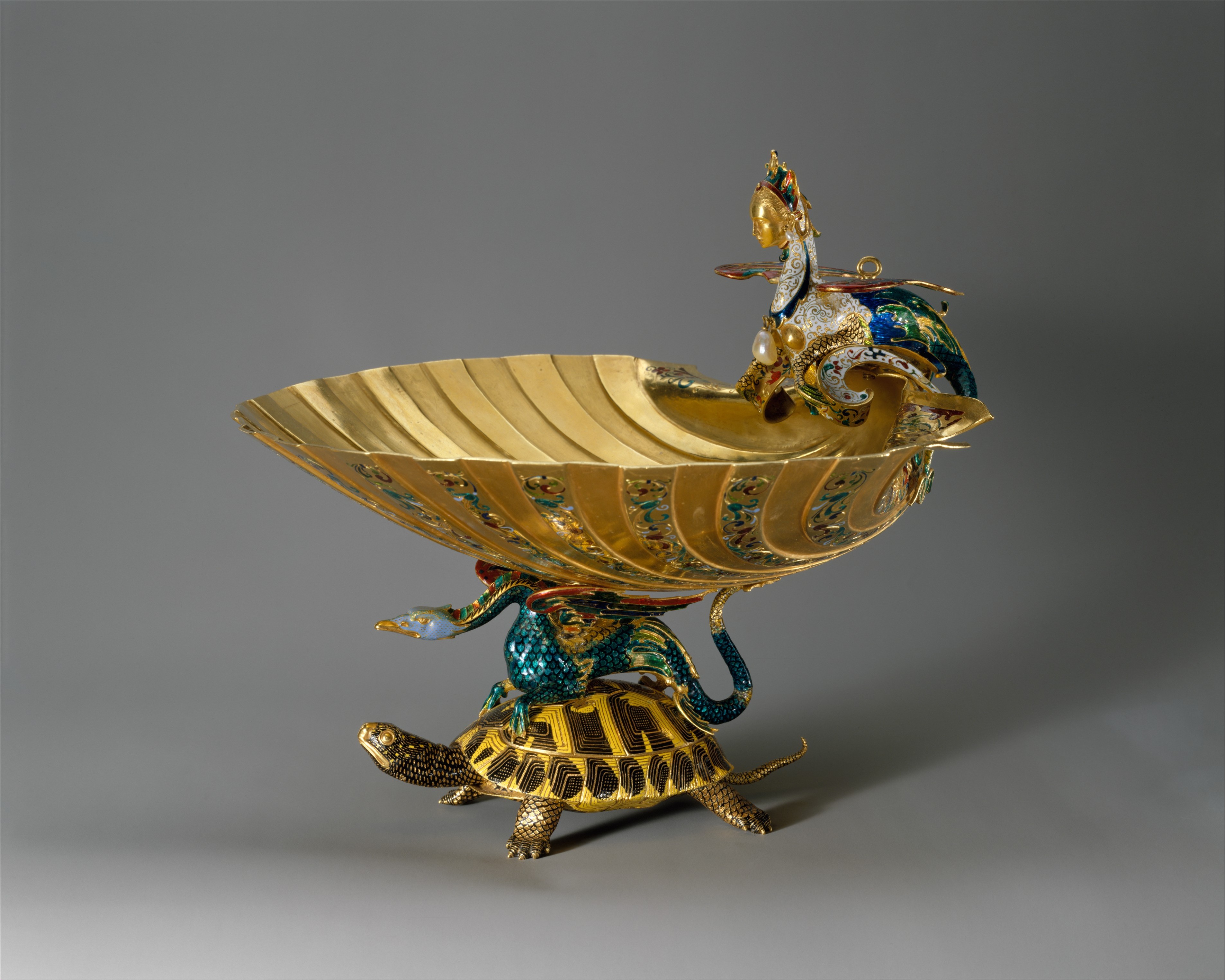
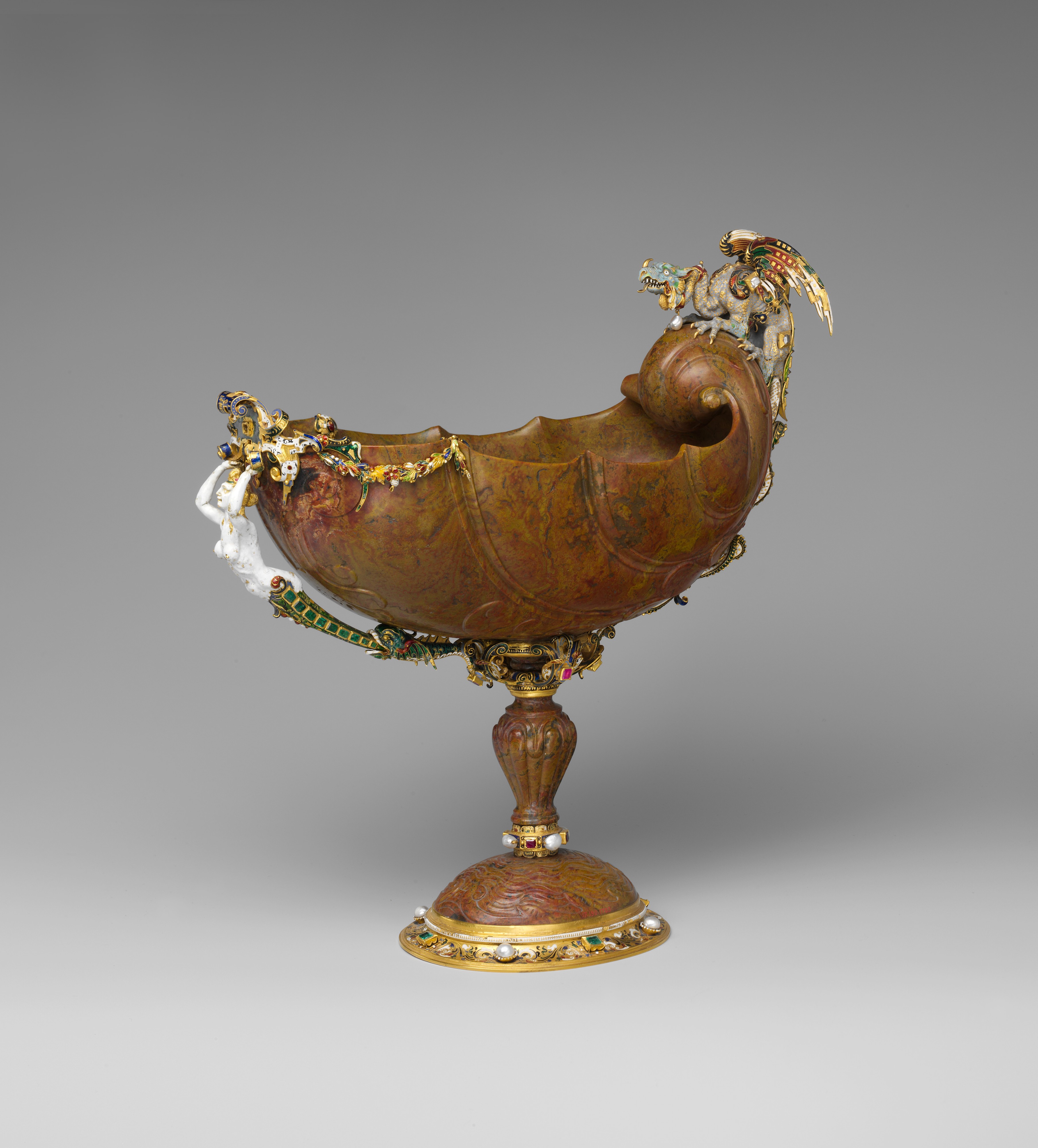
The record subject. Enamelled gold with pearls, 19.7 x 21.6 x 22.9 cm. The conch shell rests on a winged dragon standing on a tortoise; the winged sea-sphinx is the handle. The ring between her wings, which reads as a fitting for a security chain, is the head of the pin that holds the object together.
| Artist | Unrecorded nineteenth-century goldsmith; formerly Benvenuto Cellini, then Jacopo Bilivert, then Reinhold Vasters |
|---|---|
| Date | Nineteenth century. Metropolitan Museum: probably ca. 1840-50, or somewhat earlier. Hackenbroch 1984-85: ca. 1870-90 |
| Medium | Gold, partly enamelled; pearls |
| Dimensions | 19.7 x 21.6 x 22.9 cm |
| Where it is now | Metropolitan Museum of Art, New York, Gallery 556last confirmed 4 August 2026 |
| Inventory number | 14.40.667 |
| Attribution | DisputedFour positions in a hundred and thirteen years. Full note |
| Object type | Goldsmith's work |
| Period | Nineteenth century, in late sixteenth-century style |
| Cases | Disputed attribution · Has a provenance gap |
| Inscriptions | None recorded. No hallmark and no master's mark, which is the reason no maker can be named on the evidence of the object itself. |
| Owners on record | 7 links5 documented, 1 disputed, 1 unknown |
| Sources | 7 cited |
About this record Last verified 21 August 2026 · 7 sources cited · Change log
On this page 12 sections
ContentsClose
A gold and enamelled shell cup carried on a dragon standing on a tortoise, with a winged sphinx for a handle, which entered the Metropolitan Museum in 1914 with the Benjamin Altman bequest as a work by Benvenuto Cellini and was for half a century one of the most visited objects in the building. It has since been recatalogued three times: to Jacopo Bilivert of Delft in 1969, into the orbit of the nineteenth-century Aachen goldsmith Reinhold Vasters in 1984 - though the scholar who put it there expressly declined to name him as its maker - and now to nobody at all.
The object is nineteenth-century, and the proof is mechanical rather than stylistic. Its figures are cast in halves and subdivided in ways no sixteenth-century goldsmith worked; its wings are attached with soft solder hidden under electrotype gilding; the loop between the sphinx's wings is the head of a pin holding the whole thing together. A cup of this exact design is described in a Rospigliosi inventory of 1722 and was engraved in colour in Frankfurt in 1852 from a drawing made in Rome. Small details differ between that plate and the object in New York, which is the strongest single argument that the Museum holds a copy.
The Museum's current date of about 1840 to 1850 sits awkwardly with Vasters, who entered his maker's mark in Aachen in 1853, and no reasoning for the change has been published; the Museum's own machine record carries an end date of 1855, so the two brackets overlap by two years. The original, if there is one, has never been found.
Provenance
Each link is graded. Documented: a cited source supports it. Disputed: the identification is argued but not established. Unknown: no owner for that span, and the gap is not smoothed into a narrative. The grades in the glossary.
- 1722 - 1852The princely Rospigliosi family, Romedisputed
An inventory of Rospigliosi possessions dated 6 October 1722, in the Archivio di Stato in Rome, describes a gold tazza worked like a shell on a tortoise foot, with an enamelled reptile and a winged gold sphinx for a handle, an irregular pearl of about twenty grains at her breast, weighing three pounds and an unstated number of ounces. Every feature of the present object is there. Hackenbroch nevertheless concluded in 1984 that the Museum's cup can no longer be regarded as identical with the object described. The family may have received such a piece as a presentation to the Rospigliosi pope, Clement IX (1667-69); that is a suggestion, not a record.2
- 1852 - 1883Prince Giuseppe Rospigliosi, Rome (so named on the Museum's provenance line)documented
Published in colour by C. Becker and J. von Hefner-Alteneck, Kunstwerke und Gerathschaften des Mittelalters und der Renaissance (Frankfurt am Main, 1852-63), I, pp. 49-50, colour plate 38, as a salt vessel of 1540-70 said to be by Benvenuto Cellini, the property of Prince Rospigliosi in Rome, after a drawing made slightly under actual size by the Frankfurt sculptor von der Launitz. Von Hefner-Alteneck reprinted the plate in 1888, adding that the drawing had been made in Rome. Vasters owned a copy of the 1852 book: lot 540 in his estate catalogue.2
- by 1883 - 1909Prince Rospigliosi, Lamporecchio, near Pistoia, Tuscanydocumented
Eugene Plon published a photographic reproduction in Benvenuto Cellini: Orfevre, medailleur, sculpteur (Paris, 1883), pp. 262-263, plate XXIV, naming Prince Rospigliosi as owner and Lamporecchio as the location. Plon recorded that the prince held no document establishing the attribution to Cellini and knew only that the object had belonged to an ancestor who was grand master at the court of the grand duke of Tuscany.2
- 1883 - 1909Unrecordedunknown
Nothing is heard of the cup between Plon seeing it in Tuscany, in or before 1883, and its appearance with a London dealer in 1909. This is the window in which the object now in New York could have been made, copied or substituted, and it is entirely undocumented. Neither Hackenbroch nor the Museum fills it.
- 1909 - 1909Charles Wertheimer, Londondocumented
The London dealer Charles Wertheimer sold the cup now in the Metropolitan Museum to Benjamin Altman in 1909. No price is published in the sources consulted, by the dealer, the buyer or the Museum. The Museum's provenance line names the sequence Prince Giuseppe Rospigliosi, then Charles Wertheimer, then Benjamin Altman, and attaches no dates to the first two. The date of 1909 for the Wertheimer sale comes from Hackenbroch, in both 1969 and 1984, and not from the Museum.23
- 1909 - 1913Benjamin Altman, New Yorkdocumented
Altman, the New York department-store owner, bought the cup in 1909 through Wertheimer. It was already famous as the Cellini Cup. He died on 7 October 1913 and left his collection to the Metropolitan Museum.123
- 1913 - presentMetropolitan Museum of Art, New Yorkdocumented
Credit line Bequest of Benjamin Altman, 1913; accession number 14.40.667, the prefix recording accessioning in 1914. First shown to the public in 1914. On view in 2026 in Gallery 556 as 'Cup', Italian, probably ca. 1840-50 or somewhat earlier, with no maker named.125
Prices realised
This object has never been offered at public auction so far as the sources consulted record, and there is no hammer price for it anywhere. The figures that attach to this story belong to other lots: the Spitzer collection sale of 17 April to 16 June 1893, which realised 9,123,780 francs by the catalogue supplement and about 9,500,000 francs by Beissel's account; and Christie's, London, 5 July 1918, lot 17, the Vasters working drawings, bought by Lazare Lowenstein for GBP 37 16s 0d and given to the Victoria and Albert Museum the following year. Both figures are reported in Hackenbroch's monograph as prices realised without any statement of what charges they include, so neither is printed here as a separated hammer.
Technical evidence
| Attribution note | Four positions in a hundred and thirteen years. Catalogued as Benvenuto Cellini until 1969; reattributed by Yvonne Hackenbroch to Jacopo Bilivert of Delft in 1969; reassigned by the same scholar to the Aachen goldsmith Reinhold Vasters in her Metropolitan Museum Journal monograph of 1984-85; and now carried by the Museum with no maker at all, as a copy of a late-Mannerist cup, Italian, probably ca. 1840-50 or somewhat earlier. The Museum's present date is incompatible with Vasters, who entered his maker's mark in 1853. What is settled is that the object is nineteenth-century, established from its construction rather than its style: soft solder under electrotype gilding, casting in unorthodox sections, and a retaining pin where a sixteenth-century object would be soldered. |
|---|---|
| Materials | Gold, partly enamelled, with pearls. Classified by the Museum under metalwork in gold and platinum.15 |
| Dimensions | Overall 19.7 x 21.6 x 22.9 cm.12 |
| Recorded weight of the 1722 object | Three pounds and an unstated number of ounces, with an irregular pearl of about twenty grains at the sphinx's breast, per the Rospigliosi inventory of 6 October 1722. The Museum publishes no weight for the object it holds, so the two cannot be compared.2 |
| Casting | The figures are cast in halves and further subdivided into sections that follow no observation of nature. Casting in such small sections is not sixteenth-century practice; it indicates work from a graphic design rather than from a model, and it avoids a second firing that would risk the enamel.2 |
| Joins | Covered with cold enamel, most of which has chipped off.2 |
| Solder and gilding | The wings of the sphinx and of the dragon are attached with soft solder, disguised beneath a thin layer of electrotype gilding. Neither soft solder nor electrotyping belongs to sixteenth-century goldsmith's work.2 |
| X-radiography | Tubular reinforcements are visible inside the tortoise's legs, added to carry the weight of the cup.2 |
| The loop between the sphinx's wings | Reads as a suspension loop in the 1852 plate. In the Museum's cup it is the head of a long pin holding the separate parts together - parts that a genuine sixteenth-century object would have had soldered.2 |
| Enamel | Basse-taille bands beneath the shell and champleve ornament on a white ground flanking the sphinx, both executed with a fluency free of a copyist's hesitation. Read as evidence of a large workshop with specialist enamellers rather than of a single hand.2 |
| The crab | A small red enamelled crab inside the shell, in the position a viewer would expect a pearl. It appears in the 1852 plate as well, but differs slightly there in appearance and placement. Two designs for comparable enamelled gold crabs survive among the Vasters drawings at the Victoria and Albert Museum, E.3415 and E.3413-1919.2 |
| Museum date | Probably ca. 1840-50, or somewhat earlier. The machine record carries a bracket of 1800 to 1855. Hackenbroch dated it ca. 1870-90.125 |
| Technical study | Richard E. Stone (1939-2021), conservator in the Museum's Department of Objects Conservation and later conservator emeritus, was named in 1984 as preparing a technical study of the cup. The Institute of Fine Arts records that he helped unmask the Rospigliosi Cup among the fakes and forgeries at the Museum. No published study by him on this object has been located.26 |
Images
The record in full
Chapter 1The Metropolitan no longer says who made this
The label in Gallery 556 reads Cup. No maker.
The label in Gallery 556 reads Cup. No maker. No country of manufacture beyond the word Italian. A date given as probably about 1840 to 1850, or somewhat earlier. One sentence of explanation: that this is a copy of a late-Mannerist gold cup once owned by the Rospigliosi family in Rome, and that it used to be attributed to Benvenuto Cellini.
That is the fourth position the Museum has held on this object, and it is the least confident of the four. For fifty-six years the cup was a Cellini. For fifteen years after that it was by Jacopo Bilivert of Delft. For about forty years after that it was the most famous object in the corpus of the nineteenth-century Aachen goldsmith Reinhold Vasters. It is now anonymous, and the date the Museum prints on it is a date at which Vasters had not yet entered his maker's mark.
The interest of this object is not that it is a fake. It is that the argument about what kind of fake it is has never closed, and the Museum's own catalogue now sits on the far side of the argument from the article that made the cup famous for being false.
Chapter 2What it is, physically
A conch shell of gold, enamelled, held on the wings and tail of a winged dragon or basilisk, which in turn stands on the back of a tortoise with its head and tail outstretched.
A conch shell of gold, enamelled, held on the wings and tail of a winged dragon or basilisk, which in turn stands on the back of a tortoise with its head and tail outstretched. A winged sea-sphinx forms the handle. She wears a lobed diadem; drapery like lambrequins falls from her ears and chest; a large baroque pearl hangs between her breasts. Inside the shell, where a viewer would expect a pearl, sits a small red enamelled crab.
Overall it measures 19.7 by 21.6 by 22.9 centimetres. The Museum's medium line is gold, partly enamelled, with pearls, and it is classified under metalwork in gold and platinum. There is a ring fastened to the wings of the sphinx. Hackenbroch's 1969 reading of that ring was that it had served to chain the cup to a base with a padlock, which is what was done with gold plate of this rank. That reading did not survive the object being taken apart.
Chapter 3A cup of this design was in the Rospigliosi inventory of 1722
The earliest record of an object of this design is an inventory of Rospigliosi possessions dated 6 October 1722, in the Archivio di Stato in Rome.
The earliest record of an object of this design is an inventory of Rospigliosi possessions dated 6 October 1722, in the Archivio di Stato in Rome. It describes a gold tazza worked like a shell, on a foot in the form of a tortoise, with an enamelled reptile and, for a handle, a winged sphinx also of gold, with an irregular pearl of about twenty grains hanging at her breast. The whole is given as weighing three pounds and a number of ounces that the document leaves blank.
Every element of the present object is in that description, including the pearl and its approximate weight. What the description does not do is prove that the thing in New York is the thing in the inventory, and Hackenbroch's conclusion in 1984 was that it is probably not: her words were that it is no longer possible to regard the cup in the Metropolitan Museum as identical with the gold shell tazza of the 1722 inventory, while the inventory itself remains a reliable link with the historic past.
The family had a plausible reason to own such a thing. The Rospigliosi gave the church a pope, Clement IX, who reigned from 1667 to 1669, and a piece of gold plate of this ambition is the kind of object that arrives as a presentation piece to a pontiff and then stays in a family for centuries.
Chapter 4The 1852 plate is the hinge of the entire case
In 1852 the cup was published in Frankfurt am Main by C.
In 1852 the cup was published in Frankfurt am Main by C. Becker and J. von Hefner-Alteneck, in the first volume of their compilation of medieval and Renaissance works of art. The plate is in colour, large, and unusually exact. The accompanying text calls the object a salt vessel of gold enamelled in different colours, dates it 1540 to 1570, says it is said to be by Benvenuto Cellini, names Prince Rospigliosi in Rome as the owner, and states that the plate was made from a drawing taken slightly under actual size by the Frankfurt sculptor von der Launitz. Von Hefner-Alteneck printed it again in 1888, adding that von der Launitz had made the drawing in Rome.
Two facts about that plate carry the whole reattribution. The first is that Reinhold Vasters owned a copy of the book: it appears as lot 540 in the catalogue of his estate. The second is that the details do not quite match. The crab inside the shell differs slightly in appearance and placement between the 1852 plate and the object in New York, and the loop between the sphinx's wings, which is drawn in 1852 as a loop, is in the Museum's cup the head of a long pin.
A copy made from a plate rather than from the object is exactly what those small divergences describe. It is also why the dating question will not go away: a copyist working from the 1852 illustration could have worked at any time after 1852, but the Museum's present date of about 1840 to 1850 puts the manufacture before the plate was published.
Chapter 5Plon saw it in Tuscany, and the prince had no papers
Some thirty years after the Frankfurt plate, Eugene Plon included a photographic reproduction of the cup in his 1883 study of Cellini.
Some thirty years after the Frankfurt plate, Eugene Plon included a photographic reproduction of the cup in his 1883 study of Cellini. He named Prince Rospigliosi as the owner but gave the location as the family's country seat at Lamporecchio, near Pistoia in Tuscany, rather than Rome.
Plon also recorded the only piece of diligence anyone appears to have done on the attribution in the nineteenth century. He wrote that the prince possessed no document capable of establishing the authenticity of the attribution to Cellini, and knew only that the object had belonged to an ancestor who had been grand master at the court of the grand duke of Tuscany. That is a nineteenth-century owner telling a nineteenth-century scholar, in print, that the great name on his cup rested on nothing. It was published anyway, and the name stuck for another eighty-six years.
Chapter 6Altman bought it in 1909 through a London dealer
After Plon saw the cup in Tuscany, in or before 1883, nothing more is heard of it until 1909, when the London dealer Charles Wertheimer sold the cup now in the Metropolitan Museum to Benjamin Altman.
After Plon saw the cup in Tuscany, in or before 1883, nothing more is heard of it until 1909, when the London dealer Charles Wertheimer sold the cup now in the Metropolitan Museum to Benjamin Altman. Altman, who had built the Manhattan department store that carried his name, died on 7 October 1913 and left his collection to the Museum; the cup carries the credit line Bequest of Benjamin Altman, 1913 and the accession number 14.40.667, the year prefix recording the accessioning rather than the death.
No price for the 1909 purchase has been found in the sources consulted here, and none is published by the Museum. The cup was famous as the Cellini Cup before it ever entered the building, and it went on public display in 1914.
The gap between 1883 and 1909 is the load-bearing gap in this chain. It is the window in which a cup was made, or copied, or substituted, and nothing at all is documented inside it.
Chapter 7Cellini, then Bilivert, then Vasters, then nobody
The sequence of attributions is the record here, and it is worth setting out in order because each step was made on better evidence than the one before it.Until 1969 the object was by Benvenuto...
The sequence of attributions is the record here, and it is worth setting out in order because each step was made on better evidence than the one before it.
Until 1969 the object was by Benvenuto Cellini, on no documentary basis whatever. In 1969 Yvonne Hackenbroch, a curator at the Museum, published an article arguing that the style was too late for Cellini's Florentine period and indeed for his life span, and reassigned it to Jacopo Bilivert, or Bylivelt, a goldsmith from Delft whom Francesco de' Medici brought to Florence in 1573. Her case was built on the cup's dependence on the twenty-one engraved designs for grotesque vessels published in Antwerp in 1548 by Hieronymus Cock after Cornelis Floris, and on the close resemblance between the cup's sphinx and the enamelled gold sphinxes Bilivert added in 1583 to Buontalenti's lapis lazuli vase in the Palazzo Pitti. It was after this article that the object stopped being called the Cellini Cup and started being called the Rospigliosi Cup.
In 1984 Hackenbroch reversed herself in the same institution's journal. Her monograph on Reinhold Vasters ran to over a hundred illustrated pages and moved dozens of objects in museums on both sides of the Atlantic out of the sixteenth century and into the nineteenth. The Rospigliosi Cup was the most conspicuous of them. Note what she did and did not do: she showed that the cup is nineteenth-century, she set it beside Vasters's drawings, and she refused to name him as its maker, writing that in the absence of a hallmark or a master's mark it is wise to refrain from direct attributions. The trade and the press made the leap she declined to make, and the cup has been called a Vasters ever since. She was explicit that her 1969 attribution had been made before the cup was removed from display for examination and before the Vasters drawings in the Victoria and Albert Museum were understood.
The Museum's present catalogue does not name Vasters.
Chapter 8What the metal says
The technical evidence is the part of this story that does not depend on connoisseurship, and it is decisive on the question of age even where it is silent on the question of authorship.The figures...
The technical evidence is the part of this story that does not depend on connoisseurship, and it is decisive on the question of age even where it is silent on the question of authorship.
The figures are cast in halves and then subdivided into sections that follow no anatomical logic. That is the signature of a maker working from a graphic design rather than from a modelled original, and casting in such small sections is not sixteenth-century practice. It has a practical purpose: it avoids a second firing that might damage the enamel. The joins were then covered with cold enamel, which has largely chipped away.
The wings of the sphinx and of the dragon are attached with soft solder. That is not goldsmith's work; it is repair work. The silver-coloured solder was disguised under a thin layer of electrotype gilding, a process that did not exist in the sixteenth century. X-rays show strange tubular reinforcements inside the tortoise's legs, put there to carry the weight of the cup. And the loop between the sphinx's wings, the one that reads in the 1852 plate as a fitting for a security chain, turns out to be the head of a long pin holding the parts together, parts that in a genuine sixteenth-century object would have been soldered.
The enamelling, by contrast, is superb. The basse-taille bands under the shell run with a continuous, easy flow that is free of the hesitation a copyist usually betrays, and the champleve ornament on white ground flanking the sphinx is of the same quality. Hackenbroch read that as evidence of a large workshop with outstanding specialists in it rather than of a lone forger.
Richard E. Stone, of the Museum's Department of Objects Conservation, was named in 1984 as intending to publish a technical study of the cup. He was born in 1939 and died in 2021 as conservator emeritus of the Museum, and the Institute of Fine Arts, where he taught for nearly three decades, records that his students remember his accounts of the Rospigliosi Cup and the other fakes he had helped unmask at the Met. No published technical study by him on this object has been located here.
Chapter 9The drawings, and what they cost
The evidence that broke a generation of attributions is a bundle of paper.
The evidence that broke a generation of attributions is a bundle of paper. When Vasters died in 1909 his estate was sold in Aachen by the auction house of Anton Creutzer on 26 and 27 October: plaster casts, galvanoplastic reproductions, and a large art library running to some three hundred lots. The London dealer Murray Marks appears to have bought the drawings there.
They came up again at the Marks sale at Christie's in London on 5 July 1918 as a single lot, lot 17. Lazare Lowenstein bought them for GBP 37 16s 0d and presented them in 1919 to the Victoria and Albert Museum, where they are numbered E.2570 to E.3649-1919. That is on the order of a thousand sheets of working designs for objects that were at that moment hanging in the best cabinets in Europe and America, bought for less than forty pounds, by a man who then gave them away.
Only two of the drawings carry Vasters's signature. What identifies them as his is the handwriting: colour notes and instructions to the executing goldsmith, in German, across a great many sheets. Three of the sheets are shell cups: two variant sphinxes, one of them with a separate annotated design for the figure, and a third shell mounted in gold with Neptune astride a dolphin above and a dragon riding a tortoise below. Two more show enamelled gold crabs.
No object corresponding exactly or substantially to any of those three shell-cup drawings has ever come to light. They parallel the Rospigliosi Cup; they are not designs for it. Hackenbroch said so plainly: what links, if any, Vasters had with this work remain to be explored.
Chapter 10Spitzer, and the market the cup was made for
Vasters did not sell to collectors. The figure standing between him and the market was almost certainly Frederic Spitzer, born 1815, died 1890, a Viennese dealer who, on Hackenbroch's account...
Vasters did not sell to collectors. The figure standing between him and the market was almost certainly Frederic Spitzer, born 1815, died 1890, a Viennese dealer who, on Hackenbroch's account, settled on Paris in 1852 and took a large house at 33 rue de Villejust in what is now the sixteenth arrondissement and filled it with what became known as the Musee Spitzer. Bonnaffe wrote in the year of Spitzer's death that for twelve years from 1878 the house had been a place of pilgrimage for the whole European aristocracy, of birth, of talent and of fortune.
Spitzer's practice was to combine old with old, and old with new, to complete, to beautify, or simply to multiply objects, and then to attach a confident pedigree. Beissel, writing in 1909, recorded that Spitzer had for almost fifty years employed a series of first-rate artists in Paris, Cologne and Aachen who made him old things. Aachen is where Vasters was.
The sale of the Spitzer collection ran from 17 April to 16 June 1893 and realised over nine million francs; the supplement to the catalogue gives 9,123,780 francs, while Beissel gives about 9,500,000. The conditions of sale stipulated that no claim would be admitted once the lot had been knocked down. Both the Spitzer collection catalogue and the sale catalogue were in Vasters's library when it was auctioned in 1909, which Hackenbroch read as showing that he knew what Spitzer was doing with the objects he designed.
Whether Spitzer commissioned this cup is unknown. Hackenbroch raised it as a possibility and said that nothing had been found that either confirmed or denied it.
Chapter 11Where the disagreement now sits
Hackenbroch dated the cup about 1870 to 1890, which is the range she used for the Vasters drawings and for the objects she attached to them.
Hackenbroch dated the cup about 1870 to 1890, which is the range she used for the Vasters drawings and for the objects she attached to them. The Metropolitan now dates it probably about 1840 to 1850, or somewhat earlier, and its machine record carries a date bracket of 1800 to 1855.
Those two positions pull hard against each other. Vasters was born on 2 June 1827 and entered his maker's mark in Aachen in 1853, so a cup made by 1850 is not his. The overlap is narrow rather than nil: the Museum's machine record carries an end date of 1855, which leaves a two-year window in which both could be true, and 1853 marks a man setting up as an independent master rather than the first day he could work metal. What the Museum's headline date really says is that the object in the gallery may be the thing von der Launitz drew for the 1852 plate, or something contemporary with it, rather than a copy made from that plate a generation later. That reading is not available if the cup is by Vasters.
The Museum publishes no argument for the change in the record consulted here, and the culture field still reads Italian. What is not in dispute between the two positions is that the cup is a nineteenth-century object and not a sixteenth-century one, and that its own conservators established this from the way it is put together rather than from how it looks.
Chapter 12The original may still be somewhere
Hackenbroch ended her section on the cup with a sentence that most museums would have cut.
Hackenbroch ended her section on the cup with a sentence that most museums would have cut. If the object in New York is a copy, then the thing it copies is unaccounted for, and the tantalising thought cannot be entirely dismissed that somewhere, hidden away in a private collection, the original Rospigliosi cup still survives.
Nothing has surfaced. But the 1722 inventory, the 1852 plate and Plon's 1883 photograph are three independent records of a gold shell cup in Rospigliosi hands, and the object that answers to all three is not demonstrably the object in Gallery 556. That is the open file this record exists to keep open.
The artist
Reinhold Vasters
Vasters is the maker this cup was assigned to for about forty years and is no longer assigned to, and the honest way to write him is as the man whose paper made a whole class of objects re-datable. He was a working church goldsmith in Aachen who, in middle life, began supplying designs for Renaissance-style plate to a trade that sold it as four hundred years old. He signed almost nothing. What identifies his hand is a bundle of about a thousand working drawings that left his estate in 1909, changed hands twice, and reached the Victoria and Albert Museum in 1919, where they sat unremarked for sixty years.
He is not, on the Metropolitan's present catalogue, the maker of the object on this page. He remains the reason anybody looked.
Exhibited
- 1914First shown to the public, as the Cellini Cup - Hackenbroch records that the cup became an instant focus of attention when first exhibited in 1914Metropolitan Museum of Art, New York
- 1952Art Treasures of the Metropolitan, 7 November 1952 - 7 September 1953Metropolitan Museum of Art, New York
- 1970Masterpieces of Fifty Centuries, 14 November 1970 - 1 June 1971 - shown as a masterpiece the year after the Bilivert reattribution and fourteen years before the object was shown to be nineteenth-centuryMetropolitan Museum of Art, New York
- 1973Gold, 14 April - 9 September 1973Metropolitan Museum of Art, New York
- 2026On view, Gallery 556, as 'Cup', Italian, probably ca. 1840-50Metropolitan Museum of Art, New York
Literature
- C. Becker and J. von Hefner-Alteneck, Kunstwerke und Gerathschaften des Mittelalters und der Renaissance (Frankfurt am Main, 1852-63), I, pp. 49-50, colour pl. 38
- J. B. von Hefner-Alteneck, Trachten, Kunstwerke und Gerathschaften (Frankfurt am Main, 1888), IX, colour pl. 588
- Eugene Plon, Benvenuto Cellini: Orfevre, medailleur, sculpteur (Paris, 1883), pp. 262-263, pl. XXIV
- Otto von Falke, 'Silberfalschungen', Belvedere 5 (1924), pp. 1-6
- Charles Truman, on the Vasters drawings, Connoisseur (1979), p. 154 and pp. 158-161 - cited throughout Hackenbroch 1984-85 and not consulted directly here
- Yvonne Hackenbroch, 'Jacopo Bilivert and the Rospigliosi Cup', The Connoisseur 172 (1969), pp. 175-181
- Yvonne Hackenbroch, 'Reinhold Vasters, Goldsmith', Metropolitan Museum Journal 19/20 (1984-85)
Related works
| Work | Relation | Where it is |
|---|---|---|
| Ewer with cover Attributed to Reinhold Vasters | From the same bequest, still catalogued as Vasters Altman bought a group of this material together. The Museum has kept the Vasters name on this one and taken it off the Rospigliosi Cup. | Metropolitan Museum of Art, 14.40.658a, b |
| Ewer with rock crystal body Mounts attributed to Alfred Andre | The other Paris hand in the same trade A sixteenth-century rock crystal body with nineteenth-century mounts. Andre and Vasters are the two names the trade in this material now runs on. | Metropolitan Museum of Art, 14.40.660a, b |
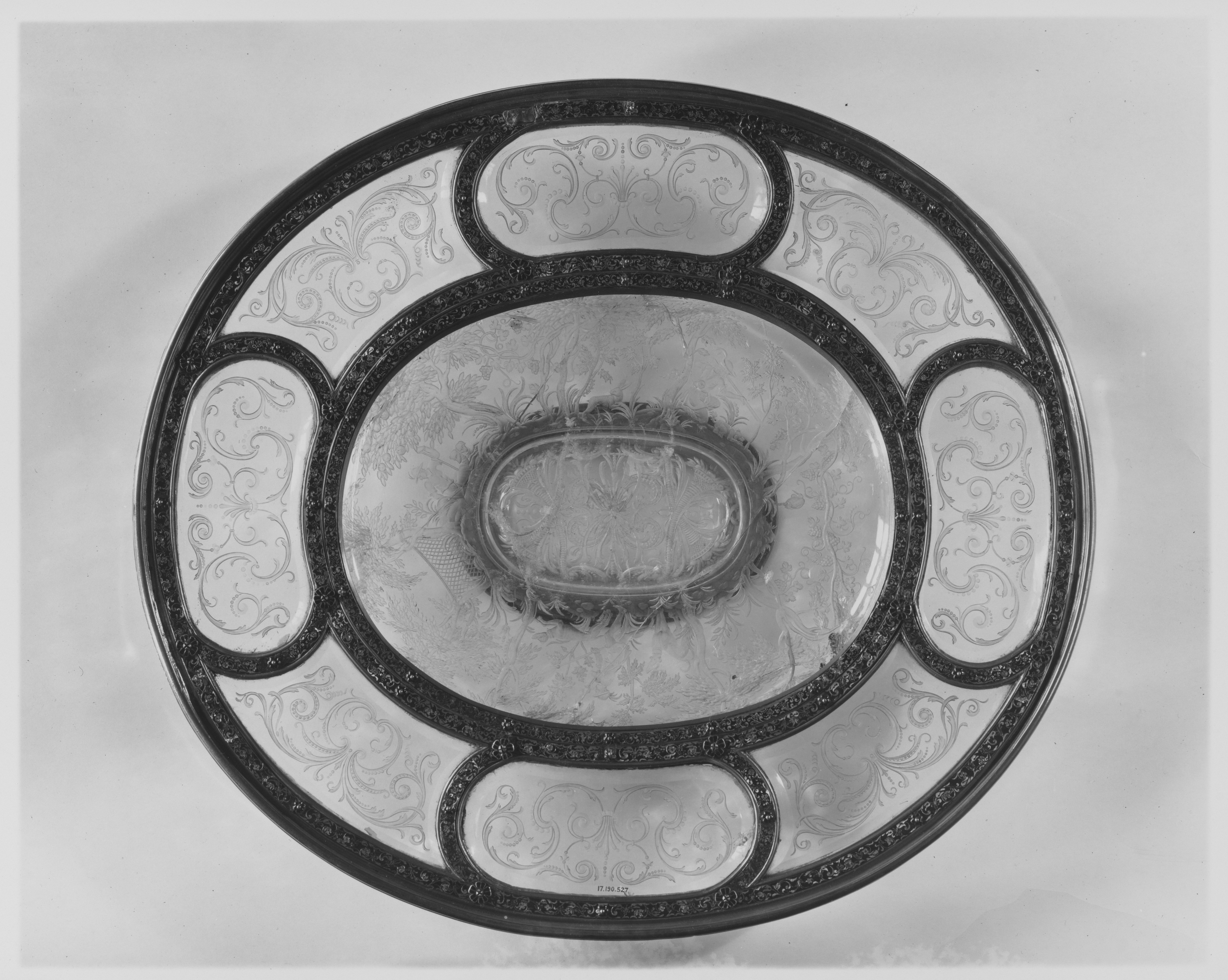
| Salver Attributed to Reinhold Vasters | Object dated to two periods at once Catalogued 1585-1600 and nineteenth century. The half-genuine object is the norm in this class and the reason connoisseurship failed on it for so long. | Metropolitan Museum of Art, 17.190.527 |
| Lapis lazuli vase with enamelled gold mounts Bernardo Buontalenti and Jacopo Bilivert | The comparison that produced the 1969 attribution Bilivert supplied the gold and enamel setting in 1583-84, including the heads and necks of the sphinxes on the vase's shoulders. Hackenbroch's 1969 case rested on their likeness to the sphinx on this cup. | Museo degli Argenti, Palazzo Pitti, Florence |
| Saliera Benvenuto Cellini | The only surviving goldsmith's work by the man this cup was attributed to Completed for Francois I in 1543. Hackenbroch's 1969 argument began from it: Cellini subordinated ornament to the human figure, and this cup does the opposite. | Kunsthistorisches Museum, Vienna |
| A Fantastic Cup After Cornelis Floris, published by Hieronymus Cock | The printed source of the composition One of twenty-one engraved designs for grotesque vessels published in Antwerp in 1548. The shell on a sea creature on a tortoise comes from this series, which is why the design is late-Mannerist whoever executed it. | Musee du Louvre, Cabinet Edmond de Rothschild, Paris |
Open questions
- Where is the gold shell cup described in the Rospigliosi inventory of 1722? If the object in New York is a copy, the original is unaccounted for and has never surfaced.
- Was the Metropolitan's cup made before or after the 1852 colour plate? The Museum's date of ca. 1840-50 or somewhat earlier puts it before; Hackenbroch's ca. 1870-90 puts it after, and only the later date is compatible with Vasters, who entered his mark in 1853.
- Why did the Museum drop the Vasters attribution, and on what evidence? No published argument for the change has been found; the catalogue simply names no maker and keeps the culture field as Italian.
- Was Frederic Spitzer a party to the commission? Hackenbroch raised the possibility and found nothing that either confirmed or denied it.
- What did Benjamin Altman pay Charles Wertheimer in 1909? No figure is published by the dealer, the estate or the Museum.
- Did Richard E. Stone ever publish the technical study of the cup announced in 1984? None has been located; he died in 2021 and his findings are known chiefly from teaching.
- Is the cup's fine enamelling the work of a separate specialist workshop, and if so whose? Hackenbroch inferred a large workshop from the quality but named no one.
- What did the wall label say when the cup hung in Masterpieces of Fifty Centuries in 1970-71, a year after the Cellini attribution had been withdrawn and fourteen years before the object was shown to be nineteenth-century?
Questions about this object
What is Cup, known as the Rospigliosi Cup?
Cup, known as the Rospigliosi Cup is a goldsmith's work, dated nineteenth century. Metropolitan Museum: probably ca. 1840-50, or somewhat earlier. Hackenbroch 1984-85: ca. 1870-90. Medium: Gold, partly enamelled; pearls.
Who made Cup, known as the Rospigliosi Cup, and is the attribution settled?
The attribution to Unrecorded nineteenth-century goldsmith; formerly Benvenuto Cellini, then Jacopo Bilivert, then Reinhold Vasters is recorded here as disputed. Four positions in a hundred and thirteen years. Catalogued as Benvenuto Cellini until 1969; reattributed by Yvonne Hackenbroch to Jacopo Bilivert of Delft in 1969; reassigned by the same scholar to the Aachen goldsmith Reinhold Vasters in her Metropolitan Museum Journal monograph of 1984-85; and now carried by the Museum with no maker at all, as a copy of a late-Mannerist cup, Italian, probably ca. 1840-50 or somewhat earlier. The Museum's present date is incompatible with Vasters, who entered his maker's mark in 1853. What is settled is that the object is nineteenth-century, established from its construction rather than its style: soft solder under electrotype gilding, casting in unorthodox sections, and a retaining pin where a sixteenth-century object would be soldered.
Where is Cup, known as the Rospigliosi Cup now?
Metropolitan Museum of Art, New York, Gallery 556. Inventory number 14.40.667. Last confirmed 4 August 2026. Bequest of Benjamin Altman, 1913; on view 2026.
What is still unknown about Cup, known as the Rospigliosi Cup?
Where is the gold shell cup described in the Rospigliosi inventory of 1722? If the object in New York is a copy, the original is unaccounted for and has never surfaced.
Sources
- 1Metropolitan Museum of Art, collection record for 'Cup', accession 14.40.667, European Sculpture and Decorative Arts (catalogue entry, provenance tab and exhibition tab consulted 4 August 2026). The Museum's current position: 'A copy of a late-Mannerist gold cup that was once in the possession of the Rospigliosi family in Rome, this object was formerly attributed to the Italian goldsmith Benvenuto Cellini.' Dated 'probably ca. 1840-50, or somewhat earlier'; no maker named. metmuseum.org/art/...
- 2Yvonne Hackenbroch, 'Reinhold Vasters, Goldsmith', Metropolitan Museum Journal 19/20 (1984-85), the section 'The Rospigliosi Gold Cup' and the biographical opening. Full text read from the Internet Archive scan. archive.org/details/...
- 3Yvonne Hackenbroch, 'Jacopo Bilivert and the Rospigliosi Cup', The Connoisseur 172 (1969), pp. 175-181. Full text read from the Internet Archive scan. archive.org/details/...
- 4Joseph W. Alsop, 'The Faker's Art', The New York Review of Books, 23 October 1986. Contemporary account of the effect of Hackenbroch's monograph on museum attributions. nybooks.com/articles/...
- 5Metropolitan Museum of Art Collection API, object 192708, fields isPublicDomain, objectDate, objectBeginDate 1800, objectEndDate 1855, classification 'Metalwork-Gold and Platinum'. collectionapi.metmuseum.org/public/...
- 6Institute of Fine Arts, New York University, 'In Memoriam: Richard E. Stone (1939-2021)', conservator emeritus of the Metropolitan Museum, recording that he helped unmask the Rospigliosi Cup among the fakes and forgeries at the Museum. ifa.nyu.edu/faculty/...
- 7Wikipedia, 'Rospigliosi Cup'. TERTIARY, used only for the outline of the popular account; to be replaced by the Metropolitan's own technical file when it is published. en.wikipedia.org/wiki/...
Last verified 21 August 2026 · Published 4 August 2026
Change log
2 August 2026 - Record deepened to the house standard: narrative sections, technical evidence, artist dossier, related works and open questions added; provenance chain and auction results replaced with the researched versions; sources rebuilt.
4 August 2026 - Record created at the house standard: researched narrative, technical evidence, maker dossier, graded provenance chain, prices with hammer and premium separated, related works, open questions and sources.
21 August 2026 - Re-verified 2026-08-21: Met API (object 192708, accession 14.40.667) still carries no artist attribution and dates the piece 1800-1855, consistent with the Vasters-forgery finding already in this record; same Altman bequest credit line. No new scholarship, litigation or relocation found. All 7 cited source URLs still resolve. No change.