The Ardagh Chalice
Unknown Irish ecclesiastical metalworking workshop, probably Munster · 8th century AD (commonly given as c. 750)
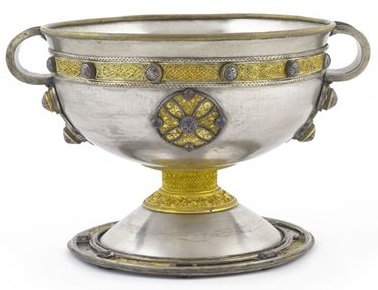
The Ardagh Chalice as displayed in the National Museum of Ireland. This photograph was itself sourced from the museum's own collections database and credited to the National Museum of Ireland.
National Museum of Ireland · CC BY-SA 2.5| Artist | Unknown Irish ecclesiastical metalworking workshop, probably Munster |
|---|---|
| Date | 8th century AD (commonly given as c. 750) |
| Medium | Silver, gilt bronze, brass, lead-tin (pewter), gold filigree and wirework, cloisonne enamel, glass and amber studs, rock crystal |
| Dimensions | Height 17.80 cm per the National Museum of Ireland's own catalogue record. Secondary sources give the rim width as either approximately 19 cm (7.5 in) or approximately 24 cm (9.5 in); this record could not resolve which figure is correct and states both, see notes_for_editor. |
| Where it is now | National Museum of Ireland - Archaeology, Kildare Street, Dublin, on permanent display in The Treasury gallerylast confirmed |
| Inventory number | 1874:99, Irish Antiquities Division. Confirmed directly against the museum's own Collections Online catalogue record (museum.ie), which lists 'Collection: Irish Antiquities' and 'Museum Number: 1874:99' as separate fields. Wikipedia's commonly repeated rendering 'IA:1874.99' is the same underlying identifier in a different notation (division initials prefixed, period substituted for colon), not a different object or a different number; this record treats the museum's own field format as authoritative. |
| Attribution | AcceptedThe chalice itself is not attributed to any named individual; no early medieval Irish goldsmith working in this tradition is recorded by name. Full note |
| Object type | Goldsmith's work |
| Period | Irish early medieval (Insular) |
| Cases | Has a provenance gap |
| Inscriptions | The names of the eleven apostles and St Paul, twelve names in total, incised in Latin uncial letters against a stippled ground, in a frieze running around the bowl beneath the girdle of gold filigree panels and studs. |
| Owners on record | 8 links6 documented, 1 disputed, 1 unknown |
| Sources | 13 cited |
About this record Last verified · 13 sources cited · Change log
On this page 9 sections
ContentsClose
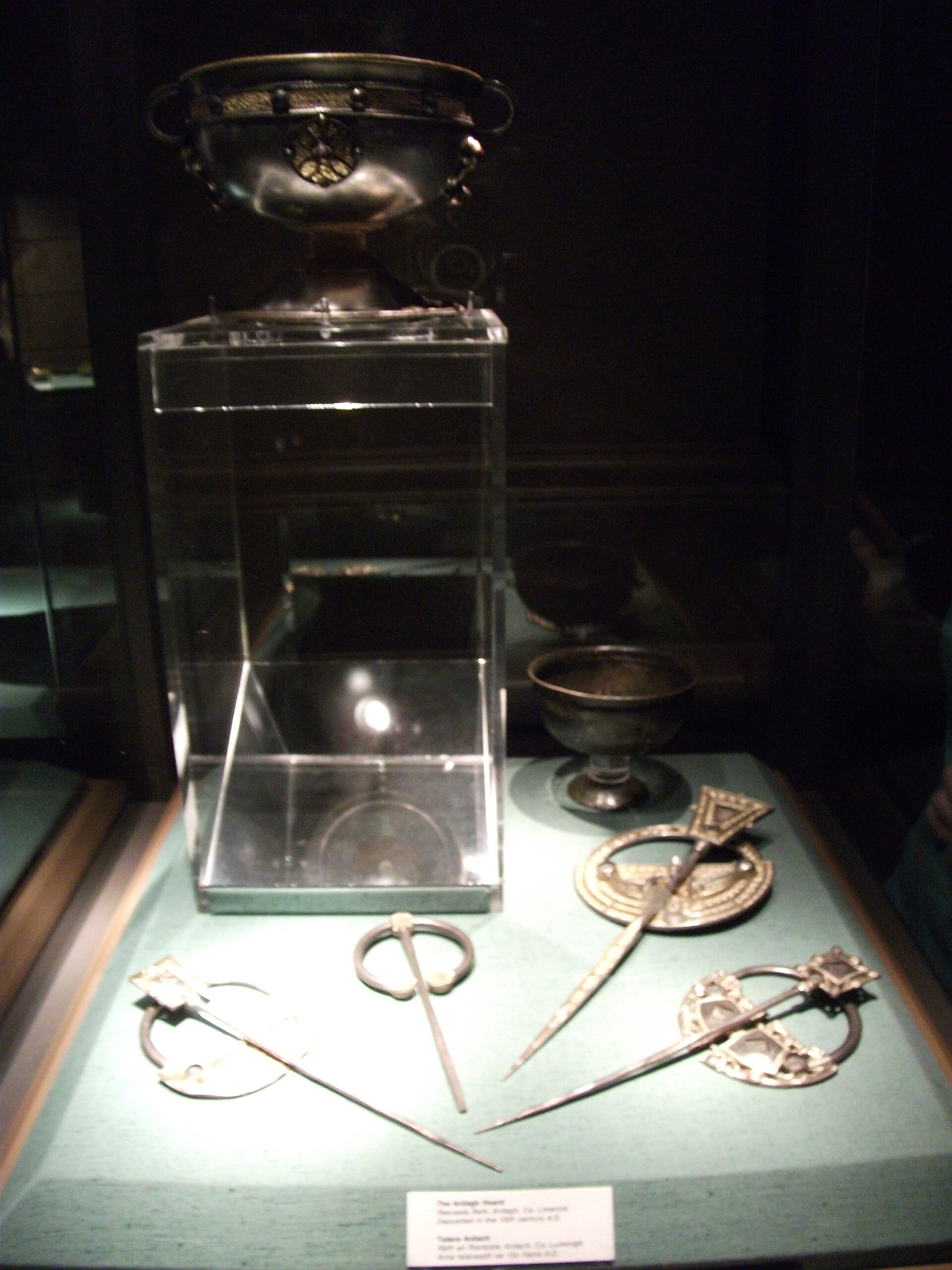
Found in September 1868 by two boys digging potatoes in a ringfort field at Reerasta, near Ardagh, County Limerick, the Ardagh Chalice is an 8th-century Irish liturgical vessel built from 354 separate pieces of silver, gilt bronze, gold filigree, enamel, glass and amber. It was already old, by at least a century and probably more, when it was buried alongside a brooch datable to around 900 AD, the true date of its concealment rather than its manufacture.
Bishop George Butler of Limerick paid the finders a reward of GBP 50 for it; the Royal Irish Academy bought it from him in 1874 for a price the sources disagree on, and the whole collection passed to the newly founded National Museum of Ireland in 1890, where it has remained on permanent display ever since, with one recorded exception: a 1977 loan to the Metropolitan Museum of Art and the Fine Arts Museums of San Francisco.
Scholars once proposed the chalice was made at Clonmacnoise and stolen by a Viking raider; that theory is now largely discounted in favour of a Munster origin, strengthened by the related Derrynaflan Hoard found in 1980. A separate, modern electrotype reproduction of the chalice, made in the early 20th century, is held by the Metropolitan Museum of Art and should never be confused with the medieval original described here.
Provenance
Each link is graded. Documented: a cited source supports it. Disputed: the identification is argued but not established. Unknown: no owner for that span, and the gap is not smoothed into a narrative. The grades in the glossary.
- 8th century AD -Unknown Irish workshop, probably Munsterdocumented
Dating to the 8th century and manufacture in Ireland are accepted on stylistic and technical grounds. The specific workshop location, Munster against the discounted Clonmacnoise theory, remains disputed; see the artist dossier.13
- 8th century AD - September 1868Unrecordedunknown
No owner, custodian or specific historical event is recorded for this period. The hoard's latest object, a thistle brooch, dates to around the end of the 9th or start of the 10th century, which sets a terminus post quem of roughly 900 AD for the act of concealment; the chalice was therefore already at least a century old, and quite possibly considerably more, when it was buried. It was found beneath a single stone slab, consistent with deliberate concealment for safekeeping rather than accidental loss, in a period generally associated with Viking-era disruption in Ireland. No source consulted ties the concealment to a specific named raid or owner.34
- September 1868 - September 1868Jim Quin (also rendered Quinn) and Paddy Flanagan, findersdocumented
Found while digging potatoes in a field at Reerasta ringfort, near Ardagh, County Limerick, beneath a stone slab that the chalice itself had sheltered. The precise spelling of Quin's surname and the question of which boy actually made the find are both disputed in the sources consulted; see open questions.3456
- September 1868 - 1874George Butler, Catholic Bishop of Limerickdocumented
Quin's mother sold, or surrendered, the hoard to Bishop Butler, who paid a reward reported at GBP 50 in total, split GBP 40 to the Quin family and GBP 10 to Flanagan. This split is repeated consistently across the independent secondary sources consulted, though none of them reproduces a contemporary 1868 or 1869 primary account verbatim.4567
- 1874 - 1890Royal Irish Academydisputed
The Academy acquired the hoard from Bishop Butler in 1874, a year corroborated by the museum's own registration number, 1874:99, still in use today. The price paid is disputed among the sources consulted: some give GBP 500 following a described dispute over treasure-trove law, at least one other gives GBP 100 and a different year, 1878, for the same transaction. This record states both figures rather than resolving the conflict.1679
- 1890 - 1977National Museum of Ireland, Dublindocumented
The Royal Irish Academy's antiquities collection, the Ardagh Hoard among it, was transferred to the National Museum of Ireland when the museum was established and opened in 1890. The museum's own catalogue record lists the acquisition method as donation and the collector as the Royal Irish Academy, consistent with this sequence.19
- 1977 - 1977On loan to the Metropolitan Museum of Art, New York, and the Fine Arts Museums of San Franciscodocumented
Shown as part of the exhibition Treasures of Early Irish Art, 1500 B.C. to 1500 A.D., drawing on the National Museum of Ireland, the Royal Irish Academy and Trinity College Dublin. The only international loan of the original object found in the sources consulted for this record; a later loan cannot be ruled out, only that none was found.13
- 1977 - presentNational Museum of Ireland - Archaeology, Kildare Street, Dublindocumented
On permanent public display in The Treasury gallery, per the museum's own website.12
Technical evidence
| Attribution note | The chalice itself is not attributed to any named individual; no early medieval Irish goldsmith working in this tradition is recorded by name. Manufacture in Ireland in the 8th century is accepted without serious dispute on grounds of style, technique and comparison with the Tara Brooch. The specific workshop location is disputed: an early and now largely discounted theory placed it at Clonmacnoise, while the National Museum of Ireland and most modern scholarship favour a Munster origin, strengthened by the 1980 discovery of the related Derrynaflan Hoard in County Tipperary. |
|---|---|
| Museum registration | 1874:99, Irish Antiquities Division, National Museum of Ireland. Confirmed directly against the museum's own Collections Online catalogue record.1 |
| Construction | A two-handled beaten and spun silver vessel assembled from 354 separate pieces. The bowl is formed from two hemispheres of sheet silver joined by a bronze pin, the join hidden beneath a gilt-bronze band.34 |
| Materials | Silver, gilt bronze, brass, lead-tin (pewter), gold filigree and wirework, cloisonne enamel in blue and red, glass and amber studs, and a polished rock crystal set into the centre of the underside of the foot.13 |
| Dimensions | Height 17.80 cm per the museum's own catalogue record. Rim diameter is given inconsistently across secondary sources, either approximately 19 cm (7.5 in, citing a New York Public Library digitised record) or approximately 24 cm (9.5 in); this record states both rather than resolving the conflict.13 |
| Decorative technique | Hammering, engraving, lost-wax casting, filigree applique and cloisonne enamelling. Cloisonne enamel bosses in blue and red are set at intervals among the gold filigree panels.3 |
| Inscription | The names of the eleven apostles and St Paul, in Latin uncial letters against a stippled ground, in a frieze around the bowl beneath the girdle of filigree and studs. A 2005 Journal of Celtic Studies article is devoted specifically to identifying this list; this record could not confirm its author or retrieve its full argument.2312 |
| Decorative parallel | The National Museum of Ireland's own catalogue entry compares the decorative band and circular medallions on the bowl to jewelled Byzantine metal straps fitted to Late Antique vessels of glass and semiprecious stone, of the kind preserved in the Treasury of St Mark's Cathedral, Venice, brought there from Constantinople during the Crusades.1 |
| Findspot | Reerasta Ringfort, Reerasta South, Ardagh, Shanid, County Limerick, per the museum's own catalogue record.1 |
Images
The record in full
Chapter 1What it is
The Ardagh Chalice is a two-handled liturgical vessel, a calyx ministerialis, made to hold the consecrated wine at Mass.
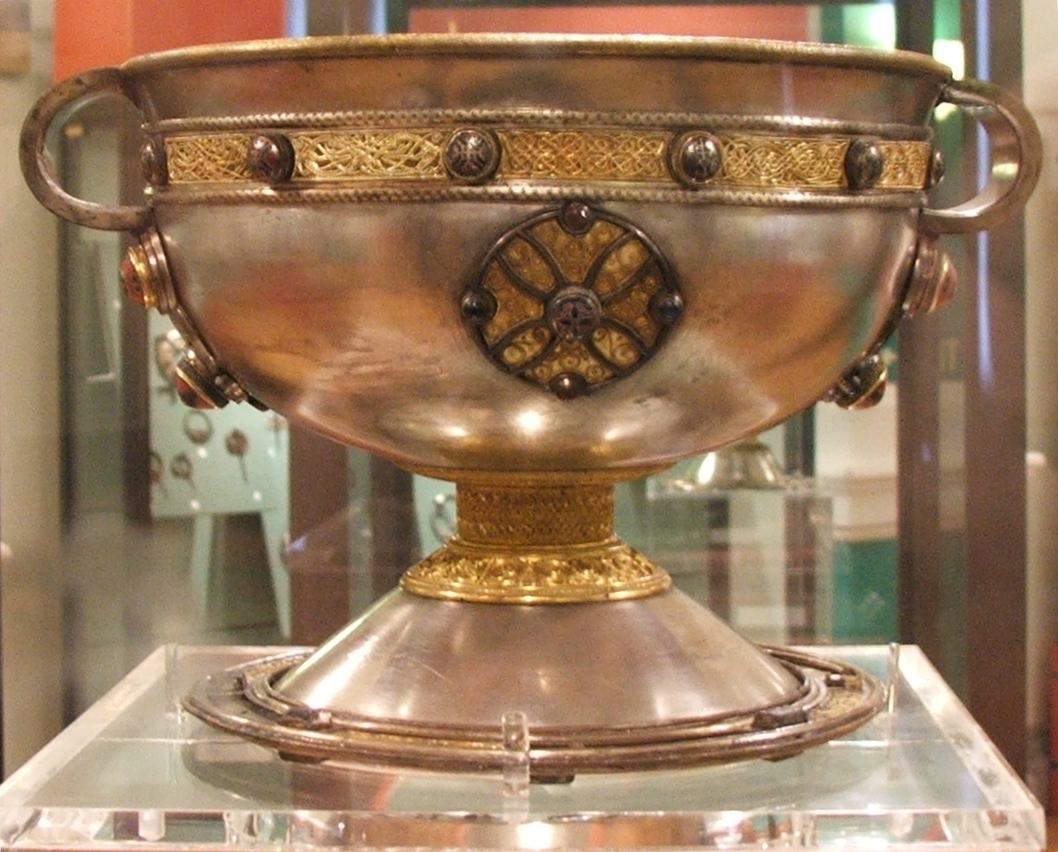
The Ardagh Chalice is a two-handled liturgical vessel, a calyx ministerialis, made to hold the consecrated wine at Mass. The bowl and foot are spun silver; the outer surface of the bowl and the underside of the foot carry applied ornament in gold, gilt bronze, brass, lead-tin, glass, amber and cloisonne enamel. The National Museum of Ireland's own catalogue record gives its height as 17.80 cm. Secondary accounts of the rim diameter disagree, some giving roughly 19 cm and others roughly 24 cm; this record has not been able to resolve which is correct from the sources consulted and states the disagreement rather than picking one.
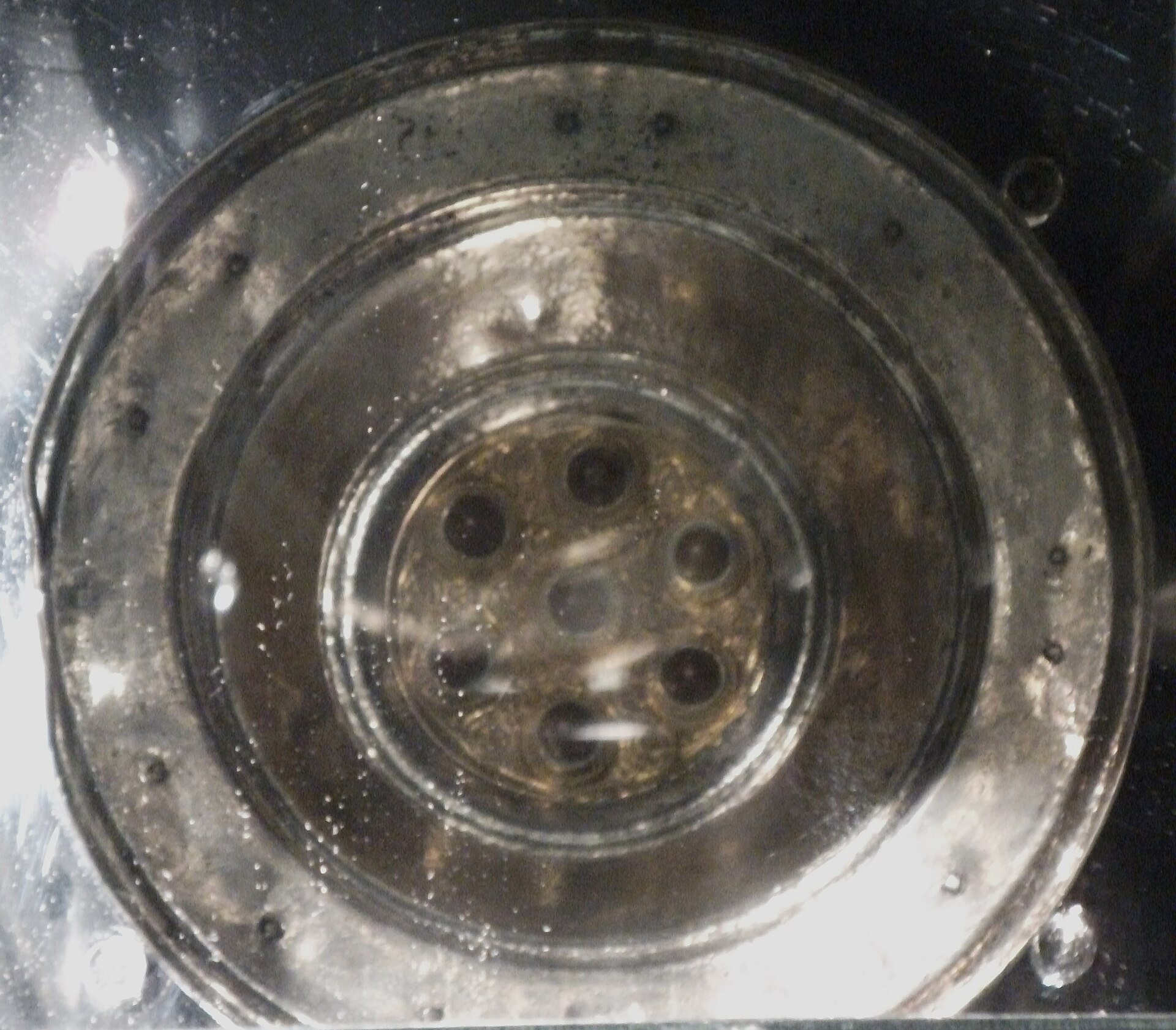
The main body is formed from two hemispheres of sheet silver joined by a bronze pin, the join concealed beneath a gilt-bronze band. The whole object is assembled, by the most widely repeated count, from 354 separate pieces, a construction typical of the most ambitious Irish ecclesiastical metalwork of the period. A polished rock crystal is set into the centre of the underside of the foot, itself elaborately decorated, so that even the surface never meant to be seen by a congregation was finished to the same standard as the surface that was.
Chapter 2How it was made and decorated
The decorative techniques used include hammering, engraving, lost-wax casting, filigree applique and cloisonne enamelling.
The decorative techniques used include hammering, engraving, lost-wax casting, filigree applique and cloisonne enamelling. A girdle of inset gold wirework panels, worked with animals, birds and geometric interlace, encircles the bowl, its studs and roundels set with cloisonne enamel bosses in blue and red. Below this girdle runs the frieze of apostles' names. The two circular medallions on the faces of the bowl and the decorative band beneath its rim appear, on the National Museum of Ireland's own account, to be held in place by a series of studs, but the studs are in fact purely decorative rather than structural.
The museum's own catalogue entry draws a specific comparison for that band and its medallions: it suggests they may have been inspired by the jewelled metal straps of Byzantine workmanship that were fitted to Late Antique vessels of glass and semiprecious stone, of the kind still preserved in the Treasury of St Mark's Cathedral in Venice, which were themselves brought there from Constantinople during the Crusades. If the comparison holds, the chalice's makers were working with an awareness, however indirect, of a Mediterranean decorative vocabulary applied to precious liturgical and secular vessels, adapted here to an Irish object built by entirely Irish construction methods. The museum places the chalice alongside the Tara Brooch and the Derrynaflan Paten as the high point of this tradition.
Chapter 3The apostles around the bowl
The names of the eleven apostles and St Paul, twelve names in total, are incised in Latin uncial letters against a stippled background in the frieze around the bowl.
The names of the eleven apostles and St Paul, twelve names in total, are incised in Latin uncial letters against a stippled background in the frieze around the bowl. Naming the Twelve on a Eucharistic vessel is a specific and legible choice: it ties the object, every time it was lifted at Mass, to the apostolic witnesses of the Last Supper for whose company the communicant prays. Paul was not one of the Twelve named in the Gospels, and his inclusion in place of, or alongside, the traditional list is itself a point of interest to specialists: a dedicated scholarly article, published in the Journal of Celtic Studies in 2005, is devoted entirely to identifying the exact list of names on the bowl and discussing how it departs from the standard Gospel enumeration. This record was not able to retrieve the full text of that article or confirm its author from the sources consulted, and states the point at the level the available secondary references support: the list is a documented feature of the object, its precise theological patterning is the subject of specialist argument, and a fuller account belongs to that literature rather than to inference from photographs.
Nothing in the sources consulted for this record supports going further and reading a hidden programme into the choice. An ecclesiastical vessel naming the apostles who witnessed the institution of the Eucharist is an ordinary and well understood piece of Christian iconography for its function; the absence of anything more esoteric is itself the accurate finding here.
Chapter 5Discovery, September 1868
The hoard was found in late September 1868 in a potato field on the south-western side of Reerasta, a rath or ringfort beside the village of Ardagh, County Limerick.
The hoard was found in late September 1868 in a potato field on the south-western side of Reerasta, a rath or ringfort beside the village of Ardagh, County Limerick. Two boys were digging potatoes when a spade struck the buried objects: the chalice had sheltered the rest of the hoard, covered by a single stone slab. Several secondary accounts render the finders' names as Jim Quin and Paddy Flanagan; other retellings give Jimmy Quinn or James Quinn for the first name. This record follows the spelling used in the National Museum of Ireland's own citation as reflected in the Wikipedia article on the hoard, Quin, while noting Quinn as a widely used alternative spelling in other secondary sources, including the Irish Times and the World History Encyclopedia.
The land at Reerasta was rented by the Quin family, reportedly from an estate held by the Sisters of Mercy. More than one secondary account states or implies that Flanagan, who worked for the Quin family, may have been the one who actually made the find, and that he did not receive equal credit for it because of his position as a labourer. Flanagan remained in Ireland and is buried in the paupers' graveyard in Newcastle West. Quin later emigrated to Australia and died in Melbourne in 1934, buried at Fawkner Memorial Park. This record treats the underlying fact of the discovery, its date, location and the two names involved as documented across multiple independent secondary accounts; it treats the question of which boy actually found the chalice, and the exact spelling of the surname, as genuinely unresolved.
Chapter 6The bishop's reward, and what the finders kept
George Butler, Catholic Bishop of Limerick, obtained the hoard from Quin's mother and paid a reward reported at GBP 50 in total, split GBP 40 to the Quin family and GBP 10 to Flanagan.
George Butler, Catholic Bishop of Limerick, obtained the hoard from Quin's mother and paid a reward reported at GBP 50 in total, split GBP 40 to the Quin family and GBP 10 to Flanagan. That split, and the total, are repeated consistently enough across independent secondary compilations, including the Limerick Diocesan Heritage Project and several other accounts drawing on the same local record, that this record treats the figure as documented rather than folklore, while noting that none of the sources consulted here reproduces an 1868 or 1869 primary newspaper account verbatim.
The disparity between that reward and the object's eventual standing is the human centre of the story: two boys digging potatoes on rented land turned up what is now judged one of the finest surviving works of early medieval European metalwork, and were paid a labourer's modest sum for it, unequally split between them. Whether that is a story about ecclesiastical property law of the period, about the ordinary powerlessness of tenant families relative to their landlord's bishop, or simply about how treasure-trove disputes were customarily settled in provincial Ireland in 1868, the sources consulted do not say, and this record does not speculate beyond what they establish.
Chapter 7From Bishop Butler to the Royal Irish Academy
The hoard passed from Bishop Butler's possession to the Royal Irish Academy in 1874, a date corroborated independently by the Academy's own registration number, 1874:99, still used as the museum's...
The hoard passed from Bishop Butler's possession to the Royal Irish Academy in 1874, a date corroborated independently by the Academy's own registration number, 1874:99, still used as the museum's museum number today. What the Academy paid Butler for it is disputed in the secondary literature consulted for this record: some accounts give GBP 500, following what is described as a protracted dispute over treasure-trove law; at least one other account gives GBP 100 for the same transaction, and gives a different year, 1878, for it. This record does not average these figures or silently pick one; both are stated, with their sources, and the discrepancy is carried into the open questions below rather than resolved by assertion.
What is not disputed is that the Academy held the collection until the National Museum of Ireland opened in 1890, at which point the Royal Irish Academy's antiquities collection, the Ardagh Hoard among it, was transferred to the new state museum. The museum's own catalogue record lists the acquisition method as donation and the collector as the Royal Irish Academy, which is consistent with a two-step history: a disputed-price purchase from Butler in 1874, followed by the Academy's donation of its holdings to the state museum on the museum's establishment.
Chapter 8Clonmacnoise, the Limerick Dane, and the case for Munster
An early theory of the chalice's origin held that it was made at the monastery of Clonmacnoise and later stolen from there in a raid attributed to an unnamed 'Limerick Dane,' that is, a Viking based...
An early theory of the chalice's origin held that it was made at the monastery of Clonmacnoise and later stolen from there in a raid attributed to an unnamed 'Limerick Dane,' that is, a Viking based at Limerick. This theory is widely repeated in popular accounts of the object. It is also, on the evidence available, unprovable: no source consulted for this record, scholarly or otherwise, ties the chalice to a specific, dated raid on Clonmacnoise, and the National Museum of Ireland's own account of the object does not mention a Clonmacnoise origin at all.
The alternative, and now the more widely favoured position, places the chalice's manufacture in Munster. That case was substantially strengthened by the 1980 discovery of the Derrynaflan Hoard in neighbouring County Tipperary, a related find of ecclesiastical metalwork, including the Derrynaflan Chalice and the Derrynaflan Paten, which the National Museum of Ireland itself compares directly to the Ardagh Chalice in its own published description of the object. In the political geography of the period, the ruling dynasty across most of Munster and Tipperary were the Eoganachta, with the Ui Fidgenti, their allies and possible kin, ruling the Limerick area where the hoard was found; the argument for a Munster workshop sits inside that regional political context. The scholarly literature most directly engaging this question is a 2001 essay by Edel Bhreathnach on the cultural and political circumstances of the hoard's manufacture and deposition, published in a conference volume on Insular art; this record has not independently read that essay and represents its conclusions only at the level that secondary summary supports, principally that a Munster origin is judged at least as likely as any alternative, and more likely than Clonmacnoise.
Chapter 9One journey out of Ireland
The chalice has spent almost the whole of its documented existence inside Ireland: buried in Limerick, held by a Limerick bishop, registered by a Dublin academy, and displayed by the national museum...
The chalice has spent almost the whole of its documented existence inside Ireland: buried in Limerick, held by a Limerick bishop, registered by a Dublin academy, and displayed by the national museum in Dublin ever since. The one clear exception found in the sources consulted for this record is 1977, when the chalice travelled to the United States as part of Treasures of Early Irish Art, 1500 B.C. to 1500 A.D., an exhibition drawing on the collections of the National Museum of Ireland, the Royal Irish Academy and Trinity College Dublin, shown at the Metropolitan Museum of Art in New York and at the Fine Arts Museums of San Francisco. No later international loan of the original object was found in the sources consulted for this record; it should not be assumed that none has occurred since, only that this research pass did not turn one up.
Chapter 10A famous object, endlessly reproduced
Part of the Ardagh Chalice's fame is a manufactured fame, in the literal sense that the object was reproduced, by electrotype and by hand, from very soon after its rediscovery.
Part of the Ardagh Chalice's fame is a manufactured fame, in the literal sense that the object was reproduced, by electrotype and by hand, from very soon after its rediscovery. A silver-gilt electrotype replica made by Frederick Elkington of London in 1879, eleven years after the find, was engraved as a wedding present to Sir Thomas George Fermor-Hesketh from the tenants of his Lancashire estates on his marriage in December 1880; that piece has since passed through at least two further sales at Sotheby's, in 2005 and again in 2020, and its lot description is one of the more precisely documented facts in this record's whole reproduction history, down to its weight and the wording of its presentation inscription.
The Metropolitan Museum of Art in New York holds its own electrotype facsimile, accessioned in 1906 under the Rogers Fund and catalogued in the Met's own online collection under object ID 463050. The Met's own record is explicit and unambiguous on this point: the object's classification is Reproductions-Metalwork, and its object date is given as early 20th century, with the note that the original is dated to around 750. This record follows that classification exactly. No image of the Met's electrotype is used anywhere in this record, and nowhere in this record is any photograph of the Met's copy captioned as though it showed the object described here; where the Met piece is mentioned at all, it is identified plainly as a modern reproduction, not the medieval original.
Beyond these two documented electrotypes, the chalice's form has been reused more informally for generations, appearing on an Irish postage stamp issued between 1990 and 1995, and providing the model for two Gaelic Athletic Association trophies, the O'Duffy Cup and the Sam Maguire Cup. A find made by two boys digging potatoes on rented land has become, by way of a Victorian electrotyping trade and twentieth-century sporting culture, one of the most widely copied shapes in Irish visual culture.
Chapter 11What is still unresolved
Several factual questions about this object remain open on the evidence this record was able to gather, and are listed in full below rather than smoothed over.
Several factual questions about this object remain open on the evidence this record was able to gather, and are listed in full below rather than smoothed over. The two that matter most for anyone using this record as a reference are the disputed 1874 purchase price paid by the Royal Irish Academy, given as either GBP 100 or GBP 500 in different secondary sources with different transaction years attached, and the identity of whoever concealed the hoard around or after 900 AD, which no source consulted here addresses at all. Both gaps are recorded as gaps.
The artist
Unknown Irish ecclesiastical metalworking workshop, probably Munster, active 8th century AD
No goldsmith's name survives for this object, and none is expected to: early medieval Irish metalworkers of this rank did not sign their work, and the identification of workshops in this period rests entirely on style, technique and findspot rather than on any documentary record of an individual maker. What can be said is said about a tradition and, tentatively, a region, not about a person.
Related works
| Work | Relation | Where it is |
|---|---|---|
| Derrynaflan Chalice and Paten Unknown Irish workshop, probably Munster | Comparable ecclesiastical metalwork from the same broad tradition and region, found in 1980 in County Tipperary; the National Museum of Ireland's own description of the Ardagh Chalice compares it directly to the Derrynaflan Paten The 1980 discovery is the main evidence cited for favouring a Munster origin for the Ardagh Chalice over the older, discounted Clonmacnoise theory. | National Museum of Ireland, Dublin |
| The Tara Brooch Unknown Irish workshop | Contemporary comparandum; the National Museum of Ireland's own description groups the Ardagh Chalice with the Tara Brooch as products of the same craft tradition Found at Bettystown, County Meath, in 1850, a different find from the Ardagh Hoard; treated separately in this collection. | National Museum of Ireland, Dublin |
| The Ardagh Chalice (electrotype reproduction) Metropolitan Museum of Art metalworking department, after the original | A modern facsimile of this object, not the object itself This is NOT the picture described in this record's subject. The Met's own catalogue classifies it under Reproductions-Metalwork and dates it to the early 20th century, noting the original is dated to around 750. No image of this piece appears in this record's gallery. | Metropolitan Museum of Art, New York, object ID 463050 |
| The Ardagh Chalice (Elkington electrotype presentation piece, 1879) Frederick Elkington, London | A Victorian silver-gilt replica of this object, made and sold as a decorative and presentation piece Engraved as a wedding gift to Sir Thomas George Fermor-Hesketh from the tenants of his Lancashire estates, December 1880. Cited here for the reproduction and circulation history, not as an image source. | Private collection; sold at Sotheby's, Dublin, 2020, having previously sold at Sotheby's, Easton Neston, in 2005 |
Open questions
- What did the Royal Irish Academy actually pay Bishop Butler for the hoard in 1874? Secondary sources give both GBP 100 and GBP 500, and at least one source gives a different year, 1878, for the same transaction.
- Who buried the hoard at Reerasta around or after 900 AD, and why was it never recovered? No source consulted identifies an owner, a specific threat, or a reason for the roughly one-and-a-half-century gap between the chalice's manufacture and its concealment.
- Was the chalice definitely made in Munster? The Munster case is favoured by most recent scholarship following the 1980 Derrynaflan discovery, but this record found no source that treats the question as fully closed.
- What is the correct rim diameter? Secondary sources disagree by a significant margin, roughly 19 cm against roughly 24 cm, and this record could not adjudicate between them from the sources consulted.
- Who wrote the 2005 Journal of Celtic Studies article on the list of apostles' names, and what exactly does it argue? This record located the article's existence and place of publication but could not retrieve its author or full text.
- Did the chalice leave Ireland on loan at any point other than the 1977 Treasures of Early Irish Art tour to New York and San Francisco? This record found no evidence of any other international loan, but absence of evidence in this research pass is not evidence of absence.
- Which of the two finders, Jim Quin or Paddy Flanagan, actually made the discovery? More than one secondary source suggests Flanagan may have found it first but was denied credit because of his status as a labourer, without settling the question.
Questions about this object
What is The Ardagh Chalice?
The Ardagh Chalice is a goldsmith's work, dated 8th century AD (commonly given as c. 750). Medium: Silver, gilt bronze, brass, lead-tin (pewter), gold filigree and wirework, cloisonne enamel, glass and amber studs, rock crystal.
Who made The Ardagh Chalice, and is the attribution settled?
The attribution to Unknown Irish ecclesiastical metalworking workshop, probably Munster is recorded here as accepted. The chalice itself is not attributed to any named individual; no early medieval Irish goldsmith working in this tradition is recorded by name. Manufacture in Ireland in the 8th century is accepted without serious dispute on grounds of style, technique and comparison with the Tara Brooch. The specific workshop location is disputed: an early and now largely discounted theory placed it at Clonmacnoise, while the National Museum of Ireland and most modern scholarship favour a Munster origin, strengthened by the 1980 discovery of the related Derrynaflan Hoard in County Tipperary.
Where is The Ardagh Chalice now?
National Museum of Ireland - Archaeology, Kildare Street, Dublin, on permanent display in The Treasury gallery. Inventory number 1874:99, Irish Antiquities Division. Confirmed directly against the museum's own Collections Online catalogue record (museum.ie), which lists 'Collection: Irish Antiquities' and 'Museum Number: 1874:99' as separate fields. Wikipedia's commonly repeated rendering 'IA:1874.99' is the same underlying identifier in a different notation (division initials prefixed, period substituted for colon), not a different object or a different number; this record treats the museum's own field format as authoritative.. Last confirmed 24 September 2026. Registered in 1874 as part of the Royal Irish Academy's Irish Antiquities collection, following the Academy's 1874 purchase from Bishop George Butler; the Academy's antiquities collection, including the Ardagh Hoard, was transferred to the newly established National Museum of Ireland when it opened in 1890. The museum's own Collections Online record lists the acquisition method as 'Donation' and the collector as 'Royal Irish Academy', consistent with this sequence.
What is still unknown about The Ardagh Chalice?
What did the Royal Irish Academy actually pay Bishop Butler for the hoard in 1874? Secondary sources give both GBP 100 and GBP 500, and at least one source gives a different year, 1878, for the same transaction.
Sources
- 1National Museum of Ireland, Collections Online, catalogue record for the Ardagh Chalice, Museum Number 1874:99, Irish Antiquities Division. museum.ie/collections/...
- 2National Museum of Ireland, 'The Ardagh Chalice,' The Treasury. museum.ie/en-ie/...
- 3Wikipedia, 'Ardagh Hoard.' Tertiary source consolidating the technical description, the Stone quotation and the workshop-origin debate; flagged for replacement with Wallace and O Floinn (eds.), Treasures of the National Museum of Ireland: Irish Antiquities, and with Bhreathnach, 'The cultural and political milieu of the deposition and manufacture of the hoard discovered at Reerasta Rath, Ardagh, Co. Limerick,' in Redknap (ed.), Pattern and Purpose in Insular Art (Oxbow Books, 2001), neither of which this record independently consulted. en.wikipedia.org/wiki/...
- 4Voices from the Dawn, 'Ardagh Ringfort.' voicesfromthedawn.com/ardagh
- 5Limerick Diocesan Heritage Project, 'Ardagh-Carrickerry Parish,' citing Treasures of Early Irish Art (Metropolitan Museum of Art, New York, 1977) and Bishop Jeremiah Newman, Treasures of Thomond. limerickdioceseheritage.org/Ardagh/...
- 6The Irish Times, 'National treasure: An Irishman's Diary on the Ardagh Chalice.' irishtimes.com/opinion/...
- 7Irish Examiner, 'Munster in 30 Artworks, No 17: The Ardagh Chalice, found in Co Limerick.' Quotes Maeve Sikora, Keeper of Irish Antiquities, National Museum of Ireland. irishexaminer.com/lifestyle/...
- 8World History Encyclopedia, 'Ardagh Chalice,' by Jenny Snook, 18 November 2020. Tertiary source; flagged for replacement with the primary museum catalogue and the Gogan monograph. worldhistory.org/Ardagh_Chalice
- 9History Is Now Magazine, 'Treasure from the Golden Age of Ireland: The Ardagh Hoard,' by Jenny Snook, 31 August 2020. Tertiary source; flagged for replacement with a primary account of the Royal Irish Academy transaction. historyisnowmagazine.com/blog/...
- 10The Metropolitan Museum of Art, collection record for 'The Ardagh Chalice' (reproduction), object ID 463050, classification Reproductions-Metalwork, object date early 20th century (original dated ca. 750), Rogers Fund, 1906. metmuseum.org/art/...
- 11Sotheby's, '44 Fitzwilliam Square: Works from the Estate of the Late Patrick Kelly,' 2020, Lot 9, 'The Ardagh Chalice. A Victorian Silver-gilt Replica Two-handled Rose Bowl, Frederick Elkington, London, 1879.' sothebys.com/en/...
- 12'The list of the apostles on the bowl of the Ardagh Chalice,' Journal of Celtic Studies 5 (2005), pp. 107-113. Author not confirmed from the excerpts available to this record; full text not retrieved. academia.edu/19419272/...
- 13The Metropolitan Museum of Art, publication page for Treasures of Early Irish Art, 1500 B.C. to 1500 A.D. (1977 exhibition catalogue). metmuseum.org/met-publications/...
Last verified · Published
Change log
24 September 2026 - Record created at the house standard: researched narrative, technical evidence, maker dossier, graded provenance chain, prices with hammer and premium separated, related works, open questions and sources.