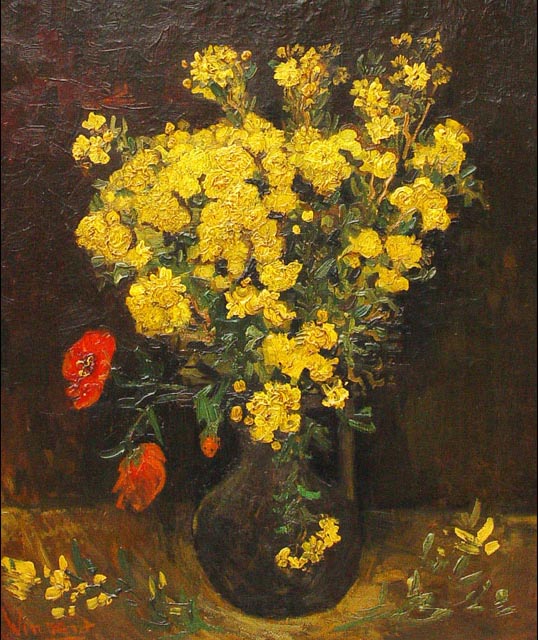
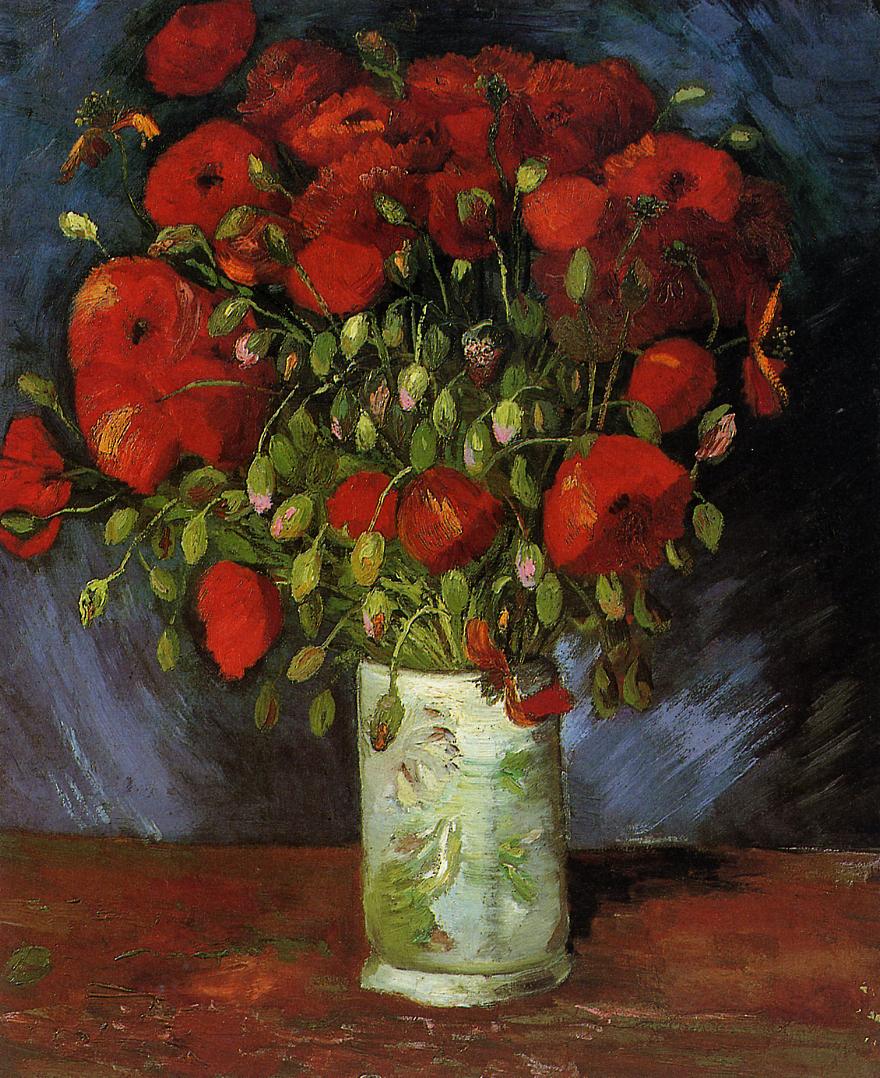
Vase with Viscaria
Paris, summer 1886 · Oil on canvas
 Dutch · 1853-1890
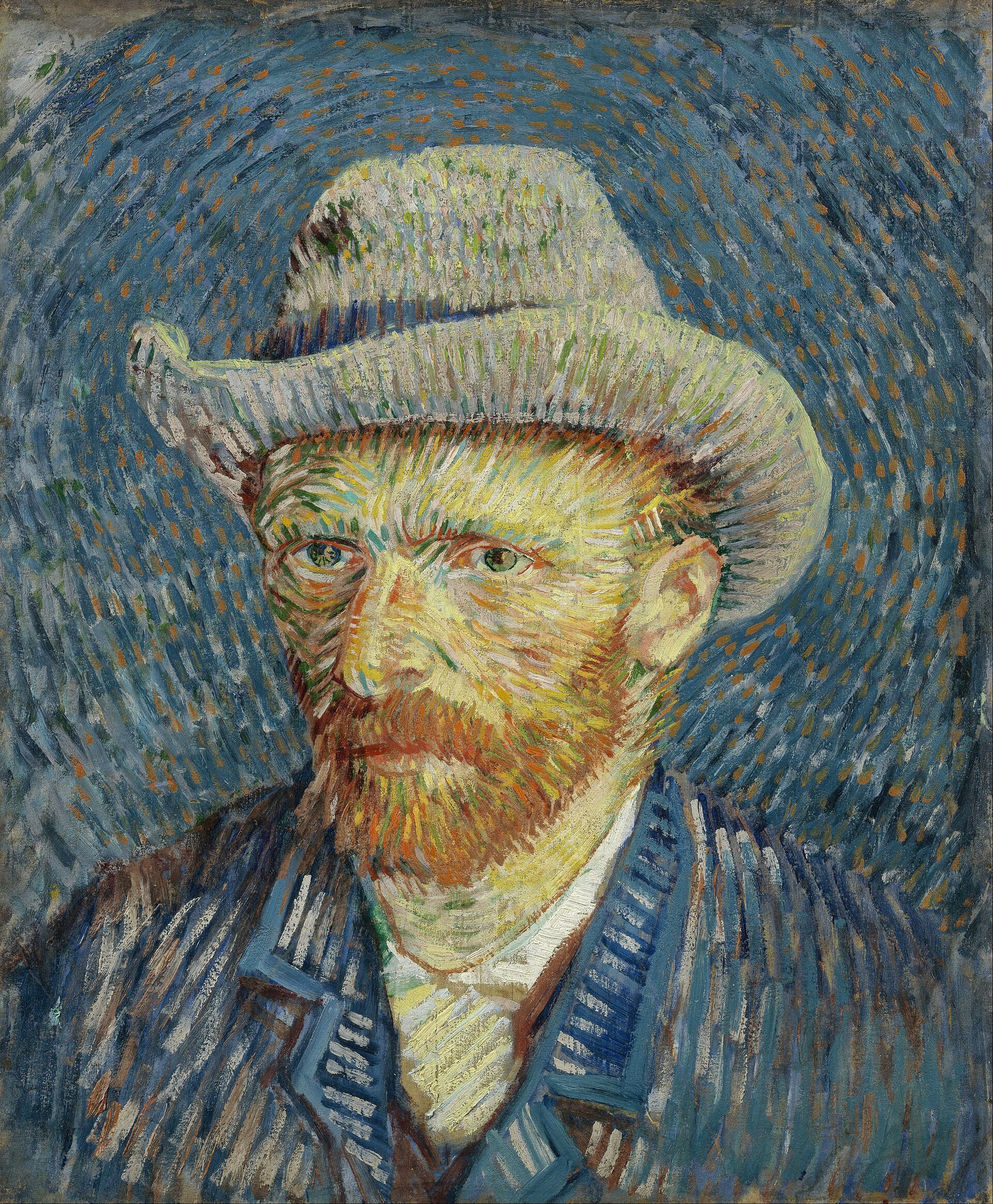
Self-portrait with grey felt hat, September 1887, Van Gogh Museum, Amsterdam. One of more than thirty self-portraits Van Gogh painted, almost all from his own reflection rather than a documented sitting by anyone else; the identification of the sitter as Van Gogh himself is secure and not disputed.
Van Gogh Museum, Amsterdam| Full name | Vincent Willem van Gogh |
|---|---|
| Worked as | Painter, Draughtsman |
| Born | 30 March 1853 · Groot-Zundert, Netherlands |
| Died | 29 July 1890 · Auvers-sur-Oise, France |
| Nationality | Dutch |
| Movement | Post-Impressionism |
| In this archive | 1 artwork |
| Sources | 35 cited |
| Last verified | 17 September 2026 |
About this page 1 artwork in the archive · Last verified 17 September 2026 · 35 sources cited
Vincent van Gogh made almost the whole of his surviving work, roughly 2,100 paintings and drawings, in a single decade that ended with his death at thirty-seven. He sold, so far as the record shows, one painting while he was alive. Everything else about the market that now surrounds his name, the auction records, the museum queues, the reproduction on every surface a picture can be printed on, was built after his death by people who were not him: his brother's widow, who published his letters and lent his pictures to every exhibition she could reach; dealers who found they could sell a story as well as a canvas; and, repeatedly, forgers who found a market ready to believe almost anything wearing his name.
The single fact most readers do not know is that he is one of the most reliably documented artists in this archive and one of the most persistently faked. More than nine hundred of his letters survive, most of them written to his brother Theo, which means his own account of what he painted, when, and why exists for a huge share of the corpus in a way it does not for almost any earlier artist. That same richness of documentation is exactly what a forger needs to fake convincingly, and the case history bears this out: an art dealer's son was convicted of selling thirty-three forged Van Goghs in Berlin in 1932, and the Van Gogh Museum itself was still reversing attributions, in both directions, in 2013 and again in 2024.
This page treats the biography, the corpus, the market and the forgery record as one connected subject, because on Van Gogh they are inseparable: the price the market has been willing to pay is the reason the forgeries kept coming, and the letters that make him unusually well documented are the same evidence that keeps being used to catch them.
Born 30 March in Groot-Zundert, exactly one year to the day after an elder brother, also christened Vincent, was stillborn and given the same name; the surviving Vincent's baptismal register entry carries the same number, 29, as his dead namesake.3
Employed by the art dealers Goupil and Cie in The Hague, London and Paris; dismissed in 1876.3
Works as an unofficial evangelist among coal miners in the Borinage, Belgium; dismissed in 1879 for want of preaching eloquence and excessive identification with the miners' poverty.3
Takes up drawing seriously at age twenty-seven, with almost no formal training.3
Moves to Paris to live with Theo; begins collecting Japanese ukiyo-e prints and absorbing Impressionist and Neo-Impressionist colour theory.33
Moves to Arles in February and rents the Yellow House; Gauguin arrives in October to join him.3
On the night of 23 December, following a confrontation with Gauguin, severs part of his own left ear; hospitalised. Gauguin leaves Arles the next day.3
Voluntarily admits himself to the Saint-Paul-de-Mausole asylum at Saint-Remy-de-Provence in May, where he remains a year.3
The Red Vineyard is bought by Anna Boch at the Les Vingt exhibition in Brussels for 400 francs, the only sale documented in Van Gogh's lifetime.45
Moves to Auvers-sur-Oise in May under the informal care of Dr Paul Gachet; paints roughly 74 pictures and 30-plus drawings in about 70 days.3
Shot in the chest in a wheatfield near Auvers on 27 July; dies 29 July, aged 37. Theo dies six months later, 25 January 1891.329
The Frankfurt Stadel version of Portrait of Dr Gachet passes from Johanna van Gogh-Bonger through several hands and is acquired by the Stadel museum in 1911.21
Johanna van Gogh-Bonger publishes Vincent's letters in three volumes, the foundation of his posthumous reputation.34
Jacob Baart de la Faille publishes the first catalogue raisonne of Van Gogh's work; the same year Otto Wacker exhibits 33 forged Van Goghs in Berlin, some initially accepted into de la Faille's catalogue.67
Otto Wacker convicted of fraud in Berlin; sentenced to 19 months, though the court found only 11 of his paintings definitively forged.6
The Reich Ministry of Public Enlightenment and Propaganda confiscates the Stadel's Portrait of Dr Gachet as degenerate art; it is later sold via Hermann Goering's agent to Franz Koenigs.21
Paul and Marguerite Gachet give their father's version of Portrait of Dr Gachet to the French state; it enters the Musee d'Orsay, accession RF 1949 16.22
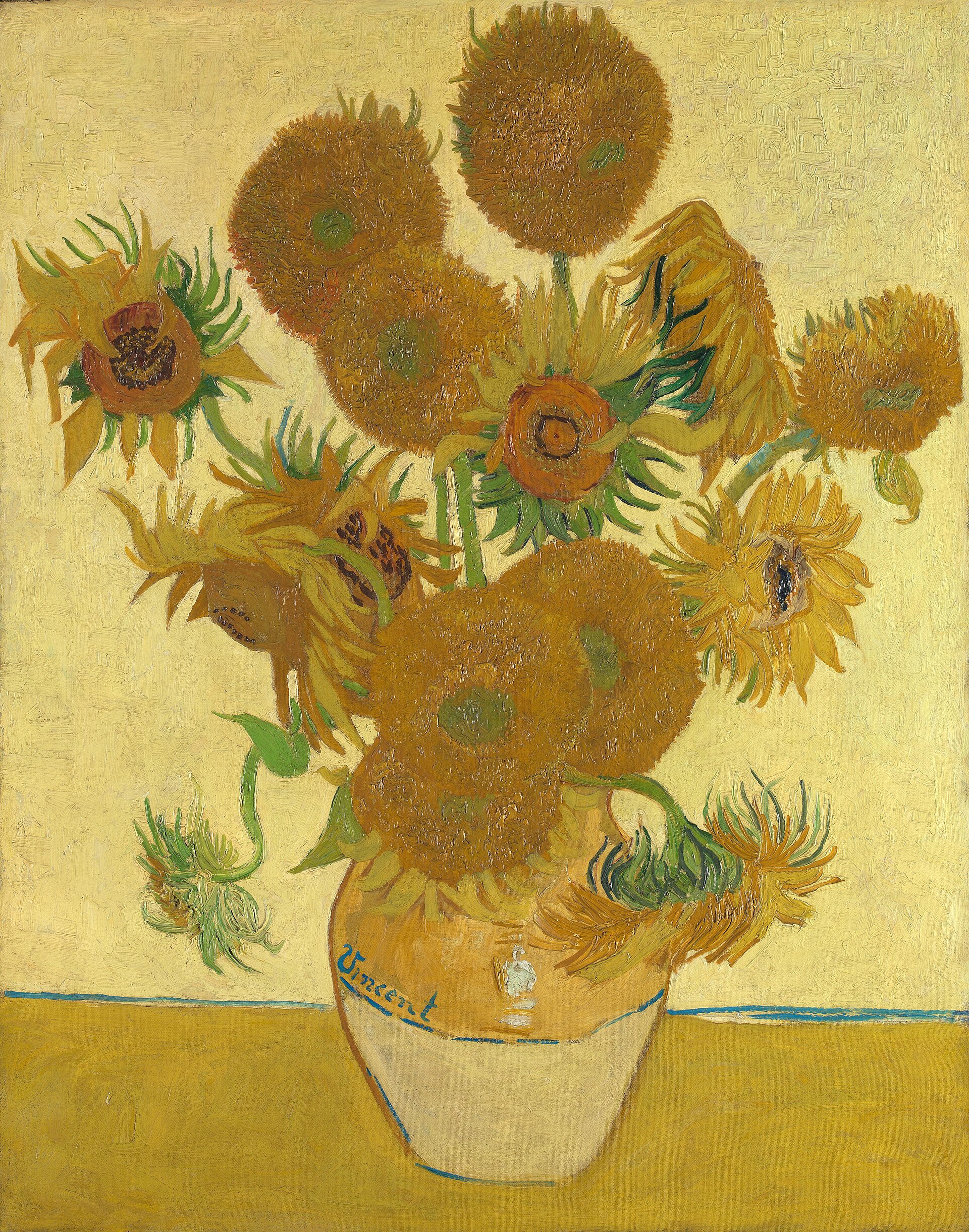
Sunflowers sells at Christie's London (30 March) to Yasuda Fire and Marine Insurance; Irises sells at Sotheby's New York (11 November) for a hammer of 49m dollars plus premium, 53.9m dollars total, to Alan Bond.16171920
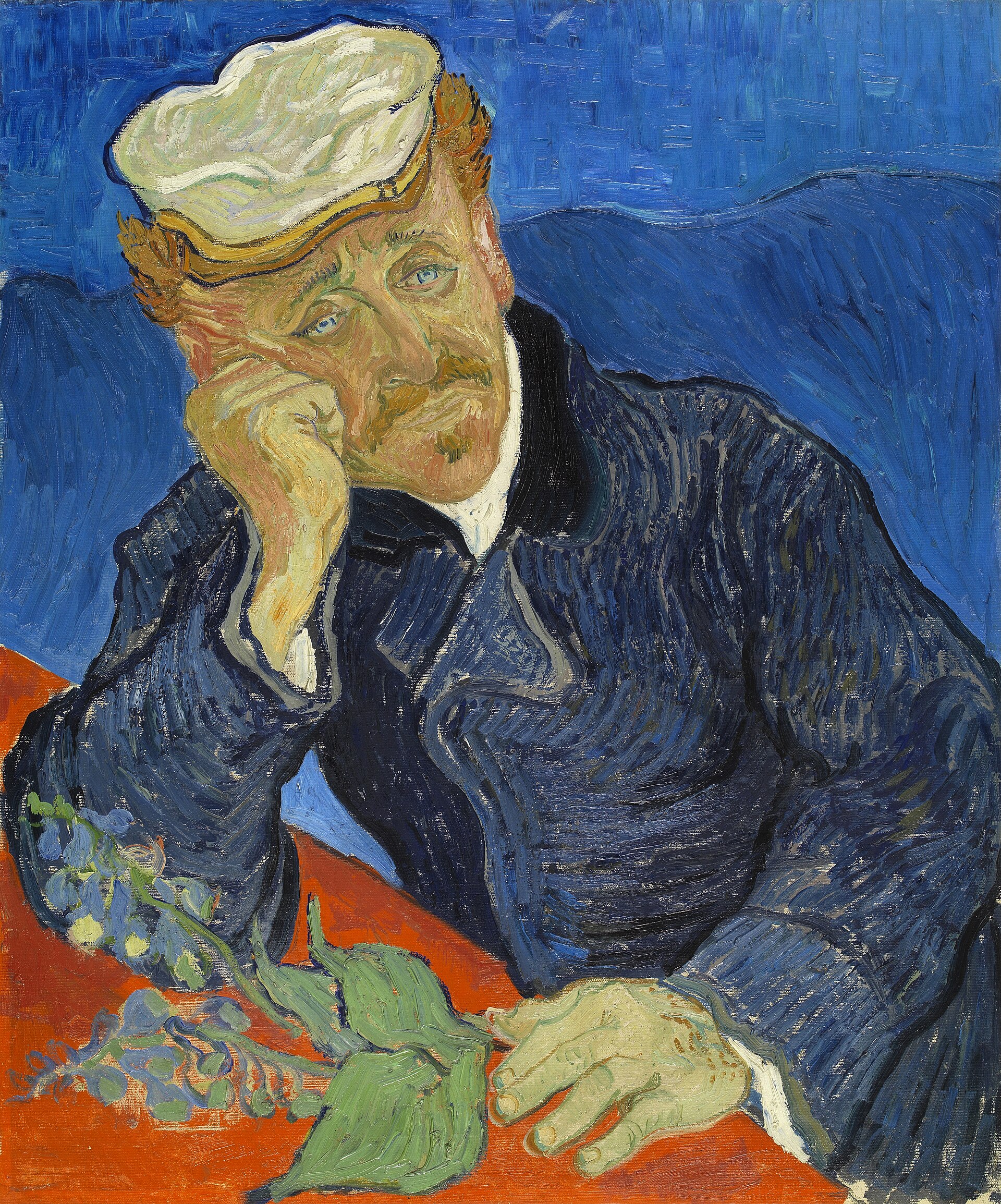
Portrait of Dr Gachet sells at Christie's New York on 15 May for a hammer of 75m dollars plus 10 percent premium, 82.5m dollars total, to Ryoei Saito; still the nominal Van Gogh auction record.2223
View of the Sea at Scheveningen and Congregation Leaving the Reformed Church at Nuenen stolen from the Van Gogh Museum, Amsterdam, on 7 December.25
Poppy Flowers cut from its frame and stolen from the Mohamed Mahmoud Khalil Museum, Cairo, on 21 August; not recovered.2728
The Van Gogh Museum authenticates Sunset at Montmajour, found in a Norwegian collector's attic, the first full-size Van Gogh newly confirmed since 1928.131415
The two Van Gogh Museum paintings stolen in 2002 recovered by Italian anti-mafia police from a property linked to Camorra figure Raffaele Imperiale.2425
Raffaele Imperiale, still a fugitive, publicly claims from hiding that he bought the two recovered Van Goghs for their artistic value rather than as a financial instrument; arrested in Dubai the same year.26
Van Gogh Museum researchers publish findings in The Burlington Magazine reattributing three works, including one the museum had itself previously authenticated, as forgeries.9
Every price that defines Van Gogh's market was set in a five-year window at the height of the late-1980s art boom, and every one of the three headline sales is followed by a second story the initial coverage did not carry. Sunflowers and Irises both sold in 1987; Portrait of Dr Gachet, still the nominal record, sold in 1990. Two of the three buyers could not straightforwardly keep what they had bought: Alan Bond had borrowed against the Irises purchase and could not complete it, and the picture was resold to the J. Paul Getty Museum at an undisclosed price; Ryoei Saito's Gachet vanished from public view after his death and has not been confirmed sighted since 1990.
The sources on the 1987 Sunflowers sale disagree with each other on the figures in a way this record states rather than resolves: contemporary wire reports gave a purchase price of approximately 36.6 million US dollars based on Yasuda's own statement of 22.5 million pounds paid, while the figure that became the standard citation afterward is 24.75 million pounds, 39.9 million dollars. No source consulted cleanly separates a hammer price from a buyer's premium for that specific sale the way Christie's and Sotheby's records do for Irises and Gachet, and this record does not manufacture a split that is not in the sources.
| Date | Sale | Work | Result | Note |
|---|---|---|---|---|
| 30 March 1987 | Christie's | Sunflowers (the Yasuda / Sompo version, a different physical painting from the National Gallery, London version illustrated on this page) | Hammer Reported variously; Yasuda stated 22.5m GBP paid With premium Total reported at 24.75m GBP / 39.9m USD in most later citations; sources do not cleanly separate hammer from premium for this sale GBP | Bought by Yasuda Fire and Marine Insurance to mark its centenary. This version was later the subject of a restitution claim by the heirs of a Jewish banker, alleging a forced Nazi-era sale in its earlier provenance; the claim is separate from, and later than, the 1987 auction. |
| 11 November 1987 | Sotheby's | Irises | Hammer 49m USD With premium 53.9m USD total (10 percent buyer's premium) USD | Bought by the Australian entrepreneur Alan Bond, financed in part by a loan from Sotheby's itself; Bond could not complete payment and the painting was resold to the J. Paul Getty Museum in 1990 for an undisclosed sum. |
| 15 May 1990 | Christie's | Portrait of Dr Gachet (the Frankfurt Stadel / Saito version, formerly Nazi-confiscated; not the Musee d'Orsay version) | Hammer 75m USD With premium 82.5m USD total (10 percent buyer's premium) USD | Bought by Ryoei Saito of Daishowa Paper Manufacturing; still the nominal Van Gogh auction record. Untraced in public since 1990; passed via a Japanese bank to Wolfgang Flottl and then to a deceased Italian collector's estate in Switzerland, per The Art Newspaper's 2019 inquiry. |
Hammer is the price at which the bidding stopped; with premium adds the fee the house charges the buyer on top. Hammer price and buyer's premium in the glossary.
| Institution | City | Holdings | Note |
|---|---|---|---|
| Van Gogh Museum | Amsterdam, Netherlands | 201 paintings, 437 drawings, 31 prints | The largest single collection, built from the estate inherited by Theo's widow Johanna van Gogh-Bonger. |
| Kroller-Muller Museum | Otterlo, Netherlands | Close to 90 paintings, over 180 drawings | The second-largest collection, assembled 1908-1929 by the private collector Helene Kroller-Muller. |
| Musee d'Orsay | Paris, France | Includes the Gachet family's version of Portrait of Dr Gachet, RF 1949 16 | Given directly by Van Gogh to Dr Gachet, and by the Gachet family to the French state in 1949. |
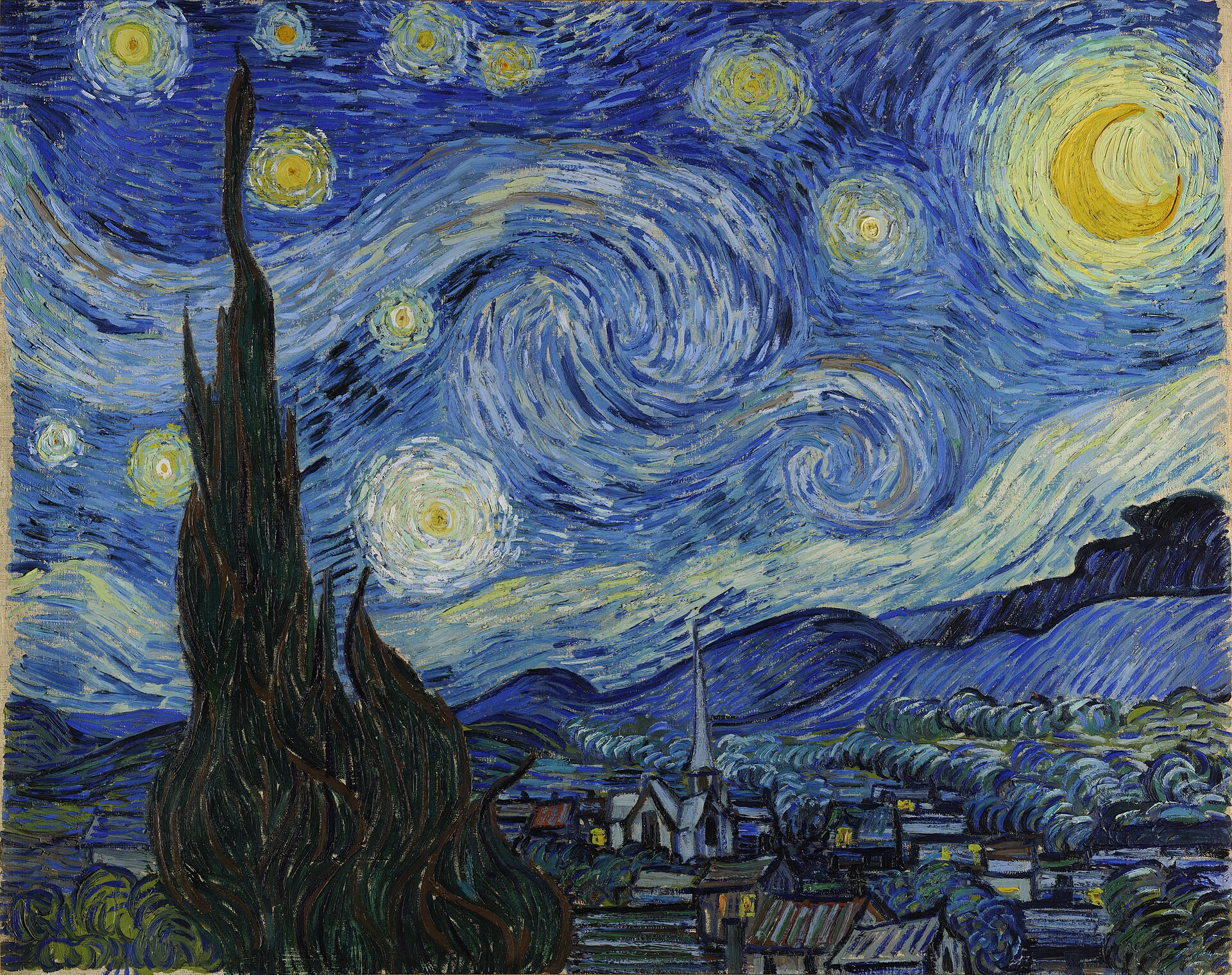
| The Museum of Modern Art | New York, United States | The Starry Night, accession 472.1941 | Dated by Van Gogh's own letter 782 to Theo, on or about 18 June 1889. |
| National Gallery | London, United Kingdom | Sunflowers, accession NG3863 | Bought with the Courtauld Fund, 1924. A different physical painting from the Yasuda/Sompo version sold at auction in 1987. |
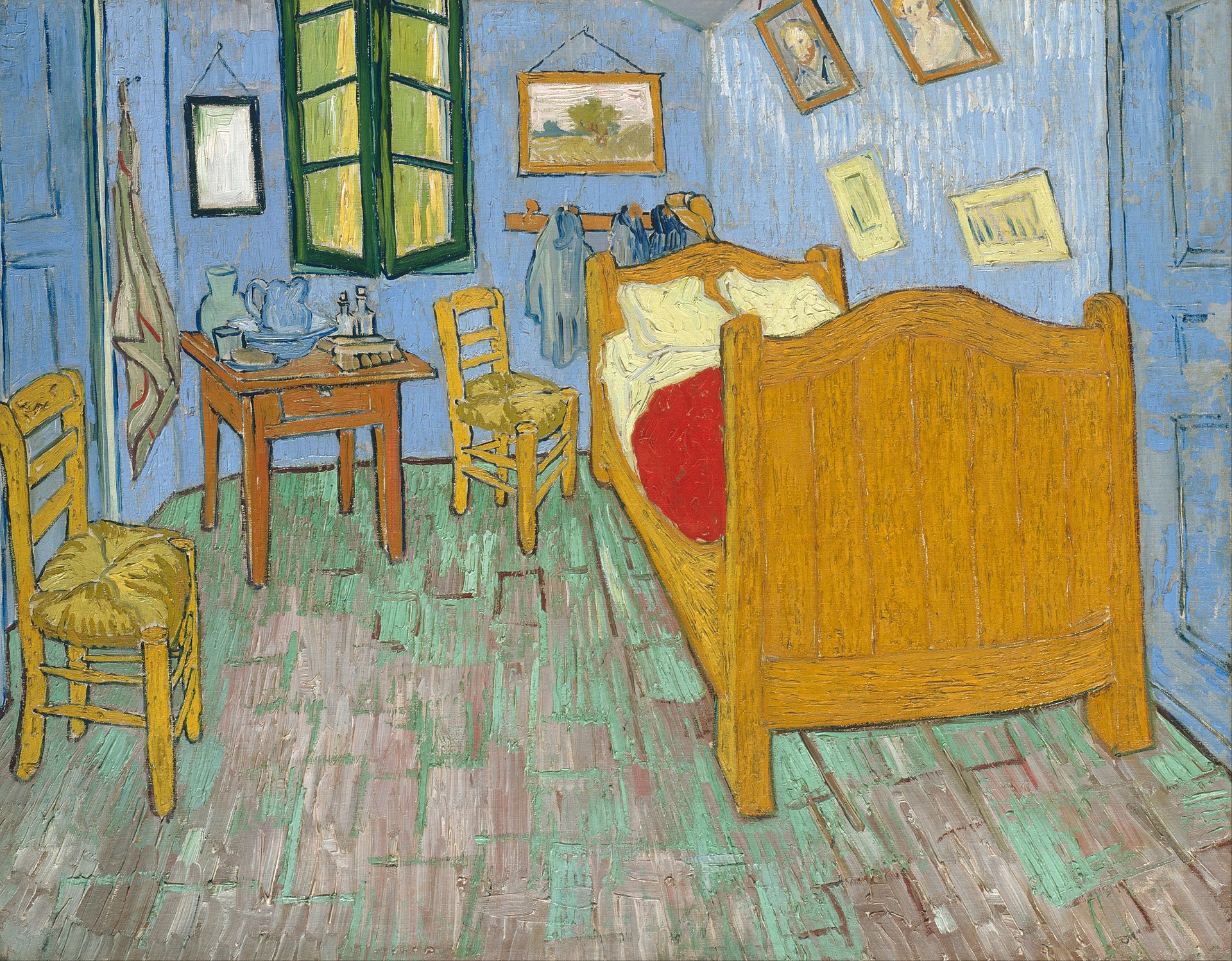
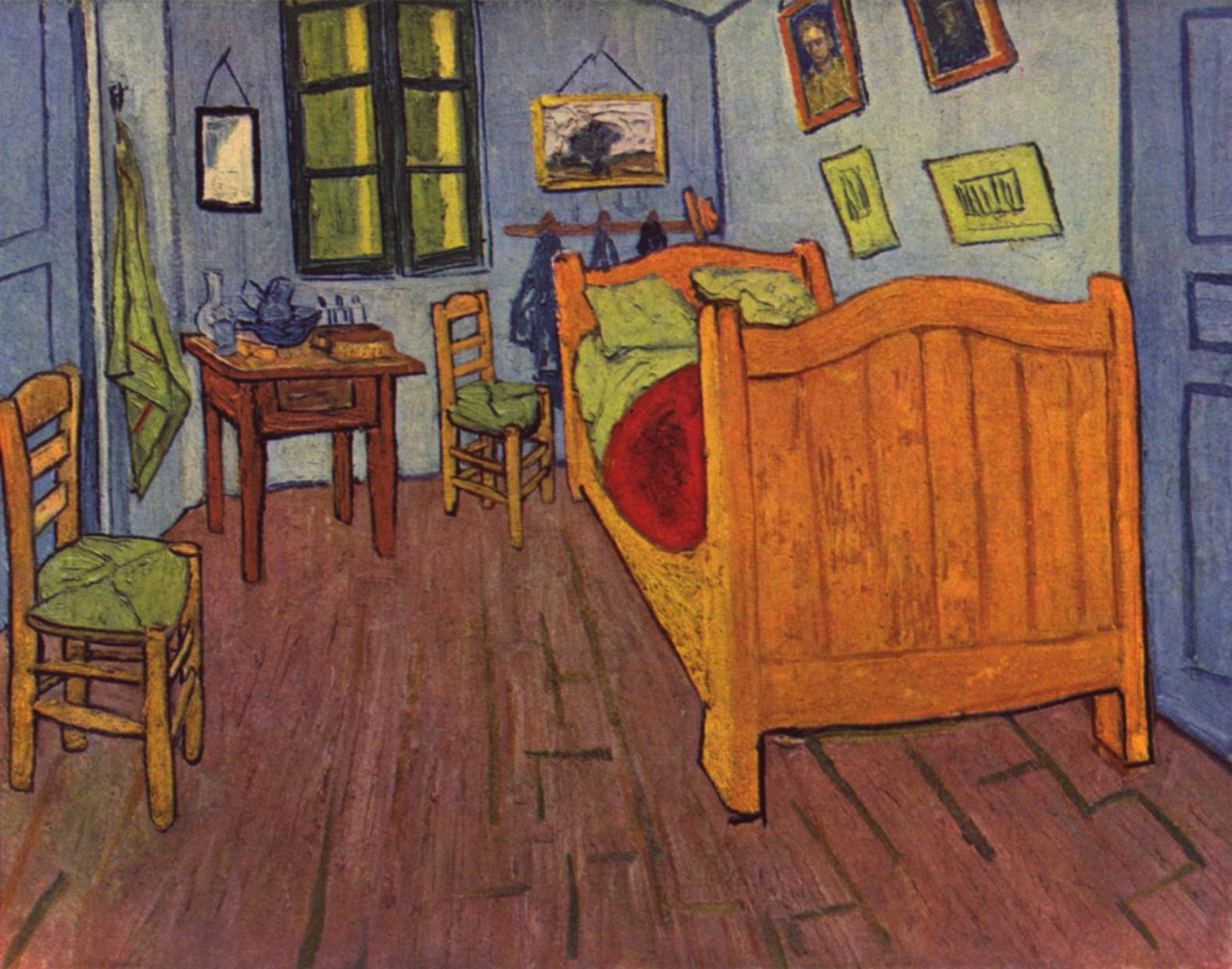
| The Art Institute of Chicago and Kroller-Muller Museum | Chicago and Otterlo | Two of the three surviving versions of The Bedroom | The third and first-painted version, October 1888, is at the Van Gogh Museum, Amsterdam; a fourth related work, a letter sketch, is privately held. |
Van Gogh was the son of a Dutch Reformed Church minister, Theodorus van Gogh, and before he painted anything he tried, seriously and at length, to enter his father's profession.
Van Gogh was the son of a Dutch Reformed Church minister, Theodorus van Gogh, and before he painted anything he tried, seriously and at length, to enter his father's profession. He worked for the art dealers Goupil and Cie in The Hague, London and Paris from 1869, was dismissed in 1876, then trained briefly for the ministry in Amsterdam and failed the entrance requirements. In 1878 he took unofficial evangelist work among coal miners in the Borinage, a mining district of southern Belgium, living in conditions as poor as the men he was sent to serve.
He was dismissed from that post in 1879, officially for a want of preaching eloquence, in practice because his superiors judged his identification with the miners' poverty excessive and undisciplined. He did not abandon the religious cast of mind that had taken him there; he redirected it. He told Theo, in the correspondence that is now the primary source for nearly everything known about him, that painting had become his way of doing the same work by other means. He took up drawing seriously in 1880, at twenty-seven, with almost no formal training, and had ten years left to live.
Nothing in Van Gogh's career happened without his younger brother Theo, who worked for most of his life as a dealer at Boussod, Valadon and Cie in Paris, the successor firm to Goupil where both...
Nothing in Van Gogh's career happened without his younger brother Theo, who worked for most of his life as a dealer at Boussod, Valadon and Cie in Paris, the successor firm to Goupil where both brothers had trained. From 1880 until Vincent's death, Theo sent money every month, without which there would have been no paint, no canvas and no rent. The arrangement was not charity in one direction only: the surviving letters record Vincent treating the paintings he sent to Paris as partial repayment, and Theo treating his brother's work as a professional investment he believed in years before anyone else did.
The relationship extended to the trade itself. Julien Tanguy, a Paris paint supplier known as Pere Tanguy, regularly accepted paintings in exchange for pigments and canvas rather than cash, and displayed the work of young painters, Van Gogh among them, in his shop window on the Rue Clauzel. Van Gogh painted three portraits of him. This was the actual commercial floor Van Gogh's work traded on in his lifetime: barter with a colour merchant and subsidy from a brother, not sales to collectors.
The claim that Van Gogh sold exactly one painting in his lifetime is close to the documented truth, though not perfectly exact: there is fragmentary evidence that a self-portrait was bought by the...
The claim that Van Gogh sold exactly one painting in his lifetime is close to the documented truth, though not perfectly exact: there is fragmentary evidence that a self-portrait was bought by the London dealers Arthur Sulley and William Lawrie, a transaction too thinly recorded to build a claim on. The one sale that is fully documented is The Red Vineyard, shown at the Les Vingt exhibition in Brussels in 1890 and bought there by the Belgian painter and collector Anna Boch for 400 francs, a few months before Van Gogh's death.
The picture's later history is itself a measure of how completely the market reassessed him after 1890. In 1909, not twenty years later, it sold again for 30,000 francs to the Moscow textile manufacturer and collector Ivan Morozov, seventy-five times what Boch had paid. It hung in Russia through the revolution and nationalisation of Morozov's collection and remains there today, in the Pushkin State Museum of Fine Arts, Moscow: the only painting Van Gogh is reliably documented to have sold while he lived is also one that has not left Russia since 1909.
Van Gogh moved to Arles in the south of France in February 1888, renting the building he called the Yellow House with the plan of founding a working colony of painters.
Van Gogh moved to Arles in the south of France in February 1888, renting the building he called the Yellow House with the plan of founding a working colony of painters. Paul Gauguin, whom he had met in Paris in November 1887, arrived to join him in October 1888. The two men worked together for nine weeks in a partnership that deteriorated into open conflict.
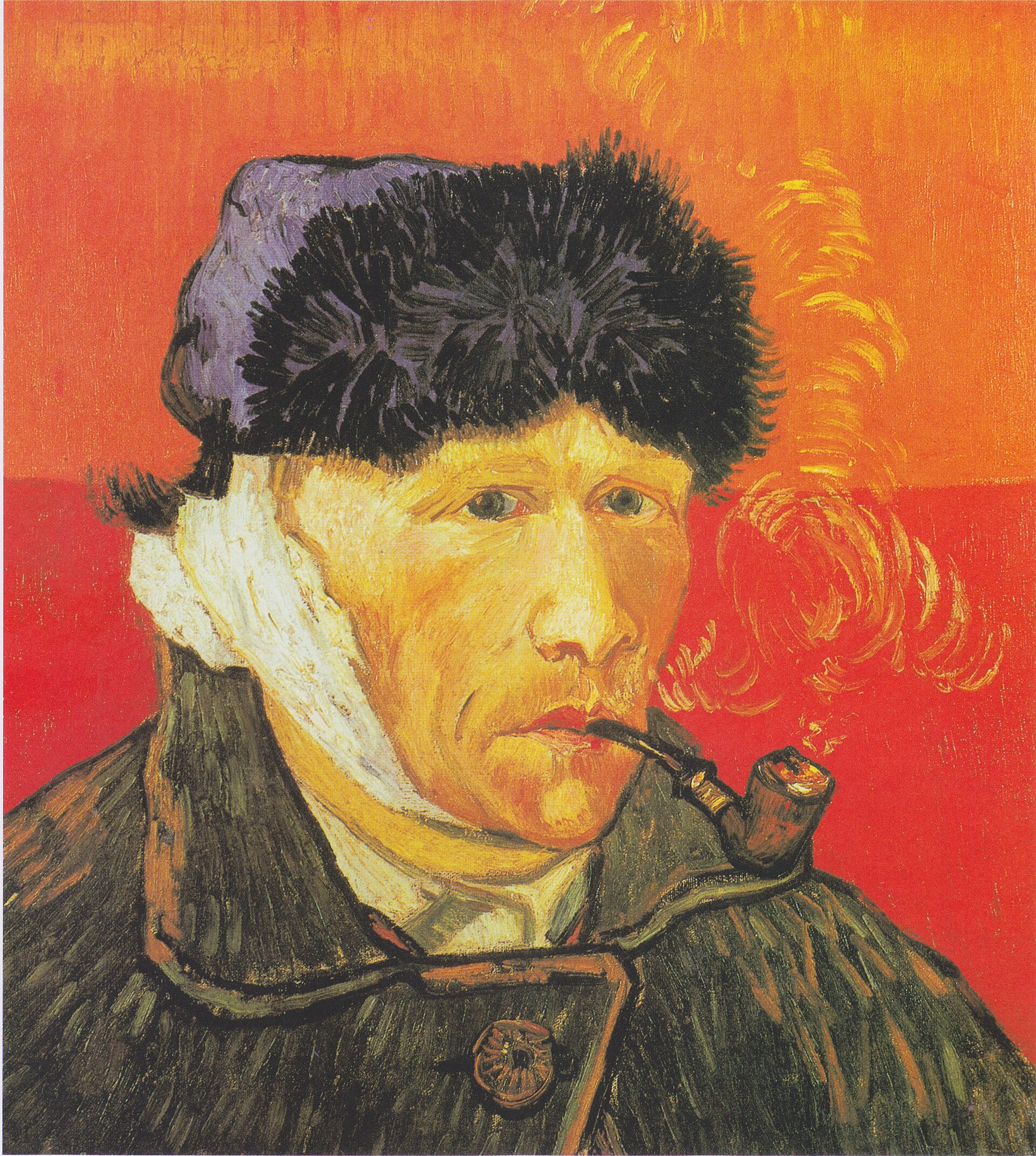
On the night of 23 December 1888, following a confrontation with Gauguin, Van Gogh cut off part of his own left ear with a razor and delivered it, wrapped, to a woman at a brothel in the town. He was hospitalised, Gauguin left for Paris the next day and the two men never met again, though they continued to correspond. Van Gogh committed himself voluntarily to the asylum of Saint-Paul-de-Mausole at Saint-Remy-de-Provence in May 1889, where he remained a year, painting between episodes of illness whose exact diagnosis is still argued over by his biographers and by physicians who have retrospectively proposed epilepsy, bipolar disorder, porphyria and other conditions without settling on one.
Van Gogh left Saint-Remy in May 1890 and settled in Auvers-sur-Oise, north of Paris, under the informal medical supervision of Dr Paul Gachet, an amateur painter and physician with existing...
Van Gogh left Saint-Remy in May 1890 and settled in Auvers-sur-Oise, north of Paris, under the informal medical supervision of Dr Paul Gachet, an amateur painter and physician with existing connections to the Impressionist circle. In the roughly seventy days between his arrival and his death he produced about seventy-four paintings and more than thirty drawings, a rate of output the Van Gogh Museum itself has called without precedent in his career, let alone in painting generally.
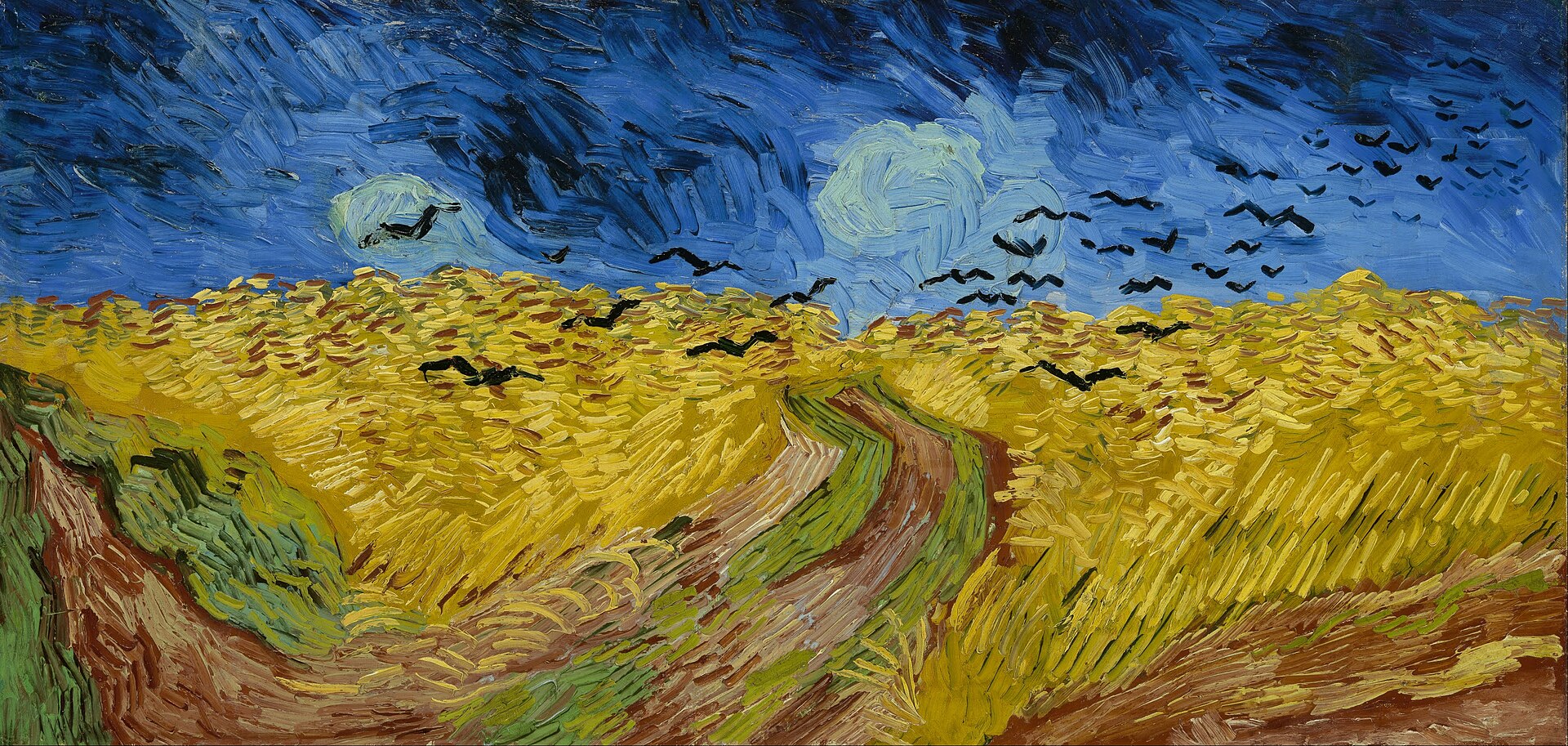
He died on 29 July 1890, two days after being found with a gunshot wound to the chest in a wheatfield near Auvers, aged thirty-seven. The wound was fatal but not immediately so; he walked back to his lodgings and lived for roughly thirty hours, during which, by Theo's own later account, he stated that he had shot himself and that no one else was to be blamed. Theo died six months later, on 25 January 1891, of complications related to syphilis; his widow, Johanna van Gogh-Bonger, inherited both men's estates and with them the task of making Vincent's reputation, which she then spent the rest of her working life building.
The standard account, resting on Theo's contemporary letters and the near-universal reading of Van Gogh scholarship since, is that Van Gogh shot himself.
The standard account, resting on Theo's contemporary letters and the near-universal reading of Van Gogh scholarship since, is that Van Gogh shot himself. It is not, however, unanimous. In their 2011 biography Van Gogh: The Life, the American writers Steven Naifeh and Gregory White Smith argued that Van Gogh was shot accidentally, or was killed, by Rene Secretan, a sixteen-year-old Parisian on a summer visit to Auvers who owned a malfunctioning revolver and who, with friends, had a documented habit of taunting Van Gogh. Naifeh and Smith's case rests on circumstantial and forensic points: the awkward angle and range of the wound for a self-inflicted shot, the fact that the gun and Van Gogh's painting equipment were never recovered from the field, and Secretan's own later evasiveness when asked about that summer.
The theory has not been accepted by the Van Gogh Museum or by the majority of specialists who have examined it, who point to the weight Theo's contemporaneous letters carry as first-hand testimony and to the absence of any period source naming Secretan. It has not, either, been disproved. This page states both positions and their proponents rather than adopting one, because the underlying evidence, a bullet wound with no recovered weapon and a hundred and thirty-five years of distance, does not currently support a closed answer.
In January 1928 the Berlin dealer Paul Cassirer exhibited a group of newly surfaced Van Gogh paintings supplied by a young art impresario named Otto Wacker, who told buyers the works came from an...
In January 1928 the Berlin dealer Paul Cassirer exhibited a group of newly surfaced Van Gogh paintings supplied by a young art impresario named Otto Wacker, who told buyers the works came from an anonymous Russian aristocrat too fearful of Soviet reprisal to be named. The exhibition coincided, by design, with the publication of the first catalogue raisonne of Van Gogh's work by the Dutch scholar Jacob Baart de la Faille, who had initially accepted the Wacker pictures into his catalogue.
Specialists denounced the paintings as fakes almost as soon as they went on public view. De la Faille withdrew his acceptance in an addendum and in 1930 published Les Faux Van Gogh, listing 174 works he now regarded as forgeries, the Wacker group among them. Wacker was tried in Berlin in April 1932, convicted of fraud, and sentenced to nineteen months in prison, though the court found that only eleven of the paintings could be definitively proven forgeries, a gap between the criminal standard of proof and the connoisseurship standard that has never fully closed. The episode is generally credited, alongside the surge in Van Gogh's posthumous prices in the same period, with making him one of the two or three most forged painters in history: The Art Newspaper's own 1997 investigation estimated at least forty-five paintings then in circulation as Van Goghs were not genuine.
Attribution on Van Gogh has not settled into a fixed list.
Attribution on Van Gogh has not settled into a fixed list. In September 2013 the Van Gogh Museum authenticated Sunset at Montmajour, a large landscape that had sat in a Norwegian collector's attic for over sixty years after the museum's own predecessor institution declined to confirm it in 1991. The 2013 reversal used a technique developed with Cornell University that matches a canvas's weave pattern to the bolt of cloth it was cut from, combined with a letter in which Van Gogh described painting the exact scene on 4 July 1888. It was the first full-size Van Gogh painting newly confirmed since 1928, the same year Wacker's fakes surfaced.
The movement has not run only one way. In October 2024 Van Gogh Museum researchers published findings in The Burlington Magazine reattributing three works long treated as genuine: a copy of Interior of a Restaurant identified by anomalous brushwork and a pigment, manganese blue, not patented until 1935; a watercolour, The Wood Gatherer, shown to have been copied from a photograph rather than drawn from life; and, most consequentially, a painting called Head of a Woman that the Van Gogh Museum had itself authenticated and that sold at Christie's in 2011 for 993,250 US dollars. A museum's own prior authentication is not, on this evidence, the end of the question.
Three sales define Van Gogh's auction history and all three date from a five-year window at the top of the late-1980s art boom.
Three sales define Van Gogh's auction history and all three date from a five-year window at the top of the late-1980s art boom. In each case the coverage that followed the hammer moved on to the next record within months, and in each case what happened to the picture afterward is at least as informative as the price.
Portrait of Dr Gachet still holds the nominal auction record for a Van Gogh, sold at Christie's New York on 15 May 1990 to the Japanese industrialist Ryoei Saito for a hammer price of 75 million US dollars plus a ten percent buyer's premium, a total of 82.5 million dollars. Saito later said in public that he wished the painting cremated with him when he died; he denied it was a serious intention, but after his death in 1996 the picture disappeared from public view. It was sold privately, after his death, to the Austrian financier Wolfgang Flottl, and from Flottl, after his own financial collapse, to an Italian collector resident in Switzerland who has since died; his family, which manages the estate privately, has not made the painting's location public. No independent institution has confirmed sighting it since 1990.
Version safety matters as much for Van Gogh's own work as for any other artist represented more than once on this archive.
Version safety matters as much for Van Gogh's own work as for any other artist represented more than once on this archive. Van Gogh painted two versions of Portrait of Dr Gachet at Auvers in June 1890. The version Saito bought in 1990 was first sold by Van Gogh's sister-in-law Johanna van Gogh-Bonger in 1897 and was acquired in 1911 by the Stadel museum in Frankfurt, where it hung until 1933. In 1937 the Reich Ministry of Public Enlightenment and Propaganda confiscated it from the Stadel as part of the campaign against what the regime called degenerate art; Hermann Goering's agent Sepp Angerer subsequently sold it in Paris to the collector Franz Koenigs, and it passed through several further hands before reaching Saito in 1990. It is, in other words, a Nazi-confiscated deaccession before it was ever an auction record.
The second version was never on the market in the same sense. Van Gogh gave it directly to Dr Gachet, whose children Paul and Marguerite Gachet gave it to the French state in 1949; it hangs today at the Musee d'Orsay, accessioned RF 1949 16. The two paintings are close in composition but are two different physical objects with two entirely different twentieth-century histories, and captions or reproductions that do not specify which version they show are a live source of the confusion this archive exists to correct.
Two Van Gogh paintings have been stolen from public museums in the last twenty-five years with outcomes that could not be more different.
Two Van Gogh paintings have been stolen from public museums in the last twenty-five years with outcomes that could not be more different. Poppy Flowers, also called Vase with Viscaria, was cut from its frame at the Mohamed Mahmoud Khalil Museum in Cairo on 21 August 2010; Egyptian police initially announced a recovery at Cairo airport within hours and then retracted the claim as based on false information. It has not been recovered and its whereabouts remain unknown; this archive holds a separate record for that specific painting.
View of the Sea at Scheveningen and Congregation Leaving the Reformed Church at Nuenen were stolen from the Van Gogh Museum in Amsterdam on 7 December 2002. They surfaced fourteen years later, in September 2016, when Italian anti-mafia police raided a farmhouse near Castellammare di Stabia belonging to the family of Raffaele Imperiale, a fugitive figure in the cocaine-trafficking Amato Pagano clan of the Camorra. Imperiale was later reported to have paid around 350,000 euros for the paintings in 2003 and, on his eventual arrest in Dubai, claimed he had bought them for their artistic value rather than as a financial instrument. Both paintings were restored to the Van Gogh Museum and are back on public display.
Van Gogh collected Japanese ukiyo-e woodblock prints in large numbers from his time in Antwerp and Paris in the mid-1880s, organised a public exhibition of them at the Cafe du Tambourin in Paris, and...
Van Gogh collected Japanese ukiyo-e woodblock prints in large numbers from his time in Antwerp and Paris in the mid-1880s, organised a public exhibition of them at the Cafe du Tambourin in Paris, and copied several directly, including Utagawa Hiroshige's Plum Park in Kameido and Sudden Shower over Shin-Ohashi Bridge. He never travelled to Japan. What he built instead, documented at length in his letters to Theo and to Gauguin, was an imagined Japan he treated as a working model: flat, saturated colour applied in unmodulated fields rather than European tonal gradation, compositions cropped and tilted the way the prints cropped and tilted their own subjects, and an idea of Japanese artists as a community of craftsmen sharing techniques rather than competing individual geniuses, which is explicitly how he wanted the Yellow House colony in Arles to work.
The debt is visible without needing to be argued for: the diagonal, cropped composition of The Sower, the flattened perspective of Almond Blossom, painted for his newborn nephew in 1890, and the outlined, poster-like colour blocks of the Pere Tanguy portraits, which include miniature ukiyo-e prints as background detail, stating the source inside the picture itself.
Van Gogh worked in thick, often unmixed paint applied directly from the tube, frequently with visible directional brushstrokes that function as part of the image's structure rather than as texture...
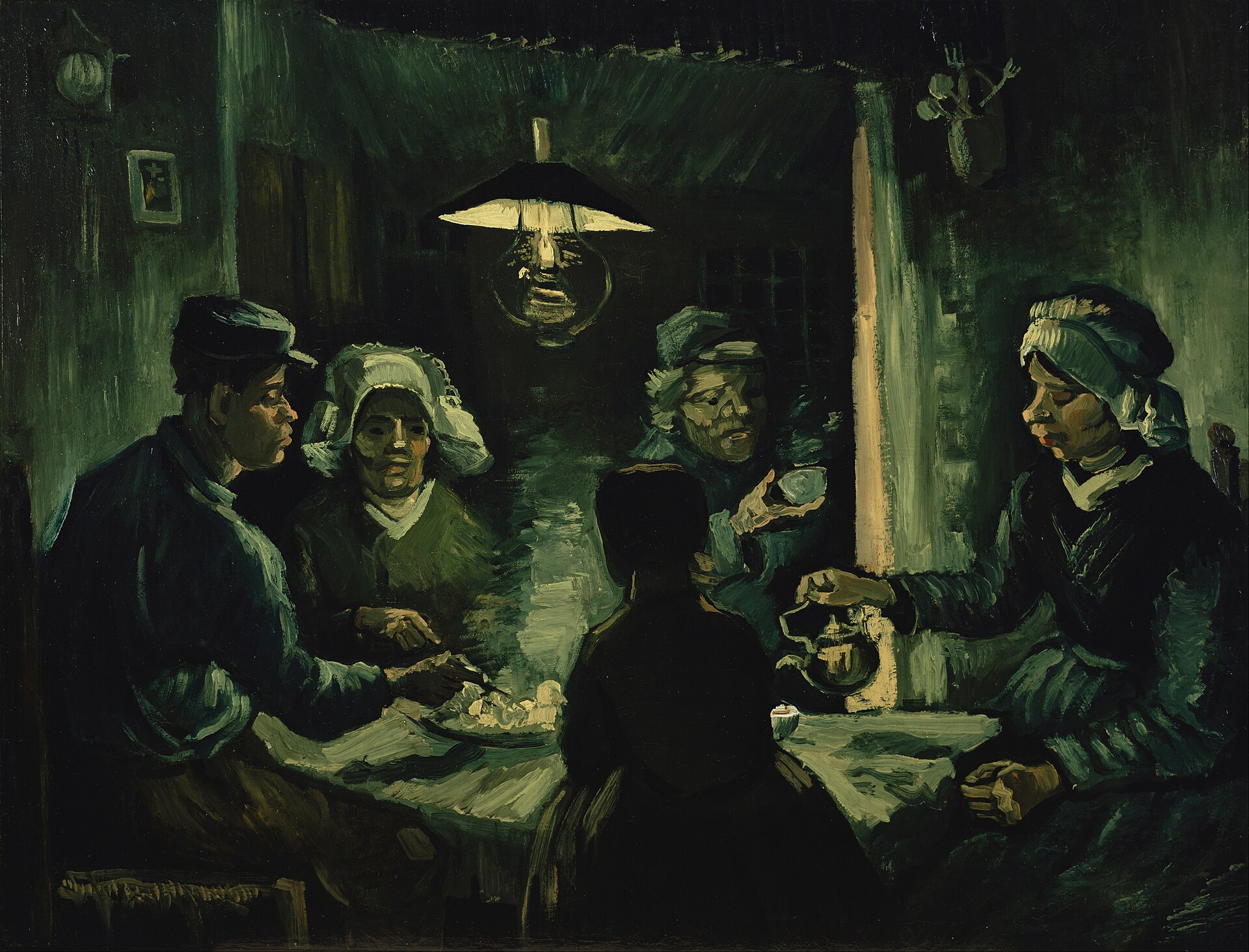
Van Gogh worked in thick, often unmixed paint applied directly from the tube, frequently with visible directional brushstrokes that function as part of the image's structure rather than as texture alone; his letters describe deliberately pursuing complementary colour contrast, blue against orange, yellow against violet, in terms drawn from Eugene Delacroix's colour theory, which he studied seriously rather than absorbing casually. The technique is diagnostic enough that connoisseurs and, more recently, technical imaging use brush rhythm and paint application as primary evidence in attribution disputes, including the 2024 Van Gogh Museum reattributions.
The chrome yellow pigment central to that palette is chemically unstable in one of its common forms. Synchrotron X-ray studies published in 2016 identified two chrome yellow types in the Van Gogh Museum's Sunflowers: a lightfast lead chromate and a sulfur-substituted variant prone to photo-induced reduction, in which hexavalent chromium converts to a trivalent form and the paint's bright yellow shifts toward brownish green. The change is not yet visible to a visitor's eye but has been measured directly in the paint layer, and conservators now manage light exposure on the affected works specifically because of it: a nineteenth-century colour choice is still actively degrading in twenty-first-century museum conditions.
Painter; Draughtsman. 1853-1890.
Born 30 March 1853, Groot-Zundert, Netherlands; died 29 July 1890, Auvers-sur-Oise, France.
The Wacker affair, Berlin, 1928-1932. Dealer Otto Wacker sold 33 paintings he claimed came from an unnamed Russian collector, exhibited at Paul Cassirer's Berlin gallery to coincide with the publication of J.-B. de la Faille's first catalogue raisonne, which had initially accepted them.
Van Gogh Museum (Amsterdam, Netherlands); Kroller-Muller Museum (Otterlo, Netherlands); Musee d'Orsay (Paris, France); The Museum of Modern Art (New York, United States); National Gallery (London, United Kingdom); The Art Institute of Chicago and Kroller-Muller Museum (Chicago and Otterlo).
Every price that defines Van Gogh's market was set in a five-year window at the height of the late-1980s art boom, and every one of the three headline sales is followed by a second story the initial coverage did not carry. Sunflowers and Irises both sold in 1987; Portrait of Dr Gachet, still the nominal record, sold in 1990.
Where is the Frankfurt Stadel / Saito version of Portrait of Dr Gachet now. Untraced by any public institution since the 1990 Christie's sale; The Art Newspaper's 2019 inquiry traced it to a deceased Italian collector's estate in Switzerland without confirming a current location.
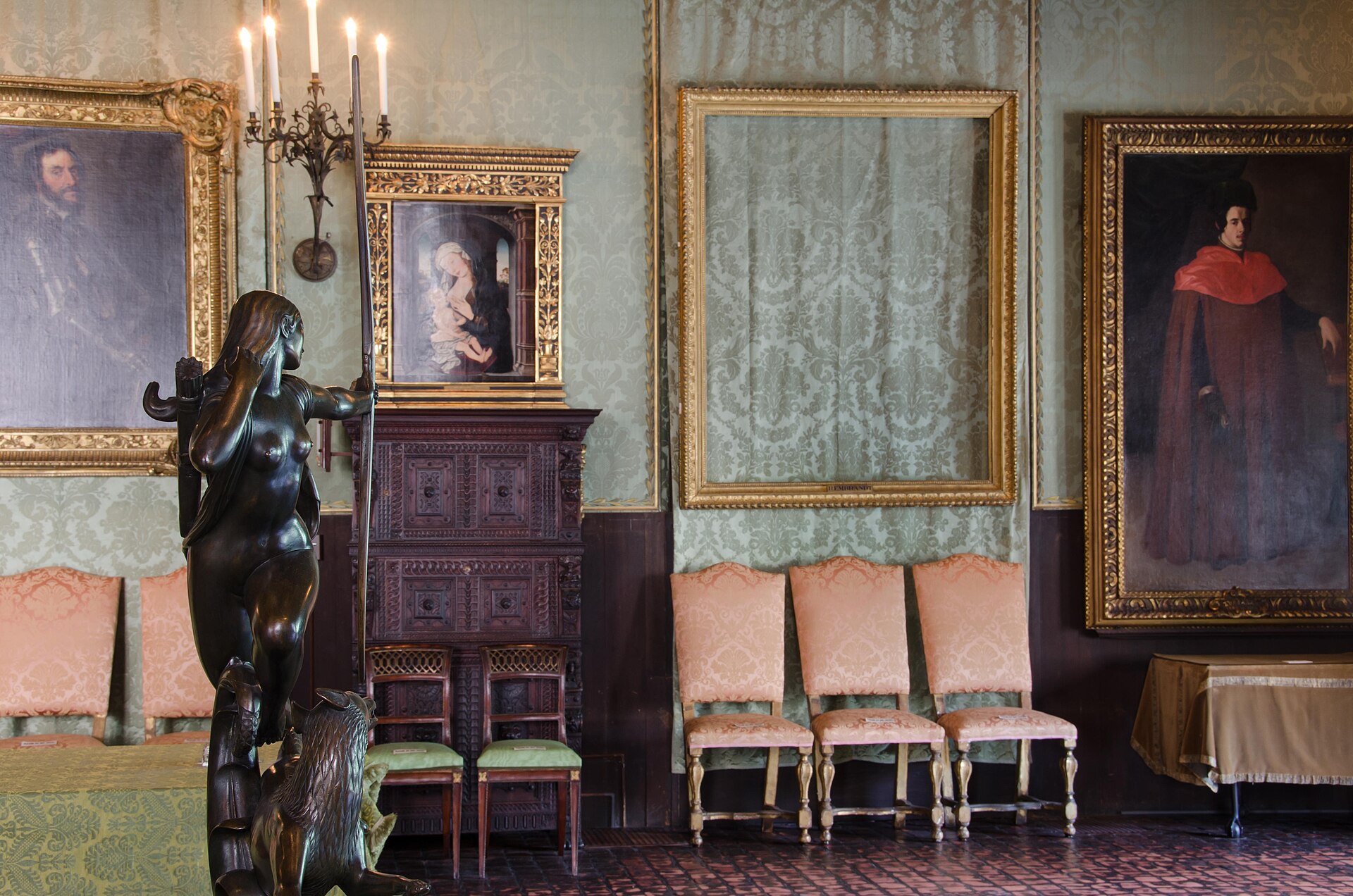
Four objects in this archive are unlocated. Every one still carries a live institutional record, and one of them still carries a...
10 min read
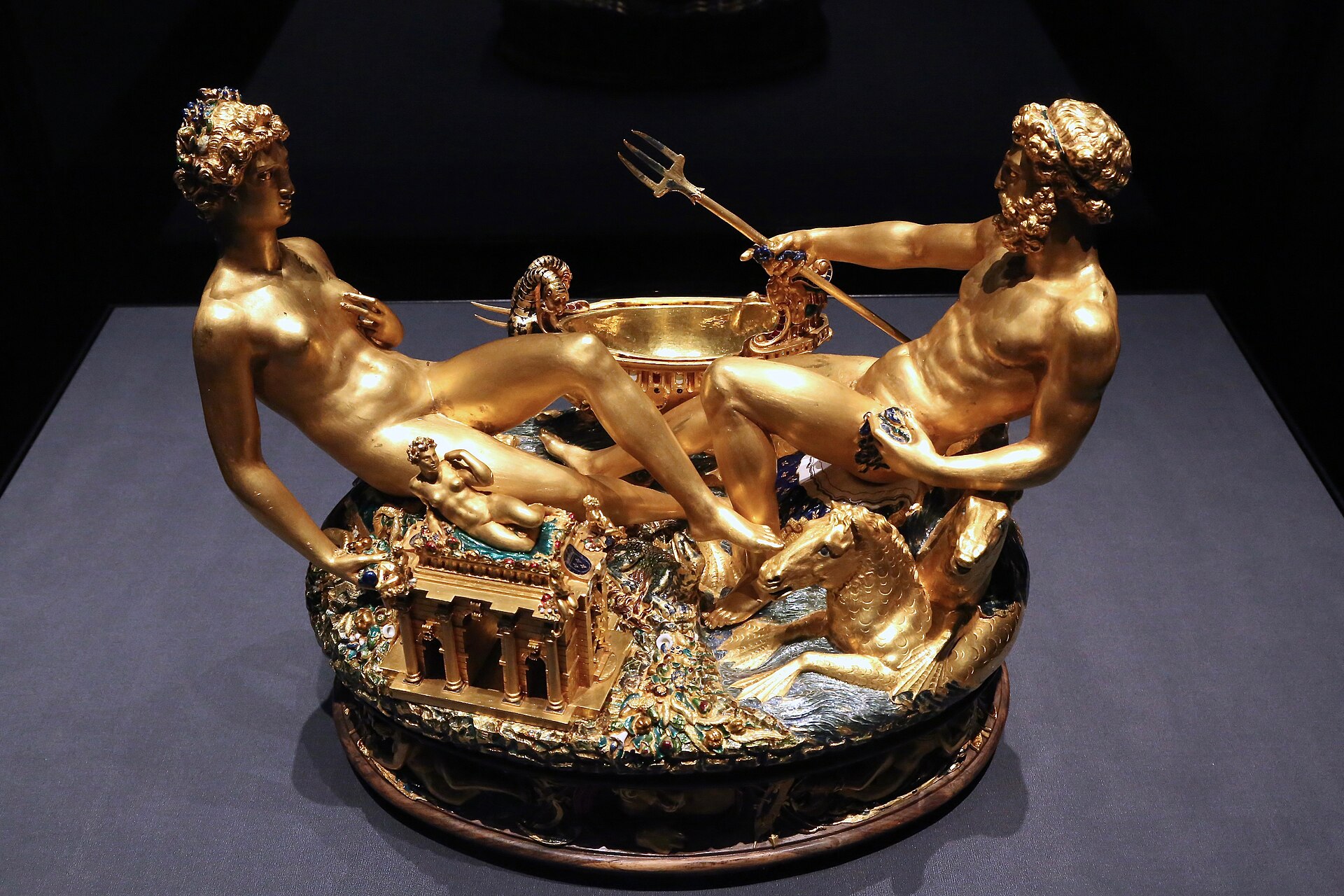
Ten objects in this archive were stolen, some twice. In no case does the thief appear as an owner.
11 min read
Ten records carry evidence on a frame. Van Eyck's integral frames date the panels to 1410-1440; a 1970 loan label on a frame in...
10 min read
Last verified 17 September 2026
One artwork and its story every Tuesday, with the picture: who owned it, what it made, and what closes soon in the exhibition calendar. No promotion, and nothing we cannot cite.
We send one email to confirm the address and keep nothing else. Every letter carries a one-click unsubscribe. How we handle your data.