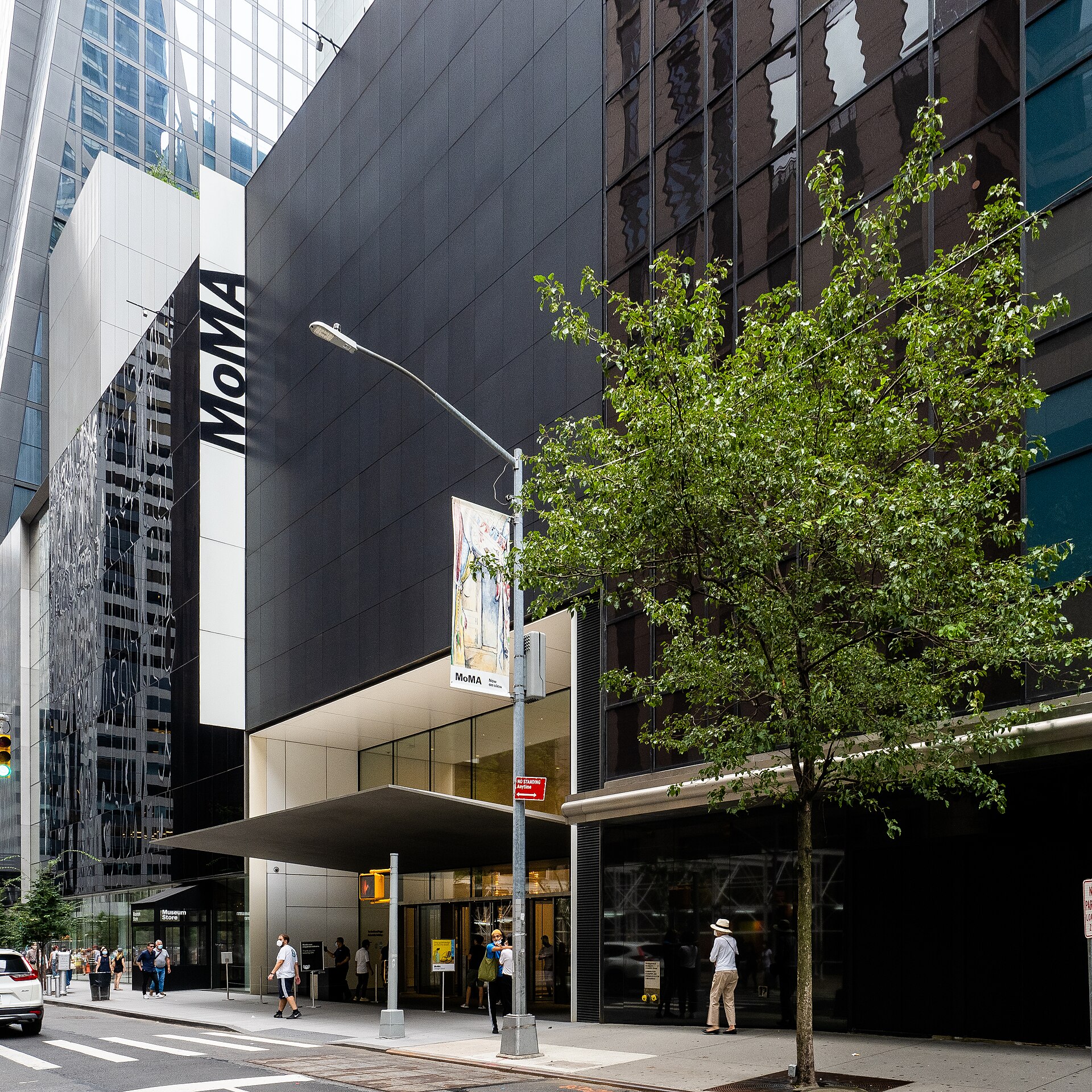
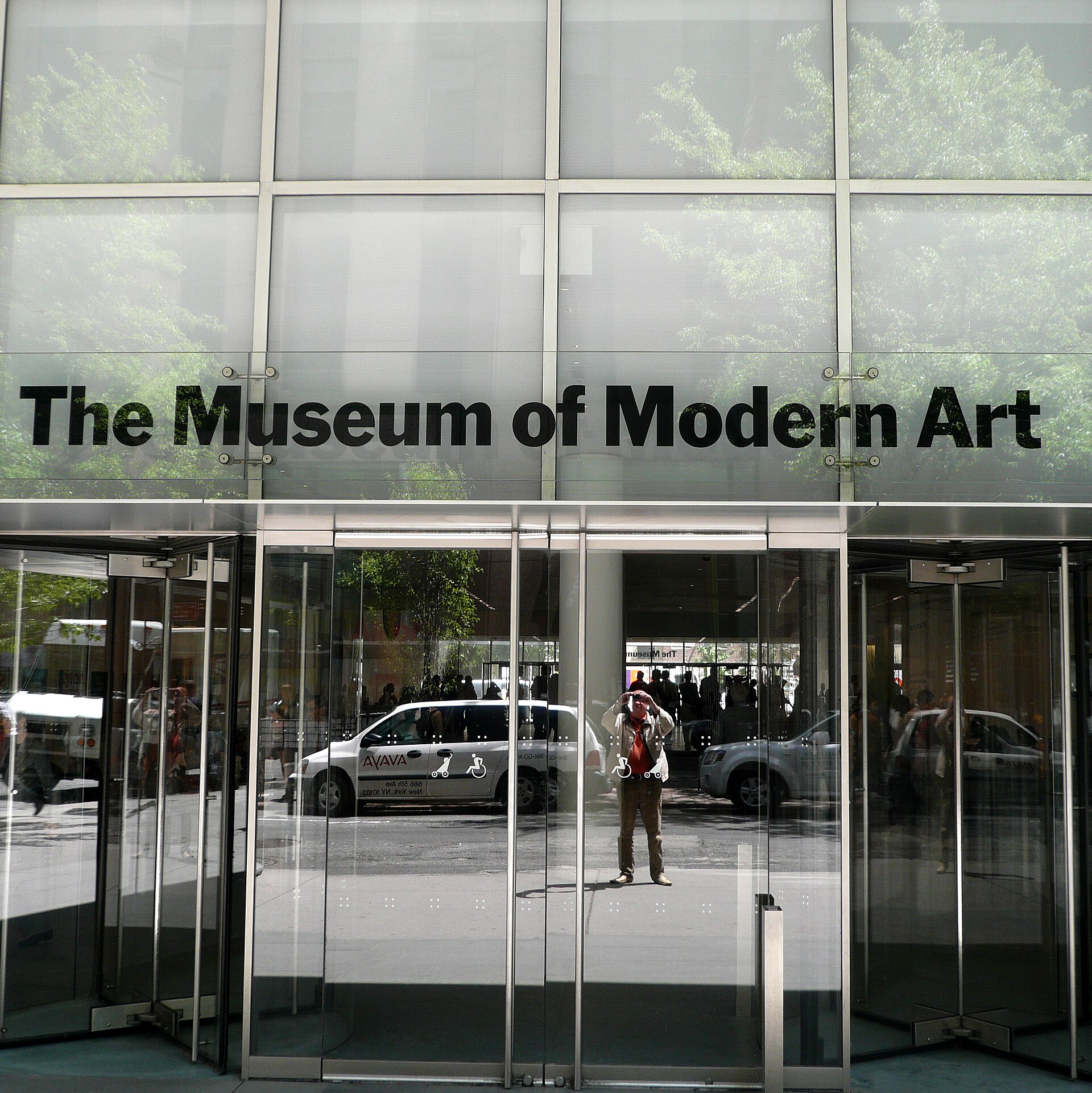
The main entrance and facade of the Museum of Modern Art on West 53rd Street, Manhattan, photographed in 2021.
ajay_suresh · CC BY 2.0Museum of Modern Art
Museum · Founded 1929
Open, admission and hours confirmed 21 August 2026 · 25 sources
On this page 16 sections
ContentsClose
MoMA's advantage is depth inside a narrow definition of modern and contemporary, rather than breadth across all of art history: it does not attempt to hold antiquities, Old Masters or most of the world's decorative arts traditions, and instead concentrates roughly 200,000 objects into the period from the 1880s to the present across six media-specific departments. That concentration is why a single museum can hold The Starry Night, Les Demoiselles d'Avignon, The Persistence of Memory, Campbell's Soup Cans and Water Lilies within a few floors of each other -- a density of touchstone 20th-century works that few other single institutions match, even against much larger universal-survey museums with far bigger total collections.
| Kind | Museum |
|---|---|
| Founded | 1929 |
| City and country |  New York, United States New York, United States |
| Address | 11 West 53 Street, Manhattan, New York, NY 10019, United States |
| Website | moma.org |
| Status | Open, confirmed |
| Record last verified |
Visiting
- Hours
- Monday-Thursday, Sunday10:30 to 17:30
- Friday10:30 to 20:30UNIQLO Friday Nights free admission from 17:30
- Saturday10:30 to 17:30
- Closed
- Thanksgiving Day. Christmas Day.
- Admission
- AdultUSD 30
- Senior (65 and over, with ID)USD 22
- Visitor with disabilitiesUSD 22free admission for one accompanying care partner
- Student (full-time, with ID, including international students)USD 17
- Children 16 and underFreefree
- MembersFreefree
Free entry: UNIQLO Friday Nights: free admission for New York State residents every Friday, 5:30-8:30pm, made possible by UNIQLO; free tickets must be reserved in advance- Tickets
- moma.org/visit The museum's own ticket page.
- Do I need to book?
- Not required for general admission, but timed tickets are recommended online; a reserved free ticket is required for UNIQLO Friday Nights
- Address
- 11 West 53 Street, Manhattan, New York, NY 10019, United States MapSubway E (all times) and F (limited weekday trains) to Fifth Avenue-53rd Street, about a block south of the museum entrance
- Website
- moma.org
- Telephone
- +1 212-708-9400
- [email protected]
Before you go how long, access, photography, bags, eating, shop
- How long to allow
- Two to three hours for the collection galleries; longer with a special exhibition
- Access
- Wheelchairs are available on site, all-gender restrooms are provided, service animals are welcome (pets are not), and a dedicated Access Programs line (voice and TTY) handles advance accessibility questions
- Photography
- Personal still photography and video are permitted in most collection galleries for non-commercial use; flash, tripods, monopods, selfie sticks and professional video equipment are prohibited, and some galleries restrict photography entirely
- Bags
- All bags are inspected on arrival; items larger than 11 x 17 x 5 inches, luggage, large umbrellas, outside food and outside alcohol are refused entry, though a staffed coat checkroom is available
- Eating
- Several restaurants and cafes operate inside the museum on their own separate hours
- Shop
- A flagship MoMA Design Store sits at street level by the main 53rd Street entrance, sunk one level below grade with its own staircase since the 2019 renovation; MoMA PS1 and an online store carry additional lines
Prices and hours change. We take them from the institution's own pages and print the day we read them, and you can check the current position at the source we used. Confirm before you travel.
What is inside
Painting and Sculpture Galleries
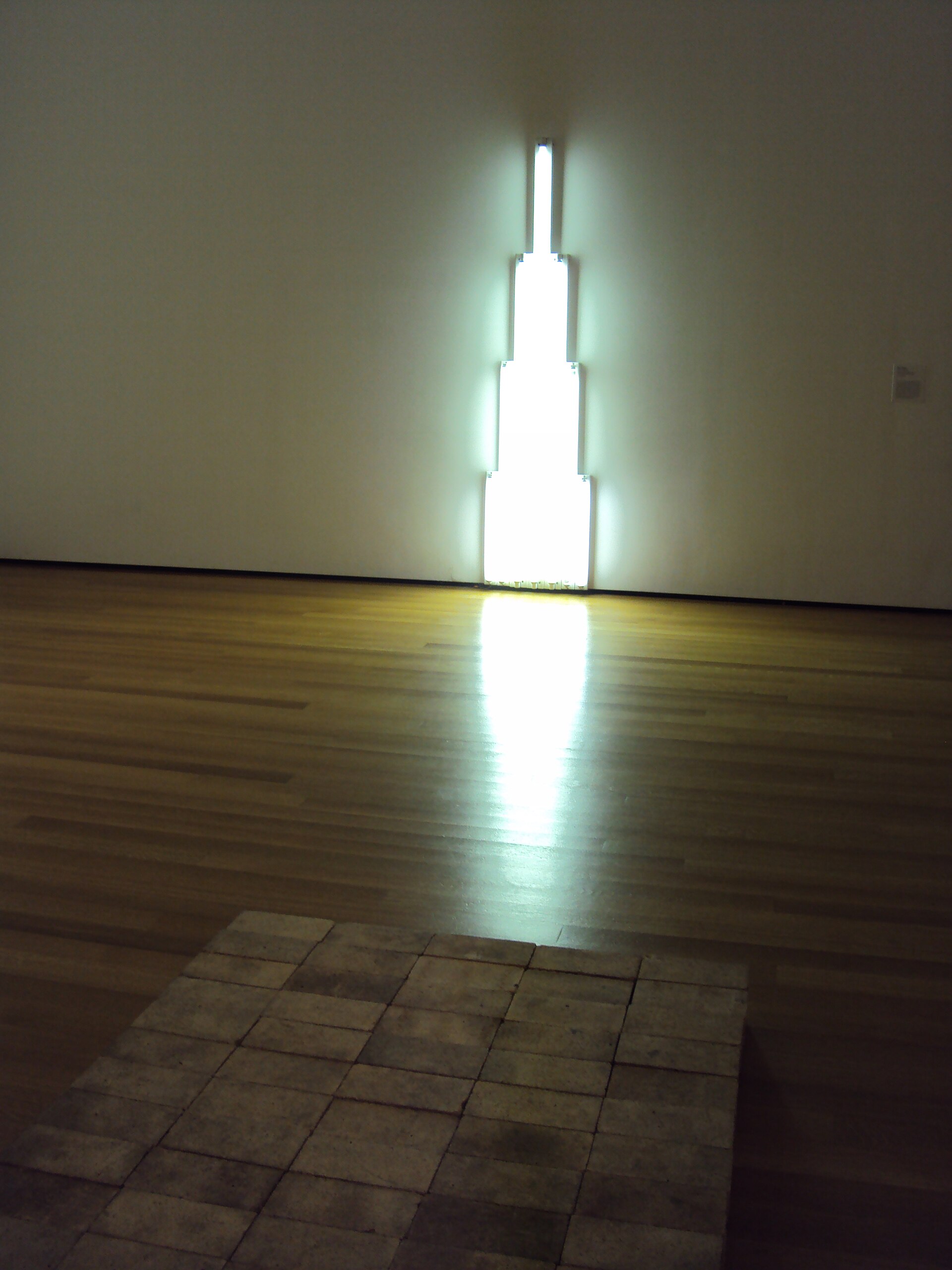
The museum's largest department: about 3,600 works of modern painting and sculpture from the late 19th century to the present, installed across floor 5 (the Alfred H. Barr, Jr. Galleries, covering the 1880s to 1940s) and floors 2 and 4 of the David Geffen Wing (1940s to now). This is where van Gogh's The Starry Night, Picasso's Les Demoiselles d'Avignon, Dali's The Persistence of Memory, Monet's Water Lilies, Rousseau's The Sleeping Gypsy and Warhol's Campbell's Soup Cans all hang.
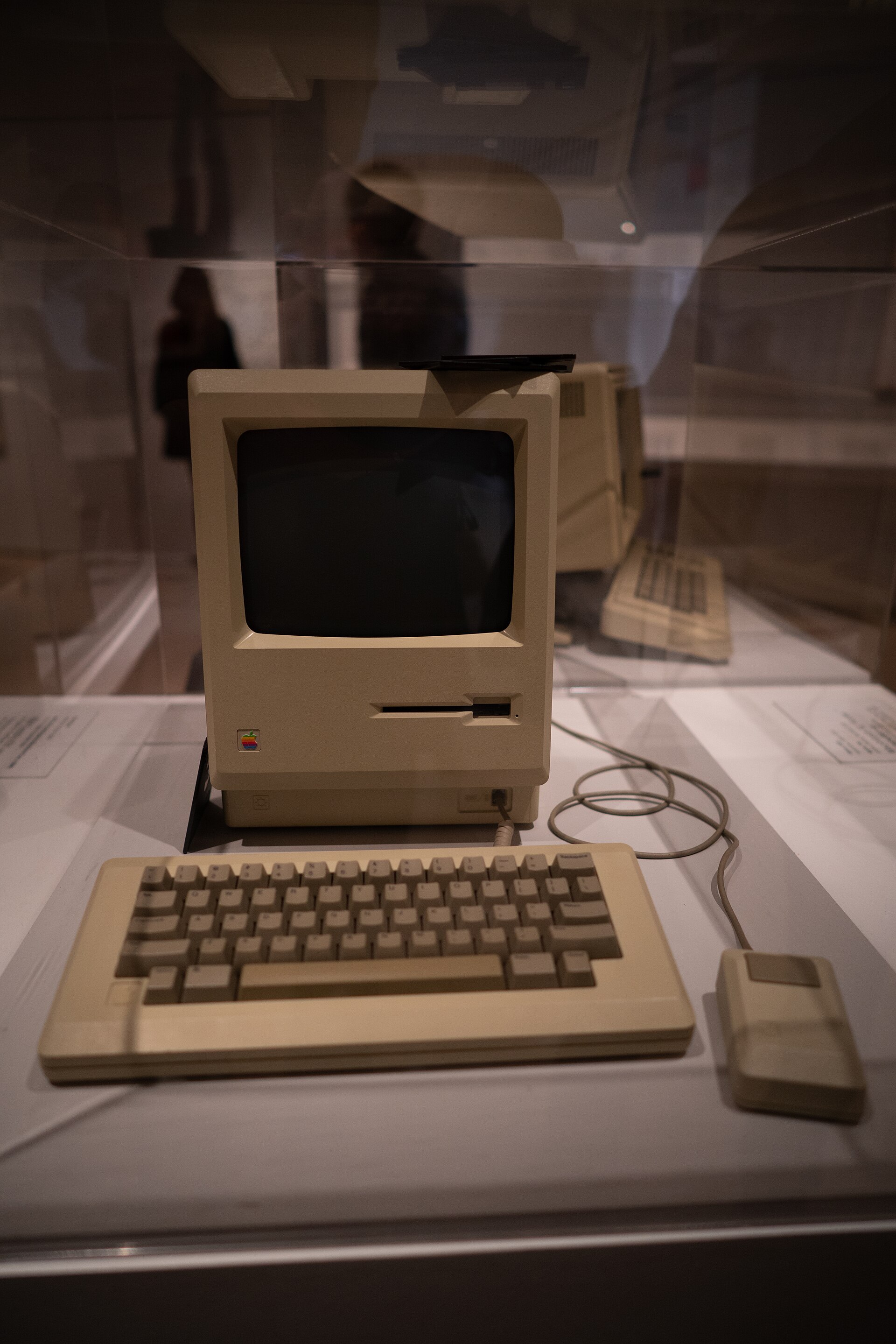
Photograph by Nan Palmero from San Antonio, TX, USA · CC BY 2.0 Architecture and Design
The world's first museum department devoted to architecture and design, founded in 1932. Its roughly 28,000 objects range from furniture, tableware, tools, textiles and sports cars to a helicopter, plus architectural drawings, models and photographs including the Mies van der Rohe Archive, and a graphic design collection of typography and posters.
Photography
Collecting photography since 1930, the department now holds more than 35,000 works spanning early daguerreotypes to contemporary digital and AI-era practice, made by artists, photojournalists, scientists and amateurs alike.
Film
Founded in 1935 as the Film Library, the department holds more than 30,000 films and 1.5 million film stills, including original Biograph and Edison negatives and the world's largest collection of D.W. Griffith films; prints are preserved off-site at the Celeste Bartos Film Preservation Center and screened year-round in the museum's own theaters.
Media and Performance
Time-based art -- moving image, video, performance, and sound- and motion-based works made for gallery presentation -- housed on the third floor of the Cullman Education and Research Building overlooking the Sculpture Garden, including the Marie-Josee and Henry Kravis Studio for performance, process and sound.
Drawings and Prints
Works on paper have been in the collection since MoMA's founding in 1929. The department now holds more than 11,000 drawings and over 60,000 prints, illustrated books and multiples, plus the Judith Rothschild Foundation's collections of Russian books and contemporary drawings, the Gilbert and Lila Silverman Fluxus Collection, and the Louise Bourgeois print archive.
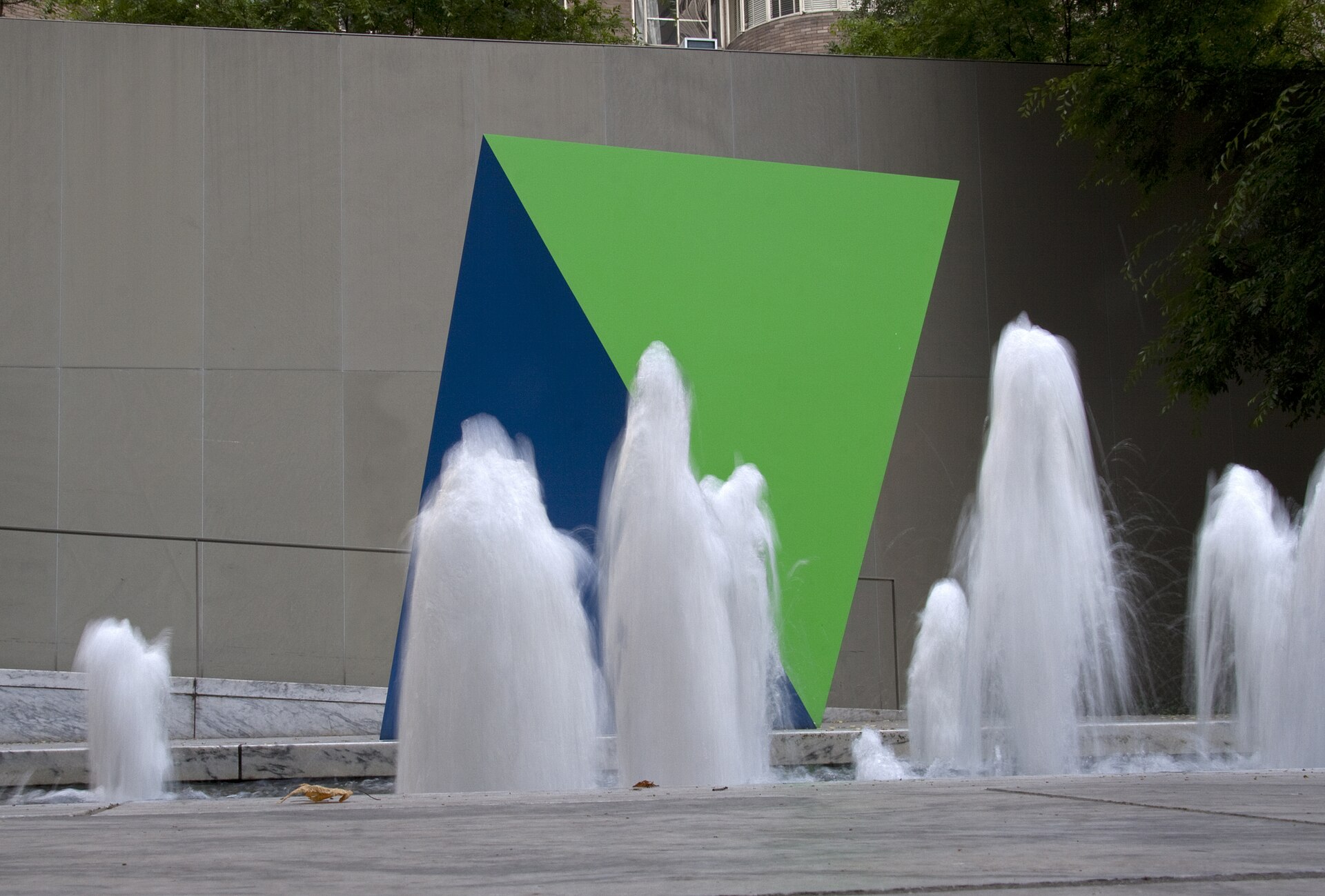
Photograph by Tony Hisgett from Birmingham, UK · CC BY 2.0 Abby Aldrich Rockefeller Sculpture Garden
An outdoor courtyard designed by Philip Johnson, framed by the Geffen Wing to the west and the Cullman Building to the east, used for large-scale sculpture, fountains and museum events; free to view from the ground-floor lobby since the 2019 renovation.
What to see first
The Starry Night
Vincent van Gogh, 1889The single work most visitors come to see: painted from memory and invention rather than direct observation, during van Gogh's twelve months at the Saint-Paul-de-Mausole asylum near Saint-Remy. Acquired in 1941 through the Lillie P. Bliss Bequest.11
Les Demoiselles d'Avignon
Pablo Picasso, 1907The canvas historians treat as the opening move of Cubism, its five figures built from angular, fractured planes drawn from Iberian sculpture and from African and Oceanic masks Picasso studied in Paris museums and private collections that had entered France through colonial channels.12
The Persistence of Memory
Salvador Dali, 1931A small canvas, only about 9.5 by 13 inches, whose melting watches over a dreamscape of the Catalan coast made Surrealism a household image; given to the museum anonymously.13
Campbell's Soup Cans
Andy Warhol, 1962Thirty-two hand-painted canvases, one per soup variety, first shown stacked on shelves like a grocery aisle; the work that announced Pop Art's arrival and Warhol's career-defining strategy of repetition.14
Water Lilies
Claude Monet, 1914-26A three-panel, roughly 42-foot mural from the series Monet worked on at Giverny until his death; MoMA became the first public collection in the United States to acquire one of his large-scale Water Lilies compositions, in 1955.15
The Sleeping Gypsy
Henri Rousseau, 1897A fantastical nocturne of a lion musing over a sleeping woman by the self-taught painter Rousseau, in the collection since 1939 as a gift of Mrs. Simon Guggenheim.16
Exhibitions on now
- On now5 Jul 2026 to 2 Jan 2027Confirmed , 7 weeks ago
Past exhibitions here
Three collectors and a director, five days after the Crash
The Museum of Modern Art was created in 1929 by three women -- Lillie P. Bliss, Mary Quinn Sullivan and Abby Aldrich Rockefeller -- who thought New York's existing museums were too conservative to show the art of their own century. They brought in four more trustees, A. Conger Goodyear, Paul Sachs, Frank Crowninshield and Josephine Boardman Crane, and hired a 27-year-old scholar, Alfred H. Barr, Jr., as founding director. Barr's plan was for a multi-departmental museum organized by medium rather than by period, a structure the museum still uses: architecture and design, drawings and prints, film, media and performance, painting and sculpture, and photography are its six curatorial departments today.
The museum opened to the public on November 7, 1929, eight days after the stock market crash that began the Great Depression. Its first show, an exhibition of Cezanne, Gauguin, Seurat and van Gogh built entirely from borrowed loans, drew more than 47,000 visitors in a single month. The collection itself began from almost nothing -- an initial gift of eight prints and one drawing -- and has grown since to roughly 200,000 works, of which more than 106,000 are catalogued online.
The building on 53rd Street
MoMA moved three times through temporary quarters in its first decade before opening the doors of its own building, designed by Philip L. Goodwin and Edward Durell Stone, on West 53rd Street in 1939. That building has been added to repeatedly rather than replaced: Philip Johnson designed expansions in 1951 and 1964 along with the Abby Aldrich Rockefeller Sculpture Garden; Cesar Pelli's 1984 renovation doubled the museum's gallery space; and a much larger project designed by Yoshio Taniguchi, adding 630,000 square feet across the Peggy and David Rockefeller Building and the Lewis B. and Dorothy Cullman Education and Research Building, reopened in November 2004 after the museum spent two years operating out of a converted stapler factory in Long Island City known as MoMA QNS.
The most recent and most disputed expansion, designed by Diller Scofidio and Renfro with Gensler, opened October 21, 2019, after a three-year, roughly 450 million dollar project that added about a third more gallery space and folded three new floors into Jean Nouvel's adjacent 53 West 53 tower. To make room for it, the museum demolished the American Folk Art Museum building next door, a 2001 structure by Tod Williams and Billie Tsien that MoMA had bought in 2011. The demolition, carried out in 2014, drew sustained criticism from architecture critics on the grounds that a museum with its own department of architecture and design was destroying a distinguished recent building for the sake of a uniform glass street front; Martin Filler's response in The New York Review of Books called it cultural vandalism, and critics writing in New York Magazine, Architectural Record and Vanity Fair made similar arguments from different angles, even as a smaller number of critics defended the decision on the grounds that the Folk Art Museum's cramped, low-lit interior had never worked well for showing art.
What is actually inside
The painting and sculpture collection is the largest department by public profile, though not by object count: about 3,600 works spread across floor 5's Alfred H. Barr, Jr. Galleries, covering the 1880s through the 1940s, and floors 2 and 4 of the David Geffen Wing, covering the 1940s to the present. The photography department, collecting since 1930, holds more than 35,000 works; architecture and design, the first curatorial department of its kind anywhere when it was founded in 1932, holds about 28,000 objects running from Arts and Crafts reform furniture to a helicopter; drawings and prints, in the collection since the museum's founding year, has grown to more than 11,000 drawings and over 60,000 prints and illustrated books; film holds more than 30,000 titles and 1.5 million stills, among them the world's largest collection of D.W. Griffith negatives, preserved off-site in Pennsylvania at the Celeste Bartos Film Preservation Center; and media and performance, the youngest department, formed in 2006 to collect time-based art made specifically for gallery presentation.
Reinstalling the story of modern art
The 2019 reopening was not only a building project. MoMA used it to rehang its entire permanent collection, breaking from the department-by-department, roughly chronological sequence Barr had established in the 1930s in favor of galleries that mix media and juxtapose canonical works with pieces by women artists and artists from Africa, Asia and Latin America who had been left out of the collection's traditional story. Critics writing at the time treated the change itself, not just the results, as a subject: some read it as the museum correcting a genuinely narrow, male and largely European account of the twentieth century it had helped write in the first place; others argued that grouping works across media and geography without a chronological throughline traded one kind of clarity for a looser, harder-to-follow arrangement. Both readings agree the rehang was a deliberate departure from decades of settled practice, not a routine reinstallation.
What it costs to get in, and who objects
Adult general admission rose to 30 dollars in October 2023, the first increase since 2011 and the same season the Whitney, the Guggenheim and the Metropolitan Museum of Art all raised their own prices, citing higher operating costs. Coverage of the increase, including a report in Hyperallergic, noted that a family of four now spends well over 100 dollars on tickets alone before food, transportation or the gift shop, and that the increase landed hardest on visitors without memberships or student and senior discounts. The museum's own answer to the affordability question is UNIQLO Friday Nights, free admission for New York State residents every Friday evening on a reserved-ticket basis, expanded to a weekly program in 2024-25; MoMA also honors a MoMA ticket at MoMA PS1 in Queens for free entry within fourteen days. Visitors who do pay full price consistently name crowding, not the art itself, as the main friction in a visit, concentrated around a small number of famous paintings and during the free evening hours.
Governance under protest
MoMA's board of trustees has itself been a target of activism separate from anything inside the galleries. In the spring of 2021 a coalition of a dozen groups, organizing under the name Strike MoMA, staged ten weeks of demonstrations outside the museum, describing it as tainted by elitism and calling attention to the outside business interests of several board members, which the coalition said were connected to prison systems, border enforcement and environmental harm. The museum did not respond publicly to the coalition's specific allegations at the time. The episode sits alongside the Folk Art Museum demolition and the 2023 price increase as evidence of a recurring pattern in how MoMA is discussed outside its own press materials: praise for the collection runs alongside sustained scrutiny of the institution's money, its board and its relationship to its own neighborhood.
What visitors say
Visitors and critics converge on the same two points from opposite directions. On the strength of the collection there is little argument: the run from van Gogh and Picasso through Monet's late work to Warhol and beyond is treated as close to definitive for the history of modern art, and the museum's own visit guidance and independent travel platforms both put a serious visit at two to three hours minimum. The friction is over access: the cost of a ticket and the density of crowds around a handful of marquee paintings are the two complaints that recur most often, alongside a running argument, now more than a decade old, over how the museum has treated its own building and its neighbors on 53rd Street.
What is praised, what is criticised
- Praised: The breadth and canonical depth of the painting and sculpture collection, spanning the 1880s to the present in one continuous run of galleries
- Praised: UNIQLO Friday Nights, the free weekly evening admission for New York State residents that the museum expanded to every Friday in 2024-25
- Praised: Recognition on travel platforms: MoMA holds TripAdvisor's Travelers' Choice award for 2026 and ranks among the top 20 things to do in New York City out of more than 2,800 listed attractions
- Criticised: The 2013-14 demolition of the adjoining American Folk Art Museum building to clear the site for the current expansion, condemned by architecture critics including Martin Filler, who called it cultural vandalism carried out by an institution that had itself founded the first American museum department of architecture and design
- Criticised: The rise of adult general admission to 30 dollars in October 2023, the same month the museum joined the Whitney, the Guggenheim and the Met in raising prices, which outlets including Hyperallergic reported as pricing a family visit well beyond casual reach
- Criticised: A ten-week 2021 protest campaign by a coalition calling itself Strike MoMA, which accused the museum of elitism and pressed the board to reconsider the business interests of some of its trustees; the museum did not respond publicly to the coalition's specific claims
- Criticised: Persistent visitor complaints about crowding around a small number of famous paintings and during free evening hours, when timed-entry reservations are required and fill quickly
Ratings on other platforms
TripAdvisor: 4.4 from 18,692 ratings, read 21 August 2026
A platform average is a tertiary source: it moves, it is not audited, and we quote no visitor's words.
Questions about Museum of Modern Art
Where is Museum of Modern Art?
11 West 53 Street, Manhattan, New York, NY 10019, United States.
How much does it cost to visit?
Adult: USD 30; Senior (65 and over, with ID): USD 22; Visitor with disabilities: USD 22; Student (full-time, with ID, including international students): USD 17; Children 16 and under: free. As confirmed 21 August 2026.
When is it open?
Monday-Thursday, Sunday 10:30-17:30; Friday 10:30-20:30; Saturday 10:30-17:30. Closed: Thanksgiving Day. Christmas Day. As confirmed 21 August 2026.
How do you get there?
Subway: E (all times) and F (limited weekday trains) to Fifth Avenue-53rd Street, about a block south of the museum entrance.
What should you see first?
The Starry Night (Vincent van Gogh, 1889); Les Demoiselles d'Avignon (Pablo Picasso, 1907); The Persistence of Memory (Salvador Dali, 1931); Campbell's Soup Cans (Andy Warhol, 1962); Water Lilies (Claude Monet, 1914-26); The Sleeping Gypsy (Henri Rousseau, 1897).
What we could not confirm
- How the 2019 rehang's cross-media, non-chronological installation will be judged once the novelty has worn off; critics were divided in real time and the museum has not published a formal self-assessment of the change.
- What, if anything, MoMA's board changed in response to the 2021 Strike MoMA protests; the museum did not issue a public point-by-point response to the coalition's claims about individual trustees' business interests.
Images
Sources
- 1MoMA, Locations and hours (visit page: address, admission prices, hours, UNIQLO Friday Nights) moma.org/visit/
- 2MoMA, Contact us (phone, email) moma.org/about/contact/
- 3MoMA, The Museum of Modern Art history moma.org/about/mission-statement/history
- 4MoMA, Painting and Sculpture (curatorial department) moma.org/about/curatorial-departments/painting-sculpture
- 5MoMA, Photography (curatorial department) moma.org/about/curatorial-departments/photography
- 6MoMA, Architecture and Design (curatorial department) moma.org/about/curatorial-departments/architecture-design
- 7MoMA, Drawings and Prints (curatorial department) moma.org/about/curatorial-departments/drawings-prints
- 8MoMA, Film (curatorial department) moma.org/about/curatorial-departments/film
- 9MoMA, Media and Performance (curatorial department) moma.org/about/curatorial-departments/media-performance
- 10MoMA, The Collection (overview: ~200,000 works, 106,000+ online) moma.org/collection/
- 11MoMA, Vincent van Gogh. The Starry Night. Saint Remy, June 1889 moma.org/collection/works/79802
- 12MoMA, Pablo Picasso. Les Demoiselles d'Avignon. Paris, June-July 1907 moma.org/collection/works/79766
- 13MoMA, Salvador Dali. The Persistence of Memory. 1931 moma.org/collection/works/79018
- 14MoMA, Andy Warhol. Campbell's Soup Cans. 1962 moma.org/collection/works/79809
- 15MoMA, Claude Monet. Water Lilies. 1914-26 moma.org/collection/works/80220
- 16MoMA, Henri Rousseau. The Sleeping Gypsy. 1897 moma.org/collection/works/80172
- 17MoMA, Year in Review 2024-25 (visitor numbers, exhibitions, new director) moma.org/about/annualreportFY25
- 18MoMA, Visitor guidelines and policies (bags, prohibited items, code of conduct) moma.org/visit/visitor-guidelines-and-policies
- 19Sydney Franklin, MoMA reopens with a $450 million mega-expansion and slick renovation, The Architect's Newspaper, 2019-10-16 archpaper.com/2019/10/moma-reopens/
- 20Vanessa Quirk, Critics React to Folk Art Museum's Imminent Demolition, ArchDaily, 2013-04-19 archdaily.com/361922/critics-react-to-folk-art-museum-s-imminent-demolition
- 21Martin Filler, MoMA's Act of Vandalism, The New York Review of Books, 2013-04-12 nybooks.com/online/2013/04/12/momas-act-vandalism/
- 22Rhea Nayyar, Want to Visit MoMA? That'll Be $30, Hyperallergic, 2023-09-14 hyperallergic.com/want-to-visit-moma-thatll-be-30/
- 23Nancy Kenney, Coalition of activist groups announces 'strike' action against MoMA, The Art Newspaper, 2021-03-24 theartnewspaper.com/2021/03/24/coalition-of-activist-groups-announces-strike-action-against-moma
- 24TripAdvisor, The Museum of Modern Art (MoMA) attraction page (aggregate rating, ), read 2026-08-21 tripadvisor.com/Attraction_Review-g60763-d105126-Reviews-The_Museum_of_Modern_Art_MoMA-New_York_City_New_York.html
- 25Wikipedia, Fifth Avenue/53rd Street station (subway service, ), read 2026-08-21 en.wikipedia.org/wiki/Fifth_Avenue/53rd_Street_station