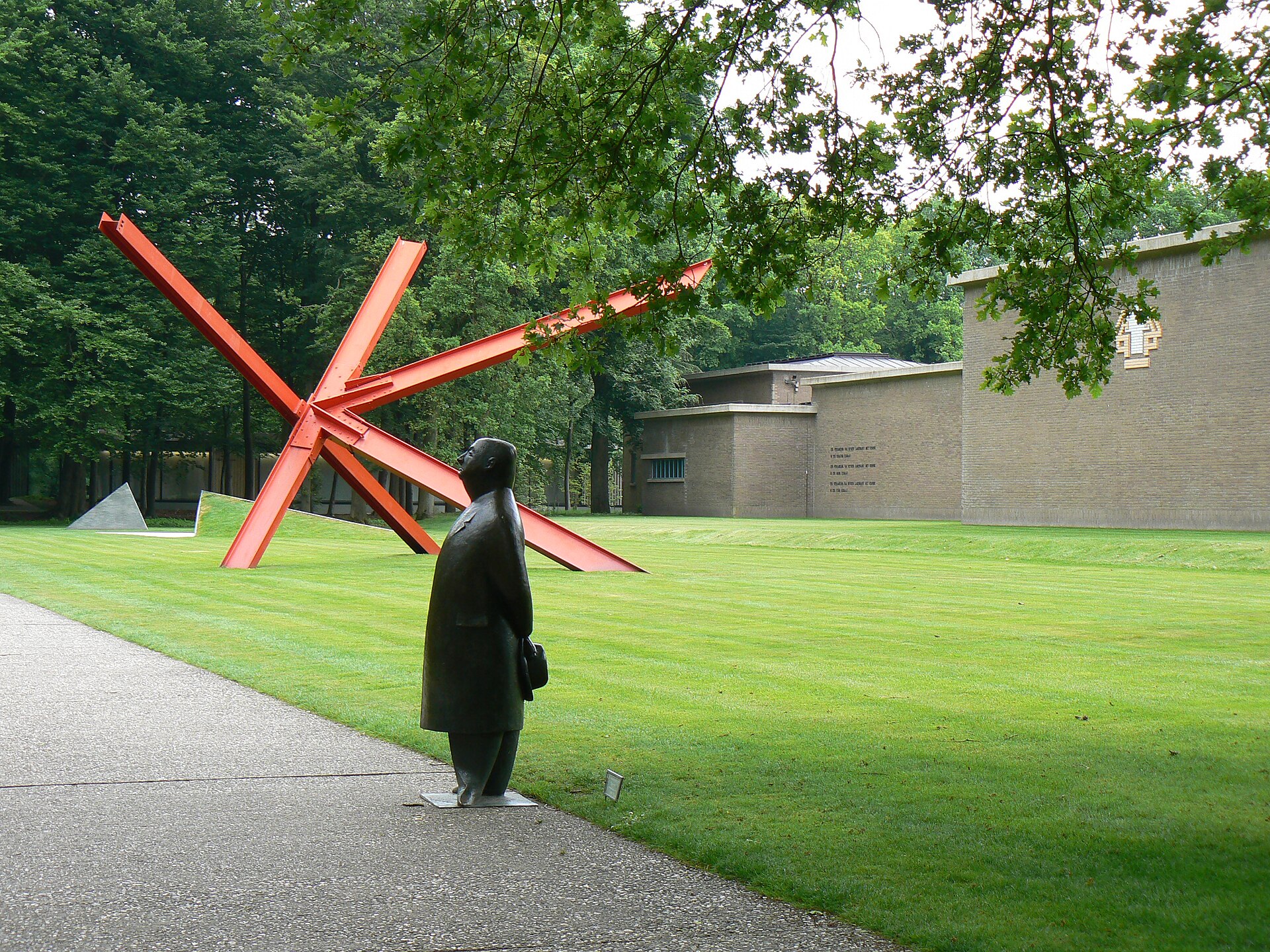
The main entrance to the Kroller-Muller Museum in the Hoge Veluwe National Park, with Mark di Suvero's steel sculpture K-piece visible beyond the doors.
Public domainKroller-Muller Museum
Museum · Founded 1938
Open, admission and hours confirmed 9 September 2026 · 20 sources
On this page 14 sections
ContentsClose
The museum's single strongest claim is depth in one artist rather than breadth across many: 88 Van Gogh paintings and over 180 works on paper, second in the world only to the Van Gogh Museum, assembled deliberately as a survey of his development rather than a scatter of trophies. Around that core sits a second, less publicised strength, Helene Kroller-Muller's own survey collection of the move from realism to abstraction through Seurat, Mondrian and early Picasso, and a sculpture garden whose scale, over 200 works across 75 acres, is matched by very few institutions in Europe.
| Kind | Museum |
|---|---|
| Founded | 1938 |
| City and country |  Otterlo, Netherlands Otterlo, Netherlands |
| Address | Houtkampweg 6, 6731 AW Otterlo, Netherlands |
| Website | krollermuller.nl/en |
| Status | Open, confirmed |
| Record last verified |
Visiting
- Hours
- Tuesday to Sunday and public holidays10:00 to 17:00
- Daily, 6 July to 24 August (summer extension)10:00 to 17:00Open every day including Monday during this period
- Closed
- Monday, except during the 6 July - 24 August summer extension. 1 January.
- Admission
- Adult, combined museum and park day ticketEUR 27.75The museum and De Hoge Veluwe National Park are run by two separate foundations; almost every visitor needs both a museum ticket and a park day ticket, and this is the combined figure quoted on the museum's own prices page.
- Youth 13-18, combinedEUR 20.80
- Child 6-12, combinedEUR 6.95
- Museumkaart or VriendenLoterij VIP-kaart holderEUR 13.85Museum admission itself is free on these cards; the figure quoted is the separate park day ticket, still required to reach the building.
- Student, CJP, Cultuurkaart or EYCA cardEUR 6.95Museum admission rate; the park day ticket is purchased separately and is not included.
- ICOM or Vereniging Rembrandt memberFreeFree museum admission; the park day ticket is still required and charged separately.
- Car or motorcycle, park entryEUR 9.80Charged per vehicle in addition to the per-person park tickets of everyone travelling in it.
- Tickets
- tickets.krollermuller.nl/en/tickets The museum's own ticket page.
- Do I need to book?
- A timed museum ticket is bought online in advance; a separate day ticket for De Hoge Veluwe National Park is also required and is booked through the park's own foundation, not the museum
- Address
- Houtkampweg 6, 6731 AW Otterlo, Netherlands MapCar/foot/bicycle Reached only from inside De Hoge Veluwe National Park, through one of three park entrances: Otterlo (2.5 km from the museum, about 5 minutes by car), Hoenderloo (4 km) or Schaarsbergen (10 km, not usable by coaches). Free white bicycles with child seats are available at the park entrances for the ride to the museum.
- Website
- krollermuller.nl/en
- Telephone
- +31 318 591 241
- [email protected]
Before you go how long, access, photography, bags, eating, shop
- How long to allow
- The Van de Velde building and Van Gogh Gallery alone hold a visitor for one to two hours; the 75-acre sculpture garden, one of the largest in Europe, comfortably adds a further two hours or more, so most visitors plan half a day to a full day and many combine the visit with cycling the wider park
- Access
- Wheelchairs, walking frames and children's buggies are loaned free of charge; the entrance paths are asphalted and the sculpture garden has both paved and unpaved paths; six accessible parking spaces sit 175 metres from the entrance, with one free companion ticket for disabled-parking-permit holders; two accessible toilets serve the museum and the sculpture garden; large-format exhibition texts, a pictogram map and a tactile display with audio description for Van Gogh's Bridge at Arles are provided; assistance dogs are welcome throughout
- Eating
- An on-site restaurant with outdoor seating in the museum grounds
- Shop
- A museum shop on site, with a separate webshop at krollermullershop.nl
Prices and hours change. We take them from the institution's own pages and print the day we read them, and you can check the current position at the source we used. Confirm before you travel.
What is inside
Van Gogh Gallery
The heart of the Van de Velde building, showing a rotating selection of around thirty to forty of the museum's roughly 88 Van Gogh paintings and more than 180 works on paper, assembled by Helene Kroller-Muller between 1908 and 1928 into the second-largest Van Gogh holding in the world after the Van Gogh Museum in Amsterdam. Highlights include Cafe Terrace at Night, Sorrowing Old Man (At Eternity's Gate) and the full-size oil study for The Potato Eaters, alongside Parisian self-portraits and later works from Saint-Remy.
Van de Velde collection wing
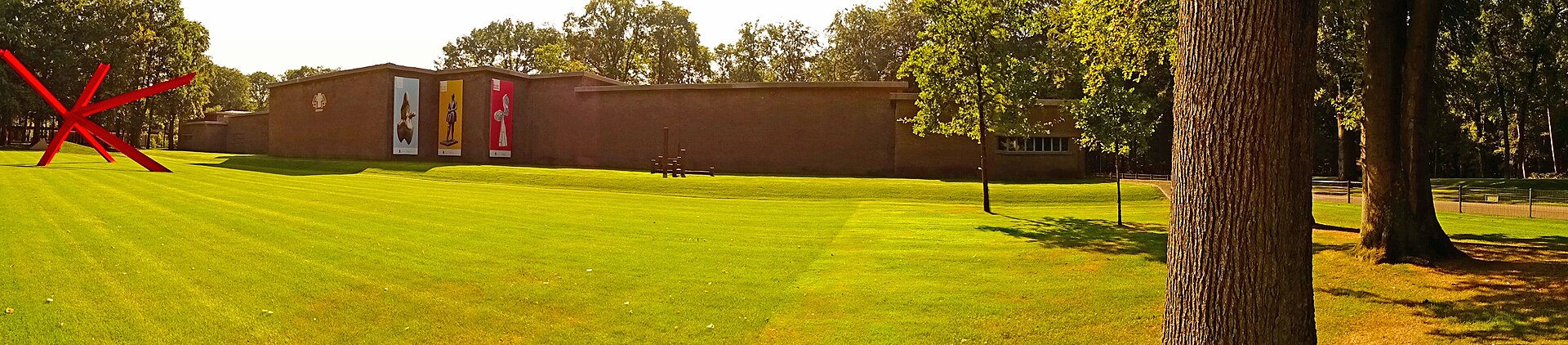
The original 1938 building beyond the Van Gogh rooms, built with small, intimate, top-lit spaces and deliberately closed brick walls to maximise hanging space. It carries Helene Kroller-Muller's own survey of nineteenth- and twentieth-century art from realism to abstraction, with Georges Seurat, Odilon Redon, Paul Gauguin, Georges Braque, Pablo Picasso and Piet Mondrian among the artists represented.
Wim Quist exhibition wing
A transparent 1977 extension standing between the sculpture garden and the Van de Velde building, built with maximum visual interaction between inside and outside. It houses the museum's later acquisitions in Minimal art, Conceptual art, Land art and Arte Povera, and hosts temporary exhibitions such as the museum's 2014 Georges Seurat retrospective.
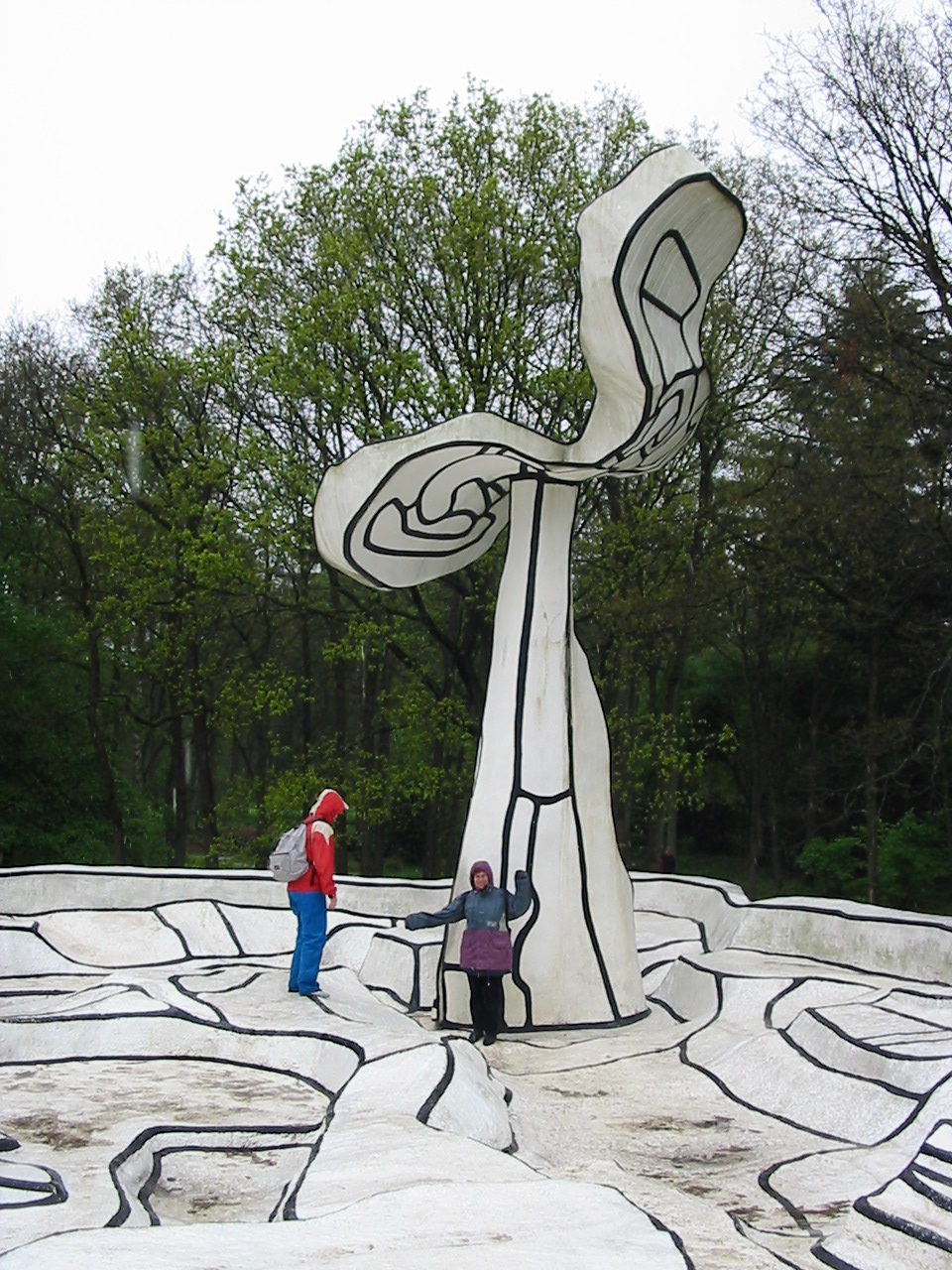
Photograph by nl:Gebruiker:Pampiertje · CC BY-SA 3.0 Sculpture garden (Beeldenpark)
Opened in 1961 on a design by landscape architect Jan Bijhouwer and later enlarged, this 75-acre garden is among the largest sculpture parks in Europe, distributing more than 200 works through woodland and open heath so that nature and sculpture carry equal weight. Artists represented include Auguste Rodin, Henry Moore, Barbara Hepworth, Aristide Maillol, Marta Pan and Jean Dubuffet, whose walk-through concrete Jardin d'email (1968-1974) is one of the garden's best-known pieces.
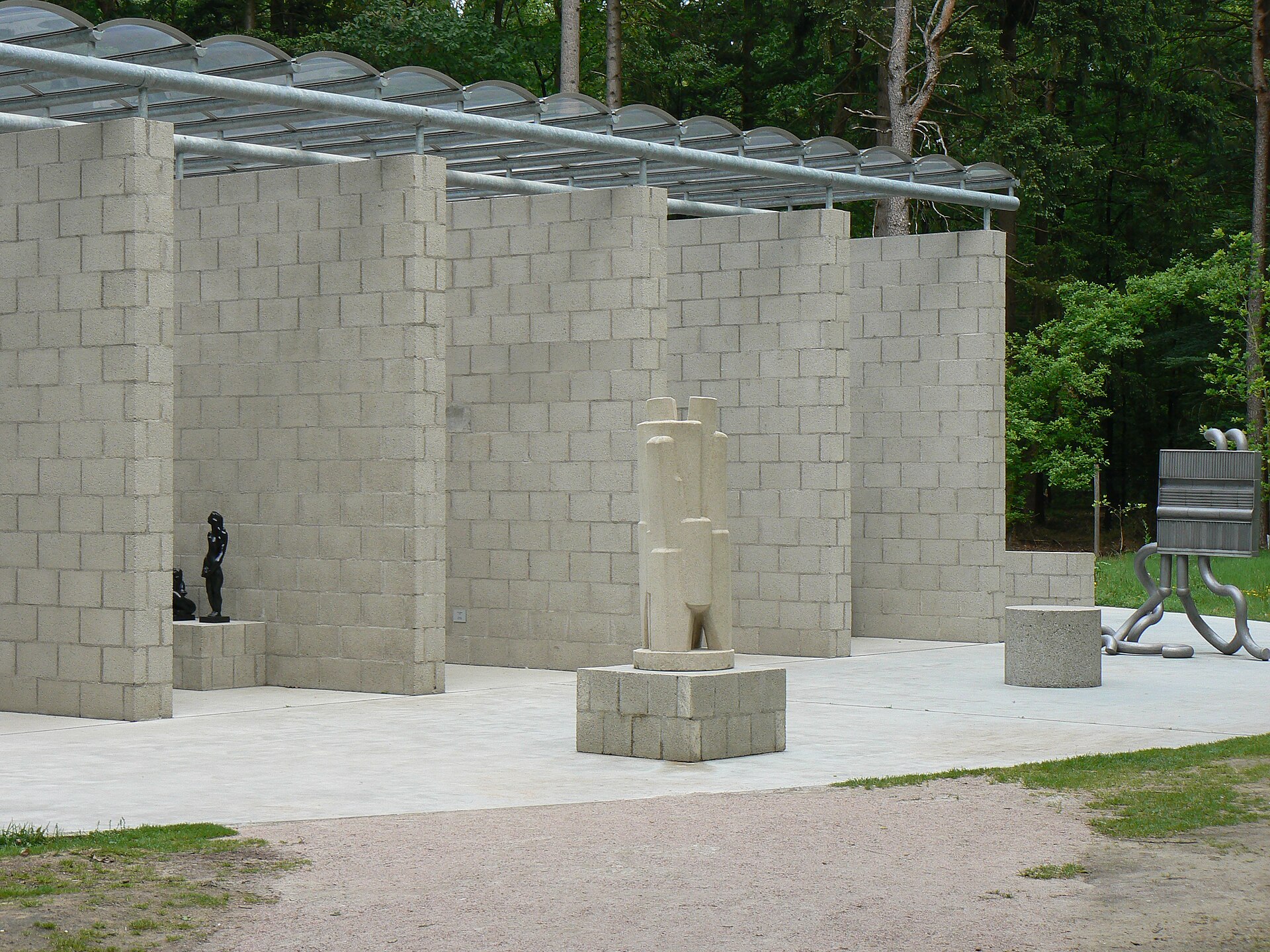
Public domain Aldo van Eyck Pavilion
A sculpture pavilion of concrete blocks and an undulating glass canopy, designed by Aldo van Eyck in the mid-1960s for a temporary exhibition in Arnhem's Sonsbeek park that once held work by Brancusi, Arp and Giacometti among some thirty sculptors. It was dismantled after that show and rebuilt inside the Kroller-Muller sculpture garden in 2005-2006, where it now shelters changing small-scale sculpture.
Rietveld Pavilion
A pavilion of clean lines and white brickwork, designed by Gerrit Rietveld in 1954-1955 for the Sonsbeek sculpture exhibition in Arnhem and moved to the Kroller-Muller sculpture garden a decade later, where it was inaugurated in 1965 with an exhibition of Barbara Hepworth. The structure proved beyond repair and was rebuilt to Rietveld's original design in 2010; it is used today for the display of small sculpture.
What to see first
Cafe Terrace at Night
Vincent van Gogh, 1888Painted in Arles in mid-September 1888, it carries the first starry sky in Van Gogh's oeuvre and is one of the most reproduced works in the collection.9
Sorrowing Old Man (At Eternity's Gate)
Vincent van Gogh, 1890Made in Saint-Remy-de-Provence in May 1890, reworking an early lithograph into a late, harrowing oil painting from the last months of Van Gogh's life.9
Full-size oil study for The Potato Eaters
Vincent van Gogh, 1885The Kroller-Muller holds Van Gogh's full-size preparatory oil study for this Dutch-period composition; the finished, definitive canvas hangs in the Van Gogh Museum in Amsterdam, and the two are not the same picture.9
Self-portrait (Paris period)
Vincent van Gogh, about 1887One of roughly twenty-five self-portraits Van Gogh painted in Paris, bought by Helene Kroller-Muller as part of her deliberate survey of his development.9
Jardin d'email
Jean Dubuffet, 1968-1974A monumental walk-in and walk-on concrete sculpture built with the artist on site in the sculpture garden; it was closed for five years of conservation work completed in May 2020 and can still only be entered when its surface is dry.10
K-piece
Mark di Suvero, 1972A large steel sculpture standing before the museum entrance, visible in the museum's own approach and one of the most photographed works in the garden.17
Aldo van Eyck Pavilion
Aldo van Eyck, 1965-1966, rebuilt 2005-2006A rare surviving example of the temporary pavilions built for the 1960s Sonsbeek sculpture exhibitions, saved and reconstructed here after the original was dismantled elsewhere.7
Exhibitions on now
The house that became a museum
The Kroller-Muller Museum exists because one collector decided a private house was the wrong place for what she owned. Helene Kroller-Muller, married to the shipping and ore-trading magnate Anton Kroller, began buying art in the first decade of the twentieth century on what her own museum now describes as a virtually unlimited budget, guided by the critic H.P. Bremmer. What started as a couple's private collection grew, across roughly twenty years of purchasing, into some 20,000 objects, and by the 1920s the Kroller-Mullers were already planning a purpose-built museum-house on the Hoge Veluwe estate they owned in Gelderland. The family's shipping fortune did not survive the economic crises of the early 1930s intact, and in 1935 Helene Kroller-Muller donated her collection, along with the Hoge Veluwe estate itself, to the Dutch state. The museum opened to the public on 13 July 1938, a few months before her death, in a building designed by the Belgian architect Henry van de Velde: small, top-lit, intimate galleries behind an almost windowless brick exterior, built to maximise wall space for paintings rather than to make an architectural statement of its own. The building was declared a Rijksmonument, a national heritage listing, in 2011. It sits inside De Hoge Veluwe National Park, a separately governed nature reserve of forest, drift-sand and heath, and that separation of ownership between museum and park is not a historical footnote: it still shapes how every visitor buys a ticket today.
The Van Gogh collection
The museum's central claim on a visitor's attention is its holding of Vincent van Gogh: 88 paintings and more than 180 drawings, the second-largest Van Gogh collection in the world after the Van Gogh Museum in Amsterdam. Helene Kroller-Muller bought her first Van Gogh, Edge of a Wood, at auction in 1908 for 110 guilders, and kept buying his work for two decades, driven by what she described as a personal identification with his spiritual searching as much as by his technique. The Van Gogh Gallery inside the Van de Velde building typically shows thirty to forty of these paintings at a time, rotated to protect works on paper and to let the museum keep telling different parts of the story. The collection runs from the Dutch period, represented by the full-size oil study for The Potato Eaters, through the Paris self-portraits of the mid-1880s, to the nocturnal Cafe Terrace at Night of September 1888 and the late, anguished Sorrowing Old Man, painted in the asylum at Saint-Remy-de-Provence in May 1890, a matter of months before Van Gogh's death. A visitor who has already seen The Potato Eaters and the sunflowers in Amsterdam will not see the same paintings twice here; the two museums hold different pictures from the same hand, and the Kroller-Muller's own account of its Potato Eaters is explicit that it is the working study rather than the finished, exhibited canvas.
Beyond Van Gogh: the modern collection and the sculpture garden
Van Gogh was never the whole of Helene Kroller-Muller's ambition. From around 1910 she also bought the French Neo-Impressionists Georges Seurat, Paul Signac and Maurice Denis, then moved toward the artists pioneering abstraction in the Netherlands, Piet Mondrian, Theo van Doesburg and Bart van der Leck, and toward Cubism through Picasso, Juan Gris and Fernand Leger. That survey of art from realism to abstraction still occupies a large part of the original Van de Velde wing. A 1977 extension by the Dutch architect Wim Quist, deliberately transparent and set between the old building and the garden, carries the museum's later, post-war acquisitions in Minimal art, Conceptual art, Land art and Arte Povera, and is also where the museum stages temporary loan exhibitions such as its 2014 Georges Seurat retrospective, which brought together twenty-three paintings and twenty-four drawings including the large Le Chahut and Le Cirque. Outside, the sculpture garden opened in 1961 to a design by the landscape architect Jan Bijhouwer and has grown into one of the largest in Europe, spreading more than 200 sculptures across 75 acres of woodland and open heath. Auguste Rodin, Henry Moore, Barbara Hepworth, Aristide Maillol, Marta Pan and Mark di Suvero, whose steel K-piece stands near the entrance, are represented alongside Jean Dubuffet's Jardin d'email, a monumental white concrete construction built on site with the artist between 1968 and 1974 that visitors are invited to walk into as well as look at; it reopened in 2020 after five years of conservation. Two rescued exhibition pavilions from the 1960s Sonsbeek shows in Arnhem, one designed by Gerrit Rietveld and one by Aldo van Eyck, were later dismantled and rebuilt inside the garden, and both have since needed a second rebuilding, in 2010 and 2005-2006 respectively, to keep Rietveld's and Van Eyck's original designs standing.
The war years and a restitution
The museum's own published history does not smooth over what happened here between 1940 and 1945. When Germany occupied the Netherlands, the museum and the Sint Hubertus hunting lodge on the estate were marked with a protective symbol, and the collection was moved into a bomb shelter. Anton Kroller died in December 1941; his assistant Sam van Deventer, who had made himself useful to the occupying authorities, was installed as museum director and negotiated directly with the Germans, at one point securing a letter from the army command intended to keep the park free of military use. It did not hold: part of De Hoge Veluwe was taken over by the German air force as an airfield, and Van Deventer instead arranged compensation that helped the park's wartime finances. The museum's own timeline goes further, stating plainly that from the summer of 1942 its bomb shelter was used to store looted art, including paintings confiscated from Jewish owners, which were later deported to Germany in 1944. One consequence of that period reached a formal resolution decades later. In June 1942 the museum bought a painting, Camille Corot's Female Figure at a Well, from the German dealer H.W. Lange, using funds supplied by the occupying authorities. The painting had belonged to George Eduard Behrens, a Jewish banker whose firm was forcibly Aryanised in 1938 and who was himself arrested and held in the Sachsenhausen concentration camp before being forced to pawn his possessions to the state in order to obtain an exit visa; he fled first to Belgium and then, in 1940, to Cuba. In its recommendation of 3 July 2008, case RC 1.71, the Dutch Restitutions Committee found that Behrens's loss of the painting was involuntary and directly connected to Nazi persecution, and advised the responsible minister to return it to his heirs, which was done. The museum has not published a similarly itemised account of every other work that passed through the same wartime storage.
Visiting today
None of that history stops the museum from being, by visitor consensus, one of the most rewarding single days out in the Netherlands: a TripAdvisor aggregate of 4.5 out of 5 from 1,851 ratings, read on 9 September 2026, sits alongside consistent praise for the Van Gogh rooms and the sculpture garden. What visitors return to less happily is the cost and structure of getting in. Because the museum and De Hoge Veluwe National Park are governed by separate foundations, a family cannot buy a museum-only ticket in most circumstances; a full park day ticket is required in addition, at 27.75 euros for an adult on top of a further per-vehicle charge for anyone arriving by car, and more than one online review has called the arrangement an unfair practice rather than simply a park entry fee. The museum's own answer, stated on its visitor pages, is that the park receives no structural subsidy and depends on entry fees for its upkeep. Visitors who accept the cost and plan for it tend to be rewarded: free loan wheelchairs and buggies, a tactile display with audio description for Van Gogh's Bridge at Arles, and a network of free white bicycles at each park entrance make both the museum and the wider Hoge Veluwe landscape unusually accessible once inside the gate.
What visitors say
Visitors consistently single out the Van Gogh collection and the sculpture garden as the two reasons to make the trip, and describe the combination of art, architecture and forest as unusual among European museums. The most repeated complaint is not about the art but the ticketing: because the museum and De Hoge Veluwe National Park are run by two separate foundations, a visitor who wants only the museum still has to buy a full park day ticket to reach it, which several reviewers describe as pushing the total cost of a single museum visit unexpectedly high for what is, in floor space, a modest building.
What is praised, what is criticised
- Praised: The depth and rotation of the Van Gogh paintings and drawings, and the chance to see them without the Amsterdam crowds
- Praised: The scale and variety of the sculpture garden, and works such as Dubuffet's Jardin d'email that can be walked into rather than only viewed
- Praised: The Van de Velde and Quist buildings' use of natural light and glass to keep the woodland visible from inside the galleries
- Praised: Temporary exhibitions drawn from the permanent collection, such as the 2014 Seurat retrospective
- Criticised: The requirement to buy a separate, non-optional national park day ticket on top of the museum ticket, which one visitor's review title called an unfair practice and others simply called expensive for what it is
- Criticised: On-site catering described by some visitors as pricey relative to the setting
Ratings on other platforms
TripAdvisor: 4.5 from 1,851 ratings, read 9 September 2026
A platform average is a tertiary source: it moves, it is not audited, and we quote no visitor's words.
Questions about Kroller-Muller Museum
Where is Kroller-Muller Museum?
Houtkampweg 6, 6731 AW Otterlo, Netherlands.
How much does it cost to visit?
Adult, combined museum and park day ticket: EUR 27.75; Youth 13-18, combined: EUR 20.8; Child 6-12, combined: EUR 6.95; Museumkaart or VriendenLoterij VIP-kaart holder: EUR 13.85; Student, CJP, Cultuurkaart or EYCA card: EUR 6.95. As confirmed 9 September 2026.
When is it open?
Tuesday to Sunday and public holidays 10:00-17:00; Daily, 6 July to 24 August (summer extension) 10:00-17:00. Closed: Monday, except during the 6 July - 24 August summer extension. 1 January. As confirmed 9 September 2026.
How do you get there?
Car/foot/bicycle: Reached only from inside De Hoge Veluwe National Park, through one of three park entrances: Otterlo (2.5 km from the museum, about 5 minutes by car), Hoenderloo (4 km) or Schaarsbergen (10 km, not usable by coaches). Free white bicycles with child seats are available at the park entrances for the ride to the museum.
What should you see first?
Cafe Terrace at Night (Vincent van Gogh, 1888); Sorrowing Old Man (At Eternity's Gate) (Vincent van Gogh, 1890); Full-size oil study for The Potato Eaters (Vincent van Gogh, 1885); Self-portrait (Paris period) (Vincent van Gogh, about 1887); Jardin d'email (Jean Dubuffet, 1968-1974); K-piece (Mark di Suvero, 1972).
What we could not confirm
- The museum's own wartime timeline states that its bomb shelter stored looted art, including confiscated Jewish property, from 1942 until it was deported to Germany in 1944, but only one resulting restitution case, the 2008 return of Corot's Female Figure at a Well to the heirs of George Eduard Behrens, has been traced for this page; whether other works from that wartime storage have since been checked against the same standard is not stated on the museum's own site.
- The sources used for this page do not itemise which specific edition or cast of several bronze sculptures in the garden is on display, where an artist such as Rodin or Moore produced multiple casts of the same design.
Images
Sources
- 1Kroller-Muller Museum, official website, home page (English) krollermuller.nl/en
- 2Kroller-Muller Museum, Visit krollermuller.nl/en/visit
- 3Kroller-Muller Museum, Tickets and prices krollermuller.nl/en/visit/tickets-and-prices
- 4Kroller-Muller Museum, Contact krollermuller.nl/en/contact
- 5Kroller-Muller Museum, Address and route krollermuller.nl/en/address-and-route
- 6Kroller-Muller Museum, Accessibility krollermuller.nl/en/visit/accessibility
- 7Kroller-Muller Museum, Architecture past and present krollermuller.nl/en/architecture-past-and-present
- 8Kroller-Muller Museum, wartime timeline (own institutional account) tijdlijn.krollermuller.nl/en/timeline/wartime-development
- 9Kroller-Muller Museum, Van Gogh collection krollermuller.nl/en/about-the-collection/van-gogh-collection
- 10Kroller-Muller Museum, Jardin d'email krollermuller.nl/en/jean-dubuffet-jardin-d-email
- 11Dutch Restitutions Committee, recommendation RC 1.71 (Behrens), 3 July 2008 restitutiecommissie.nl/en/recommendation/behrens/
- 12Wikipedia, Kroller-Muller Museum (, identity and history cross-check) en.wikipedia.org/wiki/Kr%C3%B6ller-M%C3%BCller_Museum
- 13Wikidata, Q1051928 (, identity and coordinates cross-check) wikidata.org/wiki/Q1051928
- 14TripAdvisor, Kroller-Muller Museum reviews page (, aggregate rating) tripadvisor.com/Attraction_Review-g652238-d1879092-Reviews-Kroller_Muller_Museum-Otterlo_Ede_Gelderland_Province.html
- 15Trip.com, Kroller-Muller Museum listing (, cross-check on rating) trip.com/travel-guide/attraction/otterlo/kroller-muller-museum-88578/
- 16Toos van Kooten, 'First Look: Georges Seurat at the Kroller-Muller Museum', Apollo Magazine, 21 May 2014 apollo-magazine.com/first-look-georges-seurat-kroller-muller-museum/
- 17Wikimedia Commons, File:Entrance Kroller-Muller Museum.JPG (file description page, licence and subject verification) commons.wikimedia.org/wiki/File:Entrance_Kr%C3%B6ller-M%C3%BCller_Museum.JPG
- 18Wikimedia Commons, File:Jardin d'email Dubuffet.jpg (file description page, licence and subject verification) commons.wikimedia.org/wiki/File:Jardin_d%27%C3%A9mail_Dubuffet.jpg
- 19Wikimedia Commons, File:Aldo van Eyck Pavillion.JPG (file description page, licence and subject verification) commons.wikimedia.org/wiki/File:Aldo_van_Eyck_Pavillion.JPG
- 20Wikimedia Commons, Category:Kroller-Muller Museum (file listing used to identify exterior candidates) commons.wikimedia.org/wiki/Category:Kr%C3%B6ller-M%C3%BCller_Museum


