The Painter on the Road to Tarascon
Vincent van Gogh · Arles, July or early August 1888
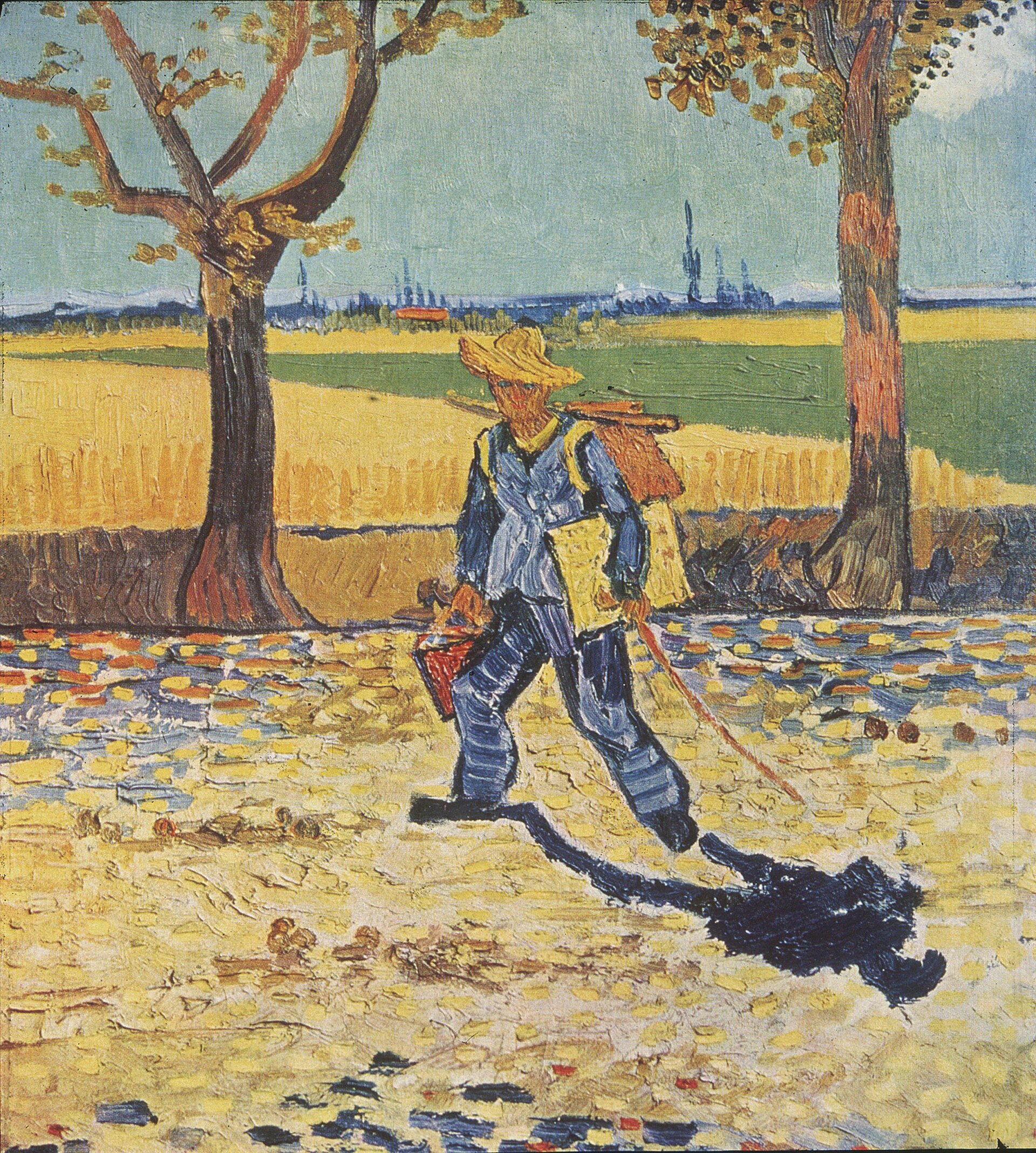
The lost painting as it survives: a reproduction printed from a photograph taken before 1945, because there has been no object to photograph since. The original oil on canvas has not been seen since the fires in the Neu-Stassfurt salt mine in April 1945. Reproduced here from Vincent van Gogh: In der Provence, R. Piper and Co., Munich 1977.
| Artist | Vincent van Gogh |
|---|---|
| Date | Arles, July or early August 1888 |
| Medium | Oil on canvas |
| Dimensions | 48 x 44 cm (Van Gogh Museum letters edition); the museum's own loss report gives 49 x 45 cm |
| Where it is now | Whereabouts unknown. Last recorded in the Neu-Stassfurt salt mine near Stassfurt, Saxony-Anhalt, where the Magdeburg museum collection was stored from 1943; not seen since two fires in the mine in April 1945last confirmed |
| Inventory number | GK 558, St 29 (Kulturhistorisches Museum Magdeburg) |
| Attribution | AcceptedAutograph and never seriously questioned. Full note |
| Object type | Painting |
| Period | Dutch, nineteenth century |
| Cases | Has a provenance gap |
| Inscriptions | No signature is recorded on the picture in the sources consulted. In the same letter that describes it the painter says he had begun signing his canvases and quickly stopped, and that one seascape carries a very large red signature because he wanted a red note in the green. |
| Owners on record | 7 links5 documented, 2 unknown |
| Sources | 24 cited |
About this record Last verified · 24 sources cited · Change log
On this page 10 sections
ContentsClose
The only picture in which Vincent van Gogh painted himself whole. The Art Newspaper's Van Gogh specialist counts his other thirty-six self-portraits as all heads or heads-and-shoulders, though Self-Portrait as a Painter in Amsterdam is a half-length with palette and brushes; here he is a small striding figure on a hot road outside Arles, loaded with a stretched canvas, a paintbox and sticks, throwing a hard blue shadow onto the stones. He described it to his brother Theo in a letter of about 13 August 1888 as a quick sketch of himself laden with boxes, sticks and a canvas on the sunny Tarascon road. The Kaiser-Friedrich-Museum in Magdeburg bought it in 1912, weeks after it hung in the Sonderbund exhibition in Cologne, which made it one of the earliest van Goghs anywhere to enter a public collection.
It was not taken in the 1937 seizure of degenerate art, although 254 other works were taken from that same museum. In 1943 it went down a salt mine at Neu-Stassfurt with more than four hundred other Magdeburg paintings, to a chamber 460 metres underground, immediately below a secret factory building jet engines for the Luftwaffe. American troops reached the mine at noon on 12 April 1945. A fire broke out hours later and a second fire on 30 April. A Monuments Man who went down in May reported the contents entirely reduced to ashes. Nobody has seen the picture since.
Whether it burned or was carried out before the fires is not settled and this record does not settle it. The German Lost Art Foundation carries it as cultural property displaced by war, not as Nazi-looted art. A Luther manuscript and a Hasenpflug painting stored in the same mine turned up again after the war, and a former curator of the Magdeburg museum has said for decades that there were not even ash remains of the paintings. The picture survives in three colour reproductions that disagree with each other about its colour, in one black-and-white glass negative of it in its frame, and in the six paintings Francis Bacon made from a reproduction of it in 1957, having never seen the original.
Provenance
Each link is graded. Documented: a cited source supports it. Disputed: the identification is argued but not established. Unknown: no owner for that span, and the gap is not smoothed into a narrative. The grades in the glossary.
- 1888 - 1888The artist, Arlesdocumented
Painted at Arles in July or early August 1888 and packed by about 13 August in a roll of thirty-six studies, carried to Paris by the second lieutenant Milliet. Van Gogh describes the picture in letter 660 and lists it first among the contents of the roll. The Van Gogh Museum edition identifies the passage with F 448 / JH 1491.4
- 1888 - 1912Not establishedunknown
The roll was consigned to Theo van Gogh in Paris. No source fetched for this record traces the picture from Theo's hands to the Cologne exhibition of 1912, and no dealer, agent or intermediate owner is named anywhere consulted. Twenty-four years of ownership are simply not on the public record, and that gap is recorded here rather than bridged.46
- 1912 - 1912Sonderbund westdeutscher Kunstfreunde und Kuenstler, Colognedocumented
Shown in the Sonderbund international exhibition at Cologne, 25 May to 30 September 1912. The installation photograph is held by the Rheinisches Bildarchiv Koeln as negative rba_32416, and The Art Newspaper reproduces it with this painting circled. In Cologne the picture was in a conventional mitred frame.6
- 1912 - 1943Kaiser-Friedrich-Museum, Magdeburgdocumented
Bought a few weeks after the Cologne exhibition, making it one of the earliest van Goghs anywhere to enter a public collection. Inventory GK 558, St 29. The museum's present director, recalling the room, says it hung upstairs on the first floor. No purchase price appears in any source consulted. Reframed shortly after acquisition in a gilded frame with swirling lines and corners that may represent stylised sunflowers. Photographed in colour in the 1930s. Not among the 254 works taken from this museum in the 1937 and 1938 confiscation of degenerate art; The Art Newspaper's Van Gogh specialist judges that it had by then been moved to the storeroom to keep it out of the action, and labels that as his own reading. Artnet News gives the purchase year as 1919, against every other source consulted.6371111310
- 1943 - 1945Kaiser-Friedrich-Museum, Magdeburg, in wartime storagedocumented
Evacuated secretly with about four hundred other Magdeburg paintings to the Neu-Stassfurt salt mine, thirty kilometres south of the city, to a worked-out salt void 460 metres down between shafts six and seven. A secret Luftwaffe jet-engine factory operated thirty metres above, worked by Dutch and Polish forced labour. The Art Newspaper's Van Gogh specialist infers that the frames would have been taken off the paintings before the move; no source states it as a fact. Bombs destroyed part of the museum building in January 1945, which vindicated the decision.536
- 1945 - presentUnknownunknown
American forces reached Stassfurt at midday on 12 April 1945. A fire broke out in the mine hours later and burned four days; a second began on 30 April and burned about two weeks. Major Michael C. Ross of the Monuments, Fine Arts and Archives section inspected in May and reported the contents entirely reduced to ashes, while the military record states that there is no clear evidence whether the fire was set accidentally or deliberately. Only a few small items were recovered. The painting has not been seen since. Whether it burned or was removed before the fires is unresolved: a Luther manuscript and a Hasenpflug painting recorded as stored in the mine reappeared afterwards, and a former curator of the museum reports that of the paintings there were said to be not even remains of ash. No document naming this object and a person who took it exists in anything consulted for this record.35108
- 2001 - presentKulturhistorisches Museum Magdeburg (claimant of record)documented
Reported by the museum to the German Lost Art Database and published there since 2001 as Lost Art-ID 12812, with the circumstance of loss given as cultural property as war loss. Indexed in Proveana under cultural goods displaced as a result of war, not under cultural goods confiscated as a result of Nazi persecution. Carried by the Monuments Men and Women Foundation on its WWII Most Wanted Art list with a reward of up to USD 25,000. The Volksstimme observed in 2014 that, unlike the degenerate art the Nazi state sold off, the ownership question would itself be unclear if the van Gogh reappeared; that is the newspaper's own sentence and not the museum director's, whose quoted words there are only that she favours famous works of art being accessible to everyone.1238
Prices realised
No auction record exists for this painting in any source consulted, and none can. It went from the artist's studio into a public collection by 1912 and has been missing since 1945, so it has never been offered at public sale. The only figure attached to it in the public record is not a price but an estimate of one: at a panel discussion in Magdeburg in 2015 the city's cultural affairs head Matthias Puhle spoke of a van Gogh painting perhaps worth twenty to thirty million euros, in the course of arguing that it is unlikely anyone is quietly keeping it at home. It is not a valuation by an auction house or an insurer, no basis for it is published, and it should not be read as one. For scale within the same museum's losses, Christian Rohlfs's Stilleben mit weissen Lilien, seized from Magdeburg as degenerate art, was offered back to the museum for 145,000 Mark before surfacing at a Duesseldorf auction in 1994; that is a different object and a different category of loss.
Technical evidence
| Attribution note | Autograph and never seriously questioned. The picture is described by the painter himself in a letter to his brother Theo of about 13 August 1888, where the Van Gogh Museum edition of the correspondence identifies the passage with this work and gives it the catalogue numbers F 448 and JH 1491. The attribution has the unusual property that it can no longer be tested against the object: the painting has not been seen since 1945, so no examination, no pigment analysis and no infrared study of it will ever be made. Everything now said about its surface is said from photographs. |
|---|---|
| Support and medium | Oil on canvas. No technical examination of the object has ever been published, and none can now be made: the painting has not been seen since 1945. Everything recorded about its surface derives from pre-1945 photographs.415 |
| Dimensions | 48 x 44 cm in the Van Gogh Museum edition of the letters, which is the figure carried with the catalogue numbers. The Kulturhistorisches Museum Magdeburg's own loss report to the German Lost Art Database gives 49 x 45 cm, and the Monuments Men and Women Foundation repeats 49 x 45 cm. The Otsuka Museum of Art, which made a full-size ceramic copy, publishes 41.8 x 48 cm, which is both different and in the opposite orientation to a picture that is taller than it is wide. Nothing consulted reconciles the three.41313 |
| Catalogue numbers | F 448 in de la Faille and JH 1491 in Hulsker, as given by the Van Gogh Museum edition of the correspondence in its note to letter 660 and repeated in the general literature. The letters edition marks the work Lost.421 |
| Inventory number | GK 558, St 29, Kulturhistorisches Museum Magdeburg. The number is carried both by the museum's own Lost Art entry and by The Art Newspaper's caption to the picture.16 |
| Signature | None is recorded in any source consulted. In the letter that describes the picture the painter says he had begun signing his canvases and stopped again because it seemed too stupid, and that one seascape carries a very large red signature only because he wanted a red note in the green.4 |
| Frame | Exhibited at Cologne in 1912 in a conventional mitred frame with no decorative corner squares. By the 1920s it hung in Magdeburg in a broad gilded frame with swirling carved lines and elaborate corners, probably made for it shortly after the purchase; the frame historian Lynn Roberts established the gilding from the surviving glass negative and reconstructed the design. The Art Newspaper's Van Gogh specialist infers that the frames would have been removed from the paintings before the 1943 evacuation, stored in an attic and destroyed on the museum director's order in 1960.6 |
| Photographic record | One black-and-white glass negative of the 1920s in the museum archive, showing the painting in its frame, unpublished until 2021. One colour photograph commissioned by the museum in the 1930s, then a rare and expensive undertaking. All later reproductions descend from pre-1945 photography, and the three colour reproductions in free circulation differ materially from one another in hue.6320 |
| Storage site and depth | Neu-Stassfurt salt mine, on the outskirts of Stassfurt, about 30 km south of Magdeburg. The paintings were in a worked-out salt void at 460 m, between shafts six and seven; a secret Luftwaffe jet-engine factory operated 30 m above them at 430 m, reached through shaft seven. The mines ceased production in 1972 and the shafts were sealed; the workings are now flooded.5310 |
Images
The record in full
Chapter 1The only self-portrait in which he walks
A small canvas, 48 by 44 centimetres in the measurement carried by the Van Gogh Museum edition of the letters, oil on canvas, made at Arles in the summer of 1888.
A small canvas, 48 by 44 centimetres in the measurement carried by the Van Gogh Museum edition of the letters, oil on canvas, made at Arles in the summer of 1888. A man walks along a road from left to right, in the near foreground, carrying a stretched canvas on his back, a paintbox, a folded easel and a bundle of sticks. He wears a straw hat and a blue working jacket over a yellow waistcoat. Behind him two pollarded trees stand on the verge, then a band of pale stubble, then a green strip, then a low horizon with a town on it. The road surface is broken into small blocks of pink, orange, white and blue. The figure throws a dark blue shadow forward and to the right, and the shadow is nearly as large as the man.
The composition is ordinary and the fact is not. Van Gogh painted himself about three dozen times. The Art Newspaper's Van Gogh specialist Martin Bailey records that the other thirty-six self-portraits are all heads, or heads and shoulders, and that the Magdeburg painting is the only one that clearly shows him in a landscape. It is also the only one that shows him working, or rather going to work, which is not the same thing and is the point of it. He is not at the easel. He is carrying the easel.
The picture has an obvious afterlife as a document, and it is worth saying what it documents. It is the nearest thing there is to a photograph of van Gogh at the height of the Arles summer: the hat he wore, the way he carried a canvas, the load he walked out with. That evidentiary value is part of why its loss is felt as more than the loss of a painting.
Chapter 2The letter that dates it, and what the letter does not settle
On or about Monday 13 August 1888 Vincent wrote to Theo from Arles.
On or about Monday 13 August 1888 Vincent wrote to Theo from Arles. The letter is number 660 in the Van Gogh Museum and Huygens Institute edition of the correspondence, 665 in the 1990 Dutch edition and 524 in the older Complete Letters. The manuscript is in Amsterdam, inventory numbers b565 a-b V/1962.
He is writing about a roll of paintings that a second lieutenant of Zouaves, Milliet, is taking to Paris for him. The roll, he says, contains thirty-six studies, many of which he is desperately dissatisfied with and is sending anyway because they will still give a vague idea of some really fine subjects in the countryside. Then he lists a few. The first one he lists is this picture: For example, there's a quick sketch I made of myself laden with boxes, sticks, a canvas, on the sunny Tarascon road. The editors of the letters attach that sentence to F 448 and JH 1491, give the medium and size as oil on canvas, 48 by 44 centimetres, and mark the work lost.
What the letter establishes is a terminus. The picture existed and was packed by about 13 August 1888. What the letter does not establish is the month it was painted. Reproductions and catalogue captions commonly date it July 1888, and the Wikimedia Commons file descriptions for the three surviving colour reproductions all say Arles, July 1888. Bailey captions it August 1888. Nothing fetched for this record resolves the difference, and a picture called a quick sketch by its maker may have been made days before it was rolled up. The honest date is July or early August 1888.
One further thing the letter fixes is the company it left in. It travelled to Paris in the same roll as a view of the Rhone in which the sky and the water are the colour of absinthe, with a blue bridge and black figures, a sower, a washing-place and a large landscape with brushwood that he calls unfinished and not at all successful.
Chapter 3A road that ran out of the Yellow House
Tarascon is a town on the Rhone about twenty kilometres north of Arles.
Tarascon is a town on the Rhone about twenty kilometres north of Arles. The road to it is a real road and van Gogh walked it. Bailey describes the picture as showing the painter trudging under a strong sun along the road which ran north from the Yellow House in Arles into the Provencal landscape he liked to paint.
The Yellow House stood on the Place Lamartine. The Van Gogh Museum records that he rented four rooms there with the intention of founding what he called a Studio of the South, a working house for a group of painters whose work Theo could sell in Paris. Paul Gauguin was the first artist to move in and, as the museum puts it, the last. Gauguin arrived in late October 1888, about ten weeks after this picture was rolled up and sent north, and left before the end of December after van Gogh cut off part of his own ear.
So the picture sits on a hinge. It was made in the months when the Arles project was still entirely ahead of him, and it shows the daily physical act on which the whole project rested: a man walking out of a rented house with his equipment on his back, in July heat, to paint the country in front of him. The distance he is covering on foot is the reason the load is on his back at all.
Chapter 4What he was reading while he painted it
The same letter that records the picture records what was in his head that week, and it is unusually explicit.
The same letter that records the picture records what was in his head that week, and it is unusually explicit. He tells Theo that the figure in Zola's writing that strikes him most to the heart is Bongrand, the painter, and he paraphrases him: that when an artist has won his talent and his reputation he is not sheltered by them, because his reputation then forbids him to produce anything less than wholly good, and at the least sign of weakness the jealous pack falls on him and demolishes the reputation and the faith a changeable public had in him.
Stronger than that, he goes on, is what Carlyle says. He recalls the Brazilian fireflies so luminous that women pin them into their hair in the evening, and applies the image directly: glory is a fine thing, but to the artist it is what the dress pin is to those insects. Then his own conclusion, in his own voice: he has a horror of success, and he fears the morning after a triumph of the impressionists, because the difficult days of the present will look later like the good times.
From there he sets out the arrangement he and Gauguin should make. Live about like monks or hermits, with work as the dominating passion, resigning comfort, settling in the cheapest place available, so that they can produce a great deal even while selling little or nothing. He is not describing an ideal. He is costing it. He complains in the same paragraphs that a cup of milk costs a franc, that a slice of bread and butter costs two, and that the paintings do not sell, and he says that if you are a painter you pass either for a madman or for a rich man.
Read next to the picture, that is not decoration. The painting shows a man dressed as a workman, carrying tools, walking to a job. The letter shows the same man rejecting fame as a thing pinned into somebody's hair and proposing to live like a lay brother in order to keep working. He also mentions, almost in passing, that he had started signing his canvases and stopped again because it seemed too stupid, leaving one very large red signature on a seascape only because he wanted a red note in the green. The refusal to sign and the self-portrait as a labourer are the same instinct, and both are documented in the one letter.
Chapter 5Magdeburg buys a van Gogh in 1912
In the summer of 1912 the Sonderbund westdeutscher Kunstfreunde und Kuenstler held its international exhibition in Cologne, from 25 May to 30 September.
In the summer of 1912 the Sonderbund westdeutscher Kunstfreunde und Kuenstler held its international exhibition in Cologne, from 25 May to 30 September. It was the show at which van Gogh was installed at the centre of modern European painting, and this picture hung in it. Bailey reproduces the installation photograph held by the Rheinisches Bildarchiv in Cologne, negative rba_32416, with the painting circled, and notes that in Cologne it was still in a conventional mitred frame with no decorative corner squares.
A few weeks after the Cologne exhibition closed, the Kaiser-Friedrich-Museum in Magdeburg bought it. The museum had opened on 17 December 1906 under its founding director Theodor Volbehr, in a building by the Viennese architects Friedrich Ohmann and August Kirstein. The Otsuka Museum of Art, which has since made a full-size ceramic copy of the picture and researched its history, states that the Magdeburg museum was buying Klimt and Cezanne in those years for the cultural education of its citizens, and that it bought the van Gogh in 1912.
That date matters more than it looks. Both the Monuments Men and Women Foundation and Bailey record the purchase as making this one of the earliest van Goghs anywhere to enter a public collection. A provincial German museum six years old had acquired a painter who had been dead twenty-two years and had sold almost nothing in his life. One source dissents on the year: the Artnet News account of 2024 says the museum bought it in 1919. Every other source consulted, including the museum's own loss report and the Van Gogh specialist who worked in the museum's archive, says 1912, and the Cologne installation photograph of 1912 supports it.
No purchase price appears in any source fetched for this record. Neither the German Wikipedia account of the museum nor the museum's own Lost Art entry gives a figure, and that absence is itself worth recording: what a German municipal museum paid for a van Gogh in 1912 is exactly the sort of number the period literature would carry and the online record does not.
Chapter 6What survives of it: one frame in one negative, and three colours that disagree
Two photographic records of this picture survive in the Magdeburg archive and between them they are all we have of it as a physical object: one black-and-white glass negative of the 1920s that shows...
Two photographic records of this picture survive in the Magdeburg archive and between them they are all we have of it as a physical object: one black-and-white glass negative of the 1920s that shows it framed and hanging, and a colour photograph of the 1930s from which every colour reproduction in the world descends. Take the frame first, because the frame is the part with a documented death of its own.
Visiting the Kulturhistorisches Museum in Magdeburg some years ago, Bailey found in its archive an unpublished glass negative of the 1920s showing the painting in its museum frame. The photographer was concentrating on the picture, so only part of the frame is in shot. It is a bold thing: broad, with swirling carved lines and elaborate corners.
The frame historian Lynn Roberts examined that photograph for The Art Newspaper and concluded that the frame was gilded. Her reasoning is visual and specific. On the top member there appear to be minute scratches on the gold, whereas the grain of the wood would be visible if it were ungilded; the brightness of the beading shows gilding, as does the relatively high contrast across the frame as a whole. She then made a reconstruction of the whole frame from the fragment.
Roberts and Bailey both read the design as made for this picture rather than bought for it. The decorative corners, Bailey writes, could well represent stylised sunflowers, and the swirling lines recall van Gogh's windswept wheatfields and turbulent skies. Since the picture arrived in Magdeburg in a plain mitred frame straight from Cologne, and the swirling frame appears on it by the 1920s, the frame was almost certainly made after the purchase and for this painting.
Whether van Gogh would have tolerated it is a separate question and both parties to it are on record. He wrote to his sister Wil that if a painting looks good in a simple frame, there is no reason to put gilding round it. In 1905 Paul Gachet the younger, son of the doctor who treated van Gogh at Auvers, put it harder still: that it is an act of moral barbarism to put gold frames around the canvases of that simple, humble man.
The frame did not go down the mine. Tobias von Elsner, for many years a curator and then deputy director at the Magdeburg museum, is not the source for this: The Art Newspaper's Van Gogh specialist infers that the frames were taken off the paintings for ease of transport and storage immediately before the evacuation, and kept afterwards in an attic store. In 1960, with Magdeburg in the German Democratic Republic, the museum director ordered them destroyed. Von Elsner's account of how that was done is the sentence to keep: they were thrown out of a window onto the street, where they smashed and were removed as rubbish. Hundreds of historic frames from paintings already lost in the war went that way. So the frame outlived the picture by fifteen years and was destroyed on purpose, in peacetime, by the institution that owned it.
Now the colour. Some time in the 1930s the Magdeburg museum had the picture photographed in colour. The Monuments Men and Women Foundation calls this a rare and expensive practice at the time and reads it as a sign of the painting's standing in the collection. Bailey makes the same point from the other side: it was one of the relatively few van Gogh paintings photographed in colour before the war.
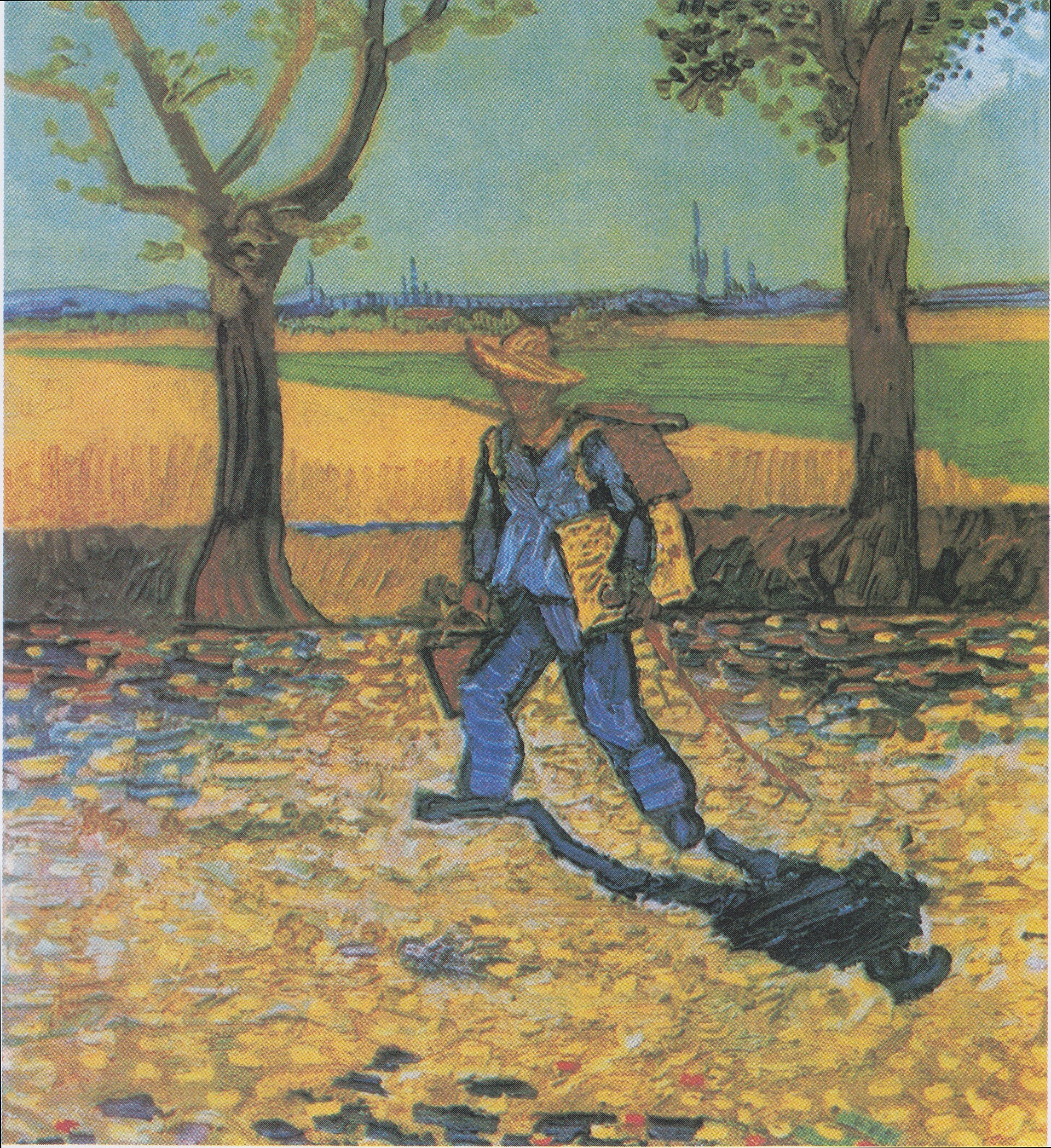
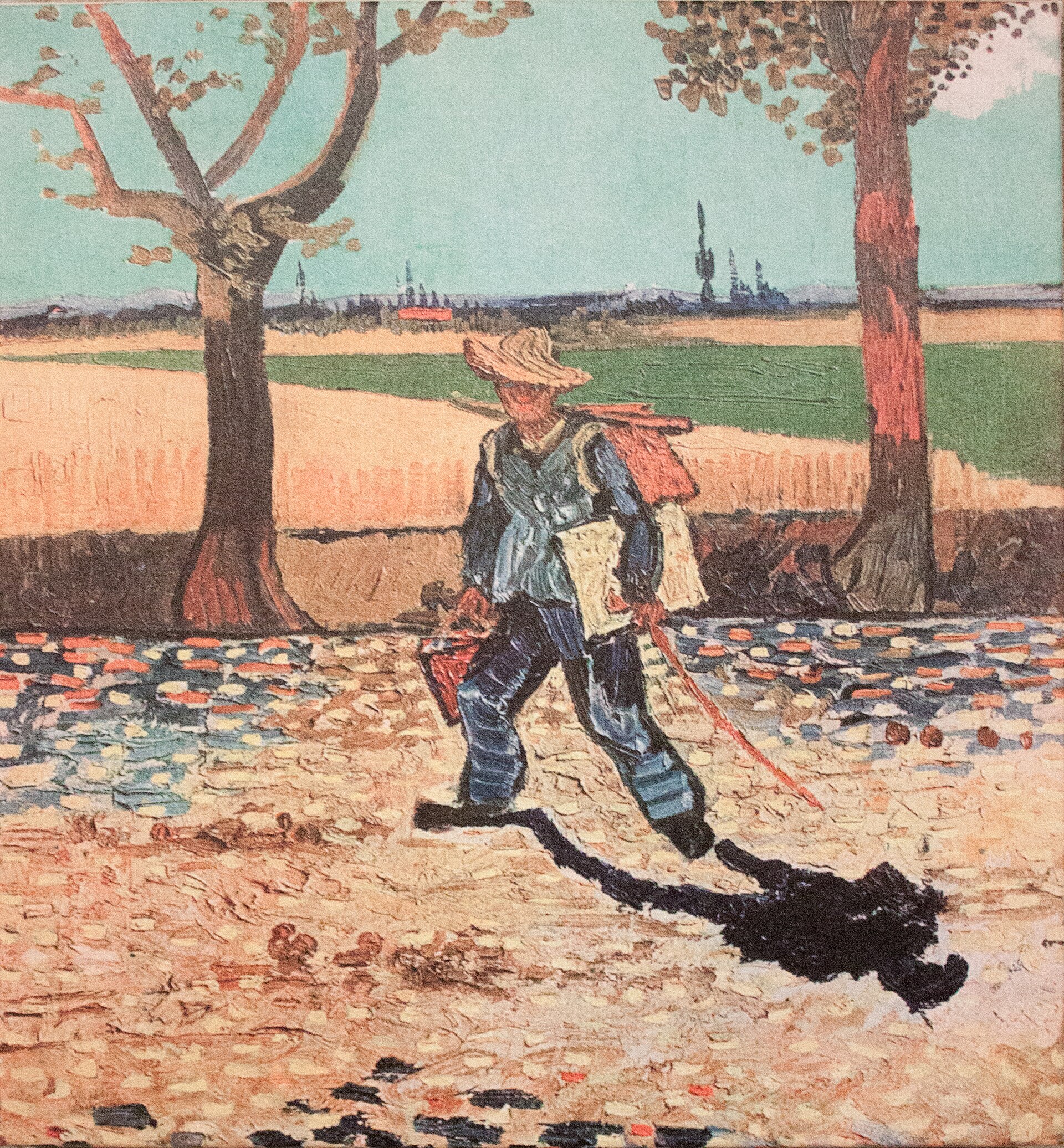
That decision is why this record can be illustrated at all. Every reproduction of this painting in circulation descends from a photograph taken before 1945, because there has been no object to photograph since. The consequence is visible the moment two reproductions are put side by side. Of the three colour reproductions of the picture on Wikimedia Commons, one gives the field behind the figure as a cool yellow-green under a pale blue-green sky, one gives the same field a warm ochre under a deeper green sky, and one gives the road a distinctly pink cast that the others do not have. The figure, the trees, the town on the horizon and the blue shadow are identical in all three. The colour is not.
There is no way to arbitrate between them, and this record does not try. What can be said is narrow and true: the drawing of the picture is secure, the tonal structure is secure, and the precise hues are a matter of which pre-war plate a given book was printed from and how it was printed. For a painter whose whole argument was about colour, that is a real loss inside the loss.
So the tally of what remains is short and can be written out. One monochrome negative showing the object framed on a wall, which is the only image of it as a thing in a room. One colour campaign of the 1930s, surviving in the printed plates struck from it, which disagree. A reconstruction drawing of a frame that was smashed in a Magdeburg street in 1960. A full-size ceramic copy made in Japan in 2018. Six paintings by Francis Bacon, made from a reproduction by a man who never saw the original. And an inventory number, GK 558, St 29, attached to nothing.
Chapter 7It was not taken as degenerate art, and the record proves it
The most frequently assumed thing about a modern painting in a German public collection in the 1930s is that the state took it.
The most frequently assumed thing about a modern painting in a German public collection in the 1930s is that the state took it. Here it did not, and that can be demonstrated rather than asserted.
The Beschlagnahmeinventar Entartete Kunst at the Freie Universitaet Berlin is the index of the works seized from German museums in the confiscation action of 1937 and 1938, compiled from the National Socialist seizure inventory itself. Searched for van Gogh, it returns five works and no more: Der Garten Daubignys, Liebespaar and Kornfeld mit Maeher from the Nationalgalerie in Berlin, with seizure numbers 15674, 15677 and 15682; the Portrait des Dr. Gachet from the Staedel in Frankfurt, number 15774; and a Selbstbildnis from the Bayerische Staatsgemaeldesammlungen in Munich, number 16554. None is from Magdeburg.
Searched instead for the Kaiser-Friedrich-Museum in Magdeburg, the same database returns 254 works, beginning with a Barlach print, three Boetticher prints, two Corinth prints and a portfolio by Josef Eberz. The museum was thoroughly purged. The van Gogh was not in the purge.
Bailey offers an explanation and labels it as his own reading: that by 1937 the painting had almost certainly been moved into the storeroom, in a successful effort to keep it from being confiscated. The Monuments Men and Women Foundation records the same outcome more flatly, saying that although the fate of such works in German public collections was most often requisition and sale, this one was for some reason left in Magdeburg. Artnet News says it narrowly escaped. All three are describing the same fact from different distances, and none of them has a document showing a decision.
There is a discrepancy in the counts worth flagging. The Freie Universitaet database returns 254 confiscated items for the Magdeburg museum. The Volksstimme, reporting von Elsner's 1995 study, gives 150 works removed in 1937 and describes the museum's total list of missing items as 488, made up of those 150 and 338 paintings treated in the research as war losses. The two figures are not necessarily in conflict, since the database counts individual sheets in print portfolios and the newspaper may be counting works, but no source consulted reconciles them.
What happened to the seized Magdeburg works is a separate history and a bleaker one. The museum's director Gabriele Koester told the Volksstimme in 2014 that eight of them are now located: Kirchner's Gebirgslandschaft hangs in Detroit, a Klee watercolour is in private hands in Lucerne, Rohlfs's Stilleben mit weissen Lilien surfaced at a Duesseldorf auction in 1994 having first been offered back to the museum for 145,000 Mark, and Nolde's Junge Ochsen, sold abroad by the regime for foreign currency, is in Saarbruecken. Koester's assessment was blunt: there is no chance the museum will ever get the pictures back, and there is no legal claim to their return.
Chapter 8Down the shaft at Neu-Stassfurt
In 1943 the picture left Magdeburg. Bailey records that it went with about four hundred other Magdeburg paintings, secretly, to a salt mine on the outskirts of Stassfurt, some thirty kilometres south...
In 1943 the picture left Magdeburg. Bailey records that it went with about four hundred other Magdeburg paintings, secretly, to a salt mine on the outskirts of Stassfurt, some thirty kilometres south of the city. The evacuation was a response to British bombing, and the judgement behind it was vindicated: part of the museum building was destroyed by bombs in January 1945.
The storage site has been named loosely in the literature and precisely in a few places. The loose name is Stassfurt. The precise name, given in the German Wikipedia account of the museum, in the title of von Elsner's study and by the Monuments Men and Women Foundation, is the Neu-Stassfurt mine. No source consulted for this record places the Magdeburg deposit at Schoenebeck, which is a different town on the Elbe between Magdeburg and Stassfurt; that attribution does not appear in any fetched source and should be treated as an error until a document supports it.
The depth is recorded twice and the two figures differ. Bailey, in his detailed account, puts the paintings 460 metres down, in one of the voids left by salt extraction, between shafts six and seven. The Monuments Men and Women Foundation puts them roughly 1,500 feet down in shaft six, which is the same figure in other units. In a later article Bailey wrote loosely of a fire nearly a kilometre underground, which does not agree with his own 460 metres; the specific figure is the one to trust.
The thing that makes the site notorious is what was immediately above the art. Thirty metres higher, at 430 metres, a secret factory was producing jet engines for the Luftwaffe, and it was reached through the seventh shaft. The labour in that factory was forced labour, Dutch and Polish, and Bailey names it as such. So a provincial museum's Cezannes, Liebermanns, Corinths and its one van Gogh spent the last two years of the war in a chamber directly beneath a slave-worked armaments plant, and were guarded by the same war that had put them there.
Chapter 9The two fires, and what the Monuments Man actually wrote
American forces reached Stassfurt at midday on 12 April 1945.
American forces reached Stassfurt at midday on 12 April 1945. The first fire broke out in the mine within hours. It burned, on the Monuments Men and Women Foundation's account, for four days. A second fire began on 30 April and burned for about two weeks.
The Monuments, Fine Arts and Archives officer Major Michael C. Ross went down to investigate a local report about the collection in May 1945 and reported that the contents had been entirely reduced to ashes. The declassified military record of the cause is quoted here in the fuller version the Foundation prints, where The Art Newspaper gives the same sentence without the Schacht VII clause, and it is the single most important sentence in the whole case: The fires were stated to have been caused by displaced persons who entered the cave to loot; in the second case, perhaps through the negligence of the US guards posted on Schacht VII. There is no clear evidence whether the fire was set accidentally or deliberately. The Foundation's fuller version adds a parenthesis, that an accidental fire was very likely if packing cases with excelsior were open.
Every word of that is careful and every word of it is a hedge. It says what was stated, not what was found. It offers accident and deliberate act as alternatives and refuses to choose. The displaced persons in the sentence were, Bailey specifies, the Dutch and Polish forced labourers from the jet-engine factory above. The Foundation goes further and lists the other candidates if looting occurred at all: Nazi personnel, local citizenry or American military personnel. It then says plainly that no definitive evidence has been found for any of them.
That is the whole documentary basis for the idea that the painting was taken. It is a wartime officer's note recording a rumour about the cause of a fire, in a chamber that contained four hundred pictures, and it names this painting nowhere.
Chapter 10What did come back out of the mine
The mine did not swallow everything, and the exceptions are what keep the case open.Two objects recorded as having been stored there turned up afterwards.
The mine did not swallow everything, and the exceptions are what keep the case open.
Two objects recorded as having been stored there turned up afterwards. A manuscript of Martin Luther's Wider Hans Worst, the polemic of 1541, was found in the United States and returned to the Kulturhistorisches Museum Magdeburg in 1996. A painting by Carl Hasenpflug also reappeared. Beyond those, Bailey records that some fire-damaged drawings, sculptures, books and natural history specimens were recovered, and the Monuments Men and Women Foundation says only a few small items survived the fire and were recovered at all.
Von Elsner, speaking at a public discussion in Magdeburg in 2015 reported by the German press agency, put it in a sentence: much burned, but not everything. He described a library recovered from the shaft that was half the size of a football pitch. And then the detail that has driven the argument for thirty years: of the paintings, he said, there were said to have been not even remains of ash.
A fourth thread runs alongside. In 2008 the museum became aware that a painting by Arnold Boecklin could be seen in the background of two photographs by Helmut Newton. The Monuments Men and Women Foundation records the sighting and is careful about it: it remains unclear whether the painting photographed has been authenticated as the original.
None of this is evidence about the van Gogh. It is evidence about the deposit. Material that was catalogued as being in that mine later existed outside it, which means the mine was not a sealed furnace, and that is the fact the destruction account has to accommodate.
Chapter 11Destroyed or taken: where the argument actually stands
Two named people on the record take opposite positions, and both of them have worked on it directly.Tobias von Elsner, who documented 338 of the roughly 400 missing Magdeburg paintings and published...
Two named people on the record take opposite positions, and both of them have worked on it directly.
Tobias von Elsner, who documented 338 of the roughly 400 missing Magdeburg paintings and published them in 1995 under the title Alles verbrannt? Die verlorene Gemaeldegalerie des Kaiser Friedrich Museums Magdeburg, believes the fires are likely to have been arson, possibly set to disguise the looting of the artworks, with the most important paintings seized and the packing cases and lesser works then set alight. He has been looking for this picture for decades and told The Art Newspaper that it is just possible some survive, and that as the van Gogh was the most important work in the collection it would have been a particularly attractive target for looters. To the news agency in 2015 he said hope dies last, and that the door stays open.
Matthias Puhle, the city's cultural affairs head, took the other view at the same 2015 discussion. He thought it unlikely that anyone today is sitting at home with a van Gogh worth perhaps twenty to thirty million euros on the living-room wall. Apart from the precious Luther manuscripts, he pointed out, very little from the Stassfurt holdings has surfaced, and that feeds the suspicion that the paintings physically no longer exist.
The institutions with a formal position have declined to choose. The German Lost Art Foundation classifies entry 12812 as cultural property lost as a result of war, and its Proveana research database files it under cultural goods displaced as a result of war rather than under cultural goods confiscated as a result of Nazi persecution. That is a deliberate distinction and it is the Foundation's own. The Monuments Men and Women Foundation lists the painting as still sought and offers a reward for it, which is not a statement that it survives but is a statement that the Foundation does not treat its destruction as proven. The Volksstimme, reporting the museum, said it is unclear whether the work was removed or destroyed in the chaos of the war, and added a point that is easy to miss: unlike the works the regime sold as degenerate, the question of who would own this painting if it reappeared is itself unclear.
Against all of that stands a popular account that is simply wrong and has spread widely. The Guardian in November 2013 described the painting as believed to have been burned in an air raid on Germany. The English Wikipedia article on the picture, which cites that Guardian piece, gives its condition as destroyed in bombing and its location as Kaiser Friedrich Museum, Stassfurt, conflating the museum in Magdeburg with the mine thirty kilometres away. The error is not confined to one paper and one encyclopaedia entry, and it survives because it is the plausible thing to assume about a German museum picture that disappeared in 1945. No air raid destroyed this picture. It was underground, in a salt mine, in another town, when whatever happened to it happened.
Chapter 12The registers it sits in, and the hole in the ground
The painting is on two public registers and both entries can be checked.The German Lost Art Database carries it as Lost Art-ID 12812, under the title Der Maler auf dem Weg nach Tarascon / Vincent auf...
The painting is on two public registers and both entries can be checked.
The German Lost Art Database carries it as Lost Art-ID 12812, under the title Der Maler auf dem Weg nach Tarascon / Vincent auf dem Weg zur Arbeit, dated 1888, described as painting, general, at 49 by 45 centimetres, with the inventory number GK 558, St 29, published since 2001. The reporting institution is the Kulturhistorisches Museum Magdeburg and the named contacts are its director Gabriele Koester and Karin Kanter of the print room. The circumstance of loss is given as cultural property as war loss. The same record is indexed in Proveana under the research context of cultural goods displaced as a result of war.
The Monuments Men and Women Foundation carries it on its WWII Most Wanted Art list with a reward of up to USD 25,000, a toll-free tip line and a dedicated email address, and reproduces the picture courtesy of the Magdeburg museum's own picture archive. No entry for this work was found on the FBI National Stolen Art File during this research, which is consistent with its classification: it is a foreign wartime loss reported by a German institution, not a theft reported to a United States law enforcement agency.
There is an accident of geography in the register history worth noticing. Since January 2015 the Deutsches Zentrum Kulturgutverluste, the German national centre for the study of cultural property losses, has had its seat in Magdeburg. The central agency for clearing up trophy art and possible Nazi loot sits in the city whose own best painting is on the database it maintains. The same database records, alongside the pictures, that the Magdeburg natural history museum is still missing seven thousand tailed amphibians.
The museum's own current position is modest and financially bounded. Its provenance research reports no indication that it ever acquired art looted under the Nazi regime, records that most of its pre-war collection was, in its own words, looted or destroyed when fire was set to the wartime storage at the Neustassfurt mine, and states that further research is limited by what the museum can afford. Von Elsner's documentation of 338 of the roughly 400 missing paintings, published in 1995, remains the base study, and it was done by one curator.
The class of loss is not unique to Magdeburg and the comparison is instructive. In 1945 a flak bunker in Berlin-Friedrichshain used as a depot burned twice, destroying major works; the Bode-Museum mounted an exhibition of those losses, Das verschwundene Museum, in the seventieth-anniversary year. A fire in a depot, twice, after the fighting has moved on, with no conclusive account of the cause, is a recognisable pattern rather than a singular event.
The place itself is no longer reachable. The Neu-Stassfurt salt mines stopped production in 1972 and the shafts were sealed. Bailey visited some years ago and found a capped circular shaft in remote countryside inside rusty wire fencing, and photographed the sealed entrance to shaft seven in 2009. The German press agency report of 2015 describes the mine as long since flooded. Whatever the answer is, it will not be found by going back down.
Chapter 13Bacon, who never saw it, and a copy fired in ceramic
The picture has had two afterlives, one famous and one quiet.In March 1957 Francis Bacon showed a group of paintings at the Hanover Gallery in London, opening on 20 March.
The picture has had two afterlives, one famous and one quiet.
In March 1957 Francis Bacon showed a group of paintings at the Hanover Gallery in London, opening on 20 March. They were made in a rush and the Estate of Francis Bacon records that some arrived wet and late. All of them derived from this painting. The series runs as Study for Portrait of Van Gogh I to VI, with Van Gogh in a Landscape and Van Gogh Going to Work of 1957 and Homage to Van Gogh of 1960 alongside. Bacon never saw the van Gogh. He could not have; it had been gone for twelve years. He worked from a reproduction, and said so.
What he did with it is a matter of record. The Estate's catalogue raisonne entry for Study for Portrait of Van Gogh VI, catalogue number 57-14, describes the road splitting and parting through the composition in a way that recalls Soutine's carcass of beef, and quotes Bacon on the figure: more like a phantom of the road. The series broke him out of the sombre monochromes that had dominated his large paintings for seven years, in some of the most vivid colour of his career, applied with a broad loaded brush in an impasto the Estate compares to Appel, de Kooning and above all Soutine. Study for Portrait of Van Gogh IV is in the Tate collection, accession T00226, catalogued there as not on display.
The consequence is worth stating plainly, because it is unusual. A lost painting produced a major body of work in another painter, at a specific and dateable turning point in his career, entirely through a printed reproduction. The picture's influence is therefore independent of its survival, and has been for eighty years.
The quiet afterlife is in Japan. The Otsuka Museum of Art at Naruto in Tokushima Prefecture, which reproduces western paintings full size on ceramic panels, made this one and put it on permanent display from 3 November 2018. It made two copies and gave one to Magdeburg. The handover ceremony was held at the Kulturhistorisches Museum on 28 November 2018, attended by the museum's director Gabriele Koester, by von Elsner as the researcher of the lost pictures and by the deputy mayor Matthias Puhle, and the copy went on show the next day. Koester praised the workmanship. Von Elsner's reported remark was that the work wipes out the sorrow of the loss, which is generous and, on the evidence of everything else he has said about it for thirty years, not quite what he thinks.
Chapter 14What this record will not say
This entry is published in a section about objects that were taken, and it is worth being exact about why it carries no account of a taking.No source fetched for this record documents anyone removing...
This entry is published in a section about objects that were taken, and it is worth being exact about why it carries no account of a taking.
No source fetched for this record documents anyone removing this painting from anywhere. The 1937 confiscation inventory at the Freie Universitaet Berlin lists five van Goghs and none of them is this one. The German Lost Art Foundation, which is the body that classifies such cases in Germany, files it as a war loss rather than as property confiscated through Nazi persecution. The only contemporary document that mentions looting at all is Major Ross's report, which records a statement about why a fire may have started in a chamber holding four hundred pictures, attributes it to nobody in particular, and says there is no clear evidence. The arson-to-cover-looting reading is von Elsner's, he advances it as a belief, and he says openly that it remains a mystery what happened to the van Gogh.
Saying the collection may have been looted and saying this painting was looted are different statements, and only the first one has a source behind it. The second is the inference that this publication exists to refuse. Until a document names this object and a hand that carried it, the record is that a museum sent its best picture underground in 1943 to keep it safe, that the place burned twice in April 1945 after the fighting had passed, and that nobody has seen it since.
That is not a smaller story. It is the exact shape of the evidence, and the exact shape of the evidence is what a reader came here for.
The artist
Vincent Willem van Gogh
Born 30 March 1853, dead by his own hand on 29 July 1890 at Auvers-sur-Oise, and a painter for barely ten of those years. The Van Gogh Museum dates the decision to become an artist to his twenty-seventh year, after he had already been an art dealer in The Hague and Paris, a schoolmaster in England and a lay preacher in the Borinage coal district of Belgium. The Arles pictures, of which this was one, belong to a stretch of about twenty months in the south of France that produced a large part of the work he is known by, and ended with a severed ear and a voluntary admission to an asylum. He is the rarest of cases in this archive: an artist whose biography is better known than his objects, and whose objects are therefore constantly read through it. The letters are the corrective, because they are his own account, written at the time, in his own hand.
Related works
| Work | Relation | Where it is |
|---|---|---|
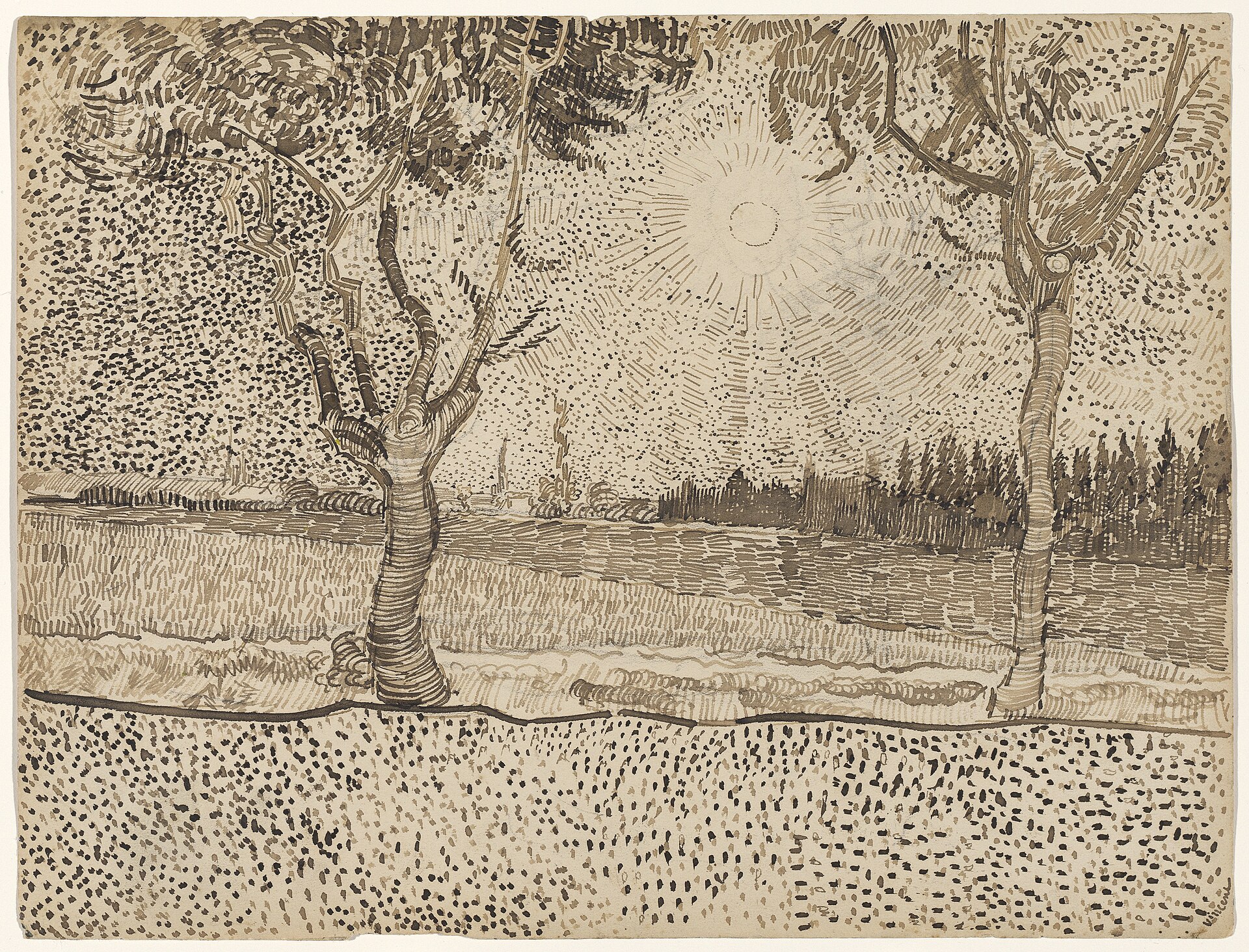
| The Road to Tarascon (La route de Tarascon) Vincent van Gogh | Same road, same weeks, different object. A reed pen and ink drawing over graphite, not a painting, and without the painter figure. Dated by the museum to Arles, about 31 July to 3 August 1888, so within days of the painting. 24.3 x 31.9 cm. It shows the road under a blazing radiating sun with trees either side and no walking figure. It is routinely confused with the Magdeburg painting because of its title. | Solomon R. Guggenheim Museum, New York, Thannhauser Collection, gift of Justin K. Thannhauser 1978, accession 78.2514.22 |
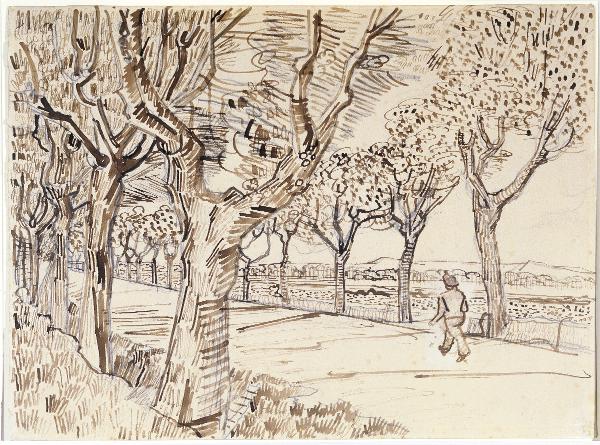
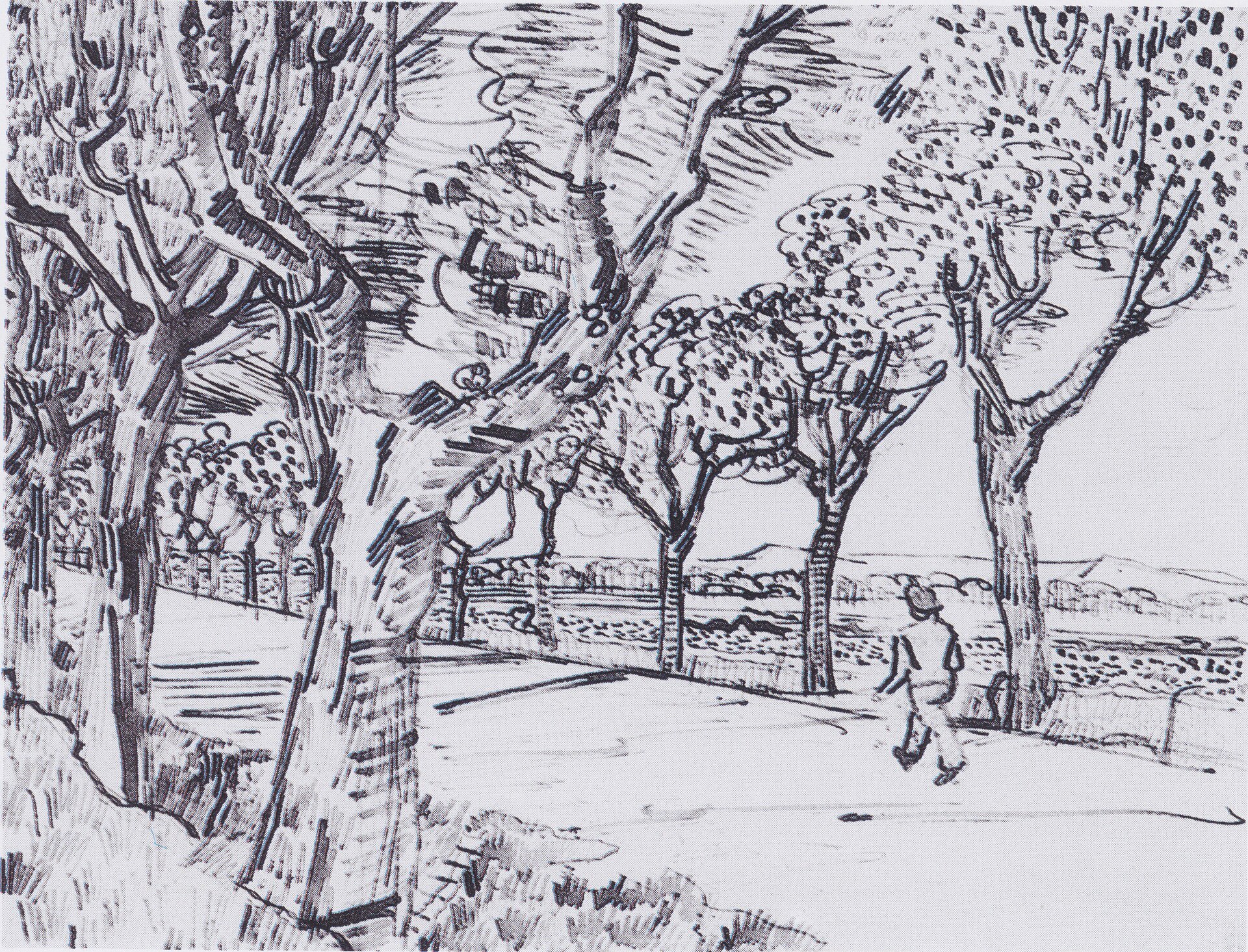
| La Route de Tarascon (April 1888) Vincent van Gogh | The earlier drawing of the same road, four months before the painting, with a small walking figure that is not the painter with his equipment. Reproduced on Wikimedia Commons twice, once in colour from the Kunsthaus and once in monochrome under the German title Auf dem Weg nach Tarascon dated Arles, July 1888. The monochrome file is the April drawing wrongly dated, and sits in search results for the painting. Both are included here as version plates for exactly that reason. | Kunsthaus Zuerich |
| Study for Portrait of Van Gogh IV Francis Bacon | Made from a reproduction of the lost painting. Bacon never saw the original. One of six Study for Portrait of Van Gogh canvases shown at the Hanover Gallery, London, from 20 March 1957. The series broke Bacon out of seven years of sombre monochrome large paintings. | Tate, accession T00226 |
| Study for Portrait of Van Gogh VI Francis Bacon | The last of the series, catalogue raisonne number 57-14, delivered after the Hanover Gallery show had already opened. The Estate quotes Bacon describing the figure as more like a phantom of the road, and reads the parting of the roadway as recalling Soutine's carcass of beef. | Not stated in the Estate's catalogue entry consulted; exhibited at the Middlesbrough Institute of Modern Art in 2014 |
| Portrait des Dr. Gachet Vincent van Gogh | The fate the Magdeburg picture escaped. Confiscated from the Staedelsches Kunstinstitut in Frankfurt in the degenerate art action, seizure number 15774. One of five van Goghs in the Freie Universitaet Berlin confiscation inventory, alongside three from the Berlin Nationalgalerie and one from Munich. None of the five is from Magdeburg, which is the documentary proof that this painting was not taken in 1937. | Private hands; not in a German public collection |
| Wider Hans Worst (1541) Martin Luther | Stored in the same salt mine as the painting and recovered afterwards, which is the single strongest argument that the mine's contents were not all destroyed. Found in the United States and returned to Magdeburg in 1996. A painting by Carl Hasenpflug recorded in the same deposit also reappeared. | Kulturhistorisches Museum Magdeburg |
Open questions
- Who owned the painting between the roll that Milliet carried to Paris in August 1888 and the Sonderbund exhibition in Cologne in 1912? No dealer, agent or intermediate owner is named in anything consulted, and twenty-four years of the chain are blank.
- What did the Kaiser-Friedrich-Museum pay for it in 1912, and out of what fund? No price appears in the museum's own loss report, in the German account of the museum's history, or in the specialist literature consulted.
- Which dimension is right? The Van Gogh Museum letters edition gives 48 x 44 cm, the museum's own Lost Art report gives 49 x 45 cm, and the Otsuka Museum, which made a full-size ceramic copy and therefore had to choose, publishes 41.8 x 48 cm in the opposite orientation.
- Was the painting shown anywhere between Cologne in 1912 and the evacuation in 1943? No exhibition history for those thirty-one years was found in any source consulted.
- Why was this picture left in Magdeburg when 254 works were taken from the same museum in 1937 and 1938, and five van Goghs were taken from Berlin, Frankfurt and Munich? The storeroom explanation is offered as a judgement, not from a document, and no seizure file or museum minute has been published either way.
- Do the 150 works the Volksstimme reports as removed from Magdeburg in 1937 and the 254 entries the Freie Universitaet Berlin inventory returns for that museum describe the same action counted differently, or two different things? No source consulted reconciles them.
- Is there a surviving pre-1945 colour transparency or plate from which the 1930s colour photograph was printed, and does it still exist in the Magdeburg picture archive? The three colour reproductions in circulation differ materially in hue and nothing consulted says which, if any, is closest to the original photography.
- Was the Arnold Boecklin seen in the background of two Helmut Newton photographs and noticed by the museum in 2008 ever authenticated as the picture from the mine? The Monuments Men and Women Foundation says it remains unclear.
Questions about this object
What is The Painter on the Road to Tarascon?
The Painter on the Road to Tarascon is a painting, dated arles, July or early August 1888. Medium: Oil on canvas.
Who made The Painter on the Road to Tarascon, and is the attribution settled?
The attribution to Vincent van Gogh is recorded here as accepted. Autograph and never seriously questioned. The picture is described by the painter himself in a letter to his brother Theo of about 13 August 1888, where the Van Gogh Museum edition of the correspondence identifies the passage with this work and gives it the catalogue numbers F 448 and JH 1491. The attribution has the unusual property that it can no longer be tested against the object: the painting has not been seen since 1945, so no examination, no pigment analysis and no infrared study of it will ever be made. Everything now said about its surface is said from photographs.
Where is The Painter on the Road to Tarascon now?
Whereabouts unknown. Last recorded in the Neu-Stassfurt salt mine near Stassfurt, Saxony-Anhalt, where the Magdeburg museum collection was stored from 1943; not seen since two fires in the mine in April 1945. Inventory number GK 558, St 29 (Kulturhistorisches Museum Magdeburg). Last confirmed 26 September 2026. Reported by the Kulturhistorisches Museum Magdeburg to the Lost Art Database as a war loss, entry 12812, published since 2001, and carried by the Monuments Men and Women Foundation on its WWII Most Wanted Art list with a reward of up to USD 25,000.
What is still unknown about The Painter on the Road to Tarascon?
Who owned the painting between the roll that Milliet carried to Paris in August 1888 and the Sonderbund exhibition in Cologne in 1912? No dealer, agent or intermediate owner is named in anything consulted, and twenty-four years of the chain are blank.
Sources
- 1German Lost Art Foundation, Lost Art Database, search request 12812, 'The painter on the way to Tarascon / Vincent on the way to work', reported by the Kulturhistorisches Museum Magdeburg, published since 2001; gives 49 x 45 cm, inventory GK 558, St 29, and the circumstance of loss as cultural property as war loss. Read 2026-09-26. lostart.de/en/...
- 2German Lost Art Foundation, Proveana research database, search for Tarascon, returning Lost Art-ID 012812 under the research context 'Cultural goods displaced as a result of war'. Read 2026-09-26. proveana.de/en/...
- 3Monuments Men and Women Foundation, WWII Most Wanted Art, 'Vincent van Gogh (1853-1890), The Painter on the Way to Tarascon, 1888'; carries the Ross report quotation, the mine depth and shaft numbers, the fire dates and a reward of up to USD 25,000. mmwf.org/wwii-most-wanted/...
- 4Vincent van Gogh, The Letters, letter 660, to Theo van Gogh, Arles, on or about Monday 13 August 1888 (Brieven 1990 no. 665, Complete Letters no. 524), Van Gogh Museum and Huygens Institute scholarly edition; manuscript Amsterdam, Van Gogh Museum, inv. b565 a-b V/1962. Editorial note identifies the Tarascon passage as F 448 / JH 1491, oil on canvas, 48 x 44 cm, Lost. vangoghletters.org/vg/...
- 5Martin Bailey, 'Hunt still on for a Van Gogh self-portrait lost deep in a salt mine during the Second World War', The Art Newspaper, 27 November 2020. theartnewspaper.com/2020/...
- 6Martin Bailey, 'A lost Van Gogh self-portrait had the most extraordinary frame that included his much-loved sunflowers - here it is reconstructed', The Art Newspaper, 15 January 2021; with Lynn Roberts's analysis and reconstruction of the frame and the 1912 Sonderbund installation photograph, Rheinisches Bildarchiv Koeln rba_32416. theartnewspaper.com/2021/...
- 7Freie Universitaet Berlin, Forschungsstelle Entartete Kunst, Beschlagnahmeinventar 'Entartete Kunst'. Searched 2026-09-26: full text 'Gogh' returns five works (Berlin Nationalgalerie EK 15674, 15677, 15682; Frankfurt Staedel EK 15774; Munich EK 16554) and none from Magdeburg; full text 'Magdeburg, Kaiser-Friedrich-Museum' returns 254 entries. emuseum.campus.fu-berlin.de
- 8Volksstimme, 'Verkauft, verbrannt, verschwunden: Suche nach Magdeburgs Kunstschaetzen', 5 February 2014; quotes Tobias von Elsner's 1995 study and the museum director Gabriele Koester. volksstimme.de/nachrichten/...
- 9Volksstimme, '488 Magdeburger Kunstwerke verschwunden', 5 February 2014; gives the breakdown of 150 works removed in 1937 and 338 counted in the research as war losses. volksstimme.de/nachrichten/...
- 10Deutsche Presse-Agentur, 'Wo ist der Magdeburger van Gogh?', published by NWZ, 30 April 2015; reports the Magdeburg panel discussion with Gabriele Koester, Tobias von Elsner and Matthias Puhle, the recovered library, the absence of ash remains and the flooded mine. nwzonline.de/kultur/...
- 11Tim Brinkhof, 'The Hunt: A Vincent van Gogh Masterpiece That Was Lost to Conflict', Artnet News, 10 June 2024. Gives the purchase year as 1919, against every other source here. news.artnet.com/art-world/...
- 12Commission for Looted Art in Europe, 'Provenance Research: Kulturhistorisches Museum Magdeburg'; records von Elsner's 1995 publication of 338 of about 400 missing paintings and the 1996 return of Luther's Wider Hans Worst. lootedart.com/MFEU4D35499_print;Y
- 13Otsuka Museum of Art, Naruto, 'Van Gogh's lost masterpiece donated to German museum'; the full-size ceramic copy on display from 3 November 2018, the second copy given to Magdeburg and the handover ceremony of 28 November 2018. o-museum.or.jp/en/...
- 14The Estate of Francis Bacon, catalogue raisonne focus, 'Study for Portrait of Van Gogh VI, 1957', catalogue number 57-14; quotes Bacon on the figure as more like a phantom of the road. francis-bacon.com/node/...
- 15The Estate of Francis Bacon, 'Van Gogh by Bacon'; the Hanover Gallery opening of 20 March 1957 and the composition of the series. francis-bacon.com/bacons-world/...
- 16Solomon R. Guggenheim Museum, collection online, Vincent van Gogh, The Road to Tarascon (La route de Tarascon), Arles, ca. 31 July - 3 August 1888, reed pen and ink over graphite on paper, 24.3 x 31.9 cm, Thannhauser Collection, accession 78.2514.22. guggenheim.org/artwork/...
- 17Jonathan Jones, 'Missing in action: artworks presumed to have been destroyed in the war', The Guardian, 4 November 2013; states that the painting is believed to have been burned in an air raid on Germany, which this record records as an error. theguardian.com/artanddesign/...
- 18Van Gogh Museum, Amsterdam, 'Vincent van Gogh in the South of France, 1888-1889'; the Yellow House, the Studio of the South and Gauguin's arrival and departure. vangoghmuseum.nl/en/...
- 19Van Gogh Museum, Amsterdam, 'The Life of Vincent van Gogh, 1853-1890'; the decision to become an artist at twenty-seven, the earlier occupations and the year at Saint-Remy. vangoghmuseum.nl/en/...
- 20Each file was also downloaded at thumbnail size and looked at before its role was assigned, which is how two candidates were identified as the Kunsthaus Zuerich drawing rather than the painting. commons.wikimedia.org/w/...
- 21Wikipedia, 'The Painter on the Road to Tarascon'. en.wikipedia.org/wiki/...
- 22Wikipedia (German), 'Kaiser-Friedrich-Museum (Magdeburg)' / Kulturhistorisches Museum Magdeburg. de.wikipedia.org/wiki/...
- 23Wikipedia, 'Nazi looting of artworks by Vincent van Gogh'. en.wikipedia.org/wiki/...
- 24Tate, collection online, Francis Bacon, 'Study for Portrait of Van Gogh IV', 1957, accession T00226; page read 2026-09-26 and recording the work as not on display. Tate's expanded catalogue text did not render for this reader, so nothing beyond the artist, title, date, accession and display status is taken from it. tate.org.uk/art/...
Last verified · Published
Change log
26 September 2026 - Record created at the house standard: researched narrative, technical evidence, maker dossier, graded provenance chain, prices with hammer and premium separated, related works, open questions and sources.