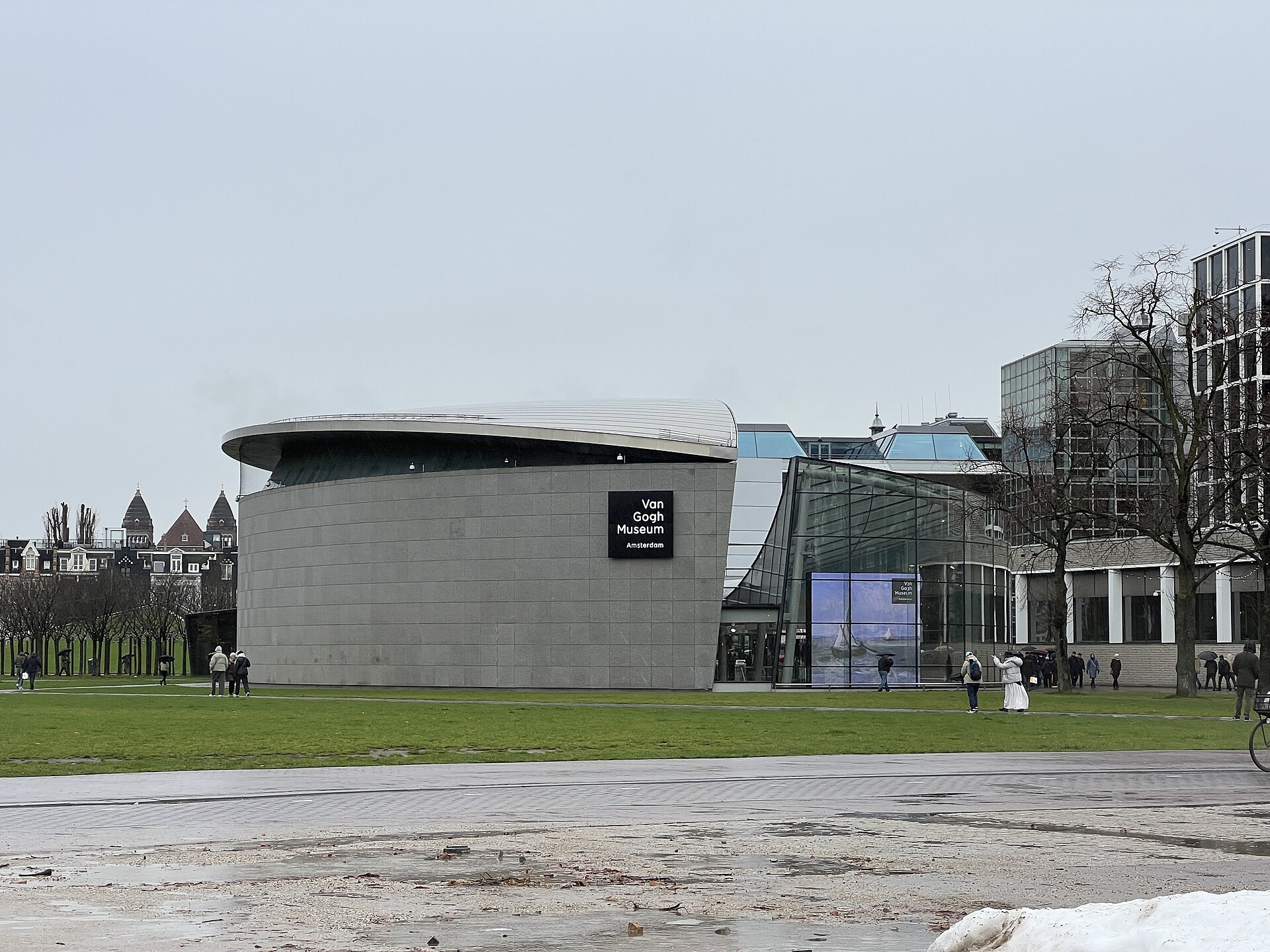
The drum-shaped stone exterior of the Kurokawa Wing, with the museum's own signage, seen from the Museumplein lawn. The rounded roof is the visible fraction of a wing that is otherwise built below ground.
Photograph by Chabe01 · CC BY-SA 4.0Van Gogh Museum
Museum · Founded 1973
Open, admission and hours confirmed 23 September 2026 · 22 sources
On this page 15 sections
ContentsClose
Around 200 paintings, more than 500 drawings and roughly 700 letters by Vincent van Gogh, the largest such holding anywhere, plus his own collection of Japanese prints and work by contemporaries including Gauguin, Monet and Toulouse-Lautrec. It is not an encyclopaedic museum and does not try to be: almost everything in the building either was Van Gogh's or was made in direct response to him, and the permanent collection is arranged to be read in the order he painted it, from Nuenen through Paris and Arles to Auvers-sur-Oise. A common misconception the museum addresses on its own site: The Starry Night is not here, and never has been - it has been in the Museum of Modern Art in New York since 1941.
| Kind | Museum |
|---|---|
| Founded | Opened 2 June 1973; the founding agreement between Vincent van Gogh's nephew and heir and the Dutch state, which created the museum's collection, dates to 1962 |
| City and country |  Amsterdam, Netherlands Amsterdam, Netherlands |
| Address | Museumplein 6, 1071 DJ Amsterdam, Netherlands |
| Website | vangoghmuseum.nl/en |
| Status | Open, confirmed |
| Record last verified |
Visiting
- Hours
- Daily09:00 to 18:00standard hours through 1 September 2026; the museum publishes a separate day-by-day calendar for October, November and December
- Friday09:00 to 21:00extended Friday hours through 1 September 2026, except 29 May, 31 July and 25 September 2026, which keep the standard 9am to 6pm
- Closed
- No general closing day - the museum is open every day of the year, including public holidays. Hours change through the autumn and around Christmas; the museum's own calendar gives the exact times for each date.
- Admission
- AdultEUR 25permanent collection and current exhibitions
- Under 18Freefree, every day, no conditions
- StudentEUR 16on presentation of a valid international student card or proof of enrolment at an EU/EEA institution
- MuseumkaartFreefree; book a start-time ticket online before visiting
- Vincent's FriendsFreefree; patrons of the Sunflower Circle, Theo van Gogh Circle, Yellow House Circle and Corporate Circle have direct access without a start-time ticket
- ICOM card, Rembrandt Card, VriendenLoterij VIP-KAART, StadspasFreefree; book online, the pass is scanned at the entrance alongside the e-ticket
Free entry: Every visitor under 18, every day, unconditionally. Museumkaart, Vincent's Friends, ICOM card, Rembrandt Card, VriendenLoterij VIP-KAART and Stadspas holders, booked online in advance- Tickets
- tickets.vangoghmuseum.com The museum's own ticket page.
- Do I need to book?
- Yes. All tickets are sold online only, each with a mandatory start time; the museum states there is no way to buy a ticket at the door, and even a free discount-card entry needs a start-time ticket booked in advance.
- Address
- Museumplein 6, 1071 DJ Amsterdam, Netherlands MapTram Lines 2, 5 or 24 to the Museumplein stop, or lines 5, 12 or 24 to Concertgebouw
Bus Lines 357 or 397 to Museumplein, or 347 or 357 to Concertgebouw
Car Q-Park underneath Museumplein, entrance on Van Baerlestraat, is the nearest car park; paid parking applies on the surrounding streets - Website
- vangoghmuseum.nl/en
- Telephone
- +31 20 570 5200
- [email protected]
Before you go how long, access, photography, bags, eating, shop
- How long to allow
- Two to three hours on average, by the museum's own reckoning, to see the permanent collection and the current exhibition, including a stop at the cafe and the shop.
- Access
- Priority entrance and a free companion ticket for visitors with a disability; wheelchairs, mobility aids and a foldable seat can be borrowed; dedicated facilities for blind, partially-sighted and deaf visitors; a Hidden Disabilities Sunflower Lanyard for non-visible conditions such as sensory sensitivity, dementia or PTSD; EnChroma glasses for visitors with colour vision deficiency.
- Photography
- Allowed throughout the permanent collection without flash, tripod or selfie stick, for personal non-commercial use only; forbidden in most temporary exhibitions and on individually labelled loan works; filming is not allowed without the museum's prior permission.
- Bags
- Self-service electronic lockers at the cloakroom take coats, handbags and small backpacks up to 45 by 25 by 25 centimetres. Large rucksacks, wheeled suitcases, trolleys of any size and folding bikes may be refused entry outright, and bags may be screened at the door.
- Eating
- Bistro Vincent, a full restaurant inside the Rietveld Building open daily from 10am, serving food shaped by the Netherlands, France and Japan; plus two smaller cafes, one in the atrium and one beside the shop.
- Shop
- A museum shop on site and a separate online store, both selling books, prints and gifts drawn from Van Gogh's life and work.
Prices and hours change. We take them from the institution's own pages and print the day we read them, and you can check the current position at the source we used. Confirm before you travel.
What is inside
The Rietveld Building
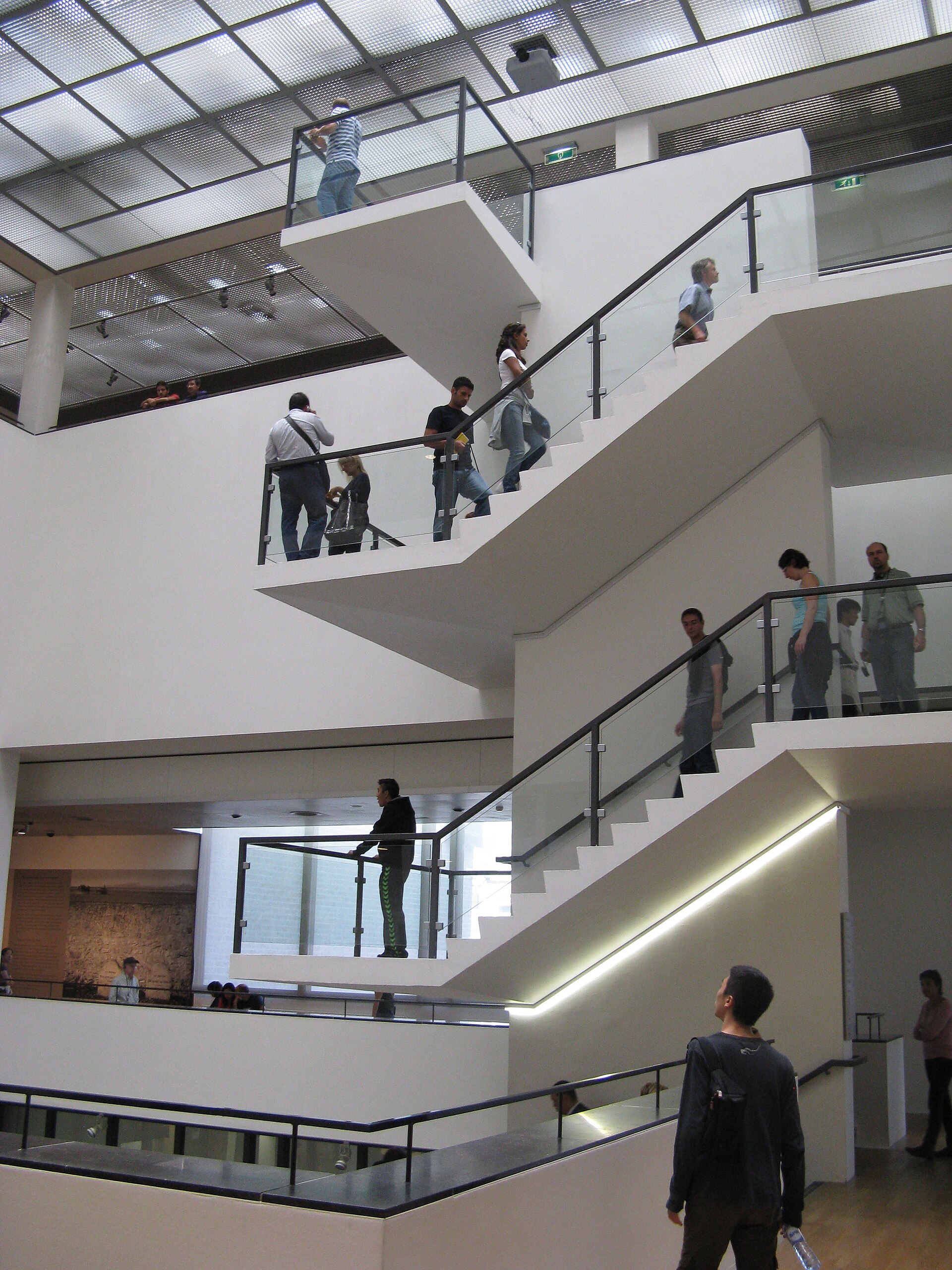
The original building, designed by Gerrit Rietveld and opened in 1973, holds the permanent collection across four chronological floors: the early Dutch years, Paris, Arles, and Saint-Remy and Auvers-sur-Oise at the end, told through paintings, drawings and letters shown together rather than paintings alone.
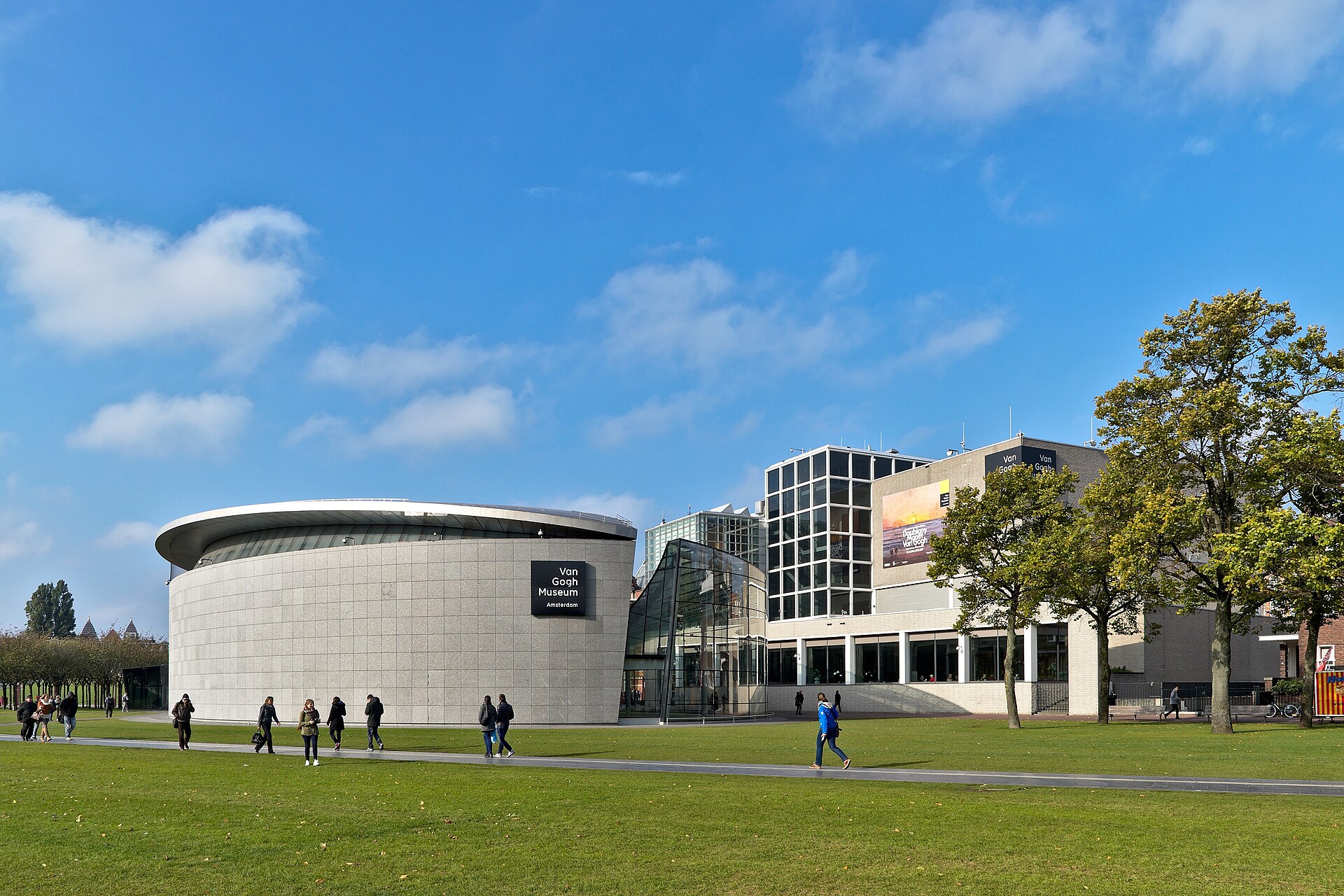
Photograph by SKopp · CC BY 4.0 The Kurokawa Wing
The elliptical exhibition wing designed by Kisho Kurokawa opened in 1999 and is built largely below ground; it holds the museum's major temporary exhibitions, currently Vincent's Path to Fame and The ReFramers present: In Search of an Anchor, with the first Dutch retrospective of James McNeill Whistler opening in October 2026.
The Print Room
A quieter room of work on paper rather than canvas: around 500 of Van Gogh's own drawings, from early studies made in Brabant to the reed-pen work of Saint-Remy, shown alongside French prints and roughly 500 Japanese woodblock prints that Vincent and Theo collected in Paris and that changed how Vincent painted.
The Entrance Hall
Opened to the public in September 2015, built out from a Kurokawa sketch by Hans van Heeswijk Architects, the glass-walled hall sits between the Rietveld building and the Kurokawa wing behind 650 square metres of cold-bent glass, and now carries ticketing, orientation and the route into both buildings.
What to see first
The Potato Eaters
Vincent van Gogh, 1885Van Gogh's first major figure composition, five peasants sharing a meal by lamplight, painted in Nuenen before he had found the bright palette the museum is best known for.5
Sunflowers
Vincent van Gogh, 1889The single painting most visitors come to see, from the Arles series, built almost entirely out of different shades of one colour.5
Almond Blossom
Vincent van Gogh, 1890Painted as a gift for his newborn nephew, blossom against a flat blue sky borrowed directly from the Japanese prints Van Gogh collected and studied for years.5
Self-Portrait with Grey Felt Hat
Vincent van Gogh, 1887One of the Paris self-portraits painted because he could not afford to pay a model, hung in the permanent collection beside the straw-hat portrait from the same year.5
Self-Portrait with Straw Hat
Vincent van Gogh, 1887Hung with the grey-felt-hat portrait from the same Paris year, the two together tracing how fast his colour and brushwork were changing.5
Irises
Vincent van Gogh, 1890Painted in the walled garden of the asylum at Saint-Remy, one of the last calm subjects he found before the final months at Auvers-sur-Oise.5
The Harvest
Vincent van Gogh, 1888Painted in a single day in June 1888; Van Gogh told Theo in a letter the finished canvas "absolutely kills all the others" he had made that spring.17
The Bedroom
Vincent van Gogh, 1888His own room at the Yellow House in Arles, the first of three versions he painted of the same view; the others are now in Chicago and Paris.5
The Sower
Vincent van Gogh, 1888A figure Van Gogh returned to across his career after Jean-Francois Millet, reworked here under an Arles sun the size of the sower's own head.5
Japanese prints from Van Gogh's own collection
Various Japanese printmakers, 19th centuryAround 500 woodblock prints Vincent and Theo bought in Paris, most still in the museum today, and the direct source of the flat colour and outline Van Gogh built his late style on.6
Past exhibitions here
- Closed22 May to 20 Sep 2026Confirmed · check before you travel
A promise the Dutch state made to one family
The Van Gogh Museum exists because of a contract, not a bequest in the ordinary sense. After Vincent van Gogh died in 1890, most of his unsold work stayed within the family: first with his brother Theo, who died six months later, then with Theo's widow Johanna van Gogh-Bonger, who spent the following decades promoting Vincent's work until it began to reach the recognition it has today. By the early 1960s the family, represented by Theo and Johanna's son V.W. van Gogh, known as 'the Engineer', grew concerned the collection would eventually be broken up and sold piece by piece. In 1962 he and the Dutch state reached an agreement without real precedent: the family transferred the entire collection, more than 200 paintings, 500 drawings and 700 to 900 letters, plus the art Vincent and Theo had collected from contemporaries, to a purpose-built Vincent van Gogh Foundation. In return the state committed to building and permanently funding a museum so the collection stayed public, intact and, in the language of the agreement, cared for 'as if it were state property'.
The museum opened on Museumplein on 2 June 1973 and was an immediate success, drawing far larger crowds than anyone had planned for. That early success is also the origin of a dispute that resurfaced in 2025: a building designed for a fraction of today's footfall, and a state subsidy its director now says has not kept pace with the promise made to the Engineer.
Two architects and a glass hinge between them
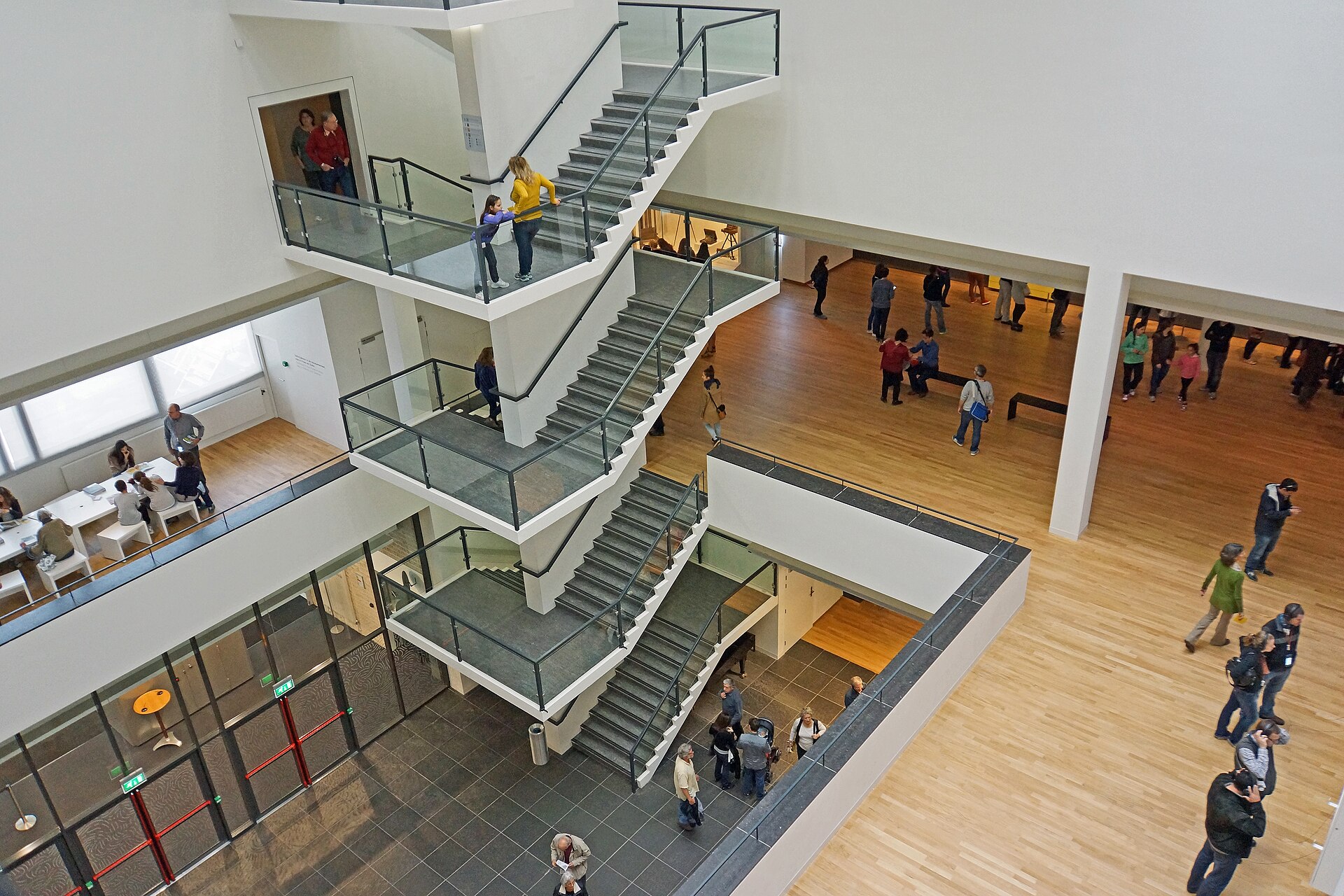
Two buildings, from two different decades, make up the museum, and they look nothing alike on purpose. The main building was designed by Gerrit Rietveld, a leading member of the De Stijl movement, commissioned in 1963 and 1964 but not completed until 1973, nine years after Rietveld's own death. His modernist instincts, geometric volumes and light-filled open space, are most visible in the central stairwell, where daylight drops through a high skylight into the galleries below. A quarter of a century later the museum had outgrown that single building, and the Japanese architect Kisho Kurokawa was commissioned to design an exhibition wing, which opened in 1999. Where Rietveld built a rectilinear cube, Kurokawa built an ellipse, and buried three-quarters of it below ground to limit its visual weight on the square; the wing's boxy print room sits at a deliberate angle to the rest of the building, a small dissonance Kurokawa intended. The extension was funded in part by the Japan Foundation and a Tokyo insurer, a fittingly international footnote for a building that houses Van Gogh's own collection of Japanese prints.
A third phase closed the gap between the two. In spring 2014 work began on a new entrance hall on Museumplein, designed by Hans van Heeswijk Architects from a sketch Kurokawa's own practice had produced as an extension of the 1999 wing's elliptical logic. It opened on 5 September 2015: 650 square metres of cold-bent glass, 30 glass roof fins up to 12 metres long, and 20 glass columns up to 9.4 metres high, carried on 65 tonnes of steel. It sits physically between the Rietveld building and the Kurokawa wing and now serves as the shared front door to both.
What the collection actually holds
The permanent collection is not a highlights reel; it is arranged so a visitor walks through Van Gogh's working life roughly in order, from the dark, earthbound palette of Nuenen and The Potato Eaters, through the sharper colour he found in Paris under the influence of Impressionism and the Japanese prints he began collecting there, into the saturated yellows and blues of Arles that produced Sunflowers, The Bedroom and The Sower, and on to the more agitated brushwork of Saint-Remy and Auvers-sur-Oise at the very end of his life. The museum keeps his letters in the same rooms as the paintings they describe, which is why the collection reads less like a survey of a famous style and more like a working diary with pictures attached.
Two things distinguish this collection from any single-artist museum built around a purchased hoard. First, roughly a third of it is works on paper, drawings and studies as much as finished paintings, kept in the Print Room rather than treated as supporting material. Second, the museum holds Van Gogh's own collection of Japanese woodblock prints, nearly 500 of them, bought in Paris with Theo and studied hard enough to reshape how Vincent used colour, outline and flattened space in his own late work. The Sunflowers most visitors come for and the almond blossom he painted for his newborn nephew both carry that debt directly.
Two thefts, and how both ended
The building has been robbed twice, in ways that read almost as dark comedy against the value of what was taken. On 14 April 1991 a thief spent hours hidden in a restroom stall before emerging after closing with an accomplice to take 20 paintings, including Sunflowers and The Bedroom, at gunpoint. The getaway lasted barely half an hour: the thieves left in a guard's car, missed a planned handover to a second vehicle after it got a flat tyre, and abandoned the car with all 20 canvases still inside near Amsterdam Amstel station. Three paintings suffered minor scratches; the rest were undamaged. Four men, two of them guards, were later convicted.
The second theft was better planned and took far longer to resolve. In December 2002, before dawn, two men smashed a window, climbed a ladder into the building and stripped two paintings from the wall in under half an hour: View of the Sea at Scheveningen and Congregation Leaving the Reformed Church in Nuenen. Both thieves were eventually caught and convicted, but the paintings themselves vanished for fourteen years, sold on for a reported 350,000 euros to a figure in the Camorra's Amato Pagano clan. Italian anti-mafia police found them in September 2016, wrapped in cloth between two walls of a house near Naples during an unrelated drug investigation, water-damaged at the edges but otherwise intact, and stripped of their frames. Both are back on the wall in Amsterdam.
The most popular museum in the country, and a ceiling it chose for itself
The Van Gogh Museum is consistently the most visited museum in the Netherlands, and by the middle of the last decade that popularity had become its own problem. Attendance climbed from an average of about 1.5 million a year to a record 2.26 million in 2017, and the building, designed decades earlier for far smaller crowds, showed it: long waits at the cloakroom, dense queues to get in, galleries too full to see the smaller works properly. Extending opening hours was not a real option, because more light exposure risks the paintings themselves. What the museum did instead, unusually for a major tourist attraction anywhere, was decide that endless growth was not a goal worth chasing, and move to online-only, timed-entry ticketing so a day's total visitor number could be capped in advance.
That policy still governs every visit. There is no ticket desk to walk up to; every visitor, including discount-card and members, books a start time online before arriving. The museum's own account of 2025 puts total visitors at 1.86 million, with more than 350,000 of them resident in the Netherlands, and reports visitors rating the experience 9.2 out of 10 on average, feedback it says increasingly credits the personal, human way the museum now tells Van Gogh's story, including its treatment of his mental health. The Anselm Kiefer exhibition staged jointly with the Stedelijk Museum was the standout draw of the year, seen by around 340,000 people and voted the best museum exhibition in the Netherlands for 2025.
A dark cloud over the building itself
Since August 2025 the museum has been in open dispute with the Dutch state over money, and the dispute is about the building rather than the art. More than fifty years of heavy footfall, almost 57 million visitors since 1973, has left the Rietveld and Kurokawa structures short of current standards for fire safety, climate control and sustainability, and most of the technical plant is past its working life and hard to source parts for. The museum has drawn up Masterplan 2028, a three-year renovation costing 104 million euros, during which it says it would remain partially open. It says it cannot pay for that alone: it already covers its own running costs to an unusual degree, generating 85 percent of its income itself, but the building belongs to the state, which committed under the 1962 agreement to fund construction and upkeep.
The state currently provides 8.5 million euros a year; the museum says it needs at least 11 million to finance the renovation and set aside for future maintenance, a gap of 2.5 million euros the Ministry of Education, Culture and Science has so far declined to close, arguing the existing subsidy already covers necessary maintenance. In a statement on its own site in August 2025, director Emilie Gordenker put the stakes plainly: 'This is the last thing we want, but if it comes to that, we would have to close the building.' The museum filed a legal complaint; by May 2026 both sides had agreed to postpone the court hearing and enter mediation instead, with the museum reporting good progress and both parties aiming to conclude before the summer. No public resolution had been reported as of the most recent reporting seen for this page, and a reader planning a visit around 2028 should check the museum's own site before booking.
What visitors say
We publish no visitor prose and no platform average without labelling it tertiary, so what follows draws on the museum's own published figures and named journalism. In its own 2025 review the museum reported 1.86 million visitors and an average visitor rating of 9.2 out of 10, with feedback repeatedly singling out how personally the collection is told through Van Gogh's own letters, and its recent framing of his story around mental wellbeing. Google's public listing, read live on 13 August 2026, showed 4.6 out of 5 from more than 108,000 ratings. Set against that is a museum that, by its own account and in the trade press, has spent a decade managing its own popularity: timed-entry tickets exist because unmanaged demand once meant queues at the door and at the cloakroom, and there is no way to buy a ticket without booking a start time in advance.
What is praised, what is criticised
- Praised: telling Van Gogh's life through his own letters alongside the paintings rather than through wall labels alone, which visitors and the museum's own 2025 survey both single out as unusually personal for a single-artist museum
- Praised: the concentration of instantly recognisable paintings in one chronological walk - Sunflowers, The Bedroom, Almond Blossom and The Potato Eaters among them
- Praised: the museum's recent emphasis on mental wellbeing in how it presents Van Gogh's life, which its own visitor feedback specifically calls out as well handled
- Criticised: no way to buy a ticket at the door - every visit needs an online booking with a fixed start time, discount card or not
- Criticised: persistent crowding at peak hours, serious enough that the museum itself chose in the late 2010s to stop treating ever-higher visitor numbers as a goal after a record 2.26 million in 2017 produced queues at entry and at the cloakroom
- Criticised: a EUR 25 standard adult ticket for what the museum's own guidance says is a two-to-three-hour visit, with no walk-up or day-of alternative
Ratings on other platforms
Google: 4.6 from 108,145 ratings, read 13 August 2026
A platform average is a tertiary source: it moves, it is not audited, and we quote no visitor's words.
Questions about Van Gogh Museum
Where is Van Gogh Museum?
Museumplein 6, 1071 DJ Amsterdam, Netherlands.
How much does it cost to visit?
Adult: EUR 25; Under 18: free; Student: EUR 16; Museumkaart: free; Vincent's Friends: free. As confirmed 23 September 2026.
When is it open?
Daily 09:00-18:00; Friday 09:00-21:00. Closed: No general closing day - the museum is open every day of the year, including public holidays. Hours change through the autumn and around Christmas; the museum's own calendar gives the exact times for each date. As confirmed 23 September 2026.
How do you get there?
Tram: Lines 2, 5 or 24 to the Museumplein stop, or lines 5, 12 or 24 to Concertgebouw; Bus: Lines 357 or 397 to Museumplein, or 347 or 357 to Concertgebouw; Car: Q-Park underneath Museumplein, entrance on Van Baerlestraat, is the nearest car park; paid parking applies on the surrounding streets.
What should you see first?
The Potato Eaters (Vincent van Gogh, 1885); Sunflowers (Vincent van Gogh, 1889); Almond Blossom (Vincent van Gogh, 1890); Self-Portrait with Grey Felt Hat (Vincent van Gogh, 1887); Self-Portrait with Straw Hat (Vincent van Gogh, 1887); Irises (Vincent van Gogh, 1890).
What we could not confirm
- Whether the mediation between the museum and the Dutch Ministry of Education, Culture and Science, reported in progress in May 2026 with a target of concluding before summer, has actually been resolved, and on what terms.
- Whether Masterplan 2028 will proceed on its stated 2028 to 2031 timeline and budget of EUR 104 million if the funding gap is not closed, and what 'partially open' would mean for a visitor during the works.
- What became of the frames removed from View of the Sea at Scheveningen and Congregation Leaving the Reformed Church in Nuenen when they were stolen in 2002; the sources consulted here describe the paintings' recovery in 2016 but not the frames.
Images
Sources
- 1Van Gogh Museum, Address and Opening Hours: address, opening hours through 2026, transport by tram, bus and car, and the statement that the museum is open daily and accessible to everyone. Read 13 August 2026. vangoghmuseum.nl/en/visit/address-and-opening-hours
- 2Van Gogh Museum, Tickets and Ticket Prices: admission tiers, discount cards, and the statement that tickets are available online only with a mandatory start time. Read 13 August 2026. vangoghmuseum.nl/en/visit/tickets-and-ticket-prices
- 3Van Gogh Museum, Contact: phone, email, postal address, Chamber of Commerce and VAT registration. Read 13 August 2026. vangoghmuseum.nl/en/contact
- 4Van Gogh Museum, The Building: the 1962 founding agreement, the Rietveld Building (designed 1963-64, opened 1973), the Kurokawa Wing (opened 1999), and the new Entrance Hall by Hans van Heeswijk Architects (opened 5 September 2015), with construction specifications. Read 13 August 2026. vangoghmuseum.nl/en/about/organisation/the-building
- 5Van Gogh Museum, The Permanent Collection: Van Gogh's Masterpieces, naming The Potato Eaters, Sunflowers, Almond Blossom, Self-Portrait with Grey Felt Hat, Self-Portrait with Straw Hat, Irises, The Harvest, The Bedroom and The Sower as the collection's own highlighted works. Read 13 August 2026. vangoghmuseum.nl/en/visit/whats-on/the-permanent-collection-van-goghs-masterpieces
- 6Van Gogh Museum, Japanese Prints from Van Gogh's Collection: almost 500 prints, most from Vincent and Theo's own collection, and how Vincent studied them in Paris. Read 13 August 2026. vangoghmuseum.nl/en/japanese-prints
- 7Van Gogh Museum, House Rules: photography and filming policy, and the cloakroom, locker and luggage rules. Read 13 August 2026. vangoghmuseum.nl/en/visit/house-rules
- 8Van Gogh Museum, Food and Drinks: Bistro Vincent and the museum's two cafes. Read 13 August 2026. vangoghmuseum.nl/en/visit/food-and-drinks
- 9Van Gogh Museum, Frequently Asked Questions about Your Museum Visit: the answer that visitors spend two to three hours on average, and confirmation that tickets cannot be bought at the door. Read 13 August 2026. vangoghmuseum.nl/en/visit/frequently-asked-questions
- 10Van Gogh Museum, Accessibility: priority entrance, mobility aids, facilities for blind, partially-sighted and deaf visitors, the Sunflower Lanyard and EnChroma glasses. Read 13 August 2026. vangoghmuseum.nl/en/visit/accessibility
- 11Van Gogh Museum, Exhibitions: current shows Vincent's Path to Fame and The ReFramers present: In Search of an Anchor, and the upcoming Whistler. Dandy and Disruptor from 16 October 2026. Read 13 August 2026. vangoghmuseum.nl/en/visit/whats-on/exhibitions
- 12Van Gogh Museum, press release, 'Van Gogh Museum Moved Visitors in 2025', 17 December 2025: 1.86 million visitors, an average visitor rating of 9.2 out of 10, the Anselm Kiefer exhibition, and the Jo van Gogh-Bonger programming. vangoghmuseum.nl/en/about/news-and-press/news/20251217-van-gogh-museum-moved-visitors-in-2025
- 13Van Gogh Museum, press release, 'Van Gogh Museum's Future in Doubt', 27 August 2025: the 1962 agreement, Masterplan 2028, the EUR 8.5 million subsidy against an EUR 11 million ask, and director Emilie Gordenker's statement to the New York Times, quoted directly on this page. vangoghmuseum.nl/en/about/news-and-press/news/20250827-van-gogh-museums-future-in-doubt
- 14The Art Newspaper, Martin Bailey, 'Van Gogh Museum could be forced to close amid funding feud with Dutch state', 28 August 2025. theartnewspaper.com/2025/08/28/van-gogh-museum-could-be-forced-to-close-amid-funding-feud-with-dutch-state
- 15The Art Newspaper, 'Van Gogh Museum in funding mediation with Dutch government following threats of closure', 5 May 2026: the postponed court hearing and the mediation talks. theartnewspaper.com/2026/05/05/van-gogh-museum-in-funding-mediation-with-dutch-government
- 16Skift, Rosie Spinks, 'Fewer Visitors to Amsterdam's Van Gogh Museum Spells Success: Here's Why', 3 July 2019: the 2017 record of 2.26 million visitors, the resulting crowding, and the museum's decision to manage rather than chase growth. skift.com/2019/07/03/fewer-visitors-to-amsterdams-van-gogh-museum-spells-success-heres-why/
- 17Vincent van Gogh to Theo van Gogh, letter of 12 or 13 June 1888, Arles, describing the wheatfield painting that became The Harvest as one that 'absolutely kills all the others'. Van Gogh Museum's letters project, mirrored at webexhibits.org. webexhibits.org/vangogh/letter/18/497.htm
- 18NPR, '2 Stolen Van Goghs Recovered By Anti-Mafia Police In Italy', 30 September 2016: the December 2002 theft of View of the Sea at Scheveningen and Congregation Leaving the Reformed Church in Nuenen, and their 2016 recovery near Naples. npr.org/sections/thetwo-way/2016/09/30/496045362/2-stolen-van-goghs-recovered-by-anti-mafia-police-in-italy
- 19Atlas Obscura, 'How 20 Stolen Van Gogh Paintings Were Recovered 35 Minutes After a Heist': the 14 April 1991 theft and its rapid recovery. atlasobscura.com/articles/how-20-stolen-van-gogh-paintings-were-recovered-35-minutes-after-a-heist
- 20Wikidata, Van Gogh Museum (Q224124): label, coordinates (52.358333, 4.881111), country and official website, cross-checked against the museum's own address and confirming this is the correct entity, distinct from the nearby Rijksmuseum. wikidata.org/wiki/Q224124
- 21Wikimedia Commons, Category:Van Gogh Museum and its subcategories Category:Interior of the Van Gogh Museum, Category:Interior of Rietveldgebouw Van Gogh Museum and Category:Exterior of the Kurokawavleugel Van Gogh Museum: the plates on this page, each per file via the API . commons.wikimedia.org/wiki/Category:Van_Gogh_Museum
- 22Google Maps business listing for Van Gogh Museum: aggregate rating 4.6 from more than 108,000 ratings, read live in the in-app browser 13 August 2026. google.com/maps/search/Van+Gogh+Museum+Amsterdam