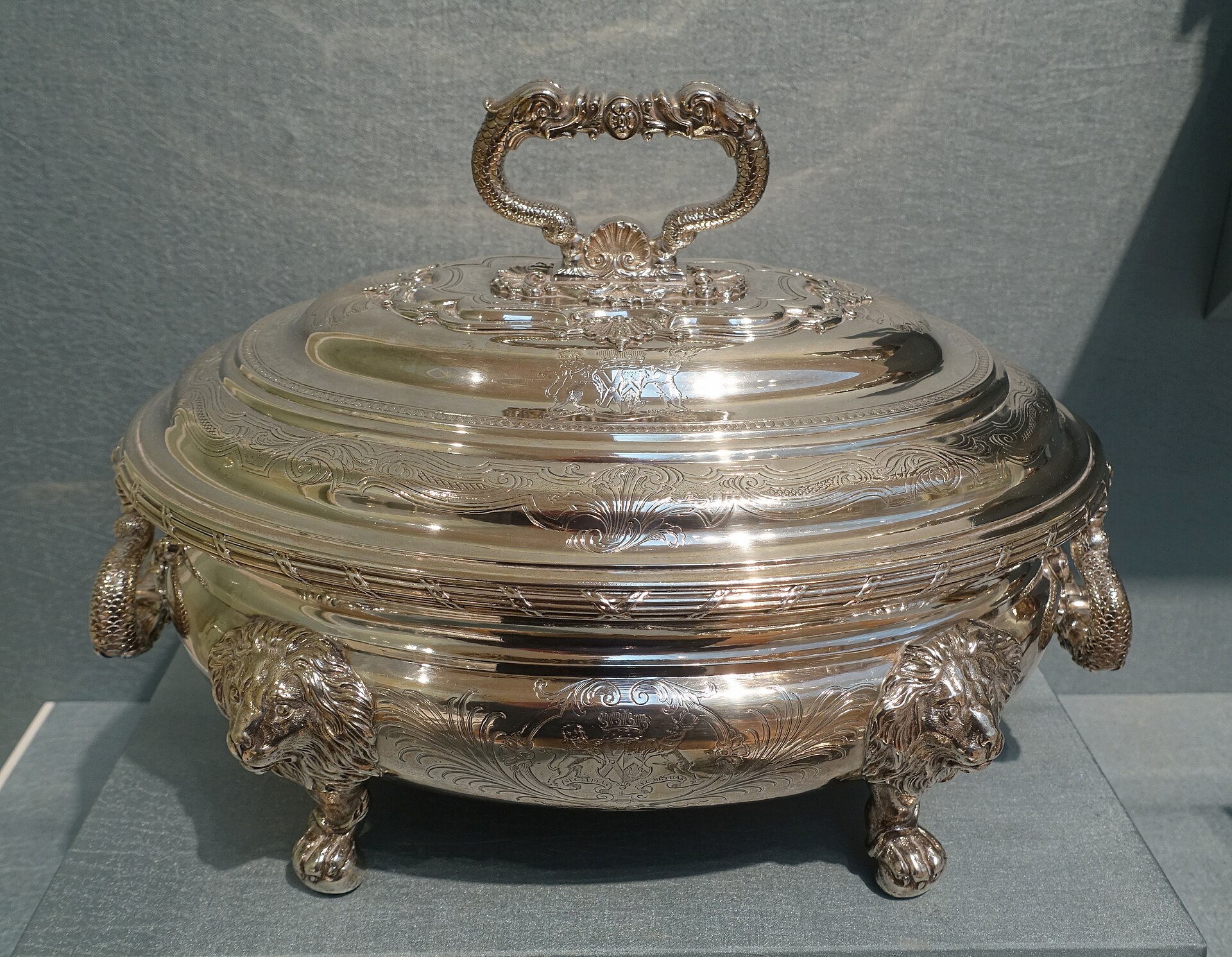
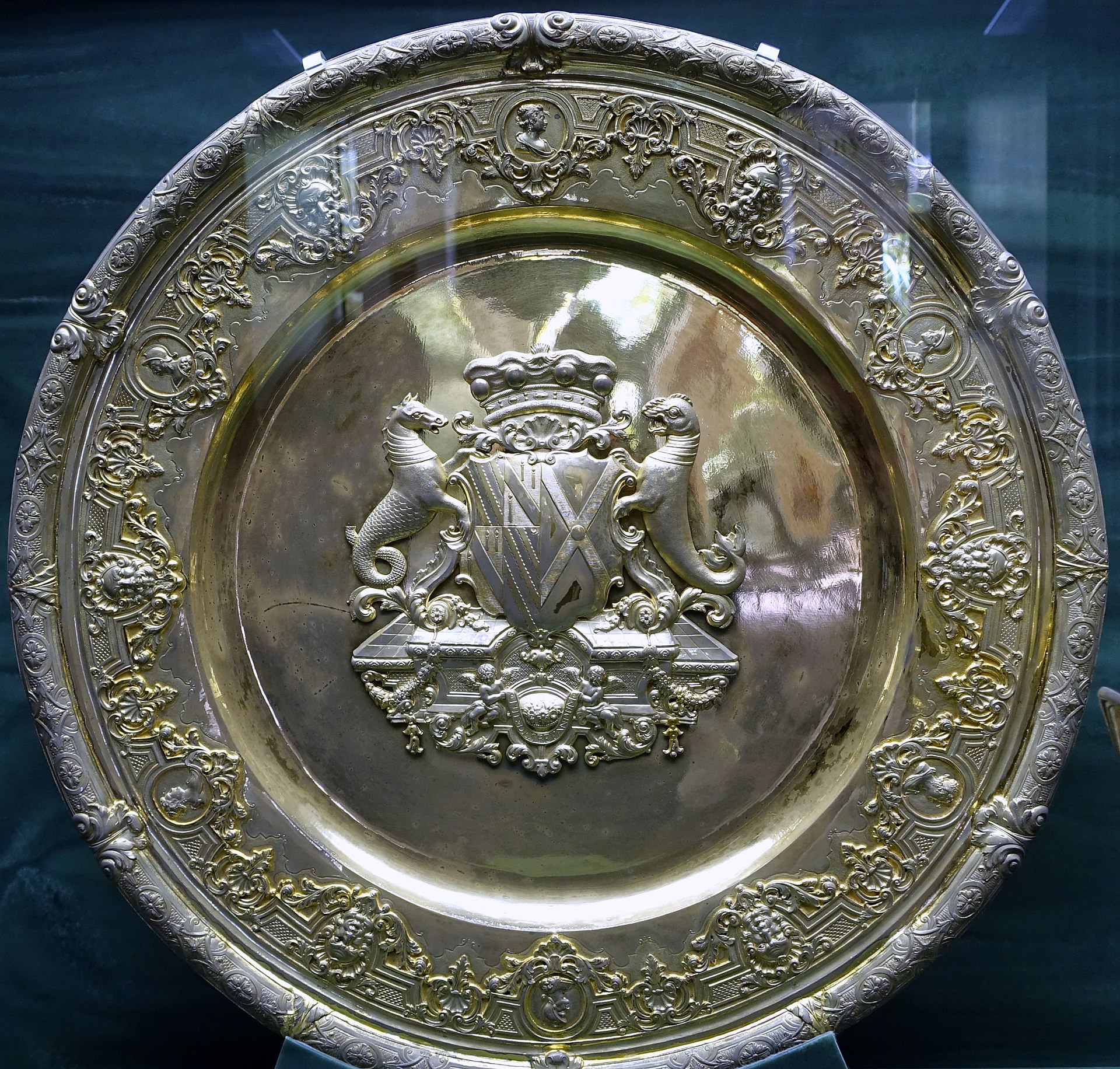
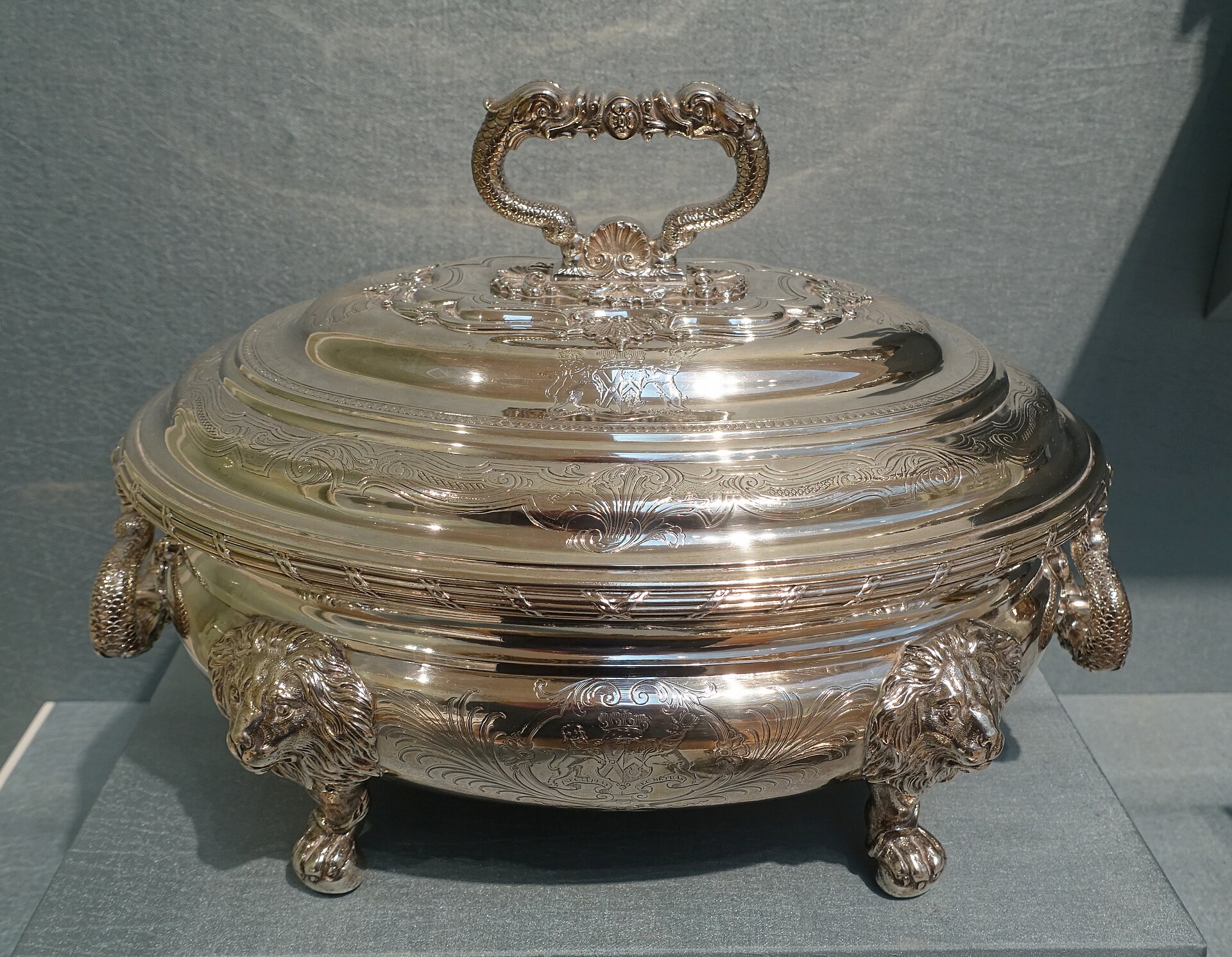
The Hardwicke Soup Tureen and Cover
1737-38, the London assay year running from late May 1737... · Sterling silver
Portland Art Museum, Portland, Oregon
 1688-1751
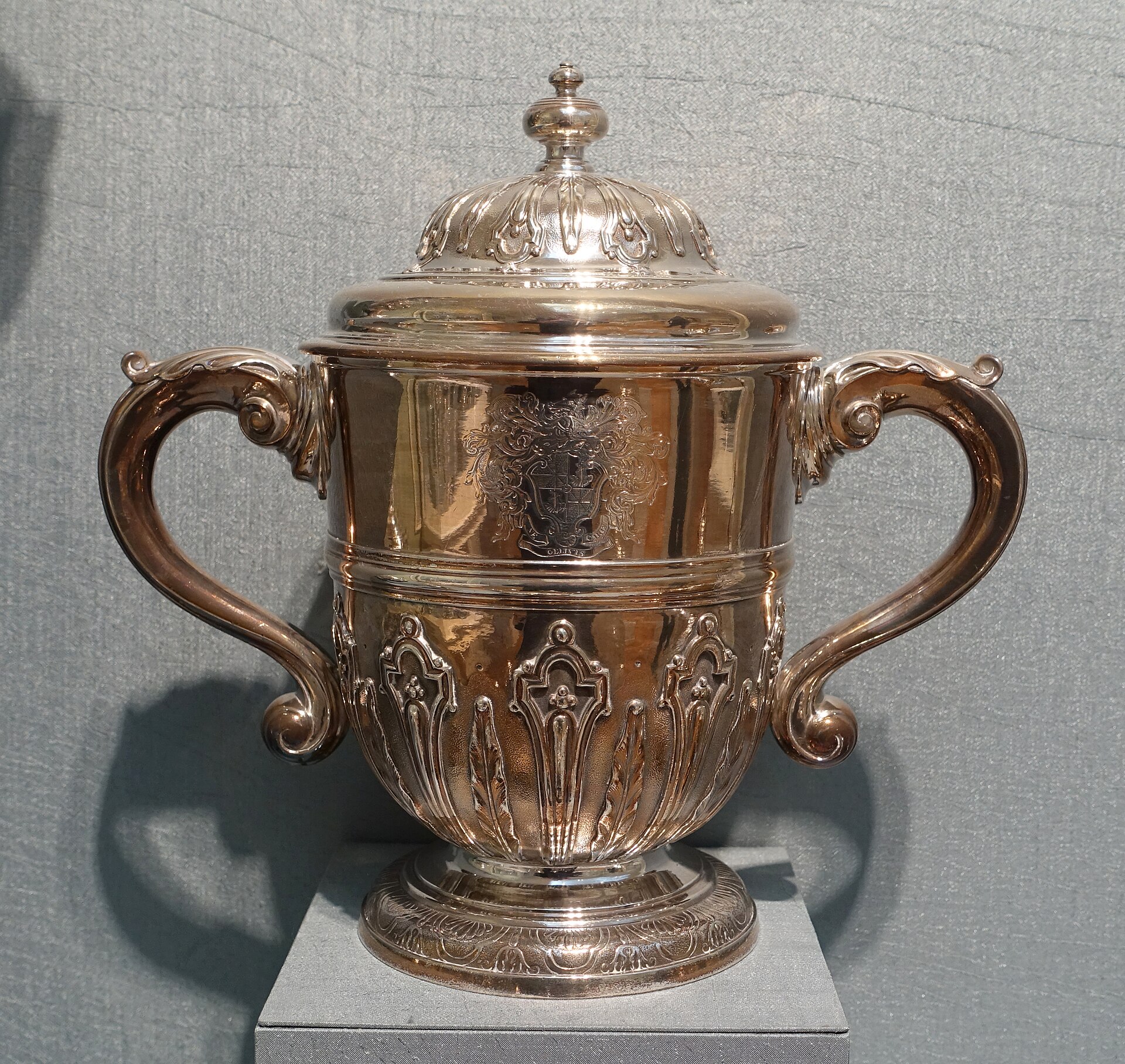
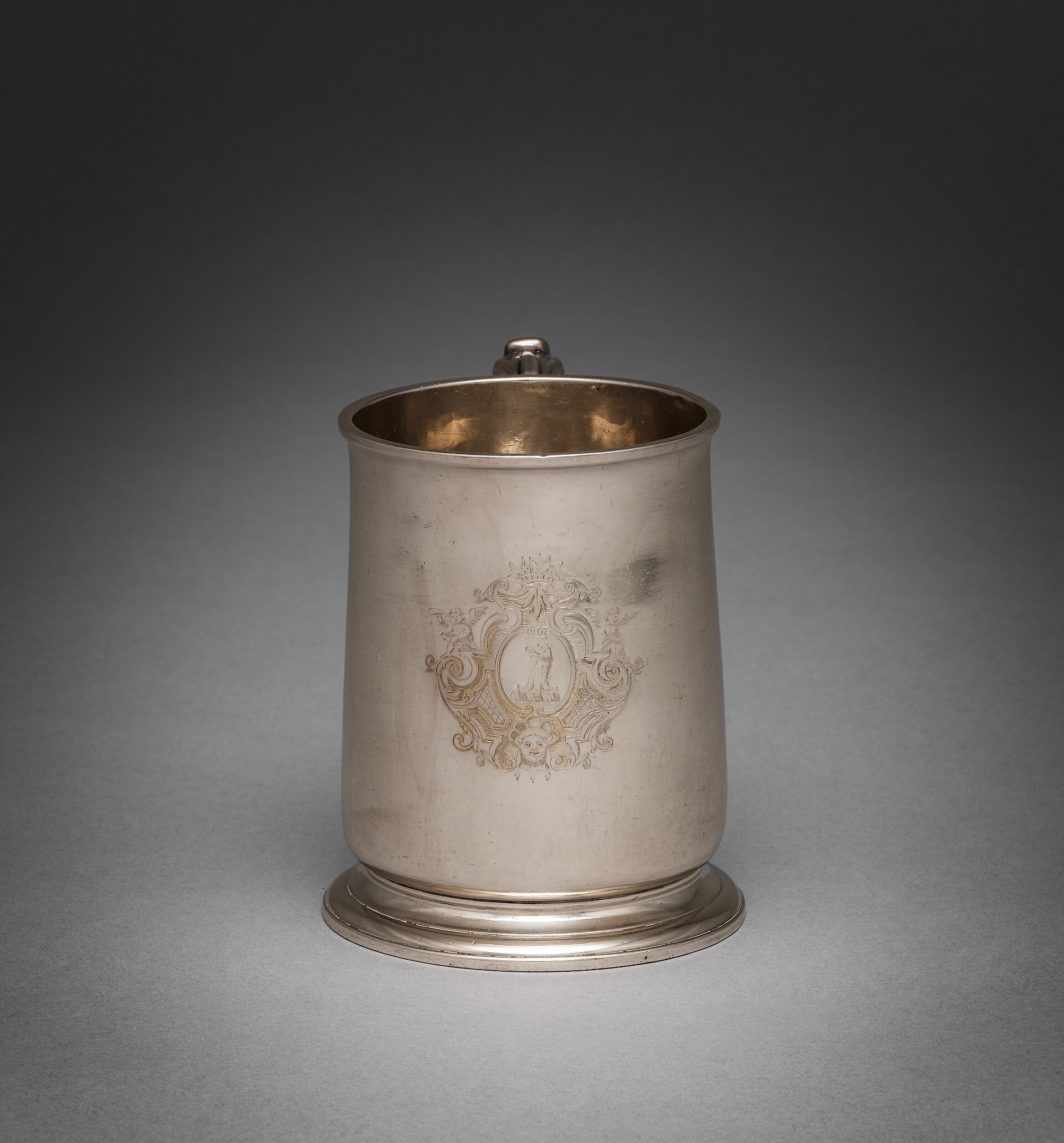
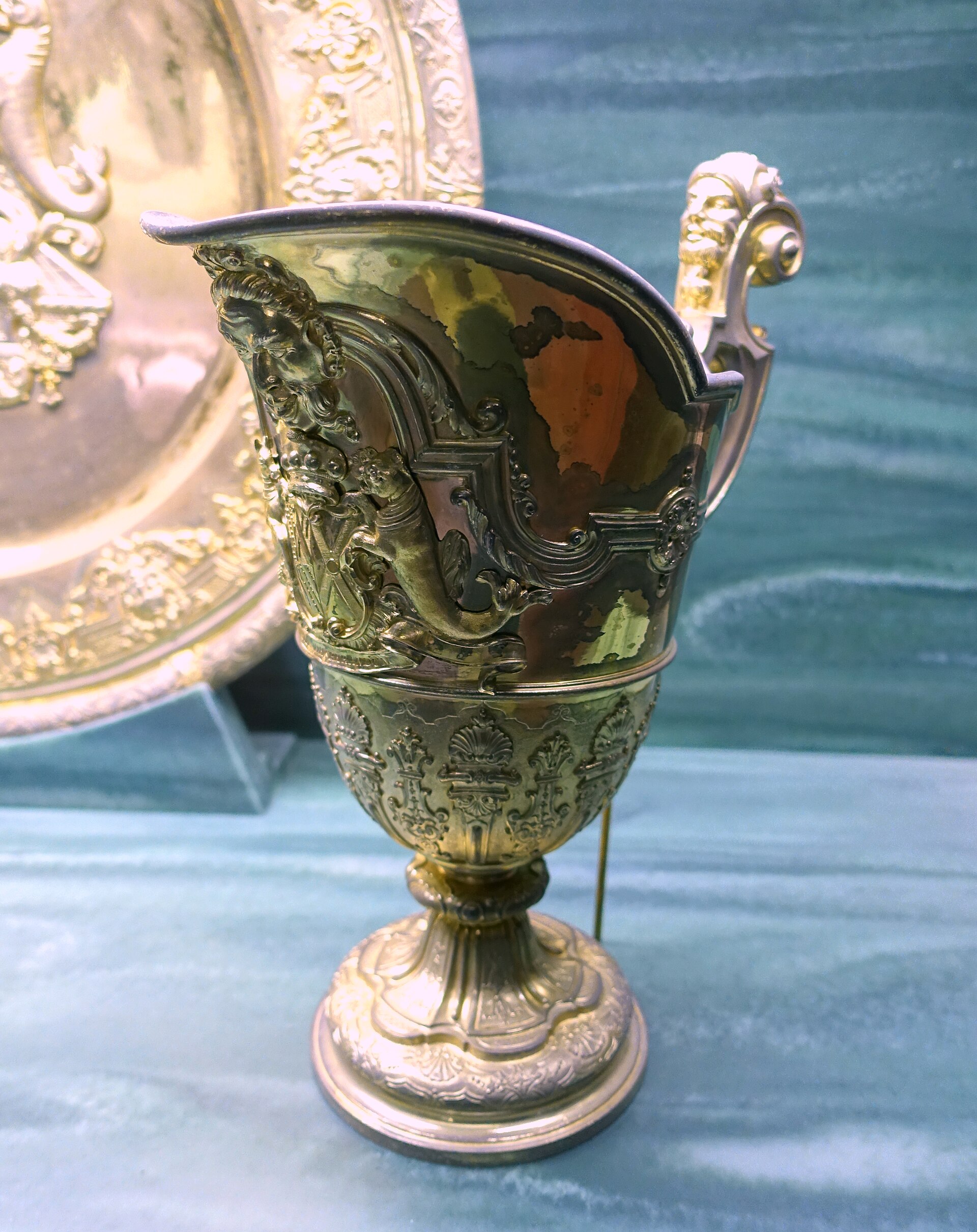
The plain manner, 1717-18 A two-handled cup and cover of 1717-18, from the years when de Lamerie was working exclusively at the Britannia standard under one of his two-letter punches, the first of 1713 or the unregistered second of about 1716. The restraint is the point: Hare's reading is that he was willing early on to make plain plate in the English Queen Anne taste for sober customers, and only later coaxed them towards the elaborate. Photographed in the Portland Art Museum; the maker and date are those on the museum's gallery label as transcribed by the photographer. No verified portrait. No securely identified likeness of this maker is known under a free licence. We do not publish a face we cannot verify.
Photograph by Daderot, released under CC0, via Wikimedia Commons| Full name | Paul Jacques Souchay de la Merie, baptised at the Walloon Church of Bois-le-Duc on 14 April 1688 |
|---|---|
| Worked as | Goldsmith and silversmith, Retail jeweller, Sponsor of other makers' plate at assay, Court Assistant and Warden of the Goldsmiths' Company |
| Born | 9 April 1688 · Bois-le-Duc, now 's-Hertogenbosch, in the United Provinces... |
| Died | 1 August 1751 · London |
| Nationality | British, of French Huguenot parentage, born in the Dutch Republic and... |
| Movement | The Huguenot school in London |
| In this archive | 4 artworks |
| Sources | 24 cited |
| Last verified | 17 September 2026 |
About this page 4 artworks in the archive · Last verified 17 September 2026 · 24 sources cited
Paul de Lamerie is the name English silver is sold on. He is also the reason the field turns on marks rather than on hands. Everything a record can honestly say about a piece of eighteenth-century London plate begins with four small punched impressions, and those impressions are a legal instrument, not a signature: they record the standard of the alloy, the assay office that tested it, the year in which it was tested, and the person who brought it in and stood behind the metal. That last mark is conventionally called the maker's mark. It is more accurately a sponsor's mark, and Ellenor Alcorn, cataloguing the Cahn collection in 2006, said so in as many words: de Lamerie's punch cannot be taken as evidence that he designed or executed the object it appears on.
There is no portrait of him. Susan Hare, introducing the Goldsmiths' Hall exhibition of 1990 that remains the fullest published account of his life, recorded that no portrait survives and that research had not turned up even a printed trade card, and built the exhibition out of objects and documents for that reason. What survives instead is paper: an apprentice register, a mark book, committee minutes recording his fines, two insurance policies, a will and an auctioneer's advertisement. The man is legible almost entirely through the institution he spent his career evading.
Because he evaded it constantly. The Goldsmiths' Company fined him twenty pounds in 1714 for not having his work hallmarked, a sum Alcorn puts at two years' wages for a labourer. In 1715 and 1716 he was charged with putting other men's plate through the Hall as his own. In 1726 nearly half the unmarked silver in a cargo bound for Russia was his. In 1737 he sat on the committee drafting a bill against fraud in the trade and helped strike out the clause that would have restored the Company's right to search his workshop. In the same period he supplied Lord Hardwicke with an ewer carrying marks cut out of another object, which is the exact offence the modern silver market still calls a duty dodger. The greatest English silversmith was also a duty dodger, and the ewer is in the Victoria and Albert Museum, its fraudulent marks dealt with and a 1944 hallmark struck to bring it within the law.
1737-38, the London assay year running from late May 1737... · Sterling silver
Portland Art Museum, Portland, Oregon
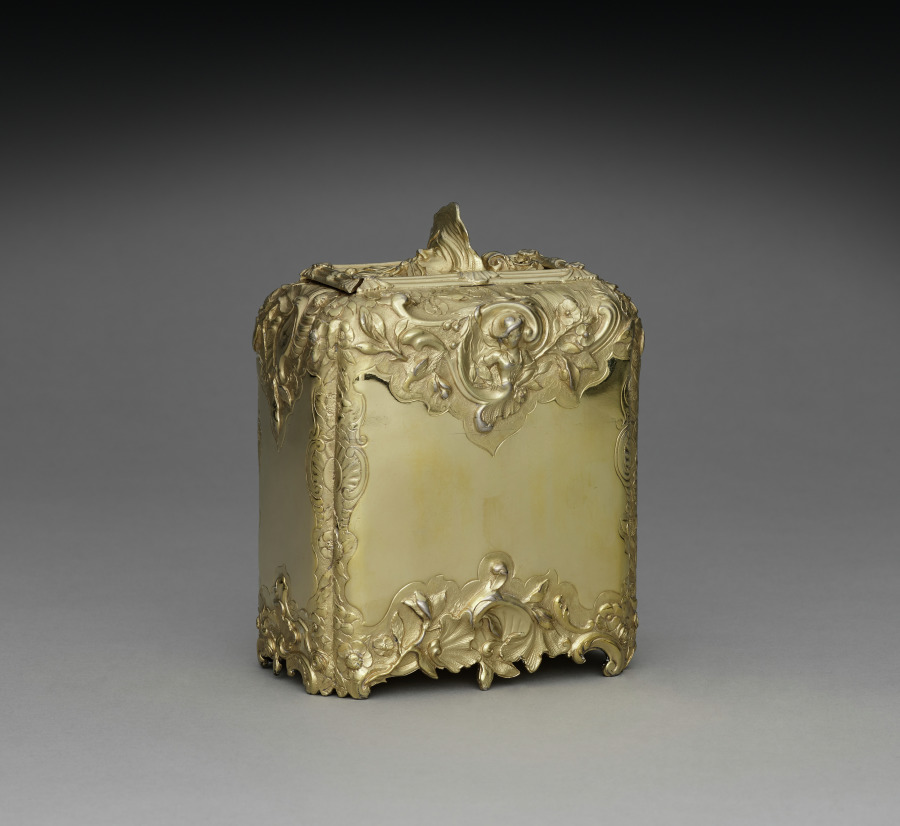
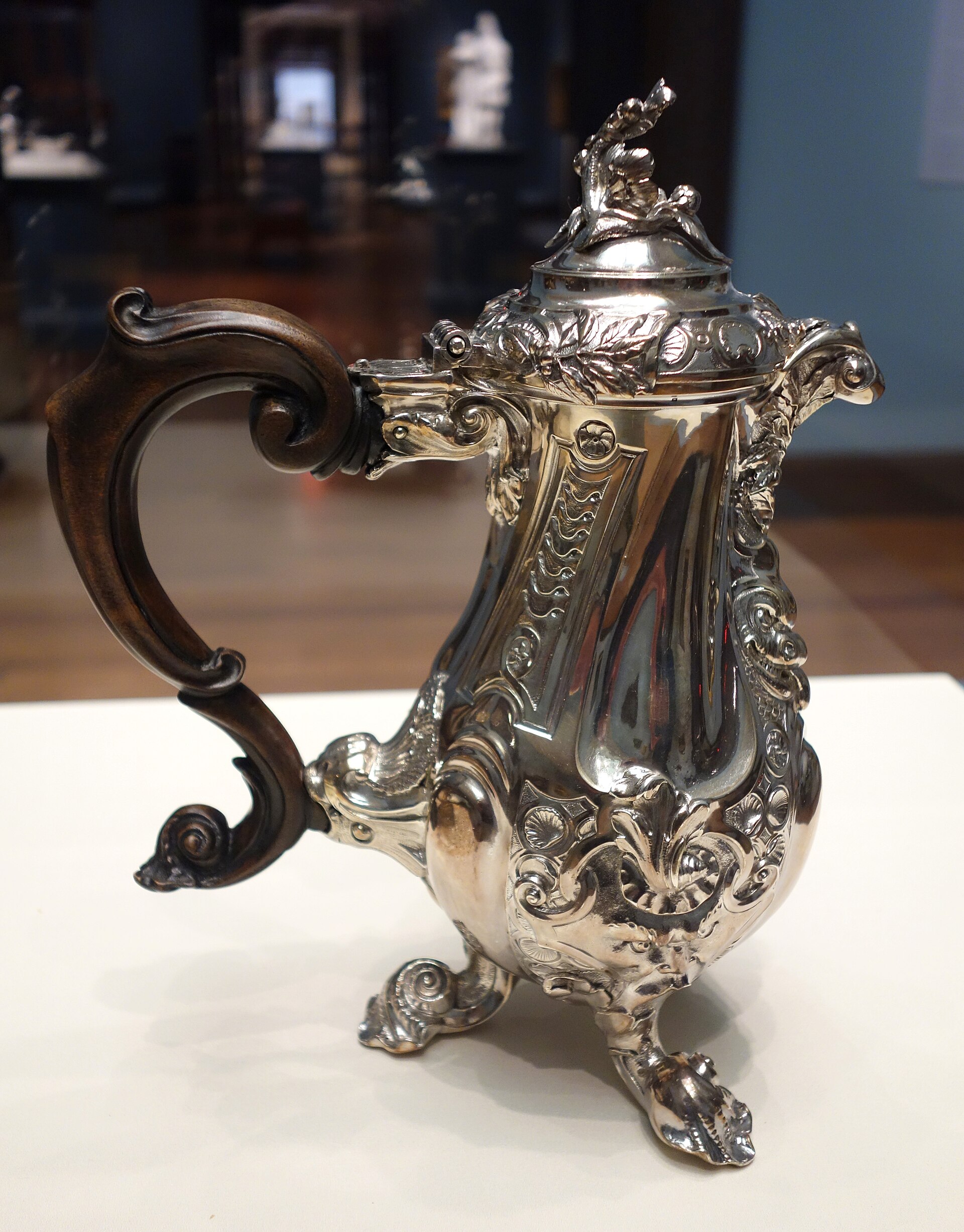
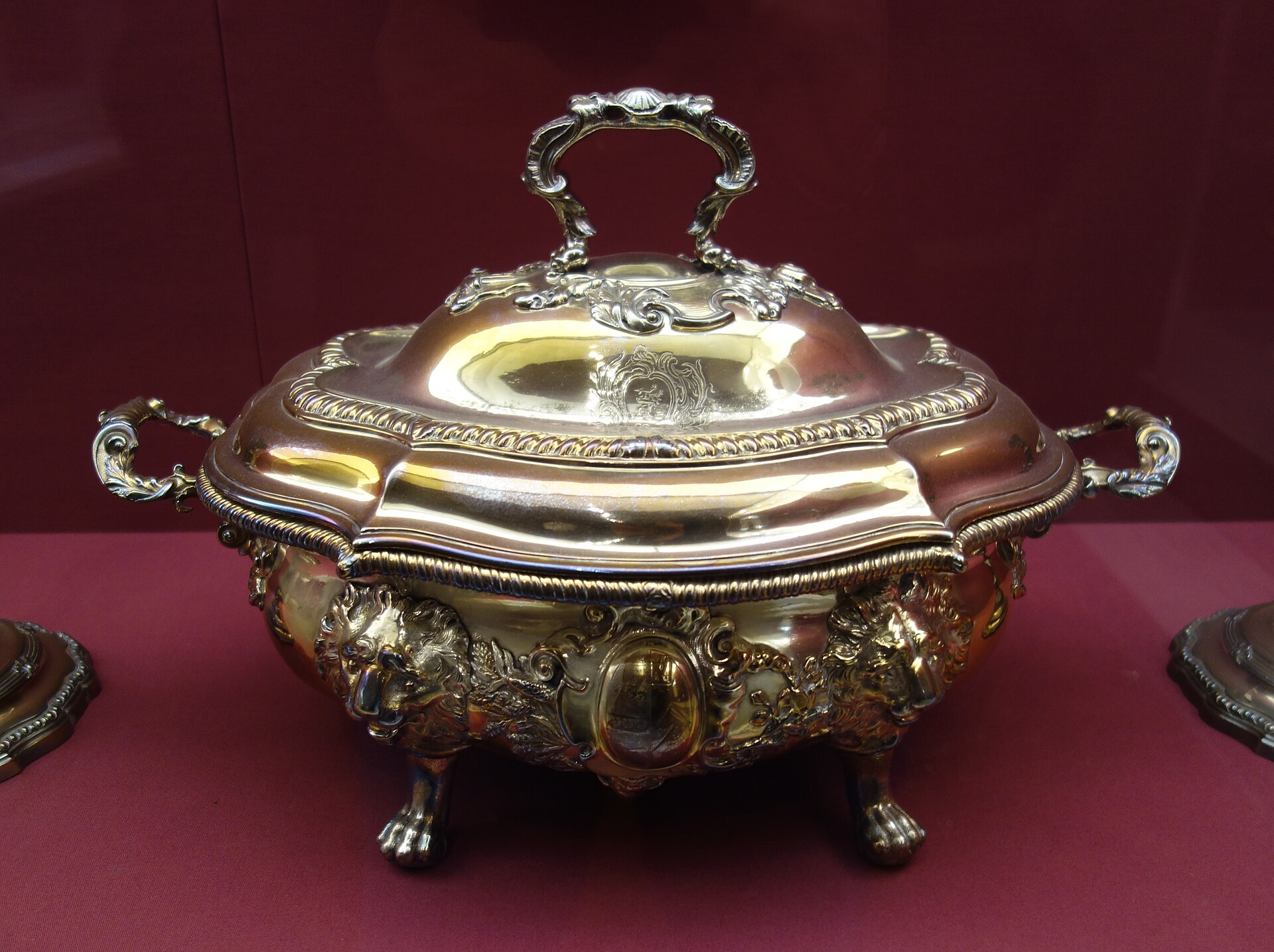
1741-42, most likely the London assay year running from... · Silver gilt
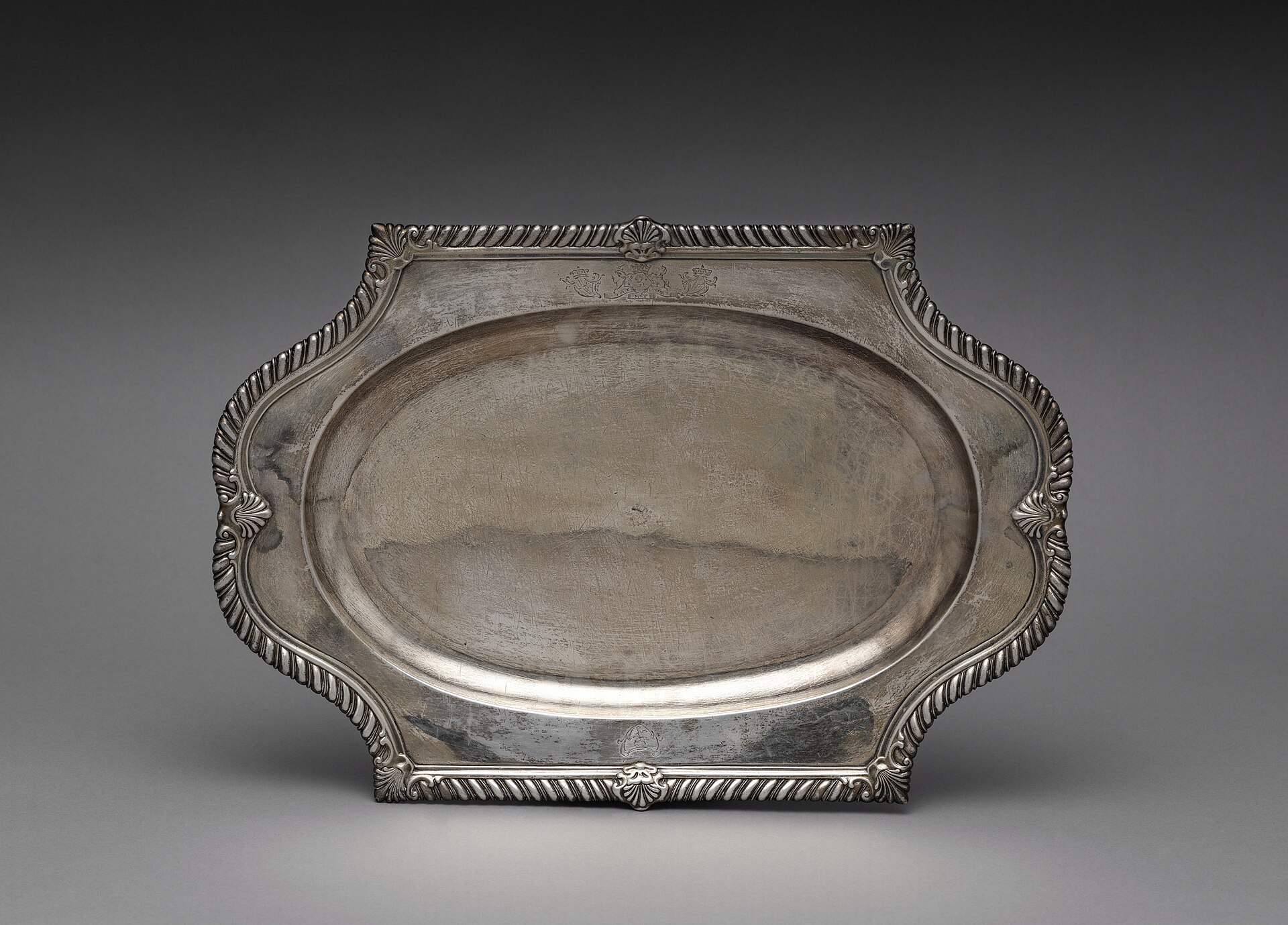
1745-1746 · Silver
Cleveland Museum of Art, Cleveland, Ohio
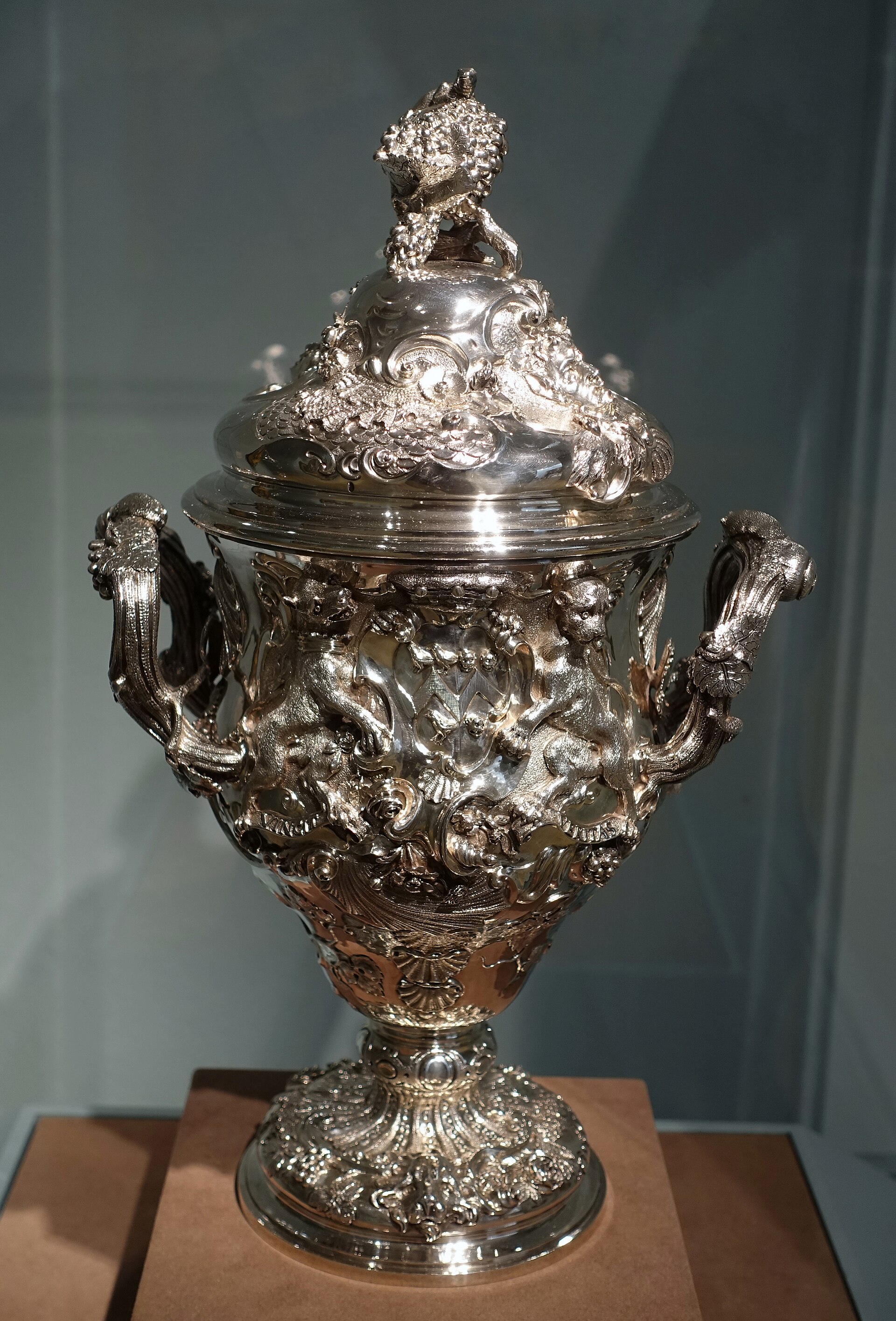
1727 · Silver
Cleveland Museum of Art, Cleveland, Ohio
Louis XIV revokes the Edict of Nantes by the Edict of Fontainebleau, and Protestant craftsmen leave France in large numbers.12
Paul Souchay de la Merie and his brother Jean Souchay de la Chancellerie are paid off in February from a list of French refugee officers in the army of the United Provinces. On 2 June the elder de la Merie and his wife Constance le Roux are admitted to the Walloon Church of Bois-le-Duc.1
Born 9 April at Bois-le-Duc and baptised there on 14 April as Paul Jacques Souchay de la Merie. In the same year Pierre Platel, his future master, lands at Torbay in the train of William of Orange.1
An extract of the baptismal entry is issued to the parents on 23 March, evidence that they had already decided to leave.1
The family appears in the poor-rate book of St James's, Westminster, living in Berwick Street, Soho, with the surname Souchay dropped in favour of de la Merie.1
The Britannia standard is made compulsory at 958.4 parts per thousand, with the lion's head erased and the seated Britannia replacing the leopard's head and the lion passant, and makers' marks are required to be the first two letters of the surname.81522
Pierre Platel buys his freedom of the Goldsmiths' Company by redemption and enters his mark in June; his shop is in Pall Mall, over against the Duke of Schomberg.1
Father and son are entered on the Roll of Denizations on 24 June. In July the father receives six pounds from a fund for French Protestant refugees in hardship, raised to pay the apprenticeship premium. On 6 August the fifteen-year-old is bound at Goldsmiths' Hall to Peter Platel for seven years.1
Sir William Trumbull's household account book at Easthamstead Park records seventy pounds paid to Mr Lamary for a tea kettle and chafing dish, two years before de Lamerie had a mark of his own.2
Takes his freedom by service at Goldsmiths' Hall on 4 February and enters his first maker's mark at the Assay Office on 5 February, the two letters LA between a crown and a fleur-de-lis, address in Windmill Street near the Haymarket. Contemporaries would have dated that February 1712.121415
Fined twenty pounds in July for not having his work hallmarked; in November the fine is still outstanding.1
Charged in June with covering foreigners' work and getting the same touched at the Hall. The complaint sets out the mechanism: private contracts to buy unfree makers' plate, swear it as his own, and sell it back at the same price after marking.12
Charged again in July on the same count, with David Willaume and David Tanqueray named alongside him. In the same year he has a second punch cut and does not register it.1
Marriage allegation filed on 7 February for a special licence from the Archbishop of Canterbury; married four days later to Louisa Juliott in the church in Glasshouse Street by the bride's uncle. Takes a second house in Windmill Street. Referred to in Company records as the King's Silversmith, inside a complaint that he is not bringing large plate to the Hall. Accepts the Livery on 18 June.12
The Wrought Plate Act of 1719 restores sterling as an option alongside Britannia, and a duty of sixpence an ounce is imposed on newly made silver brought for assay. De Lamerie changes his mark for a third time without registering it, and stays on the Britannia standard.13815
William Hogarth completes his apprenticeship to the engraver Ellis Gamble. The seal salver made for Sir Joseph Jekyll carries the London date letter for 1721-22.16
A chimney sweep's boy brings in a jewel found in the street; an apprentice removes the stones and de Lamerie values the mount at three half-pence. The boy sues. Armory v Delamirie becomes case law on trover and is still cited. It also proves he kept a retail jewellery counter.12
Takes a joint Sun Insurance policy for a thousand pounds with Ellis Gamble on the Golden Angel in Cranbourn Street on 11 October, while separately insuring his Windmill Street premises for five hundred. His clients by now include Lord Foley, the Countess of Berkeley, Viscount Tyrconnel, Lord Gower, the Earl of Bristol and the Duke of Bedford.1
Supplies George Treby with a Regence toilet service as a gift to his future wife, the end point of a sequence of commissions that had started with plain objects in 1720.1
Goldsmiths' Company officials try to seize Robert Dingley's Russian cargo at the Customs House in August. Of 4,108.05 ounces found unmarked, 2,008 are de Lamerie's. The officials are lured to the Vine Tavern in Thames Street and the ship sails.12
Makes the seal salver for Sir Robert Walpole from the Second Exchequer Seal of George I, its engraving attributed to Hogarth, one of two commissioned to mark his terms as Chancellor of the Exchequer. On 18 October he and Gamble take separate insurance policies, Gamble for a thousand pounds and de Lamerie for eleven hundred, ending the partnership.15
Chosen an Assistant of the Goldsmiths' Company on 6 May and excused the office of Renter on paying a fine of forty pounds.1
Enters his fourth mark on 27 March, the sterling PL, abandoning the Britannia standard twelve years after he ceased to be obliged to use it. The register entry records his shop sign, the Golden Ball in Windmill Street, for the first time.111
Begins investing in property, starting with a parcel in Piccadilly; further purchases follow in 1734, 1739, 1741 and 1743, in Westminster and in Gloucestershire. He also lends on mortgage.1
His father is given a pauper's burial at St Anne's, Westminster, on 26 December, at the height of the son's prosperity.12
The Maynard Dish is assayed, weighing 272 ounces 6 pennyweights and measuring 66.6 centimetres across; its chasing gives the anonymous Maynard Master his name. The Company's Standing Committee asks de Lamerie to value a stove grate for the Hall's parlour, esteeming him one of the best of judges of that fine workmanship. He is addressed as Captain in the Company minutes from this year.111
Appointed in December, with Richard Bailey and Humphrey Payne, as a trade member of the Special Committee for the Parliament Business, preparing a bill against frauds in the manufacture of gold and silver wares. He opposes the clause restoring the Company's right of search and it is left out. The Hardwicke soup tureen now in the Portland Art Museum is hallmarked 1737-38.1217
Moves to Gerrard Street early in the year and does not register the change of address at the Assay Office.1
The Plate Offences Act, 12 George II c.26, orders every goldsmith to destroy his existing marks and register a new one of initials in a different style of lettering. De Lamerie enters his fifth and last mark on 27 June, giving Gerrard Street. In this period he supplies Lord Hardwicke with a ewer carrying marks transposed from another piece.15
His mother dies in January and is buried at St Anne's, Westminster.1
Elected Fourth Warden of the Goldsmiths' Company and addressed as Major in its minutes. Makes the Newdigate centrepiece, hallmarked 1743-44, in fourteen parts and weighing 210 troy ounces, a wedding present marking the marriage of Sir Roger Newdigate of Arbury Hall and Sophia Conyers.14
Third Warden of the Goldsmiths' Company.1
Second Warden. Prime Warden would normally have followed, and did not, because of his health.12
The last year in which Jackson, quoted by E. Alfred Jones, records a de Lamerie punch registered at Goldsmiths' Hall. It cannot be squared with Hare's fifth and last mark of June 1739, and pieces of 1750-51 carry his mark in any case.16
Makes his will in May, dated 24 May by E. Alfred Jones, referring to a long and tedious illness. Dies on 1 August and is buried six days later at St Anne's, Soho. The will is proved on 8 August. The General Advertiser of 9 August notes that his death vacates the post of Lieutenant-Colonel in the Westminster Militia.16
The stock is advertised in the Daily Advertiser in January and February and sold by Abraham Langford. Frederick Knopfell, named in the will as a journeyman, enters his own mark in April with a Windmill Street address. Phillips Garden may have bought tools and casting patterns at the sale.16
The sixpence per ounce duty ends, closing the window in which duty dodging was worth the trouble. Transposed pieces made inside it remain illegal.3
From 1 December a duty mark, the sovereign's head, is required on British silver as evidence that the tax has been paid. Its presence on a piece is proof that the piece is not de Lamerie's.22
The duty mark is discontinued.22
Sir Charles Jackson writes that examples bearing de Lamerie's mark have in recent years been competed for with avidity.1
Philip A. S. Phillips publishes the first monograph, illustrating one hundred and sixty-four pieces with dates and descriptions. W. W. Watts reviews it in the Burlington Magazine in August.7
The Antique Plate Committee is established at Goldsmiths' Hall to give the Assay Office reasonable cause to correct spurious articles and to advise the trade.3
The Hardwicke duty-dodger ewer is brought within the law by re-marking. It is catalogued at the Victoria and Albert Museum as London 1736, duty dodger, marked 1944.5
The Hallmarking Act replaces all previous silver legislation and remains the statute against which the Antique Plate Committee tests an article.3
Paul de Lamerie: At the Sign of the Golden Ball is shown at Goldsmiths' Hall from 16 May to 22 June, with Susan Hare's catalogue, which becomes the standard reference and the source of the mark numbering the trade uses.1
The Maynard Dish is sold at Christie's on 22 May from the estate of Hilmar Recksten.11
Arthur Gilbert gives and loans his collection, including silver by de Lamerie, to Britain rather than to the Los Angeles County Museum of Art. New galleries open at the Victoria and Albert Museum in 2009.21
Ellenor Alcorn's Beyond the Maker's Mark: Paul de Lamerie Silver in the Cahn Collection is published, arguing that de Lamerie's punch is a sponsor's mark and that the extent of his personal work is unknown. The exhibition opens at the Victoria and Albert Museum on 7 November and travels to Memphis, St Louis and Sydney.2
The Reviewing Committee on the Export of Works of Art hears the case of the Jekyll seal salver in September, finds that it meets none of the Waverley criteria against the Victoria and Albert Museum's objection on all three, and an export licence is issued for its removal to Ireland.16
The Goldsmiths' Company holds a seminar at Goldsmiths' Hall on 12 April, Marks of deception, citing a recent increase in attempts to forge de Lamerie's maker's mark. Peter Cameron speaks on the fake marks of Paul de Lamerie.9
Silver is unlike every other collecting field in one structural respect: every object is simultaneously a quantity of bullion whose value is quoted daily and measurable to a tenth of a troy ounce. That sets a hard floor under the price of any piece, however the attribution moves, and it has also been the main cause of destruction, because plate that fell out of fashion or out of a family's ability to keep it was melted. The Goldsmiths' Company melted its own historic plate in 1667 and 1711 to raise money and had to commission replacements from de Lamerie and others in the 1740s. Everything that survives has passed a repeated economic test that no painting faces.
Above the floor, the whole premium is attributional, and the size of the premium attached to de Lamerie's name is precisely why forging his mark is worth a forger's time. The Goldsmiths' Company reported an increase in such attempts in 2024. What this record does not have is a defensible published multiple, and it does not print one.
Three cautions apply to any reported de Lamerie price. Most published figures are premium-inclusive totals presented as though they were prices, with hammer not published at all; this record separates the two wherever the source permits and says so where it does not. Several rows below are not sales at all, and each says in its house field what kind of figure it is. The same objects recur, because silver of this quality moves among a small number of dealers and collectors, so an apparent price series for the maker is often a price series for a handful of pieces. And weight enters the price directly, so two comparable objects of the same year and form can be far apart on gauge alone. The most reliable published valuations for objects of this class are not auction results at all but the fair matching prices set by the Reviewing Committee on the Export of Works of Art, which are stated in a named currency on a named date with the owner's own purchase price on the table.
| Date | Sale | Work | Result | Note |
|---|---|---|---|---|
| 1711 | Direct sale, not auction | A tea kettle and chafing dish | Hammer GBP 70 With premium Not applicable GBP | Recorded in the household account book of Sir William Trumbull of Easthamstead Park, Berkshire, as paid to Mr Lamary. This is two years before de Lamerie entered a mark of his own and while he was still working as a journeyman for Platel, so the plate cannot have carried his punch. |
| 1720s | Trade rates, not a sale | Plate generally | Hammer About 6 shillings per ounce for the silver, 3 to 5 shillings per ounce for the fashion With premium Not applicable GBP | Reported by W. W. Watts in the Burlington Magazine, August 1935, from the accounts published by Phillips. Engraving was poorly paid. The figures are the working economics of the trade: the customer bought mostly metal, and the maker's margin lived in the fashion. |
| 1757 | Trade estimate, not a sale | The cost of setting up as a goldsmith with a workshop and a shop | Hammer GBP 500 to GBP 3,000 With premium Not applicable GBP | Cited by Alcorn. It is not known who provided de Lamerie's capital in 1713. His father had raised the apprenticeship premium from a refugee relief fund in 1703 and was buried a pauper in 1735. |
| 2010-09 | Reviewing Committee on the Export of Works of Art, valuation not a sale | The Jekyll seal salver, George I, mark of Paul de Lamerie, London date letter 1721-22, 32.4 x 23.8 x 3.5 cm, 1,225 g | Hammer GBP 160,000 With premium Not applicable GBP | The value stated on the export licence application, being the price at which the owner had bought the salver. The Committee found the salver met none of the Waverley criteria and a licence was issued for export to Ireland. One of only two seal salvers with de Lamerie's mark. |
| 2010-11 report year | Temple Newsam, Leeds Museums and Galleries, private treaty after export deferral | The great silver wine cistern of Thomas Wentworth, not by de Lamerie, given as a cohort comparator | Hammer GBP 2,073,648 with tax remission With premium Not applicable; this is an acquisition price, not an auction result GBP | Funded by the National Heritage Memorial Fund 1,832,000, the Art Fund 140,000, the Monument Trust 27,000, the J. Paul Getty Jnr Trust 27,000, Leeds Collections Fund 16,000, the Fulford Bequest Fund 12,000, the Jacob Rothschild Foundation 10,000, the Goldsmiths' Company 5,000 and Leeds City Council 4,648. Included because it shows what great English silver of the period is valued at when a public body sets the figure, and because tax remission is built into it, so it is not a market price. |
Hammer is the price at which the bidding stopped; with premium adds the fee the house charges the buyer on top. Hammer price and buyer's premium in the glossary.
| Institution | City | Holdings | Note |
|---|---|---|---|
| Victoria and Albert Museum | London | The most instructive public group. The Newdigate centrepiece of 1743-44 in fourteen parts, 210 troy ounces, M.149:1 to 14-1919; the Walpole seal salver of 1727-28, M.9-1956; the Chesterfield wine cooler of 1727-28 with Crespin's mark overstriking de Lamerie's, M.1-1990; the Hardwicke duty-dodger ewer, hallmarked 1736-37 and catalogued as London 1736, M.16-1954; a cup and cover of 1736-37, 819-1890; an unmarked tea caddy of about 1730, M.314-1962; a sweetmeat basket of 1743-44, M.6-2001. | Also holds Platel's pilgrim bottle of about 1710, M.854&:2-1927, the work of his master, and an anonymous portrait of the Huguenot goldsmith Paul Crespin of about 1725, P.29-1985. The museum publishes a gallery trail devoted to de Lamerie. Its Deputy Keeper of Sculpture, Metalwork, Ceramics and Glass acted as expert adviser in the 2010 export case. |
| The Metropolitan Museum of Art | New York | More than seventy objects under his name in the public collection database, including a centrepiece with cover and eight accessory dishes of 1733-34, an epergne of 1738-39, pairs of candelabra, salvers, casters, baskets and trays, and a tureen of 1736-37. | Assembled through the Pell bequest of 1924, the Fletcher Fund of 1945, the Jules Bache Collection of 1949, the Widener and Dixon gift of 1958, the Untermyer gift and bequest of 1968 to 1973, and a Wrightsman Fund purchase in 2022. The largest single institutional count this record was able to verify. |
| Goldsmiths' Hall, the Worshipful Company of Goldsmiths | London | The Company's own commissions of the 1740s, made to replace plate the Company had sold in 1667 and 1711 to raise funds, of which de Lamerie made the most important pieces. The archives hold the apprentice registers, mark books, committee books and court books on which the documented biography rests. | Also the seat of the Assay Office and of the Antique Plate Committee. The 1990 exhibition was held here, and so was the 2024 fakes seminar. |
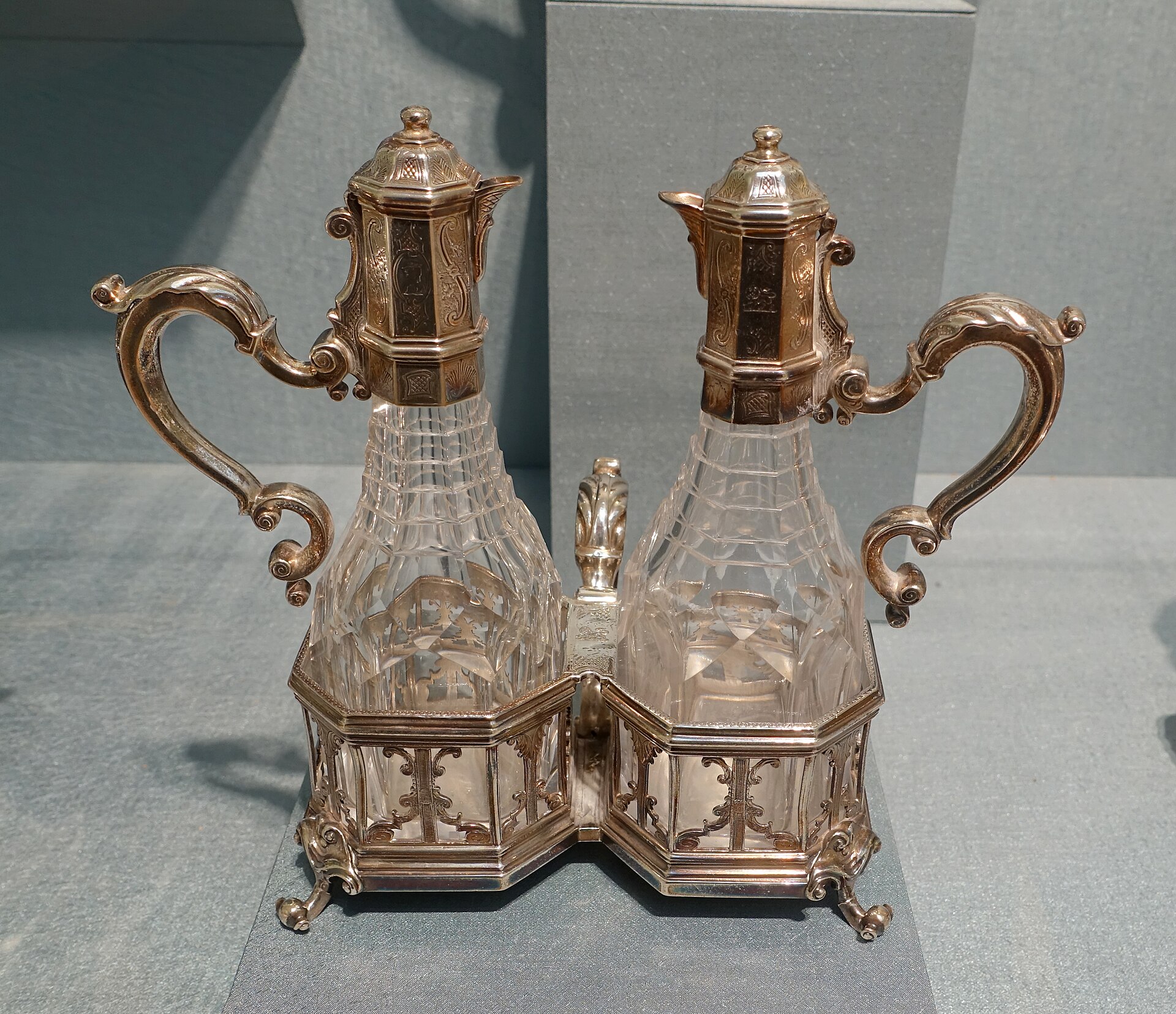
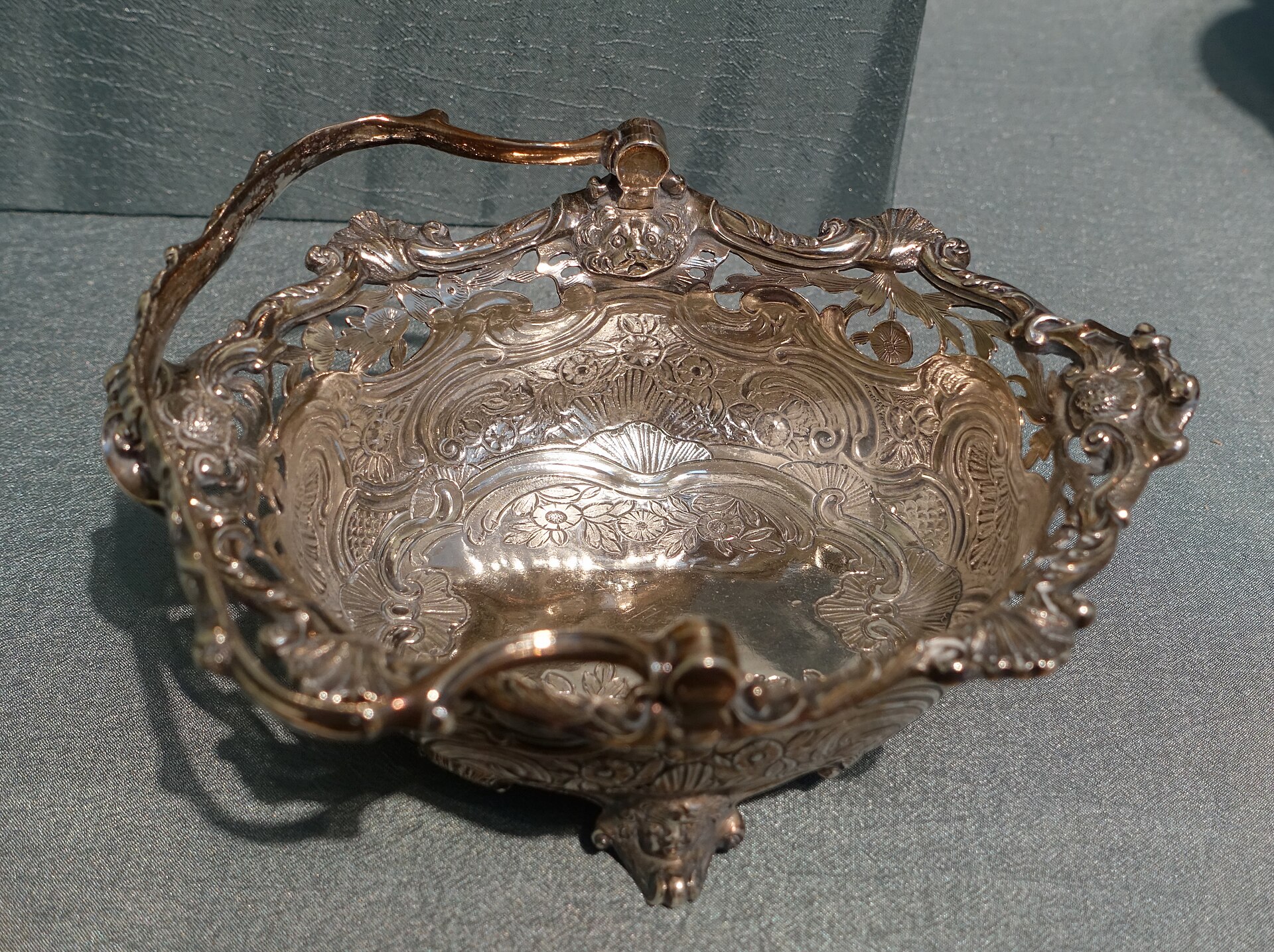
| Portland Art Museum | Portland, Oregon | The Hardwicke Soup Tureen and Cover, 1737-38, maker's mark of Paul de Lamerie, sterling standard, 69.45a-c, engraved with identical armorials below barons' coronets. Also a George I cup and cover of 1717-18, a coffee pot of 1730-31, a cruet stand of about 1733 and a George II sweetmeat basket of 1745. | Museum purchase from the William H. Nunn Trust Fund, established in memory of Alice B. Nunn. Not on view at the time of checking. The museum's own record says maker's mark of Paul de Lamerie, not by, which is the correct formula. |
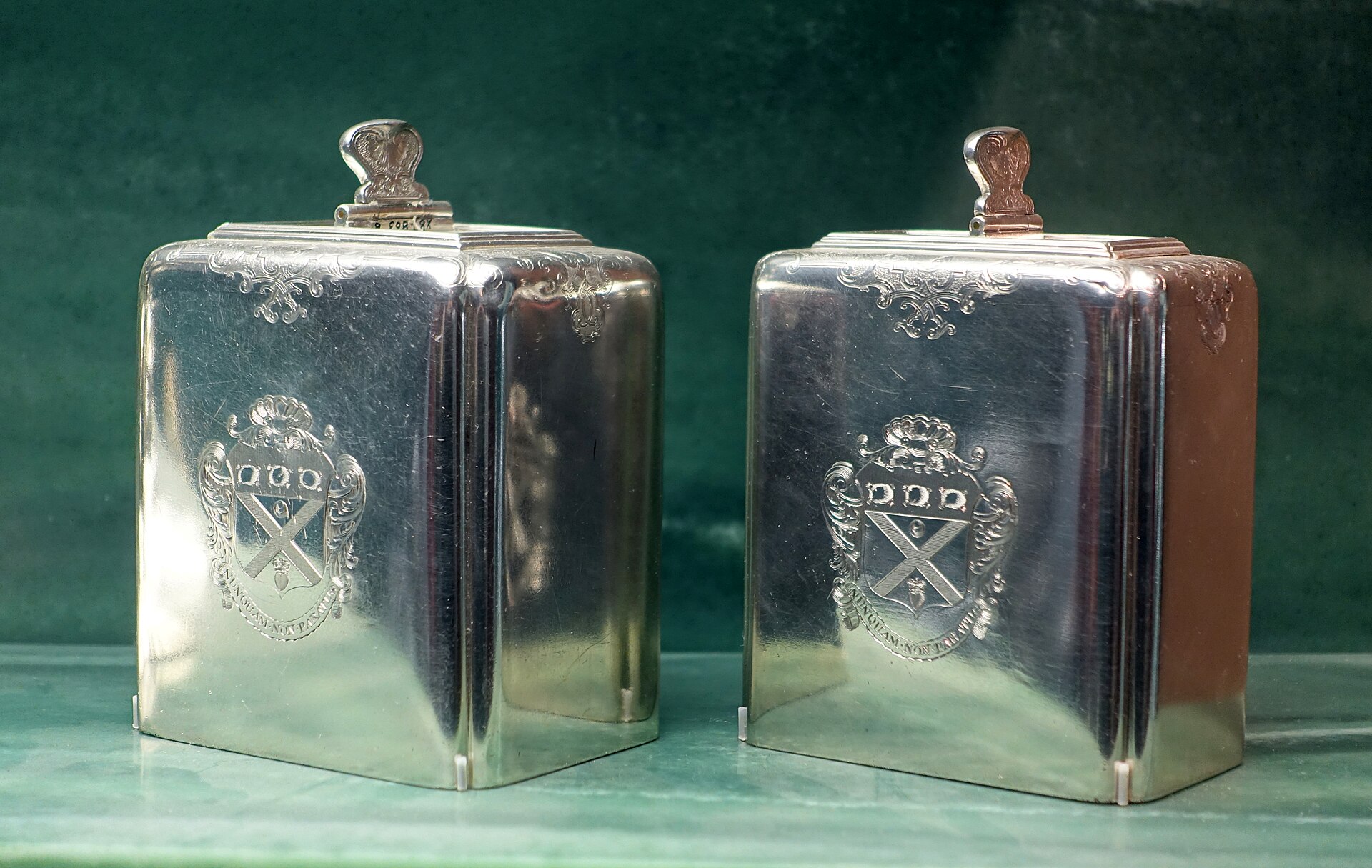
| Fowler Museum at the University of California, Los Angeles | Los Angeles | The Francis E. Fowler, Jr. collection of silver, 251 objects of the sixteenth to nineteenth centuries from Europe, Britain and the United States, including a ewer and dish of 1726-27 made for George Anson, later Baron Anson of Soberton, whose ornament the gallery label records as added later, a pair of sauceboats for the same patron of 1739-40, and tea caddies of 1731-32 engraved with the motto Nunquam Non Paratus. | The Anson ewer and dish are the clearest teaching example in a public collection of eighteenth-century silver decorated after it was made. |
| The Cahn Collection | Private | The Maynard Dish of 1736, a basket of 1745-46 and a pair of silver-gilt candelabra of 1736-37, all associated with the Maynard Master, assembled through Koopman Rare Art. | Published by Ellenor Alcorn in 2006 and toured to London, Memphis, St Louis and Sydney. Private; access is by exhibition rather than by appointment. |
| The Gilbert Collection, at the Victoria and Albert Museum | London | Silver by de Lamerie and by Paul Storr among the eight hundred and more pieces of silver, micromosaics, gold boxes, enamelled miniatures and pietre dure assembled by Sir Arthur and Rosalinde Gilbert from the mid-1960s. | Given and loaned to Britain in 1996 rather than to the Los Angeles County Museum of Art, with which Gilbert had worked since the early 1970s and where permanent galleries had been planned. New galleries opened at the Victoria and Albert Museum in 2009. One purported de Lamerie in the collection proved to be counterfeit. |
| The Al Tajir Collection | Private | Gold and silver assembled by Mahdi Mohammed Al Tajir, published as The Glory of the Goldsmith in 1989, including work by de Lamerie. | Koopman Rare Art states that it helped form the collection. Private. The Christie's salver of 1745 lists The Glory of the Goldsmith among its literature. |
| California Palace of the Legion of Honor | San Francisco | A soup tureen of 1741-42 engraved with the arms and crest of the Hill family. | An example of an object catalogued primarily by its engraved armorial, which on English silver is often the earliest surviving evidence of ownership. |
| National Museums Scotland | Edinburgh | The pair to the Victoria and Albert Museum's Chesterfield wine cooler of 1727-28. | Recorded by the Victoria and Albert Museum under the institution's earlier name, the Royal Museum of Scotland. |
| Other American holdings | Various | Cleveland Museum of Art, Cincinnati Art Museum, Dallas Museum of Art, Nelson-Atkins Museum of Art, Art Institute of Chicago, Fogg Art Museum at Harvard, J. Paul Getty Museum, Los Angeles County Museum of Art, Minneapolis Institute of Art, and a Huntington collection recorded on Wikimedia Commons whose city this record has not confirmed. | The dispersal of English eighteenth-century plate into American museums in the twentieth century is the single largest fact about where this material now is, and it happened through collectors rather than through institutional buying. |
A painting is dated by connoisseurship, by dendrochronology if it is on panel, by pigment analysis and by documents.
A painting is dated by connoisseurship, by dendrochronology if it is on panel, by pigment analysis and by documents. A piece of English silver is dated by reading four or five punches with a glass, and the reading is good to a single assay year. No other collecting field has anything comparable. This is the most useful thing on this page and it applies to every silver object the archive will ever hold, whoever made it.
The Silver Society sets out the components. A standard mark states the fineness of the alloy. A town mark states which assay office tested it. A date letter states the assay year. A sponsor's mark states who submitted it. Between 1784 and 1890 a duty mark, the sovereign's head, states that the tax had been paid; British law required it from 1 December 1784 and it was discontinued in 1890. Four of these matter for de Lamerie. The fifth postdates him by a generation, which means a piece struck with a monarch's head cannot be his, and it is the quickest single disqualifier in the field.
For London the town mark and the standard mark do double duty. There is no separate London town mark: a leopard's head together with a lion passant is itself the statement that the piece was marked at Goldsmiths' Hall, and on Britannia plate the pair is a lion's head erased with a seated Britannia. The leopard's head, which despite the name is drawn as a lion's head, was introduced in 1300 uncrowned, acquired a crown in 1478 and kept it in London until 1821, when it lost it again. The lion passant arrived in 1544 and after 1720 was used by every English assay office. Until 1821 that lion is guardant, its head turned out at the viewer; afterwards it looks ahead. Date letters begin in 1478. Each office ran its own alphabet, and the letterform and the shape of the surrounding shield change from cycle to cycle, which is what makes a letter readable to one year rather than to one of several.
Two consequences follow that a cataloguer has to hold on to. First, a London date letter runs from one May to the next and therefore straddles two calendar years, which is why the Victoria and Albert Museum dates the Newdigate centrepiece 1743-1744 and not 1743. Writing a single year on a piece of London silver discards information. Where a museum label or a dealer's record supplies only one year, this page repeats that year rather than inventing a span, and the plate captions below are label-derived in exactly that way. Second, the marks date the assay, not the making. A piece assayed in one year may have been finished in the next, and de Lamerie's own workshop shows the effect: E. Alfred Jones noted in 1920 that Jackson gave 1749 as the last date at which a de Lamerie punch was registered at Goldsmiths' Hall, yet a cruet frame and a sauce ladle of 1750-51 in Lord Swaythling's collection carry his mark, made in a year when the master was already dying and his journeymen were finishing the work. Jackson's 1749 cannot be reconciled with Hare's account of five marks ending in June 1739, and neither writer addresses the other; the discrepancy is recorded here and left open.
Between 1697 and 1720 English plate could not legally be made at the old sterling standard.
Between 1697 and 1720 English plate could not legally be made at the old sterling standard. The 1697 statute raised the required fineness to eleven ounces ten pennyweights of pure silver in the pound troy, which the Silver Society states as not less than 958.4 parts per thousand against sterling's 925, and gave the higher standard its own marks: a lion's head erased, torn off with a ragged neckline, in place of the leopard's head, and a seated figure of Britannia in place of the lion passant. The purpose was monetary. Silversmiths had been melting coin, and setting the plate standard above the coinage standard removed the incentive.
The same statute changed the form of the sponsor's mark. Where a mark had been the initials of the surname, from 1697 it was to be the first two letters of the surname. That is why de Lamerie's first punch is built on LA, set between a crown above and a fleur-de-lis below. In 1720, under the Wrought Plate Act of 1719, the sterling standard was restored as an option, and both standards remain legal to this day, so a Britannia mark after 1720 records a choice rather than a compulsion. Between 1720 and 1739 many workers ran two marks in parallel, the two-letter form for Britannia and an initials form for sterling, and the confusion that produced is the stated reason the Plate Offences Act, 12 George II c.26, passed in the parliamentary session of 1738 to 1739, ordered every plate worker to destroy his existing punches and register a new one made from the initials of forename and surname, cut in letters of a different character from those used before.
Britannia silver is softer than sterling and costs more per ounce. A maker who stayed on it after 1720 was making a claim about his work and accepting a margin penalty to make it. De Lamerie stayed on it for twelve years after he need not have, and then changed. No source consulted records his reason. One dealer's account proposes that the rococo ornament he was moving into worked better in the harder sterling alloy; that is a dealer's proposal, unevidenced.
The trade usually credits de Lamerie with two marks, the Britannia mark of 1712 or 1713 and the sterling mark of 1732.
The trade usually credits de Lamerie with two marks, the Britannia mark of 1712 or 1713 and the sterling mark of 1732. The record, registers and objects together, says five, and the three that get left out are the ones that carry the character. Two of the five never reached the register at all, which is part of the point.
The first was entered at the Assay Office in Goldsmiths' Hall on 5 February 1713, the day after he took his freedom by service, with the address given as in Windmill Street near the Haymarket. It is a Britannia-standard mark because in February 1713 there was no other kind. The date is the source of a discrepancy a cataloguer meets constantly: Hare gives the freedom as 4 February 1713 and the mark as 5 February 1713, Alcorn writes that he was made free in 1712, and the trade routinely dates the mark 1712. All are describing the same week. Under the calendar then in use the legal year began on 25 March, so a Londoner writing at the time would have dated that February to 1712, and a modern writer converting to New Style gets 1713. None of these authors spells the conversion out, and the reader is left to reconcile them. A record on a de Lamerie object of the 1710s should give the mark as entered 5 February 1712/13 and say why. Every other date on this page is given New Style, with the year beginning in January, which is why the marriage allegation of February 1717 and the stock advertisements of January 1752 are filed where a modern reader expects them and not where a contemporary would have written them.
The second mark he had cut in 1716, or 1717 depending on which account is followed, and did not tell the Hall. Hare, working from the Company's own minutes, places the unrecorded change in the year before his admission to the Livery on 18 June 1717 and illustrates the punch from the base of the Brownlow punch bowl, dating it about 1716 to 1720; a specialist dealer's summary gives 1717. The third mark followed in 1720, also unregistered. This matters beyond biography. A mark that never entered the register cannot be checked against the register, so the study of de Lamerie's punches in those years rests on impressions taken from objects rather than on the Hall's own record, which is a weaker evidential base than the field usually admits.
The fourth mark, entered on 27 March 1732, is the sterling mark, the PL that the trade calls Hare number 4 when describing a piece. Its register entry is also the first document to record his shop sign, the Golden Ball in Windmill Street. The fifth and last was entered on 27 June 1739 under the compulsion of the Plate Offences Act, and its address is Gerrard Street. He had moved there early in 1738 and had not troubled to tell the Assay Office; the new statute is the only reason the change of address is on record at all.
Take the Maynard Dish, the sideboard dish assayed in 1736 and given by one dealer account as 1736-37, which gave the anonymous chaser of de Lamerie's best rococo his working name.
Take the Maynard Dish, the sideboard dish assayed in 1736 and given by one dealer account as 1736-37, which gave the anonymous chaser of de Lamerie's best rococo his working name. Its marks, struck on the back, are a sponsor's mark PL, a lion passant, a date letter a, and a leopard's head crowned. Four punches, and each does a different job.
The lion passant says sterling, not Britannia, so the piece is after 1720 and after de Lamerie's own change of standard in 1732. The leopard's head crowned says London, and its crown says before 1821. The date letter a says the first year of a cycle, and a letter a in a London cycle running with a crowned leopard's head and a guardant lion narrows to the cycle opening in 1736. The sponsor's mark PL, in the initials form used for sterling, matches the punch entered on 27 March 1732 and cannot be the two-letter LA of the Britannia years. Every one of the four agrees with every other, and with a dish weighing 272 ounces 6 pennyweights and measuring 66.6 centimetres across, which is exactly the scale of object a customer went to de Lamerie for in the middle 1730s. That agreement is the test. A single mark that disagrees with the others is the whole of the evidence in most fraud cases.
The reading also produces the object's engraved provenance for nothing. The arms at the centre are Maynard, argent a chevron azure between three sinister hands gules, differenced by a crescent for the heir to the barony, which points to Grey, fifth Baron Maynard, who lived from 1679 to 1745. The date letter and the heraldry corroborate one another. Where they do not, one of them has been altered, and on silver the thing most often altered is the heraldry, because re-engraving arms was the ordinary way of passing plate from one family to the next. The soup tureen of 1741-42 in the California Palace of the Legion of Honor is catalogued by the arms and crest engraved on it rather than by any document, and that is normal practice: on English silver the armorial is frequently the earliest surviving evidence of ownership, and it is engraved, not written.
Louis XIV revoked the Edict of Nantes in 1685 by the Edict of Fontainebleau, and the Protestant craft population of France moved.
Louis XIV revoked the Edict of Nantes in 1685 by the Edict of Fontainebleau, and the Protestant craft population of France moved. De Lamerie's father, Paul Souchay de la Merie, was of the French petty nobility, as the territorial suffix on the surname indicates, and he and his brother Jean Souchay de la Chancellerie appear on a list of French refugee officers in the army of the United Provinces, paid off in February 1686. His mother Constance le Roux came from Rouen and had family already settled in Amsterdam. The couple were admitted to the Walloon Church of Bois-le-Duc on 2 June 1686 and their son was baptised in the same church on 14 April 1688.
A note in the margin of the baptismal register records that an extract was issued to the parents on 23 March 1689, which tells us they were already planning to move and had equipped themselves with legal proof of the child's identity. They followed William of Orange to England. By 1691 the poor-rate book of St James's, Westminster, has them in a house in Berwick Street, Soho, with the surname Souchay dropped and the territorial suffix taken in its place.
The family was poor. On 24 June 1703 father and son were entered on the Roll of Denizations, a legal prerequisite to apprenticeship, and in July of that year the father received a special payment of six pounds from a fund reserved for the relief of French Protestant refugees in hardship. The application was made after denization and before the indentures were signed, so the money was raised in order to pay the apprenticeship premium. On 6 August 1703 the fifteen-year-old was bound at Goldsmiths' Hall to Peter Platel, citizen and goldsmith of London, for seven years; Pierre had anglicised his name and the registers call him Peter.
Platel and his brother Claude came from Lille, took refuge in the Netherlands and landed at Torbay in 1688 in William's train. Platel bought his freedom of the Goldsmiths' Company by redemption in 1699 and entered his mark in June of that year; his workshop was in Pall Mall, over against the Duke of Schomberg, which is to say a short walk from the court. He worked in the Regence manner, well-proportioned, architectural, its ornament often taken from engravings by Daniel Marot, and he took only four apprentices in London. This was an expensive place to be put, and the six pounds from the refugee fund is the measure of what it cost the father to put him there.
The refugee community is the second half of the explanation. De Lamerie lived and worked in a Soho where the conversation was still mainly in French, alongside Paul Crespin, David Willaume, David Tanqueray, Simon Pantin, Peze Pilleau, Isaac Ribouleau, Augustine Courtauld and Abraham Buteux. Hare's judgement is that his eclecticism, the willingness to take ideas from men working in other trades in the same streets, is as much the cause of his success as his hand was. The eventual irony is that the same closeness let the Company charge him repeatedly with fronting for the men who had no marks of their own.
The Goldsmiths' Company minutes are the nearest thing to a biography, and what they record is a running quarrel.
The Goldsmiths' Company minutes are the nearest thing to a biography, and what they record is a running quarrel. In July 1714 de Lamerie was fined twenty pounds for not having his work hallmarked, and in November the fine was still unpaid. In June 1715 he was up on a charge that he covered foreigners' work and got the same touched at the Hall, which is to say he submitted plate made by men, mostly Huguenots, who were not free of the Company and had no registered mark, and charged them for it. The complaint of 1715 quotes the mechanism precisely: he and others had made private contracts to buy the foreigners' plate so that they might swear it to be their own, and after it was touched sold it back to them for the same price. By July 1716 he was up again on the same charge, this time with David Willaume and David Tanqueray named alongside him.
In 1717 he was already being called the King's Silversmith, and the reference occurs inside a complaint that he was making and selling great quantities of large plate that he did not bring to Goldsmiths' Hall to be marked according to law. The committee, learning that he was working on a large quantity of spoons, deferred action to see whether he would bring them in. He was tipped off, sent them in, and nothing further was done. On 18 June 1717 the Wardens invited him into the Livery.
The most useful of these episodes is the trial of Robert Dingley, a goldsmith and jeweller at St Helen's Gate, Bishopsgate Street, who exported silver, mostly by Huguenot makers, to Russia and warehoused it until he had a full cargo. In August 1726 Company officials tried to seize the cargo at the Customs House on suspicion that much of it was unmarked and the duty unpaid. Dingley swore that 18,600 ounces, all made since 1 June 1720, had been assayed and marked. A further 4,108.05 ounces had not: 314 ounces by Nicholas Clausen, 53 by Peze Pilleau, 95 by Isaac Ribouleau, 568.05 by Simon Pantin, 70 by Augustine Courtauld, 300 by Joseph Barbutt, 700 by Abraham Buteux, and 2,008 ounces, nearly half the total, by Paul de Lamerie. The inspection never happened. Dingley lured the Company's men to the Vine Tavern in Thames Street and the ship was loaded and sailed while they sat there.
The structural point behind the anecdotes is Alcorn's. The livery companies policed their trades by unannounced search, seizure and fine; those powers were challenged in court in the early seventeenth century and most companies had abandoned them by the early eighteenth. The Goldsmiths held on longer than most, largely by enforcing assay rather than by searching shops, but when in 1725 the Wardens were asked to withhold the benefit of assay from any but freemen, they were reminded that the Attorney General had reported for the Treasury that the Company could not refuse to mark plate brought in by unfreemen. The system was therefore open by law to exactly the sponsorship de Lamerie was fined for, and that is a large part of why his mark sits on objects he did not make.
Between 1720 and 1758 a tax of sixpence an ounce was levied on all newly made silver sent to an assay office to be tested and marked.
Between 1720 and 1758 a tax of sixpence an ounce was levied on all newly made silver sent to an assay office to be tested and marked. On a dish of 272 ounces 6 pennyweights that is 6 pounds 16 shillings and 2 pence, near enough seven pounds, at a moment when the metal itself ran at about six shillings an ounce and the fashion, the charge for the work, at three to five shillings. The duty was a real proportion of a real bill, and the trade's answer was immediate and obvious: cut the marks out of a small piece of plate that had already been assayed, solder the marked patch into a new and heavier one, and present it as marked. The Goldsmiths' Company Assay Office states the position without softening it. Transposing marks from one piece to another was an offence then and remains one now, and a piece that was transposed more than two hundred and fifty years ago is still illegal today.
De Lamerie did it. In December 1737 he was appointed, with Richard Bailey and Humphrey Payne, a trade member of the Company's Special Committee for the Parliament Business, preparing a bill to prevent the great frauds daily committed in the manufacturing of gold and silver wares. One clause would have restored the Company's right of search. He opposed it, the clause was entirely left out of the intended bill, he then stopped attending the meetings, and he signed the final report. Hare's explanation is the ewer. In that same period he supplied Philip Yorke, Baron Hardwicke, later Lord Chancellor, with a helmet-shaped ewer applied with Hardwicke's arms impaling those of his wife Margaret Cocks, and soldered to the underside of its foot was a plate carrying de Lamerie's mark and the London hallmark for 1736-37, cut from a smaller and cheaper object on which the duty had already been paid. He was not going to have Company officials in his workshop.
The ewer is at the Victoria and Albert Museum, museum number M.16-1954, and its catalogue line reads London 1736, duty dodger, marked 1944. That last date is the resolution: the object was brought within the law in the twentieth century by having the fraudulent marks dealt with and a current hallmark struck, which is the remedy the legislation still provides. It is the most instructive object in his oeuvre because it convicts him. That the same peer appears again on a soup tureen of 1737-38 in the Portland Art Museum, catalogued as the Hardwicke Soup Tureen and engraved with identical armorials below barons' coronets, gives some idea of the size of the account being served.
The detection method is not laboratory work in the first instance; it is knowing where a given form was marked. The Assay Office guide is specific. Eighteenth-century salvers and trays were marked in a straight line or a gentle curve. Coffee pots and mugs were marked either in a straight line to the right of the handle or in a cluster under the base. Marks cut from a small salver and let into the base of a new coffee pot will be in the wrong configuration for a coffee pot. Look for excessive solder around the marks, since solder running close to the punches may be hiding the edge of a let-in plate. Look for marks too large or too small for the object, too close together or too far apart. Duty dodgers with covers frequently have no mark at all on the cover, or only the maker's mark. Duty dodgers often carry seventeenth-century marks on an object whose form is plainly later, so the anomaly is between appearance and date. And a maker's mark struck twice alongside marks arranged in a line is a deliberate attempt to fake the clustered arrangement. The forms most often found to be duty dodgers are cups, tea and coffee wares, casters, bowls, mugs and tankards.
Where the eye is not enough, the Antique Plate Committee uses radiography, which makes a let-in patch clearly visible, and spectroanalysis of the alloy, which dates the metal independently of the punches and catches a component later than the marks allow. Both are non-destructive. Neither replaces the first question, which is whether the marks are in the place this form was marked.
The eighteenth-century duty dodger and the twenty-first-century fake are the same operation with a different motive.
The eighteenth-century duty dodger and the twenty-first-century fake are the same operation with a different motive. The Assay Office draws the distinction plainly: transposed marks outside the 1720 to 1758 window were generally made to deceive a buyer rather than to evade a tax, and that fraud tends to be much more recent. The tells are the same. Solder lines around the marks; marks in a position the form does not use, such as a Georgian punch bowl marked halfway up the side; an impression that shows on the outside but not correspondingly on the inside, which means the marks sit on an applied patch. Electroplating can hide a solder line, but plating leaves a different colour and patination, and on a chased surface it leaves matting, frosting or minute beads. A careful faker chases along the solder line to disguise it, which is itself a diagnostic.
Four further methods are catalogued. Electroforming builds a copy by depositing metal into a mould taken from the original; the outer surface can be perfect but the reverse carries a granular finish of tiny pellets, and polishing it back leaves a patination problem. The Assay Office illustrates an electroformed copy of the Mostyn Salt complete with Elizabethan hallmarks. Casting from a mould reproduces the marks softly: a struck punch displaces metal at its edges and a cast mark does not, so cast marks read as poorly defined and granular, and centrifugal casting has made this much harder to detect. Casting has a second signature that is decisive on a set. Marks on eighteenth-century flatware and candlesticks were struck by hand one piece at a time and never fall in exactly the same place; if every item in a set carries its marks in identical positions, the set was cast from one original. Soft punches were used to strike fake marks in about 1730 to 1750, made by pressing a low-melting metal into a genuine set of marks and using the cooled impression as a punch; the results are shallow and blurred, and many pieces with soft-punch marks carry the mark of the eighteenth-century maker Edward Feline, whose own punch on those pieces is sharper than the rest because a smith could lawfully hold his own. And in the second half of the twentieth century a run of sophisticated fakes struck from newly cut steel punches sold for tens of thousands of pounds; on early spoons some were so hard to detect that they moved the whole spoon market.
De Lamerie is now a target in his own right. The Goldsmiths' Company, announcing a seminar held at Goldsmiths' Hall on 12 April 2024 under the title Marks of deception, stated that there has been a recent increase in attempts to forge his maker's mark. Peter Cameron spoke on the fake marks of Paul de Lamerie; Timothy Schroder, Alastair Dickenson, Will Evans and Eleni Bide also spoke. The Company's published account of that day names the increase but publishes no count of pieces detected, and no such count appears to be public.
The body that decides is the Antique Plate Committee, established in 1939 and run by the Goldsmiths' Company. It has two stated purposes: to give the Assay Office the reasonable cause that current legislation requires before it may correct a spurious article, and to advise the antiques trade so that pieces are not misdescribed or sold illegally. Its members are academics, dealers, auctioneers and museum curators, and it works by connoisseurship, scientific testing and comparative examination of the marks together. It is worth being exact about what it rules on. The committee decides whether an article complies with the Hallmarking Act 1973. It does not certify authorship. There is no de Lamerie authentication board, there never has been, and a committee clearance means the marks are lawful, not that the object came out of his workshop.
The strongest single illustration of what that gap costs a buyer comes from Los Angeles. The Los Angeles County Museum of Art, recounting the formation of the Gilbert collection, records that Arthur Gilbert bought works by de Lamerie and by Paul Storr, and that one purported de Lamerie proved to be counterfeit, which prompted him to deepen his own expertise. That is a documented fake by this maker, bought by a serious collector, and it is on the record because the collector said so.
This is the question the field has not answered and mostly does not ask.
This is the question the field has not answered and mostly does not ask. Alcorn puts it as bluntly as it can be put: de Lamerie's marks are traditionally called maker's marks, but they cannot be taken as an indication that he was personally responsible for the design or the execution of any given piece, and the better term, growing in use but still not widespread, is sponsor's mark. His output was prodigious. We do not know how much of the surviving work bearing his mark was designed by him, executed by him, produced under his supervision, or bought in ready-made from outside. We do not know the size of his workshop or the volume it turned out. Alcorn calls it vexing that we are so uncertain about the central activity of the most famous English goldsmith of the eighteenth century, and asks whether he was an artist, an entrepreneur, or both. The Victoria and Albert Museum's own expert adviser, giving evidence to a government committee in 2010, answered both at once: his success lay in his exceptional creativity and in his ability as a businessman to sub-contract to the best available suppliers.
The reason the question cannot be closed is documentary. For George Wickes, whose business was founded in 1735 and became Garrard, the ledgers survive: two workmen's ledgers, cash, stock and supply books, and twenty volumes of gentleman's ledgers recording individual clients. They show a retail operation buying stock items from established suppliers and ordering one-off pieces from a network of subcontractors. Nothing comparable survives for de Lamerie, who must have been one of Wickes's most formidable competitors. The absence is total.
What can be named is a handful of people. Samuel Collins, apprenticed in 1732, was still working for his master at the end and was the craftsman named in the will to finish the pieces standing in the workshop; his mark was never registered at Goldsmiths' Hall, which is why nothing at all can be assigned to him by mark. Frederick Knopfell, named in the will as a journeyman, entered his own mark in April 1752, gave a Windmill Street address, and made a rose-water dish of 1751-52 for the synagogue in Duke Street, Aldgate. James Shruder witnessed the will in May 1751, having been declared bankrupt in June 1749, which makes it very likely that he was then in de Lamerie's employment, most probably as a modeller; his own workshop's coffee pot of 1749-50 in the Victoria and Albert Museum takes its seahorses, dolphins and boat from engravings published in Paris in 1734 by Jacques de Lajoue, which is a fair indication of how a London workshop of this class got its ornament. Isaac Gyles kept the books and was left forty guineas for his long and faithful services. Thirteen apprentices were taken between 1715 and 1749 at premiums between ten and forty-five pounds, of whom Bennett Bradshaw never took his freedom and yet entered a mark in partnership with Robert Tyrill in 1737, which Hare records without explaining how an unfree man came to have a registered punch, Peter Archambo the younger was bound on 5 December 1738 and turned over to his own father the same day as a device to get him into the Goldsmiths' Company rather than the Butchers', and Abraham Portal, bound in 1740 and free in 1749, is the only one with a reputation, and that mostly literary.
Then there is the Maynard Master. The name is a convenience for the anonymous chaser whose work appears on the Maynard Dish of 1736, and the pieces grouped under it include a basket of 1745-46 and a pair of silver-gilt candelabra of 1736-37. Ubaldo Vitali, who studied the group, proposed that the Maynard Master was principally a chaser who worked up his models in copper. The art historian Maureen Cassidy-Geiger has connected five drawings in the Dresden archives to the question. No name has been proposed for him and the identification remains open. What the group establishes is that the finest ornament on objects carrying de Lamerie's mark is by a hand that is demonstrably not his.
Three objects make the point from other directions. The Chesterfield wine cooler of 1727-28 in the Victoria and Albert Museum, M.1-1990, carries the mark of Paul Crespin overstruck on that of Paul de Lamerie: two Huguenot masters, one object, and the sponsor's mark recording the second man rather than the first. It was part of a service supplied by Crespin to the Royal Jewel House and issued to Philip Dormer Stanhope, fourth Earl of Chesterfield, for his embassy at The Hague, and its pair is in Edinburgh. The Ilchester ewer and basin of about 1740, probably a gift from Stephen Fox, first Earl of Ilchester, to Elizabeth Strangways Horner on her eighteenth birthday, is unmarked altogether and is attributed to de Lamerie on style and heraldry alone. And a tea caddy of about 1730 in the same museum is likewise unmarked and likewise given to him, with its arms probably engraved by William Hogarth after a design by Ellis Gamble. A record on any of the three has to say which kind of evidence it is resting on, because they are not the same kind.
The partnership with Ellis Gamble is the clearest surviving picture of how the business actually worked, and it survives because of fire insurance.
The partnership with Ellis Gamble is the clearest surviving picture of how the business actually worked, and it survives because of fire insurance. On 11 October 1723 Ellis Gamble and Paul de Lamerie, described as goldsmiths, took a Sun policy for a thousand pounds on goods and merchandise at the premises known as the Golden Angel in Cranbourn Street. At the same time de Lamerie, described as silversmith, separately insured his household goods and stock in trade in Windmill Street for five hundred pounds. Hare reads the arrangement as de Lamerie producing the silver in his own workshop and Gamble retailing it, with Gamble best placed to take the orders for engraved arms. Gamble never registered a maker's mark. On 18 October 1728 the two took adjoining separate policies, Gamble for a thousand pounds and de Lamerie for eleven hundred, and the partnership was over; the higher figure is the measure of how the five years had gone.
Gamble matters for a second reason. He was the master to whom William Hogarth was apprenticed, and Hogarth completed that apprenticeship in 1721. The engraving on de Lamerie's grandest documented commissions is repeatedly attributed to Hogarth, and the attributions rest on style rather than on signature. The Victoria and Albert Museum attributes the engraving of the Walpole seal salver to him. It attributes the arms on the unmarked tea caddy to him, after a design by Gamble. Hogarth engraved de Lamerie's own bookplate, now in the Royal Library at Windsor Castle. And when a second de Lamerie seal salver came before a government committee in 2010, the Victoria and Albert Museum's Deputy Keeper of Sculpture, Metalwork, Ceramics and Glass told the committee that the engraving was in a style associated with Gamble, that it was likely subcontracted to Gamble, and that Gamble in turn probably delegated it to a member of his workshop, which in 1721 still included the young Hogarth.
Two things follow that a cataloguer should hold. First, that chain of reasoning ends in a workshop, not in a hand, and the expert adviser said as much: the argument is that the engraving came out of Gamble's shop, and Hogarth is named as one of the people who were in it. Second, the same adviser dated the de Lamerie and Gamble partnership 1723 to 1728, which is what the insurance policies show, while the salver he was describing carries the date letter for 1721-22. The subcontract he proposes therefore predates the documented partnership by two years. That is not fatal, because two men can trade together before they insure together, but it is an inconsistency inside a single expert submission.
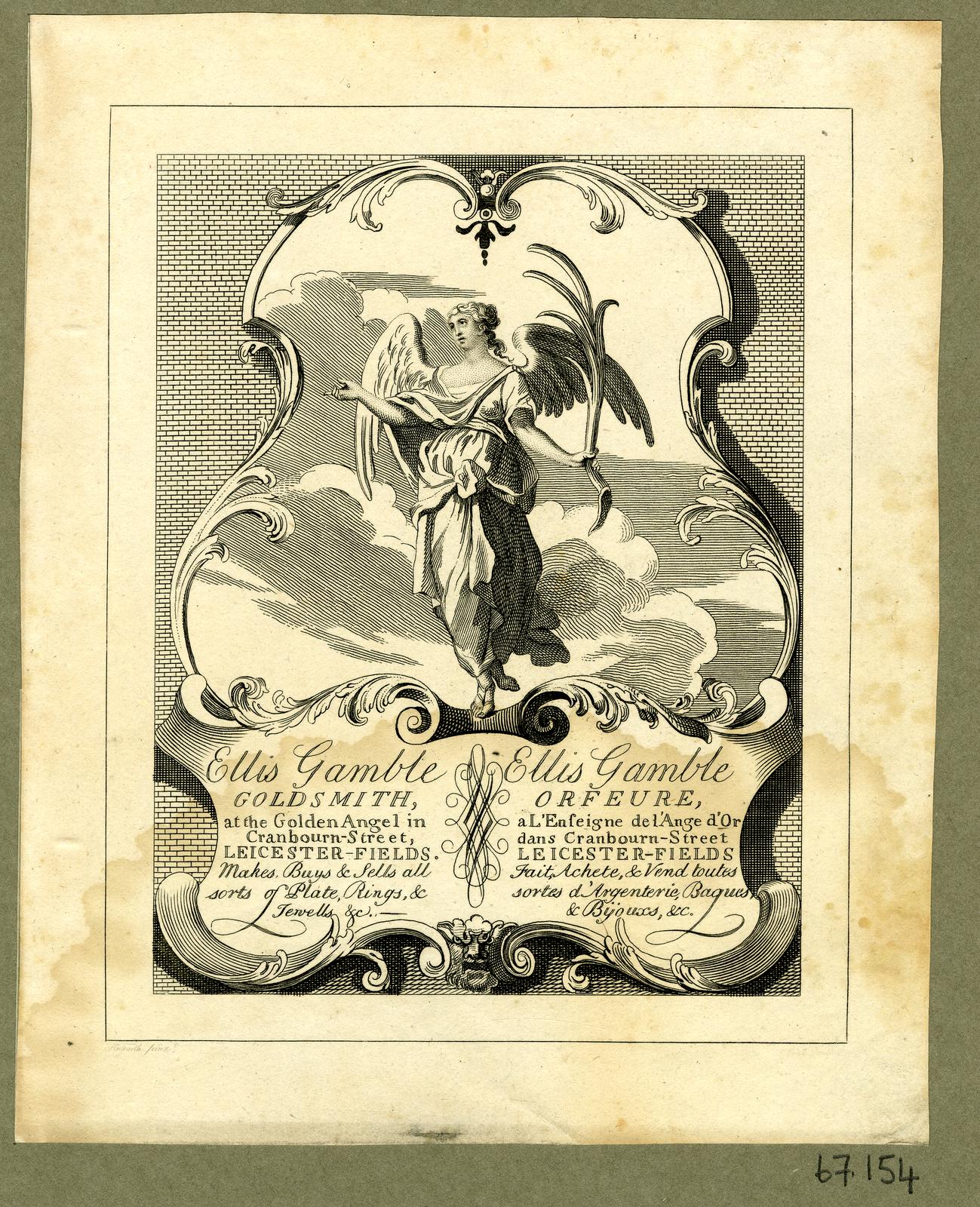
What survives of the Golden Angel is a print. The British Museum holds two impressions of Ellis Gamble's trade card, showing the sign of the angel with the text on a cartouche below and a brick wall behind, describing him as goldsmith at the Golden Angel, Cranbourn Street, Leicester Fields; its own record describes the sheets as copies of the original card and dates the impressions about 1750 to 1837. The address on it is the address on the 1723 policy. Paul de Lamerie, for whom no trade card has ever been found, is visible here only as the other name on the insurance.
By 1723 his clients already included Sir William Trumbull, Lord Foley, the Countess of Berkeley, Viscount Tyrconnel, Lord Gower, the Earl of Bristol and the Duke of Bedford.
By 1723 his clients already included Sir William Trumbull, Lord Foley, the Countess of Berkeley, Viscount Tyrconnel, Lord Gower, the Earl of Bristol and the Duke of Bedford. He was selling before he had a mark of his own: Trumbull's household account book at Easthamstead Park records seventy pounds paid to Mr Lamary for a tea kettle and chafing dish in 1711, two years before the mark was entered and while he was still a journeyman with Platel. The Right Honourable George Treby, member of parliament, was the important early patron, and the bills for silver supplied to him between 1720 and 1725 survived into modern times alongside much of the plate; Hare's reading of the sequence is that de Lamerie coaxed a conservative customer along, plain objects first, then a fashionable cup and charger in 1723, then the Regence toilet service of 1724 as a gift to his future wife.
The most influential customer was Sir Robert Walpole, for whom he made the seal salver of 1727-28. It was an established perquisite that the holder of certain Crown offices took the official silver seal matrix of that office when it fell out of use, typically on the death of a sovereign, and had it melted and made into a piece engraved with the design of the seal. George I died in 1727 while Walpole was Chancellor of the Exchequer, and the salver, museum number M.9-1956 at the Victoria and Albert Museum, is engraved with the design of the Second Exchequer Seal of George I: the seal roundels held up by Hercules for Heroic Virtue, flanked by Calumny and Envy, with the City of London behind, Prudence and Fortitude above, and a border of strapwork between masks of the Four Seasons and corner cartouches carrying the double cipher RW within the Garter collar, the arms of Walpole quartering Shorter, and the Walpole crest. It was one of two salvers Walpole commissioned to mark his terms as Chancellor, and it descended to his youngest son Horace. An object made out of the melted instrument of the state, engraved with the image of the thing destroyed to make it, is not an ordinary commission, and Hare notes how many members of parliament appear among de Lamerie's customers and wonders aloud how many followed the Whig leader's choice.
The royal appointment is thinner than it sounds. He was called the King's Silversmith from 1717 and his obituary called him silverworker to His Majesty, but Hare finds little evidence that he was filling royal orders, and the silver he probably supplied to the Prince of Wales was commissioned through George Wickes rather than ordered from him directly. The overseas trade was real and largely illicit: Dingley's Russian cargo, and behind it the court commissions that produced the centrepiece recorded by W. W. Watts in 1935 as formerly in the Bobrinsky collection in Moscow.
On price, the 1935 review of Phillips's monograph gives the working figures: silver at about six shillings an ounce and the fashion at three to five shillings an ounce, with engraving poorly paid. That ratio is the economics of the trade in one line. A customer buying plate was buying mostly metal, and the maker's profit lived in the fashion, which is also why the engraver, whose contribution was pure labour and no bullion, was the worst paid man in the chain. The range of the business ran from making a fork or repairing a coffee pot to toilet services, wine cisterns and centrepieces. Setting up as a goldsmith with both a workshop and a shop was estimated in 1757 at five hundred to three thousand pounds, and it is not known who found de Lamerie the capital; his father had needed a refugee charity to raise the apprenticeship premium and was buried a pauper in 1735.
From early in 1733 he was buying land. The first purchase was a parcel in Piccadilly with the messuages, tenements, erections and buildings thereupon erected, and others followed in 1734, 1739, 1741...
From early in 1733 he was buying land. The first purchase was a parcel in Piccadilly with the messuages, tenements, erections and buildings thereupon erected, and others followed in 1734, 1739, 1741 and 1743, several around Westminster and one as far off as Gloucestershire. He also lent money on mortgage. In 1736 he was rich enough and respected enough that the Company's Standing Committee, wanting a new stove grate with its tongs, shovel and poker valued for the Hall's parlour, instructed the Clerk to write asking Mr Paul de Lamerie to be so kind to the Company as to come and view and estimate the same, taking such assistance as he should think proper, the Committee esteeming him one of the best of judges of that fine workmanship. Hare notes that this almost grovelling tone was not usual in the minutes.
He held rank in the Westminster Militia. The Company minutes call him Captain from 1736 and Major from 1743, and his obituary in the General Advertiser of 9 August 1751 records that by his death the post of Lieutenant-Colonel in the Westminster Militia had become vacant. He was the only member of the Goldsmiths' Company of that period addressed by military rank. Hare suggests Jacobite activity and the fear of a Roman Catholic restoration as the likely motive, and notes that the regiment had no official status or uniform at that date, which is why the 1990 exhibition could show nothing of it. The interest is also inherited: his father had been a refugee officer in the Dutch service, and the son took it up only after the father was dead.
He had a bookplate engraved by William Hogarth in which a cartouche within an architectural frame holds three tree stumps: the arms of the Souchay family of France, souche being French for a tree stump, and therefore the surname his father dropped on arriving in England. He had family silver engraved for use at home, and a rubbing from one piece survives in the British Library. He was, in other words, quietly reasserting an ancestry he had not troubled to fund. His father was buried a pauper at St Anne's, Westminster, on 26 December 1735, at the height of the son's prosperity, and Hare does not soften the judgement.
He was elected an Assistant of the Goldsmiths' Company on 6 May 1731 and excused the office of Renter on paying a fine of forty pounds.
He was elected an Assistant of the Goldsmiths' Company on 6 May 1731 and excused the office of Renter on paying a fine of forty pounds. He was Fourth Warden in 1743, Third Warden in 1746 and Second Warden in 1747, at a date when consecutive advancement was by no means automatic. Prime Warden would have followed; ill health stopped it.
The will was made in May 1751 and speaks of a long and tedious illness. E. Alfred Jones gives its date as 24 May 1751 and its probate as 8 August, the day after the funeral. It left family and personal bequests, forty guineas to the book-keeper Isaac Gyles, instructions for an inventory of the stock, instructions that the work in hand be finished by Samuel Collins, and a direction that the whole be sold at public auction by Abraham Langford. The stock advertised in the Daily Advertiser in January and February 1752 gives the range of the business, and the presence of jewellery in it confirms what the 1722 lawsuit had already shown, that he kept a retail counter as well as a workshop. There was no son to carry it on; both boys had died in infancy out of six children. Jones records two unmarried daughters, Mary and Lucy, a married daughter Susannah De Baufre, and the widow, and names two executors, Charles Ffouare of St Stephen's, Walbrook, and John Malliet of Wardour Street, neither of them of the trade.
The dispersal is the part that matters for attribution. Frederick Knopfell entered his own mark in April 1752 with a Windmill Street address, and Hare raises the possibility that de Lamerie had kept a workshop in part of his former premises and that Knopfell took it over once the estate was wound up. Phillips Garden may well have bought some of the tools and casting patterns at the 1752 sale; a basket of 1747 with Garden's mark is illustrated in the 1990 catalogue for that reason. Casting patterns outlive the man who used them, and a pattern that passed to another workshop reappears on objects carrying another mark. Any record that treats a cast element as a de Lamerie signature has to reckon with the sale of 1752.
The professional postscript is bleak. Of the men around him, Ellis Gamble his former partner, Paul Crespin the fine craftsman he often worked with, James Shruder his probable modeller, Abraham Portal his apprentice, and Phillips Garden who probably bought his patterns, all went bankrupt trying to run their own businesses. De Lamerie's toughness in trade is not incidental to his reputation; it is the reason he is the one who lasted. The London Evening Post, reporting his death alongside that of Humphrey Payne, said he had been very instrumental in bringing that branch of trade to the perfection it is now in, and that is a judgement about an industry, not about a pair of hands.
Only two seal salvers with de Lamerie's mark are documented in the United Kingdom, and the other of them produced the fullest public examination of his work by a government body.
Only two seal salvers with de Lamerie's mark are documented in the United Kingdom, and the other of them produced the fullest public examination of his work by a government body. In September 2010 the Reviewing Committee on the Export of Works of Art and Objects of Cultural Interest heard case 6 of its 2010-11 year: a George I silver seal salver with the mark of Paul de Lamerie, rectangular, 32.4 by 23.8 by 3.5 centimetres, weighing 1,225 grams, made for Sir Joseph Jekyll, Chief Justice of the County Palatine of Chester from 1697 to 1717, engraved with the 1708 Judicial Seal of Queen Anne for the counties of Denbigh, Montgomery and Flint, inscribed SEALS OF THE COUNTY PALATINE OF CHESTER, SIR JOSEPH JEKYLL KNT CHIEF JUSTICE, and carrying the date letter for 1721-22.
The applicant wanted to export it to Ireland. The value stated on the licence application was 160,000 pounds, being the price the owner had paid. The Victoria and Albert Museum's Deputy Keeper of Sculpture, Metalwork, Ceramics and Glass, acting as expert adviser, objected under all three Waverley criteria: that it was so closely connected with our history and national life that its departure would be a misfortune, that it was of outstanding aesthetic importance, and that it was of outstanding significance for the study of the British tradition of converting obsolete seal matrices into silver plate, a practice going back to the sixteenth century. The submission recorded thirteen documented seal salvers in the United Kingdom, of which this was the only rectangular one and one of only two marked by de Lamerie, the other being the Walpole salver of 1727-28 in the museum's own collection. It argued that the unusual rectangular form suggested a piece commissioned for display, probably in Jekyll's new office as Master of the Rolls, to which he was appointed in 1717, and that Jekyll evidently regarded it as an heirloom. The applicant did not disagree that the salver met the criteria.
The Committee saw the salver and found that it did not satisfy any of the Waverley criteria. An export licence was issued. It was one of only four items that year found to meet none of the criteria, against fourteen referred to the Secretary of State for deferral with an aggregate value of 71,725,403 pounds. The most famous English silversmith of the eighteenth century, on an object of the rarest documented type he made, with the national museum of decorative art arguing all three grounds, did not clear the bar.
That decision is worth more to anyone valuing a de Lamerie object than any auction result on this page, and it should be read next to what happened in the same year to a comparable piece. Case 11 of 2010-11 was the great silver wine cistern of Thomas Wentworth. It was found to meet the second and third criteria, was starred, and was bought by Temple Newsam for Leeds Museums and Galleries for 2,073,648 pounds with tax remission, funded by the National Heritage Memorial Fund at 1,832,000 pounds, the Art Fund at 140,000, the Monument Trust and the J. Paul Getty Jnr Trust at 27,000 each, Leeds Collections Fund at 16,000, the Fulford Bequest Fund at 12,000, the Jacob Rothschild Foundation at 10,000, the Goldsmiths' Company at 5,000 and Leeds City Council at 4,648. Two points follow. A museum acquisition figure of that kind is not a market price, because tax remission is built into it and the Committee's fair matching price is a valuation rather than a bid. And an export bar is not a judgement on quality: a maker's fame does not clear the Waverley criteria, and a de Lamerie mark did not.
The literature is short and it is the first thing to establish, because there is no catalogue raisonne.
The literature is short and it is the first thing to establish, because there is no catalogue raisonne. Philip A. S. Phillips published Paul de Lamerie, Citizen and Goldsmith of London: A Study of His Life and Work, A.D. 1688-1751 in 1935, illustrating one hundred and sixty-four pieces, each dated and described, which W. W. Watts, reviewing it in the Burlington Magazine, said would by themselves let a reader trace the development of the style. Phillips remains the base text and is also the source of errors the later literature has had to correct; Hare notes for instance that his inference that no apprenticeship premium was paid rests on a misreading of a register that did not record premiums before an Act of 1710. Susan Hare's Goldsmiths' Hall catalogue of 1990, Paul de Lamerie: At the Sign of the Golden Ball, shown from 16 May to 22 June 1990, is the standard modern reference and its numbering of the marks is what the trade quotes. Ellenor Alcorn's Beyond the Maker's Mark: Paul de Lamerie Silver in the Cahn Collection, published in 2006 with a foreword by Tessa Murdoch, is the sharpest piece of thinking on the attribution problem and travelled with the exhibition from the Victoria and Albert Museum, 7 November 2006 to 21 January 2007, to Memphis, St Louis and the Powerhouse Museum in Sydney.
The Victoria and Albert Museum is where the most instructive group sits, and the museum publishes a gallery trail through it: Platel's pilgrim bottle of about 1710 made for General Charles Churchill, the cup and cover of 1736-37, the Newdigate centrepiece of 1743-44 in fourteen parts, the tea caddy of about 1730, the Walpole salver, the Chesterfield wine cooler, the Hardwicke duty-dodger ewer and a sweetmeat basket of 1743-44. The museum also holds an anonymous portrait of Paul Crespin of about 1725, museum number P.29-1985, which shows a Huguenot goldsmith of de Lamerie's own circle in working dress holding a late seventeenth-century vase. It is the nearest thing to a picture of the man that exists, and it is not him.
The largest single institutional accumulation is American. The Metropolitan Museum of Art's public collection database returns more than seventy objects with de Lamerie's name attached, and the credit lines show how they got there: the bequest of Alfred Duane Pell in 1924, the Jules Bache Collection in 1949, the Fletcher Fund in 1945, the gift of George D. Widener and Mrs Eleanor Widener Dixon in 1958, the gift and bequest of Irwin Untermyer between 1968 and 1973, and the Wrightsman Fund as recently as 2022. That is not one collector but six waves of American money, and it is why so much of the material a European reader would expect to find in England is in New York. The pattern repeats across the country: Portland, Cincinnati, Dallas, Cleveland, the Nelson-Atkins, the Art Institute of Chicago, the Fogg at Harvard, the California Palace of the Legion of Honor, and the Francis E. Fowler, Jr. collection of 251 objects of sixteenth- to nineteenth-century silver at the Fowler Museum at UCLA.
In private hands the important twentieth-century accumulations are the Cahn collection, which took the Maynard Dish, a basket of 1745-46 and a pair of silver-gilt candelabra of 1736-37 through the dealer Koopman Rare Art, and the collection of Mahdi Mohammed Al Tajir, which Koopman states it helped form and which was published as The Glory of the Goldsmith in 1989. Koopman, founded by Jacques and Eddy Koopman in 1952 and based in the London Silver Vaults from 1969 until 2021, also supplied the Metropolitan Museum, the Victoria and Albert Museum, the Ashmolean, the Fogg and the Minneapolis Institute of Art. Sir Arthur Gilbert, born Arthur Bernstein, who took his wife Rosalinde's surname on their marriage in 1934, made money in dressmaking in London, retired to Los Angeles in 1949 and made a great deal more in property, began collecting decorative art in the mid-1960s and assembled more than eight hundred pieces, silver among them by de Lamerie and Storr. He worked with the Los Angeles County Museum of Art from the early 1970s and was a trustee, and permanent galleries in the Ahmanson Building were planned; differing visions ended that, and he gave and loaned the collection to Britain in 1996 instead. New galleries opened at the Victoria and Albert Museum in 2009.
The Maynard Dish itself is the best illustration of how such a chain actually reads. S. F. Kennedy owned it before 1901; Crichton Brothers of London had it before 1935; Duveen Brothers in 1950; then Mrs Fay Plohn; then the estate of Hilmar Recksten, sold at Christie's on 22 May 1991; then a private London collection from 1996; then Koopman, and then the Cahn collection. Eight holders, three of them dealers, one of them an estate sale, and the object has crossed the Atlantic and come back.
Silver is the only major collecting field with a hard price floor that has nothing to do with authorship.
Silver is the only major collecting field with a hard price floor that has nothing to do with authorship. Every object is also a quantity of bullion, measurable to a tenth of a troy ounce and quoted daily. A de Lamerie dish of 272 ounces 6 pennyweights has a melt value on any given morning, and that value sets the number below which the object cannot fall, whatever the attribution does. It also explains the destruction rate: plate was melted for coin, melted for fashion and melted when a family needed cash, and everything that survives has passed a repeated economic test that a painting never faces. The Goldsmiths' Company itself sold its own historic plate in 1667 and again in 1711 to raise money, and had to commission de Lamerie and others in the 1740s to make replacements in memory of the benefactors whose gifts it had melted.
Above the floor the whole premium is attributional, and the size of the premium attached to his name is why forging his mark is worth a forger's time. That multiple is quoted in the trade rather than measured, and this record does not print a figure for it. What can be said with precision is the direction. Sir Charles Jackson wrote in 1911 that examples bearing his mark had in recent years been competed for with avidity, and Susan Hare, quoting him in 1990, remarked that exactly the same could be said then.
Three cautions apply to any reported de Lamerie price. Most published figures are premium-inclusive totals presented as if they were prices, with hammer frequently not published at all; this record separates the two where the source permits and says so where it does not. The same objects recur, because silver of this quality moves among a small number of dealers and collectors, so an apparent price series for the maker is often a price series for a handful of pieces: the Christie's salver of 1745 that passed through Thomas Secker, Bishop of Oxford, and Lord Ailwyn had by then been sold at Christie's in 1925, at Sotheby's in 1927, at Sotheby Parke-Bernet in New York in 1974 and at Christie's in Geneva in 1986 before coming round again.
The most reliable public valuations for objects of this class are not auction results at all. They are the fair matching prices set by the Reviewing Committee on the Export of Works of Art, which are published, which state the currency and the date, and which are arrived at with the applicant's own purchase price on the table. The de Lamerie seal salver of 1721-22 was valued at 160,000 pounds in 2010 on that basis, being what its owner had paid for it.
The archive's backlog names two objects, the Maynard Dish and the Newdigate centrepiece, and both can be written off this page.
The archive's backlog names two objects, the Maynard Dish and the Newdigate centrepiece, and both can be written off this page. The order of work is the same for either, and for any other piece of English silver.
Read the marks first and record all of them, individually, with their position on the object, before any question of authorship arises. Note whether the standard mark is the lion passant or the Britannia and lion's head erased, because that alone brackets the date. Convert the date letter using the London cycle that matches the letterform and shield, and record the assay year as a span across two calendar years rather than as a single year. Check that the sponsor's mark is in the form the law required in that year, two letters of the surname for Britannia before 1739 and initials for sterling, and check it against the five registered and unregistered de Lamerie punches rather than against a general impression of a PL.
Then test the marks against the object. Are they where this form was marked, and are they of a size proportionate to it. Is there solder around them, and does the impression show correspondingly on the inside. Does the cover carry marks. Do the arms agree with the date letter, and if they do not, has the piece been re-engraved for a later owner, which is common and lawful, or altered, which may not be. Check for added ornament: the ewer and dish of 1726-27 made for George Anson, later Baron Anson of Soberton, and now in the Fowler Museum are given on the museum's gallery label as having had their ornament added later, which is a change to the object that any responsible catalogue entry has to carry, and the Assay Office's own line is that later decoration is not in itself illegal but a change of use is.
Only then is it worth asking who made it, and the honest answer on most pieces is that the mark records who took responsibility for the metal at Goldsmiths' Hall and no more than that. A record that writes by Paul de Lamerie without saying what the mark can and cannot carry has repeated the field's oldest error in its own voice.
State the weight in troy ounces and pennyweights. It is a price input, it is a fraud check, and on a piece made between 1720 and 1758 it is the motive.
Goldsmith and silversmith; Retail jeweller; Sponsor of other makers' plate at assay; Court Assistant and Warden of the Goldsmiths' Company; Officer, Westminster Militia. 1688-1751; free of the Goldsmiths' Company 4 February 1713 and working under his own mark from the following day until his death on 1 August 1751.
Born 9 April 1688; baptised 14 April 1688, Bois-le-Duc, now 's-Hertogenbosch, in the United Provinces, where his French Huguenot parents were lodging; died 1 August 1751; will made in May 1751 and dated 24 May by E. Alfred Jones, proved 8 August 1751; buried six days after his death, London; buried at St Anne's, Soho, in the parish of St Anne, Westminster, where both his parents lie. No memorial survives.
Duty dodgers, 1720 to 1758, including de Lamerie's own. A tax of sixpence per ounce on newly made silver brought for assay made it worth cutting the marks out of a small piece that had already been assayed and letting the marked patch into a new and heavier object. De Lamerie supplied Philip Yorke, Baron Hardwicke, with a helmet-shaped ewer of this kind, with a plate carrying his mark and the London hallmark for 1736-37 soldered under the foot.
Victoria and Albert Museum (London); The Metropolitan Museum of Art (New York); Goldsmiths' Hall, the Worshipful Company of Goldsmiths (London); Portland Art Museum (Portland, Oregon); Fowler Museum at the University of California, Los Angeles (Los Angeles); The Cahn Collection (Private).
Silver is unlike every other collecting field in one structural respect: every object is simultaneously a quantity of bullion whose value is quoted daily and measurable to a tenth of a troy ounce. That sets a hard floor under the price of any piece, however the attribution moves, and it has also been the main cause of destruction, because plate that fell out of fashion or out of a family's ability to keep it was melted.
How much of the silver bearing de Lamerie's mark did he design or make. Alcorn states plainly that this is unknown, and no source consulted narrows it.
Across 1,322 provenance events in this archive nineteen name a woman, and four of those give her no personal name at all.
11 min read
A British hallmark fixes a year exactly, because the punch is destroyed at the end of it, and the mark people call a maker's mark...
10 min read
Two Roman silver vessels in the British Museum carry their own weights punched into the base.
12 min read
Last verified 17 September 2026
One artwork and its story every Tuesday, with the picture: who owned it, what it made, and what closes soon in the exhibition calendar. No promotion, and nothing we cannot cite.
We send one email to confirm the address and keep nothing else. Every letter carries a one-click unsubscribe. How we handle your data.
.jpg)