What the Word Signed Hides
A British hallmark fixes a year exactly, because the punch is destroyed at the end of it, and the mark people call a maker's mark names a sponsor. The autograph signature, the mark the market trusts most, is the only one nobody ever regulated.
Records in this piece: The Hardwicke Soup Tureen and Cover, Pair of Commodes, Moulin Rouge: La Goulue, La Main aux algues et aux coquillages, Girl with a Pearl Earring
On this page 8 sections
ContentsClose
In short
- The London Assay Office states that the sponsor's mark, informally called a maker's mark, exists to establish responsibility rather than to identify the manufacturer, and that it can be applied to items made by others. The PL punch on a piece of Paul de Lamerie silver is a sponsor's mark.
- The date letter on a British hallmark changes on 1 January, the font, case and shield shape all change with it so that each can indicate only one year, and every date punch is destroyed at the end of its year. That makes it the most exactly dated mark on any object in this archive, and it is the one part of the hallmark that is not compulsory.
- The Getty's own catalogue says of its pair of commodes that without the B.V.R.B. stamp they would not be attributed to Bernard II van Risenburgh on the basis of their design and quality. The museum records that the mounts are unlike his and clumsily attached, and keeps the attribution because of the mark.
- Toulouse-Lautrec's monogram on Moulin Rouge: La Goulue is drawn into the lithographic design, so it prints on every impression and identifies no individual sheet. A mark that reproduces is a mark that cannot single anything out.
- The Galle firm added a star beside the signature of a dead man to indicate posthumous production. Samuel Provost has shown that the chronology usually given for that star rests on the recollection of a former employee and is mistaken, so even the mark for not by him is unreliably dated.
- The most rigorously examined signature here is still reported in hedged language. Heritage Science reports that 3D digital microscopy at 140 times magnification appears to support the theory that the IVMeer of Girl with a Pearl Earring lies on top of the background glaze.
The word signed covers at least five different kinds of evidence
A catalogue entry that says an object is signed is making one of several completely different claims, and the entry rarely says which. The mark under discussion may have been cut by the artist, stamped by a guild inspector, struck by a state assay office, printed by the press along with the image, or added by a firm after the named person had died. These carry incompatible evidentiary weight, and only the first is a statement about a hand.
Reading across the marks recorded in this archive, a pattern emerges that runs against the way the market ranks them. The marks applied by institutions are the most reliable and the least informative about authorship. The mark applied by the artist is the most informative about authorship and the least reliable, because it is the one nobody regulated, the easiest thing on the object to add, and the hardest to date.
So the useful question is not whether a thing is signed. It is who applied the mark, under what obligation, and what exactly the mark was designed to fix.
The hallmark dates an object to a year and does not name its maker
A full traditional British hallmark comprises five marks, of which three are compulsory: the sponsor's mark, the millesimal fineness mark and the assay office mark. The traditional fineness symbol and the date letter are optional, although the Goldsmiths' Company Assay Office applies both as standard.
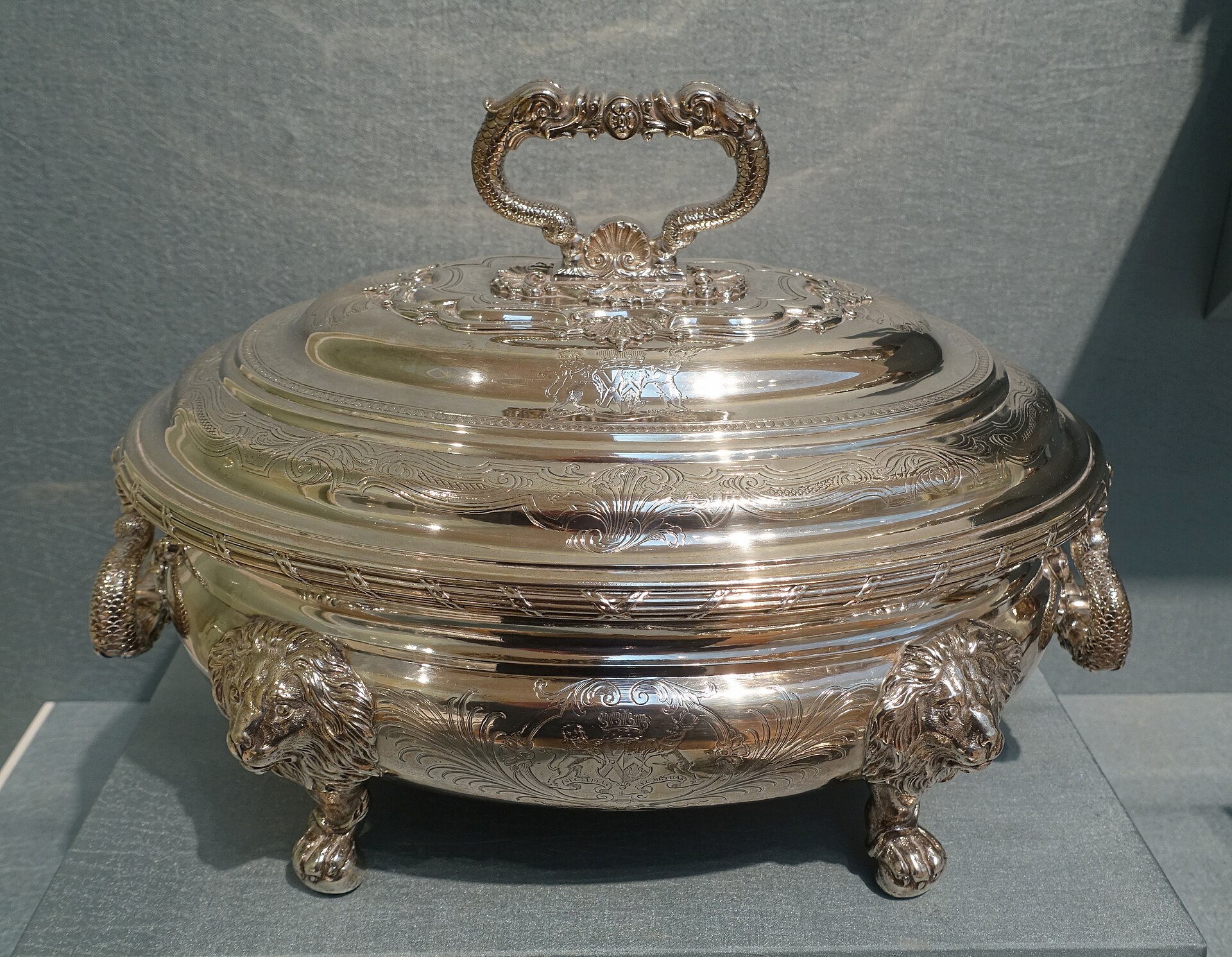
Two things about that system matter for research and are widely misunderstood. The first is what the sponsor's mark means. The London Assay Office states plainly that although this mark is sometimes informally called a maker's mark, its purpose has always been to establish responsibility rather than identify the manufacturer, and that it is applied on behalf of manufacturers, commissioners of goods or third parties and can be applied to items made by others. The Paul de Lamerie mark on the Hardwicke tureen therefore establishes that de Lamerie's workshop was answerable for submitting the piece to the assay office. It does not establish that de Lamerie raised it, chased it or engraved it, and in a busy Georgian workshop he very probably did not do all three.
The second is the date letter. It changes annually on 1 January, and the font, the case and the shape of the surrounding shield all change with it, so that each letter can indicate only one specific year. Every date punch is destroyed at the end of the year it stands for. There is no other mark discussed in this article whose evidence rests on a physical object having been deliberately eliminated, and that destruction is the reason a piece of London silver can be dated to a twelve-month period with an assurance no painting in this archive comes close to.
A guild stamp can outrank a museum's own reading of an object
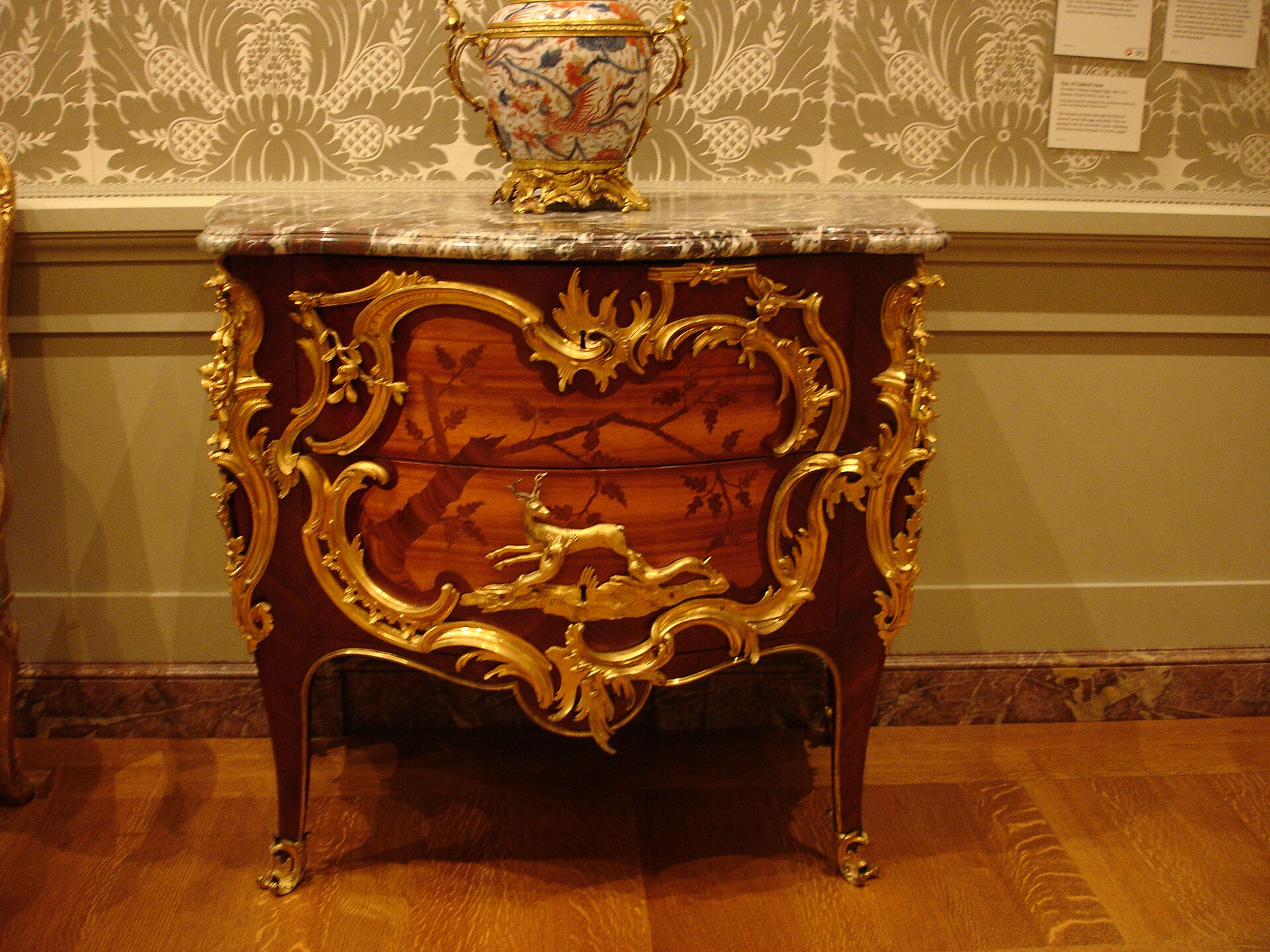
The pair of commodes at the Getty, accession 71.DA.96.1 and .2, is the clearest case in this archive of a mark overriding connoisseurship. The Getty's published catalogue records that the gilt-bronze mounts on these commodes are of designs quite unlike any others used by Van Risenburgh, that their attachment was ill considered, that the corner mounts obscure the profile of the corners and that the clumsiness of one hanging mount is not found elsewhere on this master's usually carefully conceived pieces.
Having said all that, the catalogue then states that if it were not for the presence of his stamp on these pieces and on the commodes in Dresden, they would not be attributed to Van Risenburgh on the basis of their design and quality. The museum is telling the reader that its own eye would reach a different conclusion and that the mark decides. That is an admirably honest position and it is also worth noticing what it implies: for stamped French furniture, the mark is not one input to the attribution, it is the attribution.
There is a further twist. The B.V.R.B. stamp was in use through the eighteenth century and required by the guild, and yet nobody knew whose initials they were until Jean-Pierre Baroli published the identification in 1957. For roughly two hundred years the market bought, sold and catalogued objects under a mark whose owner was unknown. The stamp was doing full attributional work long before anyone could say what it attributed them to.
A printed monogram is a property of the plate and identifies no sheet
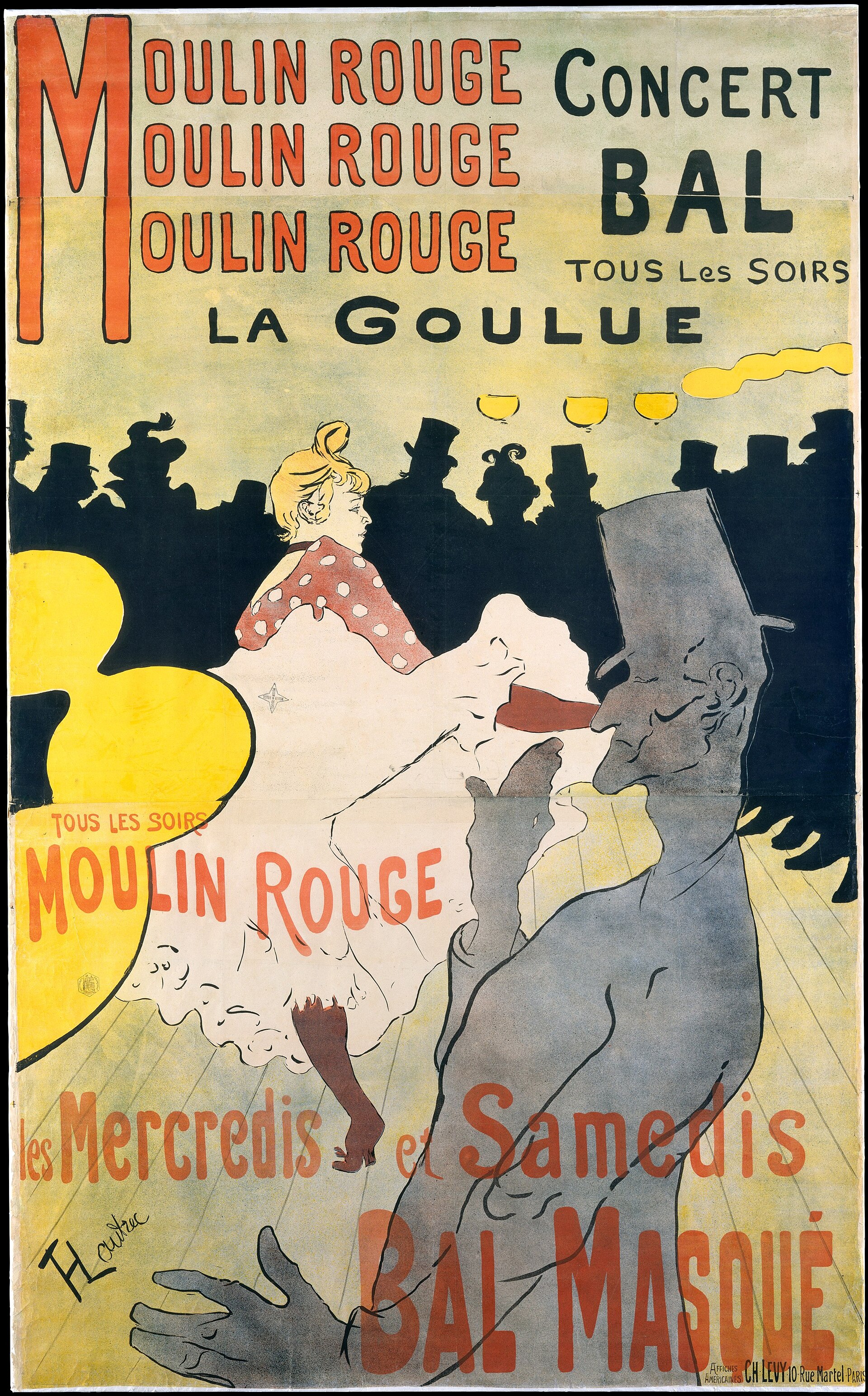
Toulouse-Lautrec's monogram on the 1891 poster Moulin Rouge: La Goulue is incorporated into the lithographic design itself, so it is printed along with the image on every impression that came off the stones. A commercial poster of this type carries no separate hand signature.
That has a consequence that is obvious once stated and constantly forgotten in practice. A mark that reproduces cannot distinguish between reproductions. The Metropolitan Museum's sheet, accession 32.88.12, and the Art Institute of Chicago's sheet, accession 1954.1193, are two separate physical objects of the same design and both carry the monogram identically. If you are trying to establish which impression passed through a particular collection, the monogram tells you nothing at all.
The same applies to Hokusai's signature on the Great Wave, which reads in translation from the brush of Iitsu, formerly Hokusai. It is cut into the block. It is on every impression, and it is genuinely informative, but about the date of the design rather than about any sheet: Hokusai changed art-name at intervals, so the form of the signature dates the block. Once again the mark is doing real work, and the work is not the work people assume.
One mark in this archive was designed to say not by him
Emile Galle died on 23 September 1904, and the firm that carried his name went on producing glass under that name until 1936. His widow settled on adding an asterisk or star beside the existing Galle signature to mark the new era, and that star is the standard indicator of posthumous production in the Galle market.
It is a strange object as evidence. It is a mark that reproduces the signature of a man who is dead and adds one character meaning he did not make this. It is applied by a company for commercial rather than scholarly reasons, and its dating turns out to be shaky: Samuel Provost, who has worked through the chronology of the firm's signatures in detail, shows that the usual 1904 to 1906 dating rests on the oral testimony of a former Galle employee, Rene Dezavelle, and that the testimony was mistaken.
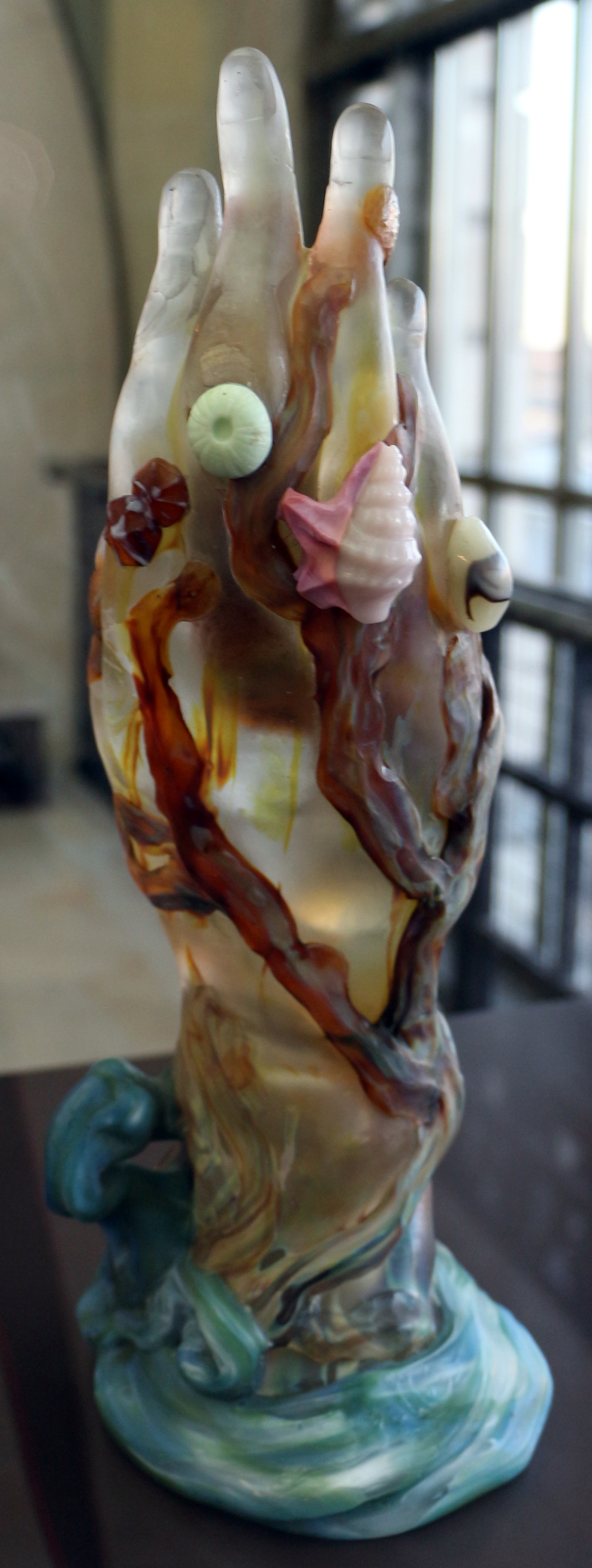
The hand at the Musee d'Orsay, given by the museum as 1904 and described by it as very probably the last work of crafted glass produced by the master from Nancy, is engraved in relief at the base with the name and no star. So the object's date rests partly on the absence of a mark: on a firm's convention, uncertainly dated, read negatively. This is the weakest link in the chain of marks in this archive, and it is doing work in the market every day.
The autograph signature is the one mark nobody regulated
Against the hallmark, the guild stamp and the printed monogram, all of which are applied by somebody other than the artist under some kind of obligation, the painter's signature stands alone. Nothing compels it, nothing records it, no register lists it, and anybody with a brush can add one at any point in an object's life. It is the mark the market pays most for and the only one with no institutional backing whatsoever.
The one thing that can be established about a painted signature is where it sits in the layer structure, and doing that properly is expensive. Girl with a Pearl Earring is probably the most examined painting in the world, and the Girl in the Spotlight project imaged its signature using macroscopic X-ray fluorescence, optical coherence tomography and 3D digital microscopy at 1.1 micrometres per pixel, which is 140 times magnification. The signature had degraded into the darkened background and was barely visible to the naked eye.
The published conclusion is worth quoting in shape rather than in full: the images appear to support the theory that the signature is on top of the glaze, individual white and black pigment particles appear to sit on the surface in one thin diagonal stroke of the M, and where cracks are present within that brushstroke the greenish glaze appears to lie beneath. That is careful, honest, expensive science, and it lands on appears. A date letter on a spoon, applied by a clerk with a punch that was then destroyed, lands on a year.

Five marks, and what each one actually fixes
Setting the cases side by side makes the inversion plain: reliability and informativeness run in opposite directions across this list. The marks that can be trusted absolutely say least about authorship, and the mark that speaks directly to authorship can be trusted least.
| Mark | Applied by | What it fixes | What it does not establish |
|---|---|---|---|
| British hallmark, date letter and assay office mark | An assay office, under statute | The year of assay and the fineness of the metal | Who made the object |
| Sponsor's mark, for example PL for Paul de Lamerie | The registered sponsor, at the assay office | Who was answerable for submitting the piece | Whose hands raised, chased or engraved it |
| Guild stamp, for example B.V.R.B. on French furniture | The workshop, with guild inspection required by law | The workshop responsible, and therefore the attribution in practice | Whether the object matches that workshop's quality, which the Getty says this pair does not |
| Printed or cut monogram, for example Toulouse-Lautrec or Hokusai | The artist, into the plate, stone or block | The design, and sometimes its date through the form of the name | Which impression you are holding |
| Firm signature with a star, Galle after 1904 | The company, after the named maker's death | That the piece is posthumous, on a disputed chronology | The year, the hand, or reliably even the decade |
| Autograph painted signature | The artist, or anybody else at any later date | Nothing, until its position in the paint layers is examined | Authorship, without stratigraphy, and even then in hedged terms |
A researcher can use this directly. When a catalogue says signed, find out which row it is in, and calibrate accordingly.
Why this archive is free to read
We do this for everyone who loves art. The people who have studied it for years, and the people who just stopped to look. Iconotheca exists so that what we learn belongs to all of them.
Nobody pays us for this. No ads, no sponsors, no commercial interest. These works belong to all of us, and we would rather share them with as many people as we can than keep them to ourselves.
If it gave you something today, tell us to keep going. Follow us, leave a like, or write a positive comment. We read every one, and they are what keeps us going.
Questions
No. The London Assay Office states that the mark commonly called a maker's mark is a sponsor's mark, whose purpose has always been to establish responsibility rather than identify the manufacturer, and that it can be applied to items made by others.
To a single year. The date letter changes on 1 January and its font, case and shield shape change with it so that each can indicate only one year, and all date punches are destroyed at the end of the year they stand for.
It identifies the workshop of Bernard II van Risenburgh, whose identity behind the initials was not published until Jean-Pierre Baroli's article of 1957. The Getty states that without the stamp, its own pair of commodes would not be attributed to him on the basis of their design and quality.
The firm added an asterisk or star after Emile Galle's death on 23 September 1904 to indicate posthumous production. The chronology of that practice is disputed, because the standard dating rests on the recollection of a former employee that Samuel Provost has shown to be mistaken.
By establishing where its paint sits relative to the layers beneath it. On Girl with a Pearl Earring this required macroscopic X-ray fluorescence, optical coherence tomography and 3D digital microscopy at 140 times magnification, and the published conclusion is still expressed as what the images appear to support.
Sources
- 1Goldsmiths' Company Assay Office, London, 'What is a hallmark'. Read 1 September 2026 for the composition of the full traditional UK hallmark, for the statement that the sponsor's mark exists to establish responsibility rather than identify the manufacturer and can be applied to items made by others, and for the date letter changing annually on 1 January with all date punches destroyed at the end of the year. assayofficelondon.co.uk/hallmarking/...
- 2Hallmarking Act 1973, section 1, on the prohibition of describing unhallmarked articles as precious metal in the course of trade. The statutory basis for the mark being applied by a third party under obligation rather than by the maker at will. legislation.gov.uk/ukpga/...
- 3J. Paul Getty Museum, French Rococo Ebenisterie in the J. Paul Getty Museum, catalogue entry 7, pair of commodes, accession 71.DA.96.1 and .2. Read 1 September 2026 for the B.V.R.B. stamp on the top of each front leg, for the commentary on the mounts, and for the statement that without the stamp the commodes would not be attributed to Van Risenburgh on the basis of their design and quality. Also the source for the citation of Jean-Pierre Baroli, 'Le mysterieux B.V.R.B. enfin identifie', Connaissance des Arts 61 (March 1957), pages 56 to 63. getty.edu/publications/...
- 4Metropolitan Museum of Art, collection record for Moulin Rouge: La Goulue, Henri de Toulouse-Lautrec, 1891, accession 32.88.12, Harris Brisbane Dick Fund, 1932. metmuseum.org/art/...
- 5Samuel Provost, 'The Galle signatures on glass after 1904: a tentative chronology, part I, 1904-1920', Newsletter on Art Nouveau Craftwork and Industry, 28 December 2020. Read 1 September 2026 for the adoption of the asterisk or star after Emile Galle's death on 23 September 1904, and for the demonstration that the 1904 to 1906 chronology resting on Rene Dezavelle's testimony is mistaken. galle.substack.com/p/...
- 6Musee d'Orsay, collection record for Emile Galle, La Main aux algues et aux coquillages, 1904, partly blown and hot-modelled crystal, 33.4 by 13.4 cm, given in 1990, on display on the median level, Salle 63. Read 1 September 2026, in a browser, after the page refused a direct fetch. musee-orsay.fr/en/...
- 7Abbie Vandivere and others, 'Fading into the background: the dark space surrounding Vermeer's Girl with a Pearl Earring', Heritage Science 7, article 69 (2019). Read 1 September 2026 for the imaging methods, for 3D digital microscopy at 1.1 micrometres per pixel and 140 times magnification, and for the hedged conclusion that the images appear to support the theory that the signature is on top of the glaze. nature.com/articles/...
- 8Mauritshuis, The Hague, collection entry for Johannes Vermeer, Girl with a Pearl Earring, inventory 670, with the technical examination summary from the Girl in the Spotlight project. mauritshuis.nl/en/...
More in Attribution and Authenticity
The partA Hallmark Can Be Genuine, Legal and About a Different Object
The V and A catalogues a Paul de Lamerie ewer of 1736 as a duty dodger, hallmarked 1944.
Composite Names Three Different Objects, and Only One of Them Is a Fake
Fifty-seven records here use composite, pastiche or assembled, and the words are doing three incompatible jobs.
The Frame Has Its Own Provenance
Ten records carry evidence on a frame. Van Eyck's integral frames date the panels to 1410-1440; a 1970 loan label on a frame in Maine proves nothing...