The Hardwicke Soup Tureen and Cover
Paul de Lamerie · 1737-38, the London assay year running from late May 1737 to late May 1738
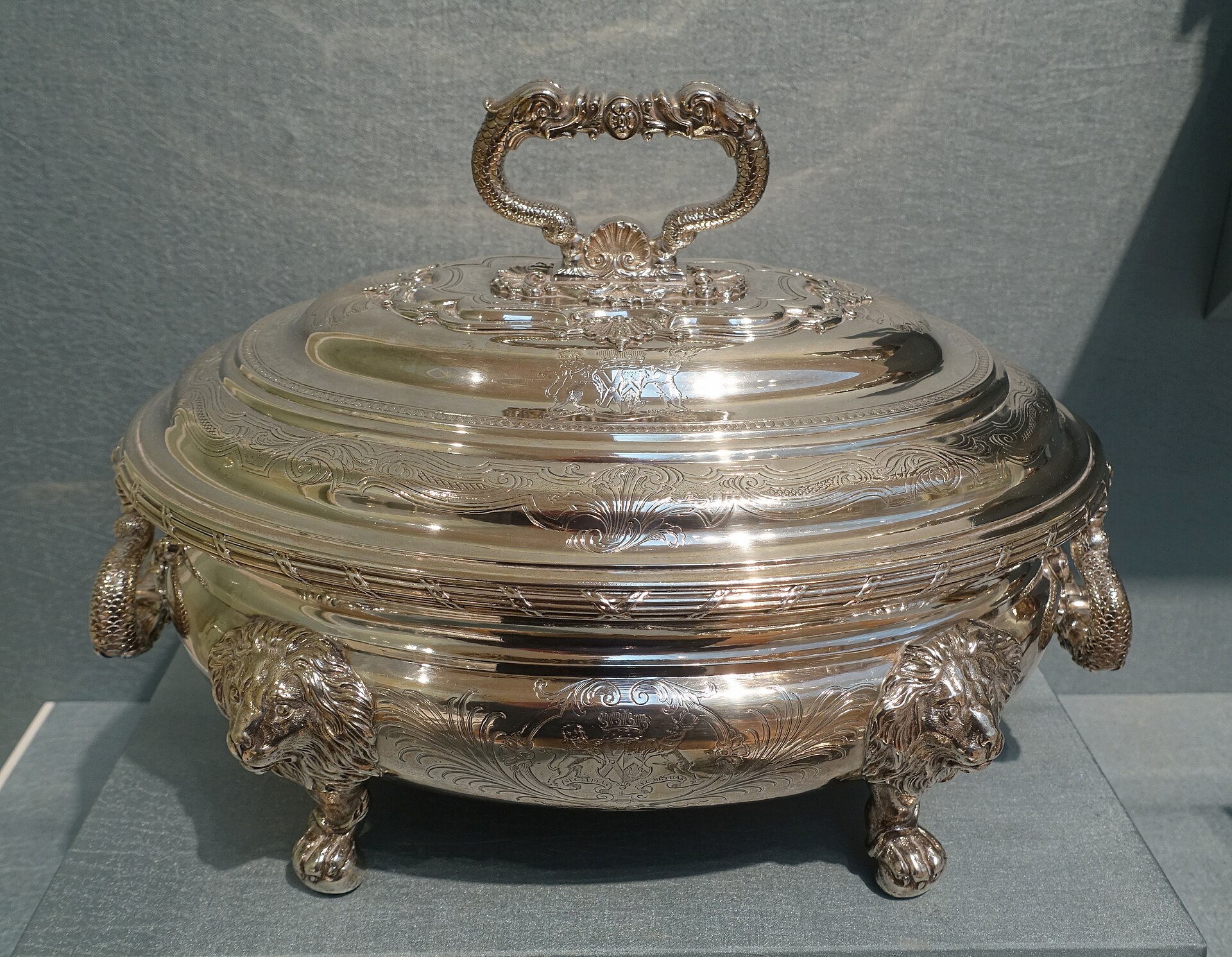
The record subject: a sterling silver soup tureen and cover hallmarked London 1737-38 with the sponsor's mark of Paul de Lamerie, accession 69.45a-c at the Portland Art Museum. Photographed on exhibit by Daderot in 2017 and released to the public domain.
| Artist | Paul de Lamerie |
|---|---|
| Date | 1737-38, the London assay year running from late May 1737 to late May 1738 |
| Medium | Sterling silver |
| Dimensions | 10 x 13 3/4 x 10 9/16 in. (25.4 x 34.9 x 26.8 cm). Weight not published in the sources consulted. |
| Where it is now | Portland Art Museum, Portland, Oregonlast confirmed |
| Inventory number | 69.45a-c |
| Attribution | AcceptedThe tureen carries London hallmarks for the assay year 1737-38 and the sterling-standard sponsor's mark PL that Paul de Lamerie registered at Goldsmiths' Hall on 27 March 1732. Full note |
| Object type | Silver |
| Period | English rococo, eighteenth century |
| Cases | Has a provenance gap |
| Inscriptions | Engraved with identical armorial devices below barons' coronets on the body and cover, per the Portland Art Museum's own catalogue description. The blazon itself has not been independently read for this record. |
| Owners on record | 5 links4 documented, 1 unknown |
| Sources | 10 cited |
About this record Last verified · 10 sources cited · Change log
On this page 11 sections
ContentsClose
A silver soup tureen and cover, hallmarked in London for the assay year 1737-38 with the sponsor's mark of Paul de Lamerie, the most famous and now one of the most forged names in English silver. It is engraved with matching armorial devices under barons' coronets, and the Portland Art Museum, which bought it in 1969, catalogues it as the Hardwicke Soup Tureen.
The name is not decorative. Twelve months earlier, in the assay year 1736-37, the same silversmith's shop supplied Philip Yorke, Baron Hardwicke, later Lord Chancellor and 1st Earl of Hardwicke, with a ewer that is now in the Victoria and Albert Museum catalogued in four words: London 1736, duty dodger. Its marks were cut from a smaller, already-taxed piece and soldered into the larger one to escape the silver duty, a fraud the museum only brought within the law by striking a fresh, legal hallmark on it in 1944. One patron, one workshop, two objects a year apart: one a documented fraud, the other apparently secure. This record sets out exactly what does and does not establish that difference, and where the evidence for this tureen runs out.
Paul de Lamerie's mark is, in 2024, the specific subject of a Goldsmiths' Company seminar on modern forgery, and a serious twentieth-century collector, Arthur Gilbert, is on record buying a de Lamerie that turned out to be fake. Against that backdrop, a piece with agreeing, unremarked marks and an unbroken institutional record since 1969 is not a small thing to be able to say.
Provenance
Each link is graded. Documented: a cited source supports it. Disputed: the identification is argued but not established. Unknown: no owner for that span, and the gap is not smoothed into a narrative. The grades in the glossary.
- 1737-38 -Associated by the holding museum's own title and cataloguing with Philip Yorke, Baron Hardwicke (created Earl of Hardwicke in 1754)documented
Hallmarked in the London assay year 1737-38 with the sterling-standard sponsor's mark of Paul de Lamerie. The Portland Art Museum catalogues the piece as the Hardwicke Soup Tureen and Cover and describes it as engraved with armorial devices below barons' coronets, consistent with Yorke's rank at the date of manufacture: he held the barony from 1733 and was not created Earl of Hardwicke until 1754. This record has not independently read the blazon and relies on the museum's own title and description for the identification.16
- - 1969Unknownunknown
No owner, dealer or sale is documented between the tureen's assay in 1737-38 and its appearance in the Portland Art Museum's collection around 1969. The gap is recorded rather than bridged.1
- 1969 - presentPortland Art Museum, Portland, Oregondocumented
Museum purchase, accession 69.45a-c, funded by the William H. Nunn Trust Fund, established in memory of Alice B. Nunn. No purchase price is published in the sources consulted.1
- 2017 - 2017Portland Art Museum, Portland, Oregondocumented
Photographed on 2 November 2017 by the Wikimedia Commons contributor Daderot while the piece was on exhibit, and released to the public domain. This photograph, verified from the file's own extmetadata (LicenseShortName 'Public domain', Copyrighted flag false), is the lead image of this record.2
- present - presentPortland Art Museum, Portland, Oregondocumented
The museum's own record states the tureen is not currently on view.1
Prices realised
No auction appearance is documented for this tureen in any source consulted for this record. It is known only through its 1969 museum purchase from the William H. Nunn Trust Fund, for which no price is published.
Technical evidence
| Attribution note | The tureen carries London hallmarks for the assay year 1737-38 and the sterling-standard sponsor's mark PL that Paul de Lamerie registered at Goldsmiths' Hall on 27 March 1732. The Portland Art Museum catalogues it without qualification as his work. As with every object bearing his punch, the mark is a legal record of who submitted the piece for assay and stood behind its silver standard, not a signature identifying whose hand raised, cast or chased it; nothing in the sources consulted for this record identifies the individual craftsman. |
|---|---|
| Object type | Soup tureen and cover, two accessioned elements plus a stand or associated part implied by the three-part accession number.1 |
| Hallmarks | London hallmarks for the assay year 1737-38, with the sterling-standard sponsor's mark of Paul de Lamerie (PL, registered 27 March 1732). The individual punches have not been read directly for this record; the assay year is as published by the Portland Art Museum. A duty of sixpence per troy ounce applied to new silver of this date, the same tax the Hardwicke ewer's marks were transposed to evade.178 |
| Standard | Sterling, not the higher Britannia standard. De Lamerie's shop had moved from Britannia to sterling silver in 1732, five years before this piece was assayed.7 |
| Material | Silver.1 |
| Dimensions | 10 x 13 3/4 x 10 9/16 in. (25.4 x 34.9 x 26.8 cm).1 |
| Weight | Not published in the sources consulted for this record.1 |
| Armorial | Identical armorial devices engraved below barons' coronets on both the body and the cover, per the museum's own catalogue description. The blazon has not been independently read for this record.1 |
| Accession number | 69.45a-c.1 |
| Acquisition | Museum purchase, the William H. Nunn Trust Fund, established in memory of Alice B. Nunn. No price published.1 |
| Display status | Not currently on view, per the museum's own record.1 |
Images
The record in full
Chapter 1What the tureen is
A soup tureen and cover in sterling silver, 25.4 by 34.9 by 26.8 centimetres, made to stand on an eighteenth-century dining table and hold a single hot dish, most likely the thick meat or game stew...
A soup tureen and cover in sterling silver, 25.4 by 34.9 by 26.8 centimetres, made to stand on an eighteenth-century dining table and hold a single hot dish, most likely the thick meat or game stew that English tables of this class served under French-influenced menus in the 1730s. Its own weight is not given in any source consulted for this record, an absence this record states rather than estimates.
It is catalogued as a pair of parts, a body and a cover, both carrying the same armorial device beneath a baron's coronet. A matching pair of coronets and arms on both elements of a tureen is the ordinary eighteenth-century practice for a piece that would be seen from above with the cover on as often as with it off, and it is also, incidentally, a built-in check: if the two elements ever separate, a mismatch between the arms on the body and the arms on the cover is one of the first things a cataloguer looks for when establishing that a lid truly belongs to its pot.
Chapter 2Baron Hardwicke, one patron, two silversmith's bills
Philip Yorke was born on 1 December 1690 and rose from a solicitor's office to the top of English law faster than almost anyone of his generation: Solicitor-General in 1720, Attorney-General in 1724...
Philip Yorke was born on 1 December 1690 and rose from a solicitor's office to the top of English law faster than almost anyone of his generation: Solicitor-General in 1720, Attorney-General in 1724, Lord Chief Justice of the King's Bench in 1733, the same year he was created Baron Hardwicke, and Lord High Chancellor of Great Britain from 1737 to 1756, the longest unbroken tenure of that office of the century. He was not created Earl of Hardwicke until 1754. That fact matters directly to this object, because it means that in 1737-38, when this tureen was assayed, and in 1736-37, when a related piece for the same man was assayed, Yorke held only the barony. Armorial devices under a baron's coronet on a piece of the mid-1730s are therefore consistent with his actual rank at the time, not an error and not an anachronism smuggled in later.
He had married Margaret Cocks in 1719; her mother was sister to the earlier Lord Chancellor Somers, a connection that did his career no harm. The Yorke arms impaling those of Cocks are the pairing recorded on the other Hardwicke object connected to Paul de Lamerie's workshop, described below. This record has not independently read the blazon on the Portland tureen and does not assert that its arms are that same impalement; it records what the museum's own catalogue description states, which is armorial devices under baron's coronets, and no more.
Chapter 3The other Hardwicke object is a proven fraud
A year before this tureen was assayed, in the London assay year 1736-37, Paul de Lamerie's shop supplied Philip Yorke, by then Baron Hardwicke, with a helmet-shaped ewer applied with his arms...
A year before this tureen was assayed, in the London assay year 1736-37, Paul de Lamerie's shop supplied Philip Yorke, by then Baron Hardwicke, with a helmet-shaped ewer applied with his arms impaling those of his wife Margaret Cocks. It survives, and it is in the Victoria and Albert Museum, museum number M.16-1954. The museum's own catalogue line for it, as recorded on its published gallery trail through the de Lamerie holdings, reads: London 1736, duty dodger, marked 1944.
A duty dodger is a specific and well-documented eighteenth-century fraud. Between 1720 and 1758 a tax of sixpence per troy ounce was charged on new silver brought to Goldsmiths' Hall for assay, and one standard evasion was to cut the punched marks out of a small object that had already paid the duty and solder that marked fragment into the base of a larger, unassayed piece, so that the larger piece appeared to have been tested and taxed when it had not. On the Hardwicke ewer, that is what happened: marks legitimately struck on a smaller, cheaper object were transposed onto the larger ewer to make it appear correctly assayed. The fraud remained illegal indefinitely under English law, which is why the Victoria and Albert Museum did not simply display the ewer as found. In 1944 it had the object brought within the law by striking a current, legal hallmark on it, a remedy the legislation still provides today. The catalogue line records both facts side by side, the original crime and its later correction, rather than hiding either.
The two objects were made in the same shop, under the same sponsor's punch, for the same patron, within about a year of each other. That proximity is what makes the pairing useful rather than anecdotal: it shows that a genuine PL punch on an object commissioned by a real, named, historically documented patron is not by itself proof that the object is what it claims to be. The mark tells a buyer who took legal responsibility for the assay. It does not, on its own, tell a buyer that an assay actually happened correctly on that object.
Chapter 4What secures this tureen, and what this record has not verified
A London hallmark of this date is built from four punches, and each does a distinct legal job: a lion passant certifying the sterling standard of the alloy; a leopard's head crowned certifying that...
A London hallmark of this date is built from four punches, and each does a distinct legal job: a lion passant certifying the sterling standard of the alloy; a leopard's head crowned certifying that the piece was assayed at Goldsmiths' Hall in London; a date letter recording the assay year; and a sponsor's mark identifying who submitted the piece and answered for it. On a piece attributed to Paul de Lamerie after 1732, that fourth punch should read PL, the sterling-standard mark he registered on 27 March 1732, distinct from the earlier two-letter LA mark he used on Britannia-standard silver before that date. Nothing in the Portland Art Museum's public description of this tureen, so far as this record was able to establish it, flags any disagreement among its punches, any transposition, any let-in patch, or any correction comparable to the 1944 hallmark on the Hardwicke ewer.
That is a meaningful absence, not proof of innocence. The Goldsmiths' Company's own guidance on detecting a transposed or forged mark asks whether the punches sit where this particular form of object was normally marked, whether there is excess solder around them suggesting a soldered-in patch, and whether the impression shows correctly on the metal's reverse; none of that physical examination has been carried out for this record, which has worked from the museum's public catalogue description and a single photograph and not from the object itself. This record has also not independently confirmed the exact blazon of the arms against a peerage or heraldic reference, has not seen the tureen's weight published anywhere, and has not located any conservation, technical-imaging or Goldsmiths' Company examination record for it. Those are the honest limits of what can be said here, and they are recorded as limits rather than smoothed into a stronger claim than the evidence supports.
Chapter 5Lamerie's mark under pressure, then and now
The duty dodger was a tax fraud, not an attempt to fool a buyer about who made an object, and de Lamerie's own shop was not innocent of the practice: the Hardwicke ewer is only one documented case...
The duty dodger was a tax fraud, not an attempt to fool a buyer about who made an object, and de Lamerie's own shop was not innocent of the practice: the Hardwicke ewer is only one documented case among several the Goldsmiths' Company minutes and later cataloguing have connected to his workshop. The market problem this record is built around is a different and larger one: the deliberate forging of his mark itself, to sell a later or lesser piece of silver as his work.
That problem is current, not historical. On 12 April 2024 the Goldsmiths' Company held a seminar at Goldsmiths' Hall titled Marks of Deception: Tackling Fakes and Forgeries in Antique British Silver, and its own published announcement states plainly that there has been a recent increase in attempts to forge the maker's mark of Paul de Lamerie. Peter Cameron, a member of the Goldsmiths' Hallmark Authentication Committee, spoke specifically on the fake marks of Paul de Lamerie; Timothy Schroder, Alastair Dickenson, Will Evans and Eleni Bide also spoke. The Company's own published account of the day names the increase in forgeries but does not publish a count of pieces detected, and no such count appears to be public anywhere consulted for this record.
The body that rules on such cases, the Goldsmiths' Hallmark Authentication Committee, formerly the Antique Plate Committee, has operated since 1939. It is worth being exact about what it does: it advises whether an article's marks comply with current hallmarking law, based on the object's hallmark, the panel's own expertise and scientific testing where needed, and if it finds marks forged, counterfeit or transposed, they are cancelled. It does not certify that a given hand made a given object. A clearance from that committee means the marks are lawful. It is not, and does not claim to be, a certificate of authorship.
The financial stakes of getting this wrong are not abstract. The Los Angeles County Museum of Art's own published history of the Gilbert Collection records that the collector Arthur Gilbert, who began buying silver by de Lamerie and by Paul Storr in the mid-1960s, was, in the museum's own words, quick to realize the potential for errors in judgment after a purported de Lamerie acquisition turned out to be a fake, and that the experience was what drove him to study the field seriously rather than trust dealers alone. A wealthy, motivated, increasingly expert collector bought a fake Lamerie. That is on the institutional record of one of the collections that now anchors the Victoria and Albert Museum's own silver galleries, and it is the clearest single demonstration available that the name on this tureen's mark is worth forging.
Chapter 6From a Georgian dining table to a purchase fund in Oregon
Between the tureen's assay in 1737-38 and its appearance in the Portland Art Museum's collection, nothing is documented in the sources consulted for this record.
Between the tureen's assay in 1737-38 and its appearance in the Portland Art Museum's collection, nothing is documented in the sources consulted for this record. The museum's own published catalogue record does not name an owner, a dealer, or a sale between the eighteenth century and its acquisition. The tureen was bought by the museum with funds from the William H. Nunn Trust, a fund established in memory of Alice B. Nunn, and given the accession number 69.45a-c, placing the purchase in or around 1969. No purchase price is published in the sources consulted. The object is not currently on view.
That is a real and stated gap of roughly two hundred and thirty years, and this record does not attempt to bridge it with a plausible-sounding guess. A reader who wants the chain of ownership between a Georgian baron's table and a Pacific Northwest museum's storage will not find it here, because it has not been found anywhere this record consulted.
Chapter 7Reading a Lamerie object honestly
Put together, the case for this tureen is this: a form and material consistent with the mid-1730s output of a documented London workshop; a sponsor's mark consistent with the punch that shop...
Put together, the case for this tureen is this: a form and material consistent with the mid-1730s output of a documented London workshop; a sponsor's mark consistent with the punch that shop registered in 1732; a rank of coronet consistent with its presumed patron's actual title at the date of manufacture; and an institutional custody record, however incomplete before 1969, with no flag of correction, re-marking or dispute attached to it anywhere this record has found. None of that is a laboratory certificate. It is the ordinary, honest standard of evidence that most silver of this class ever receives, set deliberately against an object from the same workshop and the same patron's household that failed a stricter test and had to be legally repaired in the twentieth century, and against a documented case of a real collector buying a real fake bearing this exact name.
A record that called this tureen definitively genuine on that basis would be overclaiming. A record that treated it as suspect because the maker's mark is now a known target for forgers would be punishing an object for a crime committed against its own reputation by other hands, on other pieces, mostly much later. This record does neither. It states what agrees, states what has not been checked, and leaves the rest open.
The artist
Paul Jacques Souchay de la Merie, who signed himself Paul de Lamerie
Paul de Lamerie is the name English silver of this class is sold on, and he is also, increasingly, the name English silver of this class is faked under. The Iconotheca house page on him, read in full before this record was written, sets out the full documentary life; this dossier draws the facts most relevant to a single object made in his shop for a single documented patron across two consecutive assay years.
Literature
- Susan Hare (ed.), 'Paul de Lamerie: At the Sign of the Golden Ball. An Exhibition of the Work of England's Master Silversmith (1688-1751)', Goldsmiths' Company, London, 1990. The standard modern reference on the maker and the source of the mark numbering the trade uses. NOT CONSULTED DIRECTLY for this record; cited via the Iconotheca maker page, which consulted it directly.
- Ellenor Alcorn, 'Beyond the Maker's Mark: Paul de Lamerie Silver in the Cahn Collection', with a foreword by Tessa Murdoch, John Adamson, Cambridge, 2006. The standard treatment of the sponsor's-mark-versus-authorship question for this maker. NOT CONSULTED DIRECTLY for this record; cited via the Iconotheca maker page, which consulted it directly.
Related works
| Work | Relation | Where it is |
|---|---|---|
| Ewer, Paul de Lamerie Mark of Paul de Lamerie | The same patron's silver, one year earlier, later proven to carry transposed marks cut from a smaller assayed object; a documented duty-evasion fraud brought within the law only in 1944 London 1736. Made for Philip Yorke, Baron Hardwicke, with his arms impaling those of his wife Margaret Cocks. The museum's own catalogue line: 'London 1736, duty dodger, marked 1944.' The central comparandum for this record. | Victoria and Albert Museum, London, museum number M.16-1954 |
| Tureen Paul de Lamerie | The same maker, the same object type, one assay year earlier, for a different patron London, assay year 1736-37. From the Jules Bache Collection, 1949. Confirmed public domain by the Metropolitan Museum's own Open Access programme. Shown here for the form and scale of the genre, not as evidence about this record's tureen. | Metropolitan Museum of Art, New York, accession 49.7.99a-d |
| Seal salver Paul de Lamerie, engraving attributed to a subcontracted hand | The same workshop, a decade earlier, and a different kind of attribution problem: whose hand cut the ornament, not whether the marks are genuine 1727-28, made from the melted Second Exchequer Seal of George I for Sir Robert Walpole. The engraving is attributed on style to William Hogarth or his master Ellis Gamble's workshop, not on a signature. | Victoria and Albert Museum, London, museum number M.9-1956 |
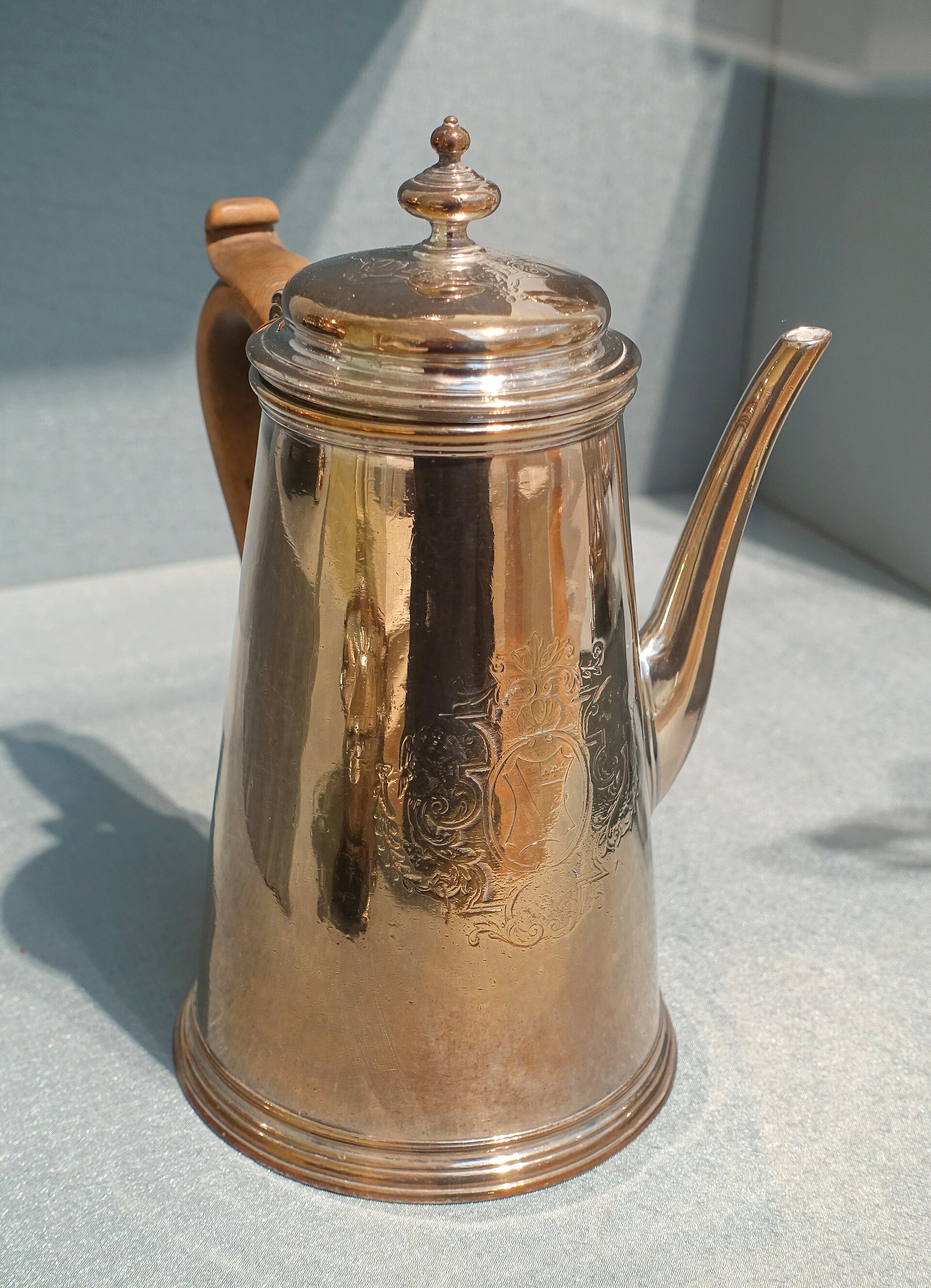
| Coffee pot Paul de Lamerie | The same maker, the same institution, a different commission London, 1730-31. Photographed for Wikimedia Commons by the same contributor as the lead plate of this record, confirming that the Portland Art Museum holds more than one documented Lamerie piece. | Portland Art Museum, Portland, Oregon |
Open questions
- Who commissioned the tureen, and was it new plate ordered by Baron Hardwicke himself, a gift, or a later re-engraving of an older piece for him? The Portland Art Museum's public record, as consulted, does not say.
- Does the engraved blazon actually match Yorke impaling Cocks, the pairing recorded on the Hardwicke duty-dodger ewer? This record has not independently read the arms and states only what the museum's own catalogue description gives, which is 'armorial devices below barons' coronets.'
- What does the tureen weigh? No weight is published in any source consulted for this record, though weight is the single most direct fraud check on a piece of this class and period.
- Where was the tureen between its assay in 1737-38 and the Portland Art Museum's purchase around 1969? No owner, dealer or sale is documented in the sources consulted.
- What did the museum pay in 1969, and how was the William H. Nunn Trust Fund constituted? The credit line names the fund and gives no figure.
- Has the tureen ever been examined by the Goldsmiths' Hallmark Authentication Committee or its predecessor the Antique Plate Committee, given the documented recent increase in attempts to forge Paul de Lamerie's mark? No such examination is recorded in the sources consulted.
- Is the tureen a single commission or part of a larger dinner or dessert service, in the way the Newdigate centrepiece and other de Lamerie table silver of this period often were? Nothing in the sources consulted establishes either answer.
Questions about this object
What is The Hardwicke Soup Tureen and Cover?
The Hardwicke Soup Tureen and Cover is a silver, dated 1737-38, the London assay year running from late May 1737 to late May 1738. Medium: Sterling silver.
Who made The Hardwicke Soup Tureen and Cover, and is the attribution settled?
The attribution to Paul de Lamerie is recorded here as accepted. The tureen carries London hallmarks for the assay year 1737-38 and the sterling-standard sponsor's mark PL that Paul de Lamerie registered at Goldsmiths' Hall on 27 March 1732. The Portland Art Museum catalogues it without qualification as his work. As with every object bearing his punch, the mark is a legal record of who submitted the piece for assay and stood behind its silver standard, not a signature identifying whose hand raised, cast or chased it; nothing in the sources consulted for this record identifies the individual craftsman.
Where is The Hardwicke Soup Tureen and Cover now?
Portland Art Museum, Portland, Oregon. Inventory number 69.45a-c. Last confirmed 12 August 2026. Museum purchase, the William H. Nunn Trust Fund, established in memory of his wife Alice B. Nunn. Not currently on view.
What is still unknown about The Hardwicke Soup Tureen and Cover?
Who commissioned the tureen, and was it new plate ordered by Baron Hardwicke himself, a gift, or a later re-engraving of an older piece for him? The Portland Art Museum's public record, as consulted, does not say.
Sources
- 1Portland Art Museum, online collection record for The Hardwicke Soup Tureen and Cover, maker's mark of Paul de Lamerie, London, 1737-38, sterling silver, accession 69.45a-c, museum purchase from the William H. Nunn Trust Fund established in memory of Alice B. Nunn. Source for the title, hallmark date, dimensions, the armorial devices below barons' coronets, and the note that the work is not currently on view. The museum's own legacy database was intermittently unreachable during research (connection refused); the details used here are corroborated across independent search-index citations of the same page and align with the same record's use as source 17 in the Iconotheca maker page for Paul de Lamerie. portlandartmuseum.us/mwebcgi/...
- 2Source for the confirmed public-domain licence (LicenseShortName 'Public domain', Copyrighted flag false) used as this record's lead image, verified directly by API query for this record. commons.wikimedia.org/wiki/...
- 3Victoria and Albert Museum, 'A Trail of Paul de Lamerie Silver in the V&A', gallery trail. Source for the Hardwicke duty-dodger ewer, museum number M.16-1954, the arms of Hardwicke impaling Cocks, the London 1736 hallmark, and the museum's own catalogue line 'duty dodger, marked 1944'. yumpu.com/en/...
- 4The Goldsmiths' Company, 'Marks of deception: tackling fakes and forgeries in antique British silver', announcement for the seminar held at Goldsmiths' Hall, London, 12 April 2024. Source for the reported recent increase in attempts to forge Paul de Lamerie's maker's mark, Peter Cameron's paper on the subject, the other named speakers, and the history and role of the Goldsmiths' Hallmark Authentication Committee. thegoldsmiths.co.uk/company-news/...
- 5Los Angeles County Museum of Art, 'History of the Gilbert Collection'. Source for the direct quotation that a purported de Lamerie acquisition by the collector Arthur Gilbert turned out to be a fake, and for the collection's later gift and loan to Britain in 1996 and display at the Victoria and Albert Museum from 2009. Fetched and quoted directly for this record. lacma.org/history-gilbert-collection
- 6Wikipedia, 'Philip Yorke, 1st Earl of Hardwicke'. Source for his birth on 1 December 1690, his legal and political career, his creation as Baron Hardwicke in 1733 and as Earl of Hardwicke only in 1754, and his marriage to Margaret Cocks in 1719. en.wikipedia.org/wiki/...
- 7Iconotheca, maker page for Paul de Lamerie. The house page on the maker, read in full before this record was written, and the source for the biography, the mark registrations of 1713 and 1732, the 1714 to 1726 fines and charges, the 1737 committee episode over the Company's right of search, and the Hardwicke ewer as the explanation Hare gives for de Lamerie's resistance to that clause. iconotheca.com/artists/...
- 8The Goldsmiths' Company Assay Office, 'Antique Silver and the Law: A Guide for the Antiques Trade'. Source, via the Iconotheca maker page which consulted it directly, for the duty of sixpence per ounce charged between 1720 and 1758, the mechanism of a duty-dodger transposition, and the detection criteria used by the Goldsmiths' Hallmark Authentication Committee. NOT CONSULTED DIRECTLY for this record. assayofficelondon.co.uk/media/...
- 9Metropolitan Museum of Art, public Collection API, object record 200583, Tureen, Paul de Lamerie, London, assay year 1736-37, accession 49.7.99a-d, the Jules Bache Collection, 1949, confirmed public domain. Source for the related_works comparandum. Fetched directly for this record. collectionapi.metmuseum.org/public/...
- 10Wikipedia, 'Paul de Lamerie'. Used only for general corroboration of dates already established by source 7. en.wikipedia.org/wiki/...

Last verified · Published
Change log
12 August 2026 - Record created at the house standard: researched narrative, technical evidence, maker dossier, graded provenance chain, prices with hammer and premium separated, related works, open questions and sources.