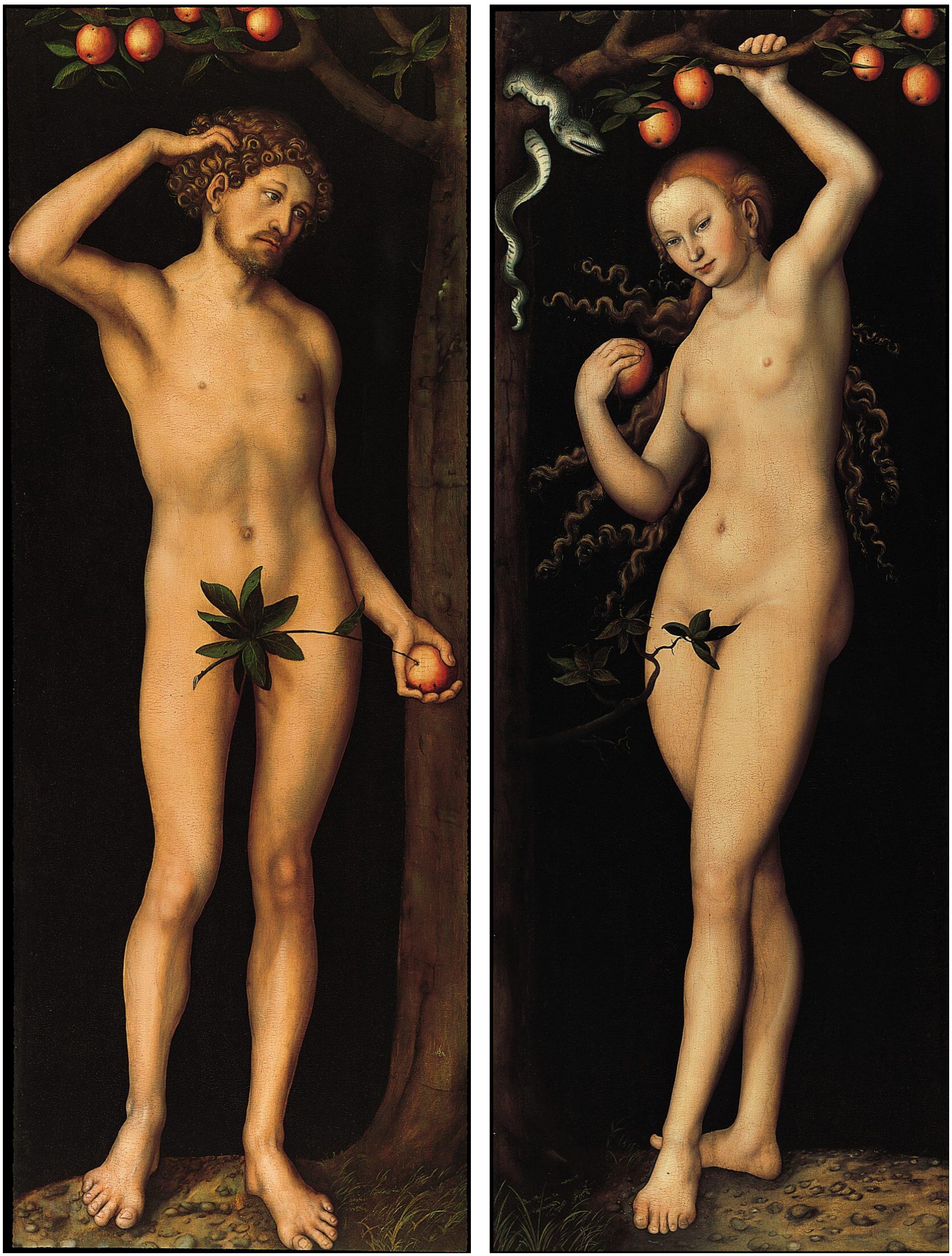
Adam and Eve
c. 1530 · Oil on panel
Norton Simon Museum, Pasadena, California.
 German · 1472-1553
| Full name | Lucas Cranach the Elder (born Lucas Maler |
|---|---|
| Worked as | Painter, Printmaker, Publisher |
| Born | 1472 (exact day not established in the sources consulted) · Kronach, Upper Franconia, Holy Roman Empire (now Bavaria... |
| Died | 1553-10-16 · Weimar, Saxony |
| Nationality | German |
| Movement | Northern Renaissance |
| In this archive | 1 artwork |
| Sources | 24 cited |
| Last verified | 9 September 2026 |
About this page 1 artwork in the archive · Last verified 9 September 2026 · 24 sources cited
Lucas Cranach the Elder was court painter to three Electors of Saxony at Wittenberg for nearly half a century, and painting was only one line of a diversified business that also included a licensed apothecary, a printing press and a bookshop. He served Wittenberg as a town councilman from 1519 and was elected its mayor three times. He was also the exact contemporary and close personal friend of Martin Luther: godfather to one of Luther's children, marriage broker and witness at Luther's wedding, and the source of most of the images by which the Reformation was seen, including the portraits of Luther himself that still define his face.
The thing most readers do not know is how industrial the workshop became. By the early 1540s payroll records show both of Cranach's sons, several qualified journeymen, up to six further assistants, three apprentices, and separate craftsmen who prepared the grounds and gilding, all producing pictures under a single mark. That mark, a crowned winged serpent granted to Cranach as a coat of arms in 1508, was not a personal signature in the modern sense: workshop practice restricted it to work judged good enough to carry it, whoever's hand actually held the brush. Every claim of certainty about which 'Cranach' a given picture is rests on that fact, and the research project now trying to sort it out, the Cranach Digital Archive, is still open.
He was also serially imitated, in his own century by his own workshop and in this one by forgers good enough to sell a fake Cranach to a reigning prince for seven million euros. Both problems, the workshop hand and the modern fake, turn on the same question: what does it actually take for a picture to be Cranach's.
Born in Kronach, Upper Franconia; the exact day is not established. He later took the town's name as his own.6
Resident in Vienna before his move to Saxony.6
Appointed court painter to Frederick the Wise, Elector of Saxony, at Wittenberg, a position he held under three successive Electors for most of the rest of his life.6
Granted a coat of arms by Frederick the Wise, a crowned winged serpent, which he adopts as his workshop insignia from this year. Travels to the Netherlands the same year at the Elector's request.6
Engraves the double portrait Frederick the Wise and John the Constant of Saxony.10
Marries Barbara Brengbier, daughter of the mayor of Gotha.6
Sons Hans and Lucas the Younger are born; both are later trained in the family workshop.6
Becomes a Wittenberg city councilman for the first time and acquires a printing press.6
Acquires the town's apothecary privilege. Martin Luther becomes godfather to Cranach's daughter Anna. Cranach paints his first portraits of Luther.65
Begins working directly with Luther, illustrating Luther's translation of the New Testament.5
The illustrated New Testament is printed on Cranach's own press.5
Acquires a publisher's privilege.5
Acts as Luther's proxy suitor to Katharina von Bora and, with his wife Barbara, witnesses their wedding.6
Paints the portrait of Martin Luther now at the Kunstsammlungen der Veste Coburg.21
Produces the earliest versions of Law and Gospel (Law and Grace), including the panel now in the National Gallery in Prague, generally held to draw on Luther's own theological input.78
Paints Judith with the Head of Holofernes, now at the Metropolitan Museum, and the Adam and Eve pair now at the Norton Simon Museum.9
Paints the Venus now in the Stadel Museum, Frankfurt.18
The complete German Bible is published carrying 123 of Cranach's illustrations.5
Lucas Cranach the Younger is first documented as a member of the workshop.5
Son Hans Cranach dies suddenly while travelling in Bologna. Cranach is elected mayor of Wittenberg for the first time (1537-1538).56
Wife Barbara dies. Cranach serves a second term as mayor (1540-1541).6
Workshop payroll records document both sons, several journeymen, up to six further assistants, three apprentices and separate ground and gilding preparators working together.5
Paints, with the workshop, the double portrait of Luther and Philipp Melanchthon now in the Uffizi. Serves a third term as mayor (1543-1544).206
Lucas Cranach the Younger formally succeeds his father as director of the Wittenberg workshop.5
Appeals to Emperor Charles V for mercy on behalf of the imprisoned Elector John Frederick I, whose portrait Cranach had painted in the 1530s.613
Follows the pardoned Elector John Frederick I into exile at Weimar.6
Dies at Weimar, aged about 81.6
The Cranach Digital Archive, funded by the Andrew W. Mellon Foundation, catalogues and technically examines the workshop's output across nine founding partner museums.1
The Prince of Liechtenstein buys the panel later known as Venus with a Veil, attributed to Cranach, for EUR 7 million.16
Sotheby's London sells La Bocca della Verita for a hammer price of GBP 8.2 million, then a new auction record for the artist.1011
French investigators seize Venus with a Veil from a Liechtenstein Collection exhibition as part of the Ruffini old masters forgery investigation.16
Christie's New York sells the restituted Portrait of John Frederick I, looted from Fritz Gutmann in 1940, for USD 7.7 million with premium.13
The Paris Court of Appeal orders Venus with a Veil returned to the Prince of Liechtenstein.16
The Norton Simon Museum's Adam and Eve panels undergo comprehensive conservation treatment at the Getty Center, Los Angeles.3
Christie's London sells Nymph of the Spring for GBP 9.4 million, reported as a new auction record for the artist. The exact calendar date was not confirmed in the sources consulted.14
Documented Cranach the Elder paintings with a secure exhibition history reach seven and low eight figures at auction, in the currency of the sale house. Three results across three different decades: Sotheby's London hammered La Bocca della Verita at GBP 8.2 million in 2015 (GBP 9.3 million with premium, then a record for the artist); Christie's New York sold the restituted Portrait of John Frederick I for a USD 6.6 million hammer and USD 7.7 million with premium in 2018, seven times its pre-sale estimate; and Christie's London took GBP 9.4 million for Nymph of the Spring in 2022, reported as a new record, though the sources consulted for this page do not specify whether that later figure is hammer or hammer-plus-premium. A panel good enough, and disputed enough, to be seized as evidence still commanded EUR 7 million as a private-treaty purchase in 2013, before any forgery investigation had begun, a reminder that scarcity and desirability can outrun due diligence.
| Date | Sale | Work | Result | Note |
|---|---|---|---|---|
| 8 July 2015 | Sotheby's, London | La Bocca della Verita (The Mouth of Truth) | Hammer GBP 8,200,000 With premium GBP 9,300,000 (also reported as approx. USD 14.4 million and approx. EUR 12.1 million on the day's conversion) GBP | Estimate GBP 6-8 million. From the collection of Countess Hardenberg, Schloss Neuhardenberg; never previously on the market. A new auction record for the artist at the time. |
| 19 April 2018 | Christie's, New York | Portrait of John Frederick I, Elector of Saxony | Hammer USD 6,600,000 With premium USD 7,700,000 USD | Estimate USD 1-2 million. Restituted to the heirs of Fritz and Louise Gutmann shortly before the sale; looted from the Gutmann collection in the Netherlands in 1940. |
| July 2022 (exact calendar date not confirmed in the sources consulted) | Christie's, London | Nymph of the Spring | Hammer Not separately reported in the sources consulted With premium GBP 9,400,000 (breakdown between hammer and premium not specified in the source) GBP | One of at least twelve known variations by Cranach on this composition. Formerly owned by Queen Christina of Sweden in the seventeenth century; never previously offered at auction. Reported by the Art Newspaper as a new auction record for the artist. |
Hammer is the price at which the bidding stopped; with premium adds the fee the house charges the buyer on top. Hammer price and buyer's premium in the glossary.
| Institution | City | Holdings | Note |
|---|---|---|---|
| Norton Simon Museum | Pasadena, California | The Adam and Eve pair, c. 1530 (accession M.1971.1.P and M.1991.1.P) | Subject of a separate record on this site, including the Goudstikker-era ownership dispute; underwent conservation at the Getty Center, 2021-2023. |
| Metropolitan Museum of Art | New York | Judith with the Head of Holofernes, c. 1530 (11.15) | Rogers Fund, 1911. |
| Stadel Museum | Frankfurt am Main | Venus, 1532 | |
| National Gallery Prague | Prague | Law and Gospel (Law and Grace), 1529 | One of the two earliest versions of the composition, alongside the Gotha panel. |
| Kunstsammlungen der Veste Coburg | Coburg | Portrait of Martin Luther, 1528 | |
| Galleria degli Uffizi | Florence | Portraits of Martin Luther and Philipp Melanchthon, 1543 | Catalogued as by Cranach the Elder and workshop. |
| National Gallery of Art | Washington, DC | Frederick the Wise and John the Constant of Saxony, 1509 (engraving, 1943.3.2885) | Rosenwald Collection. |
| Schloss Stolzenfels (Generaldirektion Kulturelles Erbe Rheinland-Pfalz) | Koblenz | Self-portrait, 1531 | Insignia and date recovered by X-ray from beneath later overpaint. |
| Liechtenstein: The Princely Collections | Vaduz / Vienna | Venus with a Veil, dated 1531 on the panel | Attribution to Cranach is disputed; see forgeries below. Ordered returned to the Prince by the Paris Court of Appeal in 2021 after seizure as evidence in a forgery investigation. |
Cranach arrived in Wittenberg around 1505 as court painter to the Elector Frederick the Wise, but the painting workshop was never his only business.
Cranach arrived in Wittenberg around 1505 as court painter to the Elector Frederick the Wise, but the painting workshop was never his only business. He became a Wittenberg town councilman for the first time in 1519 and acquired a printing press the same year. In 1520 he bought the town's apothecary privilege, and after 1523 he ran a bookshop as well. He held the mayoralty three times, in 1537 to 1538, 1540 to 1541 and 1543 to 1544. By the time of his death he was one of the richest men in the town he had helped to build.
This matters for reading the pictures, not just the biography. A workshop this commercially organised was built to produce volume, and the apothecary privilege, the printing press and the bookshop are evidence of the same organisational instinct that later let the painting workshop turn out dozens of near-identical Judiths and Venuses and, above all, portraits of Luther. The painting business was one arm of an enterprise, not a solitary artist's practice that happened to be busy.
In 1508 Frederick the Wise granted Cranach a coat of arms: a crowned serpent with upright bat wings holding a ring in its mouth.
In 1508 Frederick the Wise granted Cranach a coat of arms: a crowned serpent with upright bat wings holding a ring in its mouth. Cranach adopted the device as his workshop insignia from that year on, and it appears, painted small, on paintings across the rest of his working life and his sons' after him.
The serpent is not a signature in the sense a modern collector would expect. Technical research into the workshop's practice has established that only the most skilled painters in the shop were permitted to add the serpent to a finished picture, as a mark that the work met the shop's standard, not as a record of whose hand had painted it. A picture carrying the serpent is therefore a claim about quality control inside a large operation, not a claim that Lucas Cranach the Elder personally painted it. This is the single fact that makes attribution within the corpus as hard as it is, and it is documented, not a modern inference: the shop's own record-keeping shows the mark being awarded rather than simply applied.
Cranach's own 1531 self-portrait at Schloss Stolzenfels carries the serpent and the date 1531 at centre left, both later painted over and only recovered by X-ray and technical examination, which also ruled out the two standing doubts about the panel: that it had been cut down from a larger composition, and that it was a seventeenth-century copy. A different portrait, dated 1550 and inscribed as a self-portrait of Cranach at 77, hangs in the Uffizi; it has since been reattributed on stylistic grounds to his son, Lucas Cranach the Younger. Even a picture that calls itself a Cranach self-portrait, in an inscription, is not automatically one.
The scale is documented, not estimated. Workshop records from 1542, a period of high output, list both of Cranach's sons, several qualified journeymen, as many as six further workshop assistants and...
The scale is documented, not estimated. Workshop records from 1542, a period of high output, list both of Cranach's sons, several qualified journeymen, as many as six further workshop assistants and three apprentices, plus carpenters, woodcarvers and the specialist preparators (zubereiter) who applied ground and gilding before a painter ever touched a panel. Apprentices trained by copying and varying existing compositions before being judged ready to work more freely, and the workshop developed standardised procedures, including transferred and reused figure patterns, that let this scale of staff turn out pictures that read as uniformly 'Cranach'.
His two sons were central to it. Hans Cranach is first documented working in the shop and died suddenly while travelling in Italy, at Bologna, in 1537, a loss his father is recorded as having taken hard. Lucas Cranach the Younger is first mentioned as a member of the workshop in 1535, took on more responsibility after his brother's death, and formally succeeded his father as director of the Wittenberg workshop in 1544, nine years before the elder Cranach's own death. Because both sons trained in the family workshop from childhood and were, in the words of one biographer of the family, eager to emulate their father, scholars still struggle case by case to separate the hands, and many paintings are catalogued only as 'workshop of' one Cranach or the other for exactly this reason.
The standard catalogue raisonne, Max Friedlander and Jakob Rosenberg's Die Gemalde von Lucas Cranach, was first published in 1932 and last revised in 1979.
The standard catalogue raisonne, Max Friedlander and Jakob Rosenberg's Die Gemalde von Lucas Cranach, was first published in 1932 and last revised in 1979. It runs to 520 pages and lists roughly 1,000 panel paintings, of which only 452 are actually illustrated; the authors themselves judged an exhaustive comparison of every surviving panel 'superfluous'. The project that has since taken over the field, the Cranach Digital Archive, states plainly on its own site that the Friedlander-Rosenberg catalogue is now out of date.
The Cranach Digital Archive began in October 2009 as a partnership of nine founding museums, including the Alte Pinakothek in Munich, the Metropolitan Museum, the National Gallery in London, the Kunsthistorisches Museum in Vienna and the Gemaldegalerie in Berlin, organised by the Stiftung Museum Kunstpalast in Dusseldorf and the Cologne Institute of Conservation Sciences, directed by Professor Gunnar Heydenreich and funded by the Andrew W. Mellon Foundation from 2009 to 2018. Its own account of its progress states that the number of paintings that can now be associated with the Cranach workshop, meaning Lucas Cranach the Elder, his sons, and their assistants together, has 'almost doubled' since 1979. That figure is not the same question as how many paintings are accepted as being by the Elder's own hand, and the archive does not publish one clean number for that narrower question: by its own stated policy it records past and present attributions side by side rather than issuing a ruling, and it is explicitly a documentation platform, not an authenticating board. There is, in other words, no single current count of autograph Cranach the Elder paintings that this record can responsibly repeat as settled, and that gap is itself a finding rather than an oversight.
Cranach and Martin Luther were exact contemporaries in Wittenberg and became close, documented friends rather than a painter and a distant patron.
Cranach and Martin Luther were exact contemporaries in Wittenberg and became close, documented friends rather than a painter and a distant patron. Luther stood godfather to Cranach's daughter Anna in 1520. In 1525 Cranach acted as Luther's proxy suitor, presenting Luther's marriage proposal to the former nun Katharina von Bora, and Lucas and his wife Barbara were witnesses at the wedding itself; Cranach was in turn godfather to Luther and Katharina's first son, Johannes.
The professional partnership is equally documented. Cranach made his first portraits of Luther in 1520, before they had formally begun working together, reportedly on the recommendation of Albrecht Durer, who feared for Luther's safety after the publication of the Ninety-Five Theses and judged that a public image would help protect him. The first was an engraving showing Luther as an Augustinian monk; a second, more favourably received image showing him with an open Bible became his standard court portrait. Cranach and Luther worked together directly from 1521, illustrating Luther's translation of the New Testament, printed on Cranach's own press the following year; by 1534 the complete German Bible was published carrying 123 of Cranach's illustrations. Cranach and his workshop returned to Luther's face repeatedly across his career, from the 1520 monk portraits through the double portrait with Philipp Melanchthon of 1543, effectively a template that could be, and was, reproduced at volume: this is the same workshop system that produced the Judiths and the Venuses, turned toward a reformer's face instead of an Old Testament heroine.
Around 1529 Cranach produced the composition now known as Law and Gospel, or Law and Grace (Gesetz und Gnade): a divided panel that sets a man's fate under the Old Covenant against his fate under...
Around 1529 Cranach produced the composition now known as Law and Gospel, or Law and Grace (Gesetz und Gnade): a divided panel that sets a man's fate under the Old Covenant against his fate under grace. On the Law side he is driven toward Hell by Death and a demon, flanked by Moses with his tablets, the Brazen Serpent, and the Fall of Man; on the Gospel side John the Baptist points him toward the crucified and risen Christ, whose blood, carried through the dove of the Holy Spirit, becomes what the composition's own programme calls the saving water of baptism. The two earliest versions, in Gotha and in the National Gallery in Prague, both date to 1529; the Prague panel unifies the two halves around a single man whose lower body points toward the Law and whose head and torso turn toward the Gospel, making the choice, rather than a static contrast, the subject of the picture.
Cranach almost certainly did not invent this theology alone. He is generally held, on the strength of his working relationship and friendship with Luther, to have drawn on Luther's own input in designing the composition, and Luther's 1522 explanation of the doctrine, that the Law shows a man his sin and his helplessness and the Gospel then offers him grace freely, maps directly onto the two halves of the panel. That collaboration is the working consensus among scholars of the image rather than a documented, signed commission, and it should be read at that grade: argued, not proven by a contract. Art historians disagree on how to read the finished image. Donald Ehresmann described the two halves as showing, starkly, the way to salvation against the way to damnation; Bonnie Noble has argued for a more dynamic reading in which the Law half is not simply wrong but is the necessary precondition that makes the need for grace legible, distinguishing Lutheran doctrine from a Catholic or Jewish law taken on its own terms. The composition was reworked repeatedly by Cranach and his workshop in different media, panel, woodcut and printed pamphlet illustration, and it supplied the visual template that Hans Holbein the Younger, Erhard Altdorfer and other printmakers drew on for their own versions of the same doctrine. It is, by any reasonable measure, the single most widely reproduced piece of Reformation doctrinal art, and it was made by the same workshop, using the same production methods, that turned out portraits of Luther and cabinet-scale nudes for the Saxon court.
Alongside the religious and doctrinal commissions, Cranach's workshop supplied the Wittenberg court and its humanist circle with a steady output of female subjects that were not devotional in the...
Alongside the religious and doctrinal commissions, Cranach's workshop supplied the Wittenberg court and its humanist circle with a steady output of female subjects that were not devotional in the same sense: the Old Testament heroine Judith, shown after she has seduced and beheaded the Assyrian general Holofernes with his own sword, and Venus, the classical goddess, painted nude and alone against a dark ground. The Metropolitan Museum's Judith, from about 1530, carries the workshop's own description of its purpose in miniature: the museum's catalogue entry notes that Judith is 'dressed to kill', in an elaborate contemporary court costume that would have appealed directly to Cranach's aristocratic patrons, and that the painter and his workshop produced several versions of this successful composition. The dressing of a Biblical heroine in current Saxon court fashion, rather than in any attempt at antique or Judean costume, is itself a choice about audience: this is a picture aimed at the people who would recognise the clothes.
The Venus subjects served a related but distinct function: a classical, moralised nude for the same humanist and aristocratic Wittenberg circle that wanted the Judiths, rather than a devotional image. A Venus now in the Stadel Museum in Frankfurt, dated 1532, is one of many surviving examples of the type: a single standing nude figure, thinly veiled by convention rather than modesty, against a plain dark background. As with the Judiths, the workshop repeated this composition many times over, which is precisely what later made a modern forgery of a 'new' Cranach Venus plausible enough to fool a purchaser paying millions for it; that case is covered below, under forgeries.
Cranach's popularity with German court and civic patrons in the sixteenth century made his pictures, and the pictures of his workshop, a natural target for Nazi-era acquisition and looting four...
Cranach's popularity with German court and civic patrons in the sixteenth century made his pictures, and the pictures of his workshop, a natural target for Nazi-era acquisition and looting four centuries later: the Portrait of John Frederick I, taken from Fritz Gutmann in 1940 and only returned to his heirs in 2018, is one documented case among many. A separate, more heavily litigated case involving a different pair of Cranach panels, the Adam and Eve now split between two accession numbers at the Norton Simon Museum in Pasadena and connected to the wartime Goudstikker gallery and to Hermann Goering personally, is already covered as its own record on this site, including the full ownership dispute and its resolution in United States federal court. That history is not repeated here in order to avoid duplicating a record this publication has already researched and published; this page instead treats Cranach's broad exposure to Nazi-era displacement as a pattern documented across more than one of his works, not a single case.
In 2013 Johann Kraftner, curator to Hans-Adam II, Prince of Liechtenstein, bought a panel called Venus with a Veil, dated 1531 and attributed to Cranach, from the London dealer Konrad Bernheimer for...
In 2013 Johann Kraftner, curator to Hans-Adam II, Prince of Liechtenstein, bought a panel called Venus with a Veil, dated 1531 and attributed to Cranach, from the London dealer Konrad Bernheimer for EUR 7 million. It entered the Princely Collections as a major rediscovery. In March 2016, while on exhibition in the south of France, it was seized by the investigating judge Aude Buresi as part of a criminal investigation into a suspected old masters forgery ring linked to the French dealer and collector Giuliano Ruffini, a investigation that had already implicated paintings passed off as works by Frans Hals, Parmigianino and Orazio Gentileschi and lent or authenticated in good faith by the Louvre, the National Gallery in London, the Metropolitan Museum and other major institutions.
A 213-page scientific study commissioned during the investigation found that the panel's chemical components were inconsistent with Cranach's known workshop materials, that its signature was not authentic, and that its craquelure and other signs of age were consistent with the panel having been artificially warmed to simulate centuries of ageing. The report's own conclusion, as reported by the Art Newspaper, was that 'the most probable hypothesis is that the work was executed in the manner of Cranach the Elder, by imitating his compositions, his palette, his touch and his time period'. Other scholars and art historians who examined the case are reported to have since agreed that the panel is a modern forgery.
The investigation identified a local Italian painter, Lino Frongia, working near Reggio Emilia, as the suspected forger, and named Ruffini as the alleged organiser of the wider trafficking ring; a Bologna court declined to order Frongia's arrest, while Italy's Supreme Court validated an arrest warrant against Ruffini, who has denied the allegations against him. On 15 April 2021 the Paris Court of Appeal ruled that the investigating judge had exhausted the technical examinations available and ordered Venus with a Veil returned to the Prince of Liechtenstein, finding that continued confiscation was no longer justified and would not obstruct the wider investigation. The prince's own curator, Kraftner, has continued to maintain that the attribution to Cranach is genuine. What happened to the case and the painting after that 2021 ruling was not established in the sources consulted for this page and is recorded as unresolved below.
The Cranach Digital Archive remains an active, growing research resource rather than a closed catalogue, adding technical documentation, X-radiographs and infrared reflectograms from partner museums...
The Cranach Digital Archive remains an active, growing research resource rather than a closed catalogue, adding technical documentation, X-radiographs and infrared reflectograms from partner museums on an ongoing basis; it is the closest thing the field has to a live authority, without itself claiming to be one. On the conservation side, the Norton Simon Museum's Adam and Eve panels, already the subject of a separate record on this site, underwent a comprehensive conservation treatment at the Getty Center in Los Angeles between 2021 and 2023, and technical study of the two panels has established that both were cut from the same tree, physical evidence that they were conceived and made as a pair rather than assembled from separate stock later.
Painter; Printmaker; Publisher. 1472-1553.
Born 1472 (exact day not established in the sources consulted), Kronach, Upper Franconia, Holy Roman Empire (now Bavaria, Germany); died 1553-10-16, Weimar, Saxony.
Norton Simon Museum (Pasadena, California); Metropolitan Museum of Art (New York); Stadel Museum (Frankfurt am Main); National Gallery Prague (Prague); Kunstsammlungen der Veste Coburg (Coburg); Galleria degli Uffizi (Florence).
Documented Cranach the Elder paintings with a secure exhibition history reach seven and low eight figures at auction, in the currency of the sale house. Three results across three different decades: Sotheby's London hammered La Bocca della Verita at GBP 8.2 million in 2015 (GBP 9.3 million with premium, then a record for the artist); Christie's New York sold the restituted Portrait of John Frederick I for a USD 6.6 million hammer and USD 7.7 million with premium in 2018, seven times its pre-sale estimate; and Christie's London took GBP 9.4 million for Nymph of the Spring in 2022, reported as a new record, though the sources consulted for this page do not specify whether that later figure is hammer or hammer-plus-premium.
How many paintings are currently accepted as being by Lucas Cranach the Elder's own hand, as distinct from his workshop as a whole. No single current figure was found in the sources consulted; the Cranach Digital Archive tracks attributions individually rather than publishing one total.
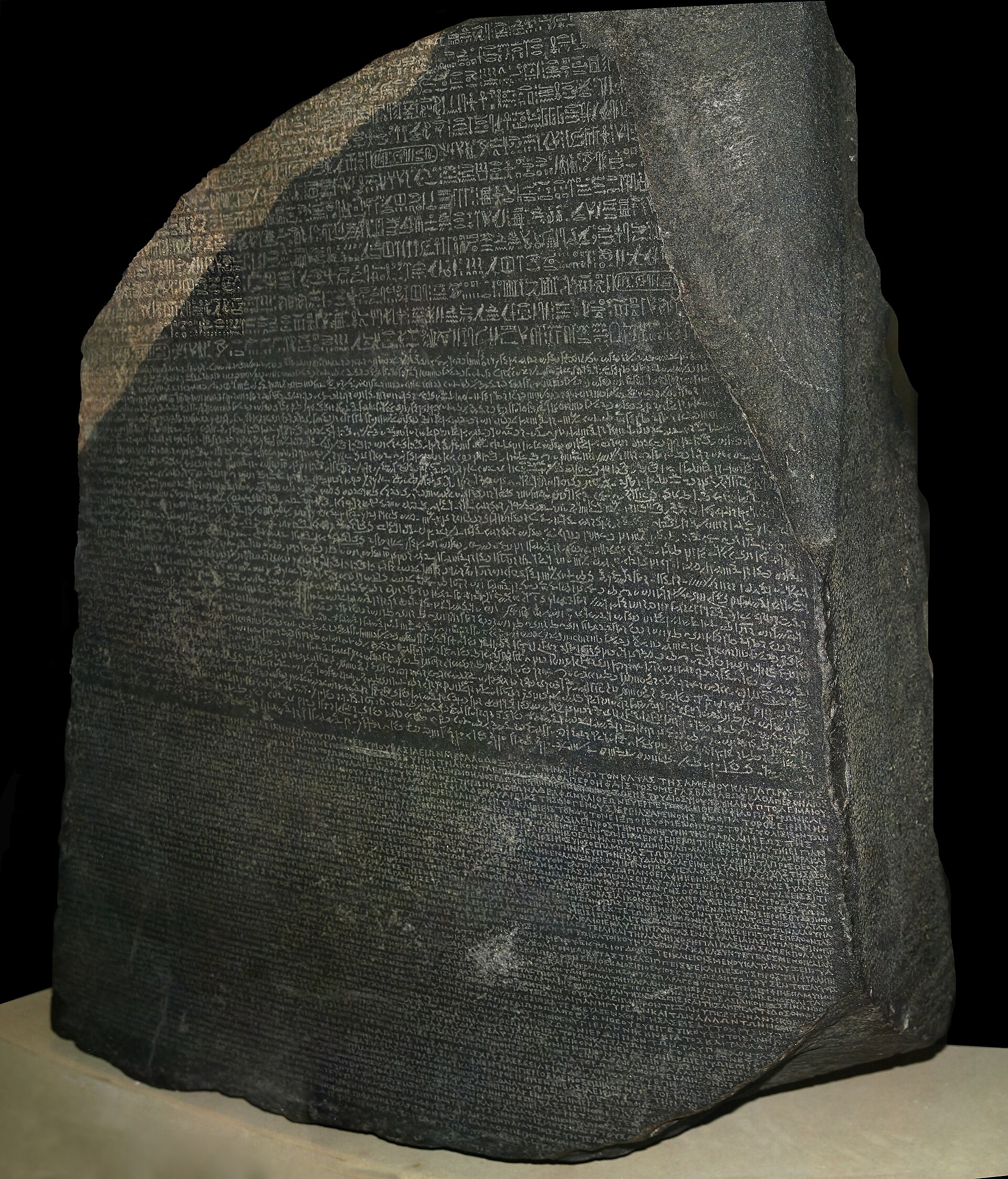
Across the disputed objects in this archive, the instrument that delivered one to its claimant was almost never a judgment.
9 min read
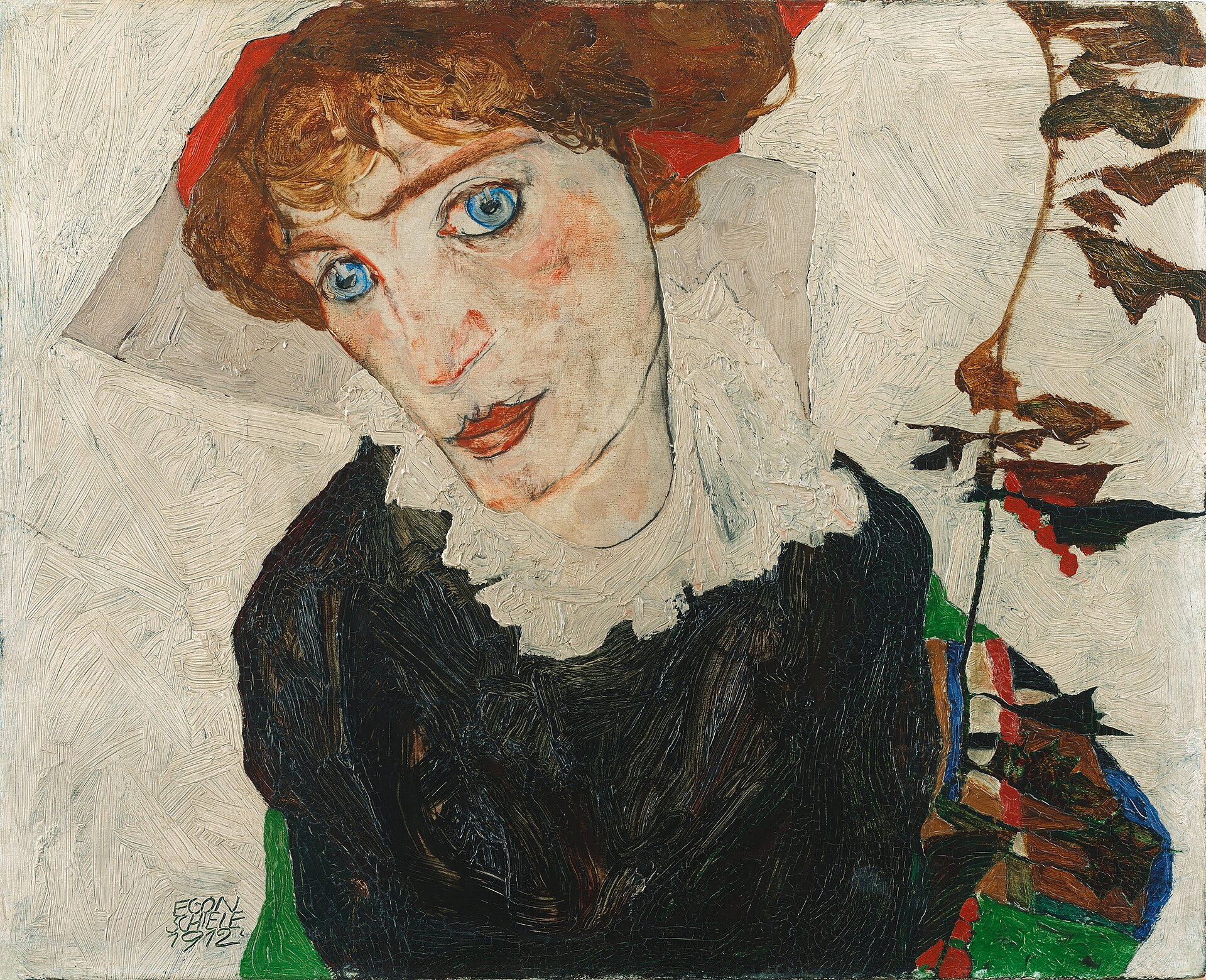
A restitution is itself an undocumented transfer. This archive holds an object delivered to a family that had never owned it, a...
12 min read
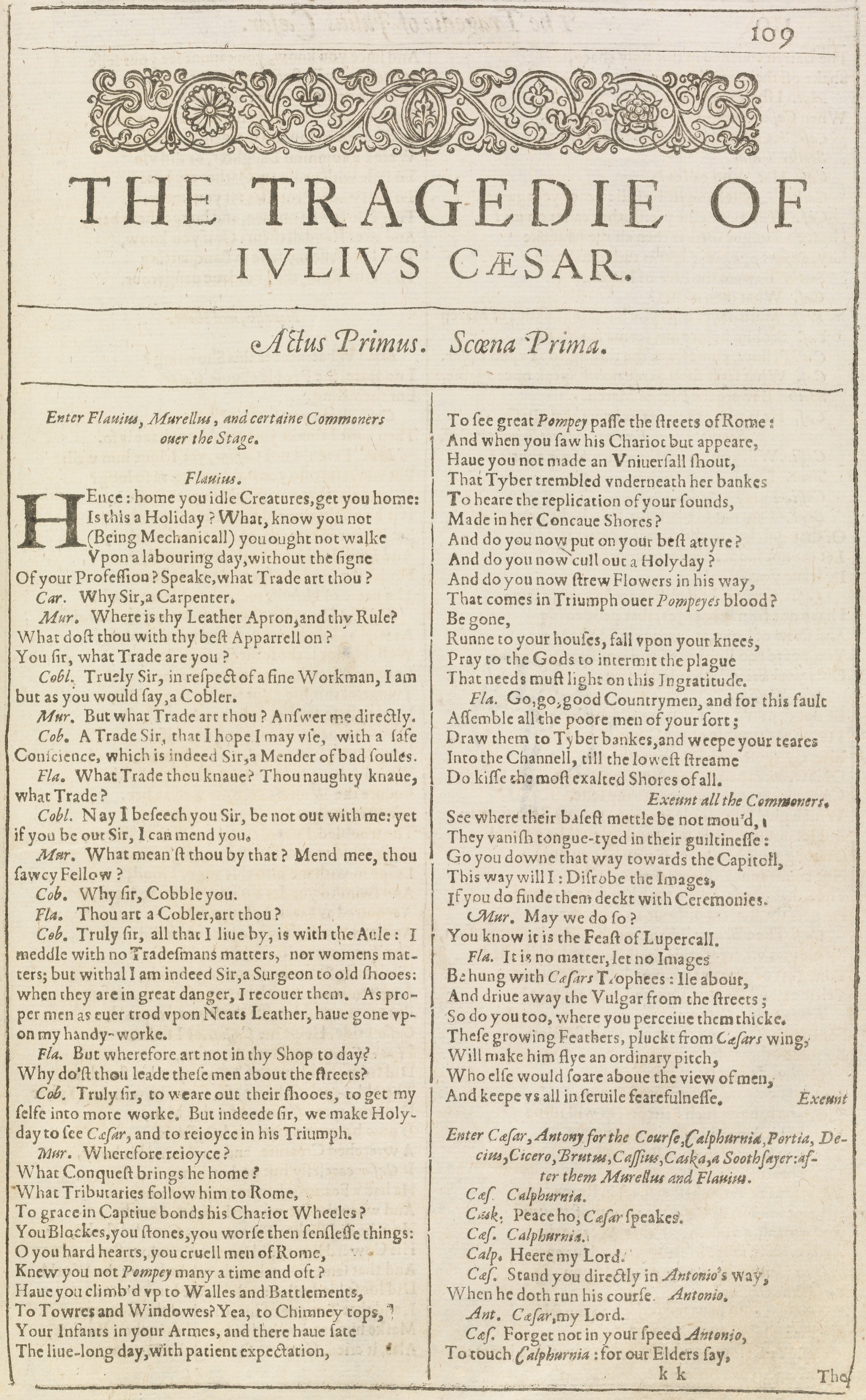
Eight records in this archive carry a museum or a state as the seller. The Bodleian sold its First Folio as a duplicate and paid...
11 min read
Twelve records here sit in a museum that carries a collector's name. In none of them is the museum the owner.
11 min read
Last verified 9 September 2026
One artwork and its story every Tuesday, with the picture: who owned it, what it made, and what closes soon in the exhibition calendar. No promotion, and nothing we cannot cite.
We send one email to confirm the address and keep nothing else. Every letter carries a one-click unsubscribe. How we handle your data.

,_Norton_Simon_Museum.jpg)


.jpg)
.jpg)

_-_The_Law_and_the_Gospel.jpg)