Adam and Eve
Lucas Cranach the Elder · c. 1530
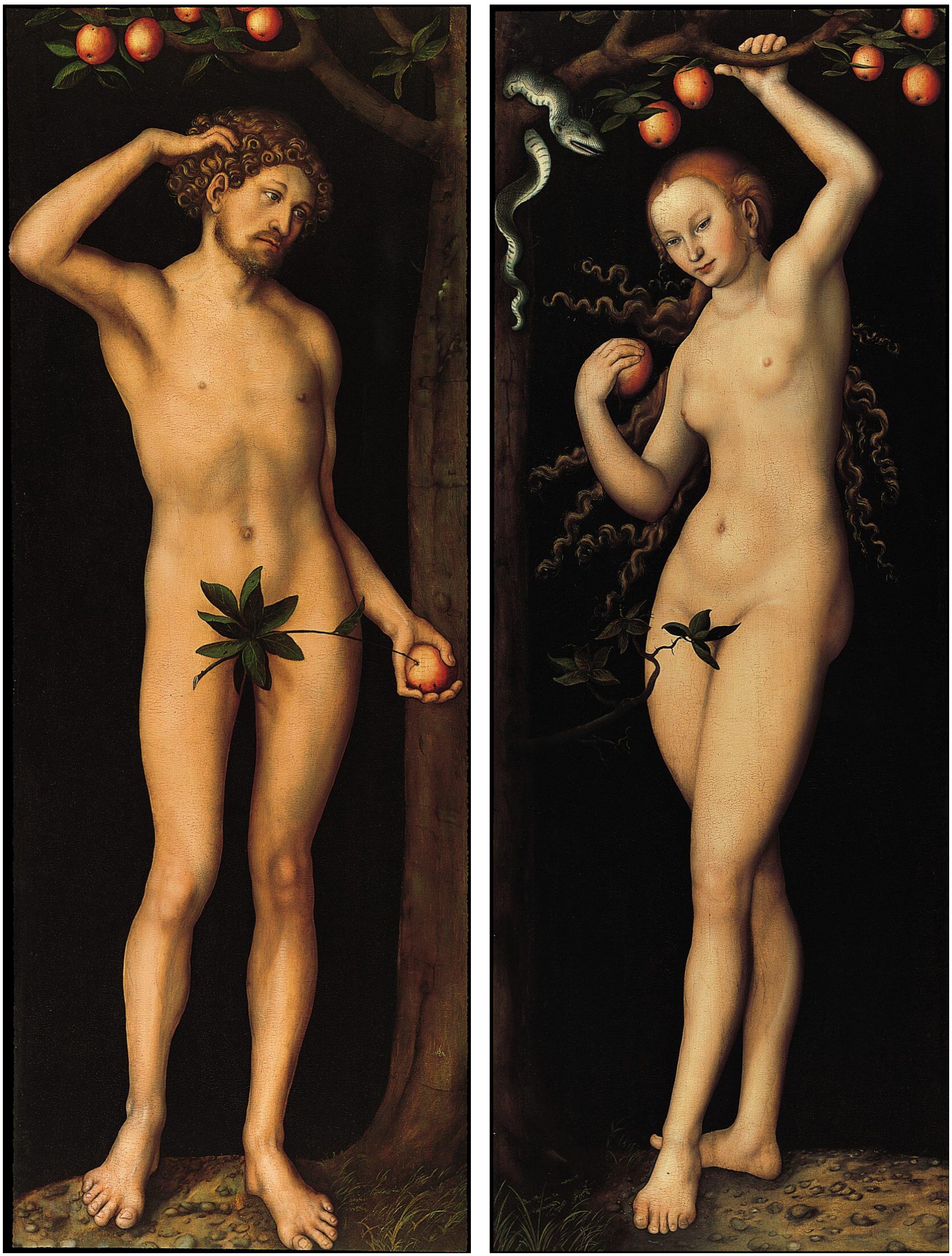
The record subject: both panels together, each 190.5 x 69.9 cm, about 1530, Norton Simon Museum, Pasadena, accession numbers M.1971.1.P and M.1991.1.P. Reproduced from the museum's own collection records.
| Artist | Lucas Cranach the Elder |
|---|---|
| Date | c. 1530 |
| Medium | Oil on panel |
| Dimensions | Each panel 190.5 x 69.9 cm |
| Where it is now | Norton Simon Museum, Pasadena, California. Owned by the Norton Simon Art Foundation. Title is settled: the claim against the museum was dismissed and certiorari denied in 2019.last confirmed 4 August 2026 |
| Inventory number | Adam: M.1971.1.P. Eve: M.1991.1.P. |
| Attribution | AcceptedGiven to Lucas Cranach the Elder by the holding museum and by every party to twelve years of litigation. Full note |
| Object type | Painting |
| Period | German, sixteenth century |
| Cases | Has a provenance gap |
| Inscriptions | Not established in the sources consulted. The museum's own catalogue record was unreachable behind a bot challenge; see the editor's note. |
| Owners on record | 7 links6 documented, 1 unknown |
| Sources | 7 cited |
About this record Last verified 10 September 2026 · 7 sources cited · Change log
On this page 11 sections
ContentsClose
Two life-size panels of about 1530, bought by the Amsterdam dealer Jacques Goudstikker from the Soviet Union at a Berlin auction in 1931, taken from his firm in a forced sale to Hermann Goering after Goudstikker died fleeing the invasion, recovered by the Allies, handed to the Dutch government in 1946, sold by the Dutch government in 1966 to a man who claimed his own family had owned them, and sold on by him to Norton Simon in 1971 for eight hundred thousand dollars.
In 2006 the Netherlands returned 202 works from the same forced sale to Goudstikker's heir. It did not return these, because it no longer had them. Twelve years of litigation in the American courts ended on 30 July 2018 with the Ninth Circuit holding that to give them back it would have to declare three official acts of the Dutch government invalid, which the act of state doctrine forbids. The Supreme Court declined the case in 2019. The museum keeps the panels. The forced sale is not in dispute and never was.
Provenance
Each link is graded. Documented: a cited source supports it. Disputed: the identification is argued but not established. Unknown: no owner for that span, and the gap is not smoothed into a narrative. The grades in the glossary.
- c. 1530 -Lucas Cranach the Elder, Wittenbergdocumented
- - 1931Unknown; possibly the Stroganoff family, then the Soviet stateunknown
Four centuries are unaccounted for. The panels were sold by the Soviet Union in 1931 at a Berlin auction billed as the Stroganoff Collection. Whether the Stroganoffs ever owned them is contested: the district court found they never did, the museum disputed that, and the Court of Appeals declined to resolve it.
- 1931 - 1940Kunsthandel J. Goudstikker NV, Amsterdamdocumented
Bought by Jacques Goudstikker at the 1931 Berlin sale and held by the dealership in which he was principal shareholder. Listed in the black notebook of gallery stock that he carried out of the Netherlands in May 1940.13
- 1940 - 1945Hermann Goeringdocumented
Taken with other artworks for two million guilders under involuntary written agreements concluded with a remaining employee of the firm after Goudstikker's death on 16 May 1940. The forced character of the transaction is uncontested by all parties to the later litigation, including the museum. A separate forced transaction transferred the firm itself, its premises, some paintings and the family's houses to the banker Alois Miedl for 550,000 guilders.1
- 1946 - 1966The Dutch Statedocumented
Recovered by Allied forces in Germany and handed to the Dutch government in 1946. The Goudstikker firm filed under Royal Decree E100 for the Miedl transaction only, settling with the state in August 1952, and in 1949 its lawyer wrote expressly waiving the right to file for restoration of rights on the works Goering had acquired. No E100 annulment of the Goering transaction was ever obtained.1
- 1966 - 1971George Stroganoff-Sherbatoffdocumented
Stroganoff petitioned the Dutch government in the 1960s asserting that the Soviet state had stolen the panels from his family. In 1966 he bought them from the Netherlands in exchange for dropping his restitution claims. The Ninth Circuit held in 2018 that this conveyance was an official act of the Dutch state, made through its own restitution process and not a one-off commercial sale.1
- 1971 - presentNorton Simon Art Foundation and Norton Simon Museum of Art at Pasadenadocumented
Bought from Stroganoff through his agent in 1971 for USD 800,000 and on continuous public display since. Title confirmed by summary judgment, affirmed by the Ninth Circuit on 30 July 2018 on the act of state doctrine, with certiorari denied on 20 May 2019. The claim by Marei von Saher, sole surviving heir of Jacques and Desi Goudstikker, was brought in 2007 and finally rejected without any finding that the 1940 taking was lawful.12
Prices realised
These panels have not been offered at public auction since 1931 and are not for sale. The only figures in the record are the 1931 Berlin sale, for which no price was found; the two million guilders paid across the whole Goering transaction in 1940, which the Ninth Circuit put at over twenty million dollars in current money and which covered many works, not only these two; and the USD 800,000 the Norton Simon Art Foundation paid Stroganoff in 1971. None of the three is a hammer price for this pair and none should be treated as a valuation of it.
Technical evidence
| Attribution note | Given to Lucas Cranach the Elder by the holding museum and by every party to twelve years of litigation. Some aggregated records confuse these panels with versions by Lucas Cranach the Younger and give a date of 1549; the museum's own accession data and the United States Court of Appeals both treat them as Cranach the Elder, and the panels are dated about 1530. |
|---|---|
| Support | Panel, one figure to each panel.56 |
| Medium | Oil.56 |
| Dimensions | Adam 190.5 x 69.9 cm; Eve 190.5 x 69.9 cm. Aggregated records also circulate a height of 187 cm and a width of 70 cm for the Adam panel; the figures above are those given with the museum's own accession numbers.56 |
| Date | About 1530. Some aggregated records carry a rival date of 1549 and an attribution to Lucas Cranach the Younger; that belongs to a different pair.56 |
| Accession numbers | Adam M.1971.1.P; Eve M.1991.1.P, Norton Simon Art Foundation. The two panels were bought in one transaction in 1971, so the difference between the two numbers is not explained by the acquisition.5 |
| Purchase price | USD 800,000, paid to George Stroganoff-Sherbatoff through his agent in 1971 by the Norton Simon Art Foundation and the Norton Simon Museum.1 |
| Value of the 1940 transaction | The Goering transaction covering these and other works was concluded at two million guilders, which the Ninth Circuit described as the equivalent of over twenty million current United States dollars. The Miedl transaction, covering the firm, showroom, some paintings, the villa and the castle, was 550,000 guilders.1 |
Images

The record in full
Chapter 1A claim that failed on none of the facts
Almost every element of this story that would normally be fought over is agreed.
Almost every element of this story that would normally be fought over is agreed. Jacques Goudstikker was a Jewish art dealer in Amsterdam. He fled the invasion in May 1940 and died on the ship. Hermann Goering and his associate Alois Miedl took over his firm through a series of involuntary written agreements with a remaining employee. The forced nature of those transactions is, in the Ninth Circuit's words, uncontested by the parties. The two Cranachs were in the Goering half of it.
The claim still failed, and it failed on a doctrine of American law that has nothing to do with art. The act of state doctrine requires United States courts to treat the official acts of foreign sovereigns within their own territory as valid. To hand these panels to Goudstikker's heir, the Ninth Circuit would have had to declare three Dutch government acts legally inoperative: the 1966 conveyance to Stroganoff, a 1999 Dutch appellate decision refusing to restore her rights, and the Dutch state's later statement that her claim to these two pictures had been settled.
It refused. The judgment does not say the paintings were lawfully taken. It says an American court cannot unpick what the Netherlands did with them afterwards.
That is the most useful thing in this file for anyone assessing a claim: the strength of the wartime facts is not what decides these cases. What decides them is the sequence of official acts that came after.
Chapter 2What they are
Two panels, each 190.5 by 69.9 centimetres, painted about 1530 and hung as a pair.
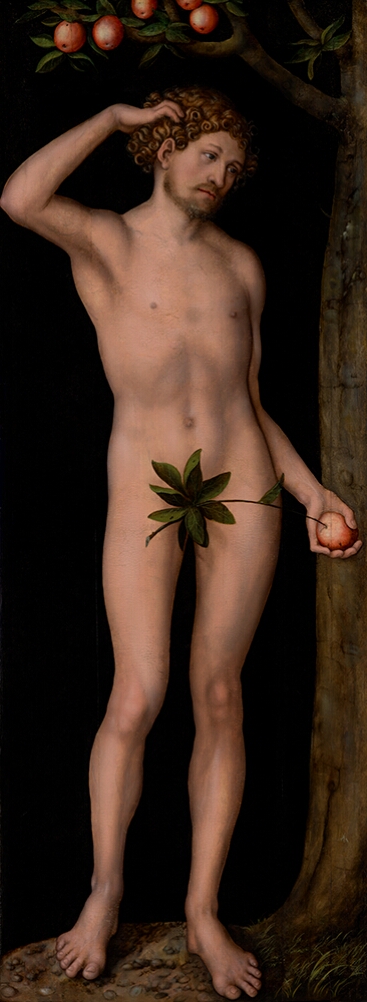
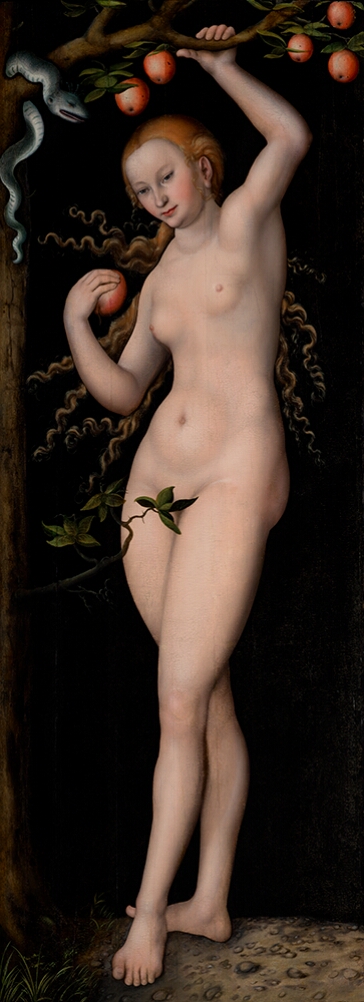
Two panels, each 190.5 by 69.9 centimetres, painted about 1530 and hung as a pair. Nudes at full length, each figure alone on its own panel against a dark ground, with the tree and the serpent divided between them. Cranach painted the subject repeatedly across three decades and his workshop repeated it further, which is why the corpus is a version-safety minefield and why aggregated databases confuse these two with panels by Lucas Cranach the Younger dated 1549.
The museum carries them under two accession numbers, M.1971.1.P for Adam and M.1991.1.P for Eve. The pair was bought in a single transaction in 1971, so the second number is not an acquisition date in the ordinary sense, and this record does not explain it.
Adam and Eve full length and life size, made for a Lutheran market in Saxony around 1530, are objects with a specific doctrinal job. Cranach was the court painter at Wittenberg, a personal friend of Martin Luther and godfather to one of his children, and the workshop that produced these panels was the principal image factory of the Reformation. A pair like this is not an excuse for two nudes. It is the Fall, the moment the law becomes necessary, painted in the town where the argument about law and grace was being had.
Chapter 3Where they came from before Goudstikker, and why nobody knows
In 1931 Goudstikker bought the panels from the Soviet Union at an auction in Berlin billed as the Stroganoff Collection.
In 1931 Goudstikker bought the panels from the Soviet Union at an auction in Berlin billed as the Stroganoff Collection. The Soviet state was selling nationalised property abroad for hard currency through the 1930s, and a good deal of what it sold under a great family's name had never belonged to that family.
Whether these panels had is the question that later mattered, and it has no clean answer. The district court found the Stroganoff family never owned them. The museum contested that, and the Ninth Circuit described the record evidence as muddied and declined to decide it, because for its purposes it was enough that the ownership was possible enough to make George Stroganoff-Sherbatoff's claim to the Dutch government in the 1960s a colourable one.
So the pre-1931 provenance is genuinely unresolved, and an unresolved question about 1917 turned out to be load-bearing for a case about 1940. That is unusual and it is worth noticing: the second dispossession in the chain, by the Soviet state, is the one that supplied the mechanism for the objects to leave Dutch hands.
Chapter 4Goudstikker
Jacques Goudstikker joined his father's Amsterdam gallery in 1919 and turned it into the most important Dutch dealership in old master paintings between the wars.
Jacques Goudstikker joined his father's Amsterdam gallery in 1919 and turned it into the most important Dutch dealership in old master paintings between the wars. From 1927 he traded from Herengracht 458 in the Golden Bend. Over 1,200 works were catalogued through his hands, and pictures that passed through his gallery are now in the Metropolitan Museum and the National Gallery in Washington.
He fled in May 1940 with his wife Desi and their child, leaving the gallery and its stock. On 16 May 1940, aboard the SS Bodegraven, he failed to see an open hatch, fell into the hold and broke his neck.
He was carrying a small black notebook listing the paintings in the gallery, the Cranachs among them. Desi kept it. Sixty-six years later it was the document on which 202 restitutions turned. A dealer's pocket inventory, written for his own use, did what no state record could.
Chapter 5The two forced sales
After Goudstikker's death the firm's assets were taken in two transactions, both concluded through a remaining employee.Alois Miedl, a banker, took the firm itself, its showroom, some of its...
After Goudstikker's death the firm's assets were taken in two transactions, both concluded through a remaining employee.
Alois Miedl, a banker, took the firm itself, its showroom, some of its paintings, and the family's villa and castle, for 550,000 guilders. He then traded on under the Goudstikker name, selling art into Germany on the strength of a dead Jewish dealer's reputation.
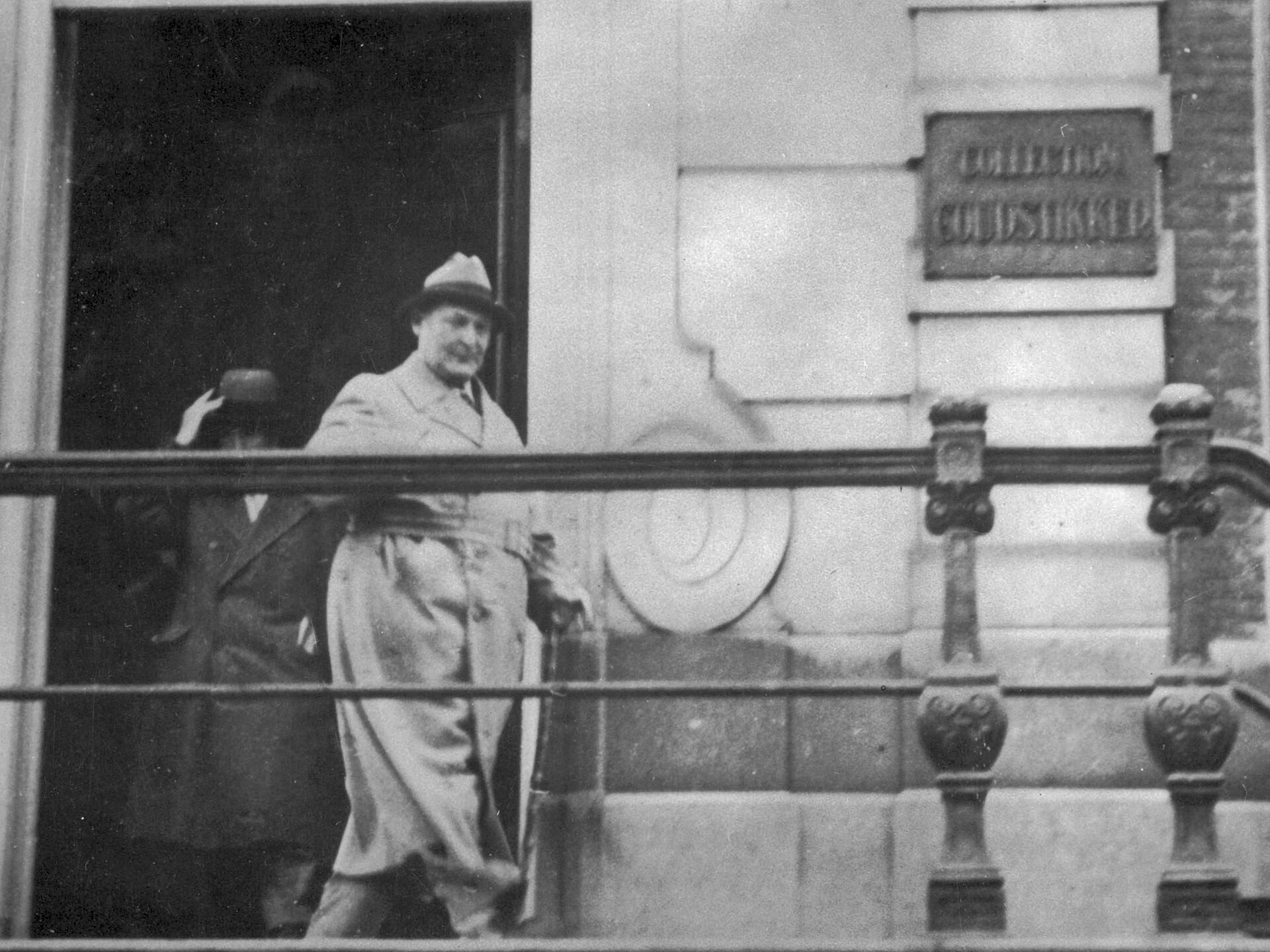
Hermann Goering took the other artworks, these two panels among them, for two million guilders, a sum the Ninth Circuit put at over twenty million dollars in current money. Goering's interest in the Amsterdam gallery was not remote: he was photographed leaving the premises at Herengracht 458 in 1941.
Dutch authorities at various times took the position that both transactions were voluntary. That position, in the court's phrase, has long since been dispelled, and by the time of this litigation the forced character of both was uncontested by everyone in the case including the museum.
Chapter 6The Dutch machinery, and the decision not to use it
The Netherlands built its restitution system out of royal decrees issued while the war was still on, and the detail of them decided this case.Royal Decree A6 of June 1940 nullified agreements with...
The Netherlands built its restitution system out of royal decrees issued while the war was still on, and the detail of them decided this case.
Royal Decree A6 of June 1940 nullified agreements with the enemy automatically, and gave a committee power to revive them. In 1947 that committee revived the nullified transactions for property the Allies had already returned to the Netherlands, reasoning that once the property was back, the protective purpose of the nullity had gone.
Royal Decree E100 of 1944 created a Council for Restoration of Rights with exclusive power to annul wartime transactions and order property returned. Its judicial division's decisions were final and had the force of a court judgment. The filing deadline for claimants was 1 July 1951. As a rule, an owner who had received money for property taken by the Nazis had to hand the price back to the state to get the object.
Royal Decree E133 of 1944 expropriated enemy assets outright: property in the Netherlands belonging to an enemy state or national passed automatically to the Dutch state.
Here is what the Goudstikker firm did with that machinery. It filed under E100 for the Miedl transaction, just before the 1951 deadline, and settled with the Dutch government in August 1952. It deliberately did not file for the Goering transaction. Its lawyer Max Meyer advised against it, on the reasoning that recovering the Goering pictures would saddle the business with a large number of works that were hard to sell, revive an art dealership nobody wanted to run and drain its liquid assets. In 1949 Meyer wrote to the Dutch agency holding the Goering works confirming that the firm waived the right to file for restoration of rights on them.
Marei von Saher conceded in later Dutch proceedings that the firm had made a deliberate and well-considered decision not to seek restoration of the Goering goods.
Nothing in that paragraph is a moral judgment on a widow in 1949 negotiating with the state that had just been occupied. It is the record of a commercial decision taken on legal advice, and it is the fact from which everything that followed runs.
Chapter 71966: the state sells the panels to a claimant
In the 1960s George Stroganoff-Sherbatoff, a United States naval officer of Russian descent, petitioned the Dutch government asserting that the Cranachs were rightfully his because the Soviet state...
In the 1960s George Stroganoff-Sherbatoff, a United States naval officer of Russian descent, petitioned the Dutch government asserting that the Cranachs were rightfully his because the Soviet state had stolen them from his family. In 1966 the two sides reached what the court called an amicable settlement: Stroganoff bought the panels back from the Netherlands in exchange for dropping his restitution claims.
Read that transaction carefully, because it is the pivot of the case. The Dutch state disposed of two paintings taken from a Jewish dealer in a forced sale by settling a competing claim from a third family about an earlier expropriation in another country. Neither the Goudstikker heirs nor the original loss featured in it. And because it was done as part of the state's own restitution process rather than as a commercial sale, an American court in 2018 held it to be a sovereign act it could not touch.
Through an agent, Stroganoff sold the panels to the Norton Simon Art Foundation and the Norton Simon Museum in 1971 for 800,000 dollars. They have been on public display in Pasadena ever since.
Chapter 82001 to 2006: the Netherlands changes its mind, and it is too late for these two
In 2001 the Dutch government reassessed a restitution process it described as bureaucratic and moved it from a purely legal approach to what it called a more moral policy approach.
In 2001 the Dutch government reassessed a restitution process it described as bureaucratic and moved it from a purely legal approach to what it called a more moral policy approach. It created a new Restitution Committee to advise the State Secretary for Education, Culture and Science on claims to property the state still held.
Von Saher, the only surviving heir of Jacques and Desi Goudstikker, petitioned for over two hundred works from the Goering transaction still in Dutch hands. On 19 December 2005 the committee recommended, in case RC 1.15, the return of 202 of the 267 works claimed: the Goering pictures went back, the Miedl pictures did not, because those had been settled in 1952.
The State Secretary took the view that her claim had already been settled in the 1950s and by a Dutch appellate decision, and returned the Goering paintings anyway. He stated expressly that the decision did not concern the Cranachs.
Her earlier Dutch petition, brought in the 1990s to the Court of Appeals as successor to the Council for Restoration of Rights, had been refused on the ground that the firm had made a conscious and well considered decision to refrain from seeking restoration on the Goering transaction.
So: the Netherlands accepted in 2005 that the Goering transaction was an involuntary loss and returned two hundred and two objects on that basis, and these two panels stayed in California, from the identical transaction, because the Dutch state had sold them to somebody else in 1966. Same seizure, same finding, opposite outcome, decided by nothing but where the objects physically were.
Chapter 9Twelve years in the American courts
In 2007 von Saher sued the museum in the Central District of California in a diversity action for replevin, conversion, statutory damages, quiet title and declaratory relief.
In 2007 von Saher sued the museum in the Central District of California in a diversity action for replevin, conversion, statutory damages, quiet title and declaratory relief. She relied on a Californian statute of limitations written for Holocaust-era art claims against museums, with a filing deadline of 31 December 2010.
The district court dismissed. In 2010 the Ninth Circuit affirmed, holding that Californian statute unconstitutional on field preemption grounds because the state was attempting to conduct foreign affairs, while giving leave to amend. The Supreme Court denied certiorari in 2011.
California then amended its general property limitation statute to run six years from actual discovery in cases of unlawful taking against a museum, and made it retroactive. Von Saher amended. The museum moved to dismiss on the ground that her claims conflicted with federal foreign policy; the district court agreed; and in 2014 the Ninth Circuit reversed over a dissent, holding that her claims did not conflict with federal policy because, as pleaded, the Cranachs had never been subject to postwar internal restitution proceedings in the Netherlands. The court declined to give serious weight to an amicus brief from the State Department and the Solicitor General, which it said had gone beyond explaining foreign policy and appeared to make factual findings. The Supreme Court denied the museum's petition in 2015.
Then came the discovery that changed it. On remand the court held over a year of discovery and, as the 2018 panel put it, the record did not bear out the allegations that had survived the motion to dismiss. In 2016 the district court gave summary judgment to the museum on Dutch law, holding that the 1947 revival of the Goering transaction, the automatic expropriation of enemy property under E133 and the absence of any E100 annulment meant the Dutch state owned the panels when it sold them in 1966.
The Ninth Circuit affirmed on 30 July 2018, but expressly not under Dutch law and without any choice-of-law analysis. It affirmed on the act of state doctrine. Judge Wardlaw concurred, writing that the case should never have got past the 2012 dismissal on preemption grounds. Certiorari was denied on 20 May 2019.
Chapter 10What this case is actually authority for
Three things a diligence file should take from it.A waiver made in 1949 can still be decisive in 2019.
Three things a diligence file should take from it.
A waiver made in 1949 can still be decisive in 2019. The firm's decision not to file under E100 for the Goering pictures, taken on commercial advice about the difficulty of selling old masters and running a gallery, ran through every subsequent decision including the Dutch refusal in the 1990s and the American judgments. Where a family engaged with a post-war restitution system at all, what they filed and what they left out is the first thing to establish.
A state that sells a disputed object launders it, and the doctrine that protects the buyer is not about art. The act of state doctrine exists to keep American courts out of foreign relations. Applied here, it means that once the Netherlands conveyed these panels as part of its own restitution machinery, no United States court would look behind the conveyance, whatever the merits of the 1940 taking.
Where the object physically sits when a state changes policy determines the outcome. Two hundred and two objects from the same seizure went back in 2006 and these two did not, purely because the Dutch state had disposed of them forty years earlier.
None of that is a finding that the museum did anything wrong. Norton Simon bought in 1971 from a seller with a conveyance from a sovereign state, and the paintings have been on public view for over fifty years with the history published. But a reader who wants to know whether a Nazi-era claim is strong should stop reading about 1940 and start reading about what each government did between 1945 and 1970. That is where these cases are won and lost.
The artist
Lucas Cranach the Elder
Cranach ran the most industrialised painting workshop in northern Europe and was the visual arm of the Reformation. He was court painter at Wittenberg for nearly half a century, a licensed apothecary, a printer, a bookseller and three times burgomaster of the town. His output is enormous, much of it repeats itself by design, and separating his hand from his sons' and his shop's is a permanent problem in the literature. That problem is not incidental to this record: it is the reason the same subject in the same format exists in many versions and the reason a database can attach the wrong date and the wrong Cranach to these two panels.
Exhibited
- 1971-presentPermanent displayNorton Simon Museum, Pasadena
Related works
| Work | Relation | Where it is |
|---|---|---|
| The Goudstikker black notebook Jacques Goudstikker | The document the whole claim rests on A pocket inventory of the gallery stock, carried out of the country in May 1940 and kept by Desi Goudstikker. The Cranachs are in it. | With the Goudstikker heir |
| 202 paintings from the Goering transaction Various | Returned from the same forced sale, by the same claim, in the same decade Dutch Restitutions Committee recommendation RC 1.15 of 19 December 2005 covered 267 claimed works and recommended 202. These two panels were expressly excluded because the Dutch state no longer held them. | Returned to Marei von Saher by the Netherlands in 2006 |
| Portrait of Wally Neuzil Egon Schiele | The mirror case: an American court found the taking a theft and the object still did not move Here the taking was uncontested and the claim failed on a doctrine of abstention. There the theft was found and the case ended in a payment. | Leopold Museum, Vienna |
| Rue Saint-Honore in the Afternoon. Effect of Rain Camille Pissarro | The other American Nazi-era claim decided on which country's law applies rather than on what happened Both cases were heard at first instance by the same district judge in the Central District of California. | Museo Nacional Thyssen-Bornemisza, Madrid |
Open questions
- Did the Stroganoff family ever own these panels? The district court found they never did; the museum contested it; the Ninth Circuit called the record muddied and declined to decide. The finding matters, because a colourable Stroganoff claim is what made the 1966 Dutch conveyance a sovereign restitution act rather than an ordinary sale.
- Which Berlin auction house sold the panels for the Soviet Union in 1931? The Ninth Circuit records only that the sale was billed as the Stroganoff Collection.
- Why does Eve carry the accession number M.1991.1.P when both panels were bought in one transaction in 1971? No published explanation was found.
- Was the 1952 settlement between the Goudstikker firm and the Dutch state a release of the Goering claims as well as the Miedl claims? The parties disputed it, the district court made no finding, and the Ninth Circuit held the answer did not affect the outcome. It remains open.
- Is the Cranach Adam recorded under inventory NK 1693 in the Netherlands Art Property Collection one of these two panels? Aggregated records attach that number to them, and the Allies did return the panels to the Dutch state in 1946, but the identification was not confirmed against a Dutch primary record for this entry.
- What are the panels insured for, and what has the museum ever published about their value? Nothing beyond the 1971 purchase price of USD 800,000 was found.
Questions about this object
What is Adam and Eve?
Adam and Eve is a painting, dated c. 1530. Medium: Oil on panel.
Who made Adam and Eve, and is the attribution settled?
The attribution to Lucas Cranach the Elder is recorded here as accepted. Given to Lucas Cranach the Elder by the holding museum and by every party to twelve years of litigation. Some aggregated records confuse these panels with versions by Lucas Cranach the Younger and give a date of 1549; the museum's own accession data and the United States Court of Appeals both treat them as Cranach the Elder, and the panels are dated about 1530.
Where is Adam and Eve now?
Norton Simon Museum, Pasadena, California. Owned by the Norton Simon Art Foundation. Title is settled: the claim against the museum was dismissed and certiorari denied in 2019. Inventory number Adam: M.1971.1.P. Eve: M.1991.1.P.. Last confirmed 4 August 2026. Bought from George Stroganoff-Sherbatoff in 1971 for USD 800,000. Confirmed by summary judgment affirmed by the United States Court of Appeals for the Ninth Circuit on 30 July 2018 on the act of state doctrine, certiorari denied 20 May 2019.
What is still unknown about Adam and Eve?
Did the Stroganoff family ever own these panels? The district court found they never did; the museum contested it; the Ninth Circuit called the record muddied and declined to decide. The finding matters, because a colourable Stroganoff claim is what made the 1966 Dutch conveyance a sovereign restitution act rather than an ordinary sale.
Sources
- 1Marei von Saher v. Norton Simon Museum of Art at Pasadena and Norton Simon Art Foundation, No. 16-56308, United States Court of Appeals for the Ninth Circuit, argued 14 February 2018, filed 30 July 2018, opinion by McKeown J., Wardlaw J. concurring. Full text, containing the 1931 Berlin purchase, the Goudstikker flight and death, the Miedl and Goering transactions and their sums, Royal Decrees A6, E100 and E133, the 1949 waiver letter, the 1952 settlement, the 1966 Stroganoff conveyance, the 1971 sale at USD 800,000, the 1999 Dutch appellate refusal, the 2001 policy change, the 2006 return excluding these panels, and the whole litigation history including Von Saher I (592 F.3d 954, 9th Cir. 2010) and Von Saher II (754 F.3d 712, 9th Cir. 2014). PRIMARY. courtlistener.com/opinion/...
- 2Von Saher v. Norton Simon Museum of Art at Pasadena, certiorari denied 20 May 2019, 139 S. Ct. 2616, 204 L. Ed. 2d 264, docket 18-1057. PRIMARY. courtlistener.com/opinion/...
- 3Wikipedia, 'Jacques Goudstikker', TERTIARY, used for the gallery at Herengracht 458, the scale of the business, the 1,200 catalogued works, the circumstances of his death aboard the SS Bodegraven on 16 May 1940, the black notebook and the 2006 return of 202 paintings. Flagged for replacement with the Goudstikker catalogue and the Dutch Restitutions Committee file. en.wikipedia.org/wiki/...
- 4Restitutiecommissie (Dutch Restitutions Committee), recommendation RC 1.15, 19 December 2005, on the trading stock of Kunsthandel J. Goudstikker NV: 267 works claimed, 202 recommended for return, the Goering works returned and the Miedl works excluded as settled by the 1952 agreement. PRIMARY. restitutiecommissie.nl/en/...
- 5Wikimedia Commons file page for the Cranach pair, reproducing the Norton Simon Museum's own catalogue data: dimensions of 190.5 x 69.9 cm for each panel and accession numbers M.1971.1.P and M.1991.1.P, with links to the museum's object records. Used because the museum's own site could not be reached; see the editor's note. commons.wikimedia.org/wiki/...
- 6Wikidata item Q88701731, 'Adam and Eve', TERTIARY aggregator, used only for the material (oil paint on plank) and the c. 1530 date, and cited here also as the source of the conflicting 1549 date and 187 cm height that this record rejects. wikidata.org/wiki/...
- 7Wikipedia, 'Lucas Cranach the Elder', TERTIARY, used only for the artist dossier: the Wittenberg court appointment, the friendship with Luther, the apothecary and printing businesses, the burgomastership, the winged serpent device and the serial character of the workshop. Flagged for replacement with Friedlaender and Rosenberg, Die Gemaelde von Lucas Cranach. en.wikipedia.org/wiki/...
,_Norton_Simon_Museum.jpg)
Last verified 10 September 2026 · Published 4 August 2026
Change log
4 August 2026 - Record created at the house standard: researched narrative, technical evidence, maker dossier, graded provenance chain, prices with hammer and premium separated, related works, open questions and sources.
10 September 2026 - Re-verified 2026-09-10: WebSearch for any 2024-2026 developments (rehearing petitions, new claims, a sale, an export request) found none beyond what this record already documents. The Ninth Circuit rehearing-en-banc petition following the 30 July 2018 panel decision and the 20 May 2019 certiorari denial remain the last word in the litigation; no further filing, appeal or settlement located. Current location, attribution and inventory numbers unchanged. Null result recorded as a finding.