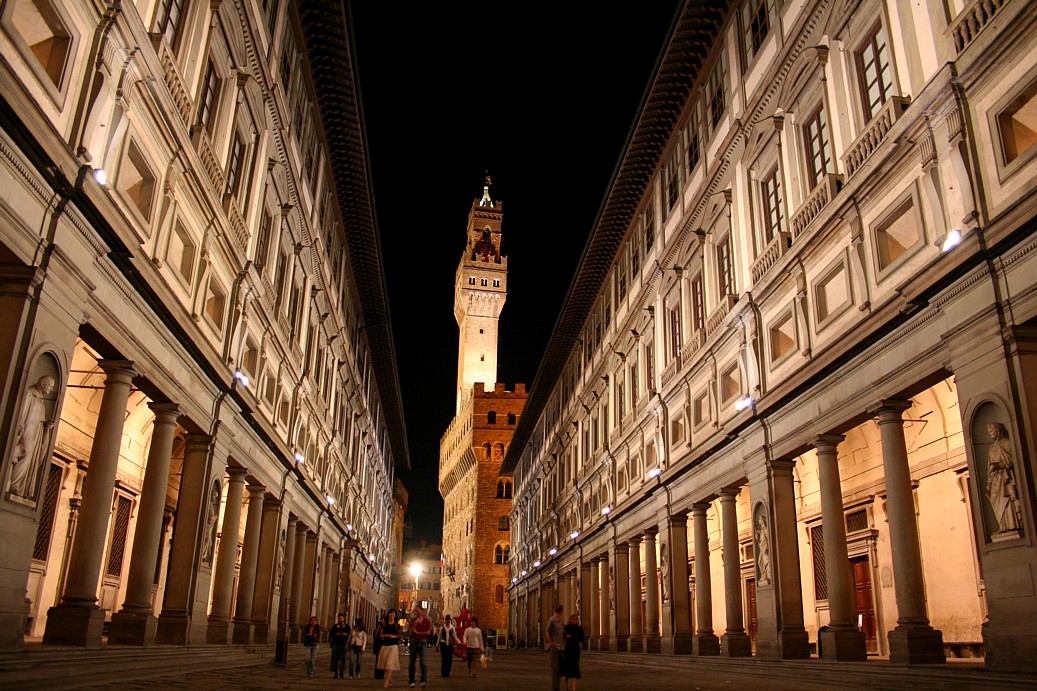
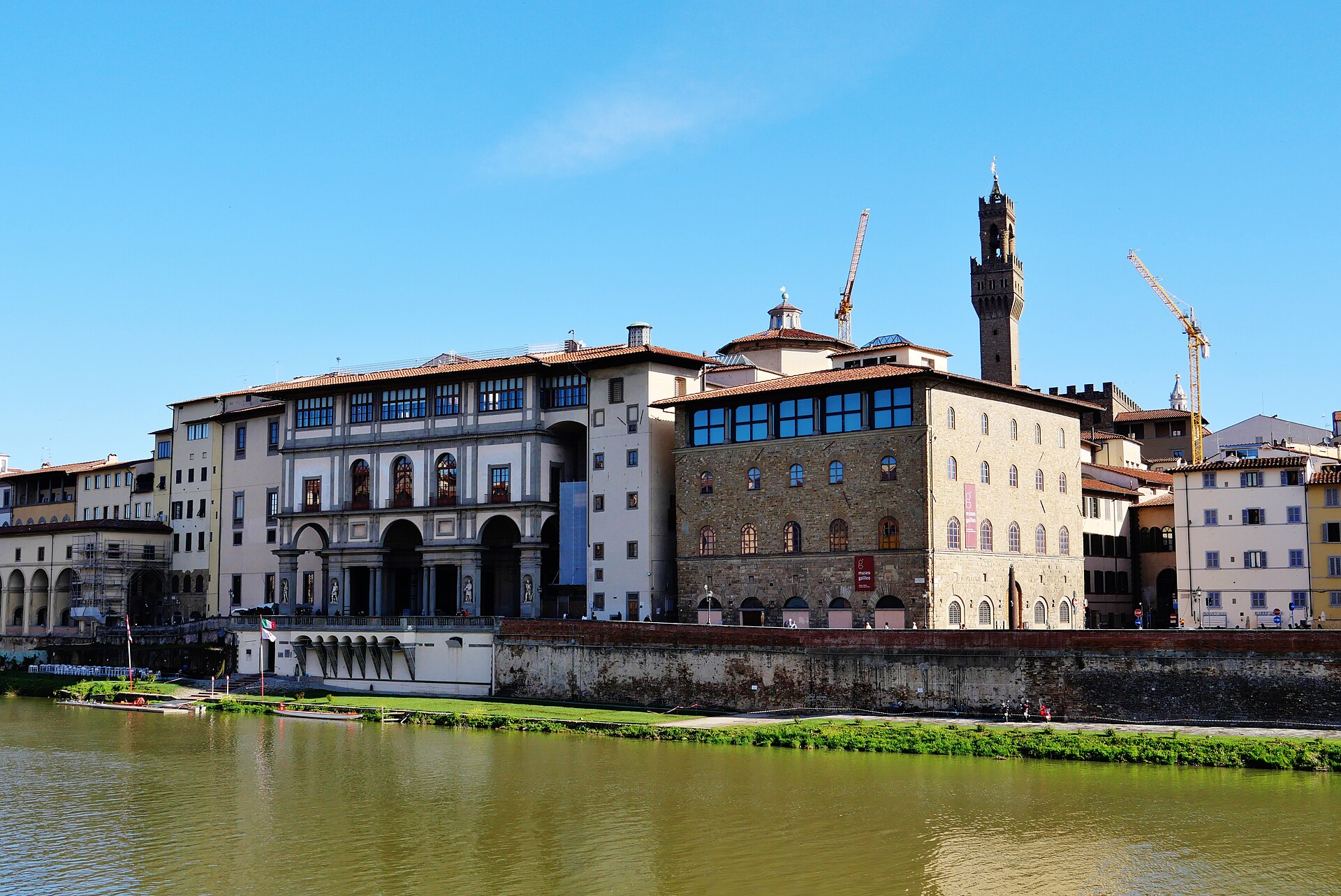
The narrow courtyard between the Uffizi's two wings at night, looking north toward the tower of the Palazzo Vecchio.
Chris Wee · CC BY 2.0Uffizi Gallery
Museum · Galleria degli Uffizi · Founded 1581
Open, admission and hours confirmed 19 August 2026 · 14 sources
On this page 15 sections
ContentsClose
The Uffizi's strength is Italian Renaissance painting from the Duecento to the Cinquecento, held in a depth and continuity that few other single buildings anywhere can match, run alongside one of the most important surviving collections of ancient Roman marble sculpture still displayed in the setting it was collected for. Its secondary strengths are a substantial German, Dutch and Flemish painting collection and, via the Vasari Corridor, a unique collection of painters' self-portraits.
| Local name | Galleria degli Uffizi |
|---|---|
| Kind | Museum |
| Founded | 1581 |
| City and country |  Florence, Italy Florence, Italy |
| Address | Piazzale degli Uffizi 6, 50122 Florence, Italy |
| Website | uffizi.it |
| Status | Open, confirmed |
| Record last verified |
Visiting
- Hours
- Tue-Sun08:15 to 18:30Ticket office closes at 17:30; from 18:30 visitors are asked to make their way to the exit
- Closed
- Monday. 1 January. 25 December.
- Admission
- Regular, purchased on the dayEUR 25Named, non-transferable ticket
- Regular, purchased in advanceEUR 29Includes online booking fee
- Afternoon entry, from 4pm (effective 1 January 2026)EUR 1620 EUR if booked online in advance; applies only to entry from 4pm onward
- ReducedEUR 2EU citizens 18 up to their 25th birthday, plus citizens of Switzerland, Norway, Liechtenstein and Uruguay and holders of certain Italian Ministry of Foreign Affairs permit cards
- Free admissionFreeUnder-18s of any nationality (under-12s must be accompanied); visitors with certified disabilities plus one companion; scholars, university students and teachers in eligible categories; accredited journalists, tour guides, ICOM members and several public-sector categories
- Uffizi + Vasari Corridor, on the dayEUR 43Mandatory timed reservation; entry to the Uffizi 2 hours before the Corridor slot; non-refundable
- Uffizi + Vasari Corridor, in advanceEUR 47Friday evening version (7-11pm, 4 July-26 December 2025 run) priced at 20/24 EUR instead
- PassePartout, 5 consecutive days, Uffizi + Pitti Palace + Boboli GardensEUR 4058 EUR with the Vasari Corridor included
- Annual pass (Passepartout), one personEUR 80Family annual pass 120 EUR; unlimited priority admission to Uffizi, Pitti Palace and Boboli Gardens for one year; Vasari Corridor is a further 20 EUR per visit
- Group surcharge, 11 or more peopleEUR 70Added to the group's Uffizi admission
Free entry: First Sunday of every month ("Sunday at the museum"), permanent collection- Tickets
- tickets.uffizi.it The museum's own ticket page.
- Do I need to book?
- Not mandatory for same-day purchase, but the museum's own booking channels and independent reporting both point to queues running to several hours in peak season (roughly April-September) without a pre-booked timed entry; the Uffizi's own ticket office recommends booking ahead.
- Address
- Piazzale degli Uffizi 6, 50122 Florence, Italy Map
- Website
- uffizi.it
- Telephone
- +39 055 0354135
- [email protected]
Before you go how long, access, photography, bags, eating, shop
- How long to allow
- 2-3 hours for the painting galleries alone; add at least 2 more hours if visiting the Vasari Corridor, which requires entering the Uffizi first and is timed separately
- Access
- Step-free access ramp on Via della Ninna; lifts to the second floor at the end of the visit route; wheelchairs are limited to 230kg combined weight and 120cm length; accessible WCs on every floor, with a note that second-floor accessible toilets need staff assistance to locate
- Photography
- The museum's FAQ lists a dedicated question on photographing artworks and a separate policy for professional photography and filming, reached via the FAQ; the specific rule text was not retrievable from the fetch used for this record and is not restated here to avoid guessing at it
- Bags
- Free cloakroom immediately inside the entrance, under the courtyard's eastern colonnade; umbrellas, large bags and backpacks must be left there
- Eating
- Cafeteria on the second floor with a terrace overlooking the city
- Shop
- Bookshop at the entrance with multilingual guides; a second shop at the ground-floor exit selling books, gallery-branded items and art-history titles
Prices and hours change. We take them from the institution's own pages and print the day we read them, and you can check the current position at the source we used. Confirm before you travel.
What is inside
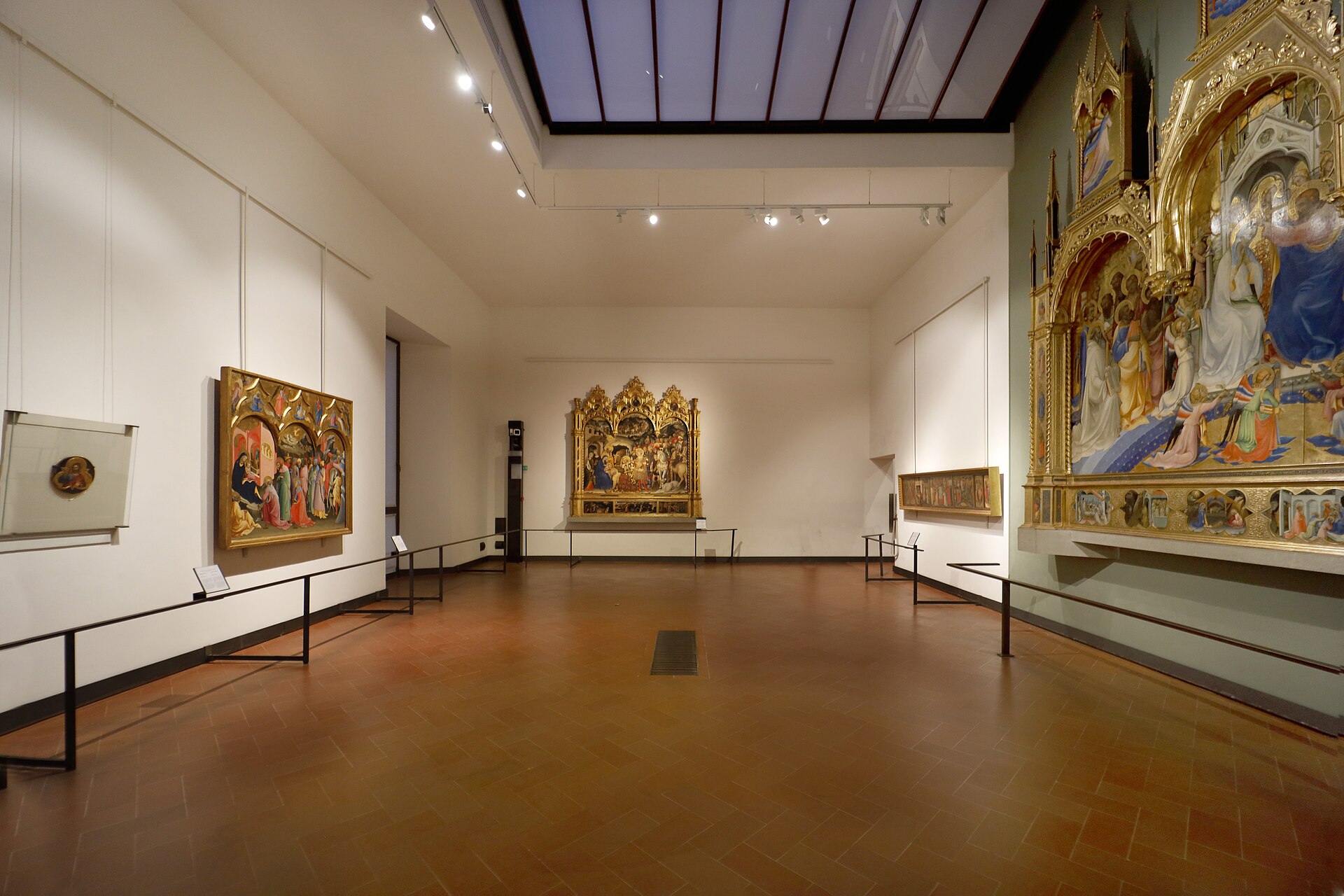
CC0 Painting Galleries
The core of the collection: a chronological hang of Italian and European painting from the 13th to the 20th century across the Uffizi's historic rooms. It runs from the great Duecento and Trecento altarpieces (Cimabue, Duccio, Giotto) through the Quattrocento (Piero della Francesca, Filippo Lippi, Botticelli, Leonardo, Verrocchio), into the High Renaissance (Michelangelo, Raphael, Titian) and Mannerism (Parmigianino), and on to Caravaggio and the Baroque, alongside a strong holding of German, Dutch and Flemish painting.
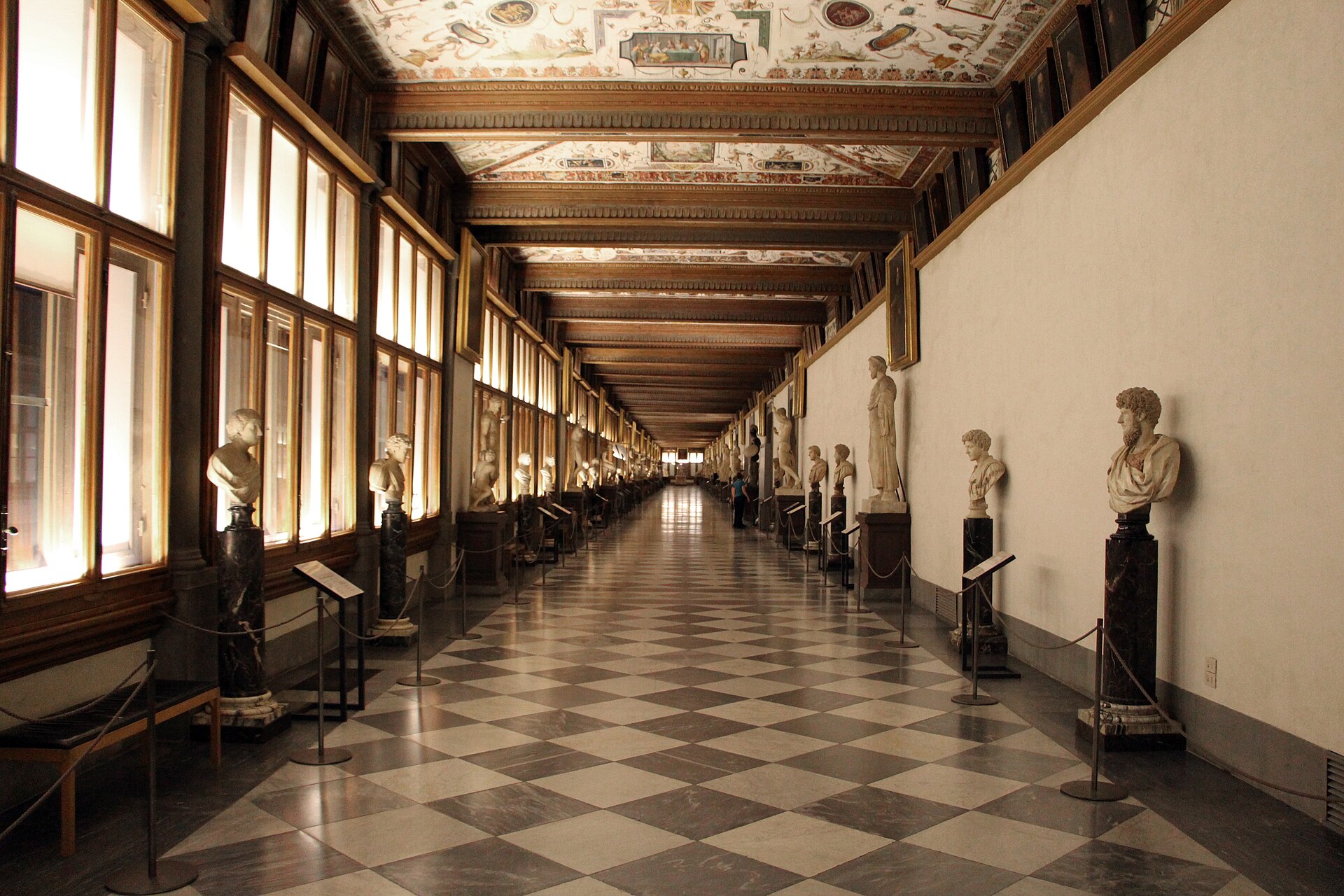
Photograph by Sailko · CC BY-SA 4.0 Sculpture Corridors
The long corridors that run the length of both wings, built by Vasari and lined since the Medici's own day with ancient Roman marble: portrait busts of emperors, Roman copies of lost Greek originals such as the Wrestlers and the Sleeping Eros, the Boy with Thorn (Spinario) and the Medici Venus, alongside later additions running as far as Marino Marini's 20th-century Pomona.
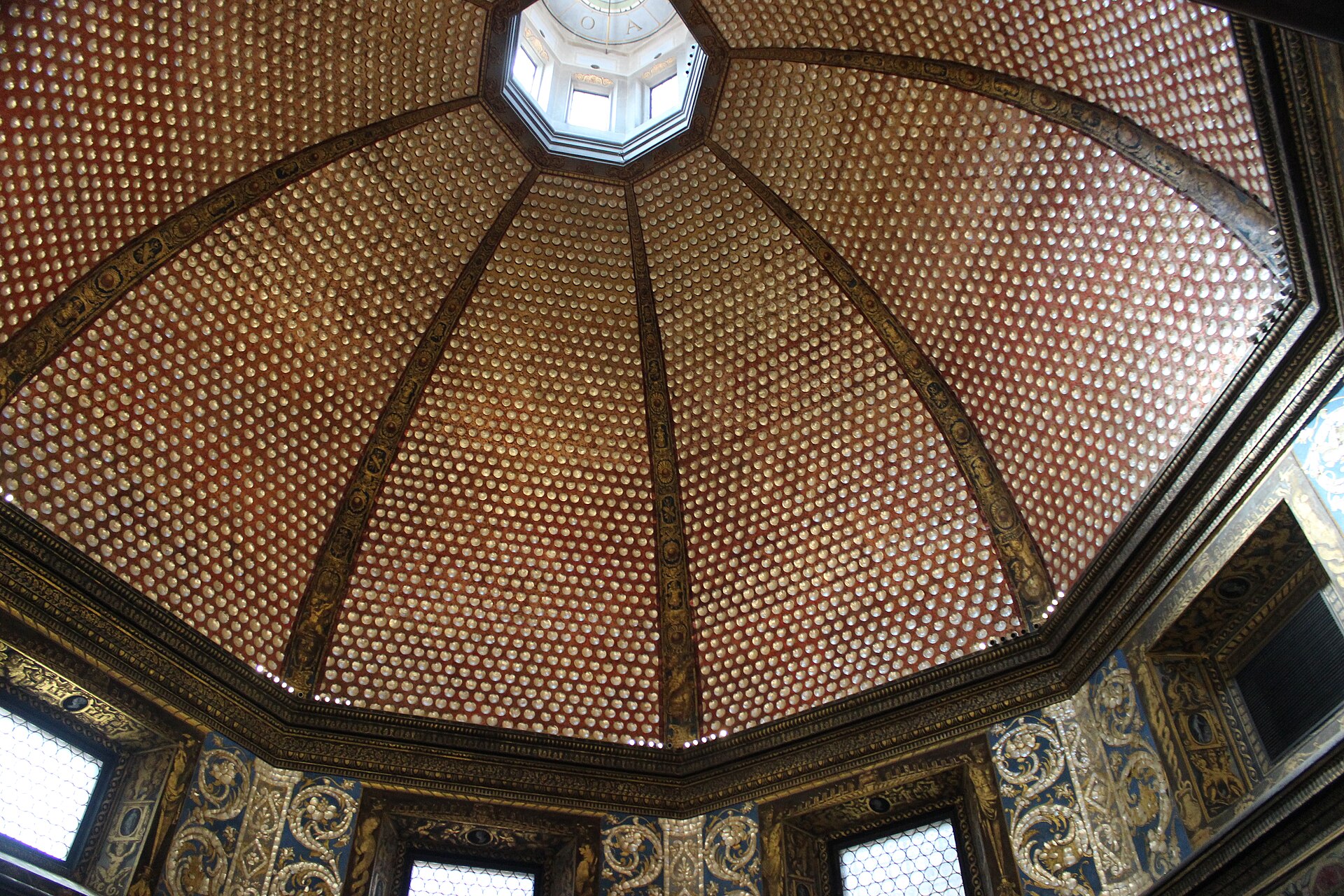
Photograph by MiguelHermoso · CC BY-SA 4.0 The Tribuna
An octagonal room designed by Bernardo Buontalenti for Grand Duke Francesco I de' Medici and completed in 1584, built specifically to display the family's most prized paintings, sculptures and jewels together. Its mother-of-pearl-studded dome made it one of the fixed stops of the Grand Tour, and it still holds the Medici Venus among other pieces.
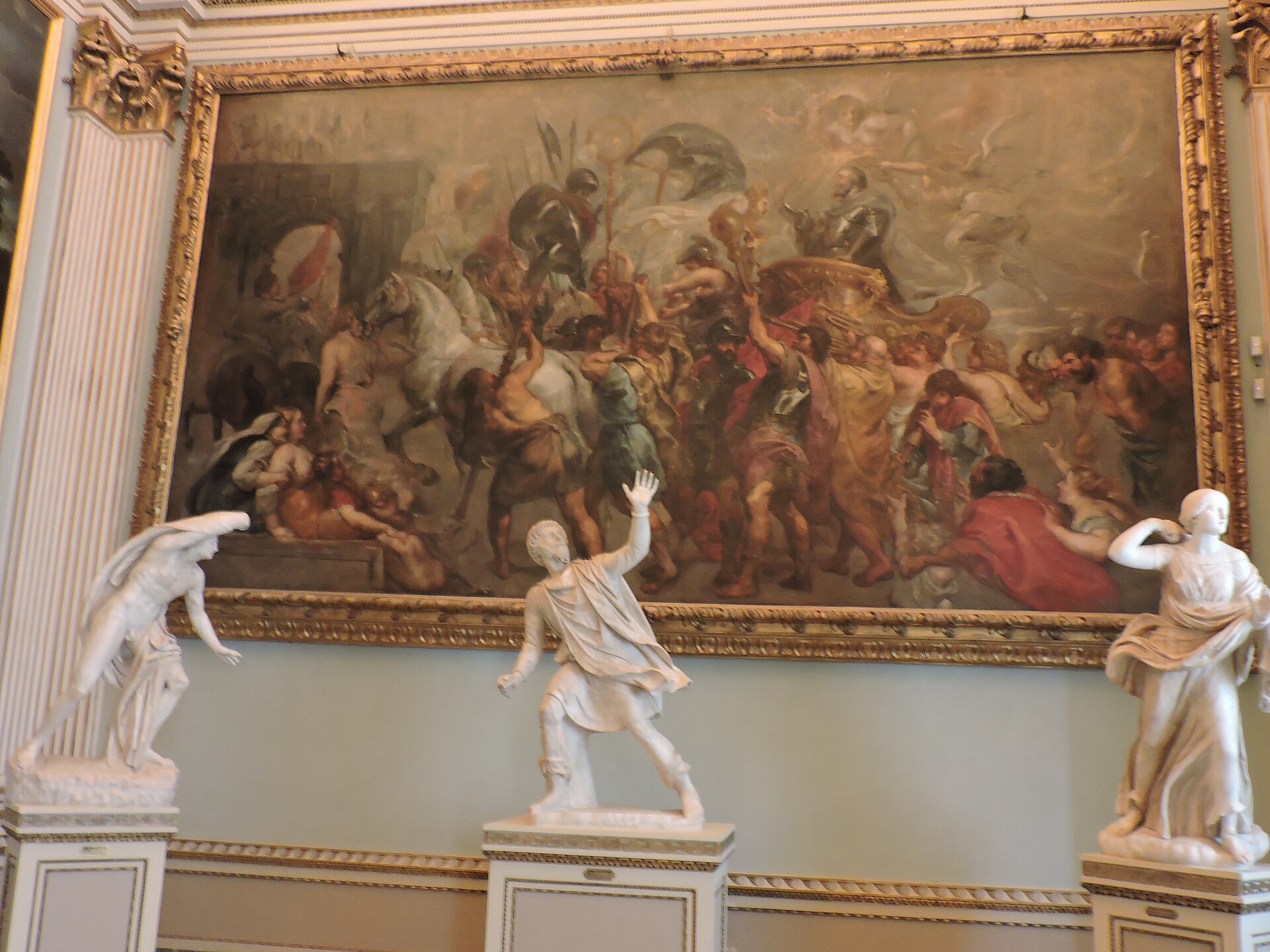
Photograph by Dimitris Kamaras from Athens, Greece · CC BY 2.0 The Niobe Room
A neoclassical hall built in the 1780s to display a Roman marble group depicting the death of Niobe's children, alongside large-format paintings. It took the worst structural and fresco damage of any room in the 1993 Via dei Georgofili car bombing and has since been restored.
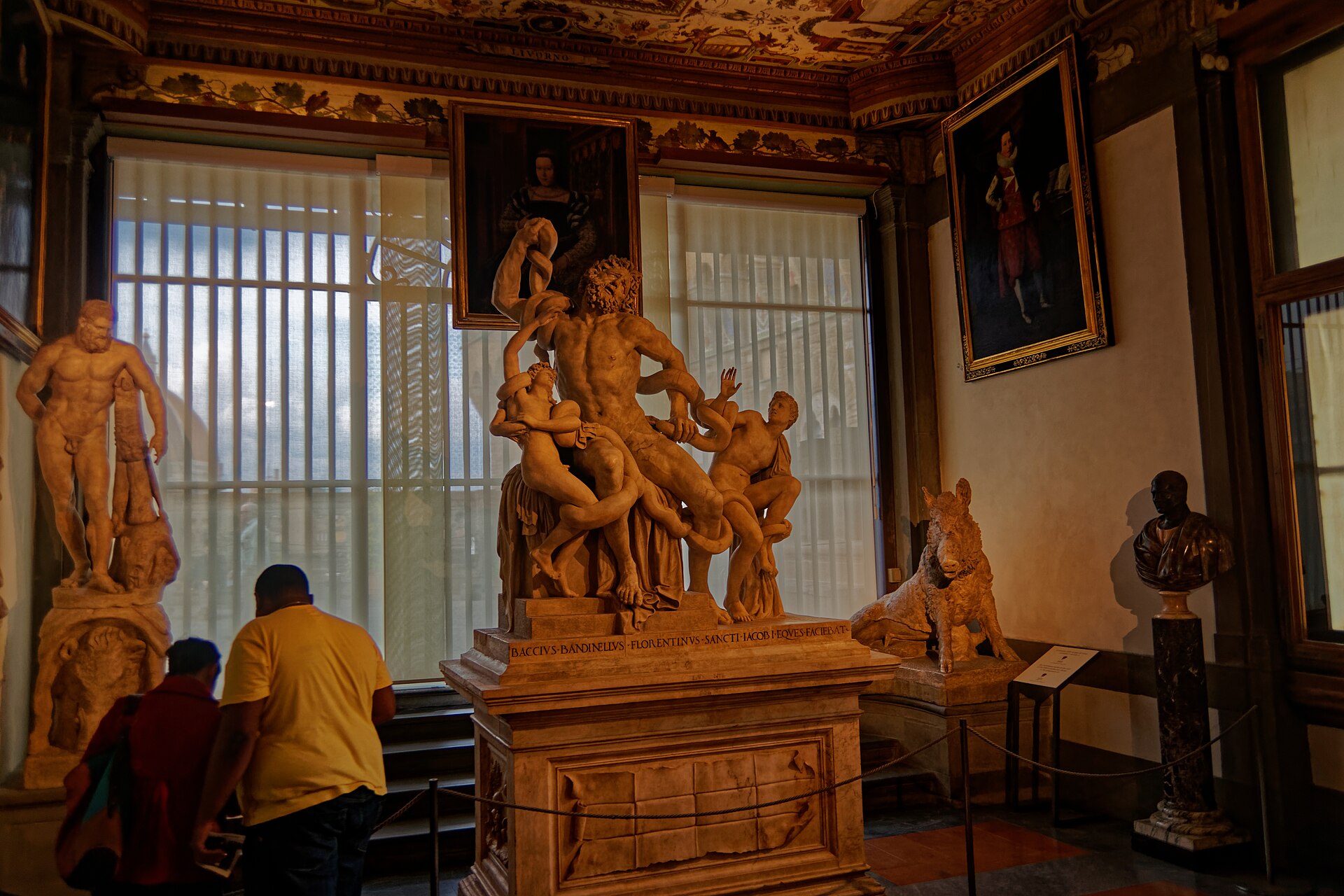
Photograph by Txllxt TxllxT · CC BY-SA 4.0 The Vasari Corridor
An elevated, roughly 750-metre passage built by Vasari in 1565 so the Medici could move between the Uffizi, the Ponte Vecchio and the Pitti Palace without using the street. It carries the gallery's collection of painters' self-portraits. Closed for safety works from 2016, it reopened on a separate, timed and non-refundable ticket.
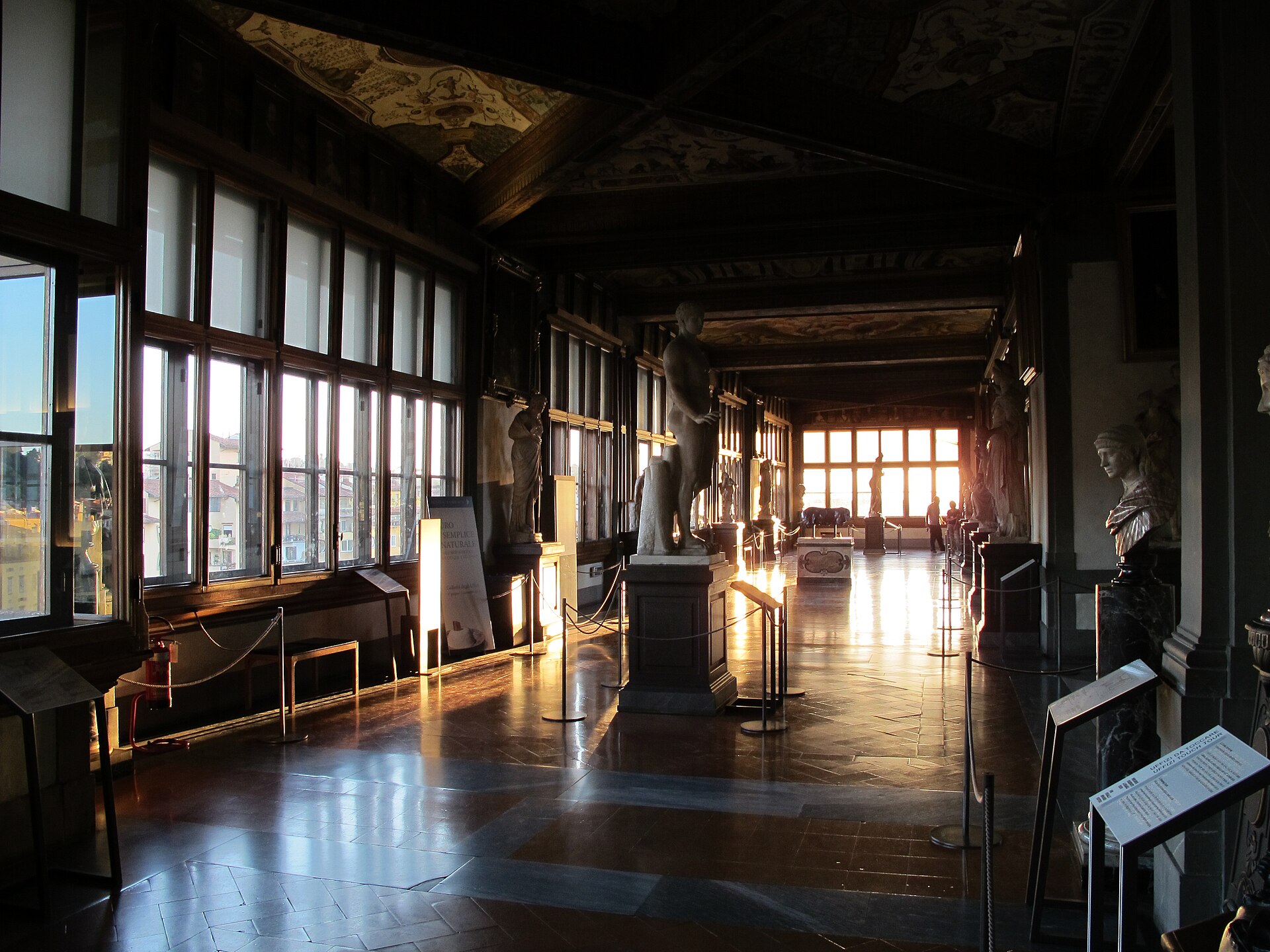
Photograph by Sailko · CC BY-SA 4.0 Second-floor Loggia (the Verone)
An open corridor-gallery on the second floor, part of the same statue-lined circulation system as the ground-floor corridors, with windows giving directly onto the rooftops of the historic centre.
Department of Prints and Drawings, Library and Archives, Photographic Department
The Uffizi's non-display collections: the Gabinetto dei Disegni e delle Stampe (master drawings and prints), the Uffizi Library and Archive, and a Photographic Department whose holdings run from the invention of photography to the present, including the museum's own record of the 1966 flood. None of these study collections is on permanent public display, and no free-licence interior photograph of any of these three departments was found on Wikimedia Commons at the time of writing; none is attached rather than guessed at.
What to see first
The Birth of Venus
Sandro Botticelli, c. 1485One of the two or three most reproduced paintings in Western art and the picture most visitors come to see; it was also the target of a February 2024 climate protest in which activists taped images of Tuscan flood damage to its protective glass.8
Primavera
Sandro Botticelli, c. 1480Botticelli's other Uffizi masterwork, hung in the rooms expanded and reopened in October 2016; targeted by a separate glue protest by climate activists in July 2022.8
Annunciation
Leonardo da Vinci, c. 1472-75One of Leonardo's earliest surviving paintings, produced while he was still working in Verrocchio's workshop, and a key document for tracing his emergence as an independent painter.8
The Holy Family (Doni Tondo)
Michelangelo, c. 1506-08Michelangelo's only surviving panel painting that is universally accepted as fully his own work, and a direct link between his sculpture and his painting.8
Medusa
Caravaggio, c. 1597Painted on a ceremonial jousting shield rather than a conventional support, showing the artist's own features on the severed head; one of the sharpest demonstrations of Caravaggio's theatrical naturalism in the collection.8
Venus of Urbino
Titian, 1538A touchstone of the reclining-nude tradition in European painting, repeatedly cited and reworked by later artists from Manet onward.8
Madonna with the Long Neck
Parmigianino, c. 1535-40, unfinishedThe clearest single statement of Florentine-Roman Mannerism's deliberate distortion of proportion in the collection, left incomplete at the artist's death.8
Medici Venus
Unknown Hellenistic sculptor, Roman marble copyThe single most celebrated object in the Tribuna through the 18th and 19th centuries, and the reason Grand Tour visitors queued to see that one room specifically.6
Exhibitions on now
- On now18 Jun to 31 Dec 2026Confirmed , 7 weeks ago
A palace of offices that became a museum of everything
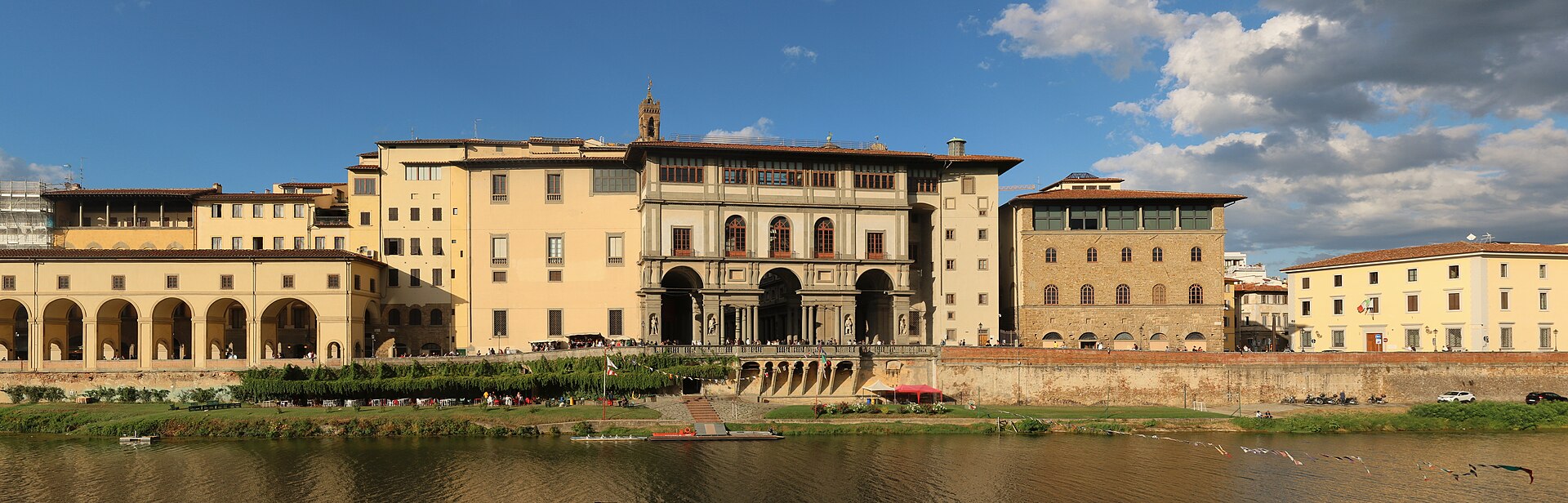
The Uffizi takes its name from the Italian for offices. Giorgio Vasari began the building in 1560 for Cosimo I de' Medici, to gather Florence's scattered administrative bodies, guilds and the state archive under one roof next to the Palazzo Vecchio. Alfonso Parigi and Bernardo Buontalenti carried the work on after Vasari's death, and the building was completed in 1581. Cosimo's son, Grand Duke Francesco I, had the top floor fitted out as a gallery for the family's own collection, and commissioned Buontalenti to design a dedicated octagonal display room, the Tribuna, finished in 1584, built to hold the Medici's most prized paintings, sculptures and jewels together in one space.
The gallery had been shown to visitors by request since the sixteenth century, but it was not officially opened to the public until 1769, and did not formally become a museum in the modern sense until 1865. Its survival as a public institution owes a direct debt to Anna Maria Luisa de' Medici, the last of the family line, who negotiated the Patto di Famiglia bequeathing the Medici art collections to the city of Florence on condition that none of it ever leave the city. The Uffizi is routinely described by historians as one of the first museums in the modern sense of the word: a princely collection deliberately kept together and opened to a public rather than dispersed among heirs.
The collection: from Giotto to Caravaggio, and the marble in between
The painting galleries run in a broadly chronological sequence through the Uffizi's historic rooms, from the great gold-ground altarpieces of the Duecento and Trecento (Cimabue, Duccio, Giotto) through the Quattrocento masters (Piero della Francesca, Filippo Lippi, Botticelli, the young Leonardo working out of Verrocchio's workshop), into the High Renaissance (Michelangelo, Raphael, Titian) and Florentine-Roman Mannerism (Parmigianino), and on to Caravaggio and the early Baroque. Running alongside the Italian material is a substantial holding of German, Dutch and Flemish painting, including work by Durer.
What separates a visit to the Uffizi from a visit to a picture gallery alone is the sculpture. The long corridors built by Vasari to connect the two wings are themselves lined, floor to cornice, with ancient Roman marble the Medici collected: portrait busts of emperors, Roman copies of lost Greek originals such as the Wrestlers and the Sleeping Eros, and the Medici Venus, which by the eighteenth century had become the single most celebrated object in the building, drawing Grand Tour visitors to the Tribuna specifically to see it. The Niobe Room, a neoclassical hall added in the 1780s, gathers a further Roman marble group depicting the death of Niobe's children under large-format paintings; it took the worst damage of any room in the building during the 1993 car bombing described below, and has since been fully restored.
The corridors: ancient marble and the Vasari Corridor
Beyond the display corridors inside the Uffizi itself, Vasari built a second, more famous corridor in 1565: an elevated passage roughly 750 metres long, connecting the Uffizi across the Ponte Vecchio to the Pitti Palace, so the Medici could move between their offices, their bridge and their residence without descending into the street. The Vasari Corridor carries the gallery's collection of painters' self-portraits and is, structurally, part of the Uffizi building even though it now sells as a separate, mandatory-reservation ticket bolted onto a standard Uffizi admission. It was closed for safety works in 2016 and has since reopened to visitors.
The corridor and its collection came close to being lost twice in the twentieth century. During the November 1966 flood, when the Arno overtopped its banks and put more than a metre of water and heating-oil-laced mud through the historic centre, Uffizi staff worked through the emergency to strip the self-portrait collection out of the low-lying, structurally exposed Corridor and carry paintings up to the building's higher floors; the museum's own Photographic Department, on the ground floor, had over 20,000 negatives submerged in the process. Superintendent Ugo Procacci led the recovery. Then, on 27 May 1993, the Sicilian Mafia detonated a car bomb on the Via dei Georgofili immediately behind the Uffizi, killing five people and destroying five works of art outright while damaging around thirty more; the Niobe Room and the building's neoclassical interior took the heaviest structural damage, and some of its frescoes were damaged beyond repair.
Flood, bomb, and glue: what the building has survived, down to the present day
More recently, the building has become a recurring target for climate protest rather than physical attack. On 22 July 2022 two activists from the group Ultima Generazione glued their hands to the protective glass over Botticelli's Primavera and unfurled a banner reading No Gas No Carbone before being removed by security and police; the painting itself was undamaged, as the glass covering is designed to take exactly this kind of contact. On 13 February 2024 a further pair from the same movement taped photographs of the previous year's fatal Tuscan floods to the glass protecting Botticelli's Birth of Venus, under a banner reading Fondo Riparazione (Repair Fund), protesting the Italian government's response to climate-driven flooding; the room reopened within about fifteen minutes and the painting was again undamaged.
Set against a 460-year run that includes a mafia bombing and a citywide flood, two removable glue protests are a minor entry in the building's own history, but they are also the most recent additions to it, and visitors researching the Botticelli rooms are as likely to find the 2022 and 2024 incidents as the paintings' own history when they search.
Visiting today: tickets, timing and the crowd problem
The Uffizi is Italy's most-visited art museum: over two million visitors in 2016 and 5,294,968 in 2024, second only to the Colosseum Archaeological Park among all Italian state museums and cultural sites ranked by the Ministry of Culture, and ahead of the Pompeii Archaeological Park in third place. The Colosseum and Pompeii rankings are both archaeological parks rather than art museums, which is why this record calls the Uffizi Italy's most-visited art museum rather than its most-visited cultural site outright. That popularity is the single biggest factor shaping an actual visit. Consulted reporting and visitor accounts converge on the same advice: without a pre-booked, timed entry, queues in peak season (roughly April through September) can run to several hours, and the free first-Sunday-of-the-month openings draw crowds heavy enough that most experienced visitors recommend paying for a normal ticket instead. A 2018 overhaul of the booking system was explicitly built to cut queueing from hours to minutes for anyone who books ahead, and that remains the core piece of practical advice for a first-time visitor: book a time slot before travelling, and expect a materially different, faster visit than someone queueing on the day.
Ticket pricing itself is not a single number and has not been stable. The standard adult admission was raised from EUR20 to EUR25 in 2023, a 25 percent increase the museum attributed to rising energy costs, which drew public pushback at the time from at least one named Italian art historian and from the director of Florence's own Galleria dell'Accademia, who said she had no plans to follow suit. As of this record, current admission (fetched directly from the museum's own ticketing page) is a flat EUR25 same-day / EUR29 advance-booking rate with no separate high- and low-season prices displayed, plus a new EUR16 (on-site) or EUR20 (online) afternoon-entry tier for anyone entering from 4pm, introduced from 1 January 2026. Combined tickets covering the Uffizi, Pitti Palace and Boboli Gardens, and an add-on for the Vasari Corridor, sit on top of that base price and are listed in full in the admission table above rather than compressed into one headline figure, because the museum's own ticketing genuinely is that layered.
What is not settled
Two things are worth flagging rather than smoothing over. First, sources disagree at the margins on the death toll of the 1993 Via dei Georgofili bombing: the Uffizi's own account and a Wikipedia summary of it give five dead, while a contemporary New York Times headline referenced in the same summary gives six; this record follows the more specific figure but has not resolved the discrepancy against the original 1993 wire reporting. Second, the museum's current ticketing page, as fetched for this record, shows no explicit high-/low-season price split, which is a change from the season-based structure reported in earlier journalism covering 2018 to 2023; whether that split was formally dropped, folded into the new afternoon-entry tier, or simply not restated on the page fetched, is not established here and should be re-checked at the next review.
What visitors say
Consulted sources agree the Uffizi holds one of the two or three most important collections of Italian Renaissance painting anywhere, and that this is not seriously contested. Where opinion divides is on the visiting experience: praise for the collection itself is close to universal, but a large share of independent commentary and visitor feedback centres on crowding, queueing and a repeatedly restructured and increasingly expensive ticketing system.
What is praised, what is criticised
- Praised: the density and quality of the Renaissance painting collection, run in an unbroken chronological sequence from the Duecento to Caravaggio that few single galleries anywhere can match
- Praised: the sculpture-lined corridors themselves, which visitors and critics alike single out as a striking space independent of any one painting hung in them
- Criticised: peak-season crowding: queues have been reported running to several hours (particularly April-September and on free first Sundays) for anyone without a pre-booked timed ticket, with the Botticelli and Leonardo rooms in particular becoming standing-room-only
- Criticised: a ticketing system that has been restructured and repeatedly raised in price since 2018 (season-based pricing, then a flat EUR20-to-EUR25 rise in 2023, then a further afternoon-entry tier from January 2026), which drew public criticism from Italian art historians and rival museum directors when the 2023 increase was announced
Ratings on other platforms
Tripadvisor: 4.6 from 39,727 ratings, read 19 August 2026
A platform average is a tertiary source: it moves, it is not audited, and we quote no visitor's words.
Questions about Uffizi Gallery
Where is Uffizi Gallery?
Piazzale degli Uffizi 6, 50122 Florence, Italy.
How much does it cost to visit?
Regular, purchased on the day: EUR 25; Regular, purchased in advance: EUR 29; Afternoon entry, from 4pm (effective 1 January 2026): EUR 16; Reduced: EUR 2; Free admission: free. As confirmed 19 August 2026.
When is it open?
Tue-Sun 08:15-18:30. Closed: Monday. 1 January. As confirmed 19 August 2026.
What should you see first?
The Birth of Venus (Sandro Botticelli, c. 1485); Primavera (Sandro Botticelli, c. 1480); Annunciation (Leonardo da Vinci, c. 1472-75); The Holy Family (Doni Tondo) (Michelangelo, c. 1506-08); Medusa (Caravaggio, c. 1597); Venus of Urbino (Titian, 1538).
What we could not confirm
- The exact death toll of the 27 May 1993 Via dei Georgofili bombing is given as five in the Uffizi's own account and a Wikipedia summary, and as six in a contemporary New York Times headline referenced by the same summary; not resolved against the original 1993 reporting for this record.
- The museum's ticketing page as fetched on 19 August 2026 shows no explicit high-/low-season price split, unlike the structure reported in journalism covering 2018-2023; whether that split still exists elsewhere on the site, was folded into the new afternoon-entry tier, or was dropped, is unresolved here.
- No free-licence interior photograph of the Department of Prints and Drawings, the Library and Archive, or the Photographic Department was located on Wikimedia Commons at the time of writing; do not substitute a different room's photograph for these three.
Images
Sources
- 1Uffizi Galleries, official site, homepage uffizi.it/en
- 2Uffizi Galleries, Tickets page (admission and combined-ticket structure) uffizi.it/en/tickets
- 3Uffizi Galleries, "The Uffizi" (hours, history, services, collections index) uffizi.it/en/the-uffizi
- 4Uffizi Galleries, Free and reduced-price ticket eligibility uffizi.it/en/pages/free-and-reduced-tickets
- 5Uffizi Galleries, Contacts page uffizi.it/en/contacts
- 6Uffizi Galleries, The Uffizi: Sculpture collection page uffizi.it/en/the-uffizi/sculpture
- 7Uffizi Galleries, Vasari Corridor page uffizi.it/en/corridoio-vasariano
- 8Wikipedia, "Uffizi" (history, incidents, key works, visitor figures), en.wikipedia.org/wiki/Uffizi
- 9The Art Newspaper, "Uffizi's ticket price hike sparks debate", 13 April 2023 theartnewspaper.com/2023/04/13/uffizis-ticket-price-hike-sparks-debate
- 10Tripadvisor, Le Gallerie Degli Uffizi attraction page (aggregate rating), , read 19 August 2026 tripadvisor.com/Attraction_Review-g187895-d191153-Reviews-Le_Gallerie_Degli_Uffizi-Florence_Tuscany.html
- 11Uffizi Galleries, "The 1966 flood's damages to the art heritage of Florence" uffizi.it/en/artworks/1966-flood-damages-to-art-in-florence
- 12Uffizi Galleries, The Uffizi: Painting collection page uffizi.it/en/the-uffizi/painting
- 13Florence Daily News, "Uffizi Confirmed as Italy's Second Most Visited Museum in 2024", 15 May 2025, reporting Italian Ministry of Culture rankings: 5,294,968 visitors, second place among state museums and cultural sites behind the Colosseum Archaeological Park florencedailynews.com/2025/05/15/uffizi-confirmed-as-italys-second-most-visited-museum-in-2024/
- 14finestresullarte.info, "The most visited state museums in 2024: the ranking. Colosseum, Uffizi and Pompeii the top three", corroborating the same Ministry of Culture figures: 5,294,968 accesses for the Uffizi Galleries, second place finestresullarte.info/en/museums/the-most-visited-state-museums-in-2024-the-ranking-colosseum-uffizi-and-pompeii-the-top-three