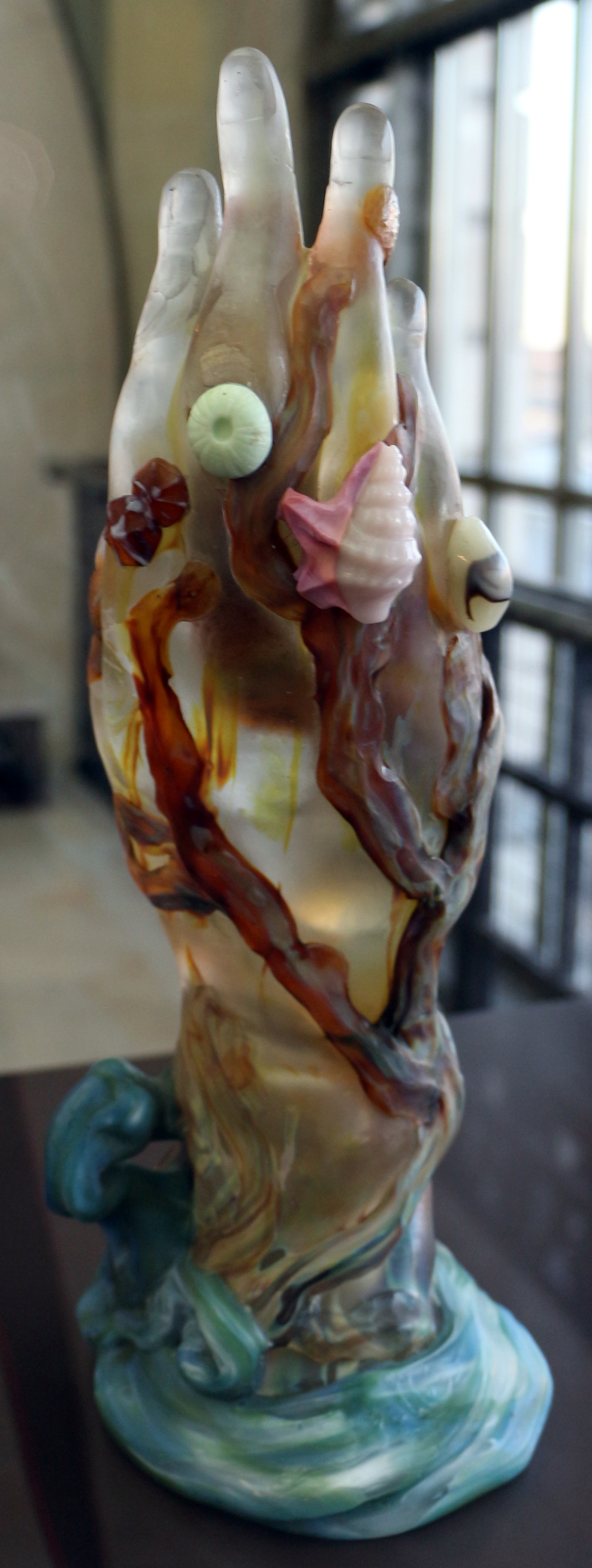
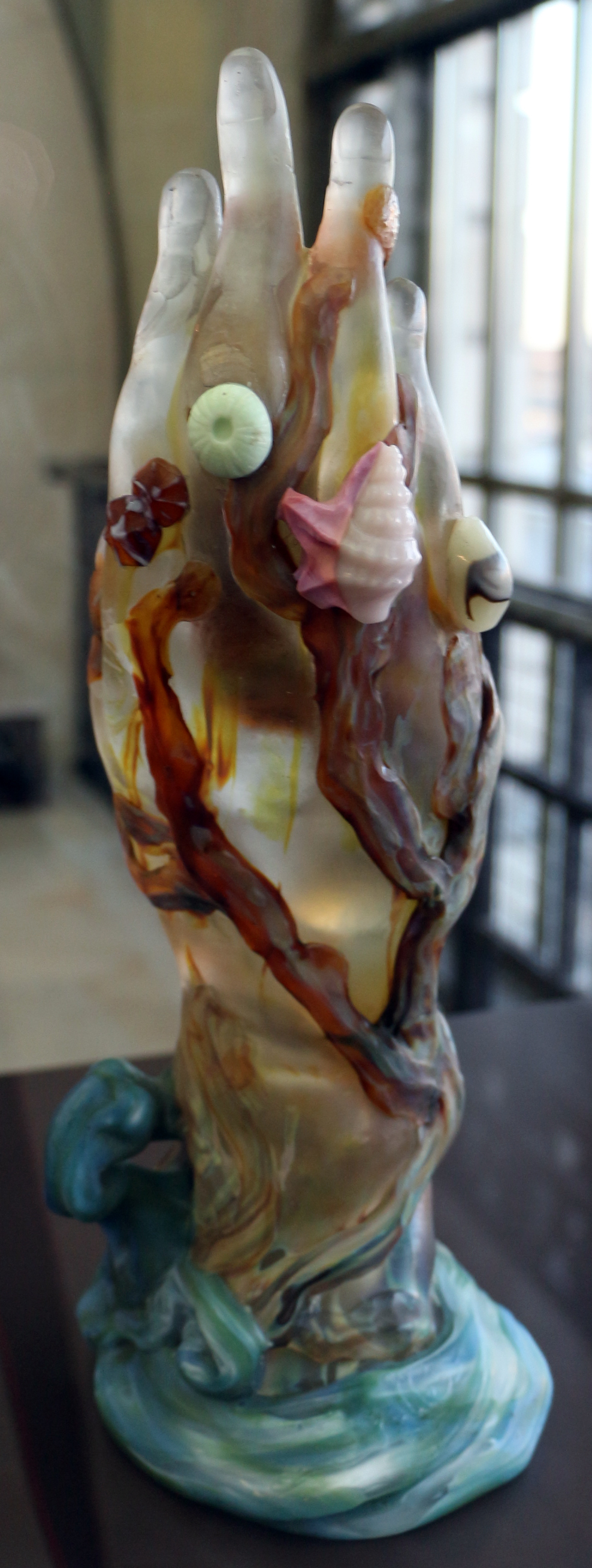
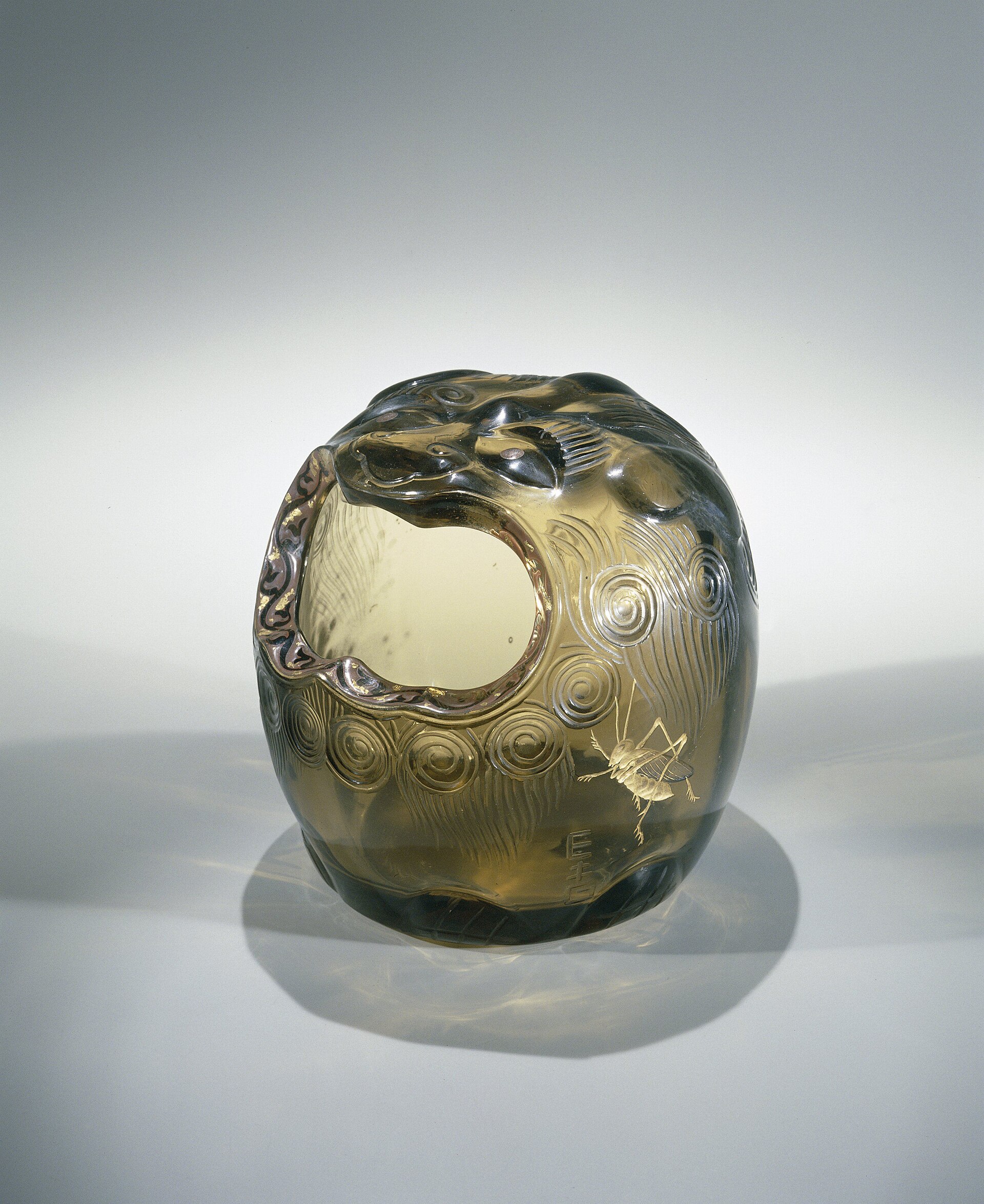
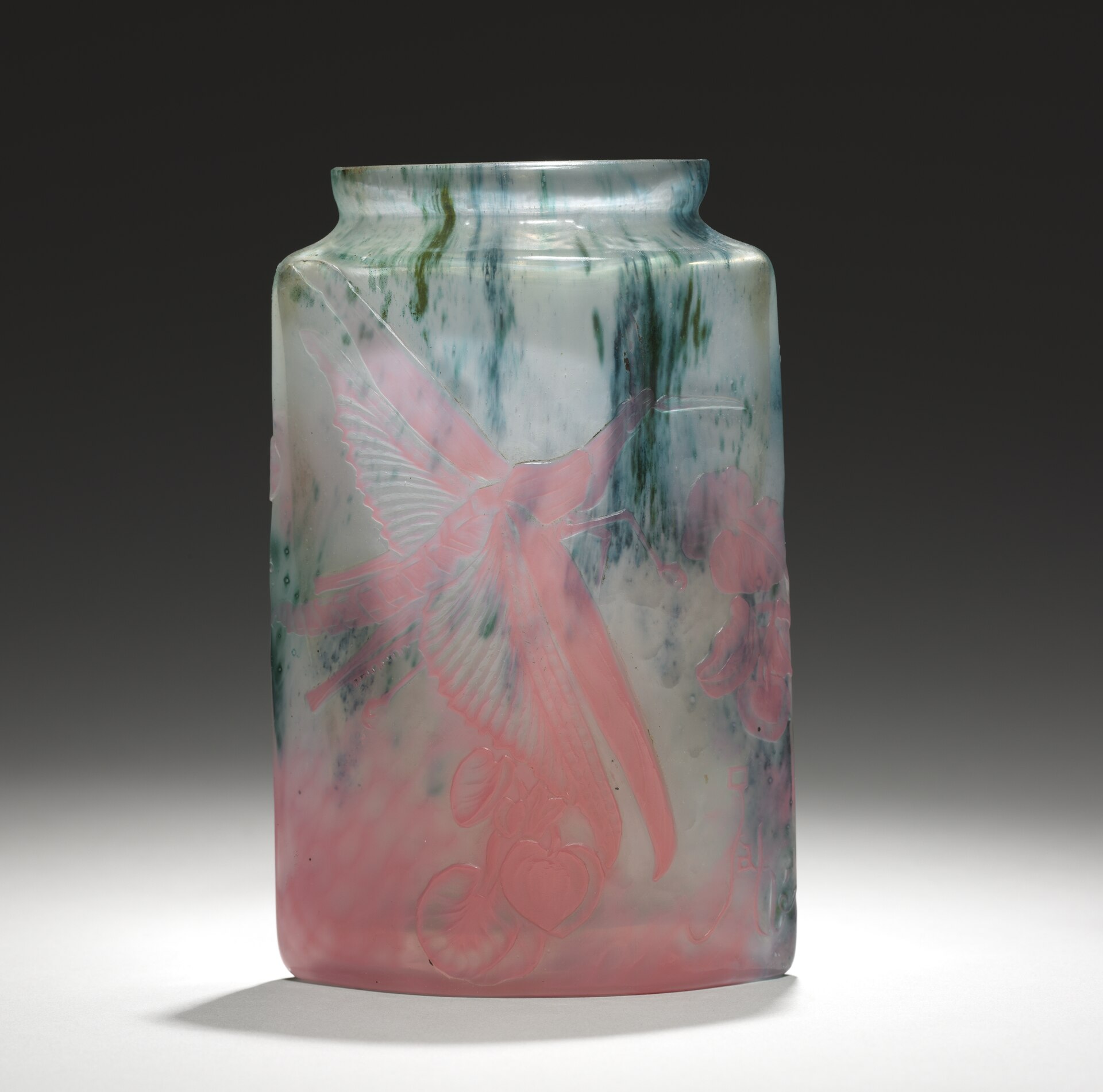
La Main aux algues et aux coquillages
1904 · Crystal
Musee d'Orsay
 French · 1846-1904
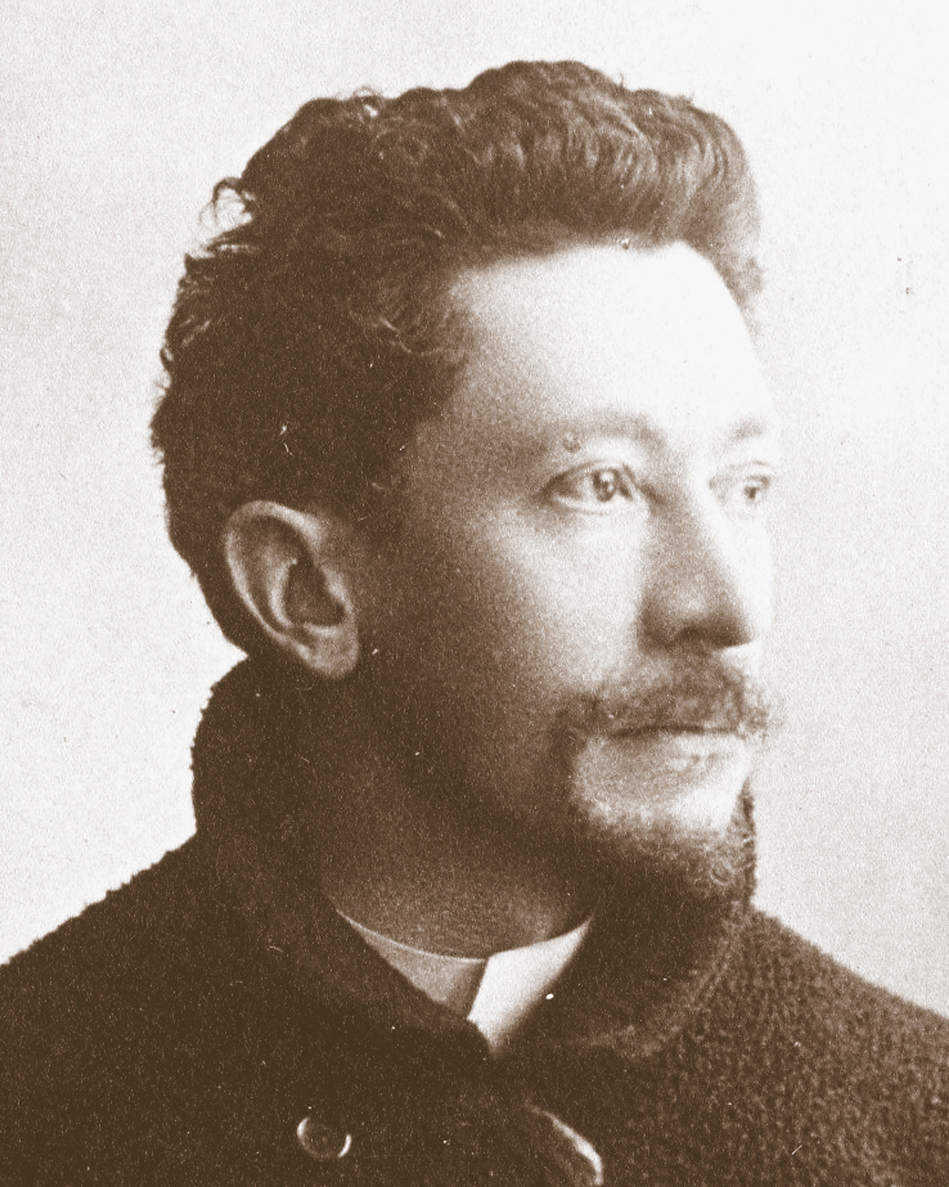
A photograph attributed to H. Duffray, taken in 1889 and used by Galle himself as his exhibitor's identification card for that year's Paris Exposition Universelle, the exposition at which he first won wide recognition. Because Galle selected this specific image to represent himself for an official, dated purpose, the identification is as secure as a photographic portrait of this period gets.
Public domain, via Wikimedia Commons. Attributed to H. Duffray, 1889.| Full name | Charles Martin Emile Galle |
|---|---|
| Worked as | Glassmaker, Furniture designer, Ceramicist, Founder, Ecole de Nancy |
| Born | 4 May 1846 · Nancy, France |
| Died | 23 September 1904 · Nancy, France |
| Nationality | French |
| Movement | Art Nouveau |
| In this archive | 3 artworks |
| Sources | 28 cited |
| Last verified | 17 September 2026 |
About this page 3 artworks in the archive · Last verified 17 September 2026 · 28 sources cited
Emile Galle signed his name on glass and furniture for twenty-six years, from 1878 to his death in September 1904. The workshop that carried his name kept signing it for thirty-two years after that, until 1936, and the best current archival estimate puts total glass production alone at somewhere between nine hundred thousand and 1.3 million pieces across the whole run. Almost none of that is in the ordinary account of Galle as an Art Nouveau flower-glass designer, and it is the single fact a buyer or a student most needs before anything else: an object signed Galle is evidence of a firm's authorship across four decades and at least three distinct regimes of production, not proof that one man made it.
What makes Galle unusually well documented, for a maker in this position, is that the firm tried to solve the problem once, openly, and then abandoned the solution because it cost money. From no earlier than January 1905 to May 1908 the Etablissements Galle marked its posthumous production with a star before the signature, specifically so a buyer could tell that Emile Galle was dead when a given piece was made. Clients began treating the marked pieces as somehow lesser, and within three years the firm dropped the star. That decision, redated from family correspondence only in 2020, is close to the whole authentication problem in miniature: an honest disclosure the market punished, on an object type where most buyers cannot otherwise tell a 1901 vase from a 1911 one.
Galle was also, on his own account and in a printed lecture he gave in 1900, working a second register at the same time. A thistle cut into a piece of Nancy glass reads, to anyone who knows what Lorraine's arms carry, as regional and post-1871 political speech rather than botanical illustration. A line of Baudelaire inlaid into a writing desk was Galle's own documented practice, not a later reader's projection. And between 1898 and 1901 he made and gave away glass explicitly in support of Alfred Dreyfus, a body of work that most of the market literature on him does not mention at all.
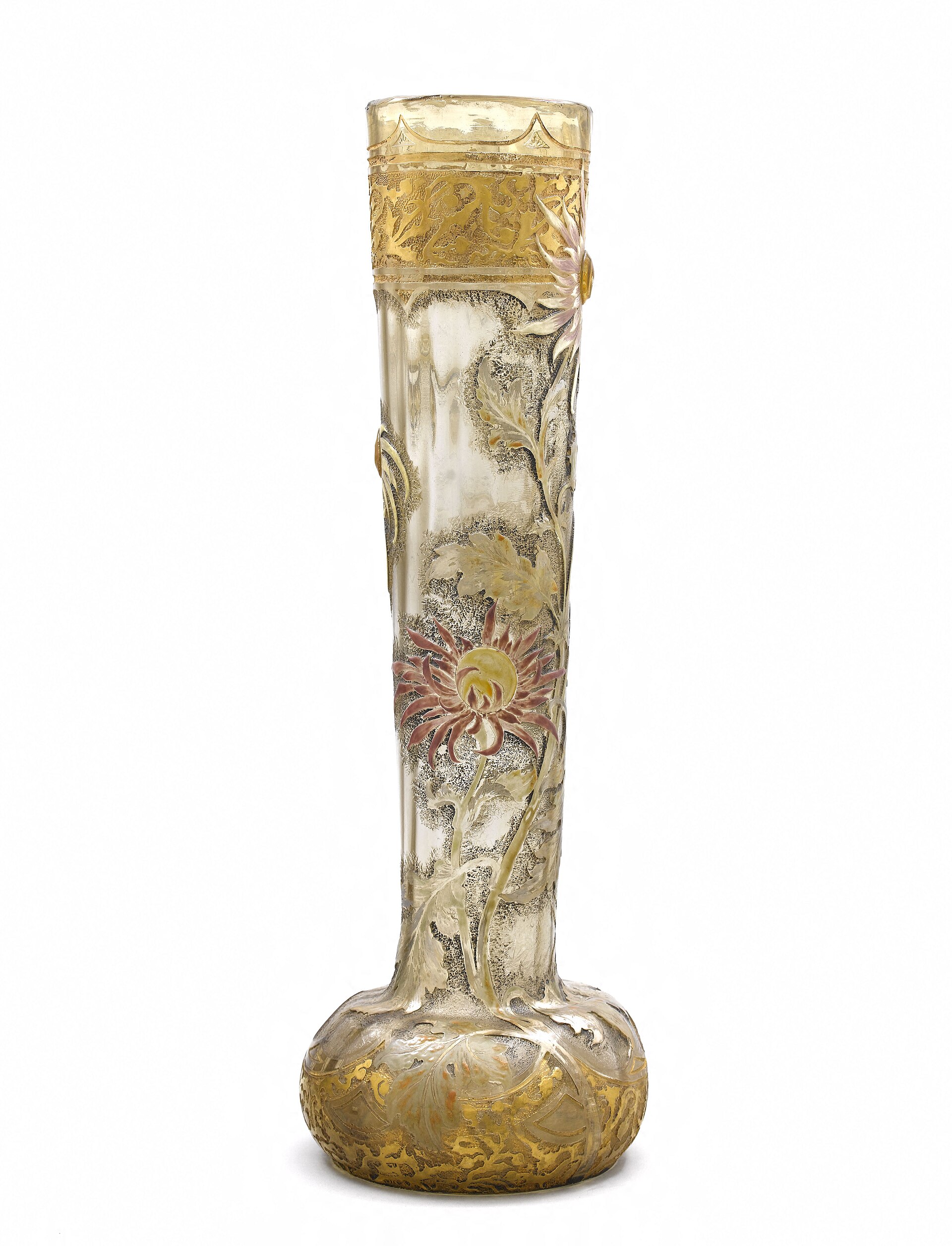
1904 · Crystal
Musee d'Orsay
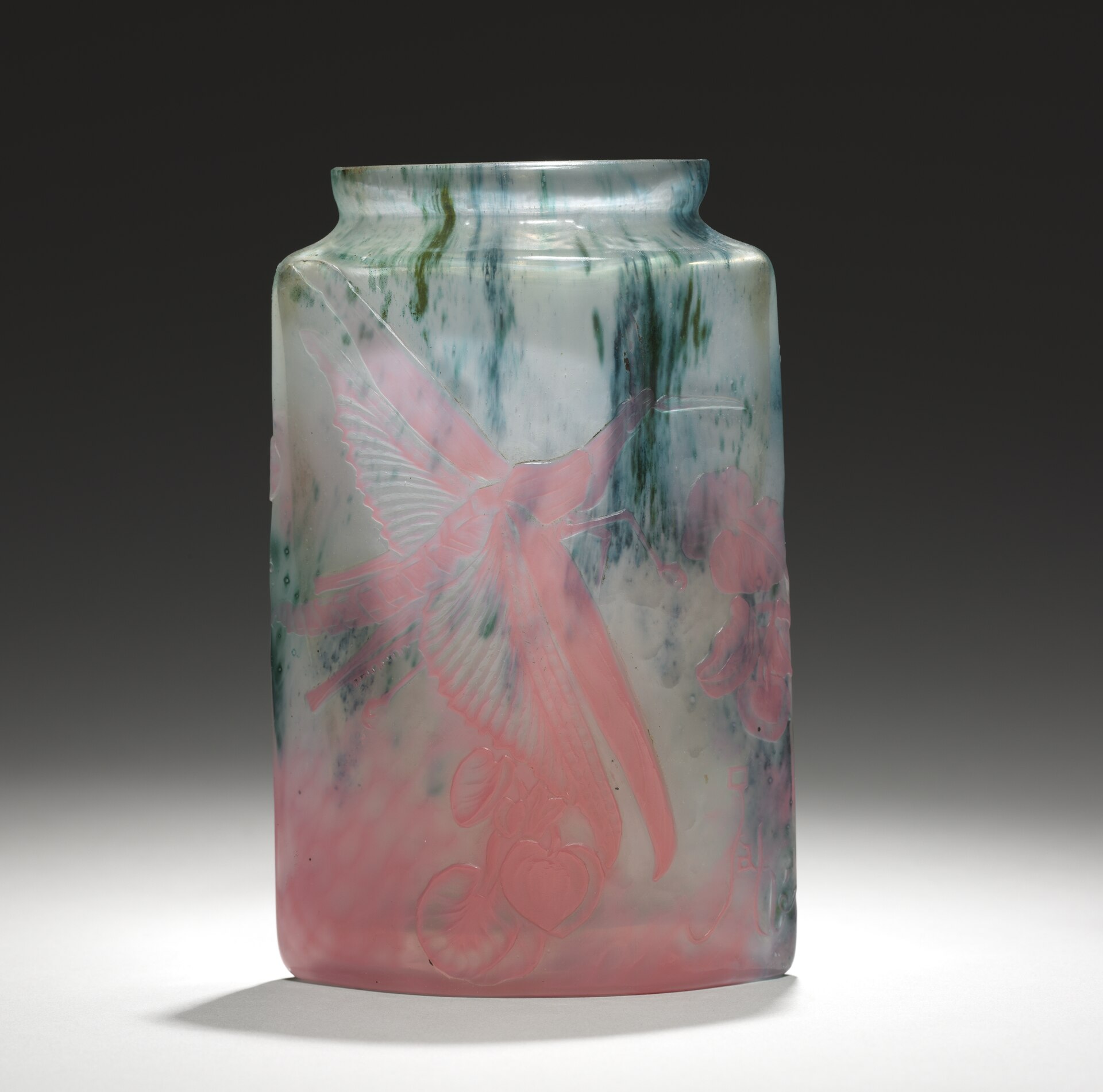
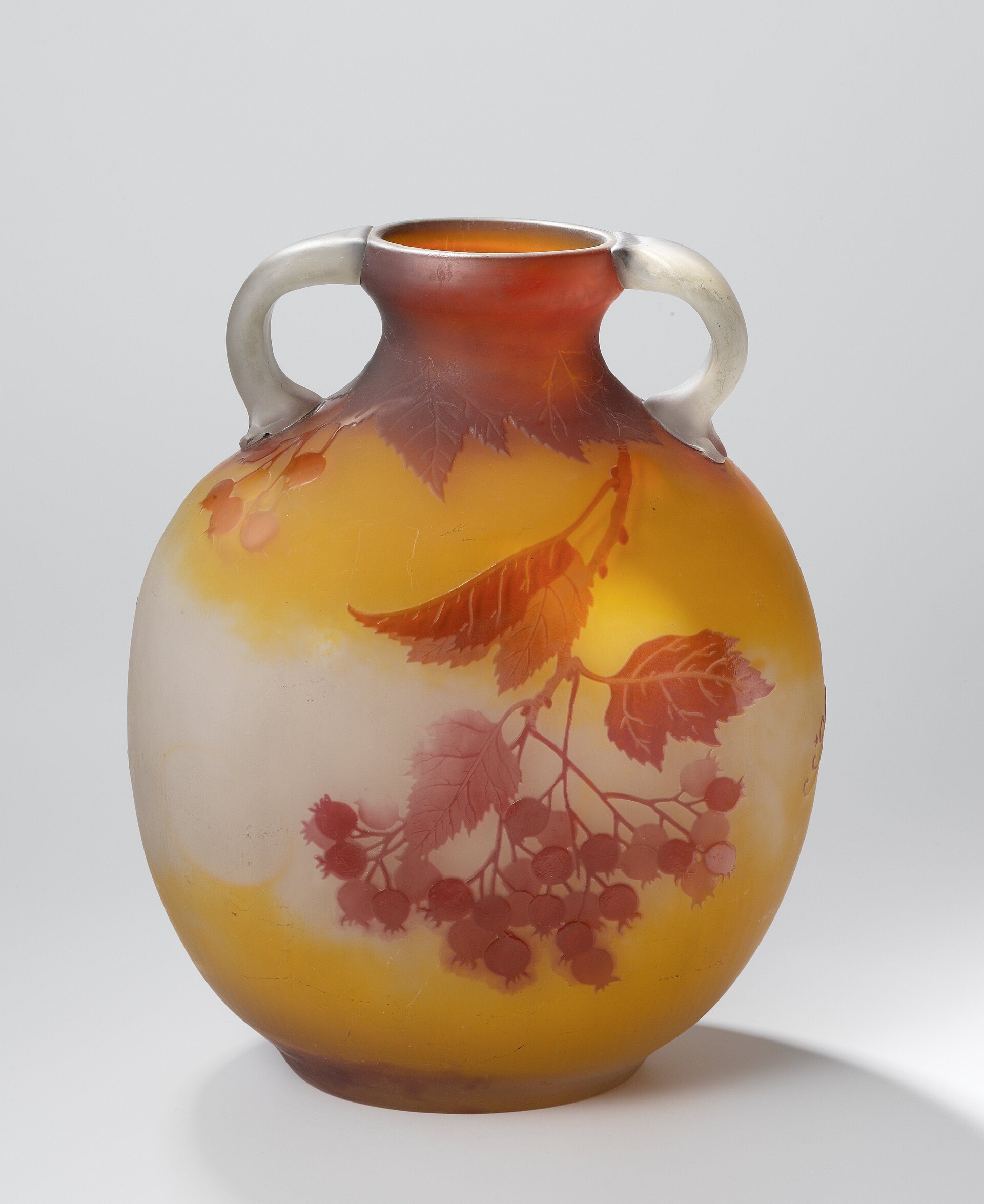
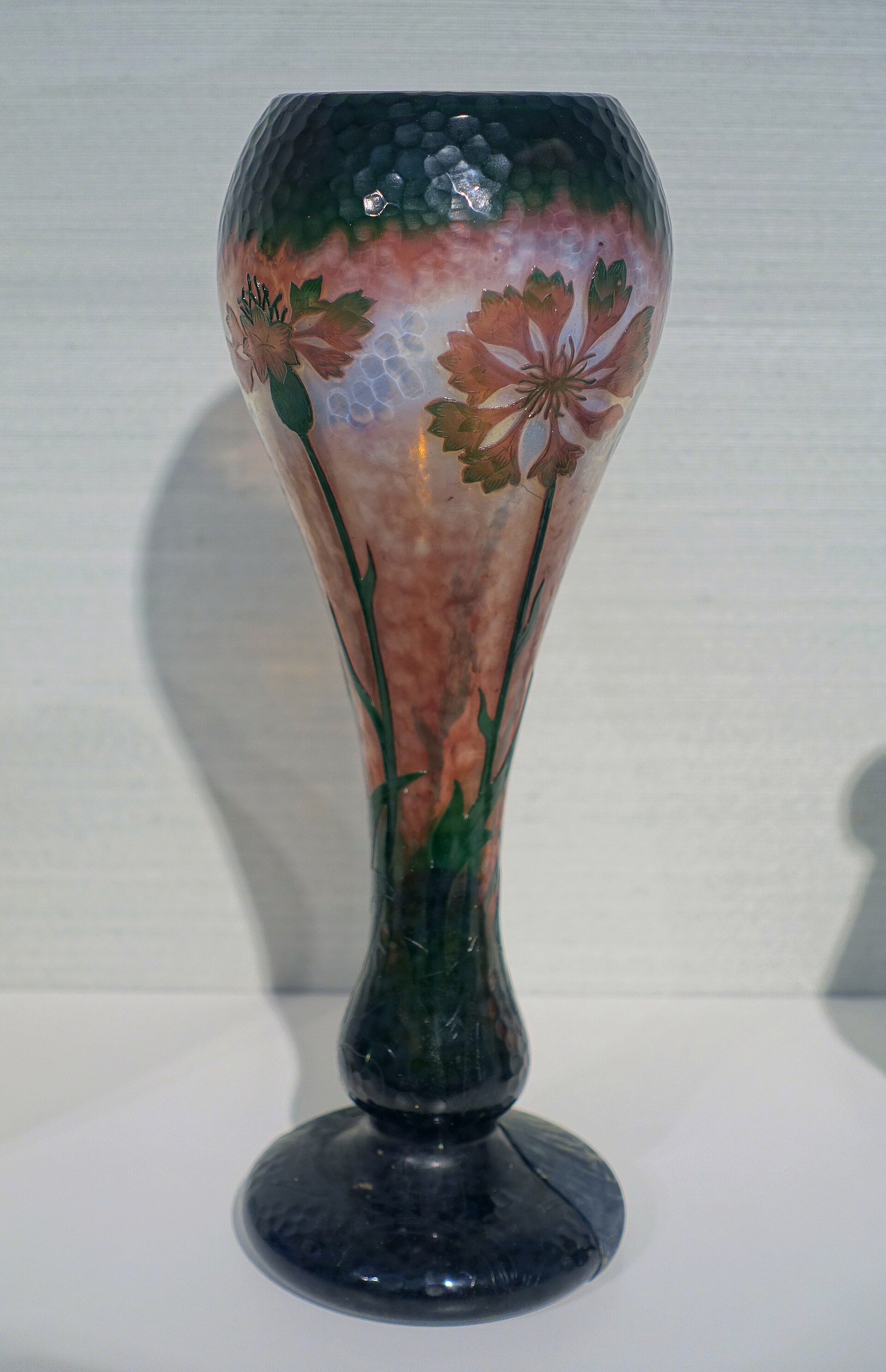
c. 1900 · Glass with pink and green inclusions
Cleveland Museum of Art, Gallery 221, 19th Century Decorative...
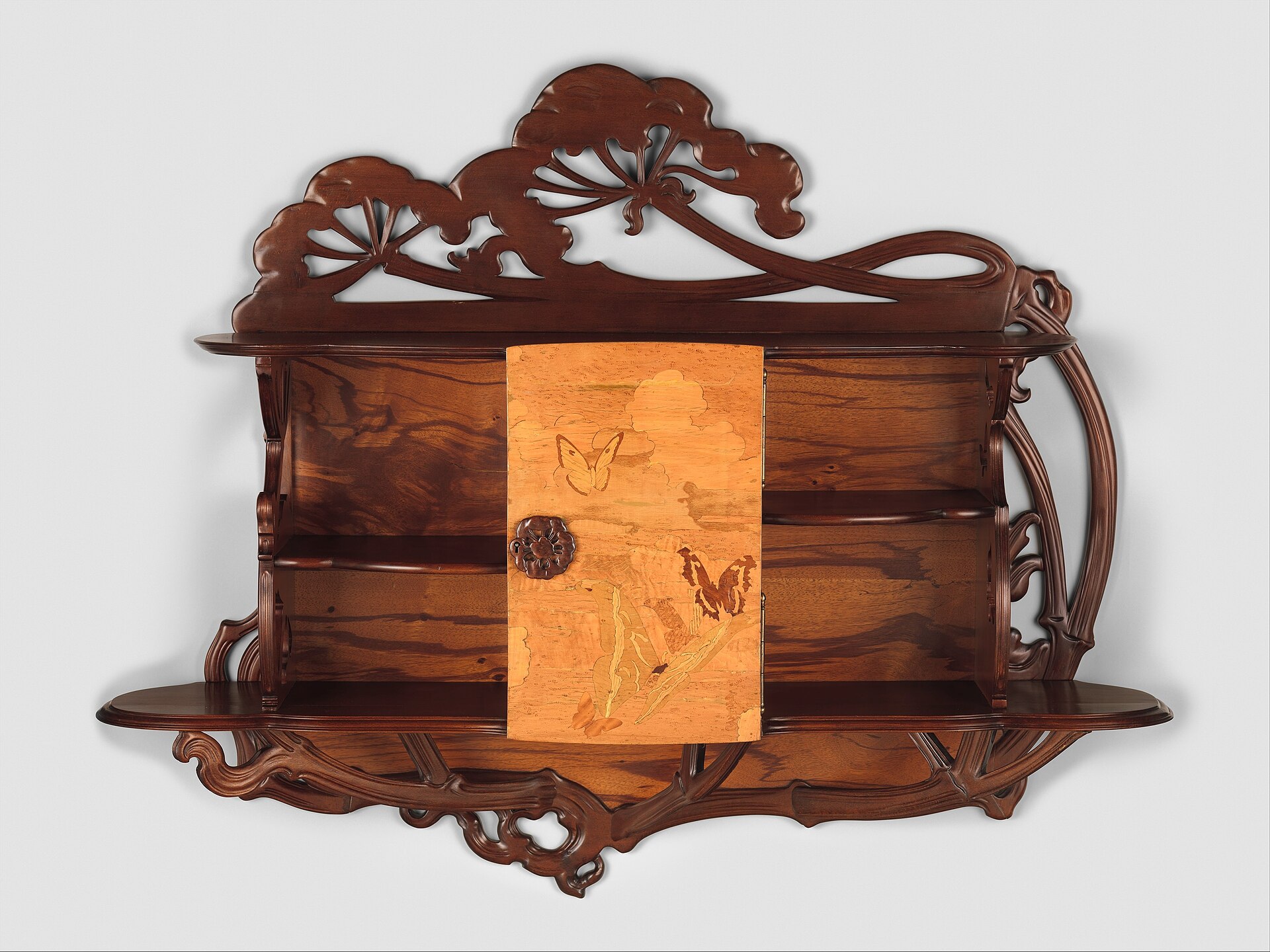
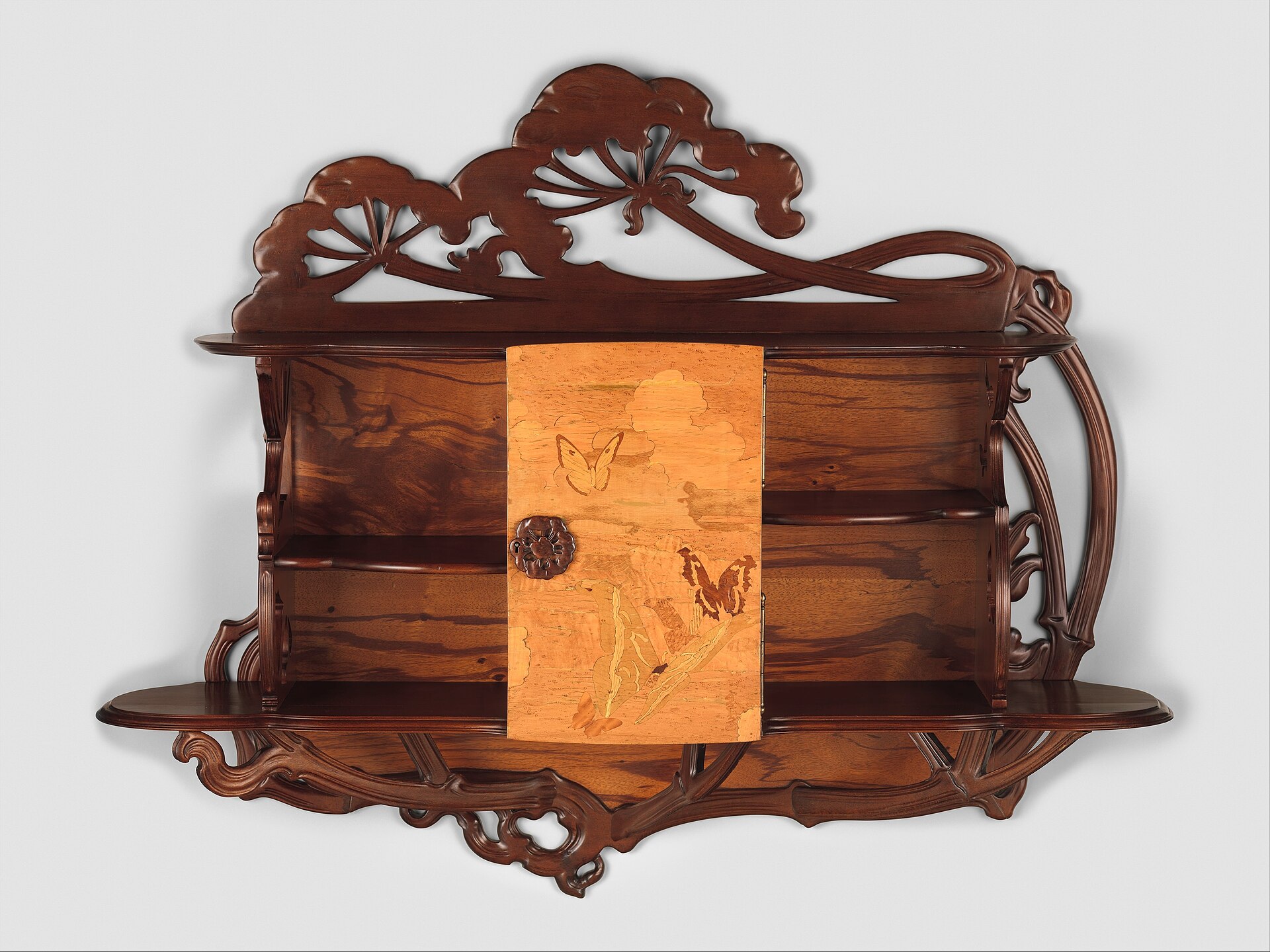
ca. 1900 · Case and carved elements in stained beech
Born in Nancy on 4 May, son of Charles Galle and Fanny Reinemer.12
Studies philosophy and botany at the Lycee Imperial in Nancy under D. A. Godron; pursues mineralogy in Weimar.12
Apprentices at the Burgun, Schverer et Cie glassworks, Meisenthal, studying glass chemistry.12
Serves in the 23rd Infantry Regiment during the Franco-Prussian War.12
Alsace and part of Lorraine are annexed to the German Empire; Galle designs a caricature series of faience plates mocking the occupation.12
Takes over management of his father's glass, faience and mirror business.12
Marries Henriette Grimm, daughter of a Protestant pastor from Bischwiller in annexed Alsace; opens his own workshop, La Garenne, in Nancy.1
First exhibits at the Paris Exposition Universelle, showing cobalt-blue moonlight glass and pottery; wins a bronze medal.1
Shows the table Le Rhin and the vases Vercingetorix and Jeanne d'Arc at the Paris Exposition Universelle.12
Files (April) and is granted (12 August) a fifteen-year patent on marqueterie de verre.1
Produces and distributes glass in support of Alfred Dreyfus, including vases dedicated to leading Dreyfusards; the Reinach hippocampus vase is dated 1901.11
Delivers Le Decor symbolique as his reception address to the Academie de Stanislas, Nancy, on 17 May; assembles Dreyfusard glass in a furnace-form stand at the Paris Exposition Universelle.11
Founds the Ecole de Nancy (Alliance Provinciale des Industries d'Art) and drafts its articles of association.23
Dies of leukaemia in Nancy on 23 September, aged 58. Direction of the firm passes to his widow, Henriette Galle.12
Henriette Galle introduces the star mark on posthumous production, no earlier than January.5
The star mark is withdrawn in May after clients began treating marked pieces as lesser.5
Henriette Galle dies; the firm continues under family and administrative direction, including her son-in-law Paul Perdrizet.15
The design team is dismissed in late 1930.6
The main furnace closes, the date usually given in general accounts for the firm's end.6
Production actually ends, a correction to the 1931 date established by Francois Le Tacon in 1993.6
The market runs across a wide range that tracks the categories of authorship closely. Ordinary commercial cameo vases trade at roughly a few hundred to two thousand US dollars; mid-tier wheel-cut cameo pieces run about two thousand to ten thousand dollars; and only a small fraction, rare designs and exceptional lifetime pieces, reach fifty thousand dollars or more. Quality marqueterie de verre has been quoted in the trade at over ten thousand dollars an inch of height. None of the results below separate a hammer price from the buyer's premium; where a source reports only a combined figure, that is stated rather than guessed at.
| Institution | City | Holdings | Note |
|---|---|---|---|
| Musee de l'Ecole de Nancy | Nancy | Over 400 Galle glass pieces within a wider Lorraine-glass collection of more than 900 objects. Formed from a selection Galle made himself, entering the municipal collection in 1903, enlarged by Eugene Corbin's 1935 gift of 759 objects and by Henry Hirsch's 1955 gift. | The natural comparison point for any Galle piece; includes documented star-marked and non-star posthumous examples. |
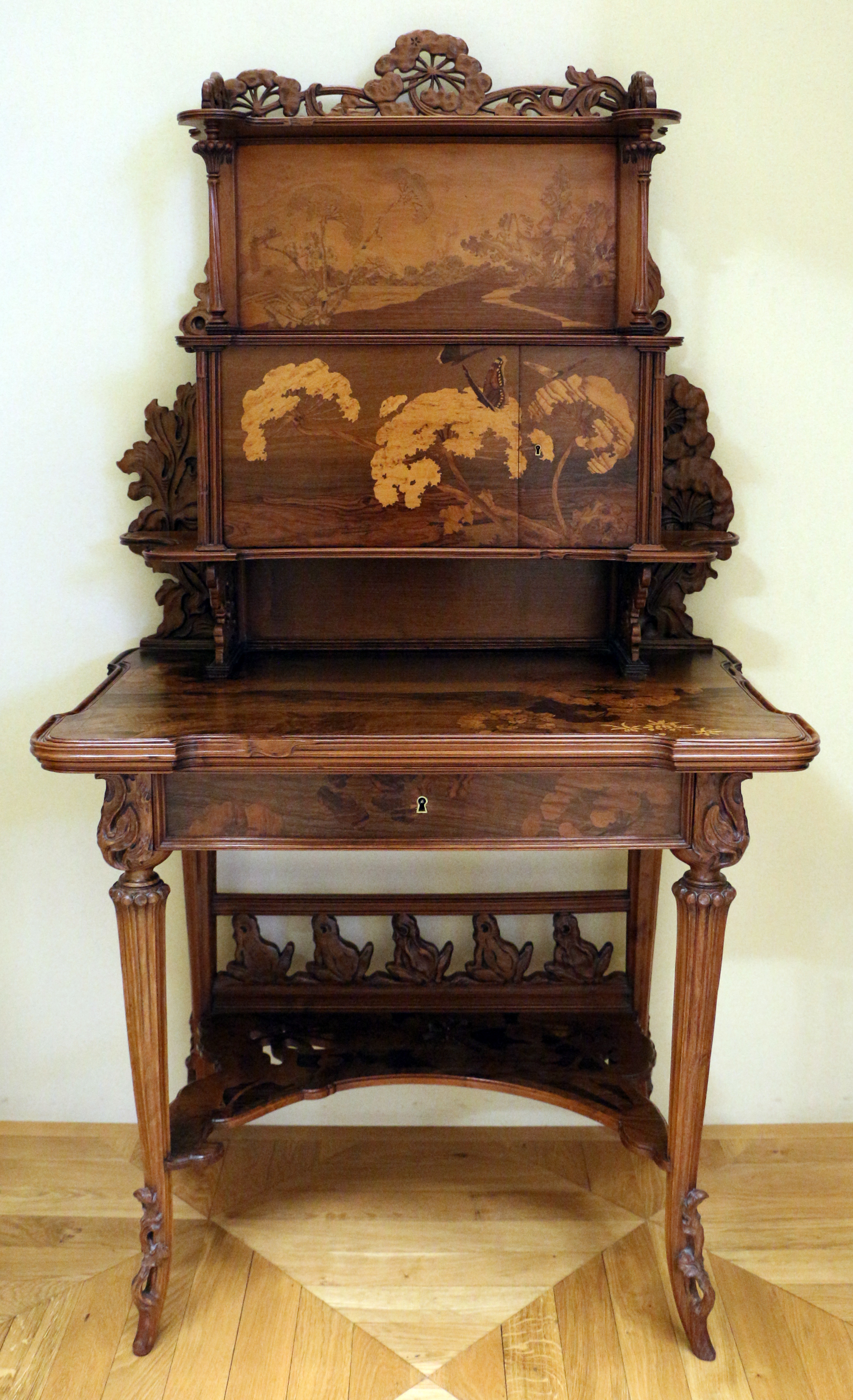
| Musee d'Orsay | Paris | Glass including La Main aux algues et aux coquillages and furniture including the bureau Les Ombellules. | Catalogued by curator Philippe Thiebaut, whose readings of the point-signed and 'no unique objects' questions are cited on this page. |
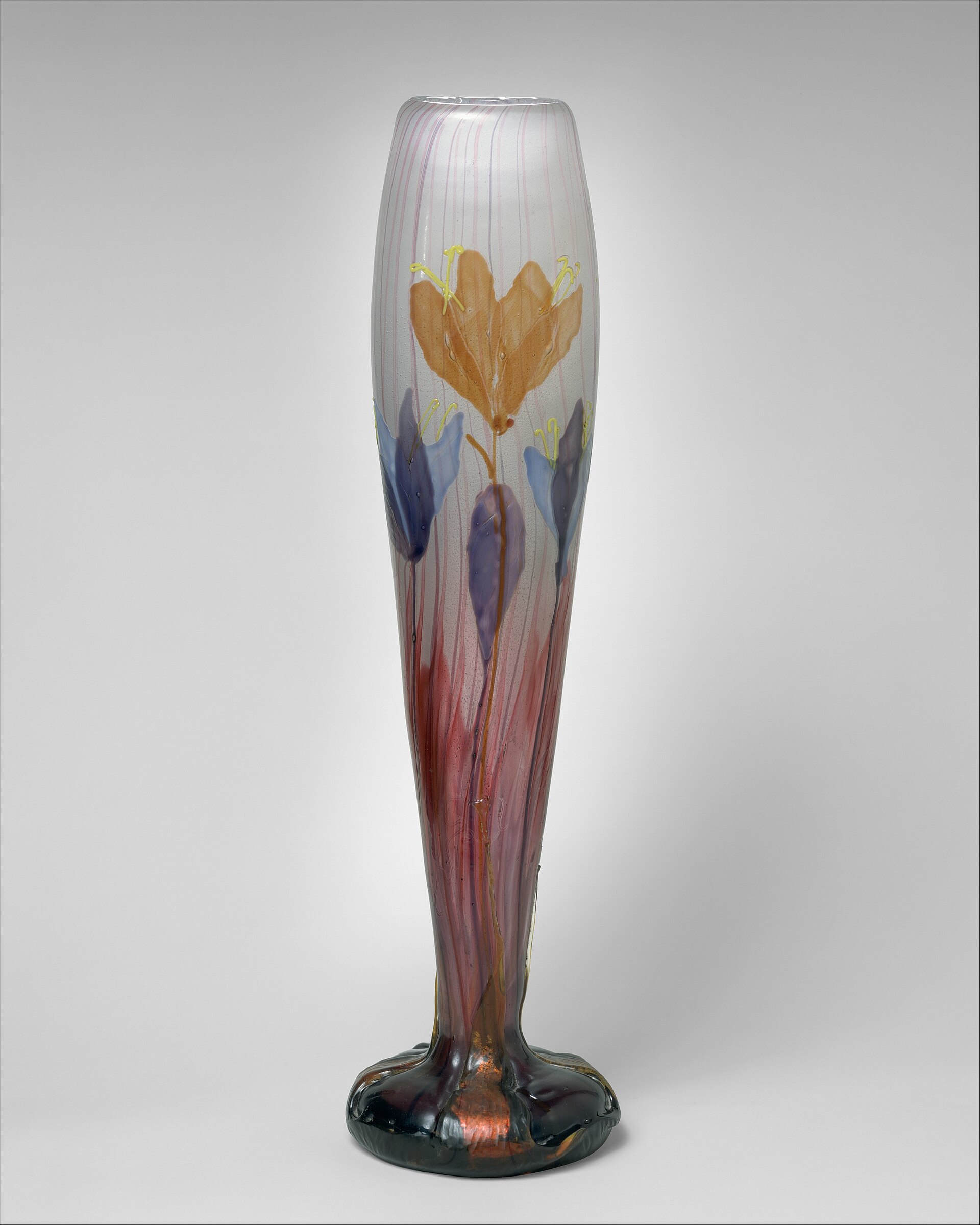
| Metropolitan Museum of Art | New York | Glass including the Autumn Crocus vase, and furniture including the Ombelliferes (cow parsley) cabinet. | Catalogues its lifetime workshop glass to 'the studio of Emile Galle' rather than to the man, a distinction this record follows. |
| Cleveland Museum of Art | Cleveland | Cameo glass including accession 1979.10, acquired from Macklowe Gallery, New York. | |
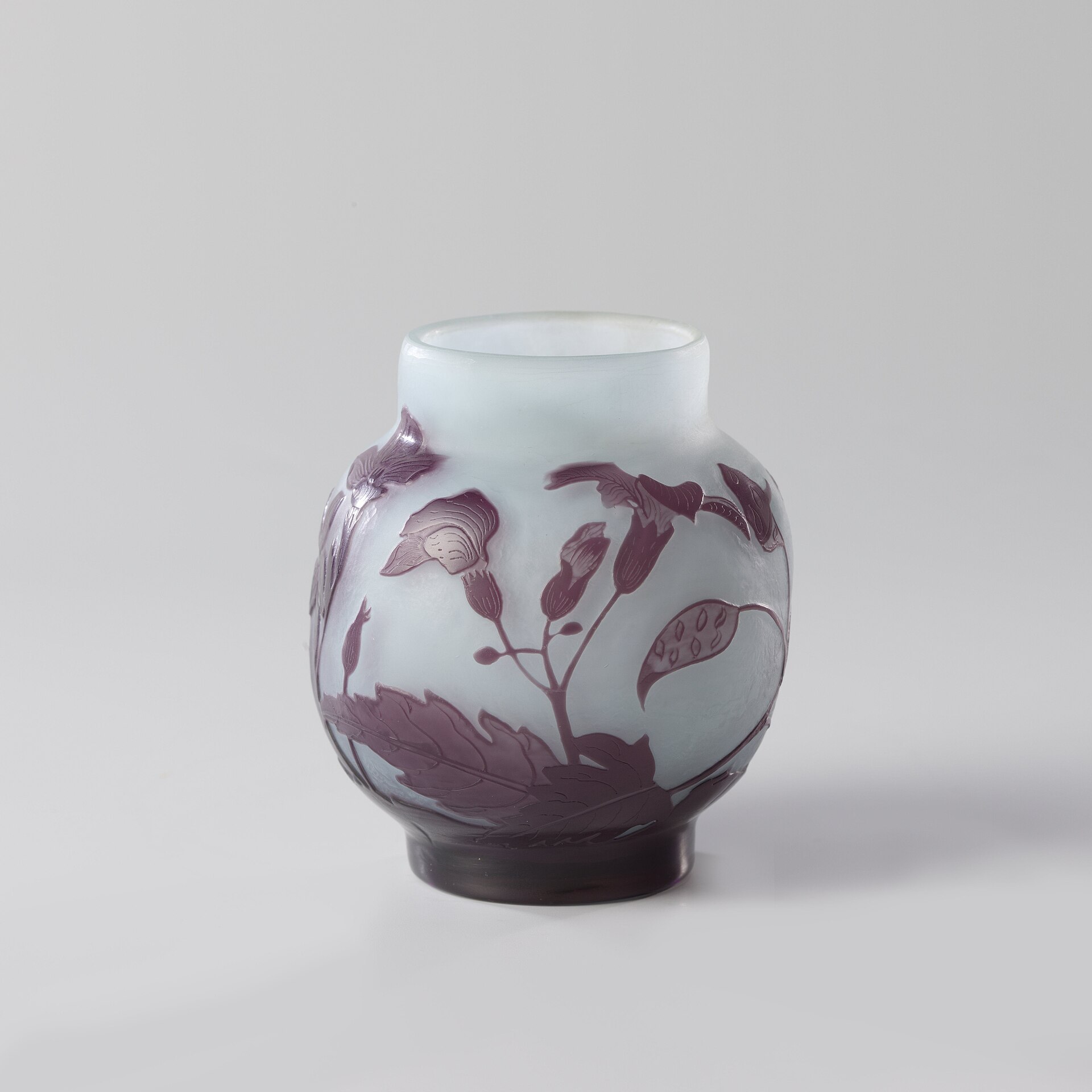
| Rijksmuseum | Amsterdam | Multiple glass pieces spanning the full mark sequence from the 1876 monogram to post-1908 posthumous production, including a rare pair carrying and lacking the star. | The single clearest public demonstration of the star-mark system. |
| Corning Museum of Glass | Corning, New York | Glass and an Emile Galle archival collection. | Archive holdings only partly surveyed for this record. |
Galle was born in Nancy on 4 May 1846, the son of Charles Galle, a Paris-born porcelain trader who had married into the trade: his wife Fanny Reinemer's family owned a crystal and porcelain shop in...
Galle was born in Nancy on 4 May 1846, the son of Charles Galle, a Paris-born porcelain trader who had married into the trade: his wife Fanny Reinemer's family owned a crystal and porcelain shop in Nancy, and Charles built on it, taking over a struggling faience factory and a mirror-manufacturing business through his father-in-law. Emile grew up inside that business rather than alongside it.
His formal education ran in a direction that later mattered more than any art school would have. At the Lycee Imperial in Nancy he studied philosophy and botany under D. A. Godron, the director of the city's botanical garden, then spent 1862 to 1866 in Weimar pursuing mineralogy alongside German, philosophy and further botany. In 1866 and 1867 he apprenticed at the Burgun, Schverer et Cie glassworks at Meisenthal, learning glass chemistry from inside an existing industrial factory rather than only from his father's shop. A designer who could also read a phase diagram and identify a plant by its family, not just its silhouette, is the background every later claim about his botanical accuracy and his colour chemistry rests on.
He took over management of his father's business in 1874 and married Henriette Grimm the following year, the daughter of a Protestant pastor from Bischwiller in Alsace, one of the territories France had just lost. He opened his own workshop, La Garenne, in Nancy, and first exhibited at the Paris Exposition Universelle in 1878, showing a cobalt-blue moonlight glass and pottery that won him a bronze medal.
Galle served in the 23rd Infantry Regiment during the Franco-Prussian War of 1870.
Galle served in the 23rd Infantry Regiment during the Franco-Prussian War of 1870. The Treaty of Frankfurt that followed annexed Alsace and part of Lorraine to the new German Empire, and Nancy, Galle's home city, stayed French only because the frontier ran a few kilometres to its east. Scholars who have studied his decorative vocabulary treat this as a formative, documented fact rather than a mood: from the immediate postwar years, Galle used three heraldic symbols attested for the region since the Middle Ages, the alerion, the thistle and the Cross of Lorraine, and he kept using them for the rest of his career.
The thistle carries the motto of the arms of Nancy and, by extension, of Lorraine: qui s'y frotte, s'y pique, roughly, whoever rubs against it gets pricked. The Cross of Lorraine had been adopted in 1477 by Duke Rene II as a rallying sign against Charles the Bold of Burgundy and, after 1871, carried a fresh charge as an emblem of the annexed provinces. In 1871 Galle designed drawings for a series of faience plates, at least nine of which are documented, mocking the German occupation directly: one shows a duck wearing a spiked helmet trying and failing to swallow a frog, with the caption qui trop embrasse mal etreint, whoever grasps too much holds nothing, the duck standing for Germany and the frog for the annexed provinces Germany would never fully absorb.
The clearest single statement of this material is the table known as Le Rhin, shown at the 1889 Paris Exposition Universelle, the centenary of the French Revolution. Its frieze, designed by Victor Prouve, illustrates a line from Tacitus, that the Rhine separates all of Gaul from Germany; its base carries the three Lorraine heraldic symbols worked at giant scale; and two phrases are inscribed on the leg: Je tiens au coeur de France, fait par Emile Galle, en bon espoir, 1889, and a pun on the thistle's own motto, plus me poigne, plus j'y tiens. Galle showed two more overtly patriotic pieces at the same exposition, vases titled Vercingetorix and Jeanne d'Arc, using two of the standard French symbols of resistance to invasion.
Galle's most valuable technical signature is marqueterie de verre, glass marquetry: fragments of coloured glass of varying thickness, shape and colour pressed into the still-malleable mass of a piece...
Galle's most valuable technical signature is marqueterie de verre, glass marquetry: fragments of coloured glass of varying thickness, shape and colour pressed into the still-malleable mass of a piece while it is hot, then flattened and smoothed once the object is formed, and only then engraved by wheel once the whole thing has cooled. He filed for a patent on the technique in April 1898 and was granted it on 12 August 1898, with fifteen years of exclusive right to it. It is slow, it is unrepeatable in the sense that no two glass fragments sit identically, and it is the line that reaches the highest prices in his output today.
It sits above a much larger, much cheaper production line that most surviving Galle glass actually belongs to: cased overlay glass, where one or more layers of coloured glass are fused around a base parison and the design is then cut back through the outer casing, either with a rotating wheel or bitten out with acid, so the pattern stands in relief against a ground colour showing through. Wheel-cutting and acid-etching are not decorative equals. Wheel-cutting is slower, sharper-edged and was reserved, in general, for the firm's better work; acid-etching allowed faster, larger production runs and correspondingly lower prices. A buyer asking whether a given vase is wheel-carved or acid-etched is asking, in practice, which end of Galle's own output scale it was made for.
This is also where the industrial scale of the operation becomes unavoidable. Samuel Provost, a historian at the Universite de Lorraine who gained access to unpublished Galle and Perdrizet family archives while researching an unrelated biography, has used surviving sales-lot records and revenue figures to estimate total glass production at somewhere between nine hundred thousand and 1.3 million pieces across 1894 to 1936, a figure reached independently by two different methods, financial and lot-number analysis, that agree to within about ten percent of each other. That number sharply revises upward Francois Le Tacon's 1998 estimate of about two hundred thousand pieces, which had stood as the working figure in the literature for two decades.
In 1901 Galle founded the Ecole de Nancy, formally the Alliance Provinciale des Industries d'Art, and drafted its articles of association himself.
In 1901 Galle founded the Ecole de Nancy, formally the Alliance Provinciale des Industries d'Art, and drafted its articles of association himself. Its stated purpose was to promote the decorative and industrial arts of Lorraine, bringing together glassmakers, furniture makers, stained-glass artists, ceramicists, leatherworkers, ironworkers and architects under a shared commitment to nature-derived ornament. Galle served as its president; Antonin Daum of the rival Daum Freres glassworks and the furniture makers Louis Majorelle and Eugene Vallin were among its most prominent members.
That membership is also the source of the most common attribution error a non-specialist can make with this material. Daum Freres was a genuinely separate firm, working the same city, the same period and an overlapping plant-based vocabulary, and pieces by the two houses are still routinely confused or mis-sold under the other's name. Belonging to the same association Galle led did not make Daum's output Galle's, in either direction, and a record or a listing that treats the two as interchangeable is simply wrong.
Galle called some of his pieces verreries parlantes, speaking glassworks, and applied the same idea to furniture as meubles parlants: objects carrying lines of poetry cut, engraved or inlaid into the...
Galle called some of his pieces verreries parlantes, speaking glassworks, and applied the same idea to furniture as meubles parlants: objects carrying lines of poetry cut, engraved or inlaid into the decoration, chosen because their themes matched the piece's subject. He set out the practice in a letter to the critic Roger Marx in 1893 and again, at length, in a printed lecture, Le Decor symbolique, delivered as his reception address to the Academie de Stanislas in Nancy on 17 May 1900 and published that year. This is a maker's own theoretical statement, not a modern reading imposed after the fact, and any claim about meaning in his work can be tested against it.
The poets he quoted most, by his own later account in his collected writings, were Victor Hugo and Charles Baudelaire; he also drew on Marceline Desbordes-Valmore, Sully Prudhomme, Paul Verlaine and the Belgian Symbolists Maurice Maeterlinck and Emile Verhaeren. A documented, dated example: a writing desk of 1900 titled Orchidees lorraines carries an extract from Baudelaire's L'Invitation au voyage, the lines translating roughly as everything there would speak, in secret, to the soul, its own sweet native tongue. The choice of Baudelaire on a piece named for Lorraine orchids is not incidental: it links a Symbolist poem about a foreign, longed-for elsewhere to flowers standing for Galle's own occupied region, on an object whose stated purpose was to make that connection legible to whoever read the desk closely enough to find the inscription.
Orchids belong to a wider debt to Japanese art that Galle dated to his own visits to the Japanese collection at the Victoria and Albert Museum in London in the 1870s, and that shaped his asymmetrical compositions, his vertical seal-style signatures on some pieces, and recurring motifs including dragonflies, cicadas and monster masks. Insects were part of his vocabulary from early in his career, drawn from the entomology he studied as a young man; the cicada in particular carried, for Galle and for the wider culture he worked inside, an established association with mortality, tied to the insect's short adult life after years spent unseen underground. None of this is presented on this page as a hidden programme Galle concealed. It is what he said, in print, that his work was doing.
Between 1898 and 1901 Galle devoted a documented number of glass pieces to the Dreyfus Affair, distributing them by different routes: giving some to the collector Henry Hirsch, offering others to the...
Between 1898 and 1901 Galle devoted a documented number of glass pieces to the Dreyfus Affair, distributing them by different routes: giving some to the collector Henry Hirsch, offering others to the Dreyfusard politician Joseph Reinach, and dedicating still others to leading Dreyfusard figures including the chemist and senator Auguste Scheurer-Kestner, Emile Zola and Sarah Bernhardt. In April 1898, in the Revue des arts decoratifs, he wrote that the flowers had to be thrown under the feet of the barbarians, that the touching grace of their dying had to be spread even over the most modest objects, a passage his own contemporaries and later historians read as a direct statement of intent behind this body of work.
The individual pieces carry specific, documented iconography. A vase decorated with seahorses, offered to Joseph Reinach in 1901, plays on the anatomical term hippocampus, the brain structure governing memory, in homage to Reinach's own multi-volume Histoire de l'affaire Dreyfus. A vase titled Le Figuier, the fig tree, one of the earliest pieces in the group, deliberately runs together two conflicting readings of the fig in Christian tradition, the barren tree as the people of Israel who failed to recognise the Messiah against the green, fruit-bearing tree as ornament. A vase called Les Ormes, the elms, made after Galle's bitter disappointment with the 1899 Rennes verdict, is worked in mourning tones of black, violet, brown and green, its bare-branched elms a classical Greek sign of grief, a raven standing for misfortune and the manipulation of public opinion, and termites reversed from the anti-Dreyfusard rhetoric that had likened Dreyfus's Jewish defenders to parasites, so that in Galle's version it is the anti-Dreyfusards themselves who appear as the parasites destroying moral and social values. A further vase, Les Hommes noirs, made with Victor Prouve, carries an anticlerical line from the songwriter Beranger, and Galle himself wondered in a letter whether its satirical intent survived in glass, a medium he thought closer to Goya's acid-bitten etchings than to caricature.
At the 1900 Paris Exposition Universelle Galle assembled a number of these pieces in a stand designed to evoke a glassmaker's furnace, which contemporary Dreyfusards, in the composer Alberic Magnard's phrase, read as an avenging furnace. This is not a footnote to Galle's decorative career. It is a documented instance of a commercial glass firm's owner using his own product line to take a public political position on the defining domestic controversy of his lifetime, at real professional risk in provincial France.
Galle died of leukaemia in Nancy on 23 September 1904, at fifty-eight.
Galle died of leukaemia in Nancy on 23 September 1904, at fifty-eight. Direction of the firm passed to his widow, Henriette Galle, and, in time, to his son-in-law Paul Perdrizet, a Nancy University professor and archaeologist who had married Galle's daughter Marguerite. The firm did not close. It continued to produce and sign glass under the name Galle for more than three decades, a fact that sits behind almost every authentication question the name now raises.
The immediate question this created was practical rather than philosophical: how was a buyer, then or now, meant to tell a piece finished by Galle's own hand from one made after his death by workers he had trained, to designs the firm still owned, under a name that was now technically an inheritance rather than a living signature.
Henriette Galle's answer, taken no earlier than January 1905 and put into effect across the bulk of that year's production, was to mark posthumous glass with a star preceding the signature.
Henriette Galle's answer, taken no earlier than January 1905 and put into effect across the bulk of that year's production, was to mark posthumous glass with a star preceding the signature. The dating rests on her own surviving letters to Albert Daigueperce, who ran the firm's Paris depot, reviewed by Samuel Provost in 2020; it corrects an older, widely repeated dating of 1904 to 1906 that rested only on the testimony of a former employee, Rene Dezavelle, given decades after the fact in 1974. On the corrected chronology the mark was withdrawn in May 1908, after roughly three years' use.
The reason for the withdrawal is on record. The factory's director, Emile Lang, reported to management that clients were treating everything bearing the star as no longer really Galle. An honest disclosure of posthumous authorship had become a discount, and after three years the firm removed the mark rather than keep absorbing the price difference. It is a small, precisely dated demonstration of something most authentication problems can only gesture at: a maker's own firm tried candour, watched the market punish it, and stopped.
Museums that catalogue their Galle holdings carefully record the star when it is present. The Rijksmuseum's own collection includes a vase with maple-branch decoration, catalogued to the workshop of Emile Galle and carrying the star, alongside a smaller vase with honesty seed-pods from about 1906 to 1914, catalogued to the same workshop with the same signature word and no star at all. Read together, in a single institution, the two objects show the whole system: one firm, one name, and a three-year window in the middle of a thirty-two-year afterlife in which the firm told the truth about who had made the piece.
Objects signed Galle fall, in the reading specialists now use, into three categories: autograph work made in Galle's own lifetime and largely by his own hand; lifetime workshop production, made under...
Objects signed Galle fall, in the reading specialists now use, into three categories: autograph work made in Galle's own lifetime and largely by his own hand; lifetime workshop production, made under his direction and to his designs by the Etablissements Galle while he was alive but not necessarily touched by him personally; and posthumous production, made and signed by the firm after 1904 under his widow's and later administrators' authority. The middle category is the one most often collapsed into the first. The Metropolitan Museum's own Autumn Crocus vase, dated about 1900, is catalogued to the studio of Emile Galle and to the Etablissements Galle rather than to the man, which specialists treat as the correct handling rather than a downgrade.
There is a documented fourth case, easy to mistake for fraud and not one: after Galle's death, a number of unfinished or defective pieces left in the workshop were signed with a small engraved point, in order to identify them as his rather than to pass them off as something they were not. Philippe Thiebaut, the curator who catalogued the Musee d'Orsay's Galle holdings, applies this reading to a hand-form vase sold at Versailles in 1970 rather than the alternative explanation that it was an unrepeated first attempt. A point-signed piece is therefore evidence of workshop record-keeping, not evidence that Galle finished the object himself.
Thiebaut has also argued, against an older reading that treated Galle's more unusual pieces as unrepeated one-offs, that there are effectively no unique Galle objects: when an exceptional design was undertaken, whether commissioned or not, the workshop generally made four to six examples at the same time as a matter of course. A claim that a given Galle piece is one of a kind should, on this evidence, be treated as a claim that the others simply have not yet surfaced.
The literature on when the firm actually closed carried two different answers for years, and the discrepancy is itself informative.
The literature on when the firm actually closed carried two different answers for years, and the discrepancy is itself informative. The design team was dismissed in late 1930 and the main furnace shut down in 1931; that date is the one repeated in most general accounts. Francois Le Tacon established in 1993, against the older literature, that production in fact continued until 1936, on a reduced basis, before the firm finally ended. There is almost no hard documentary evidence for the intervening years, roughly 1928 to 1936, because the firm had stopped exhibiting and largely stopped generating the kind of paper trail earlier periods left behind.
The marks changed repeatedly across this stretch and form their own internal chronology, useful for dating a piece independent of any accompanying provenance: an underlined crossed-G without the star, in use from 1908 to about 1920 and the longest-lived of the postwar marks; a simple mark with an unaccented underscore from about September 1920, mostly on small pieces under about fifteen centimetres; an inverted-tail G from about 1920 to 1924, associated with the designer Jean Rouppert; an underlined tangent-G from 1925, used on the larger and costlier pieces; a vertical, Japanese-styled signature from about 1927 on a crackled-glass series; and two further ornamental marks from about 1927 or 1928 through to the end, reserved for the firm's prestige line. Even the accent on the final e is not a single, stable detail: Provost's chronology distinguishes marks using a Latin acute accent from marks using a Greek epsilon, and which form appears helps narrow the date. The trade rule that an authentic signature always carries an accent is broadly right and, on this evidence, not precise enough on its own.
Samuel Provost separates the modern Galle forgery problem into two distinct categories, and collapsing them into one is itself a common error.
Samuel Provost separates the modern Galle forgery problem into two distinct categories, and collapsing them into one is itself a common error. The first is outright counterfeiting: new copies made in Romania and China in recent decades, and older glass by other makers, including Paul Nicolas, De Vez, and Burgun and Schverer, the Meisenthal firm where Galle himself apprenticed, rebaptised with a false Galle signature added after the fact. The second is alteration: genuine Galle objects reworked to hide damage or to raise their apparent quality, to the point that they no longer count as authentic originals even though the base material is real.
Trade diagnostics, compiled from years of appraisal work by the dealer Philip Chasen, add a practical checklist to Provost's categories: decorative combinations that make no botanical sense, such as terrestrial plants mixed with marine elements; naive or cartoonish drawing where the workshop's own hand was precise; visible erasure of an earlier design; clumsy hot-worked applications; motifs the firm is not documented as using; and, on pieces claiming first-quality status, a flat cameo signature where the authentic workshop practice was to cut the mark in intaglio. On the surface itself, authentic decoration was typically wheel-polished to a semi-gloss finish against a matte ground, often with a dark band and a straight-cut rim, while reproductions tend toward a uniform matte surface and a foot that is too large and too bulbous for the model. Chasen reports, as a working figure from his own appraisal practice rather than a survey, that about half of the pieces brought to him for appraisal turn out to be fake. It is the only quantified estimate of the problem's scale located for this record, and it should be read as exactly that: one dealer's experience, not a market-wide statistic.
The market for Galle runs on a wide scale, and the scale tracks the categories above closely.
The market for Galle runs on a wide scale, and the scale tracks the categories above closely. Ordinary commercial cameo vases, the acid-etched industrial line, trade at roughly a few hundred to two thousand dollars; mid-tier pieces with more elaborate wheel-cut cameo work run from about two thousand to ten thousand dollars; and only a small fraction of the glass market, rare landscape scenes and exceptional lifetime-signed pieces, reaches fifty thousand dollars or more. Quality marqueterie de verre, Galle's patented and most labour-intensive technique, has been quoted in the trade at over ten thousand dollars an inch of height. Furniture trades separately and generally lower: the best documented examples sell under fifty thousand dollars, and ordinary pieces well under two thousand.
Two results anchor the top of the market. A marqueterie de verre and wheel-carved coupe decorated with a dragonfly sold at Christie's New York in December 1980 for $250,000, a record at the time. An impressive but badly damaged mushroom-form table lamp, Les Coprins, one of six known examples, sold to an anonymous bidder at Sotheby's New York on 2 December 1989 for $1.1 million; the source located for this figure does not separate a hammer price from the buyer's premium, and it stood as the highest reported Galle result for decades. A marqueterie de verre vase on a gilt bronze base, Vase sur Socle, Grand Iris, with an identical model shown by Galle at the 1901 Dresden exhibition and the 1903 Ecole de Nancy exhibition in Paris and acquired directly from Galle by the consigning family in 1904, sold at Sotheby's Paris on 21 May 2015 against an estimate of 200,000 to 300,000 euros, reported at 435,000 euros with fees included; again, the source does not split hammer from premium. A Lys vase sold at Christie's New York in 2018 for $444,500 is described by the auction database MutualArt as the top Galle result within its own index, which begins tracking sales in 2005; that is a different, narrower claim than an all-time record, and reading it as the latter would contradict the better-documented and higher 1989 result.
Underneath the headline prices, individual models can move sharply within a few years. The Cigar Aficionado trade press cites one popular elephant-form vase design rising from about $26,000 in 1978 to $346,500 in 1990 for a rare white-glass version, tracking the broader late-1980s Art Nouveau glass boom rather than any change in the object itself. Behind the trade sits a documented network of lifetime collectors and dealers: Galle's Paris depot manager Albert Daigueperce named Henry Hirsch, in 1910, as one of the artist's five principal collectors, and Hirsch's own holdings, including the Aube et Crepuscule bed and the Libellules display case, dominated the memorial exhibition held in Nancy the same year Galle died; Hirsch gave part of his collection to the Musee de l'Ecole de Nancy in 1955.
Glassmaker; Furniture designer; Ceramicist; Founder, Ecole de Nancy. 1846-1904.
Born 4 May 1846, Nancy, France; died 23 September 1904, Nancy, France.
The modern 'Galle-style' reproduction and counterfeit market. Samuel Provost separates two distinct problems: outright counterfeits, including recent Romanian and Chinese copies and older glass by other makers, among them Paul Nicolas, De Vez, and Burgun and Schverer, the Meisenthal firm Galle himself apprenticed at, rebaptised with a false Galle signature; and alteration, where genuine Galle objects are reworked to hide damage or raise apparent quality until they no longer count as authentic originals.
Musee de l'Ecole de Nancy (Nancy); Musee d'Orsay (Paris); Metropolitan Museum of Art (New York); Cleveland Museum of Art (Cleveland); Rijksmuseum (Amsterdam); Corning Museum of Glass (Corning, New York).
The market runs across a wide range that tracks the categories of authorship closely. Ordinary commercial cameo vases trade at roughly a few hundred to two thousand US dollars; mid-tier wheel-cut cameo pieces run about two thousand to ten thousand dollars; and only a small fraction, rare designs and exceptional lifetime pieces, reach fifty thousand dollars or more.
No single accepted or rejected corpus figure exists for Galle's total output. Provost's estimate of 900,000 to 1.3 million glass pieces (1894-1936) is the best current figure but does not separate the three authorship regimes numerically.
Degas made one Little Dancer and never sold it. The 41.6 million dollars paid in 2022 was for a bronze cast a decade after his...
12 min read
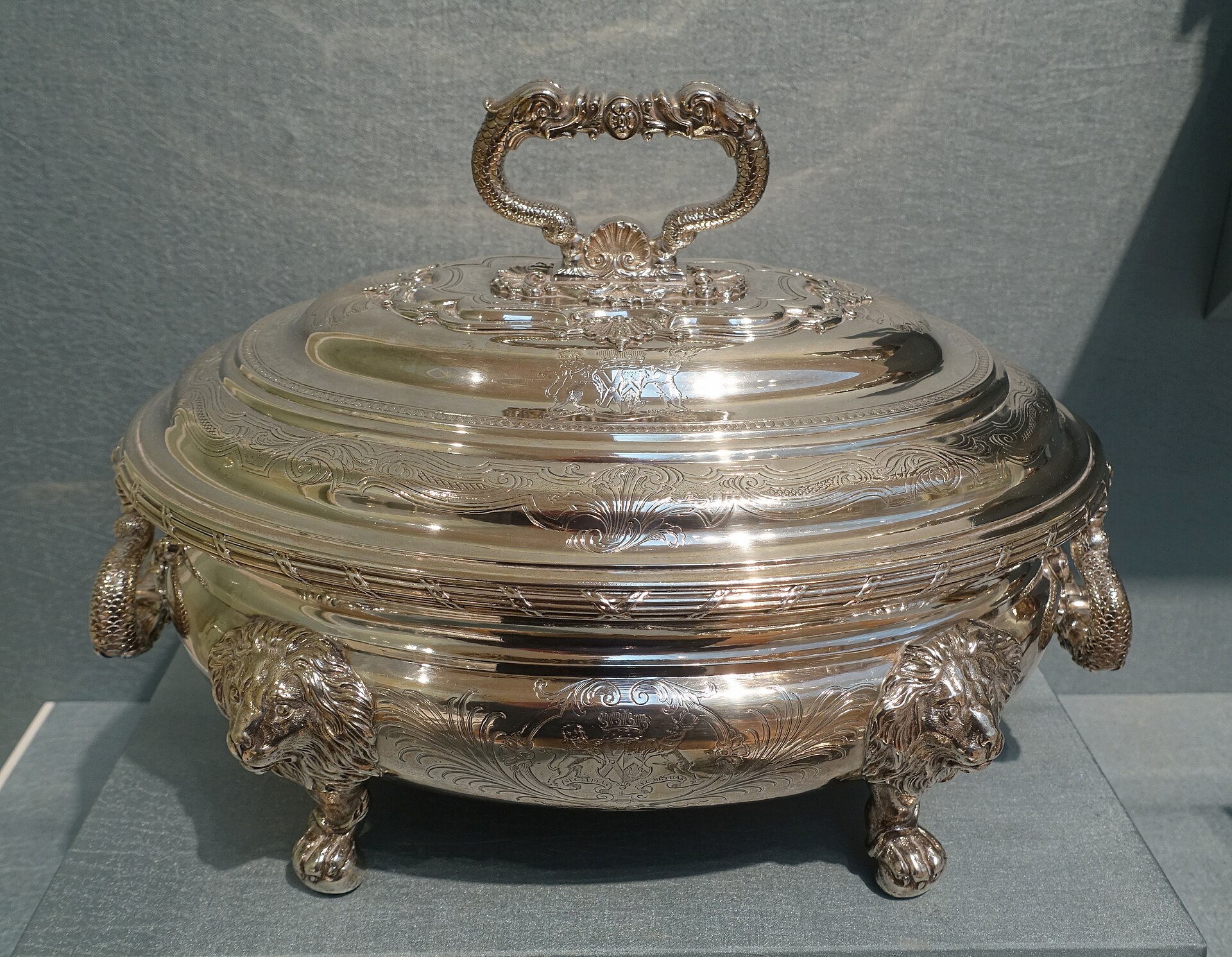
A British hallmark fixes a year exactly, because the punch is destroyed at the end of it, and the mark people call a maker's mark...
10 min read
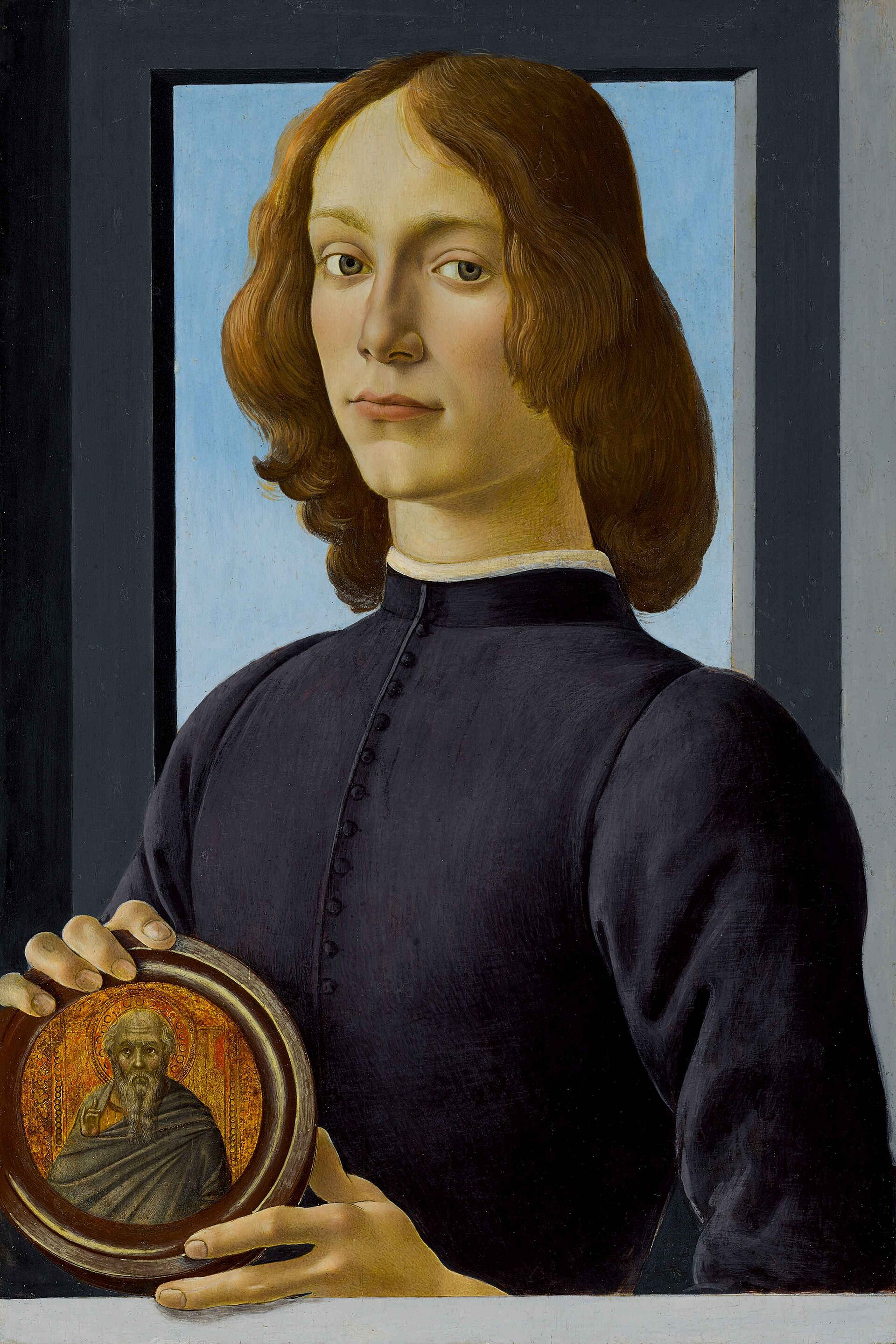
Bill Gates was named the day after he bought the Codex Leicester. The buyer of the Botticelli sold in January 2021 has not been...
12 min read
Last verified 17 September 2026
One artwork and its story every Tuesday, with the picture: who owned it, what it made, and what closes soon in the exhibition calendar. No promotion, and nothing we cannot cite.
We send one email to confirm the address and keep nothing else. Every letter carries a one-click unsubscribe. How we handle your data.


,_BK-C-2000-2.jpg)
