"Ombelliferes" (Cow Parsley) Cabinet
Emile Galle · ca. 1900
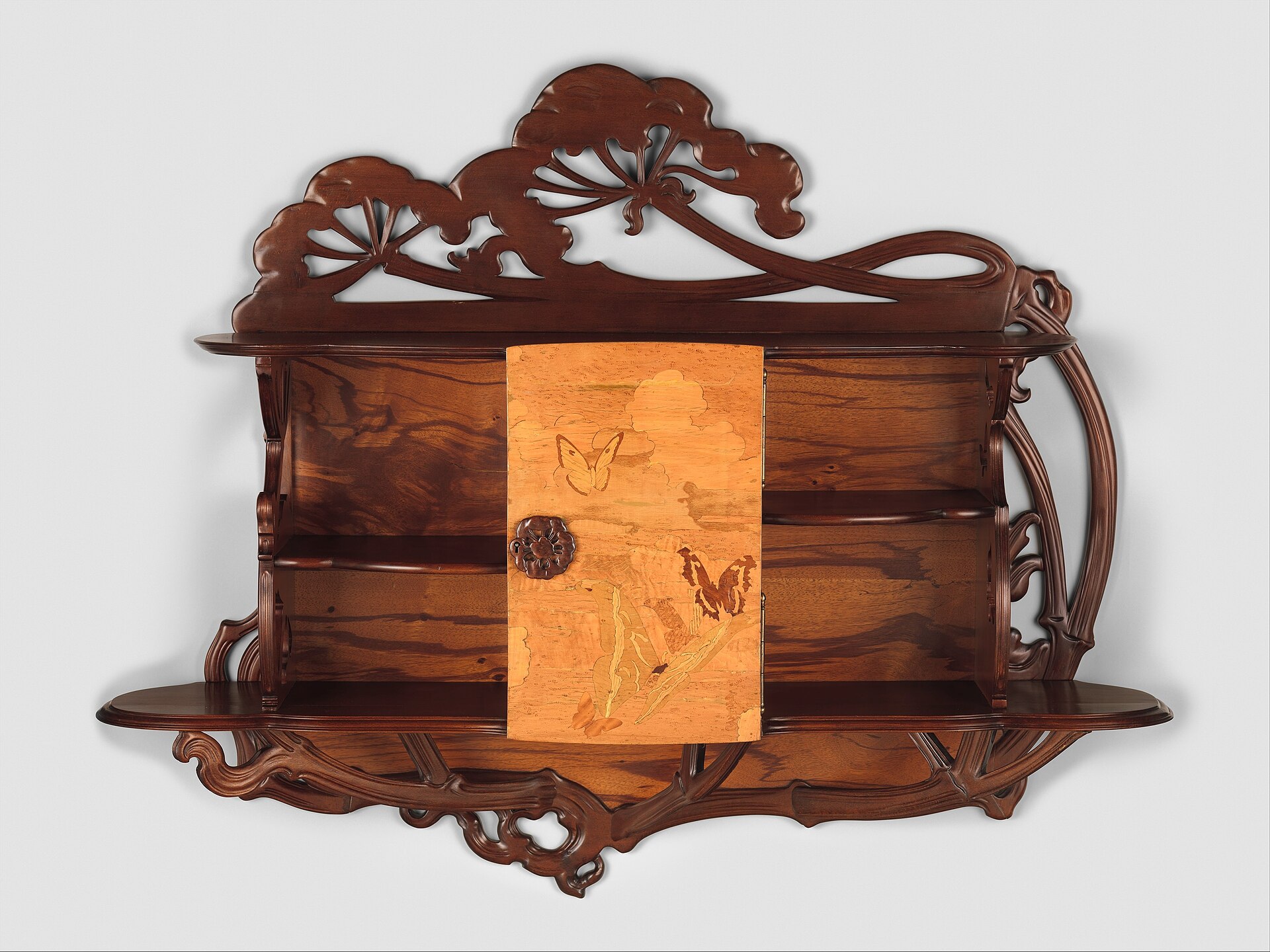
The record subject, Metropolitan Museum of Art accession 1982.246. Stained beech case with a marquetry door veneer of curly, tiger, and quilted maple, birds-eye maple, European chestnut, satinwood, and walnut. The Museum's own primary catalogue photograph, released as CC0.
| Artist | Emile Galle |
|---|---|
| Date | ca. 1900 |
| Medium | Case and carved elements in stained beech; back in plywood veneered with zebrano; door veneered with curly, tiger, and quilted maple, birds-eye maple, European chestnut, satinwood, and walnut, forming a marquetry picture of umbelliferous (cow-parsley-family) plants |
| Dimensions | 101.6 x 125.3 x 29.5 cm (40 x 49 5/16 x 11 5/8 in); 16.8 kg (37 lb) |
| Where it is now | Metropolitan Museum of Art, New York, Department of Modern and Contemporary Artlast confirmed |
| Inventory number | 1982.246 |
| Attribution | AcceptedCatalogued by the Metropolitan Museum of Art as the work of Emile Galle, dated ca. Full note |
| Object type | Furniture |
| Period | French Art Nouveau, Ecole de Nancy |
| Cases | Has a provenance gap |
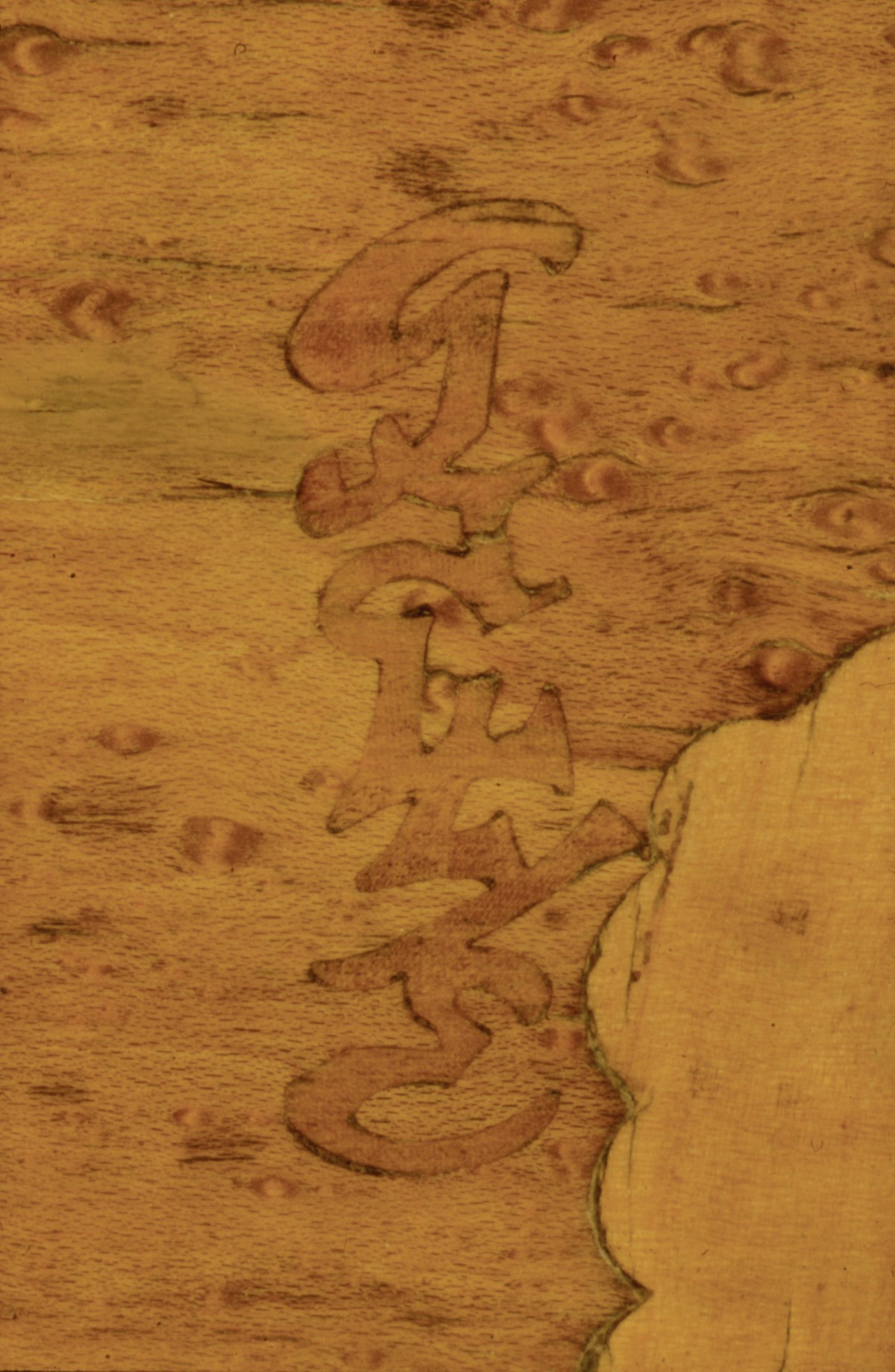
| Inscriptions | None recorded in the Metropolitan Museum's own catalogue entry. This is notable by contrast: the closely related Etagere aux Ombelliferes in the Musee des Beaux-Arts de Reims and the walnut cabinet titled "Les Ombelliferes" that has passed through the art market both carry marquetry inscriptions from the poetry of Emile Verhaeren, and the Reims piece and the Musee d'Orsay's umbellifer-themed desk both carry a marquetry signature. Whether this cabinet was made without an inscription, or carries one the Museum has not published, could not be established from the sources consulted. |
| Owners on record | 3 links2 documented, 1 unknown |
| Sources | 12 cited |
About this record Last verified · 12 sources cited · Change log
On this page 10 sections
ContentsClose
A shallow marquetry cabinet made in Emile Galle's Nancy furniture workshop around 1900, its door built entirely from contrasting wood veneers, curly, tiger, and quilted maple, birds-eye maple, European chestnut, satinwood, and walnut, into a picture of cow parsley and its umbellifer relatives. The Metropolitan Museum, which has owned it since an anonymous gift in 1982, states that only one other example of this model is known, at the Musee de l'Ecole de Nancy, making it a small, two-example rarity inside a furniture practice that otherwise produced most of its designs in numbers.
The same French title has been used for at least one other, materially unrelated Galle cabinet on the art market, and this record spends real effort keeping the two apart, along with two further umbellifer-themed pieces, at Reims and at the Musee d'Orsay, that share the plant-family programme without being this object. The cabinet's own history before 1982 is undocumented, its donor unnamed, and its exact dating basis unstated beyond the Museum's stylistic estimate; what can be said with confidence is that the estimate places its manufacture inside Galle's own lifetime, before the posthumous, star-marked production of his firm's later years.
Its timber list also corrects an easy assumption: rather than an exclusively native French material programme in keeping with Galle's documented Lorraine regionalism, the cabinet mixes local European species with an African back veneer and, almost certainly, tropical or North American figured woods in the door, a material fact this record reports plainly rather than forcing into a symbolic reading no named source has actually made about this specific object.
Provenance
Each link is graded. Documented: a cited source supports it. Disputed: the identification is argued but not established. Unknown: no owner for that span, and the gap is not smoothed into a narrative. The grades in the glossary.
- ca. 1900 -Made in the Emile Galle furniture workshop, Nancydocumented
Dated ca. 1900 by the Metropolitan Museum on stylistic grounds; no signed or dated workshop record was located. The date falls within Galle's lifetime (he died September 1904) and before the firm's post-1904 continuation under his widow, Victor Prouve, and later Paul Perdrizet.1
- ca. 1900 - 1982Unknownunknown
No owner, dealer, exhibition, or sale is documented for this cabinet across roughly eight decades between its manufacture and its arrival at the Metropolitan Museum. Nothing in the sources consulted names an intermediate holder.1
- 1982 - presentMetropolitan Museum of Art, New Yorkdocumented
Credit line 'Anonymous Gift, 1982'. The transfer to the Museum and its date are documented by the Museum's own credit line and accession number (1982.246); the donor's identity is not disclosed in any source consulted for this record and is treated here as unknown, not omitted.1
Prices realised
No auction sale of this specific object (Met 1982.246) is recorded in any source consulted. It entered the Museum by anonymous gift in 1982, not by purchase, and no market transaction for it at any date was found. General auction and dealer-market comparanda for Galle furniture as a category are discussed in the narrative (see 'Furniture against glass in the market') but no result there concerns this cabinet or its Nancy sibling.
Technical evidence
| Attribution note | Catalogued by the Metropolitan Museum of Art as the work of Emile Galle, dated ca. 1900 on stylistic grounds. The Museum's own materials list and classification are the basis for this record; no signed contract, workshop invoice, or exhibition label establishing an exact date has been located. The date falls within Galle's own lifetime (he died in September 1904), which places the cabinet before the posthumous star-mark period his firm used on glass from 1904 to 1914 and before the firm's furniture and glass production, continued after his death by his widow Henriette, by Victor Prouve, and later by his son-in-law Paul Perdrizet, was wound down in 1931. |
|---|---|
| Case and carved elements | Stained beech.1 |
| Back | Plywood veneered with zebrano, an African hardwood native to Gabon and Cameroon and therefore an imported, non-European timber in this construction.1 |
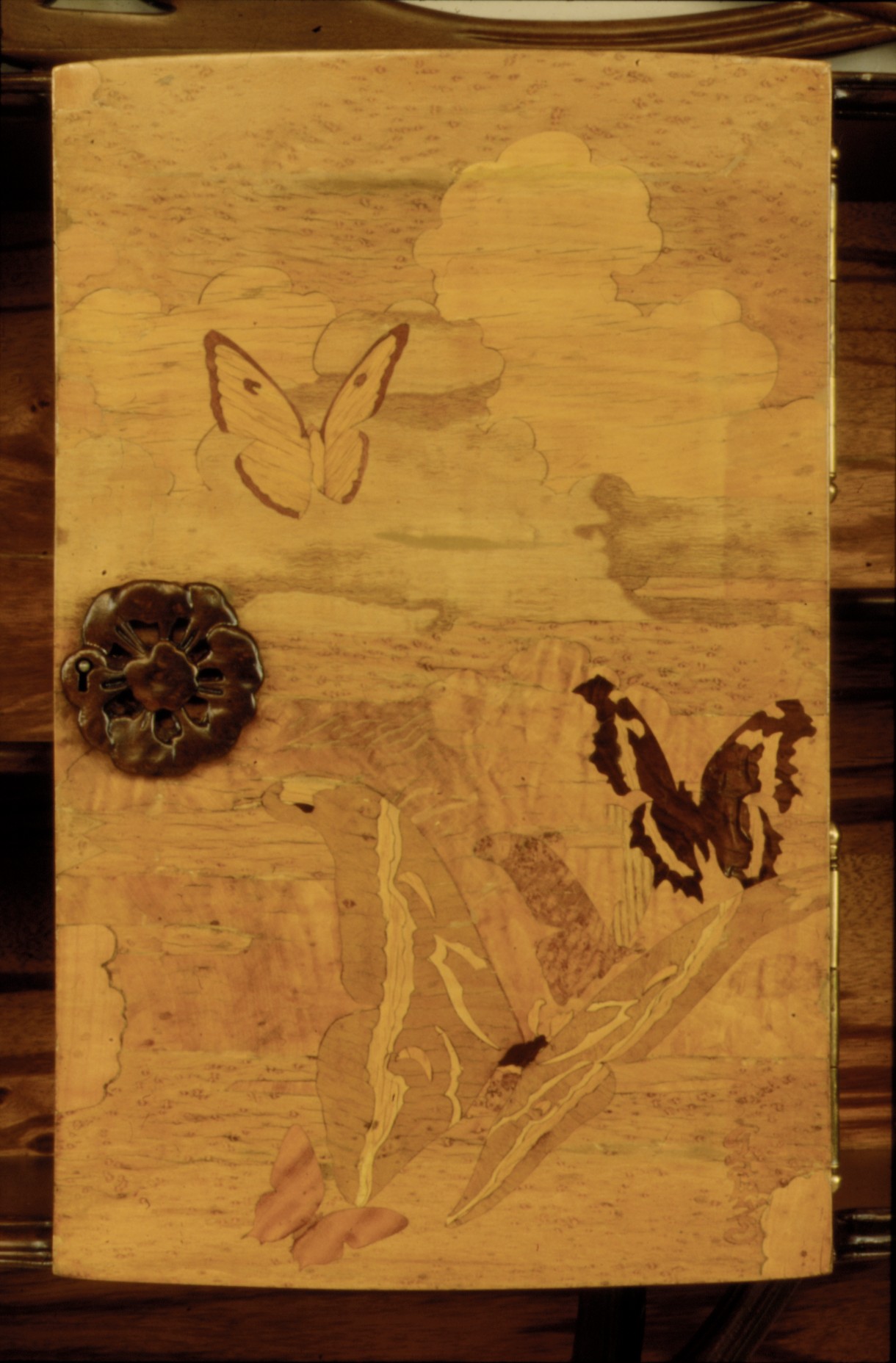
| Door veneer | A marquetry picture of umbelliferous plants built from curly, tiger, and quilted maple, birds-eye maple, European chestnut, satinwood, and walnut. Satinwood is a South or Southeast Asian or West Indian timber, not a European one; the exact species and origin of the maple veneers is not specified by the Museum.1 |
| Dimensions and weight | 101.6 x 125.3 x 29.5 cm (40 x 49 5/16 x 11 5/8 in); 16.8 kg (37 lb). A shallow wall or low cabinet, not a freestanding armoire.1 |
| Accession and classification | Accession number 1982.246, object ID 482526, catalogued by the Metropolitan Museum under classification "Furniture" and held by the Department of Modern and Contemporary Art.1 |
| Credit line | Anonymous Gift, 1982. No purchase price is recorded because the object did not enter the collection by purchase.1 |
| Dating basis | "ca. 1900", a stylistic estimate given by the Museum. No signed, dated, or documented workshop record fixing the exact year was located.1 |
| Signature or mark | None is recorded in the Museum's own catalogue entry, in contrast to the marquetry-signed Reims etagere and the marquetry-signed and inscribed cabinet of the same title that has passed through the art market.168 |
Images
The record in full
Chapter 1A low cabinet built as a botanical plate
The cabinet is modest in scale for what it is asked to carry: 101.6 centimetres wide, 125.3 centimetres high and only 29.5 centimetres deep, a shallow wall or low cabinet rather than a freestanding...
The cabinet is modest in scale for what it is asked to carry: 101.6 centimetres wide, 125.3 centimetres high and only 29.5 centimetres deep, a shallow wall or low cabinet rather than a freestanding armoire, weighing 16.8 kilograms. Its case and carved elements are worked in stained beech. The back is plywood veneered in zebrano, a striped African hardwood. The door is the piece's argument: a veneer picture assembled from curly, tiger, and quilted maple, birds-eye maple, European chestnut, satinwood, and walnut, laid up to render the stems, umbels, and foliage of cow parsley and its relatives in the Umbelliferae, the plant family that gives the piece its name.
The design is not applied ornament in the sense of a pattern printed or carved onto a pre-existing form. In Galle's marquetry furniture the plant supplies the composition: the differing grain, figure, and tone of each timber species stand in for petal, stem, and leaf the way a painter's palette stands in for local colour, and the door becomes, in effect, a small botanical illustration built entirely from the material identity of wood rather than from paint.
Chapter 2How the picture was built
Marquetry construction of this kind is a two-stage craft.
Marquetry construction of this kind is a two-stage craft. First the structural carcass is built and carved in a working timber, here stained beech, chosen for its evenness and workability rather than its colour, since it is not meant to be seen once veneered. Second, thin leaves of contrasting species are cut to shape and glued down over the surface to form the picture, exploiting each wood's natural colour and figure rather than staining or painting it to represent something it is not. The figured maples used here, curly, tiger, quilted, and birds-eye, are prized specifically because their grain does something unusual under light, which is exactly the visual effect a marquetry cutter wants for foliage that must read as alive rather than flat.
Galle's furniture workshop, established in the 1880s alongside his much older glass and ceramics operations, employed cabinetmakers, carvers, varnishers, and marquetry specialists as distinct trades; a piece of this complexity is not the work of one hand but of a shop organized the way a fine bindery or a stained-glass atelier is organized, around a designer whose name the object carries and a team of specialists whose individual contributions are, as on most workshop furniture of the period, not individually credited.
Chapter 3Cow parsley and its family
Cow parsley, Anthriscus sylvestris, is a common European hedgerow plant in the Apiaceae, the umbellifer family named for the umbrella-shaped flower clusters, or umbels, that the family's members...
Cow parsley, Anthriscus sylvestris, is a common European hedgerow plant in the Apiaceae, the umbellifer family named for the umbrella-shaped flower clusters, or umbels, that the family's members share: the same structure that gives fennel, hemlock, wild carrot, sea holly, and hogweed their characteristic flat-topped or domed flower heads. Galle returned to this plant family repeatedly and did so with what his cataloguers and later scholars describe as botanical precision rather than generic floral decoration, a habit consistent with his own training: he studied natural science formally in Nancy and in Weimar and was, by his own society membership, an active horticulturist rather than an artist merely borrowing plant forms as pattern.
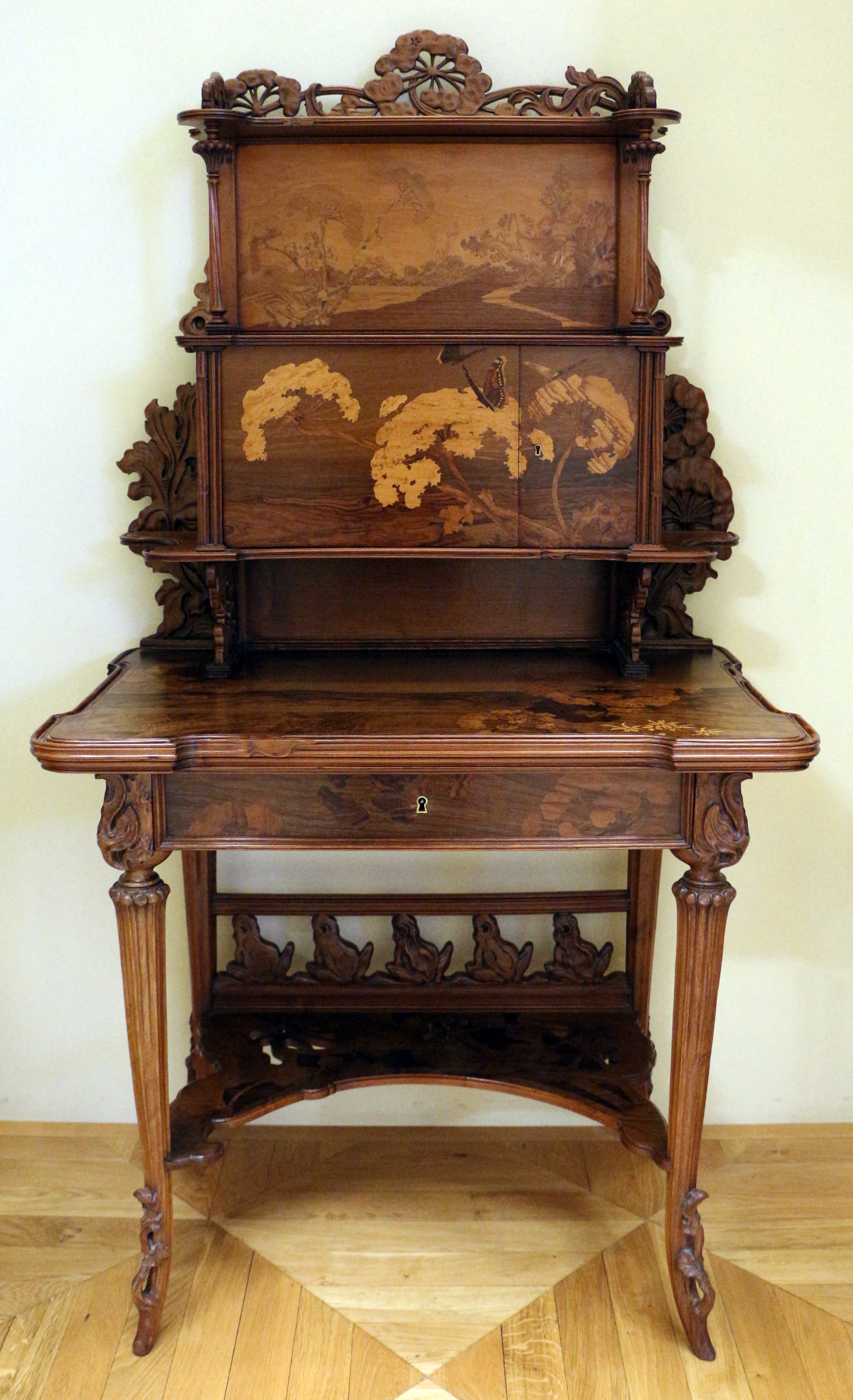
Other umbellifer-themed furniture from the same years survives and helps place this cabinet within a small, identifiable group rather than treating it as a unique idea: a shelving unit at the Musee des Beaux-Arts de Reims, the Etagere aux Ombelliferes, worked in walnut with mother-of-pearl and bronze inlay and dated 1900 to 1902; a lady's writing desk at the Musee d'Orsay, Les Ombellules, built around the related plant hogweed (Heracleum, also an umbellifer, though a different genus from cow parsley) and shown at the 1900 Paris exposition; and a walnut cabinet that has passed through the art market under the same French title, "Les Ombelliferes", discussed below because it is easily and wrongly taken for the object this record describes.
Chapter 4A model the Museum says was made twice
The Metropolitan Museum's own catalogue entry states that while most of Galle's furniture designs survive in numerous examples, this particular cabinet model is rare, with the only other known...
The Metropolitan Museum's own catalogue entry states that while most of Galle's furniture designs survive in numerous examples, this particular cabinet model is rare, with the only other known version being the one in the Musee de l'Ecole de Nancy, the museum built around Nancy's own Art Nouveau collection. That claim, made by the institution that owns and has physically examined this cabinet, is the basis on which this record treats the piece as one of exactly two known examples of its model.
It is worth being precise about what kind of claim that is. It is not a claim that this design was unique, in the way a one-off commission might be; Galle's furniture practice, like his glass practice, routinely produced a design in a run of examples for sale through his firm's outlets, and the Museum's own phrasing ("most of Galle's furniture designs exist in numerous examples") frames the Ombelliferes cabinet as the exception, not the rule. What is not documented, and what this record has not been able to establish, is why this particular model stayed rare: whether it was a special commission built as a pair and never put into general production, whether it was simply too labour-intensive in a shop that also had many cheaper models to sell, or whether other examples were made and have since been lost, broken up, or misattributed under a different or garbled title. Any of those is plausible; none is documented.
Chapter 5The Nancy sibling
The Musee de l'Ecole de Nancy is the natural home for a second example of this design: it was founded in December 1900 as a municipal museum of modern Lorraine decorative art, received thirty-nine...
The Musee de l'Ecole de Nancy is the natural home for a second example of this design: it was founded in December 1900 as a municipal museum of modern Lorraine decorative art, received thirty-nine Galle glassworks selected by the artist himself in 1904, and was later transformed by the collector Eugene Corbin's 1935 gift of 759 objects, opening in its present house on the rue du Sergent Blandan in 1954. It is exactly the kind of institution that would hold a sibling to a Galle cabinet gifted anonymously to the Met in 1982.
What this record could not do is independently confirm the Nancy cabinet from the museum's own published materials. The museum's online account of its furniture holdings, checked directly, describes other Galle furniture, including the Le Rhin table and the Aube et crepuscule bed, and describes an unrelated Bureau aux ombelles attributed to a different Ecole de Nancy figure, Eugene Vallin, but does not itself surface an Ombelliferes cabinet in the material sampled for this record. That is not evidence the piece is not there: museum websites publish a fraction of their holdings, and a piece off view is routinely absent from an institution's public pages. But it means the claim of a second example rests, in the sources actually consulted here, on the Met's own catalogue statement alone, not on independent confirmation from the Nancy museum's own voice. That gap is recorded honestly rather than papered over.
Chapter 6A name that belongs to more than one object
This is the point in the research where the greatest risk of getting the record wrong sits, and it is worth setting out in full rather than glossing over.
This is the point in the research where the greatest risk of getting the record wrong sits, and it is worth setting out in full rather than glossing over. A dealer listing for a cabinet titled "Les Ombelliferes", attributed to Galle and dated circa 1900, has circulated on the art market (Robert Zehil Gallery, Monaco). On the evidence gathered for this record, it is a different object from the Metropolitan's cabinet, not a third known example of the same model and not, so far as could be established, the Musee de l'Ecole de Nancy's piece either.
The differences are not stylistic quibbles. The market cabinet is worked in sculpted walnut with exotic wood marquetry, mother-of-pearl inlay, and chased and patinated bronze mounts; it has two doors and two shelves rather than the Met cabinet's single door; it stands roughly 153 centimetres tall against the Met cabinet's 101.6 centimetres, half again as large; it is reported as marquetry-signed "Galle" on the lower shelf and inscribed in marquetry on the right-hand door with a line from Verhaeren and, separately, on the back with an extract from Victor Hugo; and it carries an exhibition history, shown at the 1900 Exposition Universelle at the Pavillon de Marsan and again at the 1903 programme of Ecole de Nancy exhibitions. None of that description matches the Met's own materials list, dimensions, or (silent) inscription record for 1982.246. The two objects share a French title built from the same plant family and, evidently, little else that can be confirmed.
The lesson is not that the market cabinet is fake or the attribution wrong; nothing here casts doubt on it as a Galle object in its own right. The lesson is that "Ombelliferes" was not a name Galle or his firm reserved for one design. At least three, and by some readings four, distinct umbellifer-themed pieces (this cabinet, the Reims etagere, the Orsay desk, and the market cabinet) carry overlapping titles and a shared plant-family programme without being the same object, and a researcher, a saleroom cataloguer, or a future edition of this record that assumes otherwise will misattribute a fact, an image, or a price to the wrong piece. This record treats that risk as the reason to say so plainly rather than the reason to omit the comparison.
Chapter 7Speaking furniture, and this piece's silence
Galle is closely associated with what he and his contemporaries called meubles parlants, "speaking furniture": pieces inlaid in marquetry with lines of contemporary poetry, chiefly Symbolist writers...
Galle is closely associated with what he and his contemporaries called meubles parlants, "speaking furniture": pieces inlaid in marquetry with lines of contemporary poetry, chiefly Symbolist writers such as Maurice Maeterlinck and Paul Verlaine, chosen because their themes matched the piece's decorative subject. Galle described these inscriptions in a letter to the critic Roger Marx in 1893 as more than ornamental addition, the source from which the furniture derived what he called its soul and its voice. The practice sits alongside his devise, or personal motto, "Ma racine est au fond des bois, parmi les mousses autour des sources" (my root is in the depths of the woods, among the mosses around the springs), which he had inscribed on the doors of his Nancy workshops from 1885.
Against that background it is notable that the Met's own catalogue entry for this cabinet records no inscription at all, where the closely comparable Reims etagere and the market cabinet discussed above both carry Verhaeren quotations and marquetry signatures. Three explanations are all consistent with the evidence and none can be preferred over the others from the sources examined here: the cabinet may genuinely have been made without text, since not every Galle piece was a meuble parlant; an inscription may exist and simply not be recorded in the portion of the Museum's catalogue data reviewed for this record; or an inscription may have been lost or become illegible. This is recorded as an open question rather than resolved by assumption in either direction.
Chapter 8Materials as meaning, with a correction
It would be a tidy story to read this cabinet's timber list as a demonstration of Lorraine regionalism: Galle was born in Nancy in 1846, served during the Franco-Prussian War, and lived the rest of...
It would be a tidy story to read this cabinet's timber list as a demonstration of Lorraine regionalism: Galle was born in Nancy in 1846, served during the Franco-Prussian War, and lived the rest of his career in a Nancy that stayed French while neighbouring Alsace and part of Lorraine were annexed by the newly unified Germany in 1871, an event that scholars agree shaped his public identity as an artist. The Cross of Lorraine became part of his signature on many works. Documented pieces carry the theme explicitly: a table with the words "I cling to the heart of France" worked between its legs, and glass pieces from the 1889 exposition, Le Rhin, Jeanne d'Arc, Orphee et Eurydice, and Espoir, that scholarship reads as a sustained meditation on the lost territories and the hoped-for recovery of them. On this evidence, argued most fully in Suzanne Singletary's study of nature, industry, and the nation in Galle's work, applying French national and regional identity to his choice of subject and material is a documented current in his output, argued in named scholarship, though this record could not fetch the full underlying study and draws on indexed summaries of it, made explicit by name in inscriptions and titles on other pieces.
But that reading does not survive contact with this cabinet's actual materials list, and the record should say so rather than force the fit. The Museum's own materials are: stained beech for the case, zebrano, an African hardwood from the forests of Gabon and Cameroon, for the back veneer, and a door veneer combining curly, tiger, and quilted maple, birds-eye maple, European chestnut, satinwood, and walnut. Beech, chestnut, and walnut are native to France and central Europe. Satinwood is not: the timber trade uses that name for species from Sri Lanka and southern India or, in a separate West Indian species, the Caribbean, and either origin makes it an imported exotic in a Nancy workshop of 1900. Zebrano is unambiguously exotic. Birds-eye figure, the tight, dense pattern of small figured knots that gives birds-eye maple its name, is most strongly associated in the furniture trade with the North American sugar maple, Acer saccharum, though the Museum's materials list does not specify the species and this record could not verify the exact botanical identity of the maple used.
The honest conclusion is that this cabinet's material palette is not a nationalist statement built from native French timber; on the evidence of the Museum's own species list, it mixes local European woods with imported African and probably Asian, Caribbean, or North American ones in the same door. No source consulted for this record makes a documented or named-scholar argument connecting this specific object's timber choices to Lorraine identity, and this record is not going to manufacture one where the material itself argues the other way. Galle's regionalism is real and documented, elsewhere, in named, inscribed, dated pieces. Whether it has anything to do with a cabinet that reaches outside Europe for a third of its veneer is, on the evidence available, an open and probably unanswerable question, and recording that absence is itself the correct finding rather than a gap to be smoothed over.
Chapter 9Emile Galle, from glass into wood
Galle was born in Nancy on 4 May 1846, the son of Charles Galle, a merchant of glassware and ceramics who had also taken over a struggling faience factory and a mirror-manufacturing business through...
Galle was born in Nancy on 4 May 1846, the son of Charles Galle, a merchant of glassware and ceramics who had also taken over a struggling faience factory and a mirror-manufacturing business through his father-in-law. Emile studied philosophy and natural science at the Lycee Imperial in Nancy, trained as a botanist under D. A. Godron, director of Nancy's botanical garden, spent 1862 to 1866 in Weimar studying philosophy, botany, sculpture, and drawing, and in 1866 apprenticed at the Burgun and Schwerer glassworks at Meisenthal, in the part of Lorraine that would be annexed to Germany five years later, where he studied the chemistry of glass production. He took over his father's glass and ceramics business in the 1870s and built the reputation that made him famous, principally as a maker of cameo and internally decorated art glass; that glass output is a separate body of work from the furniture this record describes, and is covered elsewhere in this archive by its own records for individual Galle vases, not repeated here.
His furniture practice began later and separately. Sources place his move into cabinet-making at 1885, when he was sourcing exotic timbers for glass vase bases and, within about a year, had established his own furniture workshop staffed with carpenters, sculptors, varnishers, and marquetry specialists as a distinct operation from the glassworks. He first showed furniture publicly at the 1889 Paris Exposition Universelle and returned with more, in glass and furniture together, at the 1900 exposition, winning the Grand Prix on both occasions. In 1901 he founded, and became first president of, the Ecole de Nancy, formally the Alliance provinciale des industries d'art, the association that gave a name to the loose group of Nancy-based decorative artists, with Antonin Daum and Louis Majorelle as vice-presidents.
His stated design principle, given in 1889, called for "a pronounced bias in favour of models taken from flora and fauna, while giving them free expression"; writing on furniture design around 1900 he located true beauty not in "the acceptance of the falseness and mediocrity of prettiness without character" nor in "opulence without spirit" but in what he called the concentrated application of the structural and linear principles of nature's own growth. He was also, from 1898, an outspoken and financially risky supporter of Alfred Dreyfus, serving as treasurer of the Nancy branch of the Human Rights League, and co-founded, with Victor Prouve, a workers' education body, the Universite populaire de Nancy, in 1899. He died in Nancy on 23 September 1904, of leukemia, aged 58.
Chapter 101900, and the umbellifer year
The 1900 Paris Exposition Universelle is the documented occasion at which Galle's furniture reached its widest audience: he exhibited glass and furniture together, again won the Grand Prix, and the...
The 1900 Paris Exposition Universelle is the documented occasion at which Galle's furniture reached its widest audience: he exhibited glass and furniture together, again won the Grand Prix, and the exposition is the fixed point against which several umbellifer-themed pieces are dated, including Les Ombellules at the Musee d'Orsay, which was submitted under that title in a special catalogue Galle printed for the occasion, and the market cabinet discussed above, whose provenance places it at the 1900 exposition's Pavillon de Marsan and again at the Ecole de Nancy's own 1903 exhibition programme.
Whether this specific cabinet, 1982.246, was among the pieces shown at the 1900 exposition is not established by any source consulted for this record. The Museum's own dating, "ca. 1900", is consistent with the exposition year without confirming attendance at it, and no exhibition history is recorded in the Museum's catalogue entry. Given how many closely related umbellifer pieces are explicitly tied to that exposition, the absence of a confirmed link for this particular cabinet is worth flagging rather than assuming away in either direction.
Chapter 11Before the star: dating this piece to Galle's own hand
This archive has already had to work through a version of this problem once, with the Ruhlmann firm's continued production of the Etat cabinet model under Alfred Porteneuve after Jacques-Emile...
This archive has already had to work through a version of this problem once, with the Ruhlmann firm's continued production of the Etat cabinet model under Alfred Porteneuve after Jacques-Emile Ruhlmann's death. Galle's firm presents a comparable, and independently documented, posthumous-production problem: after his death in September 1904, his widow Henriette continued the glassworks together with Victor Prouve, and pieces made in this period were marked with a small star beside the "Galle" signature, a mark of mourning rather than deception, used until Henriette's own death in 1914, when production stopped for the war. It resumed afterward under Galle's son-in-law, the archaeologist Paul Perdrizet, who took over as president of the firm's board; sales fell sharply from 1930, and the board voted to close the works in 1931, though remaining glass stock continued to be sold off through about 1936.
That star-mark system is documented specifically for glass. This record found no equivalent documented marking convention for posthumous Galle furniture, and no source consulted here states whether furniture from the Perdrizet-era workshop carried any comparable indicator. For this cabinet the point is more straightforward in any case: a date of ca. 1900 falls squarely within Galle's own lifetime, four years before his death, and well before the 1904 to 1931 period in which the firm operated under other direction. On the dating the Museum itself gives, this is not a posthumous-production object in the way some later Galle-signed glass is; it belongs, on current evidence, to Galle's own working years and his own furniture workshop as he ran it. No signed contract or dated workshop record was found to pin the year more precisely than the Museum's own stylistic estimate, and that more precise dating basis remains an open question.
Chapter 12An anonymous gift, and the gap it leaves
The Metropolitan Museum's credit line for this object reads simply "Anonymous Gift, 1982", and its provenance field carries no owner history before that date.
The Metropolitan Museum's credit line for this object reads simply "Anonymous Gift, 1982", and its provenance field carries no owner history before that date. No source consulted for this record discloses the donor's identity, and no later Museum publication, exhibition catalogue, or press notice reviewed here names them. This record does not guess. Where a museum credit line says "anonymous", the honest and correct entry in a provenance chain is "unknown", not a name borrowed from a plausible nearby donor active in the same year; the Museum received a substantial body of European decorative arts from other, named donors in 1982, and it would be a factual error, not an inference, to attach this cabinet to any of them without a source that actually says so. None was found.
The gap is also worth naming as a category, not just a fact about this object. Most provenance gaps in this archive sit at the beginning of an ownership chain, in the centuries before an object surfaces; this one sits at the most recent link, the very transaction that brought the piece into public, cataloguable custody. An anonymous gift is a legitimate and common way for a museum to receive an object, and nothing here suggests any impropriety in this one. But it does mean the piece's own history between its manufacture around 1900 and its arrival at the Museum in 1982, a span of some eighty years that includes two world wars fought partly on Lorraine soil, is presently undocumented in any source this record could locate, and the identity of the donor who could presumably fill at least the most recent part of that gap has not been published.
Chapter 13Furniture against glass in the market
Galle is primarily a glass market name, and the price levels reflect it: current dealer and price-guide ranges put ordinary Galle cameo vases at roughly 500 to 2,000 US dollars, mid-tier pieces with...
Galle is primarily a glass market name, and the price levels reflect it: current dealer and price-guide ranges put ordinary Galle cameo vases at roughly 500 to 2,000 US dollars, mid-tier pieces with more elaborate cameo work at 2,000 to 10,000 dollars, and only a small fraction of the glass market, rare landscape scenes and lifetime-signed exceptional pieces, reaching 50,000 dollars or more. Those figures come from aggregated price-guide and dealer sources rather than a single verified sale and should be read as an order-of-magnitude picture of the glass market, not a precise index.
Furniture is thinner traded and, where it does sell, tends to sell for more than an equivalent-tier vase: a marquetry cabinet decorated with thistle, bats, and moths sold at Rago Arts in September 2022 against an estimate of 20,000 to 30,000 dollars, realizing 21,250 dollars; whether that figure is a hammer price or a total including buyer's premium is not stated in the source consulted and this record does not resolve the ambiguity by guessing. Dealer asking prices for Galle furniture on the secondary market, which are not sale results and should not be read as such, run from roughly 8,500 dollars for a smaller etagere to 28,000 dollars for an elaborate marquetry desk. No verified auction result for either known example of the Ombelliferes cabinet model, this one or the Nancy piece, was found; the Metropolitan's own example did not come to the Museum by purchase, and no source records a market transaction for it at any date.
The artist
Emile Galle
Galle is remembered first as a glassmaker, and his cameo and internally decorated art glass, covered elsewhere in this archive by its own object records, is what made his international reputation. His furniture practice is a related but distinct body of work, begun a decade into his career, run through a separately staffed workshop, and shaped by the same botanical precision and, at times, the same political and literary programme he brought to glass, expressed instead through marquetry, carved form, and inlaid quotation. This dossier covers the maker of this cabinet specifically as a furniture designer and workshop head, not as a glass artist, which is covered by the artist dossiers on this archive's other Galle records.
Related works
| Work | Relation | Where it is |
|---|---|---|
| Ombelliferes cabinet (sibling example) Emile Galle | Stated by the Metropolitan Museum to be the only other known example of this cabinet model Claim rests on the Met's own catalogue statement; this record could not independently confirm the piece from the Nancy museum's own published collection materials. | Musee de l'Ecole de Nancy, Nancy |
| Etagere aux Ombelliferes Emile Galle | Different object, same plant-family decorative programme, ca. 1900-1902 Walnut with mother-of-pearl and bronze inlay, marquetry-signed and inscribed with a line from Emile Verhaeren. From the collection of Charles Henri Grange (Reims, 1867-1939), bequeathed 1941. Not this cabinet. | Musee des Beaux-Arts, Reims (inv. 941.3.523) |
| Les Ombellules (Bureau de dame) Emile Galle | Different object, related umbellifer (hogweed) theme, submitted to the same 1900 Exposition Universelle Robinia-wood lady's desk built around hogweed rather than cow parsley. Donated by Mme Antonin Rispal in 2005. Not this cabinet. | Musee d'Orsay, Paris (inv. OAO 1467) |
| "Les Ombelliferes" cabinet (art market) Attributed to Emile Galle | Shares this cabinet's French title and plant-family subject; a materially and structurally different object Walnut with mother-of-pearl inlay and bronze mounts, two doors and two shelves, roughly 153 cm tall, marquetry-signed and inscribed with lines from Verhaeren and Victor Hugo; reported exhibition history at the 1900 Exposition Universelle (Pavillon de Marsan) and the 1903 Ecole de Nancy exhibition. Recorded here specifically to prevent it being confused with the Metropolitan's cabinet, which it is not. | Passed through Robert Zehil Gallery, Monaco |
| Vase Emile Galle | Same maker, unrelated medium (cameo glass) Covered by this archive's own separate record, galle-vase-cleveland. Included here only to mark the boundary between Galle's glass and furniture output, which this record deliberately does not cross. | Cleveland Museum of Art |
Open questions
- Who was the anonymous 1982 donor, and has that identity ever been disclosed in a Museum publication not reviewed for this record?
- What is the specific documentary basis for the Museum's 'ca. 1900' date? No signed, dated, or workshop record was located; the date is described as stylistic.
- Does the Musee de l'Ecole de Nancy's sibling cabinet carry an inscription, a marquetry signature, or any published history of its own, and can its existence be confirmed directly from the Nancy museum rather than through the Met's catalogue statement alone?
- Was this specific cabinet exhibited at the 1900 Exposition Universelle, as several closely related umbellifer-themed Galle furniture pieces were? No exhibition history is recorded for it.
- Does this cabinet carry an inscription or marquetry signature that the Museum's published catalogue data simply does not record, given that closely comparable pieces of the same decorative programme are inscribed and signed?
- What happened to this cabinet between its manufacture around 1900 and its arrival at the Museum in 1982? No owner, dealer, or exhibition history for that span was found in any source consulted.
- Is there a documented posthumous-marking convention for Galle furniture comparable to the star mark used on glass from 1904 to 1914, and if so, does its absence on this piece's catalogue record confirm a pre-1904 date or simply reflect incomplete cataloguing?
Questions about this object
What is "Ombelliferes" (Cow Parsley) Cabinet?
"Ombelliferes" (Cow Parsley) Cabinet is a furniture, dated ca. 1900. Medium: Case and carved elements in stained beech; back in plywood veneered with zebrano; door veneered with curly, tiger, and quilted maple, birds-eye maple, European chestnut, satinwood, and walnut, forming a marquetry picture of umbelliferous (cow-parsley-family) plants.
Who made "Ombelliferes" (Cow Parsley) Cabinet, and is the attribution settled?
The attribution to Emile Galle is recorded here as accepted. Catalogued by the Metropolitan Museum of Art as the work of Emile Galle, dated ca. 1900 on stylistic grounds. The Museum's own materials list and classification are the basis for this record; no signed contract, workshop invoice, or exhibition label establishing an exact date has been located. The date falls within Galle's own lifetime (he died in September 1904), which places the cabinet before the posthumous star-mark period his firm used on glass from 1904 to 1914 and before the firm's furniture and glass production, continued after his death by his widow Henriette, by Victor Prouve, and later by his son-in-law Paul Perdrizet, was wound down in 1931.
Where is "Ombelliferes" (Cow Parsley) Cabinet now?
Metropolitan Museum of Art, New York, Department of Modern and Contemporary Art. Inventory number 1982.246. Last confirmed 19 August 2026. Metropolitan Museum of Art collection database, object 482526, accessed via the Museum's public collection API and website.
What is still unknown about "Ombelliferes" (Cow Parsley) Cabinet?
Who was the anonymous 1982 donor, and has that identity ever been disclosed in a Museum publication not reviewed for this record?
Sources
- 1Metropolitan Museum of Art, 'Ombelliferes (cow parsley) Cabinet', object 482526, accession 1982.246, collection database and public collection API. metmuseum.org/art/...
- 2Wikipedia, 'Emile Galle', consolidating biography, furniture workshop founding, Ecole de Nancy presidency, political engagement, and posthumous firm history. Bloch-Dermant or Garner) for any future deepening. en.wikipedia.org/wiki/...
- 3Musee de l'Ecole de Nancy, biography of Emile Galle, 'Protagonists of the Ecole de Nancy' series. musee-ecole-de-nancy.nancy.fr/en/...
- 4Musee de l'Ecole de Nancy, 'Ma racine est au fond des bois' (focus on a work), for the text and dating of Galle's workshop-door devise. NOTE: this page is the museum's own fictionalized composition in Galle's voice, not a documentary artifact record - used here only for the devise text and its traditional dating, not as evidence of a surviving physical door. musee-ecole-de-nancy.nancy.fr/les-collections/...
- 5Musee de l'Ecole de Nancy, 'Furniture: renewing the living environment', collections page, checked directly for any listing of an Ombelliferes cabinet; none found in the material sampled. musee-ecole-de-nancy.nancy.fr/en/...
- 6Musees de la Ville de Reims, catalogue entry for 'Etagere aux ombelliferes' by Emile Galle, inventory 941.3.523. musees-reims.fr/oeuvre/...
- 7Musee d'Orsay, catalogue entry for 'Les Ombellules' by Emile Galle, inventory OAO 1467. musee-orsay.fr/en/...
- 8Robert Zehil Gallery, Monaco, dealer listing for Emile Galle, '"Les Ombelliferes", Cabinet, circa 1900', consulted for comparison and version-safety purposes only; a dealer listing, not an independent scholarly source, and not the object this record describes. robertzehilgallery.com/galerie/...
- 9American University, 'Emile Galle's Furniture: Adorned After Nature', 'Nature as Symbol: Galle's Motifs', for the meubles parlants tradition, botanical precision, and Galle's own statements on Symbolism in furniture design. edspace.american.edu/emilegallesfurniture/...
- 10Wikimedia Commons, Category:Furniture by Emile Galle, and file records for the 'Ombelliferes (cow parsley) Cabinet MET DP237552/ES6897/ES6898.jpg' images, consulted for image identification and CC0 licence verification via the Commons API field. commons.wikimedia.org/wiki/...
- 11Suzanne Singletary (or attributed author), 'La Lorraine Artiste: Nature, Industry, and the Nation in the Work of Emile Galle', eScholarship, University of California, for the argument connecting Galle's Lorraine identity and the 1871 annexation to named, inscribed works. Accessed only through indexed search results; the source PDF exceeded this record's fetch size limit and was not read in full. Flagged for direct review in any future deepening. escholarship.org/content/...
- 12Metropolitan Museum of Art, public Collection API record for object 482526, for materials, dimensions, classification, and public-domain image status. collectionapi.metmuseum.org/public/...
Last verified · Published
Change log
19 August 2026 - Record created at the house standard: researched narrative, technical evidence, maker dossier, graded provenance chain, prices with hammer and premium separated, related works, open questions and sources.