La Main aux algues et aux coquillages
Emile Galle · 1904
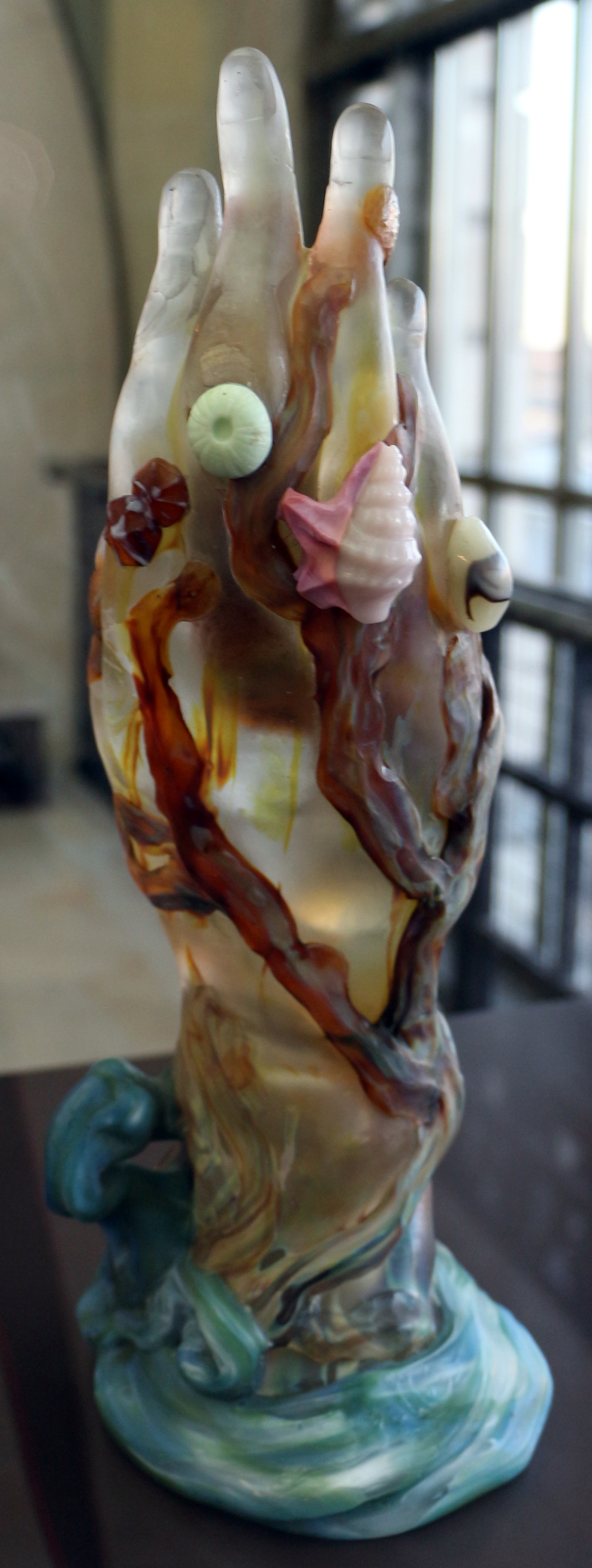
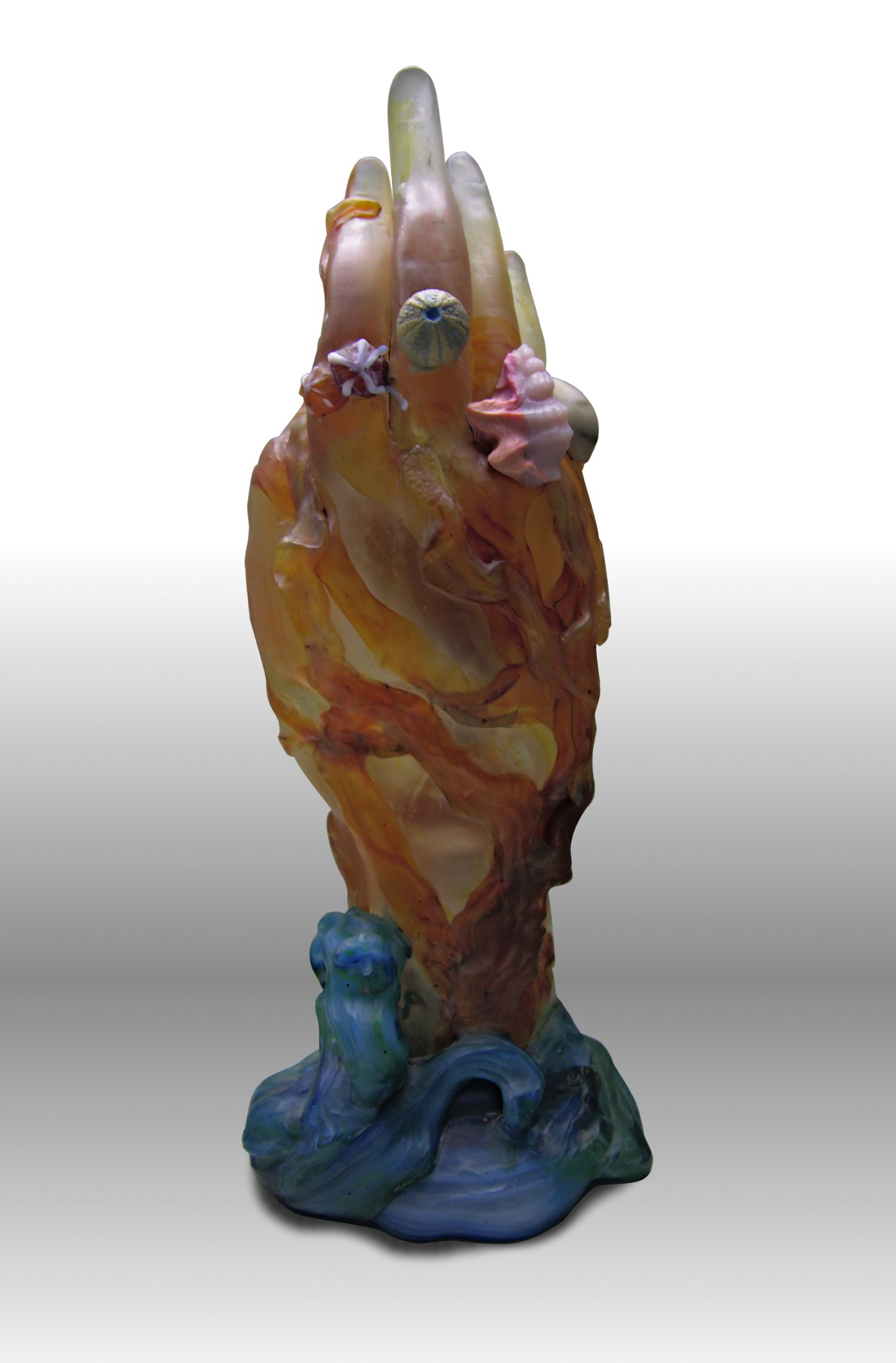
The object itself, photographed on display at the Musee d'Orsay. The hand rises from a blue-green base worked as water and seaweed; a green sea urchin, a dark red faceted stone, a pink shell and a cowrie are applied in high relief across the back of the hand and the fingers. It is the shells that separate this example from the Nancy hand catalogued as 955.1.2, on which the seaweed engraving was begun and never finished and no shell was ever applied.
Musee d'Orsay, Paris. Photograph by the Commons contributor Sailko, CC BY 3.0.| Artist | Emile Galle |
|---|---|
| Date | 1904 |
| Medium | Crystal, partly blown and modelled hot, with inclusions and applications, wheel-engraved |
| Dimensions | Height 33.4 cm; width 13.4 cm |
| Where it is now | Musee d'Orsay, Paris. On display, middle level, Room 63last confirmed 4 August 2026 |
| Inventory number | OAO 1207 |
| Attribution | AcceptedSigned and dated to the year of the maker's death. Full note |
| Object type | Glass |
| Period | French, Art Nouveau, Ecole de Nancy |
| Inscriptions | Signature engraved in relief at the base: Galle. No star. |
| Owners on record | 4 links4 documented |
| Sources | 11 cited |
About this record Last verified 21 August 2026 · 11 sources cited · Change log
On this page 12 sections
ContentsClose
A human hand, 33.4 centimetres high, modelled hot in crystal, rising out of a wave of blue-green seaweed with shells applied to its back in high relief. Emile Galle made it in 1904 and died on 23 September of that year. It was shown at Nancy five weeks later, in a case of his own design called The Depths of the Sea, at an exhibition whose opening had been put back a fortnight because he had died. The Musee d'Orsay, which has had it since 1990, calls it doubtless his last work in glass.
There are four of them. Two are in the Musee de l'Ecole de Nancy under two different titles and at two different heights, one is in Paris, and a trial piece was sold at Versailles in December 1970. Anyone citing a photograph of a Galle hand is citing one of four objects, and the only reliable way to tell them apart is the measurement.
The signature on this one reads Galle, engraved in relief at the base, and it has no star. From 1905 the Galle works put a star beside the name on its industrial production to mark it as made after the founder's death, and kept it there until May 1908, when the firm removed it because customers had begun saying that anything with a star was no longer Galle. That three-year mark is the cleanest authorship line in nineteenth and twentieth-century decorative art, and it is the reason a vase signed Galle can be by Galle, by his workshop in his lifetime, by his widow's factory in 1906, or by a joint-stock company in 1930.
Provenance
Each link is graded. Documented: a cited source supports it. Disputed: the identification is argued but not established. Unknown: no owner for that span, and the gap is not smoothed into a narrative. The grades in the glossary.
- 1904 -Made by Emile Galle at Nancydocumented
Dated 1904 by the Musee d'Orsay and signed at the base in relief, Galle, without a star. Galle died on 23 September 1904, so the object was completed within the last months of his life. Three further examples of the model exist.12
- 1904 -Exhibited at Nancy, in the maker's own display casedocumented
Shown at the Exposition d'art decoratif lorrain, galeries Poirel, Nancy, organised by the Societe lorraine des Amis des Arts, in a vitrine designed by Galle and titled Les Fonds de la mer, catalogued as number 88 and reproduced as plate 34. The opening was postponed from 15 to 29 October 1904 because of Galle's death. This is an exhibition, not a change of ownership, and is recorded here because it is the object's first appearance in the public record.12
- 1904 - 1990The Galle family, by descent; Jean Bourgogne, the maker's grandsondocumented
Kept in the family from the 1904 exhibition until the gift, but the sequence of holders inside the family is not recorded. The only named holder is the donor, Jean Bourgogne, Galle's grandson and an entomologist of international standing, born 14 February 1903 and died 10 March 1999. He was one year old when the object was made and cannot have been its first owner. When the object was lent to the Galle exhibition at the Musee du Luxembourg in 1985 and 1986 the catalogue described the lender only as a private collection. The 1990 donation was initially recorded as anonymous and was afterwards attributed to Galle's descendants.2
- 1990 - presentMusee d'Orsay, Parisdocumented
Gift, 1990. The museum's record gives the acquisition committee of 15 March 1990, the council of 21 March 1990 and a decree of 10 April 1990, and states that the work was attributed to the Musee d'Orsay in 1990. Inventory OAO 1207. It was shown almost immediately in the museum's survey of seven years of acquisitions, De Manet a Matisse, in the winter of 1990 to 1991, and has been in near-continuous exhibition use since.12
Prices realised
The object described in this record has never been sold at auction. It passed from the maker to his family and from his family to the Musee d'Orsay as a gift, and no price has ever been attached to it. The results listed below are for OTHER objects: one of the three other examples of the same model, and two Galle works quoted here as market comparanda. None of them is a valuation of this object.
| Date | Sale | Estimate | Result | Note |
|---|---|---|---|---|
| 13 December 1970 | Me Georges Blache, commissaire-priseur, Hotel Rameau, Versailles Ensemble exceptionnel Art nouveau, tableaux de l'epoque 1900, volumes et reliures, vases en pate de verre, ceramiques, porcelaines, bronzes, bijoux, argenterie, mobilier, tapis, vitraux, lot 67 | Not published in the sources consulted. | Hammer FRF 20,000. The French account uses adjugee, which is specifically the knock-down, so this is a hammer price. With premium Not published in the sources consulted. French francs | NOT THIS OBJECT. A fourth example of the model, sold at Versailles on 13 December 1970 and reproduced in colour on the cover of the sale catalogue and at plate XI. It is the only one of the four hands ever offered at public auction and it has not been located since. The 1985 Galle catalogue misprints the date as 13 December 1960. The sale is described in the literature as a historic one, among the first at which Art Nouveau prices caught fire. A footnote in the French account converts the figure to roughly 25,046 euros of 2023 purchasing power using the INSEE franc-to-euro converter; that is one method among several and is quoted as the source's own, not adopted here. Note also that Thiebaut regards this hand as a failed trial rather than a finished work. |
| 21 May 2015 | Sotheby's, Paris Bleu fleur d'eau, marqueterie de verre vase with an iris, 1901-1904 | EUR 200,000 to 300,000 | Hammer Not published. Only the premium-inclusive figure has been reported. With premium EUR 435,000, reported as including fees. EUR | NOT THIS OBJECT. A different Galle, quoted as the market comparandum at the top of the maker's range. 32 cm on a gilt bronze base, worked over entirely with the wheel; three examples of the model are documented, one exhibited at Dresden in 1901 and one at the Ecole de Nancy show in Paris in 1903. The provenance was acquisition directly from Emile Galle in 1904 and descent in the same family, which is as strong as a Galle provenance gets and is part of what the price is paying for. |
| 1989 | Sotheby's Les Coprins, table lamp | Not published in the sources consulted. | Hammer Not published. With premium USD 1.1 m approximately, as reported, UNLABELLED. USD | NOT THIS OBJECT. Reported as the standing auction record for Emile Galle. One of six examples made in 1902, in iridescent blown glass in the form of a group of mushrooms, on a wrought-iron base, 80 cm high. The exact date within 1989 and the hammer-against-premium split are missing from the sources consulted, and the figure is carried here only because it is the ceiling against which every other Galle price is read. Note that even the record object is one of six: unique works do not exist in this output. |
| 25 June 2020 | Sotheby's, London Important Design | EUR 2,000 to 4,000 | Hammer Not obtained. With premium NOT OBTAINED. The result is behind a login on the auction house's site and this record has not retrieved it. The estimate above is an expectation and is not a price realised. EUR | NOT THIS OBJECT, AND NOT A RESULT. An enamelled and gilt glass vase of about 1900, 19 cm high, signed with the EG monogram and the Cross of Lorraine and with Emile Galle Nancy on the underside, from a private collection in the United Kingdom. It is recorded here to show what the house expected at the bottom of the maker's range, and it is given its own row precisely so that an unrealised low estimate is never read against the realised figures above it. |
Hammer is the price at which the bidding stopped; with premium adds the fee the house charges the buyer on top. Hammer price and buyer's premium in the glossary.
Technical evidence
| Attribution note | Signed and dated to the year of the maker's death. The Musee d'Orsay records the inscription as a signature engraved in relief at the base, reading Galle, and dates the object 1904. It carries no star. That matters more on this maker than on almost any other: from 1905 the Galle works marked its industrial production with a star beside the name to identify it as made after Emile Galle's death on 23 September 1904, so the presence or absence of that one mark separates the man's work from the firm's. This object falls on the near side of that line, and was finished within months of the end of his life. |
|---|---|
| Technique | Crystal, partly blown and modelled hot, with inclusions and hot applications, finished by wheel engraving. The Orsay's formula is cristal partiellement souffle et modele a chaud, inclusions, applications, grave a la roue.1 |
| Dimensions | Height 33.4 cm; width 13.4 cm. The measurement is the only reliable way to distinguish this example from the three others of the model.12 |
| Signature | Engraved in relief at the base: Galle. There is no star. On the firm's own convention a star beside the name would indicate posthumous industrial production.13 |
| Designation | Catalogued by the Musee d'Orsay as a decorative object, not as a vase. It has no function.1 |
| Subject elements | A human hand rising from a base worked as seaweed and water, with shells applied in high relief to the back of the hand and the fingers. The museum indexes the object under hand, jewel, shell, seaweed and ornamentation.1 |
| First exhibition | Exposition d'art decoratif lorrain, galeries Poirel, Nancy, 1904, in a case designed by Galle and titled Les Fonds de la mer, catalogued as number 88 and reproduced as plate 34 of the exhibition catalogue.12 |
| The other examples | Musee de l'Ecole de Nancy 955.1.2, La Main aux algues, 38.5 x 12.5 cm, acquired 1955, on which the seaweed engraving was begun and never finished and no shell was ever applied; Musee de l'Ecole de Nancy RD1, La Main aux algues et aux coquillages, 32.5 x 13.2 cm, acquired 1971; and the hand knocked down at Versailles on 13 December 1970, lot 67, which Thiebaut regards as a failed trial.2 |
| Accession | OAO 1207. Gift, 1990: acquisition committee 15 March 1990, council 21 March 1990, decree 10 April 1990, attributed to the Musee d'Orsay in 1990.1 |
| Display | On display at the Musee d'Orsay, middle level, Room 63. The museum's record was last modified on 2 July 2026.1 |
| Condition | No condition report, restoration record or conservation history has been published in the sources consulted.1 |
Images
The record in full
Chapter 1There are four hands, and the difference between them is millimetres
Start here, because everything else about this object is downstream of it.
Start here, because everything else about this object is downstream of it. Four examples of the model are recorded.
The Musee de l'Ecole de Nancy holds two. One is catalogued as La Main aux algues, inventory 955.1.2, 38.5 by 12.5 centimetres, acquired in 1955. The other is catalogued as La Main aux algues et aux coquillages, inventory RD1, 32.5 by 13.2 centimetres, acquired in 1971. The Musee d'Orsay holds the third, inventory OAO 1207, 33.4 by 13.4 centimetres, acquired in 1990. A fourth was sold at public auction at Versailles on 13 December 1970 as lot 67 and is in a private collection.
The two titles are not a cataloguing muddle. They describe a real difference in the objects. On 955.1.2 the engraving of the seaweed on the back of the hand was begun and never finished, and no shell was ever applied to it: it is a hand with seaweed, and the title is accurate. The other three carry the shells. Anyone reconciling the labels should start from that and not from an assumption that curators were careless.
What the four are to each other is disputed by the two scholars who have worked on them. Francois Le Tacon holds that the two Main aux algues are first versions of the two Main aux algues et aux coquillages. Philippe Thiebaut rejects that, on the ground that reading a linear development into Galle is a misreading of how he worked, and argues instead that Galle had two fully finished pieces in hand. Thiebaut's supporting point is the more useful one for anybody cataloguing this maker: unique works do not exist in Galle's output. When an exceptional piece was undertaken, commissioned or not, four or six examples were generally made at the same time as a precaution.
So a reader who finds an image captioned La Main aux algues et aux coquillages is looking at one of three objects, and the caption will usually not say which. The measurement is the identifier. Use it.
Chapter 2What it is
A right hand, upright, palm forward, fingers together and slightly parted at the tips, rising out of a swirling base of blue-green glass worked to read as seaweed and water.
A right hand, upright, palm forward, fingers together and slightly parted at the tips, rising out of a swirling base of blue-green glass worked to read as seaweed and water. The body of the hand is a smoky, marbled crystal shot through with amber and brown inclusions that run like veins or like weed suspended in water. Applied to the back of the hand and to the fingers, in high relief and in contrasting opaque colours, are shells: a pink whelk at the centre, a pale disc, a small dark spiral, a red form at the wrist.
The Orsay describes the technique as crystal partly blown and modelled hot, with inclusions and applications, then wheel-engraved. Every one of those operations is a different trade and a different temperature. The hand was formed while the glass was soft; the inclusions were introduced into the body of the metal; the shells were applied hot and left standing proud; the detail was cut cold with a lapidary wheel afterwards. The finished object is 33.4 centimetres high and 13.4 wide.
It is not a vase, although it is sometimes catalogued as one. The Orsay classifies it as a decorative object. It holds nothing and it does not function.
Chapter 3Made in 1904; shown five weeks after he died
Emile Galle died at Nancy on 23 September 1904, aged fifty-seven.
Emile Galle died at Nancy on 23 September 1904, aged fifty-seven. The Exposition d'art decoratif lorrain, organised by the Societe lorraine des Amis des Arts at the galeries Poirel in Nancy, was due to open on 15 October. The opening was put back to 29 October because of his death.
The hand was in that exhibition. It was shown inside a display case Galle had himself conceived, catalogued as number 88 and titled Les Fonds de la mer, the depths of the sea, and it was reproduced as plate 34 of the exhibition catalogue. So the first public appearance of the object was in a room that its maker had planned and did not live to see, in a vitrine of his own devising, at a show that had been delayed to bury him.
That sequence is the reason the object is called his artistic testament, a phrase the Musee d'Orsay used for the title of a monographic exhibition built around this single work in 2004. It should be treated as a description of the circumstances rather than a statement about his intentions. Nothing consulted here records Galle saying that this was his last word.
Chapter 4The signature is the argument
The Musee d'Orsay's inscription line is nine words long in the original and it decides the authorship question: a signature engraved in relief at the base, reading Galle.Take care with what the cut...
The Musee d'Orsay's inscription line is nine words long in the original and it decides the authorship question: a signature engraved in relief at the base, reading Galle.
Take care with what the cut of that signature does and does not prove, because it is easy to get backwards. A signature engraved in relief is a cameo signature: the ground is taken away and the letters are left standing. Samuel Provost, who has done the archival work on the marks, holds that on the best pieces the signature is worked in intaglio, cut into the glass in an elaborate hand-script, and that a plain cameo signature on a piece claiming to be top-flight is a warning rather than a reassurance. On his test the relief signature on this object argues nothing in its favour. The authorship here does not rest on the mark at all. It rests on the date of 1904 and on the object's presence in the Nancy exhibition of that year, in a case Galle designed, catalogued and photographed at the time.
What the mark does settle is the other half of the question, and it settles it decisively: there is no star. The Galle works marked its posthumous industrial production with a star beside the name. If this object carried one it would not be Emile Galle's work in the sense the label claims, and the label would be wrong. It does not, and it is not.
The rule that follows is simple enough to write on a card and is broken constantly in the trade and occasionally in print: check the date of any Galle object against 23 September 1904 before calling it his own work, and then check the mark. A piece made in 1906 and signed Galle is a Galle-works piece, not a Galle.
Chapter 5The star: what it was, and exactly when it ran
After Galle's death his widow Henriette Galle took over the direction of the factory, which she ran until her own death in 1914.
After Galle's death his widow Henriette Galle took over the direction of the factory, which she ran until her own death in 1914. The industrial series produced under her direction were marked with a star beside the founder's name to identify them as posthumous.
The dates given for that mark in most reference books are 1904 to 1906, and they are wrong. That chronology descends from a single piece of testimony given by Rene Dezavelle in 1974. Samuel Provost re-dated the mark from the firm's own correspondence, principally Henriette Galle's letters to Albert Daigueperce, who managed the Paris depot. The decision to add the star was not taken before January 1905, and the mark was introduced in the first half of that year. It was removed in May 1908.
The reason for the removal is recorded and it is commercial. The factory's director Emile Lang reported customers who were claiming that everything bearing the star was no longer Galle. The mark that had been added out of respect had turned into a discount. Three years after introducing an honest disclosure of authorship, the firm withdrew it because the market punished it.
That is a fact worth holding on to well beyond this object. A maker's mark that truthfully distinguishes posthumous production from lifetime work is exactly what a provenance archive wants, and the reason so few of them exist is that they cost the estate money.
Chapter 6The full sequence of marks, and how to read one
Provost's chronology of the marks after 1904 runs as follows.
Provost's chronology of the marks after 1904 runs as follows. A first mark, standardised after 1905, derives from the prototype used for the industrial series before Galle's death. The second, from 1905 to 1908, is the underlined crossed-G with the star, with variants in the position of the star and in whether the final e is a Latin acute or a Greek epsilon. The third, from 1908 to about 1920, is the same underlined crossed-G with the star removed; it is the longest-lived mark and it carried the firm through the First World War.
Then the marks multiply with each reorganisation of the company. A simple unaccented-underscore Galle appears from about September 1920, after the departure of the sales director Daigueperce and of the designers Louis Hestaux and Paul Nicolas, and is concentrated on small pieces: bonbonnieres, atomisers, cups, averaging under fifteen centimetres. A short-lived mark with an inverted G-tail runs from about 1920 to 1924 and is associated with the designer Jean Rouppert, who left for Lyon in that year; one grapevine vase carrying it is incised with the date 28 November 1922. From 1925, when the firm became a joint-stock company and recruited George Dethorey and Theodore Ehrhart, an underlined tangent-G mark appears on the larger and costlier pieces. From about 1927 a vertical, Japanese-styled signature reading top to bottom appears, overwhelmingly on the crackled vase series. Two ornamental marks, one horizontal and one vertical, run from about 1927 or 1928 to the end on the prestige series: the polar bears, the elephants, the large floral pieces.
The end date matters too and it has also been corrected. The main furnace was shut down in 1931 and the design team had been dismissed in late 1930, but production continued until 1936; Francois Le Tacon established that in 1993 against a literature that had closed the factory in 1931. Provost notes that there is almost no hard evidence at all for the decade from about 1928 to 1936, because the firm stopped exhibiting.
The practical upshot for a cataloguer is that a Galle mark is a dating instrument. Read it properly and it gives a date range of a few years. Read it as a name and it gives you nothing but a brand.
Chapter 7What the museums call the later pieces
The best way to see how this works is to look at what careful institutions actually write on the label, because they do not write Emile Galle.The Rijksmuseum holds a vase with maple branches...
The best way to see how this works is to look at what careful institutions actually write on the label, because they do not write Emile Galle.
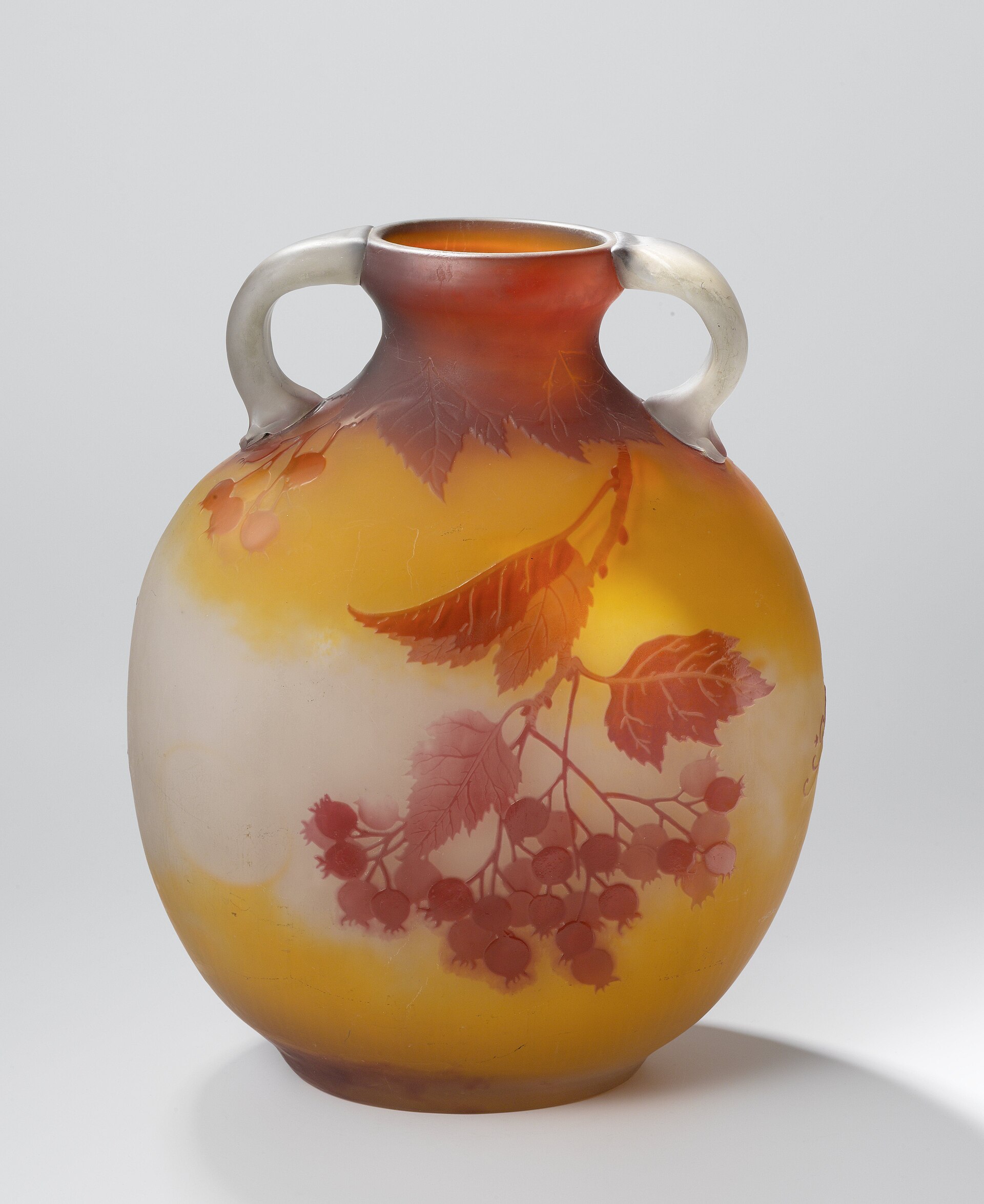
The Rijksmuseum holds a vase with maple branches, inventory BK-1983-35, 29.5 centimetres high, in colourless glass with a double yellow and orange-red overlay, etched and cut. Its maker line reads glassblower: Emile Galle, workshop of. Its date is given as about 1904 to about 1906. Its description records, in the museum's own words, the signature Galle with a star. That is a posthumous object, correctly described, and the star is on it.
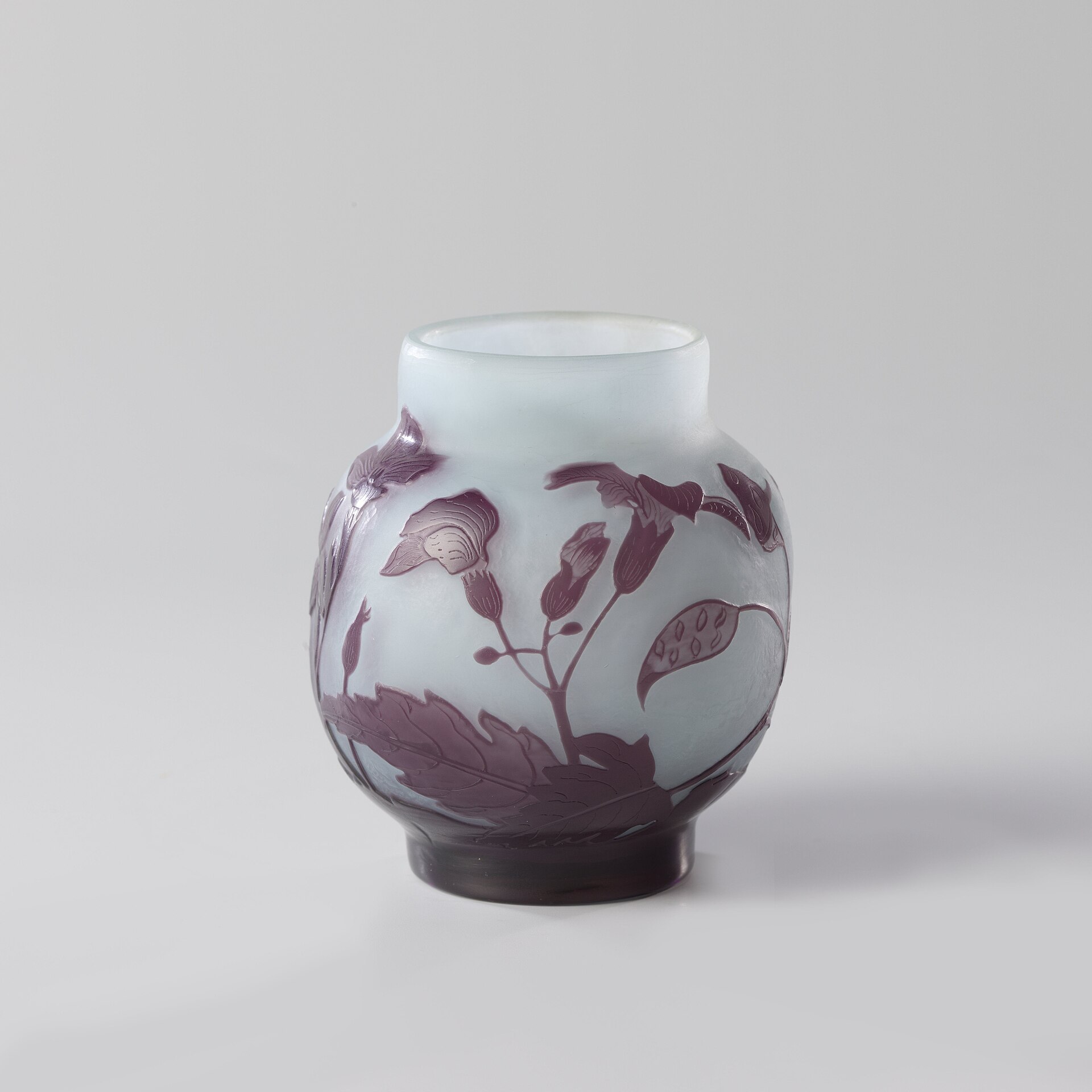
The same museum holds a small vase with honesty seed-pods, BK-1972-74, 8.8 centimetres high, again given to the workshop of Emile Galle, dated about 1906 to about 1914, with the signature Galle and no star. That is a post-1908 object, correctly described. Two vases, one museum, one signature word, ten years and one mark between them.
The Metropolitan Museum of Art catalogues an Autumn Crocus vase of about 1900 to the studio of Galle and, in its own metadata, to the Etablissements Galle. That is the third category, and the one most often lost: workshop production made while Galle was alive and running the business, which is neither his own hand nor posthumous.
One correction, offered here rather than to the museums. The Rijksmuseum's date range of about 1904 to about 1906 for the star vase is the old Dezavelle chronology. On Provost's revised dating the star cannot have been applied before the first half of 1905 and ran to May 1908, so that vase should read about 1905 to 1908. The object is not misattributed; the window is simply drawn in the wrong place, and it is drawn in the wrong place in a great many catalogues.
Chapter 8Who ran the works after him
Henriette Galle directed the factory from her husband's death until she died in 1914, with Victor Prouve, Galle's friend and a founder of the Ecole de Nancy, as artistic director.
Henriette Galle directed the factory from her husband's death until she died in 1914, with Victor Prouve, Galle's friend and a founder of the Ecole de Nancy, as artistic director. The First World War stopped production. Afterwards Paul Perdrizet, Galle's son-in-law, restarted it, added new designs and concentrated on the multi-layer cameo glass in floral and landscape patterns that most people now picture when they hear the name.
That is the crucial commercial fact about this maker. The overwhelming majority of objects on the market signed Galle were made by a company, after his death, to designs he did not make, using an industrial acid-etching process he had introduced but did not personally execute. They are not fakes. They are perfectly genuine products of the Etablissements Galle. They are simply not by the man whose signature is on them, and the difference in value between the two is two orders of magnitude.
Chapter 9The fakes, which are a separate problem from the posthumous work
Alongside genuine posthumous production there is a substantial body of outright forgery, and Provost divides it in two.The first category is counterfeit: pieces carrying imitation Galle signatures...
Alongside genuine posthumous production there is a substantial body of outright forgery, and Provost divides it in two.
The first category is counterfeit: pieces carrying imitation Galle signatures with no connection to the factory at all. Some are newly manufactured copies, principally from Romania and China. Others are older French and Lorraine glass by other makers, Paul Nicolas, De Vez, Burgun and Schverer among them, rebaptised with a Galle signature. That second kind is the harder one, because the object is a genuine period piece of related manufacture and only the mark is a lie.
The second category is alteration: genuine Galle objects modified, to hide damage or to raise the apparent quality, to the point where Provost's view is that they cease to count as Galle originals. A cut-down rim, a re-engraved passage or a replaced element turns an authentic object into something else, and the trade does not always say so.
The signals Provost sets out for the counterfeits are art-historical rather than mechanical: decorative combinations that make no sense, such as terrestrial plants with marine elements; naive or cartoonish drawing well below the workshop's standard; visible erasure or modification of the original design; clumsy hot applications; motifs the workshop did not use, such as trails of bubbles in a marine subject; and a signature left in flat cameo on a piece that claims to be of the first quality, where the firm cut intaglio.
From the trade side, the appraiser Philip Chasen adds that on authentic pieces the decoration was wheel-polished to a semi-gloss against a matte ground, so a reproduction that is uniformly matte gives itself away; that a dark band round the rim and a straight-cut rim are bad signs; that the foot is often too large and bulbous; and that the accent on the final e is a constant on authentic signatures. Provost's chronology qualifies that last point usefully: the accent is always there, but it is sometimes a Latin acute and sometimes a Greek epsilon, and which one it is helps to date the mark.
Chasen's own figure for how much of this is in circulation is the one worth quoting. Of the appraisals he carries out for individuals and insurance companies, about half turn out to be fake.
Chapter 10What Galle actually costs, and why the range is so wide
The name spans four orders of magnitude, and the reason is everything above.At the top, a marqueterie de verre vase with an iris, called Bleu fleur d'eau, made between 1901 and 1904, 32 centimetres...
The name spans four orders of magnitude, and the reason is everything above.
At the top, a marqueterie de verre vase with an iris, called Bleu fleur d'eau, made between 1901 and 1904, 32 centimetres high on a gilt bronze base and worked over entirely with the wheel, was sold at Sotheby's in Paris on 21 May 2015 against an estimate of 200,000 to 300,000 euros. It made 435,000 euros including fees. Three examples of the model are documented; one was shown at the Dresden international exhibition of 1901 and another at the Ecole de Nancy exhibition in Paris in 1903. Its provenance was as good as a Galle provenance gets: acquired directly from Emile Galle in 1904 and in the same family ever since.
The auction record for the maker is older and higher. Sotheby's sold a Les Coprins lamp in 1989 for about 1.1 million US dollars: one of six examples made in 1902, in iridescent blown glass in the form of a group of mushrooms, on a wrought-iron base, eighty centimetres high. The exact date within 1989 is not established in the sources consulted here.
At the other end, Sotheby's offered a small enamelled and gilt glass vase of about 1900, nineteen centimetres high, signed with the EG monogram and the Cross of Lorraine and with Emile Galle Nancy underneath, in its Important Design sale of 25 June 2020, at an estimate of 2,000 to 4,000 euros. That is an estimate and not a result: what the vase actually made is behind a login and this record has not obtained it. It is quoted here only for what the house expected, which is the honest use of an estimate and the only one.
An expectation of two thousand euros at one end and a realised million dollars at the other, under the same signature. What separates them is date, hand, technique and mark, in that order, and the hand is the one the price databases cannot see.
Chapter 11What it meant, and which parts of that are evidenced
The Musee d'Orsay's own reading of the hand is that its form recalls Buddhist ritual gesture, the votive offerings of antiquity and medieval reliquaries: a hand held up, presented, offered.
The Musee d'Orsay's own reading of the hand is that its form recalls Buddhist ritual gesture, the votive offerings of antiquity and medieval reliquaries: a hand held up, presented, offered. The sea supplied Galle with a large part of his decorative vocabulary, and the museum sets the object beside Baudelaire, quoting the opening of L'Homme et la mer, that the free man will always cherish the sea and that the sea is his mirror in which he contemplates his soul.
Galle was explicit about this kind of thing in his own lifetime. He read a paper called Le Decor symbolique to the Academie de Stanislas at Nancy on 17 May 1900 and published it that year. Whatever a reader makes of the hand, the maker was a man who had set out in print, four years earlier, a theory of how ornament carries meaning.
Two further readings should be graded and separated. The first is the museum's own note that the object appears to confirm an oral family tradition, that the hand was a protest at the sinking of the Russian squadron at Port Arthur during the Russo-Japanese war of 1904 to 1905. That is family testimony reported by the holding institution, and it should be read as such: not a document, not nothing. It also carries a chronological caution, since the object was finished in 1904 and the war ran into 1905.
The second is the reading, current in the French literature on the piece, that the hand belongs with Ophelia, drowned among weeds, as Millais painted her, so that the object hangs between emergence and dissolution. That is a modern interpretation by later writers and is recorded here as reception, not as intention.
What is documented, and is enough on its own, is that a dying man made a hand coming out of the sea, put it in a case called The Depths of the Sea, and did not live to see it shown.
Chapter 12Where it has been since 1990
The object stayed in the family from the 1904 exhibition until 1990, and the sequence inside the family is not documented.
The object stayed in the family from the 1904 exhibition until 1990, and the sequence inside the family is not documented. The donor was Jean Bourgogne, Galle's grandson, an entomologist of international standing, born on 14 February 1903 and so a year old when the hand was made; he cannot have been its first owner, and who held it before him is not recorded. When it was lent to the Galle exhibition at the Musee du Luxembourg in 1985 and 1986 the catalogue described the lender only as a private collection. The gift was at first recorded as anonymous and was afterwards attributed to Galle's descendants. It went through the acquisition committee on 15 March 1990, the council on 21 March and a decree of 10 April, and the work was attributed to the museum the same year. Bourgogne died on 10 March 1999. It was shown at once, in the museum's own survey of seven years of acquisitions, in the winter of 1990 to 1991.
Since then it has been out constantly and in serious company: the 1900 exhibition at the Galeries nationales du Grand Palais in 2000; a monographic exhibition at the Orsay in 2004 built around this single work and titled after it; the Galle centenary shows at the Edo-Tokyo Museum and the National Museum of Art in Osaka in 2005; Sade. Attaquer le soleil at the Orsay in 2014 and 2015; Les origines du monde at the Orsay in 2021; and Bleu profond, on artists and the invention of the deep sea, at Les Franciscaines in Deauville in 2025.
It is also, as of 2025, one of the hundred objects chosen for a book on works that tell the story of the climate. A glass hand made in Lorraine in 1904 is now being used to talk about the sea in the twenty-first century. That is where this object currently is, in both senses, and the Orsay record was last modified on 2 July 2026.
Chapter 13Why there is no photograph of the object on this page
This record carries no image of the hand itself, and the reason is a rule this publication applies against its own interest.A photograph of a three-dimensional object carries its own copyright...
This record carries no image of the hand itself, and the reason is a rule this publication applies against its own interest.
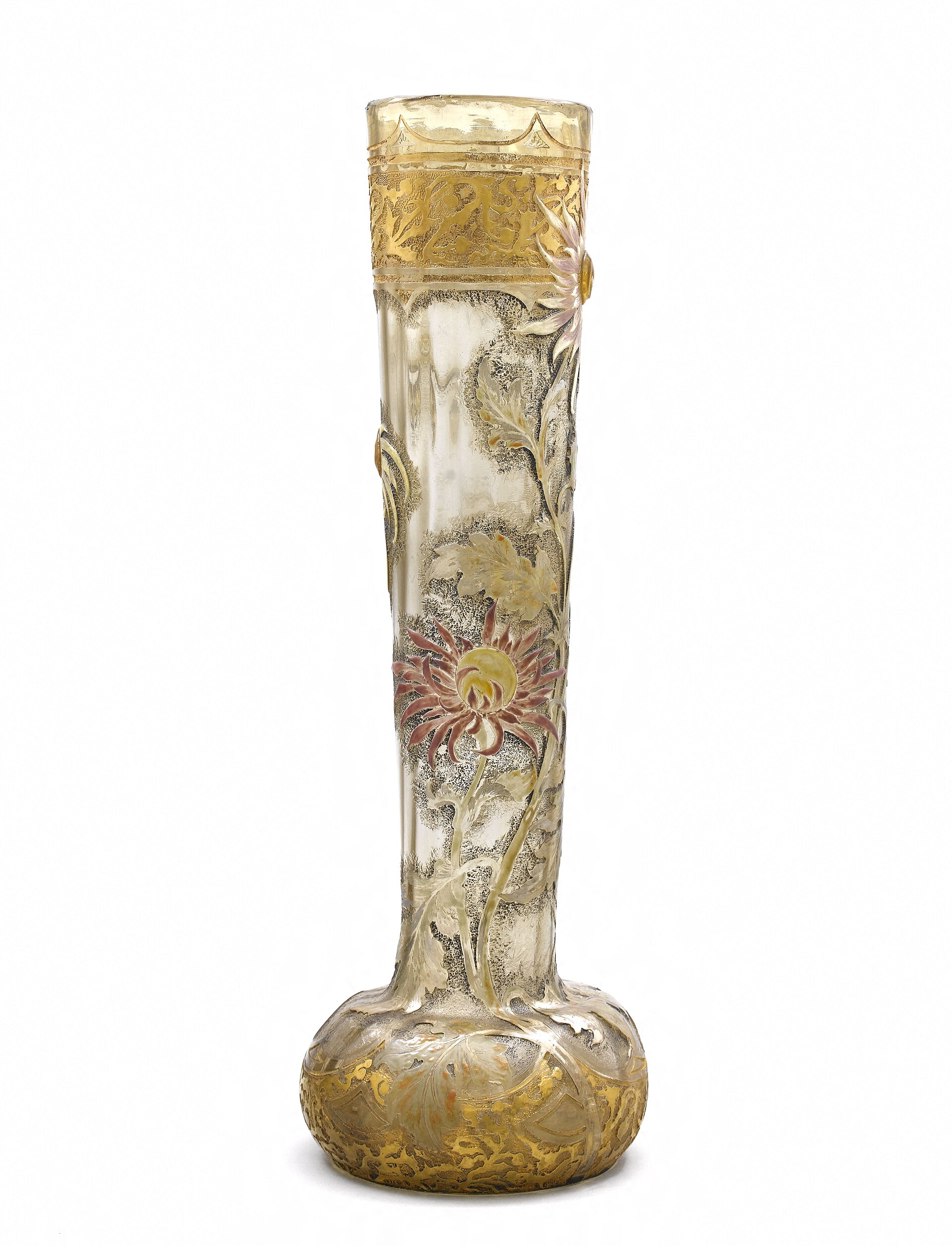
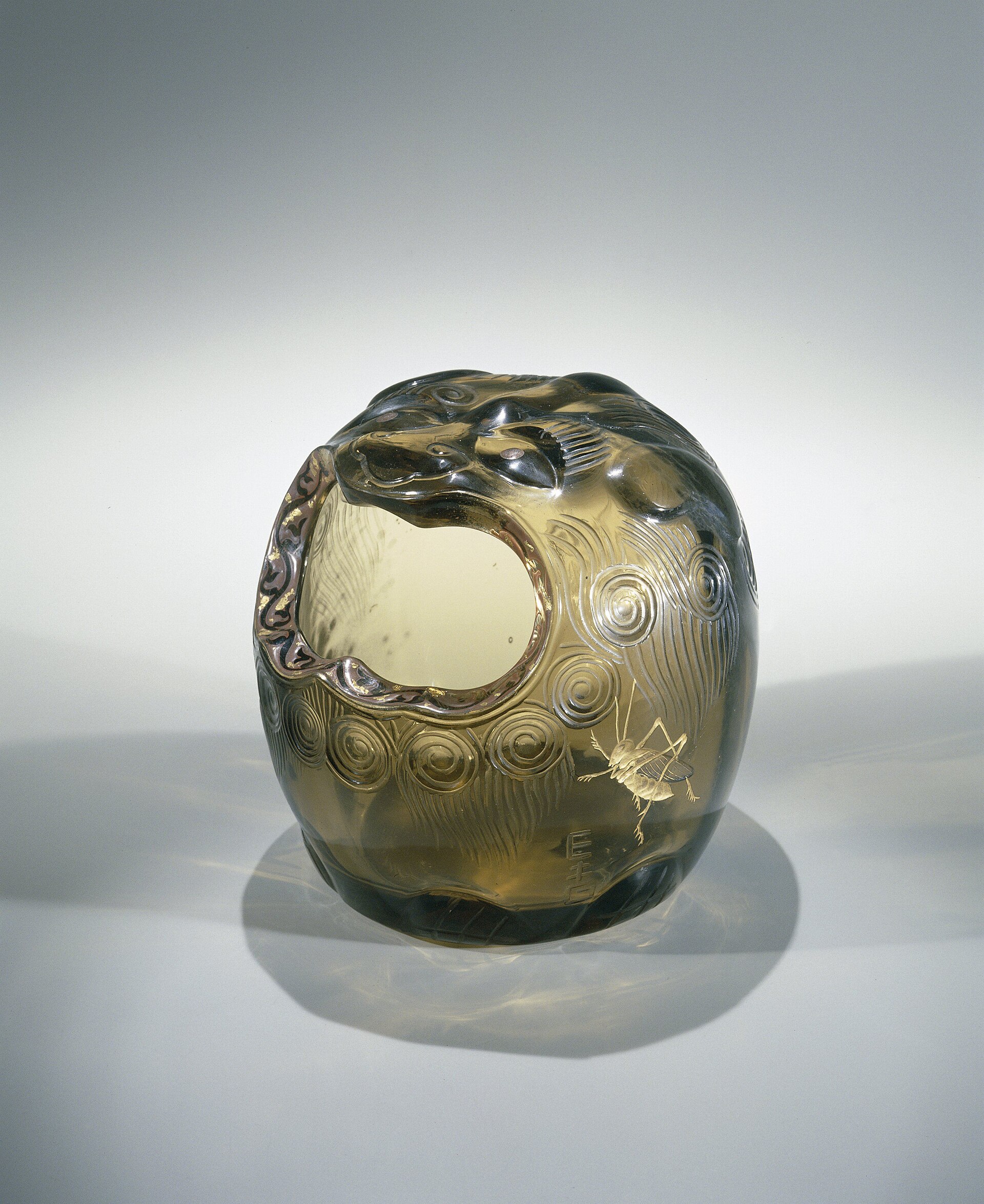
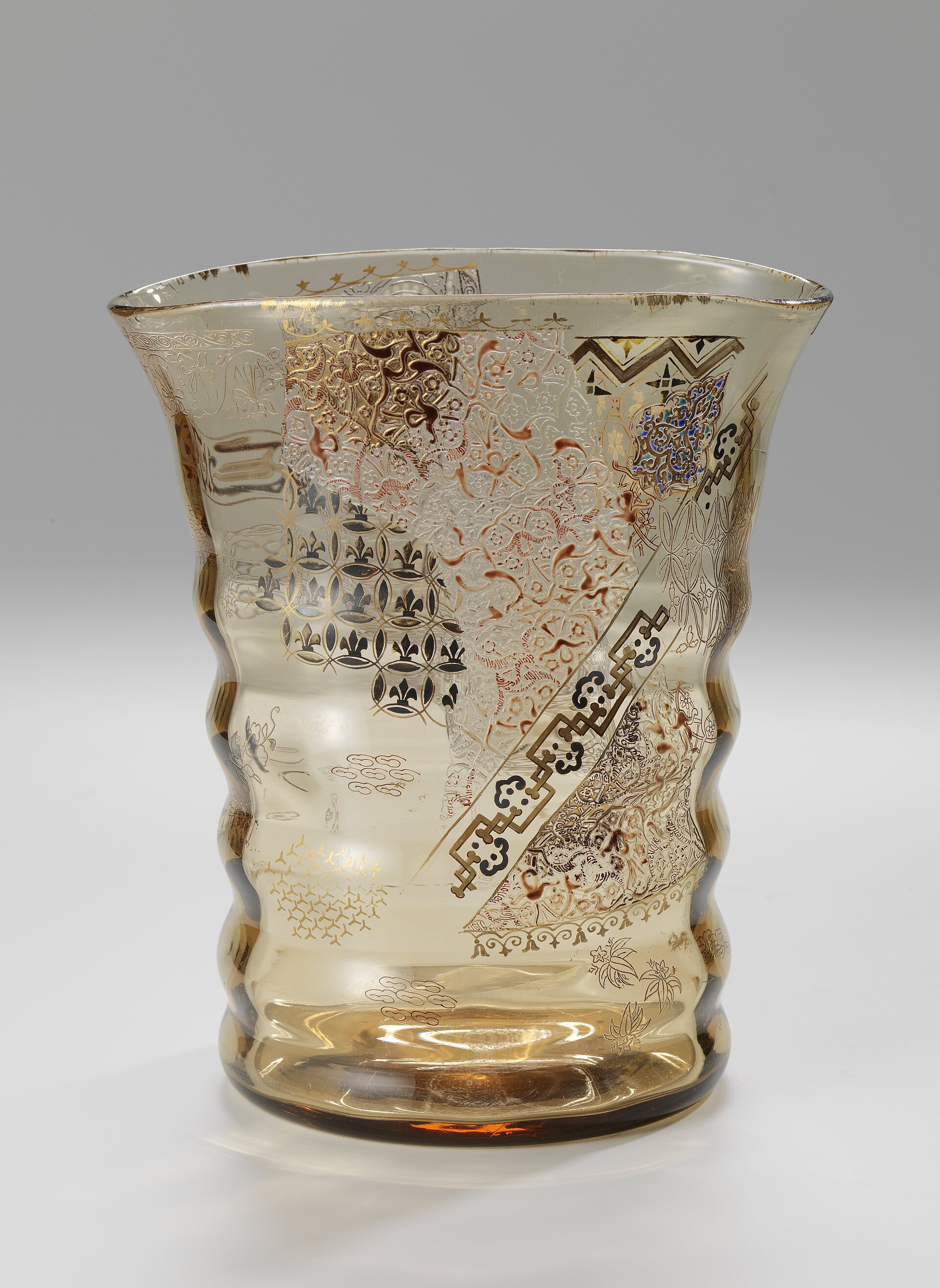
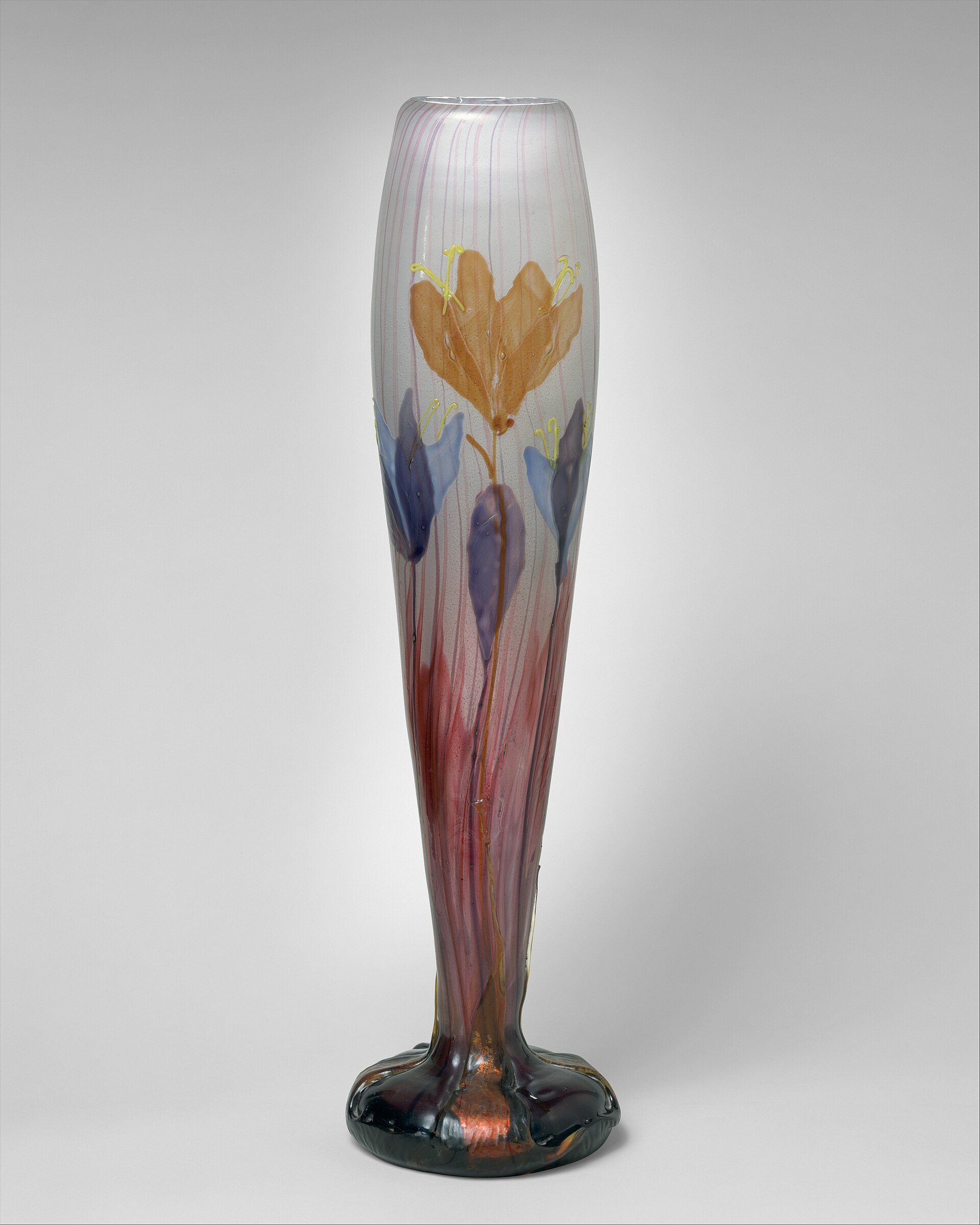
A photograph of a three-dimensional object carries its own copyright, however old the object is. Emile Galle died in 1904 and his work is long out of copyright; the photographs of it are not. Two images of this hand are on Wikimedia Commons under a public domain tag, and both tags are applied to the sculptor's death date rather than to the photograph. One of the two states on its own file page that it was taken at the Musee d'Orsay in 2021, by a named photographer, during an exhibition this object appeared in. A 2021 photograph is not in the public domain because the man who made the glass died in 1904.
Using it would put a false licence line on this page. So the plates below are all of other objects, every one of them released as CC0 by the museum that owns it, and every one of them chosen to carry a part of the argument: what Galle's own signatures look like, what the workshop's look like, and what the star looks like when a museum records it.
The artist
Emile Galle, and the Etablissements Galle after him
Galle is one of the few makers in the decorative arts whose corpus has a hard, dated, published line running through it, and it is not a stylistic line. It is a star. From the first half of 1905 to May 1908 the factory marked its industrial output with a star beside his name to say that he was dead and had not made it. That mark, its exact dates and the sequence of marks that came before and after it, is the useful material on this maker, and it is the material most reference books get wrong. This dossier is about the marks, the workshop and the fakes rather than about the biography, which is available everywhere.
Exhibited
- 1904Exposition d'art decoratif lorrain, in the vitrine Les Fonds de la mer, no. 88, plate 34Galeries Poirel, Nancy
- 1985-1986Galle, catalogue no. 148Musee du Luxembourg, Paris
- 1990-1991De Manet a Matisse: sept ans d'enrichissement au Musee d'OrsayMusee d'Orsay, Paris
- 20001900, catalogue no. 298Galeries nationales du Grand Palais, Paris
- 2004La Main aux algues et aux coquillages: le testament artistique d'Emile GalleMusee d'Orsay, Paris
- 2005Emile Galle: commemoration d'un centenaireEdo-Tokyo Museum, Tokyo, and National Museum of Art, Osaka
- 2014-2015Sade: attaquer le soleilMusee d'Orsay, Paris
- 2021Les origines du monde: l'invention de la nature au XIXe siecle, catalogue no. 204Musee d'Orsay, Paris
- 2025Bleu profond: les artistes et l'invention des fonds marinsLes Franciscaines, Deauville
Literature
- Exposition d'art decoratif lorrain, exhibition catalogue, Nancy, galeries Poirel, 1904, plate 34.
- Emile Galle, Le Decor symbolique: discours de reception a l'Academie de Stanislas a Nancy, le 17 mai 1900, Nancy, Berger-Levrault, 1900.
- Philippe Garner, Galle, Paris, Flammarion, 1977, p. 121.
- Georges Barbier-Ludwig, 'La Main aux algues et aux coquillages, a propos du symbolisme d'Emile Galle', Arts nouveaux, bulletin de l'Association des Amis du musee de l'Ecole de Nancy, no. 6, 1991.
- Francois Le Tacon, Emile Galle ou le Mariage de l'Art et de la Science, Paris, Editions Messene, 1995, pp. 136-142.
- Philippe Thiebaut, 'Le testament d'un verrier: La Main aux algues et aux coquillages (1904) d'Emile Galle', La Revue du Louvre et des musees de France, no. 3, 1996, pp. 71-80.
- Philippe Thiebaut, Galle, le testament artistique, exhibition catalogue, Musee d'Orsay, 15 June to 12 September 2004, Paris, Hazan and Musee d'Orsay, 2004, no. 1.
- Guy Cogeval (ed.), Le Musee d'Orsay a 360 degres, Paris, Skira, Flammarion and Musee d'Orsay, 2013, p. 293, text by Philippe Thiebaut.
- Samuel Provost, 'La signature Galle a l'etoile: une revision chronologique et une estimation quantitative', Journal of Glass Studies, 2017. The volume number given in the author's own online bibliography, 39, appears to be an error; the article is dated 2017.
- Servane Dargnies-de-Vitry (ed.), 100 oeuvres qui racontent le climat, Paris, GrandPalaisRMN, 2025, illustration no. 85.
Related works
| Work | Relation | Where it is |
|---|---|---|
| La Main aux algues Emile Galle | Another example of the same model, under a different title 38.5 by 12.5 cm, acquired in 1955. The tallest of the four. Its title is accurate rather than careless: the engraving of the seaweed on the back of the hand was begun and never completed, and no shell was ever applied to it. Le Tacon reads it as a first version of the pieces with shells; Thiebaut rejects that reading. | Musee de l'Ecole de Nancy, inventory 955.1.2 |
| La Main aux algues et aux coquillages Emile Galle | Another example of the same model, under the same title 32.5 by 13.2 cm, acquired in 1971. Within a centimetre of the Orsay example in both dimensions, and catalogued under the identical title. This is the pair most likely to be confused. | Musee de l'Ecole de Nancy, inventory RD1 |
| La Main aux algues et aux coquillages, the 1970 hand Emile Galle, or the workshop | A fourth example, regarded as a failed trial Knocked down at 20,000 francs at Versailles on 13 December 1970, lot 67, under Me Georges Blache at the Hotel Rameau, and reproduced in colour on the catalogue cover and at plate XI. Not located since. Thiebaut treats it as a failed trial rather than a finished work: the fingers overlap and are very short, possibly truncated, and the seaweed is coarsely applied and never reworked. It is signed, but after Galle's death many unfinished or defective pieces were signed with a point in order to identify them as his, not to defraud, so the signature on this hand is not evidence that he finished it. | Private collection |
| Bleu fleur d'eau, marqueterie de verre vase with an iris Emile Galle | Market comparandum at the top of the maker's range 1901 to 1904, 32 cm on a gilt bronze base. Sold Sotheby's Paris 21 May 2015 for 435,000 euros including fees against an estimate of 200,000 to 300,000. Three examples of the model are documented, one exhibited at Dresden in 1901 and one at the Ecole de Nancy exhibition in Paris in 1903. Acquired directly from Galle in 1904 and in the same family until the sale. | Private collection |
| Les Coprins, table lamp Emile Galle | The auction record for the maker Sold by Sotheby's in 1989 for about 1.1 million US dollars. One of six examples made in 1902, in iridescent blown glass in the form of a group of mushrooms, on a wrought-iron base, 80 cm high. The date within the year is not established in the sources consulted for this record. | Private collection |
| Vase with maple branches, BK-1983-35 Workshop of Emile Galle | A posthumous piece carrying the star, correctly catalogued 29.5 cm, colourless glass with a double yellow and orange-red overlay, etched and cut. The museum's description records the signature Galle with a star and dates it about 1904 to about 1906. On Provost's revised chronology the range should be about 1905 to 1908. | Rijksmuseum, Amsterdam |
| Autumn Crocus vase, 1984.553 Studio of Emile Galle, Etablissements Galle | Lifetime workshop production, correctly catalogued as such About 1900, glass with tray, 44.1 by 9.5 cm, gift of Lloyd and Barbara Macklowe, 1984. The middle category between autograph work and posthumous production, and the one most often lost in the trade. | Metropolitan Museum of Art, New York |
Open questions
- Which of the four hands is the one exhibited at Nancy in 1904 and reproduced as plate 34 of that catalogue? The Orsay example descends from the family and is the obvious candidate, but no source consulted matches the plate to an inventory number.
- Where is the fourth example, the trial piece sold at Versailles on 13 December 1970 as lot 67? It has not been located since.
- Are the two La Main aux algues first versions of the two with shells? Francois Le Tacon says they are; Philippe Thiebaut rejects it as reading a false linearity into Galle's development. Both positions are in print and neither has been tested against the objects.
- What was the hammer price of the Bleu fleur d'eau vase at Sotheby's Paris in 2015? Only the premium-inclusive 435,000 euros is published.
- On what date in 1989 did Sotheby's sell the Les Coprins lamp, and what was the hammer against the premium? The house is established; the rest is not.
- How many star-marked pieces were produced between 1905 and 1908? Provost's article on the star carries a quantitative estimate that this record has not been able to read; the paper was not obtained.
- Is the family tradition that the hand protests the sinking of the Russian squadron at Port Arthur documented anywhere beyond family testimony reported by the museum?
- Has the object ever been technically examined or conserved? No condition report or conservation history has been published in the sources consulted.
- Should the museums holding star-marked pieces revise their date ranges to 1905 to 1908? The Rijksmuseum's about 1904 to about 1906 is the superseded Dezavelle chronology, and it is not alone.
- Is this object (OAO 1207) among the loans to L'Etrange cas de M. Galle, Musee des Beaux-Arts de Nancy / Musee de l'Ecole de Nancy, 21 October 2026 to 27 February 2027? Press coverage describes the exhibition as supported by the Musee d'Orsay and drawing on public collections, but no checklist has been located.
Questions about this object
What is La Main aux algues et aux coquillages?
La Main aux algues et aux coquillages is a glass, dated 1904. Medium: Crystal, partly blown and modelled hot, with inclusions and applications, wheel-engraved.
Who made La Main aux algues et aux coquillages, and is the attribution settled?
The attribution to Emile Galle is recorded here as accepted. Signed and dated to the year of the maker's death. The Musee d'Orsay records the inscription as a signature engraved in relief at the base, reading Galle, and dates the object 1904. It carries no star. That matters more on this maker than on almost any other: from 1905 the Galle works marked its industrial production with a star beside the name to identify it as made after Emile Galle's death on 23 September 1904, so the presence or absence of that one mark separates the man's work from the firm's. This object falls on the near side of that line, and was finished within months of the end of his life.
Where is La Main aux algues et aux coquillages now?
Musee d'Orsay, Paris. On display, middle level, Room 63. Inventory number OAO 1207. Last confirmed 4 August 2026. Gift, 1990; acquisition committee 15 March 1990, council 21 March 1990, decree 10 April 1990, attributed to the Musee d'Orsay in the same year.
What is still unknown about La Main aux algues et aux coquillages?
Which of the four hands is the one exhibited at Nancy in 1904 and reproduced as plate 34 of that catalogue? The Orsay example descends from the family and is the obvious candidate, but no source consulted matches the plate to an inventory number.
Sources
- 1Musee d'Orsay, collection record for Emile Galle, La Main aux algues et aux coquillages, 1904, inventory OAO 1207, with the technique line, dimensions, inscription, designation, acquisition history, exhibition list, bibliography and indexing terms, and the museum's own commentary. The URL returns HTTP 403 to automated retrieval; the record, including its collapsed panels, was read in full in the in-app browser on 4 August 2026. Record last modified 2 July 2026. musee-orsay.fr/en/...
- 2French Wikipedia, 'La Main aux algues et aux coquillages'. TERTIARY. Used for the four known examples with their inventory numbers, dimensions and acquisition dates, the postponement of the 1904 Nancy opening from 15 to 29 October, the identification of Jean Bourgogne as the family owner, the Versailles sale of 13 December 1970, the Ophelia reading, and the assembled bibliography. Flagged for replacement with Thiebaut 1996 and the 2004 Orsay catalogue. fr.wikipedia.org/wiki/...
- 3Samuel Provost, 'The Galle signatures on glass after 1904: a tentative chronology, part I, 1904-1920', 28 December 2020. PRIMARY for the revised dating of the star: the decision taken no earlier than January 1905, introduction in the first half of 1905, withdrawal in May 1908, the evidence of Henriette Galle's letters to Albert Daigueperce, the quotation from the director Emile Lang, and the supersession of Rene Dezavelle's 1974 testimony. galle.substack.com/p/...
- 4Samuel Provost, 'The Galle signatures on glass after 1904: a tentative chronology, part II, 1920-1936'. Used for the marks from 1920 to 1936, the associated company reorganisations and designers, the 1931 furnace closure against the 1936 end of production established by Francois Le Tacon in 1993, and the near-total absence of evidence for about 1928 to 1936. galle.substack.com/p/...
- 5Wikimedia Commons file record for the Rijksmuseum vase with maple branches, BK-1983-35, carrying the museum's own catalogue text: workshop of Emile Galle, about 1904 to about 1906, 29.5 cm, and the signature Galle with a star. commons.wikimedia.org/wiki/...
- 6Wikimedia Commons file record for the Rijksmuseum vase with honesty seed-pods, BK-1972-74, carrying the museum's catalogue text: workshop of Emile Galle, about 1906 to about 1914, 8.8 cm, and the signature Galle. commons.wikimedia.org/wiki/...
- 7Art Without Skin, 'Un vase exceptionnel d'Emile Galle mis en vente chez Sotheby's (Paris)', 27 April 2015, on the Bleu fleur d'eau marqueterie de verre vase: the 1901-1904 dating, the 32 cm height, the estimate of 200,000 to 300,000 euros, the result of 435,000 euros including fees at Sotheby's Paris on 21 May 2015, the acquisition directly from Galle in 1904 and family descent, the three documented examples with their Dresden 1901 and Paris 1903 exhibitions, and the standing record of about 1.1 million dollars for the Les Coprins lamp in 1989. artwithoutskin.com/2015/...
- 8Wikimedia Commons file record for the Metropolitan Museum of Art Autumn Crocus vase, accession 1984.553, about 1900, carrying the museum's own metadata giving the maker as the studio of Emile Galle and as Etablissements Galle, with the gift of Lloyd and Barbara Macklowe, 1984. metmuseum.org/art/...
- 9Samuel Provost, 'Fake Galles I: when a floral design...', April 2023. Used for the two categories of fake, the Romanian and Chinese copies, the rebaptism of glass by Paul Nicolas, De Vez and Burgun and Schverer, the alteration of authentic pieces, and the diagnostic signals including the intaglio against cameo signature. galle.substack.com/p/...
- 10Philip Chasen, 'More information on how to spot reproduction Galle vases', Philip Chasen Antiques, 25 November 2010. TRADE SOURCE. Used for the wheel-polished semi-gloss decoration against a matte ground, the dark band and straight-cut rim, the over-large bulbous foot, the accent on the final e, and the appraiser's own figure that about half of the Galle pieces he appraises turn out to be fake. blog.chasenantiques.com/2010/...
- 11Sotheby's, Important Design, 25 June 2020, lot record for an Emile Galle enamelled and gilt glass vase, circa 1900, 19 cm, signed EG with the Croix de Lorraine and Emile Galle Nancy on the underside, estimate 2,000 to 4,000 euros, from a private collection in the United Kingdom. The result is behind a login and was not obtained. sothebys.com/en/...


Last verified 21 August 2026 · Published 4 August 2026
Change log
2 August 2026 - Record deepened to the house standard: narrative sections, technical evidence, artist dossier, related works and open questions added; provenance chain and auction results replaced with the researched versions; sources rebuilt.
4 August 2026 - Withheld from publication. This archive lists an object only when a photograph OF THAT OBJECT can be reproduced under a free licence. No such photograph has been found for this one, so the record is held rather than published beside pictures of other things. It will be released if a free reproduction appears.
4 August 2026 - Record created at the house standard: researched narrative, technical evidence, maker dossier, graded provenance chain, prices with hammer and premium separated, related works, open questions and sources.
21 August 2026 - Re-verified 2026-08-21. No substantive change to location, attribution, or ownership; no litigation or restitution claim found. All 11 cited sources still resolve (source 1's 403-to-bots and source 8's 429-rate-limiting are pre-existing/transient, not rot). One watch item surfaced: a major Galle exhibition, 'L'Etrange cas de M. Galle' (Musee des Beaux-Arts de Nancy / Musee de l'Ecole de Nancy, 21 Oct 2026 - 27 Feb 2027), is described in press coverage as supported by the Musee d'Orsay and drawing on public collections, but no checklist confirming this object's inclusion was found -- added to open_questions for the next pass to check once the exhibition opens and a checklist or press kit is published.