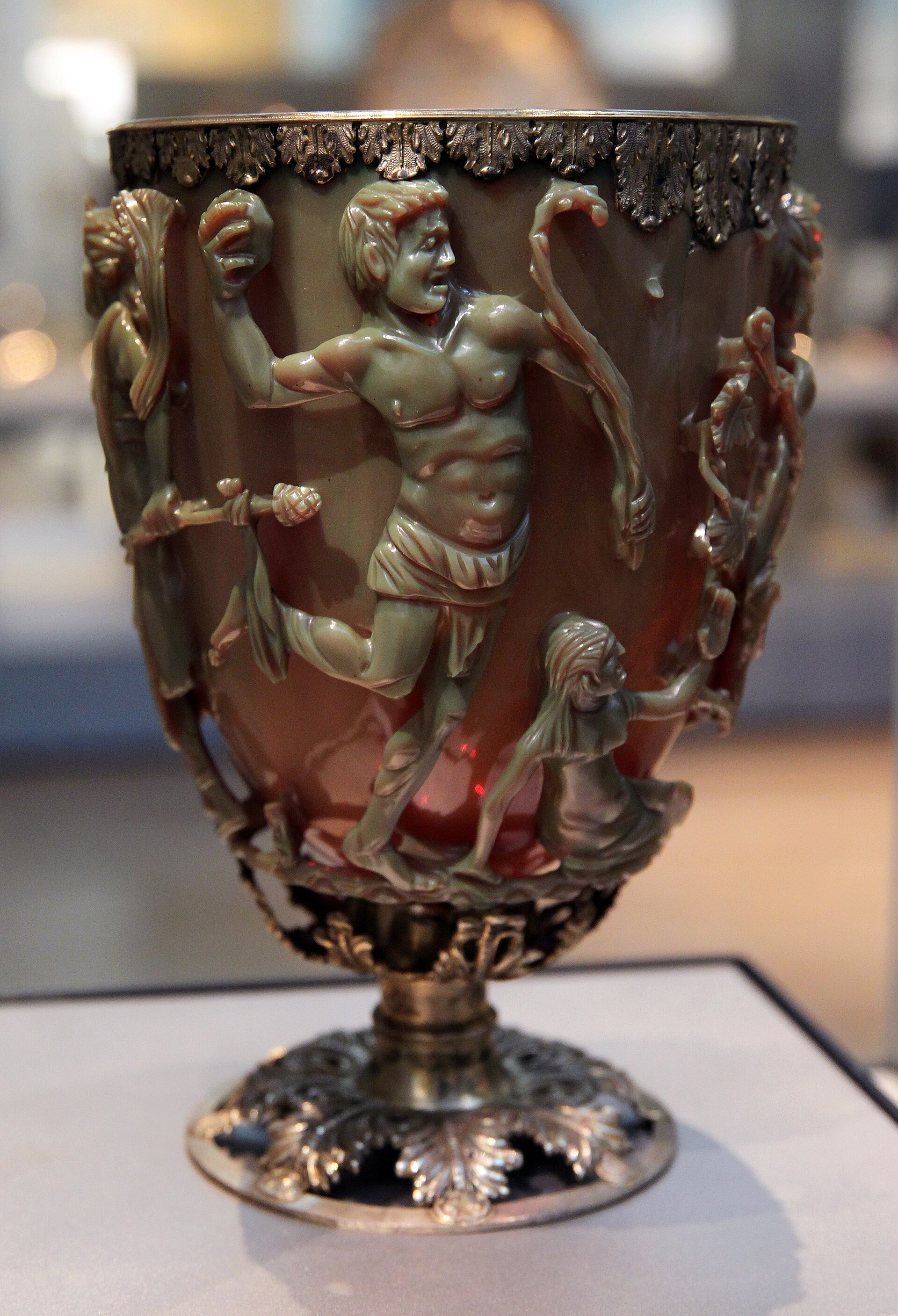
The Lycurgus Cup
4th century AD · Dichroic glass containing colloidal gold...
British Museum
 active 250-350
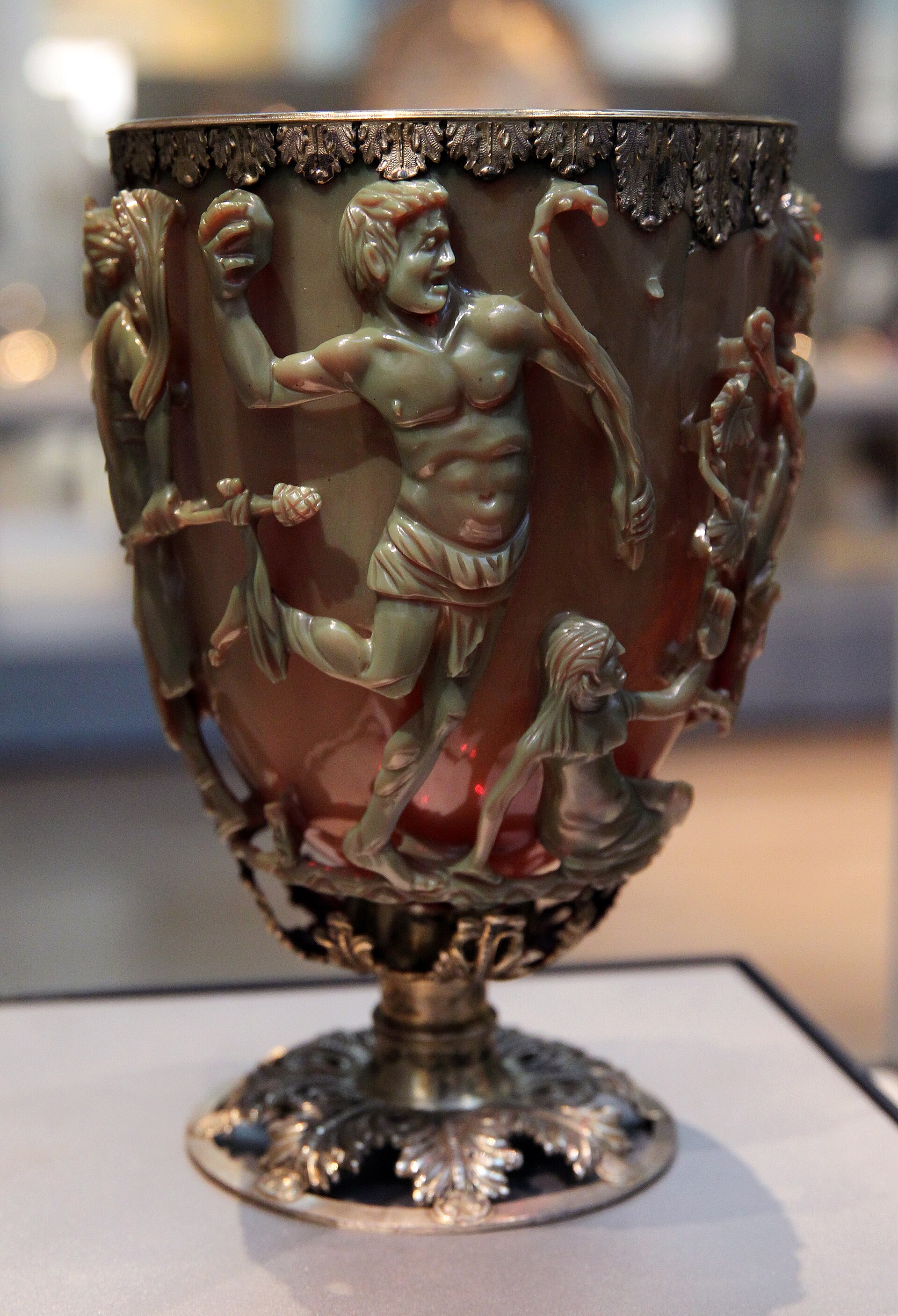
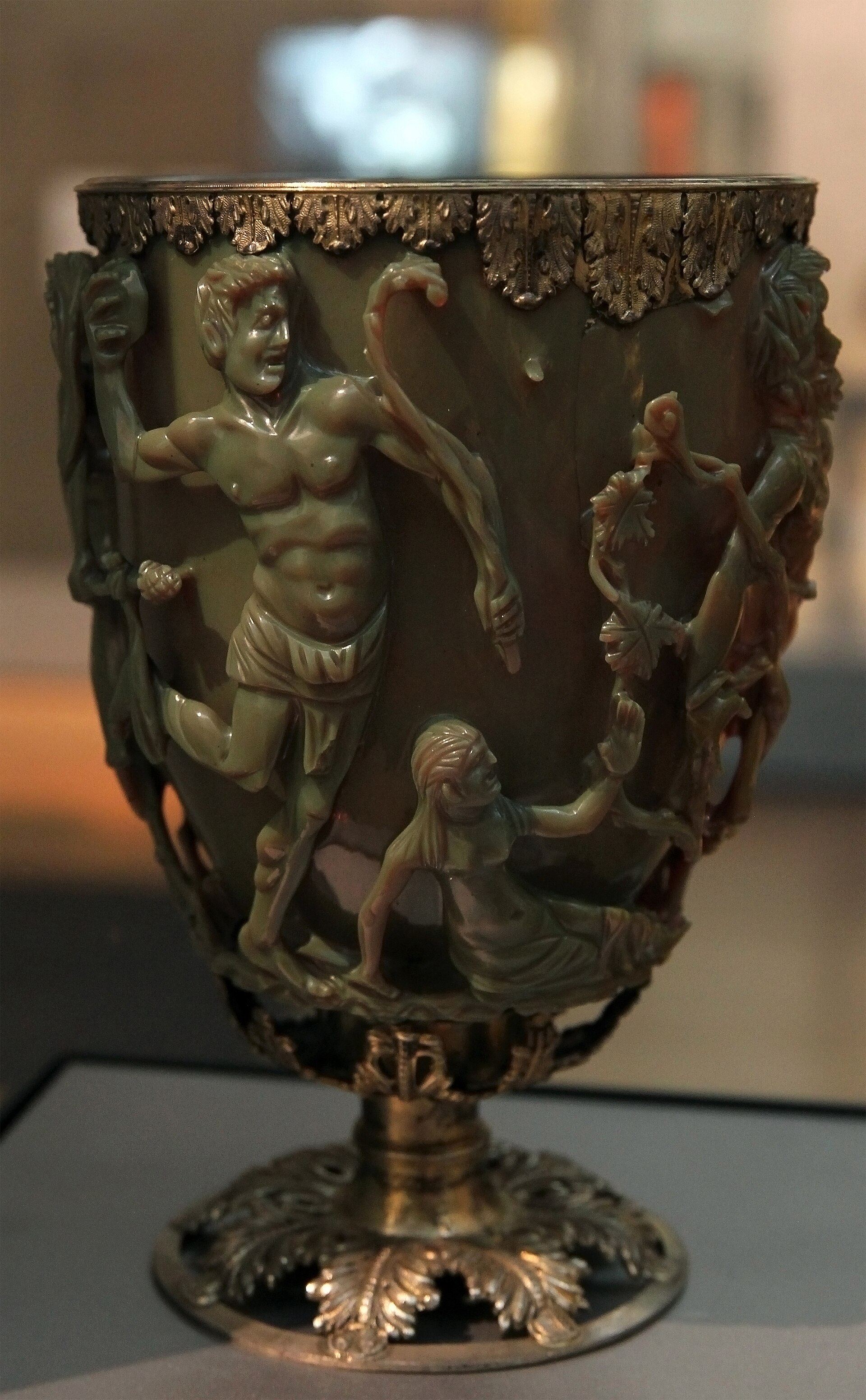
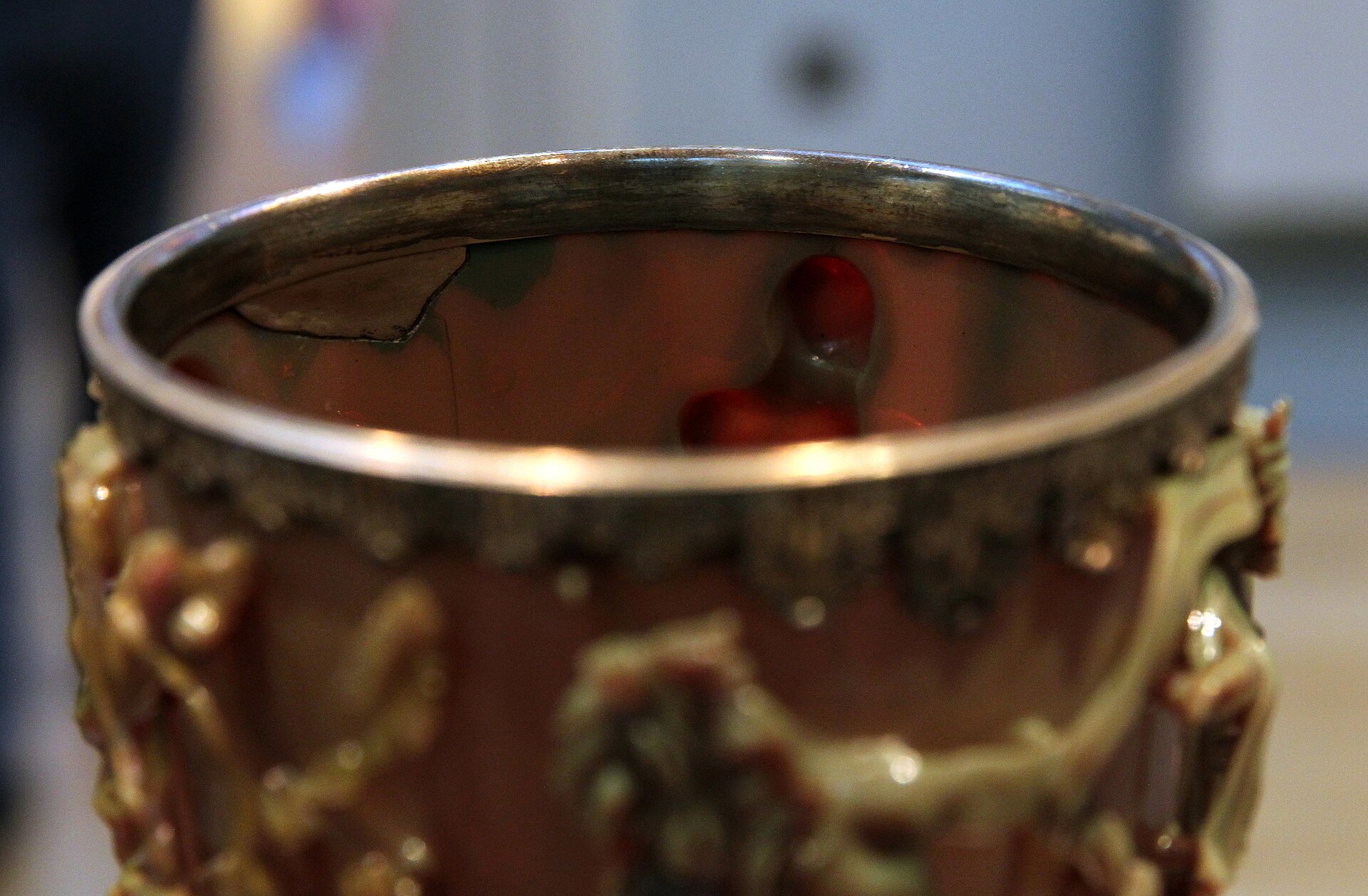
The Lycurgus Cup, lit from the front The only complete dichroic cage cup known, photographed in the British Museum with the light in front of it. In this state the cup reads olive green. It is this workshop's single most technically remarkable surviving product, and the plate is included to show the effect exactly as a viewer standing at the case would see it before any light is placed behind the glass. No verified portrait. No securely identified likeness of this maker is known under a free licence. We do not publish a face we cannot verify.
British Museum, London. Photograph by Vassil, released CC0.| Full name | No name survives for any workshop that made a cage cup, and none is likely to. |
|---|---|
| Worked as | Glassworker (vitrearius), Lapidary cutter, trade name disputed (diatretarius), Cage-cup and diatretum workshop |
| Born | Not applicable. This is a class of luxury object, not a... · Unresolved. The majority of findspots cluster on or near... |
| Died | The class goes out of use by the mid to late 4th century on... · Unknown |
| Nationality | Roman |
| Movement | Late Roman luxury glass |
| In this archive | 1 artwork |
| Sources | 15 cited |
| Last verified | 17 September 2026 |
About this page 1 artwork in the archive · Last verified 17 September 2026 · 15 sources cited
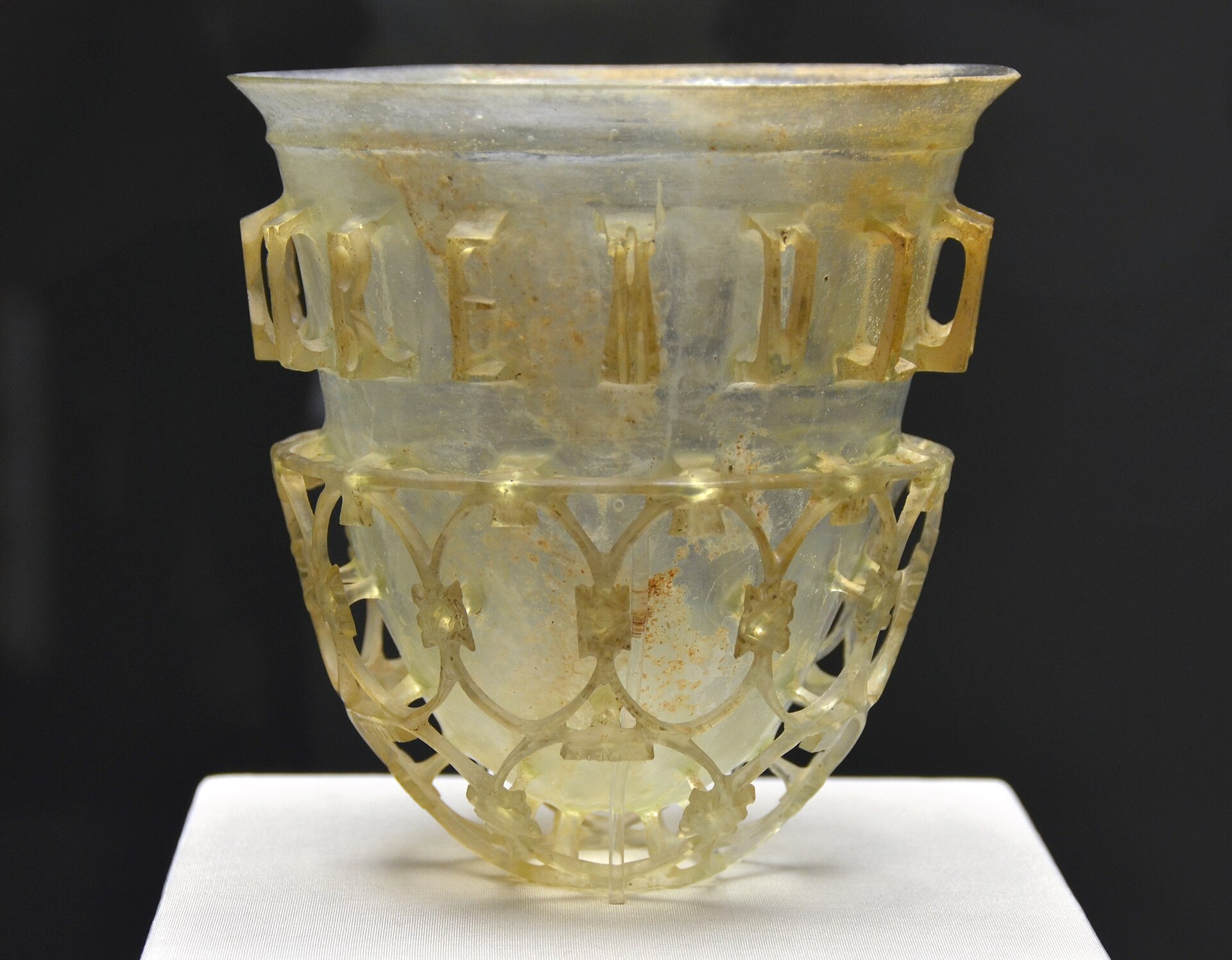
A cage cup, or diatretum, is cut from a single thick gather of glass so that an outer shell stands almost completely free of an inner cup, the two joined only by a handful of short bridges hidden inside the decoration. Held to the light, daylight shows through the gap. It is the most technically demanding object the Roman glass industry produced, and it survives in something like eighty catalogued whole vessels and fragments, of which well under ten are complete or nearly so. Not one carries a maker's name, a workshop mark, or an inscription identifying a craftsman, and no cutting shop or furnace associated with the class has ever been excavated. Two of Iconotheca's own records, for the British Museum's Lycurgus Cup and for the Constable-Maxwell cage cup, carry this workshop as their artist of record for exactly that reason: there is no name to give them, only a technique to describe.
The central dispute is not who made these vessels but how. The orthodox account, set out by Fritz Fremersdorf in 1956 and maintained in David Whitehouse's posthumous 2015 corpus, holds that the cage was cut and ground out of the solid blank with a rotating abrasive wheel, an extraordinarily slow process with no possibility of repair once a strut broke. A minority position argued since the 1990s by Rosemarie Lierke, and given a detailed physical case by Sylvia Fuenfschilling in a 2020 review, holds that the blanks were formed or fused close to their final shape and only finished cold. Both positions are held by people who have examined the vessels closely, and this page states both without arbitrating.
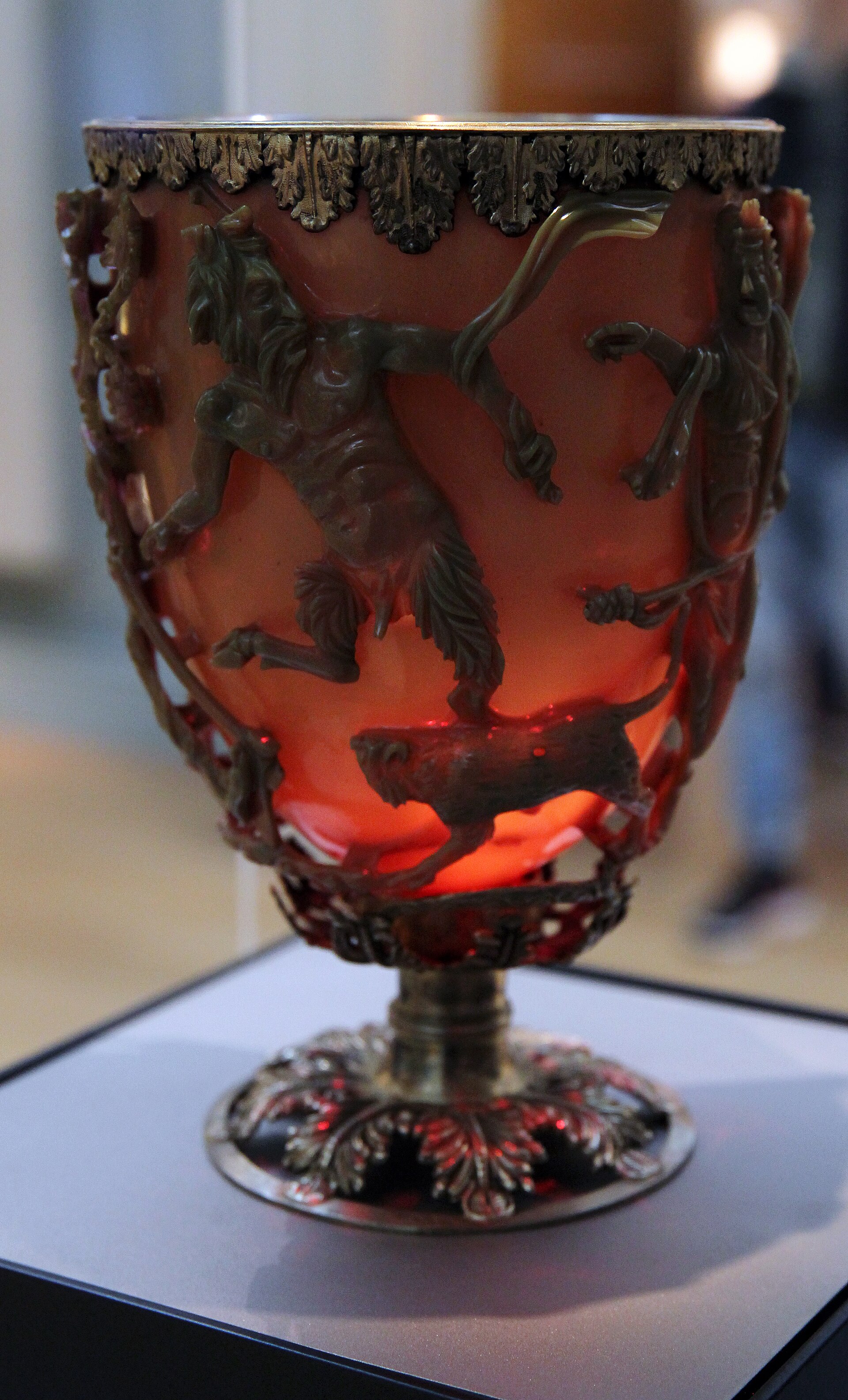
One cage cup does something none of the others do. The Lycurgus Cup, cut with a scene of Dionysos destroying the impious king Lycurgus, is dichroic: lit from in front it reads muddy green, lit from behind it turns translucent wine red, an effect produced by an alloy of gold and silver particles roughly seventy nanometres across suspended in the glass at a few hundred parts per million. Modern materials science has measured the particles and modern nanotechnology researchers still cannot fully reproduce the recipe. That a single Roman workshop, whoever they were, achieved this once and apparently never repeated it reliably is itself part of the evidence for how the whole class was made.
Earliest secure literary use of the word diatretus, in Martial, well before either the Constantinian legislation or the Digest passage usually cited alongside it for the trade name diatretarius.2
Two sarcophagi at Hohensulzen, near Worms, produce six glass vessels including cage-cup fragments. The associated grave goods date the burial to about AD 300 or slightly later, becoming the standard comparison point for dating the class.1
The mainstream working range for the class on the sources consulted for this page, with no securely dated example later than the mid to late 4th century.125
The British Museum's dating for the Lycurgus Cup, given without a finer point and without any findspot.3
The Trivulzio cage cup, found in the 17th century near Novara and acquired by Abbot Trivulzio in the 18th, enters the collection of the city of Milan, giving it the longest documented collecting history of any cage cup.1
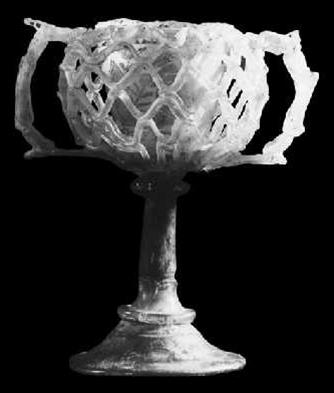
A third-century cage cup from Cologne, in the Czartoryski collection at Goluchow, is lost; it is catalogued today among Polish wartime losses and survives only as a photograph.12
Five of the six Hohensulzen glasses of 1869, including the cage-cup fragments that anchor the class's dating, go missing; only the Dionysos bottle, now at the Landesmuseum Mainz, survives.1
The Lycurgus Cup, unstudied in a Rothschild house, is investigated at Victor, Lord Rothschild's request by the British Museum, prompting the first treatment of cage cups as a class.1
Fritz Fremersdorf sets out, in detail, the cutting-from-solid account of cage-cup manufacture that remains the orthodoxy.12
The British Museum purchases the Lycurgus Cup from Victor, 3rd Lord Rothschild, a negotiated private sale rather than an auction result.3
Donald Harden and Jocelyn Toynbee publish 'The Rothschild Lycurgus Cup' in Archaeologia, defining Group A (figured) and Group B (network) and treating cage cups as a class for the first time.1
Otto Doppelfeld subdivides Group B into five further sub-groups on the presence of an inscription and of an overhanging ovolo flange.1
Rosemarie Lierke publishes her mould-formed and fused alternative to the cutting orthodoxy, including a paper specifically on the Lycurgus Cup in 2013.12
Ian Freestone, Nigel Meeks, Margaret Sax and Catherine Higgitt publish 'The Lycurgus Cup - A Roman Nanotechnology' in Gold Bulletin, summarising the electron-microscopy identification of the gold-silver colloid.6
David Whitehouse's Cage Cups: Late Roman Luxury Glasses, completed after his 2013 death by William Gudenrath and Paul Roberts, is published by the Corning Museum of Glass: 69 catalogue entries plus a 13-object addendum.25
Richard Whiteley CT-scans a Roman cameo-glass fragment, a different class of object, at the Australian National University and reports cold-working evidence inconsistent with blowing. The same test has not been reported on a cage-cup fragment.4
A French national preventive-archaeology team excavates the Autun cup, inscribed VIVAS FELICITER, from an intact fourth-century sarcophagus at Saint-Pierre-l'Estrier, still containing ambergris.1
Sylvia Fuenfschilling publishes her critical review of Whitehouse's corpus in the Journal of Roman Archaeology, setting out the physical case for the forming-and-fusing minority position.2
A team led by Vittorio Saggiomo at Wageningen University publishes an attempt to 3D-print a synthetic gold-silver dichroic nanocomposite reproducing the Lycurgus Cup's optical behaviour, and reports that reference spectra needed to calibrate the attempt are largely missing from the published literature.7
This class has almost no market, because almost none of its members are for sale: every named survivor but one has sat in a public institution for decades or centuries. The single exception is the Constable-Maxwell cup, sold three times between 1979 and 2004 and the only cage cup for which hammer, estimate and premium mean anything at all; its full sale history, including the unresolved question of whether the 1979 and 1997 figures are hammer prices or premium-inclusive totals, is carried in this archive's dedicated record for that object rather than repeated here. The Lycurgus Cup's only recorded price is its 1958 purchase from Victor, 3rd Lord Rothschild, a negotiated private sale to the British Museum rather than an auction result, so hammer and premium do not apply to it.
| Date | Sale | Work | Result | Note |
|---|---|---|---|---|
| 4 June 1979 | Sotheby Parke Bernet, London | The Constable-Maxwell cage cup | Hammer Not published as a separate figure With premium GBP 520,000 as published, unlabelled GBP | A world record for glass at auction at the time. The only cage cup ever to enter open trade; full detail in this archive's record for the object. |
Hammer is the price at which the bidding stopped; with premium adds the fee the house charges the buyer on top. Hammer price and buyer's premium in the glossary.
| Institution | City | Holdings | Note |
|---|---|---|---|
| British Museum | London | The Lycurgus Cup, 1958,1202.1, the only complete figural, dichroic cage cup known | On permanent display, Room 41. |
| Corning Museum of Glass | Corning, New York | A bowl-form cage cup with an ancient copper-alloy suspension collar and lamp-hanger | The strongest physical evidence for the lamp-use hypothesis. |
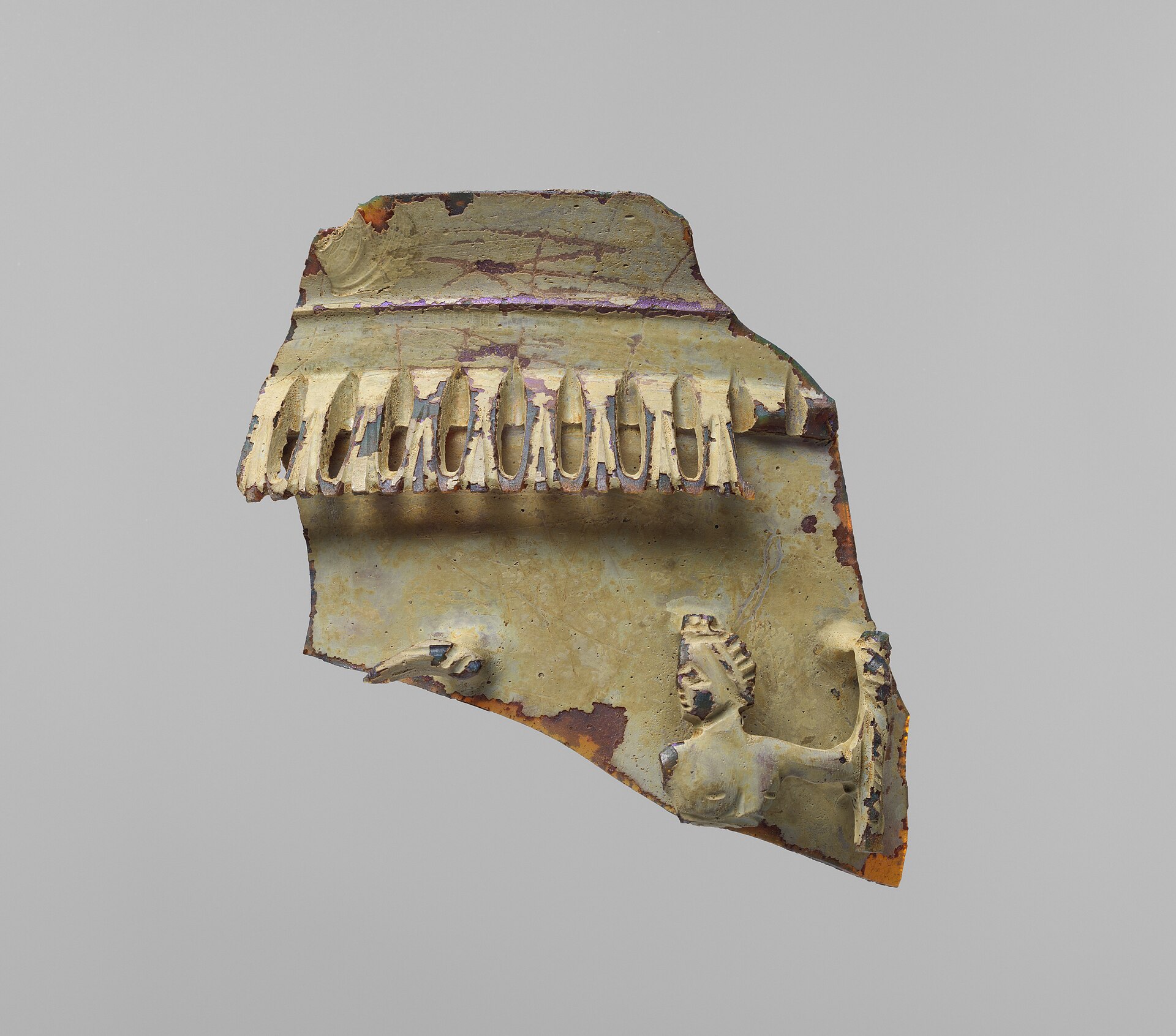
| Metropolitan Museum of Art | New York | A dichroic cage-cup fragment, accession 26.60.95 | The second known dichroic example, surviving only as a fragment. |
| Museo Archeologico | Milan | The Trivulzio cage cup, inscribed BIBE VIVAS MVLTIS ANNIS | Found in the 17th century; reported as the only cage cup with no damage at all. |
| Staatliche Antikensammlungen | Munich | A beaker-form cage cup found at Cologne, inscribed BIBE MVLTIS ANNIS | Its smooth joins are cited in the manufacturing dispute. |
| Romisch-Germanisches Museum | Cologne | A beaker-form cage cup with a Greek convivial inscription | Found in a family cemetery attached to a villa rustica. |
| Heritage Museum | Pljevlja, Montenegro | A network cage cup, no figures, inscribed VIVAS PANELLENI BONA | From the necropolis of Komini II. |
| Musee Rolin | Autun, France | The Autun cup, inscribed VIVAS FELICITER | Excavated 2020 from an intact fourth-century sarcophagus, still containing ambergris; the class's one modern controlled find. |
| Rheinisches Landesmuseum | Trier, Germany | Cage-cup fragments examined in detail by the conservator A. Gerick | Cited directly in the 2020 manufacturing dispute. |
The word cage cup describes the finished shape rather than the process, and it is worth being exact about what it names.
The word cage cup describes the finished shape rather than the process, and it is worth being exact about what it names. A vessel starts as a single thick-walled gather of glass, thick enough that most of it can be removed without breaking through to the inside. What remains, once the cutting is finished, is an inner cup of ordinary thinness and an outer shell, either a geometric mesh of interlocking rings (Donald Harden and Jocelyn Toynbee's Group B, defined in 1959) or a band of standing figures (their Group A), separated from the inner wall by an air gap and touching it only at a small number of short bridges positioned where the pattern hides them.
That is the one point on which every scholar in this field agrees, and it is worth stating plainly because it is the object's whole claim to difficulty: a cage cup is not assembled from separately made parts glued or fused together after the fact in the way a modern reader might assume. Cage and cup are the same piece of glass, and everything standing between them was, at some stage, physically part of the solid blank. What is disputed is only the sequence: whether that removal happened entirely by cold cutting after the blank cooled, or whether the blank was already close to its final two-layer form before any cold work began.
Roman technical vocabulary gives two candidate trade names, and the literature has treated them more confidently than the evidence supports.
Roman technical vocabulary gives two candidate trade names, and the literature has treated them more confidently than the evidence supports. A vitrearius is a glassmaker or glassworker; the word is secure. A diatretarius, from a root meaning pierced or perforated, is routinely translated as glass cutter in modern reference works, with the added suggestion that such a man might have trained first as a gem engraver before moving to glass.
Sylvia Fuenfschilling, reviewing Whitehouse's 2015 corpus for the Journal of Roman Archaeology in 2020, rejected that translation as too confident. Her grounds are specific: the list of craftsmen exempted from certain civic duties at Codex Theodosianus 13.4.2, issued under Constantine, names the vitrearius but does not name the diatretarius alongside him, which she suggests may mean the second trade had nothing to do with glass at all. The word's earliest attestation, in Martial at the end of the first century AD, is so distant in time from the Constantinian list and from the sixth-century Digest passage usually cited alongside it that its sense may simply have moved.
What that leaves is a two-trade division the objects themselves demand, physically, and that the documents do not quite supply. A cage cup cannot be made in one operation by one pair of hands; a hot-working stage and a cold-cutting stage are both required, whatever the cold stage turns out to have looked like. Whether one workshop did both, whether a lapidary bought blanks on an open market, or whether patron and cutter dealt directly with each other is not recoverable from any source consulted for this page, and no document exists that could settle it.
The standing reference is David Whitehouse's Cage Cups: Late Roman Luxury Glasses, published by the Corning Museum of Glass in 2015 and completed by William Gudenrath and Paul Roberts after...
The standing reference is David Whitehouse's Cage Cups: Late Roman Luxury Glasses, published by the Corning Museum of Glass in 2015 and completed by William Gudenrath and Paul Roberts after Whitehouse's death in 2013. It runs to 69 catalogue entries with a further 13 objects in an addendum, 82 entries in total, covering whole vessels and fragments alike. Fuenfschilling's 2020 review accepted that count without dispute even while rejecting the book's conclusions on manufacture.
Older figures are still in circulation and are not wrong, only counting something narrower. The 2004 Bonhams catalogue for the Constable-Maxwell cup gave over fifty whole and fragmentary examples, a figure repeated in Janet Duncan Jones's January 2019 review of the then-forthcoming Whitehouse corpus for the American Journal of Archaeology. Guinness World Records, carrying the 1979 Constable-Maxwell auction result, described that cup as one of only seven more or less complete examples, a count restricted to whole vessels. None of these numbers should be quoted against another as though one were correct and the rest were errors; they are answers to three different questions.
The corpus also grows in real time, which is the more important point for a reader checking any figure against this page. Whitehouse's catalogue closed before 2015. In 2020 a French national archaeology team excavating the Saint-Pierre-l'Estrier necropolis at Autun found a fourth-century cage cup, inscribed VIVAS FELICITER, still containing ambergris, in an intact fourth-century sarcophagus. It is not in the standing corpus and it is a genuinely new complete example with a documented context, the kind the class almost never has. Any published count is a count as of the date it was written, and this page's own figures should be read the same way.
Fremersdorf's 1956 account is the orthodoxy and Whitehouse's 2015 corpus argues for it throughout: a thick blank, cut and ground with a rotating disc fed with abrasive slurry, the cutter working...
Fremersdorf's 1956 account is the orthodoxy and Whitehouse's 2015 corpus argues for it throughout: a thick blank, cut and ground with a rotating disc fed with abrasive slurry, the cutter working blind into deep undercuts with no way to correct a slip and enormous volumes of costly glass discarded as waste. It implies a process measured in months for a single vessel, with catastrophic failure available at every stage.
Rosemarie Lierke has argued since the 1990s that this cannot be the whole story, and that cage-cup blanks were formed or fused close to their finished two-layer shape, with cold cutting reserved for the rim and for finishing detail. Fuenfschilling's 2020 review sets out, in the most detail published anywhere, the physical features on original vessels that in her judgement the cutting hypothesis leaves unexplained: air bubbles that are horizontally elongated rather than cut open; the inner wall of the cup running parallel to the inner wall of the mesh; a completely smooth inner surface to the cage; struts with rounded ends that do not quite reach the outer cage; a spiral structure visible inside the struts under a microscope; an unevenly shaped ledge below the rim. She credits A. Gerick, conservator at the Rheinisches Landesmuseum in Trier, with confirming many of the same observations directly on the Trier cage-cup fragments.
Both sides have physical demonstrations rather than only argument. Modern cutters, George Scott and Josef Welzel among them, have cut convincing cage-cup replicas from solid blanks, and those replicas are regularly produced as proof that cutting was the method. Fuenfschilling's answer, and the one this page treats as the load-bearing methodological point in the whole dispute, is that a successful modern replica shows a method was possible, not that it was the method used: modern tools, modern glass and modern habits of thought are not the ancient ones, and Whitehouse's own preference, she observes, shows in every line of his argument. Nobody has yet CT-scanned a cage-cup fragment the way Richard Whiteley scanned a Roman cameo-glass fragment at the Australian National University in 2017 and found cold-working marks the blowing hypothesis for that different class did not predict. Whether the same test, applied to a cage-cup fragment, would settle anything is itself an open question nobody has run.
One complete cage cup is dichroic, and it is the reason this workshop is known outside archaeology at all.
One complete cage cup is dichroic, and it is the reason this workshop is known outside archaeology at all. The British Museum's Lycurgus Cup reads opaque jade green under ordinary gallery lighting and translucent wine red with a light source behind it, and nothing about the object changes between the two states except where the light is coming from.
The mechanism was identified by analytical electron microscopy by D. Barber and I. C. Freestone in 1990 and summarised by Ian Freestone, Nigel Meeks, Margaret Sax and Catherine Higgitt in a paper titled The Lycurgus Cup, A Roman Nanotechnology, published in Gold Bulletin in 2007: a colloidal suspension of a silver-gold alloy, the particles on the order of tens of nanometres across, present at only a few hundred parts per million in an otherwise conventional Roman soda-lime glass batch. Particles at that scale scatter and absorb light selectively by surface plasmon resonance, so light bounced off the glass and light pushed through it come out different colours. This page cites the Freestone paper by its full bibliographic reference; despite retrying the fetch, checking the institutional repository, and searching independent mirrors, the full text could not be retrieved past a publisher login wall, and the figures above are cross-checked against the British Museum's own bibliography, which lists the paper, and against the wider technical literature that cites it, rather than read from the paper itself. That gap is recorded honestly rather than papered over.
The effect has outlived the object that carries it. In 2020 a team led by Vittorio Saggiomo at Wageningen University published an attempt, using 3D printing, to build a synthetic gold-silver dichroic nanocomposite reproducing the cup's optical behaviour, and reported that the reference spectra needed to calibrate such an attempt against the original are largely missing from the published literature. Modern nanotechnology, in other words, still cannot fully close the loop back to the fourth century. The concentrations involved are minute and the effect is sensitive to them in a way that argues against a controllable recipe: of a corpus of some eighty entries, exactly one complete dichroic vessel survives, which is closer to what an accidental dilution of a batch containing reused precious-metal glass would produce than what a repeatable formula would.
The majority of documented cage-cup findspots sit on or near the Rhine, and that concentration is the whole basis for naming Cologne and Augusta Treverorum, modern Trier, an imperial residence for...
The majority of documented cage-cup findspots sit on or near the Rhine, and that concentration is the whole basis for naming Cologne and Augusta Treverorum, modern Trier, an imperial residence for much of the period, as the standing candidates for the workshop. Janet Duncan Jones's 2019 review states the caution precisely: concentrations of findspots in Germany, Italy and the eastern Mediterranean make those areas the likeliest locations for workshops, a sentence built entirely on the word likeliest.
The caution is not academic hedging. At least two individually significant cage cups complicate the Rhineland picture directly. The 2004 Bonhams catalogue states, in one clause, that both the Constable-Maxwell cup and the Corning cage cup were allegedly found in the east, with no country, site or date given for either claim. If either report is accurate, the geography of the class needs at least two production centres rather than one, and findspot distribution stops being usable as a proxy for manufacturing location at all.
The honest position, held to consistently across this workshop's other Iconotheca records, is that findspot tells a reader where an object ended up in the ground or in a grave, which is frequently a very long way, in time and in distance, from where it was blown and cut. No furnace, no cutting shop and no workshop debris identifiable as belonging to this class has been excavated anywhere, in the Rhineland or in the east. The Rhineland hypothesis is the best-supported guess in the literature. It remains a guess.
Only a handful of cage cups have ever been recovered from a documented, dateable context, and one of those contexts no longer physically exists.
Only a handful of cage cups have ever been recovered from a documented, dateable context, and one of those contexts no longer physically exists. In 1869 two Roman sarcophagi at Hohensulzen, near Worms, produced six glass vessels including cage-cup fragments; the accompanying grave goods dated the burial to about AD 300 or slightly later, and that single burial has been the comparison point used to date the Constable-Maxwell and Corning cups ever since. Of the six Hohensulzen glasses, all but one, a Dionysos bottle now at the Landesmuseum Mainz, have been missing since 1945. A great deal of this class's chronology rests on grave goods excavated by nineteenth-century methods, from a group that is itself now mostly lost.
The mainstream working range given across the sources consulted here runs from roughly the middle of the third century to the middle of the fourth, with the British Museum dating the Lycurgus Cup simply to the fourth century and giving no finer point and no findspot at all. Janet Duncan Jones's 2019 review notes that a few examples have been proposed as early as the late first century AD, a claim this page records as contested rather than accepted: it sits well outside the working range used by every other source consulted, and no excavated context is cited to support it. This page does not extend the class's date range on the strength of a single unelaborated line in a book review, and flags the discrepancy rather than resolving it.
The Autun cup, excavated in 2020 from an intact fourth-century sarcophagus with its ambergris contents still inside, is the closest thing this class has to a controlled modern dating anchor, and it falls squarely inside the mainstream range. It is also, so far, alone: nothing else in the corpus has been excavated to a comparable standard since.
The labour argument is the strongest evidence for who these vessels were made for, because it does not depend on any single disputed source.
The labour argument is the strongest evidence for who these vessels were made for, because it does not depend on any single disputed source. Cutting a cage cup from the solid, on the orthodox account, took months of skilled work with no possibility of recovering from an error and a large volume of costly glass discarded as waste; the Bonhams catalogue note for the Constable-Maxwell cup calls the process fraught with potential disaster throughout and concludes, plainly, that only the very wealthiest of Roman society could have commissioned one. That conclusion holds regardless of which manufacturing hypothesis is correct, since Fuenfschilling's own minority position states that forming or fusing a blank close to its final shape would have needed craftsmen at least as skilled as cutting did, not less.
Roman law itself preserves one genuine textual reference to the object class, and it is worth quoting exactly because it is the closest thing to a contemporary voice this page can offer. The sixth-century Digest of Justinian, compiling earlier classical opinion, records at 9.2.27.29 a ruling attributed to the jurist Ulpian on liability for a craftsman commissioned to decorate a cup: if you gave someone the order to make a diatretum cup and he broke it because of lack of skill, he is liable for wrongful loss, but if it broke for a reason other than lack of skill, such as a defect already present in the glass, he can be excused. The passage never states what the cup was made of and never names the craftsman's trade, which is exactly the kind of gap Fuenfschilling points to when she argues that diatretarius cannot be read as documentary proof of a specialist glass-cutting trade. What the passage does establish, independent of that argument, is that Roman law recognised a commissioned diatretum as valuable enough, and its manufacture as risky enough, to need a specific liability rule.
Beyond that one legal text, no contract, delivery note, inventory or literary source naming a diatretum's price, patron or recipient has been located for this page. The only modern price evidence for the entire class is the market history of the Constable-Maxwell cup, the sole cage cup ever to leave public or documented private ownership for open sale, covered in full in this archive's own record for that object.
Where cage cups carry text at all, the text is convivial.
Where cage cups carry text at all, the text is convivial. BIBE VIVAS MVLTIS ANNIS, drink, may you live many years, is cut into the Trivulzio cup in Milan; the Munich cup carries BIBE MVLTIS ANNIS; the Cologne cup carries the Greek equivalent; the Pljevlja cup in Montenegro reads VIVAS PANELLENI BONA; the Autun cup, excavated in 2020, reads VIVAS FELICITER. These are drinking toasts cut into the most expensive glass objects the Roman world produced, which places the beaker-form, inscribed half of the class squarely inside the visual and social language of the wine table. Nothing about that meaning is hidden or in dispute; a reader should be told plainly that a class of wine vessels decorated with drinking toasts means exactly what it says.
One vessel carries a subject rather than a toast, and it is the reason this workshop's most famous product is read so differently. The Lycurgus Cup shows the death of Lycurgus, king of the Thracian Edonians, caught and bound by vine shoots after attacking the god Dionysos and his followers; the nymph Ambrosia, transformed into the vine that destroys him, is cut at smaller scale near his feet. It is a documented, independently attested myth with its own literary tradition, not an invented programme read into the object after the fact, and its message on a wine cup is direct rather than coded: this is what happens to a man who refuses the god of wine. A political reading in circulation since the mid-twentieth century proposes that the scene alludes to the 324 defeat and 325 death of the emperor Licinius at the hands of Constantine. This page grades that reading as argued, not documented: no inscription, no ancient text and no findspot connects the cup to the event, and the resemblance between a defeated Thracian king in myth and a defeated emperor in politics is a resemblance rather than a source. What can be said without argument is that the subject is unusual within the surviving corpus and that the object was made within the same century as the event the reading proposes.
A second, unresolved question sits underneath both the toasts and the myth. The beaker shape and the inscriptions argue for drinking use. Against that, the Corning cage cup retains an ancient copper-alloy collar and a three-hook lamp-hanger, physical proof that at least one bowl-form, uninscribed cage cup was suspended and lit rather than drunk from, and Christian Steckner has published specifically on cage cups as light vessels. The two readings are not necessarily in conflict across the whole class: a beaker with a toast on it and a bowl with a lamp-hanger on it can both be cage cups without being the same kind of object. What is genuinely striking, and probably not accidental, is that the Lycurgus Cup's dichroism performs only when light passes through the glass. A green cup on a table is inert. The red only appears with a light source behind or inside it, which is exactly the condition a lamp provides and an ordinary drinking cup on a table does not.
Any count of surviving cage cups is a count of what the twentieth century left behind, and the century took some of the most important comparison pieces with it.
Any count of surviving cage cups is a count of what the twentieth century left behind, and the century took some of the most important comparison pieces with it. Of the six glass vessels excavated at Hohensulzen in 1869, the single dating anchor for two of this workshop's best-known products, all but one have been missing since 1945. A third-century green glass cage cup from Cologne, formerly in the Czartoryski collection at Goluchow and part of the National Museum in Poznan, was lost in 1940 and is catalogued today among Polish wartime losses; a single photograph is all that remains of it, and it is reproduced in this record for exactly that reason. Neither loss is disputed or mysterious in the way the manufacturing question is; both are documented, dated, wartime losses, and they are the reason every published corpus count understates how many cage cups were made, not only how many survive.
Forgery, by contrast, is a live subject in this class and an almost absent one in the neighbouring class of Roman cameo glass. Appendix 8 of Whitehouse's 2015 corpus publishes four vessels, two of them nearly identical to each other, which Fuenfschilling's review summarises as probably all forgeries, with part of the technical commentary contributed by S. M. Goldstein. No comparable published forgery record exists for early Roman cameo glass, which shares the same collectors and the same market. A reader assessing an unpublished cage cup, whether in a collection, a sale room or a museum store, should treat that appendix as required reading before treating any new example as genuine.
The Lycurgus Cup is not only the single best-known object this workshop produced.
The Lycurgus Cup is not only the single best-known object this workshop produced. It is a statistical outlier inside its own corpus, and the outlier status is itself evidence about how the whole class was made.
Dichroic Roman glass survives, so far as excavated evidence shows, almost exclusively within the cage-cup class, and within that class it survives as one complete vessel and one further fragment, the Metropolitan Museum's accession 26.60.95, out of some eighty catalogued entries. If a workshop, or several workshops working from a shared recipe, had controlled the gold-silver colloid reliably, more dichroic vessels should be expected to survive in a corpus this size, even allowing for everything lost to burial, war and time. That they do not is read in the literature as evidence that the effect was not a deliberate, repeatable formula but the accidental result of diluting or reusing a glass batch that happened to carry a much higher concentration of precious metal, a conclusion reached without needing to resolve the cutting-versus-forming dispute at all. Whoever cut the Lycurgus Cup inherited an unusual batch of glass. Nothing in the evidence assembled here suggests they, or anyone else working in this class, could have asked for another one.
Glassworker (vitrearius); Lapidary cutter, trade name disputed (diatretarius); Cage-cup and diatretum workshop. active c. AD 250-350, on the mainstream dating; a small, contested group of possible precursors has been proposed earlier.
Born Not applicable. This is a class of luxury object, not a person., Unresolved. The majority of findspots cluster on or near the Rhine, which is why Cologne and Augusta Treverorum (modern Trier) are the standing candidates; at least two individually documented cage cups are reported to have come from the eastern Mediterranean instead. No cage-cup workshop, furnace or cutting shop has ever been identified archaeologically anywhere; died The class goes out of use by the mid to late 4th century on the evidence assembled here. No securely dated cage cup later than the 4th century has been found in any source consulted for this page., Unknown.
Appendix 8 of Whitehouse's 2015 corpus. Four vessels are published together, two of them nearly identical to each other, judged by the reviewing literature as probably all forgeries.
British Museum (London); Corning Museum of Glass (Corning, New York); Metropolitan Museum of Art (New York); Museo Archeologico (Milan); Staatliche Antikensammlungen (Munich); Romisch-Germanisches Museum (Cologne).
This class has almost no market, because almost none of its members are for sale: every named survivor but one has sat in a public institution for decades or centuries. The single exception is the Constable-Maxwell cup, sold three times between 1979 and 2004 and the only cage cup for which hammer, estimate and premium mean anything at all; its full sale history, including the unresolved question of whether the 1979 and 1997 figures are hammer prices or premium-inclusive totals, is carried in this archive's dedicated record for that object rather than repeated here.
Where was any cage cup actually made? No workshop, furnace or cutting shop associated with the class has ever been excavated, in the Rhineland, the eastern Mediterranean, or anywhere else.
Of 35 objects this archive has researched but does not publish, 27 already carry licensed photographs.
9 min read
One family name appears in nine records in this archive across seven object classes.
9 min read
One hundred and eighty exhibition entries in this archive use 143 different venue strings for about 112 institutions.
11 min read
Ninety-seven ownership links in this archive move an object because someone died.
9 min read
Eighty-nine of the 266 objects published here name nobody as their maker.
9 min read
Last verified 17 September 2026
One artwork and its story every Tuesday, with the picture: who owned it, what it made, and what closes soon in the exhibition calendar. No promotion, and nothing we cannot cite.
We send one email to confirm the address and keep nothing else. Every letter carries a one-click unsubscribe. How we handle your data.


