Fonthill Vase
Jingdezhen kilns, Jiangxi province (unidentified workshop) · c. 1300-1340
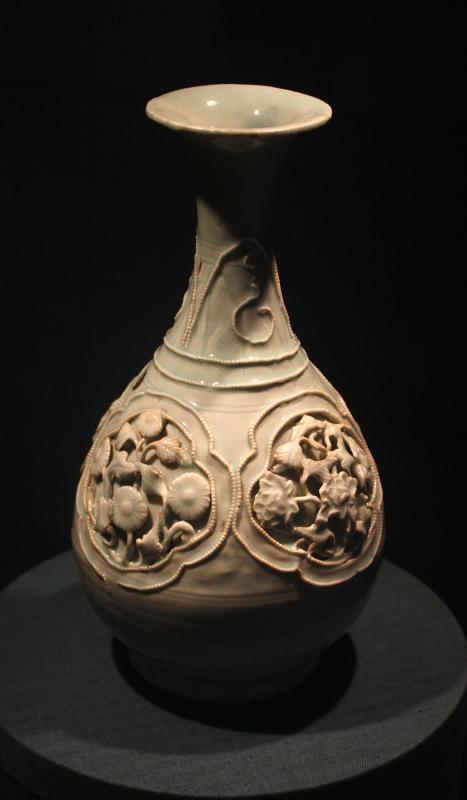
The vase as it stands today, on display at the National Museum of Ireland - Decorative Arts and History, Collins Barracks: unmounted qingbai porcelain, its medieval silver-gilt fittings lost long before the vase resurfaced in 1882.
Photo: Rictor Norton and David Allen, CC BY 2.0, via Wikimedia Commons · Photograph by Rictor Norton & David Allen| Artist | Jingdezhen kilns, Jiangxi province (unidentified workshop) |
|---|---|
| Date | c. 1300-1340 |
| Medium | Qingbai porcelain (bluish-white glazed hard-paste porcelain), applied high-relief moulded decoration; formerly fitted with a silver-gilt mount, now lost |
| Dimensions | Height 28 cm |
| Where it is now | National Museum of Ireland - Decorative Arts and History, Collins Barracks, Dublinlast confirmed |
| Inventory number | DC:1882.3941 |
| Attribution | AcceptedManufacture at the Jingdezhen kilns, Jiangxi province, in the Yuan dynasty (1271-1368), roughly 1300-1340, is accepted without serious dispute, on the basis of the qingbai body and glaze and the type's known production window immediately before Jingdezhen shifted to underglaze blue-and-white in the second quarter of the 14th century. Full note |
| Object type | Ceramic |
| Period | Chinese, Yuan dynasty (1271-1368) |
| Cases | Has a provenance gap · Rediscovered |
| Inscriptions | None on the porcelain body itself. The lost silver-gilt mount, known only from a 1713 drawing, is recorded as carrying an inscription read by the Hungarian ceramics historian Bela Krisztinkovich as JEHANA on the spout of the ewer form; this reading, and the identification it rests on, is disputed scholarship, not settled fact. See Provenance and Technical. |
| Owners on record | 12 links7 documented, 3 disputed, 2 unknown |
| Sources | 12 cited |
About this record Last verified · 12 sources cited · Change log
On this page 10 sections
ContentsClose
A qingbai porcelain vase made at the Jingdezhen kilns in China during the Yuan dynasty, around 1300 to 1340, later fitted in Europe with an elaborate silver-gilt mount that has since been lost. It is widely called the earliest documented Chinese porcelain to reach Europe, on the strength of a story that it was given to Louis the Great of Hungary in 1338; that story does not survive close scrutiny, since Louis did not become king until 1342, and a Hungarian scholar has argued the mount's own inscription names a different, later royal owner entirely.
What is solid is the Chinese manufacture, a single 18th-century drawing of the vase in its lost medieval mount, and its documented modern history: owned by the collector William Beckford at Fonthill Abbey, lost from view after his 1822 financial collapse, sold unrecognised and unmounted at the 1882 Hamilton Palace sale for under thirty pounds, and rediscovered as a historically significant object only in 1959, when a curator at the Victoria and Albert Museum matched the bare Dublin vase to the 1713 drawing.
This record grades the pre-1800 ownership chain as substantially disputed or unverified rather than smoothing it into a single confident narrative, and found no documented connection to the Medici collection despite that claim sometimes circulating alongside this object's story.
Provenance
Each link is graded. Documented: a cited source supports it. Disputed: the identification is argued but not established. Unknown: no owner for that span, and the gap is not smoothed into a narrative. The grades in the glossary.
- c. 1300 - c. 1340Manufactured, Jingdezhen kilns, Jiangxi provincedocumented
Dated on the basis of the qingbai glaze and body type and the ware's known production window at Jingdezhen before the shift to blue-and-white porcelain. Not disputed in the sources consulted.168
- 1338 -Claimed gift to Louis I ('the Great') of Hungary, via a Chinese/Alan embassy to Pope Benedict XIIdisputed
The single most repeated claim about this object. An Avignon embassy from the Great Khan in 1338 is independently documented, but no primary source consulted names this vase as part of it, and Louis did not become King of Hungary until 1342, four years after the date usually given for his receipt of the gift. Treated here as disputed, not as fact.27
- 1381 (traditional) / early 15th century (Krisztinkovich) -Mounted in silver-gilt and transferred within the Angevin dynastic network, traditionally to Charles III of Naples in 1381; alternatively, per Krisztinkovich's reading of the mount's inscription, made for Queen Joan II of Naples, reigned 1414-1435disputed
Two incompatible dates and recipients are argued in the sources consulted, resting on rival readings of a single 18th-century drawing of a mount that no longer survives to be re-examined.27
- 15th century - before 1713Reportedly the duc de Berry, then Louis the Grand Dauphin, then Francois Lefebvre de Caumartinunknown
This chain appears consistently in tertiary sources (chiefly Wikipedia) without a primary document cited. This record could not verify it independently and records it as reported rather than documented.7
- 1713 - 1713Francois Lefebvre de Caumartindocumented
Caumartin allowed the antiquarian Roger de Gaignieres to have the mounted vase drawn by Barthelemy Remy. This watercolour survives and is the sole documentary basis for everything known about the medieval mount, its heraldry and its disputed inscription.2712
- 1713 - 1813Unknownunknown
No owner documented in this century.
- 1813 - 1822William Beckford, Fonthill Abbey, Wiltshiredocumented
In Beckford's collection at Fonthill Abbey by 1813 and listed in guidebooks to the house among its rarest curiosities. The means and seller of Beckford's acquisition are not given in the sources consulted.356
- 1822 - c. 1882Disputed: either John Farquhar (purchaser of Fonthill Abbey and its contents, 1822) or retained by Beckford and inherited in 1844 by his daughter Susan Euphemia, Duchess of Hamiltondisputed
Beckford sold Fonthill Abbey and its estate to John Farquhar in 1822 for a reported 330,000 pounds. One secondary source states the vase was sold with the contents and then vanished; a separate biographical source indicates Beckford's daughter inherited what remained of his own collection on his death in 1844, implying he kept the vase out of the 1822 sale. This record could not resolve which account is correct and grades the whole period as disputed rather than choosing one narrative.369
- by 1882 - 1882Duke of Hamilton, Hamilton Palace, South Lanarkshiredocumented
In the Hamilton Palace collection by 1882, already without its mount. Sold at the Hamilton Palace sale, Christie, Manson and Woods, London, June-July 1882 (a 17-day, five-portion, roughly 2,200-lot sale forced by the 12th Duke of Hamilton's debts), catalogued only as 'a pear-shaped bottle of Chinese celadon porcelain.'3610
- 1882 - 1959Dublin Museum of Science and Art (predecessor of the National Museum of Ireland)documented
Purchased at the Hamilton Palace sale by T. M. Whitehead, Keeper of Ceramics, for 28 pounds 7 shillings, and registered simply as 'Old Chinese.' Its earlier documented history went unrecognised for roughly 77 years. The Dublin museum's buying at this sale fits a documented wider pattern: the Department of Science and Art, which administered the Dublin, London and Edinburgh museums, was an active institutional purchaser at the 1882 Hamilton Palace sale.3411
- 1959 - 1961National Museum of Ireland; identification published by Arthur Lane, Victoria and Albert Museumdocumented
Arthur Lane connected the unmounted Dublin vase with the 1713 Gaignieres drawing and published the reconnected history in the Burlington Magazine in 1961.137
- 1997 - presentNational Museum of Ireland - Decorative Arts and History, Collins Barracks, Dublindocumented
Registration DC:1882.3941, on display in the branch's permanent collection.45
Prices realised
| Date | Sale | Estimate | Result | Note |
|---|---|---|---|---|
| 1882-06 | Christie, Manson and Woods | Not documented in the sources consulted. | Hammer GBP 28.35 (28 pounds, 7 shillings) With premium Not documented; buyer's premiums of the kind now standard were not customary at 19th-century London auctions, so the hammer price is likely the full price paid. GBP | Part of the wider Hamilton Palace sale, a 17-day, roughly 2,200-lot dispersal in five portions. The vase was one lot among thousands and was not treated by the saleroom as a highlight; it was catalogued with an incorrect glaze identification (celadon rather than qingbai) and no reference to its earlier royal history. |
Hammer is the price at which the bidding stopped; with premium adds the fee the house charges the buyer on top. Hammer price and buyer's premium in the glossary.
Technical evidence
| Attribution note | Manufacture at the Jingdezhen kilns, Jiangxi province, in the Yuan dynasty (1271-1368), roughly 1300-1340, is accepted without serious dispute, on the basis of the qingbai body and glaze and the type's known production window immediately before Jingdezhen shifted to underglaze blue-and-white in the second quarter of the 14th century. No maker, workshop or reign mark is recorded, which is normal for Yuan-period Jingdezhen export and domestic wares of this class, not a gap peculiar to this piece. What is genuinely disputed is not the object's Chinese origin but the story of how and when it reached Europe, and through whose hands it passed before 1713; see Provenance. |
|---|---|
| Body | Hard-paste porcelain made from Jingdezhen porcelain stone (containing kaolin), fired to a fine white, thin-walled body.68 |
| Glaze | Qingbai: a pale bluish-white feldspathic glaze produced by a small proportion of iron fired under a reducing atmosphere in wood-fired kilns.68 |
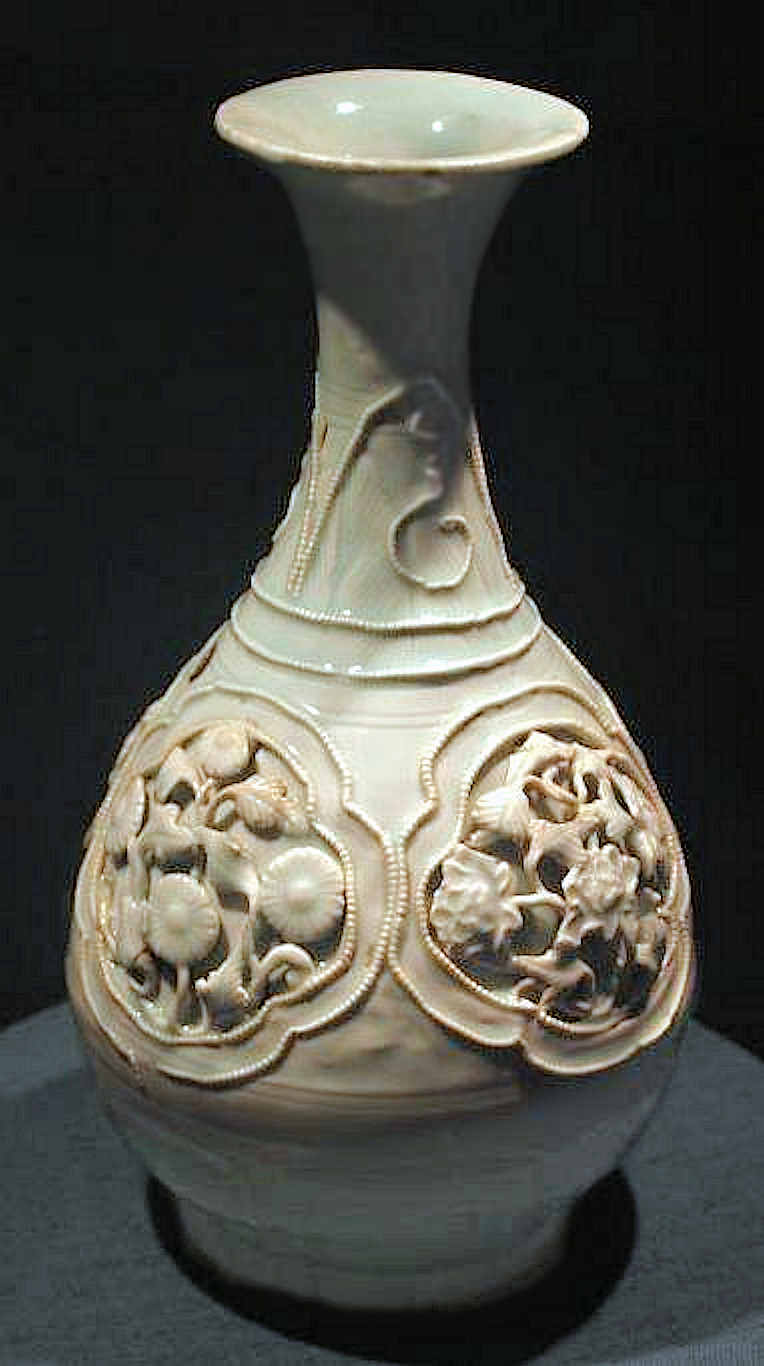
| Decoration | Four medallions of chrysanthemum, peony and magnolia built up in applied high relief around the body, with further carved and moulded ornament on the neck and lower body. Described by specialists as an unusual or experimental example of qingbai decoration rather than a standard production form.36 |
| Dimensions | Height 28 cm (width and diameter not published in the sources consulted).4 |
| Registration number | DC:1882.3941, National Museum of Ireland - Decorative Arts and History.4 |
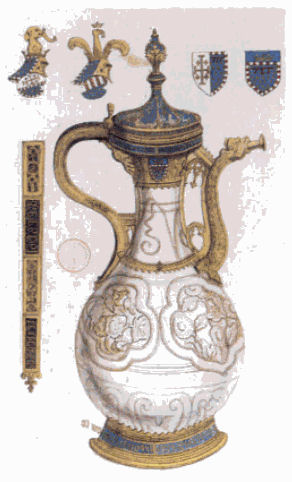
| Historic mount (not extant) | A silver-gilt mount with enamelled heraldic decoration converted the bottle into a ewer form, with handle, spout and foot, at some point after it reached Europe. The mount does not survive and is known only from a 1713 watercolour by Barthelemy Remy, commissioned by Roger de Gaignieres. The vase as held by the National Museum of Ireland today carries no mount of any kind.23712 |
| Disputed inscription | The 1713 drawing records an inscription on the spout of the mount, read by Bela Krisztinkovich as JEHANA (a form of Joan/Giovanna). This reading, and the identification of the intended owner as Joan II of Naples rather than Louis I of Hungary, is contested scholarship resting on a single 18th-century depiction of a lost object, not on the surviving mount itself.2 |
| 1882 sale catalogue description | Catalogued at the Hamilton Palace sale as: 'A pear-shaped bottle of Chinese celadon porcelain, with foliage in high relief in four medallions, and ornaments in low relief on the neck and lower part.' The description misidentifies the glaze as celadon rather than qingbai and shows no awareness of the object's documented earlier history.6 |
Images
The record in full
Chapter 1What it is, physically
The Fonthill Vase is a pear-shaped bottle of qingbai porcelain, 28 centimetres high, made at the Jingdezhen kilns in Jiangxi province during the Yuan dynasty, probably between about 1300 and 1340.
The Fonthill Vase is a pear-shaped bottle of qingbai porcelain, 28 centimetres high, made at the Jingdezhen kilns in Jiangxi province during the Yuan dynasty, probably between about 1300 and 1340. Qingbai is a pale, bluish-white glaze produced by a small proportion of iron in the glaze fired under reduction; it was the dominant Jingdezhen export ware of the late Song and early Yuan periods, before the kilns turned to underglaze cobalt blue-and-white in the second quarter of the 14th century.
What sets this vase apart from ordinary qingbai production is its decoration. Four medallions of flowering plants, chrysanthemum, peony and magnolia among them, are built up in applied high relief around the body, with further ornament carved and moulded in low relief on the neck and lower body. Standard qingbai wares of the period are far plainer, usually incised or carved rather than built up in applied relief; specialists describing the piece have called it an experimental or unusual example of the type rather than a routine product line, which is one reason it stood out enough to be worth mounting in precious metal once it reached Europe.
The vase today carries no inscription of any kind on the porcelain itself. Everything said about an inscription belongs to a mount that no longer exists and is known only from an 18th-century drawing; that distinction matters for everything that follows in this record.
Chapter 2How it was made, and why it looks the way it does
Jingdezhen porcelain of this period was built from porcelain stone, a naturally occurring rock containing kaolin and feldspathic material, ground and refined to produce a fine white, thin-walled body...
Jingdezhen porcelain of this period was built from porcelain stone, a naturally occurring rock containing kaolin and feldspathic material, ground and refined to produce a fine white, thin-walled body strong enough to be thrown or moulded into elaborate forms. The kilns fired in a reducing atmosphere using pine wood, which pulled oxygen from the iron oxide present in trace amounts in the glaze and body, turning what would otherwise read as a warm tone into the cool blue-white that gives qingbai its name, literally clear-white or blue-white.
By the time this vase was made, Jingdezhen had been the leading centre of Chinese porcelain production for roughly three centuries, but qingbai itself was near the end of its run. Within a generation of this piece being made, the same workshops had turned decisively to underglaze cobalt blue-and-white, a technical and aesthetic shift so complete that qingbai production effectively ended. The clearest fixed point for that transition is a pair of temple vases, now in the British Museum and known as the David Vases, which carry a dedicatory inscription dated to the equivalent of 1351 and are painted in the new blue-and-white style. The Fonthill Vase sits on the older side of that divide: a qingbai piece from the last active phase of the ware, made by potters who had not yet adopted, or had not yet been asked to adopt, the cobalt technique that would define Chinese export porcelain for the next six centuries.
Chapter 3What is actually documented about 1338
The claim repeated in almost every popular account of this vase is that it reached Europe in 1338 as part of a diplomatic gift from a Chinese ruler to Pope Benedict XII, and that it was this same...
The claim repeated in almost every popular account of this vase is that it reached Europe in 1338 as part of a diplomatic gift from a Chinese ruler to Pope Benedict XII, and that it was this same gift that put the vase into the hands of Louis the Great of Hungary. It is worth separating what is independently documented from what has simply been repeated.
An embassy to Pope Benedict XII at Avignon in 1338 is real and independently documented. It came from the Mongol Great Khan Toghon Temur, and it included Christian nobles at the Khan's court identified by contemporary writers, chiefly the Franciscan Giovanni de Marignolli, as Alans, a people frequently but loosely described in the sources as Nestorian Christians. The embassy's own gift-giving is recorded on the other leg of the exchange: Benedict XII sent a return mission under Marignolli in 1338, carrying gifts to the Great Khan that included, by Marignolli's own account, a large warhorse. Marignolli's mission then travelled on to China and did not return to Avignon until 1353, reporting to Benedict's successor.
This record could not find, in any source consulted, a primary document, contemporary chronicle entry, letter or inventory that names this specific porcelain vase as an item given to Louis of Hungary by this or any other embassy in 1338. The specific chain, embassy to Louis of Hungary to porcelain vase, appears in secondary and tertiary accounts (encyclopaedia entries, popular museum writing) as an inherited narrative rather than as a claim traceable to a primary source. This record does not present it as settled fact.
Chapter 4Why the Louis of Hungary attribution does not survive scrutiny
The strongest published objection to the 1338-to-Louis story is a straightforward chronological one, set out by the art historian Zsombor Jekely summarising research by the Hungarian ceramics...
The strongest published objection to the 1338-to-Louis story is a straightforward chronological one, set out by the art historian Zsombor Jekely summarising research by the Hungarian ceramics historian Bela Krisztinkovich. Louis the Great did not become King of Hungary until 1342, four years after the date on which he is supposed to have received the vase as a gift in his own right. A gift received in 1338 could not have been received by him as king, and no source consulted explains how the story survives that basic problem.
Krisztinkovich's argument goes further than pointing out the date error. Working from the only surviving depiction of the vase's medieval silver-gilt mount, a 1713 watercolour, he read an inscription on the spout of the mounted vessel as JEHANA, a form of the name Joan or Giovanna. On that reading, the mount was not made for Louis of Hungary at all but for a Queen Joan, and Krisztinkovich identified her as Joan II, Queen of Naples, who reigned from 1414 to 1435 and who, as a member of the Angevin house, also held the Hungarian royal title by inheritance despite never ruling there. If correct, this dates the mount to the early 15th century, roughly a generation after the traditional account of 1381, and detaches the vase's documented European history from Louis of Hungary altogether, leaving him with no secure role in the object's story beyond a repeated but unsupported claim.
This record treats the Louis-of-Hungary-in-1338 narrative as disputed, not disproved beyond argument, since the counter-reading itself rests on one scholar's transcription of an inscription visible only in an 18th-century drawing of a mount that no longer survives for anyone to check. But a story that cannot survive the basic fact of when its supposed recipient became king cannot be repeated here as settled provenance, and it is not.
Chapter 5The lost mount and the inscription dispute
Whatever the truth of the recipient's name, it is clear that the vase was, at some point after it reached Europe, fitted with an elaborate silver-gilt mount that transformed a Chinese bottle into a...
Whatever the truth of the recipient's name, it is clear that the vase was, at some point after it reached Europe, fitted with an elaborate silver-gilt mount that transformed a Chinese bottle into a European ewer, complete with handle, spout, foot and enamelled heraldic decoration. Fourteenth and 15th-century European courts routinely mounted exotic Asian ceramics and hardstones in precious metal, treating them as quasi-lapidary curiosities on a par with jasper or agate rather than as pottery, which is exactly the class of object this vase became once it left China.
That mount is not the mount, if any, the vase carries today. It does not exist. It is known to modern scholarship purely through a watercolour made in 1713 by the artist Barthelemy Remy, commissioned by the French antiquarian Roger de Gaignieres, who was compiling a visual record of French royal and noble antiquities and portraits. The drawing shows the mounted vase with its enamelled coat of arms and the inscription that Krisztinkovich later read as JEHANA. Without that single drawing, nothing about the vase's medieval mount, arms or inscription would be recoverable at all; the entire disputed chain rests on one 18th-century antiquarian's record of an object that had, by then, already left the collections it depicts arms for.
By the time the vase resurfaced in Ireland in 1882, it had no mount of any kind. One secondary account states it was removed, supposedly by a thief, during its time in England; no source consulted gives a documented date or circumstance for that loss, only that the vase reappeared bare. The vase on display today is unmounted porcelain. Any reader expecting a surviving mount, current or otherwise, on the object as it stands in Dublin will not find one.
Chapter 6Into the French royal orbit, and the drawing that saved its history
Popular and encyclopaedic accounts place the vase, after its Angevin-Neapolitan phase, in the hands of the duc de Berry and then Louis, the Grand Dauphin, son of Louis XIV, before it came into the...
Popular and encyclopaedic accounts place the vase, after its Angevin-Neapolitan phase, in the hands of the duc de Berry and then Louis, the Grand Dauphin, son of Louis XIV, before it came into the possession of Francois Lefebvre de Caumartin by the end of the 17th century. This record was not able to verify these specific intermediate steps against a primary source; they appear consistently in tertiary accounts (chiefly Wikipedia, which cites no primary document for them) but not in the academic literature this record was able to consult directly. They are recorded here as reported, not as verified, and the gap between the Angevin court and Caumartin's ownership by 1713 should be read as effectively undocumented in the sources available to this record.
What is solid is the 1713 event itself. Caumartin allowed Gaignieres to have the mounted vase drawn, and Barthelemy Remy's watercolour survives, now held with the rest of the Gaignieres collection. That drawing is the hinge of the vase's entire scholarly identity: it is the only reason anyone in the 20th century could connect a bare, unmounted Chinese bottle bought for a few pounds in Dublin with a documented medieval object of princely status. Without it, the vase would simply be an anonymous, well-made piece of Yuan qingbai with no European history at all.
Chapter 7Two centuries unaccounted for
Between the 1713 drawing and William Beckford's ownership of the vase by 1813, a full century, this record found no documented owner.
Between the 1713 drawing and William Beckford's ownership of the vase by 1813, a full century, this record found no documented owner. No source consulted places the vase anywhere in that period. It is treated here as a straightforward gap, not bridged by inference.
Chapter 8William Beckford and Fonthill Abbey
William Beckford (1760-1844) was, on any account, one of the most eccentric collectors in English history.
William Beckford (1760-1844) was, on any account, one of the most eccentric collectors in English history. The only legitimate son of a former Lord Mayor of London and heir to a fortune built on Jamaican sugar plantations worked by enslaved labour, he was reputed the richest commoner in Britain. He received piano lessons from the young Wolfgang Amadeus Mozart, wrote the Gothic novel Vathek in French in a matter of days, and was driven into effective exile from 1785 after a sexual scandal involving a younger male relative, William Courtenay. He returned to England in 1796 and spent much of the following quarter-century and a large part of his fortune building Fonthill Abbey in Wiltshire, an enormous mock-Gothic pile designed by James Wyatt around a central tower that collapsed more than once during and after construction, filled with an art collection assembled on a scale and with a connoisseurial intensity that made Beckford, whatever his personal reputation, a genuinely serious and well-informed collector.
The vase entered Beckford's collection by 1813, according to the sources this record consulted, though none of them documents the specific transaction, seller or price. By the time it was at Fonthill it was already valued as a historical curiosity rather than simply a fine object: guidebooks to the abbey listed it among the rarest articles of virtue in the house, alongside porcelain, furniture, paintings and armour assembled from across Europe.
Chapter 9The 1822 collapse and the disputed route out of Beckford's hands
Beckford's fortune, dependent on Jamaican plantation income, was hit hard by falling sugar prices and a legal judgment that cost him control of two of his estates.
Beckford's fortune, dependent on Jamaican plantation income, was hit hard by falling sugar prices and a legal judgment that cost him control of two of his estates. In 1822 he sold Fonthill Abbey itself, with its estate, to the gunpowder manufacturer and speculator John Farquhar for a reported 330,000 pounds and moved to Lansdown Crescent in Bath, where he built a smaller tower and continued collecting on a reduced but still serious scale until his death in 1844.
What happened to the vase at this point is where the sources this record consulted genuinely disagree, and the disagreement is recorded here rather than resolved by picking one account. One secondary source states plainly that the vase was sold to Farquhar in 1822 along with the rest of the abbey's contents, and that it then vanished for decades. A different line of evidence points the other way: Beckford's daughter and principal heir, Susan Euphemia, who in 1810 had married Alexander Hamilton, later 10th Duke of Hamilton, inherited on her father's death in 1844 what a biographical source describes as the property and collection that remained to him, implying Beckford kept a body of his finest smaller pieces out of the 1822 sale and took them to Bath, from where they would have passed to his daughter and into the Hamilton family's holdings rather than through Farquhar at all.
This record could not adjudicate between these two accounts from the sources available. Both are compatible with the vase's eventual appearance in the Hamilton Palace collection by 1882, and neither is supported here by a primary document, a sale catalogue entry naming the vase in 1822 or 1823, or a probate or gift record placing it with Susan Hamilton after 1844. The honest position is that the years 1822 to roughly 1882 are a documented gap in ownership bridged only by two competing, unverified secondary claims, and this record grades that link accordingly rather than smoothing it into a single confident sentence.
Chapter 10Hamilton Palace and the sale of 1882
By whatever route it took, the vase was in the collection at Hamilton Palace, South Lanarkshire, the seat of the Dukes of Hamilton, by 1882, without its mount and, on the evidence of what happened...
By whatever route it took, the vase was in the collection at Hamilton Palace, South Lanarkshire, the seat of the Dukes of Hamilton, by 1882, without its mount and, on the evidence of what happened next, without anyone at the palace recognising what it was. That year William Douglas-Hamilton, 12th Duke of Hamilton, faced debts reported at over a million pounds and, exploiting a loophole in the family's deed of entail, consigned a large part of the ducal collection to Christie, Manson and Woods in London. The Hamilton Palace sale ran across seventeen days in June and July 1882, in five portions comprising more than two thousand lots of pictures, sculpture, Sevres and Dresden porcelain, Chinese and Japanese ceramics, furniture, bronzes and decorative art, and was described at the time as among the most magnificent single-collection sales ever held. It marked the beginning of the end of Hamilton Palace as one of Britain's great houses; further dispersal sales followed in 1884 and 1919, and the palace itself was demolished in the 1920s.
The vase was catalogued at the sale simply as a pear-shaped bottle of Chinese celadon porcelain, with foliage in high relief in four medallions and ornaments in low relief on the neck and lower part, a description that gets the glaze family wrong, celadon and qingbai are related but distinct Chinese wares, and carries no hint that the cataloguer knew or suspected the object's earlier history. That misidentification is itself evidence of how completely the vase's princely past had been forgotten by 1882.
Chapter 11A flukey purchase and sixty years of anonymity
The vase was bought at the Hamilton Palace sale by T.
The vase was bought at the Hamilton Palace sale by T. M. Whitehead, Keeper of Ceramics at the Dublin Museum of Science and Art, the direct institutional predecessor of the National Museum of Ireland, for 28 pounds and 7 shillings. The Department of Science and Art in South Kensington, which administered the Dublin museum alongside its London and Edinburgh counterparts, was an active buyer at the Hamilton Palace sale generally, part of a documented pattern of the department furnishing its museums from exactly this kind of aristocratic dispersal. Nothing in the sources this record consulted suggests Whitehead bought the piece for any reason beyond its being a well-made, if damaged and unmounted, example of Chinese porcelain at a modest price; the museum's own register entered it simply as Old Chinese, with no indication that its buyer suspected a connection to medieval European royalty.
The vase then sat in the Dublin collection, unremarked, for the better part of eighty years. Nothing in the record traces any scholarly interest in it, or any recognition of its earlier identity, between 1882 and the late 1950s.
Chapter 12Arthur Lane's rediscovery, and what is still unresolved
The break came from outside Ireland. Arthur Lane, the ceramics curator at the Victoria and Albert Museum in London, connected the bare Dublin bottle with the mounted vessel in Gaignieres's 1713...
The break came from outside Ireland. Arthur Lane, the ceramics curator at the Victoria and Albert Museum in London, connected the bare Dublin bottle with the mounted vessel in Gaignieres's 1713 drawing, publishing the reconnected history and the identification in the Burlington Magazine in 1961. Lane's article gave the vase back its documented European identity, its likely date, and its status as a strong candidate for the earliest datable piece of Chinese porcelain known to have reached Europe, a claim that rests on this being the earliest such object for which a European documentary trace, however contested at its earliest end, exists at all, not a claim that no earlier undocumented piece could conceivably have arrived unrecorded.
The vase's Yuan-dynasty Chinese manufacture is not in serious doubt. Its passage through named medieval and early modern European hands before 1713 is, at multiple points, either disputed between named scholars with opposing readings of the same 18th-century drawing, or simply undocumented in the sources this record was able to consult. This record has tried to keep those two categories, secure Chinese manufacture and contested European reception history, visibly separate throughout, because collapsing them into one smooth narrative is exactly the error that let a chronologically impossible story (a king receiving a gift four years before he became king) stand unchallenged in popular accounts for as long as it has.
The artist
Jingdezhen kilns, Jiangxi province (unidentified Yuan-dynasty workshop)
No individual maker is named or nameable for this vase, and that is normal, not a gap peculiar to this object. Jingdezhen porcelain of the Yuan dynasty was workshop production at scale, unsigned and unmarked in the overwhelming majority of surviving pieces of this class; identifying a specific potter is not possible on current evidence and no scholar consulted for this record claims otherwise. What can be dated and located with confidence is the ware itself: qingbai, made at Jingdezhen, in the narrow window before the kilns shifted decisively to blue-and-white production.
Related works
| Work | Relation | Where it is |
|---|---|---|
| The David Vases Jingdezhen kilns | Dated Yuan-dynasty Jingdezhen porcelain (equivalent of 1351) marking the transition from qingbai to underglaze blue-and-white that this vase sits just before Already catalogued in this archive; the fixed date point against which the Fonthill Vase's undated qingbai manufacture is bracketed. | British Museum, London |
| Qingbai jar associated with Marco Polo Jingdezhen kilns | Another Yuan-dynasty qingbai vessel in a European treasury carrying an unverifiable early-arrival legend The Marco Polo association was proposed only in 1932, centuries after the object's arrival in Venice; a direct comparandum for how such legends attach themselves to genuinely early Chinese ceramics in European collections. | Treasury of the Basilica of San Marco, Venice |
| Fonthill vase (1713 watercolour) Barthelemy Remy | The sole surviving depiction of this vase's lost medieval silver-gilt mount and its disputed inscription Not a different object; a drawing of this vase as it appeared before its mount was lost. Included in this record's images with that context made explicit. | Formerly the Gaignieres collection; now Bibliotheque nationale de France |
Open questions
- By what route, and in whose hands, did the vase move between the Hamilton Palace sale entry point (by 1882) and its last confirmed pre-1822 owner, Francois Lefebvre de Caumartin, roughly two centuries earlier? No primary source consulted documents the duc de Berry, the Grand Dauphin, or Caumartin's own acquisition as anything more than a repeated secondary claim.
- Was the vase sold with Fonthill Abbey to John Farquhar in 1822, or did William Beckford retain it among the pieces he kept until his death in 1844, passing it to his daughter Susan, Duchess of Hamilton? The two accounts found in the sources consulted for this record are mutually exclusive and neither is documented by a primary source such as a named sale lot or a probate record.
- Is Bela Krisztinkovich's reading of the mount's inscription as JEHANA, and his identification of the intended owner as Joan II of Naples, correct? The mount itself no longer exists to be re-examined; the argument rests entirely on one 18th-century drawing.
- Did the vase ever pass through Louis I of Hungary's hands at all, given that he did not become king until 1342, four years after the date usually given for his supposed receipt of it? No primary document placing the vase with Louis has been identified in the sources consulted.
- When, precisely, and under what circumstances was the medieval silver-gilt mount lost? One secondary source describes a theft in England without a date; this record could not verify whether the loss occurred before the 1822 Fonthill sale, during Farquhar's or the Hamilton family's ownership, or at some other point.
- Is there any documented connection between this vase and the Medici collection in Florence? This record searched specifically for one and found none; the documented (and disputed) chain runs through the Angevin courts of Hungary and Naples and later French royal and noble collections, not through the Medici. Any claim linking this object to the Medici should be treated as unsupported unless a primary source is produced.
Questions about this object
What is Fonthill Vase?
Fonthill Vase is a ceramic, dated c. 1300-1340. Medium: Qingbai porcelain (bluish-white glazed hard-paste porcelain), applied high-relief moulded decoration; formerly fitted with a silver-gilt mount, now lost.
Who made Fonthill Vase, and is the attribution settled?
The attribution to Jingdezhen kilns, Jiangxi province (unidentified workshop) is recorded here as accepted. Manufacture at the Jingdezhen kilns, Jiangxi province, in the Yuan dynasty (1271-1368), roughly 1300-1340, is accepted without serious dispute, on the basis of the qingbai body and glaze and the type's known production window immediately before Jingdezhen shifted to underglaze blue-and-white in the second quarter of the 14th century. No maker, workshop or reign mark is recorded, which is normal for Yuan-period Jingdezhen export and domestic wares of this class, not a gap peculiar to this piece. What is genuinely disputed is not the object's Chinese origin but the story of how and when it reached Europe, and through whose hands it passed before 1713; see Provenance.
Where is Fonthill Vase now?
National Museum of Ireland - Decorative Arts and History, Collins Barracks, Dublin. Inventory number DC:1882.3941. Last confirmed 21 August 2026. Purchased at the Hamilton Palace sale, Christie, Manson and Woods, London, 1882, by T. M. Whitehead, Keeper of Ceramics at the Dublin Museum of Science and Art, the institution's predecessor. On display in the Decorative Arts and History branch at Collins Barracks.
What has Fonthill Vase sold for?
Hammer GBP 28.35 (28 pounds, 7 shillings); with premium, Not documented; buyer's premiums of the kind now standard were not customary at 19th-century London auctions, so the hammer price is likely the full price paid. Christie, Manson and Woods, 1882-06.
What is still unknown about Fonthill Vase?
By what route, and in whose hands, did the vase move between the Hamilton Palace sale entry point (by 1882) and its last confirmed pre-1822 owner, Francois Lefebvre de Caumartin, roughly two centuries earlier? No primary source consulted documents the duc de Berry, the Grand Dauphin, or Caumartin's own acquisition as anything more than a repeated secondary claim.
Sources
- 1Arthur Lane, 'The Gaignieres-Fonthill Vase: A Chinese Porcelain of about 1300', Burlington Magazine, vol. 103, no. 696 (1961), pp. 124-32. The article that reconnected the unmounted Dublin vase with its documented earlier history. jstor.org/stable/...
- 2Zsombor Jekely, 'A note on the Fonthill Vase', Medieval Hungary blog, 6 December 2010, summarising and citing Bela Krisztinkovich's research (published in Muveszettorteneti Ertesito, 1969) on the mount's date and its disputed JEHANA inscription. jekely.blogspot.com/2010/...
- 3National Museum of Ireland, ''A flukey purchase': the curious story of the Fonthill vase' (museum account of the 1882 acquisition, price and registration). museum.ie/en-IE/...
- 4National Museum of Ireland, Collections Online, object entry (registration DC:1882.3941): dimensions, materials, date and summary provenance. museum.ie/collections/...
- 5National Museum of Ireland, 'The Fonthill Vase', Decorative Arts and History / Resilience collection feature. museum.ie/en-ie/...
- 6Robert Hunter (ed.), 'A History of Chinese Export Porcelain in Ten Objects', Ceramics in America 2014, Chipstone Foundation. chipstone.org/article.php/...
- 7Wikipedia, 'Fonthill Vase'. en.wikipedia.org/wiki/...
- 8Wikipedia, 'Qingbai ware'. en.wikipedia.org/wiki/...
- 9National Trust for Scotland, 'Susan, Duchess of Hamilton (1786-1859)', on Susan Euphemia Beckford's marriage to the 10th Duke of Hamilton and her 1844 inheritance from her father William Beckford. nts.org.uk/stories/...
- 10Country Life, 'The 5 sales which made Christie's - No. 3: The Hamilton Palace sale', on the scale, dates and cause of the 1882 Hamilton Palace sale. countrylife.co.uk/luxury/...
- 11Christopher Maxwell, ''Spurious Articles': the purchases of the Department of Science and Art from the Hamilton Palace sale of 1882', Journal of the History of Collections, vol. 28, no. 1 (2016), pp. 109-. Abstract only consulted; establishes that the Department of Science and Art, which administered the Dublin museum, was an active institutional buyer at the 1882 sale generally. Does not confirm this vase by name in the portion accessible to this record. academic.oup.com/jhc/...
- 12Wikimedia Commons, file metadata (/LicenseShortName) for the three files used in this record, verified per file via the Commons API. commons.wikimedia.org/wiki/...
Last verified · Published
Change log
21 August 2026 - Record created at the house standard: researched narrative, technical evidence, maker dossier, graded provenance chain, prices with hammer and premium separated, related works, open questions and sources.