The Great Wave, Sete
Jean-Baptiste Gustave Le Gray · 1857 (exposed April 1857 at Sete; individual prints made over the following years, into the early 1860s)
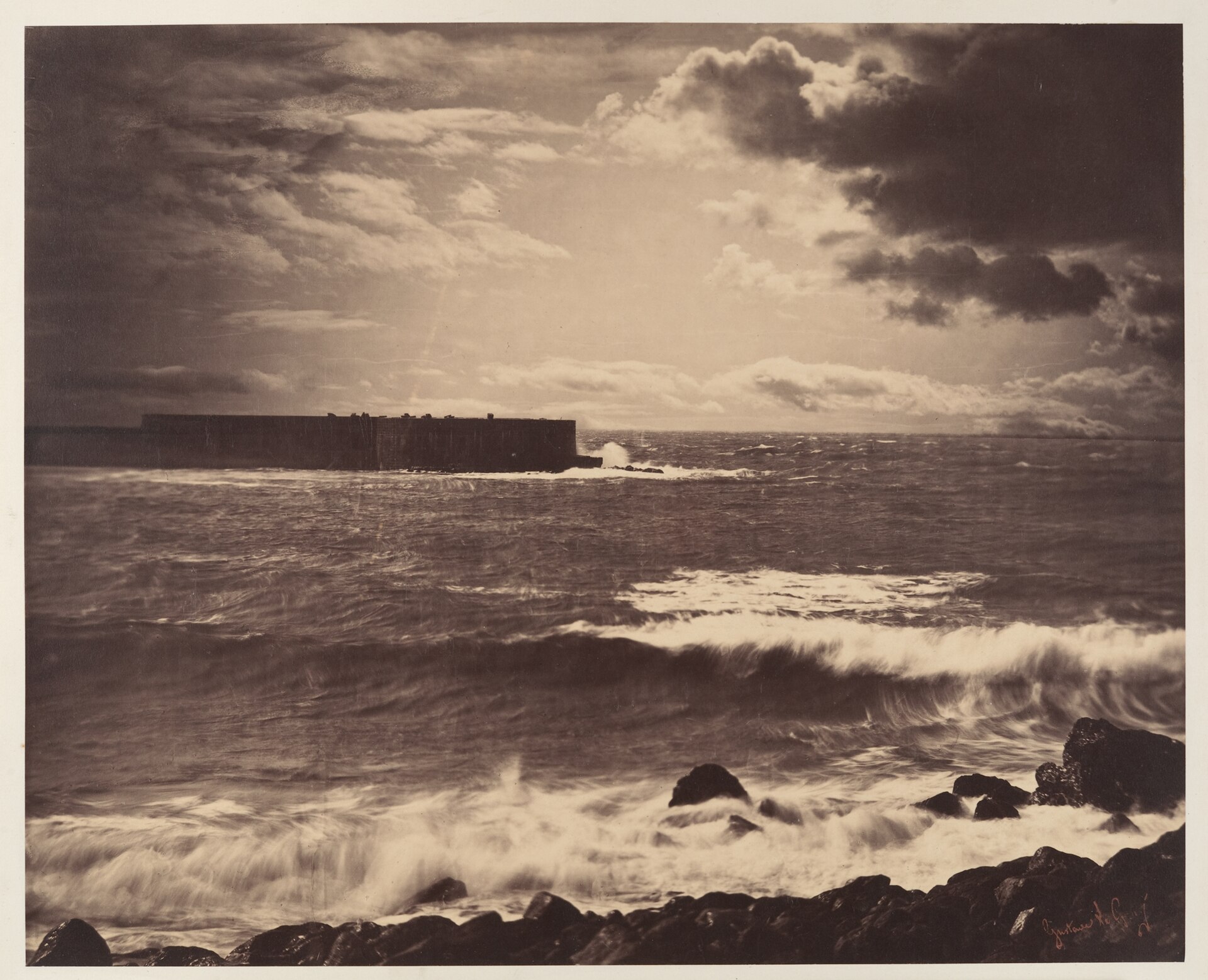
This record's reference print. Albumen silver print from two wet-collodion glass negatives, 1857, 33.7 x 41.4 cm. Metropolitan Museum of Art, accession 1976.646, gift of John Goldsmith Phillips, 1976, catalogued public domain.
| Artist | Jean-Baptiste Gustave Le Gray |
|---|---|
| Date | 1857 (exposed April 1857 at Sete; individual prints made over the following years, into the early 1860s) |
| Medium | Albumen print from two wet-collodion-on-glass negatives, combination-printed on a single sheet |
| Dimensions | Approximately 34 x 41.5 cm (image), varying by 3-8 mm between documented prints; see technical notes |
| Where it is now | This record uses the Metropolitan Museum of Art's print as its reference impression. Other fully documented prints are held by the J. Paul Getty Museum, the Art Institute of Chicago, the Los Angeles County Museum of Art, the Bibliotheque nationale de France, the Musee d'Orsay, the Victoria and Albert Museum, and the George Eastman Museum, among others.last confirmed 6 August 2026 |
| Inventory number | Metropolitan Museum of Art, accession 1976.646 |
| Attribution | AcceptedUniversally attributed to Gustave Le Gray. Full note |
| Object type | Photograph |
| Period | French, mid-nineteenth century |
| Cases | Has a provenance gap |
| Inscriptions | Most documented prints carry the number '17' in ink on the mount, sometimes with a printed or letterpress label, and the dry embossed stamp of 'Gustave Le Gray & Cie'. Placement and exact wording vary by print. |
| Owners on record | 5 links4 documented, 1 unknown |
| Sources | 26 cited |
About this record Last verified 14 September 2026 · 26 sources cited · Change log
On this page 10 sections
ContentsClose
In April 1857, on the jetty at Sete on the French Mediterranean coast, Gustave Le Gray exposed two glass negatives from the same camera position: one timed for the breaking wave and the stone breakwater, the other for the sky. Wet-collodion emulsion could not hold both together in a single frame, so in the darkroom he combined the two negatives on one sheet of albumen paper. The result, printed and sold under the title Grande Vague, Sete, no. 17 in his own numbering, was received as a technical sensation and a work of real poetic force, and it survives today in at least seven public collections, no two prints from quite the same run.
A print from the collection of Andre and Marie-Therese Jammes sold at Sotheby's London on 27 October 1999 for a hammer price of GBP 442,500, GBP 507,500 with premium, then the highest price ever recorded for a single photograph at auction. The buyer was reported in the press, though never confirmed by the saleroom itself, to be Sheikh Saud bin Mohammed Al-Thani of Qatar.
Because Le Gray printed this image repeatedly over several years and recycled sky negatives across more than one seascape composition, no single print can stand for all the others, and this record treats the Metropolitan Museum's impression, gift of John Goldsmith Phillips in 1976, as its reference point while cataloguing what is documented about the rest.
Provenance
Each link is graded. Documented: a cited source supports it. Disputed: the identification is argued but not established. Unknown: no owner for that span, and the gap is not smoothed into a narrative. The grades in the glossary.
- April 1857 -Gustave Le Graydocumented
Two wet-collodion glass negatives exposed from the mole Saint-Louis jetty at Sete, one for the sea and breakwater, one for the sky, combined by Le Gray in printing on albumen paper. The exposure is associated with Le Gray's documented visit to Sete around the opening of the Toulouse-Sete railway on 2 April 1857.16
- 1857 - 1858Gustave Le Gray (studio sales and exhibition)documented
The critic Marc-Antoine Gaudin, writing in La Lumiere, named Le Gray's 1857-58 seascapes 'the event of the year'. On 25 July 1858 the columnist Henri d'Audigier described this specific view in La Patrie after visiting Le Gray's studio, praising its wave crests and, notably, attributing the effect to a single instantaneous exposure of about 1/20 of a second, unaware of or omitting the combination-printing process that actually produced it.16
- 1860 -Gustave Le Gray & Ciedocumented
Along with 'The Breaking Wave', this was one of only three images Le Gray submitted to the French Ministry of the Interior for copyright protection in 1860, as his photographic company was collapsing into bankruptcy.16
- 1860 - 1976Unrecordedunknown
No ownership record for this specific print, between Le Gray's studio and its entry to the Metropolitan Museum, is given in the sources consulted. John Goldsmith Phillips, curator of Western European Arts at the Museum, is recorded only as the donor in 1976, not as a documented earlier link in an ownership chain.12
- 1976 - presentMetropolitan Museum of Art, New Yorkdocumented
Accessioned as 1976.646, gift of John Goldsmith Phillips. Catalogued as public domain under the Museum's Open Access policy.12
Prices realised
| Date | Sale | Estimate | Result | Note |
|---|---|---|---|---|
| 27 October 1999 | Sotheby's London: La Photographie, Collection Marie-Therese et Andre Jammes | GBP 40,000 - 60,000 (as reported by trade press; not verified against the original Sotheby's catalogue, which was not available to this research) | Hammer GBP 442,500 With premium GBP 65,000 GBP | A print of this photograph from the Jammes collection set the record price for any single photograph at auction at the time, within a 287-lot sale that totalled GBP 7,430,693 and itself set a record for a photography auction. The winning bid was a telephone bid; the buyer was widely reported in the press, though not confirmed by Sotheby's in any source consulted here, as Sheikh Saud bin Mohammed Al-Thani of Qatar. Sotheby's specialist Philippe Garner attributed the price to the print's condition and printing quality. Dollar equivalents of roughly USD 840,000 to 850,000 circulated depending on the conversion date used; the pound figures are the primary ones. |
| not confirmed (viewing dates of 15-16 November given; year not stated on the lot page consulted) | De Baecque et Associes Lyon: Ancient and Modern Paintings, lot 297 | EUR 30,000 - 40,000 | Hammer EUR 57,000 With premium 25% TTC (buyer's premium including tax; approximately EUR 14,250, for a total near EUR 71,250) EUR | A separate, later print of the same photograph, numbered 17 in ink and carrying the 'Gustave Le Gray & Cie' dry stamp and an inventory mark '13,329', described by the auctioneer's cataloguer as an exceptionally fresh impression with only slight sky-area defects. This sale is included to show that prints of this image continue to trade well outside the 1999 record and should not be mistaken for it. |
Hammer is the price at which the bidding stopped; with premium adds the fee the house charges the buyer on top. Hammer price and buyer's premium in the glossary.
Technical evidence
| Attribution note | Universally attributed to Gustave Le Gray. Prints carry his mount marks and the dry stamp of his firm, Gustave Le Gray & Cie, and this title was one of only three photographs he submitted to the French Ministry of the Interior for copyright deposit in 1860. Authorship is not in dispute; what is genuinely unsettled is which negative pairing and which printing campaign any single extant impression belongs to, since Le Gray reused sky negatives across several seascape compositions over several years. |
|---|---|
| Negative process | Two wet-collodion-on-glass negatives from the same or closely matched camera position: one exposed for the sea, breakwater and shore, one for the sky. Wet-collodion emulsion of the period could not record both a bright sky and a dark, textured sea in a single exposure without one or the other losing detail.16179 |
| Printing process | Albumen silver print. The two negatives were printed in register onto a single sheet of albumen paper, with the join running along the horizon; on some prints the seam is faintly visible on close inspection.146 |
| Camera position | Positioned on the mole Saint-Louis jetty at Sete, pointed south across the western entrance of the harbor, deliberately excluding the port and its shipping from the frame.16 |
| Date of exposure | April 1857, associated by scholarship with Le Gray's documented visit to Sete around the opening of the Toulouse-Sete railway line on 2 April 1857. The Museum of Modern Art catalogues its own print to 1856; this discrepancy is unresolved.16 |
| Dimensions across documented prints | Image size varies by roughly 3 to 8 millimetres between institutions: Metropolitan Museum of Art 33.7 x 41.4 cm; Los Angeles County Museum of Art 34.0 x 41.8 cm; Art Institute of Chicago 34.1 x 41.8 cm; Getty Museum about 34.3 x 41.9 cm; Victoria and Albert Museum 34.3 x 41.2 cm; Bibliotheque nationale de France 34.5 x 41.6 cm; Musee d'Orsay 34.2 x 42.0 cm. This range is consistent with ordinary trimming variation across a printing campaign, not evidence of a different negative pairing on its own.1468910 |
| Mount marks and numbering | Most documented prints carry the number '17' in ink on the mount, matching the numbering used independently by the Bibliotheque nationale de France, the Musee d'Orsay and a later auction print sold by De Baecque et Associes, and the dry embossed stamp 'Gustave Le Gray & Cie'. The Art Institute of Chicago's own catalogue data associates its print with an album its curators call 'Vistas del Mar', a Spanish-language title whose authenticity as Le Gray's own naming was not independently confirmed in this research.7101220 |
| 1860 copyright deposit | This title, together with 'The Breaking Wave', was one of only three photographs Le Gray submitted to the French Ministry of the Interior for copyright protection in 1860, as his photographic company was collapsing.16 |
| Contemporary account of the exposure | The columnist Henri d'Audigier, writing in La Patrie on 25 July 1858 after visiting Le Gray's studio, described this print in detail and stated it must have been fixed on the glass in about a twentieth of a second, as a single instantaneous exposure. This is a documented contemporary misunderstanding: the image was combination-printed from two separately timed negatives, not captured in one instant.16 |
| Rights status of this record's reference print | The Metropolitan Museum of Art catalogues its print, accession 1976.646, as public domain under its Open Access policy.12 |
Images
The record in full
Chapter 1What the object is
The photograph shows a single breaking wave crossing a wide stretch of open Mediterranean water, framed against a stone breakwater and a sky heavy with cloud, at the port of Sete on the French...
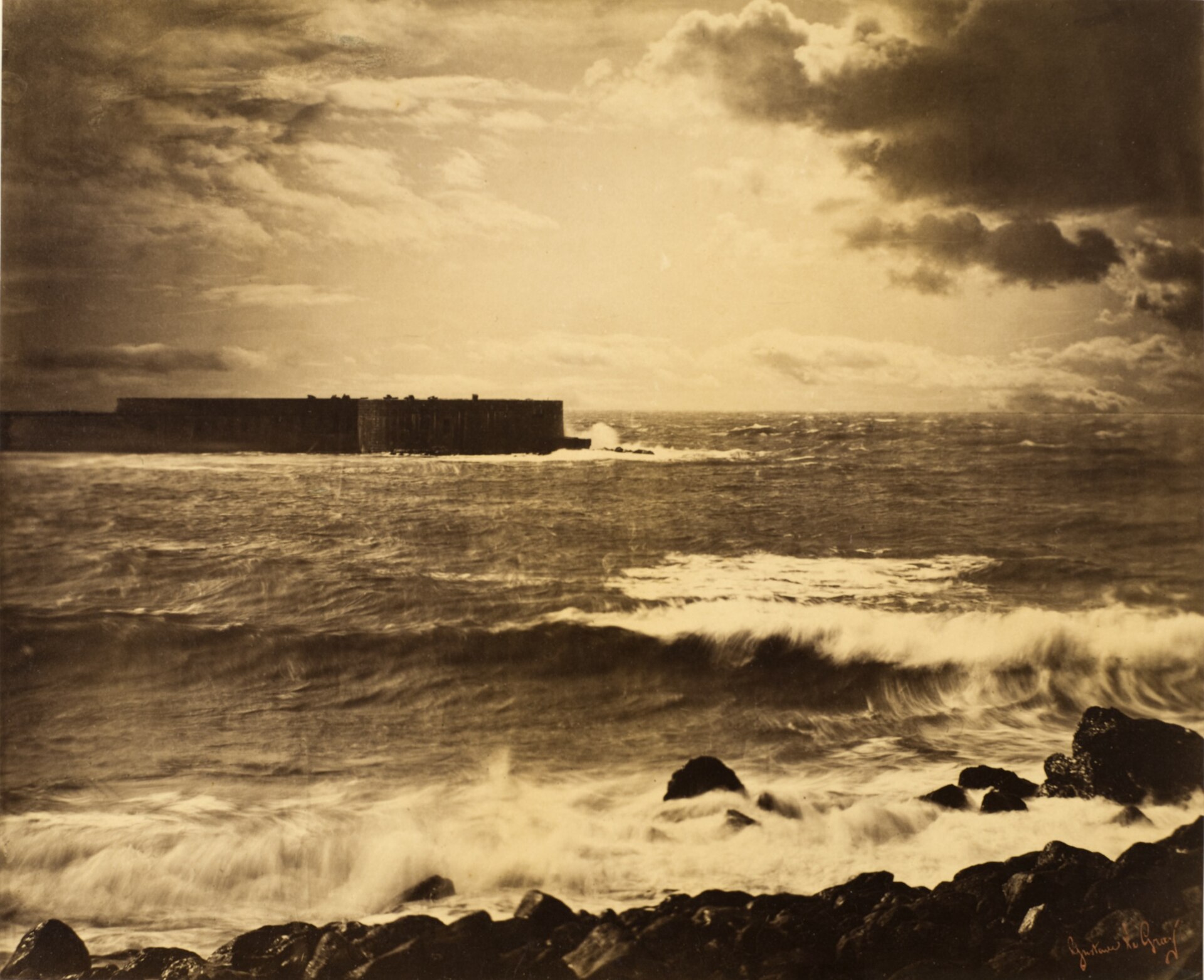
The photograph shows a single breaking wave crossing a wide stretch of open Mediterranean water, framed against a stone breakwater and a sky heavy with cloud, at the port of Sete on the French Mediterranean coast. It is an albumen silver print, roughly 34 by 41.5 centimetres, printed from two separate glass negatives on one sheet of paper: one negative held the sea, the breakwater and the shore, the other held the sky. There is no boat, no figure and no view of the harbor itself in the frame. Le Gray pointed his camera south across the western entrance of the harbor, deliberately excluding the port infrastructure that a conventional maritime view of Sete would have included, and built the composition around the wave and the sky alone.
No two surviving prints are identical in size: institutional records give figures from about 33.7 by 41.4 centimetres (Metropolitan Museum) to about 34.5 by 41.6 centimetres (Bibliotheque nationale de France) and 34.2 by 42.0 centimetres (Musee d'Orsay). This is ordinary variation from trimming and mounting practice across a printing campaign that ran over several years, not evidence that the prints come from different negatives.
Chapter 2Why one negative could not do the job, and how Le Gray solved it
This is the genuine technical achievement behind the picture, and it is worth being precise about it.
This is the genuine technical achievement behind the picture, and it is worth being precise about it. Wet-collodion glass negatives of the 1850s were not evenly sensitive across the visible spectrum, and a landscape exposure long enough to record detail in dark foreground water and stone left the bright sky wildly overexposed, so that clouds disappeared into a blank, textureless white. Expose instead for the sky, and the sea and shore fell into featureless silhouette. There was no single exposure time that could hold both a textured sky and a textured sea on one wet-collodion plate.
Le Gray's solution was to abandon the idea of a single negative altogether. He made two separate glass negatives from the same or a closely matched camera position, choosing an exposure for each that suited what it needed to record, then combined the two in the darkroom, printing them onto a single sheet of albumen paper so that the join fell along the horizon. Contemporary and later technical examination of these prints finds the seam largely successful, visible only on close inspection along the horizon line in some impressions. He was not the only photographer of his generation to use combination printing or negative retouching to manage tonal range, but his seascapes, made between 1856 and 1858, were the technique's first celebrated public demonstration, and this photograph is the best-documented example of it.
It is also documented that Le Gray reused certain sky negatives across more than one seascape composition. That fact, on its own, is the seed of the version-safety problem this record treats carefully throughout: an image titled 'Grande Vague, Sete' in one collection is not guaranteed, without direct comparison, to share an identical sky negative with an image of the same title in another collection, even though both are genuine Le Gray prints of what is recognisably the same sea negative and composition.
Chapter 3Sete, April 1857, and the circumstances of the campaign
The exposure is tied to a specific, documented occasion: Le Gray's presence at Sete around the opening of the Toulouse-Sete railway line on 2 April 1857.
The exposure is tied to a specific, documented occasion: Le Gray's presence at Sete around the opening of the Toulouse-Sete railway line on 2 April 1857. Scholarship on the picture has connected the timing of this seascape campaign to the business affairs of Le Gray's photographic company, which depended on a small number of wealthy backers. One of them, the Marquis de Briges, died on 17 April 1857, shortly after the Sete exposures were made, and it has been proposed that the seascape campaign, including a closely related composition called 'The Breaking Wave', was produced in part around a renegotiation of financial backing for Le Gray's firm following that death. This is offered in the scholarship as a plausible context for the timing, not as a documented commission; no contract or correspondence establishing it as such was found in the sources consulted.
The negatives made at Sete were not printed on the spot. Sky negatives were combined with the sea and shore negative back in Le Gray's Paris studio, which is itself part of why a single 'Sete' campaign could yield multiple distinct final compositions sharing some negatives and not others.
Chapter 4How it was received, 1857-1858
The response was immediate and, for a photograph, unusually intense.
The response was immediate and, for a photograph, unusually intense. The critic Marc-Antoine Gaudin, reviewing the year's photography for the journal La Lumiere, called Le Gray's seascapes of 1857-58 'the event of the year'. The columnist Henri d'Audigier gave the fullest surviving eyewitness account of this specific print, after a visit to Le Gray's studio, in La Patrie on 25 July 1858: he described how 'the swells become fleecy in the distance, descend foaming toward the viewer and break like white powder on the rocks along the shore', and that 'each wave is crowned by a little white puff whose every bitter drop we can count'.
D'Audigier's account is also a documented record of a misunderstanding that the photograph itself encouraged: he wrote that the scene must have been fixed on the glass in about a twentieth of a second, as though it were a single instantaneous capture. It was not. The illusion of an instant seized whole was itself a product of combining two separately timed negatives, and nothing in d'Audigier's account suggests he knew this. That gap between what a sophisticated contemporary viewer believed he was seeing and how the image was actually made is, on its own terms, a piece of evidence about how completely Le Gray's combination printing succeeded as an illusion.
Chapter 5Which institutions hold documented prints, and what is known of each
At least seven public collections hold a print catalogued under this title or its French equivalent, and each has its own separately documented history, which this record treats separately rather...
At least seven public collections hold a print catalogued under this title or its French equivalent, and each has its own separately documented history, which this record treats separately rather than assuming a shared chain.
The Metropolitan Museum of Art, New York, holds the print used as this record's reference image: accession 1976.646, gift of John Goldsmith Phillips in 1976, catalogued by the Museum as public domain. No earlier ownership is published. The J. Paul Getty Museum, Los Angeles, holds a print catalogued as about 1857, accession 84.XM.637.1, part of a collection whose photographic holdings the Museum has released broadly under its Open Content Program's CC0 licensing; the specific licence tag for this object could not be independently confirmed in this research because the Getty's own object page repeatedly failed to load in full. The Art Institute of Chicago holds a print acquired with the Hugh Edwards Fund, catalogued in the museum's own data as number 17 from an album its curators associate with the name 'Vistas del Mar'; this record treats that album attribution as the museum's own cataloguing choice, not as an independently verified fact about Le Gray's original numbering system. The Los Angeles County Museum of Art holds a print, accession M.2008.40.1284, from the Marjorie and Leonard Vernon Collection, a gift of the Annenberg Foundation and Carol Vernon and Robert Turbin in 2008.
The Bibliotheque nationale de France holds a print under reference RESERVE FOL-EO-13(3), from the former collection of Alfred Armand, in its Department of Prints and Photography. The Musee d'Orsay holds a print, reference PHO 1985 127, acquired by the French national museums in 1985; until that year it belonged to the collector and magazine editor Roger Therond. The Victoria and Albert Museum, London, holds a print, museum number 68004, that entered the collection through the Townshend Bequest in the nineteenth century; the V&A's own site permits only limited non-commercial reproduction of its scan and does not release it under a public-domain or CC0 licence, so no image from that print appears in this record's gallery even though the photograph itself is out of copyright by age. The George Eastman Museum holds a print described as a gift of the Eastman Kodak Company from the former collection of the early photography historian and collector Gabriel Cromer; a precise accession number was not found in the sources consulted and should be confirmed directly with the museum before publication.
Chapter 6The market for the image before 1999
Nineteenth-century photography did not command anything like painting-market prices for most of the twentieth century, and prints of this image moved through dealers and specialist collections...
Nineteenth-century photography did not command anything like painting-market prices for most of the twentieth century, and prints of this image moved through dealers and specialist collections, including the Jammes collection assembled by Andre and Marie-Therese Jammes, well before its value was tested against the wider art market. The Jammes collection was one of the deepest private holdings of early French photography in existence, and its dispersal at Sotheby's beginning in 1999 was itself a scholarly event: the sale catalogue, prepared with input from Jammes and from photography historians, remains a reference point for dating and cataloguing Le Gray's work, including the 2002 monograph on Le Gray published by the Bibliotheque nationale de France to accompany a major retrospective.
Chapter 7The 1999 Sotheby's sale and the record
On 27 October 1999, Sotheby's London sold the Jammes collection's photography holdings in a single-owner sale of 287 lots that realised a total of GBP 7,430,693, itself a record for a photography...
On 27 October 1999, Sotheby's London sold the Jammes collection's photography holdings in a single-owner sale of 287 lots that realised a total of GBP 7,430,693, itself a record for a photography auction, with 92 percent of lots sold by number and 99 percent by value. Within that sale, a print of this photograph sold on a telephone bid for a hammer price of GBP 442,500; with the buyer's premium the total came to GBP 507,500, then the highest price ever paid for a single photograph at auction, a record that displaced one set only weeks earlier at Sotheby's New York by a Charles Sheeler photograph. Another Le Gray print in the same Jammes sale, a beech tree study, sold for a closely comparable GBP 441,500 to the same anonymous telephone bidder. Sotheby's specialist Philippe Garner attributed the price for the seascape to a combination of exceptional condition and what he called 'perfect printing', calling it one of the finest Le Gray impressions ever offered at auction.
The buyer was widely reported in art-market and trade press, though not confirmed in any statement from Sotheby's found in this research, to be Sheikh Saud bin Mohammed Al-Thani of Qatar, a member of the Qatari ruling family who was, through the late 1990s and 2000s, one of the most aggressive buyers across multiple collecting fields, from photography to natural history specimens. Reported dollar equivalents of roughly USD 840,000 to 850,000 circulated at the time depending on the day's exchange rate used by the reporting outlet; the pound sterling figures, hammer and premium separately, are the reliable ones and should be treated as primary over any dollar conversion.
Chapter 8After the record: what displaced it, and what became of the print
The record stood for roughly three and a half years.
The record stood for roughly three and a half years. In May 2003, Sheikh Saud Al-Thani himself bought a daguerreotype, 'Athenes, Temple de Jupiter Olympien' by Joseph-Philibert Girault de Prangey, for a reported GBP 565,250, surpassing the price he had paid for the Le Gray. The two purchases, by the same collector within a few years of each other, mark the point at which nineteenth-century photography as a collecting category began to be priced against, rather than far below, painting and works on paper from the same period.
What happened to this specific print after 1999 is less well documented than the sale itself. Sheikh Saud's wider photography holdings were, according to trade press coverage from the following decade, consigned to secure, climate-controlled storage in Qatar, with an announced plan for a dedicated photography museum that had not been realised by the time of his death in 2014; parts of his broader art collection are shown at Qatar's Museum of Islamic Art, but no source consulted here confirms that this particular photograph is on public display anywhere. Its current custodianship, within the Qatari state's broader art holdings following the Sheikh's death, is not something this research could verify from public sources, and it is recorded here as unresolved rather than assumed.
Chapter 9The wider market: other prints, other sales
The 1999 record is the peak, not the whole market.
The 1999 record is the peak, not the whole market. A separate print of this same photograph, numbered 17 and carrying Le Gray's own dry stamp, sold at the Lyon auction house De Baecque et Associes for a hammer price of EUR 57,000 against an estimate of EUR 30,000 to 40,000, described by the cataloguer as an exceptionally well-preserved impression with only minor sky-area flaws; the exact year of that sale could not be confirmed from the lot page consulted and is flagged rather than guessed at.
Other Le Gray seascapes, distinct compositions rather than this image, have also traded strongly: in August 2011 the Vendome auction house Rouillac sold 'Bateaux Quittant le Port du Havre', a different combination-printed Le Gray seascape made at Le Havre, for a hammer price of EUR 917,000, roughly USD 1.32 million with premium, to a Houston-based buyer, briefly the record for any nineteenth-century photograph before being overtaken later the same year by a Billy the Kid tintype. In the same Rouillac sale, a print of 'La Vague Brisee', the vertical companion image from the same 1857 Sete campaign as this photograph, sold for roughly EUR 372,000. These figures establish the price floor and ceiling for Le Gray's combination-printed seascapes as a market cohort, distinct from and well below the singular 1999 result for this specific image.
Chapter 10Gustave Le Gray, as far as it bears on this photograph
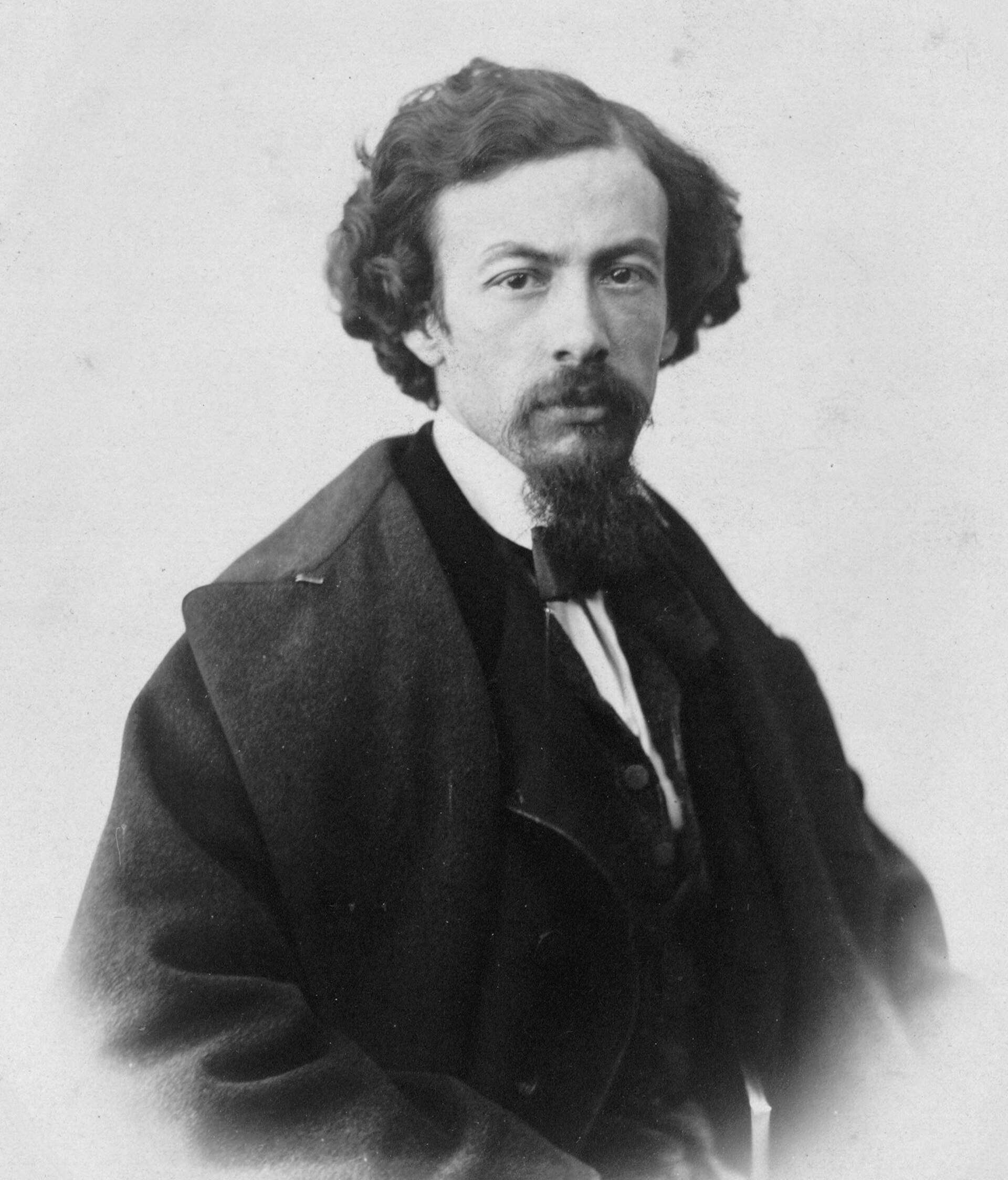
Le Gray was trained as a painter, first under Francois-Edouard Picot and then in the studio of Paul Delaroche, and travelled through Switzerland and Italy on his parents' money before turning to...
Le Gray was trained as a painter, first under Francois-Edouard Picot and then in the studio of Paul Delaroche, and travelled through Switzerland and Italy on his parents' money before turning to photography in the late 1840s. That painter's training shaped his approach to the medium: contemporaries and later historians agree that Le Gray sought a complete visual impression of a scene, closer to how the eye and memory compose a view than to what a single photographic plate could literally record, and the combination-printed seascapes are the clearest surviving demonstration of that ambition.
By 1851 he had published a treatise advocating waxed paper negatives, a refinement of the calotype process that made paper negatives sharper and more durable, and the same year helped found the Societe Heliographique, among the first photographic societies anywhere, and was one of five photographers chosen for the Mission Heliographique, an official commission to document historic French monuments. He taught photography to pupils who themselves became significant figures, including Nadar and Charles Negre. By 1855 he had opened a lavishly appointed studio in Paris and become an official photographer to Napoleon III, receiving in 1857, the same year as the Sete seascapes, an unusual commission to photograph imperial army manoeuvres at the Camp de Chalons.
The studio failed financially within three years of that peak. By 1859 his backers were, in the words of one historian, showing fatigue at 'always paying out and never receiving', and the business was further undercut by the rise of the cheap carte-de-visite portrait format, which undermined the market for Le Gray's more expensive studio portraiture. On 1 February 1860 his company was dissolved; in May of that year, at around forty years old, he left France, abandoning his wife and remaining children and evading his creditors. He travelled the Mediterranean for a period with the writer Alexandre Dumas, photographed Giuseppe Garibaldi during the Sicilian campaign, and eventually settled in Egypt, where by 1864 he was established in Cairo, teaching drawing and running a modest photography business, with occasional commissions from the Egyptian viceroy Ismail Pasha. He died in Cairo on 30 July 1884. His seascapes, made and sold across barely three years of an otherwise turbulent career, remain the work for which he is most widely known.
Chapter 11What is still unresolved
The most consequential open question is not about ownership but about identity: whether every print catalogued under this title, across seven or more institutions, was printed from an identical pair...
The most consequential open question is not about ownership but about identity: whether every print catalogued under this title, across seven or more institutions, was printed from an identical pair of negatives, or whether Le Gray, working across several years and reusing sky negatives between compositions, combined this sea negative with more than one sky negative on different printing occasions. The sources consulted document the general practice of negative reuse without settling the question for this specific title, and this record has deliberately avoided asserting a single shared negative pairing across all seven collections without direct technical comparison of the prints themselves.
A second question concerns dating: the Museum of Modern Art catalogues its own print of this composition to 1856, a year earlier than the 1857 date used by the Metropolitan Museum, the Getty, the Art Institute of Chicago, LACMA and the French national institutions, and tied by them to the documented April 1857 Sete railway opening. No source consulted here reconciles the discrepancy, and this record has not used MoMA's print or date rather than guess which is correct.
The artist
Jean-Baptiste Gustave Le Gray
Le Gray trained as a painter and never fully stopped thinking like one, which is the most useful single fact for understanding this photograph. He spent barely three years, 1856 to 1858, on the seascapes that made him famous, inside a career that also included official work for Napoleon III, a major documentary commission, and a business collapse severe enough that he left the country to escape his creditors and never returned to Europe. Almost every fact below bears directly on how and why this specific photograph exists.
Related works
| Work | Relation | Where it is |
|---|---|---|
| The Breaking Wave (La Vague Brisee, Mer Mediterranee, no. 15) Gustave Le Gray | Vertical companion image from the same April 1857 Sete campaign; the two sailboats entering port distinguish it clearly from this photograph One of only two images, alongside this one, that Le Gray submitted for copyright protection in 1860. A separate print sold at Rouillac, Vendome, in August 2011 for a hammer price of roughly EUR 372,000, a different sale from the 1999 record discussed here. | Art Institute of Chicago, among other collections |
| Cloudy Sky, Mediterranean Sea (no. 16) Gustave Le Gray | A sky study catalogued in the same numbered sequence as this photograph, illustrating that Le Gray catalogued and likely reused his sky negatives independently of the seascape compositions they were combined into Not confirmed as the specific sky negative used in this photograph; included to show how the negative-reuse question in the open questions below arises directly from Le Gray's own practice. | Art Institute of Chicago |
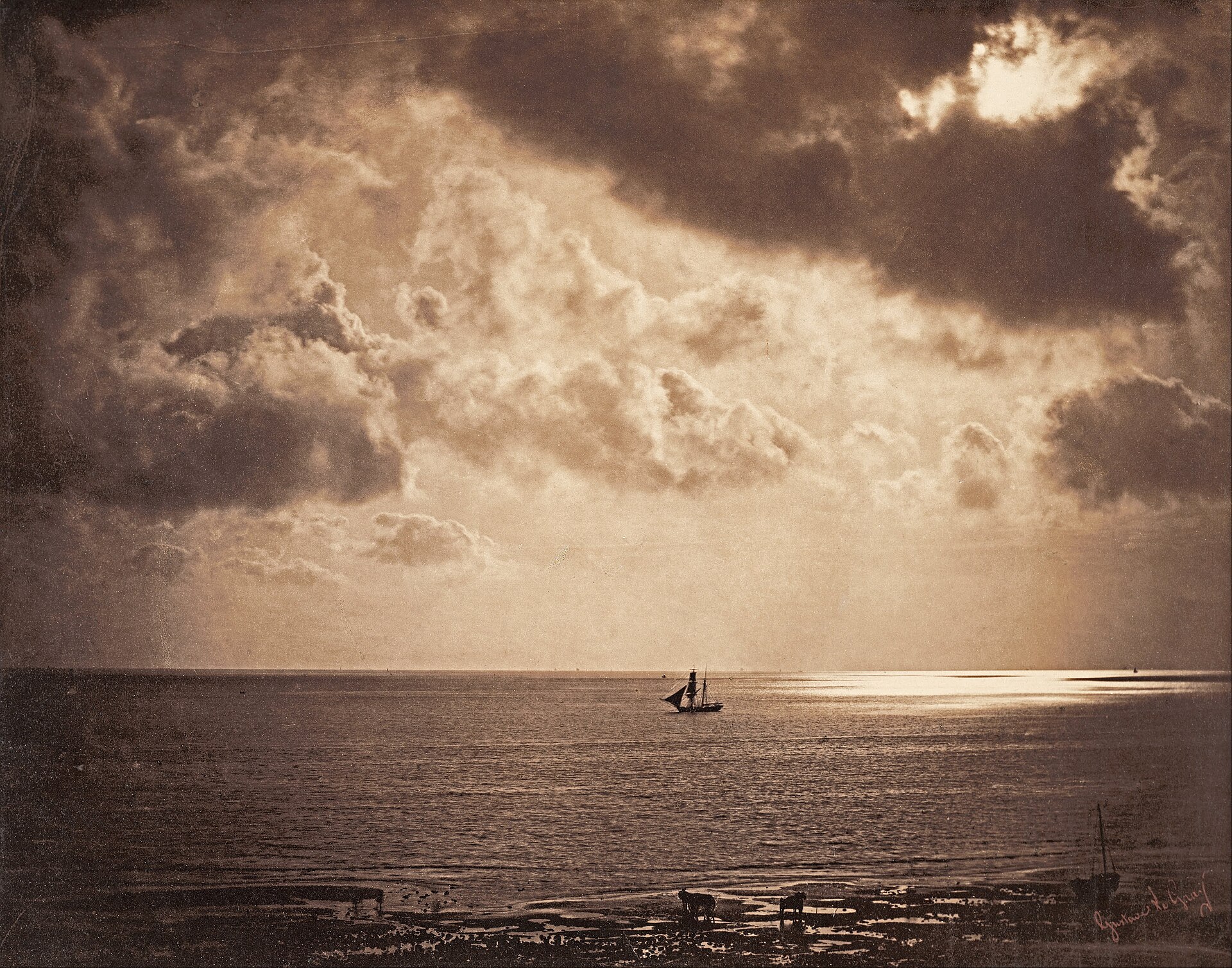
| The Brig / Brig upon the Water (Le Brick au clair de lune) Gustave Le Gray | A different, earlier combination-printed seascape, made in 1856, not at Sete. This is NOT the same photograph as the one described in this record and must not be conflated with it Le Gray's first widely exhibited combination print, shown at the Photographic Society of London in autumn 1856 and reportedly bought in print form by Queen Victoria; it established the reputation that the 1857 Sete seascapes then extended. Included here specifically as a version-safety comparison, not as an alternate print of this photograph. | J. Paul Getty Museum and multiple other collections |
| Athenes, Temple de Jupiter Olympien Joseph-Philibert Girault de Prangey | The daguerreotype that displaced this photograph's 1999 price as the auction record for a single photograph, bought in May 2003 by the same collector reported to have bought this print in 1999 Sold for a reported GBP 565,250, roughly three and a half years after the Le Gray sale discussed in this record. | Reported private collection; not independently confirmed |
Open questions
- Do all seven or more documented prints of this title share an identical pair of negatives, or did Le Gray combine this sea negative with more than one sky negative across different printing occasions between 1857 and the early 1860s? The sources consulted confirm that he reused sky negatives across compositions in general, but do not settle this for this specific title without direct technical comparison of the prints themselves.
- Why does the Museum of Modern Art catalogue its print to 1856, against the 1857 date used by every other institution consulted and tied to the documented April 1857 Sete railway opening? No source found here reconciles the discrepancy.
- Was the reported buyer of the 1999 Sotheby's print, Sheikh Saud bin Mohammed Al-Thani of Qatar, ever confirmed as such by Sotheby's itself, or does that identification rest entirely on press reporting? No auction-house statement confirming it was found in this research.
- What is the current custodianship of the 1999 record-setting print, within the Qatari state's art holdings, following Sheikh Saud Al-Thani's death in 2014? Trade press describes his broader photography collection as held in storage with no public museum realised; no source locates this specific print.
- Does the 'Vistas del Mar' album title used in the Art Institute of Chicago's own catalogue data reflect Le Gray's own naming and numbering of his seascape prints, or is it a later cataloguing convention, possibly reflecting a Spanish-speaking early owner or dealer, applied independently of the French numbering ('no. 17') used by the Bibliotheque nationale de France, the Musee d'Orsay and later auction houses?
- What is the George Eastman Museum's accession number and acquisition date for its print, beyond its being a gift of Eastman Kodak Company from the former Gabriel Cromer collection? This could not be confirmed from the sources consulted and should be checked directly against the museum's own database.
Questions about this object
What is The Great Wave, Sete?
The Great Wave, Sete is a photograph, dated 1857 (exposed April 1857 at Sete; individual prints made over the following years, into the early 1860s). Medium: Albumen print from two wet-collodion-on-glass negatives, combination-printed on a single sheet.
Who made The Great Wave, Sete, and is the attribution settled?
The attribution to Jean-Baptiste Gustave Le Gray is recorded here as accepted. Universally attributed to Gustave Le Gray. Prints carry his mount marks and the dry stamp of his firm, Gustave Le Gray & Cie, and this title was one of only three photographs he submitted to the French Ministry of the Interior for copyright deposit in 1860. Authorship is not in dispute; what is genuinely unsettled is which negative pairing and which printing campaign any single extant impression belongs to, since Le Gray reused sky negatives across several seascape compositions over several years.
Where is The Great Wave, Sete now?
This record uses the Metropolitan Museum of Art's print as its reference impression. Other fully documented prints are held by the J. Paul Getty Museum, the Art Institute of Chicago, the Los Angeles County Museum of Art, the Bibliotheque nationale de France, the Musee d'Orsay, the Victoria and Albert Museum, and the George Eastman Museum, among others. Inventory number Metropolitan Museum of Art, accession 1976.646. Last confirmed 6 August 2026. Gift of John Goldsmith Phillips, 1976.
What has The Great Wave, Sete sold for?
Hammer GBP 442,500; with premium, GBP 65,000. Sotheby's, 1999-10-27.
What is still unknown about The Great Wave, Sete?
Do all seven or more documented prints of this title share an identical pair of negatives, or did Le Gray combine this sea negative with more than one sky negative across different printing occasions between 1857 and the early 1860s? The sources consulted confirm that he reused sky negatives across compositions in general, but do not settle this for this specific title without direct technical comparison of the prints themselves.
Sources
- 1Metropolitan Museum of Art, collection catalogue entry for [The Great Wave, Sete], accession 1976.646. metmuseum.org/art/...
- 2Metropolitan Museum of Art, Open Access API record for object 261941. collectionapi.metmuseum.org/public/...
- 3Metropolitan Museum of Art, Heilbrunn Timeline of Art History essay, 'Gustave Le Gray (1820-1884)'. metmuseum.org/toah/...
- 4J. Paul Getty Museum, collection catalogue entry, 'The Great Wave, Sete', object 62015 / 84.XM.637.1. getty.edu/art/...
- 5J. Paul Getty Museum, collection catalogue entry, 'The Brig', object 62016. getty.edu/art/...
- 6Art Institute of Chicago, collection catalogue entry, 'The Great Wave, Sete', artwork 36848. artic.edu/artworks/...
- 7Art Institute of Chicago, public API record for artwork 36848. api.artic.edu/api/...
- 8Los Angeles County Museum of Art, collection catalogue entry, object 142477 (M.2008.40.1284). collections.lacma.org/object/...
- 9Victoria and Albert Museum, collections catalogue entry, item O72699. collections.vam.ac.uk/item/...
- 10Musee d'Orsay, collection catalogue entry, 'Grande vague, Sete - no. 17'. musee-orsay.fr/en/...
- 11Bibliotheque nationale de France, Catalogue general, bibliographic record for '[La Grande vague - Sete - No. 17]'. catalogue.bnf.fr/ark:/...
- 12BnF Essentiels, 'No. 17 - Grande vague, Sete'. essentiels.bnf.fr/fr/...
- 13George Eastman Museum, 'Featured Collection: The Gabriel Cromer Collection'. Flagged for direct re-verification; accession number for this print not confirmed. eastman.org/featured-collection-gabriel-cromer-collection
- 14Wikipedia (French), 'La Grande Vague, Sete'. fr.wikipedia.org/wiki/...
- 15Wikipedia (English), 'Gustave Le Gray'. en.wikipedia.org/wiki/...
- 16Young, 'Photography and the Philosophy of Time: On Gustave Le Gray's Great Wave, Sete', Nonsite.org. nonsite.org/photography-and-the-philosophy-of-time
- 17Richard Harrington, 'The First HDR Photo: Gustave Le Gray, Two Negatives, and the Problem of Sea and Sky'. richardharrington.com/blog/...
- 18iPhotoCentral newsletter, 'Photography Sale Of The Millenium: Jammes Auction Sale In London Lives Up To The Hype And More!'. iphotocentral.com/news/...
- 19iPhotoCentral newsletter, 'Le Gray Sale Sets 19th-Century Photo Record--Briefly--At Over $1.3 Million to Texas Oil Man' (Rouillac, 2011; a different Le Gray work, cited here as market comparanda only). iphotocentral.com/news/...
- 20De Baecque et Associes, auction lot page, 'Grande Vague, Sete no. 17', lot 297. debaecque.fr/en/...
- 21Wikidata, 'The Great Wave, Sete', Q3209564. wikidata.org/wiki/...
- 22Wikimedia Commons, Category:La Grande Vague, Sete, and file-level extmetadata for images used in this record's gallery. commons.wikimedia.org/wiki/...
- 23Paul Fraser Collectibles, 'The vast and spectacular collections of Sheikh Saud al Thani of Qatar'. paulfrasercollectibles.com/blogs/...
- 24The Art Newspaper, 'Collector interview: Sheikh Saud Al Thani of Qatar' (2004). theartnewspaper.com/2004/...
- 25PetaPixel, 'Getty's Open Content Program Has 88,000 Images You Can Use for Free', on the CC0 status of Getty Museum collection images generally. petapixel.com/2024/...
- 26Gustave Le Gray, 'Traite pratique de photographie sur papier et sur verre' (1850), digitized copy. archive.org/details/...
Last verified 14 September 2026 · Published 6 August 2026
Change log
6 August 2026 - Record created at the house standard: researched narrative, technical evidence, maker dossier, graded provenance chain, prices with hammer and premium separated, related works, open questions and sources.
14 September 2026 - Re-verification pass: searched for any change in current location, attribution, market activity or litigation since 2026-08-06. None found. The 1999 Jammes-collection record sale (GBP 442,500 hammer, Sotheby's) and the later De Baecque et Associes print sale already in this record's auction_results remain the most recent documented market activity for prints of this image; no 2025-2026 auction of a print of this photograph was found. No change made to current_location, provenance or auction_results.