Minister Kibi's Adventures in China (Kibi daijin nitto emaki)
Unknown painter of the Kyoto court circle, formerly given to Tokiwa Mitsunaga · 12th century (late Heian period)
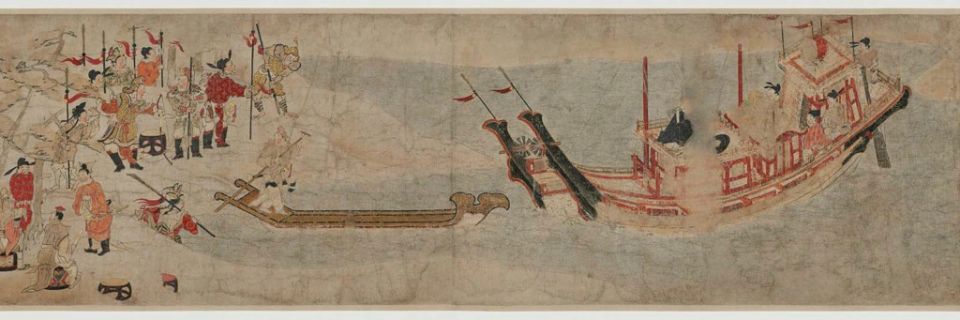
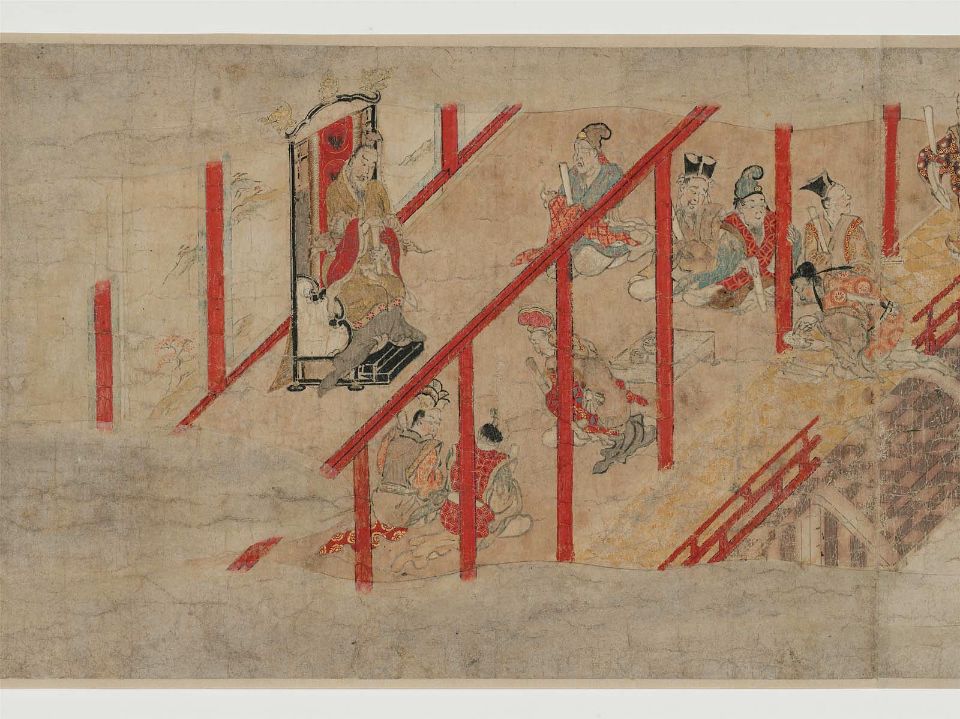
The record subject. Scroll one of the four, Museum of Fine Arts accession 32.131.1, showing the Japanese minister Kibi no Makibi arriving in China. Ink, colour and gold on paper, twelfth century.
| Artist | Unknown painter of the Kyoto court circle, formerly given to Tokiwa Mitsunaga |
|---|---|
| Date | 12th century (late Heian period) |
| Medium | Set of four handscrolls; ink, colour and gold on paper, with rosewood endknobs |
| Dimensions | Scroll 1 image 32 x 674.6 cm, overall 36.5 x 804.9 cm; scroll 4 image 30.2 x 648.1 cm, overall 36.7 x 779.1 cm. The four together run to roughly 24.4 m of painted surface. |
| Where it is now | Museum of Fine Arts, Boston; recorded as not on viewlast confirmed 4 August 2026 |
| Inventory number | 32.131.1 to 32.131.4 |
| Attribution | DisputedThe Museum of Fine Arts, Boston catalogues the four scrolls as by an unknown Japanese artist of the Heian period, twelfth century. Full note |
| Object type | Painting |
| Period | Japanese, Heian period |
| Cases | Disputed attribution · Has a provenance gap |
| Inscriptions | Text passages alternate with the painted scenes in the emaki convention. No artist's signature or seal. |
| Owners on record | 7 links5 documented, 1 disputed, 1 unknown |
| Sources | 6 cited |
About this record Last verified 24 August 2026 · 6 sources cited · Change log
On this page 10 sections
ContentsClose
Four twelfth-century Japanese handscrolls, running to some twenty-four metres of painted surface, telling a wildly unhistorical story about a real Japanese envoy who outwits the entire Tang court with the help of a ghost. They left Japan in 1932, sold by an Osaka dealer through Yamanaka and Company of New York to the Museum of Fine Arts, Boston, and the sale caused a national outcry.
The timing is the point. Japan's National Treasures Preservation Law had been in force since 1 July 1929, but it protected only objects that had been designated. These scrolls had not been. On 1 April 1933, not nine months after the accession, Japan enacted a second statute to stop undesignated art leaving the country in the economic crisis, and about eight thousand objects were placed beyond export under it. The literature treats the export of these scrolls as a cause of that statute; the legislative record has not been checked here, so this record records the sequence and attributes the causal claim rather than making it.
The provenance is unusually complete for a Japanese painting of this age - a shrine in Wakasa by 1441, the Sakai lords of Wakasa, two generations of Sakai, a Tokyo Art Club auction in 1923, two generations of the Toda family in Osaka, and then Boston. A companion scroll believed to have been kept at the same shrine stayed in Japan and is a National Treasure. This one is recorded by its own museum as not on view.
Provenance
Each link is graded. Documented: a cited source supports it. Disputed: the identification is argued but not established. Unknown: no owner for that span, and the gap is not smoothed into a narrative. The grades in the glossary.
- 12th century - by 1441Unknown; the scrolls were painted in the capitalunknown
No commission, patron or first owner is recorded. The scrolls first appear in the record already at a shrine in the provinces.13
- by 1441 - unknownOshio Hachiman Shrine, Wakasa Province (now Fukui Prefecture)documented
Documented at the shrine by 1441. The Ban Dainagon Ekotoba is believed to have been kept there with them.123
- unknown - 1920The Sakai family, Lords of Wakasa Province, to Sakai Tadamichi (d. 1920)disputed
The Museum of Fine Arts writes that the scrolls were probably acquired from the shrine by the Sakai family. Graded disputed because the museum itself hedges the step and gives it no date. Held by Sakai Tadamichi until his death in 1920.12
- 1920 - 1923Sakai Tadatae (b. 1883, d. 1939)documented
Inherited from his father. Sold three years later, in the period when former daimyo families were breaking up their collections under financial pressure.12
- 1923 - 1930Toda Yashichi, 2nd (b. 1867, d. 1930), Osakadocumented
Bought from Sakai Tadatae at auction at the Tokyo Art Club in 1923. No hammer price is published in the sources consulted.12
- 1930 - 1932Toda Yashichi, 3rd, known as Toda Rosui (b. 1892, d. 1942), dealer, Osakadocumented
Inherited from his father and sold within two years. Toda Rosui was a dealer, which is the point at which the scrolls entered the trade proper.12
- 1932 - presentMuseum of Fine Arts, Bostondocumented
Sold by Toda Rosui through Yamanaka and Company, New York, to the Museum of Fine Arts; accession date 7 July 1932; accessions 32.131.1 to 32.131.4. Funded by exchange from the William Sturgis Bigelow Collection; no price published. The export provoked public outrage in Japan and was lawful, the scrolls being undesignated under the 1929 National Treasures Preservation Law. Japan enacted the Law Regarding the Preservation of Important Works of Fine Arts on 1 April 1933, a statute directed at undesignated objects leaving the country; the reference literature links the two events causally and this record reports that link as an attribution.1235
Prices realised
| Date | Sale | Estimate | Result | Note |
|---|---|---|---|---|
| 1923 | Tokyo Art Club | Not published | Hammer Not published in the sources consulted With premium Not published in the sources consulted JPY | Consigned by Sakai Tadatae and bought by Toda Yashichi the second of Osaka. The Museum of Fine Arts records the sale and the parties but no figure, and no figure appears in the sources consulted here. Recorded as an event with an unknown price rather than omitted, because this is the only time the scrolls have been offered at public auction in their documented history. |
Hammer is the price at which the bidding stopped; with premium adds the fee the house charges the buyer on top. Hammer price and buyer's premium in the glossary.
Technical evidence
| Attribution note | The Museum of Fine Arts, Boston catalogues the four scrolls as by an unknown Japanese artist of the Heian period, twelfth century. A long-standing tradition gives them to Tokiwa Mitsunaga, the painter to whom the Ban Dainagon Ekotoba is attributed, and the two works are believed to have been kept in the same Wakasa shrine. Art historians treat the Mitsunaga attribution as questionable on the ground of stylistic variation between the two, and place the painter instead as an unnamed contemporary working in the capital. The holding museum's own catalogue takes the cautious position; the popular literature does not. |
|---|---|
| Format | Four handscrolls (emaki), each separately accessioned 32.131.1 to 32.131.4, with rosewood endknobs of the genus Dalbergia.12 |
| Medium | Ink, colour and gold on paper.12 |
| Dimensions | Scroll 1: image 32 x 674.6 cm, overall 36.5 x 804.9 cm. Scroll 4: image 30.2 x 648.1 cm, overall 36.7 x 779.1 cm. The set together approaches 24.4 m of painted surface.123 |
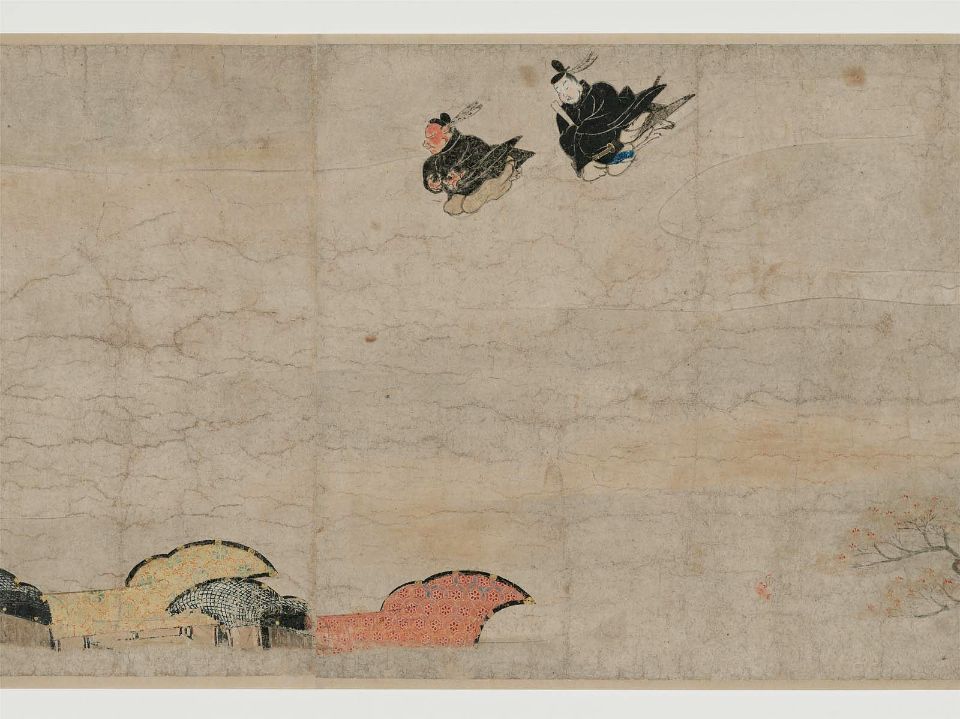
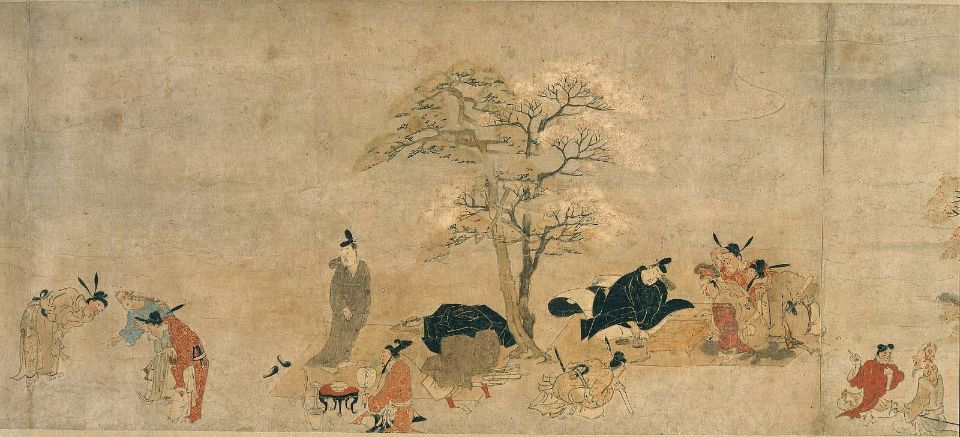
| Narrative structure | Six narrative sections across the four scrolls: the arrival in China and the escort to the tower; the ghost of Abe no Nakamaro appearing as a demon; the test on the Wen Xuan; the examination by a Chinese scholar; the plot to kill Kibi if he loses at go; and the go match itself and its aftermath.3 |
| Signature | None. No signature or seal; the attribution rests entirely on style and on shared provenance with the Ban Dainagon Ekotoba.13 |
| Catalogue history | First published for the museum by Robert T. Paine Jr., 'The Scroll of Kibi's Adventures in China', MFA Bulletin 31, no. 183 (February 1933), which remains the source cited by the museum for the early provenance. Later in MFA Highlights: Arts of Japan (2008), p. 194, and MFA Japanese Masterpieces (2012), no. 26.12 |
| Display status | Recorded by the museum as not on view. Light-sensitive materials on paper; a scroll of this length can only be exhibited in sections.12 |
| Rights status of the photographs | Reproductions of all four scrolls are available on Wikimedia Commons under a public domain statement, credited to the Museum of Fine Arts, Boston. Verified per file against extmetadata LicenseShortName on 4 August 2026.6 |
Images
The record in full
Chapter 1What the object is
Four handscrolls of ink, colour and gold on paper, with endknobs of rosewood.
Four handscrolls of ink, colour and gold on paper, with endknobs of rosewood. The Museum of Fine Arts gives scroll one an image 32 cm high and 674.6 cm long, and scroll four an image 30.2 cm high and 648.1 cm long; mounted with endpapers each is roughly eight metres. Together the four make up something close to twenty-four and a half metres of painted narrative. The superlative of longest known scroll is applied in the reference literature to the work as a single undivided scroll, which is itself contested here.
They are read the way all emaki are read: unrolled a little at a time with the right hand while the left rolls up what has passed, so that the viewer sees about sixty centimetres at once and the story moves through the hands rather than across a wall. Passages of text alternate with the painted scenes. There is no signature and no seal.
The four scrolls are separately accessioned - 32.131.1 through 32.131.4 - and separately mounted, which is the ordinary condition for a long emaki and not evidence of damage.
Chapter 2The story, and why a Japanese painter told it
Kibi no Makibi was a real man, a scholar-official who went to Tang China with a Japanese embassy in the eighth century and came back carrying Chinese learning that reshaped the Japanese court.
Kibi no Makibi was a real man, a scholar-official who went to Tang China with a Japanese embassy in the eighth century and came back carrying Chinese learning that reshaped the Japanese court. Abe no Nakamaro was also real: he went to China on the same kind of mission, rose in the Tang bureaucracy, and never came home. He died there.
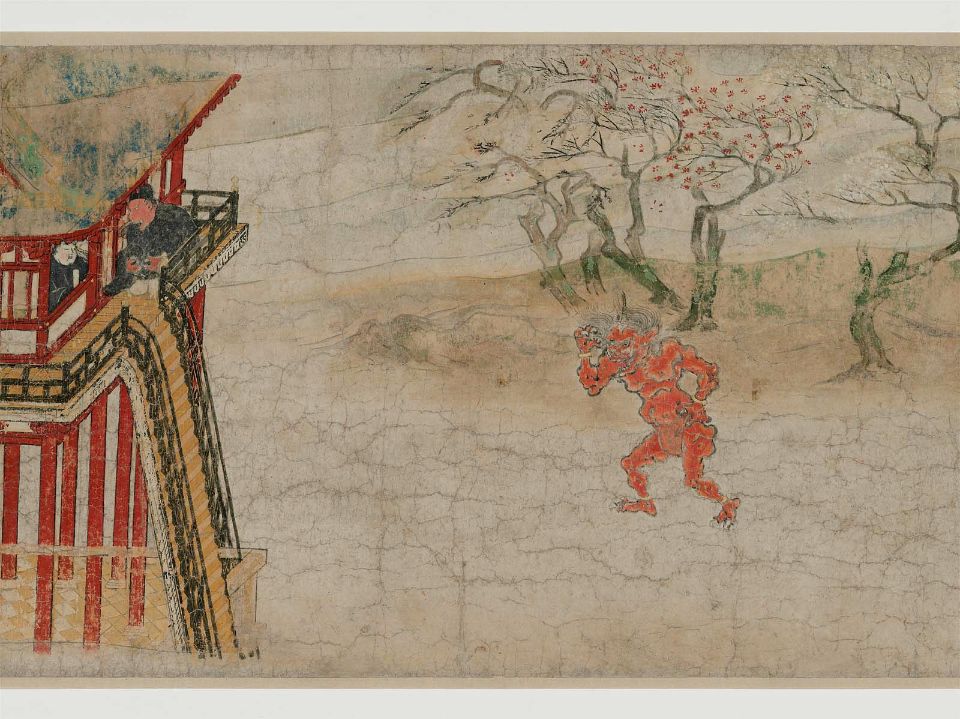
The scrolls take these two and build a fantasy on them. Kibi arrives in China by boat and is escorted by Chinese officials to a tower, where he is shut up. The ghost of Abe no Nakamaro appears to him in the form of a demon, identifies himself, and offers to help. The Chinese set Kibi a series of tests designed to humiliate him: an exegesis of the Wen Xuan anthology, an examination by a Chinese scholar, and finally a game of go, with the understanding among the court officials that if he loses he will be killed. He wins the go match by supernatural means, concealing the evidence by swallowing a stone. The last scroll shows the Chinese emperor being told that the Japanese minister has won.
This is a national fantasy of intellectual superiority, painted in the twelfth century about the eighth. It matters that by then Japan had not sent an official embassy to China for nearly three hundred years; the missions were discontinued in 894. The scrolls are not a report from a relationship, they are a story told long after the relationship lapsed, and the pleasure they take in beating Chinese scholars at Chinese learning is the pleasure of a culture that has decided it no longer needs the teacher.
Chapter 3The ghost is the doctrine
The helper in this story is not a god and not a Buddhist protector.
The helper in this story is not a god and not a Buddhist protector. It is Abe no Nakamaro, a Japanese man who died in a foreign country, and he appears as an oni, a demon.
That is not decorative. In the belief system this painting was made inside, a person who dies away from home, without the proper rites performed by their own people at the proper place, does not settle. The unquiet dead of the Heian imagination are precisely the ones who died wrongly, in exile, in disgrace or abroad - the same logic that produced the cult of Sugawara no Michizane, exiled to Kyushu and afterwards placated as a god because his angry spirit was held to be causing disasters in the capital. Nakamaro's demonic form is a statement about what happened to him, not a costume.
It also produces the moral joke at the heart of the scrolls. The Japanese envoy is saved from the Chinese by another Japanese envoy whom China kept. The instrument of the victory over China is the man China would not let go home.
Chapter 4The attribution fight
The Museum of Fine Arts catalogues these scrolls as by an unknown Japanese artist.
The Museum of Fine Arts catalogues these scrolls as by an unknown Japanese artist. The traditional attribution, still repeated in popular sources, is to Tokiwa Mitsunaga, the painter given the Ban Dainagon Ekotoba, and it is easy to see why the two names became attached: the two works are believed to have been kept at the same Hachiman shrine in Wakasa Province, and they are close in date and in manner of narrative.
Art historians treat the identification as questionable, on the ground of stylistic variation between the two works, and place the painter of the Kibi scrolls instead as an unnamed artist of the capital, a contemporary of Mitsunaga rather than Mitsunaga himself.
The disagreement is worth stating cleanly because of what hangs on it. If the two scrolls are by one hand, the Kibi set is by the painter of a designated National Treasure and its export in 1932 becomes an even sharper loss. If they are not, then the strongest thing linking them is a shared shrine, which is a provenance fact rather than a stylistic one. This record follows the holding museum and treats the attribution as open.
Chapter 5Every owner named, over five hundred years
The Museum of Fine Arts publishes a provenance for these scrolls that is far fuller than the norm for Japanese painting of this age, and it rests on research published in the museum's own Bulletin by...
The Museum of Fine Arts publishes a provenance for these scrolls that is far fuller than the norm for Japanese painting of this age, and it rests on research published in the museum's own Bulletin by Robert T. Paine Jr. in February 1933, within months of the acquisition.
By 1441 the scrolls were at the Oshio Hachiman Shrine in Wakasa Province, now Fukui Prefecture. They were probably acquired from the shrine by the Sakai family, the lords of Wakasa, and passed to Sakai Tadamichi, who died in 1920, and then to his son Sakai Tadatae, born 1883 and died 1939. In 1923 Sakai Tadatae sold them at auction at the Tokyo Art Club to Toda Yashichi the second, of Osaka, born 1867 and died 1930, and they passed to his son Toda Yashichi the third, known as Toda Rosui, a dealer, born 1892 and died 1942. In 1932 Toda Rosui sold them through Yamanaka and Company of New York to the Museum of Fine Arts. The accession date is 7 July 1932.
Two things in that chain deserve to be pulled out. The first is 1923: a daimyo family selling its heirlooms at auction in Tokyo. The old peerage was under sustained financial pressure after the First World War, and the scrolls moved from an aristocratic house into the trade at exactly the point when Japanese aristocratic collections were being broken up. The second is Yamanaka and Company, the Osaka firm with branches in New York, Boston, London and Peking that was the principal conduit for East Asian art into American collections in this period. This was not a private accident. It was the pipeline working as designed.
Chapter 6The one-year gap in Japanese law
The outrage in Japan at the 1932 sale is documented, and the legislative response is documented, and the relationship between them is the single most useful fact on this page.Japan already had an...
The outrage in Japan at the 1932 sale is documented, and the legislative response is documented, and the relationship between them is the single most useful fact on this page.
Japan already had an export control. The National Treasures Preservation Law came into force on 1 July 1929, replacing legislation of 1897, and it extended protection to objects in public and private institutions and in private hands specifically in order to prevent the export or removal of cultural properties. Its limitation is the one every designation regime has: it protected what had been designated. These scrolls had not been.
On 1 April 1933, Japan enacted the Law Regarding the Preservation of Important Works of Fine Arts, created to prevent art objects that had not been designated from being exported under the pressure of the economic crisis. It offered a simpler and faster designation procedure and a temporary protection that included export control. Roughly eight thousand objects across nine categories were brought under it and forbidden to be exported.
The scrolls left in the window. Sold in 1932, accessioned in Boston on 7 July 1932, and by 1 April 1933 the category of thing they were had been closed. The reference literature treats the outcry at this sale as a cause of the 1933 statute; that causal chain is asserted there and has not been checked here against the legislative record, so it is reported as an attribution and not as a finding. What can be stated without qualification is the sequence, and that the export was lawful under Japanese law as it stood. No restitution claim has ever been made, and this record does not offer a reason for that.
Chapter 7The sibling that stayed
The Ban Dainagon Ekotoba is a late twelfth-century emaki attributed to Tokiwa Mitsunaga, with calligraphy attributed to Fujiwara Norinaga, telling the story of a conspiracy and an arson at the...
The Ban Dainagon Ekotoba is a late twelfth-century emaki attributed to Tokiwa Mitsunaga, with calligraphy attributed to Fujiwara Norinaga, telling the story of a conspiracy and an arson at the Otenmon gate. It is believed to have been kept at the same Wakasa shrine as the Kibi scrolls.
It did not leave Japan. It is a designated National Treasure and it is in the Idemitsu Museum of Arts in Tokyo.
Two works of the same date, the same tradition and, on the traditional attribution, the same hand, held for centuries in one provincial shrine. One is a National Treasure in Tokyo. The other is in Boston, recorded by its own museum as not on view. Nothing separates their fates except which of them a dealer was able to move before April 1933.
Chapter 8What it cost, and what nobody has published
The Museum of Fine Arts does not publish a purchase price.
The Museum of Fine Arts does not publish a purchase price. Its credit line records the mechanism instead: museum purchase with funds by exchange from the William Sturgis Bigelow Collection. That is a museum selling or trading part of an existing holding to fund a new acquisition, and it means the true cost of these scrolls to Boston was paid partly in other Japanese objects rather than in cash.
Which objects were exchanged, and to whom, is not stated. That is a real gap and it is unusually consequential here, because Bigelow's collection was itself assembled in Japan in the 1880s under conditions that would not be repeated, and anything traded out of it in the early 1930s entered the market from a source of the highest quality.
The 1923 hammer price at the Tokyo Art Club is also unpublished in the sources consulted. There is therefore no price anywhere in this object's five-hundred-year documented history: not the shrine, not the Sakai transfer, not the 1923 auction, not the 1932 sale. The chain of custody is one of the best of its kind and the financial record is empty.
Chapter 9Where it is now
The Museum of Fine Arts records all four scrolls as not on view.
The Museum of Fine Arts records all four scrolls as not on view. The scrolls are included in the museum's own Japanese Masterpieces catalogue of 2012 and in its Arts of Japan highlights volume of 2008, so they are published and acknowledged as among the strongest things it owns.
An emaki cannot be displayed continuously. Light damages pigment and paper, and a twenty-four-metre object can only be shown in sections in any case, so rotation and long periods in storage are ordinary conservation practice rather than neglect. That said, the practical situation is worth stating for anyone planning to see them: the work whose export changed Japanese law is, in the normal course, not on a wall anywhere.
The artist
An unnamed painter of the Kyoto court circle, late twelfth century; traditionally identified with Tokiwa Mitsunaga
There is no signature on these scrolls, no seal, no contract and no record of a commission. What there is instead is a hypothesis with a name attached to it, and the strength of that hypothesis is the whole of the argument about who painted them. Tokiwa Mitsunaga, also given as Fujiwara Mitsunaga, is the painter to whom the Ban Dainagon Ekotoba is attributed - itself an attribution rather than a documented fact. The two scroll sets are believed to have been kept together in one provincial shrine for centuries, which is a strong circumstantial link and not a stylistic one, and specialists who compare the painting itself find the variation between them too great to accept one hand. The holding museum agrees and catalogues the artist as unknown.
Related works
| Work | Relation | Where it is |
|---|---|---|
| Ban Dainagon Ekotoba Attributed to Tokiwa Mitsunaga; calligraphy attributed to Fujiwara Norinaga | Believed kept at the same Wakasa shrine; the comparison on which the attribution turns Late twelfth century. A designated National Treasure of Japan. It stayed; the Kibi scrolls did not. | Idemitsu Museum of Arts, Tokyo |
| The William Sturgis Bigelow Collection Various, Japanese | The holding that paid for this acquisition The scrolls were bought with funds by exchange from Bigelow's collection, assembled in Japan in the 1880s. Which objects were exchanged out to raise the money is not published. | Museum of Fine Arts, Boston |
| Heiji Monogatari Emaki, Night Attack on the Sanjo Palace Unknown, Japanese | The museum's other great Japanese narrative handscroll of the same tradition Acquired a generation earlier and by a different route. Boston's Japanese holdings are among the strongest outside Japan, and the two scrolls together are the reason. | Museum of Fine Arts, Boston |
| Objects designated under the 1933 Law Regarding the Preservation of Important Works of Fine Arts Various | The legal cohort created in response to exports of this kind About eight thousand objects in nine categories were designated under the 1933 statute and forbidden to be exported. The Kibi scrolls are the sort of object it was written for, and they had already gone. | Japan |
Open questions
- Who painted the scrolls? The museum says unknown; the tradition says Tokiwa Mitsunaga; specialists say a contemporary of Mitsunaga working in Kyoto. No documentary evidence has been produced either way.
- What did the Museum of Fine Arts pay in 1932, and which objects from the Bigelow Collection were exchanged to fund the purchase? Neither figure nor list is published.
- What did the scrolls make at the Tokyo Art Club auction in 1923? No hammer price appears in the sources consulted.
- How did the scrolls pass from the Oshio Hachiman Shrine to the Sakai family? The museum's own provenance uses the word probably, and the transfer is undated.
- Were the scrolls ever considered for designation under the 1929 National Treasures Preservation Law before the 1932 sale, and if so what happened? An undesignated object was exportable, and whether anyone tried to designate these is not established.
- Did the 1932 sale directly cause the 1933 statute, or merely coincide with a wave of exports that did? The outrage is documented and the law followed within a year; a direct causal chain is asserted in the literature and is not, in the sources consulted here, evidenced from the legislative record.
- Was the work originally one continuous scroll later cut into four, or made as four? Accounts differ, and the answer bears on how the object should be described.
Questions about this object
What is Minister Kibi's Adventures in China (Kibi daijin nitto emaki)?
Minister Kibi's Adventures in China (Kibi daijin nitto emaki) is a painting, dated 12th century (late Heian period). Medium: Set of four handscrolls; ink, colour and gold on paper, with rosewood endknobs.
Who made Minister Kibi's Adventures in China (Kibi daijin nitto emaki), and is the attribution settled?
The attribution to Unknown painter of the Kyoto court circle, formerly given to Tokiwa Mitsunaga is recorded here as disputed. The Museum of Fine Arts, Boston catalogues the four scrolls as by an unknown Japanese artist of the Heian period, twelfth century. A long-standing tradition gives them to Tokiwa Mitsunaga, the painter to whom the Ban Dainagon Ekotoba is attributed, and the two works are believed to have been kept in the same Wakasa shrine. Art historians treat the Mitsunaga attribution as questionable on the ground of stylistic variation between the two, and place the painter instead as an unnamed contemporary working in the capital. The holding museum's own catalogue takes the cautious position; the popular literature does not.
Where is Minister Kibi's Adventures in China (Kibi daijin nitto emaki) now?
Museum of Fine Arts, Boston; recorded as not on view. Inventory number 32.131.1 to 32.131.4. Last confirmed 4 August 2026. Museum purchase with funds by exchange from the William Sturgis Bigelow Collection; accession date 7 July 1932.
What has Minister Kibi's Adventures in China (Kibi daijin nitto emaki) sold for?
Hammer Not published in the sources consulted; with premium, Not published in the sources consulted. Tokyo Art Club, 1923.
What is still unknown about Minister Kibi's Adventures in China (Kibi daijin nitto emaki)?
Who painted the scrolls? The museum says unknown; the tradition says Tokiwa Mitsunaga; specialists say a contemporary of Mitsunaga working in Kyoto. No documentary evidence has been produced either way.
Sources
- 1Museum of Fine Arts, Boston, collection record for 'Minister Kibi's Adventures in China (Kibi daijin nitto emaki), scroll 1', accession 32.131.1, with medium, dimensions, credit line, display status and the complete seven-step provenance from the Oshio Hachiman Shrine to the museum. Read 4 August 2026. collections.mfa.org/objects/...
- 2Museum of Fine Arts, Boston, collection record for scroll 4, accession 32.131.4, carrying the same provenance and the dimensions of the fourth scroll, and citing Robert T. Paine Jr., 'The Scroll of Kibi's Adventures in China', MFA Bulletin 31, no. 183 (February 1933), p. 2, for the early provenance. Read 4 August 2026. collections.mfa.org/objects/...
- 3Wikipedia, 'Kibi Daijin Nitto Emaki', for the narrative sections, the overall dimensions, the questioning of the Mitsunaga attribution on grounds of stylistic variation, the shared Wakasa shrine provenance with the Ban Dainagon Ekotoba, and the outrage in Japan at the 1932 sale. TERTIARY: to be replaced with Paine 1933 and the MFA Japanese Masterpieces catalogue of 2012. en.wikipedia.org/wiki/...
- 4Wikipedia, 'Ban Dainagon Ekotoba', for the attribution to Tokiwa Mitsunaga, the calligraphy attributed to Fujiwara Norinaga, its designation as a National Treasure and its location in the Idemitsu Museum of Arts. TERTIARY. en.wikipedia.org/wiki/...
- 5Wikipedia, 'Cultural Properties of Japan', for the National Treasures Preservation Law in force from 1 July 1929 and expressly intended to prevent the export or removal of cultural properties, and for the Law Regarding the Preservation of Important Works of Fine Arts of 1 April 1933, created to stop undesignated objects being exported during the economic crisis, under which about eight thousand objects in nine categories were forbidden export. TERTIARY: to be replaced with the statutes themselves and the Agency for Cultural Affairs record. en.wikipedia.org/wiki/...
- 6Wikimedia Commons, file records for the Museum of Fine Arts reproductions of scrolls 1 to 4, each carrying a public domain statement and the museum's own object link. Licences read per file from extmetadata LicenseShortName on 4 August 2026. commons.wikimedia.org/wiki/...

Last verified 24 August 2026 · Published 4 August 2026
Change log
2 August 2026 - Record deepened to the house standard: narrative sections, technical evidence, artist dossier, related works and open questions added; provenance chain and auction results replaced with the researched versions; sources rebuilt.
4 August 2026 - Record created at the house standard: researched narrative, technical evidence, maker dossier, graded provenance chain, prices with hammer and premium separated, related works, open questions and sources.
24 August 2026 - Re-verification pass: current location (MFA Boston, accessions 32.131.1-32.131.4, not on view), attribution (artist unknown, Heian period, no committee ruling change), and all six cited sources confirmed unchanged. No litigation or restitution claims found.