The Devonshire Hunting Tapestries
Unidentified tapestry workshop, Arras (probably) · c. 1425-1450 (individually dated by costume: Boar and Bear Hunt c. 1425-1430; Falconry and Swan and Otter Hunt c. 1430-1440; Deer Hunt c. 1440-1450, on a design believed to originate in the 1420s)
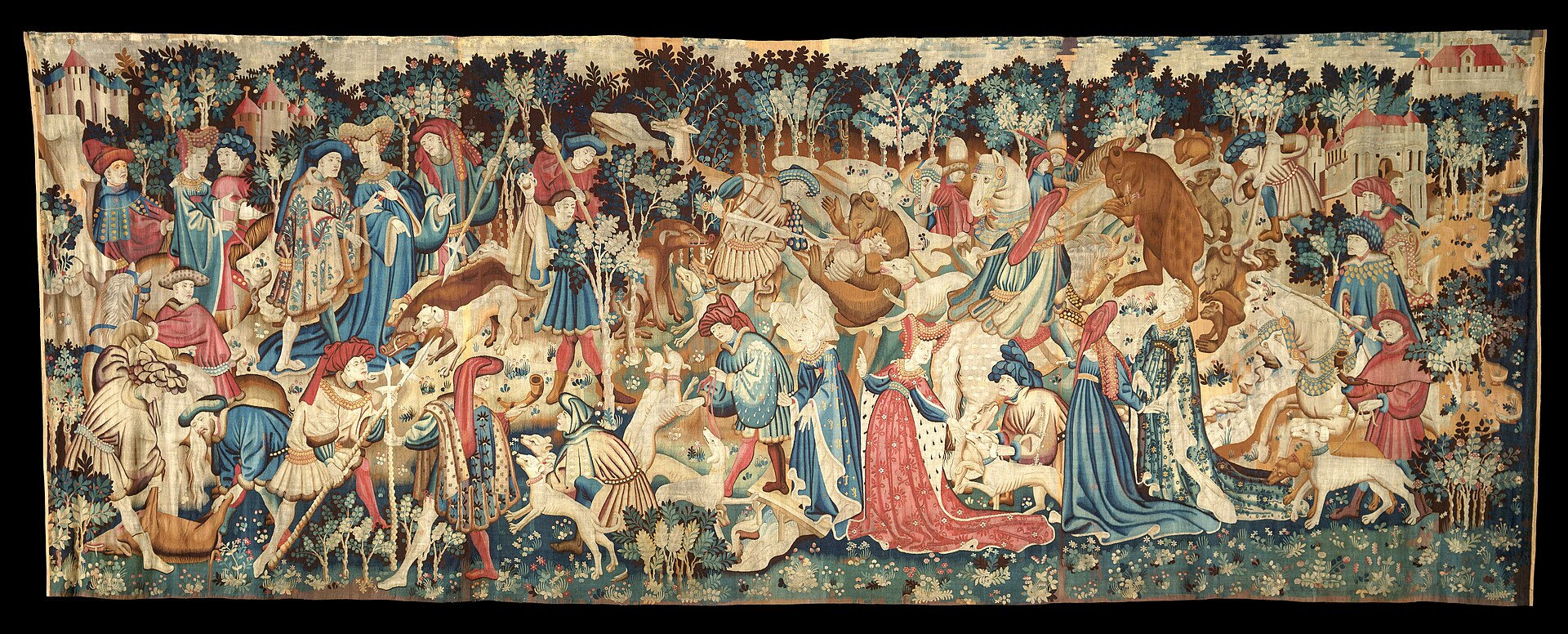
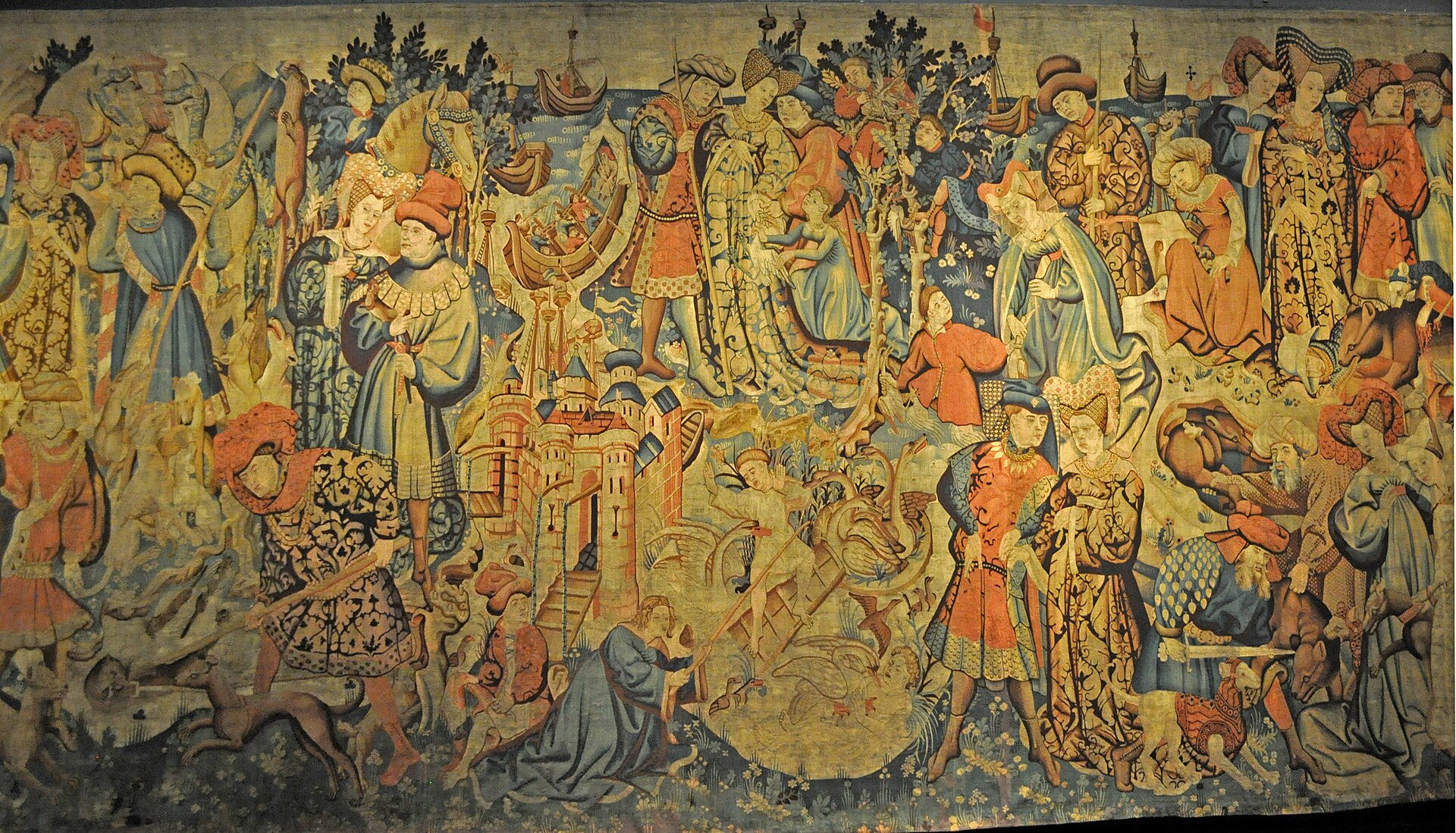
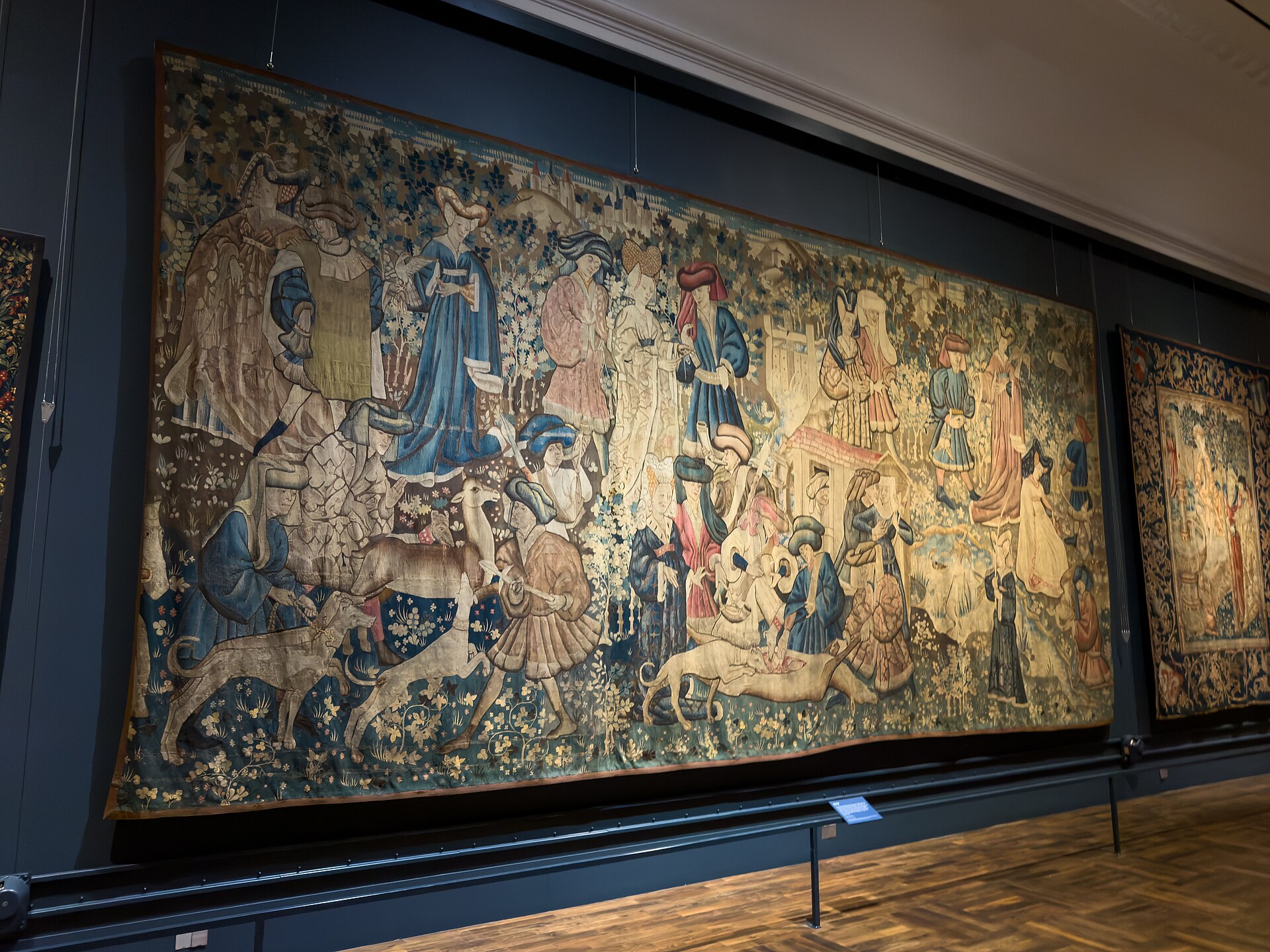
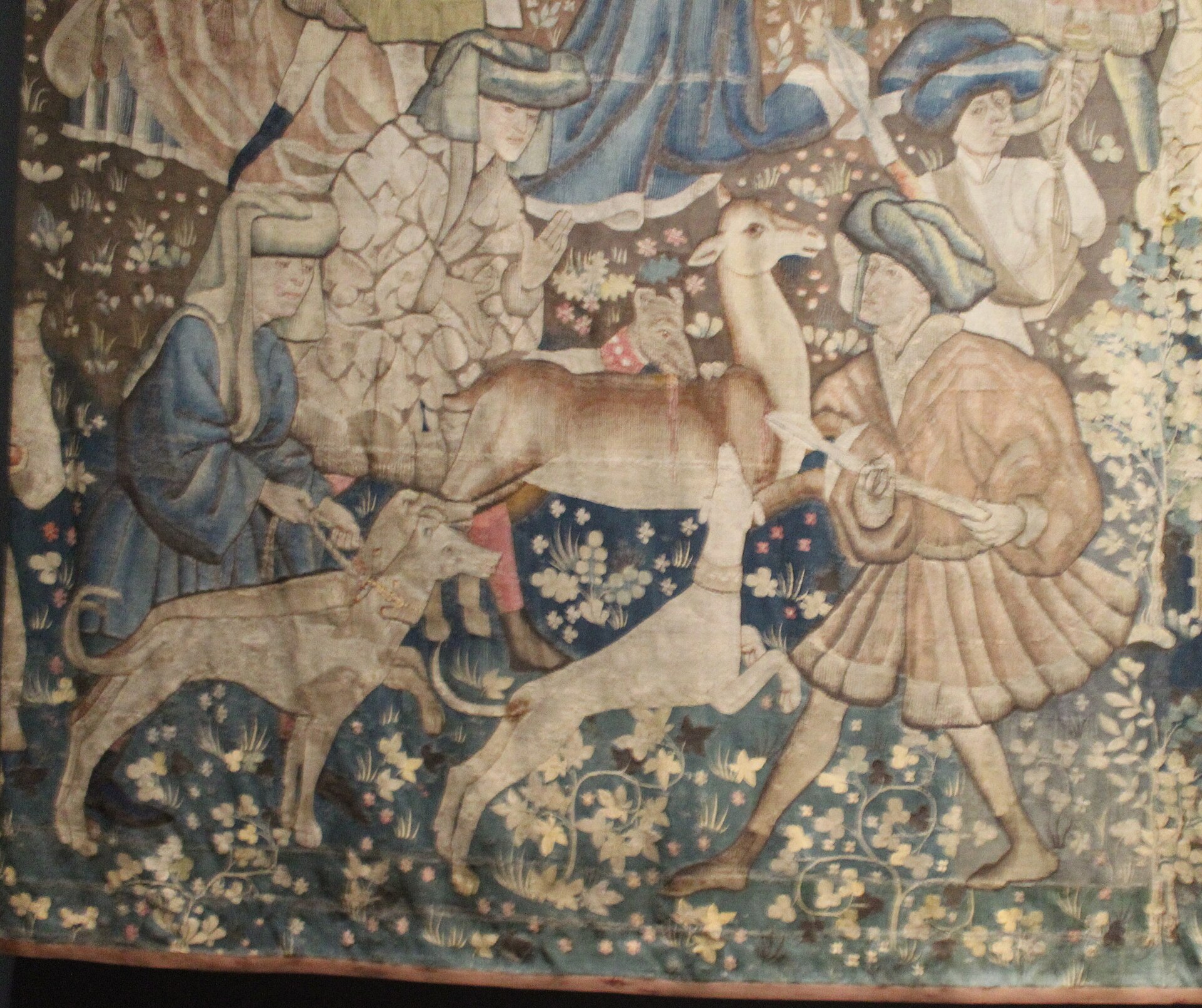
Boar and Bear Hunt, T.204-1957, late 1420s. Full-panel high-resolution capture via the Google Art Project, showing the boar hunt at left and the bear hunt at right.
| Artist | Unidentified tapestry workshop, Arras (probably) |
|---|---|
| Date | c. 1425-1450 (individually dated by costume: Boar and Bear Hunt c. 1425-1430; Falconry and Swan and Otter Hunt c. 1430-1440; Deer Hunt c. 1440-1450, on a design believed to originate in the 1420s) |
| Medium | Wool, tapestry-woven (wool warp and weft), slit-tapestry technique, woven on a mixture of high-warp and low-warp looms across the four panels |
| Dimensions | Boar and Bear Hunt (T.204-1957): approx. 378-385 cm high x 1018-1023 cm wide. Falconry (T.202-1957): 445 cm x 1075.9 cm. Swan and Otter Hunt (T.203-1957): 424 cm x 1118 cm. Deer Hunt (T.205-1957): 409 cm x 808 cm. All four dimensions are as currently mounted, after cutting, loss and restoration; none preserves its full original size. |
| Where it is now | Victoria and Albert Museum, London (South Kensington), on permanent display. The V&A's own online catalogue currently places Falconry, Swan and Otter Hunt and Deer Hunt in Room 94, the Tapestries gallery, and the Boar and Bear Hunt in Room 10a, the Francoise and Georges Selz Gallery; gallery assignments have changed with redisplays and are not necessarily fixed. In 2021 two of the four panels went on temporary loan to the Sculpture Gallery at Chatsworth House, Derbyshire, to mark the house's reopening, before returning to the V&A.last confirmed |
| Inventory number | T.202-1957 (Falconry), T.203-1957 (Swan and Otter Hunt), T.204-1957 (Boar and Bear Hunt), T.205-1957 (Deer Hunt) |
| Attribution | UnknownNo designer, cartoon painter, weaver or commissioning patron is named in any surviving document for any of the four panels. Full note |
| Object type | Textile |
| Period | Netherlandish, fifteenth century (Burgundian Artois) |
| Cases | Has a provenance gap |
| Inscriptions | A reversed inscription reading (when corrected) MONTE LE DESIRE appears woven into the sleeve of a lady's blue gown in the Boar and Bear Hunt panel; the reversal is a direct result of weaving on a low-warp loom, where the cartoon is worked from beneath and left-right orientation flips. The same panel contains two figures woven left-handed for the same reason. Horse trappings in the Falconry panel carry a repeated letter M, of undetermined meaning. |
| Owners on record | 13 links11 documented, 2 unknown |
| Sources | 10 cited |
About this record Last verified · 10 sources cited · Change log
On this page 9 sections
ContentsClose
Four large wool tapestries at the Victoria and Albert Museum, woven in the Southern Netherlands, probably at Arras, between about 1425 and 1450, and known individually as Boar and Bear Hunt, Falconry, Swan and Otter Hunt and Deer Hunt. No designer, weaver or original patron is documented for any of the four, and the V&A's own catalogue entry cautions that the group may be the remains of three or four separate weaving campaigns rather than one matching commission.
Their documented history begins in 1601, in an inventory of Hardwick Hall drawn up for Bess of Hardwick, by which point they had already been cut into pieces; roughly a century and a half before that is undocumented. By the 1840s the fragments were being used to insulate the Long Gallery at Hardwick against drafts, and were rediscovered and restored around 1899-1910, then displayed at Chatsworth House until 1957, when the estate of the 10th Duke of Devonshire transferred them to HM Government in lieu of death duties and they were allocated to the V&A, where they remain, with a single loan display back at Chatsworth in 2021.
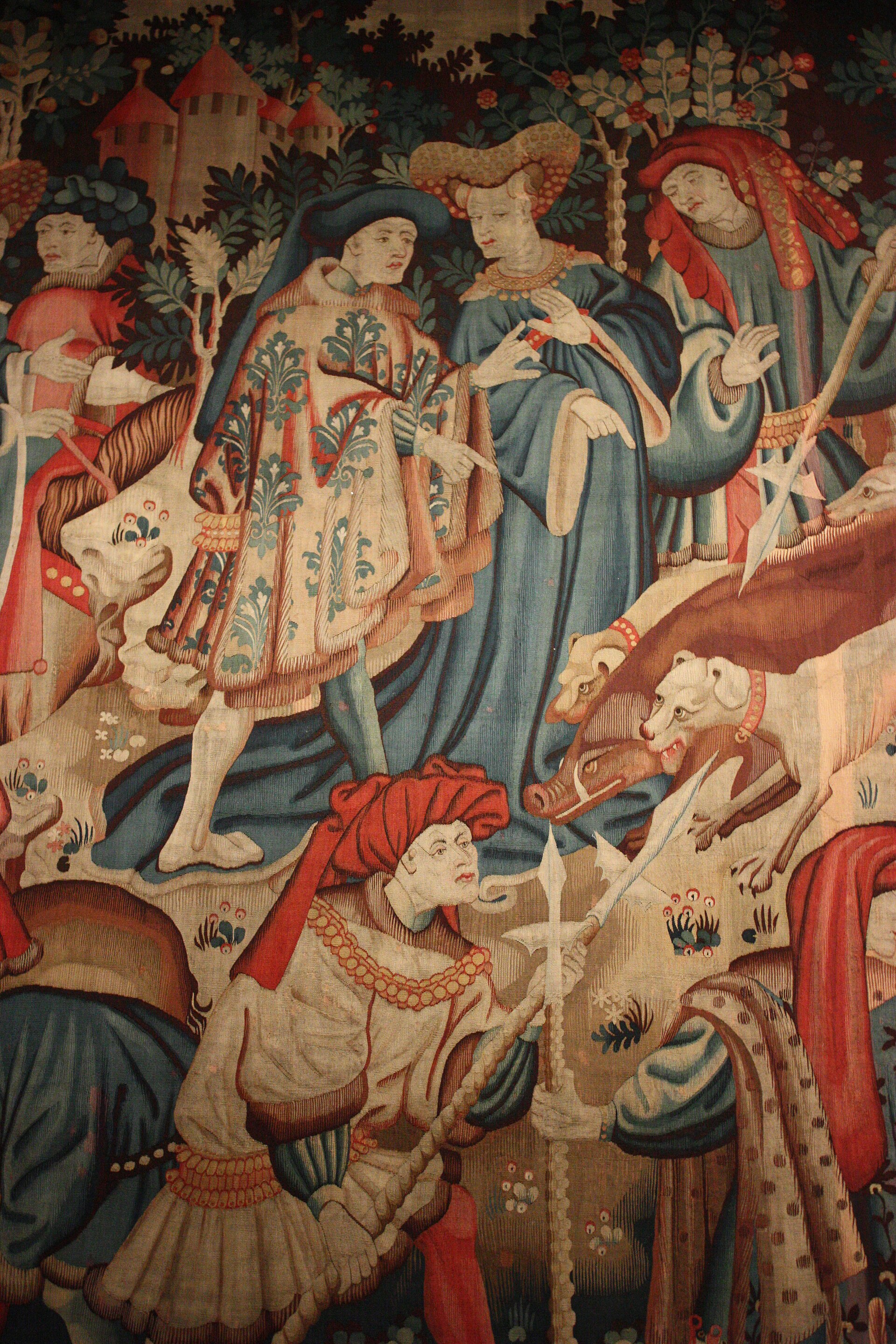
The Boar and Bear Hunt panel carries physical proof of its own weaving process: an inscription reading MONTE LE DESIRE, woven mirror-reversed because the panel was made on a low-warp loom, alongside two figures woven left-handed for the same reason.
Provenance
Each link is graded. Documented: a cited source supports it. Disputed: the identification is argued but not established. Unknown: no owner for that span, and the gap is not smoothed into a narrative. The grades in the glossary.
- c. 1425 - c. 1450Unidentified workshop(s), probably Arras, Southern Netherlandsunknown
No commission record, designer, weaver or original patron is documented. Dating and probable place of origin rest entirely on costume analysis and general knowledge of the Arras weaving trade, not on a contract or inscription naming a maker or patron.123459
- c. 1450 - 1601Unknownunknown
No owner, location or transaction is documented for roughly a century and a half between manufacture and the tapestries' first secure documentary appearance in 1601. This record does not bridge the gap with an inferred owner.9
- 1601 -Elizabeth Talbot, Countess of Shrewsbury (Bess of Hardwick), or the Cavendish-Talbot household at Hardwick Halldocumented
A 1601 inventory of Hardwick Hall, compiled for Bess of Hardwick's will, lists four matching tapestries already cut into smaller pieces. The inventory documents presence at Hardwick Hall at that date; it does not by itself prove Bess personally acquired the tapestries rather than inheriting or otherwise receiving them, which remains unresolved. A possible earlier link to Mary, Queen of Scots, raised in later writing on Hardwick's textiles, is unverified and is not treated as established.69
- 1601 - 1840sCavendish family, Dukes of Devonshire, at Hardwick Halldocumented
The tapestries descended with Hardwick Hall to the Cavendish Dukes of Devonshire. No source consulted supplies a detailed record of their condition or exact display within this span beyond the fact of continued presence at Hardwick.69
- 1840s - c. 1899William George Spencer Cavendish, 6th Duke of Devonshire, and successors, Hardwick Halldocumented
The already-fragmentary tapestries were nailed into the walls of the Long Gallery at Hardwick Hall, in places in overlapping layers, to exclude drafts, with no apparent recognition at the time of their origin or importance.67
- c. 1899 - c. 19107th Duke of Devonshire; South Kensington Museum (V&A predecessor)documented
The tapestries were recognised as historically significant and sent to the South Kensington Museum for reconstruction, carried out 1900 to roughly 1908-1910 by the Decorative Needlework Society under Elizabeth Gemmell. Accounts differ on who is chiefly responsible for the rediscovery and the decision to restore: the V&A credits Arthur Long, Librarian to the House of Lords; Chatsworth's own history credits Lady Louisa Egerton with discovery and names Arthur Strong, Chatsworth's Librarian, as a further figure. This record records both accounts rather than choosing between them.67
- c. 1908 - 1939Dukes of Devonshire, Chatsworth Housedocumented
The restored tapestries were hung in the Sculpture Gallery at Chatsworth House, prominently enough that the 1910 guide to Chatsworth described them, rather than the room's sculpture, as its principal glory.78
- 1939 - 1945Dukes of Devonshire, Chatsworth Housedocumented
Chatsworth librarian Francis Thompson had the tapestries placed in storage before Penrhos College was evacuated to Chatsworth for the war, a decision credited with protecting them.8
- 1949 - 1950Dukes of Devonshire (lending); Musee de Cluny and Burlington House (borrowing)documented
Falconry was lent to a French landscape exhibition at Burlington House, London, in 1949. Deer Hunt was sent to the Musee de Cluny, Paris, in 1950, where it was conserved under the Louvre curator Pierre Verlet, an intervention that involved reweaving and some loss of original patterned detail.48
- 1950 - 1966Dukes of Devonshire, then Victoria and Albert Museum from 1957documented
The Boar and Bear Hunt panel underwent restoration work in Paris and in Haarlem across this span, spanning the 1957 change of ownership.1
- 1950 - 1957Estate of the 10th Duke of Devonshiredocumented
The 10th Duke of Devonshire died in 1950. His estate faced death duties, settled in part through the Acceptance in Lieu scheme, under which objects of national importance are accepted by HM Government in place of a cash tax payment. The settlement concluded, and the tapestries were allocated to the V&A, in 1957, seven years after the Duke's death.123410
- 1957 - presentVictoria and Albert Museum, Londondocumented
Accepted by HM Government in lieu of tax and allocated to the V&A in 1957; museum numbers T.202-1957 to T.205-1957. Conservation work on at least one panel continued after the transfer, into 1966.1234
- 2021 - 2021Victoria and Albert Museum (lending); Chatsworth House (borrowing)documented
Two of the four panels returned on loan to the Sculpture Gallery at Chatsworth House for a single display season, marking the house's reopening, before returning to the V&A. Sources consulted do not specify which two panels travelled.8
Technical evidence
| Attribution note | No designer, cartoon painter, weaver or commissioning patron is named in any surviving document for any of the four panels. The Victoria and Albert Museum's own catalogue records the place of manufacture as Arras, probably, and the wider region as the Southern Netherlands, on grounds of style and technique, not documentation. Dating is derived entirely from costume history, which places the four panels across a twenty-five year span rather than a single moment, and the V&A's catalogue entry for the Boar and Bear Hunt panel goes further, describing the group as the remains of three, or more likely four, different sets rather than a single uniform commission. This record treats the attribution to one Arras workshop, and the identity of the four panels as one matching set, as genuinely unresolved rather than settled. |
|---|---|
| Materials and technique | Wool warp and weft, tapestry-woven using the slit-tapestry method standard to the period, in which adjoining colour areas are woven as separate blocks left with small vertical slits between them.1234 |
| Loom types used across the set | The four panels were not all woven on the same type of loom; the set shows a mixture of high-warp (haute lisse) and low-warp (basse lisse) production. The Boar and Bear Hunt panel is identifiably low-warp work.9 |
| Physical evidence of low-warp weaving | In the Boar and Bear Hunt panel, the inscription MONTE LE DESIRE appears mirror-reversed, and two figures are woven left-handed where the design intended right-handed figures, both direct consequences of working from a cartoon placed beneath the warp on a low-warp loom.19 |
| Dimensions by panel | Boar and Bear Hunt (T.204-1957): height 378.4-385.4 cm (varies across the width), width 1018.7-1023 cm, estimated weight 50 kg. Falconry (T.202-1957): 445 x 1075.9 cm. Swan and Otter Hunt (T.203-1957): 424 x 1118 cm. Deer Hunt (T.205-1957): 409 x 808 cm.1234 |
| Restoration and conservation history | Reconstructed 1900-c.1910 by the Decorative Needlework Society under Elizabeth Gemmell at the South Kensington Museum. Deer Hunt further restored in Paris, 1950-51, under Pierre Verlet, with some loss of patterned textile detail through reweaving. Boar and Bear Hunt restored in Paris and Haarlem across 1950-1966.1478 |
| Current accession numbers and gallery placement | T.202-1957 (Falconry) and T.203-1957 (Swan and Otter Hunt): Room 94, Tapestries. T.204-1957 (Boar and Bear Hunt): Room 10a, the Francoise and Georges Selz Gallery. T.205-1957 (Deer Hunt): Room 94, per the V&A's own online catalogue as consulted for this record.1234 |
Images
The record in full
Chapter 1Four hangings, one accession, four different hunts
The Devonshire Hunting Tapestries are four large wool tapestries at the Victoria and Albert Museum, each named for the hunt it depicts: Boar and Bear Hunt, Falconry, Swan and Otter Hunt, and Deer...
The Devonshire Hunting Tapestries are four large wool tapestries at the Victoria and Albert Museum, each named for the hunt it depicts: Boar and Bear Hunt, Falconry, Swan and Otter Hunt, and Deer Hunt. Each is roughly four metres high, and together, laid end to end, they run to something over forty metres of woven wall hanging, filled with hundreds of hunters, dogs, horses, birds and quarry set in an imagined forest landscape.
They were accessioned as a group in 1957, with museum numbers T.202-1957 through T.205-1957, and they are usually discussed as a single set. That framing is convenient and largely accurate, but it is worth stating plainly at the outset that it is also, on the V&A's own account, an approximation: the four panels were not necessarily woven at the same moment for the same room, and their status as one coherent commission is itself one of the open questions this record records rather than resolves.
Chapter 2What each panel shows
Boar and Bear Hunt (T.204-1957) is divided left to right: boar hunting on the left, bear hunting on the right, with hunters carrying cross-barred spears designed to stop a charging boar before its...
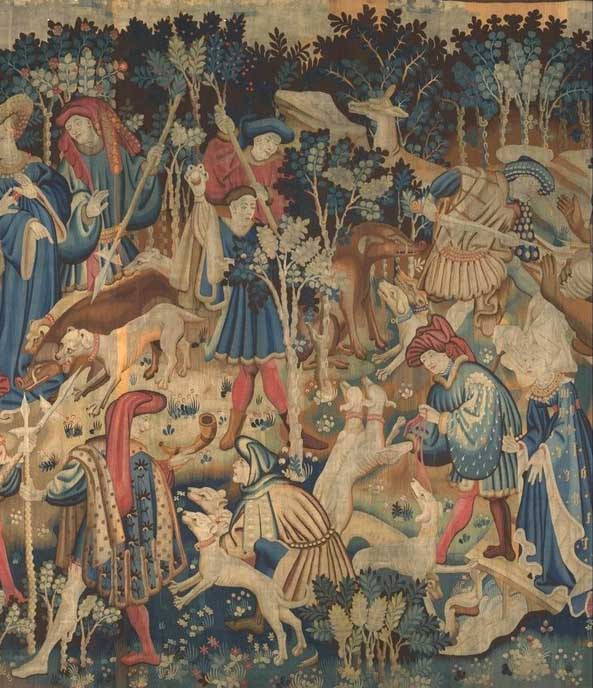
Boar and Bear Hunt (T.204-1957) is divided left to right: boar hunting on the left, bear hunting on the right, with hunters carrying cross-barred spears designed to stop a charging boar before its tusks reached the shaft. Figures are proportionally smaller here than in the other three panels, dressed in fashion the V&A dates to the late 1420s, and the palette runs to blues and pinks against brown animals and green-brown forest.
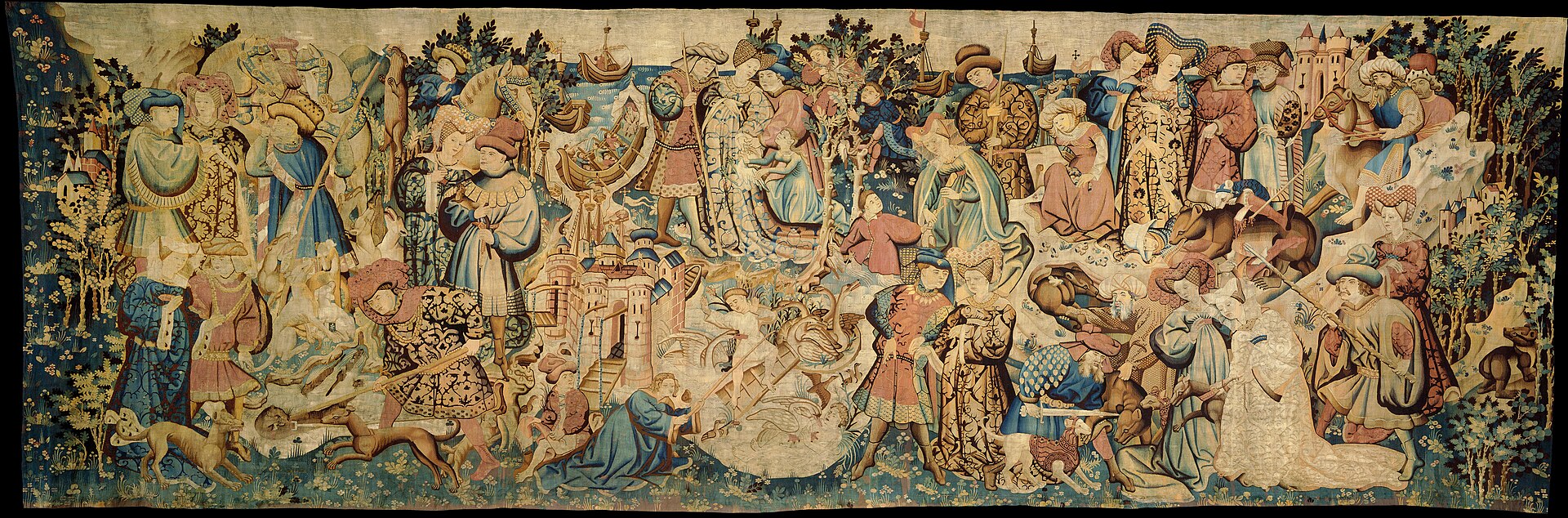
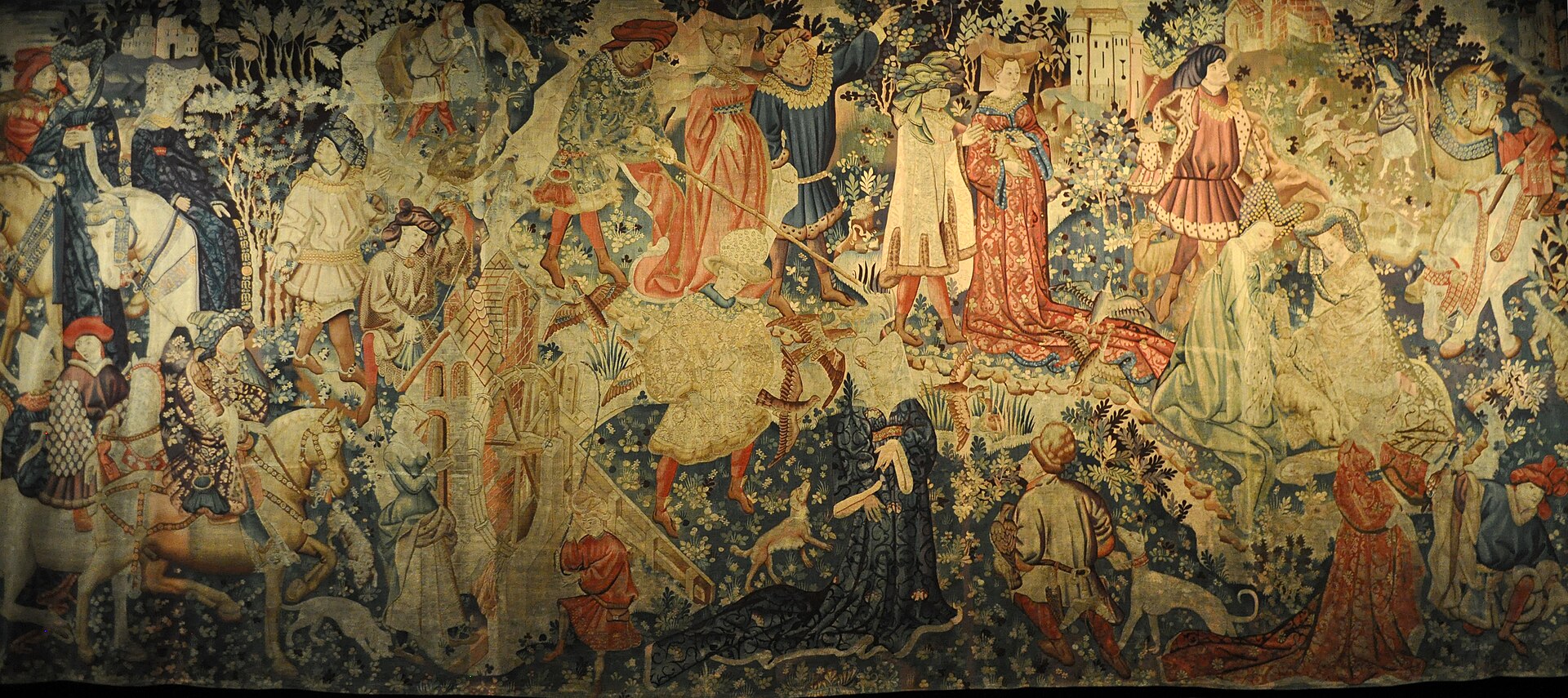
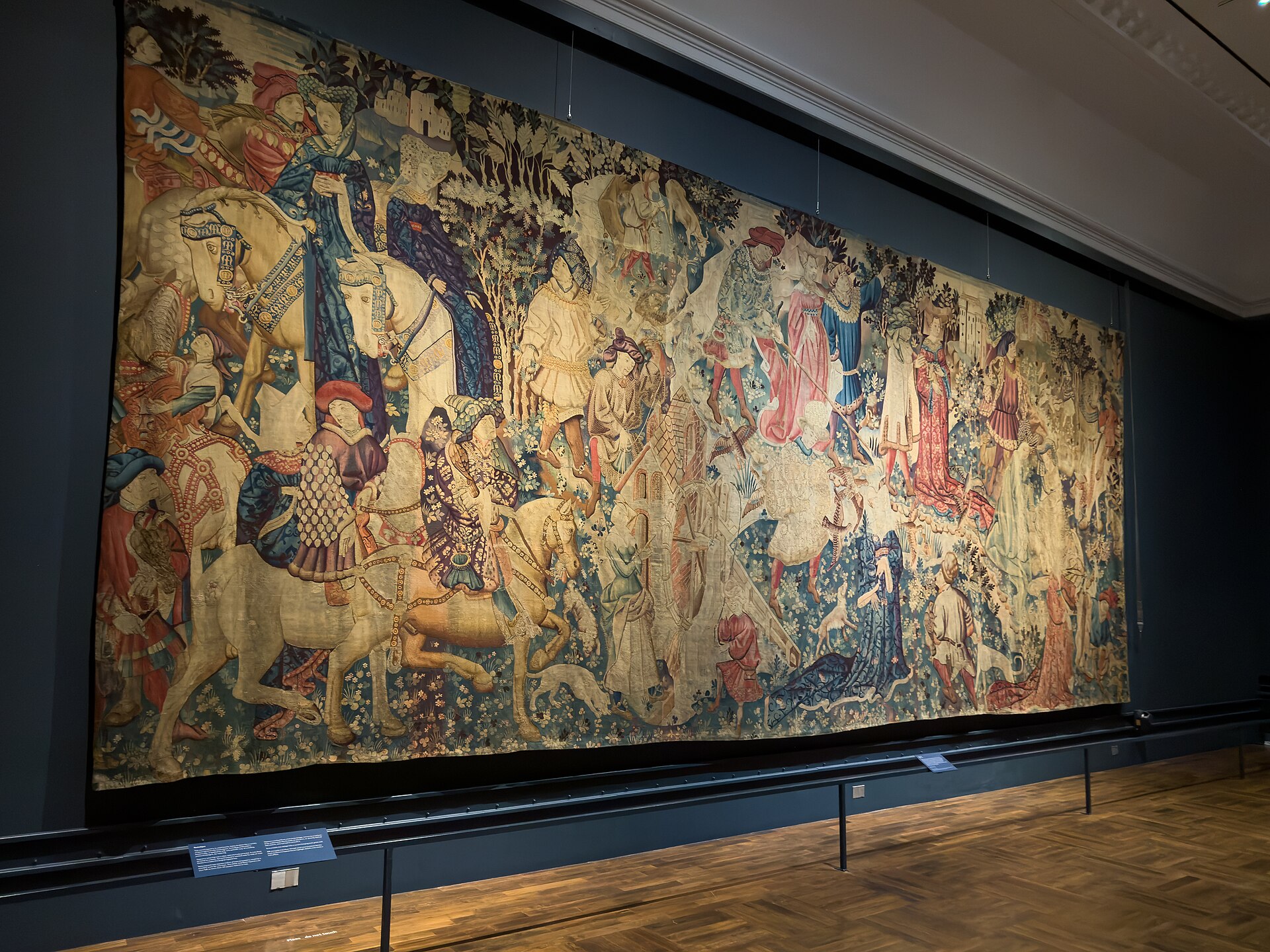
Falconry (T.202-1957) is the tallest of the four and, unusually for the group, follows a single hunt rather than several: nobles on horseback approach a mill, falcons are released on waterfowl along a stream, and hawks are called back with v-shaped lures. It is missing a section from its left side. Swan and Otter Hunt (T.203-1957), the widest panel, combines a land and water landscape: otters are hunted for pelts and to protect fish stocks on the left, boys rob a swan's nest and a heron's nest at the centre near a castle, and on the right, figures identified by the V&A as Saracens, one mounted on a camel, hunt bears - a detail that has no basis in northern European hunting practice and reads as an imaginative, romance-inflected addition rather than a record of an actual event.
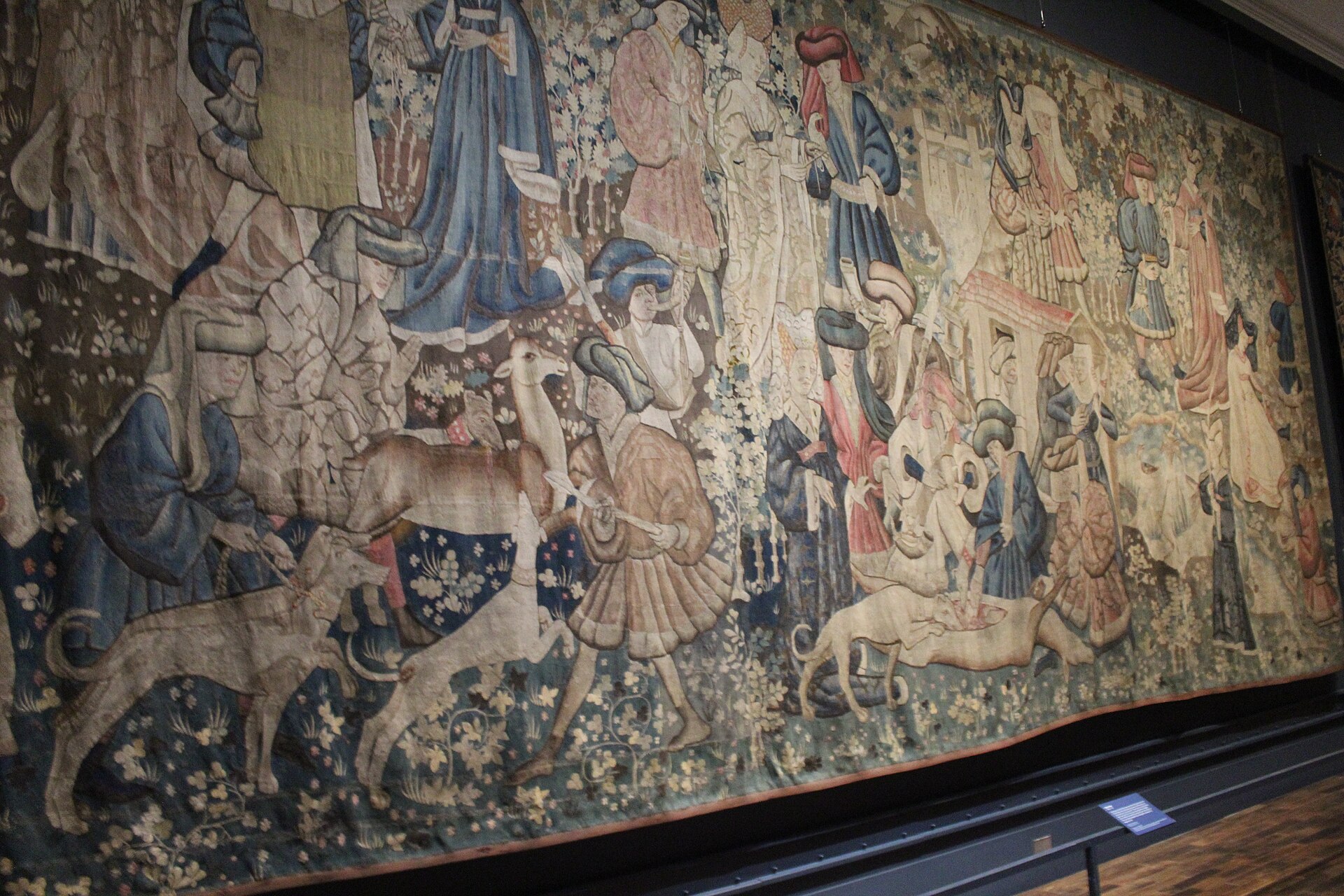
Deer Hunt (T.205-1957), the smallest and, on the V&A's own assessment, the weakest panel in execution, shows an active hunt on the left and, at its centre, the ritual butchering of a slain deer, the curee, with meat and offal formally distributed to particular huntsmen and to favoured hounds; a court figure flirts with a miller's wife nearby, and hawking on foot fills the upper register. The V&A dates its design to the 1420s but its actual weaving to 1440-1450, meaning it was woven from an older pattern.
Chapter 3What tapestries of this scale were for
A hanging of this size was never a minor domestic purchase.
A hanging of this size was never a minor domestic purchase. Forty metres of figured wool tapestry, woven by hand, represented a major outlay of skilled labour and material, and the V&A's own published account of the group frames that outlay as serving more than one purpose at once: tapestries of this kind provided physical insulation for the stone-walled halls of a fifteenth-century household, and they carried visual narrative in a period of widespread low literacy, when a pictured story read around a room did work that text could not do for most of the people who saw it. The same source records that Henry VIII alone owned upward of two hundred tapestries depicting hawking and hunting scenes, which gives some sense of how normal, rather than exceptional, a large hunting tapestry set was as a category of aristocratic and royal possession in this period, even though few individual sets of this scale and completeness have survived intact.
There is a bleak irony in the fact that this specific set's own documented history includes exactly the insulating function contemporaries would have recognised: cut into pieces and nailed up against drafts in the Long Gallery at Hardwick Hall in the 1840s, the tapestries were, in that moment, being used for precisely the practical purpose that had always been part of their design, only stripped of the status and narrative value that had originally justified the expense of weaving them figured rather than plain.
Chapter 4How the tapestries were woven, and what the weaving reveals
All four are tapestry-woven in wool, warp and weft, using the slit-tapestry technique standard to the period, in which adjoining blocks of colour are woven separately and left with small vertical...
All four are tapestry-woven in wool, warp and weft, using the slit-tapestry technique standard to the period, in which adjoining blocks of colour are woven separately and left with small vertical slits between them rather than interlocked. The set was not woven on a single type of loom: evidence in the weave shows a mixture of high-warp (haute lisse) and low-warp (basse lisse) production across the four panels, a fact recoverable only from the tapestries themselves, since no workshop record survives to state it directly.
The clearest evidence is in the Boar and Bear Hunt panel, woven on a low-warp loom. On a low-warp loom the weaver works from below the cartoon, which is placed flat beneath the warp threads, and any lettering or asymmetric detail in the design comes out mirror-reversed unless the weaver compensates. The inscription MONTE LE DESIRE, woven into a lady's sleeve, reads backwards for exactly this reason, and two figures elsewhere in the same panel are woven left-handed where the design intended right-handed figures. This is not decorative choice; it is a byproduct of process, and it is the strongest single piece of physical evidence for how, specifically, this one panel was made.
Chapter 5Courtship, not only quarry
The Boar and Bear Hunt panel carries more than a hunting scene.
The Boar and Bear Hunt panel carries more than a hunting scene. A lady at the centre wears a blue gown with the (reversed) inscription MONTE LE DESIRE worked into her sleeve, a phrase belonging to the vocabulary of courtly love rather than to hunting, and a gentleman nearby wears silver teardrop shapes on his sleeve that the V&A's own curatorial description also reads as referring to the pursuit of love rather than to the chase. Fifteenth-century hunting scenes of this kind routinely double as courtship imagery - the hunt as a literary and visual metaphor for pursuit in love was a live convention in the period - and this record treats that reading as argued by the V&A's own published description of the object, not as this record's own interpretation.
The repeated letter M woven into the horse trappings in the Falconry panel is a separate and unresolved detail. The V&A's catalogue entry offers the possibility that it refers to the Virgin Mary rather than to an owner's initial, but frames this explicitly as a suggestion, not a finding, and no source consulted for this record supplies supporting documentation either way. This record follows the V&A in stating it as an open possibility and nothing more.
The fictional detail of Saracen hunters on a camel in the Swan and Otter Hunt panel belongs to the same imaginative register as the courtship vocabulary: it signals that these tapestries were never intended as literal hunting manuals, but as large decorative narratives drawing on a wider stock of contemporary romance and chivalric imagery, in which distant, exoticised figures could appear in a European forest without contradiction. No source consulted offers a documented reading of what that specific figure meant to a fifteenth-century viewer beyond identifying it as invented; this record does not go further than the sources allow.
Chapter 6One set, or the remains of several
The framing of these four hangings as a single Devonshire set is a modern convenience built on their shared later provenance, not a fact established by contract or common commission.
The framing of these four hangings as a single Devonshire set is a modern convenience built on their shared later provenance, not a fact established by contract or common commission. The V&A's own online catalogue entry for the Boar and Bear Hunt panel states that the surviving pieces are the remains of three, or more likely four, different sets, brought together only in retrospect by their common ownership history rather than by a single original weaving campaign.
The costume-based dating supports this caution rather than contradicting it: the four panels span roughly 1425 to 1450, a twenty-five-year range that is unusually wide for pieces normally discussed as a matching suite. The mixed use of high-warp and low-warp looms across the group points the same way, since a single coordinated commission for one room would more typically, though not invariably, be woven by one method. This record therefore treats the Devonshire Hunting Tapestries as a group defined by its shared collecting history at Hardwick Hall and its shared 1957 accession at the V&A, and treats the claim that they were designed and commissioned together as unresolved.
Chapter 7Before Hardwick: nothing documented
No source consulted for this record identifies a first owner, a commissioning patron, or a location for any of the four panels between their manufacture in the second quarter of the fifteenth century...
No source consulted for this record identifies a first owner, a commissioning patron, or a location for any of the four panels between their manufacture in the second quarter of the fifteenth century and their first secure documentary appearance, which is an inventory drawn up in 1601. Roughly a century and a half of the tapestries' existence is undocumented in every source available to this record. This gap is recorded here as a gap, not bridged with a plausible guess.
Chapter 8Hardwick Hall and the 1601 inventory
The earliest secure documentary link between these tapestries and the Devonshire family's houses is a 1601 inventory of Hardwick Hall in Derbyshire, compiled for Elizabeth Talbot, Countess of...
The earliest secure documentary link between these tapestries and the Devonshire family's houses is a 1601 inventory of Hardwick Hall in Derbyshire, compiled for Elizabeth Talbot, Countess of Shrewsbury, universally known as Bess of Hardwick, for the purposes of her will. The inventory lists four matching tapestries already cut into smaller pieces at that date, which is itself notable: the panels were already being adapted to fit particular rooms within decades of being woven, long before their nineteenth-century fate as insulation.
Whether Bess of Hardwick acquired these specific tapestries herself, inherited them, or received them by another route is not established by any source consulted here. One later account raised elsewhere in scholarship on Hardwick's textiles is that some of the older tapestries recorded in the 1601 inventory, potentially including this group, may have belonged at an earlier point to Mary, Queen of Scots, who was held in the custody of Bess's fourth husband, George Talbot, 6th Earl of Shrewsbury, for a substantial part of her captivity. This record has not been able to verify that connection against a primary document and states it here as a possibility raised in later writing, not as an established fact.
Chapter 9Cut up for warmth: the 1840s
By the 1840s, under William George Spencer Cavendish, 6th Duke of Devonshire, the tapestries, already fragmented, were being used at Hardwick Hall as insulation and draught exclusion, nailed into the...
By the 1840s, under William George Spencer Cavendish, 6th Duke of Devonshire, the tapestries, already fragmented, were being used at Hardwick Hall as insulation and draught exclusion, nailed into the walls of the Long Gallery, in places in overlapping layers, with no apparent recognition of what they were. This is the low point of the object's physical history: pieces of a fifteenth-century weaving, cut and re-cut to fit gaps around windows and doors, valued at that moment for keeping out drafts rather than for anything else.
Chapter 10Rediscovery and a decade of restoration
Around 1899 the fragments were recognised for what they were.
Around 1899 the fragments were recognised for what they were. Accounts differ on exactly who is responsible for that recognition and for setting restoration in motion, and this record states the discrepancy rather than picking a version: the V&A's own published account credits Arthur Long, Librarian to the House of Lords, with persuading the 7th Duke of Devonshire to send the tapestries to the museum for restoration, while Chatsworth's own published history of the tapestries credits Lady Louisa Egerton with the discovery during a visit and names Arthur Strong, then Chatsworth's Librarian, as a figure in the process instead. Both accounts may describe different parts of the same sequence of events; neither source consulted here resolves the conflict, and this record does not invent a reconciliation.
What is not in dispute is the restoration itself. Reconstruction was carried out at the South Kensington Museum, the V&A's institutional predecessor, by the Decorative Needlework Society under the supervision of Elizabeth Gemmell, with a team of eight women working on the panels full time. The first panel was completed by February 1902, and the full restoration of all four ran to roughly a decade, finishing around 1908 to 1910.
Chapter 11Chatsworth, war, and postwar damage
Once restored, the tapestries moved to Chatsworth House, the Devonshire family's principal seat, and were hung in the Sculpture Gallery from around 1908, prominently enough that the 1910 guide to...
Once restored, the tapestries moved to Chatsworth House, the Devonshire family's principal seat, and were hung in the Sculpture Gallery from around 1908, prominently enough that the 1910 guide to Chatsworth judged the tapestries, not the sculpture, to be the room's real glory; Duchess Evelyn Cavendish had sculpture moved to accommodate them.
They remained at Chatsworth through the interwar period. During the Second World War the Chatsworth librarian Francis Thompson had the tapestries put into storage before Penrhos College was evacuated to the house, a decision credited with protecting them through the war years. By 1950 Duchess Evelyn, herself a skilled embroiderer, was recording concern about their condition, noting particular deterioration in the Boar and Bear Hunt panel.
Despite their fragility, two of the panels were lent out for exhibition in this period: Falconry travelled to a French landscape exhibition at Burlington House in London in 1949, and Deer Hunt was sent to the Musee de Cluny in Paris in 1950, where it was conserved under the Louvre curator Pierre Verlet. The V&A's own catalogue record for the Boar and Bear Hunt panel separately notes restoration work carried out in Paris and in Haarlem across a longer span, 1950 to 1966, and the V&A's record for the Deer Hunt panel notes that its 1950-51 Paris restoration involved reweaving that lost some of the original patterning of the textiles depicted within the design - a conservation choice with a real cost, recorded plainly by the museum rather than glossed over.
Chapter 121957: death duties and Acceptance in Lieu
The 10th Duke of Devonshire died in 1950.
The 10th Duke of Devonshire died in 1950. Under the death duty regime then in force, his estate faced a large tax liability, and the family used the Acceptance in Lieu scheme, a mechanism under which the UK government accepts objects of national importance in part or full settlement of inheritance tax rather than requiring the tax to be paid in cash. The credit line on every one of the four V&A catalogue entries records this precisely: accepted by HM Government in lieu of tax payable on the estate of the 10th Duke of Devonshire and allocated to the Victoria and Albert Museum.
This is a real and recurring feature of British heritage law, not a one-off arrangement invented for this object. It exists because a straightforward cash tax bill on an estate rich in land and inherited chattels but comparatively poor in liquid cash has historically forced the break-up and sale of exactly the kind of collections, like Chatsworth's, that a nation might otherwise wish to keep intact and accessible; Acceptance in Lieu lets the tax be paid in kind, with the accepted object or objects then allocated to a public institution. The transfer became final in 1957, seven years after the 10th Duke's death, which is itself an indication of how long these settlements can take to conclude.
Chapter 13Since 1957: at the V&A, and one return to Chatsworth
Since 1957 the tapestries have been V&A property, with the museum responsible for their conservation and display; the Boar and Bear Hunt panel's restoration record shows conservation work continuing...
Since 1957 the tapestries have been V&A property, with the museum responsible for their conservation and display; the Boar and Bear Hunt panel's restoration record shows conservation work continuing into 1966, well after the transfer. In 2021, to mark the reopening of Chatsworth House after renovation and closure, two of the four panels went back on loan to the Sculpture Gallery at Chatsworth for a single display season, a homecoming reported at the time as a rare and temporary return to the room where they had hung for much of the twentieth century, before going back into the V&A's care. This record has not been able to confirm from the sources consulted exactly which two of the four panels travelled on that loan.
Chapter 14Naming the four, precisely, to avoid confusion
Hunting tapestries as a subject are not rare in major museum collections, and several genuinely unrelated medieval and early modern groups share the loose label hunting tapestry.
Hunting tapestries as a subject are not rare in major museum collections, and several genuinely unrelated medieval and early modern groups share the loose label hunting tapestry. This record is specifically about the four Netherlandish panels accessioned by the Victoria and Albert Museum in 1957 as T.202-1957 (Falconry), T.203-1957 (Swan and Otter Hunt), T.204-1957 (Boar and Bear Hunt) and T.205-1957 (Deer Hunt), formerly at Hardwick Hall and Chatsworth House, Derbyshire. It is not the Unicorn Tapestries at the Met Cloisters in New York, a separate and unrelated set; it is not the Hunts of Maximilian tradition of later Netherlandish tapestry; and it is not any other hunting-themed tapestry group at another institution. Readers checking this record against a museum label or a sale catalogue should match the accession numbers above, not the title alone.
The artist
Unidentified tapestry workshop or workshops, probably Arras, Southern Netherlands (Artois)
No individual maker's name attaches to any of the four Devonshire Hunting Tapestries. There is no signature, no surviving contract, and no workshop mark recorded in any source consulted for this record. What can be said rests on the tapestries themselves and on the general reputation of their probable place of manufacture, and this record treats that as an honest limit rather than an invitation to assign a name. Where earlier or popular accounts refer to a specific designer or master weaver for this group, no source fetched for this record supports that attribution, and none is offered here.
Related works
| Work | Relation | Where it is |
|---|---|---|
| The Lady and the Unicorn (La Dame a la Licorne) Unidentified, Southern Netherlandish or French workshop | A separate, unrelated tapestry group in the broader Franco-Flemish tradition, connected to this record only by an institutional coincidence: the Deer Hunt panel was sent to the same museum, the Musee de Cluny, for conservation under curator Pierre Verlet in 1950. Not the same set, workshop or period style as the Devonshire tapestries; named here for version safety and because of the documented 1950 conservation link. | Musee de Cluny, Paris |
| The Unicorn Tapestries Unidentified, Southern Netherlandish workshop | A different and unrelated set of fifteenth or early sixteenth-century hunting-themed tapestries, frequently confused with the Devonshire group in casual reference purely because both are described as hunting tapestries. No shared commission, patron or provenance with the Devonshire Hunting Tapestries has been found in the sources consulted for this record. | The Metropolitan Museum of Art (The Cloisters), New York |
| Hardwick Hall N/A (historic house) | The tapestries' first documented location, recorded in the 1601 inventory of Bess of Hardwick, and their home, in increasingly fragmentary and then reassembled form, from at least 1601 into the early twentieth century. The tapestries left Hardwick for restoration around 1900 and were subsequently displayed at Chatsworth rather than returning to Hardwick. | Hardwick Hall, Derbyshire (National Trust) |
| Chatsworth House, Sculpture Gallery N/A (historic house) | The tapestries' display location under Devonshire family ownership from roughly 1908 until the 1957 transfer to the V&A, and the site of a single-season loan display in 2021 after the V&A had taken ownership. The 1910 guide to Chatsworth judged the tapestries, not the room's sculpture, to be the gallery's principal attraction. | Chatsworth House, Derbyshire |
Open questions
- Were the four panels woven as a single coordinated commission for one set of rooms, or are they, as the V&A's own catalogue entry for the Boar and Bear Hunt suggests, the remains of three or four separate weaving campaigns brought together only by later shared ownership?
- No designer, cartoon painter, weaver or patron is named for any of the four panels in any source consulted. The Arras attribution and the c. 1425-1450 dating both rest on style and costume rather than documentation.
- Where were the tapestries, and who owned them, between their manufacture in the second quarter of the fifteenth century and their first secure documentary appearance in the 1601 Hardwick Hall inventory? No source consulted bridges this roughly 150-year gap.
- Did any of the tapestries recorded in the 1601 Hardwick inventory, including possibly this group, previously belong to Mary, Queen of Scots during her captivity in the custody of Bess of Hardwick's fourth husband? This possibility appears in later writing on Hardwick's textiles but has not been verified against a primary document for this record.
- What does the repeated letter M on the horse trappings in the Falconry panel denote? The V&A's own catalogue raises the Virgin Mary as a possibility but explicitly frames it as a suggestion rather than an established reading.
- Who should be credited with recognising and rescuing the tapestries around 1899-1900? The V&A's published account names Arthur Long, Librarian to the House of Lords; Chatsworth's published history instead credits discovery to Lady Louisa Egerton and names Arthur Strong, the Chatsworth Librarian. This record has not been able to reconcile the two accounts.
- Which two of the four panels were lent to Chatsworth House for the 2021 reopening display? The sources consulted for this record confirm the loan of two panels but not which two.
Questions about this object
What is The Devonshire Hunting Tapestries?
The Devonshire Hunting Tapestries is a textile, dated c. 1425-1450 (individually dated by costume: Boar and Bear Hunt c. 1425-1430; Falconry and Swan and Otter Hunt c. 1430-1440; Deer Hunt c. 1440-1450, on a design believed to originate in the 1420s). Medium: Wool, tapestry-woven (wool warp and weft), slit-tapestry technique, woven on a mixture of high-warp and low-warp looms across the four panels.
Who made The Devonshire Hunting Tapestries, and is the attribution settled?
The attribution to Unidentified tapestry workshop, Arras (probably) is recorded here as unknown. No designer, cartoon painter, weaver or commissioning patron is named in any surviving document for any of the four panels. The Victoria and Albert Museum's own catalogue records the place of manufacture as Arras, probably, and the wider region as the Southern Netherlands, on grounds of style and technique, not documentation. Dating is derived entirely from costume history, which places the four panels across a twenty-five year span rather than a single moment, and the V&A's catalogue entry for the Boar and Bear Hunt panel goes further, describing the group as the remains of three, or more likely four, different sets rather than a single uniform commission. This record treats the attribution to one Arras workshop, and the identity of the four panels as one matching set, as genuinely unresolved rather than settled.
Where is The Devonshire Hunting Tapestries now?
Victoria and Albert Museum, London (South Kensington), on permanent display. The V&A's own online catalogue currently places Falconry, Swan and Otter Hunt and Deer Hunt in Room 94, the Tapestries gallery, and the Boar and Bear Hunt in Room 10a, the Francoise and Georges Selz Gallery; gallery assignments have changed with redisplays and are not necessarily fixed. In 2021 two of the four panels went on temporary loan to the Sculpture Gallery at Chatsworth House, Derbyshire, to mark the house's reopening, before returning to the V&A. Inventory number T.202-1957 (Falconry), T.203-1957 (Swan and Otter Hunt), T.204-1957 (Boar and Bear Hunt), T.205-1957 (Deer Hunt). Last confirmed 19 August 2026. Victoria and Albert Museum online collections catalogue, individual entries for T.202-1957 to T.205-1957.
What is still unknown about The Devonshire Hunting Tapestries?
Were the four panels woven as a single coordinated commission for one set of rooms, or are they, as the V&A's own catalogue entry for the Boar and Bear Hunt suggests, the remains of three or four separate weaving campaigns brought together only by later shared ownership?
Sources
- 1Victoria and Albert Museum, online collections catalogue, 'The Devonshire Hunting Tapestries' (Boar and Bear Hunt), museum no. T.204-1957. collections.vam.ac.uk/item/...
- 2Victoria and Albert Museum, online collections catalogue, 'Falconry', museum no. T.202-1957. collections.vam.ac.uk/item/...
- 3Victoria and Albert Museum, online collections catalogue, 'The Devonshire Hunting Tapestries' (Swan and Otter Hunt), museum no. T.203-1957. collections.vam.ac.uk/item/...
- 4Victoria and Albert Museum, online collections catalogue, 'The Devonshire Hunting Tapestries' (Deer Hunt), museum no. T.205-1957. collections.vam.ac.uk/item/...
- 5Victoria and Albert Museum, 'The Devonshire Hunting Tapestries' (article). vam.ac.uk/articles/...
- 6Victoria and Albert Museum blog, 'The Devonshire Hunting Tapestries'. vam.ac.uk/blog/...
- 7Chatsworth House, 'A Stitch in Time: The past lives of the Devonshire Hunting Tapestries, pt. I'. chatsworth.org/news-media/...
- 8Chatsworth House, 'Tracing the past lives of the Devonshire Hunting Tapestries' (pt. II). chatsworth.org/news-media/...
- 9Wikipedia, 'Devonshire Hunting Tapestries', consolidating costume dating, loom-type and inscription evidence, and general provenance narrative. en.wikipedia.org/wiki/...
- 10Wikipedia, 'Acceptance in lieu', for the general mechanism of the UK tax-settlement scheme used in the 1957 transfer. en.wikipedia.org/wiki/...
Last verified · Published
Change log
19 August 2026 - Record created at the house standard: researched narrative, technical evidence, maker dossier, graded provenance chain, prices with hammer and premium separated, related works, open questions and sources.