The Ardabil Carpet
Maqsud of Kashan (Maqsud Kashani), named in the inscription · Dated AH 946, equivalent to 1539-40
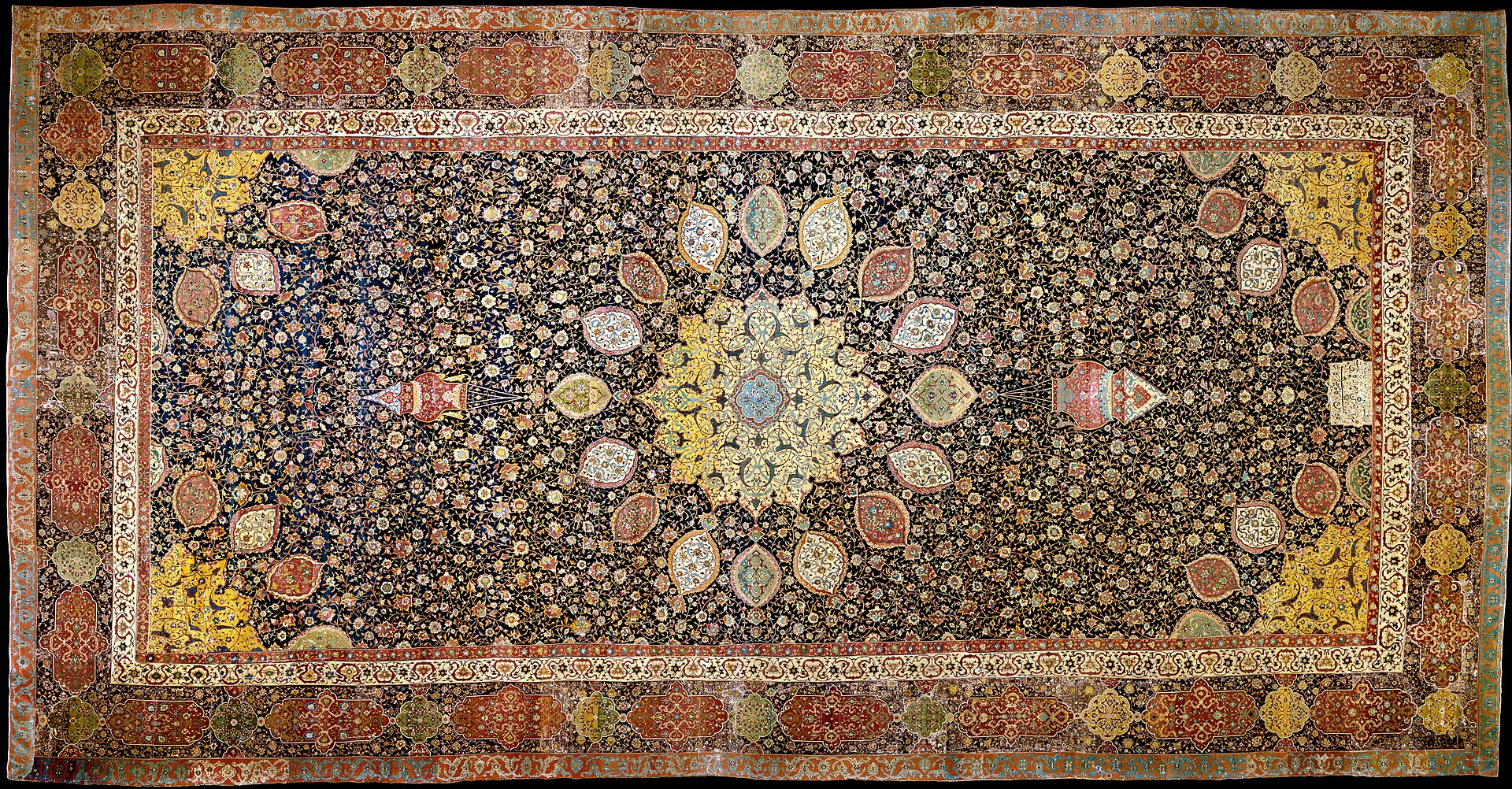
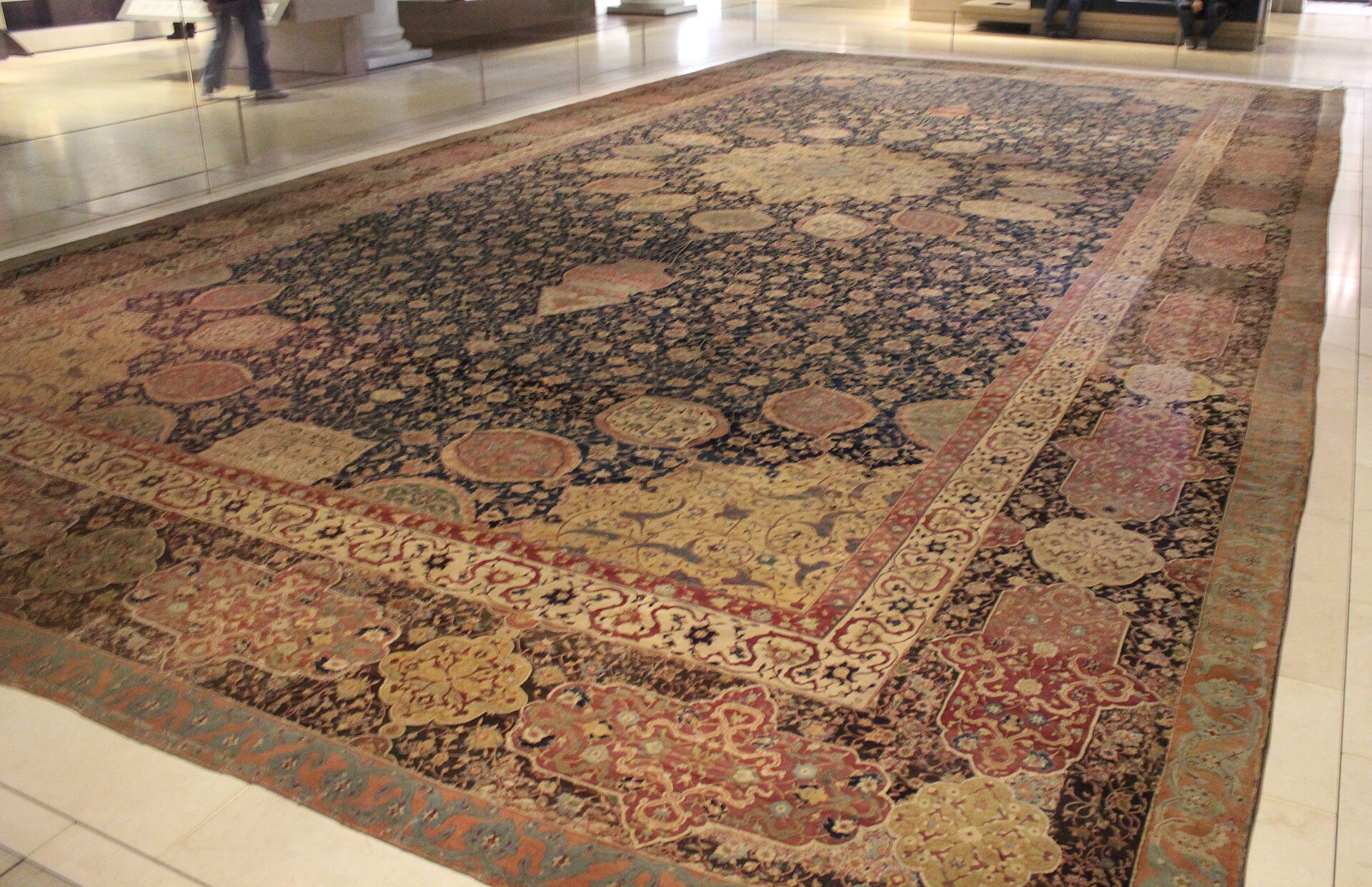
The LONDON carpet, the complete one. Victoria and Albert Museum 272-1893, dated AH 946 (1539-40). Photographed flat and face-on, so this is a faithful reproduction of a substantially two-dimensional object rather than a photograph of a three-dimensional one. Google Art Project capture of the V&A object, 8029 x 4189 pixels.
| Artist | Maqsud of Kashan (Maqsud Kashani), named in the inscription |
|---|---|
| Date | Dated AH 946, equivalent to 1539-40 |
| Medium | Wool knotted pile on a silk warp and weft foundation, asymmetrical knot open to the left |
| Dimensions | V&A carpet (272-1893): 1044 cm at the middle, 1032.5 cm and 1031 cm at the sides, by 529.5 to 535.5 cm. LACMA carpet (53.50.2): 718.8 x 400.1 cm. |
| Where it is now | Victoria and Albert Museum, London, Room 42, the Jameel Gallery (272-1893). The twin is in the Los Angeles County Museum of Art, David Geffen Galleries (53.50.2).last confirmed 3 August 2026 |
| Attribution | DocumentedBoth carpets carry a knotted inscription panel naming Maqsud of Kashan and dating the work to AH 946 (1539-40). Full note |
| Object type | Textile |
| Period | Safavid Iran, sixteenth century |
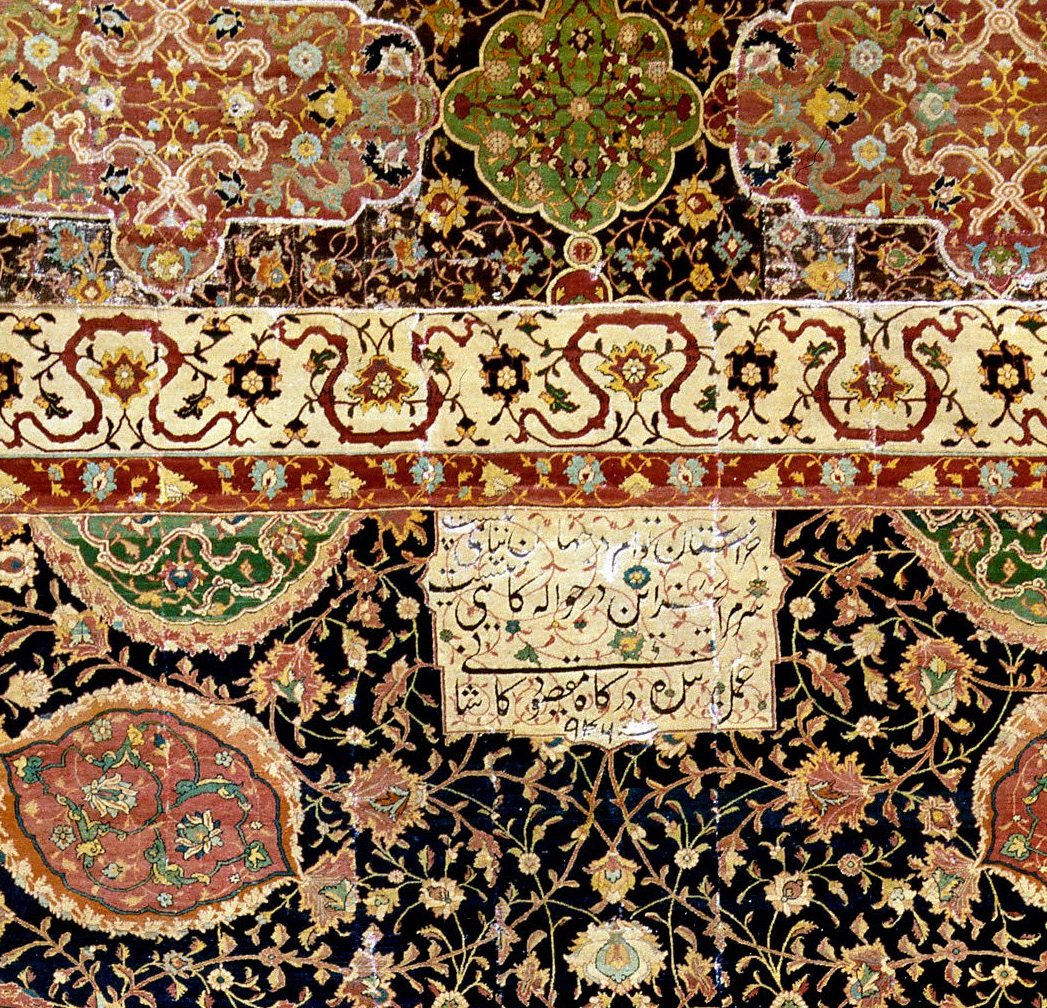
| Inscriptions | Knotted into a white-ground panel at one end of the field, in nastaliq. Transliterated: Joz astan-e to-am dar jahan panah-i nist / Sar-e mara be-joz in dar hawala-gah-i nist / Amal-e banda-ye dargah Maqsud Kashani / sana 946. Translated by the V&A: Except for thy threshold, there is no refuge for me in all the world. Except for this door, there is no resting-place for my head. The work of a servant of the court, Maqsud of Kashan. |
| Owners on record | 9 links8 documented, 1 disputed |
| Sources | 6 cited |
About this record Last verified 19 August 2026 · 6 sources cited · Change log
On this page 12 sections
ContentsClose
Two carpets, not one. A matching pair woven in Safavid Iran and dated 1539-40, designed to lie side by side and fill a square room. One is in London and is complete. The other is in Los Angeles and is not, because before either was sold its outer borders and part of its lower field were cut away and used to mend the one now in London.
Almost every popular account of the Ardabil Carpet describes a single object. The V&A's own catalogue record gives the twin the wrong inventory number in one place and the right one in another. This record separates the two carpets, states which is which on every plate, and records what was taken from which.
Provenance
Each link is graded. Documented: a cited source supports it. Disputed: the identification is argued but not established. Unknown: no owner for that span, and the gap is not smoothed into a narrative. The grades in the glossary.
- 1539-40 -Woven as a matching pairdocumented
Both carpets carry a knotted panel dating them to AH 946 and naming Maqsud of Kashan. LACMA reports the plausible proposal that they were woven simultaneously on back-to-back looms; the V&A notes that their knot densities are near-identical, which supports one team working at one time. Stead's 1974 monograph is reported to dissent from that reading on the knot counts; not verified at source.134
- 1539-40 - 1888The shrine of Shaykh Safi al-Din, Ardabil (reported)disputed
Both museums say the carpets were reported to have come from the shrine, and the V&A proposes that the pair was designed to fill a square space under the dome of the Jannat-sara built by Shah Tahmasp. Nineteenth-century travellers recorded carpets at the shrine: Keith Edward Abbott in a Foreign Office narrative of 1843 and W. R. Holmes in 1845. No sixteenth-century document naming these two carpets has been published in the sources consulted; surviving eighteenth-century shrine inventories do not obviously list them; and at least one survey has argued the pair could not have been laid unfolded in the room proposed. Three centuries of the chain are otherwise blank.134
- 1888 - c. 1890Ziegler and Co, Manchesterdocumented
A trading firm with offices at Tabriz and Sultanabad (modern Arak). It bought the carpet in 1888 from the shrine, either directly or through the Tabriz-based carpet dealer Hildebrand Stevens, and repaired it heavily. In 1889-90 the shrine authorities completed restoration works on buildings of the complex; the V&A's inference is that the carpet was sold to fund the renovation. The earthquake usually named as the cause of that damage is a later tradition and is not asserted by the museum.1
- c. 1890 - 1893Vincent J. Robinson and Co Ltd, 34 Wigmore Street, Londondocumented
The art-import firm that held both carpets. The repairs that made one carpet complete at the expense of the other were carried out in this period; the V&A credits Robinson's with extensive repair work before the sale. By 1892 the London carpet was on show in Robinson's showroom, and the managing director Edward Stebbing published a monograph on it the same year. The Times covered it on 26 May 1892.1
- 1892 - 1905Charles Tyson Yerkes, New York and Chicago (the Los Angeles carpet)documented
Robinson sold the second carpet to the traction magnate Charles Tyson Yerkes for 80,000 dollars, in the V&A's words apparently on condition that the carpet should not return to Britain. Yerkes died in 1905 and his collections were dispersed at auction in New York in 1910.1
- 1893 - presentVictoria and Albert Museum, London (the London carpet)documented
Purchased March 1893 for 1,750 pounds from Vincent J. Robinson and Co Ltd, after an opening offer of 1,500 pounds in January was refused by Robinson's managing director Edward Stebbing. The increase followed consultation with the Museum's Art Referees William Morris and Frederic Leighton. The shortfall was made up by private subscription: John Edward Taylor guaranteed 250 pounds, Morris offered 20 pounds, with A. W. Frank, E. Steinkopff and, in the accession register's phrase, other gentlemen. Museum number 272-1893.1
- after 1905 - before 1938Joseph Raphael De Lamar, then Joseph Duveen (the Los Angeles carpet)documented
The V&A records the sequence from the Yerkes collection to De Lamar and then to the dealer Joseph Duveen. De Lamar died in 1918 and his collection was dispersed in turn. The exact dates and the prices of these two transfers are not given in the V&A record.1
- 1938 - 1953J. Paul Getty (the Los Angeles carpet)documented
Getty bought the carpet from Duveen in 1938. The price is not given in the V&A or LACMA records.1
- 1953 - presentLos Angeles County Museum of Art (the Los Angeles carpet)documented
Gift of J. Paul Getty, 1953, to what was then the Los Angeles County Museum of History, Science and Art. Accession number 53.50.2. On view in the David Geffen Galleries in a display titled Persianate Arts: The Ardabil Carpet and Manuscript Painting.13
Prices realised
Neither carpet has been sold at public auction as a single lot in the modern market. The two figures that circulate are private-treaty prices from the 1890s: 1,750 pounds paid by the South Kensington Museum in March 1893 for the London carpet, and 80,000 dollars paid by Charles Tyson Yerkes in 1892 for the Los Angeles carpet. Both are private sales with no buyer's premium; a premium column would be meaningless for either. The Los Angeles carpet did pass through the Yerkes estate dispersal of 1910 and the De Lamar dispersal after 1918, and figures from those sales are not carried here because none has been cited to a source in this pass. Any modern auction figure quoted for an Ardabil carpet refers to a different object.
Technical evidence
| Attribution note | Both carpets carry a knotted inscription panel naming Maqsud of Kashan and dating the work to AH 946 (1539-40). This is a signature in the sense that a building inscription is a signature: it names the man responsible for the commission rather than the hands that tied the knots. The V&A and LACMA both read him as the designer or the official in charge of production, not as a weaver, and not as a slave in the literal sense despite the wording. |
|---|---|
| Warp | White silk, Z2S, depressed, 126 threads per decimetre (32 per inch).1 |
| Weft | White silk; three shoots of paired threads after each row of knots; 78 knots per decimetre (19 per inch) in the vertical direction.1 |
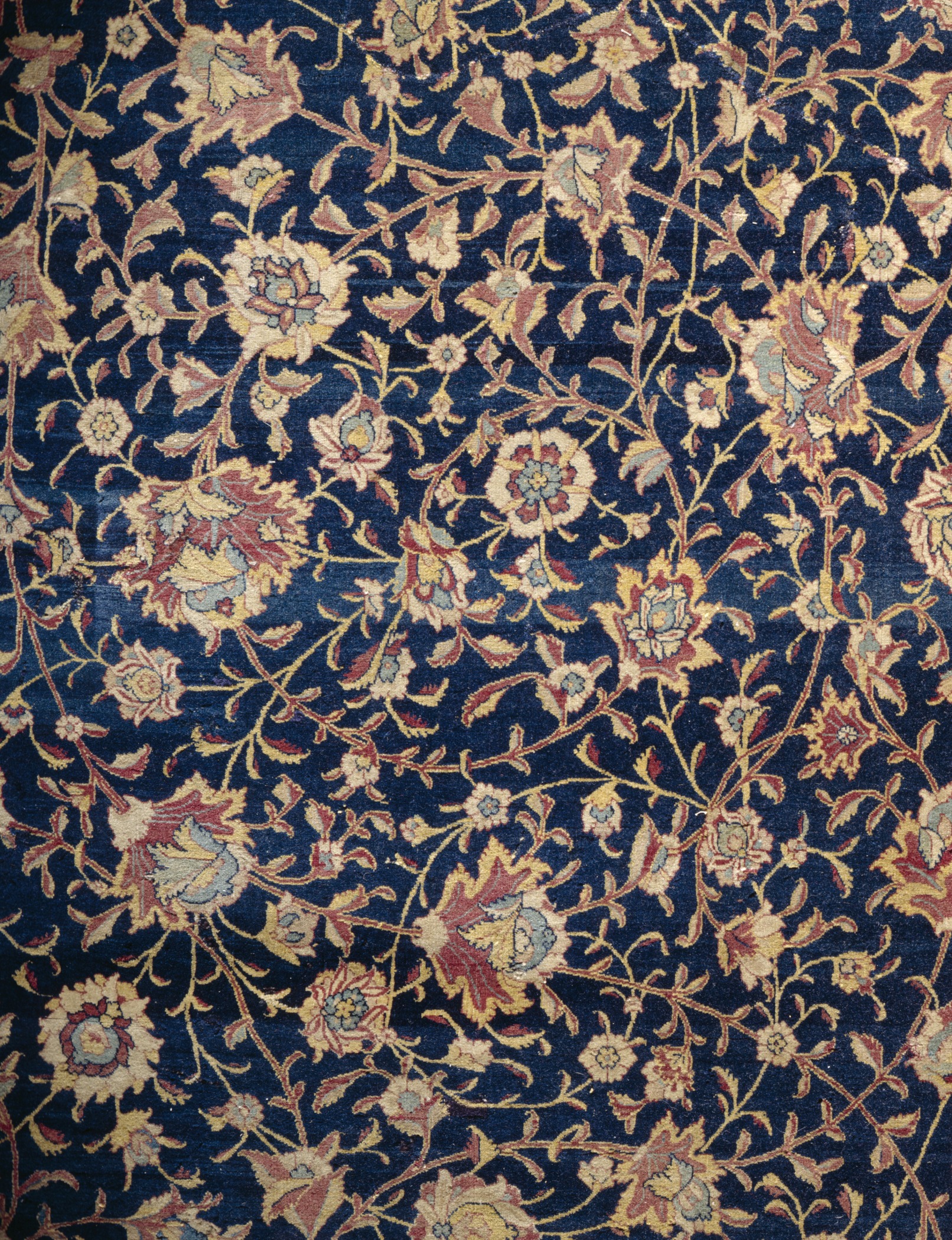
| Pile | Wool in ten colours: dark red, red, light red, yellow, green, dark blue, blue, light blue, black and white.1 |
| Knot | Asymmetrical, open to the left.1 |
| Knot density, London carpet | An average of 5,300 knots per square decimetre (340 per square inch). The V&A records that the count varies throughout the structure and that the figure is therefore an average, equivalent on its own arithmetic to about 5,472 per square decimetre. Stead's 1974 monograph is reported to publish lower counts for this carpet; not verified at source.14 |
| Knot density, Los Angeles carpet | An average of 350 knots per square inch on the V&A's figures. The near-parity with the London carpet supports the accepted proposal that the two were woven by the same team at the same time. Stead is reported to give the Los Angeles carpet a distinctly higher density than the London one and to argue against simultaneous weaving; not verified at source.14 |
| Total knots | Not counted, only derived. Published totals for the London carpet range from about twenty-five or twenty-six million to over thirty million depending on the density and area used. LACMA has put its own smaller carpet at about fifteen and a half million. Treat any single figure as an estimate that inherits the uncertainty of an averaged density.13 |
| Dimensions, London carpet | Length 1044 cm at the middle, 1032.5 cm and 1031 cm at the two sides; width 529.5 cm at the middle, 530 cm at the non-inscription end, 535.5 cm at the inscription end. An older gallery panel gave 34 feet 6 inches by 17 feet 6 inches.1 |
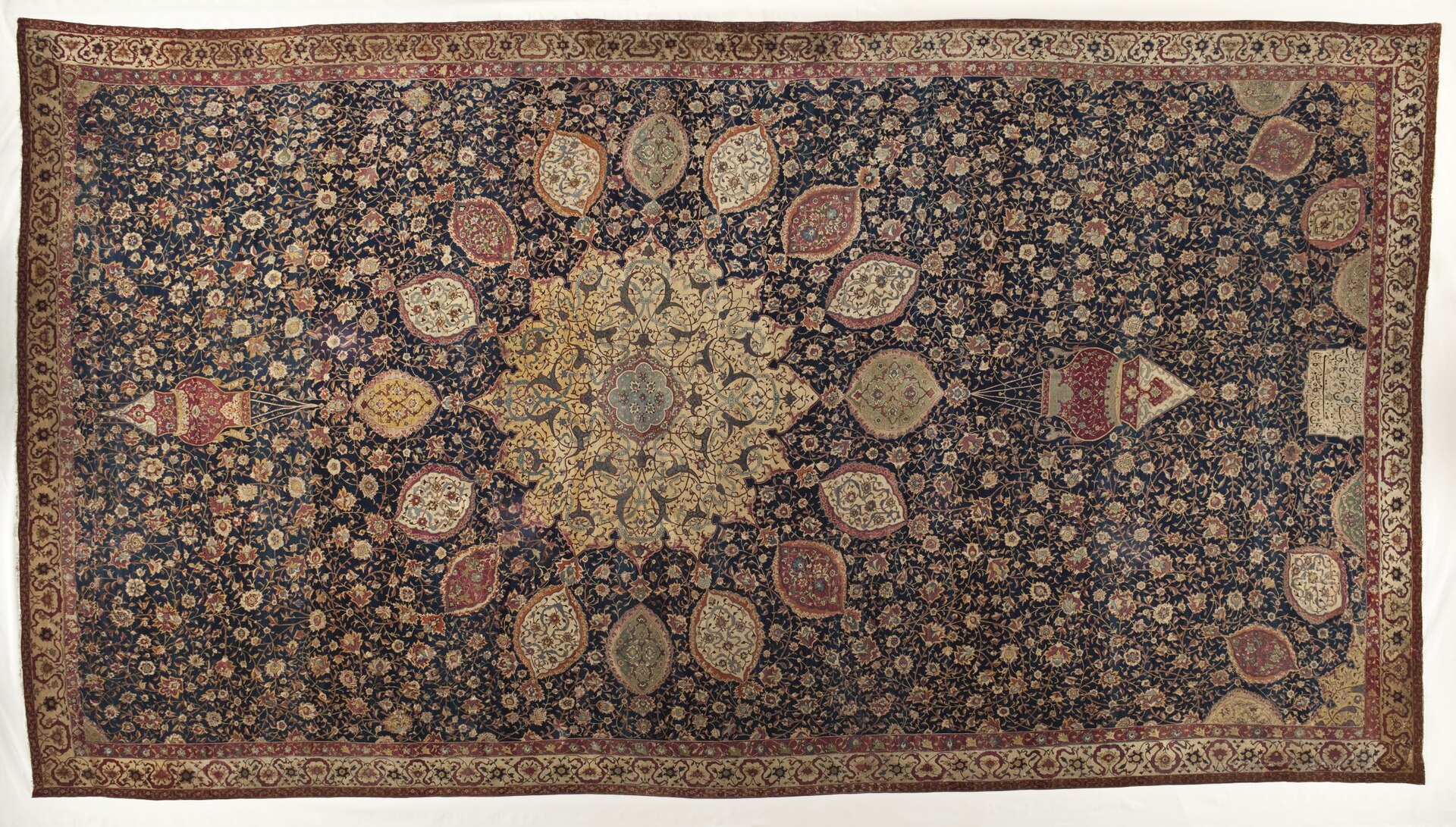
| Dimensions, Los Angeles carpet | 718.8 x 400.1 cm (283 x 157.5 in). Smaller than the London carpet in both directions, the result of the removal of the outer borders and a section of the lower field.3 |
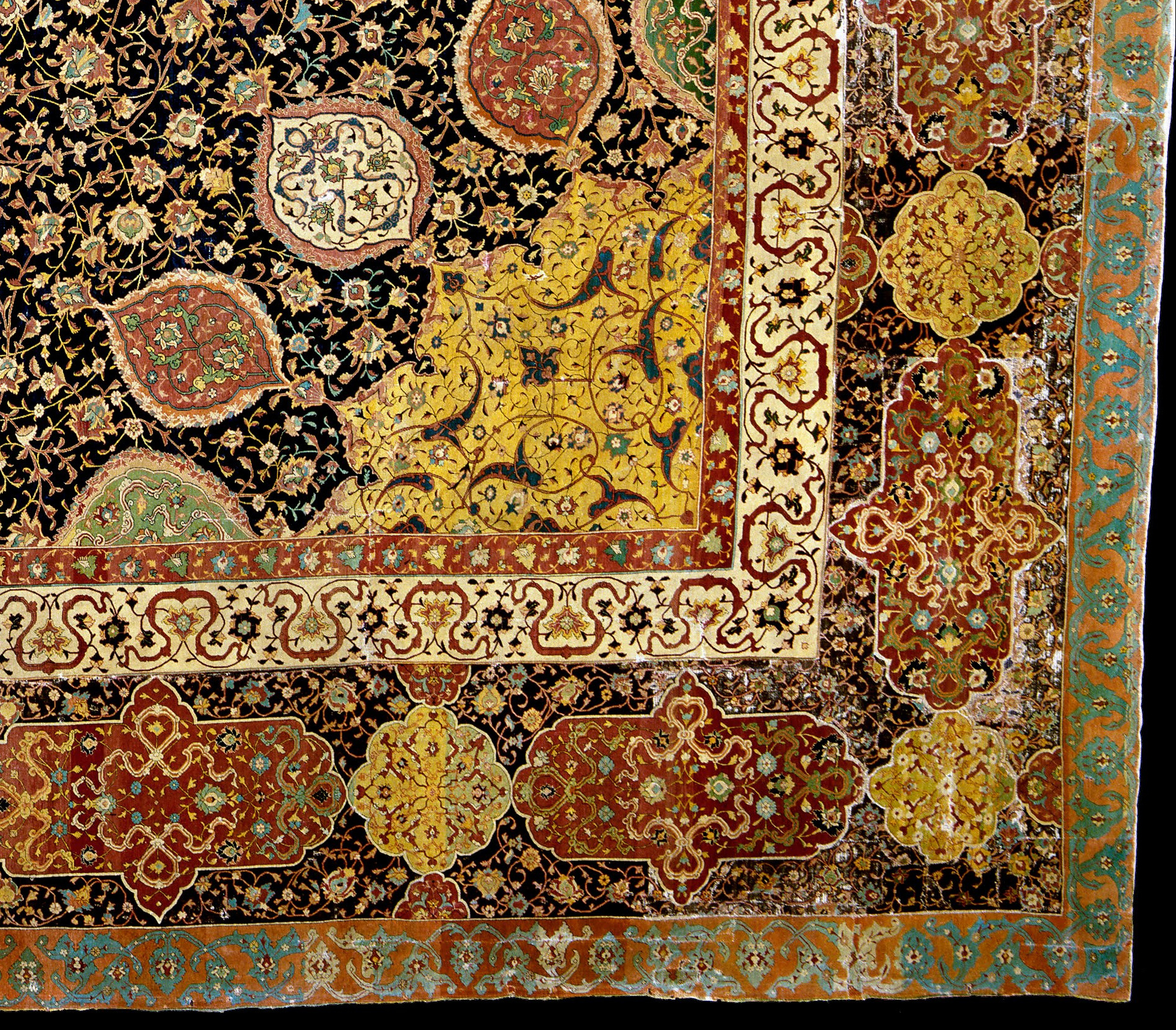
| Borders, London carpet | Main border: blue ground with red cartouches separated by large green rosettes, the cartouches containing cloudbands and lotus flowers. Inner border: cream ground with floral meander. Outer border: red ground with double meander.1 |
| Border, Los Angeles carpet | The outer border is a replacement. The original outer borders were removed before 1893 and used to repair the London carpet.3 |
| Side and end finishes | Missing on the London carpet.1 |
| Field design | Dark blue ground; yellow central medallion (shamsa) with sixteen satellite ovals; a quarter medallion in each corner; two suspended red lamps on the long axis, one larger than the other; two superimposed systems of spiralling scrolls, one with thick dark red stems, one with thinner cream stems. On the Los Angeles carpet the corner quarter-medallions are only partially preserved.13 |
| Inscription panel | Knotted into a white-ground panel at one end of the field, in nastaliq script. The first two lines are a Persian couplet from a ghazal by Hafiz; the third is the signature of Maqsud of Kashan with the date 946. Both carpets carry the inscription, with small variations in the ligatures of the letters.13 |
| Dyes | Natural dyestuffs including pomegranate rind and indigo, per the V&A's public account. No published dye analysis of either carpet was located in this pass.2 |
| Open imaging | The V&A publishes an open IIIF presentation manifest for 272-1893 alongside a machine-readable JSON record, so the London carpet can be examined at deep zoom and pulled into any IIIF viewer without permission or fee. The Google Art Project capture of the same carpet runs to 8029 x 4189 pixels. No equivalent open manifest for the Los Angeles carpet was located in this pass, which means the complete carpet is far easier to study closely than the cut one.6 |
Images

The record in full
Chapter 1There are two Ardabil carpets, and most accounts describe a hybrid of both
The object usually called the Ardabil Carpet is the one in the Victoria and Albert Museum, museum number 272-1893.
The object usually called the Ardabil Carpet is the one in the Victoria and Albert Museum, museum number 272-1893. It is complete, about ten and a half metres by five and a third, and it is the carpet reproduced on posters, in textbooks and in the Jameel Gallery. It is not the whole story, because it was made as one of a matching pair, and the other carpet still exists.
The second carpet is in the Los Angeles County Museum of Art, accession number 53.50.2, a gift of J. Paul Getty in 1953. LACMA's own catalogue calls the two a matched pair whose designs are virtually identical apart from small variations in the ligatures of their inscriptions. The V&A calls the Los Angeles carpet the twin, notes that it is only partially intact, and records that fragments of both carpets exist in other public and private collections.
What follows is written to keep them apart. Where this record says the London carpet it means 272-1893. Where it says the Los Angeles carpet it means 53.50.2. Every picture in the gallery below names which of the two it shows.
Chapter 2What was taken from the Los Angeles carpet, and what it still has
This is the fact the record exists to get right.
This is the fact the record exists to get right. Before the South Kensington Museum bought the London carpet in 1893, the dealers had a complete carpet to sell and a damaged one, and they made the complete one out of both.
LACMA's curatorial note, revised in 2024, states it plainly: sometime before the V&A acquired its Ardabil in 1893, the outer borders and a section of the lower field are believed to have been removed from the Los Angeles carpet in order to repair the one now in London, and the Los Angeles carpet was subsequently given a new outer border. The V&A's record says the same thing from the other end, that pieces were taken from the Los Angeles carpet to repair the border of the London carpet, and that the London record carries a diagram in which dotted lines mark the patches.
So the Los Angeles carpet lost its outer borders, lost a section of the lower field, and lost most of the corner quarter-medallions, which LACMA describes as only partially preserved. It did not lose its central medallion. The great yellow sunburst with its sixteen radiating pendants is still there, both mosque lamps are still there, and the inscription panel naming Maqsud of Kashan and the year 946 is still there. A published claim that the Los Angeles carpet has no medallion is wrong, and it is wrong in a way that would make every plate in this record unusable if it were repeated here.
What the Los Angeles carpet has instead of its original border is a replacement, and the carpet is smaller in both directions: 718.8 by 400.1 centimetres against 1044 by roughly 532. The difference is not only the missing border. Part of the field went too.
Chapter 3Made as a pair, for a room that was square
The V&A gives the reason the carpets are the size they are.
The V&A gives the reason the carpets are the size they are. Each measures approximately ten metres by five, and the two were designed to lie side by side and occupy, together, a square space under the dome of the Jannat-sara, one of the new buildings Shah Tahmasp added to the shrine complex at Ardabil.
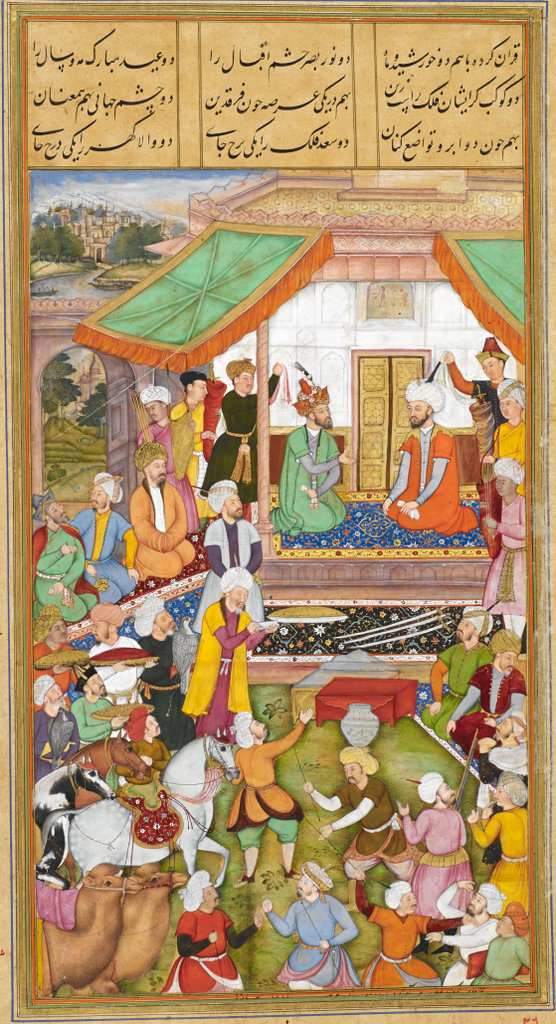
That is a design argument as much as an archaeological one, and it carries a consequence for the reading of the whole object. A pair of carpets that only makes sense as a square is a pair made for a specific floor, not for a market. The V&A notes that the chamber would have served as a royal reception hall, and that Tahmasp used it in 1544 when he received the exiled Mughal emperor Humayun. Humayun walked over these carpets, went home with Safavid court artists in his entourage, and Persian court design entered Mughal India through that visit.
The proposal is not unopposed, and the objection is a physical one rather than a stylistic one. The measured floor of the domed chamber usually identified with the carpets does not comfortably take two carpets of this size laid flat, and at least one survey has concluded that they could not have been placed there unfolded. A record that repeats the Jannat-sara story without the objection is repeating a museum label, not the evidence.
Chapter 4How they were made
Warp and weft are white silk. The pile is wool, in ten colours: dark red, red, light red, yellow, green, dark blue, blue, light blue, black and white.
Warp and weft are white silk. The pile is wool, in ten colours: dark red, red, light red, yellow, green, dark blue, blue, light blue, black and white. The knot is asymmetrical and open to the left, at an average of 5,300 knots per square decimetre, which the V&A gives as 340 knots per square inch. The warp is Z2S, depressed, at 126 threads per decimetre, with three shoots of paired weft threads after each row of knots.
The V&A is careful about the knot count in a way that matters here. It records that the count varies throughout the structure, that 340 per square inch is an average, and that the Los Angeles carpet has been recorded at an average of 350 per square inch. Near-parity in knot density across two carpets is technical evidence, not connoisseurship: it supports the accepted proposal that both were woven by the same team at the same time. LACMA goes further and reports the plausible proposal that the two were woven simultaneously on back-to-back looms.
That parity is reported to be contested. Rexford Stead's 1974 monograph for the Getty is cited in later writing as publishing counts that do not agree with the museums', giving a lower density for the London carpet than for the Los Angeles one and arguing from the difference that the two were not woven side by side. This record could not read Stead at source and does not reproduce his figures. What is recorded here is that a disagreement about the knot counts exists in the literature, that it bears directly on the simultaneous-weaving claim both museums make, and that it needs checking against the book.
Wool for the pile rather than silk is a deliberate choice and not a cheap one. The V&A points out that wool holds dye better than silk does, which is why a carpet meant to read as ten distinct colours across fifty square metres is knotted in wool on a silk foundation rather than in silk throughout.
An older V&A gallery panel estimated about four years to weave the pair, and inferred a royal commission from the cost that implies. LACMA says each would have taken several years. Neither museum claims a documented contract.
Chapter 5Nobody agrees how many knots are in it
The total knot count of the London carpet is one of the most quoted figures in Islamic art and there is no agreed number.
The total knot count of the London carpet is one of the most quoted figures in Islamic art and there is no agreed number. Published totals range from roughly twenty-five or twenty-six million at the low end to well over thirty million at the high end, depending on which density is used and whether the figure is taken over the whole carpet or the field alone. LACMA's own public writing has put its smaller carpet at about fifteen and a half million.
Every one of those totals is a multiplication, not a count. Nobody has counted the knots in either carpet. The correct way to read the figure is as a derived quantity that inherits all the uncertainty of the density it was derived from, and the density is explicitly an average over a structure the V&A says varies throughout.
Chapter 6The design is a book cover the size of a room
The field is dark blue. At the centre is a yellow medallion, a shamsa, with sixteen satellite ovals radiating from it.
The field is dark blue. At the centre is a yellow medallion, a shamsa, with sixteen satellite ovals radiating from it. A quarter of the same medallion is repeated in each of the four corners. Above and below the centre, on the long axis, hang two red mosque lamps. The rest of the ground carries two independent systems of spiralling leafy scrolls laid one over the other, one with thick dark red stems, the other with thinner cream stems.
The V&A traces the vocabulary directly: designs of this kind were produced for manuscript illumination and bookbinding in the same period and the same court workshops, and the carpet composition is derived from them. That is why it reads as a single vast illuminated page rather than as a repeating textile pattern. It is also why the medallion-and-corner scheme is usually associated with Tabriz, the Safavid capital, where the court design studio was.
The lamps carry the argument. The V&A reads them as an image of divine light, referring to the Safavid claim of descent from the Prophet, whose nature is described in terms of light, the Nur-Muhammadi. Shah Tahmasp was completing an expansion of the shrine of Shaykh Safi al-Din at the time these carpets were made, and the shrine was the basis of his family's claim to rule: descent from a saint, and beyond him from the Shia Imams and the Prophet. A carpet with lamps of divine light hanging over the floor of that shrine's reception hall is a dynastic argument in wool.
Chapter 7The optical correction almost nobody notices
The two lamps are not the same size, and neither are the oval pendants nearest to them.
The two lamps are not the same size, and neither are the oval pendants nearest to them. This is not damage or repair. A V&A wall panel of 1998 records it as a deliberate correction for foreshortening.
The reasoning it sets out is precise. Weaving began at one end. Dignitaries would sit at that end, on the carpet or on low cushions, looking down its length against the direction of the pile, which is where the colours read best. From that seat the far lamp is further away and would appear smaller, so the far lamp was woven larger. Seen from the position the designer intended, the two lamps and their pendants appear the same size.
It is one of the few pieces of evidence anywhere in the object about how it was actually meant to be used, and it comes from the object itself rather than from a document.
Chapter 8How they left Iran
The V&A's object history is more specific than the popular account.
The V&A's object history is more specific than the popular account. Ziegler and Co of Manchester, a trading firm with offices at Tabriz and at Sultanabad, now Arak, bought the carpet in 1888 from the shrine of Shaykh Safi at Ardabil, either directly or through the Tabriz-based carpet dealer Hildebrand Stevens, and repaired it heavily. In 1889-90 the shrine authorities completed new restoration work on buildings of the complex. The V&A puts the inference carefully: arguably the carpet was sold in order to fund that renovation.
The version of that story usually told is more colourful and less supported. It holds that an earthquake damaged the shrine and that the carpets were sold to pay for the repairs. The earthquake is the weak link. It is a later tradition rather than a documented event tied to this sale, and the V&A itself does not assert it as fact; it says arguably. This record follows the museum and does not turn a plausible motive into a recorded cause.
By 1892 the London carpet was on display in the showroom of Vincent J. Robinson and Co Ltd at 34 Wigmore Street. Edward Stebbing, Robinson's managing director, published a monograph on it the same year, The Holy Carpet of the Mosque at Ardebil, and The Times ran a piece headed An Extraordinary Carpet on 26 May 1892. The object was being made famous before it was sold, by the man selling it.
Two nineteenth-century travellers had recorded carpets at the shrine before any of this: Keith Edward Abbott in a Foreign Office narrative of 1843, and W. R. Holmes in Sketches on the Shores of the Caspian in 1845. Those sightings are the reason the Ardabil attribution is taken seriously at all, and they are also the reason it is not certain, because a traveller describing large carpets in a shrine is not the same as an inventory naming these two. Eighteenth-century inventories of the shrine's contents survive and have been studied; what they do not do is name a pair of carpets that answers to these.
Chapter 9What the museum actually paid, and the figure that is usually quoted
The V&A's catalogue record and the V&A's own public article do not agree, and both are current.The catalogue record for 272-1893 gives the sequence in detail.
The V&A's catalogue record and the V&A's own public article do not agree, and both are current.
The catalogue record for 272-1893 gives the sequence in detail. John Edward Taylor, a wealthy private collector, brought the carpet to the Director's attention over the summer of 1892. In January 1893 the Museum offered 1,500 pounds. That was not enough for Edward Stebbing at Robinson's, and Taylor volunteered to raise the shortfall from private donors. By March 1893 the money was still short, and after consulting two of its Art Referees, William Morris and Frederic Leighton, the Museum raised its offer to 1,750 pounds. Stebbing accepted. The donors named in the accession register are Taylor, who guaranteed 250 pounds, Morris, who offered 20 pounds, A. W. Frank, E. Steinkopff, and in the register's phrase other gentlemen.
The V&A's public article on the carpet gives the price as 2,000 pounds in March 1893. This record follows the catalogue entry at 1,750 pounds, because it is the account that cites the accession register and reconstructs the negotiation, and it flags the discrepancy rather than averaging it. A reader who finds 2,000 pounds elsewhere has not found a different sale.
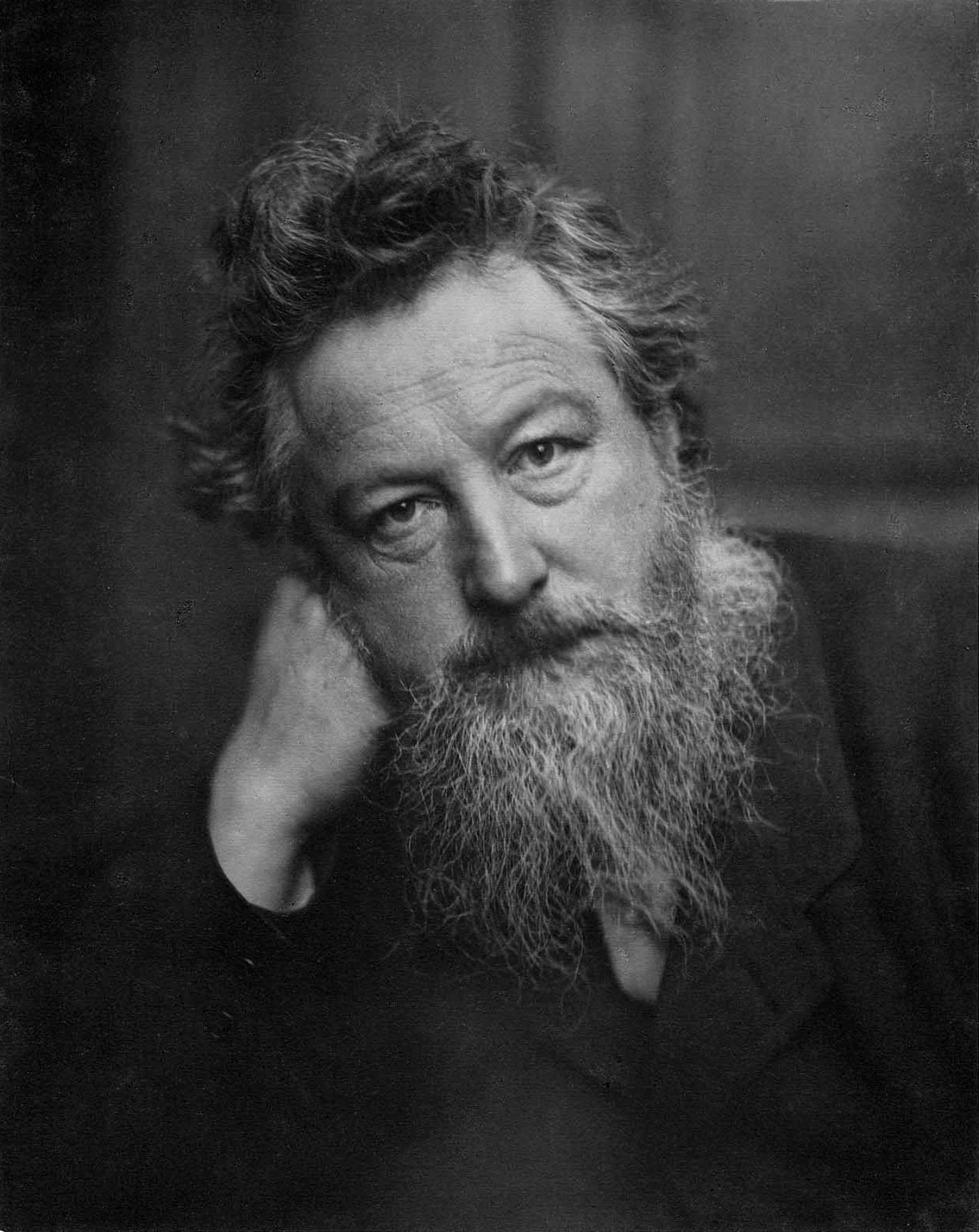
The 20 pounds Morris put in is worth holding on to. The most influential designer in Britain contributed roughly one per cent of the purchase price, and his real contribution was the opinion, not the cheque. His written assessment for the Museum called the carpet of singular perfection, and logically and consistently beautiful, and it is the sentence that bought it.
Chapter 10The twin's American chain
In 1892, before the London sale closed, Vincent Robinson sold the second carpet abroad.
In 1892, before the London sale closed, Vincent Robinson sold the second carpet abroad. The buyer was Charles Tyson Yerkes, the Chicago and London traction magnate, and the price was 80,000 dollars. The V&A adds a condition to the sale that is worth stating exactly as the museum does: apparently on condition that the carpet should not return to Britain.
That condition, if it was real, is a piece of dealer behaviour rather than law. Robinson was about to sell the London carpet to a national museum as a unique object. A second, near-identical carpet arriving in London would have been inconvenient.
From Yerkes the carpet went to Joseph Raphael De Lamar, then to the dealer Joseph Duveen, then in 1938 to J. Paul Getty, who gave it to the Los Angeles County Museum of Art in 1953. Yerkes died in 1905 and his collections were dispersed at auction in New York in 1910; De Lamar died in 1918 and his were dispersed in turn. The second Ardabil carpet therefore passed through two full American estate dispersals before Duveen placed it with Getty, which is the reason its chain is better documented than most nineteenth-century carpet provenance.
Chapter 11Ten minutes on the hour, and twenty in every sixty
In 2006 the V&A built a case in the centre of the Jameel Gallery for the London carpet and set a lighting regime that is itself part of the object's history: the carpet is lit for ten minutes on the...
In 2006 the V&A built a case in the centre of the Jameel Gallery for the London carpet and set a lighting regime that is itself part of the object's history: the carpet is lit for ten minutes on the hour and ten minutes on the half hour, and is otherwise in near darkness, to preserve its colours.
Note the arithmetic, because it is usually got wrong. The gallery label says on the hour and half-hour, which is two ten-minute periods, twenty minutes of light in every sixty. The common paraphrase that the carpet is lit for ten minutes an hour halves the real exposure.
The regime is a public admission that the object is consumed by being seen. It also changes what visiting means. The most famous carpet in the world is dark for two thirds of the day, and the museum tells you so on the label.
Chapter 12It has almost never been on a floor
A carpet is a floor covering and this one has spent almost none of its museum life on a floor.
A carpet is a floor covering and this one has spent almost none of its museum life on a floor. For most of the twentieth century the London carpet hung vertically behind glass, which is how a textile that heavy is displayed when the alternative is people walking on it.
The 2006 Jameel Gallery case put it flat again, in a horizontal vitrine at the centre of the room. That is closer to the way it was meant to be seen than anything the museum had done before, and it is still not the way it was meant to be seen, because the designer's whole optical correction assumes a viewer sitting on the carpet at one end of it.
Chapter 13The name is a claim, not a fact
Ardabil is where the carpets are said to have come from.
Ardabil is where the carpets are said to have come from. It is not where they are documented to have been made, and the strength of the shrine attribution has been questioned in print.
The critical case runs roughly as follows. The shrine provenance rests on a nineteenth-century dealer's account and on travellers' sightings of large carpets at the shrine, not on an inventory. The room the pair is supposed to have furnished may not take them. The eighteenth-century shrine inventories that survive do not obviously list them. And the man who first published the carpet at length, Edward Stebbing, was the managing director of the firm selling it, which gives the founding account of the object a commercial interest in its holiness.
Dorothy Armstrong's 2020 study in Iran treats the whole thing as a case of invention: how a Persian artefact was appropriated and transformed into the object the Western market and the Western museum needed it to be. That is an argument about reception, and this record keeps it in that register rather than presenting it as a finding about the sixteenth century. But it is the reason the words said to have come from appear in both museums' own descriptions, and a reader is entitled to know that the two most careful institutions in the field both hedge.
Chapter 14Where they are now
The London carpet is in Room 42, the Jameel Gallery, at V&A South Kensington, under the 2006 lighting regime, museum number 272-1893.The Los Angeles carpet is on view in LACMA's David Geffen...
The London carpet is in Room 42, the Jameel Gallery, at V&A South Kensington, under the 2006 lighting regime, museum number 272-1893.
The Los Angeles carpet is on view in LACMA's David Geffen Galleries in a display titled Persianate Arts: The Ardabil Carpet and Manuscript Painting. LACMA's curatorial note was revised in 2024 and its Unframed blog ran the carpet as part of a 50 Works 50 Weeks series in April 2026. For most of the twentieth century the Los Angeles carpet was the one nobody photographed. It is now the centre of a named gallery display, which is the first time in its museum life that it has been presented as an object in its own right rather than as the other one.
Both carpets are easier to study from a desk than they have ever been, and unequally so. The V&A publishes an open IIIF manifest and a machine-readable record for the London carpet, which means anyone can zoom into its knots in a standard viewer without asking permission, and the Google Art Project capture of it runs to eight thousand pixels on the long side. No equivalent open manifest for the Los Angeles carpet was found. The carpet that was cut to repair the other one is still the harder of the two to look at.
The artist
Maqsud of Kashan (Maqsud Kashani)
Nothing is known about Maqsud of Kashan except the four lines he put on two carpets. He is not documented in any Safavid court record that either museum cites, no other object carries his name, and the two institutions that hold his work describe his role in slightly different terms. He is a name attached to the two most famous carpets in the world and to nothing else, which makes him one of the best-known and least-known makers in Islamic art.
Exhibited
- 2006-presentJameel Gallery, Room 42, permanent display in a purpose-built central caseVictoria and Albert Museum, London
- 2026Persianate Arts: The Ardabil Carpet and Manuscript PaintingLos Angeles County Museum of Art, David Geffen Galleries
Literature
- Edward Stebbing, The Holy Carpet of the Mosque at Ardebil, London, 1892. Written by the managing director of the firm that was selling it.
- Rexford Stead, The Ardabil Carpets, Malibu: The J. Paul Getty Museum, 1974. The monograph on the pair, published by the museum whose founder bought the second carpet.
- Martin E. Weaver, The Ardabil Puzzle, The Textile Museum Journal 23 (1984), pp. 43-51.
- Jennifer Wearden, The Ardabil Carpet: The Early Repairs, HALI 80 (1995), pp. 102-107.
- Donald King, The Ardabil Puzzle Unravelled, HALI 88 (1996), pp. 88-92.
- Lynda Hillyer and Boris Pretzel, The Ardabil Carpet: A New Perspective, V&A Conservation Journal 49 (2005), pp. 11-13.
- Sheila S. Blair, Proclaiming Sovereignty: The Ardabil Carpets, in Text and Image in Medieval Persian Art, Edinburgh University Press, 2014, pp. 228-282.
- Dorothy Armstrong, Inventing the Ardabil Carpet: a Case Study in the Appropriation and Transformation of a Persian Artifact, Iran 58, no. 1 (2020), pp. 110-130.
- Tim Stanley, A Speculation on the Design of the Ardabil Carpets, in Iranian Art from the Sasanians to the Islamic Republic: Essays in Honour of Linda Komaroff, Edinburgh University Press, 2024.
Related works
| Work | Relation | Where it is |
|---|---|---|
| Ardabil Carpet Maqsud of Kashan | The twin. Same commission, same year, same inscription, cut down to repair the London carpet Gift of J. Paul Getty, 1953. On view in the David Geffen Galleries. Outer borders replaced; a section of the lower field removed; corner quarter-medallions only partially preserved; central medallion, both lamps and the inscription panel intact. | Los Angeles County Museum of Art, 53.50.2 |
| Fragments of the Ardabil carpets Maqsud of Kashan | Pieces cut from one or both carpets during the nineteenth-century repairs The V&A records that fragments from both carpets exist in public and private collections. No published census of them was found in the sources consulted. | Public and private collections, unlisted |
| The Chelsea Carpet Unknown | The V&A's other great Safavid medallion carpet, held as a comparandum for the type Named for the King's Road shop where the museum bought it, which is a reminder that carpet names record dealers as often as origins. | Victoria and Albert Museum, London |
| The Shahnama of Shah Tahmasp Safavid court studio, Tabriz | Same patron, same court workshop culture, the manuscript idiom the carpet design is derived from The illumination and binding designs of Safavid court manuscripts are the source the V&A names for the carpet's medallion-and-corner composition. | Dispersed; leaves in the Metropolitan Museum of Art, the Aga Khan Museum and elsewhere |
| The Clark Sickle-Leaf Carpet Unknown, southern Persia | The market benchmark. A Safavid carpet that did go to auction A century later, a fraction of the size, and the holder of the world auction record for a carpet. Museum carpets and market carpets are different populations and the Ardabil pair has never been tested against the second. | Private collection |
Open questions
- Were these two carpets made for the shrine at Ardabil at all? Both museums say the carpets were reported to have come from the shrine, and the V&A calls the Jannat-sara fit a proposal. No sixteenth-century inventory naming them has been published in the sources consulted.
- Do the carpets physically fit the room they are said to have been made for? At least one survey has concluded that they could not have been laid there unfolded. The V&A's square-space argument and that objection have not been reconciled in print.
- Where were they woven? Tabriz is the usual attribution on design grounds. LACMA gives Iran, possibly Tabriz. There is no documentary evidence of the workshop.
- Who was Maqsud of Kashan? He is named on two carpets and nowhere else in the literature either museum cites.
- How many fragments of the two carpets survive, and where are they? The V&A records that fragments exist in public and private collections but no census has been published.
- What exactly was cut, and from where? LACMA says the outer borders and a section of the lower field are believed to have been removed. Believed is the museum's word. The V&A's diagram of patches is the closest thing to a map, and it maps the London carpet, not the Los Angeles one.
- Did Vincent Robinson really impose a condition that the second carpet must not return to Britain? The V&A reports it with the qualifier apparently. No contract has been published.
- What did the V&A actually pay, 1,750 pounds or 2,000? Two current V&A publications disagree.
- Was there an earthquake, and did it cause the sale? The restoration works of 1889-90 are recorded; the earthquake that supposedly necessitated them is a tradition, and the V&A frames the connection to the sale as an argument rather than a fact.
- What happened between 1540 and 1843? No owner, location or use is documented for three centuries; the shrine attribution rests on nineteenth-century travellers and on the fit of the room.
- Was the date panel misread when the carpet was first published in 1892, and later corrected to AH 946? The claim appears in secondary writing and could not be verified against Stead or against Stebbing in this pass. If true it would explain nineteenth-century references carrying a different year.
Questions about this object
What is The Ardabil Carpet?
The Ardabil Carpet is a textile, dated dated AH 946, equivalent to 1539-40. Medium: Wool knotted pile on a silk warp and weft foundation, asymmetrical knot open to the left.
Who made The Ardabil Carpet, and is the attribution settled?
The attribution to Maqsud of Kashan (Maqsud Kashani), named in the inscription is recorded here as documented. Both carpets carry a knotted inscription panel naming Maqsud of Kashan and dating the work to AH 946 (1539-40). This is a signature in the sense that a building inscription is a signature: it names the man responsible for the commission rather than the hands that tied the knots. The V&A and LACMA both read him as the designer or the official in charge of production, not as a weaver, and not as a slave in the literal sense despite the wording.
Where is The Ardabil Carpet now?
Victoria and Albert Museum, London, Room 42, the Jameel Gallery (272-1893). The twin is in the Los Angeles County Museum of Art, David Geffen Galleries (53.50.2). Last confirmed 3 August 2026. V&A purchase 1893; LACMA gift of J. Paul Getty 1953.
What is still unknown about The Ardabil Carpet?
Were these two carpets made for the shrine at Ardabil at all? Both museums say the carpets were reported to have come from the shrine, and the V&A calls the Jannat-sara fit a proposal. No sixteenth-century inventory naming them has been published in the sources consulted.
Sources
- 1Victoria and Albert Museum, Explore the Collections, catalogue record for The Ardabil Carpet, museum number 272-1893. Carries the physical description, dimensions, inscription and translation, object history with the purchase negotiation and prices, the Yerkes to De Lamar to Duveen to Getty chain, and the gallery labels of 1998 and 2006. collections.vam.ac.uk/item/...
- 2Victoria and Albert Museum, article, The Ardabil Carpet. The museum's public account, including the dyes, the knot density, the lighting regime and William Morris's assessment. Gives the purchase price as 2,000 pounds, which conflicts with the catalogue record. vam.ac.uk/articles/...
- 3Los Angeles County Museum of Art, collection record for the Ardabil Carpet, accession 53.50.2, curatorial note revised 2024. States what was removed from the Los Angeles carpet and when, the replacement outer border, the partial survival of the corner medallions, and the back-to-back looms proposal. collections.lacma.org/object/...
- 4Rexford Stead, The Ardabil Carpets, Malibu: The J. Paul Getty Museum, 1974. Getty publications record. NOT READ AT SOURCE IN THIS PASS: the Getty virtual-library PDF address redirects to a JavaScript landing page that could not be read, so the monograph is cited here only for the existence and shape of its argument, at second hand from later summaries. Every claim in this record attributed to Stead is marked as unverified and must be checked against the book before it is relied on. getty.edu/publications-reports/...
- 5Los Angeles County Museum of Art, Unframed, 50 Works 50 Weeks: The Ardabil Carpet, 7 April 2026. The museum's current public writing on its carpet, confirming the matched pair, the partially preserved corners, and the carpet's place in the permanent collection of the David Geffen Galleries opening in 2026. unframed.lacma.org/2026/...
- 6Victoria and Albert Museum, machine-readable object record and IIIF presentation manifest for 272-1893. The API record confirms the accession number and title; the IIIF manifest is an open, deep-zoomable imaging resource that any student or researcher can use without permission or fee. Both were retrieved successfully for this record. iiif.vam.ac.uk/collections/...
Last verified 19 August 2026 · Published 4 August 2026
Change log
2 August 2026 - Record deepened to the house standard: narrative sections, technical evidence, artist dossier, related works and open questions added; provenance chain and auction results replaced with the researched versions; sources rebuilt.
4 August 2026 - Record created at the house standard: researched narrative, technical evidence, maker dossier, graded provenance chain, prices with hammer and premium separated, related works, open questions and sources.
19 August 2026 - 2026-08-19: Re-checked. V&A half confirmed still on permanent display in Room 42, the Jameel Gallery, same 2006 case and ten-minutes-on-the-hour-and-half-hour lighting regime. LACMA half confirmed on view in the David Geffen Galleries in the Persianate Arts: The Ardabil Carpet and Manuscript Painting display, matching the location already on file. No new scholarship found on the AH 946 (1539-40) date or on the one-carpet-cut-to-repair-the-other account. No Iranian or other restitution or repatriation claim found on either half. All six cited sources re-fetched and confirmed live: the V&A catalogue record, the V&A public article, the LACMA collection record, the Getty publications-report page for Stead's 1974 monograph, the LACMA Unframed post of 7 April 2026, and the V&A IIIF manifest. The Getty page still cannot be read past its landing page in this environment, as previously noted. Record confirmed current as of this date. No edits made to the narrative or provenance.