The Laboratory Dates the Material, Not the Object
Radiocarbon put the wax of the Bode Museum's Flora bust in the Renaissance. The bust was made in the nineteenth century, and the wax came from a whale. A physical date is a date for a substance, and the substance has a history of its own.
Records in this piece: Bust of Flora, Tomb Cover, Codice Maya de Mexico, Bronze statuette of a horse, Kouros, Tiara of Saitapharnes
On this page 10 sections
ContentsClose
In short
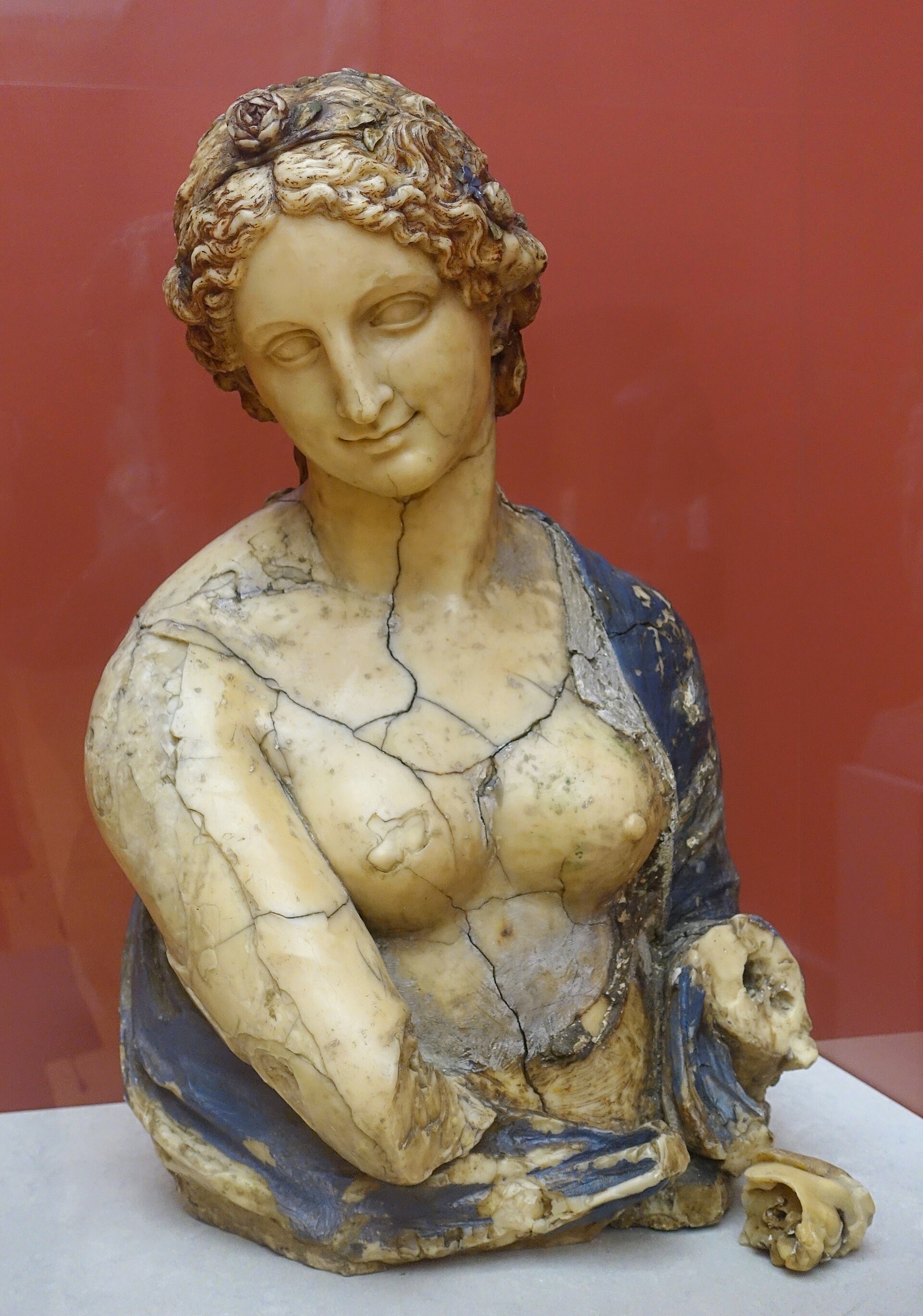
- The raw radiocarbon dates for the wax of the Bode Museum's Flora bust run from 340 to 395 years before present, which read naively would place it in the Renaissance and support the attribution to Leonardo. The wax is spermaceti, from a sperm whale, and marine carbon is already old when the animal eats it. Corrected, the bust is nineteenth-century.
- Two wax reliefs made by Richard Cockle Lucas in 1848 and 1850, of documented date, returned raw dates of 380 to 420 years before present in the same study. Objects known to be about 170 years old measured as roughly 400. That is the size of the trap.
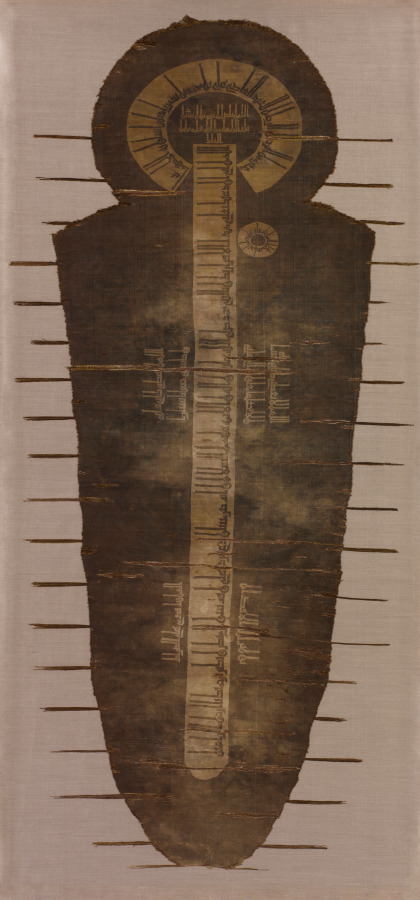
- The Cleveland Museum of Art has moved radiocarbon results into the date field itself on four silks catalogued in the Buyid style. One dates to 899 to 1160 and is genuine. Two date to after 1950.
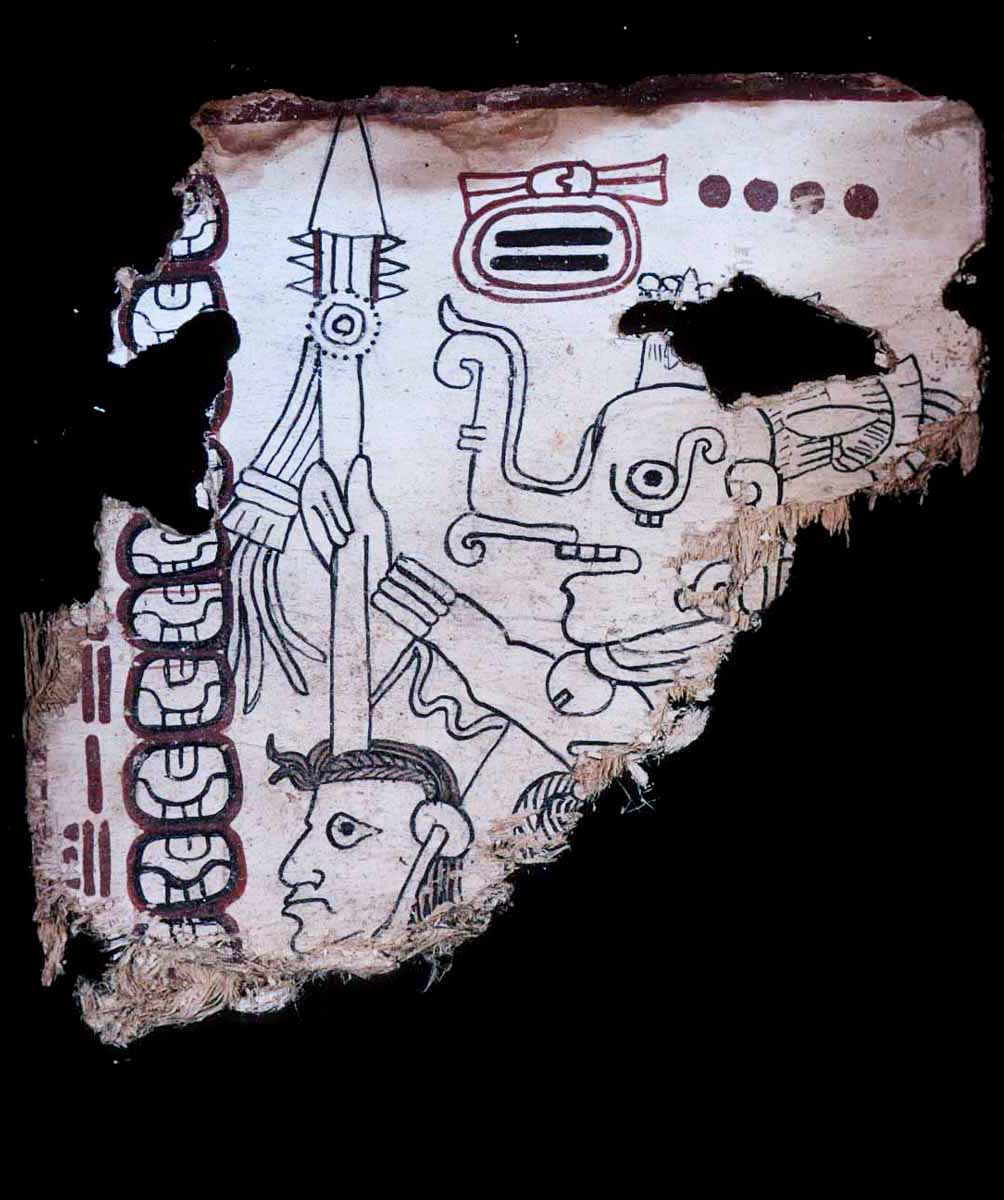
- The first radiocarbon date published for the Grolier Codex was taken from one of eight blank sheets of fig bark paper found with it, not from a painted page. Blank ancient paper is the classic forger's material, and the source that reports the later dates says in the same sentence that they date the paper and not the images upon it.
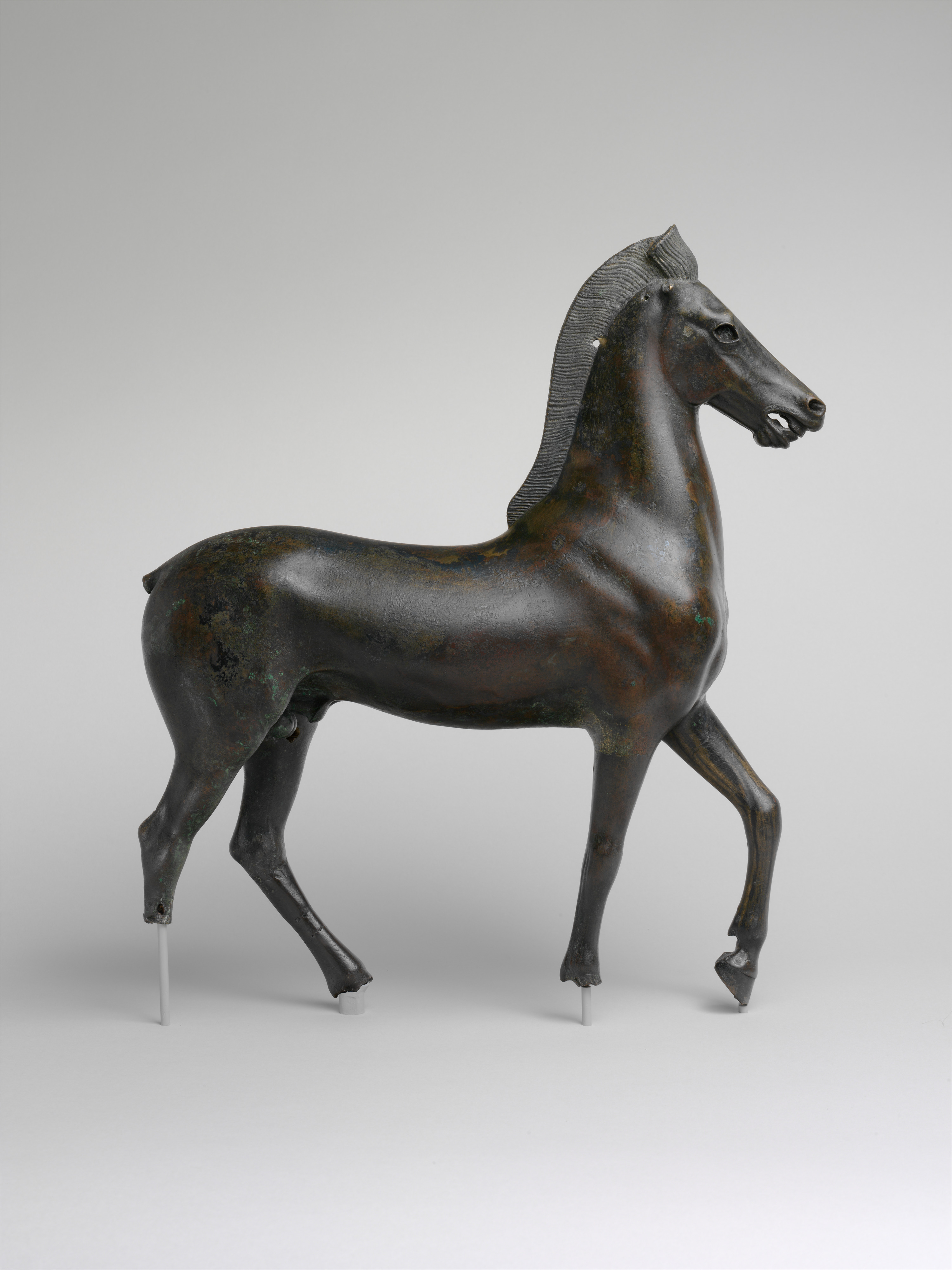
- For a cast bronze the physical clock and the making are the same event. Thermoluminescence zeroes when clay is fired, and the clay core of a lost-wax bronze is fired during the casting, which is why the Metropolitan's bronze horse could be cleared after being publicly called a forgery in 1967.
- The physical date is often much less precise than the stylistic one it is asked to check. Thermoluminescence put the Metropolitan horse anywhere between about 500 and 50 BC with equal probability, a band of 450 years, against a catalogue date of 480 to 470.
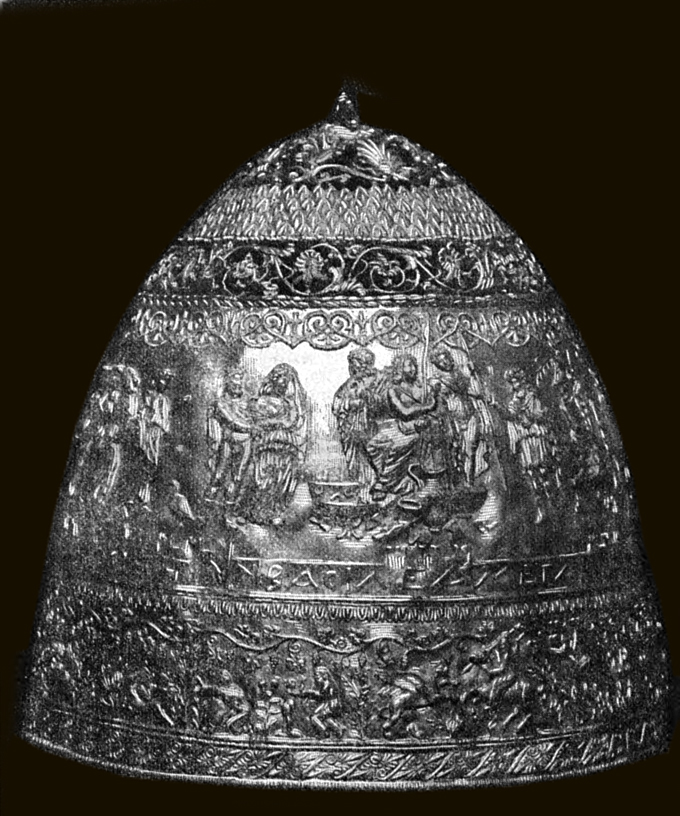
- Gold and stone have no clock at all. The Louvre dates the Tiara of Saitaphernes to the nineteenth century and names its maker, and neither fact came from a laboratory.
A physical date is a date for a substance, and substances have their own histories
Every absolute dating method in use on works of art measures something about a material, and then somebody has to argue from the material to the object. Radiocarbon measures when an organism stopped exchanging carbon with its environment, which is when the tree was felled, the flax cut, the animal killed. Thermoluminescence measures when a mineral was last heated past about five hundred degrees, which for pottery is the firing. Neither of them measures when anybody made anything.
Most of the time the gap between the two does not matter, because the material was used soon after it was obtained and nobody had a motive to arrange otherwise. The cases collected here are the ones where it does matter, and they fall into three kinds: the material was already old when the maker got it, the material's carbon was old before the material existed, or the material has no measurable clock and the laboratory can say nothing at all.
We are not making a case against scientific dating, which has settled questions that connoisseurship argued about for a century. We are making the narrower point that a date from a laboratory arrives attached to a specific physical claim, and that reading the number without the claim is how a good method produces a wrong answer.
The Flora bust dated to the Renaissance because its wax came from a whale
The wax of the Flora bust returns raw radiocarbon dates of 340 to 395 years before present, and the correct reading of those numbers is not the Renaissance. Ina Reiche, Lucile Beck and Ingrid Caffy published the study in Scientific Reports in April 2021, and its central finding is chemical before it is chronological: the bust is made principally of spermaceti, the wax from the head cavity of a sperm whale, with minor amounts of beeswax.
That single fact changes what the numbers mean. Carbon in the ocean is depleted relative to the atmosphere, so a marine animal is already carbon-old while it is alive, and a date measured on its tissue has to be corrected for what is called the marine reservoir effect. The authors built a calibration for the case and dated the bust to the nineteenth century.
The control in the study is the part we find most persuasive, because it does not depend on trusting the correction. The same laboratory dated two wax reliefs by Richard Cockle Lucas, the British sculptor to whom the bust has long been attributed: Leda and the Swan, made in 1850, and Woman and Winged Woman, dated 1848. Objects of documented nineteenth-century date returned raw dates of 380 to 420 years before present. The offset is real, it is roughly 400 years, and it runs in the direction that flatters a Renaissance attribution.
There was an earlier warning. Juergen Freundlich dated 3.2 grammes of wax from below the bust's left arm in the 1980s and got a conventional age of 290 plus or minus 40 years before present, and, applying a reservoir correction, placed it in the nineteenth century. The materials found inside the back of the bust when it was opened, wood, newspaper and textile, return 110 to 195 years before present, combining to 155 plus or minus 20, which is entirely consistent.
Notice what nearly happened. An uncorrected number, on a real object, measured competently, would have put a wax bust in the fifteenth or sixteenth century, in a case where a museum's director general had staked his reputation on exactly that. The authors say as much about the earlier chemistry: the art-historical interpretation was likely influenced by the attribution the researchers wished to obtain.
Four silks, one method, and a museum that rewrote its own date fields
Cleveland has done something unusual with its Buyid silks: it put the laboratory result in the date field. Buyid textiles, ascribed to tenth and eleventh century Iran, were bought in quantity by American museums in the middle of the twentieth century and have been under suspicion for decades. Rather than annotate the doubt in a footnote, the Museum's public records now give a radiocarbon range where a period would normally sit, and rewrite the culture line to say in the style of the Buyid period.
| Object | Accession | Culture line as published | Date field, radiocarbon, 95 per cent probability |
|---|---|---|---|
| Fragments with winged lions in roundels | 1975.45 | Iran, Buyid or Seljuk period | 899 to 1160 |
| Tomb Cover | 1954.780 | Iraq or Iran, in the style of the Buyid period (945 to 1055) | 1640 to 1950 |
| Tunic fragment with lion killing khilin in octagonal medallions | 1982.23 | Iraq or Iran, in the style of the Buyid period (945 to 1055) | after 1950 |
| Caftan | 1985.59 | Iran, in the style of the Buyid period (945 to 1055) | after 1950 |
The phrase after 1950 is doing a lot of work and deserves unpacking. Atmospheric nuclear testing roughly doubled the carbon-14 in the atmosphere between the mid-1950s and 1963, so anything that grew afterwards carries a signature no earlier material can have. It is the one part of the radiocarbon record that is sharper than the rest, and here it is being used to say, in the museum's own catalogue, that a silk sold as a thousand years old is younger than the person who bought it.
The first row is the reason this is not simply a story about fakes. Radiocarbon cleared 1975.45 as ninth to twelfth century. The same method, applied across a group, separated the material rather than condemning it, which is what a method is for.
A Maya codex was first dated from a blank sheet
The manuscript that appeared on the market in 1971 came with eight blank sheets of fig bark paper, and it was one of those blank sheets that was carbon dated to AD 1230 plus or minus 130. Donna Yates records this in the Trafficking Culture case study, and once it is said out loud the difficulty is obvious: a date on an unpainted sheet found alongside a painted manuscript establishes the age of a piece of paper and nothing whatever about the images.
The hypothesis this invites is old and specific. J. Eric S. Thompson, the codex's most determined critic, proposed that a forger could have obtained genuine blank ancient paper and painted on it, which is not an exotic suggestion: blank leaves survive, they turn up in archaeological contexts, and they are worth far more with something on them.
The 2016 reassessment reported further dates of AD 1257 plus or minus 110 and 1212 plus or minus 40, and the same summary that reports them adds the qualification in the same breath: although this is the date of the paper, not images upon it. The case for authenticity was eventually made on other grounds, and we think it is a strong one. No modern pigments were found, including in the Maya blue, which is difficult to reproduce; the sharp edges are breaks in the gypsum ground rather than modern cuts; the figures were laid in with sketch and grid lines matching the practice of Maya murals; and the objects said to have been found with it check out.
Every item on that list is an argument about the paint, the ground and the method. Not one of them is the radiocarbon date, which is the number everybody quotes.
For a cast bronze the clock and the making are the same event
Thermoluminescence is the one method in this article that measures the making rather than the material. Minerals accumulate energy from ambient radioactivity and release it as light when heated; firing empties the store and, as the technical report puts it, the dating clock is set to zero. In lost-wax casting the clay core is fired when the bronze is poured, so the clock starts at the casting.
That is what saved the Metropolitan's horse. In December 1967, at the close of the third of the Museum's own Art Forgery Seminars, Joseph V. Noble announced that accession 23.69 was a forgery made in the early twentieth century, possibly in France. Kate Lefferts and colleagues published the re-examination, and its abstract is unusually blunt: the technical evidence used to condemn the horse does not hold up under critical evaluation. Zimmerman's measurements on three zircon grains from the core gave an age of 2250 plus or minus 210 years before present.
One detail from that report has stayed with us. The Museum's own radiography of the horse had deposited a calculated dose of about 15 rads into the core, and possibly more, since not every exposure had been recorded. The investigation into the object had been adding to the very quantity the laboratory would later measure. Anybody planning a technical examination should read that twice.
The physical date is frequently less precise than the one it is checking
The thermoluminescence result on the Metropolitan horse covers 450 years, and the catalogue entry it was asked to test covers ten. Zimmerman's own formulation, quoted in the report, is that the results show only that the horse was probably made between about 50 BC and 500 BC with, for practical purposes, equal probability for any time in this period. The Museum's date was 480 to 470 BC.
So the laboratory did not confirm the catalogue. It refuted the forgery claim, which is a different and much weaker statement, and it is the statement the method could actually support. An earlier round of measurements on quartz particles had produced rough minimum and maximum ages of 2,000 and 5,500 years, a span of three and a half millennia.
This asymmetry runs through the whole field. A physical result can usually exclude, and can rarely confirm. It is at its most powerful when it says a thing cannot be as old as claimed, because that is a one-sided test, and at its weakest when it is asked to pin a date that a curator has already narrowed by eye.
An ageing test is only as good as the claim that nature alone can do it
The Getty kouros was authenticated in part by a chemical argument about ageing that was later shown to be reproducible in a laboratory. Analysis found that magnesium had leached out of the dolomitic marble, and the reasoning ran that de-dolomitization of that kind could only have happened naturally, over centuries. Then somebody removed magnesium from dolomitic marble artificially, and the argument stopped being an argument.
The Getty took the statue to Athens in 1992 for an international colloquium, and the nineteen invited experts, scientists and connoisseurs together, could not reach a consensus. The catalogue entry has since carried one of the more honest labels in any museum: Greek, about 530 BC, or modern forgery.
The structure of the failure is what matters here, because it is not a failure of measurement. The magnesium loss was real and was measured correctly. What collapsed was the premise that only time could produce it, and that premise was never a measurement at all. Any test that dates an object by how weathered, corroded, crazed or patinated it is rests on the same kind of premise, and those premises have a poor record.
Gold and stone carry no clock, and the date comes from the archive instead
No laboratory method dates worked gold. There is no organic carbon to measure, no firing to zero a thermoluminescence clock, and the metal's own atoms carry no record of the day somebody hammered them. The same is broadly true of carved stone, which is why the Getty kouros argument had to be about a weathering process rather than an age.
The Louvre's record for the Tiara of Saitapharnes is therefore instructive. It gives the material as gold and the techniques as sheet-forming, hammering, soldering, repousse and chasing. It gives the date of creation as the nineteenth century. And it names the artist: Rouchomowsky, Israel, orfevre, 1860 to 1934. The dedicatory inscription running round the wall of the tiara, in Greek, honouring the great and invincible king Saitapharnes, is catalogued as modern.
Every one of those determinations came from testimony and documents. The goldsmith came to Paris and demonstrated that he could reproduce the work, and that is why a national museum can print a maker's dates against an object of solid gold. The Louvre bought it in 1896 and it is currently not on display, which is its own kind of statement.
The general lesson is unglamorous. Where no clock exists, the date is an archival question and always was, and no amount of instrumentation will make it a physical one.
How to read a scientific date
Ask first what was sampled, and insist on an answer at the level of the physical sample rather than the object. A date from a blank leaf associated with a manuscript, from the wooden stretcher rather than the canvas, from a repair rather than an original element, or from the wax rather than the pigment, is a date for that thing and its relationship to the object still has to be argued.
Ask next what reservoir or offset applies. Marine carbon, freshwater carbon and the bomb pulse all move results by amounts that dwarf the quoted uncertainty. The Flora bust's raw wax dates and the raw dates for two documented Lucas reliefs sit in the same range, and no error bar on either would have told you that.
Then compare the width of the result to the width of the question. A 450-year window does not adjudicate between 480 and 470 BC. It adjudicates between antiquity and 1910, which may be all you needed, but it is not the same claim and it should not be reported as though it were.
And when a test rests on how much something has aged rather than on a clock, find out who established that nature alone can produce that state, and when, and whether anybody has tried to reproduce it since. That is the question nobody asked about the Getty kouros until after the statue had been bought.
Why this archive is free to read
We do this for everyone who loves art. The people who have studied it for years, and the people who just stopped to look. Iconotheca exists so that what we learn belongs to all of them.
Nobody pays us for this. No ads, no sponsors, no commercial interest. These works belong to all of us, and we would rather share them with as many people as we can than keep them to ourselves.
If it gave you something today, tell us to keep going. Follow us, leave a like, or write a positive comment. We read every one, and they are what keeps us going.
Questions
It tells you when the organism that supplied the material stopped taking in carbon: when the tree was felled, the flax cut or the animal killed. Getting from that to the date of the object is an argument, not a measurement, and it fails whenever the maker used material that was already old or came from the sea.
Because the bust is made mainly of spermaceti, the wax from a sperm whale's head, and marine carbon is depleted relative to the atmosphere, so a marine animal measures older than it is. Raw dates on the wax run 340 to 395 years before present; corrected for the marine reservoir effect the 2021 study in Scientific Reports places the bust in the nineteenth century. Two wax reliefs by Richard Cockle Lucas of documented 1848 and 1850 date returned raw dates of 380 to 420 in the same study.
It means the radiocarbon signature includes the surge in atmospheric carbon-14 caused by nuclear weapons testing, which began in the mid-1950s. The Cleveland Museum of Art gives that date for two silks catalogued as being in the style of the Buyid period, 1985.59 and 1982.23, in the date field of their public records.
No. Gold contains no organic carbon and no firing event, so there is nothing to measure. The Louvre dates the Tiara of Saitapharnes to the nineteenth century and names Israel Rouchomowsky as its maker on the strength of testimony and documents, not laboratory analysis.
For a cast bronze, yes. Thermoluminescence resets when clay is fired above roughly five hundred degrees, and the clay core of a lost-wax bronze is fired by the casting itself, so the clock and the making coincide. That is how the Metropolitan Museum's bronze horse, publicly called a forgery in 1967, was shown to have been cast in antiquity.
Often much less precise than the catalogue date they are checking. Thermoluminescence placed the Metropolitan horse between about 500 and 50 BC with equal probability across that range, a band of 450 years, against a published date of 480 to 470 BC.
Sources
- 1Ina Reiche, Lucile Beck and Ingrid Caffy, New results with regard to the Flora bust controversy: radiocarbon dating suggests nineteenth century origin, Scientific Reports 11, article 8249, published 15 April 2021. Read in full for the identification of the wax as spermaceti, the marine reservoir correction, the raw wax dates of 340 to 395 BP for the bust and 380 to 420 BP for the two dated Lucas reliefs, the 110 to 195 BP dates on the filling materials, and Freundlich's earlier 290 plus or minus 40 BP result. nature.com/articles/...
- 2Cleveland Museum of Art, Open Access API, collection records for accessions 1975.45, 1954.780, 1982.23 and 1985.59. Read for the date fields giving radiocarbon results at 95 per cent probability and for the culture lines reading in the style of the Buyid period. openaccess-api.clevelandart.org/api/...
- 3Cleveland Museum of Art, collection record 1954.780, Tomb Cover. The museum's own public page for the record subject illustrated here. clevelandart.org/art/...
- 4Donna Yates, Grolier Codex, Trafficking Culture encyclopedia, University of Glasgow. Read in the raw page for the eight blank sheets of fig bark paper, the AD 1230 plus or minus 130 date taken from one of them, the later dates of AD 1257 plus or minus 110 and 1212 plus or minus 40 with the qualification that these are the date of the paper and not the images upon it, and the arguments from Maya blue, gypsum ground and sketch lines. traffickingculture.org/encyclopedia/...
- 5Kate C. Lefferts, Lawrence J. Majewski, Edward V. Sayre and Pieter Meyers, Technical Examination of the Classical Bronze Horse from the Metropolitan Museum of Art, Journal of the American Institute for Conservation, vol. 21, no. 1. Read in the raw page for Noble's December 1967 announcement, the statement that the dating clock is set to zero at firing, Zimmerman's age of 2250 plus or minus 210 years BP from three zircon grains, his quoted 500 BC to 50 BC formulation, the earlier quartz estimates of 2,000 and 5,500 years, and the 15 rads deposited by the museum's own radiography. cool.culturalheritage.org/jaic/...
- 6Trafficking Culture, case study: Getty Kouros, University of Glasgow. Read for the de-dolomitization argument, the demonstration that magnesium can be removed from dolomitic marble artificially, the 1992 Athens colloquium at which nineteen invited experts reached no consensus, and the museum label reading Greek, about 530 BC, or modern forgery. traffickingculture.org/encyclopedia/...
- 7Musee du Louvre, collection record for the tiare de Saitapharnes, inventory MNC 2135 and Bj 2357. Read for the date of 1800 to 1900, the attribution to Rouchomowsky, Israel, orfevre, 1860 to 1934, the material and techniques, the inscription catalogued as modern, the 1896 purchase, and the current location given as non expose. collections.louvre.fr/en/...
More in Attribution and Authenticity
The partA Hallmark Can Be Genuine, Legal and About a Different Object
The V and A catalogues a Paul de Lamerie ewer of 1736 as a duty dodger, hallmarked 1944.
Composite Names Three Different Objects, and Only One of Them Is a Fake
Fifty-seven records here use composite, pastiche or assembled, and the words are doing three incompatible jobs.
The Frame Has Its Own Provenance
Ten records carry evidence on a frame. Van Eyck's integral frames date the panels to 1410-1440; a 1970 loan label on a frame in Maine proves nothing...