Kouros
Unidentified sculptor, Greek Archaic or modern · About 530 BCE, or twentieth century. The museum has published both possibilities as alternatives and has not chosen between them.
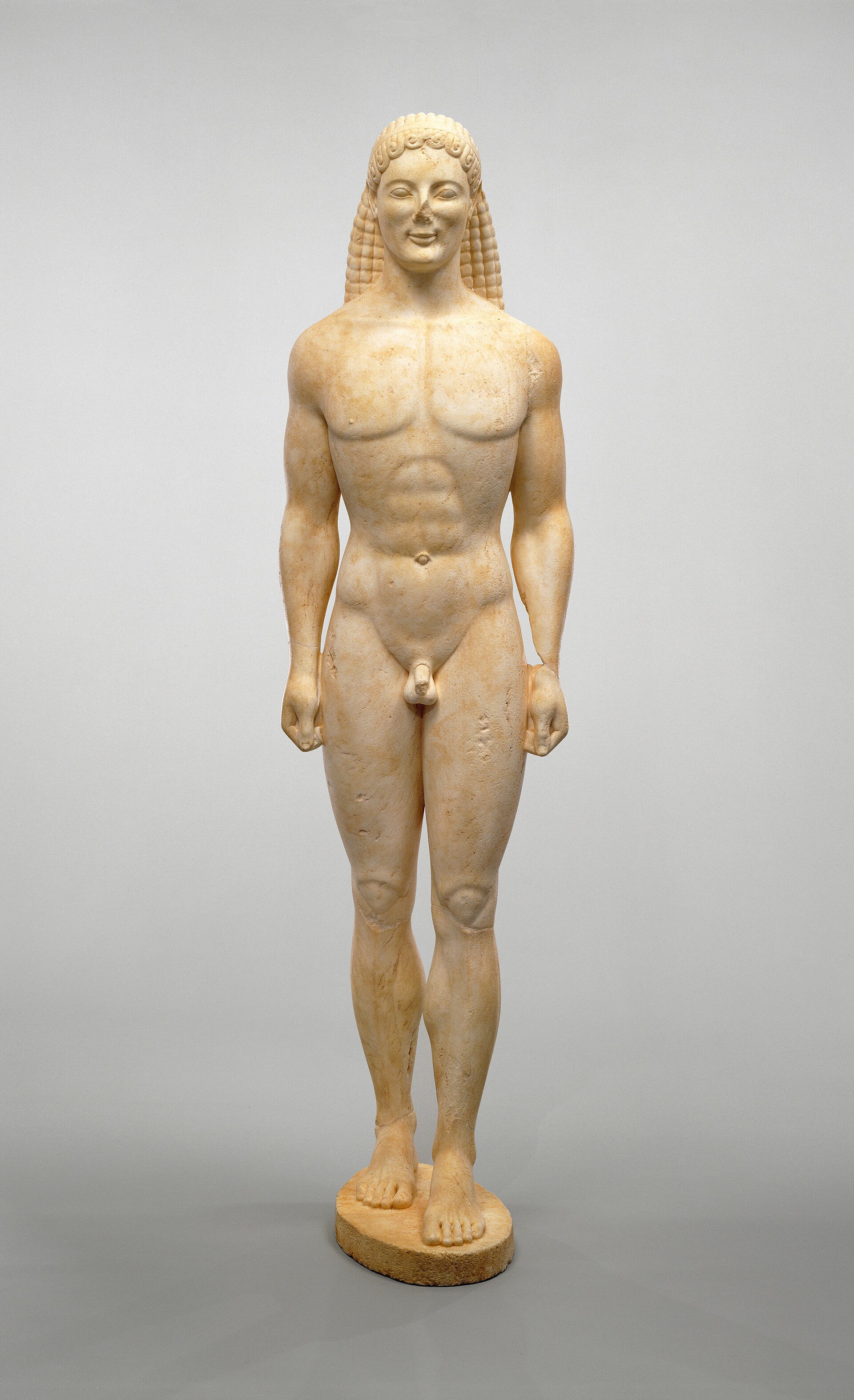
The record subject. Over life-size dolomitic marble, labelled by the museum Greek, about 530 B.C., or modern forgery. Published by the J. Paul Getty Museum under an open-content licence.
| Artist | Unidentified sculptor, Greek Archaic or modern |
|---|---|
| Date | About 530 BCE, or twentieth century. The museum has published both possibilities as alternatives and has not chosen between them. |
| Medium | Dolomitic marble, measured by X-ray diffraction at about 88 per cent dolomite and 12 per cent calcite, with the quarry source identified as Thasos at about 90 per cent probability |
| Dimensions | Over life-size. Height about 206 cm, width about 54.6 cm |
| Where it is now | J. Paul Getty Museum, Getty Villa, Malibu, California. Removed from public display in 2018 and held in storage.last confirmed 4 August 2026 |
| Inventory number | 85.AA.40 |
| Attribution | UnknownThe J. Full note |
| Object type | Sculpture |
| Period | Greek Archaic, or twentieth century |
| Inscriptions | None recorded. |
| Owners on record | 4 links2 documented, 2 disputed |
| Sources | 5 cited |
About this record Last verified 5 September 2026 · 5 sources cited · Change log
On this page 10 sections
ContentsClose
An over life-size marble youth in the Archaic Greek manner, standing with the left foot forward and the arms at the sides, bought by the J. Paul Getty Museum in 1985 for around ten million dollars. Its label at the Getty Villa read: Greek, about 530 B.C., or modern forgery. There is no other label like it in a major museum, and it is the most honest sentence in this record.
The statue arrived in Los Angeles in seven pieces with a Swiss provenance going back to 1930, supported by letters. The letters were fabricated: one supposedly written in 1952 carries a postcode that did not exist until 1972, and another of 1955 refers to a bank account that was not opened until 1963. The scientific case for antiquity rested on de-dolomitisation, the leaching of magnesium from the surface of a dolomitic marble, argued by the geologist Stanley Margolis to require centuries and natural conditions. In the early 1990s Miriam Kastner produced the same alteration in a laboratory.
Nineteen invited specialists met in Athens in May 1992 and could not agree. The sculpture came off view in 2018. Nobody has ever named an ancient workshop for it, and nobody has ever proved a modern one.
Provenance
Each link is graded. Documented: a cited source supports it. Disputed: the identification is argued but not established. Unknown: no owner for that span, and the gap is not smoothed into a narrative. The grades in the glossary.
- 1930 - 1983Dr Jean Lauffenberger, Geneva (claimed)disputed
The documents supplied with the statue traced it to the Geneva collection of Dr Jean Lauffenberger, said to have bought it from a Greek dealer in 1930, and included letters of the early 1950s. The Getty's own later investigation established that these letters were forgeries: a 1952 letter attributed to Ernst Langlotz carries a postcode that did not exist until 1972, and a 1955 letter refers to a bank account not opened until 1963. This link is recorded because it was the basis of the purchase, and it is graded disputed because its documentary support is known to be false. Nothing is established about the statue's whereabouts before 1983.12
- before 1983 - 1983Reported chain through Calabria to Gianfranco Becchinadisputed
Jason Felch and Ralph Frammolino reported in 2011 that a man named Fernando Onore sold the statue to an intermediary in Calabria for an undisclosed sum, and that the intermediary sold it to Gianfranco Becchina for one hundred thousand dollars. This is a published account of a claim made after the 1992 colloquium. No finding has been made, and the same source states that whether Becchina knew the object's status is unknown.1
- 1983 - 1985Gianfranco Becchina, Basel, on deposit at the Gettydocumented
In September 1983 the Getty's antiquities curator Jiri Frel took the statue on loan for approval from the Basel dealer Gianfranco Becchina, together with the provenance documents. It arrived in seven pieces and was held at Malibu while the acquisition was considered.12
- 1985 - presentJ. Paul Getty Museum, Malibudocumented
Acquisition approved in January 1985. The price is reported as 9.5 million dollars by the Trafficking Culture project and as 10 million by other accounts; the figures have not been reconciled and both are recorded here. Federico Zeri, a founding trustee, had argued that the statue was a forgery and should not be bought, was overruled, and left the board in 1984. First exhibited October 1986 and publicly announced in 1987 by the curator Marion True. Displayed for years with the label Greek, about 530 B.C., or modern forgery. Removed from display in April 2018 after a reinstallation of the Getty Villa and held in storage, viewable by appointment. Accession number 85.AA.40.123
Prices realised
This statue has never been offered at public auction. It was acquired privately from a dealer, and the reported price is a negotiated purchase price rather than a hammer price, so there is no premium to separate from it. The reported figure is not consistent between sources: the Trafficking Culture research project gives 9.5 million US dollars for the acquisition approved in January 1985, while other accounts give 10 million. Both are recorded and neither is preferred. A separate reported figure of 100,000 US dollars appears in Felch and Frammolino's account of an earlier transfer to the dealer; it is an unverified claim about a private sale and is not a market price for this object.
Technical evidence
| Attribution note | The J. Paul Getty Museum's own label read: Greek, about 530 B.C., or modern forgery. That is not a hedge, it is the finding. The statue was bought in 1985 with provenance documents that were later shown to be fabricated; a geological argument for antiquity based on de-dolomitisation of the marble surface was published, and then undercut when the same alteration was produced artificially in a laboratory; nineteen experts convened in Athens in 1992 could not agree. The sculpture was removed from display in 2018. No positive attribution to an ancient workshop or to a modern hand has ever been established. |
|---|---|
| Material | Dolomitic marble. X-ray diffraction gave approximately 88 per cent dolomite and 12 per cent calcite.2 |
| Quarry source | Identified as the island of Thasos with about ninety per cent probability, on the isotopic and petrographic criteria set out in the classical marble literature.2 |
| Dimensions | Over life-size; height about 206 cm and width about 54.6 cm. The Getty's own published measurements could not be retrieved for this record, and these figures come from an aggregated database entry.4 |
| Condition on arrival | The statue was deposited at Malibu in 1983 in seven pieces.2 |
| De-dolomitisation | Stanley Margolis of the University of California, Davis, found that magnesium had leached from the dolomite of the surface, leaving a crust of calcite, and concluded that this could occur only over many centuries and under natural conditions. This was the principal scientific argument for antiquity.12 |
| The counter-experiment | In the early 1990s Miriam Kastner induced de-dolomitisation artificially in the laboratory. The procedure is not simple, but the demonstration removed the inference on which Margolis's argument depended: the absence of magnesium can no longer be taken as a reliable indication of authenticity.12 |
| The comparison forgery | A kouros torso, a certain forgery published by Jeffrey Spier in 1990, was bought by the Getty for study. It is of identical dolomitic marble, but the sculpting techniques differ dramatically from those of the statue, including the use of power tools. Spier proposed a Rome workshop and possibly the same block of marble; the direct comparison did not bear that out.12 |
| Provenance documents | A 1952 letter attributed to Ernst Langlotz carries a postcode that did not exist until 1972. A 1955 letter refers to a bank account that was not opened until 1963. The Getty's own subsequent investigation established that the letters said to constitute the provenance were forgeries.12 |
| Museum label | Greek, about 530 B.C., or modern forgery. In use on the gallery label and in the museum's online record for many years.12 |
| Current status | Removed from public display in April 2018 following a reinstallation of the Getty Villa, and held in storage, viewable by appointment. Accession number 85.AA.40 retained. The museum's photograph of the object is published under a CC0 open-content licence.23 |
Images
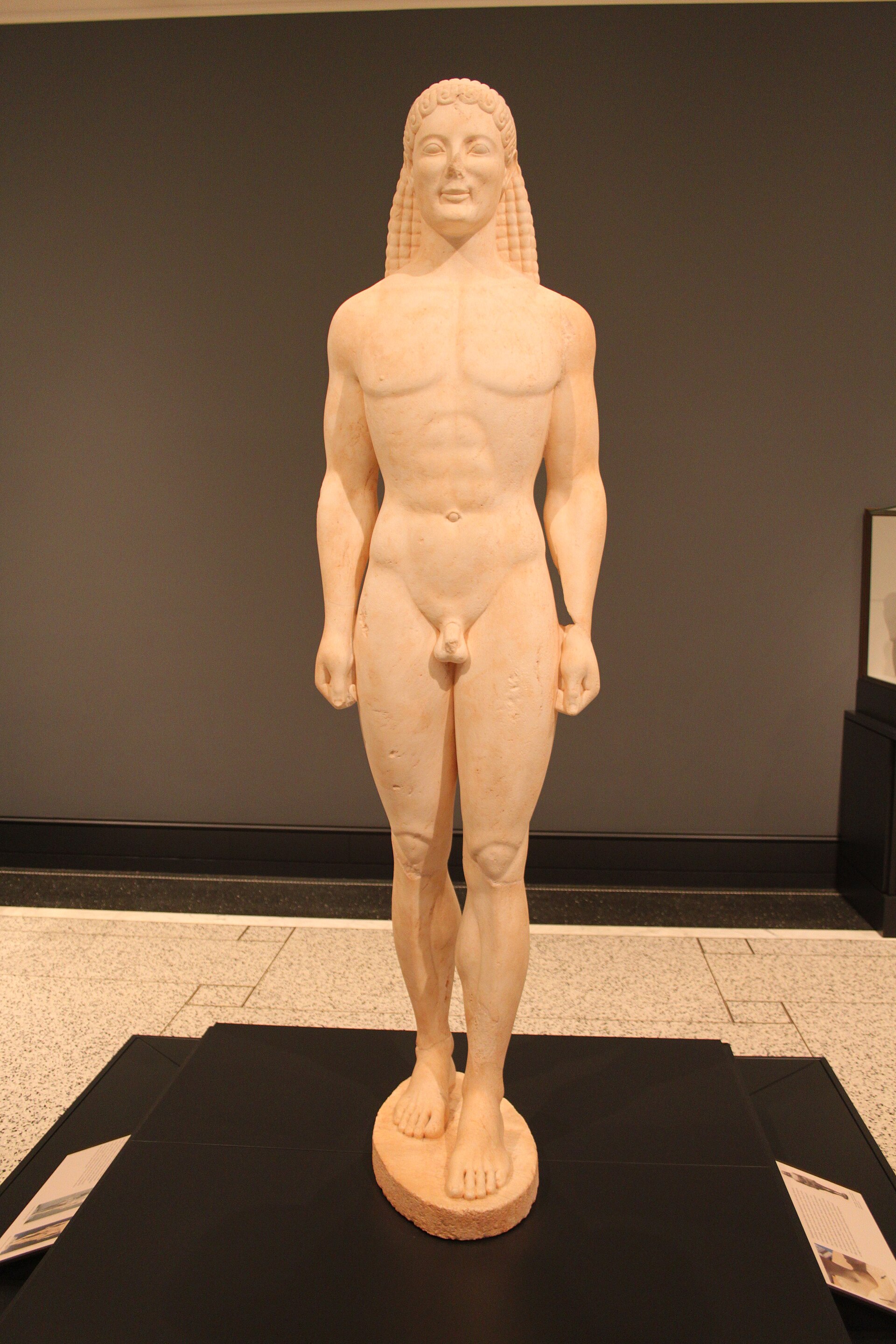
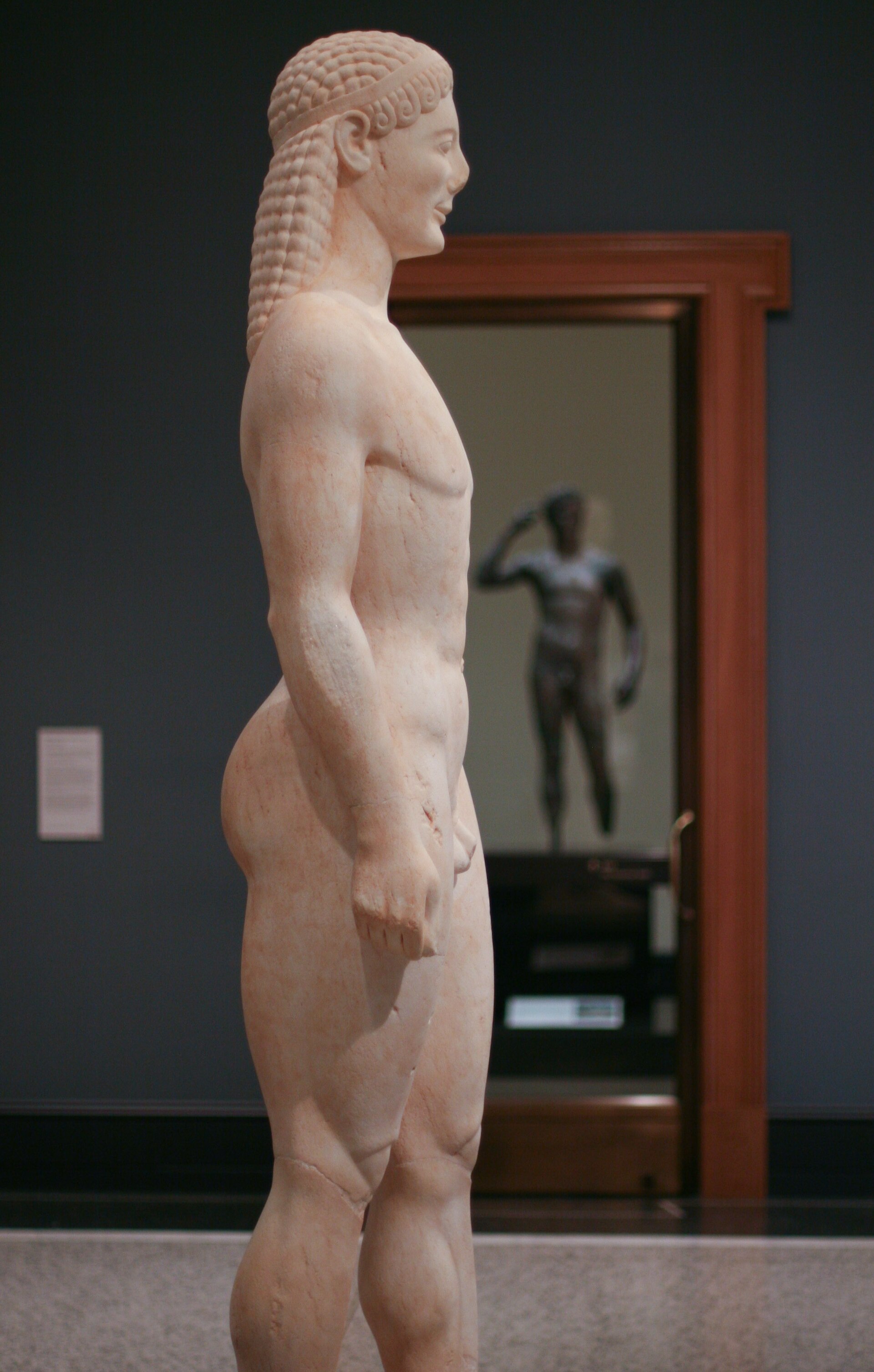
The record in full
Chapter 1The label is the object
For most of the time it was on show, the wall text beside this statue at the Getty Villa read: Greek, about 530 B.C., or modern forgery.Museums do not write labels like that.
For most of the time it was on show, the wall text beside this statue at the Getty Villa read: Greek, about 530 B.C., or modern forgery.
Museums do not write labels like that. A label is an institutional assertion, and the whole apparatus of curatorship exists to make one possible. This one refuses. It sets out two propositions separated by two and a half thousand years and declines to prefer either, and it stayed up for years while the museum kept the object on public view underneath it.
Whatever else is true about this sculpture, that sentence is the most valuable thing about it, and it is worth being clear about what it costs an institution to write. It concedes that a purchase of around ten million dollars may have bought nothing; that the museum's own experts cannot settle the question; and that the visitor is being handed an unresolved problem rather than a fact. It is also, on the evidence, correct.
Chapter 2What the thing is
A kouros is a standing nude male figure, an Archaic Greek type used both as a dedication in sanctuaries and as a grave monument.
A kouros is a standing nude male figure, an Archaic Greek type used both as a dedication in sanctuaries and as a grave monument. The standard pose is fixed: left foot forward, arms at the sides, looking straight ahead. The figure is carved in from four faces of a rectangular block and retains the block's general shape, and Archaic sculptors reduced anatomy and musculature to decorative patterning across the marble surface. The type is not a portrait of any individual; it is the idea of youth.
This one is over life-size, about 206 centimetres high and 54.6 across, in dolomitic marble. X-ray diffraction gave a composition of roughly 88 per cent dolomite and 12 per cent calcite, and the quarry source was identified as the island of Thasos with about ninety per cent probability.
Dolomitic marble matters to the case in a way ordinary calcitic marble would not, because the whole scientific argument for the statue's antiquity depends on a chemical alteration that only dolomite undergoes.
Chapter 3Seven pieces and a Basel dealer
The sculpture entered the Getty's orbit in September 1983, when the antiquities curator Jiri Frel took it on loan for approval from the dealer Gianfranco Becchina, based in Basel.
The sculpture entered the Getty's orbit in September 1983, when the antiquities curator Jiri Frel took it on loan for approval from the dealer Gianfranco Becchina, based in Basel. It arrived in seven pieces.
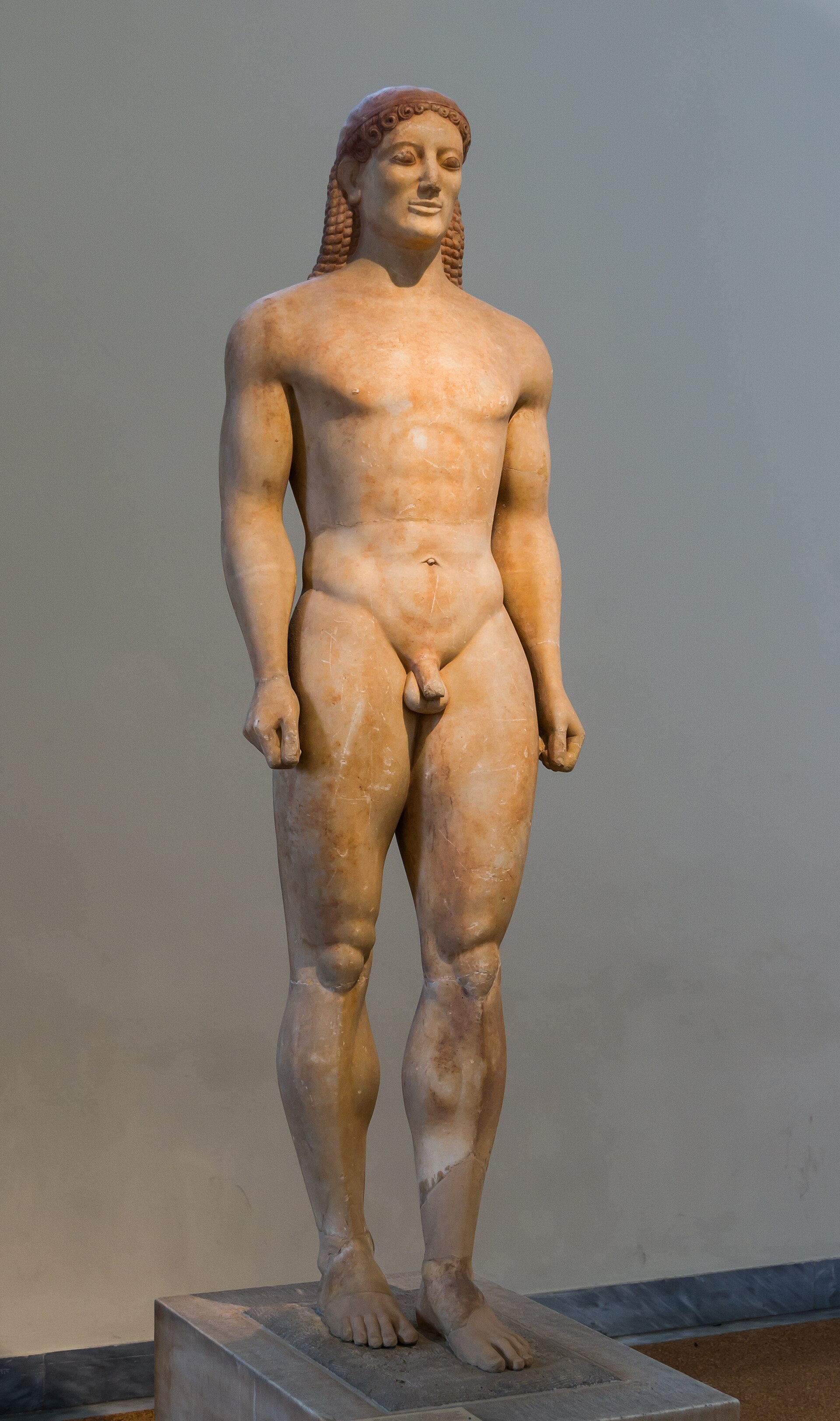
With it came documents. They traced the statue to the Geneva collection of a Dr Jean Lauffenberger, who was said to have acquired it from a Greek dealer in 1930, and included correspondence from the early 1950s. One letter, dated 1952, purported to be from Ernst Langlotz, then the leading authority on Archaic Greek sculpture, remarking on the statue's resemblance to the kouros from Anavyssos in Athens, National Archaeological Museum 3851. Another, of 1955, referred to repairs carried out by a restorer named as A. E. Bigenwald.
A provenance beginning in 1930 was not incidental. It placed the statue in a private collection before the modern law of cultural property, and it supplied the one thing an unexcavated antiquity cannot supply for itself: a history.
Chapter 4The three dates that destroyed the paperwork
The letters were forgeries, and they were caught by dates rather than by handwriting.The postcode on the 1952 Langlotz letter did not come into existence until 1972.
The letters were forgeries, and they were caught by dates rather than by handwriting.
The postcode on the 1952 Langlotz letter did not come into existence until 1972. A bank account referred to in a 1955 letter was not opened until 1963. A document cannot cite something that does not yet exist, and no amount of expertise in Archaic sculpture is required to see it; the check is clerical.
That is the most transferable lesson in this file. Forged provenance is generally not detected by testing the object. It is detected by testing the paper against the calendar: postcodes, telephone formats, letterheads, company registrations, bank accounts, the death dates of the people who supposedly wrote and received things. Whoever assembled this dossier knew a great deal about Greek sculpture and not enough about the Deutsche Bundespost.
The Getty's own later investigation established that the letters constituting the provenance were fabrications. What that establishes about the statue is precisely nothing. A forged provenance proves that somebody wanted the object to have a history it did not have; it does not prove the object is modern. The two questions are separate, and running them together is the commonest error made about this case.
Chapter 5A trustee resigns
Federico Zeri, the Italian art historian and a founding member of the museum's board of trustees, argued that the kouros was a forgery and should not be bought.
Federico Zeri, the Italian art historian and a founding member of the museum's board of trustees, argued that the kouros was a forgery and should not be bought. He was overruled. He left the board in 1984.
The acquisition was approved in January 1985. The reported price differs between careful sources: the Trafficking Culture research project at the University of Glasgow gives 9.5 million dollars, and other accounts give 10 million. This record does not reconcile them; the discrepancy is itself information about how little of this transaction was ever made public.
The statue was first exhibited in October 1986 and publicly announced in 1987 by Marion True, who by then held the antiquities curatorship. Marion True and Jiri Frel are both matters of public record in this chain and appear here only in the roles the published sources give them.
Chapter 6The science that seemed to settle it
The case for antiquity was geological and it was, on its face, powerful.Stanley Margolis, a geology professor at the University of California, Davis, examined the marble and found that the surface...
The case for antiquity was geological and it was, on its face, powerful.
Stanley Margolis, a geology professor at the University of California, Davis, examined the marble and found that the surface had undergone de-dolomitisation: the magnesium had leached out of the dolomite, leaving a crust of calcite. His conclusion was that this alteration could occur only over the course of many centuries and only under natural conditions.
That is exactly the kind of argument that ends an authenticity dispute, because it is not a judgement about style. It is a claim about a chemical process with a known rate, applied to a surface that a sculptor cannot fake by carving. If it holds, the statue was in the ground or exposed to weather for a very long time and cannot be a modern carving.
It did not hold.
Chapter 7The same crust, made in a laboratory
In the early 1990s Miriam Kastner induced de-dolomitisation artificially in the laboratory.
In the early 1990s Miriam Kastner induced de-dolomitisation artificially in the laboratory. The procedure was not simple, and nobody has claimed that a forger casually did it. But the argument Margolis had made was not that artificial de-dolomitisation is difficult. It was that it is impossible, and that the absence of magnesium is therefore a reliable indicator of age. Once the alteration had been produced by human agency in a laboratory, that inference was gone.
This is the central mechanism of the record and it deserves to be stated in general terms, because it recurs across the whole field. A scientific authentication argument has two halves: the measurement, and the claim that no process other than age could produce the measurement. The measurement is usually robust. The second half is a negative claim about the entire space of possible processes, and negative claims of that kind are only as good as the current state of knowledge. Margolis's measurement was never challenged. What was refuted was the sentence that gave it evidential force.
The consequence is that the geology no longer decides anything in either direction. De-dolomitisation on this statue is consistent with two and a half millennia of burial. It is also consistent with a laboratory. A test that is consistent with both hypotheses is not evidence for either.
Chapter 8The torso in Basel
In 1990 Jeffrey Spier published a study in the Burlington Magazine under the title Blinded by Science.
In 1990 Jeffrey Spier published a study in the Burlington Magazine under the title Blinded by Science. He had found a kouros torso which is a certain forgery and which shows notable technical similarities to the Getty statue. The proposal was that both had come out of a workshop in Rome, and possibly out of the same block of marble.
The Getty bought the torso for study purposes, which is a rational and underused institutional act. Having acquired it, the museum could compare the two directly, and the comparison cut against Spier's reading: the torso is made of identical dolomitic marble, but the sculpting techniques are dramatically different, including the use of power tools that the Getty statue does not show.
So the comparison object established that a modern forger did carve dolomitic marble of this kind, and did not establish that this modern forger carved this statue. Like everything else in the file, it narrows nothing.
Chapter 9Athens, 25 to 27 May 1992
The Getty then did something no museum was obliged to do.
The Getty then did something no museum was obliged to do. It shipped the disputed statue to Greece and convened a colloquium in Athens from 25 to 27 May 1992, at which nineteen invited specialists, scientists and connoisseurs together, examined it and argued.
They did not reach a consensus. The proceedings were published the following year under the editorship of Angeliki Kokkou, which means the disagreement itself is on the record in a citable form rather than being reported second-hand.
A remark attributed to one American museum curator at the conference, quoted in The Economist of 20 June 1992, is the summary the case deserves: the moral is, never ever buy a piece without a provenance.
That is the finding. Not that the statue is fake, and not that the science failed, but that an object with no findspot and no verifiable history cannot be resolved after the fact by any means available, and that the resolution had to happen at the point of purchase or not at all.
Chapter 10Off view since 2018
Following a reinstallation of the Getty Villa, the kouros came off public display in April 2018 and went into storage, viewable by appointment.
Following a reinstallation of the Getty Villa, the kouros came off public display in April 2018 and went into storage, viewable by appointment. The museum's director, Timothy Potts, is reported to have said that it was removed because of its disputed authenticity.
Removing it from the galleries is not the same act as deaccessioning it or as issuing a finding. It is a decision about what a gallery of authentic Archaic sculpture should contain, and it can be read either as a quiet concession that the object is modern or as ordinary curatorial hygiene about an unresolved object. The sources consulted here do not record a formal change to the catalogue entry, and the object retains its accession number, 85.AA.40, and the photograph the Getty publishes of it under an open licence.
Later claims about who made it circulate in the literature. Ralph Frammolino and Jason Felch reported in 2011 that a man named Fernando Onore had sold the statue to an intermediary in Calabria, who sold it on to Becchina for one hundred thousand dollars. That is a published account of a claim; no finding has been made, and the same source states that whether Becchina knew the object's status is unknown. It is recorded here because it is in the published record and for no stronger reason.
Chapter 11What this object is actually useful for
It is the best available demonstration that scientific authentication is asymmetric.Science can exclude.
It is the best available demonstration that scientific authentication is asymmetric.
Science can exclude. Thermoluminescence excluded a modern date for the Metropolitan Museum's bronze horse; radiocarbon excluded the Renaissance for the Berlin Flora bust. Those are strong results because they are negative: they rule a period out, and a rule-out survives improvements in technique.
Science struggles to confirm. To use a measurement as proof of age, somebody has to assert that nothing but age could produce it, and that assertion is a claim about everything anyone might ever be able to do. Margolis's de-dolomitisation argument was of the confirming kind, and it lasted until one laboratory did the thing it said could not be done.
The second lesson is about sequence. The provenance documents were checked and found false after the purchase. Every one of the disqualifying facts, the postcode and the bank account, was available before it, at the cost of a few enquiries, and none of them required an opinion about Archaic sculpture. The Getty spent around ten million dollars and then thirty years of scientific and scholarly effort on a question that a clerk with a directory could have opened in an afternoon.
And the third is the label. Faced with an object it could not resolve, the museum printed the alternatives on the wall and left them there. That was the right thing to do, and it is the reason this record can be written at all.
The artist
Unidentified: either an Archaic Greek sculptor of about 530 BCE or a twentieth-century carver
There is no maker to describe, and the reason there is none is the subject of this record. What can be described is the type, because the kouros is one of the most rigidly codified forms in Greek sculpture, and that codification is exactly what makes it forgeable. A form defined by a small number of fixed rules can be reproduced by anybody who knows the rules.
The second thing that can be described is the market that the object entered. An unexcavated antiquity has no author, no findspot and no history, and its value therefore rests entirely on documents supplied by the seller. Every feature of this case follows from that: the letters, the Geneva collection, the 1930 date that predates the modern law of cultural property, and the thirty years of laboratory work undertaken to answer a question that documents should have answered at the outset.
Related works
| Work | Relation | Where it is |
|---|---|---|
| Kouros of Anavyssos, known as Kroisos Unidentified Attic sculptor | The comparison named in the forged 1952 Langlotz letter About 530 BCE, from a grave at Anavyssos in Attica. The forged provenance document invoked it precisely because it is the securely dated benchmark for a kouros of this moment. | National Archaeological Museum, Athens, inv. 3851 |
| Kouros torso, a certain forgery Unidentified modern hand | Bought by the Getty for study after Jeffrey Spier published it in 1990 Same dolomitic marble; dramatically different carving technique, including power tools. Proposed as coming from the same Rome workshop and possibly the same block, a proposal the direct comparison did not support. | J. Paul Getty Museum |
| Statue of a Victorious Youth Unidentified Greek bronze caster | The Getty's other contested antiquity Undisputed as ancient and disputed as to title and export, where the kouros is the reverse: nobody disputes how it entered the collection, and nobody can say what it is. | J. Paul Getty Museum, Getty Villa |
| Bronze statuette of a horse Unrecorded Greek bronze caster | The opposite outcome under an absolute dating method Condemned as a forgery in 1967 and cleared by thermoluminescence, which could exclude a modern date. No comparable exclusion is available for carved marble, which is why the kouros remains open. | The Metropolitan Museum of Art, New York, 23.69 |
Open questions
- Is the statue ancient or modern? Nineteen specialists convened in Athens in 1992 could not agree, and no evidence published since has settled it.
- If modern, who carved it and where? Claims reported by Felch and Frammolino in 2011 name a seller and an intermediary in Calabria; no finding has been made and the account is unverified.
- What did the Getty actually pay? Trafficking Culture gives 9.5 million dollars for the acquisition approved in January 1985; other accounts give 10 million. The two figures have not been reconciled.
- Has the museum ever formally amended the catalogue entry, or only removed the object from display? The sources consulted record the 2018 removal and no change of attribution.
- Where did the dolomitic marble of the comparison torso come from, and does it in fact share a block with the statue? Spier proposed it; the technical comparison at the Getty pointed away from it.
- What are the Getty's own published dimensions and full condition report? The museum's collection page could not be read by any automated method used for this record, and the measurements given here come from an aggregated database.
- Who was Dr Jean Lauffenberger, and did he exist as described? The Geneva collection is the load-bearing claim of a provenance whose supporting letters are forged, and no independent record of it is cited in the sources consulted.
Questions about this object
What is Kouros?
Kouros is a sculpture, dated about 530 BCE, or twentieth century. The museum has published both possibilities as alternatives and has not chosen between them.. Medium: Dolomitic marble, measured by X-ray diffraction at about 88 per cent dolomite and 12 per cent calcite, with the quarry source identified as Thasos at about 90 per cent probability.
Who made Kouros, and is the attribution settled?
The attribution to Unidentified sculptor, Greek Archaic or modern is recorded here as unknown. The J. Paul Getty Museum's own label read: Greek, about 530 B.C., or modern forgery. That is not a hedge, it is the finding. The statue was bought in 1985 with provenance documents that were later shown to be fabricated; a geological argument for antiquity based on de-dolomitisation of the marble surface was published, and then undercut when the same alteration was produced artificially in a laboratory; nineteen experts convened in Athens in 1992 could not agree. The sculpture was removed from display in 2018. No positive attribution to an ancient workshop or to a modern hand has ever been established.
Where is Kouros now?
J. Paul Getty Museum, Getty Villa, Malibu, California. Removed from public display in 2018 and held in storage. Inventory number 85.AA.40. Last confirmed 4 August 2026. Purchased 1985 from the dealer Gianfranco Becchina.
What is still unknown about Kouros?
Is the statue ancient or modern? Nineteen specialists convened in Athens in 1992 could not agree, and no evidence published since has settled it.
Sources
- 1Trafficking Culture (University of Glasgow), case study 'Getty Kouros'. Research-project account of the 1983 loan for approval from Gianfranco Becchina to Jiri Frel, the January 1985 approval at 9.5 million dollars, the 1987 public announcement by Marion True, the Lauffenberger provenance and the finding that the letters were forgeries, the de-dolomitisation argument and its refutation, Spier's 1990 torso, the 1992 Athens colloquium of nineteen experts, the museum label, and the claims reported by Felch and Frammolino in 2011. traffickingculture.org/encyclopedia/...
- 2Wikipedia, 'Getty kouros'. Tertiary source, used for the marble composition of 88 per cent dolomite and 12 per cent calcite by X-ray diffraction, the Thasos identification at ninety per cent probability, the arrival in seven pieces, the 1972 postcode and 1963 bank account, Stanley Margolis and Miriam Kastner, Federico Zeri's resignation, the colloquium dates of 25 to 27 May 1992, the museum label, the 2018 removal, and the bibliography (Kokkou 1993; Herz and Waelkens 1988; Spier, Burlington Magazine 132 (1990), pp. 623-631; True, Burlington Magazine 129, no. 1006 (1987), pp. 3-11; Kimmelman, New York Times, 4 August 1991). Flagged for replacement with the colloquium proceedings and the Burlington articles. en.wikipedia.org/wiki/...
- 3Wikimedia Commons file page for the J. Paul Getty Museum's own open-content photograph of the kouros, accession 85.AA.40. Read as wikitext: carries the Getty's own descriptive essay on the kouros type, arete and kalokagathia and the Theognis quotation, and the CC0 licence tag under which the museum publishes the image. commons.wikimedia.org/wiki/...
- 4Wikidata item Q5554723, Getty Kouros. Tertiary aggregated record, used only for the height of 206.1 cm, the width of 54.6 cm and the inventory number 85.AA.40, because the museum's own collection page could not be read by any automated method attempted for this record. Flagged for replacement with the Getty's published measurements. wikidata.org/wiki/...
- 5J. Paul Getty Museum, collection page for the kouros, object 103VNP. The canonical museum record. The page is a JavaScript application which returns no catalogue content to any automated fetch attempted here, including direct request, the Wayback Machine and the museum's linked-data endpoints, so no claim in this record rests on it. getty.edu/art/...
.jpg)
Last verified 5 September 2026 · Published 4 August 2026
Change log
4 August 2026 - Record created at the house standard: researched narrative, technical evidence, maker dossier, graded provenance chain, prices with hammer and premium separated, related works, open questions and sources.
5 September 2026 - Re-verification pass. No change: still in storage at the Getty Villa, viewable by appointment only, no new scientific study, ownership move or formal redetermination found since 2026-08-04. Checked one press claim explicitly: a widely-shared 2018 Artsy headline states the sculpture 'was officially deemed a forgery' - read the article's own body text directly, which instead quotes the museum's own gallery label as still reading Greek, about 530 B.C., or modern forgery and quotes then-director Timothy Potts's personal view ('it's fake') from the 2018 storage move. That is a director's stated opinion, not a formal curatorial or scientific redetermination superseding the label's own both-or language, and the record's existing text (no positive attribution to an ancient or a modern hand has been established) remains accurate. No correction needed.