Bust of Flora
Attributed to Richard Cockle Lucas · After 1700 on radiocarbon evidence; reported by the maker's son to have been modelled in 1846. Bought and exhibited as about 1500.
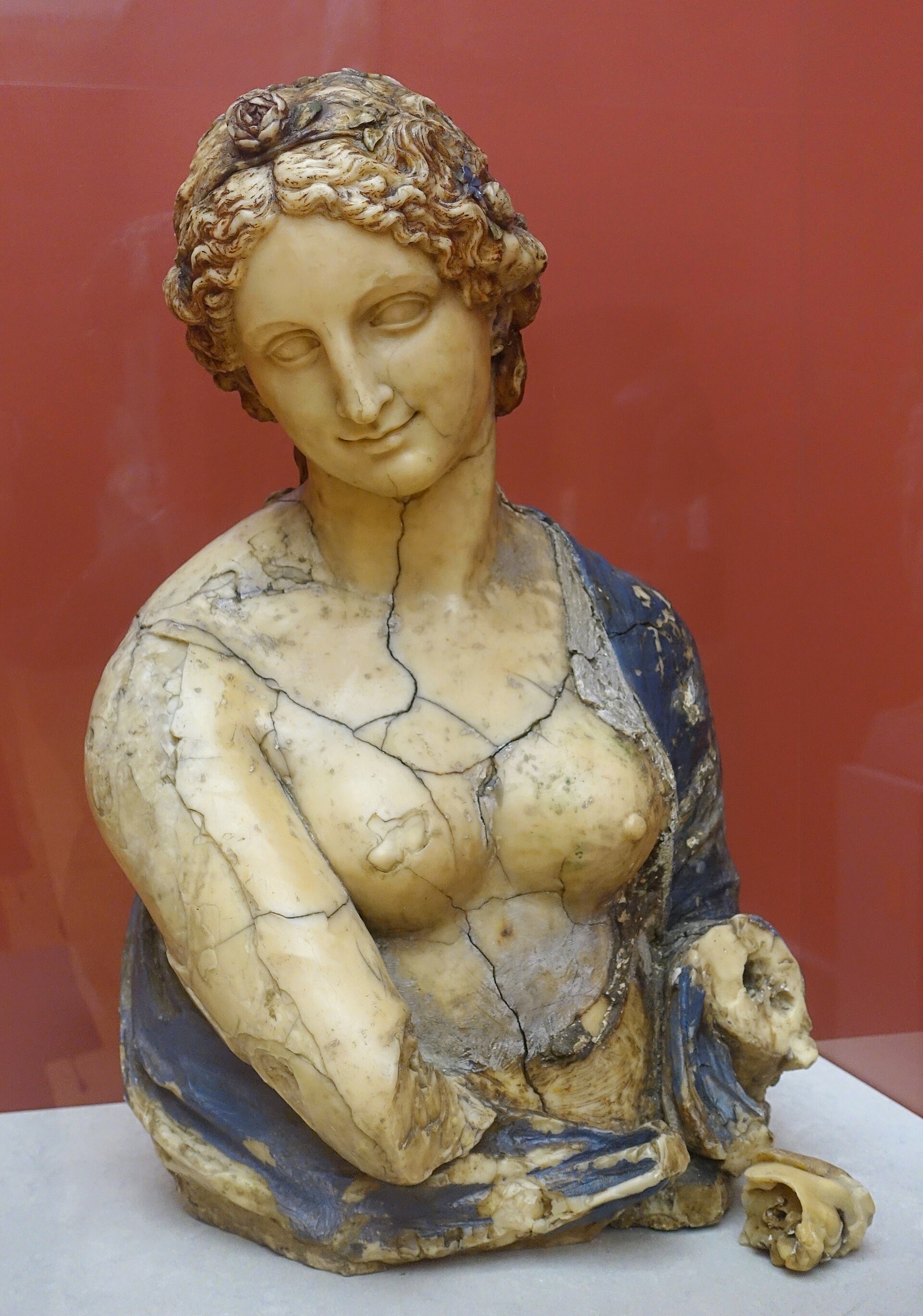
The record subject. Painted wax, about 70 cm high, Skulpturensammlung und Museum fuer Byzantinische Kunst, inventory 5951. Bought in London in 1909 as a Leonardo; radiocarbon dating published in 2021 places every analysed constituent after 1700.
| Artist | Attributed to Richard Cockle Lucas |
|---|---|
| Date | After 1700 on radiocarbon evidence; reported by the maker's son to have been modelled in 1846. Bought and exhibited as about 1500. |
| Medium | Wax, principally spermaceti with minor beeswax and probably stearin or tallow, partly painted; hollow cast in at least three layers by lost-wax moulding |
| Dimensions | About 70 cm high; weight approximately 28 kg |
| Where it is now | Skulpturensammlung und Museum fuer Byzantinische Kunst, Bode-Museum, Staatliche Museen zu Berlin, Stiftung Preussischer Kulturbesitzlast confirmed 17 September 2026 |
| Inventory number | 5951 |
| Attribution | DisputedBought in London in 1909 by Wilhelm von Bode for the Berlin royal museums as a work of Leonardo da Vinci, and challenged in the English press within a year as a wax made in 1846 by the Southampton sculptor Richard Cockle Lucas. Full note |
| Object type | Sculpture |
| Period | Nineteenth century, in the manner of the Italian Renaissance |
| Cases | Disputed attribution · Has a provenance gap |
| Inscriptions | None recorded. The cavity behind the bust was found to contain a wooden spar, newspaper and textile, all of nineteenth-century date. |
| Owners on record | 4 links1 documented, 2 disputed, 1 unknown |
| Sources | 5 cited |
About this record Last verified 17 September 2026 · 5 sources cited · Change log
On this page 10 sections
ContentsClose
A painted wax bust of a young woman as Flora, about seventy centimetres high and weighing some twenty-eight kilograms, bought in London in 1909 by Wilhelm von Bode, director general of the Prussian collections, as a work by Leonardo da Vinci. Within two years more than seven hundred and thirty articles had been published about it in Germany, England, France, Italy, Austria and Denmark. The English press said it had been made in 1846 by a Southampton sculptor named Richard Cockle Lucas, and Lucas's son swore that he had helped his father build it out of candle ends.
The case ran for a century because the material fought back. The bust is made of spermaceti, the wax from the head cavity of the sperm whale, and a whale's carbon is not in equilibrium with the atmosphere. Radiocarbon measurements on it come out several centuries too old unless they are corrected for the marine reservoir effect, and no reservoir age for sperm whale material had ever been published.
Ina Reiche, Lucile Beck and Ingrid Caffy solved that in 2021 by calibrating against a wax relief Lucas made in 1850, of nearly identical composition, whose date is known. Every analysed constituent of the Flora bust dates after 1700. It cannot be by Leonardo. Who made it is still not proved.
Provenance
Each link is graded. Documented: a cited source supports it. Disputed: the identification is argued but not established. Unknown: no owner for that span, and the gap is not smoothed into a narrative. The grades in the glossary.
- 1846 - unknownRichard Cockle Lucas, Southampton (claimed)disputed
Albert Lucas made a statutory declaration that his father Richard Cockle Lucas made the Flora bust in 1846, that he assisted him, and that the wax was built up in layers from candle ends. A watercolour of the bust by Lucas's son also survives, and The Times published the claim in 1910. Graded disputed because it is testimony by an interested party more than sixty years after the event, and because the radiocarbon evidence, while compatible with it, cannot confirm a specific year.14
- unknown - 1909Unrecordedunknown
Nothing is recorded of the bust between its making and its appearance on the London market in 1909. This gap is the reason the 1846 claim cannot be corroborated by ownership evidence.
- 1909 - 1909London art marketdisputed
The mechanism of the 1909 sale is described in two incompatible ways in the modern literature. Reiche, Beck and Caffy state that Wilhelm Bode bought the bust at an auction in London for a high price, 185,000 gold marks. The German account of the case names the London art dealer Murray Marks as the seller, acting through an intermediary, Willy Gretor, and notes a second reported price of 160,000 marks. Both are recorded here and neither is preferred.13
- 1909 - presentStaatliche Museen zu Berlindocumented
Acquired in 1909 by Wilhelm von Bode, director general of the Berlin royal museums, and attributed by him to Leonardo da Vinci on the resemblance of the face to figures in known Leonardo paintings; published by Bode in the Jahrbuch der Koeniglich Preussischen Kunstsammlungen in 1909 and in Kunst und Kuenstler in 1910. More than 730 articles for and against appeared within two years across Germany, England, France, Italy, Austria and Denmark, and the argument continued into the 1930s. Now inventory 5951 in the Skulpturensammlung und Museum fuer Byzantinische Kunst, shown in the Bode-Museum, with the authorship recorded as not entirely clarified.134
Prices realised
The reported price of the 1909 acquisition is 185,000 gold marks, with a second figure of 160,000 marks reported elsewhere. It cannot be classified as a hammer price or as a negotiated price, because the sources disagree on whether the transaction was an auction in London or a private sale through the dealer Murray Marks acting via an intermediary. No auction house, sale date or lot number is given in any source consulted, and there is therefore no premium to separate from the reported sum. No modern currency equivalent is offered, because conversion methods for the 1909 gold mark differ by an order of magnitude.
Technical evidence
| Attribution note | Bought in London in 1909 by Wilhelm von Bode for the Berlin royal museums as a work of Leonardo da Vinci, and challenged in the English press within a year as a wax made in 1846 by the Southampton sculptor Richard Cockle Lucas. Radiocarbon dating published in Scientific Reports in April 2021 established that every analysed constituent of the bust postdates 1700, which excludes the Renaissance and therefore excludes Leonardo. That is a negative finding and the authors state it as one. It does not by itself put the bust in Lucas's hands, although the wax of the Flora and the wax of a relief he made in 1850 proved chemically almost indistinguishable. No museum has published a positive attribution to any named maker. |
|---|---|
| Material | Wax, partly painted. Gas chromatography with mass spectrometry identifies it as principally spermaceti of type A, from the sperm whale Physeter macrocephalus, with minor components of beeswax. The main fatty acid ester components are tetradecyl tetradecanoate, hexadecyl hexadecanoate and hexadecyl dodecanoate. A high acid content and stearic acid indicate stearin or possibly tallow in the mixture.1 |
| Dimensions and weight | About 70 cm high; weight approximately 28 kg. Inventory number 5951, Skulpturensammlung und Museum fuer Byzantinische Kunst, Staatliche Museen zu Berlin.1 |
| Construction | Hollow cast in at least three wax layers by lost-wax moulding, the innermost layer being the most opaque. Established by X-ray radiography and tomography, neutron tomography and endoscopy.1 |
| Pigment evidence | Infrared spectroscopy found lead stearates in the Flora bust and untransformed lead white in the comparison relief by Lucas. Lead stearate is probably a degradation product of lead white.1 |
| The filling | The cavity at the back contained a wooden spar of coniferous wood cut on the half strand, newspaper and textile. There was not enough of the spar for dendrochronology.1 |
| Radiocarbon: terrestrial materials | Wood 110 plus or minus 30 BP; textile 195 plus or minus 30 BP; paper 170 plus or minus 30 BP; combined 155 plus or minus 20 BP. Calibrated on IntCal20 to 1682-1938, 1646-1950 and 1656-1950 respectively, combining to 1667-1950 AD. All definitively after 1650.1 |
| Radiocarbon: the wax | Six samples from the surface and the interior gave uncalibrated ages from 340 plus or minus 30 to 395 plus or minus 30 BP. Read without correction those would suggest the sixteenth or seventeenth century, which is a large part of why the case survived so long.1 |
| The marine reservoir problem | Spermaceti is marine, and marine carbon is older than atmospheric carbon. The global average reservoir age of surface water is about 500 years, ranging from about 400 in subtropical oceans to over 1000 at the poles, and a sperm whale integrates the reservoir ages of every water mass it feeds in. No reservoir age had ever been published for sperm whale bone or spermaceti except Freundlich's estimate of 300 plus or minus 200 years.1 |
| The calibration method | Because the reservoir age and the exact spermaceti content could not be determined, the authors calibrated against a dated object instead. Richard Cockle Lucas's relief Leda and the Swan, made in 1850, has an almost identical wax composition; the mixture of IntCal20 atmospheric and Marine20 marine curves was adjusted until the Leda distribution sat correctly on either side of 1850, giving 15 per cent atmospheric to 85 per cent marine, plus or minus 10 per cent. Calibrated on the atmospheric curve alone, the Leda dates fall outside its known year, which independently confirms marine carbon in the wax.1 |
| Result | Applying the same mixed calibration to the Flora wax puts all six samples after 1704, with a statistical combination given in the paper's text as 1712-1950. The figure caption for the same data gives 1707-1950; the discrepancy is internal to the paper and immaterial to the conclusion.1 |
| Analytical facilities | 3 MeV micro proton induced X-ray emission at the NewAGLAE facility of the C2RMF, Paris; Fourier transform infrared spectroscopy and gas chromatography with mass spectrometry at the Rathgen-Forschungslabor of the Staatliche Museen zu Berlin; accelerator mass spectrometry radiocarbon dating at the ARTEMIS facility, LMC14-LSCE, Universite Paris-Saclay.1 |
| Earlier examinations | Chemical analysis identified spermaceti in the wax in 1910 and again in the 1980s. Friedrich Rathgen published on the question in 1910 and G. Pinkus analysed the wax in the same year. R. Rottlaender published a study of the authenticity question in the Berliner Beitraege zur Archaeometrie in 1988. The German account of the case states that the bust was the first sculpture to be examined by X-ray, in 1910; that claim is tertiary here and is not independently confirmed.13 |
Images
The record in full
Chapter 1What the object is
A bust of a young woman, bare-breasted, her head inclined and turned, holding a flower: Flora, the Roman goddess of spring and flowering.
A bust of a young woman, bare-breasted, her head inclined and turned, holding a flower: Flora, the Roman goddess of spring and flowering. It stands about seventy centimetres high and weighs approximately twenty-eight kilograms. It is made of wax and is partly painted, and the polychromy is one of the things that persuaded people it was Renaissance work.
Internally it is hollow. X-ray radiography and tomography, neutron tomography and endoscopy establish that it was cast hollow in at least three wax layers by lost-wax moulding, the innermost layer being the most opaque. The cavity at the back can be opened, and when it was opened it was found to contain a wooden spar, newspaper and textile.
The material is the whole case, and it needs stating precisely. Gas chromatography with mass spectrometry shows that the wax is principally spermaceti, the fatty wax taken from the head cavity of the sperm whale, Physeter macrocephalus, with minor amounts of beeswax and a high content of palmitic and stearic acids indicating stearin or possibly tallow in the mixture. Infrared spectroscopy found lead stearates, probably a degradation product of lead white.
Chapter 2Wax was not a Renaissance material for finished sculpture
The first problem with the object was never technical.
The first problem with the object was never technical. It was that no other wax sculpture of the Italian Renaissance is known.
Wax was central to Renaissance sculpture as a means, not as an end: it is the material of the model destroyed in lost-wax casting, and of the bozzetto. A finished, painted, exhibitable wax bust of this scale has no companions in the period. That absence should have been the first question asked in 1909, and it was, by other people, immediately.
Spermaceti compounds the problem in the same direction. It was rare and expensive in the Renaissance, and it was ordinary in the nineteenth century, when it was used for candles and for making sculptures from two-dimensional models. Chemists identified spermaceti in the Flora's wax in 1910, a year after the purchase, and again in the 1980s. The identification alone does not settle the date, because spermaceti did exist in the sixteenth century, but it puts the object in a nineteenth-century material world rather than a Renaissance one.
Chapter 3Bode buys it, 1909
Wilhelm von Bode was the most powerful museum figure in Europe, and he bought the bust in London in 1909 for the Berlin royal museums, hoping to add an outstanding Renaissance object to the...
Wilhelm von Bode was the most powerful museum figure in Europe, and he bought the bust in London in 1909 for the Berlin royal museums, hoping to add an outstanding Renaissance object to the collection. The price is given as 185,000 gold marks.
How he bought it is not agreed. The 2021 study states that Bode bought the bust at an auction in London. The German scholarly summary of the case says the seller was the London art dealer Murray Marks, acting through an intermediary named Willy Gretor, and notes that one source gives the price as 160,000 rather than 185,000 marks. This record does not choose between those accounts; it records that a sale of this size, in London, in 1909, is described in two incompatible ways in the modern literature, and that the difference matters because an auction and a brokered private sale carry different evidence about who knew what.
Murray Marks is a name that recurs in this field. He is the London dealer who bought Reinhold Vasters's studio drawings at the Aachen estate sale in the same year, 1909, the archive that would eventually re-date a large group of Renaissance goldsmiths' work in museums on two continents.
Bode attributed the bust to Leonardo da Vinci on the resemblance of the face to figures in well-known Leonardo paintings, and published the attribution himself in the Jahrbuch der Koeniglich Preussischen Kunstsammlungen in 1909, under a title that ends in a question mark, and again in Kunst und Kuenstler in 1910.
Chapter 4Seven hundred and thirty articles
Within two years of the acquisition more than seven hundred and thirty articles had appeared about the bust in the German and English press and in France, Italy, Austria and Denmark.
Within two years of the acquisition more than seven hundred and thirty articles had appeared about the bust in the German and English press and in France, Italy, Austria and Denmark. The dispute continued into the 1930s.
It was not only an art-historical argument. It ran between Berlin and London in the years before 1914, and national feeling was part of its energy on both sides: a German museum had bought an English wax as an Italian masterpiece, or a British newspaper campaign was trying to humiliate the greatest museum director in Europe, depending on which paper the reader took.
The scale of the coverage is itself a fact about the object. Very few disputed attributions have generated a literature of that size, and almost none in the popular press. It is the reason the case never quietly went away, and the reason a laboratory in Paris was still working on it in 2020.
Chapter 5The son's declaration
The counter-attribution was specific from the start.
The counter-attribution was specific from the start. The Times published an article in 1910 stating that the bust had been made by Richard Cockle Lucas, an English sculptor, working from a painting.
Lucas's son Albert then made a statutory declaration, on oath, that his father had made the Flora bust in 1846, that he had helped him, and that the wax had been built up in layers from candle ends. A watercolour of the bust painted by Lucas's son also survives.
Sworn testimony from a participant is strong evidence and it is not conclusive evidence. It was given by a man with an interest in his father's reputation, about work done more than sixty years earlier, in the middle of an international controversy. What can be said is that the account is specific, was made under legal penalty, and named a date, a method and a source image.
Gustav Pauli, the museum director in Hamburg, put the attribution to Lucas on a scholarly footing: a British nineteenth-century sculptor known to have made a large number of wax sculptures after ancient models.
Chapter 6What was inside the bust, and what that does and does not show
When the back of the bust was opened it was found to contain a wooden spar, newspaper and other materials of the nineteenth century.
When the back of the bust was opened it was found to contain a wooden spar, newspaper and other materials of the nineteenth century. Albert Lucas had described stuffing of exactly that kind.
The 2021 study dated those materials. The wood gave 110 plus or minus 30 years before present, the textile 195 plus or minus 30, the paper 170 plus or minus 30, and the three combine to 155 plus or minus 20. Calibrated against the atmospheric curve they give 1682 to 1938, 1646 to 1950 and 1656 to 1950 respectively, combining to 1667 to 1950; the ranges are broad because the calibration curve is flat across that period. All three are definitively after 1650.
The authors then add the caveat that matters, and they add it themselves: it is possible that these objects were introduced later, when modifications were carried out. A filling is not a signature. If the packing inside the cavity had been the only evidence, the case would still be open, because packing is exactly the kind of thing a restorer replaces.
That is why the wax itself had to be dated, and the wax is where the problem lay.
Chapter 7Why a wax made of whale cannot be dated in the ordinary way
Radiocarbon dating assumes that the carbon in the material was in equilibrium with atmospheric carbon while the organism was alive.
Radiocarbon dating assumes that the carbon in the material was in equilibrium with atmospheric carbon while the organism was alive. Wood, linen, paper and beeswax satisfy that assumption. A sperm whale does not.
Carbon dissolved in the ocean is older than carbon in the air, because it has been out of contact with the atmosphere for a long time. Anything that eats in the sea therefore carries an apparent radiocarbon age that is too great, an offset called the marine reservoir effect. The global average for surface water is around five hundred years; real values range from about four hundred years in subtropical oceans to over a thousand at the poles. A sperm whale travels across all of it, integrating the reservoir ages of every water mass it feeds in.
The consequence for this object is stark. Uncalibrated measurements on the Flora's wax come out between 340 and 395 years before present, which read naively would put the bust in the sixteenth or seventeenth century, which is to say in the Renaissance. Those numbers are a large part of why the case survived so long. They are also wrong, and they are wrong for a reason that has nothing to do with the sculpture.
No marine reservoir age had ever been published for sperm whale bone or for spermaceti. The nearest available values were for other cetaceans: an average of 370 plus or minus 30 years for various North Atlantic whales, from a study of twenty-one animals caught off Norway in the nineteenth century; about 200 years for Canadian Arctic bowheads; 320 plus or minus 35 for marine mammals living near Sweden; about 350 for a seventeenth-century finback whale from Spitsbergen; and 570 plus or minus 95 for bowheads in a compilation from the Canadian Arctic archipelago. The only estimate for spermaceti was Juergen Freundlich's, of 300 plus or minus 200 years.
Chapter 8Freundlich's date in the 1980s, and why one measurement was not enough
The first radiocarbon date on the bust was made by Juergen Freundlich in the 1980s.
The first radiocarbon date on the bust was made by Juergen Freundlich in the 1980s. He took 3.2 grams of wax from below the left arm and obtained a conventional age of 290 plus or minus 40 years before present, laboratory code KN-3224. Applying a marine reservoir correction, he gave a calendar date within the nineteenth century.
That result excluded the Renaissance, and it is now understood to have been right. It did not close the case, and it is worth being clear about why not, because the reason is methodological rather than political.
Freundlich had one sample, from one place, and a reservoir correction he had estimated himself with an uncertainty of plus or minus two hundred years. Anyone who wished to could contest the correction, and contesting the correction changed the answer by centuries. The measurement was sound; the parameter that converted it into a date was a judgement. Assessments of the casting method pointing away from the Renaissance, and the historical documents, sat alongside it in the same unresolved condition.
Chapter 92021: using a known object to calibrate an unknown one
The solution Ina Reiche, Lucile Beck and Ingrid Caffy published in April 2021 is the reason this record exists, because the method is more interesting than the verdict.They took two series of...
The solution Ina Reiche, Lucile Beck and Ingrid Caffy published in April 2021 is the reason this record exists, because the method is more interesting than the verdict.
They took two series of samples: loose fragments and surface samples from the bust, then further samples from inside it, so that a claim that the surface was not original could not be used to dismiss the result, plus the wooden spar, the textile and the paper from the filling. They also sampled two wax reliefs by Richard Cockle Lucas whose dates are known: Leda and the Swan, made in 1850, in the Alte Nationalgalerie in Berlin, and Woman and Winged Woman, dated 1848.
Infrared spectroscopy and gas chromatography showed that the wax of the Flora bust and the wax of the Leda relief are almost identical: principally spermaceti of the sperm whale, with minor beeswax, in both. That similarity is the hinge. Because the Leda relief was made in 1850 and its composition matches, it can be used to determine the calibration itself.
They calibrated the Leda measurements with combinations of the atmospheric IntCal20 curve and the marine Marine20 curve until the resulting distribution sat correctly on either side of 1850, and the mixture that achieved it was fifteen per cent atmospheric to eighty-five per cent marine, with an uncertainty of ten per cent. Calibrated on the atmospheric curve alone, the Leda dates fall outside the year it is known to have been made, which independently confirms that marine carbon is present in the wax.
The same mixture applied to six wax samples from the surface and interior of the Flora bust puts every one of them after 1704, with a statistical combination given in the text as 1712 to 1950. The wax dates now agree with the wood, paper and textile dates, which the authors describe as confirming the strength and validity of the approach.
Chapter 10What the result proves, and what it explicitly does not
The finding is negative and the authors state it as a negative: all of the analysed constituents of the Flora bust are dated after 1700, precluding the bust from being created in the Renaissance...
The finding is negative and the authors state it as a negative: all of the analysed constituents of the Flora bust are dated after 1700, precluding the bust from being created in the Renaissance period, and therefore precluding an attribution to Leonardo da Vinci.
What it does not do is name a maker or a decade. The authors say plainly that uncertainty in the calibration curves leads to a broad interval for the wax, with a precision of about two centuries. An object dated to somewhere between 1704 and 1950 is not thereby dated to 1846. The radiocarbon evidence is compatible with Albert Lucas's sworn account and does not confirm it; it is equally compatible with a wax made in 1780 by somebody nobody has ever named.
What narrows it is the chemistry rather than the dating: the wax of this bust and the wax of a documented Lucas relief of 1850 are, on infrared and chromatographic evidence, almost the same material. That is a strong argument, and it is an argument about a workshop's supplies rather than about a hand. Spermaceti was a commodity.
There is one small internal inconsistency in the paper worth flagging for anyone citing it. The body text gives the statistical combination of the six Flora wax dates as 1712 to 1950; the caption to the figure showing those dates gives 1707 to 1950. The difference is immaterial to the conclusion and it should not be quoted from memory.
Chapter 11The sentence about the people who got it wrong
The 2021 paper contains a judgement on a century of previous work that is unusual to find in a scientific journal, and it is the most useful thing in it.Reviewing the analyses done in the 1900s and...
The 2021 paper contains a judgement on a century of previous work that is unusual to find in a scientific journal, and it is the most useful thing in it.
Reviewing the analyses done in the 1900s and 1910s, which were of very high quality, the authors observe that the art-historical interpretation of the bust was likely influenced by the attribution that the researchers wished to obtain, an attribution to Leonardo.
That is not an accusation of dishonesty. The chemists in 1910 found spermaceti and reported it accurately. An expert who examined the surface observed cracks and read them as evidence of significant ageing. Others argued that the polychromy used Renaissance techniques, and that the face closely resembles Leonardo's figures, which it does. Every one of those observations is defensible on its own. What determined the conclusion was the order in which the questions were asked and which findings were treated as decisive, and that was set by what the institution had already paid for and published.
The Berlin museums have carried two objects of this kind, both bought on Bode's authority and both later given up. The other is the painting known as The Man with the Golden Helmet, acquired in 1897 as a Rembrandt over the objections of Cornelis Hofstede de Groot and Abraham Bredius, and reclassified as circle of Rembrandt in 1986.
Chapter 12Where it stands
The bust remains in Berlin, in the Skulpturensammlung und Museum fuer Byzantinische Kunst, under inventory number 5951, and it is shown in the Bode-Museum.
The bust remains in Berlin, in the Skulpturensammlung und Museum fuer Byzantinische Kunst, under inventory number 5951, and it is shown in the Bode-Museum. The English-language summary of the museum's labelling gives England, nineteenth century, with a question mark. The German account of the case states that the authorship of the sculpture is still not entirely clarified.
That is the correct position, and it is worth defending against tidier versions. The 2021 study closed one question absolutely: this is not a Renaissance object and it is not by Leonardo. It left the other open. A museum that answered the first question and declined to invent an answer to the second has done its job.
The case is also the cleanest demonstration available of what radiocarbon is for. It excluded a period; it named nobody. Anyone reaching for a scientific test to confirm an attribution should read this paper and notice that its authors, having done everything correctly with three laboratories and a dozen samples, were able to say only that the thing is not five hundred years old.
The artist
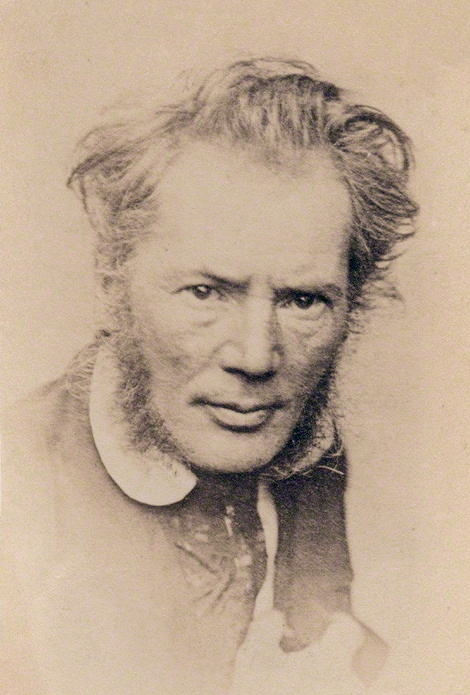
Richard Cockle Lucas
The bust has no confirmed author, and this dossier covers the man the evidence points towards without reaching. Richard Cockle Lucas was an English sculptor who worked in marble, in plaster and, unusually and extensively, in wax, making a large number of pieces after ancient models. He is a documented figure with dated works in public collections, which is precisely why he is useful here: two of his waxes are in Berlin with their years attached, and it was those, not the Flora, that made the 2021 dating possible.
The oddity of this case is that the maker's own family made the claim. Lucas's son Albert swore to having helped his father build the bust out of candle ends in 1846, and painted a watercolour of it. In most forgery cases the maker is silent or unknown. Here a family volunteered the authorship and a great museum spent a century declining to accept it.
Related works
| Work | Relation | Where it is |
|---|---|---|
| Leda and the Swan Richard Cockle Lucas | The dated object used to calibrate the radiocarbon measurements on this bust A wax bas-relief 22 x 17.8 x 3 cm, made in 1850. Its wax is almost identical in composition to the Flora's, and because its date is known it supplied the calibration that the missing sperm whale reservoir age could not. | Alte Nationalgalerie, Staatliche Museen zu Berlin, inv. B II 433 |
| Woman and Winged Woman Richard Cockle Lucas | Second dated comparison object in the 2021 study A wax bas-relief 7.5 x 13 cm, dated 1848, which gave an uncalibrated radiocarbon age of 380 plus or minus 30 BP, in the same range as the Flora samples. | Skulpturensammlung und Museum fuer Byzantinische Kunst, Staatliche Museen zu Berlin, Lfd. Nr. 247 |
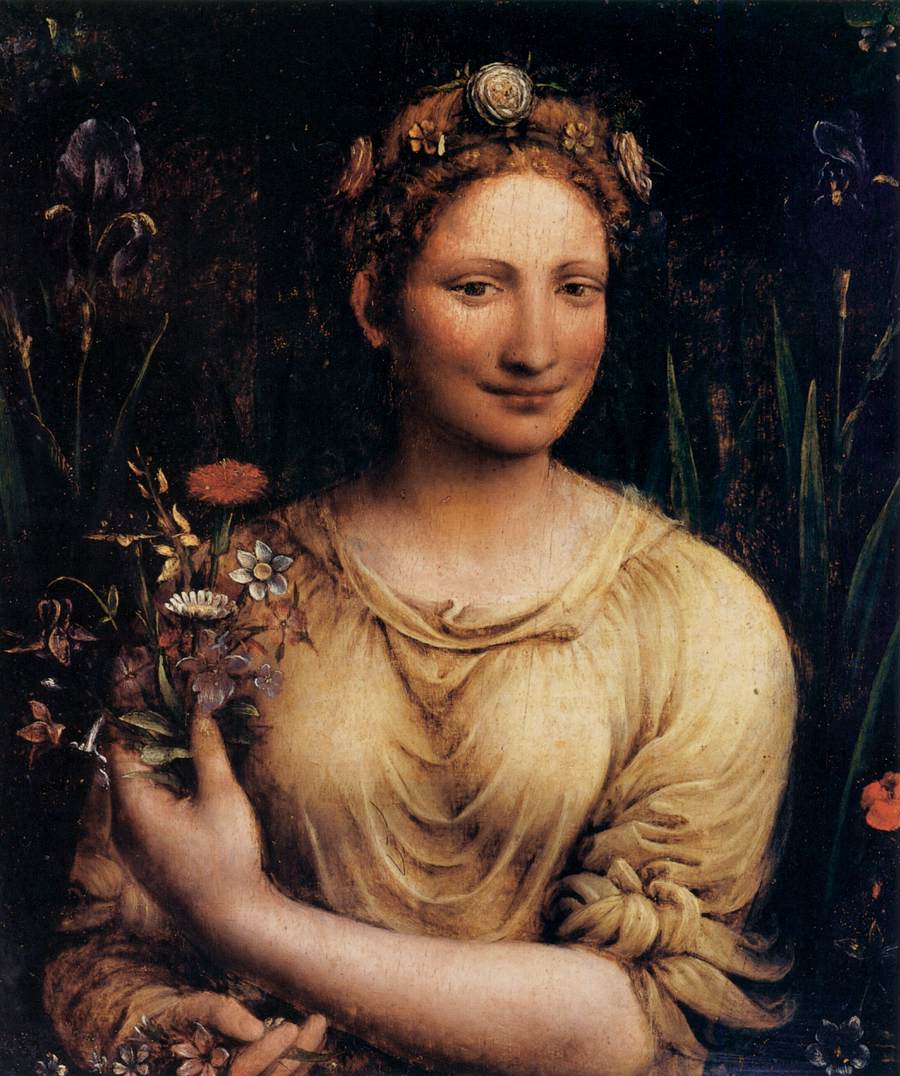
| Flora Francesco Melzi | The painted composition to which the bust's face is compared By Leonardo's pupil and heir. The resemblance of the bust's face to painted Flora and Columbine types of the Leonardo circle is what generated the attribution in 1909, and it is not disputed; what is disputed is what a resemblance proves. | State Hermitage Museum, St Petersburg |
| The Man with the Golden Helmet Circle of Rembrandt | The other great Berlin attribution bought on Wilhelm von Bode's authority and later withdrawn Acquired in 1897 as a Rembrandt over the objections of Hofstede de Groot and Bredius, and reclassified as circle of Rembrandt in 1986 after technical examination. | Gemaeldegalerie, Staatliche Museen zu Berlin, inv. 811A |
| Kouros Unidentified, Greek Archaic or modern | The opposite outcome of scientific testing Where radiocarbon could exclude a period for the Flora bust, no comparable exclusion exists for carved marble, and the Getty statue remains formally undecided. | J. Paul Getty Museum, Malibu, 85.AA.40 |
Open questions
- Who made the bust? The 2021 study excludes the Renaissance and Leonardo and names nobody. Albert Lucas's sworn declaration that his father made it in 1846 remains testimony rather than proof.
- Was the 1909 acquisition an auction purchase or a private sale? The 2021 study says Bode bought it at an auction in London; the German account of the case says the seller was the dealer Murray Marks acting through the intermediary Willy Gretor.
- What was actually paid? 185,000 gold marks is the figure given in the scientific literature; a second figure of 160,000 marks is reported in the German account.
- Where was the bust between 1846, the date claimed by the maker's son, and 1909?
- Which interval does the 2021 paper intend for the combined wax dates, 1712 to 1950 as printed in its text or 1707 to 1950 as printed in its figure caption?
- Could the bust be earlier than Lucas? The calibrated range begins in the first decade of the eighteenth century, and the radiocarbon evidence alone cannot exclude a maker working a century before him.
- Would a larger sample of the wooden spar permit dendrochronology? The 2021 study reports that there was not enough material.
- What is the exact current wording of the museum's label and catalogue entry? The accounts consulted here give England, nineteenth century, with a question mark, and state that the authorship is not entirely clarified.
Questions about this object
What is Bust of Flora?
Bust of Flora is a sculpture, dated after 1700 on radiocarbon evidence; reported by the maker's son to have been modelled in 1846. Bought and exhibited as about 1500.. Medium: Wax, principally spermaceti with minor beeswax and probably stearin or tallow, partly painted; hollow cast in at least three layers by lost-wax moulding.
Who made Bust of Flora, and is the attribution settled?
The attribution to Attributed to Richard Cockle Lucas is recorded here as disputed. Bought in London in 1909 by Wilhelm von Bode for the Berlin royal museums as a work of Leonardo da Vinci, and challenged in the English press within a year as a wax made in 1846 by the Southampton sculptor Richard Cockle Lucas. Radiocarbon dating published in Scientific Reports in April 2021 established that every analysed constituent of the bust postdates 1700, which excludes the Renaissance and therefore excludes Leonardo. That is a negative finding and the authors state it as one. It does not by itself put the bust in Lucas's hands, although the wax of the Flora and the wax of a relief he made in 1850 proved chemically almost indistinguishable. No museum has published a positive attribution to any named maker.
Where is Bust of Flora now?
Skulpturensammlung und Museum fuer Byzantinische Kunst, Bode-Museum, Staatliche Museen zu Berlin, Stiftung Preussischer Kulturbesitz. Inventory number 5951. Last confirmed 17 September 2026. Acquired in London in 1909 for the Berlin royal museums.
What is still unknown about Bust of Flora?
Who made the bust? The 2021 study excludes the Renaissance and Leonardo and names nobody. Albert Lucas's sworn declaration that his father made it in 1846 remains testimony rather than proof.
Sources
- 1Ina Reiche, Lucile Beck and Ingrid Caffy, 'New results with regard to the Flora bust controversy: radiocarbon dating suggests nineteenth century origin', Scientific Reports 11, article 8249, 15 April 2021, doi 10.1038/s41598-021-85505-x. Open access under CC BY 4.0; full text read. Affiliations: PCMTH team, IRCP and C2RMF, CNRS and PSL University, Paris; Rathgen-Forschungslabor, Staatliche Museen zu Berlin; LMC14-LSCE, CEA-CNRS-UVSQ, Universite Paris-Saclay. Source for the composition, the construction, the sampling, all radiocarbon measurements, the marine reservoir discussion, the calibration against the 1850 Leda relief, and the conclusion. pmc.ncbi.nlm.nih.gov/articles/...
- 2Europe PMC bibliographic record for the same paper, PMID 33859211, PMCID PMC8050239, giving the abstract in full: that the bust is made primarily of spermaceti extracted from sperm whales, that radiocarbon dating must therefore consider the marine reservoir effect, that a new calibration method was generated, and that the bust is dated to the nineteenth century and cannot be attributed to Leonardo. ebi.ac.uk/europepmc/...
- 3Wikipedia (German), 'Wachsbueste der Flora'. Tertiary source, used for the inventory number 5951, the Murray Marks and Willy Gretor account of the 1909 sale and the alternative price of 160,000 marks, the statement that the authorship is still not entirely clarified, the claim that the bust was the first sculpture examined by X-ray in 1910, and the bibliography: Bode 1909 and 1910, Friedrich Rathgen 1910, G. Pinkus 1910, Hans Ost 1984 and 2008, R. Rottlaender 1988, Ulrike Wolff-Thomsen 2006. Flagged for replacement by those primary items. de.wikipedia.org/wiki/...
- 4Wikipedia, 'Flora (sculpture)'. Tertiary source, used for the 1910 article in The Times stating that Lucas made the work from a painting, Albert Lucas's sworn testimony that he assisted his father and the candle-ends technique, the discovery of debris including a letter dated in the 1840s when the base was removed, and the museum labelling reported as England, nineteenth century, with a question mark. en.wikipedia.org/wiki/...
- 5Wikimedia Commons, category and file pages for Richard Cockle Lucas and for the Bode-Museum photograph of the bust, read as wikitext for licence and identification. Includes the albumen carte-de-visite self-portrait of about 1858 sourced from the National Portrait Gallery, London, and painted and sculpted portraits in Southampton City Museums. commons.wikimedia.org/wiki/...
Last verified 17 September 2026 · Published 6 August 2026
Change log
6 August 2026 - Record created at the house standard: researched narrative, technical evidence, maker dossier, graded provenance chain, prices with hammer and premium separated, related works, open questions and sources.
17 September 2026 - Re-verified via fresh web search: the bust remains on display at the Bode Museum, labeled England / 19th century with a question mark, consistent with the no-positive-attribution status already recorded here. The 2021 Scientific Reports radiocarbon study (already cited in this record's attribution block) remains the last scientific word; no new study, sale, move or attribution claim found. No change to current_location or attribution.