Codice Maya de Mexico
Unknown Maya scribe · c. AD 1021-1154
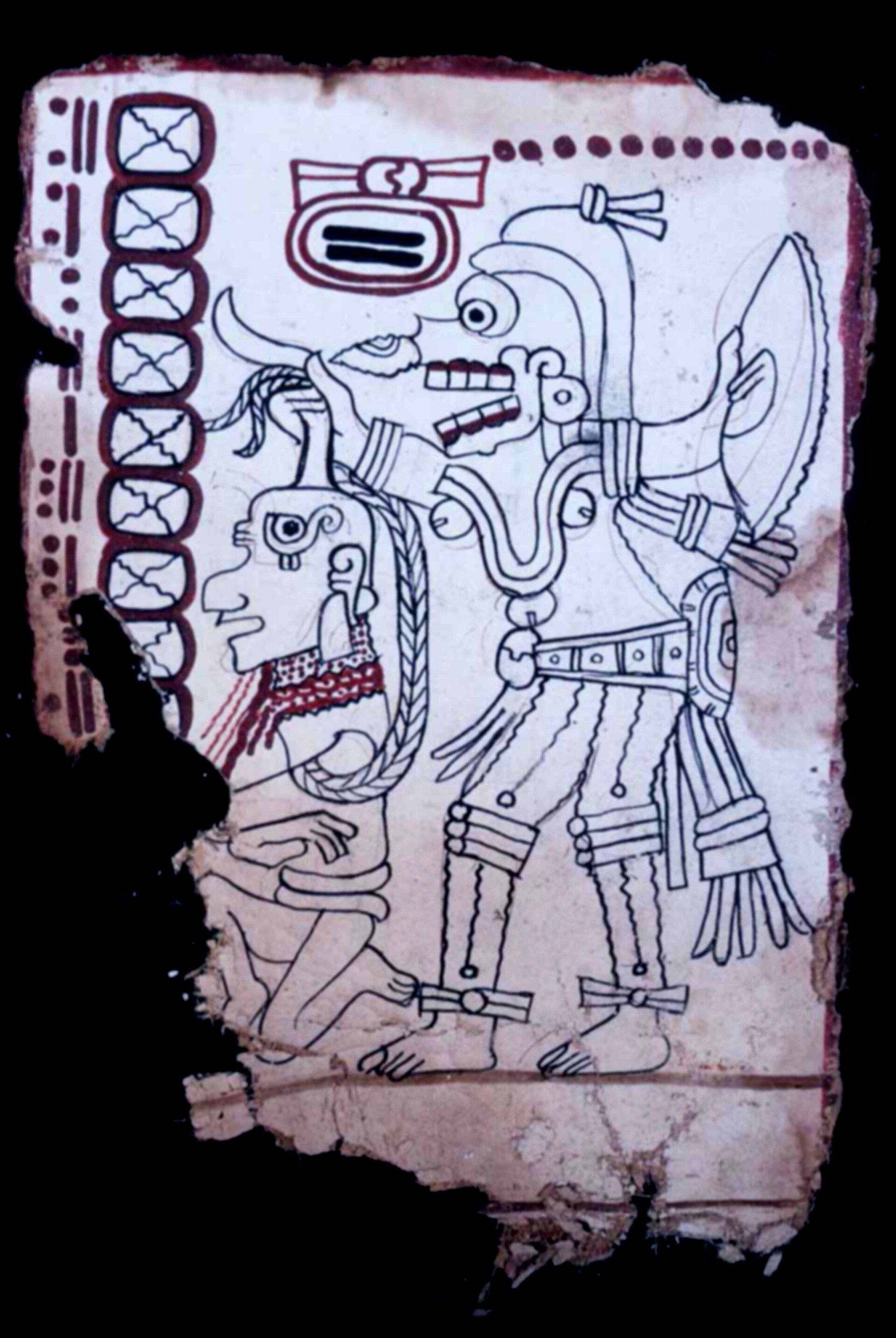
The record subject: page 6 of the Codice Maya de Mexico, formerly the Grolier Codex, held by the Biblioteca Nacional de Antropologia e Historia, Mexico City. A skeletal death deity, identified as a version of the Central Mexican Morning Star, holds a decapitated god by the hair. The column of day signs runs down the left edge and the ring numbers across the top; the water damage across the foot of the page is present on every leaf.
| Artist | Unknown Maya scribe |
|---|---|
| Date | c. AD 1021-1154 |
| Medium | Amate (fig-bark paper), three-ply, faced on both sides with a gypsum ground, painted in lamp black, hematite red, Maya blue and cochineal brown |
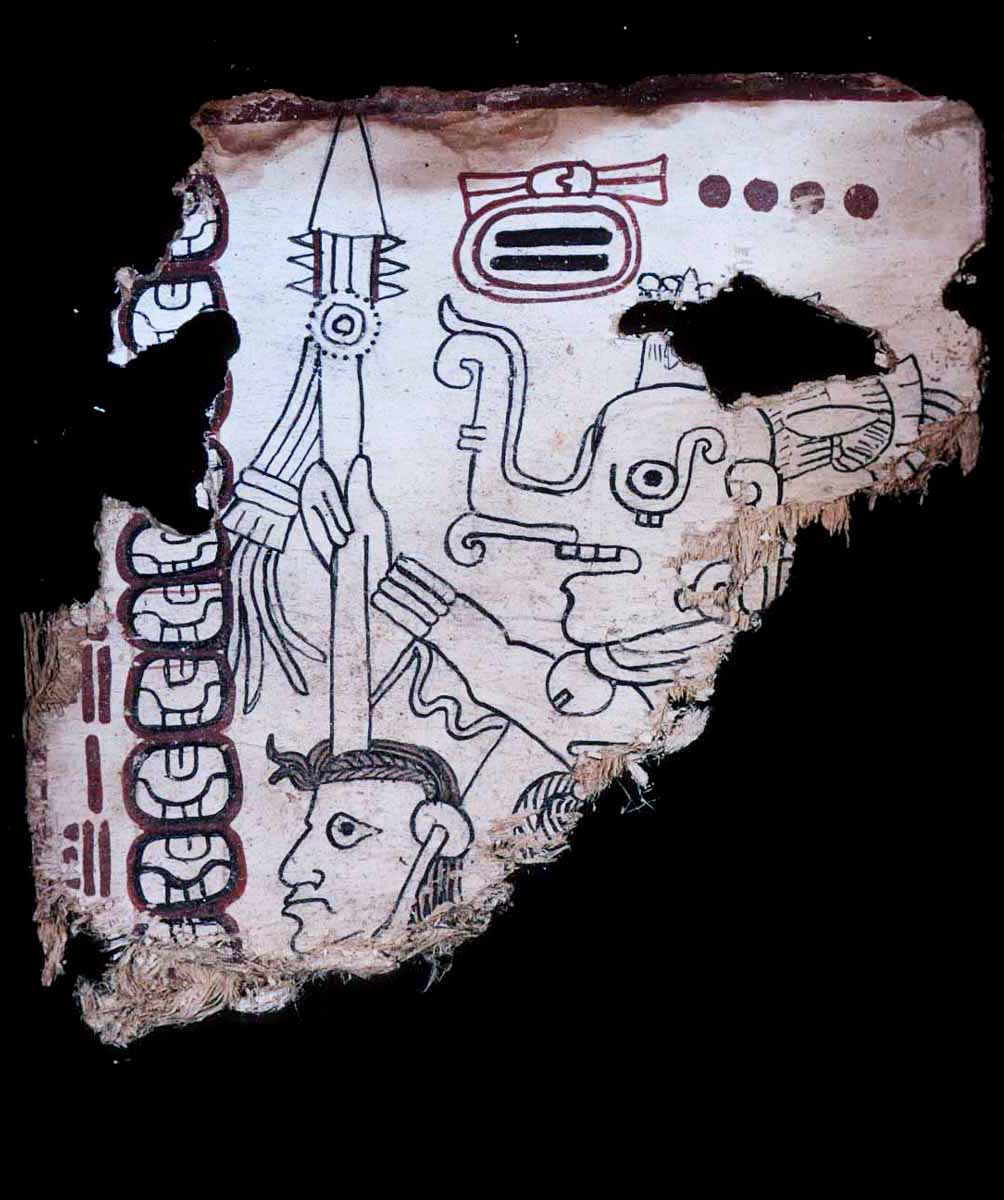
| Dimensions | Ten surviving pages, typically about 12.5 cm wide; the tallest fragment, folio 8, measures 19 cm. Red frame lines show the pages were once substantially taller, and the complete screenfold would have measured about 250 cm |
| Where it is now | Biblioteca Nacional de Antropologia e Historia, Mexico Citylast confirmed 18 September 2026 |
| Inventory number | No inventory number published in the sources consulted |
| Attribution | AttributedA single hand, working with at least two brushes: a thick one for the columns of day signs and a finer one for the figures. Full note |
| Object type | Manuscript |
| Period | Maya, Early Postclassic |
| Cases | Has a provenance gap · Seized, looted or confiscated |
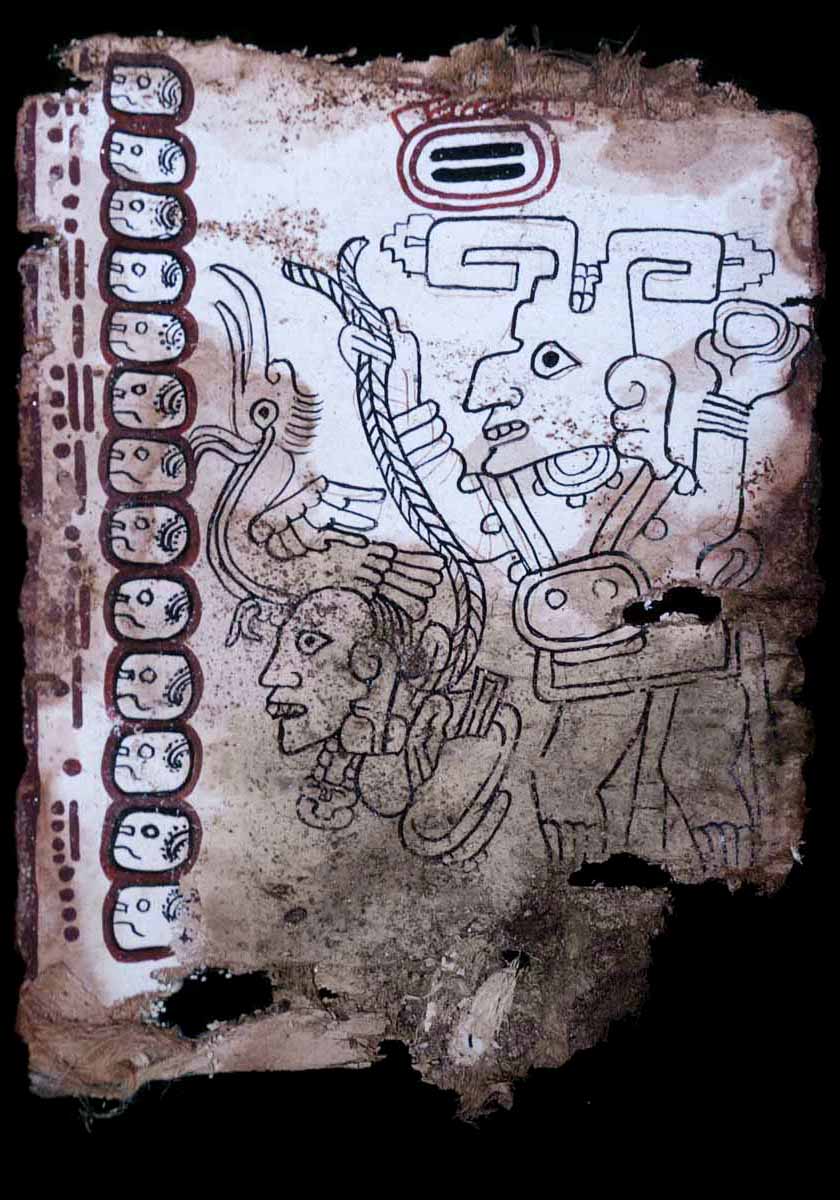
| Inscriptions | Columns of repeated day signs down the left of each page, thirteen in all where complete, and ring numbers across the upper margin recording the synodic periods of Venus in a hybrid notation combining Maya bars and dots with the single dots used in Central Mexico and Oaxaca |
| Owners on record | 7 links4 documented, 2 disputed, 1 unknown |
| Sources | 4 cited |
About this record Last verified 18 September 2026 · 4 sources cited · Change log
On this page 10 sections
ContentsClose
The oldest surviving book of the Americas, and the only one of the four known Maya codices that is still in the hemisphere that made it. Ten pages survive of an original twenty, painted on three-ply fig-bark paper faced with gypsum, recording the synodic cycle of Venus in a hybrid notation that mixes Maya bars and dots with the single dots of Central Mexico. Radiocarbon and pigment analysis place it between 1021 and 1154.
Its entire modern history is a demonstration of what an absent find-spot costs. In 1965 or 1966 the Mexican collector Josue Saenz was telephoned by a man who called himself Gonzales, flown from Villahermosa in a light aircraft whose compass had been covered with a cloth, and set down on a remote airstrip in the foothills of the Sierra de Chiapas, where villagers showed him a codex, a mosaic mask and other objects said to have come from a dry cave. His own authenticator called them fakes. He bought anyway. The cave has never been located, identified or excavated.
Because there was no context, the manuscript was attacked as a forgery for forty years - most damagingly by J. Eric S. Thompson in 1975, who never saw it. It was defended by Michael Coe, who had shown it at the Grolier Club in New York in 1971 and who, asked at the time where it came from, would say only that it was a real hot potato lent by an anonymous owner. Vindication came from materials science: no modern pigment, Maya blue made with palygorskite, a gypsum ground, radiocarbon dates on the paper, and the demonstration that the sharp edges critics read as scissor cuts were breaks in the plaster and the work of arthropods. On 30 August 2018 the Instituto Nacional de Antropologia e Historia ratified it as authentic and renamed it the Codice Maya de Mexico. The find-spot is still unknown, and everything a proper excavation would have told us about the book is still gone.
Provenance
Each link is graded. Documented: a cited source supports it. Disputed: the identification is argued but not established. Unknown: no owner for that span, and the gap is not smoothed into a narrative. The grades in the glossary.
- c. 1021-1154 -Painted by a single Maya scribe; patron, place of production and library unrecordeddocumented
The date rests on radiocarbon determinations on the paper: 1035-1431 in a 1972 test, 1050-1284 in 2012, and further dates under the Mexican programme narrowing to 1021-1154. The style has been related to late painting at Chichen Itza and to the Mixtec manuscript tradition. Nothing is known of who commissioned or used it.13
- - 1965 or 1966Said to have been in a dry cave in the highlands of Chiapas, near Tortuguero; never verifiedunknown
The cave is a claim made by the men who sold the book and repeated ever since. It has never been located, identified, entered or excavated by anyone. The objects said to have been found with it - a mosaic mask, a wooden box, a knife handle, a child's sandal, a length of rope and eight blank sheets of unstuccoed fig-bark paper - would have constituted a unique Maya funerary or ritual deposit if they had been recorded together. They were not.134
- 1965 or 1966 - 1966Unidentified looters and villagers, Sierra de Chiapasdisputed
Josue Saenz was contacted by a caller giving the name Gonzales, who telephoned three times and told him to take the first flight to Villahermosa in Tabasco. He was met by strangers, put into a light plane whose compass was covered with a cloth, and landed at a remote airstrip in the foothills of the Sierra de Chiapas, where villagers produced looted material. Accounts differ on what happened next: Michael Coe records that Saenz was allowed to take the objects to Mexico City for authentication, Karl Meyer that the villagers refused and demanded a decision on the spot. Meyer records that Saenz offered 2,000 dollars, that the villagers produced a Parke-Bernet auction catalogue to show they knew American prices, and that he wrote a post-dated cheque for more.34
- 1966 - the 1970sDr Josue Saenz, Mexico Citydocumented
Saenz was a Mexican collector whose holdings founded the Museo Amparo in Puebla. He told an interviewer that he had begun collecting pre-Hispanic art in 1944 and stopped buying in 1972 when a new Mexican law made all unregistered antiquities the property of the nation. His own expert, the art authority Jose Luis Franco, judged the material fake; he bought regardless.34
- 20 April 1971 - 5 June 1971On loan, anonymously, to the Grolier Club, New Yorkdocumented
Shown in an exhibition organised by Michael Coe. The catalogue Coe published in 1973, The Maya Scribe and His World, gave the owner inaccurately as a private collection, New York. Asked in 1973 by the journalist Karl Meyer where the codex had come from, Coe said only that it was a real hot potato lent to the Grolier Club by an anonymous owner. The manuscript takes its old name from these seven weeks.13
- the 1970s - 2018The Mexican state; held in a vault at the Museo Nacional de Antropologia, Mexico Citydisputed
How the codex passed to Mexico is not settled. One account has the Attorney General of Mexico invoking the United States-Mexico treaty of July 1970 on the recovery and return of stolen archaeological, historical and cultural property, in 1976, producing a seizure and an official return - a rare invocation of that instrument. Most accounts simply record a donation by Saenz without naming a date or a donor. Trafficking Culture flags the timing and the circumstances as unclear and notes that the volume usually cited for the return does not in fact cover it. For decades afterwards the book was in a vault and not on public display.13
- 30 August 2018 - presentThe Mexican state; Biblioteca Nacional de Antropologia e Historia, Mexico Citydocumented
The Instituto Nacional de Antropologia e Historia published Boletin 299 ratifying the manuscript as the oldest authentic book of the Americas and renaming it the Codice Maya de Mexico. It was shown at the Museo Nacional de Antropologia for three weeks in September and October 2018, and a new facsimile was published by the Mexican government the same year.1
Prices realised
This manuscript has never been sold at auction and has no hammer price, no premium and no published purchase price. The only figure in the record is an offer: Josue Saenz offered 2,000 dollars at the airstrip, the villagers refused, produced a Parke-Bernet auction catalogue to demonstrate what Mexican antiquities were making in New York, and Saenz wrote a post-dated cheque for a larger sum that no account specifies. It should be noted that a widely mirrored statement that the codex first appeared at an auction in the late 1960s cannot be traced to any account of a sale, and appears to derive from a misreading of that catalogue in the looters' hands. A price list brandished by a seller is not a sale record.
Technical evidence
| Attribution note | A single hand, working with at least two brushes: a thick one for the columns of day signs and a finer one for the figures. That is a conclusion drawn from the underdrawing and the finished painting, not a name. The larger attribution question here is not who painted it but whether a Maya painted it at all: the manuscript was denounced as a modern forgery in 1975 and was defended and attacked in print for forty years, because it came out of the ground through looters and there was no context to argue from. Scientific programmes in 2007, 2015 and 2018 concluded it is authentic, and the Mexican state ratified that conclusion in August 2018. |
|---|---|
| Support | Amate, paper beaten from the inner bark of the wild fig, in three plies - the construction that lets a screenfold bend without splitting.1 |
| Ground | A thin foundation of gypsum, calcium sulphate, 0.2 to 0.3 mm thick, applied to both faces. Only one face was completed as a manuscript.1 |
| Pigments | Lamp black; red from hematite; brown from cochineal; and Maya blue, indigo bound into palygorskite. Palygorskite was identified in 2007 by the Institute of Physics of the National Autonomous University of Mexico using non-destructive methods. No modern inorganic material was detected.13 |
| Radiocarbon | 1972: AD 1035-1431. 2012: AD 1050-1284. A blank associated sheet gave AD 1230 plus or minus 130 in the date Coe published in 1973. The Mexican programme narrowed the manuscript to AD 1021-1154 and further established that the pigment is contemporaneous with the paper.13 |
| Extent | Ten surviving pages of an original twenty, in the current Mexican account; Trafficking Culture gives eleven sheets from an alleged twenty-one. The first eight and last two of the original are missing. Only pages four, five and six remain physically attached to one another.13 |
| Dimensions | Pages typically about 12.5 cm wide; the tallest surviving fragment, folio 8, is 19 cm. Red frame lines at the foot of pages four to eight show that the scribe had reserved space for text below each figure, and that the complete book stood about 250 cm long unfolded, roughly the size of the Dresden Codex.1 |
| Hand | Underdrawing and finished painting indicate a single scribe using at least two brushes: a thick one for the viscous pigment of the day signs, a finer one for the figures. As in the late paintings at Chichen Itza, the final line follows the underdrawing only loosely.1 |
| Notation | A hybrid system: Maya bar-and-dot numerals together with the single dots used in Central Mexico and Oaxaca. Ring numbers in the upper margin encode the synodic intervals of Venus - 8 days at inferior conjunction, 236 as Morning Star, within a 584-day cycle.1 |
| Condition | At least three episodes of high humidity; the lower portion of every page is badly water damaged. Small arthropods lived in the book and chewed its margins, producing crisp edges that critics read as scissor cuts; other apparently sharp cuts are breaks in the gypsum ground. The pages were torn apart by rough handling after removal.13 |
Images
The record in full
Chapter 1Four books survived the burning, and this is the only one still in the Americas
The Maya wrote books. They made them from the inner bark of the wild fig, beaten into paper, faced with a fine plaster and folded like a screen, and they filled them with astronomy, ritual and...
The Maya wrote books. They made them from the inner bark of the wild fig, beaten into paper, faced with a fine plaster and folded like a screen, and they filled them with astronomy, ritual and prophecy. During the conquest these were read by Spanish clergy as falsehoods of the devil and burned in bulk, after which the men who had burned them expressed surprise that the Maya were distraught.
Three books survived, and all three left the hemisphere: the Dresden, the Madrid and the Paris codices, carried to Europe in the sixteenth century as curiosities. Until 1971 that was the entire corpus. It had been assumed that no more would ever be found, because fig-bark paper does not survive the wet, acidic soils of Mesoamerica.
This manuscript is the fourth, and it is the only one still in the Americas. It is also, on the Mexican determination of 2018, the oldest surviving book of the Americas - older than any of the three in Europe.
What it says is astronomy. The pages record the synodic cycle of Venus: ninety days of invisibility at superior conjunction, two hundred and fifty as Evening Star, eight days invisible at inferior conjunction, two hundred and thirty-six as Morning Star, five hundred and eighty-four days in all, and five of those cycles running exactly to eight solar years. Venus in Mesoamerica is not a goddess of love but a dangerous, warlike thing, and the figures on these pages are gods with spearthrowers, knives and captives. The book was a working instrument in the hands of a priest, for predicting when a hostile power would appear in the sky.
Chapter 2A telephone call, a covered compass, and a cave nobody has ever found
In 1965 or 1966 a man giving the name Gonzales telephoned Dr Josue Saenz, a Mexican collector, three times, and told him to take the first flight to Villahermosa in Tabasco and ask no questions.
In 1965 or 1966 a man giving the name Gonzales telephoned Dr Josue Saenz, a Mexican collector, three times, and told him to take the first flight to Villahermosa in Tabasco and ask no questions. At Villahermosa strangers met him and put him into a light aircraft. The compass had been covered with a cloth. Saenz knew the country well enough to work out roughly where they were going, and they landed on a remote airstrip in the foothills of the Sierra de Chiapas.
Villagers brought out looted antiquities: a codex, a mosaic mask, and other pieces, which they said had been found together in a dry cave. They did not say where the cave was.
Two accounts of the transaction survive and they do not agree. Michael Coe, told the story by Saenz, records that Saenz was allowed to carry the objects back to Mexico City to have them authenticated before buying. Karl Meyer, who investigated the mask, records that the villagers refused and demanded a decision on the spot, that Saenz offered two thousand dollars, and that the villagers produced a Parke-Bernet auction catalogue to demonstrate that they knew what Mexican antiquities were fetching in New York. Saenz then wrote a post-dated cheque for a higher figure.
What is not in dispute is that his authenticator, the respected art expert Jose Luis Franco, judged the material to be fake, and that Saenz bought it anyway.
Sixty years later, that airstrip conversation is still the entire provenance of the oldest book in the Americas. The cave has never been located. No archaeologist has entered it. Nobody has ever been named as the finder.
Chapter 3Seven weeks in New York gave it a name it has now lost
Michael Coe, then the leading American Mayanist, examined the manuscript in Mexico City and was reasonably satisfied it was not a forgery.
Michael Coe, then the leading American Mayanist, examined the manuscript in Mexico City and was reasonably satisfied it was not a forgery. He obtained Saenz's permission to show it in an exhibition he was organising at the Grolier Club in New York, where it was on view from 20 April to 5 June 1971. From those seven weeks in a private bibliophiles' club the book took the name it carried for the next forty-seven years.
The exhibition catalogue Coe published in 1973 listed the owner as a private collection, New York. That was not true; the owner was a collector in Mexico City. Asked directly, that same year, by the journalist Karl Meyer where the codex had come from, Coe would say only that it was a real hot potato lent to the Grolier Club by an anonymous owner, and would say nothing more.
It is worth being fair about what that means. Coe was not the trafficker, and he was, on the record, right about the object: he backed its authenticity from the start and lived to see a national institute agree with him. But the concealment of an owner in a printed catalogue is exactly the practice by which unprovenanced material acquires respectability, and the reader should notice that the first published statement about this manuscript's ownership was a false one.
Chapter 4Thompson's attack, and the reason it landed
In 1975 J. Eric S. Thompson, the most authoritative Mayanist of the previous generation, published a paper declaring the manuscript a forgery.
In 1975 J. Eric S. Thompson, the most authoritative Mayanist of the previous generation, published a paper declaring the manuscript a forgery. He had not seen it.
His arguments were not foolish. He pointed to iconographic anachronisms, and to a strange absence: Maya codices tell a reader what a date portends, and this one, while it tracks Venus, carries no omens and none of the cardinal directions that saturate other Maya inscriptions. Claude-Francois Baudez later developed the point - the book, in this reading, is useless, and a real ritual manuscript is not useless.
Thompson also had an answer to the radiocarbon date. Blank fig-bark paper does turn up in caves; looters find it and discard it because buyers do not want it. An enterprising forger, he suggested, would simply acquire old paper and paint on it, and the paint would be what mattered. That objection was correct in principle, and it took forty years and a laboratory to close.
The reason the attack landed so hard is the reason this record sits in an archive about provenance. There was nothing to answer it with. No excavation, no context, no associated material recorded in place, no findspot, no witness, no photograph in the ground. The only alternative to Thompson's story was a collector's account of a covered compass and a cave, and an account is not a document.
Chapter 5The paper, the plaster and the blue
What eventually answered Thompson was materials science, and it is worth setting out, because it is a model of how an unprovenanced object can still be interrogated.The support is amate, fig-bark...
What eventually answered Thompson was materials science, and it is worth setting out, because it is a model of how an unprovenanced object can still be interrogated.
The support is amate, fig-bark paper, and it is three-ply, which is what allows a screenfold to bend without splitting. Both faces were prepared with a thin ground of gypsum, calcium sulphate, between two and three tenths of a millimetre thick, to give a smooth painting surface. Only one face was ever finished.
The palette has been identified: lamp black; red from hematite; brown from cochineal; and Maya blue, the famously stable pigment made by binding indigo dye into the clay mineral palygorskite. In 2007 the Institute of Physics at the National Autonomous University of Mexico ran non-destructive tests and identified the palygorskite. No modern inorganic material was detected anywhere in the manuscript.
Radiocarbon has been applied three times over forty-five years: a 1972 measurement gave 1035 to 1431, a 2012 test gave 1050 to 1284, and the Mexican programme narrowed the range to 1021 to 1154. Those are dates for the paper. The Mexican studies went further and established that the pigment is contemporaneous with the support, which is the finding that answers Thompson's old-paper argument directly.
The physical objections went the same way. Sharp edges that critics read as knife cuts turned out to be breaks in the gypsum ground, and elsewhere the crisply chewed margins left by small arthropods that had lived in the book. The manuscript passed through at least three episodes of high humidity in its life. Its pages were torn apart by rough handling in the trade; only pages four, five and six are still joined to one another.
Chapter 6What the object says about itself
Read as an object rather than as a case, the manuscript is a technical performance.Each surviving page carries a standing deity facing left, a column of repeated day signs down the left edge, and...
Read as an object rather than as a case, the manuscript is a technical performance.
Each surviving page carries a standing deity facing left, a column of repeated day signs down the left edge, and ring numbers across the top margin. The ring numbers do arithmetic. On page seven a bar and three dots inside the ring instruct the reader to count forward eight days, the exact period of Venus's invisibility at inferior conjunction; on page eight the figure sixteen inside the ring is added to eleven dots each standing for twenty, giving two hundred and thirty-six, the exact period of visibility as Morning Star.
The gods are violent. Page one has K'awiil taking a captive; page two a death god; page six a skeletal deity, identified by John Carlson as a version of Tlahuizcalpantecuhtli, the Central Mexican Morning Star, holding a decapitated god by the hair with a jagged flint blade set in his nose; page eight a bird deity who has shot the temple in front of him with an atlatl dart; page ten a death god launching a dart into water to strike a shell. The numeration is hybrid, mixing Maya bars and dots with the single dots of Central Mexico and Oaxaca, and the headdresses have close parallels in the Venus pages of the Codex Vaticanus B.
This is why the book matters beyond the courtroom. It is surviving evidence that Maya and Central Mexican systems were being used together in a single manuscript in the eleventh or twelfth century, in the decades when Tula and Chichen Itza were declining. The style has been connected backwards to the late painting at Chichen Itza, where, as here, the final painted line wanders freely from the underdrawing, and forwards to the Mixtec codices, whose headdresses appear here first.
Chapter 7Forty years of argument, and one study that ended it
The literature on this manuscript is easy to summarise: a queue of scholars publishing for and against, none of them able to settle it, because the question was not really about the object.Against...
The literature on this manuscript is easy to summarise: a queue of scholars publishing for and against, none of them able to settle it, because the question was not really about the object.
Against: Thompson in 1975, Susan Milbrath in 2002, Baudez in 2002. For: David Stuart, John Carlson, and Victoria and Harvey Bricker, who pointed out that the contents are not copied from any known codex and yet are consistent with an accurate pre-Hispanic calendar - a difficult thing for a forger to manage. In 2008 Ruvalcaba, Zetina and colleagues published a non-destructive study which found no modern materials but also flagged what they called induced degradation, and concluded, honestly, that their work neither supported nor refuted authenticity.
In 2015 Coe, Stephen Houston, Mary Miller and Karl Taube published a full-size facsimile and a comprehensive study, using photographs taken by Enrico Ferorrelli for National Geographic in 1987, together with a full set of hand drawings released uncopyrighted so that anyone could work from them. They answered the calendrical objections, showed that the suspect cuts were plaster breaks, that the layout followed the sketch-and-grid practice of Maya mural painting, and that the pigments included Maya blue, which is exceptionally difficult to reproduce. Their closing question was whether the painter of this book could have lived in the twentieth century, and their answer was no.
Then, on 30 August 2018, the Instituto Nacional de Antropologia e Historia published its bulletin ratifying the manuscript as authentic and as the oldest book of the Americas, renaming it the Codice Maya de Mexico. Nobody has seriously argued the other way since.
Chapter 8A seizure, or a donation? Nobody has established which
The legal history of this object is a small scandal of imprecision, and it deserves to be set out exactly.One account holds that in 1976 the Attorney General of Mexico invoked the treaty of July 1970...
The legal history of this object is a small scandal of imprecision, and it deserves to be set out exactly.
One account holds that in 1976 the Attorney General of Mexico invoked the treaty of July 1970 between the United States and Mexico on the recovery and return of stolen archaeological, historical and cultural property, and that this produced a seizure of the codex and its official return to Mexico. That treaty has been invoked very few times, which would make this one of its significant applications.
Most other accounts say simply that Josue Saenz donated the manuscript to the Mexican nation, and give neither a date nor a donor. Trafficking Culture, which went looking, records the timing and circumstances as unclear, and notes that the volume usually cited for the return does not in fact cover it.
These are not the same event. A treaty seizure is a coercive act premised on the object being stolen property of the Mexican state. A donation is a gift, with the tax and reputational consequences a gift carries, and it implies that title was the donor's to give. One of them happened, and this record cannot say which.
There is a further wrinkle in Saenz's own words. He told an interviewer that he stopped buying pre-Hispanic art in 1972 because a new Mexican law made all unregistered antiquities the property of the nation, and added that the law ended lawful collecting without solving the problem of preserving the nation's archaeological heritage. A man who says that has understood precisely what changed. What he does not say is what it meant for the codex he had bought six years earlier.
Chapter 9The mask that may or may not have been in the same box
A mosaic stone mask was bought in 1966 by Mildred Barnes Bliss, co-founder with her late husband of Dumbarton Oaks in Washington, and it is there still.Coe published that the mask and the codex came...
A mosaic stone mask was bought in 1966 by Mildred Barnes Bliss, co-founder with her late husband of Dumbarton Oaks in Washington, and it is there still.
Coe published that the mask and the codex came out of the same cave and were shown to Saenz together at the airstrip. The route the mask took afterwards is better documented than the codex's: Saenz, on Jose Luis Franco's opinion that it was a fake, tried to stop his cheque and found it already cashed, then passed the mask to a dealer with instructions to sell it without any guarantee of authenticity, and it moved through a New York dealer into the United States. Gordon Ekholm, curator of Mexican archaeology at the American Museum of Natural History, examined it under a microscope, found what he took to be evidence that a beard had once been attached - a detail he thought a forger would not invent - and pronounced it genuine, which by Meyer's account considerably enhanced its value. It is now widely accepted as authentic.
Whether it and the codex were ever in the same box is not established. Trafficking Culture points out that the small plane and the cave appear nowhere in the literature around the codex at the time of the 1971 exhibition, and that the connection rests on Coe's later telling and on a dealer's word to a journalist.
The consequence is stated best by the researcher who assembled the case. Because it is unknown whether the mask and the codex were found together, and because both were looted, the opportunity to study what may have been an entirely unique Maya funerary context has been lost. Two objects, both now accepted as genuine, both in public collections, and the relationship between them permanently unrecoverable.
Chapter 10The counts do not agree, and neither do the names
A reader coming to this manuscript from the literature should be warned that the basic figures differ between authorities, and this record does not smooth them over.The number of surviving leaves is...
A reader coming to this manuscript from the literature should be warned that the basic figures differ between authorities, and this record does not smooth them over.
The number of surviving leaves is given as ten in the current Mexican account and as eleven by Trafficking Culture. The original length is given as twenty pages in one place and twenty-one in another. The surviving pages are numbered one to ten in the modern convention even though the first eight and the last two of the original are the ones missing, which is a scheme guaranteed to mislead. The 1971 exhibition is named as Ancient Maya Calligraphy in one account and as The Maya Scribe and His World in another; the latter is certainly the title of Coe's 1973 book. Eight blank, unstuccoed sheets of fig-bark paper are associated with the manuscript, and one of them produced the 1230 plus or minus 130 radiocarbon date that Coe published in 1973 - a date, that is, measured on a blank sheet rather than on a painted page.
And a claim now mirrored across the internet, that the manuscript first appeared at an auction in the late 1960s, cannot be traced to any record of a sale. The only auction in the story is a Parke-Bernet catalogue held up by looters at an airstrip to prove they knew what the New York market paid. A sales catalogue in a seller's hand is not a provenance.
Chapter 11What was actually lost
The codex is authentic, it is in Mexico, it has been published in facsimile twice and it was shown to the public in its own country for three weeks in the autumn of 2018 - the first time most...
The codex is authentic, it is in Mexico, it has been published in facsimile twice and it was shown to the public in its own country for three weeks in the autumn of 2018 - the first time most Mexicans could see the oldest book of their own hemisphere. On any reasonable measure this is among the better outcomes in this archive.
Set against that: no one knows where it was found, what it was found with, whether the mask belongs to it, what deposit it came from, whether the cave holds anything else, or whether the missing pages survive. The eight blank sheets exist but their relationship to the painted ones is a matter of assertion. Forty years of scholarly effort went into proving that the object is old, which an excavation would have established on the first day, and that effort was subtracted from the work of reading it.
Michael Coe put the position more sharply than any of his critics. The irony of the whole business, he wrote, is that if the codex had been found in an old library it would be accepted by even the most rock-ribbed scholar as genuine. The same is true of a trench. The doubt was never about the paint. It was about the hole in the ground that nobody has ever seen.
The artist
An unnamed Maya scribe of the Early Postclassic, and the tradition he worked in
The maker is one man with two brushes, working somewhere in the Maya world between about 1021 and 1154, in the decades when Tula and Chichen Itza were losing their grip on Mesoamerica. Nothing else about him is recoverable, and the reason is not the passage of time: the only object of his that survives came out of the ground through the market, so the library, the settlement and the deposit that would have told us who he was are unrecorded. What can be described is the trade he belonged to, the materials it used, and the intellectual system his book operates inside.
Related works
| Work | Relation | Where it is |
|---|---|---|
| Mosaic Maya mask Unknown, Maya | Said by Coe to have been found in the same cave and shown to Saenz at the same airstrip Bought by Mildred Barnes Bliss in 1966 after Saenz, whose own expert called it fake, passed it to a dealer to sell without any guarantee of authenticity. Gordon Ekholm of the American Museum of Natural History pronounced it genuine on microscopic evidence that a beard had once been attached. Whether it and the codex were ever together is unestablished. | Dumbarton Oaks Research Library and Collection, Washington |
| The Dresden Codex Unknown Maya scribes | One of the three codices that reached Europe; the closest comparison for scale and content Its Venus tables at pages 46 to 50 resemble the material here, a resemblance noted by both Coe and Thompson. Unfolded, the Codice Maya de Mexico would have been about the same length. | Sachsische Landesbibliothek, Dresden |
| The Madrid Codex Unknown Maya scribes | One of the four known Maya books Also called the Tro-Cortesianus. Like the Dresden and Paris codices it left Mesoamerica in the sixteenth century. | Museo de America, Madrid |
| The Paris Codex Unknown Maya scribes | One of the four known Maya books The most fragmentary of the three European codices. | Bibliotheque nationale de France, Paris |
Open questions
- Where is the cave? No location has ever been given, entered or excavated, and the only people who could say are the men who sold the book in 1965 or 1966.
- Was the codex transferred to Mexico by treaty seizure or by donation? One account has the Attorney General of Mexico invoking the 1970 United States-Mexico treaty in 1976; most accounts record only an undated donation by Saenz. The two are entirely different legal events.
- Were the mask now at Dumbarton Oaks and the codex found together? Coe published that they were; the connection rests on his later telling and on a dealer's statement to a journalist, and the small plane and the cave appear nowhere in the literature around the 1971 exhibition.
- How many leaves survive, ten or eleven, and was the original twenty pages or twenty-one? Current Mexican accounts and Trafficking Culture disagree.
- Do the missing pages survive anywhere? The first eight and the last two of the original screenfold are unaccounted for.
- What is the relationship of the eight blank fig-bark sheets to the painted ones? One of them supplied the radiocarbon date Coe published in 1973, which means the earliest published date for this manuscript was measured on a sheet with no painting on it.
- What was the 1971 exhibition actually called? Trafficking Culture gives Ancient Maya Calligraphy and other accounts give The Maya Scribe and His World, which is certainly the title of Coe's 1973 book.
- How much did Saenz pay? He is recorded as offering 2,000 dollars and then writing a post-dated cheque for more. No account consulted gives the figure, or says whether the codex and the mask were paid for together.
- Is the manuscript on public display in 2026? The last exhibition traced is the three-week showing at the Museo Nacional de Antropologia in September and October 2018; before that it spent decades in a vault.
Questions about this object
What is Codice Maya de Mexico?
Codice Maya de Mexico is a manuscript, dated c. AD 1021-1154. Medium: Amate (fig-bark paper), three-ply, faced on both sides with a gypsum ground, painted in lamp black, hematite red, Maya blue and cochineal brown.
Who made Codice Maya de Mexico, and is the attribution settled?
The attribution to Unknown Maya scribe is recorded here as attributed. A single hand, working with at least two brushes: a thick one for the columns of day signs and a finer one for the figures. That is a conclusion drawn from the underdrawing and the finished painting, not a name. The larger attribution question here is not who painted it but whether a Maya painted it at all: the manuscript was denounced as a modern forgery in 1975 and was defended and attacked in print for forty years, because it came out of the ground through looters and there was no context to argue from. Scientific programmes in 2007, 2015 and 2018 concluded it is authentic, and the Mexican state ratified that conclusion in August 2018.
Where is Codice Maya de Mexico now?
Biblioteca Nacional de Antropologia e Historia, Mexico City. Inventory number No inventory number published in the sources consulted. Last confirmed 18 September 2026. In Mexican state custody since the 1970s; officially ratified and renamed by the Instituto Nacional de Antropologia e Historia on 30 August 2018.
What is still unknown about Codice Maya de Mexico?
Where is the cave? No location has ever been given, entered or excavated, and the only people who could say are the men who sold the book in 1965 or 1966.
Sources
- 1Wikipedia, 'Maya Codex of Mexico'. TERTIARY, but densely referenced to the Mexican publication El Codice Maya de Mexico, antes Grolier (INAH, 2018) and to Coe, Miller, Houston and Taube, 'The Fourth Maya Codex', Maya Archaeology 3. Used for the 1021-1154 date range, the INAH ratification and renaming of 30 August 2018 (Boletin 299), the surviving extent and dimensions, the three-ply amate and gypsum ground, the pigment identifications, the 1972 and 2012 radiocarbon dates, the palygorskite identification of 2007, the arthropod damage and the moisture episodes, the page-by-page iconography, the Venus arithmetic, the style comparisons with Chichen Itza and the Mixtec codices, the Grolier Club dates of 20 April to 5 June 1971, the 1976 invocation of the 1970 United States-Mexico treaty, and the three-week showing at the Museo Nacional de Antropologia in September and October 2018. To be replaced with the INAH volume of 2018 and with Coe and colleagues (2015). en.wikipedia.org/wiki/...
- 2Wikimedia Commons file page for the lead plate, 'Grolier Codex, page 6.jpg', a reproduction of a page of this manuscript released as a faithful photograph of a two-dimensional public domain work. Read in the raw wikitext for the licence rather than through the API summary; the companion file for page 1 gives its source as mayavase.com. commons.wikimedia.org/wiki/...
- 3Donna Yates, 'Grolier Codex', Trafficking Culture encyclopedia, University of Glasgow, last modified 8 September 2016. Source for the Saenz acquisition story and its variants, the eight blank fig-bark sheets and the AD 1230 plus or minus 130 date published by Coe in 1973, the inaccurate ownership line in Coe's 1973 catalogue, the 'real hot potato' remark to Karl Meyer, Thompson's 1975 arguments and the old-paper objection, Baudez on futility, the Ruvalcaba findings of 2008, the 2016 rebuttals, Saenz's statement to Irene Herner about the 1972 law and the Museo Amparo, and the note that the timing and circumstances of the transfer to Mexico are unclear while the 1970 treaty invocation is recorded by Vitelli (1977). traffickingculture.org/encyclopedia/...
- 4Donna Yates, 'Mosaic Maya Mask', Trafficking Culture encyclopedia, University of Glasgow, last modified 19 February 2017. Source for the Gonzales telephone calls, the flight from Villahermosa, the refusal to let the objects leave the airstrip in Meyer's version, the 2,000 dollar offer and the Parke-Bernet catalogue, the stopped cheque that had already been cashed, the sale through dealers into the United States, Gordon Ekholm's microscopic examination and the beard, Mildred Barnes Bliss's purchase in 1966, and the caution that the connection between mask and codex is not established. traffickingculture.org/encyclopedia/...

Last verified 18 September 2026 · Published 6 August 2026
Change log
6 August 2026 - Record created at the house standard: researched narrative, technical evidence, maker dossier, graded provenance chain, prices with hammer and premium separated, related works, open questions and sources.
18 September 2026 - Re-verification pass: confirmed via fresh web search that the codex remains at the Biblioteca Nacional de Antropologia e Historia (BNAH), Mexico City, its custodian since ratification, and that the 2018 authentication (INAH's multi-team scientific and art-historical programme, concluding the manuscript predates the other three surviving Maya codices by roughly two centuries) stands with no new challenge found. Its most recent public exhibition traced in fresh searches remains the 2022-2023 loan to the J. Paul Getty Museum, Los Angeles, already predating this record's last check; no newer loan, exhibition, or renewed forgery claim found. No change to attribution, custody, or the manuscript's status made.