An inscription is read on a date, not seen
Six objects in this archive carry writing that settled what they are. In every case the reading is an event with a date and a reader, and in four of them the reading changed a category.
Records in this piece: Sword of King Goujian of Yue, The Shroud of Cadouin, "Antonius" Violin, Medallion with a Portrait of Gennadios, Brescia Medallion, Bowl
On this page 8 sections
ContentsClose
In short
- Six objects in this archive were identified, dated or re-attributed by writing on their own surface. In five of the six the decisive reading happened centuries after the writing was made, on a date we can name: 1934, 1966, 1927, the 2010s and 2024.
- A reading is not the same as the writing. The Sword of Goujian's last two characters were read three ways by three scholars inside two months, and the Antonius violin's label was read as 1721, 1717 and 1711 by three readers across a century.
- The reading can move an object between categories. A relic became a Fatimid court textile in August 1934; a museum label that had said Alexandria for ninety-seven years lost its evidence in April 2024 and, as of this week, still says Alexandria.
- A record should carry the reader and the date beside the transcription, because a later reader with better light, better comparanda or better philology can and does reverse the earlier one.
Six objects in this archive carry writing that decided what they are
Six objects in this archive were classified by writing on their own surface, and in each case the reading of that writing is an event with a date and a named reader. That is the claim of this piece, and it is a narrower claim than it sounds. Writing on an object feels like the most direct evidence there is: the maker, or the owner, or the court, put words on the thing, and the words say what it is. But words have to be read, and a reading made in 1927 can be undone in 2024 by someone who knows more about Greek nicknames. The archive holds enough of these cases to set them side by side.
We chose the six because between them they cover the full range of what a reading can do. One fixed a king's name on a sword. One turned a relic into a turban. One moved a violin ten years along its maker's career. Two held up a city of manufacture for nearly a century and then dropped it. One, the bowl from Kashan, is the case where the writing was legible from the day it was fired and needed no reading event at all, which is the control the other five should be measured against.
| Object | What is written | Decisive reading | What the reading changed |
|---|---|---|---|
| Sword of Goujian, Hubei | Eight characters, bird-worm script | Tang Lan, letter of 5 January 1966; accepted by 28 February 1966 | An anonymous Yue royal sword became Goujian's |
| Shroud of Cadouin, Perigueux | Kufic band naming the caliph al-Musta'li | Gaston Wiet, 1934, from photographs | A relic of Christ became a Fatimid tiraz of 1096-97 |
| Antonius violin, the Met | Handwritten year on a printed label | Yana van Dyke, ultraviolet, published 7 March 2017 | A date of 1721 or 1717 became 1711 |
| Gennadios medallion, the Met | Greek, a name and an epithet | Joseph Breck 1927; Rachel Patt, April 2024 | Alexandria asserted, then its evidence removed |
| Brescia medallion | Two Greek words near the rim | Breck 1927; Patt 2024 | Galla Placidia dropped; Alexandria dropped |
| Kashan bowl, the Met | Date 583 AH and Persian verses | Legible since manufacture | Nothing; the date and hand stood from the start |
The Sword of Goujian took two months and a dozen scholars to read its own name
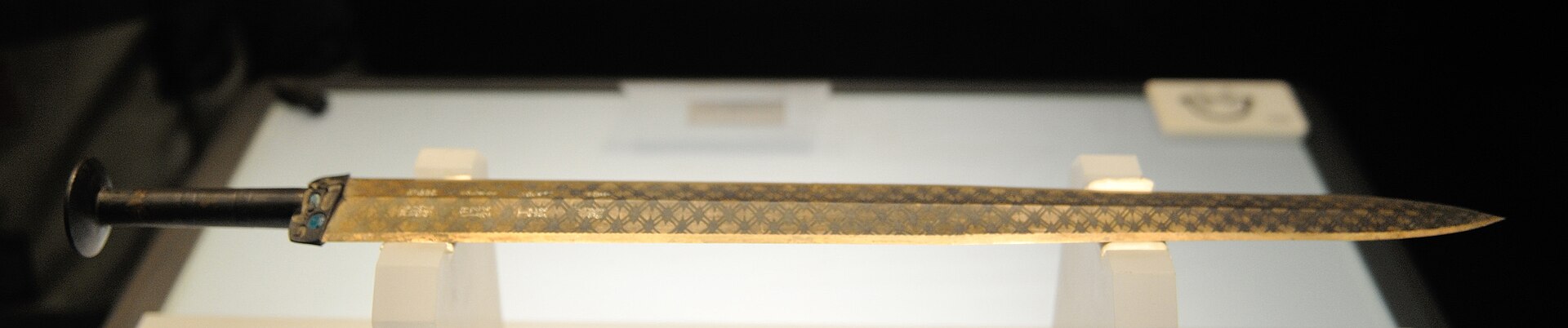
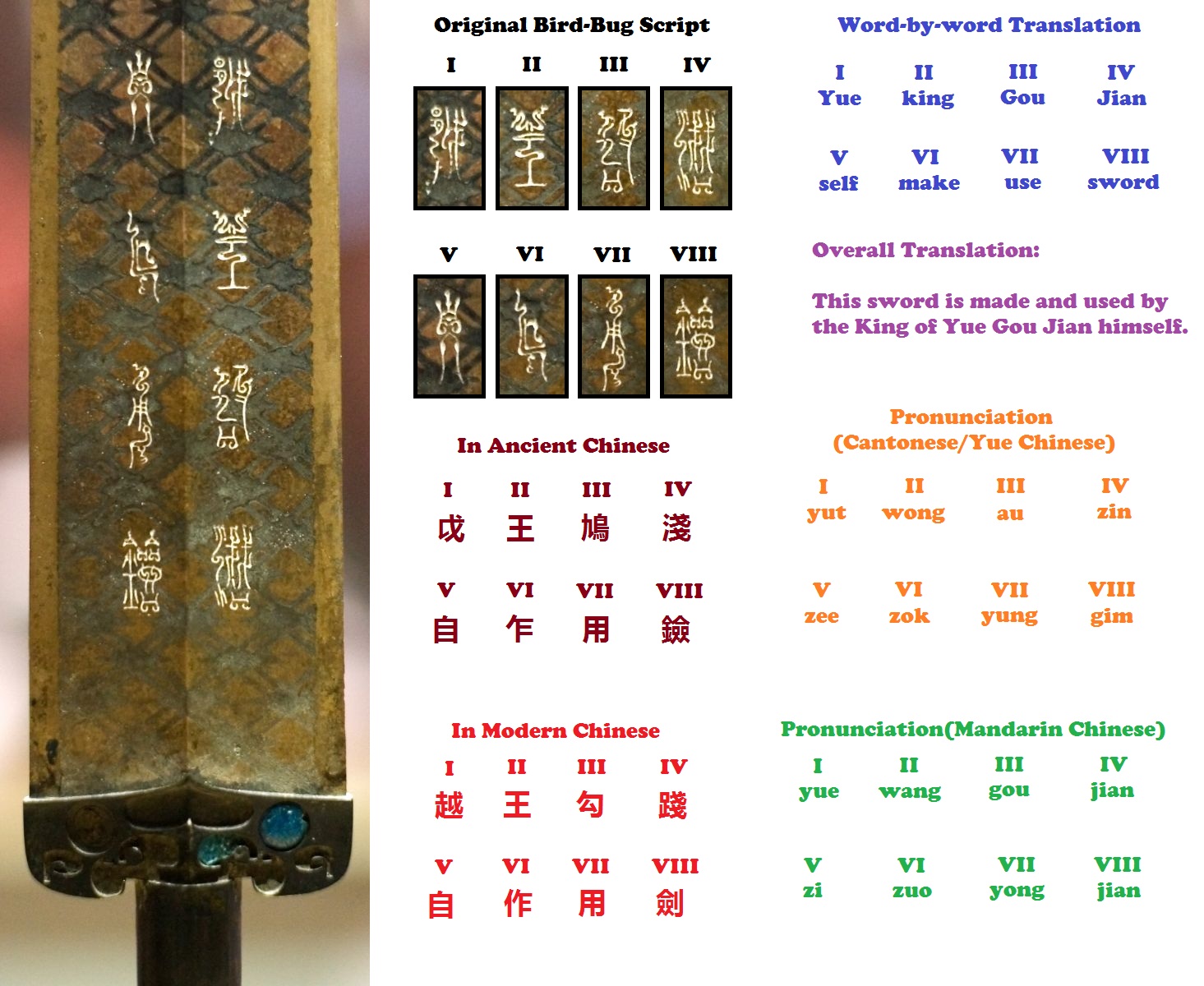
The Sword of Goujian was excavated in December 1965 and its eight-character inscription was read in stages, the last two characters taking until the end of February 1966. The script is niaozhuan, the bird-worm seal script of the southern states, ornamented to the point where trained epigraphers disagree. Six of the eight characters had appeared on earlier excavated weapons and were read on site by the historian Fang Zhuangyou, who was directing the dig: the King of Yue, made this sword for his own use. The two remaining characters carried the king's personal name, and nine kings are recorded for Yue.
Fang proposed the reading Shao Hua and identified the tomb as a Yue royal burial on that basis. Other workers on the site disagreed, so at the end of December 1965 he sent tracings, rubbings and photographs, with his own view, to Guo Moruo, Xia Nai, Tang Lan, Chen Mengjia, Yu Xingwu, Rong Geng, Shang Chengzuo and others. Guo Moruo wrote back quickly and agreed with Fang. On 5 January 1966 Tang Lan of the Palace Museum wrote that the two characters read Jiuqian, a phonetic loan for Goujian, and that the tomb could not be a Yue royal tomb but a Chu one holding a Yue treasure. Chen Mengjia's letter of 8 January agreed. On 28 February Guo Moruo wrote again: on close examination it is indeed Goujian's sword. Fang circulated the conclusion and no objection came back.
Nothing about the bronze changed between December and February. What changed was which scholar's reading the others accepted, and the tomb's identity changed with it. The archive's record holds the marriage-dowry and war-trophy theories for how the sword reached a Chu grave as open, because the reading settled the name and nothing else.
The Cadouin shroud was read in 1934 and stopped being a relic within days
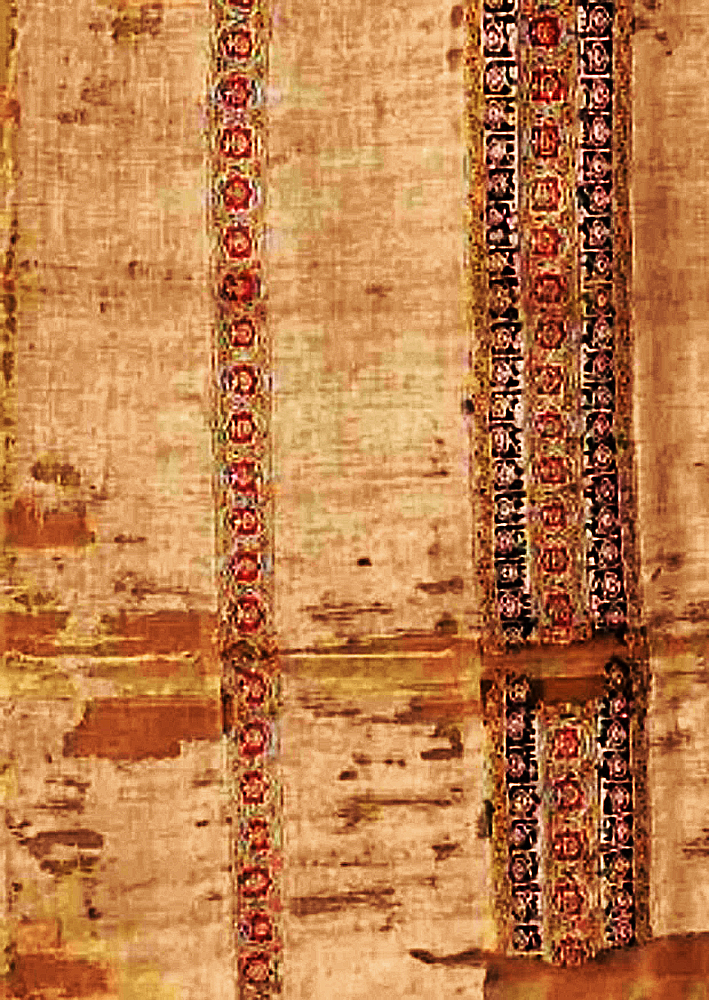
The Shroud of Cadouin was read in 1934 by Gaston Wiet, director of the Museum of Islamic Art in Cairo, working from photographs, and its seven-hundred-year pilgrimage ended the same summer. The cloth is a fine linen 295 by 135 cm with decorated bands at each end, and the bands carry a woven Kufic text. As early as 1868 the vicomte de Gourgues had remarked that part of the ornament looked like oriental lettering. Nobody followed it up in a way that reached the diocese. In 1934 the vicar general of Perigueux asked a Jesuit, Father P. J. Francez, to examine the bands; Francez recognised Coptic-period motifs and sent photographs to Wiet.
Wiet's reading, as the diocese's own account gives it, runs through the profession of faith with the Shi'a formula that Ali is the friend of God, a blessing on the pure imams, and then the full name and titles of the reigning imam, al-Musta'li billah, Commander of the Faithful, who reigned from 1094 to 1101. The text suggested a turban for a high dignitary. By a communique in La Semaine religieuse dated 11 August 1934, Monsignor Louis, bishop of Perigueux and Sarlat, suppressed the ostensions planned for September while the study was completed. Francez published his conclusions in 1935 under the title Un pseudo-linceul du Christ. On 2 December 1935 the cloth was classified as a Monument Historique, the state's category for a historic textile rather than the Church's for a relic.
The reading did not change a thread of the object. It changed the noun. The first document to mention a shroud at Cadouin is an act of Simon de Montfort of September 1214, and no document bridges the century between the weaving in 1096-97 and that act; our record leaves the Crusade-era routes as hypotheses. What we can date to the day is the moment the object stopped being what it had been for seven centuries, and that moment is a reading.
The Antonius label was read three ways before ultraviolet settled it
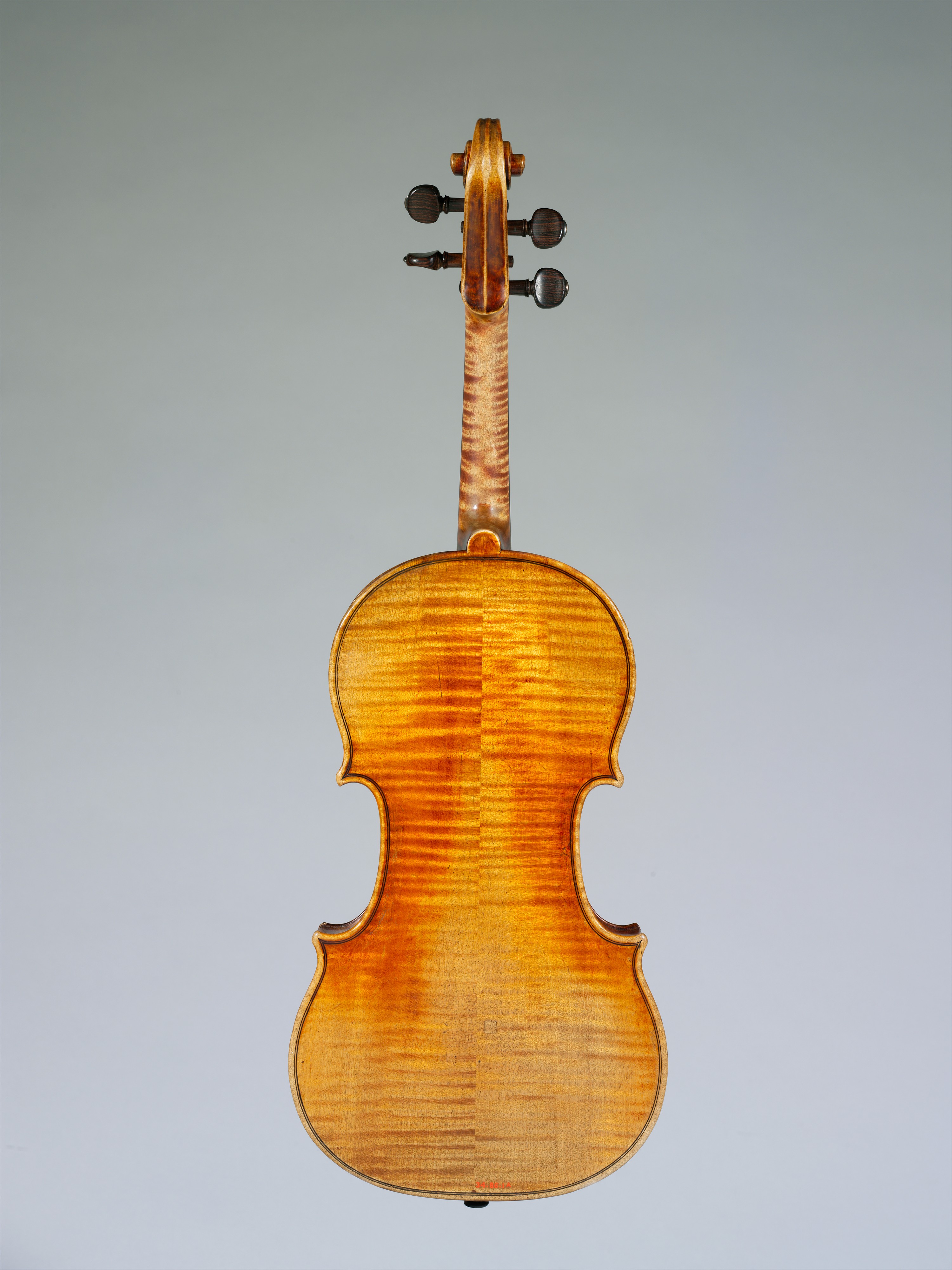
The Antonius violin at the Metropolitan Museum was read as 1721, then 1717, then 1711, by three readers across roughly a century, and the third reading was the first to be done under ultraviolet light. Stradivari's labels after 1700 were printed with a leading numeral 1 and the rest of the year written by hand, and on this label the handwritten digits had degraded. Annie Bolton Matthews Bryant's will and her correspondence with the Museum gave 1721 when she bequeathed the instrument in 1933. In the 1950s the New York expert Rembert Wurlitzer examined the label and read 1717, a date inside the Golden Period, and the Museum adopted it. Later curators hedged between the two.
The Museum's own account, published by the curator Jayson Kerr Dobney on 7 March 2017, describes what ended the hedging. The paper conservator Yana van Dyke examined the label itself, confirmed the paper as consistent with the early eighteenth century and untampered, and read the digits under ultraviolet as 17ii, Stradivari's own way of writing 1711. Two securely dated instruments of the same year, the Duport cello and the Earl of Plymouth, Kreisler violin, carry the year written the same way. The Museum's catalogue now gives 1711 without qualification; the Open Access record we pulled this week says the same.
What we find useful in this case is that all three readings were made by competent people looking at the same label. The difference was the instrument used to look, and the comparanda available. A record that stored only the current date would have stored 1721 in 1934 and 1717 in 1960 and been wrong both times without knowing it.
Two Greek endings held up a whole city for nearly a century
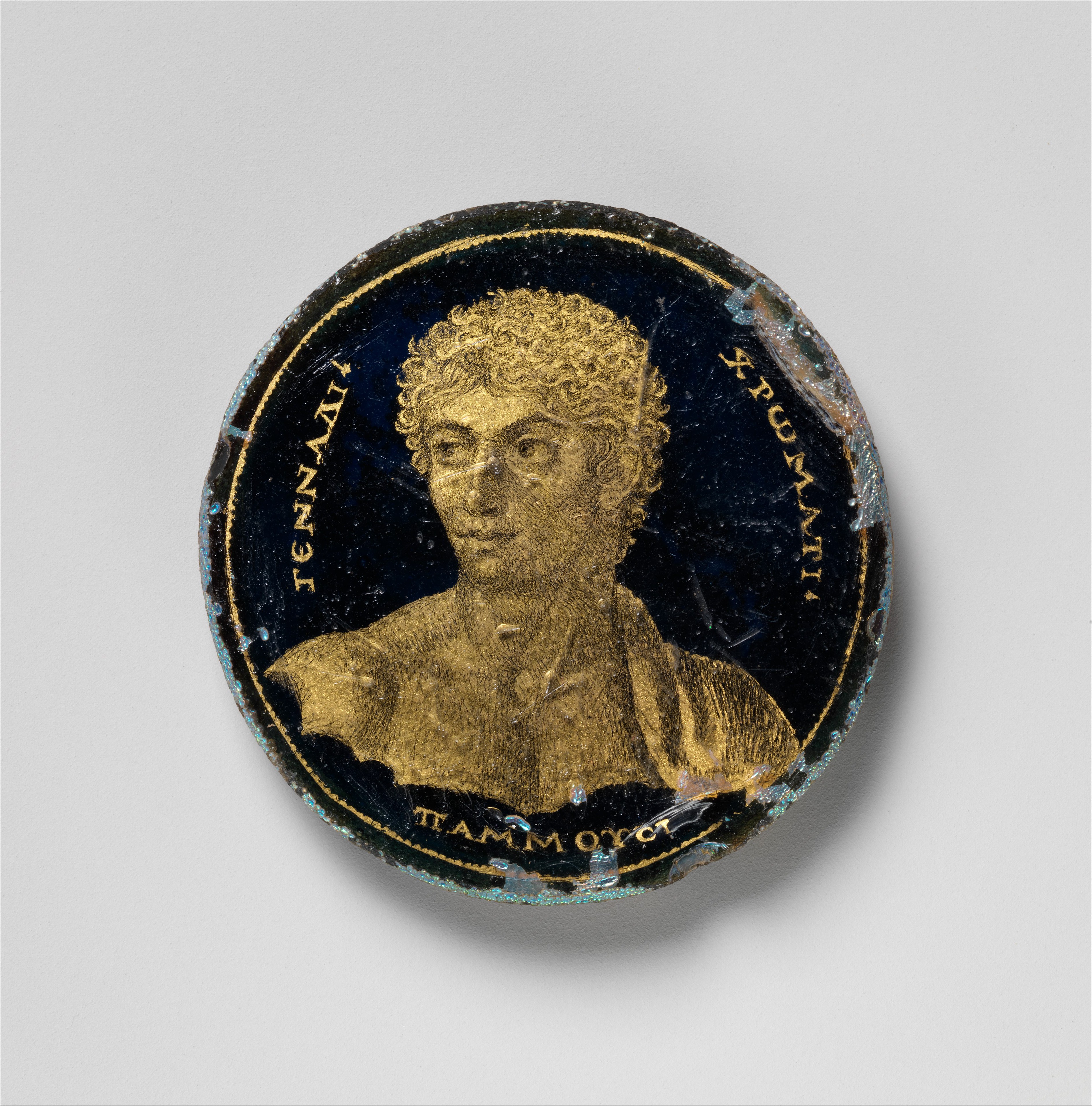
The Gennadios medallion in New York and the Brescia medallion set into the Cross of Desiderius are the only two inscribed gold-glass portraits known, and for ninety-seven years their inscriptions carried a claim that both were made in Alexandria. The Gennadios roundel is 4.1 cm across, bought by the Met through the Fletcher Fund in 1926 from the Paris dealer Martin Fabiani with no earlier owner recorded. Its Greek names the sitter and calls him most accomplished in the musical arts. In 1927 Joseph Breck published the piece and read the word-endings in iota as Alexandrian Greek. The same argument attached the Brescia medallion, whose two words near the rim are conventionally transliterated BOUNNERI and KERAMI, and it was still being repeated in 2007.
Rachel Catherine Patt's article in the American Journal of Archaeology for April 2024, volume 128 number 2, pages 221 to 242, takes the two inscriptions as the whole evidential base of the Alexandrian theory and finds no such dialect feature in either. She reads the endings instead as a nickname form that flourished across the later Roman Empire, ending in -i in Latin and in iota in Greek, unmoored from any one city. The abstract says the grounds on which the connection rests need to be reconsidered, and the body of the article says why: the desire to give a spectacular unprovenanced object a great metropolis is a habit of the discipline, not a fact about the glass.
Two things follow for a record. First, the Brescia piece has now lost two identifications in a row, the Galla Placidia label that eighteenth-century antiquarians gave it and that Breck rejected in 1927, and the Alexandrian workshop that Breck's own reading supplied. Second, the Met's structured record still reads Made in Alexandria, Egypt. We checked the Open Access API on 11 September 2026 and the geography fields say exactly that, while Patt's article sits in the object's bibliography and dates the piece about 200 to 250 rather than the Museum's 250 to 300. A reading has been published and the label has not yet caught up.
The Kashan bowl is the case where the writing was legible from the start
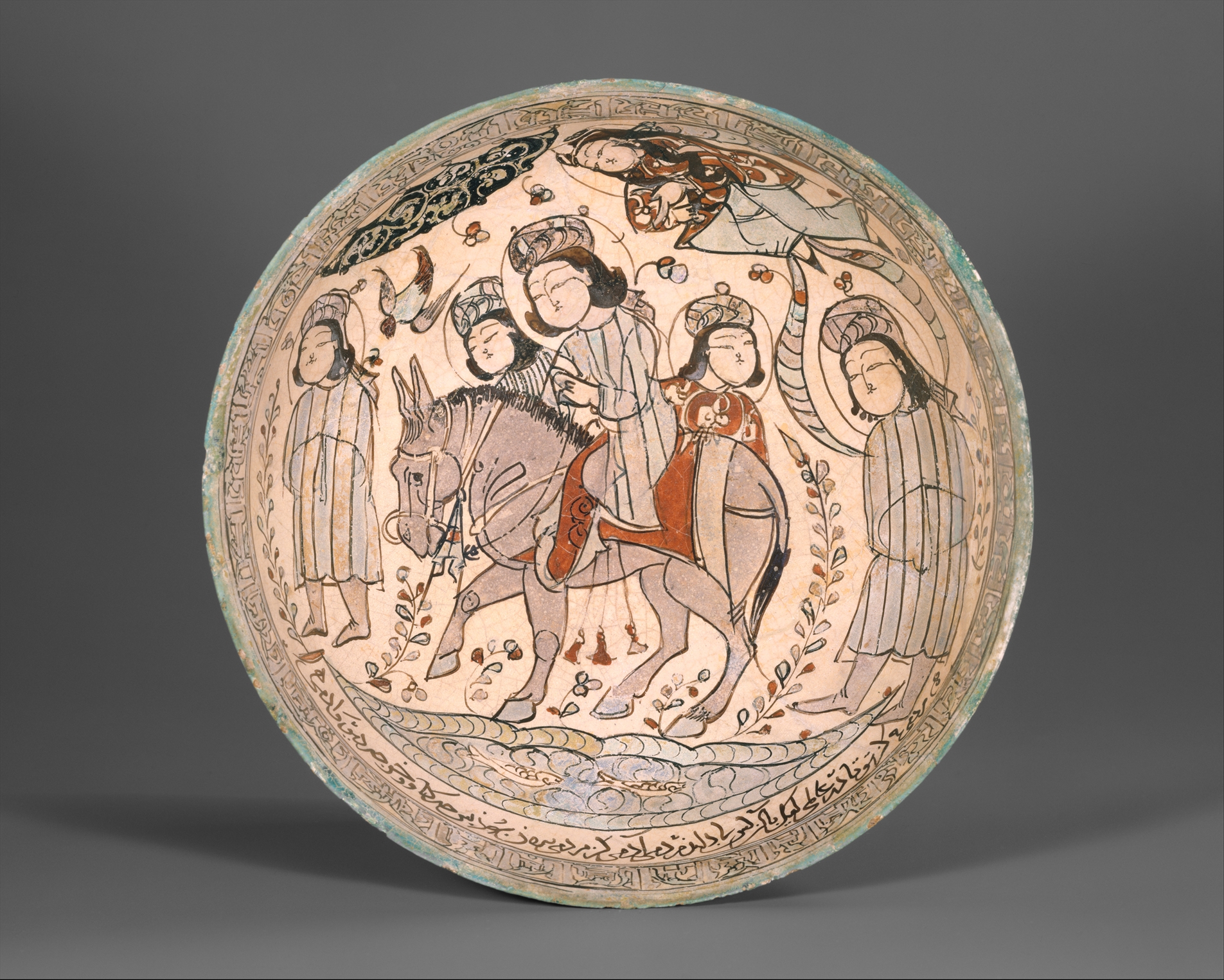
The mina'i bowl at the Metropolitan Museum dated 583 AH, which is 1187, is the control case: its inscription has been read the same way since it was fired, because it was written in a living script for a reader who shared it. The date is on the exterior. A kufic band around the rim carries good wishes to the owner in Arabic, and Persian verses beneath a fish-pond motif are recorded by the Museum as composed by Abu Zayd al-Kashani himself, which is the basis on which the bowl is attributed to him. The Museum bought it through the Fletcher Fund in 1964 together with a second bowl by the same hand, accession 64.178.1, dated a year earlier.
Abu Zayd's signed and dated output runs from 1186 to 1219 and is larger than that of any other identified potter of the medieval Islamic world, so the attribution rests on a corpus rather than a single reading. That is why nothing in the table above appears in this bowl's last column. There was no event. The verses said who wrote them and the date said when, and nobody in the eight centuries since has had to argue about either.
The contrast with the five other objects is the point. An inscription needs a reading event when its script has died, when its language has moved on, when its letters have faded, or when its meaning depends on a philological claim that later scholarship can test. Bird-worm script died with the southern states. Kufic was foreign to Perigord. The digits on a violin label fade. The Greek nickname form was misread as dialect. The Kashan bowl escaped all four conditions, and it is the only one of the six whose category has never moved.
What a record should carry: the reading, the reader and the date
A record of an inscribed object should store the transcription, the name of the person who made it, the date they made it, and the instrument or comparanda they used, because each of the five contested readings above was reversed by a change in exactly one of those things. Tang Lan had the same rubbings as Guo Moruo and a different method. Wiet had photographs and Arabic; the monks had neither. Van Dyke had ultraviolet light and two dated instruments from the same year. Patt had the onomastics of the later Empire that Breck did not.
We are not saying the current readings are wrong. Goujian is accepted, al-Musta'li is woven into the cloth, 1711 matches two other labels, and Patt's argument has not been answered in print as far as we have found. We are saying that each of them is a reading, and that the honest form of the field is a dated one: read as X by Y in Z. Where two readings compete, both belong in the record with their dates, the way our sword record keeps the marriage and trophy theories side by side. Where a museum's structured field still carries a reading its own bibliography has overtaken, as the Met's does for Gennadios, the record should say so and give the date it was checked, which for us is this week.
Is there a shortcut? We looked for one and did not find it. The only inscriptions here that never needed a dated reading are the ones written in a script that never died, for readers who never went away.
Why this archive is free to read
We do this for everyone who loves art. The people who have studied it for years, and the people who just stopped to look. Iconotheca exists so that what we learn belongs to all of them.
Nobody pays us for this. No ads, no sponsors, no commercial interest. These works belong to all of us, and we would rather share them with as many people as we can than keep them to ourselves.
If it gave you something today, tell us to keep going. Follow us, leave a like, or write a positive comment. We read every one, and they are what keeps us going.
Questions
Six of the eight characters were read on site in December 1965 by Fang Zhuangyou. The king's name was proposed as Jiuqian, a loan for Goujian, by Tang Lan in a letter of 5 January 1966, supported by Chen Mengjia on 8 January and accepted by Guo Moruo on 28 February 1966.
In 1934, when Gaston Wiet, director of the Museum of Islamic Art in Cairo, read the Kufic band from photographs sent by the Jesuit P. J. Francez and found the name of the caliph al-Musta'li, who reigned from 1094 to 1101. The bishop suppressed the September 1934 pilgrimage by a communique dated 11 August 1934.
Because the New York expert Rembert Wurlitzer read the degraded handwritten digits on the label as 1717 in the 1950s and the Museum adopted his reading. A paper conservator examining the label under ultraviolet light in the 2010s read 17ii, Stradivari's shorthand for 1711, matching the Duport cello and the Earl of Plymouth, Kreisler violin of the same year.
The Metropolitan Museum's record still says Made in Alexandria, Egypt, as checked on 11 September 2026. The only evidence for that was a reading of the Greek word-endings as Alexandrian dialect, published in 1927. Rachel Patt's 2024 article in the American Journal of Archaeology finds no such dialect feature and reads the endings as a later-Roman nickname form, so the attribution currently has no published basis.
Sources
- 1China News Service, republishing Beijing Daily, 'Exploring the mystery of the Sword of Goujian: who is the King of Yue in the eight-character inscription', 7 December 2016. Read in a browser. Source for Fang Zhuangyou's on-site reading, the letters of late December 1965, Tang Lan's letter of 5 January 1966, Chen Mengjia's of 8 January and Guo Moruo's of 28 February 1966. chinanews.com.cn/m/...
- 2Hubei Provincial Museum, official collection page for the Sword of Goujian. Dimensions and excavation data. hbww.org.cn/zgzb/...
- 3Serge Larue de Charlus, Conservatoire Diocesain d'Art Sacre de Perigueux, 'Le Suaire de Cadouin', PDF on the diocesan site. Read in full. Source for the 1214 act, the 1934 examination by Francez and Wiet, the communique of 11 August 1934 in La Semaine religieuse, Francez's 1935 publication, the classification of 2 December 1935 and the 295 by 135 cm measurement. artsacre.diocese24.fr/wp-content/...
- 4Jayson Kerr Dobney, 'Dating Stradivari's Antonius Violin', The Metropolitan Museum of Art, Perspectives, 7 March 2017. Read in the in-app browser after the page refused command-line requests. Source for the three readings of the label, Yana van Dyke's ultraviolet examination and the two comparison instruments. metmuseum.org/perspectives/...
- 5The Metropolitan Museum of Art, Open Access API, object 503008, the Antonius violin, accession 34.86.1a. Consulted 11 September 2026 for the date 1711, medium, dimensions, credit line and gallery. collectionapi.metmuseum.org/public/...
- 6Rachel Catherine Patt, '"Probably Alexandria": Gold-Glass Portraiture and the Allure of Egypt', American Journal of Archaeology 128.2, April 2024, pages 221-242, DOI 10.1086/728800. Abstract and figure caption read on the journal's site. ajaonline.org/article/...
- 7The Metropolitan Museum of Art, Open Access API, object 466645, Medallion with a Portrait of Gennadios, accession 26.258. Consulted 11 September 2026; the geography fields read Made in Alexandria, Egypt and the date 250-300. collectionapi.metmuseum.org/public/...
- 8Joseph Breck, 'The Ficoroni Medallion and Some Other Gilded Glasses in the Metropolitan Museum of Art', The Art Bulletin, 1927. Record of the 1927 reading, via JSTOR. jstor.org/stable/...
- 9The Metropolitan Museum of Art, Open Access API, object 451753, Bowl, Abu Zayd al-Kashani, accession 64.178.2, dated 583 AH/1187 CE. Consulted 11 September 2026 for the date, medium, dimensions, credit line and gallery. collectionapi.metmuseum.org/public/...
- 10Iconotheca, record pages for the six objects, with their own graded provenance and sources: the Sword of Goujian, the Shroud of Cadouin, the Antonius violin, the Gennadios medallion, the Brescia medallion and the Kashan bowl. iconotheca.com/artworks/...
More in Attribution and Authenticity
The partA Hallmark Can Be Genuine, Legal and About a Different Object
The V and A catalogues a Paul de Lamerie ewer of 1736 as a duty dodger, hallmarked 1944.
Composite Names Three Different Objects, and Only One of Them Is a Fake
Fifty-seven records here use composite, pastiche or assembled, and the words are doing three incompatible jobs.
The Frame Has Its Own Provenance
Ten records carry evidence on a frame. Van Eyck's integral frames date the panels to 1410-1440; a 1970 loan label on a frame in Maine proves nothing...