Medallion with a Portrait of Gennadios
Unknown Roman gold-glass engraver · 250-300 CE (Metropolitan Museum dating); Patt 2024 gives ca. 200-250 CE for the same object in her published figure caption
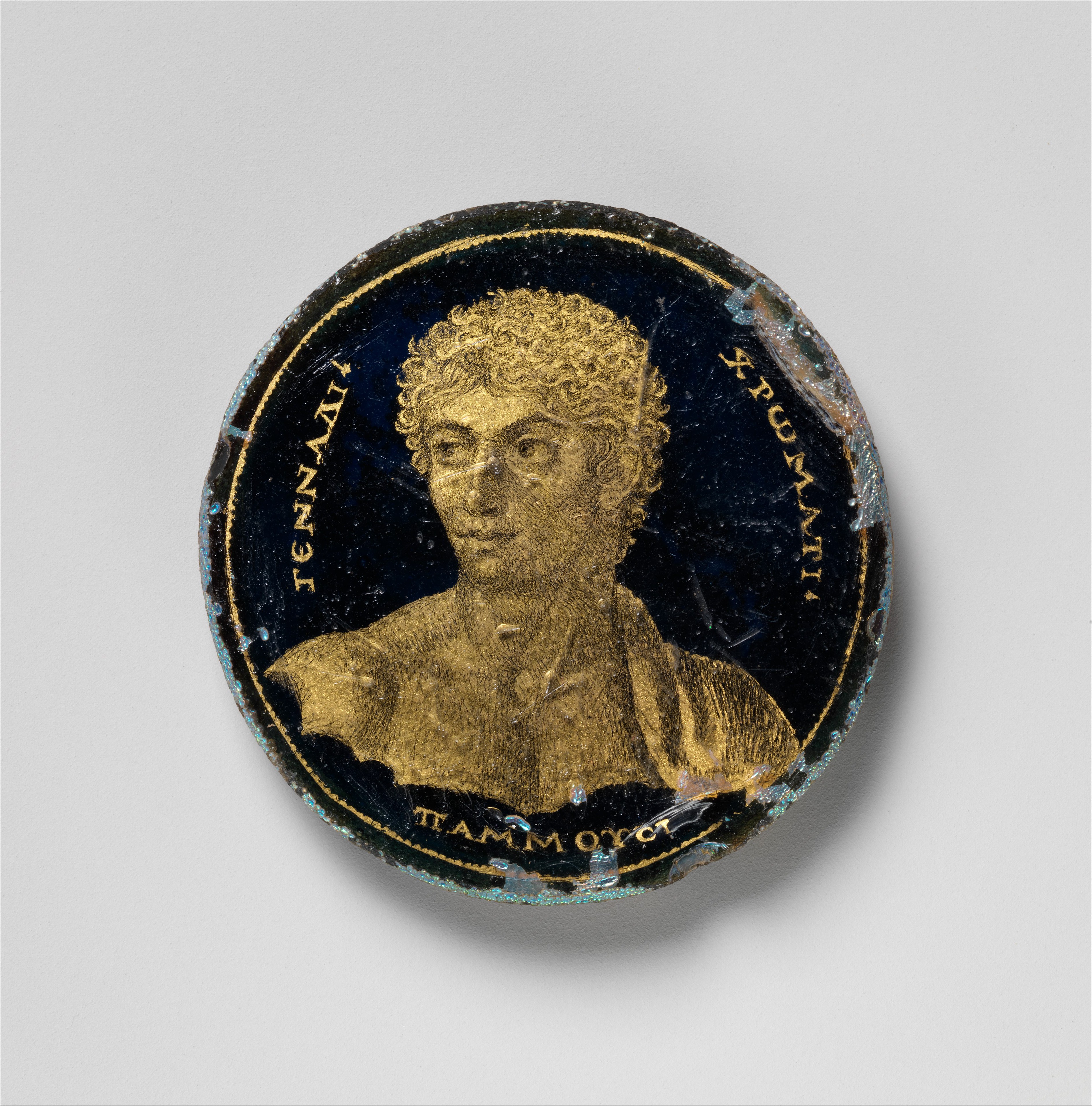
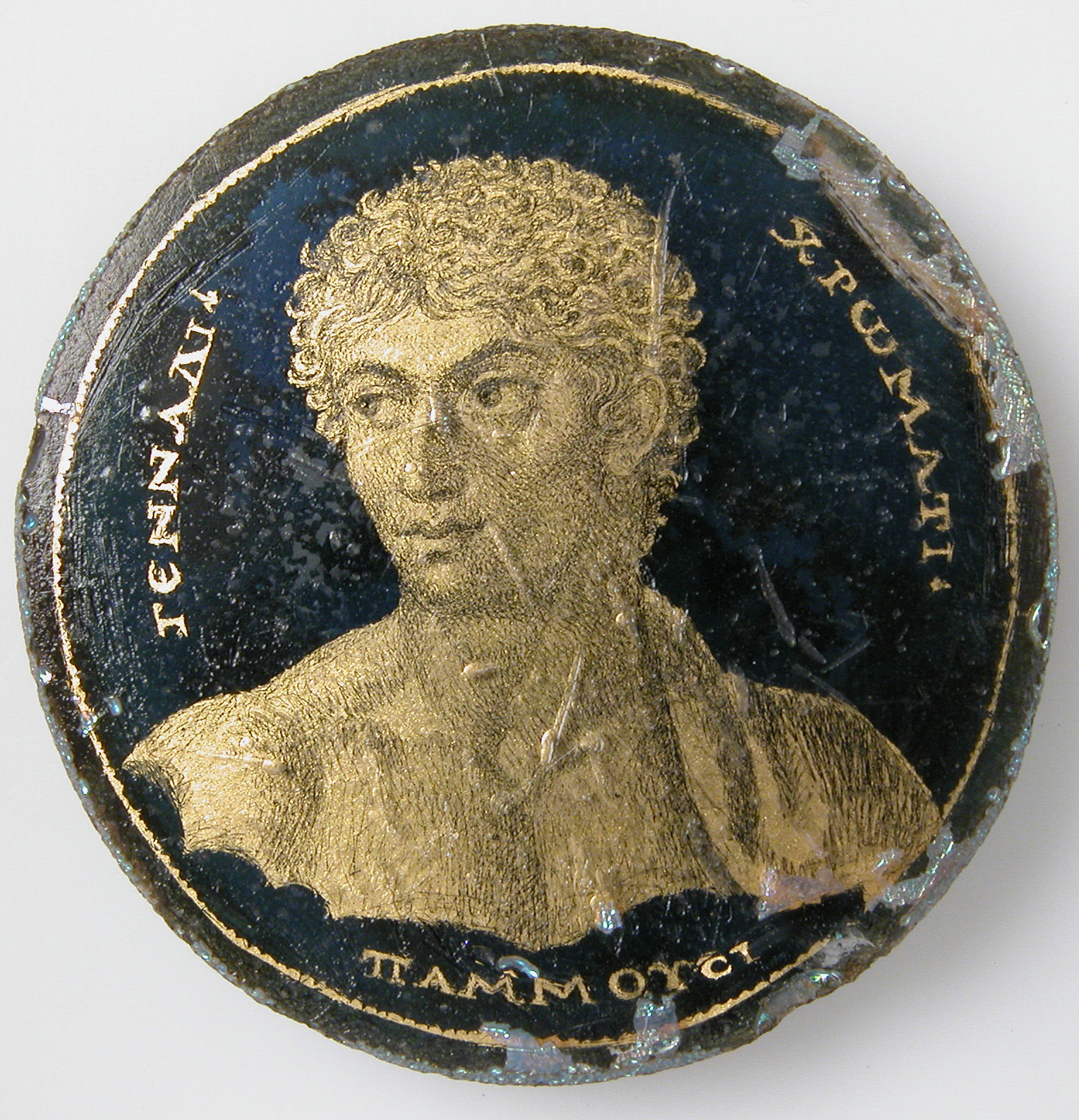
The record subject. Glass, gold leaf, and polychromy, 4.1 x 0.6 cm, Roman, 250-300 CE (Metropolitan Museum dating). Fletcher Fund, 1926. The Metropolitan Museum of Art, accession 26.258.
| Artist | Unknown Roman gold-glass engraver |
|---|---|
| Date | 250-300 CE (Metropolitan Museum dating); Patt 2024 gives ca. 200-250 CE for the same object in her published figure caption |
| Medium | Glass, gold leaf, polychromy |
| Dimensions | 4.1 x 0.6 cm (1 5/8 x 1/4 in.), a pierced pendant roundel, not a cut vessel-bottom fragment |
| Where it is now | Metropolitan Museum of Art, New Yorklast confirmed |
| Inventory number | 26.258 (Object ID 466645) |
| Attribution | DisputedJoseph Breck, the Metropolitan Museum's own curator, proposed in a 1927 Art Bulletin study that this medallion and comparable third-century gold-glass portrait roundels were made in Alexandria, Egypt, reading word-terminations in iota in the Greek inscription as a marker of Alexandrian dialect Greek. Full note |
| Object type | Glass |
| Period | Roman, third century CE |
| Cases | Disputed attribution · Has a provenance gap |
| Inscriptions | Inscribed in Greek, translated by the Metropolitan Museum of Art as: 'Gennadios, most accomplished in the musical arts.' The word-terminations in iota in this Greek text are the specific philological detail at the center of the 2024 reattribution dispute. |
| Owners on record | 4 links2 documented, 2 unknown |
| Sources | 11 cited |
About this record Last verified · 11 sources cited · Change log
On this page 9 sections
ContentsClose
A gold-glass pendant portrait, 4.1 centimeters across, made somewhere in the Roman Empire in the second half of the third century CE and inscribed in Greek with the name of the young man it shows: Gennadios, called most accomplished in the musical arts. The Metropolitan Museum of Art bought it in 1926 through the Fletcher Fund from a French dealer, Martin Fabiani, with no earlier owner recorded anywhere in the sources consulted.
Since Joseph Breck's 1927 study, the inscription has anchored a claim that this medallion, and a whole class of comparable third-century gold-glass portraits, was produced in Alexandria, Egypt, on the strength of word-endings read as Alexandrian Greek. Rachel Catherine Patt's 2024 article in the American Journal of Archaeology treats this medallion as one of only two inscribed examples the entire theory rests on, the other being a medallion set into the Cross of Desiderius in Brescia, and finds no genuine Alexandrian dialect feature in either text. She reads the endings instead as a documented nickname form of the later Roman Empire, unmoored from any single city.
The pre-1926 ownership chain is not padded out here because it does not exist in the record: the Museum's own provenance field runs directly from an unrecorded maker to the French dealer who sold the piece in 1926. That gap is reported as a gap, not bridged with invention.
Provenance
Each link is graded. Documented: a cited source supports it. Disputed: the identification is argued but not established. Unknown: no owner for that span, and the gap is not smoothed into a narrative. The grades in the glossary.
- 250-300 CE -Unrecorded maker and first owner(s)unknown
The medallion's place of manufacture is itself disputed (see attribution). No maker, workshop, or first owner is named or inferable from any source consulted. The subject, Gennadios, is known only from the inscription; he is not otherwise documented (see open questions).13
- - 1926Unrecordedunknown
The Metropolitan Museum's own published provenance field for this object contains a single line: '[Martin Fabiani (French)(sold 1926)]'. Nothing precedes it. No auction record, dealer stock number, exhibition, or earlier collection has been found in the sources consulted that would extend the chain further back. This is recorded as a genuine gap, not filled with speculation.1
- - 1926Martin Fabiani (French dealer)documented
The Metropolitan Museum's provenance field names Martin Fabiani, a French dealer, as the party who sold the medallion to the Museum in 1926; the bracketed format is the Museum's own convention for a dealer of record where fuller title history is not published. Whether this is the same Martin Fabiani (1899-1989) later prominent in the Paris art trade as Ambroise Vollard's associate and, after 1940, as a dealer active during the German occupation, cannot be confirmed from the sources consulted: the only detailed biography found makes no mention of antiquities dealing, of gold glass, or of this sale, and his documented career in that biography centers on paintings from the 1930s onward. The two may be the same person or two different men who happened to share a name; this record does not assert an identification that the sources do not support.111
- 1926 - presentMetropolitan Museum of Art, New Yorkdocumented
Acquired in 1926 through the Fletcher Fund, the acquisitions endowment created from the 1917 bequest of the industrialist and collector Isaac Dudley Fletcher. The same fund later purchased Velazquez's Portrait of Juan de Pareja for the Museum. The medallion carries accession number 26.258 and Object ID 466645, and the Museum's Open Access API records it as public domain (isPublicDomain: true).128
Technical evidence
| Attribution note | Joseph Breck, the Metropolitan Museum's own curator, proposed in a 1927 Art Bulletin study that this medallion and comparable third-century gold-glass portrait roundels were made in Alexandria, Egypt, reading word-terminations in iota in the Greek inscription as a marker of Alexandrian dialect Greek. Rachel Catherine Patt's 2024 article in the American Journal of Archaeology treats this medallion as one of only two inscribed exemplars the entire Alexandria hypothesis rests on and finds no genuine Alexandrian dialect feature present, proposing instead that the iota-terminations reflect a documented type of later Roman Imperial nickname unconnected to any single city. As of 2026-09-03 the Museum's own object record has not been revised to match: its prose overview hedges the attribution as 'probably' Alexandria while its structured Geography field states 'Made in Alexandria, Egypt' without qualification, even though Patt's article is now listed in the object's own published bibliography. |
|---|---|
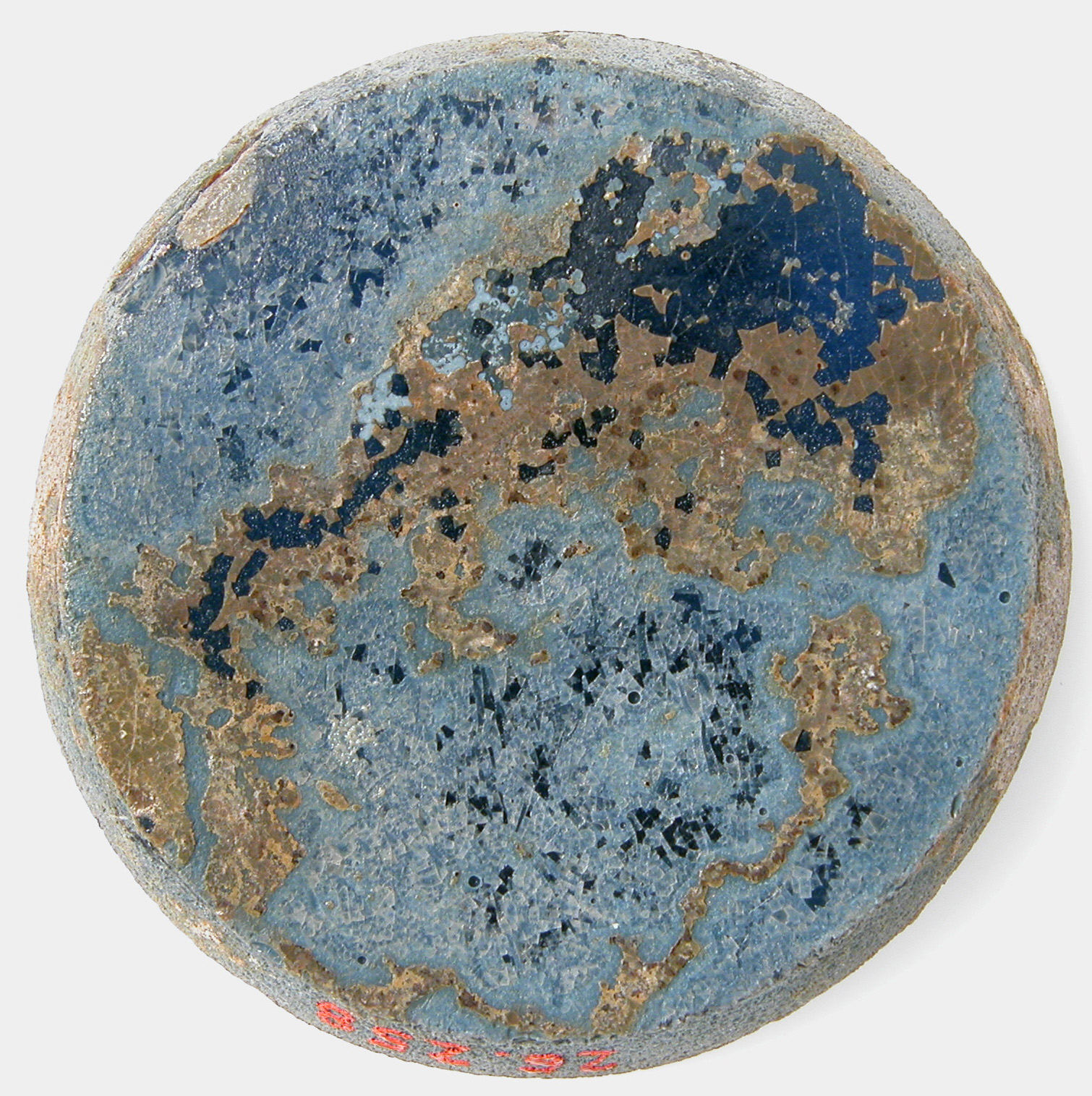
| Support and medium | Glass, gold leaf, polychromy, worked as a sandwich-glass roundel with the gold leaf engraved and sealed between two fused layers of glass.12 |
| Classification | Glass - Gold glass, the Metropolitan Museum's own live facet designation for this object.2 |
| Dimensions | Overall 4.1 x 0.6 cm (1 5/8 x 1/4 in.). A small pendant roundel, not a cut vessel-bottom fragment.12 |
| Inscription | Inscribed in Greek, translated by the Metropolitan Museum as 'Gennadios, most accomplished in the musical arts.' The word-terminations in iota are the specific philological feature at the center of the 2024 reattribution dispute.13 |
| Object format | Classified by Wikidata as a pendant, distinct from the far more numerous gold-glass vessel-bottom fragments recovered pressed into catacomb mortar.67 |
| Museum dating | The Metropolitan Museum dates the object 250-300 CE on its own live object record. Rachel Catherine Patt's 2024 article, illustrating this exact medallion as its figure 1, gives a different range, ca. 200-250 CE, in the published caption. The two primary sources for the same object do not agree.13 |
| Attribution field | The Museum's structured Geography field reads 'Made in Alexandria, Egypt' without qualification; its prose overview hedges the same claim as 'probably.' Patt 2024, now listed in the object's own published bibliography, argues the epigraphic basis for either version does not hold.123 |
| Display status | Not on view as of 2026-09-03. Curatorial department of record is Medieval Art and The Cloisters.1 |
| Credit line and accession | Fletcher Fund, 1926. Accession 26.258, Object ID 466645. Recorded as public domain (isPublicDomain: true) in the Museum's Open Access API.12 |
Images
The record in full
Chapter 1What it is
A small gold-glass roundel, 4.1 centimeters in diameter and 0.6 centimeters deep, worked as a sandwich of two fused glass layers with a design in gold leaf sealed permanently between them.
A small gold-glass roundel, 4.1 centimeters in diameter and 0.6 centimeters deep, worked as a sandwich of two fused glass layers with a design in gold leaf sealed permanently between them. It shows the head and shoulders of a young man, rendered with the direct, wide-eyed frontality typical of Roman portraiture of its period, and it was made to be mounted and worn as a pendant rather than set into a vessel.
The Greek inscription beside the head names him: Gennadios, described as most accomplished in the musical arts. The Metropolitan Museum's own translation is a plain declarative sentence, not a riddle, and the object itself is equally direct in what it is for: a small, wearable, personal image of a specific named individual, made to be looked at closely by the people who knew him.
It is currently not on view. The Museum's department of record is Medieval Art and The Cloisters, a placement that reflects an institutional grouping of late antique material with the medieval collection rather than any claim about the object's own religious content, since nothing in the image or inscription is Christian.
Chapter 2The inscription and the man it names
Gennadios is an ordinary Greek personal name, not a title or an honorific, and no independently documented historical individual of that name can be connected to a private portrait of the third...
Gennadios is an ordinary Greek personal name, not a title or an honorific, and no independently documented historical individual of that name can be connected to a private portrait of the third century CE. A search of the individuals conventionally listed under the name turns up bishops, generals, and scholars from the fifth century onward: a patriarch of Constantinople who died in 471, a historian of Marseille of the same century, more than one Byzantine general given the title exarch of Africa, a bishop of Astorga in the ninth century, a second patriarch of Constantinople in the fifteenth. None predates this medallion by less than a century and a half, and none has ever been proposed as its subject. The honest reading is that Gennadios here is simply a name attached to a private face, with no further identifiable person behind it in the surviving record.
What the inscription does establish is social context rather than identity. Describing a young man as most accomplished in the musical arts places him among the educated, leisured youth of the Roman Empire for whom musical training, like rhetoric, was a marker of cultivation and family standing, and for whom success in a musical contest was a genuine, recordable achievement worth commemorating in gold and glass. Objects of this exact kind, small enough to be worn on the body, are widely understood among specialists in the class as personal or family gifts, exchanged at moments such as a betrothal, a wedding, a birth, or a comparable family or civic occasion, rather than as public honorific monuments. A medallion praising a young man's skill at music fits that pattern precisely: it is the kind of object a family or a patron would commission to mark a competitive success, wearable evidence of a personal accomplishment rather than an official commemoration.
Chapter 3Alexandria, probably: Breck's 1927 study
The claim that this medallion was made in Alexandria, Egypt, is not a modern museum label written casually.
The claim that this medallion was made in Alexandria, Egypt, is not a modern museum label written casually. It descends from a specific scholarly argument, made in a specific place, by a specific person: Joseph Breck, a curator at the Metropolitan Museum itself, who published the piece in the Art Bulletin in June 1927 under the title 'The Ficoroni Medallion and Some Other Gilded Glasses in the Metropolitan Museum of Art.' That title is itself informative: Breck's study covered several of the Museum's gold-glass objects together, with this Gennadios medallion appearing as one of the 'other gilded glasses' alongside the Museum's separately catalogued, uninscribed Mother-and-Child medallion (accession 17.190.109a, the one popularly called the Ficoroni medallion; see below on why the two must not be confused).
Breck's argument for Alexandria rested on the Greek inscription itself: he read its word-terminations in iota as a feature of Alexandrian Greek, a regional dialect marker, and used that reading to localize the medallion's manufacture to Alexandria. For roughly a century, that identification held. It was repeated, restated, and folded into successive Museum guidebooks and general surveys of late antique art without being independently re-examined at the epigraphic level, becoming one of those attributions that is true because everyone has said it, rather than because anyone has recently checked it.
Chapter 4Patt's 2024 reassessment
Rachel Catherine Patt's article, '"Probably Alexandria": Gold-Glass Portraiture and the Allure of Egypt,' published in the American Journal of Archaeology 128, no.
Rachel Catherine Patt's article, '"Probably Alexandria": Gold-Glass Portraiture and the Allure of Egypt,' published in the American Journal of Archaeology 128, no. 2 (April 2024), pages 221 to 242, returns directly to the epigraphic evidence Breck used and re-examines it. Her stated conclusion, in her own published abstract, is that she demonstrates the absence of a genuine Alexandrian Greek dialect in the inscriptions and offers an alternative onomastic reading to resolve the iota-ending problem that had been read as dialectal.
Her proposal is specific and philological, not impressionistic: she argues that the words ending in iota on these gold-glass roundels represent a documented type of nickname that flourished across the later Roman Imperial period generally, popularly ending in -i in Latin inscriptions and -i-sound (iota) in Greek ones. If correct, the ending is a feature of a name-formation convention current across the wider later Roman Empire, carrying no information at all about where a given object naming someone in that convention was actually made. The iota that Breck read as a regional fingerprint becomes, in Patt's reading, a period-wide naming habit that could appear on an inscription made almost anywhere in the Greek-speaking Roman world.
This medallion is not incidental to that argument. Patt uses it as her lead illustration, captioned in the published article as figure 1, and the object's own current bibliography at the Metropolitan Museum, current as of 2026-09-03, now lists her article by name. The reassessment is not a general essay that happens to mention this piece; this piece is one of the two load-bearing exhibits the entire argument is built on.
Chapter 5The Brescia medallion: the other pillar of the argument
Patt's abstract is explicit that the Alexandrian attribution for this whole class of object has 'long been associated with Alexandria as the place of production on the basis of inscriptions on two...
Patt's abstract is explicit that the Alexandrian attribution for this whole class of object has 'long been associated with Alexandria as the place of production on the basis of inscriptions on two examples, one in Brescia and one in New York.' The New York example is this medallion. The Brescia example is a comparable gold-glass portrait roundel set into the Cross of Desiderius, the great jewelled reliquary cross now in the Museo di Santa Giulia in Brescia, Italy, and it is the subject of a separate Iconotheca record published alongside this one.
The two medallions function as a matched pair in the scholarship precisely because they are, on current evidence, the only two inscribed gold-glass portrait roundels of this general type: every other object in the wider gold-glass corpus that has been proposed as Alexandrian rests on style and technique alone, with no text to argue about. Breck's 1927 case for Alexandria, and every subsequent restatement of it, depends on reading both of these two inscriptions the same way. Patt's 2024 case against Alexandria works the same way in reverse: she has to show that the iota-ending reading fails for both texts, not just one, because if only one inscription supported the Alexandrian dialect theory and the other did not, the theory could survive on the surviving example. Her argument is that neither inscription, examined on its own philological merits, actually supports a distinctively Alexandrian Greek dialect at all, which is why she treats the two objects as a single combined case rather than as two separate footnotes.
This is also why conflating either of these two medallions with a third, unrelated gold-glass object would corrupt the argument rather than merely mislabeling a picture. The whole force of Patt's reassessment depends on there being exactly two inscribed exemplars, named as such. A record that muddled a third piece into that pair, or mistook the pair for a third piece entirely, would misrepresent the shape of the scholarly debate itself, not just a caption.
Chapter 6The larger claim: an allure of Egypt, not a proof of it
Patt's article does not stop at reassessing two inscriptions.
Patt's article does not stop at reassessing two inscriptions. Her stated broader conclusion, again in her own words from the published abstract, is that 'the desire to attribute the gold-glass portraits to Alexandria is part of a larger impulse in art history of the classical period to assign especially remarkable and luxurious works of art without provenience to ancient metropolises.' The title of the article makes the same point more bluntly: 'the allure of Egypt.'
Read this way, the century-long Alexandria attribution for this medallion is a case study in a wider pattern the article names directly: when a luxury object of unknown findspot is unusually fine, unusually well preserved, or unusually well documented by name, there is a recurring scholarly pull toward crediting a famous ancient center, rather than toward the plainer and less satisfying conclusion that its precise origin is simply not recoverable from the object itself. Patt's argument does not claim to know where this medallion actually was made. It claims, more narrowly and more defensibly, that the specific philological evidence long used to say Alexandria does not hold up, and that the appeal of Alexandria as an answer has done real work in keeping a weak argument alive for a hundred years.
That is the honest state of the question as it stands today: removing Breck's epigraphic argument does not relocate the workshop to Rome, Antioch, or anywhere else with any more evidence than it had for Alexandria. It reopens the question rather than answering it differently, and this record treats that reopening as the finding it is, rather than quietly reasserting Alexandria out of habit or replacing it with an equally unsupported alternative.
Chapter 7How a gold-glass portrait was actually made
The general technique behind objects of this class, sometimes called gold sandwich glass, is documented independently of any single example: gold leaf was laid onto a flat disc of glass and fixed...
The general technique behind objects of this class, sometimes called gold sandwich glass, is documented independently of any single example: gold leaf was laid onto a flat disc of glass and fixed with an adhesive, and an artisan then scraped away the unwanted gold with a fine point to leave the design, whether a portrait, an inscription, or both, in the remaining gold leaf. A second layer of glass was then fused over the decorated disc under heat, so that the gold image was sealed permanently between two glass layers, protected from abrasion and from any need for later retouching. It is a technique that produces genuine permanence: gold leaf under an unbroken glass skin does not tarnish, flake, or fade the way an exposed painted surface does, which is a large part of why so many examples of this general class have survived from antiquity into modern museum collections in legible condition.
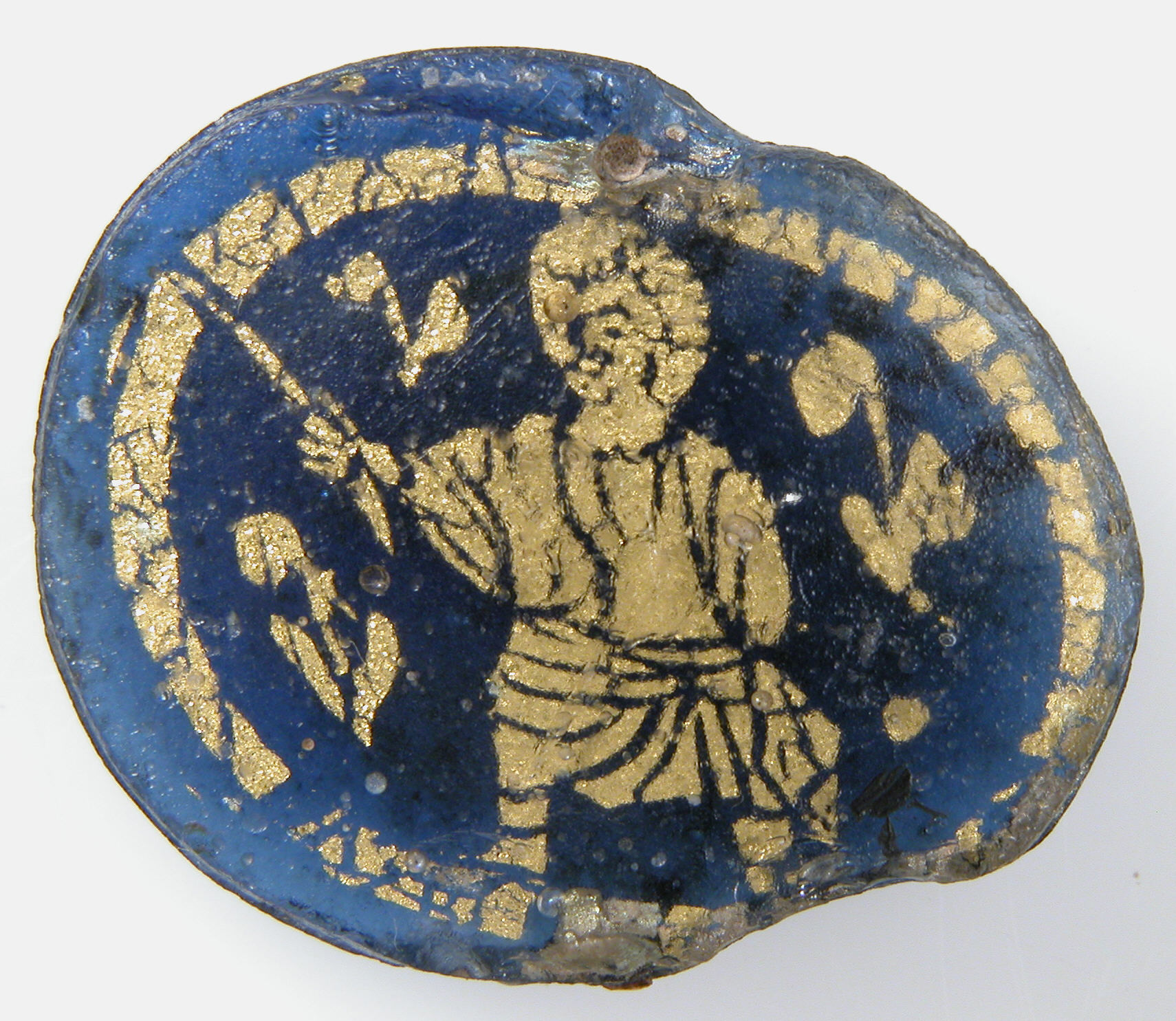
Two distinct subtypes of the wider gold-glass corpus should not be confused with each other. By far the larger surviving group, several hundred known fragments, are cut vessel-bottoms: the round base of a drinking vessel, decorated in this technique, later cut away from the rest of the glass and pressed into wet mortar as a grave marker set into the wall of a burial niche in the Roman catacombs, where hundreds have been recovered still embedded in mortar. This medallion belongs to the second, much smaller subtype: a pendant made from the outset to be worn, pierced or mounted for suspension, and never part of a drinking vessel at all. No technical study specific to this exact medallion, such as an X-ray fluorescence reading of the gold leaf's composition or a compositional analysis of the glass itself, has been located in the sources consulted for this record; if one exists in an unpublished conservation file at the Metropolitan Museum, it has not surfaced in public literature.
Chapter 8What this kind of object was for
Portrait roundels of this general Roman type, whether cut from a vessel or made as a standalone pendant, are consistently associated in the literature with personal and family occasions rather than...
Portrait roundels of this general Roman type, whether cut from a vessel or made as a standalone pendant, are consistently associated in the literature with personal and family occasions rather than public commemoration: gifts marking a wedding or a wedding anniversary, a betrothal, a birth, a New Year, a religious festival, or, as here, a specific personal achievement such as victory in a contest. They are private objects in the fullest sense, made to travel with a person or to be kept within a household rather than displayed in a civic or religious building.
Read against that convention, Gennadios's medallion sits squarely inside the genre's ordinary, well-attested function: it is a wearable, personal commemoration of one young man's success in a musical contest, of exactly the kind a family with the means to commission gold-glass work would have made or bought to mark such an occasion. Nothing about the object asks to be read as anything grander than that, and nothing in the sources consulted suggests it should be. The absence of a hidden civic, religious, or dynastic programme here is itself the finding: this is a domestic object commemorating a private accomplishment, not a public monument, and treating it as more than that would be the invention this record is built to avoid.
Chapter 9The 1926 purchase and the Fletcher Fund
The Metropolitan Museum bought the medallion in 1926 using the Fletcher Fund, an acquisitions endowment that did not exist before 1917.
The Metropolitan Museum bought the medallion in 1926 using the Fletcher Fund, an acquisitions endowment that did not exist before 1917. It was created from the bequest of Isaac Dudley Fletcher, a Bangor, Maine-born industrialist who made his fortune as president of the Barrett Manufacturing Company, an asphalt distributor, and who settled in New York in 1865. Fletcher assembled a personal art collection that included works then attributed to David, Gainsborough, Rembrandt, Reynolds, and Rubens, and on his death in 1917 he left both that collection and a substantial sum of money to the Metropolitan Museum, the money earmarked to keep buying art in his name.
The Fletcher Fund went on to become one of the Museum's most consequential acquisitions endowments across the twentieth century: the same fund later purchased Velazquez's Portrait of Juan de Pareja, among other major works. The 1926 purchase of this medallion is a comparatively modest transaction within that larger history, a small object bought in the ordinary course of a large, active acquisitions fund rather than a headline purchase, and nothing in the sources consulted suggests it was accompanied by any unusual fanfare, exhibition, or public announcement at the time.
Chapter 10Martin Fabiani and the wall the chain runs into
The Museum's own provenance field for this object contains exactly one line before its own acquisition: '[Martin Fabiani (French)(sold 1926)].' No auction house, no earlier private collection, no...
The Museum's own provenance field for this object contains exactly one line before its own acquisition: '[Martin Fabiani (French)(sold 1926)].' No auction house, no earlier private collection, no country of findspot, and no date of export is recorded anywhere in the sources consulted. This is, on its face, a thin chain, and this record does not attempt to thicken it with inference.
A French art dealer named Martin Fabiani (1899-1989) is independently documented: Corsican-born, he moved in the Paris art world of the 1920s, brokering paintings and, by his own account, meeting figures such as Claude Monet and Moise Kisling during that period, before becoming closely associated in the 1930s with the dealer Ambroise Vollard, whose estate he helped administer after Vollard's death in 1939. He went on to a controversial and heavily documented career during the German occupation of Paris, trading in works with a provenance history that has drawn later scrutiny. Whether this is the same Martin Fabiani who sold a Roman gold-glass medallion to the Metropolitan Museum in 1926 cannot be confirmed from the sources examined for this record: the detailed biography located makes no mention of antiquities, of gold glass, or of any transaction with the Metropolitan Museum, and his documented activity in that account centers on paintings rather than ancient objects. The name, the nationality, and the period are all consistent with a match; nothing found actually proves one. This record states that plainly rather than asserting an identification it cannot support, and flags it as an open question for anyone with access to the Museum's own acquisition files or to French art-trade directories of the 1920s.
No auction record search, dealer archive, or exhibition history search conducted for this record turned up an earlier appearance of the medallion under any name: not 'Gennadios medallion,' not 'gold glass medallion 26.258,' and not any plausible period description of a gold-glass roundel of this size. That absence is itself worth recording. Where a house rule requires a recorded gap over an invented chain, this is that gap: the pre-1926 history of this object is graded unknown, not filled in, because nothing found supports filling it in.
Chapter 11Not the Ficoroni medallion: a warning against a specific, documented confusion
The Metropolitan Museum holds a second, separately catalogued gold-glass portrait medallion that is frequently discussed in the same breath as this one, and the two must not be conflated.
The Metropolitan Museum holds a second, separately catalogued gold-glass portrait medallion that is frequently discussed in the same breath as this one, and the two must not be conflated. That other object, accession 17.190.109a, Object ID 463989, is titled 'Gold Glass Medallion with a Mother and Child' and is popularly known as the Ficoroni medallion. It shows a fashionably dressed matron with her son, who wears a large gold pectoral, and it entered the Museum in 1917 as a gift of J. Pierpont Morgan, decades before this medallion arrived by purchase in 1926.
Three things distinguish the two objects sharply, and all three matter to the argument this record covers. First, the Mother-and-Child medallion carries no personal-name inscription at all: the Museum's own object page describes only the imagery, with no text to read and therefore no epigraphic argument to make about it. Second, it is consequently not one of the two medallions, this one and the Brescia example, that Rachel Catherine Patt's 2024 article reassesses; her article is specifically about the two inscribed exemplars, and the uninscribed Mother-and-Child medallion falls outside that argument entirely. Third, the Mother-and-Child medallion has a far longer and better documented ownership history than this medallion does, reportedly traceable through the eighteenth-century antiquarian Francesco de' Ficoroni, Horace Walpole's collection at Strawberry Hill, the Dilke family, and the dealer Amedeo Canessa before reaching J.P. Morgan. That rich chain belongs entirely to accession 17.190.109a and is not reproduced here in any detail, because doing so would misattribute someone else's documented provenance to this object's genuinely thin one.
Joseph Breck's own 1927 study is, ironically, the direct historical source of the risk of confusing the two: his article's title, 'The Ficoroni Medallion and Some Other Gilded Glasses in the Metropolitan Museum of Art,' covers both objects together in a single publication, with this Gennadios medallion filed under 'some other gilded glasses.' A reader working from that title alone, or from a citation to it, could easily assume the two objects share a single provenance or a single scholarly argument. They do not. This section exists specifically to close that door.
Chapter 12A century in the literature
The Metropolitan Museum's own published bibliography for this object is, in effect, a documented attribution history in miniature, running from Breck's original 1927 study through seventeen...
The Metropolitan Museum's own published bibliography for this object is, in effect, a documented attribution history in miniature, running from Breck's original 1927 study through seventeen subsequent citations to Patt's 2024 reassessment. Francis Henry Taylor illustrated it in his 1954 survey Fifty Centuries of Art. The Museum's own 1962 and 1972 collection guides both illustrated it as a numbered highlight. Vera Ostoia catalogued it in 1969 for the loan exhibition 'The Middle Ages: Treasures from the Cloisters and the Metropolitan Museum of Art,' which travelled to the Los Angeles County Museum of Art in January to March 1970 and to the Art Institute of Chicago in May to July 1970, the medallion's first documented appearances outside New York.
Kurt Weitzmann featured it prominently in the Museum's own Bulletin in autumn 1977, where it appears as figure 41 and as the issue's cover illustration, before including it as catalogue number 264 in his landmark 1979 exhibition volume Age of Spirituality: Late Antique and Early Christian Art, Third to Seventh Century, itself drawn from a exhibition held at the Metropolitan Museum from November 1977 to February 1978. It reappears in the Museum's 1983, 1994, and 2012 guides, in a 1987 study of the Museum's medieval holdings by Mary B. Shepard, in a 1995 German-language study of glass-painting history, in a 2001 Bulletin essay on Byzantine art, in Daniel Thomas Howells's 2015 catalogue of late antique gold glass at the British Museum, and in Kenneth Lapatin's 2015 Getty Museum volume Luxus: The Sumptuous Arts of Greece and Rome, before arriving at Patt's 2024 reassessment. Its most recent public exhibition at the Metropolitan Museum itself was 'The Good Life: Collecting Late Antique Art at The Met,' which ran from May 2021 to May 2023.
Read start to finish, that sequence of seventeen citations across ninety-seven years is itself the attribution history in primary form: an object identified once, in 1927, and then carried forward through guidebook after guidebook and survey after survey largely on the strength of that first identification, until a specialist returned to the original epigraphic evidence in 2024 and found it did not hold. That is not a criticism of any single writer in the chain; restating a settled-looking scholarly consensus is normal practice. It is, however, exactly the pattern Patt's own article names as a besetting habit of the field, playing out in real time in this object's own bibliography.
Chapter 13Where it stands now
As of 2026-09-03, the medallion is not on view at the Metropolitan Museum.
As of 2026-09-03, the medallion is not on view at the Metropolitan Museum. Its published object record has not been revised since Patt's 2024 article was added to its bibliography: the Museum's structured Geography field still reads 'Made in Alexandria, Egypt' without qualification, while its own prose overview more cautiously calls the object's origin in Alexandria a probability rather than a fact. The two statements sit on the same page and do not fully agree with each other, and neither has yet been brought into line with the specialist literature the Museum itself now cites.
A second, smaller discrepancy sits alongside the larger attribution question: the Museum's own object record dates the piece 250-300 CE, while Patt's own published 2024 article, illustrating this exact medallion as its figure 1, gives the object a different range in its caption, circa 200-250 CE. Both figures come from primary sources for the same physical object, and this record does not attempt to adjudicate between them; it records the disagreement as a fact about the current state of the published record, worth a reader's attention if either date is load-bearing for further work.
What is settled is narrower than either the attribution or the exact date: a small, well-preserved, publicly owned, and freely reproducible object, made in the Roman Empire in the third century CE, naming a young musician whose achievement it was made to honor, bought by a great museum in 1926 from a dealer whose own history before that sale has not survived in any source this record could locate. The gap is real. It is recorded as a gap, and that, together with a century-old attribution now under serious and specific scholarly challenge, is the honest state of the object today.
The artist
Unknown Roman gold-glass engraver
No gold-glass portrait roundel of this type carries a maker's signature, and this medallion is no exception. The craftsman who engraved it is anonymous, as is the craftsman behind every other example in the genre, including its closest inscribed relative in Brescia. What can be reconstructed is not a biography but a craft tradition: a specific, durable technique, a debated geography, and a corpus whose most basic attribution question, where these objects were actually made, was reopened rather than settled by the most recent scholarship to examine it.
Related works
| Work | Relation | Where it is |
|---|---|---|
| Medallion set into the Cross of Desiderius Unknown Roman gold-glass engraver | The only other inscribed gold-glass portrait roundel; paired with this medallion as the twin textual basis for the century-old Alexandria production hypothesis and for Patt's 2024 reassessment of it. Inscribed in Greek with a name likewise ending in iota, the feature central to Patt's argument. Covered in a separate Iconotheca record. | Museo di Santa Giulia, Brescia, Italy |
| Gold Glass Medallion with Christ as a Miracle Worker Unknown Roman or Byzantine gold-glass engraver | Same medium and general genre, later in date (300-500 CE) and explicitly Christian in subject, listed by the Metropolitan Museum itself among objects related to this one. Shows the same gold sandwich-glass technique carried into an explicitly religious later phase of the genre. | Metropolitan Museum of Art, New York (accession 18.145.8) |
| Ring with bezel in the form of a bust of Serapis Unknown Roman-Egyptian engraver | Same broad time and place grouping on the Metropolitan Museum's own object page; a comparandum for personal and divine-portrait engraving from the milieu the Alexandria hypothesis invokes. Ptolemaic or Roman period, circa 1st century BCE to 1st century CE, gold. | Metropolitan Museum of Art, New York (accession 26.7.832) |
| Gold Glass Medallion with a Mother and Child Unknown Roman gold-glass engraver | A different, separately catalogued Metropolitan Museum object, popularly called the Ficoroni medallion. Included here ONLY to prevent confusion: it is uninscribed and is NOT one of the two medallions Patt's 2024 article reassesses. Entered the Museum through the 1917 J. Pierpont Morgan gift and reportedly carries a far longer documented ownership history, through Ficoroni, Horace Walpole's Strawberry Hill, the Dilke family, and the dealer Amedeo Canessa. That chain belongs to accession 17.190.109a alone and is deliberately not reproduced here. | Metropolitan Museum of Art, New York (accession 17.190.109a, Object ID 463989) |
Open questions
- Who did Martin Fabiani acquire the medallion from, and when, before selling it to the Metropolitan Museum in 1926? No source consulted extends the chain earlier than the dealer's own name.
- Is the Martin Fabiani who sold this medallion in 1926 the same Martin Fabiani (1899-1989) later prominent in the Paris art trade as Ambroise Vollard's associate and, after 1940, in occupation-era dealing? The detailed biography located for that dealer does not mention antiquities or this sale.
- Was Gennadios a specific, otherwise identifiable individual, or purely a personal name attached to an anonymous private portrait? No third-century bearer of the name is documented in any source consulted; every other Gennadios on record is at least a century and a half later.
- Which dating is correct for this object: the Metropolitan Museum's own 250-300 CE, or the ca. 200-250 CE given in Rachel Catherine Patt's own 2024 published caption for the same medallion?
- Now that Patt's 2024 article appears in the Metropolitan Museum's own published bibliography for this object, will the Museum revise its structured Geography field, which as of 2026-09-03 still states 'Made in Alexandria, Egypt' without qualification?
- Has any technical or conservation study specific to this exact medallion, such as gold-leaf composition analysis or glass compositional analysis, ever been carried out? None was located in the sources consulted, and if one exists in an unpublished Metropolitan Museum conservation file, it has not surfaced in the public literature.
Questions about this object
What is Medallion with a Portrait of Gennadios?
Medallion with a Portrait of Gennadios is a glass, dated 250-300 CE (Metropolitan Museum dating); Patt 2024 gives ca. 200-250 CE for the same object in her published figure caption. Medium: Glass, gold leaf, polychromy.
Who made Medallion with a Portrait of Gennadios, and is the attribution settled?
The attribution to Unknown Roman gold-glass engraver is recorded here as disputed. Joseph Breck, the Metropolitan Museum's own curator, proposed in a 1927 Art Bulletin study that this medallion and comparable third-century gold-glass portrait roundels were made in Alexandria, Egypt, reading word-terminations in iota in the Greek inscription as a marker of Alexandrian dialect Greek. Rachel Catherine Patt's 2024 article in the American Journal of Archaeology treats this medallion as one of only two inscribed exemplars the entire Alexandria hypothesis rests on and finds no genuine Alexandrian dialect feature present, proposing instead that the iota-terminations reflect a documented type of later Roman Imperial nickname unconnected to any single city. As of 2026-09-03 the Museum's own object record has not been revised to match: its prose overview hedges the attribution as 'probably' Alexandria while its structured Geography field states 'Made in Alexandria, Egypt' without qualification, even though Patt's article is now listed in the object's own published bibliography.
Where is Medallion with a Portrait of Gennadios now?
Metropolitan Museum of Art, New York. Inventory number 26.258 (Object ID 466645). Last confirmed 3 September 2026. Purchased through the Fletcher Fund, 1926; curatorial department of Medieval Art and The Cloisters; not currently on gallery view.
What is still unknown about Medallion with a Portrait of Gennadios?
Who did Martin Fabiani acquire the medallion from, and when, before selling it to the Metropolitan Museum in 1926? No source consulted extends the chain earlier than the dealer's own name.
Sources
- 1Metropolitan Museum of Art, object page, 'Medallion with a Portrait of Gennadios,' accession 26.258, Object ID 466645, consulted for the overview text, Geography field, Signatures/Inscriptions/Markings tab, Provenance tab, Exhibition History tab, and References/bibliography tab. metmuseum.org/art/...
- 2Metropolitan Museum of Art Collection API, object record for Object ID 466645 (structured data: classification, department, credit line, isPublicDomain, primaryImage, additionalImages). collectionapi.metmuseum.org/public/...
- 3Patt, Rachel Catherine. '"Probably Alexandria": Gold-Glass Portraiture and the Allure of Egypt.' American Journal of Archaeology 128, no. 2 (April 2024): 221-242. DOI: 10.1086/728800. Abstract and figure 1 caption (dating this object ca. 200-250 CE) consulted via the journal's own article page. ajaonline.org/article/...
- 4Metropolitan Museum of Art, object page, 'Gold Glass Medallion with a Mother and Child,' accession 17.190.109a, Object ID 463989, consulted only to verify this is a separate, uninscribed object and to confirm its distinguishing facts for the version-safety section. metmuseum.org/art/...
- 5Wikipedia, 'List of gold glass portraits,' consulted for general corpus function (commemorative gifts) and Brescia medallion details. en.wikipedia.org/wiki/...
- 6Wikipedia, 'Gold glass,' consulted for the general gold sandwich-glass manufacturing technique, catacomb vessel-bottom findspots, and the traditional Alexandria production hypothesis as background. en.wikipedia.org/wiki/...
- 7Wikidata, item Q29385435, 'Medallion with a Portrait of Gennadios,' consulted for structured classification (instance of: pendant) and depicted concepts. wikidata.org/wiki/...
- 8Wikipedia, 'Isaac Dudley Fletcher,' consulted for the biography of the Fletcher Fund's founder and confirmation that the same fund later purchased Velazquez's Portrait of Juan de Pareja. en.wikipedia.org/wiki/...
- 9Wikimedia Commons, Category:Medallion with a Portrait of Gennadios, MET 26.258, and the Commons API imageinfo/ for the files therein, consulted to confirm CC0 licensing on Metropolitan Museum-donated files. commons.wikimedia.org/wiki/...
- 10Wikipedia, 'Gennadios' (disambiguation), consulted to confirm no third-century individual of this name is documented anywhere in the historical record. en.wikipedia.org/wiki/...
- 11Wikipedia (French), 'Martin Fabiani,' consulted for the biography of the French art dealer of that name active from the 1920s onward, to assess (inconclusively) whether he is the same Martin Fabiani named in this object's Metropolitan Museum provenance record. fr.wikipedia.org/wiki/...
Last verified · Published
Change log
3 September 2026 - Record created at the house standard: researched narrative, technical evidence, maker dossier, graded provenance chain, prices with hammer and premium separated, related works, open questions and sources.