Sword of King Goujian of Yue
Yue-state royal bronze workshop (maker unrecorded) · c. 496-465 BCE, during Goujian's reign as King of Yue
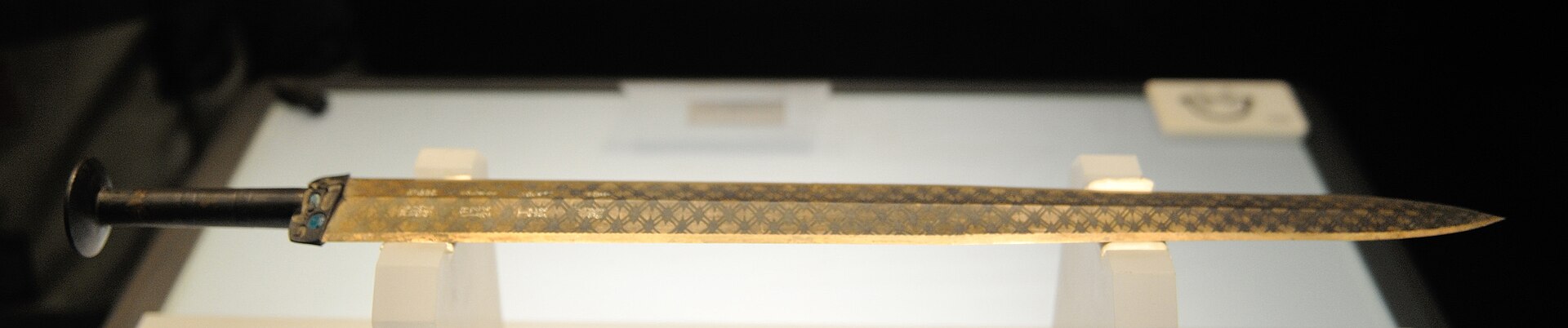
The sword as displayed at the Hubei Provincial Museum, photographed 6 April 2015. Photographed and released by the photographer under a free licence; the file description explicitly identifies the location as the Hubei Provincial Museum, the object's permanent home since 1999.
Photograph by Siyuwj, via Wikimedia Commons, CC BY-SA 4.0| Artist | Yue-state royal bronze workshop (maker unrecorded) |
|---|---|
| Date | c. 496-465 BCE, during Goujian's reign as King of Yue |
| Medium | Cast bronze (copper-tin alloy, with trace lead and iron), hilt inlaid with glass and turquoise, bird-script inscription near the guard, silk-wrapped grip, pommel cast with eleven concentric rings; found inside a black-lacquered wood scabbard |
| Dimensions | Overall length c. 55.6-55.7 cm (sources vary by a millimetre); hilt length 8.4 cm; blade width 4.6-5 cm (sources vary); weight 875 g |
| Where it is now | Hubei Provincial Museum, Wuhan, Hubei, Chinalast confirmed |
| Inventory number | Held in the museum's permanent collection; displayed in a dedicated hall |
| Attribution | AcceptedThe sword's ownership is attributed to Goujian, King of Yue (r. Full note |
| Object type | Arms and armour |
| Period | Chinese, Spring and Autumn period (object date); burial context dated to the Warring States period |
| Cases | Has a provenance gap |
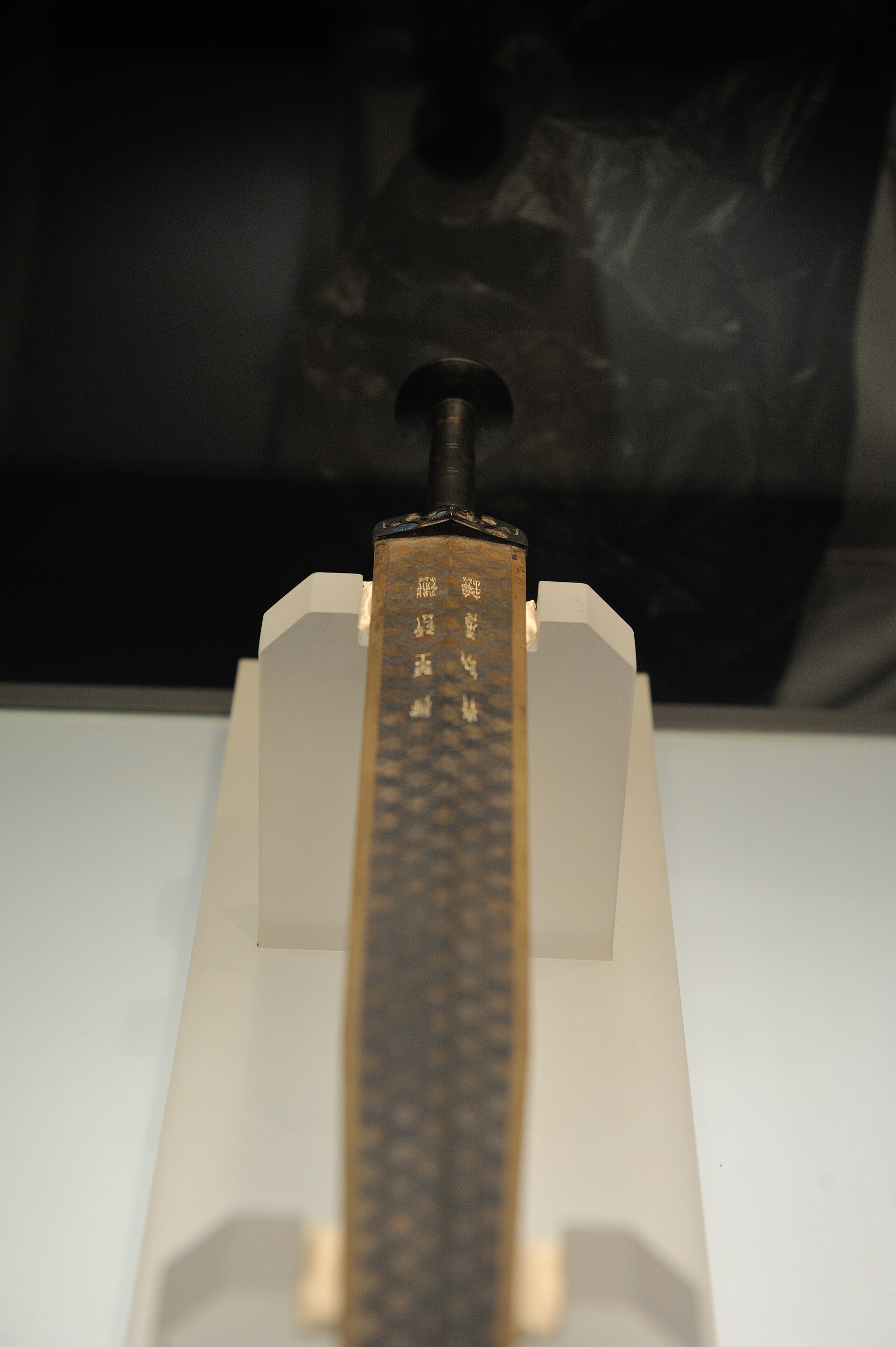
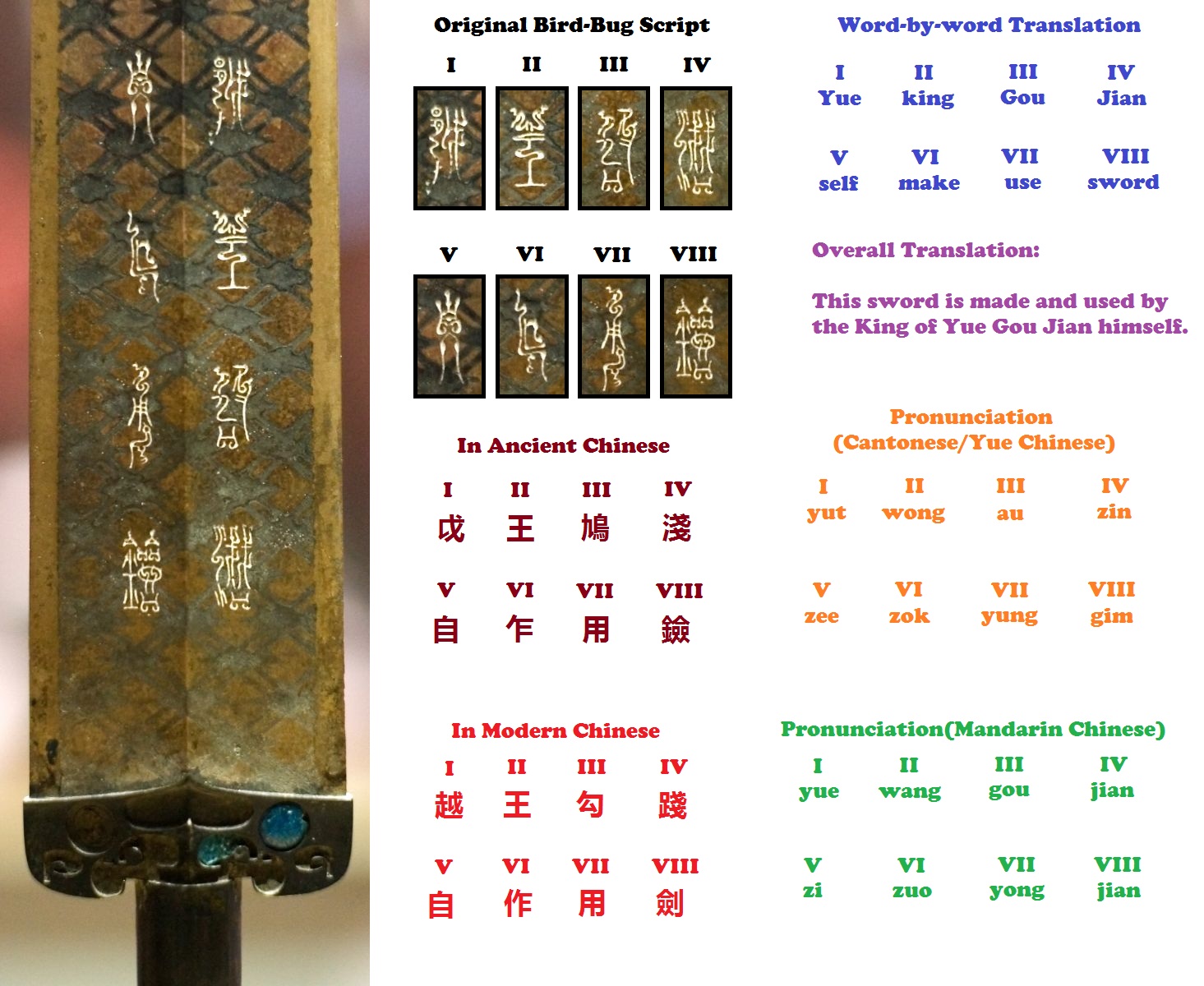
| Inscriptions | Eight characters in bird-worm script (niaozhuan/niaochongshu) near the guard, in two lines of four. Read as: Yue Wang [name], zi zuo yong jian - 'King of Yue [personal name], made [this] for his own use.' The first four characters, 'King of Yue,' were legible from the outset; the final two characters, giving the king's personal name, were disputed for more than two months among Chinese epigraphers before the reading 'Goujian' (an early transcription rendered it phonetically as 'Jiuqian') prevailed over a rival reading of 'Shaohua.' |
| Owners on record | 6 links4 documented, 1 disputed, 1 unknown |
| Sources | 12 cited |
About this record Last verified · 12 sources cited · Change log
On this page 9 sections
ContentsClose
A bronze short sword, 55.6 to 55.7 cm long, inscribed in bird-worm script with the name of Goujian, King of Yue (r. c. 496-465 BCE), the ruler remembered for enduring years of hardship after defeat before eventually reversing it. Excavated in December 1965 from Wangshan Tomb No. 1 near Jiangling, Hubei, a burial belonging not to a king of Yue but to a Chu courtier named Shao Gu, and recovered still bright and essentially untarnished after roughly two thousand four hundred years underground.
Reading the inscription took Chinese epigraphers, including Guo Moruo and Tang Lan, more than two months of correspondence in 1965-1966 to resolve against a rival candidate reading. How the sword passed from Yue royal ownership into a Chu tomb remains a live question, argued between a marriage-dowry theory and a war-trophy theory, neither documented by a contemporary written source. Its resistance to corrosion is equally unsettled: an early chromium-treatment claim has been tested and rejected, but the sources consulted for this record directly disagree over whether a deliberate sulfide surface treatment or simply the sealed, oxygen-poor burial environment explains the rest.
Damaged once, by a 0.7 cm scratch during a 1994 loan to Singapore, the sword has not left China since and was placed in 2013 on the country's list of relics forbidden from exhibition abroad. It remains on permanent display at the Hubei Provincial Museum in Wuhan, and its fame runs well beyond specialist circles: in 2026 an airport in the same province issued a security notice naming souvenir replicas of the sword specifically among items too large to carry aboard a flight.
Provenance
Each link is graded. Documented: a cited source supports it. Disputed: the identification is argued but not established. Unknown: no owner for that span, and the gap is not smoothed into a narrative. The grades in the glossary.
- c. 496-465 BCE -Goujian, King of Yuedocumented
Ownership is established by the sword's own eight-character inscription, deciphered by consensus among Chinese epigraphers in 1965-1966 after a documented dispute over the reading of the king's personal name.16
- c. 465 BCE - before ownership by Shao GuUnknown; possibly the Chu royal houseunknown
How the sword passed from Yue royal ownership into the possession of a Chu courtier is not documented by any contemporary written source located for this record. Two reconstructions circulate - transfer as part of a marriage dowry when Goujian's daughter married into the Chu royal house, or seizure as a war trophy during Chu's conquest of Yue in the 300s BCE - and neither has documented contemporary support tying it specifically to this object.12
- unknown - unknown (burial)Shao Gu, a Chu courtier of dafu rank, great-grandson of a Chu kingdisputed
Identified as the tomb's occupant via inscribed bamboo strips recovered from the same burial, according to Chinese museum and popular sources; this record has not verified the identification against the original excavation site report and grades it disputed on sourcing grounds, not because a rival identification has been proposed.12
- burial - December 1965Interred, undisturbeddocumented
The sword remained in Wangshan Tomb No. 1, inside its lacquered scabbard, from burial until its 1965 excavation.12
- December 1965 - April 1999Chinese state cultural-heritage authoritiesdocumented
Excavated by a Hubei archaeological team as part of survey work ahead of the Zhanghe reservoir irrigation canal. The sword was studied and identified in 1965-1966 but was kept without public display for roughly three decades; the specific custodial institution during that interval is not stated in the sources consulted (see open questions).126
- April 1999 - presentHubei Provincial Museum, Wuhandocumented
Shown briefly in Beijing in April 1999 ahead of the fiftieth anniversary of the People's Republic, then installed in the Hubei Provincial Museum's galleries in Wuhan after National Day 1999, where it remains the museum's most prominent object. Damaged by a 0.7 cm scratch during a 1994 loan to Singapore (prior to this final custody phase); placed on China's list of cultural relics forbidden from exhibition abroad on 19 August 2013.128
Technical evidence
| Attribution note | The sword's ownership is attributed to Goujian, King of Yue (r. c. 496-465 BCE), on the strength of an eight-character bird-script inscription naming him, deciphered by correspondence among Chinese epigraphers in 1965-1966. That attribution is accepted and essentially unchallenged in current scholarship. The maker is a separate question and remains completely open: no smith, workshop head or overseer is named on the object or in any surviving record, and the object type is inferred from the inscription's formula (a king's personal weapon) rather than from any signed or documented workshop. |
|---|---|
| Material | Cast bronze, a copper-tin alloy. One popular-science source citing the Hubei Provincial Museum gives roughly 80-83 percent copper and 16-17 percent tin with trace lead and iron for the sword as a whole; a separate figure attributed by Wikipedia to Fudan University and Chinese Academy of Sciences analysis gives zone-specific figures instead (see the corrosion-science narrative section). Neither figure has been traced by this record to a primary publication and both are flagged for replacement.210 |
| Dimensions | Overall length 55.6-55.7 cm (sources vary); hilt length 8.4 cm; blade width 4.6-5 cm (sources vary); weight 875 g.12 |
| Inscription | Eight characters in bird-worm script (niaozhuan) in two lines near the guard, on the blade's obverse face, reading 'King of Yue [Goujian], made [this] for his own use.' The final two characters, giving the king's personal name, were the subject of a documented scholarly dispute in 1965-1966 (see narrative).16 |
| Hilt and pommel | Grip originally wrapped in silk; guard inlaid with blue glass on one face and turquoise on the other; pommel cast as a disc bearing eleven concentric rings.12 |
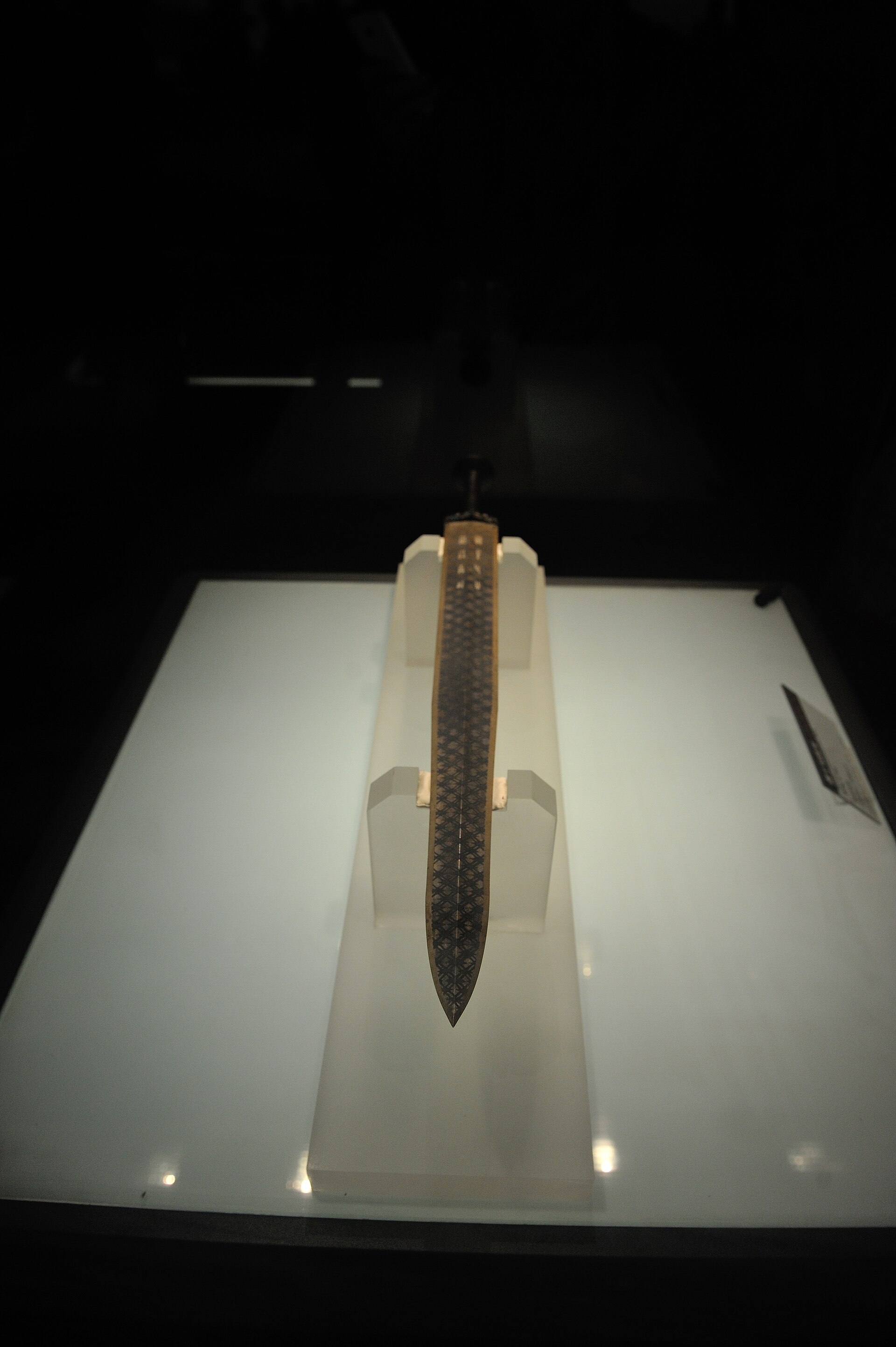
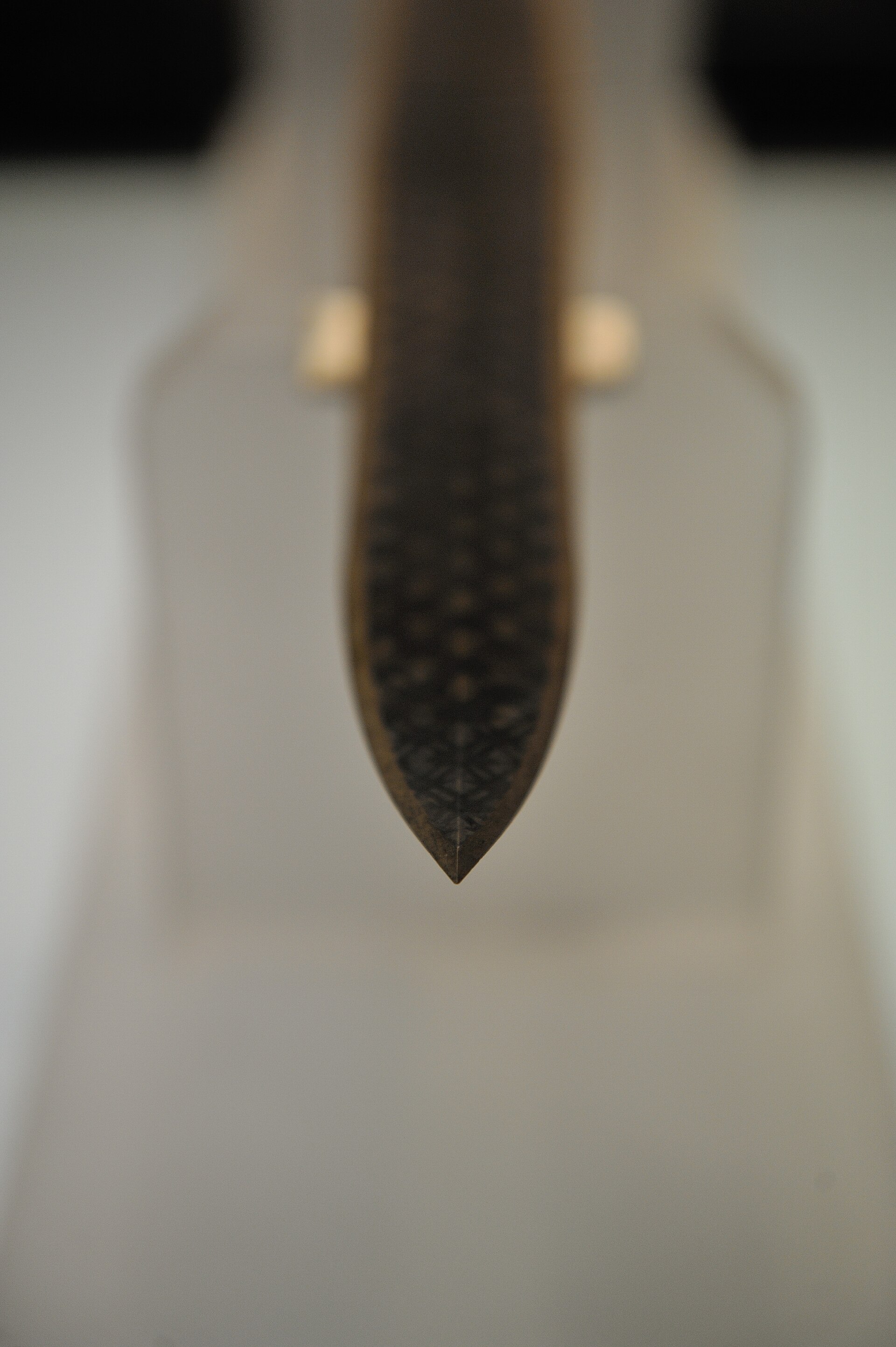
| Surface decoration | A repeating pattern of dark rhomboid (diamond) shapes across both faces of the blade. The process that produced this pattern is disputed: accounts range from a deliberate ancient sulfide surface treatment to the effect being an artefact of burial contamination rather than an intentional finish (see corrosion-science narrative section).1011 |
| Scabbard | Recovered together with the sword: a wood scabbard finished in black lacquer, itself well preserved. Its close, effectively airtight fit around the blade is credited by at least one account as a major factor in the metal's preservation, alongside the wider burial environment.210 |
| Comparative surface metallurgy (different object) | A broken bronze sword fragment excavated from the same group of Chu tombs at Wangshan in 1965, held at the Jingzhou Museum, was analysed by SEM/EDS in a 2022 peer-reviewed study and found to carry a tin-rich surface layer (c. 38.5 wt% Sn against c. 18.6 wt% Sn in the bulk metal), 0.1-0.6 mm thick, with markedly higher hardness than the sword body, attributed to a post-casting dip- or wipe-tinning process. This is evidence about a different sword from the same excavation, not a direct study of the Sword of Goujian, and is included here as context for regional metallurgical practice only.4 |
Images
The record in full
Chapter 1A short sword built in two metals
The object is a bronze jian, a straight double-edged short sword, measuring a little under 56 centimetres from pommel to tip - sources give 55.6 or 55.7 cm, a millimetre of disagreement that has...
The object is a bronze jian, a straight double-edged short sword, measuring a little under 56 centimetres from pommel to tip - sources give 55.6 or 55.7 cm, a millimetre of disagreement that has never been resolved and probably reflects nothing more than where two different measurers set their calipers. The hilt runs 8.4 cm and the blade is 4.6 to 5 cm across at its widest, for a total weight of 875 grams. This is a hand weapon sized for a person, not a ceremonial oversized blade meant only for display.
Two features set it apart from an ordinary bronze sword of the period. The first is decorative: the flat of the blade carries a repeating pattern of dark rhomboid diamonds, cast or worked into the surface in a way that is still argued about (see below). The hilt is inlaid with blue glass on one face and turquoise on the other, the grip was originally wrapped in silk, and the pommel is cast as a disc bearing eleven fine concentric rings, a level of lathe-like precision in bronze that has itself drawn technical comment, though no citable engineering study of exactly how the rings were produced has been located for this record. The second is the inscription: eight characters in bird-worm script, an ornamental variant of seal script in which the strokes of ordinary characters are elaborated into stylised birds, insects and feathers, cut or inlaid near the guard on the sword's obverse face.
The sword was not found loose. It was recovered still inside a wood scabbard finished in black lacquer, itself a well-preserved object, and the fit between blade and scabbard is part of why the metal survived as well as it did. None of this is disputed; what is disputed is why the metal underneath the lacquer looks, by every account, essentially untarnished after two and a half thousand years in wet ground. That question runs through several sections of this record rather than being answered in any one place, because it has not been answered conclusively by anyone.
Chapter 2A drought, a canal, and fifty tombs
The sword's discovery has an unglamorous origin.
The sword's discovery has an unglamorous origin. In the early 1960s Jiangling county, in Hubei, suffered consecutive years of drought, and the local authorities planned an irrigation canal to bring water from the Zhang River reservoir to the affected farmland. Cultural-heritage surveys were run ahead of the earthworks, standard practice for any Chinese infrastructure project crossing ground with known archaeological potential, and in 1965 surveyors working roughly seven kilometres northwest of Jinancheng - the site of Ying, a former capital of the state of Chu - found that the soil in one stretch was loose, consistent with earlier digging. That stretch became the Wangshan tomb complex.
Excavation ran from mid-October 1965 to January 1966 and eventually opened more than fifty Chu-period tombs, yielding over two thousand artefacts in total. The sword came from a single grave within that group, Wangshan Tomb No. 1, recovered in December 1965 from a casket alongside a human skeleton, on the left side of the body. The tomb's occupant has been identified, through inscribed bamboo strips recovered from the same burial, as a man named Shao Gu, whose rank was equivalent to a dafu (a senior official grade) and who was, by the strips' own account, a great-grandson of a Chu king and someone who moved in and out of royal service closely enough for the texts to record it. This identification is reported consistently across Chinese popular and museum sources but this record has not located the original excavation site report, and it is flagged here for verification against that primary publication rather than the secondary accounts consulted.
Shao Gu was a Chu aristocrat, not a Yue one. That single fact is the seed of the puzzle that occupies a later section of this record: why a sword inscribed with the name of a King of Yue ended up buried with a courtier of the rival state of Chu.
Chapter 3Recognising what had been found
Accounts of the excavation agree that the sword was recognised immediately as exceptional, even before anyone could read its inscription.
Accounts of the excavation agree that the sword was recognised immediately as exceptional, even before anyone could read its inscription. A bronze blade that had spent two millennia in waterlogged ground with no significant rust, still bright along its edge, was itself the anomaly that made the object notable independent of who it had belonged to.
A claim repeats across popular writing on the sword that it could still cut through a stack of paper, or a comparable number of layered sheets, when tested shortly after excavation. This record has not been able to trace that claim to a dated, named, first-hand account, only to later retellings that do not cite one, and it is reported here as a widely repeated story rather than a documented fact. What is documented, and is the more interesting claim in any case, is the corrosion state itself: an object of this age recovered from a wet burial in this condition was unusual enough, on its own metallurgical merits, to trigger the scientific interest recorded in a later section of this record.
Chapter 4Two months to agree on two characters
Reading the inscription took longer than finding the sword.
Reading the inscription took longer than finding the sword. The script is niaozhuan, bird-worm seal script, deliberately ornamented to the point of near-illegibility even to trained epigraphers, and the eight characters had to be worked out one at a time.
Fang Zhuangyou, who took part in the excavation, deciphered the first six characters relatively quickly: they read, in substance, 'King of Yue' and 'made [this sword] for his own use,' which was enough to establish that the object was a Yue king's personal sword without yet establishing which king. Fang then wrote to a group of the leading Chinese epigraphers and archaeologists of the day, including Guo Moruo, Xia Nai, Tang Lan, Chen Mengjia, Yu Xingwu, Rong Geng, Shang Chengzuo, Xu Zhongshu and Su Bingqi, soliciting readings of the remaining two characters, which carried the king's personal name.
The dispute that followed was real, not a formality. Fang Zhuangyou's own proposed reading was 'Shaohua,' a name associated in some traditions with a Chu agent who was said to have later become a Yue king, and by one account Guo Moruo initially leaned toward the same reading, without being fully certain of it. Tang Lan, a specialist in bronze inscriptions, argued instead for a reading transcribed at the time as 'Jiuqian,' understood as an early phonetic rendering of the name later standardised as Goujian. The correspondence ran for more than two months before the group converged on Tang Lan's reading. Nine kings are recorded as having ruled Yue across its history, which is the scale of the identification problem the epigraphers were actually solving: not simply confirming a name already suspected, but ruling out several plausible historical Yue kings whose names could, in principle, have fit the same two characters, before settling on Goujian specifically.
That the sword names Goujian by name, rather than the more famous king of Yue's rival state of Wu, matters for how the object should be read culturally. Goujian is the figure remembered in the phrase 'sleeping on brushwood, tasting gall,' a story of a defeated king enduring deliberate hardship for years in order to rebuild his state and eventually reverse his defeat, recorded in early Chinese historiography as part of the Wu-Yue wars of the fifth century BCE. A sword inscribed with his own name and reserved, by the inscription's own wording, for his personal use, is therefore not an anonymous royal weapon: it carries the name of a specific, still-remembered king whose personal history was itself built around endurance and the eventual reclaiming of what he had lost.
Chapter 5How a Yue king's sword crossed into Chu
Yue and Chu were separate, often rival southern states during the Spring and Autumn and Warring States periods, and the presence of a sword inscribed with a Yue king's own name in the tomb of a Chu...
Yue and Chu were separate, often rival southern states during the Spring and Autumn and Warring States periods, and the presence of a sword inscribed with a Yue king's own name in the tomb of a Chu courtier is not self-explanatory. Two principal explanations circulate in Chinese scholarship and popular writing, and this record has not found either treated as definitively settled.
The first is a marriage-alliance theory. Goujian is recorded as having married a daughter into the Chu royal house; in the fuller version of the story, she became a consort of King Zhao of Chu, was later remembered under the name Yue Ji, and her son eventually reigned as King Hui of Chu. On this account, the sword travelled to Chu as part of a dowry accompanying that marriage, and passed at some later point from the Chu royal house to Shao Gu, whose bamboo-strip record of close royal service would explain why a king might have given him so significant an object.
The second is a war-trophy theory. Chu conquered Yue outright in the 300s BCE, roughly a century and a half after Goujian's own reign, in a campaign usually dated to between 309 and 306 BCE. On this account the sword was seized as spoils during that conquest, entered Chu ownership by capture rather than gift, and was later granted or otherwise passed to Shao Gu before being buried with him.
Both accounts require the sword to have already been an heirloom, decades or generations old, by the time it reached Shao Gu's tomb: it names a king who died in 465 BCE, and the tomb itself is generally placed in the middle Warring States period, well over a century later. Neither theory has documented, contemporary written support tying it specifically to this sword; both are reconstructions built from the wider historical record of Chu-Yue relations, matched against the fact of where and with whom the object was buried. Chinese-language popular accounts describe the marriage-dowry theory as the more widely repeated of the two, but this record treats that as a description of which story circulates more, not as evidence that it is correct.
There is a broader, better-documented pattern behind either theory. Olivia Milburn's 2008 study of southern sword legends in early China argues that the kings of Wu and Yue used swords as a mark of their right to rule while living, and had them buried as royal grave-goods when they died - swords in this tradition functioned as regalia, not merely as weapons. Read against that framework, a royal sword's movement into another royal house's hands, whether by marriage, gift, or conquest, and its eventual placement in the grave of a trusted courtier rather than a king, is consistent with an object whose value was understood to be dynastic and personal rather than simply metallurgical. That is an argued reading of the object's significance, attributable to Milburn's scholarship specifically, not a claim this record makes about what Shao Gu or the Chu court privately believed.
Chapter 6The unsettled chemistry of an unrusted blade
The sword's condition has generated more competing explanations than any other aspect of the object, and the sources consulted for this record do not agree with each other.The account that circulates...
The sword's condition has generated more competing explanations than any other aspect of the object, and the sources consulted for this record do not agree with each other.
The account that circulates most widely in popular science writing runs as follows. The blade is a copper-tin bronze, reported in one popular account at roughly 80 to 83 percent copper and 16 to 17 percent tin with trace lead and iron; a different figure, attributed by Wikipedia to analysis by Fudan University and the Chinese Academy of Sciences but not independently verified against a primary publication for this record, breaks the composition down by zone: a central ridge at roughly 41.5 percent copper and 42.6 percent tin with 5.9 percent sulfur, blade edges at roughly 57.3 percent copper and 29.6 percent tin with 0.9 percent sulfur, and the dark decorative pattern areas at roughly 73.9 percent copper and 22.8 percent tin. These two sets of figures are not obviously reconcilable as stated, and this record has not been able to trace either to a primary paper it could read directly; both are flagged for replacement with a citable original source.
There is a further inconsistency worth recording rather than smoothing over. General secondary accounts of Wu-Yue sword construction describe a deliberate differential-casting design: a lower-tin, tougher alloy at the ridge to prevent the blade snapping, and a higher-tin, harder alloy at the cutting edge to hold a sharp line, a genuine and separately documented Bronze Age engineering technique. The zone-specific figures attributed to Fudan University and Chinese Academy of Sciences analysis, cited above, in fact show the opposite pattern for this particular sword: a higher tin percentage at the ridge (42.6 percent) than at the edge (29.6 percent). Either the general low-tin-core description does not apply to this specific sword, or one of the two secondary sources has transposed ridge and edge in transmission; this record cannot resolve which, and flags the contradiction rather than silently adopting one reading over the other.
An early theory held that the surface had been deliberately treated with a chromium compound, forming a protective chromium-oxide layer, a claim that would have been strikingly, almost implausibly, advanced for Bronze Age metallurgy given that chromium electroplating is a nineteenth and twentieth century Western industrial process. That claim has since been directly tested and rejected: more precise modern examination, described in Chinese popular-science coverage as scanning electron microscopy with energy-dispersive spectral analysis, found no chromium in the sword's metal, and Chinese sources describe the sulfur-and-chromium-plating narrative that circulated for years as resting on earlier, less rigorous testing.
What replaces the chromium claim is contested rather than settled. One line of argument, repeated in general popular coverage, credits a deliberate ancient sulfide surface treatment: sulfur compounds applied or induced on the blade's surface, forming a stable copper-sulfide layer that resisted further oxidation, likened in one account to a tight protective coating sealing the metal from air and moisture. A second, more specific and more skeptical line of argument, attributed in an industry corrosion-science source to Hou Dejun, a research fellow associated with the Hubei Provincial Museum and Hubei's archaeological institute, rejects the deliberate-treatment reading outright: on this account, ancient Yue craftsmen did not apply a sulfide treatment at all, and the sulfur detected on the sword's surface arrived from the decomposition of organic material inside the sealed tomb rather than from any smithing process, with the blade's survival credited almost entirely to the burial environment - the tomb sealed with clay, moisture controlled with charcoal, oxygen effectively excluded - rather than to any special treatment of the bronze itself.
These two accounts cannot both be fully correct as stated, since one credits intentional ancient surface chemistry and the other denies it existed at all. This record has not found a synthesis reconciling them and presents both, attributed to their respective sources, rather than choosing between them.
A separate, genuinely peer-reviewed study bears on this question only indirectly and must not be mistaken for research on the Sword of Goujian itself. Xie Chi and colleagues published a 2022 materials-science analysis in the journal Materials of a broken bronze sword fragment recovered from the same group of Chu tombs excavated at Wangshan and Shazhong in 1965 - explicitly not the Sword of Goujian, but an object from the same excavation context, previously unstudied because it survives only incomplete. Using scanning electron microscopy, energy-dispersive spectrometry and microhardness testing, the authors found a tin-rich surface layer, around 38.5 percent tin by weight against roughly 18.6 percent tin in the bulk metal beneath, 0.1 to 0.3 millimetres thick over most of the blade and thickening to 0.6 millimetres at the edge, with markedly higher hardness in that surface layer than in the body of the blade. They propose the layer was produced by a post-casting dip- or wipe-tinning process, or a tin amalgam treatment, and calculate that forming a layer of that thickness would have taken on the order of days at 600 degrees Celsius or under two days at 700 degrees Celsius, timescales achievable with period technology. The paper does not mention chromium and does not discuss sulfur or sulfide chemistry at all. It is included here because it demonstrates that differential, deliberately engineered surface metallurgy was practised on at least one other sword from the same tomb group, which is suggestive context for how Wu-Yue swordsmiths of the period worked bronze surfaces - but it is evidence about a different object, and this record treats it strictly as that.
Chapter 7One loan, one scratch, and a permanent ban
The sword left China only once. On 24 August 1994 it was on display in Singapore as part of an exhibition of Chu-culture relics from the Warring States period.
The sword left China only once. On 24 August 1994 it was on display in Singapore as part of an exhibition of Chu-culture relics from the Warring States period. During dismantling of the display, an acrylic panel from the exhibition case became stuck against the blade; when Chinese staff examined the sword afterward they found a new scratch, reported as 0.7 centimetres long and 0.1 centimetres wide, that had not been present before the loan. The damage, though small, was treated in China as effectively irreversible and as proof that even careful institutional handling abroad carried a real risk to an object of this rarity.
The sword did travel again within China itself: it went to Beijing for a short exhibition in April 1999, ahead of the fiftieth anniversary of the People's Republic, before being installed in the Hubei Provincial Museum's public galleries later that year, and it was shown at Taiwan's National Museum of History in a cross-strait cultural exchange in November 2010. But it has not left mainland China again since the 1994 Singapore damage. On 19 August 2013 the sword was formally placed on the Third Batch of Cultural Relics Prohibited from Exhibition Abroad, a list maintained by Chinese cultural-heritage authorities that puts a small number of the country's most significant and physically vulnerable objects permanently off-limits to foreign loan. That listing, rather than any single administrative decision made in 1994, is the current legal basis for the sword never leaving the country again.
Chapter 8A national symbol in daily circulation
The sword's fame inside China is not confined to specialist or museum audiences.
The sword's fame inside China is not confined to specialist or museum audiences. It featured in December 2017 on the state broadcaster CCTV's documentary series 'National Treasure' ('Guojia Baozang'), and reporting from January 2018 names Jiang Xudong, deputy director of the Hubei Provincial Museum's Culture and History Center, as leading an ongoing research effort into the sword's history in connection with that programme; this record has not located a published output from that specific research effort beyond the initial press coverage of its existence, and treats the project as active-as-reported rather than concluded.
The sword is also, more informally, one of the most widely reproduced Chinese museum objects in the domestic souvenir trade: full-size and miniature bronze replicas are sold in large numbers at the Hubei Provincial Museum's own shop and more broadly online, marketed in English-language listings under names invoking the sword directly. That popularity produced a small, dated news event in 2026: during the May Day holiday period, Wuhan Tianhe International Airport issued a security notice, which circulated widely on Chinese social media, specifying that replica 'Sword of Goujian' souvenirs with blades longer than six centimetres could not be carried by passengers and had to be checked, sent by courier, or left in storage - the genuine article's fame having produced enough of a specific class of souvenir weapon that the airport named it explicitly in its own signage. Chinese commentary treated the episode as good-humoured evidence of a wider revival of interest in traditional material culture among younger visitors, comparable to the contemporary popularity of historical hanfu clothing.
Chapter 9Naming, and the objects this one must not be confused with
The sword carries no single fixed English name across the sources consulted for this record: it appears as 'Sword of Goujian,' 'Sword of King Goujian of Yue,' and, in a fuller academic-catalogue...
The sword carries no single fixed English name across the sources consulted for this record: it appears as 'Sword of Goujian,' 'Sword of King Goujian of Yue,' and, in a fuller academic-catalogue style, 'Spring and Autumn Period Sword of King Goujian of Yue.' Its own inscription gives the king's name in a form early scholarship transcribed phonetically as 'Jiuqian,' before the reading was standardised to the name now used, 'Goujian,' across modern scholarship - a reminder that even the object's own label for its owner has shifted since 1965 as transcription conventions were worked out.
It must also be kept distinct from a related but different class of object: the bronze weapons of Goujian's historical rival, King Fuchai of Wu. Nine bronze swords inscribed with Fuchai's name have been recorded to date, unearthed variously in Hubei, Henan and Shandong provinces, held across different collections including the National Museum of China; a bronze spear bearing a comparable eight-character gold-inlaid inscription naming Fuchai was separately excavated in 1983 from Mashan Tomb No. 5, also in Jiangling, and is described by the National Museum of China as the first weapon of its specific type recorded for that king. These are Wu-state royal weapons, made for and inscribed with the name of Wu's own king, and although they come from the same region, the same broad period, and in the spear's case the same county as the Sword of Goujian, they are separate objects belonging to a rival royal house and must not be described or captioned as related versions of this sword.
Confusion is a live risk with this object specifically because of how widely it has been reproduced. Commercial and craft replicas are sold in large numbers, some marketed explicitly as museum-quality reproductions, and at least one image encountered during research for this record, showing an inscribed blade at a museum in Anyang, is captioned by its own photographer as a copy rather than the original object. No image in this record's gallery is drawn from that class of material; every plate here is either a photograph taken at the Hubei Provincial Museum itself, credited to a named photographer, or an explanatory diagram of the script clearly identified as such rather than as a photograph of the object.
The artist
Unknown Yue-state royal bronze workshop
No maker is named anywhere on this object, and none is documented in any source consulted for this record. What can be discussed with evidence is the world the sword was made inside: the state of Yue itself, the reputation its swordsmiths held among their contemporaries, the specific king whose name the blade carries, and the wider tradition of royal bronze weapons from Yue and its rival Wu, of which this sword is one of the very few surviving examples that can be tied to a named individual owner rather than to a workshop or a type alone.
Related works
| Work | Relation | Where it is |
|---|---|---|
| Broken bronze sword fragment (unnamed), Wangshan/Shazhong Chu tombs Unknown Chu- or Wu-Yue-tradition workshop | Excavated from the same 1965 group of Chu tombs at Wangshan; the subject of the only peer-reviewed materials-science study located for this record, though it is a different sword, not the Sword of Goujian Analysed by Xie Chi et al. (Materials, 2022) for its tin-rich surface layer; cited here strictly as comparative metallurgical context, not as evidence about this record's sword. | Jingzhou Museum, Hubei |
| 'King Fuchai of Wu' bronze sword (one of nine recorded examples) Wu-state royal workshop, maker unrecorded | Bronze sword bearing the inscribed name of Goujian's historical rival, King Fuchai of Wu; a distinct object from a rival royal house, not a version of this sword Nine Fuchai-inscribed swords have been recorded to date, from Hubei, Henan and Shandong. Named explicitly here to prevent confusion with the Sword of Goujian. | National Museum of China, Beijing (one of several examples held across different Chinese collections) |
| Bronze spear of King Fuchai of Wu Wu-state royal workshop, maker unrecorded | A different weapon type bearing a comparable eight-character gold-inlaid inscription naming King Fuchai of Wu Excavated 1983 from Mashan Tomb No. 5, Jiangling - the same county as the Sword of Goujian's findspot, but a separate tomb, a separate excavation, and a weapon of a rival king. | National Museum of China, Beijing |
Open questions
- Whether Wangshan Tomb No. 1 was sealed under the reign of King Zhao of Chu or King Huai of Chu bears directly on which of the two competing theories (marriage dowry versus war trophy) is more plausible, and this record has not found the tomb's dating treated as settled in the sources consulted.
- Whether the sword's own surface metal has ever been directly examined with modern SEM/EDS methods, of the kind applied to the related but different broken sword fragment by Xie et al. in 2022, or whether the widely repeated composition figures for this specific sword still rest on an older, less precisely sourced analysis this record could not verify against a primary publication.
- Whether the dark diamond-pattern surface treatment is the product of a genuine deliberate ancient sulfide process, as popular accounts describe, or is instead, as argued by Hou Dejun, an artefact of burial contamination with no intentional surface chemistry involved - the two accounts in this record's sources directly contradict each other and neither has been shown to be authoritative.
- Exactly where and in whose institutional custody the sword was kept for the roughly three decades between its December 1965 excavation and its first public exhibition, in Beijing in April 1999, is not stated in any source consulted for this record.
- Whether mainstream Chinese archaeology treats either the marriage-dowry or the war-trophy explanation for the sword's presence in a Chu tomb as more than a plausible reconstruction, or whether both remain openly competing, unresolved hypotheses in the specialist literature this record could not access directly.
- The identity of the tomb's occupant, Shao Gu, and his documented relationship to the Chu royal house rest in this record on Chinese popular and museum secondary sources; the original Wangshan excavation site report has not been consulted and would be the appropriate primary source to verify this against.
Questions about this object
What is Sword of King Goujian of Yue?
Sword of King Goujian of Yue is an arms and armour, dated c. 496-465 BCE, during Goujian's reign as King of Yue. Medium: Cast bronze (copper-tin alloy, with trace lead and iron), hilt inlaid with glass and turquoise, bird-script inscription near the guard, silk-wrapped grip, pommel cast with eleven concentric rings; found inside a black-lacquered wood scabbard.
Who made Sword of King Goujian of Yue, and is the attribution settled?
The attribution to Yue-state royal bronze workshop (maker unrecorded) is recorded here as accepted. The sword's ownership is attributed to Goujian, King of Yue (r. c. 496-465 BCE), on the strength of an eight-character bird-script inscription naming him, deciphered by correspondence among Chinese epigraphers in 1965-1966. That attribution is accepted and essentially unchallenged in current scholarship. The maker is a separate question and remains completely open: no smith, workshop head or overseer is named on the object or in any surviving record, and the object type is inferred from the inscription's formula (a king's personal weapon) rather than from any signed or documented workshop.
Where is Sword of King Goujian of Yue now?
Hubei Provincial Museum, Wuhan, Hubei, China. Inventory number Held in the museum's permanent collection; displayed in a dedicated hall. Last confirmed 19 August 2026. Excavated December 1965 from Wangshan Tomb No. 1, Jiangling, Hubei. Kept but not exhibited for roughly three decades; transported to Beijing for a short exhibition in April 1999 and installed in the Hubei Provincial Museum's public galleries in Wuhan after National Day 1999, where it has remained the museum's signature object since.
What is still unknown about Sword of King Goujian of Yue?
Whether Wangshan Tomb No. 1 was sealed under the reign of King Zhao of Chu or King Huai of Chu bears directly on which of the two competing theories (marriage dowry versus war trophy) is more plausible, and this record has not found the tomb's dating treated as settled in the sources consulted.
Sources
- 1Hubei Provincial Museum, official collection page for the Sword of Goujian ('Sword of Goujian'). hbww.org.cn/zgzb/...
- 2Wikipedia, 'Sword of Goujian.' source, consolidating excavation, dimension, inscription and exhibition-history claims; with the original Wangshan excavation site report and primary metallurgical publications where those claims are load-bearing. en.wikipedia.org/wiki/...
- 3Wikipedia (Chinese), 'Sword of Goujian' (Yuewang Goujian Jian). zh.wikipedia.org/zh-hans/...
- 4Xie, Chi; Fu, Chunlin; Li, Sishi; Liao, Lingmin; Chen, Guantao; Pan, Chunxu. 'A Special Ancient Bronze Sword and Its Possible Manufacturing Technique from Materials Science Analysis.' Materials (Basel), 15(7): 2491, 28 March 2022. Peer-reviewed. Studies a different bronze sword fragment from the same 1965 Wangshan/Shazhong Chu tomb group, not the Sword of Goujian itself. pmc.ncbi.nlm.nih.gov/articles/...
- 5Milburn, Olivia. 'The Weapons of Kings: A New Perspective on Southern Sword Legends in Early China.' Journal of the American Oriental Society, 128(3): 423-437, 2008. Peer-reviewed academic source on swords as royal regalia and grave-goods among the kings of Wu and Yue; accessed for this record via its published abstract and secondary listing rather than the full journal text. academia.edu/43438902/...
- 6China News Service, 'Investigating the mystery of the Sword of Goujian: who is the King of Yue named in the eight-character inscription,' 8 December 2016. Covers the Fang Zhuangyou / Guo Moruo / Tang Lan identification dispute. chinanews.com.cn/m/...
- 7National Museum of China, '"King Fuchai of Wu" Bronze Sword.' Used here for version-safety comparanda distinguishing the Sword of Goujian from inscribed weapons of King Fuchai of Wu. en.chnmuseum.cn/collections_577/...
- 8South China Morning Post, 'How China's "Excalibur of the East" souvenir swords sparked airport security warning,' 2026. scmp.com/lifestyle/...
- 9People's Daily Online, 'Scientists work to uncover the story behind a legendary sword,' 17 January 2018. Names Jiang Xudong, deputy director of the Hubei Provincial Museum's Culture and History Center, and references the CCTV 'National Treasure' documentary series. en.people.cn/n3/...
- 10China Corrosion and Protection industry portal (corrdata.org.cn), '2500-year unrusted Sword of Goujian: what materials and techniques were actually used?,' 8 March 2016. Attributes the sceptical, environment-only corrosion-resistance account to Hou Dejun, a research fellow associated with the Hubei Provincial Museum and Hubei's archaeological institute. corrdata.org.cn/news/...
- 11NetEase (163.com), popular-science article on why the Sword of Goujian has not rusted for 2500 years, covering the chromium-plating claim and its rejection, and the copper-sulfide protective-layer account. 163.com/dy/...
- 12Baidu Tashuo, article on why the Sword of Goujian was found in a Chu noble's tomb, including the identification of the tomb occupant as Shao Gu. wapbaike.baidu.com/tashuo/...
Last verified · Published
Change log
19 August 2026 - Record created at the house standard: researched narrative, technical evidence, maker dossier, graded provenance chain, prices with hammer and premium separated, related works, open questions and sources.