The Shroud of Cadouin
Fatimid state tiraz workshop, Damiette (dar al-tiraz al-khassa) · 1096 or 1097 CE (AH 489 or 490)
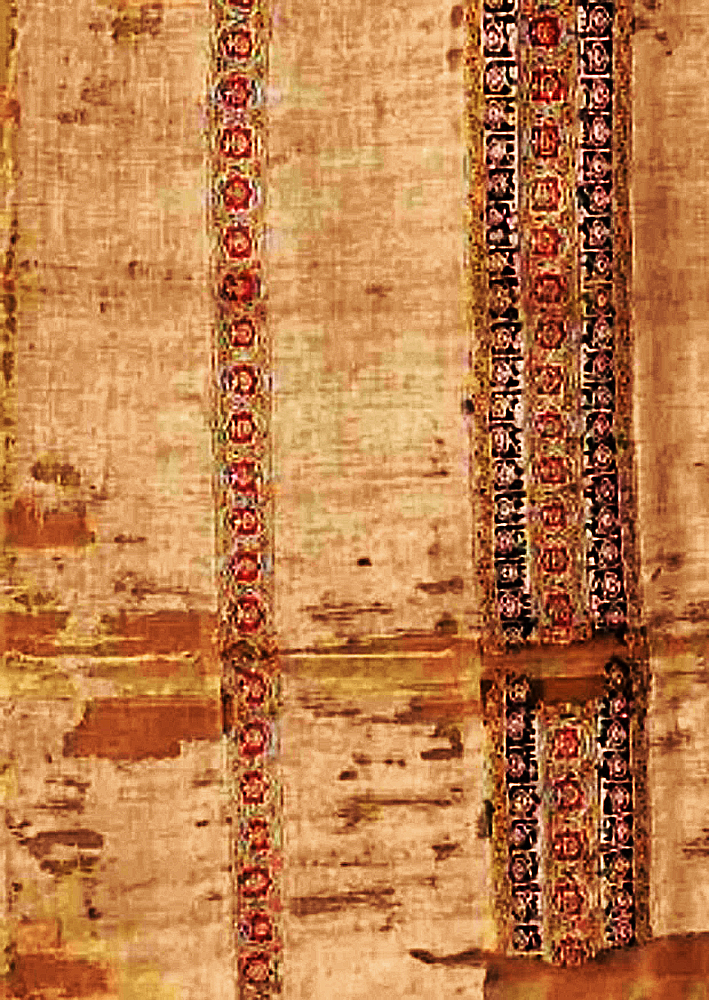
The textile itself: a Fatimid tiraz cloth of 1096-97, woven for the caliph al-Musta'li, venerated for seven centuries as the shroud of Christ before its 1934-35 identification.
| Artist | Fatimid state tiraz workshop, Damiette (dar al-tiraz al-khassa) |
|---|---|
| Date | 1096 or 1097 CE (AH 489 or 490) |
| Medium | Linen, with decorative end-bands woven in linen, silk and metal thread; Kufic inscription woven into the cloth on the loom |
| Dimensions | 295 x 135 cm (measured unmounted during the 1989-90 restoration) |
| Where it is now | Diocese of Perigueux et Sarlat; the original cloth is conserved under museum-standard light, humidity and temperature control in Perigueux and is not on public display. A facsimile, produced by ENSISA (Ecole Nationale Superieure d'Ingenieurs Sud-Alsace) and the Laboratoire de Recherche des Monuments Historiques, has been shown at the entrance to the cloister of Cadouin Abbey since 2012.last confirmed |
| Inventory number | Classified Monument Historique, 2 December 1935 |
| Attribution | AcceptedIdentified from its own woven Kufic inscription, read in 1935 by the orientalist Gaston Wiet, director of the Museum of Islamic Art in Cairo, from photographs supplied by Father P.J. Full note |
| Object type | Textile |
| Period | Fatimid Egypt, late 11th century |
| Cases | Has a provenance gap · Restituted or repatriated |
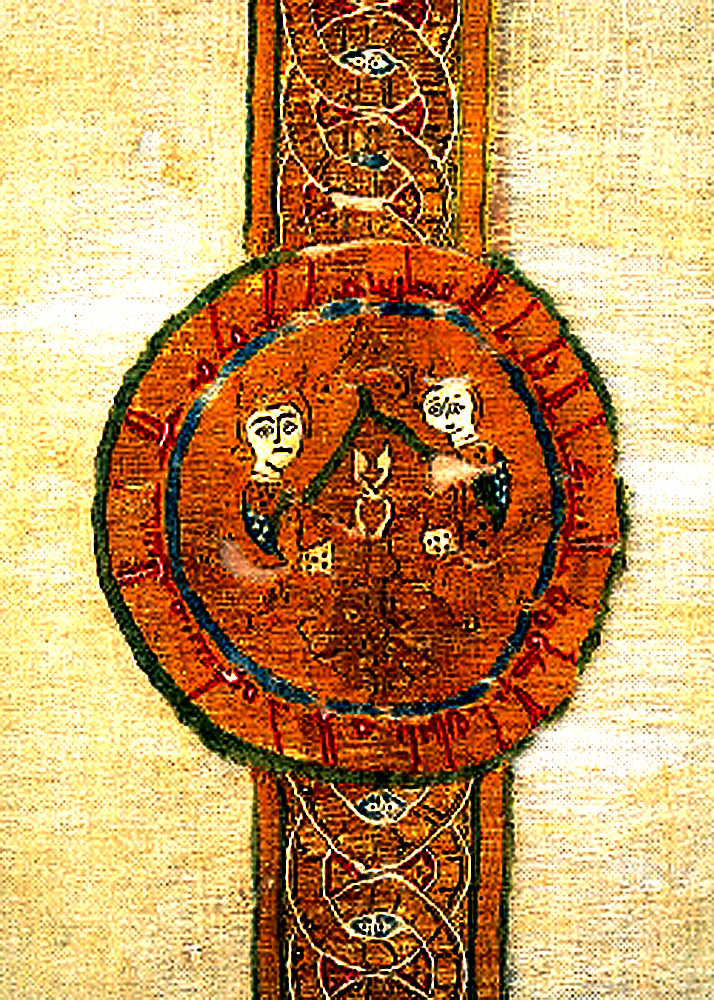
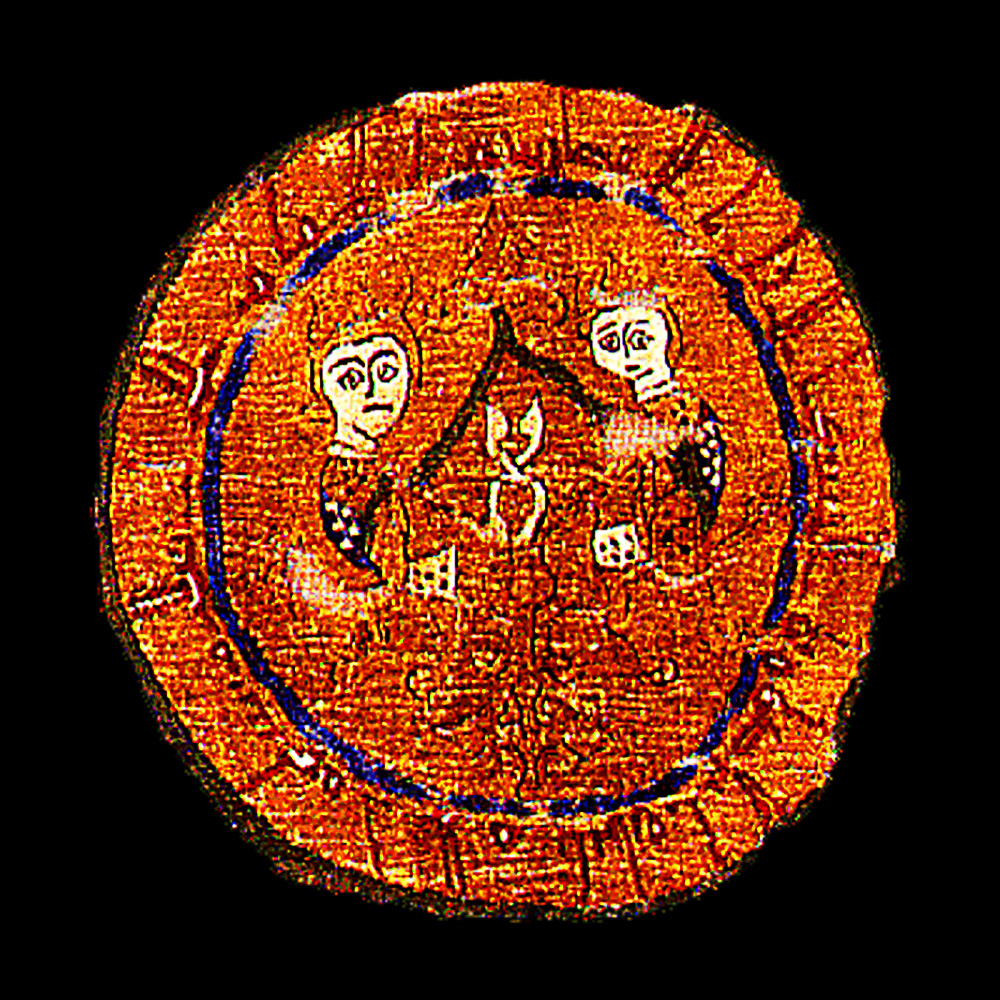
| Inscriptions | Two registers of monumental Kufic script woven into the end-bands: an opening invocation and the shahada with the Shi'a formula naming Ali, followed by the titles and name of the caliph al-Musta'li and his vizier al-Afdal. Full text and translation in the technical section below. |
| Owners on record | 15 links14 documented, 1 unknown |
| Sources | 17 cited |
About this record Last verified · 17 sources cited · Change log
On this page 9 sections
ContentsClose
For roughly seven hundred years the abbey of Cadouin, in the Dordogne, held what pilgrims by the thousand believed to be the cloth that had wrapped Christ's head in the tomb. Kings intervened on its behalf, popes granted it indulgences, and it survived theft, a thirty-year exile in Toulouse, and the Revolution. In 1934 a Jesuit sent photographs of its woven border to the Cairo museum director and Arabist Gaston Wiet, who read a Kufic inscription that named a living ruler: it is a Fatimid Egyptian court textile, woven in 1096 or 1097 for the caliph al-Musta'li and his vizier al-Afdal, almost certainly a ceremonial turban, not a burial cloth. The bishop cancelled the pilgrimage within days.
What the inscription cannot explain is how a piece of Fatimid state regalia crossed from Cairo to Perigord. No document bridges the century between its 1096-97 manufacture and its first certain mention in a 1214 charter; every proposed Crusade-era route, gift, plunder, or the abbey's own pious legend of a dying bishop's chaplain, remains an argued hypothesis. A near-identical sibling textile, the Veil of Saint Anne at Apt, survives from the same commission and underwent the same reversal; a third, wholly unrelated object, the Suaire de Saint-Josse at the Louvre, shares only the broad shape of the story and must not be confused with either.
The cloth itself survives, conserved under museum conditions in Perigueux, owned by the Diocese of Perigueux et Sarlat, and unseen by the public since a facsimile took its place at Cadouin in 2012. It is one of only two known complete examples of its kind.
Provenance
Each link is graded. Documented: a cited source supports it. Disputed: the identification is argued but not established. Unknown: no owner for that span, and the gap is not smoothed into a narrative. The grades in the glossary.
- 1096 or 1097 -Fatimid state tiraz workshop (dar al-tiraz al-khassa), Damiette, under caliph al-Musta'li and vizier al-Afdaldocumented
Date, place and patron established by the cloth's own woven inscription, read by Gaston Wiet in 1935 and cross-checked against the closely related, explicitly dated Veil of Saint Anne from the same commission.13
- 1096 or 1097 - 1214Unknownunknown
Completely undocumented. The abbey's own legend places a First Crusade-era transfer (Adhemar de Monteil, a dying chaplain, a Perigourdin priest, a 1117 fire) but this account first appears only in a thirteenth-century parchment notice and in a chronicle written decades after the events it describes; no papal bull or charter from the twelfth century mentions any shroud at all. Alternative scholarly hypotheses (a diplomatic gift at the siege of Antioch, 1097-98; battlefield plunder from Ascalon, 1099) are argued positions, not documented transfers.124511
- September 1214 - 1219Cadouin Abbey, under an act of Simon de Montfortdocumented
Simon de Montfort grants the abbey a tithe and a rent to maintain a lamp before the shroud, describing it as kept there with honour; Amaury de Montfort confirms and extends the grant in 1219. This is the earliest source for the object's presence at Cadouin that can be independently dated and verified.1211
- 1239 - 1337Cadouin Abbeydocumented
1239: Amaury de Montfort donates a gold reliquary vessel, with a special Cistercian General Chapter exception permitting it; 1292: Bishop Raymond d'Auberoche of Perigueux personally examines and touches the cloth and endows the abbey with parish revenue; 1336-37: King Philippe VI twice intervenes by royal ordinance, citing his own devotion to the shroud.12
- 1345 - 1392Cadouin Abbey, in wartime distressdocumented
The abbey is repeatedly pillaged; a 1357/58 royal charter describes the monks reduced to beggary with only two remaining to guard the church; popes Clement VI (1344), Urban V (1368) and Gregory XI (1371) grant indulgences naming the shroud as the object of pilgrimage.12
- 1392 - 1455City of Toulouse (removed from Cadouin for safekeeping, then disputed)documented
Abbot Bertrand de Moulins moves the shroud to Toulouse in 1392 to keep it from English forces; it is taken to Paris in 1399 in a failed attempt to cure Charles VI; two Cadouin monks fail to steal it back in 1402; Cadouin monks finally recover it in September 1455, which Toulouse treats as a theft and pursues at law.12
- 1458 - 1468Cadouin Abbey (title confirmed by royal courts)documented
The cloth spends close to a year at Aubazine Abbey, Correze, amid the ongoing Toulouse legal claim; the Parlement de Paris rules definitively for Cadouin in 1461, and Louis XI issues a second confirming ruling in 1468.12
- 1644 - 1789Cadouin Abbeydocumented
A formal Histoire du Saint Suaire is approved by the bishop after his personal visit in 1643 and published in 1644; Pope Benedict XIII grants further indulgences to the pilgrims' confraternity in 1724.1
- 1790s - 1797Hidden by the mayor of Cadouin (M. Bureau), then Cadouin parishdocumented
Hidden through the Revolution rather than surrendered; brought back out for the resumption of public display on 8 September 1797.1
- 1840 - 1934Cadouin parish, Diocese of Perigueuxdocumented
New reliquary chest described from 1840; Pope Pius IX grants plenary indulgences in 1865; the Paris goldsmiths Poussielgue-Rusand deliver a bronze reliquary chasse in 1866; the bishop formally re-establishes the pilgrimage and confraternity in 1878; ten thousand pilgrims recorded in 1836.1
- August 1934 - December 1935Diocese of Perigueux et Sarlatdocumented
Father P.J. Francez examines the cloth and sends photographs to Gaston Wiet, director of the Museum of Islamic Art, Cairo; the bishop, Monsignor Louis, cancels the September 1934 pilgrimage pending results; Wiet's reading and Francez's published study (1935) identify the cloth as an eleventh-century Fatimid textile; the cloth is classified Monument Historique on 2 December 1935.12912
- 1936 - 1989Diocese of Perigueux et Sarlatdocumented
Remains on view in the basilica at Cadouin as a classified historic textile rather than an object of veneration.1
- 1989 - 1990Diocese of Perigueux et Sarlat, in the custody of the Inspection des Monuments Historiquesdocumented
Removed to conservation ateliers at Vanves; foreign sewn repairs taken out and the cloth remounted between silk crepeline; measured at 295 x 135 cm; wax traces distinguished from the blood and ointment described by early modern witnesses.1
- 1990 - 2012Diocese of Perigueux et Sarlat, in the custody of the Musee d'Art et d'Archeologie du Perigorddocumented
A planned climate-controlled case for the object's return to Cadouin is abandoned; DRAC Aquitaine withdraws the cloth from the abbey and places it with the Musee d'Art et d'Archeologie du Perigord before returning legal custody to the Diocese; further conservation and study run through the 2000s; a facsimile is produced by ENSISA (Mulhouse) with the Laboratoire de Recherche des Monuments Historiques.1
- 2012 - presentDiocese of Perigueux et Sarlatdocumented
The ENSISA facsimile has stood at the entrance to the Cadouin cloister since 2012. The original was brought back briefly for an in-situ exhibition in the basilica in 2017 under DRAC supervision, then returned to museum-standard storage in Perigueux, where it is conserved today and is not on public view.1
Technical evidence
| Attribution note | Identified from its own woven Kufic inscription, read in 1935 by the orientalist Gaston Wiet, director of the Museum of Islamic Art in Cairo, from photographs supplied by Father P.J. Francez, S.J. The text names the Fatimid caliph al-Musta'li and his vizier al-Afdal and gives a production date equivalent to 1096 or 1097 CE. No individual maker's name survives or was ever recorded: Fatimid tiraz cloth was produced anonymously inside a state-controlled workshop, and the inscription names the patron and the workshop, not a weaver. |
|---|---|
| Material | Fine plain-weave linen ground, with decorative end-bands woven in linen, silk and metal thread.1 |
| Dimensions | 295 x 135 cm, measured unmounted during the 1989-90 restoration; both original woven selvedges survive.1 |
| Inscription script | Monumental Kufic, woven into the decorative end-bands on the loom, not embroidered or applied afterward.12 |
| Inscription text (as read by Gaston Wiet, 1935) | An opening blessing; the Muslim profession of faith with the Shi'a formula that Ali is the friend of Allah, and a blessing on the pure imams of the Prophet's house; then the full name and titles of the reigning imam: al-Musta'li billah, Commander of the Faithful, sword of Islam, guide of the missionaries of the believers, Abu'l-Qasim Shahanshah al-Musta'li.1 |
| Patron named in the text | Caliph al-Musta'li, ninth Fatimid caliph and nineteenth Ismaili imam, reigned 29 December 1094 to 12 December 1101; the text is read alongside comparable tiraz naming his vizier, al-Afdal Shahanshah, vizier 1094-1121.378 |
| Date of manufacture | AH 489 or 490, equivalent to 1096 or 1097 CE, established by comparison with the closely related Veil of Saint Anne (Apt), whose inscription gives the workshop and an explicit date in that range.3 |
| Workshop | A private (khassa) state tiraz workshop at Damiette, Egypt, identified by comparison with the Apt veil's inscription; Fatimid tiraz production was a royal monopoly run through state-controlled workshops.310 |
| Probable original function | The 1989-90 restoration report concluded the most probable original use of so large and light a transparent cloth was as a turban or ceremonial khil'a textile for a high-ranking figure, not a shroud.1 |
| Later additions | Traces described by 17th- and 18th-century witnesses as blood and mingled ointments were identified on technical examination as candle wax.1 |
| Protective status | Classified Monument Historique, 2 December 1935, a purely secular heritage designation unconnected to its former status as a relic.12 |
Images
The record in full
Chapter 1What the cloth actually is
The Shroud of Cadouin is a large piece of fine plain-weave linen, measured at 295 by 135 centimetres when it was taken off its mount for conservation in 1989-90.
The Shroud of Cadouin is a large piece of fine plain-weave linen, measured at 295 by 135 centimetres when it was taken off its mount for conservation in 1989-90. Each end carries a decorative band combining a floral register with a line of monumental Kufic script, worked in linen, silk and metal thread and built into the cloth on the loom rather than embroidered on afterward. Both original selvedges survive, which is unusual: most surviving Fatimid tiraz cloth reaches museums as a cut fragment, and a complete, whole piece with both woven edges intact is rare enough on its own to be a significant textile, independent of what its inscription says.
For roughly seven centuries the Benedictine, then Cistercian, abbey that held this cloth, and the pilgrims who travelled to see it, believed it was the linen that had wrapped the head of Christ in the tomb. Read correctly, the inscription names a living Egyptian ruler, gives a production date within a year, and states the workshop that made it. It is a Fatimid court textile of the late eleventh century, not a relic of the Passion, and every other fact in this record has to be read against that reversal.
Chapter 2The legend of how it arrived
The story the abbey told about its relic survives in a parchment notice of the thirteenth century, posted in the monastery church on the gospel side of the altar, and later repeated by the chronicler...
The story the abbey told about its relic survives in a parchment notice of the thirteenth century, posted in the monastery church on the gospel side of the altar, and later repeated by the chronicler Alberic of Trois-Fontaines writing around the middle of that century. In this account the cloth had been seen centuries earlier by Arculf, bishop of Perigueux, on a pilgrimage to Jerusalem around 670-680, in a church built on the site of the Holy Sepulchre. It was then found again during the First Crusade by Adhemar de Monteil, bishop of Le Puy and the pope's legate on that expedition, who on his deathbed at Antioch in August 1098 gave it to a chaplain. That chaplain died on the voyage home and passed it to a priest from Perigord, who kept it in a small church near Cadouin, traditionally identified as Brunet, near Cussac. In 1117, while the priest was away, that church burned; the cloth was found unharmed, and the monks of Cadouin, whose own abbey had been founded only two years earlier, took charge of it. The priest, on his return, tried to reclaim it, failed, and is said to have entered the monastery himself as its keeper until his death before 1135.
None of this can be checked against a contemporary document. Several papal bulls survive in favour of the abbey from the twelfth and early thirteenth centuries, and not one of them mentions a shroud. The legend's own internal chronology places the object's arrival in 1117; the first source that can actually be dated and verified is from 1214, a gap of nearly a century in which the relic that supposedly built the abbey's fortune goes entirely unmentioned. The historian Jean Maubourguet noted in 1936 that there was no historical proof for the 1117 date at all, and called the traditional account unfounded stories. This record follows him: the Adhemar de Monteil narrative is reported here as the abbey's own foundation legend, not as documented history.
Chapter 3The first documented centuries
The earliest source that can be dated and checked is an act of Simon de Montfort, leader of the Albigensian Crusade, from September 1214: he grants the abbey a tithe on the fishery of Castelnaud and...
The earliest source that can be dated and checked is an act of Simon de Montfort, leader of the Albigensian Crusade, from September 1214: he grants the abbey a tithe on the fishery of Castelnaud and an annual rent of twenty-five Perigourdin pounds on that fishery, to keep a lamp burning night and day before the shroud, which the act says is kept there with honour, with two lamps lit instead of one on days of public display. The relic was then held in a silver chest. In April or May 1219 Amaury, Simon's son, confirmed the grant and added a further rent.
The object's status kept rising through the thirteenth century. In 1239 Amaury donated a gold vessel to replace the silver one, and the Cistercian General Chapter at Citeaux made a special exception to its own strict rules on precious ornament to allow it, on condition the gold vessel was never put to any other use, sold, or pledged. In 1292 Raymond d'Auberoche, bishop of Perigueux, endowed the abbey with half the revenues of the parish of Monsac after, in his own words, touching the very holy shroud of Our Lord with his own hands and beholding the glorious marks of sweat and spices, testimony of his death, printed on the sacred cloth. In the 1330s King Philippe VI of Valois twice intervened by royal ordinance, first converting a feudal falcon-tax owed by the abbot into a cash payment, then in 1337 waiving it outright, citing in his own charter the devotion he held for the holy shroud of Our Lord that rests in the church of the abbey of Cadouin. A king of France was legislating in the relic's favour more than a century before anyone thought to ask what the inscription on it said.
Chapter 4War, theft and thirty years at Toulouse
The Hundred Years War nearly ended the abbey.
The Hundred Years War nearly ended the abbey. English raids from the 1340s onward left it so reduced that a 1357 or 1358 charter of King Jean le Bon describes the abbot and monks reduced to wandering like beggars, the abbey stripped of its income, only two monks left to guard the church. Popes granted a sequence of indulgences through this period, in 1344, 1368 and 1371, each one naming the shroud by name as the draw for pilgrims and alms.
In 1392, to keep the relic out of English hands, Abbot Bertrand de Moulins moved it to Toulouse in a grand procession, first to the church of Le Taur and then to a purpose-altered oratory near the College Saint-Bernard. The Toulouse authorities spent heavily on its keeping: a solid iron-bound chest with eight locks in 1392, a silver and crystal reliquary the following year, and repeated requests to the papacy for fresh indulgences to draw pilgrims to the city rather than to Cadouin. In August 1399 the shroud was taken to Paris in the hope of curing King Charles VI of his madness; it failed, and a contemporary chronicler noted that the cloth could not be the true shroud of Jesus in any case, since it was multi-coloured and trimmed with fringes. Two Cadouin monks tried to steal it back in January 1402 and were caught. Toulouse held on to it for another fifty years, resisting repeated Perigord petitions for its return, until Cadouin monks finally recovered it in September 1455, an act Toulouse promptly treated as a theft and took to law. The dispute ran for years, with the cloth spending nearly a year at Aubazine Abbey in Correze while courts and kings argued over it, before the Parlement de Paris ruled definitively for Cadouin in 1461, a ruling Louis XI confirmed a second time in 1468.
Chapter 5Restoration, revolution and revival
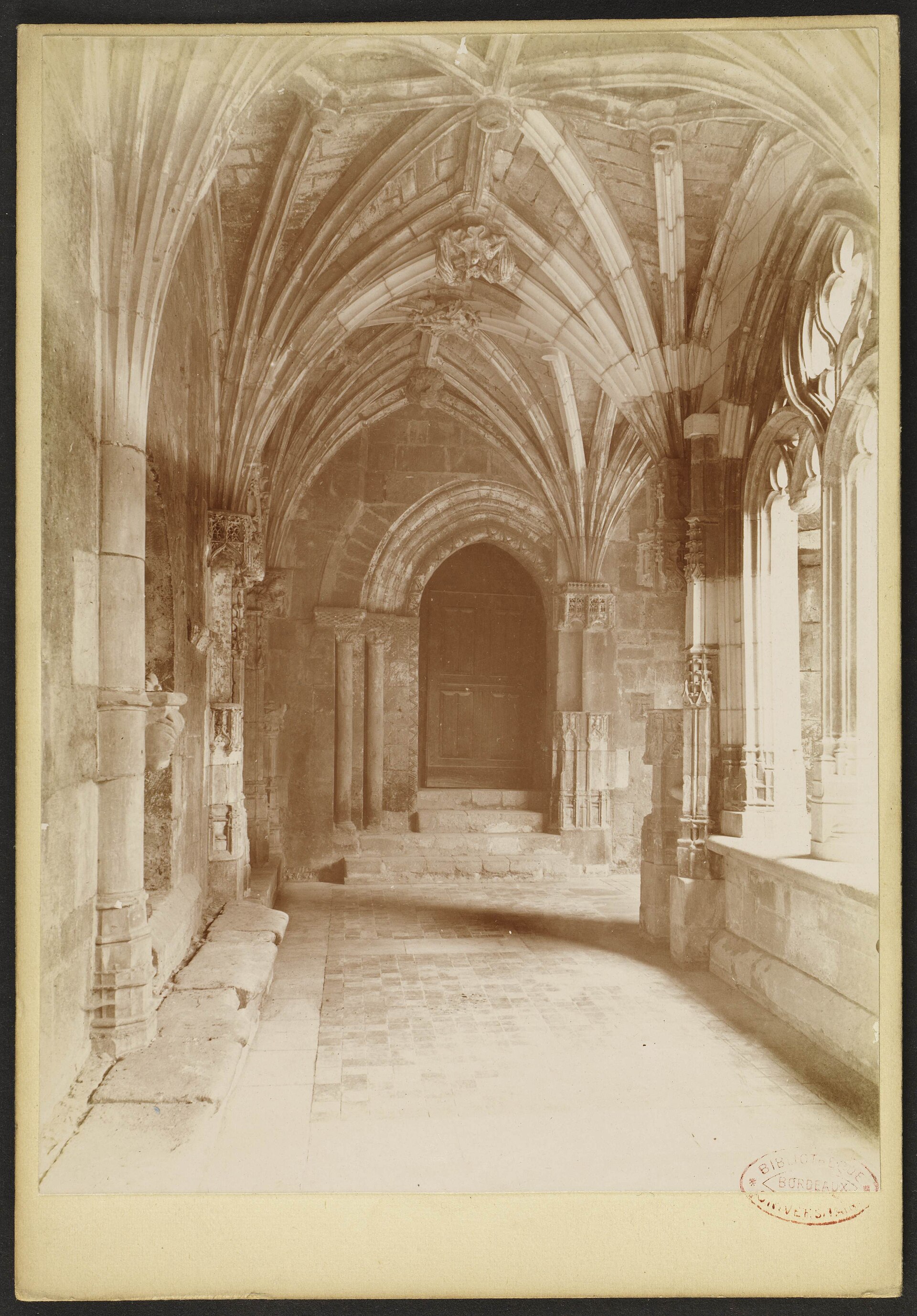
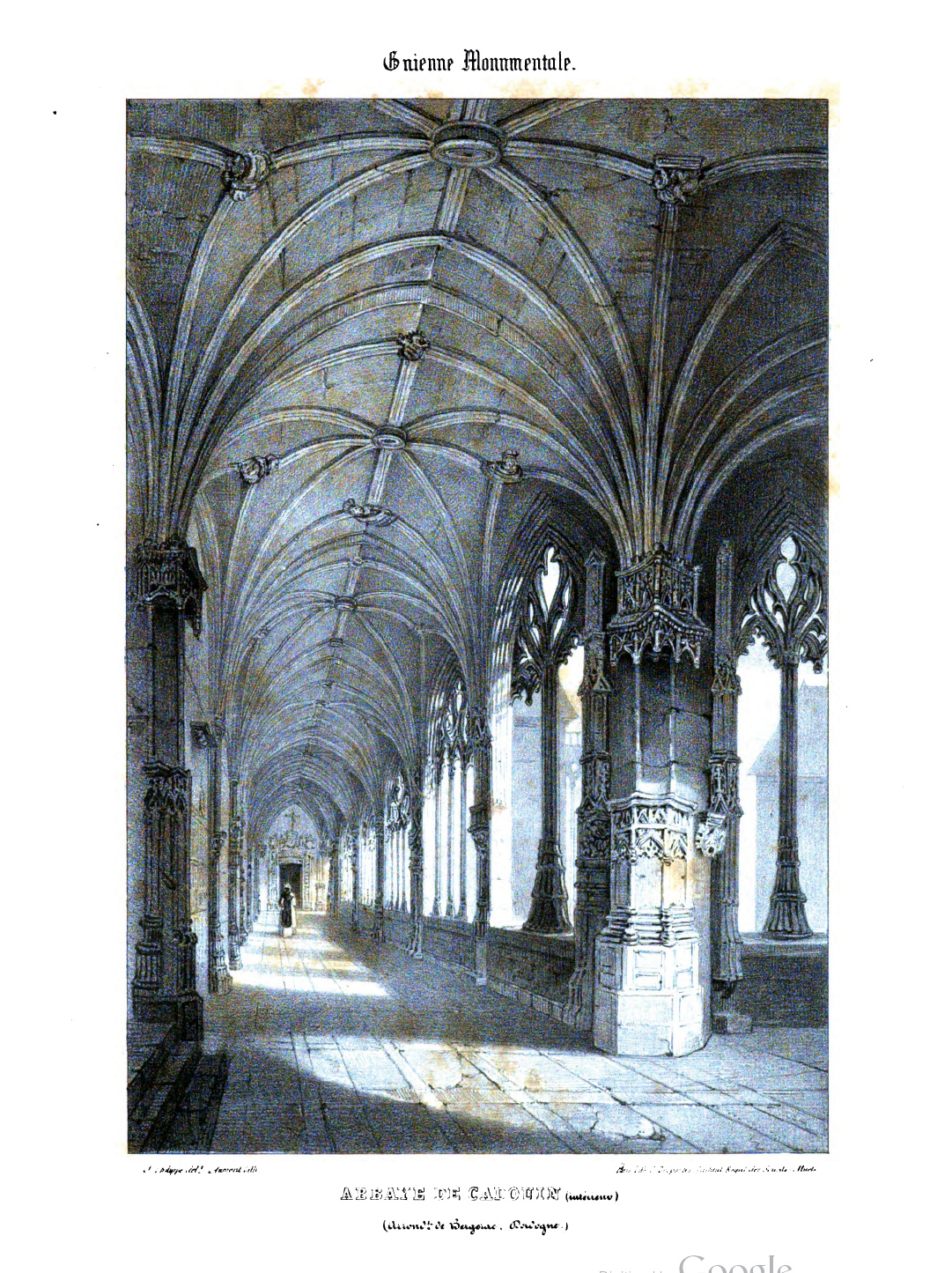
Louis XI, who had just settled the Toulouse dispute in the abbey's favour, backed a wider reconstruction of Cadouin after the war, funding the flamboyant Gothic cloister and a covered market hall.
Louis XI, who had just settled the Toulouse dispute in the abbey's favour, backed a wider reconstruction of Cadouin after the war, funding the flamboyant Gothic cloister and a covered market hall. Devotion to the shroud recovered with the buildings: a formal Histoire du Saint Suaire, approved by the bishop after a personal visit in 1643, was published in 1644, and Pope Benedict XIII granted further indulgences to the pilgrims' confraternity in 1724.
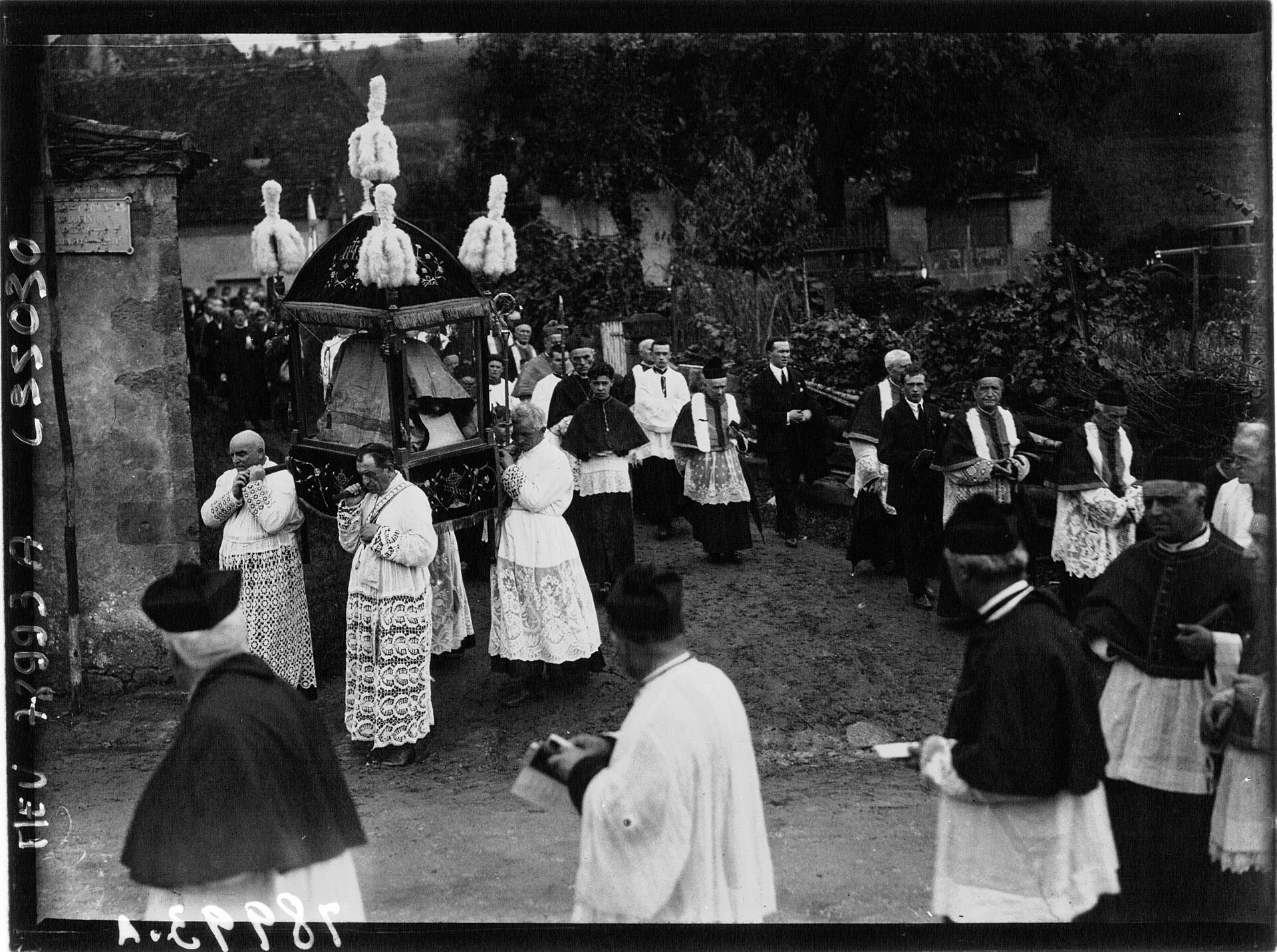
The Revolution came closest of all to destroying it. The mayor of Cadouin, known in the sources only as M. Bureau, hid the relic rather than surrender it, and it was brought back out for the resumption of public display on 8 September 1797. The nineteenth century then rebuilt the cult from a low base: a sumptuous new reliquary chest was described by successive antiquarians from 1840 onward, Pope Pius IX granted plenary indulgences in 1865, the Paris goldsmiths Poussielgue-Rusand delivered a bronze reliquary chasse 1.5 metres square in 1866 at a cost of 1,800 francs, and in 1878 the bishop of Perigueux formally re-established the pilgrimage and its confraternity. Ten thousand pilgrims are recorded visiting in a single year, 1836. None of this crowd, and none of the clergy who organised it, had any idea what the inscription on the cloth in front of them actually said.
Chapter 6How the identification happened
The first person on record to notice that the ornament looked like Arabic writing was the vicomte de Gourgues, who remarked in 1868 that some of the decorative border resembled the zigzag outline of...
The first person on record to notice that the ornament looked like Arabic writing was the vicomte de Gourgues, who remarked in 1868 that some of the decorative border resembled the zigzag outline of oriental lettering. Early in the twentieth century the orientalist Adrien de Longperier thought he recognised a Koranic verse in it. Neither observation was followed up in a way that reached the Church authorities.
That changed in 1934. The vicar general of the diocese of Perigueux asked a Jesuit, Father P.J. Francez, to examine the embroidered bands. Francez noticed eight-pointed stars characteristic of Coptic-period art and dated the cloth provisionally to the Fatimid period, the tenth to twelfth centuries. He sent photographs to Gaston Wiet, director of the Museum of Islamic Art in Cairo and professor at the Ecole des Langues Orientales in Paris, one of the leading Arabists of his generation. Wiet read the text: an opening blessing, the Islamic declaration that there is no god but Allah, the statement that Muhammad is the messenger of Allah and that Ali is the friend of Allah, a blessing on both of them and on the pure imams of their house, and then the full titles and name of the reigning imam, al-Musta'li billah, Commander of the Faithful, sword of Islam, guide of the missionaries of the believers, Abu'l-Qasim Shahanshah al-Musta'li. Wiet dated the cloth to the reign of the ninth Fatimid caliph and nineteenth Ismaili imam, al-Musta'li, 1094 to 1101, and judged from the text and its formulas that it had probably been woven as a turban for a high dignitary. He published the identification in 1936 as Un nouveau tissu fatimide.
On 11 August 1934, a communique in the diocesan bulletin La Semaine Religieuse announced that the bishop, Monsignor Louis of Perigueux and Sarlat, had cancelled that September's public display pending the outcome of the study. Father Francez concluded in his own 1935 study, published as Un pseudo-linceul du Christ, that the cloth had been woven at Damiette under al-Musta'li, while still arguing that its transfer to Cadouin could be dated to the First Crusade. On 2 December 1935 the cloth was classified a Monument Historique, a purely secular protection that has nothing to do with the relic status the Church had just withdrawn from it.
Chapter 7What the inscription actually proves, and what it does not
The identification rests on the text itself, not on style alone, which is what makes it hard to argue with.
The identification rests on the text itself, not on style alone, which is what makes it hard to argue with. Fatimid tiraz inscriptions follow a fixed formula: a religious invocation, the name and titles of the reigning caliph, the name of the vizier, the place of manufacture, and the year, in that order. The Cadouin cloth's text supplies the caliph, al-Musta'li, and the vizier, al-Afdal, and modern study of comparable Fatimid tiraz places its manufacture in the state workshop, or dar al-tiraz, at Damiette, dated by related textiles from the same commission to the Islamic years 489 or 490, equivalent to 1096 or 1097 CE.
What the inscription cannot do is explain how the cloth got from a Fatimid palace workshop to a French abbey. It carries no information at all about any transfer, gift, or capture. Every account connecting it to the First Crusade, whether the pious legend of Adhemar de Monteil or the more sober academic guesses discussed below, is a hypothesis built to explain a fact the object itself is silent about.
Chapter 8A robe of honour, not a shroud: what the object was for
Reading the inscription as a devotional accident misses what the Fatimid state was actually doing when it commissioned this cloth.
Reading the inscription as a devotional accident misses what the Fatimid state was actually doing when it commissioned this cloth. Tiraz production in Fatimid Egypt was a royal monopoly, run out of state-controlled workshops, and the finished cloth functioned as an instrument of rule, not decoration. Robes bearing the caliph's name and titles were bestowed on officials, allies and favoured subjects in a ceremony called khil'a, literally the act of taking off one's own garment to give it to another; the practice traces itself back to the Prophet Muhammad giving his own cloak to the poet Ka'b ibn Zuhayr, and under the Fatimids it became a central ritual of state, comparable to coinage as a public proof that authority to rule came from the caliph and from God. Wearing or holding a piece of caliphal tiraz was a public statement of loyalty and rank; giving one away, whether as a court gift or a diplomatic present, was itself a political act.
The religious content of the inscription is not neutral either. The declaration that Ali is the friend of Allah, alongside the standard Muslim profession of faith, is a specifically Shi'a formula: the Fatimids were an Ismaili Shi'a dynasty, and their caliphs held the further title of imam, spiritual as well as political head of the community. A textile naming al-Musta'li in these terms was not a piece of generic Islamic ornament. It was a state proclamation of Ismaili doctrine and of one specific, contested claim to the imamate, at the exact moment that claim was being fought over: al-Musta'li's own succession, engineered by his vizier al-Afdal over an elder half-brother, Nizar, split the Ismaili movement and produced the rival Nizari line within the Fatimid caliph's own lifetime. None of that context reached the pilgrims who knelt in front of the cloth in Perigord for seven hundred years believing it to be Christian.
Chapter 9How a Fatimid court textile might have reached the Crusaders
Assuming a genuine Crusade-era transfer occurred at all, two working hypotheses have been proposed by later historians, and neither can be verified from a contemporary document.The first, argued by...
Assuming a genuine Crusade-era transfer occurred at all, two working hypotheses have been proposed by later historians, and neither can be verified from a contemporary document.
The first, argued by the historians Brigitte and Gilles Delluc and supported by the historian Amin Maalouf's account of the siege, points to the siege of Antioch, October 1097 to June 1098. Antioch was held by Sunni Turks, rivals of the Shi'a Fatimids of Egypt, and in early 1098 an Egyptian embassy visited the Crusader camp bearing gifts and proposing an alliance against their common Turkish enemy. On this reading the cloth, or one like it, could have been part of that diplomatic exchange, and could specifically be linked to the near-contemporary Veil of Saint Anne, discussed below.
The second hypothesis, discussed at a 2009 colloquium of local historians by Pierre de Riedmatten drawing on the historian Jacques Heers, points instead to the Battle of Ascalon on 12 August 1099, when a Crusader force routed an Egyptian relief army commanded in person by the vizier al-Afdal, who fled the field leaving his own tent and a vast quantity of plunder behind him. Robert of Normandy is recorded buying the vizier's standard for twenty silver marks and donating it to the Church of the Holy Sepulchre; on this reading, raised by de Riedmatten as a question rather than a claim, the Cadouin cloth could conceivably be connected to that same captured material, though no source identifies it as such.
A separate account, tied to the abbey's own legend, has Adhemar de Monteil obtaining the cloth at Antioch by unspecified means before his death there in August 1098. All three explanations share the same weakness: total silence in every twelfth-century document that survives. This record states clearly that no scholar has produced a contemporary source proving how or when the cloth crossed from Fatimid to Christian hands, and treats every proposed route as an argued hypothesis, not an established fact.
Chapter 10The sibling textile at Apt, and the object it must not be confused with
Cadouin's shroud is not the only Fatimid tiraz cloth to have spent centuries venerated as a Christian relic in France.
Cadouin's shroud is not the only Fatimid tiraz cloth to have spent centuries venerated as a Christian relic in France. The Veil of Saint Anne, held in the treasury of the cathedral of Apt in Provence, is a linen veil of 310 by 152 centimetres, woven in the same private tiraz workshop at Damiette in the same year, 1096 or 1097, and inscribed with the names of the same caliph, al-Musta'li, and the same vizier, al-Afdal. Local tradition credited it to the bishop of Apt or to a returning crusader in the years around the First Crusade. Scholars treat the two textiles as products of a single court commission, close enough in material and text that they are regularly discussed as a pair; this record treats the Apt veil strictly as comparanda, not as part of Cadouin's own object history.
A different textile must be kept entirely separate from both. The Suaire de Saint-Josse, now in the Louvre, is a silk samite saddle cloth woven in north-eastern Iran before 961 CE for the Samanid general Abu Mansur Bakhtegin; it was brought back from the First Crusade by Etienne de Blois and given to the abbey of Saint-Josse near Boulogne-sur-Mer, and it too was venerated for centuries before its Islamic origin and Persian, not Egyptian, manufacture were recognised. The two objects share a broad shape of story, a Christian relic tradition punctured by the correct reading of an Arabic inscription, but they are unrelated: different textile, different region and dynasty, different patron, different discovery, different find date, and different holding institution. Nothing in this record should be read as applying to the Saint-Josse cloth, and nothing published about the Saint-Josse cloth should be read back into this one.
Chapter 11The reaction, and what the diocese lost
The 1934 announcement ended a pilgrimage that had run, with interruptions for war and exile, for over seven hundred years.
The 1934 announcement ended a pilgrimage that had run, with interruptions for war and exile, for over seven hundred years. The bishop's cancellation of the September 1934 ostensions, and the definitive lifting of the pilgrimage that followed the 1935-36 findings, cost the parish a real and recurring source of visitors and income; the diocesan historian who compiled the fullest modern account of the affair records that the pilgrimage lost a large part of its revenue as a direct result. A privately printed reminiscence quoted at a later local history colloquium, framed as a conversation with an elderly priest who had shown the cloth to the examining scholar, describes the priest as devastated, the candle that had burned before the reliquary for centuries extinguished, and speaks of the shroud as, in his words, no longer existing, dead. That is a literary retelling rather than a primary transcript, and this record treats it as evidence of the emotional register of the local reaction rather than as a documented quotation, but the underlying facts it dramatises, the cancelled ostensions and the extinguished lamp, are independently documented.
The Church's own response was not to hide the finding. Father Francez, the Jesuit who had commissioned the study, published his own conclusions in 1935 under the plain title Un pseudo-linceul du Christ, and the diocese cooperated with the secular Monument Historique classification the following year. The object was not destroyed, hidden, or deaccessioned; it continued to belong to the diocese as a historic textile rather than as a relic, which is the same status it holds today.
Chapter 12Conservation and where the cloth is now
The shroud stayed on display in the basilica at Cadouin, no longer as an object of veneration but as a historic curiosity, until 1989.
The shroud stayed on display in the basilica at Cadouin, no longer as an object of veneration but as a historic curiosity, until 1989. In 1989-90 the Inspection des Monuments Historiques had it removed to ateliers at Vanves, near Paris, where conservators took out later, foreign, sewn-on repairs and remounted the cloth between two sheets of transparent silk crepeline; it was during this campaign that the piece was measured at 295 by 135 centimetres and the conservators' own report concluded that the most probable original use of so large and light a transparent cloth was as a turban, not a shroud, and noted that it is exceptionally rare for a piece of this size to survive whole, with both selvedges and both decorative bands intact. Traces that seventeenth and eighteenth-century witnesses had described as blood and mingled ointments were established at this examination to be candle wax.
A planned climate-controlled display case for the object's return to Cadouin in 1990 was never built. When the project fell through, the Direction Regionale des Affaires Culturelles (DRAC) Aquitaine withdrew the shroud from the abbey rather than risk further light damage, placing it instead with the Musee d'Art et d'Archeologie du Perigord in Perigueux before formally returning custody to its legal owner, the Diocese of Perigueux et Sarlat. Further conservation and technical study followed in the 2000s, and a facsimile, produced by the engineering school ENSISA of Mulhouse working with the Laboratoire de Recherche des Monuments Historiques, has stood at the entrance to the Cadouin cloister since 2012 in place of the original, whose fragility no longer allows either light exposure or public handling. In 2017 the original was brought back to the basilica for a short exhibition under DRAC supervision, tied to an anniversary of the abbey's foundation legend; it was returned afterward to museum storage in Perigueux, where it remains, unseen by the public, the object that once drew ten thousand pilgrims in a single year.
The artist
The Fatimid state tiraz (dar al-tiraz), Damiette, Egypt
No weaver's name is attached to this cloth, and none was ever expected to be: Fatimid tiraz cloth was the product of a royal monopoly, made in state-controlled workshops for the caliph's own use and for distribution as robes of honour, and the inscription woven into it names the patron and the workshop, not the maker. Understanding this object means understanding the institution that produced it and the political ritual it served, not a biography.
Related works
| Work | Relation | Where it is |
|---|---|---|
| Veil of Saint Anne (Voile de Sainte-Anne) Fatimid state tiraz workshop, Damiette | From the same private tiraz commission, same year (1096-97), naming the same caliph al-Musta'li and vizier al-Afdal; treated by scholars as a matched pair with the Cadouin shroud 310 x 152 cm, also venerated for centuries as a Christian relic before its Fatimid origin was recognised. Comparanda only; not part of Cadouin's own object history. | Treasury of the Cathedral of Apt, Provence, France |
| Suaire de Saint-Josse Workshop in Khurasan, north-eastern Iran (Samanid era) | Superficially similar story (an Islamic-inscribed textile venerated for centuries as a Christian relic, then correctly reattributed), but a wholly unrelated object Silk samite saddle cloth woven before 961 CE for the Samanid general Abu Mansur Bakhtegin; different textile, different dynasty and region, different patron, different discovery. Included here specifically to prevent conflation with the Cadouin shroud. | Musee du Louvre, Paris (acquired 1922) |
| Shroud of Turin Unknown | Another Christian relic presented for centuries as Christ's own burial cloth and subjected to scientific dating in the twentieth century (1988 radiocarbon dating), though with a disputed rather than settled outcome Instructive contrast rather than a related object: Cadouin's Kufic inscription gave a hard, textual, largely undisputed identification, where Turin's radiocarbon result remains contested by the cloth's continuing defenders. This object already has its own Iconotheca record (slug: shroud-of-turin). | Cathedral of Saint John the Baptist, Turin |
| Fatimid tiraz textile fragments (comparanda) Fatimid state tiraz workshops, Egypt | Broader surviving cohort of inscribed Fatimid court textiles, mostly fragmentary, that establish the standard formula (invocation, caliph, vizier, place, date) against which the Cadouin and Apt inscriptions are read Cited for comparison of inscriptional formula and production context; no single fragment is claimed here as directly related to the Cadouin cloth. | Multiple public and private collections, including the Metropolitan Museum of Art, New York |
Open questions
- How and when did the textile actually leave Fatimid Egypt and reach Perigord? No document bridges the gap between its manufacture in 1096-97 and the first verifiable mention of a shroud at Cadouin in 1214.
- Which, if any, of the proposed Crusade-era transfer routes is correct: a diplomatic gift during the siege of Antioch (1097-98), war spoil from the Fatimid defeat at Ascalon (1099), or the abbey's own Adhemar de Monteil legend? No contemporary twelfth-century source supports any of the three.
- What was the cloth's original intended recipient and use at the Fatimid court? The 1989-90 restoration report proposes a turban for an unnamed high dignitary, but no inventory or court record naming an actual recipient has been found.
- Is there any independent trace of the 1117 fire and the Brunet parish legend, or is the entire chaplain-to-priest chain a thirteenth-century invention built to justify a shroud that had, in fact, arrived by an unknown and perhaps unedifying route (purchase, gift exchange, or plunder)?
- What is the full name of the bishop of Perigueux and Sarlat who cancelled the 1934 pilgrimage? Every source consulted for this record gives him only as Monsignor Louis.
- Did the Arabist Georges Marcais play any direct, documented role in confirming Gaston Wiet's 1935 reading, as some later secondhand summaries state, or does that claim rest on nothing more than his general authority on Islamic art through his Manuel d'art musulman (1926-27)? No primary source located for this record credits Marcais specifically with the Cadouin identification.
- Has the cloth received modern scientific dating (radiocarbon or comparable analysis) independent of the textual and art-historical dating to 1096-97, or does the accepted date rest entirely on the inscription and its comparison with the Apt veil?
Questions about this object
What is The Shroud of Cadouin?
The Shroud of Cadouin is a textile, dated 1096 or 1097 CE (AH 489 or 490). Medium: Linen, with decorative end-bands woven in linen, silk and metal thread; Kufic inscription woven into the cloth on the loom.
Who made The Shroud of Cadouin, and is the attribution settled?
The attribution to Fatimid state tiraz workshop, Damiette (dar al-tiraz al-khassa) is recorded here as accepted. Identified from its own woven Kufic inscription, read in 1935 by the orientalist Gaston Wiet, director of the Museum of Islamic Art in Cairo, from photographs supplied by Father P.J. Francez, S.J. The text names the Fatimid caliph al-Musta'li and his vizier al-Afdal and gives a production date equivalent to 1096 or 1097 CE. No individual maker's name survives or was ever recorded: Fatimid tiraz cloth was produced anonymously inside a state-controlled workshop, and the inscription names the patron and the workshop, not a weaver.
Where is The Shroud of Cadouin now?
Diocese of Perigueux et Sarlat; the original cloth is conserved under museum-standard light, humidity and temperature control in Perigueux and is not on public display. A facsimile, produced by ENSISA (Ecole Nationale Superieure d'Ingenieurs Sud-Alsace) and the Laboratoire de Recherche des Monuments Historiques, has been shown at the entrance to the cloister of Cadouin Abbey since 2012. Inventory number Classified Monument Historique, 2 December 1935. Last confirmed 31 August 2026. Ownership rests with the Diocese of Perigueux et Sarlat; custody of the original textile passed to museum-standard storage after the Direction Regionale des Affaires Culturelles (DRAC) Aquitaine withdrew it from display at Cadouin following the abandonment of a planned climate-controlled case in 1990.
What is still unknown about The Shroud of Cadouin?
How and when did the textile actually leave Fatimid Egypt and reach Perigord? No document bridges the gap between its manufacture in 1096-97 and the first verifiable mention of a shroud at Cadouin in 1214.
Sources
- 1Serge Larue de Charlus, Responsable du Conservatoire Diocesain d'Art Sacre de Perigueux, "Le Suaire de Cadouin - objet de devotion: l'histoire d'un pelerinage," diocesan bulletin Confluences. artsacre.diocese24.fr/wp-content/...
- 2Association Les Amis de Cadouin, Actes du XVIeme colloque, "Croisades, pelerinages et miracles" (22 August 2009), including Jean-Francois Gareyte, "Essai sur la pre-histoire du Saint Suaire de l'abbaye de Cadouin," and Pierre de Riedmatten's addendum on the 1934-35 identification; and Actes du XVIIeme colloque (21 August 2010), including Pierre Dor, "Nouveautes sur l'histoire du suaire de Cadouin au Moyen Age." A local historical society compilation citing archival sources (Bibliotheque nationale de France, fonds Perigord; Archives Municipales de Toulouse); flagged as secondary and to be replaced where possible with the primary acts it quotes. abbaye-de-cadouin.com/wp-content/...
- 3Bernard O'Kane, "The Egyptian Art of the Tiraz in Fatimid Times" (book chapter), on the Veil of Saint Anne, the Shroud of Cadouin, and the Damiette workshop inscription. archive.org/stream/...
- 4Wikipedia, "Cadouin Abbey." source; with the archival acts and Wiet's and Francez's original 1935-36 publications. en.wikipedia.org/wiki/...
- 5Wikipedia (French), "Abbaye de Cadouin." source; . fr.wikipedia.org/wiki/...
- 6Wikipedia (French), "Voile de Sainte-Anne." source; . fr.wikipedia.org/wiki/...
- 7Wikipedia, "Al-Musta'li." source; with a scholarly history of the Fatimid succession crisis of 1094. en.wikipedia.org/wiki/...
- 8Wikipedia, "Al-Afdal Shahanshah." source; . en.wikipedia.org/wiki/...
- 9Wikipedia, "Gaston Wiet." source; with an obituary or the biographical volume Gaston Wiet et les arts de l'Islam. en.wikipedia.org/wiki/...
- 10Wikipedia, "Robe of honour." source on the khil'a ceremony and Fatimid tiraz practice; with a specialist textile-history source. en.wikipedia.org/wiki/...
- 11Histoire-genealogie.com, "Le Saint Suaire de Cadouin." histoire-genealogie.com/Le-Saint-Suaire-de-Cadouin
- 12Association Les Amis de Cadouin, "Saint Suaire de Cadouin: de la legende a l'histoire." amisdecadouin.com/balade-patrimoine-visiter-cadouin/...
- 13Wikipedia, "Suaire de Saint-Josse," consulted specifically to confirm this is a wholly separate object from the Shroud of Cadouin. en.wikipedia.org/wiki/...
- 14Wikimedia Commons, File:Saint-Suaire de Cadouin.jpg, file description page and confirming Public Domain licensing. commons.wikimedia.org/wiki/...
- 15Wikimedia Commons, Agence Meurisse press photographs of the Fete du Saint-Suaire, Cadouin, 15 September 1930 (Bibliotheque nationale de France / Gallica), file description pages confirming Public Domain licensing. commons.wikimedia.org/wiki/...
- 16Wikimedia Commons, File:Ancienne abbaye de Cadouin - J-A Brutails - Universite Bordeaux Montaigne - 1276.jpg and File:Abbaye de Cadouin.jpg, file description pages confirming Public Domain licensing. commons.wikimedia.org/wiki/...
- 17Wikimedia Commons, File:Voile de Sainte-Anne a Apt.jpg and File:Voile Sainte-Anne Detail de l'Aba au nom du calife al Musta'li.jpg, file description pages confirming Public Domain licensing. commons.wikimedia.org/wiki/...


Last verified · Published
Change log
31 August 2026 - Record created at the house standard: researched narrative, technical evidence, maker dossier, graded provenance chain, prices with hammer and premium separated, related works, open questions and sources.