Brescia Medallion
Unknown Roman gold-glass workshop, location disputed between Rome and Alexandria · c. 200-300 CE (portrait medallion); set into the Cross of Desiderius by the 9th century CE
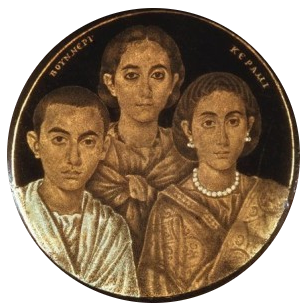
The medallion as displayed within the Cross of Desiderius: an older woman flanked by a younger woman and a young man, in gold leaf fused between two layers of glass with painted pigment detail. Public domain, verified via the Commons API (LicenseShortName: Public domain; Copyrighted: False), tagged as an old work with no known author and no attribution requirement.
| Artist | Unknown Roman gold-glass workshop, location disputed between Rome and Alexandria |
|---|---|
| Date | c. 200-300 CE (portrait medallion); set into the Cross of Desiderius by the 9th century CE |
| Medium | Gold leaf fused between two layers of blown glass, engraved and detailed with painted pigment; mounted within a gold, wood-cored, gem-set processional cross |
| Dimensions | Medallion approximately 6 cm in diameter as an independent object; overall dimensions of the Cross of Desiderius are not established in the sources consulted |
| Where it is now | Museo di Santa Giulia, Brescia, Italy. Displayed in place within the Cross of Desiderius, in the Romanesque oratory of Santa Maria in Solario, part of the former monastic complex of San Salvatore-Santa Giulia.last confirmed |
| Inventory number | No public accession or inventory number is published for this object. It is a civic-museum holding identified by name and by its fixed physical position within the Cross of Desiderius, not by a catalogue number of the kind US open-access museums publish. |
| Attribution | DisputedNo maker is named or knowable. Full note |
| Object type | Glass |
| Period | Roman Imperial (medallion); Lombard-Carolingian (the cross into which it is set) |
| Cases | Disputed attribution · Has a provenance gap |
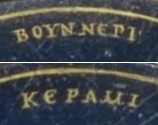
| Inscriptions | Greek, two words running near the rim, conventionally transliterated BOUNNERI and KERAMI. Read since the 1920s as evidence of an Alexandrian Greek dialect; re-read by Patt (2024) as a nickname form (a nickname or by-name added alongside a person's formal name) well attested across the later Roman Empire and ending regularly in -i in both Latin and Greek. No confirmed translation of either word as a personal name or title is settled in the sources consulted. |
| Owners on record | 7 links6 documented, 1 unknown |
| Sources | 16 cited |
About this record Last verified · 16 sources cited · Change log
On this page 9 sections
ContentsClose
A Roman gold-glass portrait roundel of about 200-300 CE, showing three unidentified figures, fixed since the early medieval period into the face of the Cross of Desiderius, a gem-studded gold processional cross in the Museo di Santa Giulia, Brescia. Eighteenth-century antiquarians proposed it showed the empress Galla Placidia with her children; that identification stood as the standard museum label for well over a century before Joseph Breck rejected it in print in 1927.
A second theory then took its place: that the medallion, one of only two inscribed gold-glass portraits known, was made in Alexandria, argued from a supposed Alexandrian dialect feature in its Greek inscription and repeated as recently as 2007. Rachel Catherine Patt's 2024 article in the American Journal of Archaeology dismantles that argument in turn, re-reading the same letters as a common later-Roman-Imperial nickname form rather than dialect evidence.
What remains, after two rejected identifications forty years short of a century apart, is an anonymous Roman family portrait of real technical accomplishment, its sitters, its workshop and the exact date of its arrival on a Lombard king's cross all still genuinely unresolved.
Provenance
Each link is graded. Documented: a cited source supports it. Disputed: the identification is argued but not established. Unknown: no owner for that span, and the gap is not smoothed into a narrative. The grades in the glossary.
- c. 200-300 CE -Unknown patron or familydocumented
The medallion itself is the evidence for its own manufacture: a gold-glass portrait roundel of a type securely dated by comparison with the wider corpus, principally the Gennadios medallion, to the 3rd century CE. The identity of the patron, sitters and workshop is not documented.17
- c. 300 CE - by the early 18th centuryUnknownunknown
No findspot, excavation record, or owner is documented for the medallion between its manufacture and its incorporation into the Cross of Desiderius. The date of that incorporation is itself unresolved: the cross's own goldsmith's work is dated to the 9th century CE by the Fondazione Brescia Musei, after King Desiderius's reign ended in 774, despite the cross's traditional association with his personal gift to the monastery he founded.69
- 8th-9th century CE (traditional attribution to Desiderius) / 9th century CE (goldsmith's dating) - modern periodMonastery of San Salvatore-Santa Giulia, Bresciadocumented
The cross, with the medallion set into it, is documented in monastic and civic custody in Brescia; the monastery itself was founded in 753 by Desiderius and his wife Ansa, who is recorded on a now-lost tomb inscription in the church's southern wall, seen as late as the 17th century, naming her queen and wife of King Desiderius. The cross's later display location, the Romanesque oratory of Santa Maria in Solario, was decorated with frescoes by Floriano Ferramola between 1513 and 1524, indicating continuous custody within the same religious complex across the medieval and early modern periods.69141516
- c. 1725 (recalled 1762) - 1858Civic and ecclesiastical antiquarian custody, Bresciadocumented
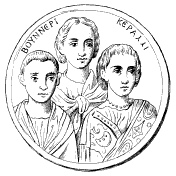
Francesco Antonio Zaccaria recalled in a work published in 1762 having seen the medallion around 1725, the earliest specific sighting located for this record. By 1858 the medallion was known to Raffaele Garrucci, who published a drawing of it in his study of gilded glass from the Roman catacombs despite doubts, shared with Hermann Vopel, about its authenticity.411
- 1858 - 1927Museo Civico Cristiano / Musei Civici, Bresciadocumented
The medallion was displayed and catalogued under the identification of Galla Placidia and her children, Valentinian III and Justa Grata Honoria, an identification current since the 18th century, until it was formally challenged in print by Breck in 1927.49
- 1927 - 2024Museo di Santa Giulia (from 1998), Bresciadocumented
The imperial identification was rejected following Breck's 1927 study. A subsequent theory, current from the 1920s and restated by Elsner in 2007, proposed an Alexandrian workshop on linguistic grounds; the monastic complex housing the cross became the Museo di Santa Giulia, part of the Fondazione Brescia Musei, in 1998.5614
- 2024 - presentMuseo di Santa Giulia, Brescia (Fondazione Brescia Musei)documented
The medallion remains on display in situ within the Cross of Desiderius. Patt's 2024 American Journal of Archaeology article directly challenges the Alexandrian-workshop theory, leaving both the sitters' identity and the workshop's location unresolved in current scholarship.114
Technical evidence
| Attribution note | No maker is named or knowable. Two separate identifications have been made and rejected for this object, at two different levels. First, an 18th-century antiquarian tradition proposed that the medallion portrayed the empress Galla Placidia with her children Valentinian III and Justa Grata Honoria; this imperial identification became the standard museum label for generations and is now firmly rejected (Breck 1927). Second, a later theory held that the workshop itself was Alexandrian, argued from a supposed Alexandrian dialect feature in the Greek inscription (a reading current since the 1920s and repeated by Elsner in 2007); this theory has in turn been directly challenged by Patt (2024), who re-reads the same letters as a common later-Roman-Imperial nickname form rather than dialect evidence. No accepted identification of the three sitters, and no settled workshop location, currently stands in their place. |
|---|---|
| Technique | Gold leaf fused between two layers of blown glass (gold sandwich glass), the design cut into the gold leaf with a fine point before the second glass layer was fused over it; painted pigment detail added on top of the gold outline.8 |
| Diameter | Approximately 6 cm as an independent object.7 |
| Subject | Three bust-length figures: an older woman at centre, flanked by a younger woman and a young man, shown frontally in the fixed, wide-eyed manner typical of third-century gold-glass portraiture.679 |
| Inscription | Greek, two words near the rim, conventionally transliterated BOUNNERI and KERAMI. Read as evidence of an Alexandrian dialect from the 1920s through at least 2007; re-read by Patt (2024) as a later-Roman-Imperial nickname form. No confirmed translation is settled.123 |
| Dating basis | Assigned to the 3rd century CE on stylistic and technical comparison with the wider gold-glass portrait corpus, principally the Gennadios medallion (Metropolitan Museum, c. 200-250 CE); no independent scientific dating of the glass or gold itself is reported in the sources consulted.17 |
| Mount and condition | Set into the front face of the Cross of Desiderius; the reverse and edge of the medallion are concealed by the cross's gold mounting and have not been independently examined in any source consulted for this record.69 |
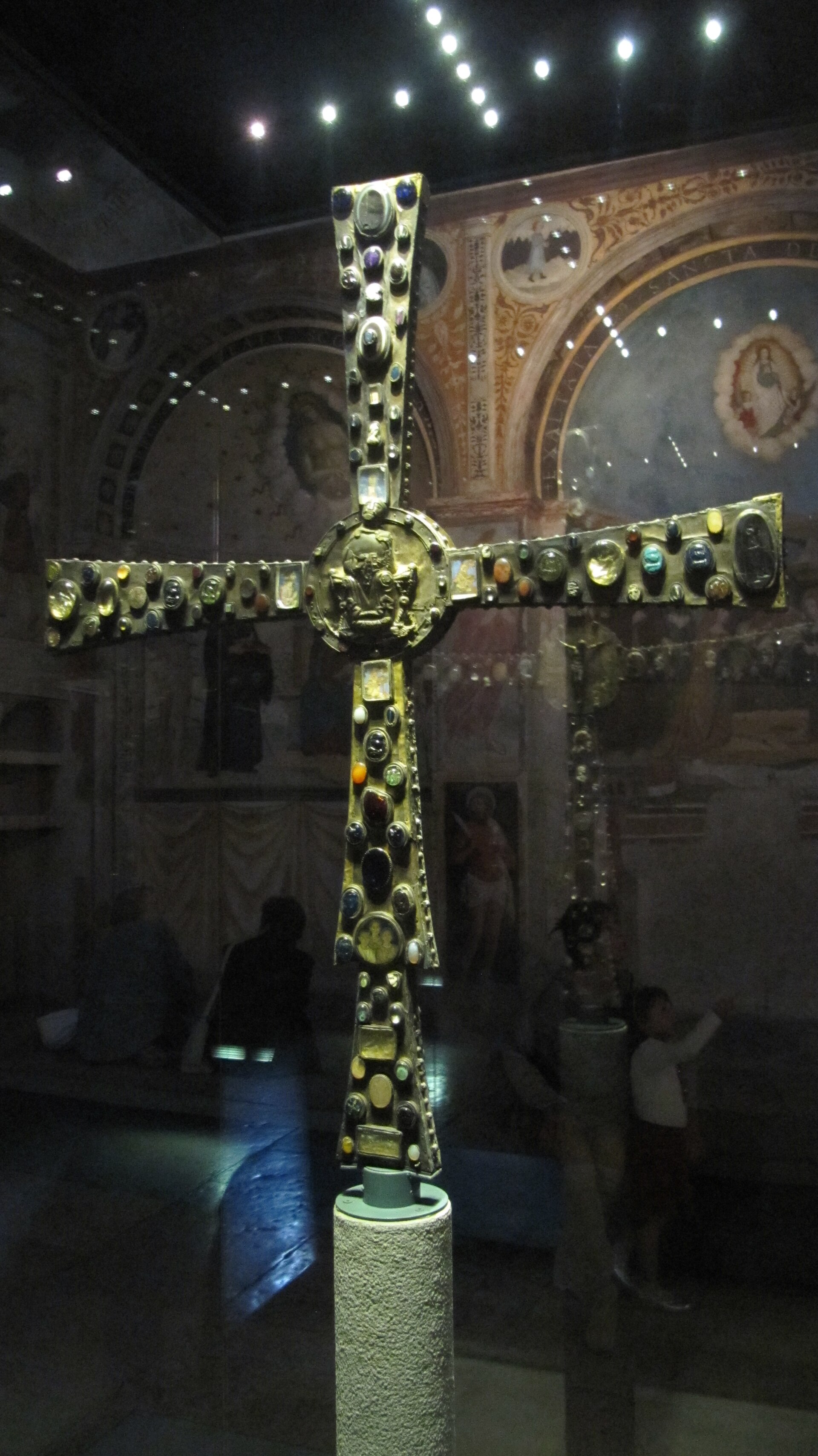
| The host object | The Cross of Desiderius: a wood-cored, gold-plated crux gemmata of early-Carolingian goldsmith's work, dated by the Fondazione Brescia Musei to the 9th century CE, set with 211-212 gemstones, cameos and glass-paste elements dating from the Roman period to the 16th century, including around 50 ancient gems.69 |
| Workshop attribution | Unresolved. Proposed as Alexandrian on the basis of a supposed dialect feature in the inscription (current from the 1920s, restated by Elsner 2007); that basis is directly challenged by Patt (2024), leaving the workshop unlocated between Rome and Alexandria.15 |
Images
The record in full
Chapter 1A gold face fixed into a much later cross
The object this record describes is a roundel about six centimetres across, made by fusing a design in gold leaf between two layers of glass and finishing the detail in painted pigment.
The object this record describes is a roundel about six centimetres across, made by fusing a design in gold leaf between two layers of glass and finishing the detail in painted pigment. It shows three people from the chest up: an older woman at the centre, flanked by a younger woman and a young man. All three look outward with the fixed, wide-eyed frontality typical of the finest gold-glass portraits of the third century CE, a manner that anticipates the icon painting of the centuries that follow it far more than it recalls the sculpture that came before it.
The medallion does not stand alone in a case. It is fixed into the front face of the Cross of Desiderius, a gem-studded gold processional cross kept in the Museo di Santa Giulia in Brescia, and has been fixed there since at least the early medieval period. Its reverse and edge are concealed by the cross's own gold mounting, which means the object has effectively been examined, for as long as it has been documented, only from one side. This record treats it as its own entry because it is catalogued and discussed in the scholarly literature as an independent work with its own history, identity crisis and attribution dispute, distinct from the cross that now carries it.
Chapter 2How a gold-glass portrait was actually made
Gold glass, sometimes called gold sandwich glass, is a technique in which a design in gold leaf is glued to a glass disc, then worked with a fine point that scratches away the gold exactly as an...
Gold glass, sometimes called gold sandwich glass, is a technique in which a design in gold leaf is glued to a glass disc, then worked with a fine point that scratches away the gold exactly as an engraver works a printing plate, leaving lines and details as bare glass against the gold ground. A second glass disc is then fused over the top, sealing the gold permanently between two layers of glass where it cannot tarnish, flake or be touched. On the finest examples, including this one, a painter has added colour on top of the gold outline to render faces, hair and drapery, which is why these portraits read less like glinting metalwork and more like small paintings under glass.
The technique is closely associated with the Roman glass industry of the third and fourth centuries CE. The great majority of surviving gold-glass work, several hundred pieces, comes from roundels cut from the bases of cups and bowls and cemented into the mortar of the Roman catacombs as markers for burial niches; most of these show simple devotional or domestic imagery rather than individualised portraits. The Brescia medallion belongs to a much smaller and finer group: portrait medallions of named or once-named individuals, of which only two carry an inscription that has been read as a personal name or nickname at all. This is one of them; the other is the Gennadios medallion in the Metropolitan Museum of Art.
Chapter 3The Cross of Desiderius
The Cross of Desiderius is a wood-cored, gold-plated processional cross of the crux gemmata type: a cross whose entire surface is set with gemstones, cameos and glass paste elements rather than left...
The Cross of Desiderius is a wood-cored, gold-plated processional cross of the crux gemmata type: a cross whose entire surface is set with gemstones, cameos and glass paste elements rather than left as plain metal. The Fondazione Brescia Musei, which holds and displays it, describes it as a rare example of early-Carolingian goldsmith's work of the ninth century, set with 212 gems, cameos and glass elements whose own dates of manufacture range from the Roman period to the sixteenth century. Wikipedia's account gives a close figure, 211 gemstones including around 50 ancient gems. Either count describes the same fact: this is a composite object, assembled once and added to more than once, in which a great many individually older and more valuable pieces have been set into a single later frame.
Among those older pieces, alongside a cameo of the emperor Augustus and another of Christ Pantocrator, sits the third-century gold-glass medallion this record is about. The cross is traditionally associated with Desiderius, the last king of the Lombards, and is said to have been given by him to the monastery he and his queen, Ansa, had founded in Brescia. The goldsmith's work of the cross itself, however, is dated by the museum's own scholarship to the ninth century, after the end of Desiderius's reign in 774 and, on most chronologies, after his death in Frankish captivity. That gap between a Lombard royal association and a Carolingian-period object is not resolved in the sources consulted here and is recorded as an open question below, rather than smoothed into a single tidy date.
Chapter 4Why a pagan-era portrait sits on a Christian reliquary
Setting a five-hundred-year-old pagan or at least religiously neutral Roman portrait into a Christian processional cross is not an anomaly to be explained away; it is the ordinary practice by which...
Setting a five-hundred-year-old pagan or at least religiously neutral Roman portrait into a Christian processional cross is not an anomaly to be explained away; it is the ordinary practice by which early medieval courts and monasteries built their most prestigious objects. A crux gemmata was valued precisely for the antiquity, rarity and workmanship of the individual gems it carried, not only for the gold that held them. Ancient engraved gems, cameos and, more rarely, painted glass portraits like this one were harvested from earlier Roman material, much of it already centuries old by the time it was reused, and set into new frames as visible proof of the wealth, connections and claim to Roman continuity of whoever commissioned the piece.
The Cross of Desiderius carries that practice at an unusual scale: about fifty ancient gems out of roughly two hundred and twelve pieces total, spanning from the Roman Imperial period through the sixteenth century, all mounted onto one ninth-century goldsmith's frame. The gold-glass medallion is simply the most legible example, because unlike a plain engraved gem it carries recognisable human faces and an inscription that later viewers could try, and repeatedly fail, to read correctly. Its presence on the cross says nothing at all about the identity of the people it shows; it says only that a Roman portrait of real value and beauty had survived long enough, and travelled far enough, to be judged worth including in the treasury of a Lombard royal foundation.
Chapter 5How the medallion became 'Galla Placidia'
The identification of the three figures as the fifth-century western Roman empress Galla Placidia with her children Valentinian III and Justa Grata Honoria is documented as an eighteenth-century...
The identification of the three figures as the fifth-century western Roman empress Galla Placidia with her children Valentinian III and Justa Grata Honoria is documented as an eighteenth-century antiquarian proposal. The earliest specific documentary trace located for this record is the theologian and antiquarian scholar Francesco Antonio Zaccaria, who in a work published in 1762 recalled having seen the medallion around 1725; his account is one of the threads later scholarship, including Breck's 1927 study, uses to trace the object's documented history backward. This record has not located a single named individual credited as the first to specifically propose the Galla Placidia identification, as opposed to simply describing or recording the object's presence on the cross; that gap is recorded honestly in the open questions below rather than assigned to a scholar on the strength of the pattern alone.
What is well documented is the outcome. Once attached to a real, nameable and important empress, the identification supplied exactly what an eighteenth- and nineteenth-century museum label wanted: a specific historical anchor for an otherwise anonymous ancient face, and a flattering connection between the Lombard treasury and the imperial Roman past it was already trying to claim through its cameo of Augustus. The identification held as the standard museum attribution for well over a century before it was formally and successfully challenged in print.
Chapter 6An interruption: was it even ancient?
Before the Galla Placidia identification was corrected, it was nearly overtaken by a different and more radical doubt: that the medallion was not an authentic ancient object at all.
Before the Galla Placidia identification was corrected, it was nearly overtaken by a different and more radical doubt: that the medallion was not an authentic ancient object at all. In the nineteenth century, the scholars Raffaele Garrucci and Hermann Vopel, both serious students of early Christian gilded glass, are recorded as having suspected the piece was a fake. Garrucci nonetheless published a careful drawing of it in his 1858 study of gilded glass from the Roman catacombs, a plate now in the public domain and reproduced in this record's gallery, which means the doubt was recorded in the same scholarly literature that eventually helped settle it.
The authenticity question and the identity question are logically separate but were resolved by the same twentieth-century turn toward technical and comparative connoisseurship: once the medallion could be set alongside a securely ancient corpus of gold-glass portraiture, both its status as a genuine third-century object and its status as a Roman face wrongly given an imperial fifth-century name became clear at more or less the same time. A reader encountering only the confident modern museum label would have no reason to know that this piece once had to survive a forgery accusation before it could even be argued over.
Chapter 7Breck's 1927 correction
The formal rejection of the imperial identification is credited in the modern literature to Joseph Breck, curator at the Metropolitan Museum of Art, in his 1927 Art Bulletin study 'The Ficoroni...
The formal rejection of the imperial identification is credited in the modern literature to Joseph Breck, curator at the Metropolitan Museum of Art, in his 1927 Art Bulletin study 'The Ficoroni Medallion and Some Other Gilded Glasses in the Metropolitan Museum of Art.' Breck's article is principally about the Ficoroni medallion and related pieces in the Metropolitan's own collection, and it places the Brescia medallion into a comparative discussion of gilded glass portraiture rather than treating it as its sole subject; it is nonetheless the source repeatedly cited by later scholarship, including Patt (2024), as the point at which the Galla Placidia reading was set aside on scholarly grounds rather than merely doubted in passing.
What Breck's correction did not supply, and could not have supplied from stylistic and comparative argument alone, was a replacement identity for the three sitters. Removing an emperor's family from the object left three anonymous Roman faces where a named imperial family had stood in every guidebook for a century and a half. That vacancy is exactly what later twentieth- and twenty-first-century scholarship, including the debate this record covers next, has tried and failed to fill with certainty.
Chapter 8The next theory: an Alexandrian family
With the imperial identification gone, attention moved from who the sitters were to where the medallion, and its close cousin the Gennadios medallion in New York, were made.
With the imperial identification gone, attention moved from who the sitters were to where the medallion, and its close cousin the Gennadios medallion in New York, were made. Scholarship going back nearly a century, and restated by Jas Elsner in his 2007 study Roman Eyes: Visuality and Subjectivity in Art and Text, read the endings of certain words in the Greek inscriptions on both medallions, terminating in iota, as a distinctive feature of Alexandrian Greek. On that philological basis, both medallions were proposed to be Alexandrian products, part of a broader modern habit of assigning rare, luxurious, unprovenanced ancient objects to famous ancient cities on relatively thin linguistic grounds.
This Alexandrian theory was not a fringe position. It became, in effect, the second consensus about this pair of medallions: rejected as imperial portraits, accepted as evidence of an otherwise poorly documented Alexandrian school of luxury portrait glasswork. It held that position for the better part of a century, cited in survey literature on Roman Egypt and on gold glass alike, until it was itself directly challenged.
Chapter 9Patt (2024) dismantles the Alexandrian dialect argument
Rachel Catherine Patt's 2024 peer-reviewed article in the American Journal of Archaeology, '"Probably Alexandria": Gold-Glass Portraiture and the Allure of Egypt,' treats the Brescia medallion and...
Rachel Catherine Patt's 2024 peer-reviewed article in the American Journal of Archaeology, '"Probably Alexandria": Gold-Glass Portraiture and the Allure of Egypt,' treats the Brescia medallion and the Gennadios medallion together as the only two inscribed gold-glass portraits in the surviving corpus, and reopens exactly the linguistic argument that had supported their Alexandrian attribution. Her stated conclusion, in the article's own abstract, is that 'the grounds on which the connection rests need to be reconsidered.'
Patt's specific counter-argument is philological, not merely sceptical. The word endings in iota that earlier scholarship, repeated as recently as Elsner (2007), read as a marker of a distinctively Alexandrian dialect of Greek are shown, in her reanalysis, not to correspond to any dialect that is otherwise attested. In place of a dialect explanation, she proposes an onomastic one: these are not dialect forms at all but a specific kind of nickname, a by-name carried alongside a person's formal name, of a type that is well documented across the wider later Roman Empire, and which regularly took an ending in -i in Latin and the corresponding -i (iota) ending in Greek. If that reading holds, the entire evidentiary basis for locating the workshop in Alexandria specifically, as opposed to Rome or anywhere else Greek-speaking naming practices of this kind were current, disappears. Patt's own framing of the wider pattern is pointed: the impulse to assign rare, unprovenanced luxury objects to famous ancient metropolises such as Alexandria without independent evidence is, in her reading, closer to a habit of scholarly imagination than a documented archaeological finding.
This record follows the specification's own instruction not to flatten a nuanced philological argument into a vague statement that a scholar 'disagrees.' The disagreement here is precise: it is about whether a specific letter ending is dialect evidence or onomastic evidence, and Patt's case rests on showing that the dialect said to exist has no independent attestation, while the nickname pattern she proposes in its place does.
Chapter 10If not an empress, and not necessarily Alexandrian, then who
With both the Galla Placidia identification and the confident Alexandrian workshop attribution now under serious challenge, the honest state of the evidence is that the three figures on the Brescia...
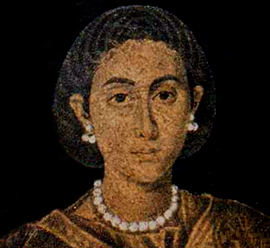
With both the Galla Placidia identification and the confident Alexandrian workshop attribution now under serious challenge, the honest state of the evidence is that the three figures on the Brescia medallion are an unidentified family or household group, portrayed with the same frontal, wide-eyed formality used across gold-glass portraiture of the period, whose names, if the inscription does record names or nicknames, cannot currently be matched to any known historical individual. Some cataloguing of comparable unidentified Roman gilded-glass portraits, including material connected to the wider Brescia civic collection, has historically used the plain Latin tag effigies ignotae, unknown likenesses, which is a more honest description of this object's status than any of the specific identities that have been proposed and withdrawn for it.
No scholarship consulted for this record proposes a specific alternative named identification for the three sitters. The object is best described, at the current state of publication, as a fine and unusually well-preserved third-century Roman family portrait in gold glass, made by an unlocated workshop, for patrons whose names are not recoverable from the surviving evidence.
Chapter 11Ansa, Desiderius and the monastery that outlasted the Lombard kingdom
The monastery traditionally connected to this cross, San Salvatore, was founded in Brescia in 753 by Desiderius, then a Lombard duke and shortly afterward the last king of the Lombards, together with...
The monastery traditionally connected to this cross, San Salvatore, was founded in Brescia in 753 by Desiderius, then a Lombard duke and shortly afterward the last king of the Lombards, together with his wife Ansa, using land the couple had inherited from the late King Aistulf. Their eldest daughter, Anselperga, became the monastery's first abbess. In 761 the monastery received the relics of Saint Julia, after which the complex eventually took the joint name San Salvatore-Santa Giulia by which it and the modern museum are known. An inscription recording Ansa as queen and wife of King Desiderius reportedly stood on a tomb structure in the church's southern perimeter wall until as late as the seventeenth century, which is the most direct surviving documentary trace of her personal connection to the foundation.
Desiderius became king of the Lombards in 756, three years after the monastery's founding, and was deposed by Charlemagne in 774, ending the independent Lombard kingdom. The monastery he and Ansa founded did not end with their political fall. It continued as a religious institution through the medieval and early modern periods, its own treasury, including the cross now bearing his name, surviving inside the community that guarded it.
Chapter 12From monastic treasury to civic museum
The Cross of Desiderius is recorded as having been kept within the monastic complex, in or near the Romanesque oratory of Santa Maria in Solario, across the medieval and early modern life of the...
The Cross of Desiderius is recorded as having been kept within the monastic complex, in or near the Romanesque oratory of Santa Maria in Solario, across the medieval and early modern life of the institution. By the mid-nineteenth century the medallion and the cross were known to civic scholarship in Brescia; the medallion's earliest documented sighting, via Zaccaria's 1762 recollection of seeing it around 1725, and Garrucci's 1858 published drawing both predate any transfer to a purpose-built public museum, meaning the objects had already passed into a form of civic or ecclesiastical custody, described in period sources as the Museo Civico Cristiano, well before the twentieth century.
The monastic complex of San Salvatore-Santa Giulia itself became Brescia's city museum, the Museo di Santa Giulia, in 1998, under the Fondazione Brescia Musei. The cross has remained on display in the same oratory, Santa Maria in Solario, which is decorated with frescoes painted by Floriano Ferramola between 1513 and 1524, meaning the setting a visitor sees the medallion in today is itself a sixteenth-century addition to a much older room. The San Salvatore-Santa Giulia monastic complex, together with the Capitolium archaeological area in Brescia, forms part of a UNESCO World Heritage Site. The custodial chain, in short, runs from an early medieval monastic treasury, through nineteenth-century civic antiquarian custody, to a purpose-built modern museum, without the object ever having left the city in which it has been documented since at least the early eighteenth century.
Chapter 13The wider corpus: gold-glass portraits as a genre
The Brescia medallion belongs to a recognised and relatively small corpus of Roman gold-glass portrait medallions distinct from the far larger body of simple devotional roundels salvaged from the...
The Brescia medallion belongs to a recognised and relatively small corpus of Roman gold-glass portrait medallions distinct from the far larger body of simple devotional roundels salvaged from the catacombs. Comparable pieces include a husband-and-wife pair in the Museo Sacro of the Vatican Museums, dated to the first half of the third century and about 4.9 centimetres in diameter; a portrait of two young men in Bologna, of the first quarter of the fourth century, about 5.1 centimetres across and inscribed with a drinking toast rather than a name; a family portrait in the Vatican Library whose date and dimensions are not established in the sources consulted; and a further husband-and-wife pair in the Vatican Museums dated broadly to the third or fourth century. Closest of all is the Gennadios medallion in the Metropolitan Museum of Art, accession 26.258, dated about 200 to 250 CE and about 4.1 centimetres in diameter, inscribed in Greek with a name, Gennadios, and a claim to musical skill; it is the subject of a separate Iconotheca record and is the only other inscribed portrait in this genre, which is precisely why Patt's 2024 article treats the two together as a matched pair of evidence rather than as two unrelated curiosities.
Set against that small comparative group, the Brescia medallion is unusual chiefly for its survival route: rather than being recovered archaeologically from a Roman catacomb, as most of its cousins were, it survived by a wholly different mechanism, incorporation as a valued antique into a much later piece of Christian goldsmith's work, which is also why its own excavation context and original findspot are simply not recoverable.
Chapter 14What remains unsettled
Two successive scholarly consensuses about this object, first that it showed a Roman empress, second that it was made in Alexandria, have each been formally overturned in the peer-reviewed...
Two successive scholarly consensuses about this object, first that it showed a Roman empress, second that it was made in Alexandria, have each been formally overturned in the peer-reviewed literature, in 1927 and 2024 respectively. No third consensus has yet taken their place. The identity of the three sitters, the location of the workshop, the date and circumstances of the medallion's incorporation into the Cross of Desiderius, and even the precise translation of its two-word Greek inscription all remain open in the sources consulted for this record, and are recorded as such below rather than resolved by assertion.
The artist
Unknown Roman gold-glass workshop, active 3rd century CE, location disputed between Rome and Alexandria
No name survives for the workshop that made this medallion, and none is likely to be recovered. What can be described is the genre it belongs to: a small, technically demanding class of Roman luxury portraiture in glass, of which only a few dozen examples are known at all and only two, this medallion and its close cousin the Gennadios medallion in New York, carry an inscription that has ever been read as naming a sitter. Everything said below is therefore a dossier on a technique and a corpus, not on an individual hand, exactly as the specification asks for an anonymous workshop object.
Related works
| Work | Relation | Where it is |
|---|---|---|
| Gennadios medallion Unknown Roman gold-glass workshop | The only other inscribed gold-glass portrait medallion known; treated together with the Brescia medallion as the entire evidentiary basis for the Alexandrian-workshop theory that Patt (2024) challenges. Subject of a separate Iconotheca record. c. 200-250 CE, approx. 4.1 cm diameter, inscribed in Greek naming Gennadios and praising his musical skill. | Metropolitan Museum of Art, New York, accession 26.258 |
| Husband and wife portrait pair Unknown Roman gold-glass workshop | Comparable gold-glass family/couple portrait medallion of the same general period First half of the 3rd century CE, approx. 4.9 cm diameter. | Museo Sacro, Vatican Museums |
| Two young men Unknown Roman gold-glass workshop | Comparable gold-glass portrait medallion, later in date, showing the genre's continuation into the 4th century First quarter of the 4th century CE, approx. 5.1 cm diameter, inscribed with a drinking toast rather than a name. | Museo Civico Archeologico, Bologna |
| Family portrait medallion Unknown Roman gold-glass workshop | Further comparable gold-glass family portrait Date and dimensions not established in the sources consulted. | Vatican Library |
| Ficoroni Medallion Unknown Roman gold-glass workshop | The comparative subject of Breck's 1927 study, the same article that established the rejection of the Galla Placidia identification for the Brescia medallion Discussed alongside the Brescia medallion in Breck 1927. | Metropolitan Museum of Art, New York |
Open questions
- Who are the three people actually shown on the medallion? Both the imperial identification (Galla Placidia and her children) and the confident location of the workshop in Alexandria have been rejected in the peer-reviewed literature; no accepted alternative identity has replaced either.
- Where was the medallion made? Patt (2024) removes the philological basis for an Alexandrian attribution but does not establish an alternative workshop location; Rome and other Greek-speaking centres of the later Roman Empire remain possible and unresolved.
- What do the two inscribed words, BOUNNERI and KERAMI, actually mean or name? No confirmed translation is settled among the sources consulted, whether as personal names, nicknames, or something else.
- Who first specifically proposed the Galla Placidia identification, and on what stated grounds? An eighteenth-century antiquarian tradition and Zaccaria's 1762 account of seeing the piece around 1725 establish the identification's currency by the mid-eighteenth century, but no single named originator or a stated rationale beyond costume and pose has been located for this record.
- When, precisely, was the gold-glass medallion incorporated into the Cross of Desiderius, and by whom? The cross's goldsmith's work is dated by the Fondazione Brescia Musei to the 9th century CE, after the end of Desiderius's own reign in 774, while the cross is traditionally said to have been his gift to the monastery; how that traditional attribution relates to the object's actual ninth-century date is not resolved in the sources consulted.
- Where was the medallion, physically, between its third-century manufacture and its documented presence on the cross by the early modern period? No excavation record, findspot, or intermediate owner is documented for this gap of several centuries.
Questions about this object
What is Brescia Medallion?
Brescia Medallion is a glass, dated c. 200-300 CE (portrait medallion); set into the Cross of Desiderius by the 9th century CE. Medium: Gold leaf fused between two layers of blown glass, engraved and detailed with painted pigment; mounted within a gold, wood-cored, gem-set processional cross.
Who made Brescia Medallion, and is the attribution settled?
The attribution to Unknown Roman gold-glass workshop, location disputed between Rome and Alexandria is recorded here as disputed. No maker is named or knowable. Two separate identifications have been made and rejected for this object, at two different levels. First, an 18th-century antiquarian tradition proposed that the medallion portrayed the empress Galla Placidia with her children Valentinian III and Justa Grata Honoria; this imperial identification became the standard museum label for generations and is now firmly rejected (Breck 1927). Second, a later theory held that the workshop itself was Alexandrian, argued from a supposed Alexandrian dialect feature in the Greek inscription (a reading current since the 1920s and repeated by Elsner in 2007); this theory has in turn been directly challenged by Patt (2024), who re-reads the same letters as a common later-Roman-Imperial nickname form rather than dialect evidence. No accepted identification of the three sitters, and no settled workshop location, currently stands in their place.
Where is Brescia Medallion now?
Museo di Santa Giulia, Brescia, Italy. Displayed in place within the Cross of Desiderius, in the Romanesque oratory of Santa Maria in Solario, part of the former monastic complex of San Salvatore-Santa Giulia. Inventory number No public accession or inventory number is published for this object. It is a civic-museum holding identified by name and by its fixed physical position within the Cross of Desiderius, not by a catalogue number of the kind US open-access museums publish.. Last confirmed 3 September 2026. Fondazione Brescia Musei, the public foundation that operates the Santa Giulia Museum; the monastic complex became Brescia's city museum in 1998 and the cross has remained on display there in the same oratory.
What is still unknown about Brescia Medallion?
Who are the three people actually shown on the medallion? Both the imperial identification (Galla Placidia and her children) and the confident location of the workshop in Alexandria have been rejected in the peer-reviewed literature; no accepted alternative identity has replaced either.
Sources
- 1Patt, Rachel Catherine. "'Probably Alexandria': Gold-Glass Portraiture and the Allure of Egypt." American Journal of Archaeology 128, no. 2 (April 2024). ajaonline.org/article/...
- 2American Journal of Archaeology / University of Chicago Press, journal record for Patt (2024), DOI 10.1086/728800. journals.uchicago.edu/doi/...
- 3Academia.edu, preprint/summary listing for Patt (2024), consulted where the publisher page could not be fetched in full. academia.edu/116136044/...
- 4Breck, Joseph. "The Ficoroni Medallion and Some Other Gilded Glasses in the Metropolitan Museum of Art." The Art Bulletin 9, no. 4 (June 1927): 352-356. jstor.org/stable/...
- 5Elsner, Jas. Roman Eyes: Visuality and Subjectivity in Art and Text. Princeton: Princeton University Press, 2007. jstor.org/stable/...
- 6Wikipedia, "Cross of Desiderius." source; with the Fondazione Brescia Musei's own catalogue entry and published conservation literature. en.wikipedia.org/wiki/...
- 7Wikipedia, "List of gold glass portraits." source, consulted for the comparative corpus of gold-glass portrait medallions and their dimensions. en.wikipedia.org/wiki/...
- 8Wikipedia, "Gold glass." source, consulted for the manufacturing technique. en.wikipedia.org/wiki/...
- 9Wikimedia Commons, "Category:Gold glass wrongly thought to be Galla Placidia," consulted for file captions documenting the rejected identification and the Elsner Alexandria theory. commons.wikimedia.org/wiki/...
- 10Wikimedia Commons API, extended metadata for File:Brescia medallion.png, used to verify public-domain licensing. commons.wikimedia.org/wiki/...
- 11Wikimedia Commons API, extended metadata for File:Brescia medallion (Garrucci).jpg, crediting Raffaele Garrucci, Vetri ornati di figure in oro trovati nei cimiteri dei cristiani primitivi di Roma (Rome, 1858). commons.wikimedia.org/wiki/...
- 12Wikimedia Commons API, extended metadata for File:Effigies ignotae (saec. IV, Brescia, Musei Civici).jpg. commons.wikimedia.org/wiki/...
- 13Wikimedia Commons API, extended metadata for File:Croce di Desiderio (Santa Giulia, Brescia) fronte.JPG, crediting photographer PrincipeRoby, CC BY-SA 4.0. commons.wikimedia.org/wiki/...
- 14Fondazione Brescia Musei, "Santa Giulia Museum." bresciamusei.com/en/...
- 15Wikipedia, "San Salvatore, Brescia." source, consulted for the monastery's founding by Desiderius and Ansa. en.wikipedia.org/wiki/...
- 16Wikipedia, "Ansa, Queen of the Lombards." source. en.wikipedia.org/wiki/...

.jpg)
.jpg)
_fronte.JPG)
Last verified · Published
Change log
3 September 2026 - Record created at the house standard: researched narrative, technical evidence, maker dossier, graded provenance chain, prices with hammer and premium separated, related works, open questions and sources.