"Antonius" Violin
Antonio Stradivari · 1711
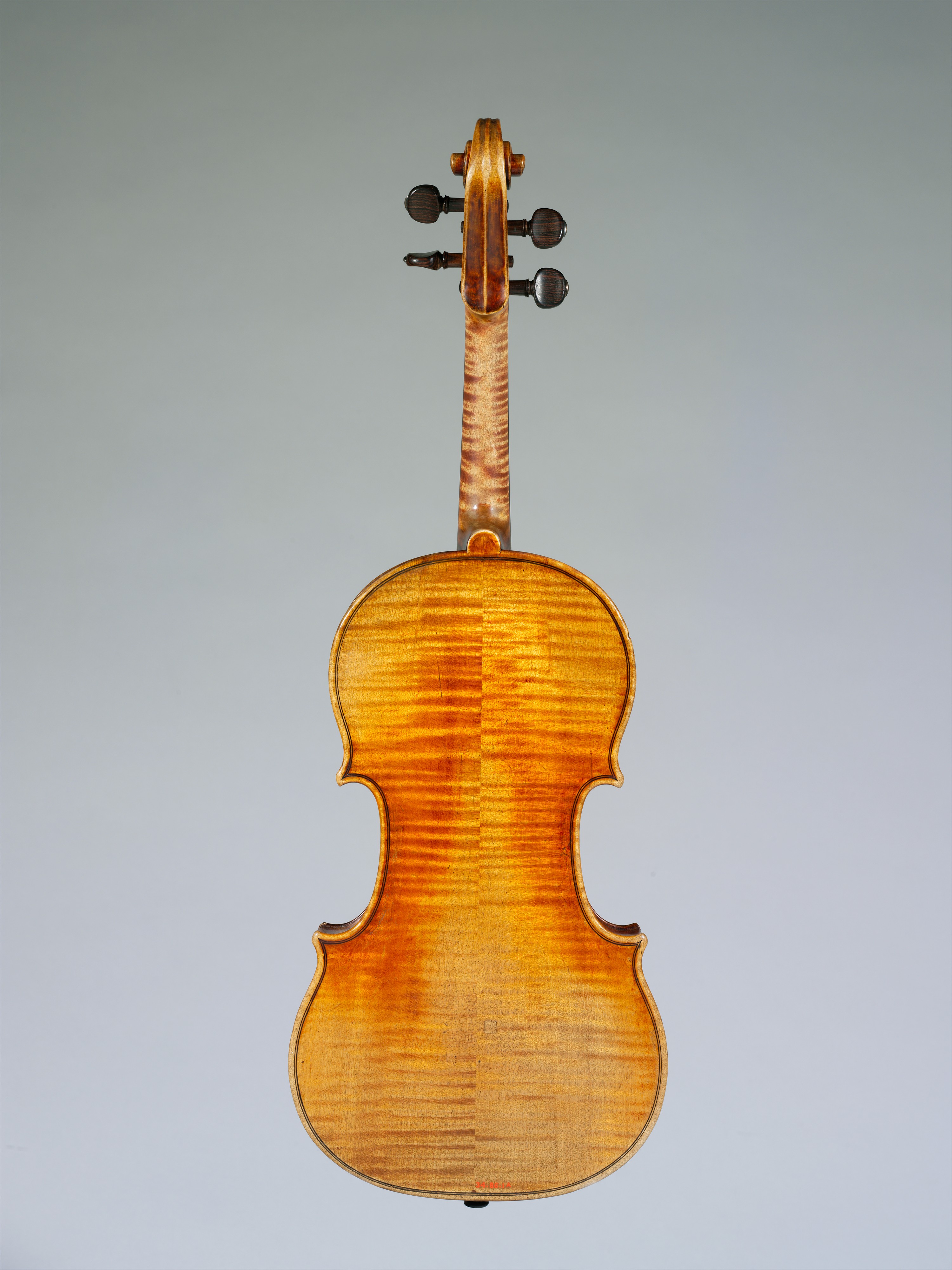
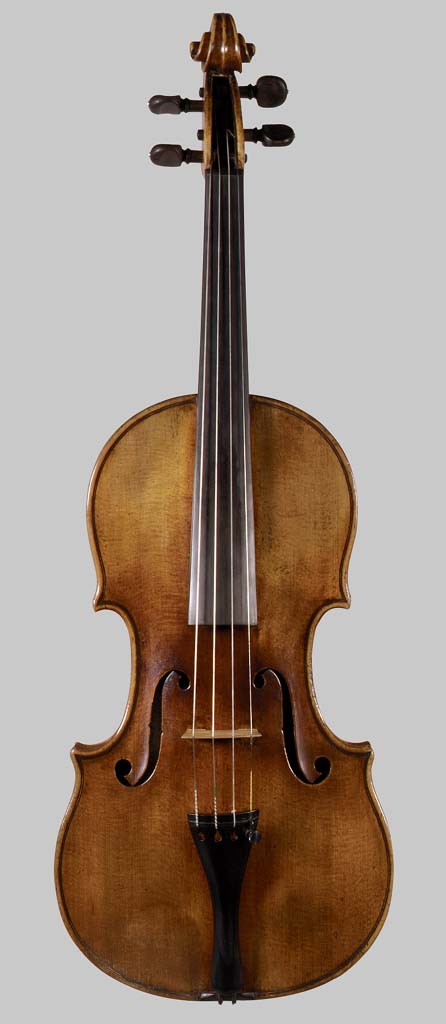
Antonio Stradivari, the 'Antonius' violin, Cremona, 1711. Maple, spruce and ebony. Bequest of Annie Bolton Matthews Bryant, 1933; Metropolitan Museum of Art, accession 34.86.1a.
| Artist | Antonio Stradivari |
|---|---|
| Date | 1711 |
| Medium | Maple (back, ribs, neck, scroll), spruce (table), ebony (fingerboard, pegs, tailpiece), under oil varnish |
| Dimensions | Height 58.4 cm (23 in); width 20.3 cm (8 in) overall, as given by the Metropolitan Museum of Art. Length of back 35.5 cm, as measured in the Cozio Archive. |
| Where it is now | The Metropolitan Museum of Art, New York, on view in Gallery 684 (Department of Musical Instruments)last confirmed |
| Inventory number | 34.86.1a |
| Attribution | AcceptedAttribution to Antonio Stradivari is undisputed and rests on the maker's own printed-and-inscribed paper label inside the instrument, consistent with his documented labelling practice for the period. Full note |
| Object type | Musical instrument |
| Period | Italian, early eighteenth century (Cremonese school, Stradivari's "Golden Period," c. 1700-1720) |
| Cases | Has a provenance gap |
| Inscriptions | Printed and handwritten paper label pasted inside the body, reading "Antonious Stradiuarius Cremonensis / Faciebat Anno 1711," countersigned in a later hand "F. A. Mayer, Violin expert." Stradivari's post-1700 labels carried only a pre-printed "1" for the year, with the remaining digits added by hand; on this label the final two digits, degraded by dirt and age, were long misread as "17" and "21" before ultraviolet examination confirmed them as "11." |
| Owners on record | 8 links6 documented, 1 disputed, 1 unknown |
| Sources | 13 cited |
About this record Last verified · 13 sources cited · Change log
On this page 10 sections
ContentsClose
A grand-pattern violin built by Antonio Stradivari in Cremona in 1711, squarely inside the run of years now called his Golden Period. Its maker was never in doubt; its date was. A degraded handwritten numeral on the instrument's own label was read as 1721 in the owner's will, revised to 1717 by the New York expert Rembert Wurlitzer in the 1950s, and finally confirmed as 1711 only in the 2010s, when a Museum paper conservator examined the label under ultraviolet light and matched its digit pattern to two other securely dated Stradivari instruments from the same year.
The violin reached the Metropolitan Museum in 1933-34 as a bequest from the Boston sculptor Annie Bolton Matthews Bryant, together with a second, earlier Stradivari violin nicknamed "The Francesca." Both instruments had belonged first to Bryant's mother, Anne Fay Bolton Matthews, who bought the Antonius from the concertmaster-turned-dealer Felix Berber in Geneva in 1909; Berber had owned it since 1904, and before him it belonged to the Berlin and Leipzig violin maker Wilhelm Hermann Hammig. That chain, while real, stops there: nothing in the sources consulted for this record accounts for the instrument's whereabouts across the roughly two centuries between its making in 1711 and Hammig's ownership by 1905.
The two Bryant violins were the first Stradivaris to enter an American museum collection. The Antonius remains on public display in New York and has been used in concert by members of the American String Quartet, most documented in a 2012 performance for the American Musical Instrument Society. Its precise condition and restoration history after 1933, and whether it has ever been altered from its original Baroque configuration as its companion the Francesca demonstrably was, are not fully documented in the sources this record could verify.
Provenance
Each link is graded. Documented: a cited source supports it. Disputed: the identification is argued but not established. Unknown: no owner for that span, and the gap is not smoothed into a narrative. The grades in the glossary.
- 1711 -Antonio Stradivari, Cremonadocumented
Date established by the maker's own printed-and-handwritten paper label, read under ultraviolet light as '17ii' (1711) after two earlier, incorrect published readings (1721, then 1717). Cross-checked against the identically dated 'Duport' cello and 'Earl of Plymouth, Kreisler' violin.12
- 1711 - by 1905Unrecordedunknown
No owner, dealer or location is documented for approximately 180 years between the violin's manufacture and its earliest identified owner, Wilhelm Hermann Hammig. This record does not bridge the gap with supposition.3
- - 1905Wilhelm Hermann Hammig (1838-1925), violin and bow maker, Markneukirchen, Berlin and Leipzigdocumented
Recorded as owner 'until 1905' by both the Metropolitan Museum's own provenance note and the Cozio Archive. How or when he acquired the instrument is not recorded.2313
- 1905 - 1909Felix Berber (1871-1930), violinist, formerly concertmaster of the Leipzig Gewandhaus Orchestradocumented
Berber had owned the violin since 1904 per the Museum's account (a one-year discrepancy against the Cozio Archive's 'from 1905'). He brought it, with a Guarneri del Gesu he had also acquired, on an American tour in 1909-10, likely hoping to sell it to a wealthy American buyer.123
- 1909 -Sale finalised: Felix Berber to Anne Fay Bolton Matthewsdocumented
On 24 December, Berber signed an affidavit at the American Consulate in Geneva affirming the violin as the work of Antonio Stradivari and finalising its sale to Matthews - an unusually well-documented private sale for the period.1
- 1909 - 1915Anne Fay Bolton Matthewsdocumented
Played the violin, and its companion the 'Francesca,' until her death in 1915. Probably gave both instruments their nicknames, honouring Stradivari and his first wife Francesca Ferraboschi.1
- 1915 - 1933Annie Bolton Matthews Bryant (1871-1933), sculptor, Bostondisputed
Inherited both violins from her mother. The Museum's own account implies inheritance at the mother's 1915 death; the Cozio Archive's ownership chain instead gives Bryant's own holding as running 'in 1925 and until 1933.' The exact transition date is not established by the sources consulted.13
- 1933 - presentThe Metropolitan Museum of Art, New Yorkdocumented
Bequeathed by Bryant, who died in 1933 at her summer home in Waltham, Massachusetts; received by the Museum in the spring of 1934 together with the 'Francesca' violin. Accession number 34.86.1a. The two instruments were the first Stradivari violins owned by an American museum.124
Technical evidence
| Attribution note | Attribution to Antonio Stradivari is undisputed and rests on the maker's own printed-and-inscribed paper label inside the instrument, consistent with his documented labelling practice for the period. What was genuinely unsettled for over a century was not who made the violin but when: the handwritten year on that same label was misread for decades, so this record's central dispute is one of date, not of hand. |
|---|---|
| Materials | Maple (back, ribs, neck and scroll), spruce (table), ebony (fingerboard, pegs and tailpiece), under an orange-brown oil varnish.123 |
| Back | Two-piece maple back of even, small figure.3 |
| Dimensions (Museum) | Height 58.4 cm (23 in); width 20.3 cm (8 in) overall.2 |
| Back length (Cozio Archive) | 35.5 cm, identical to the separately documented back length of the 1711 'Earl of Plymouth, Kreisler' violin.310 |
| Pattern | Grand pattern, the wider body proportions established by Nicolo Amati in the mid-17th century and re-adopted by Stradivari from about 1700, after a decade of experimenting with a narrower long pattern (used, for example, on the companion 'Francesca' of 1694).12 |
| Label | Printed and handwritten paper label pasted inside the body: 'Antonious Stradiuarius Cremonensis / Faciebat Anno 1711,' countersigned in a later hand 'F. A. Mayer, Violin expert.' Identity of Mayer not established.2 |
| Dating method | Post-1700 Stradivari labels were pre-printed with a leading '1' only; the remaining digits were handwritten and, on this label, had degraded to the point of misreading. Museum paper conservator Yana van Dyke confirmed the paper as consistent with an early-18th-century sheet with no evidence of tampering, then read the handwritten digits under ultraviolet light as '17ii' (1711), a reading cross-checked against Stradivari's identically dated 'Duport' cello and 'Earl of Plymouth, Kreisler' violin, both also of 1711.1910 |
| Classification | Chordophone-Lute-bowed-unfretted (Museum classification).2 |
| Setup / condition | Not itemised in any source consulted for this instrument specifically. The Museum's own published account of its Stradivari holdings identifies the unrelated 'Gould' violin (1693) as the only one of its Stradivari violins returned to a Baroque setup, implying the Antonius remains in a modernised configuration, as its companion the Francesca is separately documented to be - but no source specifies what, if anything, was altered on the Antonius itself, or when.67 |
| Credit line and accession | Bequest of Annie Bolton Matthews Bryant, 1933; accession number 34.86.1a; received by the Museum in the spring of 1934.12 |
Images
The record in full
Chapter 1What it is
The "Antonius" is a violin of maple, spruce and ebony, built by Antonio Stradivari in Cremona in 1711 and standing 58.4 centimetres high and 20.3 centimetres across at its widest, with a two-piece...
The "Antonius" is a violin of maple, spruce and ebony, built by Antonio Stradivari in Cremona in 1711 and standing 58.4 centimetres high and 20.3 centimetres across at its widest, with a two-piece maple back of even, small figure under an orange-brown varnish and a back length of 35.5 centimetres. It is built on what the trade calls the grand pattern: the wider, fuller body proportions that Nicolo Amati had established in Cremona in the mid-seventeenth century, and that Stradivari himself returned to around 1700 after a decade of experimenting with a narrower, longer outline.
It hangs today in Gallery 684 of the Metropolitan Museum's Department of Musical Instruments, catalogued as accession 34.86.1a, one of a small group of instruments by this maker that the Museum owns or has on loan, and the only one of the Museum's Stradivari violins bequeathed together with a documented sibling in a single gift from a single private collection.
Chapter 2The Golden Period, and where 1711 sits inside it
Stradivari worked in Cremona for more than seven decades, and over 600 instruments made in his workshop, with the assistance of his sons Francesco and Omobono, are known to survive.
Stradivari worked in Cremona for more than seven decades, and over 600 instruments made in his workshop, with the assistance of his sons Francesco and Omobono, are known to survive. The Museum's own catalogue note for this violin places the years from about 1700 to 1720 at the summit of that career: Stradivari had by then abandoned the narrower long pattern of the 1690s, returned to Amati's grand-pattern proportions, and adopted a flatter arching across the top and back that is credited with giving his instruments of this period a more powerful, more projecting tone. This run of two decades is what the trade calls his Golden Period, and instruments from inside it are consistently the most sought after of his output.
1711 falls near the middle of that window, six years before the Museum's own catalogue material once wrongly placed this violin and ten years before the date given in the owner's will. Two other instruments securely dated to the same year, discussed below, make it possible to say something more specific than "Golden Period" about where 1711 sits: it is a year for which Stradivari's dated output is directly comparable across at least three surviving instruments in three different collections.
Chapter 3A label read three ways
The dispute this record exists to document is not about attribution.
The dispute this record exists to document is not about attribution. It is about a date, and it ran for more than a century inside the Museum's own paperwork before being resolved. Stradivari, after 1700, used labels pre-printed with the maker's name, place and a single leading numeral "1" for the year, leaving the remaining digits to be added by hand. On instruments that have travelled for three centuries, those handwritten digits accumulate dirt, varnish transfer and abrasion, and become genuinely difficult to read without technical aid.
On this violin, that difficulty produced three different published dates. Annie Bolton Matthews Bryant's will and her correspondence with the Museum gave the date as 1721. In the 1950s the New York violin expert Rembert Wurlitzer, whose firm is credited with having examined, sold, restored or authenticated more than half of the world's known Stradivari instruments, re-examined the label and read it instead as 1717, a date the Museum then adopted in its own materials because it placed the violin unambiguously inside the Golden Period and, not incidentally, made it more desirable. For a period after that, Museum curators and conservators hedged, describing the instrument in print as dated either 1717 or 1721.
Both historical readings were wrong.
Chapter 4How the label was finally read
The correction came from the Museum's own Department of Musical Instruments, working with Yana van Dyke, a paper conservator on its staff, who examined the physical label itself rather than relying...
The correction came from the Museum's own Department of Musical Instruments, working with Yana van Dyke, a paper conservator on its staff, who examined the physical label itself rather than relying on the accumulated weight of prior published opinion. She confirmed first that the paper was consistent with an early eighteenth-century sheet and showed no evidence of having been removed, replaced or tampered with, which matters because a swapped or forged label is the single most damaging thing that can happen to a Stradivari's documentary record. She then examined the handwritten numerals under ultraviolet light, which is described in the Museum's own account as having made the correct reading "obvious to even the most untrained eye": not "1721" or "1717," but "17ii," Stradivari's own shorthand for 1711.
The finding did not rest on this instrument in isolation. The Museum's curator of musical instruments noted that "17ii" is exactly how Stradivari is known to have written the year on other instruments made in 1711, citing by name two of them: the cello now called the "Duport," today associated with the Nippon Music Foundation after a long ownership by Mstislav Rostropovich, and the violin known as the "Earl of Plymouth, Kreisler," once owned by Fritz Kreisler, whose documented back length of 35.5 centimetres matches this violin's exactly. Cross-checking a disputed digit against securely dated instruments from the same year is a narrow, specific, evidence-based method, and it is the reason this record can state 1711 as settled rather than merely re-asserting the most recent guess in a sequence of guesses.
The correspondence in which this conclusion first appears in writing dates to November 2010, in an exchange between the Museum's curator, Jayson Dobney, and the Tarisio Cozio Archive; the fuller published account followed in the Museum's own Perspectives essay in March 2017.
Chapter 5Before Boston: Hammig, Berber and a Geneva affidavit
The ownership record before 1933 is thin but not empty, and it is worth stating exactly how far it goes and where it stops.
The ownership record before 1933 is thin but not empty, and it is worth stating exactly how far it goes and where it stops. The earliest identified owner is Wilhelm Hermann Hammig (1838-1925), a violin and bow maker who ran workshops in Markneukirchen, Berlin and Leipzig; the Cozio Archive records him as owning this violin until 1905, without stating how or when he acquired it or from whom.
From Hammig the violin passed to Felix Berber (1871-1930), a German violinist who had been concertmaster of the Leipzig Gewandhaus Orchestra and taught at the Royal Academy of Music in Munich before later teaching at the Geneva Conservatory. Berber had owned the Stradivari since 1904 and, in 1909, also acquired a violin by Giuseppe Guarneri del Gesu; he appears to have brought both instruments on an American tour that year hoping to sell the Stradivari to a wealthy buyer. He made his American solo debut playing the Brahms Violin Concerto with the Symphony Society of New York (a predecessor of the New York Philharmonic) in October 1910, and repeated the piece with the Boston Symphony the following month, a concert the Museum's own account suggests Anne Fay Bolton Matthews likely attended.
The sale itself is documented with unusual precision for an instrument of this period: on 24 December, Berber signed an affidavit at the American Consulate in Geneva affirming the violin as the work of Antonio Stradivari and finalising its sale to Matthews. It is a rare thing for a private instrument sale from this era to leave behind a dated, notarised, consular document, and it is the firmest link in the chain before the Museum's own records begin.
Nothing found for this record explains where the violin was for the roughly 180 years between its making in 1711 and Hammig's ownership by 1905. That gap is not filled here with supposition.
Chapter 6Two violins, one bequest
Anne Fay Bolton Matthews, who bought the Antonius from Berber in 1909, already owned or soon after acquired a second Stradivari, an earlier long-pattern violin of 1694 nicknamed "The Francesca." The...
Anne Fay Bolton Matthews, who bought the Antonius from Berber in 1909, already owned or soon after acquired a second Stradivari, an earlier long-pattern violin of 1694 nicknamed "The Francesca." The Museum's own account states plainly that she played both instruments until her death in 1915, and that she probably gave them their nicknames herself, honouring Stradivari and his first wife, Francesca Ferraboschi. The two instruments are not a matched pair and were not built together: they were made seventeen years apart, on two different body patterns, and came together only in this one American household. This record is about the Antonius alone; the Francesca appears here only as the OTHER instrument in the same bequest, and should not be read as sharing this violin's construction date, pattern or documented alteration history.
Matthews's daughter, the sculptor Annie Bolton Matthews Bryant, inherited both violins. The Cozio Archive's own ownership chain lists her as holder "in 1925 and until 1933," which sits awkwardly against the Museum's statement that her mother played the instruments "until her death" in 1915 - the two primary sources do not agree on exactly when ownership passed from mother to daughter, and this record does not resolve that gap by guessing.
Chapter 7Annie Bolton Matthews Bryant
Bryant (1871-1933) was born into a Boston Brahmin family, the daughter of William A.
Bryant (1871-1933) was born into a Boston Brahmin family, the daughter of William A. Matthews, Jr. and Annie Bolton (Fay) Matthews, and lived at 9 Exeter Street in Boston's Back Bay. She trained first as a painter at the Academie Julian in Paris, where in the 1890s she met Wallace Bryant, an American portrait painter who also competed as an archer for the Boston Archery Club and won a bronze medal in the team round at the 1904 Summer Olympics in St. Louis; the two married in 1898 and separated around 1917. After the separation Bryant turned to sculpture, studying under Frederick Warren Allen, and built a career substantial enough to win the Sterling Memorial Sculpture prize in 1931 and to hold membership in the Copley Society of Art, the National Association of Women Artists and the Newport Art Association. She died in 1933 at her summer home in Waltham, Massachusetts.
Nothing in the sources consulted suggests Bryant herself was a working musician; the two Stradivaris came to her through inheritance from a mother who did play them, not through her own performing life. Her will left both instruments to the Metropolitan Museum, where they arrived in the spring of 1934 as the first violins by Stradivari owned by any American museum. No source consulted for this record states, in Bryant's own words or those of her executors, why the Metropolitan was chosen over a conservatory, a performing musician or a European institution; the choice of a general art museum for a pair of playable instruments is documented as a fact, not explained as a reasoning.
Chapter 8Into the Museum, and onto the stage
The violin has never been treated purely as a static object.
The violin has never been treated purely as a static object. The Museum's own audio holdings for this accession include a 2021 recording of Paganini's Caprice No. 2 played on the Antonius by Colin Jacobsen, and video of Sean Avram Carpenter performing Gershwin's "It Ain't Necessarily So" on the same instrument with pianist Gabriela Martinez, both produced to accompany the Museum's published account of the violin's dating.
Its most fully documented public performance came on 17 May 2012, when members of the American String Quartet played the Allegro ma non troppo from Dvorak's String Quartet No. 10 in E-flat major for the American Musical Instrument Society at the Museum: Peter Winograd on the Antonius, Laurie Carney on the companion Francesca, Daniel Avshalomov on viola and Wolfram Koessel on a Museum cello of 1984. A second, separately reported American String Quartet appearance with the same two Stradivari violins is recorded for May 2014, that time alongside a seventeenth-century viola by Jacob Stainer and a mid-nineteenth-century cello by Jean-Baptiste Vuillaume.
Chapter 9What is not documented
Several things a reader would reasonably want to know about this specific instrument are not established in the sources this record could verify, and are recorded here as gaps rather than filled with...
Several things a reader would reasonably want to know about this specific instrument are not established in the sources this record could verify, and are recorded here as gaps rather than filled with inference from the maker's general history.
The label itself carries a second signature beyond Stradivari's own printed text: "F. A. Mayer, Violin expert," written directly onto the label. No source consulted identifies who Mayer was, when he examined the instrument, or why his attestation was added to the label rather than issued as a separate certificate, which was already the more usual practice by the early twentieth century.
The Museum's own bibliography for this object lists Laurence Libin's 1977-78 article in the Journal of the Violin Society of America, titled "The 'Restored' Stradivari and Amati Violins of the Metropolitan Museum of Art." Secondary reporting on that article, and on the Museum's restoration programme generally, documents in detail a 1975 project in which the Amsterdam luthier Frederick Lindeman returned a different Museum Stradivari, the "Gould" violin of 1693, to an approximation of its original Baroque setup, complete with a shorter neck, a smaller bass bar, gut strings and a period bridge and pegs modelled on a Stradivari viola in Florence. No source found for this record confirms whether the Antonius specifically was addressed in Libin's article, or whether it underwent any comparable treatment. The companion Francesca, by contrast, is separately and specifically documented as having been modernised at some point with a lengthened fingerboard, a chin rest, wire strings and an enlarged soundpost and bass bar for greater projection in large concert halls - alterations extremely common on eighteenth-century violins that remained in active use, but documented here for the Francesca, not for the Antonius.
Put plainly: it is not established in the sources consulted whether the Antonius today plays in a Baroque or a modernised setup, or what if anything was changed and when. General practice across the surviving Stradivari corpus makes some alteration likely, but likelihood is not documentation, and this record does not convert one into the other.
Chapter 10The 1711 cohort and the wider Museum collection
Two facts place this violin inside a comparable group rather than in isolation.
Two facts place this violin inside a comparable group rather than in isolation. First, the "Duport" cello and the "Earl of Plymouth, Kreisler" violin, both also made in 1711 and both carrying the same "17ii" label convention, gave the Museum's conservators the external check that resolved this instrument's own date; without securely dated comparanda from the same year, the ultraviolet reading of a single degraded label would have been a weaker case. Second, the Antonius sits inside a small but genuine Museum-held Golden Period cohort: the "Gould" violin of 1693 (Museum accession 55.86a-c, unrelated to the Bryant bequest, restored to Baroque setup in 1975), the companion "Francesca" of 1694, and the "Batta-Piatigorsky" cello of 1714, on loan to the Museum. Comparing the Antonius against these neighbours, rather than against Stradivari's career as a whole, is what the Museum's own conservation and dating work has actually done, and it is the basis for treating 1711 as settled.
The artist
Antonio Stradivari
Stradivari's general biography - his disputed birth year, the question of his training under Nicolo Amati, his sons Francesco and Omobono, his total output and his surviving tools and patterns - is covered in depth on other Stradivari records in this archive and is not repeated at length here. This dossier instead stays close to what is distinctive about this violin's own story: how Stradivari's own labelling habits, and the wider dated corpus from a single year of his career, became the evidence that settled a century-old dispute about when this particular instrument was made.
Literature
- The following items are catalogued in the Metropolitan Museum's own bibliography for this object (source 2, References tab) but were not independently examined for this record and should be read as a citation list only, flagged here for a researcher who wants to go further: Jayson Kerr Dobney, 'Pride of New York,' The Strad, vol. 126 (2015), pp. 51-56; Jayson Kerr Dobney, 'Guitar Heroes: Legendary Craftsmen from Italy to New York,' The Metropolitan Museum of Art Bulletin (Winter 2011), p. 42, cat. 72; Stewart S. Pollens, Stradivari (Cambridge University Press, 2010), p. 305; Rudy Pensa, Archtop Guitars: The Journey from Cremona to New York (Graphis, 2010), pp. 26-27; Stewart S. Pollens, 'Le Messie,' Journal of the Violin Society of America, vol. 16, no. 1 (1999), p. 92 and p. 100 n. 51; Emanuel Winternitz, Musical Instruments of the Western World (McGraw-Hill, 1967), pp. 184-186, fig. 70; Emanuel Winternitz, Metropolitan Museum Bulletin (May 1954), p. 265; Laurence Libin, 'The "Restored" Stradivari and Amati Violins of the Metropolitan Museum of Art,' Journal of the Violin Society of America, vol. 4, no. 1 (Winter 1977-78), pp. 34-47.
Related works
| Work | Relation | Where it is |
|---|---|---|
| "Francesca" Violin Antonio Stradivari | Companion instrument in the same 1933 Bryant bequest - a DIFFERENT, earlier violin, not a matched pair with the Antonius Made in 1694, seventeen years before the Antonius, on Stradivari's narrower long pattern rather than the Antonius's grand pattern. Separately documented as having been modernised with a lengthened fingerboard, chin rest, wire strings and an enlarged soundpost and bass bar - alterations not documented for the Antonius itself. | Metropolitan Museum of Art, New York (accession 34.86.2) |
| "Duport" Cello Antonio Stradivari | Made the same year, 1711, and carrying the same handwritten '17ii' label convention that was used to confirm the Antonius's date One of Stradivari's 'B-form' cellos. Famous separately for a dent said to have been caused by Napoleon while handling the instrument in 1812. | Nippon Music Foundation (formerly played by Mstislav Rostropovich) |
| "Earl of Plymouth, Kreisler" Violin Antonio Stradivari | Made the same year, 1711, with an identical documented back length of 35.5 cm and the same label-dating comparandum used for the Antonius Owned by Fritz Kreisler from 1928 to 1945, then sold through the Wurlitzer firm to the violinist Jacques Gordon in 1946 - a provenance chain running through the same New York dealing world (Wurlitzer) that later dated the Antonius. | Private ownership (Cozio Archive, Property ID 44058) |
| "Gould" Violin Antonio Stradivari | A different, unrelated Stradivari in the same Museum department, useful for contrast on setup and condition history Made in 1693, acquired 1955 (gift of George Gould), and restored in 1975 by the Amsterdam luthier Frederick Lindeman to an approximation of its original Baroque setup. The Museum's own account identifies the Gould as the only one of its Stradivari violins returned to that configuration, by implication distinguishing it from the still-modernised Antonius and Francesca. | Metropolitan Museum of Art, New York (accession 55.86a-c) |
| "Batta-Piatigorsky" Violoncello Antonio Stradivari | Golden Period comparandum, on loan to the same Museum department Made in 1714, three years after the Antonius, and displayed in the same gallery grouping of Museum Stradivari instruments. | On loan to the Metropolitan Museum of Art, New York |
Open questions
- Where was the violin between its completion in 1711 and the earliest identified owner, Wilhelm Hermann Hammig, documented only as owning it 'until 1905'? No source consulted accounts for the intervening roughly 180 years.
- Exactly when did ownership pass from Anne Fay Bolton Matthews to her daughter, Annie Bolton Matthews Bryant? The Museum's own account states the mother played the instrument until her death in 1915; the Cozio Archive's ownership chain instead gives the daughter's holding as running 'in 1925 and until 1933.' The two primary sources do not agree, and this record does not resolve the gap.
- Who was 'F. A. Mayer, Violin expert,' whose signature appears written directly onto the instrument's own Stradivari label, and when and why was it added there rather than issued as a separate certificate?
- Has the Antonius ever been altered from an original Baroque configuration - a lengthened neck, a replaced bass bar or soundpost, a conversion to wire strings - as is separately documented for its companion the Francesca and for the great majority of playing-condition 18th-century violins? No source examined for this record confirms or rules this out for the Antonius specifically.
- What does Laurence Libin's 1977-78 Journal of the Violin Society of America article, cited in the Museum's own bibliography for this object, actually say about the Antonius? Secondary reporting on the Museum's 1970s restoration programme documents that project in detail for a different instrument, the 'Gould' violin, but this record could not independently confirm what, if anything, the article says about the Antonius.
- Has the violin ever received a formal written authentication certificate - from W. E. Hill and Sons, the Wurlitzer firm, J&A Beare, or a comparable authority - beyond Rembert Wurlitzer's 1950s dating opinion and the Museum's own 2010s ultraviolet examination? No such certificate was located in the sources consulted.
- Why did Annie Bolton Matthews Bryant leave both violins to the Metropolitan Museum of Art specifically, rather than to a conservatory, a performing musician, or a European institution? No source consulted records her reasoning.
Questions about this object
What is "Antonius" Violin?
"Antonius" Violin is a musical instrument, dated 1711. Medium: Maple (back, ribs, neck, scroll), spruce (table), ebony (fingerboard, pegs, tailpiece), under oil varnish.
Who made "Antonius" Violin, and is the attribution settled?
The attribution to Antonio Stradivari is recorded here as accepted. Attribution to Antonio Stradivari is undisputed and rests on the maker's own printed-and-inscribed paper label inside the instrument, consistent with his documented labelling practice for the period. What was genuinely unsettled for over a century was not who made the violin but when: the handwritten year on that same label was misread for decades, so this record's central dispute is one of date, not of hand.
Where is "Antonius" Violin now?
The Metropolitan Museum of Art, New York, on view in Gallery 684 (Department of Musical Instruments). Inventory number 34.86.1a. Last confirmed 7 September 2026. Bequest of Annie Bolton Matthews Bryant, 1933; received by the Museum in the spring of 1934.
What is still unknown about "Antonius" Violin?
Where was the violin between its completion in 1711 and the earliest identified owner, Wilhelm Hermann Hammig, documented only as owning it 'until 1905'? No source consulted accounts for the intervening roughly 180 years.
Sources
- 1Jayson Kerr Dobney, "Dating Stradivari's 'Antonius' Violin," The Metropolitan Museum of Art, Perspectives, March 7, 2017. metmuseum.org/perspectives/...
- 2The Metropolitan Museum of Art, Collection catalogue entry, Antonio Stradivari, '"Antonius" Violin,' object 503008 (Overview, Signatures/Inscriptions/Markings, Provenance, Exhibition History and References tabs). metmuseum.org/art/...
- 3Tarisio, Cozio Archive, "Antonio Stradivari, Violin, Cremona, 1711, the 'Antonius'," Property ID 40522. tarisio.com/cozio-archive/...
- 4Wikipedia, "Nanna Matthews Bryant" (Annie Bolton Matthews Bryant). en.wikipedia.org/wiki/...
- 5Wikipedia, "Wallace Bryant (archer)." en.wikipedia.org/wiki/...
- 6The Strad, "Stradivari to Degas: The Strad visits the Metropolitan Museum's string instrument collection." thestrad.com/lutherie/...
- 7Benning Violins, "The Stradivarius Instruments of The Met Museum." benningviolins.com/reference/...
- 8Jayson Kerr Dobney, "Tracing the History of Antonio Stradivari's 'Gould' Violin," The Metropolitan Museum of Art, Perspectives, April 25, 2016. Cited only for the unrelated 'Gould' violin, used here as comparanda. metmuseum.org/perspectives/...
- 9Wikipedia, "Duport Stradivarius." Cited only as comparanda for the 1711 'Duport' cello. en.wikipedia.org/wiki/...
- 10Tarisio, Cozio Archive, "Antonio Stradivari, Violin, Cremona, 1711, the 'Earl of Plymouth, Kreisler'," Property ID 44058. Cited only as comparanda. tarisio.com/cozio-archive/...
- 11Wikipedia, "Rembert Wurlitzer Co." en.wikipedia.org/wiki/...
- 12Corilon, "Rembert Wurlitzer and the travels of antique violins." corilon.com/us/...
- 13Tarisio, Cozio Archive, maker biography, "Wilhelm Hermann Hammig," Maker ID 1637. tarisio.com/cozio-archive/...
Last verified · Published
Change log
7 September 2026 - Record created at the house standard: researched narrative, technical evidence, maker dossier, graded provenance chain, prices with hammer and premium separated, related works, open questions and sources.