Bowl
Abu Zayd al-Kashani · Dated 583 AH / 1187 CE
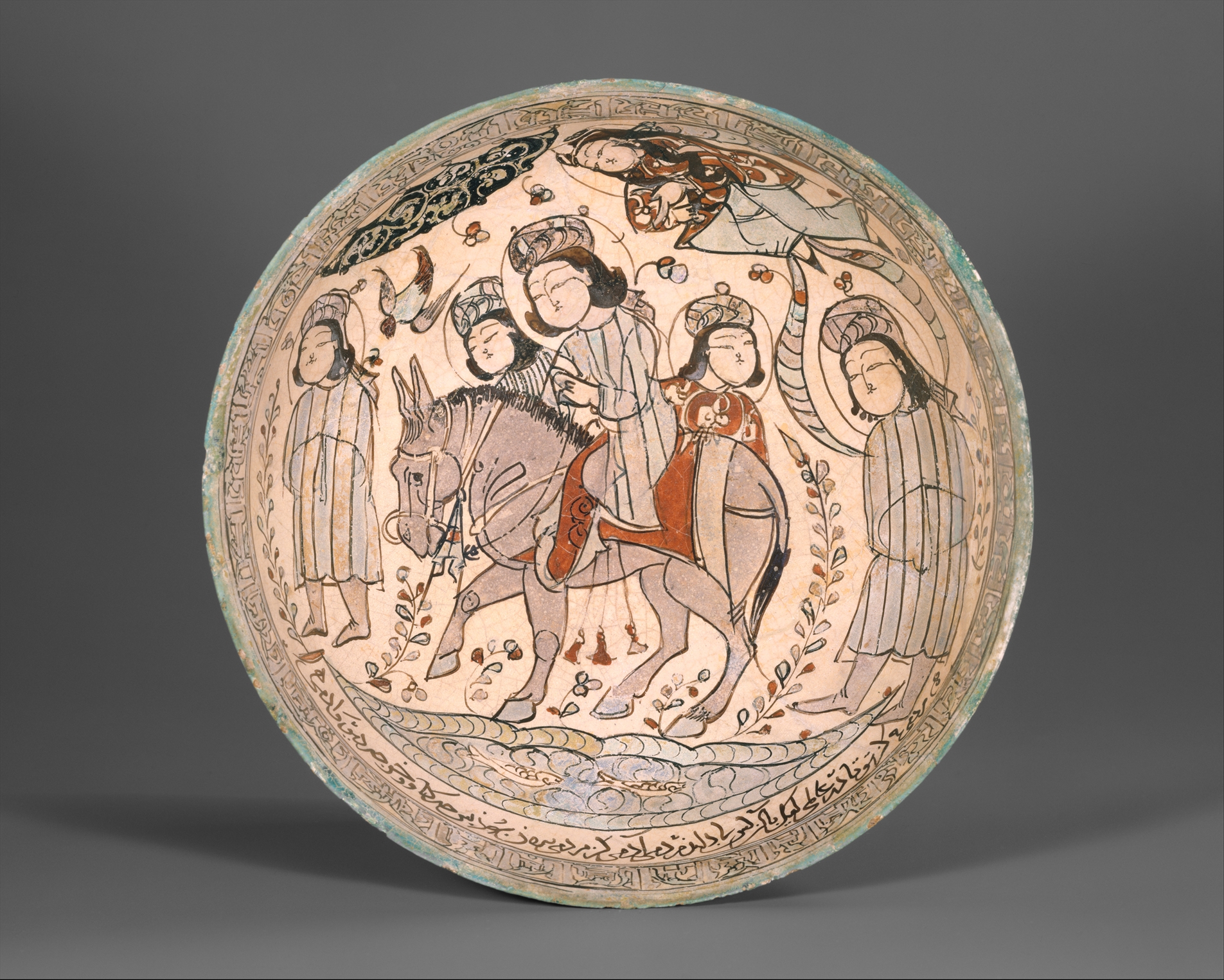
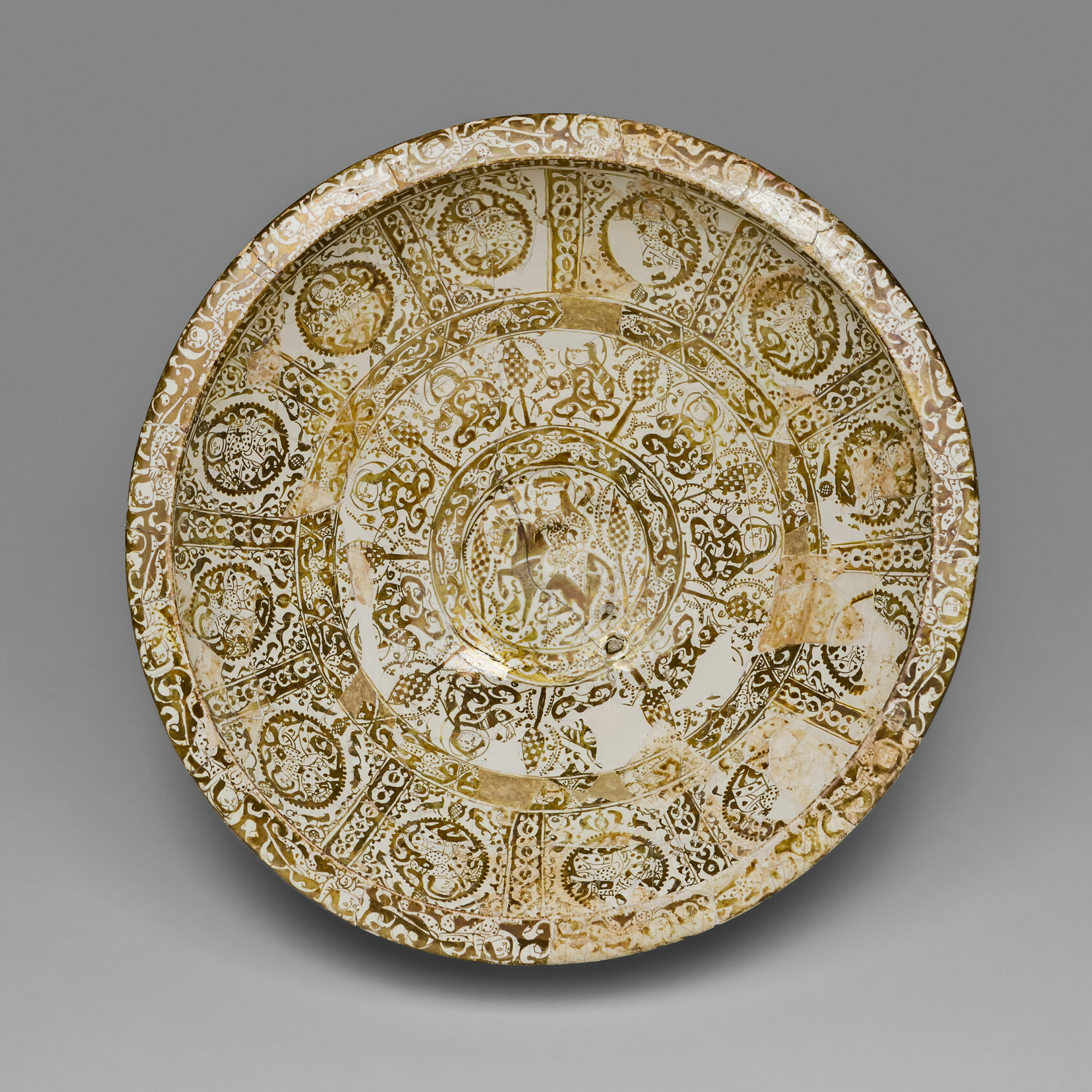
The record subject. Stonepaste, mina'i technique, 9.2 cm high, 21.6 cm diameter. Metropolitan Museum of Art, Fletcher Fund, 1964, accession 64.178.2.
| Artist | Abu Zayd al-Kashani |
|---|---|
| Date | Dated 583 AH / 1187 CE |
| Medium | Stonepaste; polychrome in-glaze and overglaze painted on an opaque monochrome glaze (mina'i) |
| Dimensions | Height 3 5/8 in. (9.2 cm); diameter of rim 8 1/2 in. (21.6 cm) |
| Where it is now | Metropolitan Museum of Art, New Yorklast confirmed |
| Inventory number | 64.178.2 |
| Attribution | AcceptedAccepted as the work of Abu Zayd al-Kashani on the strength of the bowl's dated Persian verses, which the Metropolitan Museum's own curatorial record identifies as composed by Abu Zayd himself. Full note |
| Object type | Ceramic |
| Period | Seljuk Iran, late 12th century (Kashan) |
| Cases | Has a provenance gap |
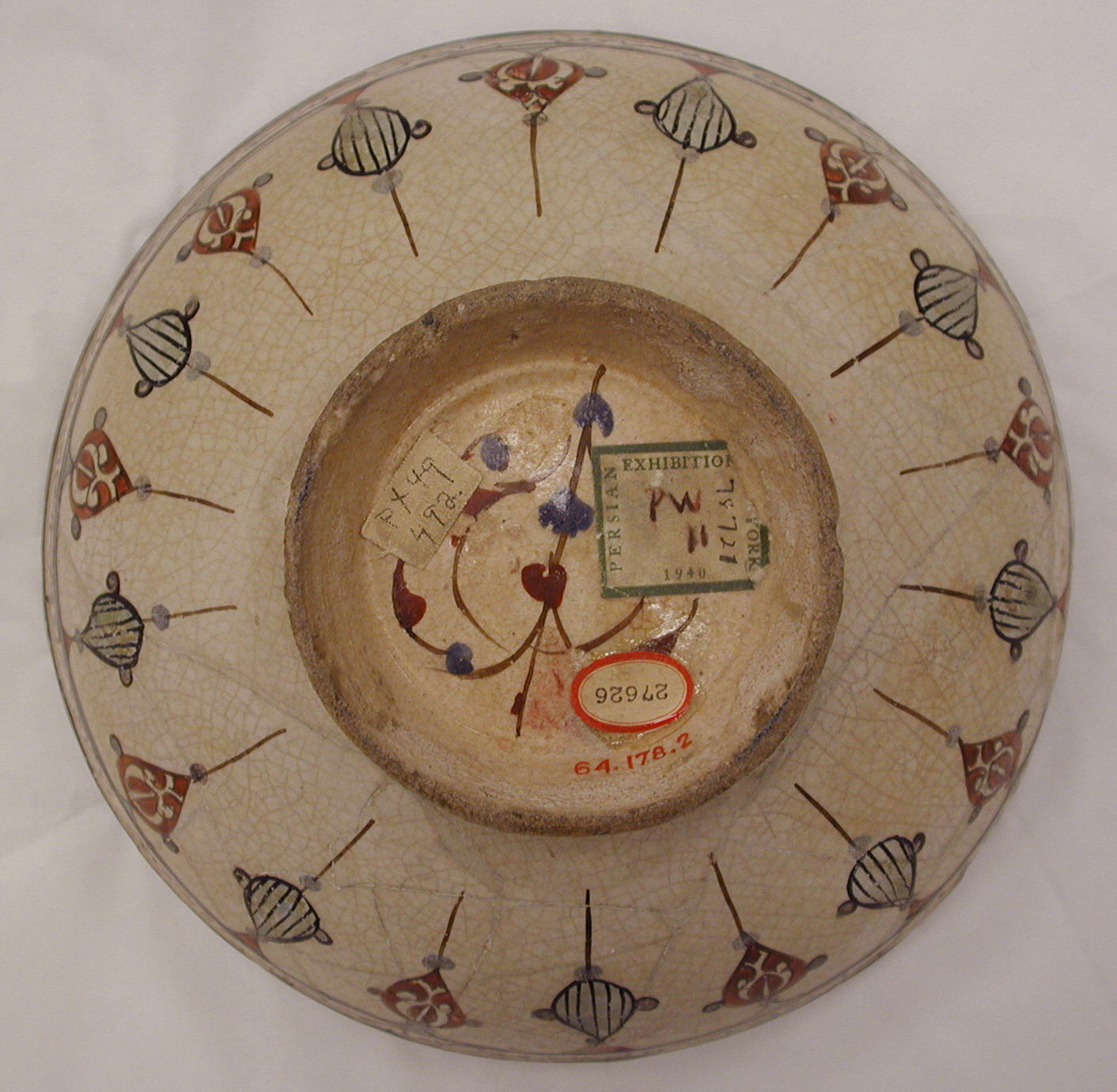
| Inscriptions | A kufic band around the rim carrying good wishes to the bowl's owner, in Arabic; beneath a fish-pond motif on the exterior, verses of Persian poetry that the Met identifies as composed by Abu Zayd himself; the date 583 AH (1187 CE). The Met's own catalogue notes that the figural scenes on the bowl do not directly illustrate the verses, though they may relate to them thematically. |
| Owners on record | 3 links2 documented, 1 unknown |
| Sources | 10 cited |
About this record Last verified · 10 sources cited · Change log
On this page 9 sections
ContentsClose
A small enamelled bowl thrown and painted in Kashan and dated, in its own inscription, to 583 AH, 1187 CE - one of the earliest pieces of mina'i ware, the most technically demanding and expensive overglaze ceramic Iran produced before the Mongol conquest, that can be tied to a named maker rather than placed by style alone. The Metropolitan Museum attributes it to Abu Zayd al-Kashani, a potter and poet whose signed and dated output, running from 1186 to 1219, is larger than that of any other identified ceramicist of the medieval Islamic world.
It was acquired in 1964 through the Fletcher Fund alongside a second bowl by the same hand, 64.178.1, dated a year earlier; between the two of them they are the earliest firmly dated works in Abu Zayd's corpus. The Met's own record is silent on where the bowl was before 1964, and that silence is left as a recorded gap rather than filled with invented ownership. What the bowl does supply, reliably, is exactly what most of the mina'i corpus lacks: a secure date and a named hand, in a field where a large proportion of surviving pieces have been shown to be faked, rebuilt from fragments, or restored past the point of easy trust.
The technique itself does not survive the century it was made in. Mina'i production in Kashan ends with the Mongol invasion of the 1220s and is never revived in its original two-firing form; what follows, in lajvardina ware, keeps the kiln process but changes the palette and drops the figural narrative this bowl still carries.
Provenance
Each link is graded. Documented: a cited source supports it. Disputed: the identification is argued but not established. Unknown: no owner for that span, and the gap is not smoothed into a narrative. The grades in the glossary.
- 583 AH / 1187 CE - 1964Unknownunknown
No owner, dealer, or intermediary is documented between the bowl's manufacture in Kashan in 1187 and its appearance in the Met's 1964 accession record. Neither the museum's public object page nor its Open Access API carries an objectHistory or provenance field for this accession.12
- 1964 - 1964Metropolitan Museum of Art, New Yorkdocumented
Acquired through the Fletcher Fund, a general purchase endowment created from the 1917 bequest of Isaac Dudley Fletcher; the credit line names the fund, not a dealer or a prior private owner. Accessioned under the same fund and year as the companion bowl, 64.178.1, though the Met's public record does not explicitly state the two were bought in a single transaction.129
- 1964 - presentMetropolitan Museum of Art, New Yorkdocumented
Held continuously in the Islamic Art department since 1964. On view at The Met Fifth Avenue, Gallery 453, as of the last verification date of this record.12
Technical evidence
| Attribution note | Accepted as the work of Abu Zayd al-Kashani on the strength of the bowl's dated Persian verses, which the Metropolitan Museum's own curatorial record identifies as composed by Abu Zayd himself. This bowl and its companion, 64.178.1 (dated 582 AH/1186 CE), are recorded by the Met as the earliest dated pieces attributed to him, within a signed corpus that runs to roughly fifteen tiles and vessels made between 1186 and 1219, more than any other identified potter of the medieval Islamic world. As with the wider mina'i corpus, the attribution rests on the object's own inscription; no independent documentary record outside the bowl itself confirms it. |
|---|---|
| Body | Stonepaste (fritware): a ceramic paste of ground quartz, glass frit and a small proportion of clay, harder and whiter than ordinary earthenware, and the standard body for Kashan's luxury overglaze wares.12 |
| Technique | Mina'i ("enamelled"), also called haft-rang ("seven colours"): an opaque monochrome glaze fixed by a first firing, then painted over in black, red, white and gilded enamel colours and fixed by a second, lower-temperature firing. Cobalt blue and turquoise could additionally be worked into the base glaze before the first firing.125 |
| Dimensions | Height 3 5/8 in. (9.2 cm); diameter of rim 8 1/2 in. (21.6 cm).12 |
| Inscribed date | 583 AH, corresponding to 1187 CE, given on the exterior.12 |
| Inscriptions | A kufic band around the rim with good wishes to the owner, in Arabic; Persian verses beneath a fish-pond motif on the exterior, recorded by the Met as composed by Abu Zayd himself.2 |
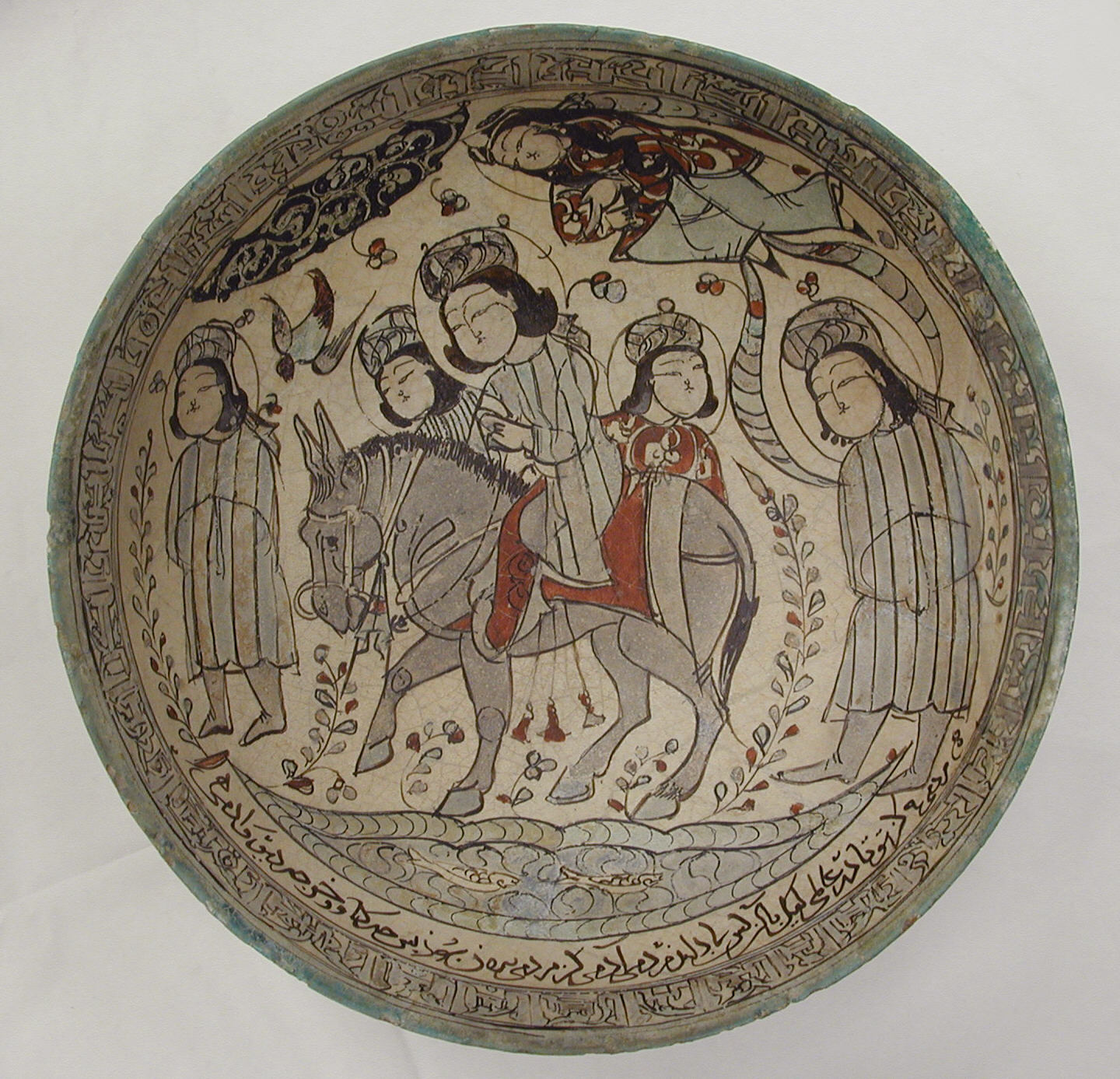
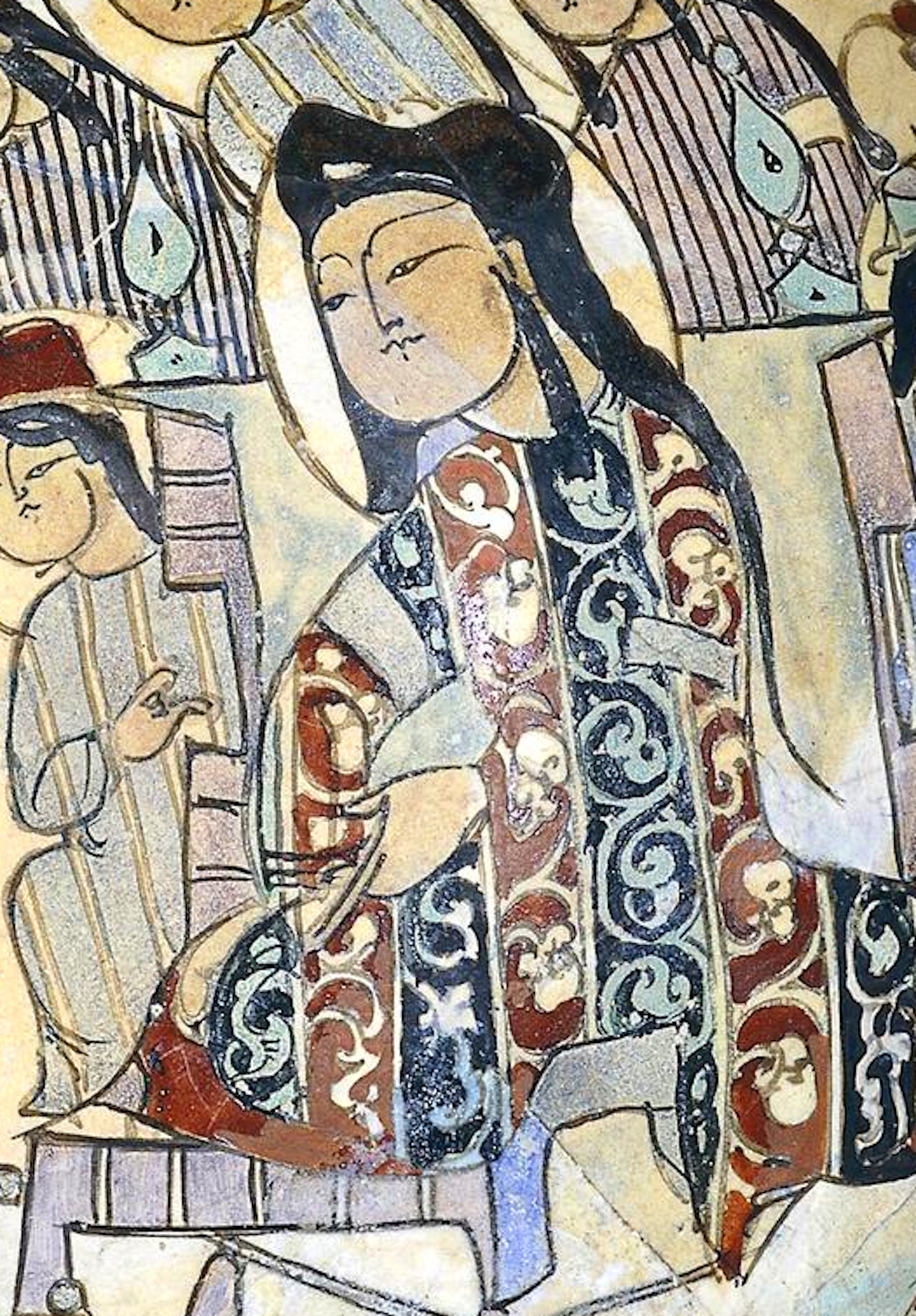
| Figural decoration | Interior scene of a mounted horseman with standing attendant figures and birds, painted in the full mina'i palette of white ground, cobalt, turquoise, black outline and gilding.12 |
| Signature basis | Attributed to Abu Zayd al-Kashani on the strength of the inscribed verses; this bowl and its companion, 64.178.1 (582 AH/1186 CE), are recorded by the Met as the earliest dated pieces attributed to him, within a signed corpus Oliver Watson places at roughly fifteen tiles and vessels dated between 1186 and 1219.24 |
| Acquisition | Credit line: Fletcher Fund, 1964 - a general Met purchase endowment from the 1917 bequest of Isaac Dudley Fletcher, not a named dealer or private donor of this object.129 |
Images
The record in full
Chapter 1What it is
A shallow stonepaste bowl, 9.2 centimetres high and 21.6 centimetres across the rim, painted in the technique known as mina'i - Persian for enamelled, and also called haft-rang, seven colours.
A shallow stonepaste bowl, 9.2 centimetres high and 21.6 centimetres across the rim, painted in the technique known as mina'i - Persian for enamelled, and also called haft-rang, seven colours. Its interior carries a mounted horseman attended by standing figures and birds, painted in an opaque white ground with cobalt blue, turquoise, black outline, red, and applied gold, the palette that made mina'i the most expensive tableware Kashan produced in the twelfth century.
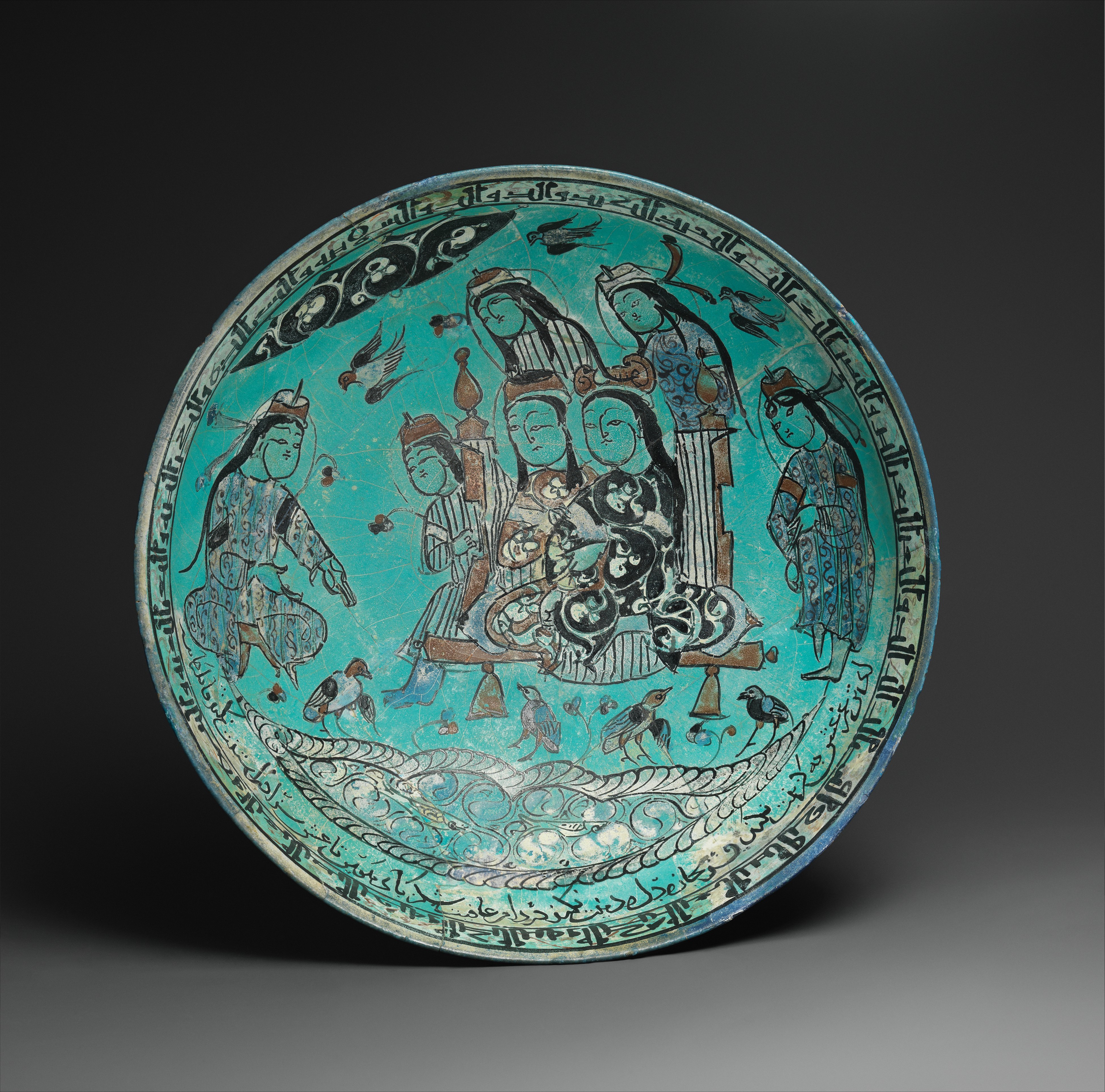
It is one half of a pair. The Metropolitan Museum acquired this bowl together with a second, 64.178.1, painted on a turquoise ground with a majlis scene beside a pond and dated a year earlier, 582 AH/1186 CE. The Met's own catalogue entry describes the two together: both inscribed in Arabic and Persian, both dated on the exterior, both carrying good wishes to their owner in a kufic band around the rim, and both carrying verses of poetry, composed by the potter himself, set beneath a small painted fish pond. The museum records them as the earliest dated pieces attributed to Abu Zayd al-Kashani.
Chapter 2How mina'i was made
Mina'i decoration is built in two firings on top of an already-finished vessel.
Mina'i decoration is built in two firings on top of an already-finished vessel. The stonepaste body - a fritware paste of ground quartz, glass frit and a small amount of clay, harder and whiter than ordinary earthenware - was thrown, glazed in an opaque white or, on the companion bowl, turquoise ground, and fired once to fix that base glaze. Cobalt blue and turquoise could be worked into the glaze at this stage; everything else came after. The painter then applied the black outlines, the reds, the whites, and any gilding over the fired glaze, in enamel pigments that would not survive the temperature of the main firing, and returned the piece to the kiln for a second, lower-temperature firing to fuse those overglaze colours in place without disturbing the glaze beneath them.
That second firing is the whole difficulty of the technique, and the whole reason it stayed a luxury good rather than a common one. A piece that had already survived one kiln firing had to survive a second, at a temperature calibrated to bond fragile enamel without cracking a glaze that was already vitrified. The failure rate, and the cost of the extra fuel, labour and material, kept mina'i restricted to wares made for people who could pay for it.
Chapter 3The potter who signed it
Almost nothing survives from twelfth and thirteenth century Iran with a maker's name attached.
Almost nothing survives from twelfth and thirteenth century Iran with a maker's name attached. Mina'i and lustre production in Kashan was a workshop industry, and workshop objects are ordinarily anonymous; a piece is dated, at best, by comparison to other pieces, not by a name on it. Abu Zayd al-Kashani is the exception. His name, or a signature scholars accept as his, appears on roughly fifteen surviving tiles and vessels made between 1186 and 1219, more than any other identified potter of the period, and he worked in both of the two most expensive overglaze techniques Kashan produced: mina'i enamel and lustre.
Oliver Watson's 1985 study of what he called documentary mina'i established that the Abu Zayd who signed enamelled bowls was the same man who signed lustreware, tying two separately studied bodies of material to one workshop figure. Watson has also observed, of the 1186 companion bowl specifically, that its quality is too accomplished for a first attempt - the implication being that Abu Zayd must have been producing enamelled ware before the earliest piece now known to survive, work that is lost or has not been identified as his.
He was also, on the evidence of his own vessels, a poet rather than only a painter of other people's verse. The Persian lines beneath the fish pond on this bowl and its companion are recorded by the Met as his own composition, not a quotation from an established poet - unusual, since most inscribed ceramic poetry of the period borrows from known verse rather than originating with the potter.
Chapter 4A family trade
Kashan's overglaze ceramics industry, across the twelfth to fourteenth centuries, is documented as having run through a small number of families rather than an open market of independent workshops.
Kashan's overglaze ceramics industry, across the twelfth to fourteenth centuries, is documented as having run through a small number of families rather than an open market of independent workshops. The best-recorded example is the Abu Tahir family of Kashan potters, whose signatures appear on tiled mihrabs and other work across four generations between 1205 and 1333. Abu Zayd's most substantial documented undertaking outside vessel painting was carried out in exactly that collaborative mode: tile revetment for the tomb chambers of two Shi'i shrines, that of Fatima al-Ma'suma at Qom and that of Imam Reza at Mashhad, worked jointly with the Kashan potter Muhammad ibn Abi Tahir.
One source consulted for this record reports that Abu Zayd himself belonged to a Hasani sayyid family in Kashan, claiming descent from the Prophet Muhammad through Ali and his son Hasan. That claim comes from a single secondary account rather than a primary document this record has examined directly, and it is flagged here for verification rather than stated as settled; it is included because, if correct, it places a working craftsman inside the same class of learned, descent-conscious families that produced the shrine inscriptions he helped execute.
Chapter 5Why a dated, signed piece matters
Most mina'i is undated. Where a piece carries no inscription giving a year, the standard practice is to place it by style against the small number of pieces that do carry dates, and those dates...
Most mina'i is undated. Where a piece carries no inscription giving a year, the standard practice is to place it by style against the small number of pieces that do carry dates, and those dates cluster in a narrow band: Watson records signed and dated examples running from the 1170s to 1219, when Kashan's overglaze industry collapses. A bowl with no inscription is usually filed simply as late twelfth or early thirteenth century, which is a wide enough window to blur real change inside it.
The problem is compounded by the state of the surviving corpus. Scholarship on mina'i in the twentieth and twenty-first centuries has had to reckon with how much of what museums hold is not, in its present form, what left the kiln. Pieces were faked outright, and far larger numbers were extensively restored, rebuilt from fragments of more than one vessel, filled with plaster, and repainted to read as complete objects, particularly as the ware became fashionable and valuable to collectors from the late nineteenth century onward. Specialists in the field have written that one must now be suspicious of any mina'i piece that appears whole and unscathed, and recent technical scholarship has turned to unrestored archaeological sherds precisely because an intact-looking bowl can no longer be trusted at face value.
Set against that background, a bowl that is both securely dated by its own inscription and traceable to a specific, named hand is not simply one more object in the corpus - it is one of the fixed points the rest of the corpus is measured against. A dated, signed, unambiguous 1187 bowl narrows the range within which an unsigned, undated comparandum can be placed, and does so independently of style, which is exactly the kind of evidence that restoration and fakery cannot manufacture after the fact.
Chapter 6Where it was made, and the limits of that certainty
Mina'i ware is conventionally attributed to Kashan as a matter of course, and this bowl is catalogued that way.
Mina'i ware is conventionally attributed to Kashan as a matter of course, and this bowl is catalogued that way. But the attribution of the wider corpus to a single city is not as settled as the convention implies. The Art Institute of Chicago catalogues a large lustre bowl bearing a date of 587 AH/1191 CE and associated with Abu Zayd, but gives its place of production as Iran generally and its geography as Rayy or Kashan, not Kashan alone - and notes that the signature on that piece is illegible, so its link to Abu Zayd rests on inscriptional and stylistic grounds weaker than the direct attribution carried by this bowl. Watson's own research has additionally identified a group of mina'i fragments made, not merely found, at Fustat in Egypt, complicating the assumption that all mina'i production was confined to Iran in the first place.
None of this displaces the Kashan attribution for this specific bowl, which rests on its own inscription rather than on the general assumption. It does mean that the broader claim - that mina'i is a Kashan technique, full stop - is more an operating convention among specialists than a documented fact for every piece that carries it.
Chapter 7The technique's disappearance
Mina'i production in Kashan ends, so far as the dated evidence shows, with the Mongol conquest of Iran in the 1220s.
Mina'i production in Kashan ends, so far as the dated evidence shows, with the Mongol conquest of Iran in the 1220s. No dated pieces are known from the years immediately following, and lustreware - made in the same city, by potters from the same milieu, using a related but distinct overglaze process - shows no dated example again until 1261, a gap of roughly four decades that marks how severe the disruption to Kashan's ceramic industry was. Mina'i itself never resumes as a technique after that break. It was not revived, and no later Iranian or wider Islamic workshop is documented reconstructing the specific two-firing enamel process Abu Zayd worked in.
What follows it in the Ilkhanid period is lajvardina ware, which shares mina'i's basic method - overglaze enamel and gilding fixed in a second, lower-temperature firing - but changes the base glaze to a deep cobalt blue ground and moves away from figural narrative scenes toward pattern. Scholars studying the two technically describe lajvardina as best understood as a continuing variant of the mina'i production process rather than an unrelated invention, which means the underlying kiln technology survived the Mongol disruption even where the specific ware, and the workshops that had made it, did not.
Chapter 8What is depicted
The interior of this bowl carries a mounted rider on horseback, flanked by attendant figures on foot and birds worked into the surrounding field, painted in the layered mina'i palette of white...
The interior of this bowl carries a mounted rider on horseback, flanked by attendant figures on foot and birds worked into the surrounding field, painted in the layered mina'i palette of white ground, cobalt, turquoise, black line-work, and gilding. Figural riding and courtly-attendance scenes of this kind are a standard subject in Seljuk-period luxury objects generally, appearing across metalwork, manuscript painting and ceramics of the same decades, and nothing in the sources consulted for this record identifies a specific narrative episode, from epic or elsewhere, that this scene is meant to illustrate.
The Met's own catalogue text makes a point of separating the figural scene from the text: the Persian verses inscribed beneath the small painted fish pond on the exterior do not illustrate the imagery on the interior, though the museum allows that the two may relate thematically. That is a curatorial judgement rather than a settled reading, and it is repeated here as exactly that - an observation that the picture and the poem were not designed as a single illustrated narrative, without a further claim about what, if anything, connects them.
Chapter 9What owning it meant
The kufic band's good wishes to the bowl's owner are the clearest surviving evidence of the object's intended function: this was made to be given to, or bought by, a specific patron, and to carry...
The kufic band's good wishes to the bowl's owner are the clearest surviving evidence of the object's intended function: this was made to be given to, or bought by, a specific patron, and to carry that patron's name into the room in which it was used. A bowl combining a rare and costly technique, a courtly hunting-and-attendance scene, and an original poem by the maker is a piece of conspicuous luxury tableware, made for display and for use at a table where its quality, and its poetry, would be recognised and read aloud - not an object made anonymously for open sale.
Nothing in the sources consulted for this record identifies who that patron was, or the specific occasion, if any, for which the bowl and its companion were commissioned. That is recorded here as an absence rather than filled with a plausible guess: the inscription tells us the object was meant for an owner worth naming, not who that owner was.
Chapter 10How the Met acquired it
The Metropolitan Museum's credit line for this bowl reads simply Fletcher Fund, 1964.
The Metropolitan Museum's credit line for this bowl reads simply Fletcher Fund, 1964. The Fletcher Fund is not a named donor of this specific object; it is a general purchase endowment created from the 1917 bequest of the New York businessman and collector Isaac Dudley Fletcher, used across departments to buy art for the museum's own collection rather than to receive a gift of an already-owned piece. Both this bowl and its companion, 64.178.1, carry the identical credit line and accession year, which is consistent with - though the Met's public record does not explicitly state - the two having been acquired together as a pair.
Beyond that, the Met's own record is thin. Neither the museum's public object page nor its Open Access API entry for this accession number carries an objectHistory or provenance field of any kind: no dealer, no prior private owner, no auction, no country of export is named. That gap is reported here honestly rather than bridged with a plausible chain, in keeping with this record's standing rule that an undocumented gap is worth more than an invented one. It is worth noting for comparison that the Met's own record for this bowl's companion is equally silent on ownership before 1964, which suggests the absence reflects what the museum holds on file rather than an omission specific to this one accession.
Chapter 11Condition, and what has not been verified
No conservation or restoration report for this specific accession number is published in the sources consulted for this record.
No conservation or restoration report for this specific accession number is published in the sources consulted for this record. That silence should not be read either way. The wider mina'i corpus is documented, by specialists working on fakes, forgeries and restoration in Islamic pottery, as containing an unusually high proportion of pieces that have been rebuilt from multiple fragments, filled, and repainted, sometimes to the point of obscuring or altering original inscriptions on other, unrelated Met-held mina'i bowls examined in that literature. Whether this particular bowl has undergone conservation treatment, and if so of what kind, is not established by any source this record was able to consult, and it is recorded in the open questions below rather than assumed in either direction.
Chapter 12Where it stands now
The bowl is on view at The Met Fifth Avenue, in Gallery 453, in the museum's Islamic Art galleries, and is published by the Met as public domain through its Open Access programme - the basis on which...
The bowl is on view at The Met Fifth Avenue, in Gallery 453, in the museum's Islamic Art galleries, and is published by the Met as public domain through its Open Access programme - the basis on which the image accompanying this record is used. It has carried its accession number without interruption since 1964, and nothing in the sources consulted indicates any change in ownership, location or legal status since that acquisition.
The artist
Abu Zayd ibn Muhammad ibn Abi Zayd al-Kashani
Almost no potter working in twelfth and thirteenth century Iran left a name behind. Kashan's overglaze ceramics industry was a workshop trade, and workshop objects are, by default, anonymous - dated and attributed by comparison, not by inscription. Abu Zayd al-Kashani is the documented exception: a working potter and, on the evidence of his own vessels, a poet, whose name or accepted signature survives on more pieces than any other identified maker of the period. That makes him one of the very few individuals in medieval Islamic ceramics who can be discussed as a person with a datable career rather than only as a style.
Related works
| Work | Relation | Where it is |
|---|---|---|
| Bowl with a Majlis Scene by a Pond Abu Zayd al-Kashani | Companion piece, acquired together and recorded by the Met as the other of the two earliest dated pieces attributed to Abu Zayd Dated 582 AH/1186 CE, one year earlier than this bowl. Painted on an opaque turquoise ground rather than white, with a majlis scene by a pond. Same credit line, Fletcher Fund, 1964, and the same absence of published pre-1964 ownership history. | Metropolitan Museum of Art, New York, accession 64.178.1 |
| Serving Bowl with Miniature Figures, Arabic Blessings, and Persian Poetry Attributed to Abu Zayd al-Kashani (signature illegible) | A later, larger lustre bowl associated with Abu Zayd, made in the related but technically distinct lustre overglaze process Dated Safar 587 AH/March 1191 CE. Catalogued by the Art Institute with a place of origin of Iran and a geography of Rayy or Kashan rather than Kashan alone, and its own signature is described as illegible - its link to Abu Zayd rests on weaker inscriptional grounds than the direct attribution this record's subject carries. | Art Institute of Chicago, accession 1927.414 |
| Plate Abu Zayd al-Kashani | A later, securely signed lustre work, marking the far end of Abu Zayd's documented dated output Dated Jumada II 607 AH/December 1210 CE. Direct fetch of the museum's own object page was blocked by the institution's bot check at research time; the accession number and date are corroborated across independent citations but are flagged here for direct verification. | National Museum of Asian Art, Smithsonian Institution, Washington DC, accession F1941.11 |
| Enamelled (mina'i) bowl with an enthroned figure Signed with a form of signature, but not with the name Abu Zayd; attribution to him is debated | A different bowl, from the same year as this record's subject, illustrating how easily two objects sharing a date and a technique can be mistaken for one another Also dated 1187 (583 AH). Its signature does not carry Abu Zayd's name, and the piece is substantially restored, so its attribution to him rests on weaker grounds than the direct textual attribution carried by this record's subject. Included here specifically as a version-safety comparandum, not as a work securely by the same hand. | British Museum, London, accession 1945,1017.261 |
| Tomb-chamber tile revetment Abu Zayd al-Kashani, with Muhammad ibn Abi Tahir | Documented monumental collaboration, outside vessel painting Cited in the scholarship on Abu Zayd as his most substantial undertaking beyond bowls and plates; this record has not independently verified the tilework in situ and relies on secondary reporting. | Shrine of Fatima al-Ma'suma, Qom, and shrine of Imam Reza, Mashhad, Iran |
Open questions
- What is this bowl's ownership history before 1964? Neither the Met's public object page nor its Open Access API record carries an objectHistory or provenance field for accession 64.178.2; the Fletcher Fund credit line names a purchase endowment, not a dealer or a prior private owner.
- What did the Met pay for it in 1964, and from whom was it bought? No acquisition price, dealer, or seller is published in the sources consulted.
- Has this specific bowl undergone restoration or conservation treatment? No conservation report for accession 64.178.2 is published in the sources consulted. The wider mina'i corpus is documented to include extensive undisclosed restoration on other, unrelated pieces, so this cannot be assumed in either direction without direct technical examination.
- Were this bowl and its companion, 64.178.1, acquired together as a single transaction? The identical credit line and accession year are consistent with a joint acquisition, but the Met's public record does not state this explicitly.
- Who was the original patron named in the kufic band's good wishes? The inscription indicates the bowl was made for a specific owner; that owner's identity is not given in the sources consulted.
- Does this bowl relate, stylistically or through workshop practice, to the British Museum's differently-attributed 1187 bowl (accession 1945,1017.261)? Both carry the same year; whether they share a common origin beyond coincidence of date is not established here.
- Was Abu Zayd solely responsible for painting this bowl, or did a workshop divide the throwing, glazing, and painting between different hands under his name? Not addressed in the sources consulted for this record.
Questions about this object
What is Bowl?
Bowl is a ceramic, dated dated 583 AH / 1187 CE. Medium: Stonepaste; polychrome in-glaze and overglaze painted on an opaque monochrome glaze (mina'i).
Who made Bowl, and is the attribution settled?
The attribution to Abu Zayd al-Kashani is recorded here as accepted. Accepted as the work of Abu Zayd al-Kashani on the strength of the bowl's dated Persian verses, which the Metropolitan Museum's own curatorial record identifies as composed by Abu Zayd himself. This bowl and its companion, 64.178.1 (dated 582 AH/1186 CE), are recorded by the Met as the earliest dated pieces attributed to him, within a signed corpus that runs to roughly fifteen tiles and vessels made between 1186 and 1219, more than any other identified potter of the medieval Islamic world. As with the wider mina'i corpus, the attribution rests on the object's own inscription; no independent documentary record outside the bowl itself confirms it.
Where is Bowl now?
Metropolitan Museum of Art, New York. Inventory number 64.178.2. Last confirmed 4 September 2026. Credit line: Fletcher Fund, 1964. On view at The Met Fifth Avenue, Gallery 453, Islamic Art department. No dealer, prior owner, or acquisition price is published by the Met for this object.
What is still unknown about Bowl?
What is this bowl's ownership history before 1964? Neither the Met's public object page nor its Open Access API record carries an objectHistory or provenance field for accession 64.178.2; the Fletcher Fund credit line names a purchase endowment, not a dealer or a prior private owner.
Sources
- 1The Metropolitan Museum of Art, Open Access Collection API, object 451753 (accession 64.178.2). Fetched directly from collectionapi.metmuseum.org. collectionapi.metmuseum.org/public/...
- 2The Metropolitan Museum of Art, curatorial object page, "Bowl," Abu Zayd al-Kashani, accession 64.178.2. metmuseum.org/art/...
- 3The Metropolitan Museum of Art, Open Access Collection API, object 451752 (accession 64.178.1, the companion bowl). Fetched directly from collectionapi.metmuseum.org. collectionapi.metmuseum.org/public/...
- 4Wikipedia, "Abu Zayd ibn Muhammad ibn Abi Zayd," for his signed corpus, dates of activity, Oliver Watson's 1985 study of documentary mina'i, the Qom and Mashhad shrine tilework, and Watson's observation on the 1186 bowl. en.wikipedia.org/wiki/...
- 5Wikipedia, "Mina'i ware," for the double-firing process, haft-rang terminology, the production gap after the Mongol invasion, and lajvardina as a related successor technique. en.wikipedia.org/wiki/...
- 6The Art Institute of Chicago, Collection API and object page, "Serving Bowl with Miniature Figures, Arabic Blessings, and Persian Poetry," accession 1927.414. Fetched directly from api.artic.edu. artic.edu/artworks/...
- 7National Museum of Asian Art, Smithsonian Institution, object record for Plate, accession F1941.11. Direct fetch of asia.si.edu was blocked by the institution's bot-verification system at research time; the accession number, date and attribution are corroborated across independent citations of the museum's own record but are flagged for direct verification. asia.si.edu/object/...
- 8Mina'i bowl, dated 1187, by Abu Zayd Kashani, Kashan, Seljuk Empire (British Museum, 1945,1017.261).jpg," sourcing the British Museum's own object record for accession 1945,1017.261. commons.wikimedia.org/wiki/...
- 9Wikipedia, "Isaac Dudley Fletcher," for the 1917 bequest that established the Fletcher Fund used to acquire this bowl. en.wikipedia.org/wiki/...
- 10Farida Ali, "Abu Zayd, Master Potter and Poet of Kashan." Independent secondary source, not an academic publication; used here only for the reported Hasani sayyid family background and the family-workshop framing of Kashan's ceramics industry, both flagged for direct verification against a primary or academic source (for example, Encyclopaedia Iranica's entries on Abu Zayd and on the Abu Tahir family of potters, which could not be directly fetched at research time owing to the site returning 403 errors to automated requests). artfarida.co.uk/abu-zayd-master-potter-and-poet-of-kashan
.jpg)
Last verified · Published
Change log
4 September 2026 - Record created at the house standard: researched narrative, technical evidence, maker dossier, graded provenance chain, prices with hammer and premium separated, related works, open questions and sources.