The Art of Painting
Johannes Vermeer · c. 1666-68
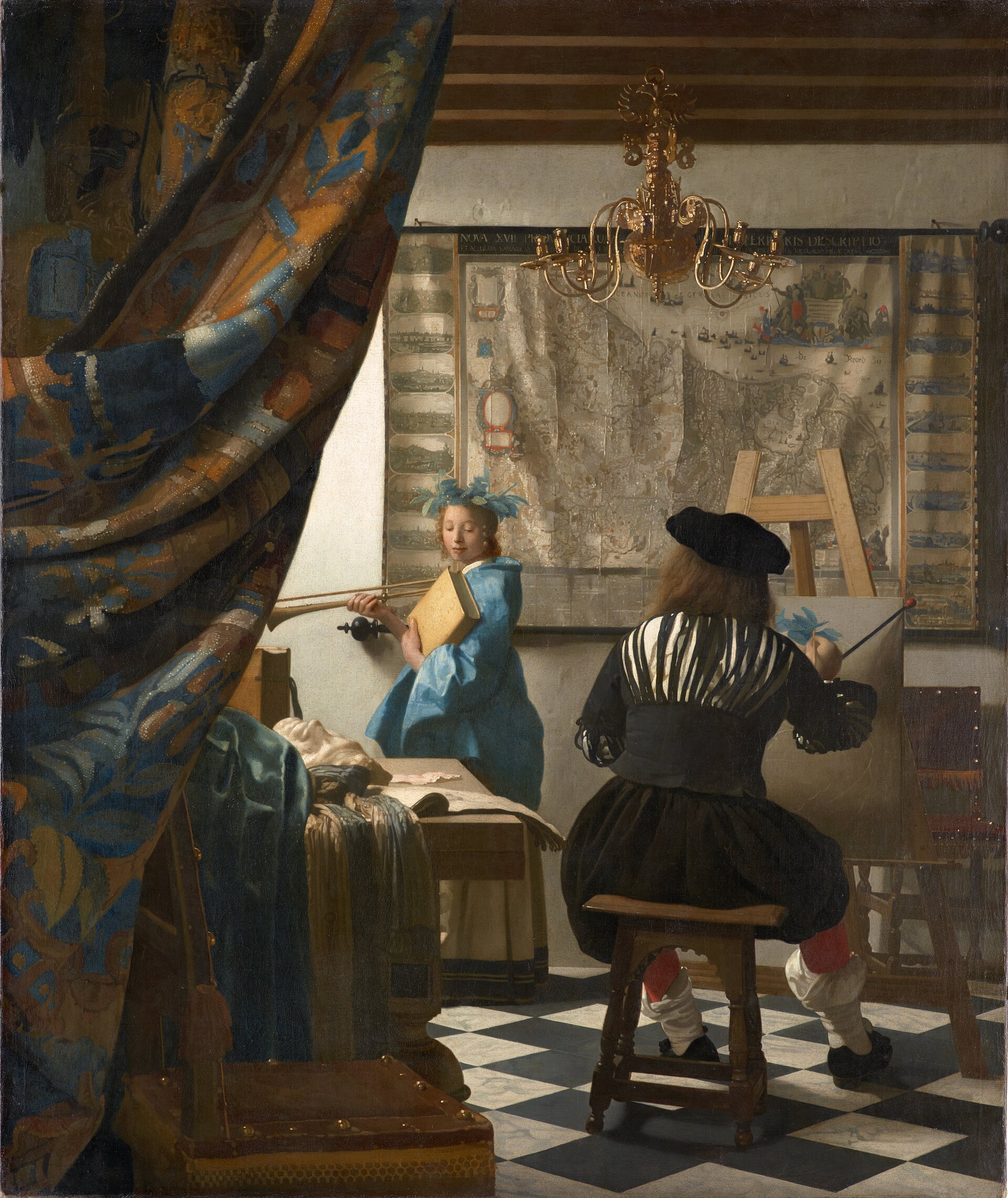
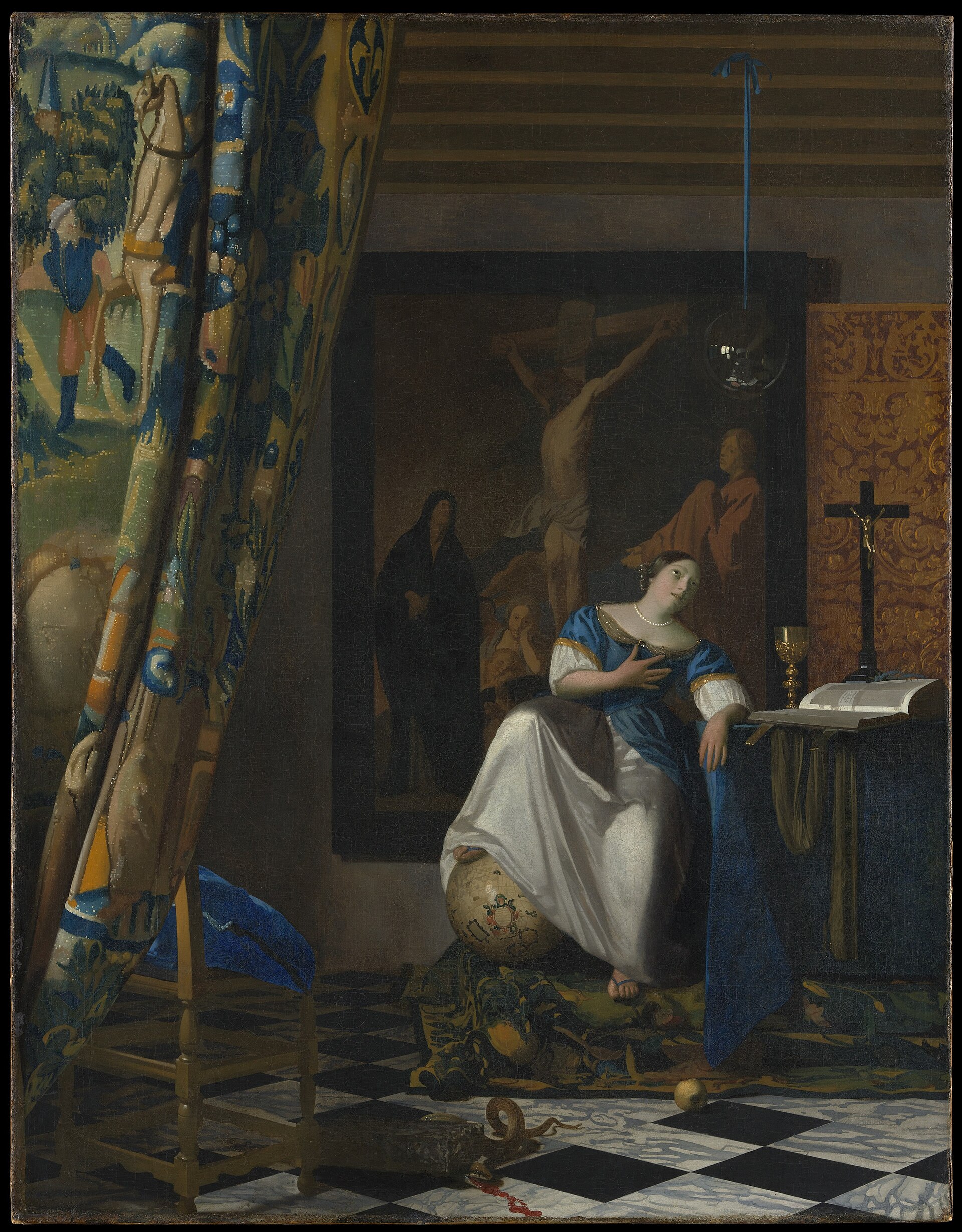
The whole picture: oil on canvas, 120 x 100 cm, Kunsthistorisches Museum Vienna, inv. GG 9128. High-resolution photograph made for the Google Art Project; public domain.
| Artist | Johannes Vermeer |
|---|---|
| Date | c. 1666-68 |
| Medium | Oil on canvas |
| Dimensions | 120 x 100 cm (frame 152.5 x 133.5 x 10.5 cm) |
| Where it is now | Kunsthistorisches Museum Wien, Gemaeldegalerie, Room XII. Property of the Republic of Austria.last confirmed |
| Inventory number | GG 9128 (also Linz no. 1096a; Munich Central Collecting Point no. 1284) |
| Attribution | AcceptedSigned on the wall map, 'I Ver-Meer', and accepted as autograph by every source consulted for this record. Full note |
| Object type | Painting |
| Period | Dutch, seventeenth century |
| Cases | Has a provenance gap |
| Inscriptions | Signed 'I Ver-Meer' on the lower border strip of the wall map. Latin title band along the top of the map naming Nicolaum Piscatorem (Visscher). A date applied by the artist after the signature, read from infrared examination as MDCLXVI(I I?), is reported but not independently published. A false signature of Pieter de Hooch on the lower cross support of the stool is visible in infrared. |
| Owners on record | 17 links12 documented, 4 disputed, 1 unknown |
| Sources | 33 cited |
About this record Last verified · 33 sources cited · Change log
On this page 10 sections
ContentsClose
A 120 by 100 centimetre canvas of about 1666-68 in which Vermeer shows a painter at his easel, a model dressed as Clio, a wall map of the Seventeen Provinces and a brass chandelier crowned with the Habsburg eagle. It is the one picture Vermeer kept: within weeks of his death in 1675 his widow assigned it to her mother before a notary to keep it from his creditors, and the document calls it by the name it still has, The Art of Painting. Its trail after the Delft sale announced for 15 March 1677 is lost for about 126 years, until it appears in 1803 in the Vienna estate of Gottfried van Swieten as a work by Pieter de Hooch with a false signature, and then runs through the Czernin collection, where Waagen and Thore-Burger recognised it as a Vermeer about 1860.
It was a famous picture that could not leave Austria. Between 1923 and 1938 dealers and museums were reported to have offered sums up to about USD 1.3 million; Andrew Mellon was the intended buyer of a USD 1 million option in 1936; and the Austrian monuments authorities never granted an export licence. On 4 October 1940 Count Jaromir Czernin sold it to Adolf Hitler for RM 1.65 million for the Linz museum. Recovered from the Altaussee salt mine in 1945, it was handed to the Republic of Austria and has been in the Kunsthistorisches Museum since.
The sale is still disputed. Czernin claimed from 1945 that he had been pressured and was refused by the restitution commissions in 1949 and the Administrative Court in 1960. On 18 March 2011 the Art Restitution Advisory Board unanimously recommended against returning it to his heirs, finding no coercion and no persecution of the seller; the heirs' lawyer, Randol Schoenberg, rejected the finding and argued that the Board ignored his evidence. This record sets out the Board's published findings, the heirs' position and the points on which the sources disagree, from the 1677 sale date to the day Austria took the picture over in November 1945.
Provenance
Each link is graded. Documented: a cited source supports it. Disputed: the identification is argued but not established. Unknown: no owner for that span, and the gap is not smoothed into a narrative. The grades in the glossary.
- c. 1666-68 - 1675Johannes Vermeer, Delftdocumented
Painted in the later 1660s (dates proposed run from 1662-65 to c. 1666-69; the Vienna museum says about 1666/68). That it stayed with Vermeer until his death in mid-December 1675 is inferred from the 1676 act that treats it as his widow's to assign, and the National Gallery says it apparently stayed in his possession. No document shows it was ever sold in his lifetime.311136
- 1675 - 22 or 24 February 1676Catharina Bolnes (1631-1687), Vermeer's widowdocumented
Left a widow with heavy debts. On 10 February 1676 twenty-six other paintings, probably Vermeer's dealer's stock, had been transferred to the dealer Jan Coelenbier for 500 guilders in the name of a creditor, Jannetje Stevens. The Art of Painting was not among them according to de Visser. She was declared bankrupt on 24 April 1676.312
- 22 or 24 February 1676 - 1677Maria Thins (c. 1593-1680), Vermeer's mother-in-law, by notarial transfer in The Haguedocumented
The act, before the notary Johan Vos, calls it a piece of painting by her late husband 'in which was depicted The Art of Painting [De Schilderkunst]'. The estate inventory of 29 February 1676 did not list it. The curator of the estate, Anthonie van Leeuwenhoek (appointed 30 September 1676), judged the transfer illegal; Montias thought it at least curious.312126
- 1676 - 1677Estate of Johannes Vermeer under its curator Anthonie van Leeuwenhoek; Delft auction announced for 15 March 1677disputed
De Visser, following Montias, says Leeuwenhoek impounded the picture and posters announced a sale at the Guild of Saint Luke on 15 March 1677; Maria Thins protested by notarial letter on 12 March. The Vienna museum, de Visser and Essential Vermeer give 15 March; the National Gallery gives 15 May. No record of the sale exists, and neither its contents nor the outcome of the dispute is known. De Visser argues Thins may have stalled the sale by claiming as a preferred creditor, a status granted on 3 July 1679.112910
- 1677 - 1803Unknownunknown
Nothing documents the picture for about 126 years, until the van Swieten estate of 1803. Lot 3 of the Dissius sale (Amsterdam, 16 May 1696), 'the portrait of Vermeer in a room with various accessories', sold for 45 guilders, may or may not be this picture. De Visser's suggestion that it passed through the notary Hendrick Terbeeck van Coesfelt, whose granddaughter married Gerard van Swieten in 1729, is explicitly a conjecture, and the route to Vienna in 1745 is set out in the next row.11213223233
- c. 1745 - 1803The van Swieten family, Vienna: Gerard van Swieten (1700-1772), physician to Maria Theresa, and his son Gottfried van Swieten (1733-1803)disputed
The National Gallery thinks a strong possibility that it reached Vienna early and was in Gerard's collection, and de Visser argues it arrived on 7 June 1745. The one firm point is that in 1803 it was in Gottfried van Swieten's estate, attributed to Pieter de Hooch and carrying a false De Hooch signature.1127
- 1804 or 1813 - 1804 or 1813Johann Rudolf Count Czernin von und zu Chudenitz (1757-1845), Viennadisputed
The Board gives 1804, from the van Swieten estate; the Vienna museum and the National Gallery give 1813. A diary note of his son Eugen Karl says he paid 50 florins in bad bank-billets; Swillens gave 30 florins; the German Kunst und Politik page says the seller was a Viennese saddler. The picture was thought to be by Pieter de Hooch.7101122230
- 1804 or 1813 - 1845Johann Rudolf Count Czernindocumented
Hung in his Vienna palace gallery under De Hooch's name ('Peter van Hooghe' on its frame label and in the gallery guide). The gallery was open to visitors by 1845 on one account and since about 1800 on another. Johann Rudolf died in 1845.12271
- 1845 - 1925The Czernin family, by descent within the Czernin entail (Fideikommiss)documented
The sources name Eugen Karl Czernin (1796-1868) as the Count's son and say the Vermeer was incorporated with the gallery into the entail in 1862. Recognised as a Vermeer by Thore-Burger and Waagen about 1859-60. The intermediate holders are not named in the sources consulted. The entail holder Eugen Jaromir Czernin (1851-1925) died on 5 November 1925.712128
- 1925 - 1932Franz Jaromir Czernin (1857-1932), heir; estate litigated in Prague and Viennadocumented
Prague and Vienna courts both claimed the estate and the question whether the entail survived in Austria was litigated until 1932. Franz Jaromir died childless on 9 April 1932 and left his allodial estate to his nephew and adoptive son Eugen Czernin.7
- 1932 or 1933 - 4 October 1940Jaromir Czernin-Morzin (1908-1966); a one-fifth interest or share of proceeds held by Eugen Czernin (1892-1955)documented
By the agreement of 23 February 1933, the Vermeer was to go to Jaromir Czernin with 20 per cent of the sale proceeds to Eugen, according to the Board; the National Gallery describes Eugen as holding one-fifth of the picture and Jaromir four-fifths, with a 1933 appraisal of nearly one million schilling. No export licence was ever applied for or granted. Offers from Duveen Brothers for Andrew Mellon, among others, are in the Board's findings; none produced a sale.71
- 4 October 1940 - 1945Adolf Hitler, for the planned Fuehrermuseum, Linz (Sonderauftrag Linz); agent Hans Possedisputed
The transaction is documented in detail: purchase offer of 4 October 1940 accepted, entail court approval 25 October, payment confirmed 13 November, letter of thanks 20 November, inheritance duty RM 380,000. The Board (18 March 2011) found no coercion and no persecution of the seller; the heirs' lawyers argue the contrary. See the narrative for who holds which position. Linz number 1096a.711817231619202129
- 1940 - 1945Hitler's Linz collection, held in Munich; moved to the salt mine at Altausseedocumented
The Vienna museum and the National Gallery say moved to Altaussee in the winter of 1943-44; the Board says October 1944. Recovered there by US Army units in spring 1945.19713
- 27 June 1945 - late November 1945Allied (US) authorities, Central Collecting Point Munichdocumented
Received at the Collecting Point on 27 June 1945 (card 1284); listed as Austrian property with the Czernin family as presumed owner and the 1940 price noted. Escorted to Vienna by Andrew Ritchie in a private railway car.72324
- late November 1945 - 1952Republic of Austria, deposited at the Kunsthistorisches Museumdocumented
Handed to the Austrian federal government on 28 November 1945 (Board); the National Gallery and Essential Vermeer say 17 November 1945; the card says issued 27 November 1945; the museum's database says handed to the museum on 7 November 1946. Jaromir Czernin's claims were rejected in 1945-46 and by the restitution commissions in 1949.72311310
- 31 March 1952 - presentRepublic of Austria (the Federation), by forfeiture of Hitler's propertydocumented
The People's Court declared the painting, as Hitler's property, forfeited to the Federation under the 1947 Property Forfeiture Act. Czernin's later applications were refused, the last by the Administrative Court on 30 June 1960.7
- 1958 - presentKunsthistorisches Museum Vienna, Gemaeldegalerie, inv. 9128documented
Inventoried in late 1958 or early 1959. On 18 March 2011 the Art Restitution Advisory Board unanimously recommended against transferring it to the heirs of Jaromir Czernin. On view in Room XII.978101831
Prices realised
| Date | Sale | Estimate | Result | Note |
|---|---|---|---|---|
| 16 May 1696 | Amsterdam, sale of the collection of Jacob Abrahamsz. Dissius (the Kunst und Politik page names Coelenbier; not confirmed elsewhere) | Not recorded | Hammer 45 guilders, if lot 3 is this picture With premium No buyer's premium is recorded in the sources guilders | Lot 3 was described as 'the portrait of Vermeer in a room with various accessories, uncommonly beautifully painted by him'. Whether it is The Art of Painting is disputed: the German Kunst und Politik page supposes it is, Essential Vermeer notes that the price was scarcely twice that of the tiny Lacemaker in the same sale and that few experts think it corresponds to so large a canvas. The same sale offered twenty-one Vermeers. No sale of this picture at public auction is documented; the museum's provenance line records a Delft auction of 15 March 1677 but no record of that sale survives. |
Hammer is the price at which the bidding stopped; with premium adds the fee the house charges the buyer on top. Hammer price and buyer's premium in the glossary.
Technical evidence
| Attribution note | Signed on the wall map, 'I Ver-Meer', and accepted as autograph by every source consulted for this record. For roughly the first sixty years of the nineteenth century the picture was catalogued in the Czernin gallery as by Pieter de Hooch and carried a false De Hooch signature, which infrared reflectography has since shown on the stool; Thore-Burger and Gustav Waagen recognised it as Vermeer's about 1859-60. The date is argued: the Vienna museum says about 1666/68, scholars cited by Essential Vermeer give 1662-65 to c. 1666-69. |
|---|---|
| Support | Plain-weave linen, thread count 11.1 x 16.5 per square centimetre. Cusping shows the canvas was fixed to its strainer with 11 nails along the sides and 9 along top and bottom. Relined with a glue lining and stretcher construction probably of the nineteenth century; the older stretcher mentioned by the National Gallery had warped slightly and was adapted during treatment.135 |
| Dimensions | Picture 120 x 100 cm. Frame 152.5 x 133.5 x 10.5 cm.11 |
| Ground | A single layer of coarsely ground lead white with chalk, ochre, umber and charcoal black, a mid-tone grey-brown. Earlier analysis suggested protein and drying oil; recent analysis found linseed oil dominant.135 |
| Medium and condition of the paint | A 1994-95 study found an oil-rich tempera mixture with small additions of protein used for the lighter passages, with resins, gums and proteins in the overlying coatings; the National Gallery describes an oil and protein binder in different concentrations. Fine cracks in the upper layers, especially the whites, were worsened by humidity and temperature change, harsh alkaline solvents in earlier restorations and old oil varnish seeping into the cracks.135 |
| Signature | "I Ver-Meer" on the lower border strip of the wall map, behind Clio's collar.1113 |
| Inscription on the map | Latin title band along the top edge, partly hidden by the chandelier, naming the mapmaker as Nicolaum Piscatorem: NOVA XVII PROV[IN]CIARUM [GERMANIAE INF]ERI[O]RIS DESCRIPTIO / ET ACCURATA EARUNDEM ... DE NO[VO] EM[EN]D[ATA] ... REC[TISS]IME EDIT[A P]ER NICOLAUM PISCATOREM, as transcribed by the museum. The National Gallery attributes the map to Claes Jansz. Visscher; Essential Vermeer reads the name as Nicolaus Visscher.11213 |
| Date inscription | A date applied by the artist immediately after the signature has been reported from infrared examination, read as MDCLXVI(I I?) and consistent in lettering with The Astronomer (1668) and The Geographer (1669). De Visser reads 1666, 1667 or 1668, most likely 1668. Not independently published in the sources consulted. The Vienna museum dates the picture about 1666/68.131211 |
| Underdrawing | Infrared reflectography shows fine black underdrawing lines at the arms of the chandelier, the frames of the single city views on the map and the easel, and shows that the first modelling begins with the shadowed areas.13 |
| Perspective construction | The vanishing point, just below the black finial of the pole weighting the map, is marked with a pinhole still visible. A second deformation at the right side of the map is reported as the vanishing point for the stool. Strings from the pin would have set out the orthogonals of tiles and table. The National Gallery also discusses the camera obscura as a possible aid to conceiving, not painting, the composition.5134 |
| Compositional changes | The National Gallery states that microscopy, infrared photography and X-radiography found no compositional change in this large scene. The Vienna report summarised by Essential Vermeer agrees about the X-ray but records a pentimento in the painter's right shoe, where bone black is used.513 |
| Pigments identified | Lead-tin yellow in the chandelier highlights and chair tacks; yellow earth, umber or ochre in the tapestry leaves with ultramarine in shadows; ochre in Clio's book; verdigris underpainting under a semi-transparent ultramarine layer in the teal cloth on the table; ultramarine in the ships on the map and the veining of the floor; vermilion in the painter's leggings; vine black, with bone black in the right shoe.135 |
| False signature | A signature of Pieter de Hooch is still present on the lower cross support of the painter's stool and is visible in infrared reflectography. Essential Vermeer says it was applied in the eighteenth century; de Visser says it is not known when or by whom.1312 |
| Condition and treatment history | Flaking was noticed in the early 1950s after a travelling exhibition. A first in-depth study was made in 1994-95. Hubert Dietrich's treatment, over a number of years, consolidated the paint under a pliable membrane devised by Werner Juette, adapted the warped stretcher, reduced yellowed varnish and removed discoloured retouching.135 |
| Numbers carried | Kunsthistorisches Museum Gemaeldegalerie 9128 (given late 1958 or early 1959); Linz number 1096a; Munich Central Collecting Point number 1284.91023 |
| Published imaging | A high-resolution image (6209 x 7377 px) from the Google Art Project is on Wikimedia Commons as public domain. The museum's database offers a download for private use. No IIIF manifest was checked for this record.1125 |
Images
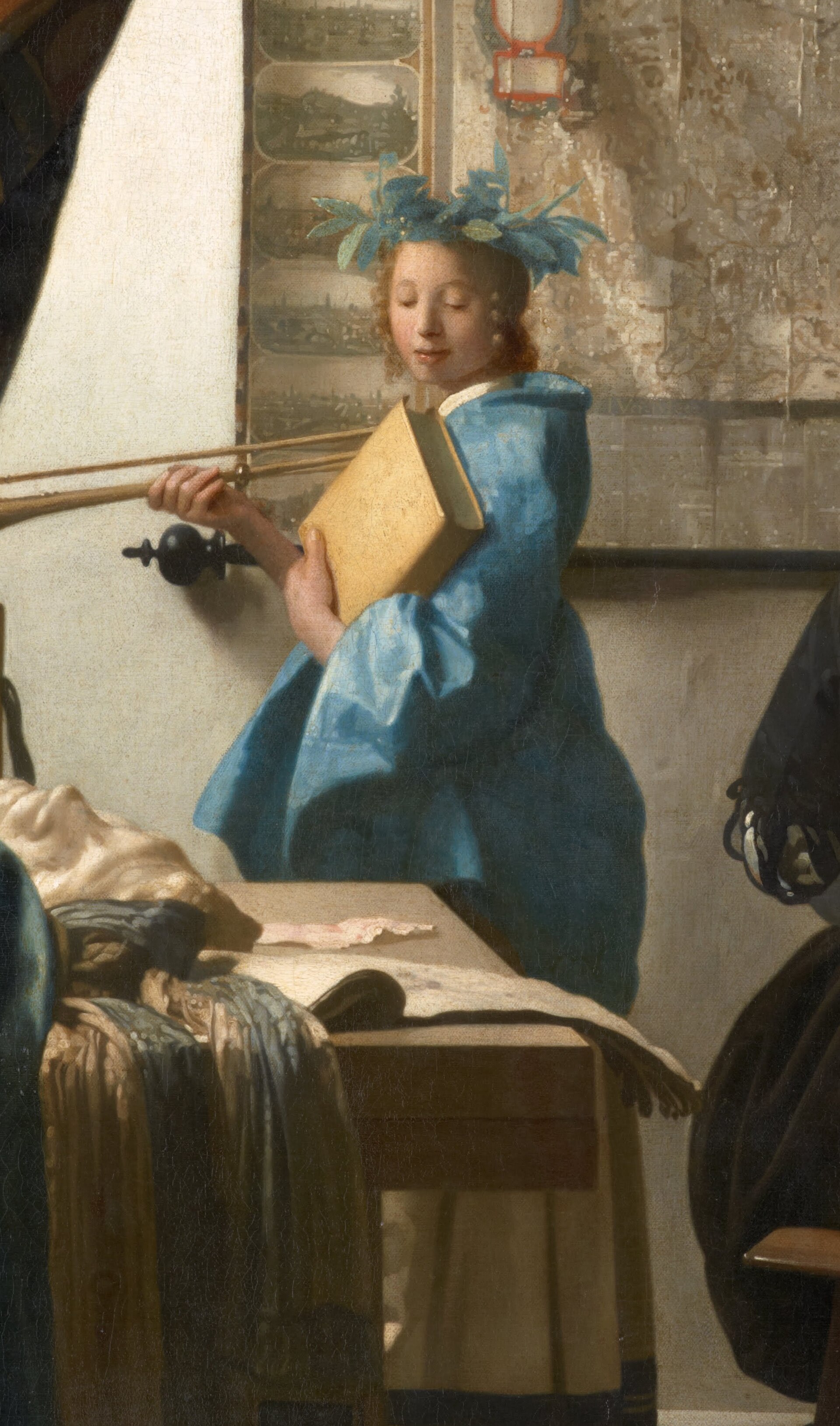
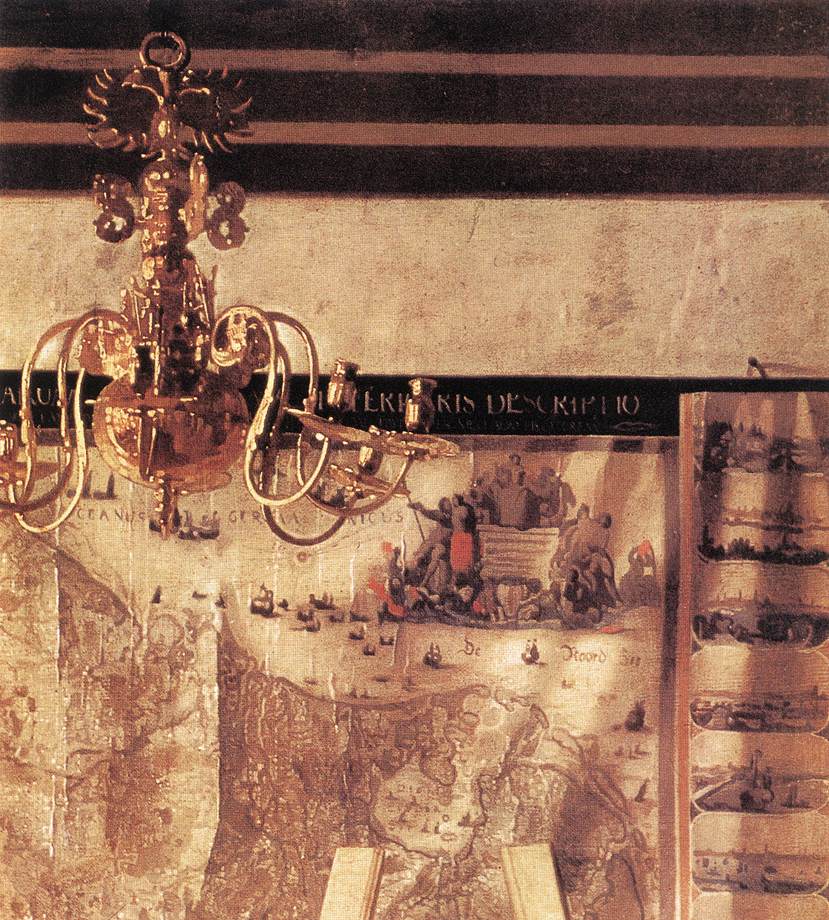
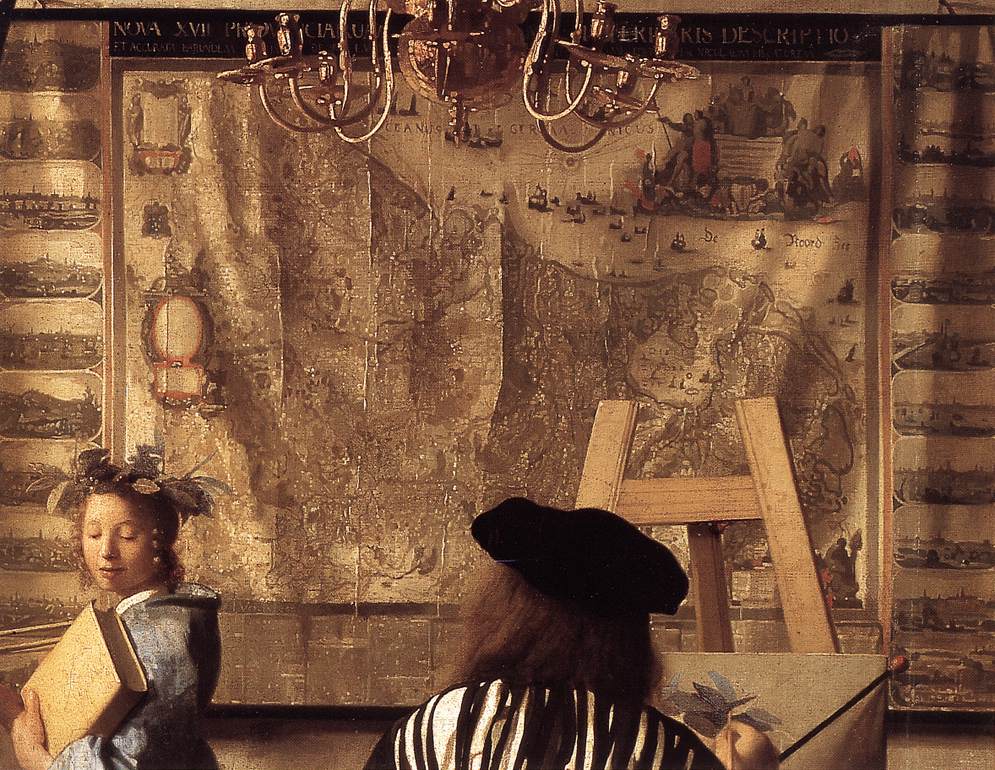
The record in full
Chapter 1A 120 by 100 centimetre canvas, signed on the map, known by a dozen names
The Kunsthistorisches Museum in Vienna records the picture as oil on canvas, 120 by 100 centimetres, in a frame measuring 152.5 by 133.5 by 10.5 centimetres, dated "about 1666/68" and carrying the...
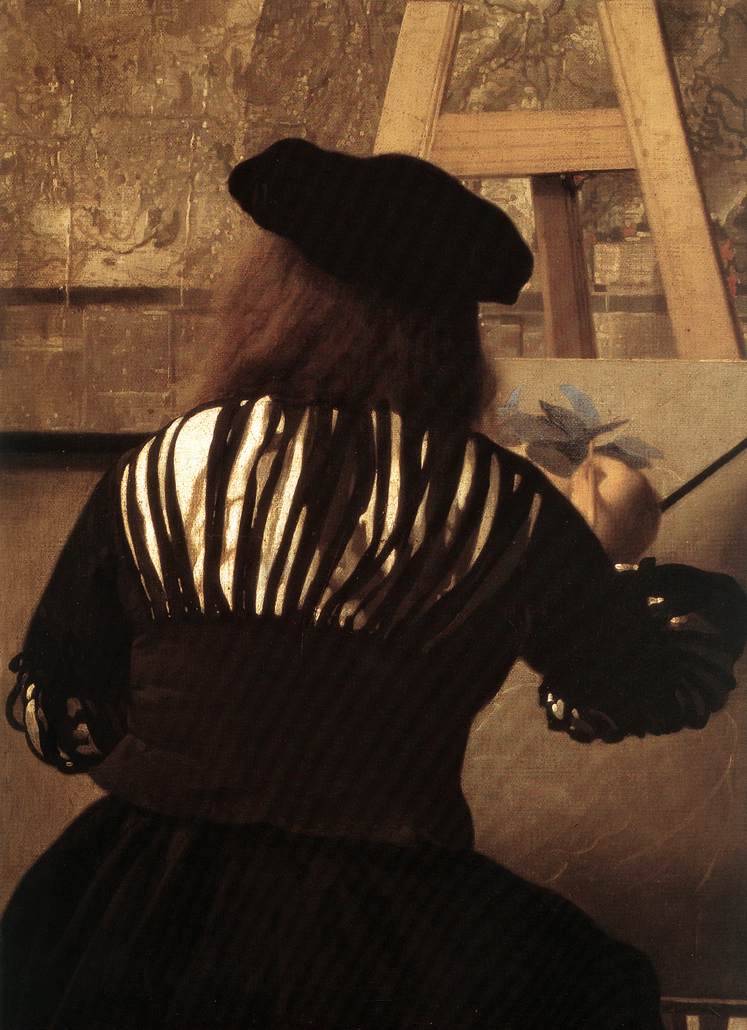
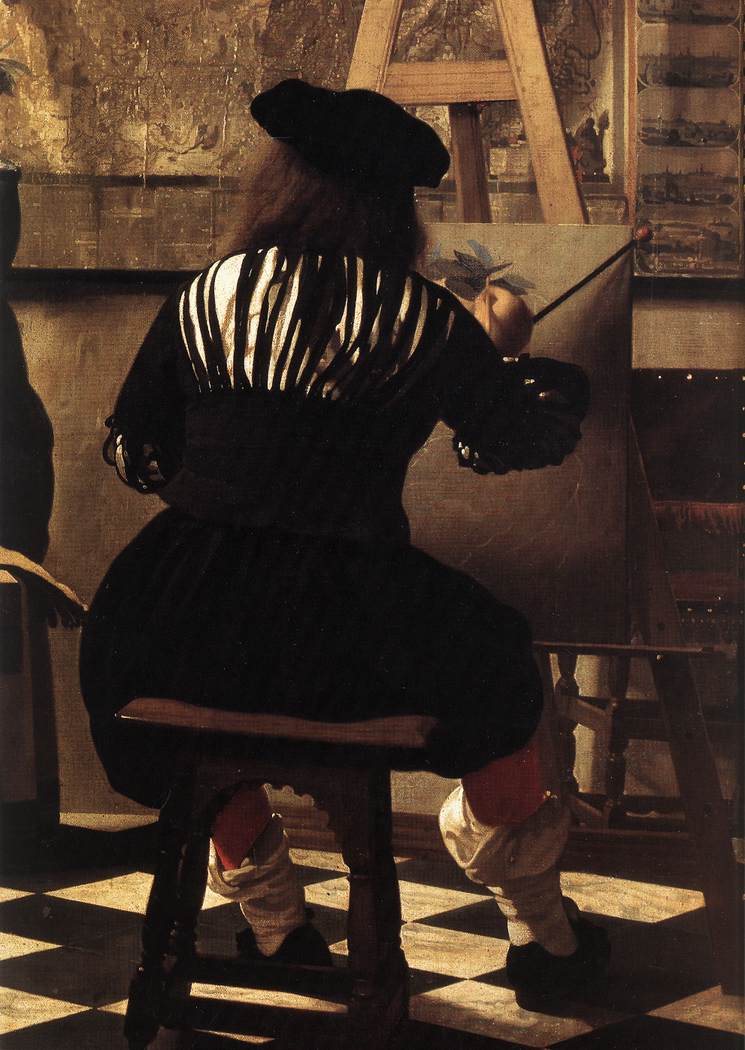
The Kunsthistorisches Museum in Vienna records the picture as oil on canvas, 120 by 100 centimetres, in a frame measuring 152.5 by 133.5 by 10.5 centimetres, dated "about 1666/68" and carrying the inventory number Gemaeldegalerie 9128. It shows a painter seen from behind, seated on a stool before an easel in a room with a black and white marble floor, laying the first leaves of a laurel wreath onto a grey canvas. His model stands against a large wall map of the Netherlands, wearing the laurel and holding a trumpet in one hand and a thick book in the other. A heavy tapestry is drawn back at the left; a plaster mask, a sketchbook and a fold of cloth lie on the table; and a brass chandelier hangs from the beams.
Vermeer signed it on the lower border strip of the map, "I Ver-Meer". The museum also transcribes the Latin title band along the top of the map, which names the mapmaker as "Nicolaum Piscatorem", the Latinised form of Visscher. Which Visscher is a point on which the sources part: the National Gallery of Art in Washington gives Claes Jansz. Visscher, while Essential Vermeer reads the same name as Nicolaus (Nicolaes) Visscher. The map, one of the great wall maps of the Seventeen Provinces with a column of city views down each side, is the nearest thing the painting has to a text, and it is central to the arguments over the date and the meaning of the picture.
The picture has been catalogued under a run of titles, and the migration of titles is how it gets confused with other things. The notarial act of 1676 that first names it calls it "De Schilderkunst", the Art of Painting. In the Vienna museum it is Die Malkunst. In English it has been the Allegory of Painting, Painter in His Studio, and, in the titles of the 1949-51 American tour and the 1954 Italian shows, The Artist in His Studio and L'atelier. While it hung in the Czernin gallery as a work by Pieter de Hooch, its frame label and the gallery guide called it the "Atelier by Peter van Hooghe". Count Jaromir Czernin, writing to Hitler on 20 November 1940, referred to it as "Der Maler", the Painter.
It also carries three administrative numbers that matter for tracing it through the 1940s. The Linz number 1096a belongs to Hitler's collection for the planned museum at Linz. The Munich Central Collecting Point card number is 1284, and its restitution card in the Bundesarchiv, transcribed in the German Historical Museum's online database, gives the title as "De Schilder..." with receipt on 27 June 1945 and issue on 27 November 1945. The Kunsthistorisches Museum number 9128 was given only in late 1958 or early 1959, when the painting was formally taken into the permanent collection. It is not The Astronomer, which is a different Vermeer in the Louvre with its own record on this site, and it is not any of the other pictures of the Czernin family collection.
Chapter 2Vermeer kept it for the rest of his life, and his widow tried to keep it from his creditors
The National Gallery of Art's online account of the painting states that the picture apparently remained in Vermeer's possession from the late 1660s until his death in 1675, and that it was not sold...
The National Gallery of Art's online account of the painting states that the picture apparently remained in Vermeer's possession from the late 1660s until his death in 1675, and that it was not sold even though the family was in severe financial trouble. Nothing in the paper trail contradicts that, and the one document that names it does so in a way that shows how its owners thought of it. On 24 February 1676 Vermeer's widow, Catharina Bolnes, transferred ownership to her mother, Maria Thins, in order to keep the picture away from creditors. The act describes "a piece of painting [by] her Late husband in which was depicted The Art of Painting [De Schilderkunst]". The National Gallery notes what is unusual in that wording: seventeenth-century notaries and inventory-takers normally described a picture by what it showed, and this one is named for what it is about.
Whether Vermeer painted it for a purpose is inference. The French diplomat Balthasar de Monconys, who came to Delft in 1663, recorded that Vermeer "did not have any of his works" to show him, and was taken instead to a baker's shop to see a single-figure picture for which, he noted, 600 livres had been paid. That visit is earlier than any date proposed for this canvas, so it cannot be about it, but Essential Vermeer, which reproduces the diary entry, treats the picture as Vermeer's show-case piece, and Wikipedia (a tertiary source) quotes Walter Liedtke's suggestion that it may have been made to have an outstanding specimen of his art in the studio. In 1669 the Delft regent Pieter Teding van Berckhout wrote in his diary "I went to see a celebrated painter named Vermeer" who "showed me some examples of his art, the most extraordinary and most curious aspect of which consists in the perspective". The diary does not say which pictures he was shown.
What the 1676 act proves is narrower and more useful than a motive. Within weeks of Vermeer's death in mid-December 1675 his widow transferred this canvas to her mother by notarial act. The National Gallery reads the act as an attempt to keep the picture from creditors, and de Visser adds that the transfer was also meant to reduce the debts Catharina owed her mother. The act is the earliest document that names the picture.
Chapter 3Clio, a trumpet, a mask and a map: what the picture says, and who has argued each reading
The reading set out by the National Gallery of Art, which is also the reading in the Vienna museum's own label, is that the young woman is Clio, the Muse of history, and that the picture is an...
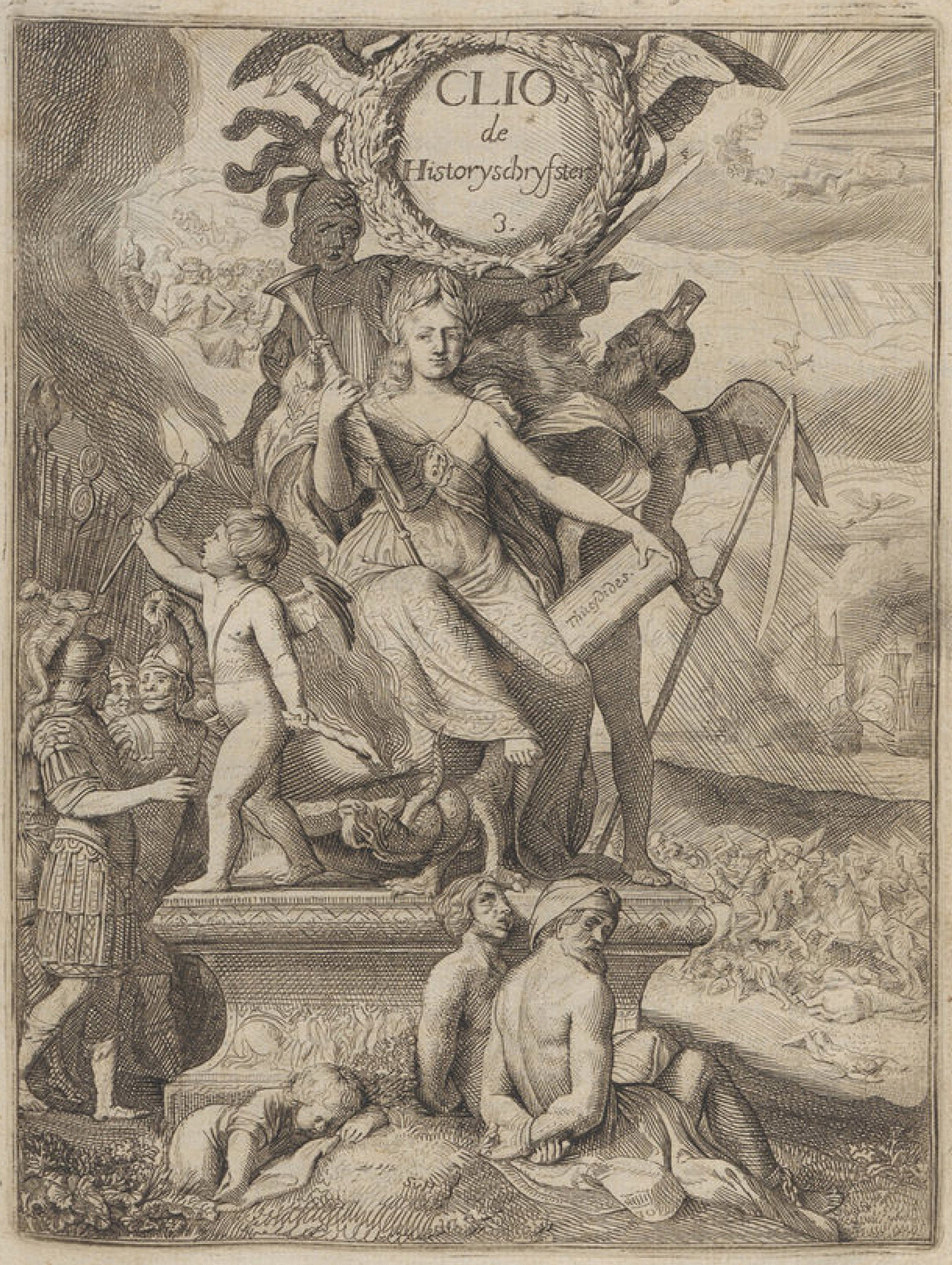
The reading set out by the National Gallery of Art, which is also the reading in the Vienna museum's own label, is that the young woman is Clio, the Muse of history, and that the picture is an allegory of painting. The grounds are the attributes. The laurel wreath stands for honour, glory and eternal life, the trumpet for fame and the thick folio, perhaps a volume of Thucydides, for history. The National Gallery points out that these are the attributes Cesare Ripa assigns to Clio in his Iconologia, the sixteenth-century dictionary of personifications that painters used, and that Samuel van Hoogstraten's treatise of 1678 prints a Clio almost exactly as Ripa describes her, with book and trumpet. That the painting is about the art is documented by the 1676 act, which titles it "The Art of Painting". That the woman is Clio and the attributes come from Ripa is the argument of the National Gallery and of Essential Vermeer, and it is widely held. It rests on resemblance to Ripa's text, not on any document showing that Vermeer owned or read the book.
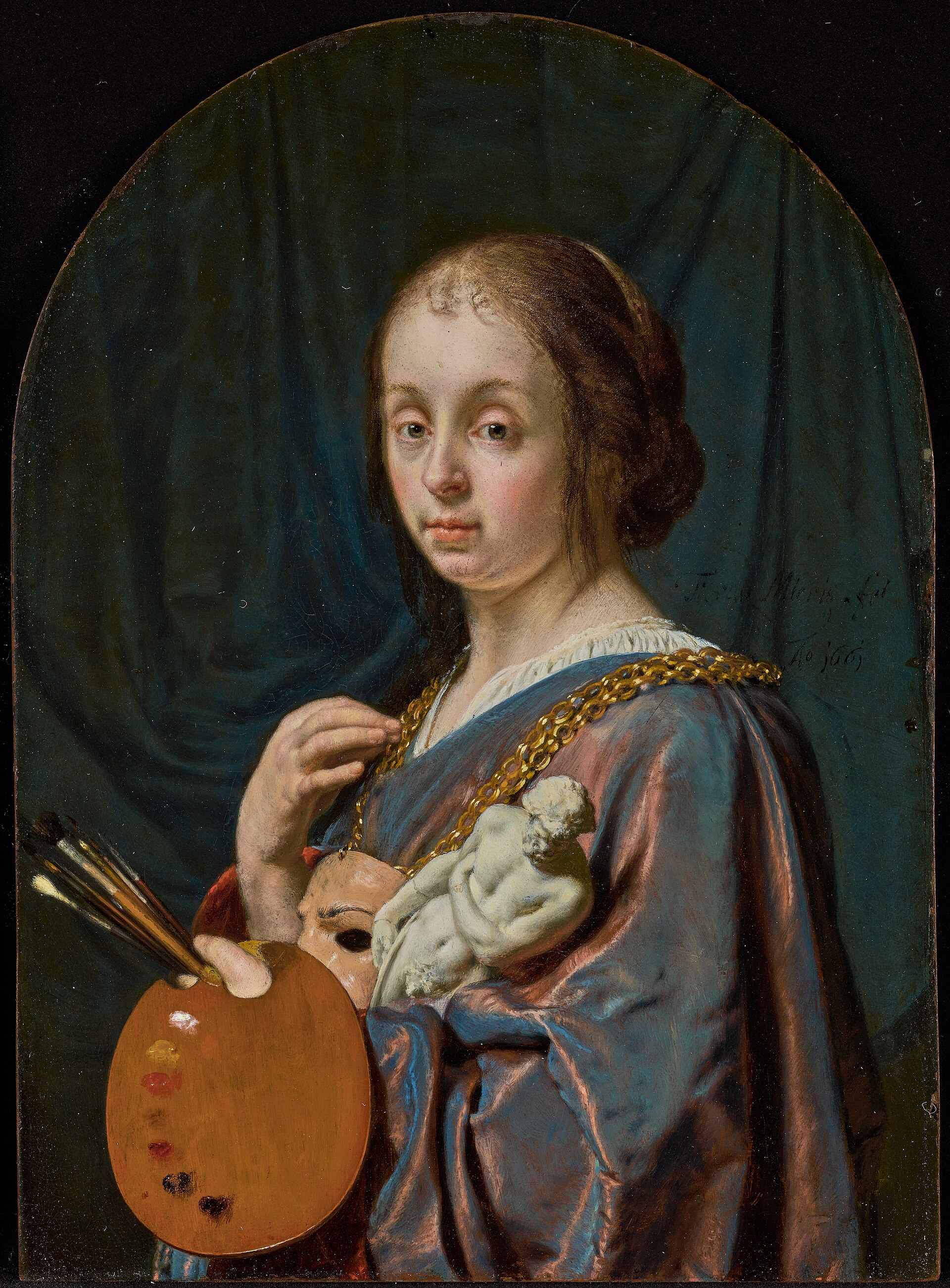
Other identifications have been put forward. Wikipedia, a tertiary source, records readings of the figure as Fama (citing Elisabeth Neurdenburg, 1942), as Pictura, the personified art of painting (citing Benjamin Binstock, 2013) and as Poetry, the last tied to Plutarch's remark, later turned by Horace into ut pictura poesis, that painting is silent poetry; the Clio reading it credits to Karl Gunnar Hullen (1949). The mask on the table points the same way as the Pictura reading. Ripa's Painting wears a gold chain with a stage mask, and the National Gallery notes that Frans van Mieris's contemporary Pictura of 1661 follows Ripa closely as a single allegorical figure, while Vermeer breaks with the convention by turning the mask into a studio prop left on the table. Essential Vermeer reports other readings of the mask: as the plaster cast of antiquity that a painter drew from, as a nod to the paragone, the argument over whether painting or sculpture stood higher, and, in a suggestion of the art historian Sabine Penot, as Apollo, because a headband runs above the brows and the head sits against the brightest triangle of wall.
The map and the chandelier are where the arguments are fiercest. The National Gallery observes that Visscher's map was already out of date when Vermeer painted it, that the Treaty of Muenster in 1648 had divided the seventeen provinces into the independent north and the Spanish Habsburg south and that a conspicuous crease runs down the centre of the map as if marking the division. The chandelier in front of it is crowned by a double-headed eagle, the Habsburg emblem. On that basis a political reading has been argued: a lament for the lost unity of the Low Countries, or a reminder of the former rulers. Wikipedia, citing Liedtke, records that Liedtke finds this political reading unconvincing because it overlooks other motives. The National Gallery's own reading is different. It proposes that the map and chandelier together indicate that the artist, through his command of history, brings fame to his city and country, a theme that Giorgio Vasari's Lives and Karel van Mander's Schilder-boeck had made familiar, and one that Dirck van Bleyswijck's Beschryvinge der Stadt Delft of 1667 took up. Bleyswijck lamented that fame comes to artists only after death and mentioned Vermeer only in a list. The National Gallery also notes that Clio's trumpet sits directly under a view of the Hof in The Hague, the seat of government. Essential Vermeer adds two minor readings of the eagle, one critic's suggestion that it stands for sight among the five senses and another that it is a phoenix of a reunited country, and records that Svetlana Alpers read the map as part of a Dutch "mapping impulse" in which painting and map-making are likened.
The painter's costume has its own literature. The National Gallery calls the slashed black doublet similar to garments worn on special occasions earlier in the century and suggests it may heighten the picture's historicising character. The dress historian Marieke de Winkel, quoted by Essential Vermeer, argues the reverse: that slashed doublets had come back into fashion in the 1620s and 1630s and reached their extreme form in the 1660s, when Vermeer painted this one, so that the costume claims descent from the earlier Netherlandish painters while staying in its own time. The tapestry drawn back from the scene reminds the National Gallery of Pliny's story of the contest between Zeuxis and Parrhasius, in which a painted curtain fooled Zeuxis, a statement about illusion made inside a picture about painting.
Two points are worth setting down plainly because they limit how far any of this can be pushed. First, nothing in the documents ties the picture to a patron, a commission or a confraternity: it was kept in the studio. Second, none of the sources consulted argues for a hidden programme. On the National Gallery's account the attributes are conventional ones drawn from printed sources such as Ripa, and the unusual thing is a choice and not a secret: to put an allegory into a modern studio instead of a single allegorical figure. The readings above are therefore best treated as scholars' arguments about a picture whose title says what it is about, and not as a code with a key. Later readings, such as the suggestion that the Habsburg eagle and the divided map would have appealed to Hitler, are reception history, and are mentioned in the section on 1940.
Chapter 4What is documented about Vermeer's beliefs and reading, and what is argued from his marriage
The evidence for what Vermeer thought is thinner than the literature on this picture suggests.
The evidence for what Vermeer thought is thinner than the literature on this picture suggests. He was baptised in the Reformed Nieuwe Kerk in Delft on 31 October 1632, raised a Protestant and in April 1653 married Catharina Bolnes, a Catholic from a family of the Delft Papenhoek, the Papists' Corner. Essential Vermeer records that no document proves a conversion, and that scholars nonetheless maintain he converted around the time of the marriage or at least took part in bringing up the children in his wife's faith. The National Gallery's text says flatly that the alliance led him to convert. Wikipedia (tertiary) reports that Walter Liedtke judged the conversion made with conviction, and that the couple lived in the house of Maria Thins on the Oude Langendijk, almost next to a hidden Jesuit church. The couple named their first daughter Maria for Maria Thins and Essential Vermeer notes a son named Ignatius, after the founder of the Jesuits. Arthur Wheelock has argued that the conversion shaped Vermeer's art, citing the religious pictures including the late Allegory of Faith, and Essential Vermeer notes there is considerable disagreement among scholars about his zeal. Gregor Weber's 2023 book, cited by Essential Vermeer, treats links to the Delft Jesuits as having come to light recently. Whether any of this bears on the allegory of painting is not argued anywhere that the sources consulted reach.
On reading, the documentary evidence is almost empty. The inventory of the house made in 1676 listed "five books in folio size; another 25 books of all kinds" and identified none of them, according to Essential Vermeer. The studio contents recorded in the same inventory, which Wikipedia summarises from Montias, included two chairs, two painter's easels, three palettes and ten canvases, and Essential Vermeer notes a maulstick among them, the same support the painter in this picture holds. The documented intellectual footprint of the man is practical and public instead of doctrinal: he was head of the Delft Guild of Saint Luke on two occasions, and in May 1672 he was summoned to The Hague as an expert on Italian painting, where, as Jorgen Wadum relates, he and Johannes Jordaens judged a collection offered for sale to be rubbish. Wadum draws from this that Vermeer would have had a connoisseur's knowledge of Italian art.
The belief that is documented, then, is the one the object itself carries: that painting is a liberal art whose practitioner deserves a place with poets and historians, and that its dignity is a matter of fame. Essential Vermeer describes Vermeer as an ambitious painter who defined himself as an artist and gentleman. Essential Vermeer observes that Vermeer's tools in the picture are the instruments of a gentleman painter and that the palette and chest of drawers, the marks of manual labour, are conspicuously absent.
Chapter 5How it was built: a pinhole in the wall map, a grey ground and no second thoughts
Vermeer left no drawings, so the National Gallery of Art points out, what is known of his procedure comes from the paintings, and this is the one that shows a painter at work.
Vermeer left no drawings, so the National Gallery of Art points out, what is known of his procedure comes from the paintings, and this is the one that shows a painter at work. The painter sits to work and steadies his hand on a maulstick. The canvas on his easel has a light grey ground with the composition indicated in what is probably chalk, and on it he has laid flat, unmodulated strokes as the underlayer for the laurel, leaving glazes and highlights for a later stage. The leaves are blue because Dutch painters made green by laying a transparent yellow glaze over a blue underpainting, a technique Essential Vermeer describes and cautions was prone to fading.
Technical examination of the canvas has been done at the Vienna museum. Essential Vermeer's catalogue entry prints a technical report that it ties to the museum's 2010 exhibition catalogue (Haag, Oberthaler and Penot, eds., with essays by Robert Wald and Elke Oberthaler among others), and the figures that follow are from that report. The support is a plain-weave linen with a thread count of 11.1 by 16.5 per square centimetre, cusped enough to show that it was stretched with 11 nails along the sides and 9 along top and bottom. It was relined with a glue lining and a new stretcher, probably in the nineteenth century. The ground is a single layer of coarsely ground lead white with chalk, ochre, umber and charcoal black, a mid-tone grey-brown whose dominant medium is linseed oil. Infrared reflectography shows fine black underdrawing lines in the arms of the chandelier, the frames of the city views on the map and the easel; the first modelling of the forms begins with the shadows. Lead-tin yellow is the principal pigment of the chandelier, with thick impasto in the highlights, as the National Gallery also notes. Ultramarine is found in the ships on the map, in the veining of the marble floor, in the shadows of the tapestry and as a glaze over a copper-based underlayer in the teal cloth on the table. Vermilion is the red of the painter's leggings. Black is almost entirely vine black except in one pentimento in the painter's right shoe, where it is bone black. Jorgen Wadum, the Mauritshuis conservator, has stressed in an interview that Vermeer used lapis lazuli ultramarine lavishly and early, and as an underpaint, to an extent no other seventeenth-century painter is known to have done.
The perspective was built with a pin. The National Gallery of Art reports that the vanishing point sits just below the black finial of the pole weighting the map, that Vermeer marked it with a pin and that the pinhole is still visible; strings attached to the pin would have set out the orthogonals of the tiles and table edge. Essential Vermeer, summarising the Vienna report, adds a second deformation at the right side of the map that served as the vanishing point for the stool. The National Gallery also points out that, despite the elaborate preparation, Vermeer adjusted the perspective for effect, painting the artist at a scale that would make him tower over his model. Wadum is the authority for the "pinhole and string" method across the oeuvre, in his "Vermeer in Perspective" of 1995.
One finding differs between the National Gallery's online account and the Vienna report. The National Gallery states that not a single compositional change had been found in this large, complex scene by microscopy, infrared photography or X-radiography, and concluded that Vermeer must have worked out the composition beforehand, perhaps with a careful preliminary drawing. The report summarised by Essential Vermeer agrees that the X-ray shows no change in composition but records a pentimento in the right shoe. The difference is small and the overall judgement stands: this was an unusually resolved design.
On the camera obscura, the National Gallery's position is that Vermeer may have used one to conceive, not to paint, the composition, pointing to the blurred drapery at the table edge and the crisper brushwork on the chandelier and the map; Essential Vermeer records that the debate is ongoing and that a camera leaves no trace. Neither source offers a document.
The picture's date has been argued on the evidence of the signature and the style, and the dates scholars have given are: 1662-65 (Albert Blankert, 1975), c. 1666-67 (Arthur Wheelock, 2000), c. 1666-69 (Walter Liedtke, 2008), c. 1667-68 (Wayne Franits, 2015) and c. 1666-68 (Pieter Roelofs and Gregor Weber, 2023), as tabulated by Essential Vermeer, with the Vienna museum itself giving about 1666/68. The National Gallery of Art assigns it to 1667, arguing from Bleyswijck's book of that year. Infrared examination has reportedly found a date applied by the artist immediately after the signature, read as MDCLXVI(I I?). Erik de Visser, in his provenance study, reads it as 1666, 1667 or 1668 and "most likely 1668" from the spacing and extent of overpaint, and notes that the lettering is consistent with the inscriptions on The Astronomer (1668) and The Geographer (1669). Wikipedia (tertiary) notes that some have proposed a date as late as 1670-75. The reading of the inscription is not independently published in the sources consulted and should be treated as a report of the Vienna examination, not a settled date.
Chapter 6More than a century without a name: from the Delft auction of 1677 to the Van Swieten estate of 1803
Vermeer died in the middle of December 1675.
Vermeer died in the middle of December 1675. Erik de Visser's provenance study on the Essential Vermeer site, drawing on the documents transcribed by John Michael Montias in Vermeer and His Milieu (1989), gives the 13th or 14th; Wikipedia gives the 15th, the day of his burial. His widow, in a petition to the court, described the end: the ruinous war had left him unable to sell his art and, in the National Gallery of Art's translation, "left sitting with the paintings of other masters that he was dealing with" (the full passage is quoted in the artist dossier). On 10 February 1676 twenty-six paintings, probably the greater part of his stock as a dealer, were transferred to the dealer Jan Coelenbier for 500 guilders, in the name of Jannetje Stevens to whom the family owed money for shop goods. Two weeks later, on 22 or 24 February, Catharina assigned The Art of Painting to Maria Thins before a notary, Johan Vos, in The Hague, a notary she is not known to have used before or after. The estate inventory was made on 29 February, and the picture is not in it, de Visser reports. On 24 April Catharina pleaded poverty and was declared bankrupt, and on 30 September the microscopist Anthonie van Leeuwenhoek was appointed curator of the estate.
The National Gallery and de Visser agree on what Leeuwenhoek did, and differ on the outcome. Both state that Leeuwenhoek found the transfer to Maria Thins invalid. Wikipedia, citing Montias, calls it at least a curious transaction. De Visser, following Montias, says that one would not normally expect a person to go before a notary to cede property to her mother, and that the curator treated it as an attempt to hide the painting from creditors before the inventory. According to de Visser the picture was impounded and posters were printed for an auction of the stock at the Guild of Saint Luke's hall in Delft on 15 March 1677. On 12 March, from The Hague, the eighty-four-year-old Maria Thins had a notary read Leeuwenhoek a letter reasserting that the picture belonged to her. The National Gallery thinks Catharina's attempt "almost certainly failed" and that the painting left the family's possession at about that time; it gives the sale date as 15 May 1677, where the Vienna museum, de Visser and Essential Vermeer give 15 March. No record of the sale has survived and neither its contents nor the result of the dispute is known. De Visser argues that Maria Thins, by claiming the status of a preferred creditor, may have stalled the sale; he notes that a court did grant her that status on 3 July 1679 after seven months' deliberation, and that she was still swearing in October 1679 about the repayment of debts from the February 1676 settlement. He offers this as conjecture. The museum's own provenance line reads simply "auction Delft 15.3.1677".
The painting then drops from the record for about 126 years, until the Van Swieten estate of 1803 (the Board says 1804), and no document fills the interval; Erik de Visser's conjecture, below, would account for about seventy of those years. One candidate for its first reappearance is lot 3 of the sale of Jacob Abrahamsz Dissius's collection in Amsterdam on 16 May 1696, which included twenty-one paintings by Vermeer and in which lot 3 was described as "the portrait of Vermeer in a room with various accessories, uncommonly beautifully painted by him", sold for 45 guilders. The 1696 sale and the 45 guilders are in Essential Vermeer and in the German Kunst und Politik site, which supposes the lot to be the Art of Painting. Essential Vermeer, which reproduces the catalogue wording, observes that the price was scarcely twice what the tiny Lacemaker fetched in the same sale and that few experts believe the lot corresponds to a canvas so much larger and more ambitious. The question is open.
De Visser's own proposal for the years up to 1745 is a chain of people, argued on probability and not on documents. He notes that the Hague notary Hendrick Terbeeck van Coesfelt dealt with Vermeer's family from April 1676 to 1708, became the guardian of the children after Catharina's death at the end of 1687 and that Coesfelt's granddaughter Maria married the Leiden physician Gerard van Swieten on 27 September 1729. De Visser's argument is that the picture was held by Coesfelt, passed to Maria and went with the van Swietens to Vienna when Gerard became Maria Theresa's physician in June 1745. He says plainly that he does not know how the painting came into Coesfelt's possession and that no document has been found. A footnote records that Elke Oberthaler's contribution to the 2010 Vienna catalogue states, without a source, that the picture first resurfaced in the collection of Gerard van Swieten as a work by Pieter de Hooch.
Chapter 7Sold as a Pieter de Hooch: the van Swietens, a saddler and Count Czernin
The first firm sighting is in the estate of Gottfried van Swieten (1733-1803), son of the physician Gerard, who on de Visser's argument inherited it from his mother.
The first firm sighting is in the estate of Gottfried van Swieten (1733-1803), son of the physician Gerard, who on de Visser's argument inherited it from his mother. The National Gallery of Art states that in 1803 the painting, attributed to Pieter de Hooch and carrying a false De Hooch signature, was part of his estate. Infrared reflectography has since shown the false signature on the lower cross support of the painter's stool, according to Essential Vermeer and de Visser. When the signature was added, by whom and why is unknown. De Visser sets out four possibilities: that it happened in the eighteenth century in a family that knew the picture's origin, which he thinks unlikely; shortly before the 1804 auction to command a better price; by a middleman such as the saddler; or some time after 1677 to put creditors off the scent, which he calls the least plausible.
The buyer was Johann Rudolf Count Czernin von und zu Chudenitz (1757-1845), a Bohemian-Austrian nobleman, collector and court official (Oberstkaemmerer, according to the Austrian Science Fund). The Fund's project record on the Czernin collection calls his Vienna palace home to one of the most prestigious collections of old masters in the world and says he is credited as collector above all for "his" Vermeer, although no monograph on him exists. The date and the seller are disputed. The Vienna museum and the National Gallery give 1813, and the German Kunst und Politik site says the Count bought it that year from a Viennese saddler for 50 gulden. The Art Restitution Advisory Board's findings of 2011 give 1804, from the estate of Gottfried van Swieten. De Visser sets out what each side has. A notice in the Wiener Zeitung of May 1804 announced the van Swieten estate sale, and a diary note of 12 April 1837 by the Count's son Eugen Karl says his father "bought it for 50 florins in bad bank-billets after [Gottfried] Van Swieten's death", without giving a year. De Visser adds that Swillens gave the price as 30 florins, and that scholars have long maintained 1813 and a saddler. He says the saddler's existence and the sale to Czernin have not been documented.
The money is worth reading closely. The fifty florins were, in the diary's words, in "bad bank-billets", that is in depreciated paper currency, and Wikipedia's article on the Austrian gulden records that the Wiener Stadt Banco notes had fallen against coin until their value was fixed in 1811 at one fifth of face value in coin. If the saddler was paid in notes at that rate, the price corresponds to about ten florins in coin, which is a derived figure and an inference: the sources do not say which notes were used, at what rate or in which year. On any reading the picture was sold as an inexpensive De Hooch.
The Czernin gallery was hung in the family palace in Vienna. The Austrian Science Fund project says the collection of about 350 old masters has been on public view in the palace since about 1800, while Essential Vermeer says that the picture gallery opened shortly before the Count's death in 1845 and that an 1846 Baedeker advised visitors to ask the concierge and tip. The National Gallery agrees with the later date. In the Czernin gallery the picture hung under De Hooch's name, with a frame label and a guide calling it "Peter van Hooghe".
The recognition was made by two men in the same years. The critic Theophile Thore-Burger, who as de Visser puts it had virtually doubled the number of accepted Vermeers by 1860, made the attribution in the 1859 catalogue of the Arenberg collection without having seen the picture, on the strength of a trusted authority, and Gustav Friedrich Waagen, director of the Berlin museum, saw it in Vienna and confirmed it in 1860. The National Gallery puts the recognition at 1860 and credits Thore-Burger. Wikipedia (tertiary) cites Waagen's Handbuch of 1862, page 110. Thore-Burger saw the picture in person in 1866 and was the first to describe the "I Ver-Meer" signature. He did not mention a date. In 1862, the 2011 findings state, the picture was incorporated together with the gallery into the Czernin entail (Fideikommiss), a legal bond that restricted its sale. The Board says a Reich law ended entails from 1 January 1939, but that the restrictions on the holder stayed in force until the entail court declared the entail extinct on 3 June 1941, and the same court approved the 1940 sale.
Chapter 8Fifteen years of offers, a family at law with itself and an export licence that was never granted
A recurring fact in the Board's account is that the painting could not be exported from Austria without a licence from the Federal Monuments Office.
A recurring fact in the Board's account is that the painting could not be exported from Austria without a licence from the Federal Monuments Office. The 2011 findings of the Art Restitution Advisory Board record that the Federal Monuments Office applied in 1923 to put the Czernin gallery under supervision and declared on 24 January 1924 that its preservation was in the public interest, that the Vermeer could not leave the country without the Office's licence and that no concrete application for such a licence was ever filed, and none was granted before the Anschluss of March 1938. The Board's account is of an Office and a Ministry of Education that were unwilling to give one. At the end of March 1936 Chancellor Kurt Schuschnigg told Eugen Czernin it was highly doubtful a licence could be given. The National Gallery of Art says Schuschnigg refused permission for the sale and export of the painting, quoting the "nearly fanatical veneration" of it in Vienna's art-interested circles. (Schuschnigg was Count Jaromir Czernin's brother-in-law, as the National Gallery and the heirs' lawyer both note.) In May 1934, according to Eugen Czernin's lawyer's report, the Office had said that exporting the Vermeer would be a disproportionate sacrifice compared with keeping the rest of the gallery in Vienna.
The owners also had trouble at home. When the entail holder Eugen Jaromir Czernin died in November 1925, Prague and Vienna courts both claimed his estate and the question of whether the entail survived in Austria was litigated for years. His heir Franz Jaromir Czernin died childless in April 1932. In an agreement of 23 February 1933, which the Board describes, the Vermeer was to go to Jaromir Czernin (born 1908), who was to pay 20 per cent of the proceeds of any sale to Eugen Czernin (1892-1955), whom the Board calls Jaromir's uncle; Eugen received the rest of the gallery. The National Gallery's account is structured differently: Eugen was to hold one fifth of the painting and Jaromir four fifths, because the Vermeer was appraised at nearly one million schilling while the entire remaining collection was valued at a little over 250,000. The two descriptions agree on the one-fifth share and differ on whether it was an ownership share or a share of proceeds.
The Board's findings read as a ledger of the international market. In 1923 Joseph Duveen's firm approached the entail holder at a price of GBP 50,000 to 60,000. In September 1925 the Czernin administration replied by telegram that the Vermeer was "not for sale at present". In the next years Duveen's files record offers or rumours of offers: two English gallery offers of USD 1 million each reported by Gabriel de Terey (the Budapest museum director Duveen had enlisted) and a bid from the New York dealer Roland Knoedler of USD 450,000; two English museum offers of USD 1.25 million in 1927, which Duveen's firm called "ridiculous" internally; a figure of USD 400,000 for Andrew Mellon in September 1928, according to Duveen's New York to Paris telegrams; and an alleged Mellon offer of about GBP 200,000 around 1931 that the family took as a benchmark. After Franz's death the family expected at least USD 800,000, and Jaromir demanded USD 2 million, then USD 1.5 million. The London dealers Asscher and Welker offered GBP 85,000, which Eugen Czernin refused in March 1935. Duveen's firm in October 1935 reported a reduced demand of USD 900,000 plus USD 200,000 for lawyers, commission and export. The Vienna and New York dealer Silbermann offered USD 1 million, which Duveen's men judged to be for publicity, and Seligmann USD 1.2 million. Marianne Scharmuetzer offered 18 million Czechoslovak crowns for unnamed clients, Kurt Walter Bachstitz was sent a draft contract at USD 935,000 in March 1936 and an Amsterdam dealer Nathan Katz offered 1 million guilders and was seen as linked to the Rijksmuseum, whose officials, according to an Austrian envoy in The Hague, could not afford it. The most concrete negotiation was with Duveen for Andrew Mellon in the spring of 1936: a six-month option at USD 1 million was drafted, with export costs split 15 per cent to the seller and 85 per cent to the buyer, and Duveen's New York office objected that the draft would commit it to buy in gold before any export permission was given. The National Gallery says Mellon "evidently offered $1 million" in 1935. The Board says no contract was concluded, and that Duveen's firm broke off its negotiations when Mellon died on 27 August 1937. A last approach in February 1938, from a Vienna lawyer acting for Duveen, claimed readiness to pay about USD 1 million and drew no reply.
Two points follow from these details, both of them stated by the Board. First, no concrete foreign offer after Mellon's death is documented. Second, the foreign price of roughly USD 1 million presupposed an export licence. No application was ever filed and none was granted before the Anschluss, and the Board describes the Office and the Ministry of Education as unwilling to grant one. The Board concludes that the size of the foreign price is accordingly of only limited relevance.
Chapter 9How the sale to Hitler was arranged in 1939 and 1940
After the Anschluss the Austrian monuments law stayed in force, the entail was to expire on 1 January 1939 under a Reich law abolishing entails and the dispute between Eugen and Jaromir Czernin...
After the Anschluss the Austrian monuments law stayed in force, the entail was to expire on 1 January 1939 under a Reich law abolishing entails and the dispute between Eugen and Jaromir Czernin continued; these shaped the sale. The Board's findings, which are the fullest published account and are drawn from the Commission for Provenance Research's dossier, record that the entire Czernin gallery was put under protection as a unit on 7 October 1938. Count Eugen Czernin's lawyer met the Berlin dealer Karl Haberstock in September 1938, and in February 1939 Haberstock was sent a copy of the painting made for Eugen. In March and April 1939 a Hildegard Gussenbauer, writing as an employee of an advisory body on domestic culture and linked to Haberstock, offered one million reichsmarks, which Eugen thought out of the question, and Jaromir replied that he was not averse to selling and had been offered far more from abroad by private parties. On 4 August 1939 Jaromir's lawyers told Eugen that Hitler wished to see the painting in Munich. It travelled by night train accompanied by lawyers for both Czernins, was shown at the Munich dealer Maria Almas-Dietrich in the presence of the Czernin representatives and was back in Vienna on 7 August. A report written in December 1939 by an official of the Vienna ministry says Hitler declined at the price of RM 1.7 million. The National Gallery of Art's account is different in two respects: it places the first approach in the summer of 1939 with a visit by Hans Posse, the director of the Dresden gallery acting as Hitler's art agent, and has Hitler unwilling to pay the RM 2 million Czernin sought.
The Hamburg tobacco manufacturer Philipp Reemtsma came next. The National Gallery says he proposed to buy at RM 1.8 million with the backing of Hermann Goering, and the Board records a telegram of 9 December 1939 in which Goering's staff chief told the Vienna monuments office that Goering had approved the sale to Reemtsma. The Board gives the Reemtsma price as RM 1.8 million net, RM 2 million with a RM 200,000 commission. Officials in Vienna, among them Friedrich Plattner and Herbert Seiberl, tried to stop it, and appealed through the Reich Chancellery. On 29 and 30 December 1939 Hans Heinrich Lammers wired that Goering had not in fact approved the sale and that Hitler wished the painting to stay in the gallery and not be disposed of without his personal permission. Eugen Czernin noted in his diary on 5 January 1940, as the Board renders it, that after almost eight years of writing, legal hair-splitting and fruitless negotiations a state purchase now looked like a way out. Jaromir's lawyers on 5 and 10 January 1940 went to the Vienna ministry and the Berlin education ministry to promote precisely that solution, which is the Board's reason for saying the state purchase was pursued from Czernin's side.
On 19 March 1940 Plattner proposed that the Reich buy the picture for the Kunsthistorisches Museum at RM 1.75 million. On 12 April 1940 a letter went to the Vienna ministry and the monuments office. The Board says it was written by Czernin's lawyer Ernst Egger and states that Czernin remained ready to sell, that about RM 1.5 million should flow to him and that the inheritance-duty question should be settled without further burden on the heir. The National Gallery attributes the letter to Czernin himself and says it demanded a purchase by the state in exchange for the lost sale to Reemtsma. A Reich Chancellery note of 25 April 1940 recorded that Hitler was not inclined to waive inheritance duties or to compensate Czernin with land, and that the purchase should instead be paid from the RM 1 million freed by the confiscation of the Oskar Bondy art collection, with the balance from other funds. The Board's summary mentions the Bondy money in several documents of January, April and July 1940. It concerns where the Reich's funds were to come from. The Board does not say, and nothing in the sources consulted says, that this painting itself was seized. On 13 September 1940 Jaromir Czernin signed, at the Regina Palast Hotel in Munich, an option to sell for RM 1.5 million plus inheritance duty, valid until 15 March 1941. On 26 September Martin Bormann instructed Hans Posse to buy for RM 1.65 million, which the Board explains as RM 1.4 million plus RM 250,000, half of the inheritance duty then expected to be RM 500,000. Posse called on Jaromir Czernin on 2 October 1940 at his estate in Marschendorf in Bohemia, and the purchase offer was handed over and accepted on 4 October. The National Gallery says the director of the Kunsthistorisches Museum presented the picture to Hitler at his Munich residence on 11 October. The Board says the painting, without its frame, was handed over at the Fuehrerbau in Munich on 12 October to the architect Hans Reger, whom Bormann had charged with housing the picture, and that the entail court approved the sale in a preliminary order that day and finally on 25 October.
Payment came in November. The Board records that Czernin's lawyer was chasing the money on 29 October, citing the loss of interest; that Czernin confirmed receipt on 13 November; that the tax office assessed inheritance duty of RM 380,000 on 14 November, on an offer Czernin had made and the finance minister accepted, and paid it from the sale price; and that Jaromir kept the whole proceeds, so that Eugen Czernin, who kept the rest of the gallery, paid him RM 280,000 in three instalments between May 1941 and December 1942 as partial reimbursement of the duty. The National Gallery's account has Hitler granting Czernin a reduced tax on the work. On 20 November 1940 Jaromir Czernin wrote to Hitler to thank him for what he called "the most perfect and delightful solution", closing with a wish that the picture "bring you, my Fuehrer, joy always" and the German salute. Martin Bormann's note of 8 October to Lammers, quoted by the Board, had remarked that this "best picture of Vermeer" had an international value far above the approved price.
It was later argued that Hitler would have found the political reading of the picture congenial: the Habsburg eagle and the divided map as a story of the Low Countries and the Empire. Wikipedia reports this as a view in the literature, with Liedtke's objection. It is a reception-history point about what a twentieth-century viewer might have made of the map, not evidence for why the picture was bought. The sources record why the picture was wanted in plainer terms: Hitler wanted it for the Linz museum and Hans Posse was his agent, and Essential Vermeer states that Hitler saw in Vermeer the embodiment of the great artist he desired.
Chapter 10Voluntary or forced: the claims from 1945 to 2011, and who holds which position
The main sequence of events is not in dispute in the sources consulted (the sources differ on some details, noted below and in the earlier sections): the offers, Reemtsma, Lammers's telegram, Posse's...
The main sequence of events is not in dispute in the sources consulted (the sources differ on some details, noted below and in the earlier sections): the offers, Reemtsma, Lammers's telegram, Posse's visit and the price of RM 1.65 million appear in the Board's findings, in the National Gallery's account and in the heirs' lawyer's articles alike. What differs is what the circumstances meant. The Art Restitution Advisory Board's unanimous decision of 18 March 2011, issued under the 1998 Art Restitution Law, recommended that the Minister for Education, Arts and Culture not transfer the painting to the heirs of Jaromir Czernin. The members were chaired by Clemens Jabloner, with Ilsebill Barta, Bertrand Perz, Artur Rosenauer, Franz Philipp Sutter and Peter Zetter. The Board's reasoning, in its own published findings, runs as follows, and it is for the Board and not for this record to assert it. Jaromir Czernin had wanted to sell since at least February 1933. A sale abroad might have brought about USD 1 million, but no export permission had been given before the Anschluss. After the Anschluss the picture was offered to Hitler in August 1939, who declined at RM 1.7 million, and then to Reemtsma at a net RM 1.8 million; that sale failed because of an intervention by Hitler initiated by the Vienna monuments officials. The purchase finally made on 4 October 1940 "essentially corresponds" to the proceeds that the Reemtsma sale would have brought, and the Board's arithmetic is that Reemtsma's RM 2 million less a RM 200,000 commission and RM 500,000 expected duty left RM 1.3 million, whereas Hitler's RM 1.65 million less the RM 380,000 duty actually assessed left about RM 1.27 million. The Board concludes that the sale was actively pursued by Jaromir Czernin's lawyers, that he did not stand under pressure when he concluded it and that his later claim of political persecution cannot be proved, citing his application of 9 April 1940 to join the Nazi party, in which he named earlier memberships of the Sudeten German Party and affiliated organisations; the application was refused in 1940 and again in 1943, which the Board says cannot count as persecution. It also finds the later account that Posse dictated Czernin's letter of thanks to Hitler not credible, since some six weeks had passed since Posse's visit. The Board says it by no means overlooks that Alix Czernin was exposed to antisemitic hostility, but sees no causal link to the sale. The Board also reasons from the status of Alix Czernin, Jaromir's second wife, whose maternal grandfather Eduard Oppenheim counted as Jewish under the Nuremberg laws: the 1939 census card recorded one Jewish grandparent, which the Board says made her a "Mischling of the second degree" in Nazi terminology, the restitution courts had not treated second-degree Mischlinge as persecuted and the Board saw no reason to extend the presumption. Its public statement, as reported by the Austrian broadcaster ORF through the Board's scientific coordinator, Eva Blimlinger, was that it found "no single indication" the sale was made under coercion.
The heirs' position is documented through their lawyers and in the press. In 2009 their attorney Andreas Theiss, quoted by Agence France-Presse via Artforum (8 September 2009), said Jaromir Czernin had sold "to protect the life of his family", that a new expert appraisal found the painting was sold for no more than one million reichsmarks, "a fraction of its value" (the same report gives the price as RM 1.65 million) and that the family had filed its request on 31 August. The Vienna museum's page says the heirs first proposed the return in September 2008, so the year is inconsistent between the sources. The Los Angeles lawyer E. Randol Schoenberg, who represents a step-daughter of Jaromir Czernin, set out his case in a March 2011 article for the Jewish Journal and in an interview for Essential Vermeer. In those he argues that Alix Czernin's grandfather was the Jewish banker Oppenheim, that she was attacked in Der Stuermer in 1933, lost custody of her children in 1940 after the Gestapo intervened and was declared "Jewish and an enemy of the state" in September 1940, weeks before the sale (the interview gives September; the Jewish Journal article says only later that year); that Bormann "asked around if any outstanding taxes could be used to take the painting away"; and that Posse told Czernin Hitler would get the painting "one way or another". The last claim echoes what Czernin himself wrote in his 1947 application: the Board's summary records him saying that Posse told him the Reich had other ways to obtain the picture. The Board places the review by the Racial-Political Office on 13 and 14 October 1940, after the purchase offer of 4 October, and notes that those race-office papers survive only as copies certified in 1952, the originals not having been found. Schoenberg argues that the post-war tribunals applied the wrong standard because they would not accept that Czernin had been married to a persecuted person, and that the Board in 2011 ignored his evidence; the Board's decision says that the post-war courts had in substance examined and rejected a coercion claim, and the Board then examined the facts independently. After the decision Schoenberg told the Austrian press agency APA that he had not been notified and called the decision an insult, and said that if the Republic believed it was right he would propose arbitration. The Board's finding and his criticism are both on the record.
The earlier rounds ran from 1945. The Board records that Jaromir Czernin demanded the picture back through lawyers on 15 October 1945, claiming, in the National Gallery's rendering, that Hitler had pressured him into selling for an "outright ridiculous price". On 21 January 1946 the education ministry rejected the claim, saying he had sold "without undue force". A memorandum from the head of the Munich Central Collecting Point in February 1946, quoted by the Board, recorded that there had been speculation that this was a forced sale but that Czernin needed money and was "perfectly happy to sell"; it added that there was no evidence the picture had been looted by the Germans and that its ownership would be decided under Austrian law. On 20 October 1947 Czernin applied under the Third Restitution Act. The Restitution Commission rejected the application on 11 January 1949, and the Supreme Restitution Commission did so on 14 May 1949; in 1949, according to the National Gallery, the highest commission found the complaint "completely unsubstantiated, indeed malicious". Civil suits against the Republic in 1950 and 1951 were dismissed. On 31 March 1952 the People's Court declared the painting, as the property of Adolf Hitler, forfeited to the Federation under the 1947 Property Forfeiture Act. A second application of February 1953 under the Second Restitution Act was decided on its merits by the finance minister on 26 August 1955, who found that the sale to Hitler was a speculation Czernin considered advantageous at the time and regretted only in hindsight; the Administrative Court rejected his complaint on 30 June 1960. In the autumn of 1955 Czernin was meanwhile offering the picture to the National Gallery of Art, as the National Gallery records. Further claims by other claimants followed: a New York man in 1980 who said Czernin had bequeathed it to him by notarial deed in 1938, and, in 1986, an ex-wife of Czernin who sued in Innsbruck on the basis of an alleged transfer in December 1954, whose case was put to eternal rest by agreement and who then offered to buy the picture for 60 million schilling, an offer the museum declined on 17 October 1986. The 1998 Art Restitution Law is what gave the 2008 or 2009 request a forum, and the Vienna museum's statement says the Commission for Provenance Research, with researchers Susanne Hehenberger and Monika Loescher, was assembling the dossier. Die verkaufte Malkunst, edited by the two of them and published in 2012, is volume 4 of the Commission's series, according to the Austrian Science Fund's project page.
Chapter 11Altaussee, Munich and a private railway car to Vienna
The Vermeer stayed in Munich after the 1940 purchase.
The Vermeer stayed in Munich after the 1940 purchase. The Board says it was moved to the salt mine at Altaussee in October 1944; the National Gallery and the Vienna museum say the winter of 1943-44. Essential Vermeer records that American troops found it in the mine with thousands of other works including Michelangelo's Bruges Madonna and Vermeer's own Astronomer, and that, after the Nero decree, orders were issued by the local Nazi district leader to destroy the works by blowing up the mines, which lower-ranking men diverted by blocking the entrance instead. The National Gallery says that US Army special units retrieved the works in the spring of 1945 and took this painting to the Central Collecting Point in Munich. The Board and the German Historical Museum's database agree the Collecting Point received it on 27 June 1945, and the card is numbered 1284.
The Americans treated it as Hitler's personal property. The National Gallery names General Mark Clark, Andrew Ritchie and Colonel Theodore Paul as the officers who determined this, and the Board says the Collecting Point's list of "Austrian property" marked the Czernin family as the "presumed owner" and recorded that Hitler had bought the picture for RM 1.65 million. Ritchie, the Monuments Man who represented the US Allied Commission for Austria at Munich, escorted the picture to Vienna in a private railway car, according to the Monuments Men and Women Foundation. The handover dates are not in agreement. The National Gallery and Essential Vermeer say 17 November 1945, the German Historical Museum card gives 27 November 1945 as the day of issue; the Board says the picture was handed to the Austrian federal government on 28 November 1945; and the Vienna museum's online record says it was handed to the museum on 7 November 1946. The National Gallery says it was shown shortly afterwards at the Hofburg with other recovered works. The picture was formally inventoried in the Kunsthistorisches Museum, with the number 9128, only in late 1958 or early 1959; until then it was a deposit made by the government. The Board records the forfeiture decision of 1952, and the Vienna museum states that every post-war request to recover the picture was denied in court, the last by the Administrative Court in 1960.
Chapter 12What the money meant, from 45 guilders to 1.65 million reichsmarks
Four prices frame the picture, and each means something only against the wages and currencies of its day.
Four prices frame the picture, and each means something only against the wages and currencies of its day. The method used here for every comparison is simple: the price divided by a contemporary wage taken from a named source, with no modern-currency conversion beyond the dollar figures the sources give (2.5 reichsmarks to the dollar) and one labelled inference about florins. Modern equivalents are deliberately not given. Methods based on price indices, average earnings and the share of national output differ by an order of magnitude, and none of the sources consulted gives one for this picture.
The 1660s and 1696. Essential Vermeer estimates that Vermeer's income in the 1660s, from picture sales and above all his mother-in-law's financial help, probably ranged from 850 to 1,500 guilders a year, against about 500 for a mason and that an average Dutch house might cost 1,000 guilders. Monconys in 1663 was told that a single-figure Vermeer in a baker's shop had cost 600 livres, and thought 6 pistoles too much. At the Amsterdam sale of 1696 lot 3, if it was this picture, went for 45 guilders, about nine per cent of a mason's annual earnings at Janson's figure, a little under five weeks' pay; the identification is disputed.
1804 or 1813. Fifty florins in depreciated paper, possibly worth about ten florins in coin on the 1811 conversion rate, was the price of the picture to Count Czernin, as the son's diary records it. De Visser reports that Swillens gave 30 florins. Whichever year is right, the buyer believed he was getting a De Hooch.
1923 to 1937. Foreign demand put the picture at GBP 50,000 to 60,000 (1923), USD 400,000 (Mellon, 1928 per Duveen's telegrams), USD 1 million to 1.25 million (reported English offers 1925-27), a demanded USD 2 million falling to USD 900,000 plus USD 200,000 of costs by October 1935 and a drafted option at USD 1 million in 1936. In 1933 the picture was appraised at nearly one million Austrian schilling and the whole rest of the gallery at a little over 250,000, as the National Gallery reports. The Board says that none of the foreign sums was ever a completed sale and that all of them depended on an export licence that did not exist.
1940. The Reich paid RM 1.65 million. Schoenberg and the arthistorynews.com post of 20 March 2011 both give about USD 660,000 for that sum, which implies the rate of 2.5 reichsmarks to the dollar, so Hitler's price was about two thirds of the USD 1 million of the 1936 draft option; Schoenberg puts it at 65 per cent of the price Czernin had wanted. After the RM 380,000 inheritance duty the Board computes about RM 1.27 million to Czernin, against about RM 1.3 million net in the failed Reemtsma sale. For a worker's-wage comparison, the International Labour Review (1944) gives the average gross weekly earnings of German industrial workers as 39.89 marks in 1940, an average of March, June, September and December. That is about RM 2,074 a year at 52 weeks, before tax and without allowing for short time. On those figures the price equals about 795 years of an industrial worker's gross earnings. The same sum was recorded by Bormann as the "approved" price for a picture whose "international value", in his words, was far higher, and the Reich Chancellery planned to pay for it with about RM 1 million left over from the Bondy confiscation.
The tax and legal context matters as much as the price. The inheritance duty linked to dissolving the entail (RM 380,000 assessed on 14 November 1940) was in effect negotiated: the Vienna ministry first guessed RM 550,000, the sale price was set so that duties between RM 250,000 and RM 500,000 would not change it and the finance ministry accepted Czernin's offer of a lower assessment. The National Gallery's account says Hitler granted him reduced tax. The Austrian state took the painting not by purchase but by forfeiture of Hitler's property under the 1947 act, by decision of the People's Court of 31 March 1952.
Chapter 13Fame, shows, flaking paint and a loan that was refused
The picture's fame was made late and in stages.
The picture's fame was made late and in stages. From its first firm appearance in the early nineteenth century until 1860 it was catalogued as a De Hooch. After the recognition, the National Gallery says, its fame, stature and value grew alongside Vermeer's reputation. The Vienna museum's online database holds a photograph of it by J. Loewy, the court photographer, dated 1888 to 1891, and a CODART announcement of the 2015 Czernin inventory says Josef Loewy photographed the gallery's pictures around 1900. Today a super-zoom image made for the Google Art Project is public domain on Wikimedia Commons, which is the plate used here as the lead. Salvador Dali's Ghost of Vermeer of Delft Which Can Be Used as a Table (1934) and Malcolm Morley's 1968 acrylic copy at 266.7 by 221 centimetres are cited in Wikipedia as reworkings of the figure of the painter.
After 1946 the painting travelled more than it ever had. Essential Vermeer's exhibition list shows it in Zurich in 1946-47 (as "Meisterwerke aus Oesterreich") and then in the "Art Treasures from the Vienna Collections" tour of 1947-52, with stops in Brussels, Amsterdam, Paris, Stockholm, Copenhagen, London (Tate, 1949), Washington (National Gallery of Art, 1949-50), New York (Metropolitan Museum), San Francisco, Chicago, St Louis, Toledo, Toronto, Boston, Philadelphia, Oslo and Innsbruck, then Vienna and Zurich in 1953 and Rome and Milan in 1954. Delft in 1964-65, Paris in 1966, Washington in 1999-2000, the Metropolitan Museum and National Gallery in 2001 for Vermeer and the Delft School, Madrid in 2003, the Mauritshuis in 2005 as "The Vienna Vermeer, an exceptional loan", Tokyo in 2008 and Vienna in 2010 for the museum's own exhibition followed. The list is Essential Vermeer's.
Essential Vermeer's condition note links the flaking to that travel: considerable adhesion problems with minute flaking, above all in the lighter areas, were noticed in the early 1950s after the museum's travelling exhibition. The first in-depth study of the painting's condition was made in 1994-95 in connection with the large Vermeer exhibition in Washington and The Hague of 1995-96, and found an oil-rich tempera mixture with small additions of protein in the lighter passages, which with resins, gums and proteins in the overlying coatings produced increased mechanical stresses. The National Gallery describes the treatment that followed under the Vienna conservator Hubert Dietrich, carried out slowly with a stereomicroscope over a number of years: a pliable membrane devised by Werner Juette held the paint layer under light suction during consolidation, the warped old stretcher was adapted to bring the canvas back into plane, the yellowed varnish was reduced and discoloured retouching removed. Essential Vermeer's list of showings does not include the 1995-96 exhibition, and after the American tour of 1949-52 its next listed showing in the United States is the Washington show of 1999-2000.
When the Rijksmuseum in Amsterdam mounted the largest Vermeer exhibition ever, from 10 February to 4 June 2023, with 28 of the 37 known paintings, the Kunsthistorisches Museum did not lend. The Italian magazine Mag 1861, in an English-language report of 12 February 2023 by Sonia Montrella, wrote that the picture was "jealously guarded" in Vienna, which "first hesitated, then finally refused to lend it". The museum's reason is not given in the source consulted. The picture hangs in Room XII of the Gemaeldegalerie, in the Vienna museum's own listing.
The literature on the picture is large and mostly follows the dates above: Albert Blankert's monograph (1975), Arthur Wheelock's Vermeer and the Art of Painting (1995) and later work, Walter Liedtke's 2001 and 2008 catalogues, Svetlana Alpers's The Art of Describing (1983) on maps, Montias's Vermeer and His Milieu (1989) on the documents, the Vienna museum's 2010 catalogue Vermeer: Die Malkunst edited by Sabine Haag, Elke Oberthaler and Sabine Penot, Gregor Weber's and Pieter Roelofs's Rijksmuseum catalogue of 2023 and, for the twentieth-century history, Hehenberger and Loescher's Die verkaufte Malkunst. Of these only the National Gallery's online account, Essential Vermeer, de Visser's study, the Board's findings and the Austrian Science Fund's page were read for this record; the printed works are cited as the sources name them and should be checked against the books.
The artist
Johannes Vermeer (Jan Vermeer van Delft)
Johannes Vermeer is known from a small number of surviving pictures, an unusually dense run of Delft legal papers transcribed by John Michael Montias and a few contemporary remarks. Almost nothing is known about how he trained, what he read or how he chose his subjects, and none of his pictures is documented as a commission. The Art of Painting is the exception that tells the most about him, because it is the one he kept, and because the papers that survive from the weeks after his death show his family trying to keep it.
Related works
| Work | Relation | Where it is |
|---|---|---|
| The Astronomer Johannes Vermeer | Dated 1668 and inscribed in lettering said to match the date reported on the Art of Painting; Essential Vermeer says it was found in the same salt mine at Altaussee Has its own record on this site (vermeer-the-astronomer). It reached the Louvre by a different route and should not be confused with the Vienna picture. | Musee du Louvre, Paris |
| The Geographer Johannes Vermeer | Dated 1669; its inscriptions are the other comparison cited for the lettering of the date on the Art of Painting Companion in composition to The Astronomer. | Staedel Museum, Frankfurt am Main |
| Allegory of the Catholic Faith Johannes Vermeer | The other late allegory that scholars say Vermeer composed from Ripa's Iconologia The picture Wheelock cites for the effect of the conversion. | The Metropolitan Museum of Art, New York |
| Girl with the Red Hat Johannes Vermeer | Painted in the mid to late 1660s; the National Gallery compares its diffused focus with the Art of Painting in the camera obscura argument A small panel and a different kind of picture; included only for the technical comparison. | National Gallery of Art, Washington |
| Pictura (An Allegory of Painting), 1661 Frans van Mieris the Elder | The conventional single-figure allegory after Ripa that the National Gallery sets against Vermeer's modern studio Oil on copper, 12.5 x 8.5 cm. | J. Paul Getty Museum, Los Angeles |
| Clio, the historian (etching in Inleyding tot de hooge schoole der schilderkonst, 1678) Samuel van Hoogstraten | Clio with book and trumpet, almost exactly as Ripa describes her Published after Vermeer's death, and cited by the National Gallery to show how widely the Ripa Clio was used. | Printed book; copy in the National Gallery of Art, Washington, and Radboud University Library, Nijmegen |
| The Music Lesson, 1671 Jacob Ochtervelt | Shows a similar but not identical wall map of the seventeen provinces Essential Vermeer notes that Ochtervelt and Nicolaes Maes used the map six times between them and that only Vermeer attached the strips of city views. | Art Institute of Chicago |
| Visscher's wall map of the Seventeen Provinces Visscher (Claes Jansz. or Nicolaes, the sources differ) | The printed map Vermeer reproduces, with city views According to Essential Vermeer, found in the double bottom of a chest; printed in Amsterdam. | One complete original print is recorded at Skokloster Castle, Sweden |
Open questions
- Was The Art of Painting sold at the Delft sale of 15 March 1677 (or 15 May, as the National Gallery has it), or was it withdrawn after Maria Thins's claim of 12 March? No record of that sale survives.
- Where was the picture between 1677 and the first firm record in the van Swieten estate of 1803? Erik de Visser's chain through the notary Terbeeck van Coesfelt and a van Swieten marriage of 1729 rests on probability, and de Visser says he does not know how the painting came into the notary's hands.
- Is lot 3 of the Dissius sale of 16 May 1696, 'the portrait of Vermeer in a room with various accessories' at 45 guilders, this painting? The German Kunst und Politik page supposes so; Essential Vermeer notes the price and size make it unlikely; no document settles it.
- In what year did Johann Rudolf Czernin buy it, from whom and for how much? The Board says 1804 from the van Swieten estate; the museum and the National Gallery say 1813; a diary says 50 florins in depreciated notes and Swillens says 30 florins; the saddler is unnamed.
- Who applied the false Pieter de Hooch signature, and when? Essential Vermeer says the eighteenth century and de Visser says it is unknown. The date MDCLXVI(I I?) reported after the signature is also not published in full, and it is not explained why the numerals were not restored when the signature was.
- Did the heirs of Jaromir Czernin take any further step after the Board's recommendation of 18 March 2011, such as the arbitration Randol Schoenberg said he would propose? None was found in the sources consulted.
- How was the RM 1.65 million actually funded? The Reich Chancellery's note of 25 April 1940 envisaged RM 1 million freed by the confiscation of the Oskar Bondy collection, and the Board's summary does not say which funds paid the price in November 1940.
- When was the Linz-bound picture moved to Altaussee: the winter of 1943-44 (National Gallery, Vienna museum) or October 1944 (the Board)? And on what day did it pass to Austria: 17, 27 or 28 November 1945, or, in the museum's own database, 7 November 1946?
- Is the picture in its original frame or a period one, and when was the present frame made? The museum gives the frame size only; no source consulted dates the frame.
- What does the picture's insured or declared value stand at? No published figure was found; the 1936 USD 1 million draft option and the 1986 offer of ATS 60 million to buy it are the nearest public numbers.
- Why did the Kunsthistorisches Museum decline to lend to the Rijksmuseum in 2023? The only source consulted reports the refusal and gives no reason.
Questions about this object
What is The Art of Painting?
The Art of Painting is a painting, dated c. 1666-68. Medium: Oil on canvas.
Who made The Art of Painting, and is the attribution settled?
The attribution to Johannes Vermeer is recorded here as accepted. Signed on the wall map, 'I Ver-Meer', and accepted as autograph by every source consulted for this record. For roughly the first sixty years of the nineteenth century the picture was catalogued in the Czernin gallery as by Pieter de Hooch and carried a false De Hooch signature, which infrared reflectography has since shown on the stool; Thore-Burger and Gustav Waagen recognised it as Vermeer's about 1859-60. The date is argued: the Vienna museum says about 1666/68, scholars cited by Essential Vermeer give 1662-65 to c. 1666-69.
Where is The Art of Painting now?
Kunsthistorisches Museum Wien, Gemaeldegalerie, Room XII. Property of the Republic of Austria. Inventory number GG 9128 (also Linz no. 1096a; Munich Central Collecting Point no. 1284). Last confirmed 8 October 2026. Handed to the Austrian government in November 1945; forfeited to the Federation by the People's Court decision of 31 March 1952; inventoried in the Gemaeldegalerie in late 1958 or early 1959. On 18 March 2011 the Art Restitution Advisory Board unanimously recommended against transferring it to the heirs of Jaromir Czernin.
What has The Art of Painting sold for?
Hammer 45 guilders, if lot 3 is this picture; with premium, No buyer's premium is recorded in the sources. Amsterdam, sale of the collection of Jacob Abrahamsz. Dissius (the Kunst und Politik page names Coelenbier; not confirmed elsewhere), 1696-05-16.
What is still unknown about The Art of Painting?
Was The Art of Painting sold at the Delft sale of 15 March 1677 (or 15 May, as the National Gallery has it), or was it withdrawn after Maria Thins's claim of 12 March? No record of that sale survives.
Sources
- 1National Gallery of Art, Washington, 'Vermeer: The Art of Painting, The Painting's Afterlife' (online catalogue pages, archived copy of 18 May 2016). Provenance from Delft to the 1958 Vienna inventory, the Czernin family, the 1933 appraisal, the 1935-40 negotiations, Altaussee, the 1945-46 claims. web.archive.org/web/...
- 2National Gallery of Art, 'Vermeer: The Art of Painting, Art and History' (archived copy of 18 May 2016). The map, the chandelier, Clio's trumpet, Bleyswijck's 1667 book. web.archive.org/web/...
- 3National Gallery of Art, 'Vermeer: The Art of Painting, The Art of Painting' (archived copy). The 24 February 1676 transfer and the wording of the act; Clio and her attributes after Ripa. web.archive.org/web/...
- 4National Gallery of Art, 'Vermeer: The Art of Painting, Painting and Illusionism' (archived copy). The mask, the tapestry, the camera obscura, Frans van Mieris's Pictura. web.archive.org/web/...
- 5National Gallery of Art, 'Vermeer: The Art of Painting, Technique and Conservation' (archived copy). Pinhole, ground, no compositional change, medium, Hubert Dietrich's conservation. web.archive.org/web/...
- 6National Gallery of Art, 'Vermeer: The Art of Painting, Vermeer of Delft' (archived copy). Short biography, the widow's petition of 1677. web.archive.org/web/...
- 7Kunstrueckgabebeirat (Art Restitution Advisory Board), Beschluss of 18 March 2011, Jaromir Czernin, 'Die Malkunst' (inv. GG 9128), 34 pp., unanimous; published by the Commission for Provenance Research, Vienna. Primary source for the findings of fact and the Board's reasoning (in German). provenienzforschung.gv.at/beiratsbeschluesse/...
- 8Art Restitution National Fund of the Republic of Austria, 'Recommendations 2011': lists the 55th session of 18 March 2011 and the non-recommendation for Jaromir Czernin. kunstdatenbank.at/recommendations-2011
- 9Kunsthistorisches Museum, 'On the current state of the discussion of the provenance of Vermeer's The Art of Painting' (2010 exhibition page, archived copy of 2012). web.archive.org/web/...
- 10Kunsthistorisches Museum Vienna, object database entry 'The Art of Painting', English page: dating, inventory, provenance line, room. khm.at/en/...
- 11Kunsthistorisches Museum Wien, Objektdatenbank 'Die Malkunst' (German page): dimensions, frame size, signature and map inscription, inventory number, provenance, similar items including the 1888-91 Loewy photograph. khm.at/objektdb/...
- 12Erik de Visser, 'The Puzzle Solved? Notes on the Early Provenance of Vermeer's The Art of Painting', Essential Vermeer (documents of 1676-77 after Montias; the Coesfelt and van Swieten hypothesis; the 1804/1813 acquisition; the false De Hooch signature; Waagen and Thore-Burger). essentialvermeer.com/history/...
- 13Jonathan Janson, Essential Vermeer, interactive catalogue entry 'The Art of Painting' (technical report, condition, dating table, exhibition list, 1696 sale, Monconys, Teding van Berckhout, the artist's costume, the mask, the chandelier). Secondary source compiled from the Vienna 2010 catalogue and other literature. essentialvermeer.com/catalogue/...
- 14Jonathan Janson, Essential Vermeer, 'Vermeer's Life' (marriage, Catholic circle, children). essentialvermeer.com/vermeer's_life.html
- 15Interview with Jorgen Wadum, Essential Vermeer (5 February 2003; technique, ultramarine, output, the 1672 Hague expertise). essentialvermeer.com/interviews_newsletter/...
- 16Interview with E. Randol Schoenberg, Essential Vermeer (20 March 2011): the heirs' lawyer's account. A partisan source; every statement from it is attributed in the text. essentialvermeer.com/interviews_newsletter/...
- 17E. Randol Schoenberg, 'Will Austria part with Hitler's Vermeer?', Jewish Journal, 17 March 2011. Written by the lawyer for a claimant, a step-daughter of Jaromir Czernin; every statement from it is attributed in the text. jewishjournal.com/opinion/...
- 18ORF Oe1, 'Keine Rueckgabe des Vermeer-Bildes' (March 2011): the Board's decision as reported by APA, with Eva Blimlinger's statement and Schoenberg's reaction. oe1.orf.at/artikel/...
- 19Artforum, 'Austrian Family Seeks Return of Vermeer Sold to Hitler' (8 September 2009), reporting AFP and Der Standard: the heirs' attorney Andreas Theiss. artforum.com/news/...
- 20CODART, 'Czernin family demands restitution of The art of painting by Johannes Vermeer from the Austrian government' (14 September 2009), citing Der Standard. codart.nl
- 21Bendor Grosvenor, Art History News, 'Vermeer will not be restituted' (20 March 2011): price in reichsmarks and dollars at the time. arthistorynews.com/articles/...
- 22Kunst und Politik project, 'Besitzfolgen' (provenance sequence of Vermeer's Malkunst, German; undated academic web page). Used only for the 1696 lot, 45 guilders and the saddler of 1813; the page gives the date of the 1696 sale as 16 March, while Essential Vermeer's provenance table and Wikipedia's article on Jacob Dissius give 16 May. alien.mur.at/rax/...
- 23Deutsches Historisches Museum, Datenbank zum Central Collecting Point Muenchen, Muenchner Nr. 1284 (Linz-Nr. 1096a): restitution card, 'De Schilder...', Jan Vermeer van Delft, receipt 27 June 1945, issue 27 November 1945. dhm.de/datenbank/...
- 24Monuments Men and Women Foundation, biography of Andrew Ritchie (escort of the Czernin Vermeer to Vienna in a private railroad car). monumentsmenandwomenfnd.org/monuments-men-and-women/...
- 25Wikipedia, 'The Art of Painting' ( source; by the Vienna 2010 catalogue and Wheelock 1995, Liedtke 2001, Binstock 2013). en.wikipedia.org/wiki/...
- 26Wikipedia, 'Johannes Vermeer' ( source; used for the date of death, the studio inventory and the widow's petition, which the National Gallery also gives; by Montias 1989). en.wikipedia.org/wiki/...
- 27Austrian Science Fund (FWF), project P 22188 'The Czernin collection of Old Master paintings' (Imma Walderdorff): the Czernin gallery, Johann Rudolph Czernin and the 2012 volume 'Die verkaufte Malkunst'. fwf.ac.at/en/...
- 28CODART, 'New inventory of the former Czernin Gallery of Paintings published' (4 November 2015): Juffinger and Walderdorff's inventory; Loewy photographs of about 1900. codart.nl/research-study/...
- 29Rene Livchen, 'Net Wages and Real Wages in Germany', International Labour Review (1944), Table I: gross weekly earnings of industrial workers, 39.89 marks in 1940. webapps.ilo.org/public/...
- 30Wikipedia, 'Austro-Hungarian florin' ( source): Wiener Stadt Banco notes fixed in 1811 at one fifth of face value in coin. en.wikipedia.org/wiki/...
- 31Sonia Montrella, 'Vermeer mania', Mag 1861 (AGI), 12 February 2023: the Rijksmuseum exhibition and the Kunsthistorisches Museum's refusal to lend. mag1861.it/en/...
- 32Jonathan Janson, Essential Vermeer, 'Provenances of Vermeer's paintings' (table giving the Dissius sale, Amsterdam, 16 May 1696, with lot numbers). essentialvermeer.com/references/...
- 33Wikipedia, 'Jacob Dissius' ( source): the 16 May 1696 auction in Amsterdam offered 21 Vermeer paintings. en.wikipedia.org/wiki/...
Last verified · Published
Change log
8 October 2026 - Record created at the house standard: researched narrative, technical evidence, maker dossier, graded provenance chain, prices with hammer and premium separated, related works, open questions and sources.