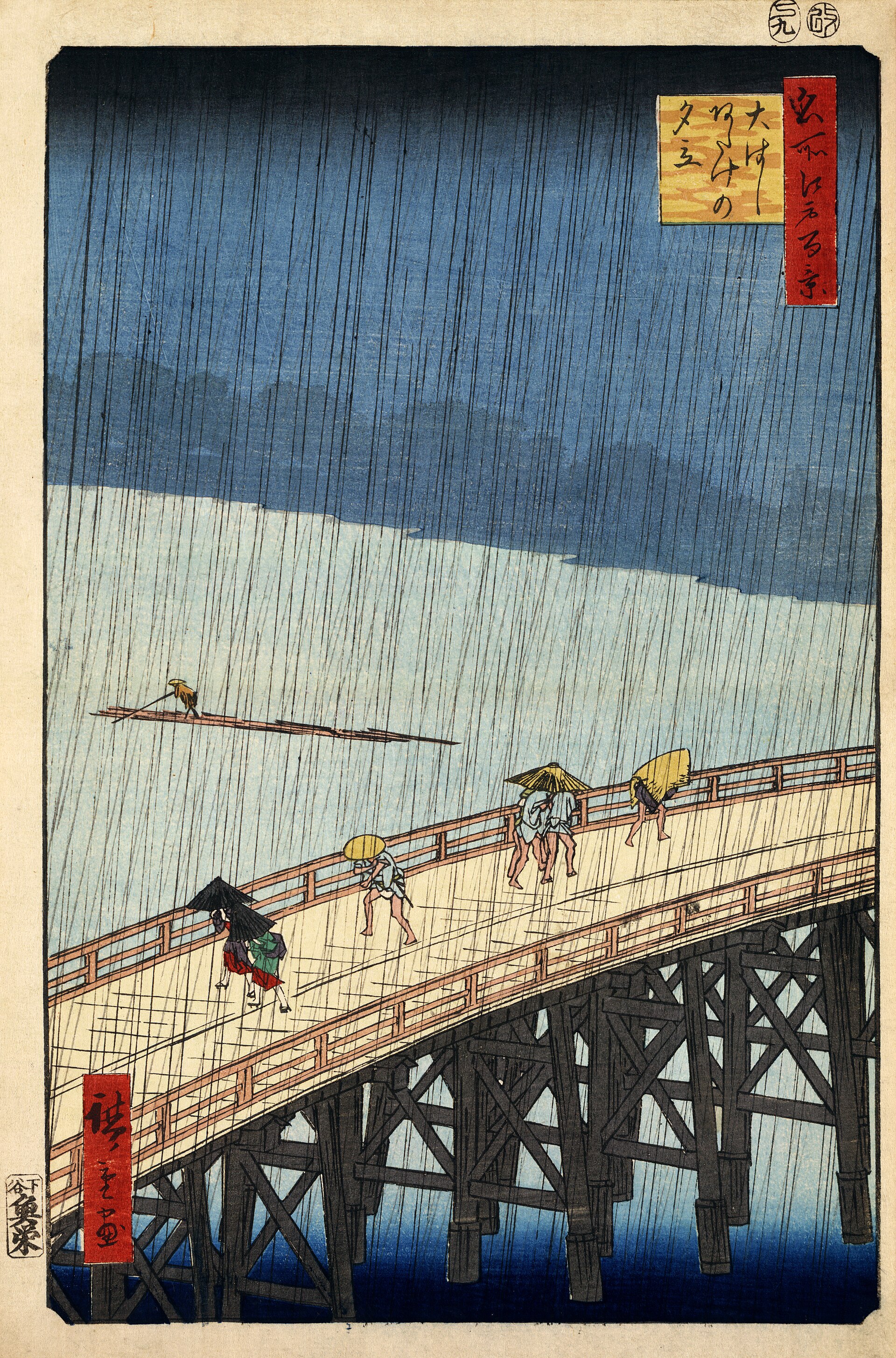
Sudden Shower over Shin-Ohashi Bridge and Atake
1857 · Woodblock print
Library of Congress
 Japanese · 1797-1858
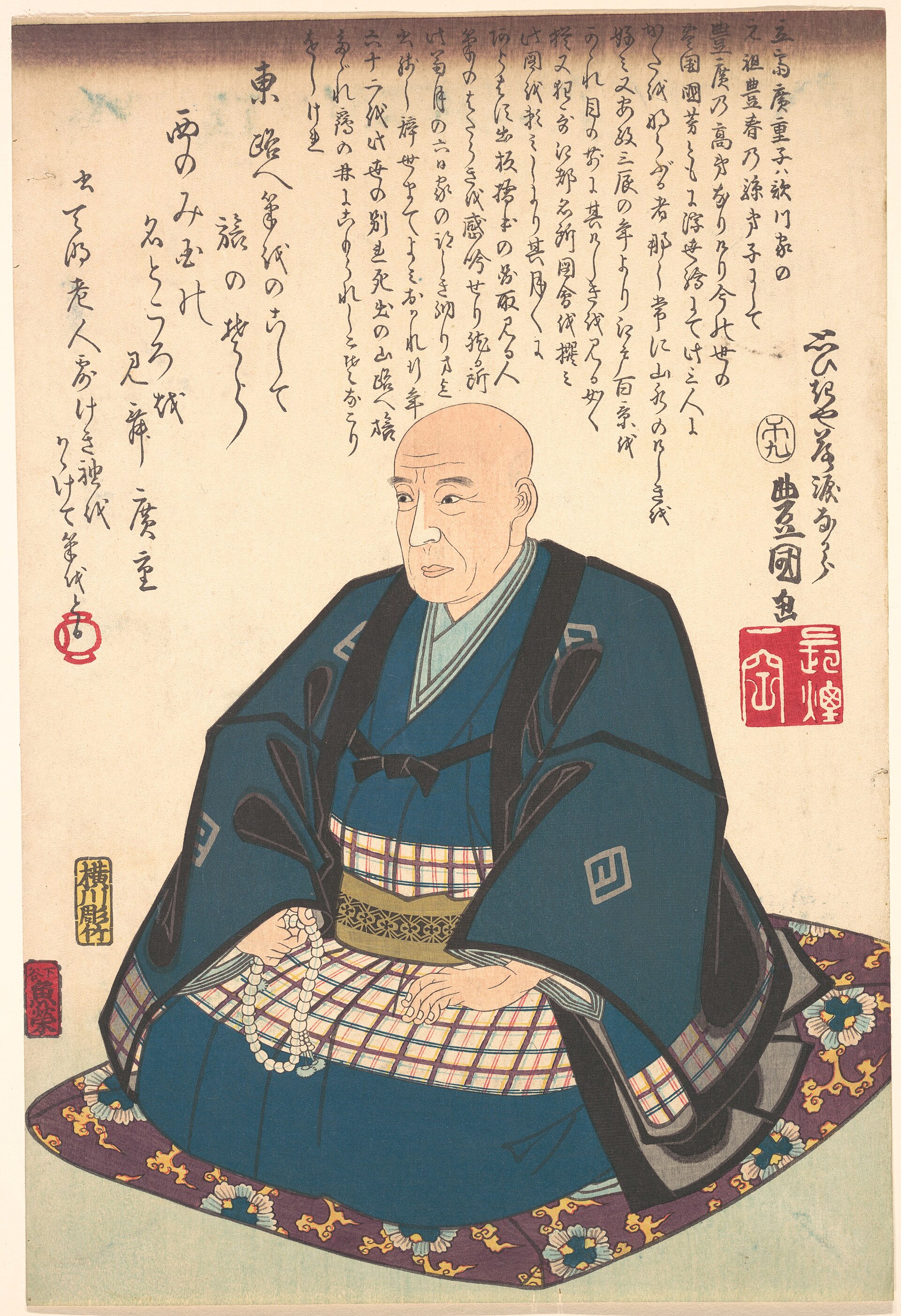
A posthumous memorial portrait, not a self-portrait or a portrait from life: made by Hiroshige's friend and fellow Utagawa-school artist Kunisada (signing as Toyokuni), published in the ninth month of 1858, the month after Hiroshige's death, by Uoya Eikichi, the same publisher then still issuing the unfinished One Hundred Famous Views of Edo. Hiroshige is shown as a Buddhist priest, head shaved, seated with a rosary, the standard convention for this genre of memorial print, shi-ni-e. Kunisada's own inscribed verse reads, in translation, grieving while thinking of him, painted by Toyokuni; a longer elegy on the same sheet is by the poet Tenmei Rojin, Hiroshige's friend and, separately, an admirer of the Hundred Views in his own recorded words. The Metropolitan Museum of Art, which holds this impression, also carries an alternate attribution on its own catalog record to Utagawa Toyokuni II (1777-1835); since that artist died more than two decades before this print was made, that alternate attribution cannot be read literally and most likely reflects a documented historical confusion over Kunisada's own later use of the Toyokuni name (see open_questions).
Metropolitan Museum of Art, New York| Full name | Ando Tokutaro, known professionally as Utagawa Hiroshige (also written Ando Hiroshige, and signing early book work... |
|---|---|
| Worked as | Ukiyo-e print designer, Painter, Book illustrator |
| Born | 1797 · Edo (now Tokyo), Japan |
| Died | 1858 (Ansei 5, 9th month, 6th day by the traditional... · Edo, Japan |
| Nationality | Japanese |
| Movement | Ukiyo-e, Utagawa school |
| In this archive | 1 artwork |
| Sources | 23 cited |
| Last verified |
About this page 1 artwork in the archive · Last verified · 23 sources cited
Utagawa Hiroshige designed the two landscape series most people mean when they picture Japanese woodblock prints without meaning Hokusai: The Fifty-three Stations of the Tokaido, cut in 1833-34, and One Hundred Famous Views of Edo, the project still being issued in installments when he died in 1858. He worked inside a trade, not alone. Every sheet carrying his name also carries a publisher's seal, a carver's unsigned labor and a printer's hand on the baren, and the trade did not stop when he did. Two of his students went on to marry the same woman in succession and sign the same name after him, so that new prints reading Hiroshige kept reaching the shops for more than a decade after the man himself was dead.
The harder thing to find, and the thing this page leads with, is what that signature does and does not guarantee on a sheet that was printed in the thousands from blocks which wore, were recut, and in the twentieth century were cut again from nothing by a workshop that still sells its facsimiles today. Two plates in this page's own gallery are exactly that last thing, an honestly labeled modern facsimile of a Tokaido design rather than an Edo-period pull, because the difference is most of what a serious attribution in this field actually turns on.
None of that diminishes the design work itself. Hiroshige's real innovation, repeated across a documented output in the low thousands, was to put the texture of ordinary travel, rain, snow, a ferry crossing, tired feet on a bridge, into a landscape genre that had mostly been about famous places rather than the people passing through them. Vincent van Gogh copied two of his prints directly onto canvas in 1887, and the debt runs on through much of the Impressionist and Post-Impressionist landscape that followed.
Born in Edo as Ando Tokutaro, son of a hereditary fire warden.1615
His mother dies; his father resigns the fire warden's post to him and dies himself the following year.15
Seeks training with Utagawa Toyokuni I and Utagawa Toyohiro; joins Toyohiro's studio.815
Granted the professional name Utagawa Hiroshige by Toyohiro.814
First signed published work appears, in book illustration.15
Turns decisively toward landscape printmaking.8
Travels the Tokaido as part of an official procession, gathering material for his first great series.178
The Fifty-three Stations of the Tokaido, Hoeido edition, published by Takenouchi Magohachi and Tsuruya Kiemon; establishes his reputation.17
Designs bird-and-flower (kacho-e) tanzaku prints for the publishers Kawaguchiya Shozo and Sanoya Kihei, among others.910118
Designs close to 600 uchiwa fan prints over more than two decades, more than any contemporary.8
His son Nakajiro dies; his first wife had already died.15
Marries his second wife, Yasu.15
Tatsu, later married in turn to both his successors, joins the household.1520
One Hundred Famous Views of Edo published serially by Uoya Eikichi; unfinished at his death.23
Dies in Edo during a severe cholera epidemic; his will shows financial debt. His pupil Shigenobu takes the name Hiroshige II and completes the outstanding plates.1623
A memorial portrait by Kunisada (Toyokuni), published by Uoya Eikichi, is issued.435
Hiroshige II (Shigenobu) dissolves his marriage to Tatsu and moves to Yokohama, per one secondary account; a second account gives this as 1867. The sources consulted do not agree and neither cites a primary document for the date.20
Tatsu marries Shigemasa, who signs work Hiroshige II and then, by 1869, Hiroshige III. The exact year of the marriage is not fixed by the sources consulted for this page.20
Sotheby's London sells a Vever-collection impression of Sudden Shower over Shin-Ohashi Bridge and Atake for GBP 138,600, reported as a record for a single Hiroshige print.1819
The British Museum holds Hiroshige: Artist of the Open Road, its first exhibition devoted solely to the artist in over 25 years; Sotheby's Paris sells a complete set of Famous Places in the Sixty-odd Provinces for a record 2,116,500 EUR.819
Christie's New York begins selling more than 600 prints from the Alan Medaugh collection.19
Hiroshige's market runs on two very different tracks at once. A small number of exceptional, well-provenanced impressions of his most famous designs reach six figures in pounds sterling or more, while ordinary, sound impressions of the same famous series trade at dealer level for a few hundred to a few thousand US dollars, and modern hand-printed facsimiles of the same designs, honestly sold as such by workshops including the Adachi Institute, sell new for the equivalent of tens of dollars. Condition, impression generation and provenance separate those tiers far more than the design itself does, since Hiroshige printed in the thousands rather than in the small, closely tracked runs that make a Sharaku or an Utamaro portrait scarce.
| Date | Sale | Work | Result | Note |
|---|---|---|---|---|
| 2022-07 | Sotheby's, London | Sudden Shower over Shin-Ohashi Bridge and Atake, One Hundred Famous Views of Edo (a different impression from the one in this archive's Shin-Ohashi record) | With premium GBP 138,600 total, reported GBP | From the historic collection of Henri Vever (1854-1942); estimate GBP 70,000-100,000 per Sotheby's own lot page. Described at the time as a world record for a single Hiroshige print, an early deluxe impression in pristine condition. The hammer/premium split was not independently confirmed from Sotheby's public lot page, which requires a login to show results; the total figure is as reported by a tertiary source (see sources). |
| 2025 | Sotheby's, Paris | Famous Places in the Sixty-odd Provinces, complete set | With premium EUR 2,116,500 EUR | The artist's outright auction record for a body of work rather than a single sheet, as reported by a tertiary source; a US dollar equivalent of roughly 2.4 million circulated in press coverage. As elsewhere in this archive, the currency the sale actually struck in (EUR) is treated as the real figure and the dollar conversion as derived. |
| 2004-2017 (sample) | Artelino (dealer/auction archive) | Individual Hoeido-edition Tokaido station sheets (Nihonbashi, Shinagawa, Kawasaki, Kanagawa, Hodogaya, Totsuka, Fujisawa, Oiso, Odawara, Hakone and others) | With premium USD 420 to 2,100 per sheet across the sampled results USD | Ordinary trade-level results for genuine, generally sound individual station prints, offered by a specialist Japanese-print dealer rather than a major auction house; included to show the price floor for authentic but unexceptional impressions, well below headline auction prices for the same series. |
Hammer is the price at which the bidding stopped; with premium adds the fee the house charges the buyer on top. Hammer price and buyer's premium in the glossary.
| Institution | City | Holdings | Note |
|---|---|---|---|
| Library of Congress, Prints and Photographs Division | Washington, D.C. | Holds the impression of Sudden Shower over Shin-Ohashi Bridge and Atake already recorded in this archive, plus other Hoeido Tokaido sheets including two Adachi Institute facsimile impressions of Nihonbashi illustrated on this page. | Digitized under a Nichibunken-sponsored program; the original sheets are restricted as fragile. |
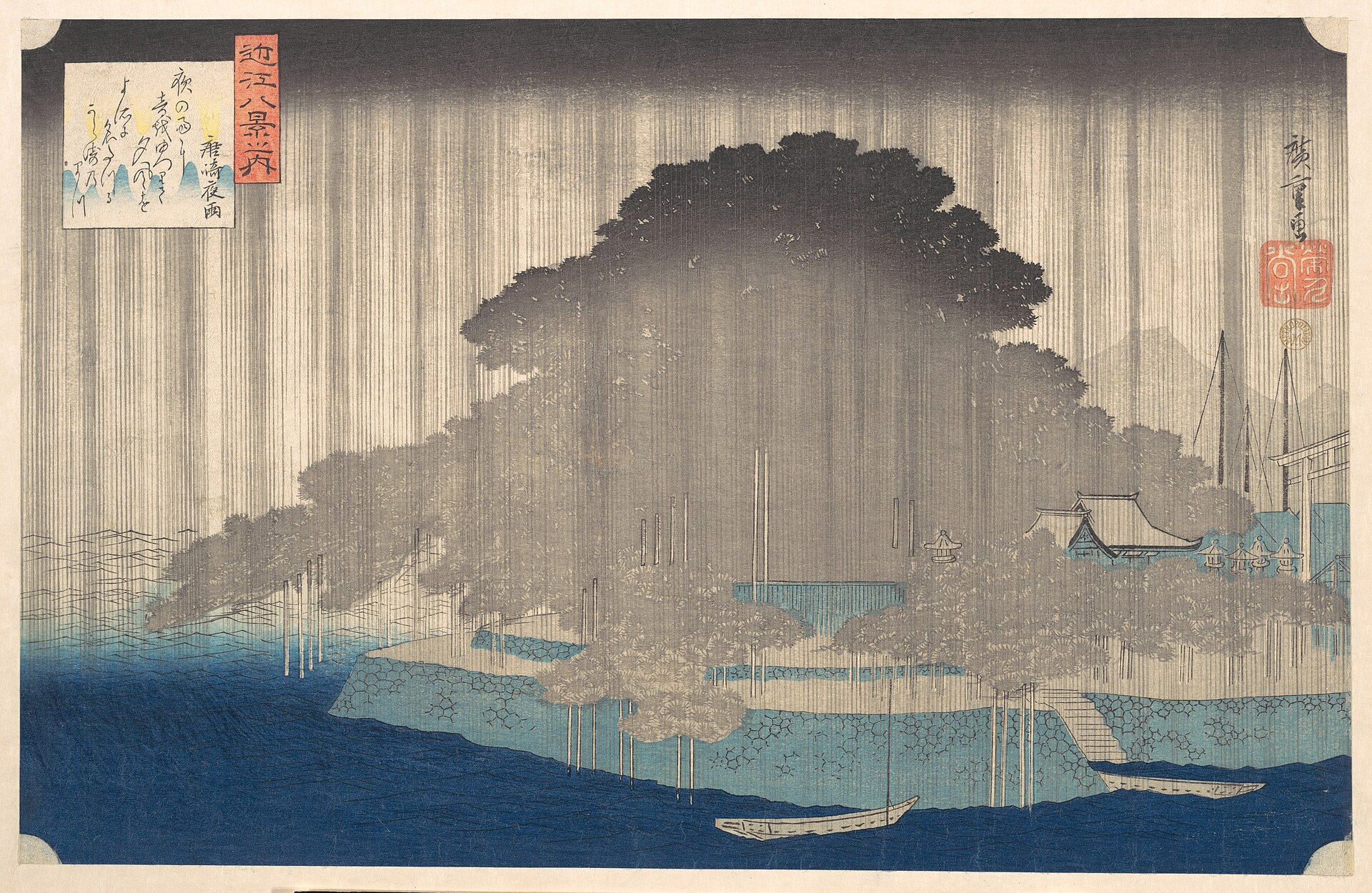
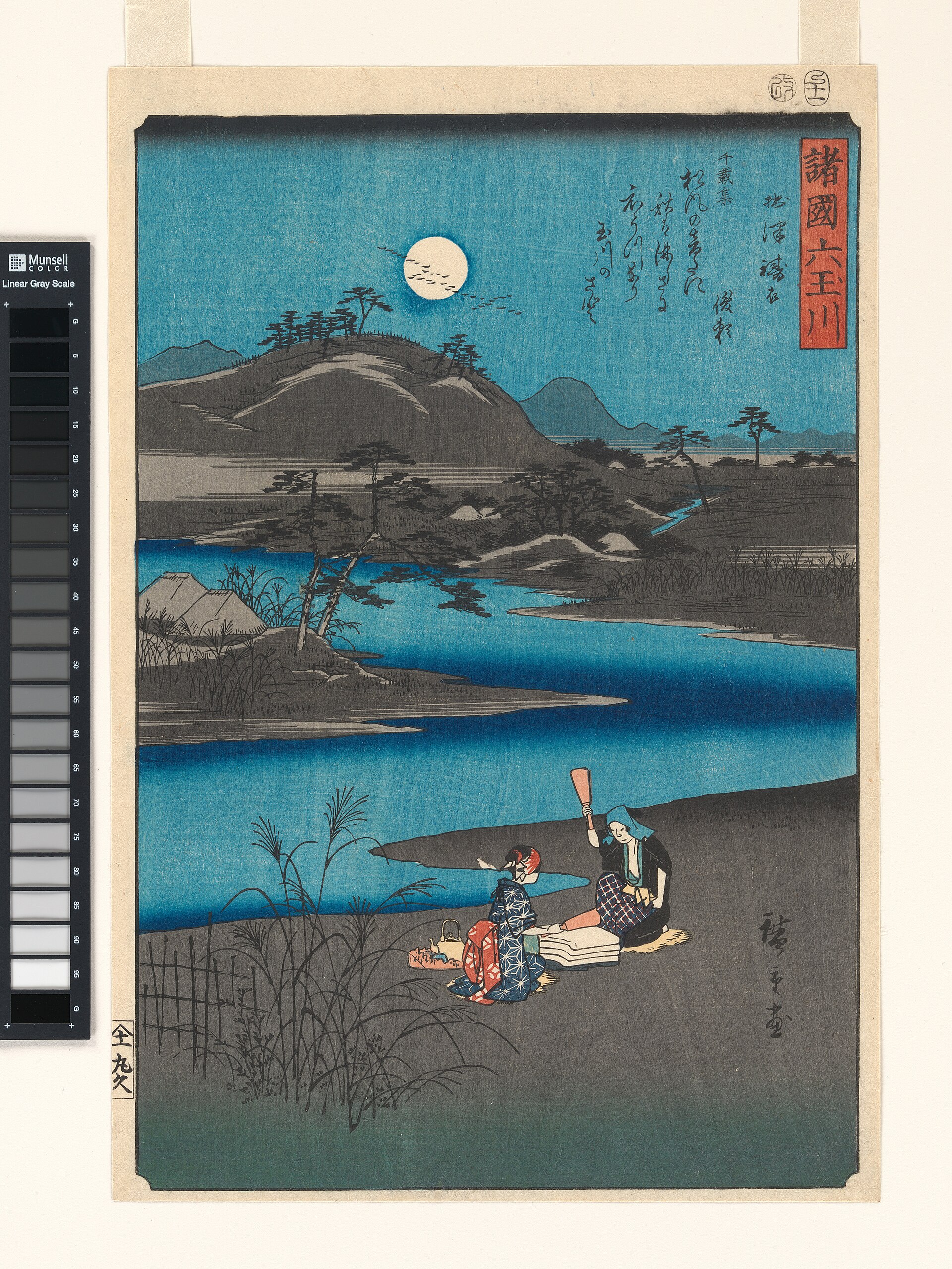
| Metropolitan Museum of Art | New York | Genuine Edo-period impressions including Sudden Shower at Shono (Hoeido Tokaido), Night Rain at Karasaki (Eight Views of Omi) and Six Jewel Rivers from Various Provinces, all illustrated in this page's gallery, plus the Kunisada memorial portrait of Hiroshige used as this page's portrait. | Released under the Met's open access policy; several are CC0 on Wikimedia Commons. |
| Museum of Fine Arts, Boston | Boston | Holds a Kunisada memorial portrait of Hiroshige, accession 11.15638, from the William Sturgis Bigelow collection, with detailed cataloguing of its publisher, blockcutter and date used on this page. | |
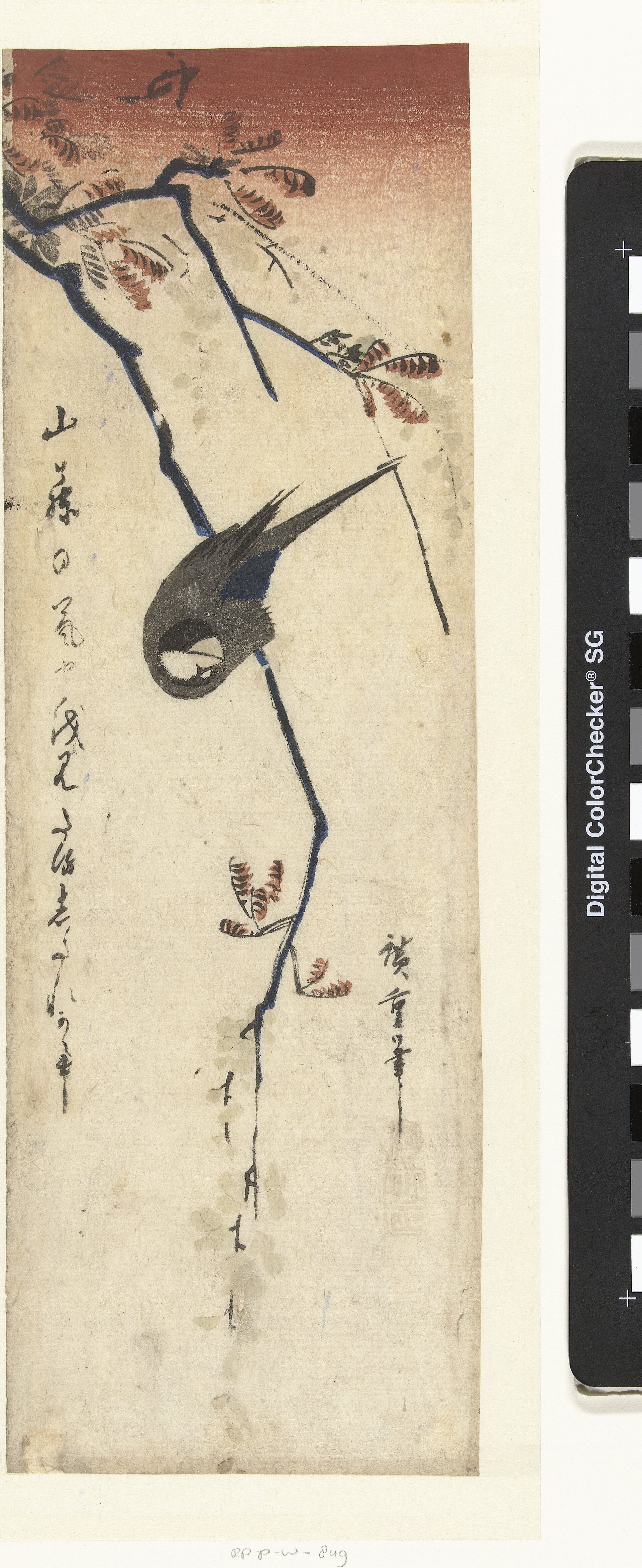
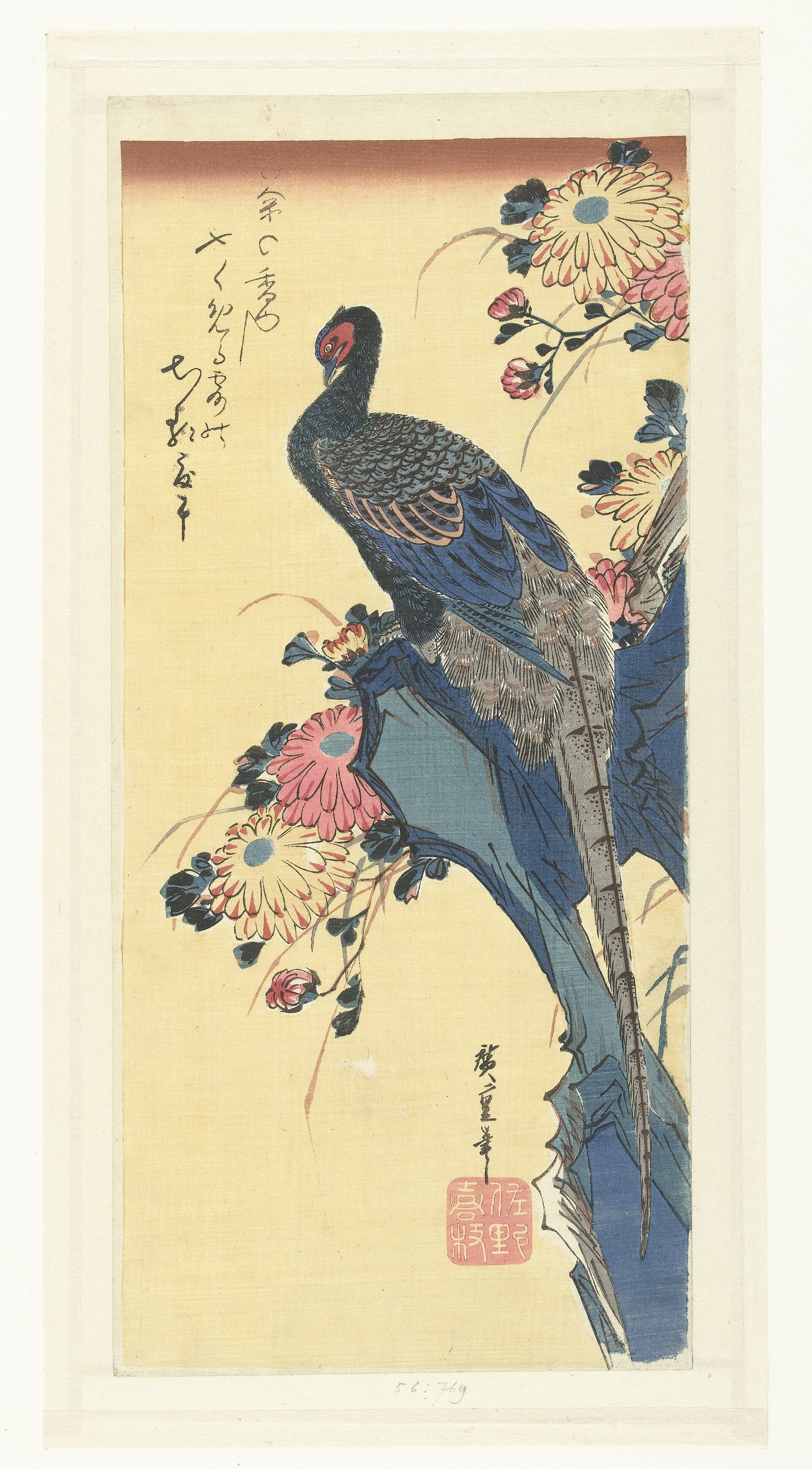
| Rijksmuseum | Amsterdam | Holds bird-and-flower (kacho-e) tanzaku prints by Hiroshige, three of which are illustrated in this page's gallery, catalogued to their original 1833-37 publishers. | Released as CC0. |
| British Museum | London | Held the exhibition Hiroshige: Artist of the Open Road in 2025, drawing on loans from the Alan Medaugh collection; its own curatorial account is a principal source for this page. | |
| Brooklyn Museum | New York | Holds a complete set of One Hundred Famous Views of Edo, the basis of Henry Smith and Amy Poster's 1986 catalogue, and holds the impression of Sudden Shower over Shin-Ohashi already cited in this archive's own record for that print. | |
| Art Institute of Chicago | Chicago | Holds Hoeido Tokaido impressions and a Kunisada memorial portrait of Hiroshige. | The museum's own object pages were not directly reachable for this record; live.artic.edu returned a Cloudflare block to automated retrieval (see sources). |
| Ota Memorial Museum of Art (Otakinen Museum) | Tokyo | A museum dedicated to ukiyo-e that has published research specifically on Hiroshige's biography and death, cited on this page and in this archive's Shin-Ohashi record. | Specific holdings were not itemized for this page. |
Hiroshige was born in Edo in 1797 as Ando Tokutaro, the son of Ando Genyemon (also transliterated Genemon), who held the hereditary post of fire warden, jobikeshi-doshin, in the Yayosu (Yaesu) fire...
Hiroshige was born in Edo in 1797 as Ando Tokutaro, the son of Ando Genyemon (also transliterated Genemon), who held the hereditary post of fire warden, jobikeshi-doshin, in the Yayosu (Yaesu) fire brigade attached to the Tokugawa shogunate, on the east side of Edo Castle. The post carried some standing but little duty in the closing, slack decades of the Tokugawa regime, and firemen of this rank were known to spend much of their time on amateur art, netsuke carving and verse rather than fire-fighting. According to Britannica's account, Hiroshige's mother died in the spring of 1809, when he was twelve; his father resigned the post to him shortly afterward and died himself early the following year. Hiroshige's own duties as fire warden were minimal and his wages small, which left him time for the sketching he had already shown a taste for.
He was not a child prodigy. Several accounts agree that an early tutor, a fireman with some training in the Kano school, and a family friend, the amateur painter Okajima Rinsai, gave him his first instruction, but nothing survives from that period, and his first signed, published work did not appear until 1818, six years after he had already been granted a professional name.
Around 1811 Hiroshige sought training with two prominent Utagawa-school artists working in Edo's popular Floating World milieu: Utagawa Toyokuni I, the fashionable master of actor and beauty prints...
Around 1811 Hiroshige sought training with two prominent Utagawa-school artists working in Edo's popular Floating World milieu: Utagawa Toyokuni I, the fashionable master of actor and beauty prints, and Utagawa Toyohiro. The British Museum's 2025 curatorial account states plainly that both masters turned him away at first, and that he applied a second time to Toyohiro, who relented. An older account, Edward Strange's 1925 biography, frames the same episode more gently, as Toyokuni's crowded studio simply having no room and Hiroshige going to Toyohiro instead; either way the outcome was the same. Toyohiro's more restrained, less gaudy taste is generally credited with shaping the younger artist's eye, in contrast to what a lifetime spent imitating Toyokuni's actor prints might have produced.
Only about a year into his apprenticeship, in the 3rd month of 1812, Toyohiro granted him the professional name Utagawa Hiroshige, combining the hiro of Toyohiro's own name with a Japanese-style reading, shige, of a character from Hiroshige's given name at the time, Juemon. He held that name, plus the later art-name Ichiyusai, for the rest of his life. His first signed published work did not appear until 1818, in book illustration; for a decade after that he worked in the ordinary Floating World trade of actor portraits, images of beautiful women and fan paintings, not yet the landscapes he became known for.
Around 1830 Hiroshige turned decisively to landscape.
Around 1830 Hiroshige turned decisively to landscape. In 1832 he traveled the Tokaido, the coastal highway linking Edo to the imperial capital at Kyoto, as part of an official procession; the trip supplied the first-hand material for The Fifty-three Stations of the Tokaido, published in 1833-34 and co-issued by two publishers working together, Takenouchi Magohachi under the studio name Hoeido and Tsuruya Kiemon under the studio name Senkakudo. Despite its title the series runs to 55 designs, one for each of the 53 official post stations plus a view of the starting point at Nihonbashi in Edo and the destination at Sanjo Bridge in Kyoto. It became, by wide agreement among dealers and museums, the best-selling and most imitated of Hiroshige's many later Tokaido series, and it made his reputation as a landscape artist.
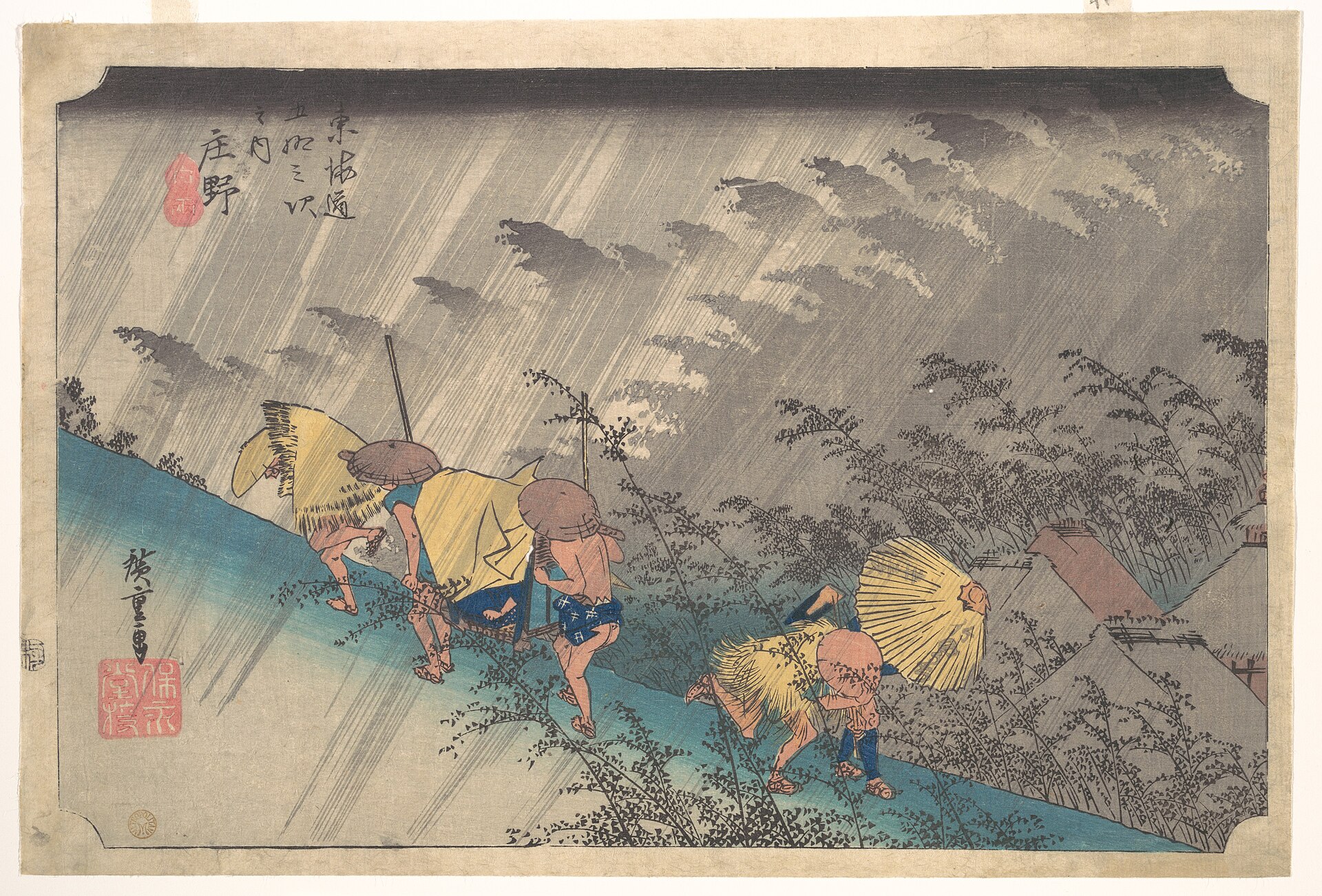
One sheet from this edition, Sudden Shower at Shono, showing travelers bent against a driving rain on a hillside above the station of Shono, is illustrated in this page's gallery from a genuine Edo-period Hoeido-edition impression at the Metropolitan Museum of Art. It is worth setting beside the print already in this archive's own record for Sudden Shower over Shin-Ohashi Bridge and Atake, from Hiroshige's last series 24 years later: two rainstorms, a quarter-century apart, by the same hand, in two different formats and two different modes of carving the rain itself.
No print carrying Hiroshige's name was made by Hiroshige alone.
No print carrying Hiroshige's name was made by Hiroshige alone. For each design he prepared a detailed outline drawing on thin paper, hanshita-e, block-ready drawing, which after a government censor's approval went to a master block-cutter. That craftsman, trained for roughly a decade, pasted the drawing face-down onto a block of mountain cherry wood, cut precisely along the outlines and chiseled away the surrounding wood to leave the key block, omohan, then cut a further block for each color. A printer, also apprenticed for about ten years, mixed the pigments, registered each color block against the others using small notches cut into the wood, kento, and transferred the ink to paper by hand with a round, bamboo-wrapped pad, the baren; no mechanical press was involved anywhere in the process. Effects that read as painterly, the graded sky, embossed texture, mica grounds on other artists' prints, were the printer's craft as much as the designer's idea.
The consequence for how a page like this one should be read is direct: Hiroshige himself never touched a printing block. What a signature guarantees is the design; the carving and the printing were done by named or, far more often, unnamed specialists whose individual skill is why the same design can look markedly different, and be worth markedly different amounts, from one impression to the next.
Japanese has words for the distinction that most determines what an ukiyo-e sheet is worth: shozuri, first printings pulled while the blocks were fresh, with crisp key-block lines, the full intended...
Japanese has words for the distinction that most determines what an ukiyo-e sheet is worth: shozuri, first printings pulled while the blocks were fresh, with crisp key-block lines, the full intended color scheme and clean bokashi gradation; and atozuri, later printings from the same blocks after wear had begun to blur the lines and simplify the color. A design could stay in print for years after its first run, and after an artist's death long after that, with no change to the signature on the sheet.
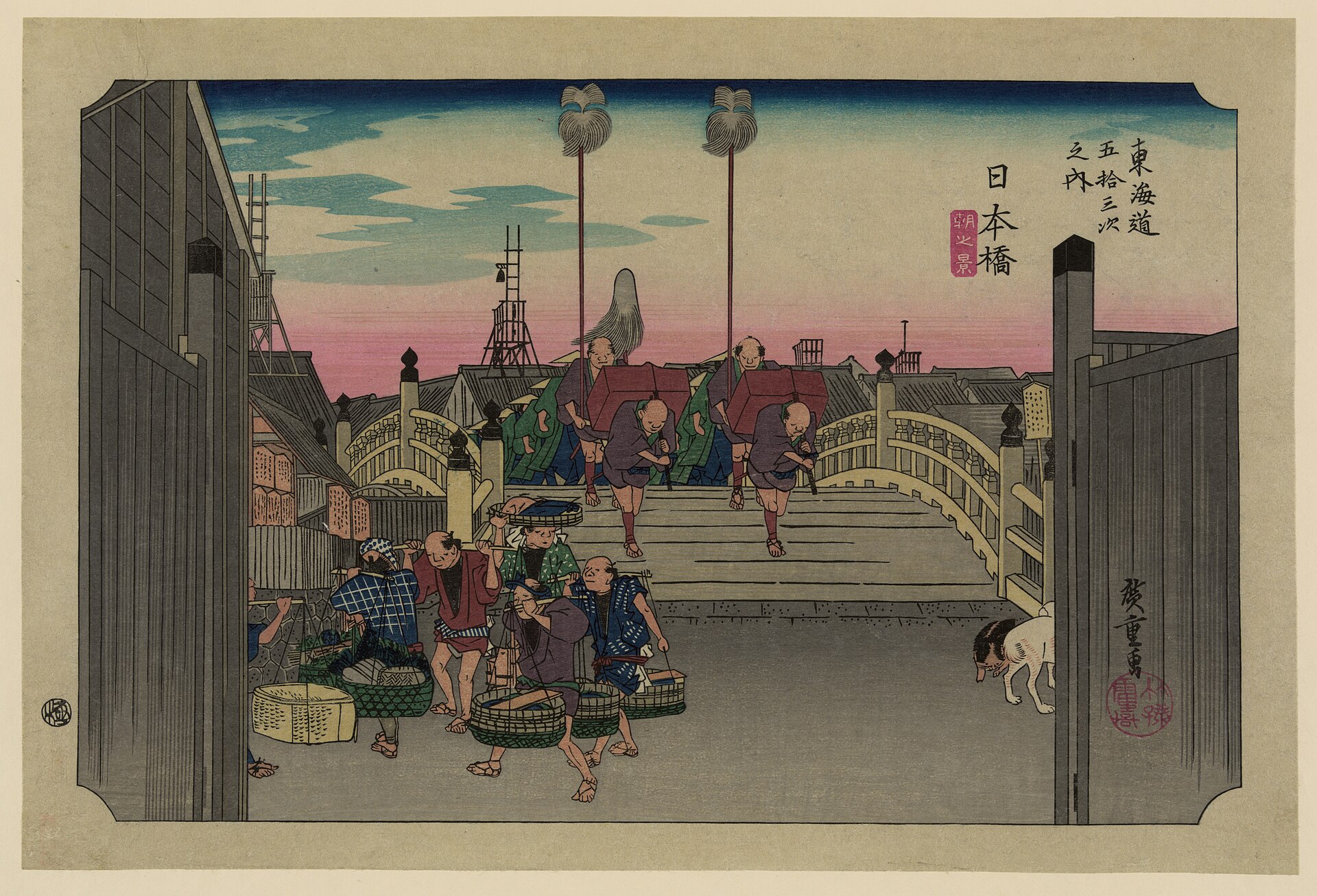
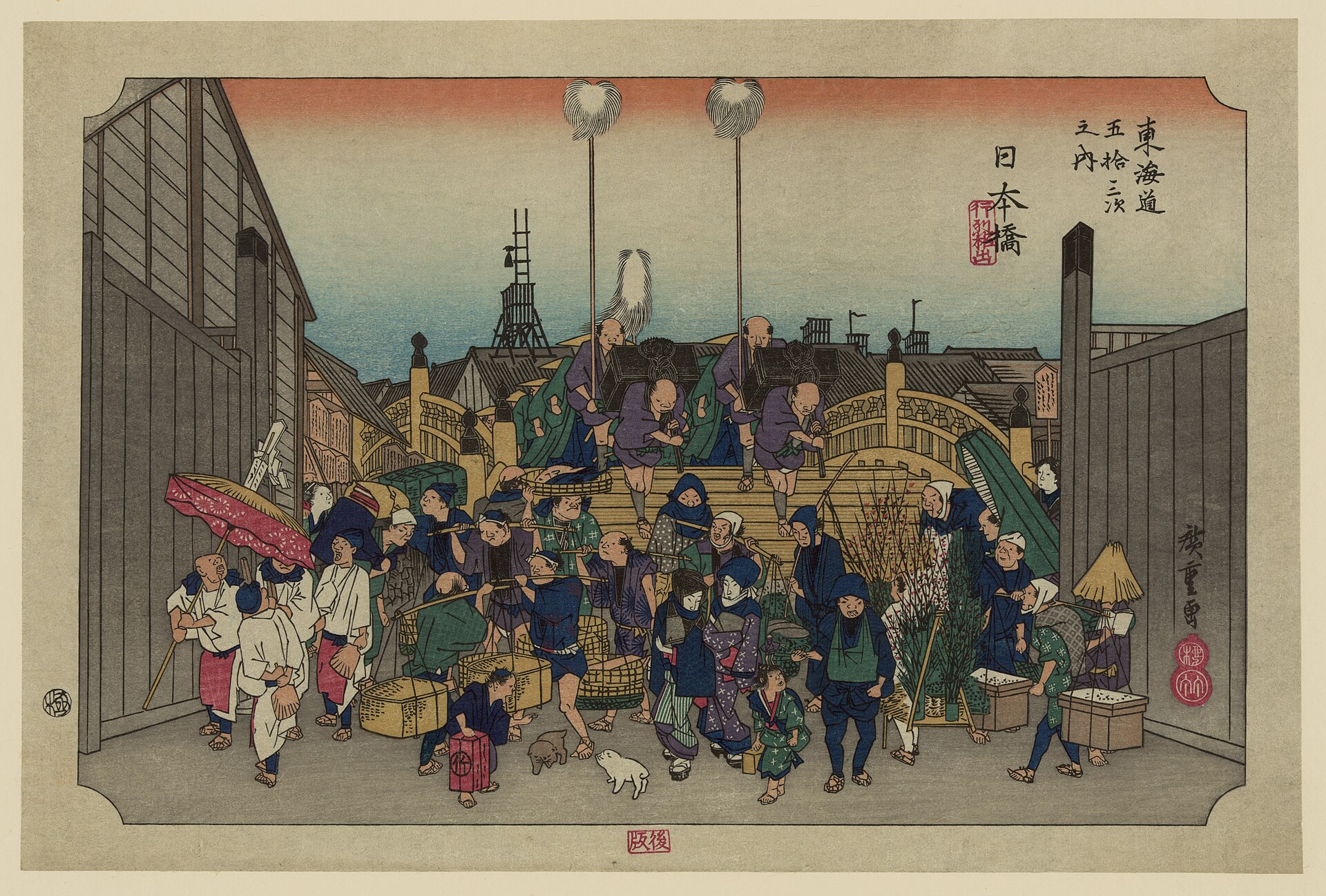
Two plates in this page's gallery make the more extreme version of that problem concrete rather than abstract. Both are impressions of Nihonbashi, the first design in the Hoeido Tokaido, held by the Library of Congress; the Library's own catalog record for each one states plainly that it is an Adachi modern reprint, Showa era, meaning a twentieth-century facsimile hand-printed by the Adachi Institute of Woodcut Prints in Tokyo from blocks the Institute itself recut, not a nineteenth-century pull from Hiroshige's own lifetime blocks. One is catalogued simply as Nihonbashi, the other as Nihonbashi, 2nd edition, reflecting that the Hoeido Tokaido's opening design is documented in more than one composition: the dealer archive Artelino describes a state showing a busy morning crowd of merchants and porters crossing the bridge, and a second state showing a daimyo's procession on the same bridge instead, changes generally accepted as made or approved by Hiroshige himself at the publisher's request rather than later interference. Both Library of Congress sheets illustrated here show the porters-and-merchants composition, not the procession.
The point of showing two honestly labeled facsimiles rather than omitting them is that the facsimile trade is not a fringe problem in this field, it is the ordinary condition of encountering Hiroshige's most famous series today. Recut, hand-printed reproductions of the Hoeido Tokaido and the Hundred Views, made the Edo way on cherry blocks and washi paper, are sold openly and inexpensively by name-brand Japanese workshops, Adachi among them, alongside the Edo-period originals that command five and six figures at auction; the seal in the margin, since reproductions generally copy it faithfully, proves nothing on its own about which one a given sheet is.
Hiroshige's last major series, One Hundred Famous Views of Edo, comprises 118 numbered views organized by the traditional lunar seasons plus a title page, published serially between 1856 and 1858-59...
Hiroshige's last major series, One Hundred Famous Views of Edo, comprises 118 numbered views organized by the traditional lunar seasons plus a title page, published serially between 1856 and 1858-59 by Uoya Eikichi. He did not live to see it finished, dying in 1858 with a small number of plates still outstanding; his successor Hiroshige II completed them, bringing the eventual total to 120 sheets. This archive already holds a full record for the series' most reproduced plate, Sudden Shower over Shin-Ohashi Bridge and Atake, cataloguing a Library of Congress impression in depth, including its print-state, Van Gogh and market history, and nothing here repeats that record rather than points to it.
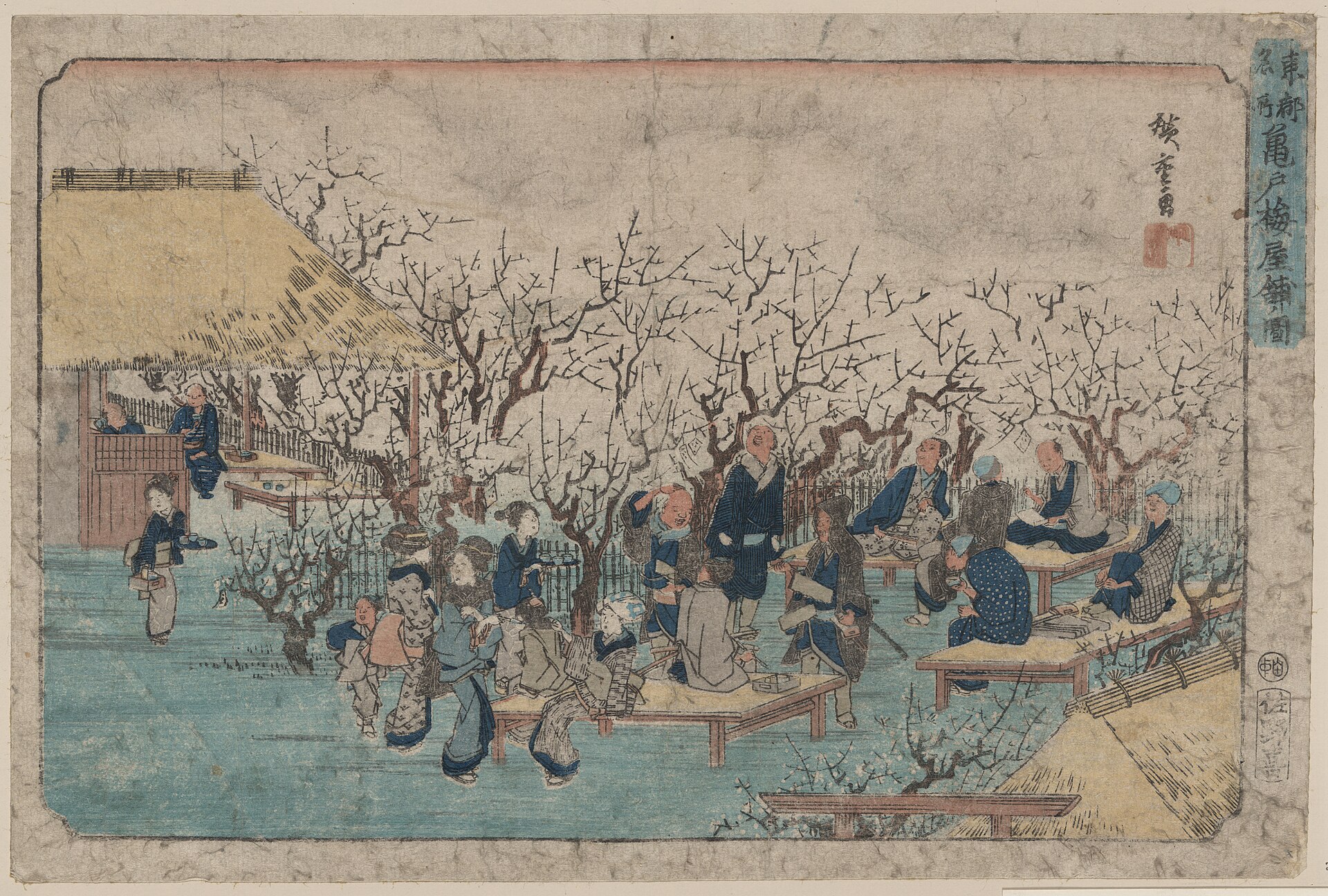
What belongs on this page instead is the second half of the same story. Van Gogh did not copy only the bridge in the rain; in the same weeks of 1887 he also painted Flowering Plum Tree, after Hiroshige's Plum Estate at Kameido, Kameido Umeyashiki, plate 30 of the same series, now illustrated here in a Library of Congress impression alongside its companion. Together the two oil copies, both at the Van Gogh Museum in Amsterdam, are the best-documented instance of any Western painter working directly from specific, identifiable sheets of Hiroshige's late work, technical examination reported by the British Museum in 2025 found a pencil tracing mark on Van Gogh's own copy of the bridge print lining up precisely with his transfer of the design to canvas.
Alongside the travel series Hiroshige worked steadily in kacho-e, bird-and-flower prints, most often in the tall, narrow tanzaku format recalling a poem-card.
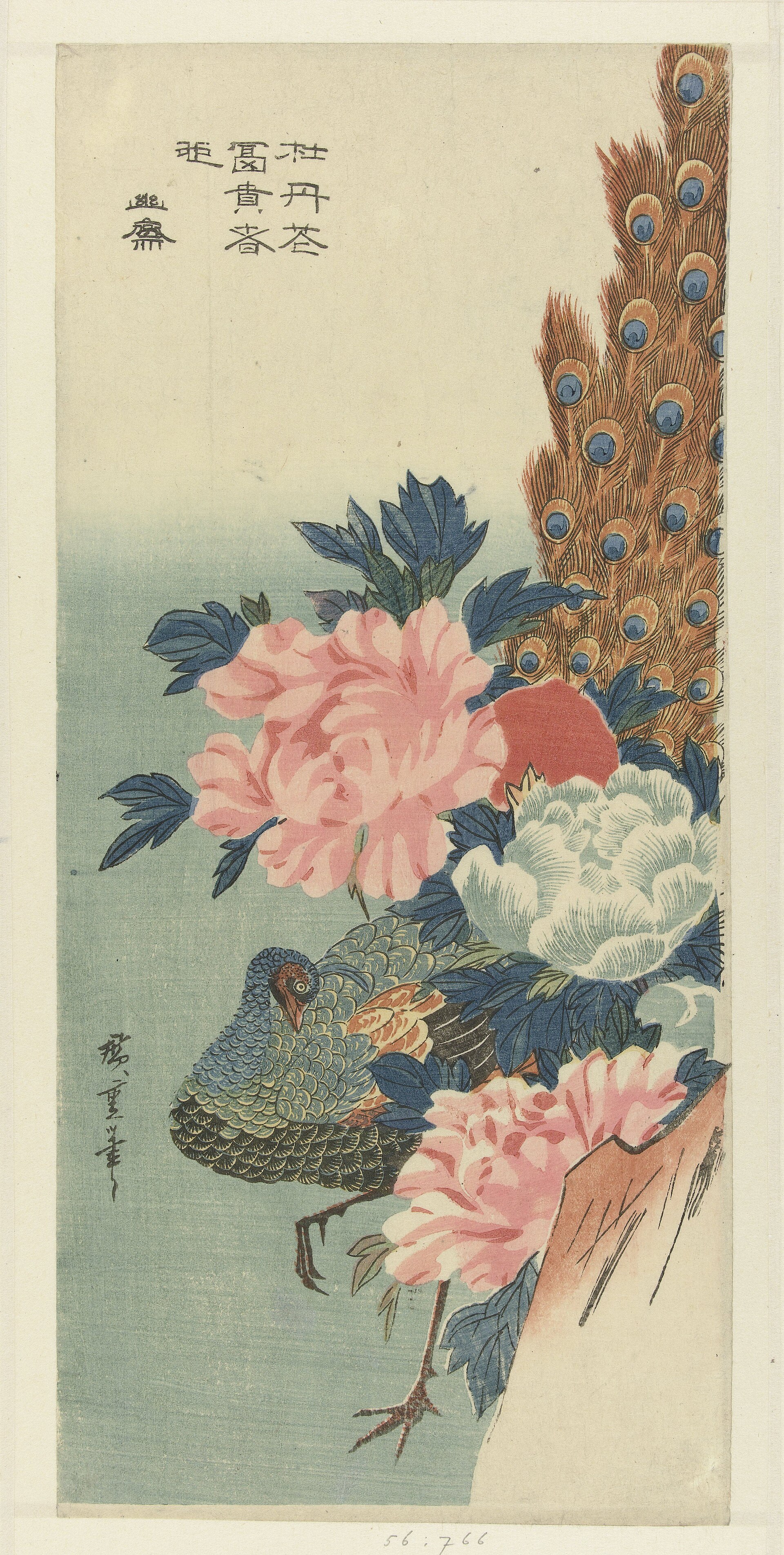
Alongside the travel series Hiroshige worked steadily in kacho-e, bird-and-flower prints, most often in the tall, narrow tanzaku format recalling a poem-card. The Rijksmuseum's own catalog records for three sheets illustrated in this page's gallery, a bird on a wisteria branch, a pheasant among chrysanthemums and a peacock beneath peonies, date all three to 1833-1837 and name two different publishers responsible for issuing them, Kawaguchiya Shozo, studio name Shoeido, and Sanoya Kihei; the British Museum's 2025 account independently names Kawaguchiya Shozo as the publisher behind roughly forty medium tanzaku nature prints Hiroshige designed in the same short span, an unprompted match between an Amsterdam museum's catalog card and a London curator's research that is a small, useful proof of how consistently this material has been documented.
The deep, near-black blue in these prints and in Hiroshige's skies and rivers generally is consistent with Prussian blue, known in Japan as bero-ai after Berlin, the European city associated with its manufacture. It reached Japan as an import, too costly at first for large-scale printing, and became cheap enough for it once Chinese manufacture of the pigment began around the end of the 1820s, just as Hiroshige was turning to landscape. The characteristic saturated skies and water of his generation of ukiyo-e were made possible by an imported industrial chemical, not by anything unique to indigenous materials, a pattern that holds across nineteenth-century Japanese printmaking generally.
Starting in the mid-1830s and continuing for more than twenty years, Hiroshige designed close to 600 uchiwa, the round, hand-held fan prints sold cheaply for a single summer's use and then usually...
Starting in the mid-1830s and continuing for more than twenty years, Hiroshige designed close to 600 uchiwa, the round, hand-held fan prints sold cheaply for a single summer's use and then usually discarded, more than any other artist of his generation produced. The British Museum's 2025 account is explicit that this figure is regularly revised upward: many of these fan designs are known today from only a single surviving example, and on that basis a recent estimate places the true size of the fan corpus alone nearer 1,000 designs, not his whole career output, just the fan prints. It is a useful miniature of the larger problem: a national collection with curatorial resources is still finding previously unrecorded Hiroshige sheets in a corpus more than a century and a half old.
There is no ratified total and no single body that certifies one.
There is no ratified total and no single body that certifies one. The figure most often repeated in general and dealer literature is a round 5,000 to 8,000 designs across prints, paintings and book illustrations; a more conservative tertiary estimate puts the print total nearer 4,000 to 4,500. The British Museum's 2025 account gives a figure that can be checked by arithmetic rather than simply repeated: it states that Hiroshige devoted more than twenty different print series to the Tokaido alone, amounting to roughly 700 prints, or 15 percent of his output. Taken at face value that implies a total design output on the order of 4,500 to 4,700, which sits inside the range the popular literature gives, though this page's own derivation of that number from the museum's stated percentage should be read as exactly that, an inference, not a figure the museum itself states outright. Beyond the prints, the same account credits him with hundreds of paintings and dozens of illustrated books, categories with even less settled counts.
Unlike a single, endlessly re-examined design such as Hokusai's Great Wave, no comparable sheet-by-sheet census exists for any individual Hiroshige print, let alone his whole oeuvre. The nearest things to an authority are survey scholarship rather than a numbered catalogue raisonne: Henry D. Smith II and Amy G. Poster's 1986 Brooklyn Museum volume, built from the Brooklyn Museum's own complete set of the Hundred Views and illustrating every plate at full size with individual commentary, and Matthi Forrer's 1997 monograph, with essays by Suzuki Juzo and Smith. Neither book's plate-by-plate judgments were examined directly for this page, and both are cited here for their scope and standing rather than for any specific ruling drawn from them.
Hiroshige's first wife, of samurai descent, bore him a son, Nakajiro, and died before 1845, when Nakajiro also died young; he then married a second wife, Yasu, some twenty years his junior.
Hiroshige's first wife, of samurai descent, bore him a son, Nakajiro, and died before 1845, when Nakajiro also died young; he then married a second wife, Yasu, some twenty years his junior. According to Edward Strange's 1925 account, Hiroshige and Yasu also had, or adopted, a daughter, Tatsu; a later secondary account states more specifically that Tatsu was Yasu's niece, adopted into the family around 1851 after her father, Yasu's brother, was banished from the priesthood over an affair. The two accounts are not fully reconcilable on the details and neither was independently verified against a primary genealogical record for this page.
What is documented without dispute is what happened to the name after 1858. Tatsu married Hiroshige's leading pupil, who signed his own work Shigenobu and took the name Hiroshige II on his teacher's death, completing the outstanding plates of the Hundred Views. The marriage did not last: by 1865 Shigenobu had dissolved it and left Edo for the newly opened treaty port of Yokohama, where he worked under a different name. Tatsu then married another of Hiroshige's students, Shigemasa, who at first also signed himself Hiroshige II before settling, by 1869, on Hiroshige III, apparently after the first Hiroshige II's death that year. For roughly a decade after the original Hiroshige died, more than one living artist had a family-sanctioned claim to sign new work with his name, and a sheet reading simply Hiroshige from that window belongs to one of three different hands depending on when, precisely, it was cut.
Hiroshige died in the autumn of 1858, during a cholera epidemic that struck Edo hard that year; the Ota Memorial Museum of Art records that roughly 28,000 people are reported to have died in the city...
Hiroshige died in the autumn of 1858, during a cholera epidemic that struck Edo hard that year; the Ota Memorial Museum of Art records that roughly 28,000 people are reported to have died in the city in 1858, without establishing with certainty whether cholera itself, rather than some other cause coinciding with the epidemic, killed Hiroshige specifically. The British Museum's 2025 account adds a detail the older biographical tradition mostly omits: despite two decades as one of the most commercially successful print designers in Japan, Hiroshige reportedly sought frequent loans to cover his household expenses and died in debt, and his surviving will shows what the museum's curator describes as cloudy hesitations and misgivings over his finances and over how to acknowledge his samurai origins. It is a plainer, more precarious picture of the man than the serene landscapes suggest.
His death poem, jisei, is recorded in more than one English rendering; this archive's existing record for the Shin-Ohashi print gives one translation, and the British Museum's 2025 account gives another, differing in wording but not in sense, both invoking the Buddhist Pure Land of Amida in the west as the destination of a life spent recording the sights of the east, Edo. Multiple honest translations of the same seventeen-century-old Japanese verse are ordinary, not evidence that either one is wrong.
In the ninth month of 1858, the month after his death, a memorial portrait was published under the title Memorial Portrait of Ichiryusai Hiroshige, drawn by his friend and fellow Utagawa-school artist Kunisada, who was by then working under the inherited name Toyokuni, blockcut by Yokokawa Takejiro and issued, in a detail that ties the print directly back to Hiroshige's own last project, by Uoya Eikichi, the same publisher who had issued the still-unfinished Hundred Views. It belongs to a recognized Edo genre, shi-ni-e or death pictures, memorial prints normally circulated privately among an artist's own circle rather than sold to the general public, conventionally showing the deceased dressed as a Buddhist priest, head shaved, holding a rosary. Kunisada's own inscribed verse beside his signature reads, in translation, grieving while thinking of him, painted by Toyokuni; the sheet also carries a longer inscription, in the hand of the poet and literary friend Tenmei Rojin, that period translations identify as Hiroshige's own death poem rather than a separate composition of Rojin's own, the same Tenmei Rojin who, in his own lifetime, had praised the Hundred Views for pictures that seem to place the landscapes before our very eyes. A period authority on Japanese prints, Basil Stewart, called Kunisada's portrait of Hiroshige undoubtedly Kunisada's best work in figure-studies, and a notable example in portraiture by any artist.
In July 2022 Sotheby's London sold, as part of a run of lots from the historic Henri Vever collection, an impression of Sudden Shower over Shin-Ohashi Bridge and Atake described as an early deluxe...
In July 2022 Sotheby's London sold, as part of a run of lots from the historic Henri Vever collection, an impression of Sudden Shower over Shin-Ohashi Bridge and Atake described as an early deluxe impression in pristine condition, against a published estimate of GBP 70,000 to 100,000; reported at GBP 138,600, it was described at the time as a world record for a single Hiroshige print. This archive's own existing record for a different impression of the same design already documents a later sale, at Sotheby's London in September 2023, from the collection of the musician Freddie Mercury, which hammered at GBP 230,000 and totaled GBP 292,100 with premium, a higher figure than the 2022 total. Whether the 2023 Mercury sale is now recognized as having reset the auction record the 2022 sale claimed, or whether the record label applied to the 2022 sale on some narrower basis this page's sources do not specify, was not resolved by the sources consulted here and is recorded as an open question rather than guessed at.
Set against those headline sales, the ordinary trade in individual Hoeido Tokaido sheets runs far lower: the dealer archive Artelino records single station prints from the same 1833-34 edition, in generally sound condition, selling at auction for sums in the low hundreds to low thousands of US dollars, 420 to 2,100 dollars across a sample of results from 2004 to 2017, which is the more representative price for a genuine but unexceptional Edo-period impression once celebrity provenance and record-chasing are set aside.
The artist's outright auction record, for an entire body of work rather than a single sheet, was set at Sotheby's Paris in 2025, when a complete set of Famous Places in the Sixty-odd Provinces realized 2,116,500 EUR; a US dollar equivalent of roughly 2.4 million circulated in press coverage of the sale, and as with other cross-currency auction results in this archive, the currency the saleroom actually struck the hammer in is the one recorded here as the real figure. As of September 2026, Christie's has begun selling, in New York, more than 600 prints from the fifty-year private collection of the American collector Alan Medaugh, the same collection that lent images to the British Museum's 2025 Hiroshige exhibition; Christie's own specialists describe Hiroshige as having a market moment, with estimates raised repeatedly over the preceding six or seven years. That sale was still in progress at the time this page was written and its results are not yet part of the record.
Ukiyo-e print designer; Painter; Book illustrator. 1797-1858.
Born 1797, Edo (now Tokyo), Japan; died 1858 (Ansei 5, 9th month, 6th day by the traditional calendar; the Gregorian date is given as either 6 September or 12 October 1858 depending on the conversion used, and both figures circulate in the literature), Edo, Japan.
Twentieth-century facsimile reprints, sold honestly and dishonestly. The Adachi Institute of Woodcut Prints and other Tokyo and Kyoto workshops recut Hiroshige's most famous designs from new blocks and hand-print them on washi in the Edo manner, including mica grounds and embossing where the original called for them; sold openly and labeled as reproductions, they are inexpensive, but the same sheets can be, and have been, passed off as period originals once a seller drops or obscures the word reproduction. Two Library of Congress impressions of Nihonbashi illustrated on this page are exactly this category of object, honestly catalogued by the Library itself as Adachi modern reprints of the Showa era.
Library of Congress, Prints and Photographs Division (Washington, D.C.); Metropolitan Museum of Art (New York); Museum of Fine Arts, Boston (Boston); Rijksmuseum (Amsterdam); British Museum (London); Brooklyn Museum (New York).
Hiroshige's market runs on two very different tracks at once. A small number of exceptional, well-provenanced impressions of his most famous designs reach six figures in pounds sterling or more, while ordinary, sound impressions of the same famous series trade at dealer level for a few hundred to a few thousand US dollars, and modern hand-printed facsimiles of the same designs, honestly sold as such by workshops including the Adachi Institute, sell new for the equivalent of tens of dollars.
Whether the September 2023 Sotheby's sale of a Freddie Mercury-collection impression of Sudden Shower over Shin-Ohashi Bridge and Atake, at a higher total than the July 2022 Vever-collection sale of the same design, is now recognized as having reset the record the 2022 sale claimed at the time. Not addressed in the sources consulted for this page.
Last verified
One artwork and its story every Tuesday, with the picture: who owned it, what it made, and what closes soon in the exhibition calendar. No promotion, and nothing we cannot cite.
We send one email to confirm the address and keep nothing else. Every letter carries a one-click unsubscribe. How we handle your data.


_LCCN2008660727.jpg)


