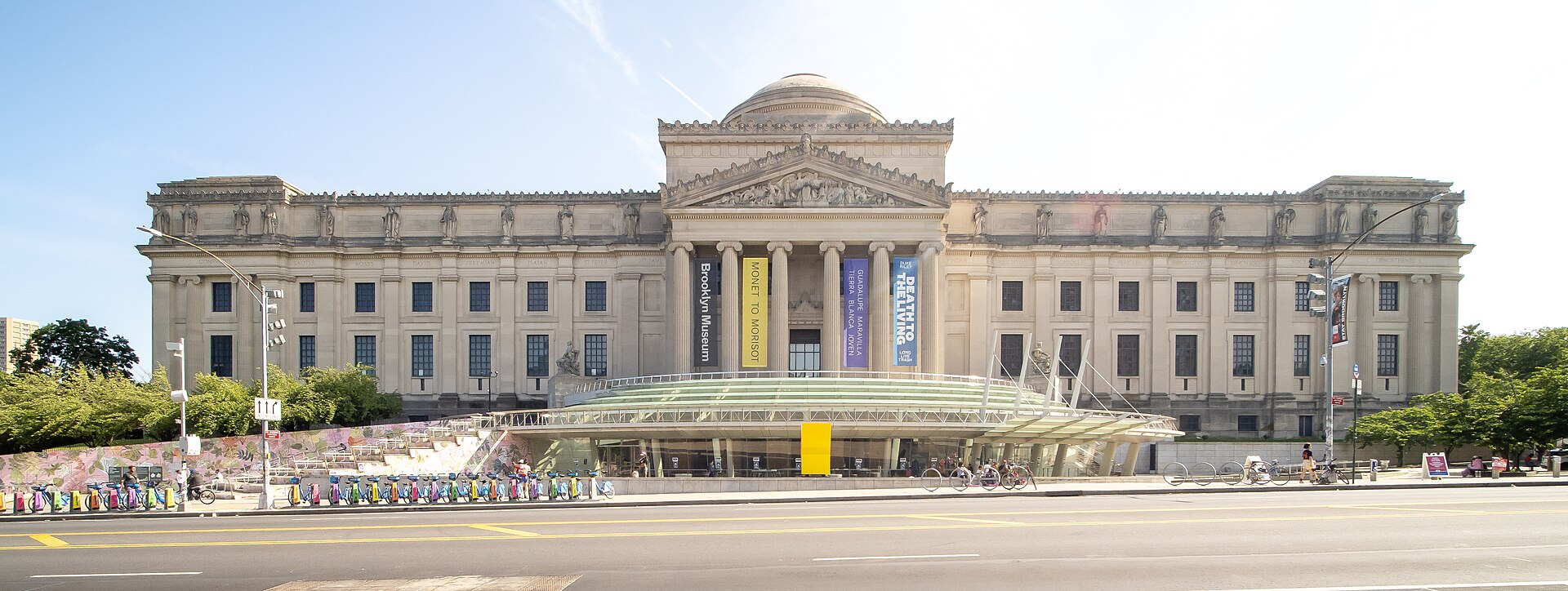
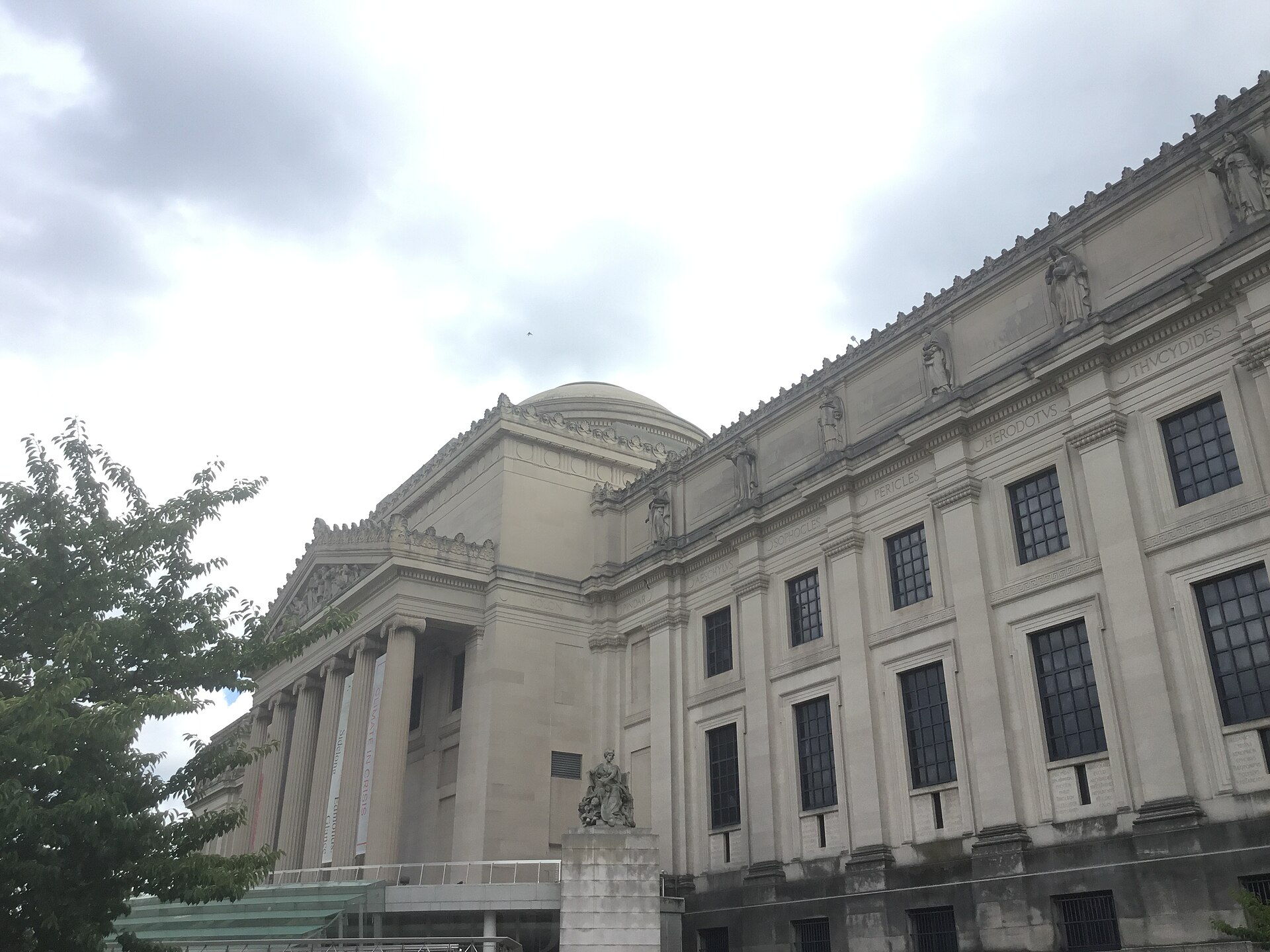
The 1897 Beaux-Arts facade by McKim, Mead and White, with James Polshek's 2004 glass entrance pavilion at ground level
ajay_suresh, CC BY 2.0Brooklyn Museum
Museum · Founded 1823
Open, admission and hours confirmed 9 September 2026 · 15 sources
On this page 16 sections
ContentsClose
An encyclopedic collection of more than 140,000 objects across thirteen curatorial areas and over 6,000 years, by the Museum's own account, built inside a building that was itself never finished to its original scale. Its Egyptian, Classical and Ancient Near Eastern holdings are unusually deep for a museum of Brooklyn's size, and the Elizabeth A. Sackler Center for Feminist Art, built specifically to hold Judy Chicago's The Dinner Party, gives the Museum a distinction few encyclopedic museums of comparable size can claim: an entire permanent wing organised around a single work of feminist art rather than a period or a geography. American Art, Asian and African galleries recently renovated or scheduled for renovation, and a contemporary programme that commissions large-scale new work for fixed spaces in the building round out a collection that is, by design, broader than any single visit can cover.
| Kind | Museum |
|---|---|
| Founded | 1823, as the Brooklyn Apprentices' Library; incorporated as the Brooklyn Institute in 1843; the present Eastern Parkway building opened to the public 1 June 1897 |
| City and country |  Brooklyn, United States Brooklyn, United States |
| Address | 200 Eastern Parkway, Brooklyn, New York 11238-6052, United States |
| Website | brooklynmuseum.org |
| Status | Open, confirmed |
| Record last verified |
Visiting
- Hours
- Monday-TuesdayClosed
- Wednesday-Sunday11:00 to 18:00Visitors are asked to exit the galleries 15 minutes before closing
- Closed
- Every Monday and Tuesday. Thanksgiving, Christmas Day and New Year's Day. First Saturdays, a free or reduced-price evening programme, run on the first Saturday evening of select months rather than every month.
- Admission
- General admission, AdultUSD 20General admission is a pay-what-you-can suggested amount rather than a fixed fee; a visitor may pay any amount at the in-person Admissions Desk, though online and kiosk sales charge the full suggested amount shown here. Covers the permanent collection and any non-ticketed exhibitions
- General admission, Adult 65+USD 14Suggested amount; pay-what-you-can in person
- General admission, Student 20+ with valid IDUSD 14Suggested amount; pay-what-you-can in person
- General admission, visitor with disabilitiesUSD 14A care partner is admitted free of charge
- General admission, ages 13-19FreeFree
- General admission, ages 4-12FreeFree
- Ticketed exhibition (example: Iris van Herpen: Sculpting the Senses), AdultUSD 30Includes general admission. Ticketed exhibitions run on timed entry in 15-minute increments; Members enter free and untimed
- Ticketed exhibition, Adult 65+ / visitor with disabilities / student 20+ with ID / ages 13-19USD 21Includes general admission
- Ticketed exhibition, ages 4-12USD 12Includes general admission
- Members, general admission and ticketed exhibitionsFreeFree and untimed
Free entry: Members enter free at all times, with free untimed entry to ticketed exhibitions. Active-duty military personnel and their families, with valid ID, free general admission. SNAP/EBT cardholders, free general admission with card shown at the desk. Members of the American Alliance of Museums (AAM) and the International Council of Museums (ICOM), free general admission with a valid card. Culture Pass holders through the New York, Brooklyn and Queens Public Library systems, and Cool Culture Family Pass and Culture Connected participants, free general admission. Corporate and University Membership programme participants, free general admission with a valid card, pass or ID shown at the desk- Tickets
- brooklynmuseum.org/visit/tickets The museum's own ticket page.
- Do I need to book?
- No for general admission, though advance online booking is encouraged and a limited number of tickets are held back for same-day purchase at the Museum. Ticketed special exhibitions run on timed entry in 15-minute increments
- Address
- 200 Eastern Parkway, Brooklyn, New York 11238-6052, United States MapSubway 2 and 3 trains to the Eastern Parkway-Brooklyn Museum station, which is ADA accessible; an elevator runs to street level and a ramp continues from there to the Museum's front entrance
Paratransit The MTA's Access-A-Ride service drops off and picks up at the small traffic circle entered from the stoplight on Eastern Parkway
Car and parking An open-air parking lot sits at the back of the Museum, entered from Washington Avenue or Eastern Parkway, with a 15-minute grace period for drop-off and pick-up before charges apply; the lot has an uphill ramp to the back entrance
Bike share Citi Bike docking is out front of the Museum, and bike racks are available - Website
- brooklynmuseum.org
- Telephone
- +1 718 638 5000
- [email protected]
Before you go how long, access, photography, bags, eating, shop
- How long to allow
- The Museum does not publish a single recommended duration; Tripadvisor's own visitor-facing summary suggests two to three hours, and the encyclopedic spread across five floors and thirteen collection areas makes a single short visit necessarily partial
- Access
- The building, grounds and parking lot are wheelchair accessible, as is the Eastern Parkway-Brooklyn Museum subway station. Free manually operated wheelchairs and folding cane stools are available at Coat Check in the first-floor lobby, two elevators run from the first to the fifth floor, and the Museum publishes a social-narrative guide and a service-animal policy. Accessible programming includes ASL-interpreted tours, verbal description tours for blind and low-vision visitors, and Brooklyn Mornings sessions for adults with memory loss
- Photography
- Not itemised in the pages this desk could reach; the Museum's FAQ addresses object and photography rules for specific ticketed exhibitions on a show-by-show basis rather than as one standing policy
- Bags
- Not itemised in the pages this desk could reach beyond the presence of a free Coat Check at the first-floor lobby entrance
- Eating
- The Brooklyn Museum Cafe sits in the sunlit first-floor lobby, serving grab-and-go sandwiches and salads, hot soups and curry, coffee from the Brooklyn roastery Parlor Coffee, and rotating canned cocktails and nonalcoholic drinks. Open Wednesday to Sunday, 11 am to 5:30 pm, closed Monday and Tuesday with the Museum itself. Members get a 10 percent discount
- Shop
- A Museum Shop operates on site; the Museum also runs an online shop at a separate subdomain of its own website
Prices and hours change. We take them from the institution's own pages and print the day we read them, and you can check the current position at the source we used. Confirm before you travel.
What is inside
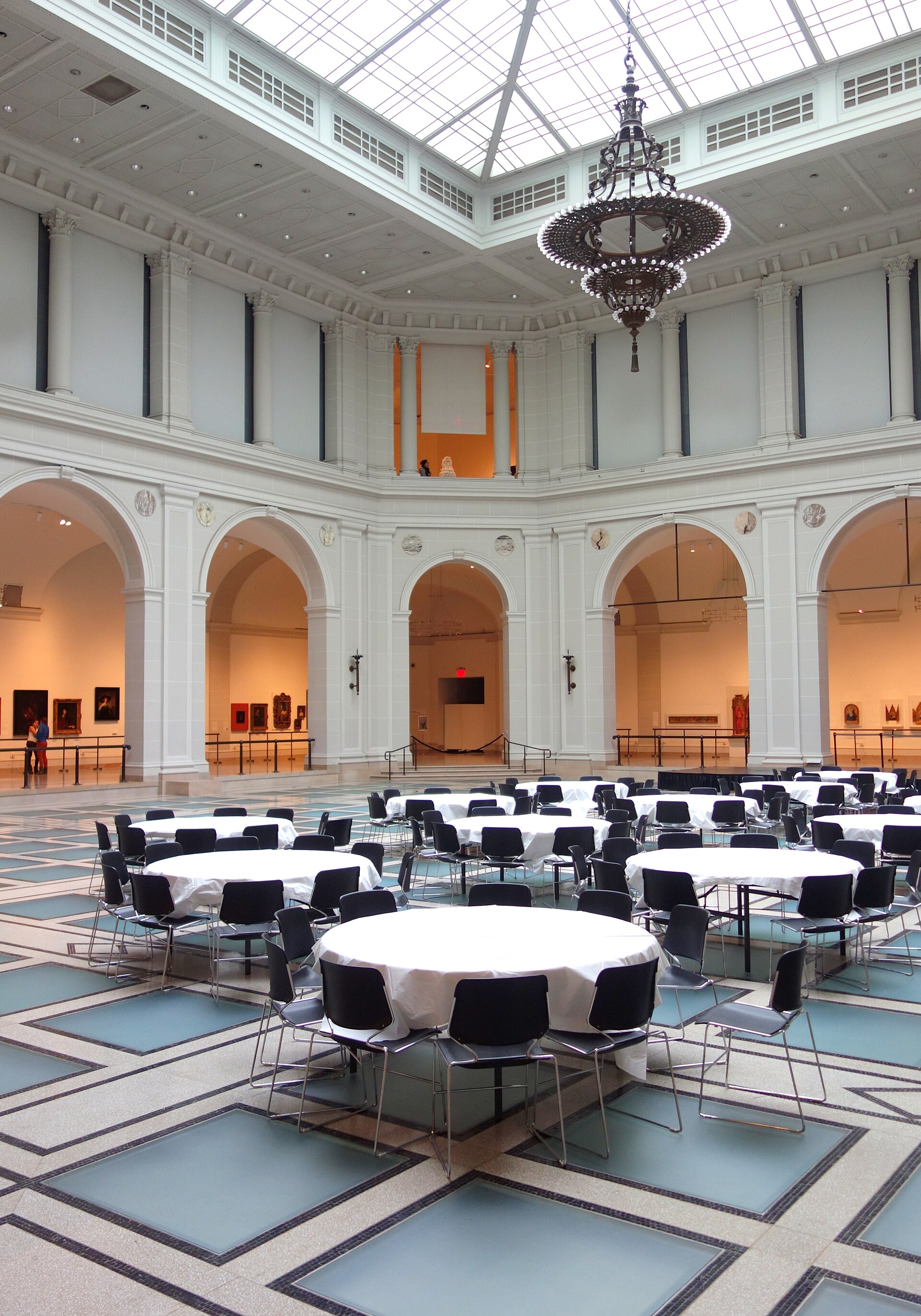
CC0 The Beaux-Arts Court and the 1897 McKim, Mead and White building
The skylit central court of the original building, ringed by an arcade of arched openings leading into the European and American painting galleries, with a glass roof, tiled floor and a suspended ironwork chandelier. It is what survives, and is regularly used, of the competition-winning 1893 design by McKim, Mead and White, built as only the northern wings and one light court of a much larger unbuilt plan.
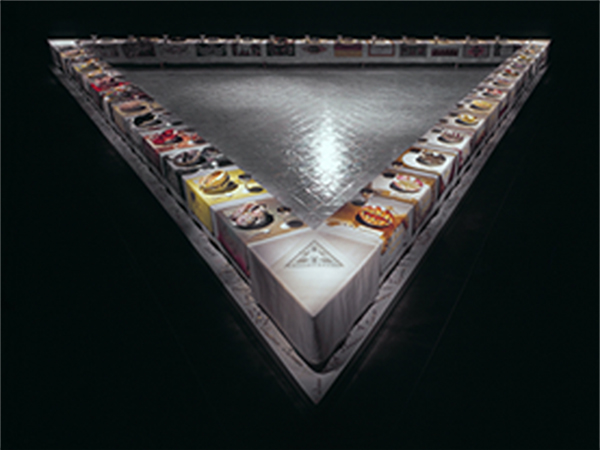
Photograph by Photo: Donald Woodman. Work of art: Judy Chicago. · CC BY-SA 4.0 Elizabeth A. Sackler Center for Feminist Art
A dedicated centre for feminist art opened in March 2007, built around Judy Chicago's The Dinner Party, a triangular table installation honouring 39 women from history, each with a place setting, given to the Museum by the Elizabeth A. Sackler Foundation in 2002. The centre also mounts changing feminist-art exhibitions in adjoining galleries.
Egyptian, Classical and Ancient Near Eastern Art
A collection spanning more than 3,000 years, drawing scholarly attention for its depth relative to the Museum's overall size: Predynastic and Old through New Kingdom sculpture and reliefs, coffins and funerary papyri including the Brooklyn Medical Papyrus and the Book of the Dead of Sobekmose, and Greek, Roman and ancient Near Eastern antiquities shown alongside the Egyptian material. No verifiable free-licence photograph of this specific gallery run was found for this page; individual holdings are catalogued below.
American Art
About 2,000 objects made in America from roughly 1720 to 1945, anchored by Francis Guy's Winter Scene in Brooklyn, the first object acquired for the American art collection, and running through Gilbert Stuart's 1796 portrait of George Washington, Edward Hicks's The Peaceable Kingdom and Winslow Homer's 1887 marine painting Eight Bells. No verifiable free-licence interior photograph of this specific gallery run was found; the paintings are catalogued individually below.
Arts of Africa, Asia, the Americas, the Islamic World and the Pacific Islands
Five collecting areas that reopened their South Asian and Islamic-world galleries in 2022 after a twelve-year renovation cycle, and that are due a further renovation: in early 2026 the Museum hired Peterson Rich Office to rebuild 6,400 square feet on the third floor into four new galleries for the African art collection, a roughly 13-million-dollar project planned to take about a year. No free-licence photograph of the current installation was found for this page.
Decorative Arts and Design, and the Contemporary Art galleries
Period rooms and decorative-arts holdings sit alongside the Museum's contemporary programme, which includes Alexis Rockman's Manifest Destiny, an eight-by-twenty-four-foot oil-on-wood mural commissioned by the Museum in 2004 as the centrepiece of the second-floor Mezzanine Gallery, depicting a flooded, climate-changed Brooklyn waterfront centuries in the future. No free-licence photograph of either gallery run was found for this page.
Toby Devan Lewis Education Center
A dedicated education wing that opened in January 2024 with three studios and a gallery, used for the Museum's school, family and community programming rather than for the permanent collection on view. No free-licence photograph of the space was found for this page.
What to see first
The Dinner Party
Judy Chicago, completed 1979; given to the Museum 2002A permanent installation rather than a picture on a wall, and the reason the Museum built an entire wing, the Elizabeth A. Sackler Center for Feminist Art, around a single work; the triangular table sets a place for each of 39 women from myth and history, and the gift from the Elizabeth A. Sackler Foundation in 2002 made Brooklyn the piece's permanent home after years of the work having none.9
Winter Scene in Brooklyn
Francis Guy, about 1820The first object acquired for the Museum's American art collection, which makes it the founding picture of an entire department rather than simply an old view of the borough.9
Portrait of George Washington
Gilbert Stuart, 1796Named by the Museum's own history among the most famous works in its American holdings, one of the numerous Washington portraits Stuart produced from his own studio replicas, which makes provenance and studio attribution a live question on any Stuart Washington and not particular to this canvas.9
The Peaceable Kingdom
Edward Hicks, 19th centuryOne of dozens of versions the Pennsylvania Quaker painter made of the same Biblical subject over his career, so the interest of any single Peaceable Kingdom, including this one, lies partly in comparing it against the roughly sixty other known versions rather than treating it as a unique image.9
Eight Bells
Winslow Homer, 1887A marine painting from the period of Homer's career the Museum's own account treats as his most mature, showing two ship's officers taking a navigational sighting; it is one of the works the Museum's history names among the most significant in the American collection.9
Bird Lady
Unrecorded Predynastic Egyptian maker, Naqada periodA terracotta female figure with upraised, bird-like arms, among the best-known surviving examples of Predynastic Egyptian representational sculpture and one of the objects the Museum's own account singles out from an Egyptian collection that spans more than 3,000 years.9
Painting of Lady Tjepu
Unrecorded maker, New Kingdom, Dynasty 18, reign of Amenhotep III, about 1390-1352 BCEA tomb painting from tomb 181 at Thebes, cited in the Museum's own history as a specific, securely dated example of the depth of its New Kingdom holdings rather than a generic Egyptian picture.9
Manifest Destiny
Alexis Rockman, 2004An 8-by-24-foot oil-on-wood mural commissioned by the Museum as the centrepiece of the second-floor Mezzanine Gallery, imagining Brooklyn's Gowanus and Red Hook waterfront centuries after climate change and rising seas have remade it, and one of relatively few large-scale commissioned contemporary works made specifically for a fixed space in the building.9
Exhibitions on now
Past exhibitions here
- Closed8 May to 4 Oct 2026Confirmed · check before you travel
A library that grew into an unfinished palace
The Brooklyn Museum traces its founding to August 1823, when a group of Brooklyn citizens including Augustus Graham set up the Brooklyn Apprentices' Library in Brooklyn Heights, formally incorporated in November 1824. The library merged with the Brooklyn Institute in 1843, and after that building burned down in 1891, its trustees reorganised in 1890 as the Brooklyn Institute of Arts and Sciences and launched an architectural competition for a new home on Eastern Parkway, on the edge of the newly created Prospect Park. The Brooklyn Daily Eagle called the competition one of the most important in the history of American architecture; McKim, Mead and White won it.
What they proposed was enormous: a building four times the size of anything that was ever built, arranged around a central memorial hall with four separate light courts. Brooklyn's mayor approved construction bonds in January 1895, ground was broken that December, and the first section opened to the public on 1 June 1897, with a formal opening on 2 October 1897, one of the borough's last major public buildings before Brooklyn was folded into the newly consolidated City of New York in 1898. That consolidation is also the reason the plan was never finished: political and financial support for an independent Brooklyn cultural palace evaporated almost as soon as Brooklyn stopped being an independent city, and only the northern wings and a single light court, the Auditorium Court, were ever built.
Stalled wings, vanished steps, and a name that came back
Construction limped forward for another two decades rather than stopping outright. A central entrance pavilion, approved in 1899, took until 1903 to near completion and was meant to hold a 1,250-seat lecture hall and a sculpture hall serving as the main lobby. The eastern wing finally opened in December 1907, bringing the building to roughly one-eighth of its originally planned size. Two further wings, contracted in 1911, stalled in November 1914 when the contractor went bankrupt, and by the 1920s only 28 of a planned 80 facade sculptures had ever been installed; the building's main corridor was still unfinished.
In 1934 the city's Parks Department, under Public Works Administration labour, removed the building's original grand entrance staircase entirely, replacing it with ground-level doors; the remodelled entrance was dedicated in October 1935. A rear annex added in 1955 gave the upper floors a new internal stair. The museum spent 1997 to 2004 operating as the Brooklyn Museum of Art, a rebrand it dropped the same year its new entrance opened, reverting to the plainer name it had carried since 1897 and has kept since.
The glass front door
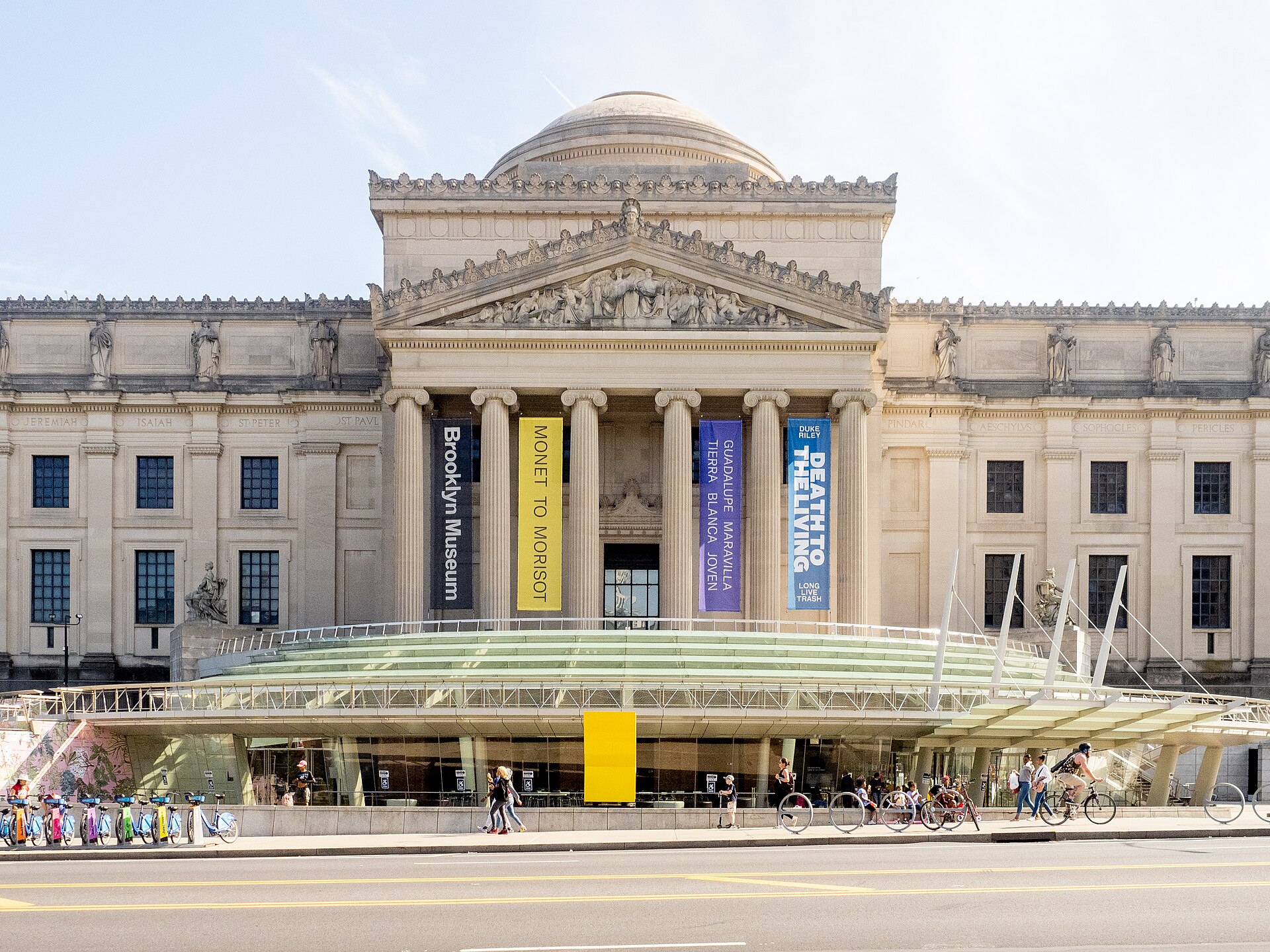
By 2000 the building's ground-level entrance, put in place in the 1930s, was widely regarded as a dead zone rather than a welcome. The Museum hired architect James Polshek, who described the existing front as a wasteland and proposed what he called Brooklyn's new front stoop: a glass entrance pavilion with four metal pylons and a semicircular plaza, built despite preservationist objections and approved by the city's Landmarks Preservation Commission. The brick piers that had once carried the vanished 1897 staircase were themselves worked into a new brick arch as part of the project. Completed in April 2004 at a final cost of 63 million dollars against an initial 55-million-dollar estimate, the pavilion also brought air conditioning to the entire building for the first time, and it remains the entrance every visitor uses today, fronted now by the banners of whatever exhibition is running.
An encyclopedic collection, department by department
The Museum's own account describes an encyclopedic collection of more than 140,000 objects spanning over 6,000 years, organised into thirteen collecting areas: American Art, Arts of Africa, Arts of Asia, Arts of the Americas, Arts of the Islamic World, Arts of the Pacific Islands, Contemporary Art, Decorative Arts and Design, Egyptian, Classical and Ancient Near Eastern Art, European Art, Feminist Art, Libraries and Archives, and Photography. The Egyptian collection alone spans more than 3,000 years and includes the Brooklyn Medical Papyrus and the Book of the Dead of Sobekmose alongside sculpture reaching back to the Predynastic period. American Art runs from Francis Guy's Winter Scene in Brooklyn, the first work acquired for that department, through Gilbert Stuart's 1796 Washington portrait and Edward Hicks's The Peaceable Kingdom to Winslow Homer's 1887 Eight Bells.
The single work that gets its own wing is Judy Chicago's The Dinner Party, a triangular table with a place setting for each of 39 women from history and myth, given to the Museum in 2002 by the Elizabeth A. Sackler Foundation and housed since March 2007 in the Elizabeth A. Sackler Center for Feminist Art built specifically to hold it. Asian and Islamic-world galleries reopened in 2022 after a twelve-year renovation, and in early 2026 the Museum hired Peterson Rich Office to rebuild 6,400 square feet of the third floor into new African art galleries, a roughly 13-million-dollar project. A newer addition, the Toby Devan Lewis Education Center, opened in January 2024 with three studios and a gallery for school and community programming rather than the permanent collection.
A museum that keeps rehanging its own arguments
The Museum has been the subject of genuine controversy more than once, and none of it belongs off this page. In 1999 the exhibition Sensation, drawn from Charles Saatchi's private collection rather than the Museum's own holdings, provoked New York City mayor Rudolph Giuliani to threaten to cut the Museum's public funding over Chris Ofili's The Holy Virgin Mary; a federal judge ruled the funding threat unconstitutional, and the show went on, but the episode is still the first thing many people associate with the Museum's name decades later, even though the painting itself never entered its permanent collection.
In 2020, facing pandemic-era financial pressure, the Museum sold works at auction, including a Lucas Cranach the Elder painting that made 4.2 million dollars at Christie's and, weeks later, paintings by Monet, Dubuffet, Degas, Miro and Matisse consigned to Sotheby's, aiming to build a 40-million-dollar fund whose income would pay for the routine care of its roughly 160,000-object collection. The sales were made possible by a temporary relaxation of industry rules by the Association of Art Museum Directors, but some observers still called the scale of the sell-off a shortsighted jettisoning of crucial holdings. In 2023, the exhibition It's Pablo-matic, co-curated with the comedian Hannah Gadsby, drew unusually harsh reviews, including from the New York Times, and the Museum's director defended it publicly rather than revising course. Most recently, in February 2025, the Museum announced 47 layoffs and a reduced exhibition schedule against what its director called a cash-flow crisis approaching a 10-million-dollar deficit, driven by inflation and a slow post-pandemic recovery in attendance; increased funding from the New York City Council later averted further cuts.
Two hundred years on, still a working borough institution
The Museum has spent its bicentennial, marked across 2023 to 2026, publicly reckoning with both halves of its record rather than only celebrating the founding date. Breaking the Mold: Brooklyn Museum at 200, its own anniversary exhibition, draws on the full collection rather than a curated highlight reel, and a parallel Brooklyn Icons project has singled out 200 objects across the collection's full range. The institution has run First Saturdays, a free or reduced-price evening of programming, for a quarter of a century, and its own materials now include a formal land acknowledgement recognising that the Museum stands on the unceded ancestral homeland of the Lenape people.
Anne Pasternak has directed the Museum since September 2015, through the 2020 deaccessioning sales, the 2023 Pablo-matic controversy and the 2025 budget crisis alike, and remains in the role as the Museum works through a renovation of its African art galleries due to finish around 2027. None of that history changes what a visitor does at the door on any given Wednesday through Sunday: pay whatever amount they choose at the Admissions Desk, or nothing at all if they are thirteen to nineteen years old, and walk into a building whose finished half is still, by any ordinary measure, one of the largest encyclopedic art collections in the United States.
What visitors say
We reproduce no visitor review prose and cite no invented star average beyond the single aggregate logged below. What is consistent across the Museum's own published materials and the named journalism this desk read is that visitors are struck by the scale and range of an encyclopedic collection inside a building most did not expect to be this large, and specifically by the Elizabeth A. Sackler Center for Feminist Art and its Egyptian and Asian holdings, which visitors describe as unusually deep for a museum of Brooklyn's size. The friction points are not the admission price, which is a suggested pay-what-you-can amount rather than a fixed fee, but the institution's recent history: a 2020 round of deaccessioning sales that divided opinion even among museums that had just been given cover to do the same thing, a widely and often harshly reviewed 2023 exhibition that the Museum's own director publicly defended rather than revised, and a 2025 budget crisis serious enough to cost dozens of staff their jobs and to cut the annual exhibition schedule. None of that is this desk's place to resolve; it is recorded because a museum that asks a reader to trust its account of its own objects is also a party to its own recent record.
What is praised, what is criticised
- Praised: the breadth of an encyclopedic, roughly 140,000-object collection spanning more than 6,000 years, inside a single Brooklyn building
- Praised: the Elizabeth A. Sackler Center for Feminist Art and Judy Chicago's The Dinner Party as a destination in its own right, not an adjunct to the painting galleries
- Praised: the depth of the Egyptian, Classical and Ancient Near Eastern collection relative to the Museum's overall size
- Praised: the free or low-cost First Saturdays evening programme, running for a quarter of a century, and the pay-what-you-can structure of general admission itself
- Praised: the light-filled 2004 glass entrance pavilion and Beaux-Arts Court as spaces in their own right, not just circulation between galleries
- Criticised: the Museum's 2020 decision to deaccession works, including a Cranach sold at Christie's for 4.2 million dollars and paintings by Monet, Dubuffet, Degas, Miro and Matisse consigned to Sotheby's, to fund collection care rather than acquisitions; some museum-world observers called the pace and scale a shortsighted jettisoning of crucial holdings even after the Association of Art Museum Directors had relaxed its own rules to permit exactly this kind of sale
- Criticised: It's Pablo-matic: Picasso According to Hannah Gadsby, the Museum's 2023 exhibition co-curated with the comedian, which the New York Times critic Jason Farago characterised, in a review reproduced with direct quotation by Artnet News, as offering little to see, no catalogue to read, and ambitions pitched at what he called GIF level; the Museum's director defended the show publicly rather than revising it
- Criticised: a February 2025 budget crisis in which director Anne Pasternak said inflation and slow post-pandemic attendance recovery had produced a cash-flow problem approaching a 10-million-dollar deficit, leading to 47 layoffs, senior pay cuts of up to 20 percent, a reduced exhibition schedule and fewer weeknight events, before increased City Council funding averted further cuts
- Criticised: the 1999 Sensation exhibition controversy, in which then-mayor Rudolph Giuliani threatened to cut the Museum's public funding over Chris Ofili's The Holy Virgin Mary, a work from the Saatchi collection rather than the Museum's own holdings, before a federal court found the funding threat unconstitutional; the episode still shapes how the Museum is discussed decades later even though the painting itself was never part of its permanent collection
Ratings on other platforms
Tripadvisor: 4.5 from 1,693 ratings, read 9 September 2026
A platform average is a tertiary source: it moves, it is not audited, and we quote no visitor's words.
Questions about Brooklyn Museum
Where is Brooklyn Museum?
200 Eastern Parkway, Brooklyn, New York 11238-6052, United States.
How much does it cost to visit?
General admission, Adult: USD 20; General admission, Adult 65+: USD 14; General admission, Student 20+ with valid ID: USD 14; General admission, visitor with disabilities: USD 14; General admission, ages 13-19: free. As confirmed 9 September 2026.
When is it open?
Monday-Tuesday closed; Wednesday-Sunday 11:00-18:00. Closed: Every Monday and Tuesday. Thanksgiving, Christmas Day and New Year's Day. As confirmed 9 September 2026.
How do you get there?
Subway: 2 and 3 trains to the Eastern Parkway-Brooklyn Museum station, which is ADA accessible; an elevator runs to street level and a ramp continues from there to the Museum's front entrance; Paratransit: The MTA's Access-A-Ride service drops off and picks up at the small traffic circle entered from the stoplight on Eastern Parkway; Car and parking: An open-air parking lot sits at the back of the Museum, entered from Washington Avenue or Eastern Parkway, with a 15-minute grace period for drop-off and pick-up before charges apply; the lot has an uphill ramp to the back entrance; Bike share: Citi Bike docking is out front of the Museum, and bike racks are available.
What should you see first?
The Dinner Party (Judy Chicago, completed 1979; given to the Museum 2002); Winter Scene in Brooklyn (Francis Guy, about 1820); Portrait of George Washington (Gilbert Stuart, 1796); The Peaceable Kingdom (Edward Hicks, 19th century); Eight Bells (Winslow Homer, 1887); Bird Lady (Unrecorded Predynastic Egyptian maker, Naqada period).
What we could not confirm
- The Museum's own about page states an encyclopedic collection of more than 140,000 objects; older tertiary sources cite a total collection figure, including archival and study material, closer to 500,000. This page follows the Museum's own current published figure rather than the larger tertiary one, and a future check should confirm which basis the Museum itself now uses.
- The 2025 budget crisis was described by the Museum's director as improving after increased City Council funding, but no source found for this page states the deficit has been closed; a future check should confirm the Museum's current financial position.
- The African art gallery renovation announced for 2026 was reported as a roughly one-year project at research time; a future check should confirm whether it opened on schedule.
- Studio attribution and replica questions around the Museum's Gilbert Stuart portrait of George Washington, and around which of Edward Hicks's roughly sixty Peaceable Kingdom versions this one is, were not resolved by the sources this desk could reach and are noted rather than settled here.
Images
Sources
- 1Brooklyn Museum, "Plan your visit" (hours, address, directions) brooklynmuseum.org/visit
- 2Brooklyn Museum, "Tickets" (admission prices and discounts) brooklynmuseum.org/visit/tickets
- 3Brooklyn Museum, "About the Museum" (mission, collection size, bicentennial programming) brooklynmuseum.org/about
- 4Brooklyn Museum, "Contact the Museum" (phone, address) brooklynmuseum.org/about/contact
- 5Brooklyn Museum, "Museum map" (floor directory, elevators, wheelchairs, email contact) brooklynmuseum.org/visit/floor_directory
- 6Brooklyn Museum, "Accessibility" (subway and parking access, accessible programming) brooklynmuseum.org/visit/accessibility
- 7Brooklyn Museum, "Dining" (Cafe hours and menu) brooklynmuseum.org/visit/dining
- 8Brooklyn Museum, "Collection" (the thirteen collection areas; Brooklyn Icons bicentennial project) brooklynmuseum.org/collection
- 9Wikipedia, "Brooklyn Museum" (founding, building history, architecture, named collection highlights; ) en.wikipedia.org/wiki/Brooklyn_Museum
- 10Wikidata, item Q632682, "Brooklyn Museum" (identity and coordinates; ) wikidata.org/wiki/Q632682
- 11The Art Newspaper, "Brooklyn Museum steams ahead on deaccessioning", 16 October 2020 theartnewspaper.com/2020/10/16/brooklyn-museum-steams-ahead-on-deaccessioning
- 12The Art Newspaper, "Brooklyn Museum to lay off more than 40 staffers amid rising deficit", 12 February 2025 theartnewspaper.com/2025/02/12/brooklyn-museum-layoffs-deficits
- 13Artnet News, "Is Hannah Gadsby's Picasso Show at the Brooklyn Museum 'Disastrous' or Are Its Critics Just 'Hysterical'? Here Are All the Hot Takes", 5 June 2023, reproducing quotations from Jason Farago's New York Times review news.artnet.com/art-world/hannah-gadsby-picasso-show-brooklyn-museum-reactions-2315306
- 14Tripadvisor, "Brooklyn Museum" aggregate visitor rating, read 9 September 2026 tripadvisor.com/Attraction_Review-g60827-d110213-Reviews-Brooklyn_Museum-Brooklyn_New_York.html
- 15Wikimedia Commons, file description page confirming the installation location of Judy Chicago's The Dinner Party commons.wikimedia.org/wiki/File:Judy_Chicago_The_Dinner_Party.jpg
