Museum of Fine Arts, Boston
Museum · Founded 1870
Open, admission and hours confirmed 13 August 2026 · 31 sources
On this page 15 sections
ContentsClose
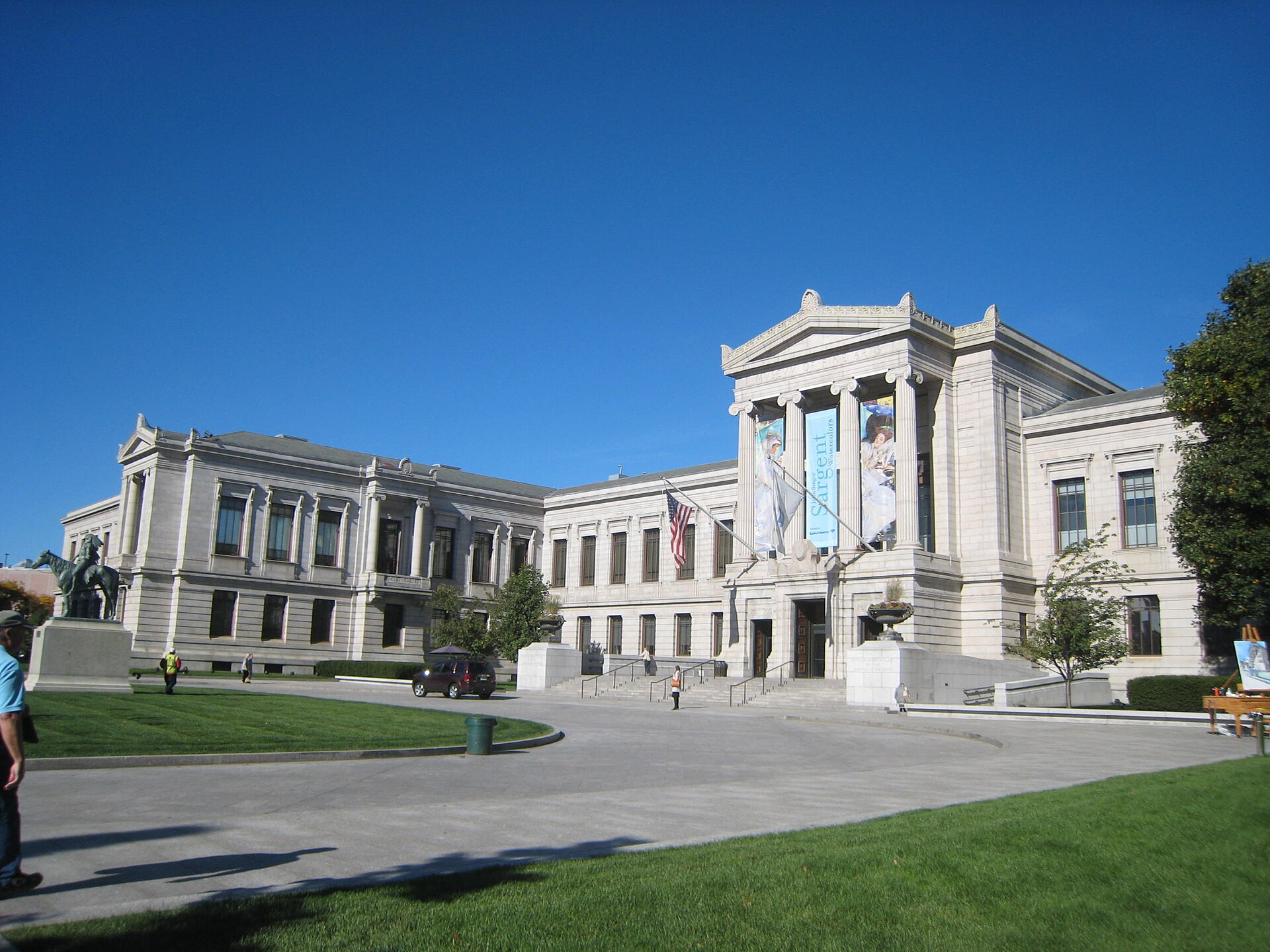
Nearly 500,000 works, by the museum's own count, across departments that run from the Reisner-excavated Egyptian and Nubian material (the museum's own claim: the finest Old Kingdom holdings outside Cairo, the largest Nubian collection outside Khartoum) through Ancient Greece and Rome, Islamic art, the Arts of Asia, Art of Europe, the Art of the Americas from the seventeenth-century period rooms to twentieth-century painting, Contemporary Art in the Linde Family Wing, and dedicated departments for Musical Instruments, Photography, Prints and Drawings, and Fashion, Textiles and Jewelry. What distinguishes the collection from an assembly of good departments is that several of its holdings were built by a single sustained excavation or acquisition program rather than by scattered purchase: the Harvard-MFA Expedition under George Reisner for Egypt and Nubia, and the Robert Owen Lehman gift for the Kingdom of Benin, now much reduced after 2025's returns and restitutions. The museum is equally direct, on its own provenance pages, about where that same acquisition history has required giving objects back, and its June 2026 reinstallation of the 18th-century American galleries shows the same instinct applied to interpretation rather than restitution: pairing an existing icon, the Sons of Liberty Bowl, with a newly displayed object, David Drake's storage jar, to complicate rather than simply celebrate it.
| Kind | Museum |
|---|---|
| Founded | Incorporated 1870; opened to the public at Copley Square, 4 July 1876; the present Huntington Avenue building opened November 1909 |
| City and country |  Boston, United States Boston, United States |
| Address | 465 Huntington Avenue, Boston, Massachusetts 02115, United States |
| Website | mfa.org |
| Status | Open, confirmed 13 August 2026 |
| Record last verified | 13 August 2026 |
Visiting
- Hours
- Sunday, Monday, Wednesday, Saturday10:00 to 17:00
- Thursday, Friday10:00 to 22:00Late opening
- TuesdayClosed
- Closed
- Tuesday, every week. Closed New Year's Day, Patriots' Day, the Fourth of July, Thanksgiving, and Christmas. Last entry is 30 minutes before closing.
- Admission
- MembersFreeFree at every visit. Membership cards admit members daily within the limits of their level; for special exhibitions a ticket is still required even for members
- AdultsUSD 30General admission
- Youths, 7 to 17USD 14
- Youths, 0 to 6FreeFree, but a ticket is still required. The museum's own FAQ states plainly that every visitor, regardless of age, must have a ticket, including babies
Free entry: Members are admitted free at every visit; there is no member-independent free day published on the museum's own hours-and-admission page as read on 13 August 2026. Every visitor, of any age, must hold a ticket to enter, even when that ticket's price is zero- Tickets
- mfa.org/tickets The museum's own ticket page.
- Do I need to book?
- Not required for general admission, but every visitor of any age needs a ticket, including infants. Advance booking online or by phone is recommended, and is effectively required for timed special-exhibition entry
- Address
- 465 Huntington Avenue, Boston, Massachusetts 02115, United States MapSubway Green Line E train to the Museum of Fine Arts stop, the Orange Line to the Ruggles stop, or the Commuter Rail (Zone 1A) to Ruggles. Fare information is on the MBTA website
Bus The 39 bus to the Huntington Avenue at Ruggles Street or Louis Prang Street stop, or the 8, 19, 47 or CT2 buses to the Ruggles Street at Huntington Avenue stop
Car and parking Self-parking at three museum-run facilities, the Huntington Lot, the Fenway Lot and the Museum Road Garage, all with entrances on Museum Road. The Huntington Lot is closest to the Huntington Avenue Entrance and has accessible spaces along the Huntington Avenue side; the Fenway Lot pairs with the level-entrance Linde Family Wing Entrance. The garage office, for parking assistance when planning a visit, is 617-369-3657
Entrances The Huntington Avenue Entrance is the main entrance, fully accessible with ramps on both sides of the stairs and power-assist doors. The Linde Family Wing Entrance on Museum Road is reserved for visitors who require a level entrance. The State Street Corporation Fenway Entrance, opened in 2008, is currently closed to the public - Website
- mfa.org
- Telephone
- +1 617-267-9300
Before you go how long, access, photography, bags, eating, shop
- How long to allow
- The museum publishes no suggested visit length. Its own count of nearly 500,000 works across encyclopedic, largely rotating collections makes a single afternoon a matter of choosing departments rather than attempting the building. MFA Mobile, on the Bloomberg Connects platform, is the museum's own self-guided answer for a visitor with about an hour
- Access
- Manual wheelchairs and rollators are free on a first-come basis at the Huntington Avenue Entrance and the Linde Family Wing Entrance. Service dogs are welcome; emotional-support and comfort animals are not. Most restrooms are wheelchair accessible; the exception is the pair off the second-floor rotunda, tight for some wheelchairs because of an in-stall sink, and two all-gender single-occupancy restrooms on Level G are fully accessible with changing tables. Free gallery stools, sensory kits (noise-reducing headphones, fidgets and sunglasses) and EnChroma glasses for colour blindness are available on request at the Sharf Visitor Center. General access questions go to 617-267-9300 or by email; programme-specific access questions go to 617-369-3189
- Photography
- The museum's own visitor pages do not publish a standalone photography policy; general visitor conduct is covered under its bag-inspection and security rules
- Bags
- Backpacks, large bags and outside food or drink are not permitted in the galleries, with exceptions made for medical or religious need. Any bag larger than 11 by 15 inches must be checked in the Coat Room at the Huntington Avenue Entrance, and all bags are subject to inspection
- Eating
- Three dining venues, each requiring the same museum admission ticket. New American Cafe offers table service in the glass-enclosed Ruth and Carl J. Shapiro Family Courtyard (Sunday, Monday, Wednesday, Saturday 11:00 to 15:45; Thursday and Friday 11:00 to 19:45; closed Tuesday). Taste is a coffee, pastry and wine bar in the Linde Family Wing for Contemporary Art (10:30 to 16:00 most days, 10:30 to 18:00 Thursday and Friday; closed Tuesday). Garden Cafeteria, also in the Linde Family Wing, serves pizza, sandwiches and family-priced options and opens onto the Calderwood Courtyard for seasonal outdoor eating; a vending machine outside it runs during all museum hours
- Shop
- The Signature Shop, at the Huntington Avenue Entrance, can be visited without a ticket. The museum store also sells online, with curbside pickup
Prices and hours change. We take them from the institution's own pages and print the day we read them, and you can check the current position at the source we used. Confirm before you travel.
What is inside
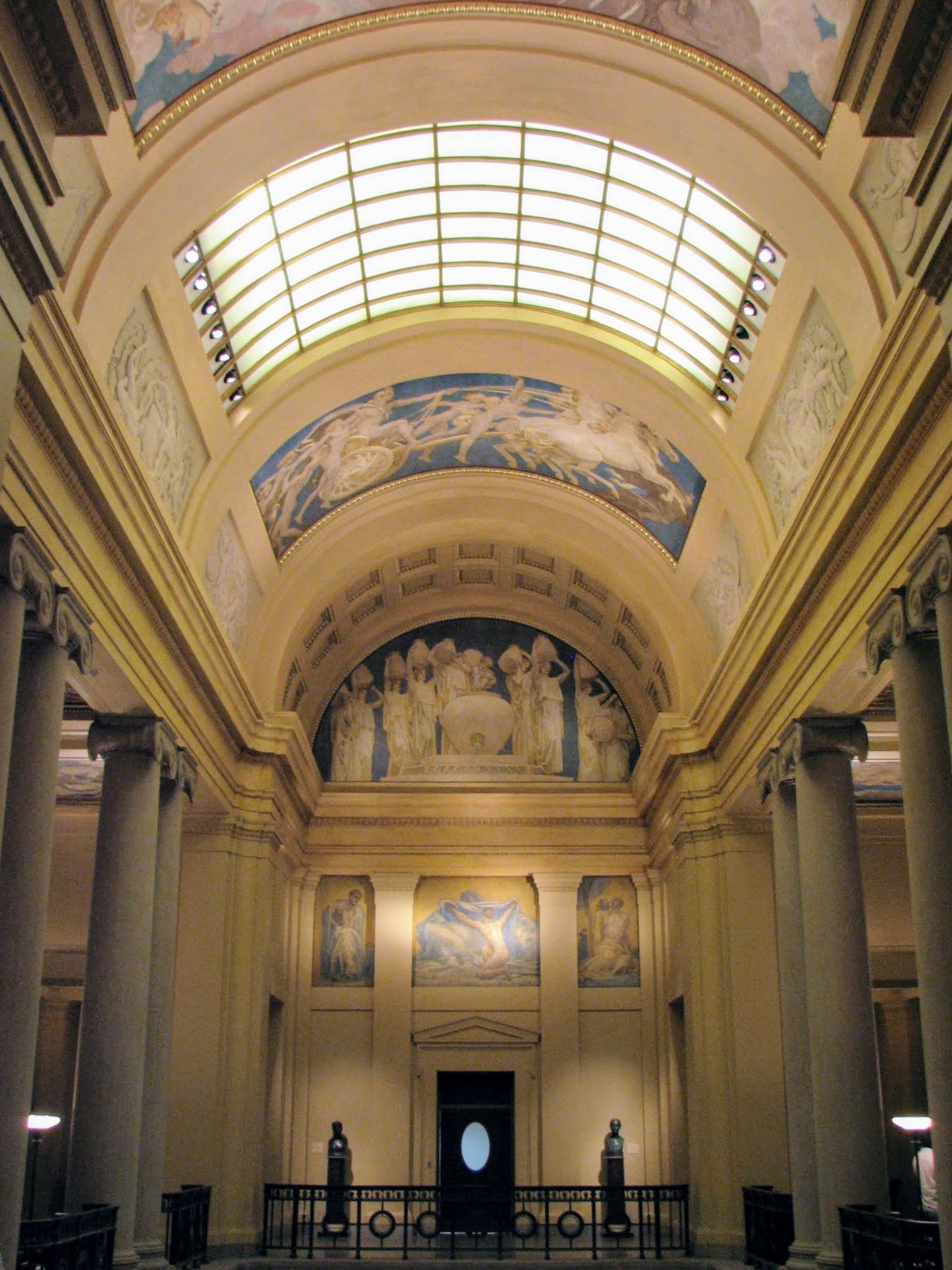
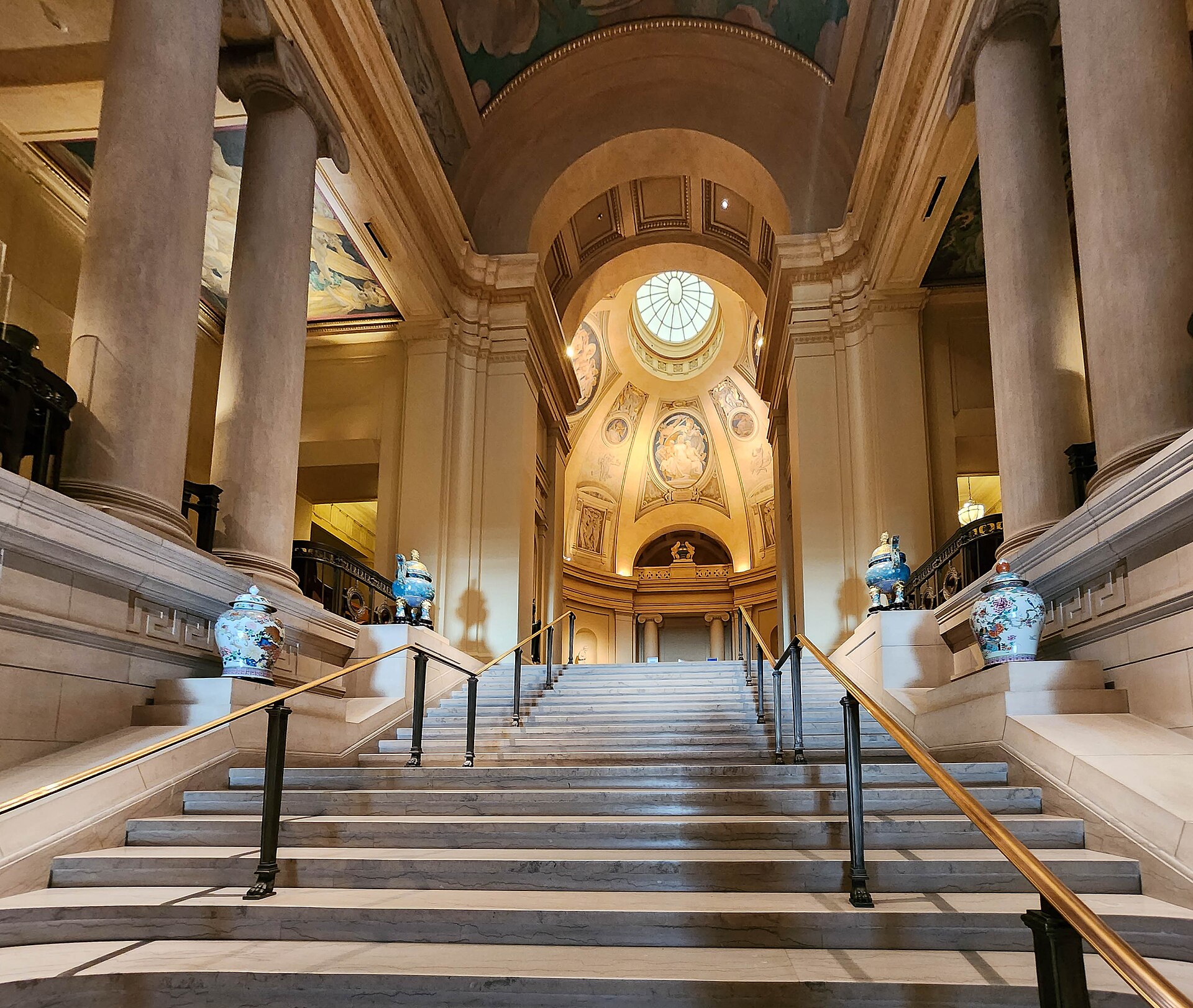
Photograph by EgorovaSvetlana · CC BY-SA 4.0 The Ruth and Carl J. Shapiro Rotunda and Colonnade
The domed entrance hall (Gallery 205) and the barrel-vaulted gallery beyond it (Gallery 204, the Shapiro Colonnade) at the head of the Huntington Avenue grand staircase, both painted by John Singer Sargent in a mural campaign completed in two phases, the Rotunda in 1921 and the Colonnade in 1925, incorporating sculpted relief as well as paint. The murals were conserved and restored in 1999. It is the ceremonial spine of Guy Lowell's 1909 building and the point every visitor entering through the main doors walks straight into.
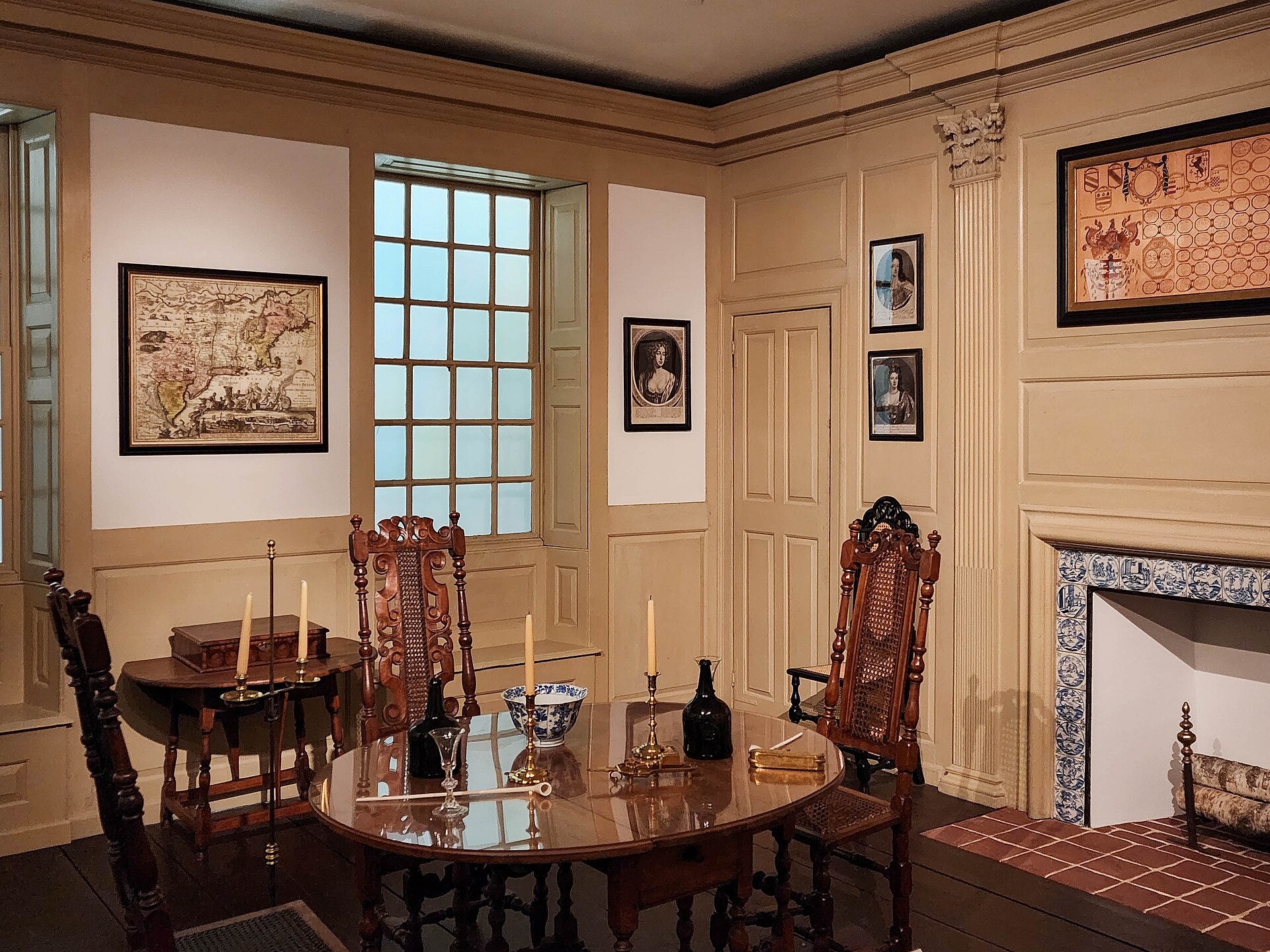
Photograph by Crisco 1492 · CC BY-SA 4.0 The Art of the Americas Wing: seventeenth-century New England period rooms
Reconstructed colonial interiors on the lower level (the Brown-Pearl Hall and the Manning House among them), furnished with joined chairs, gate-leg tables, delft-tiled fireplaces and a 1670s-style map of New England on the wall, alongside the department's holdings of Pilgrim-century furniture and silver. These rooms sit inside the Norman Foster-designed Art of the Americas Wing that opened in 2010, which rebuilt this end of the museum around a chronological walk from the seventeenth century to the twentieth.
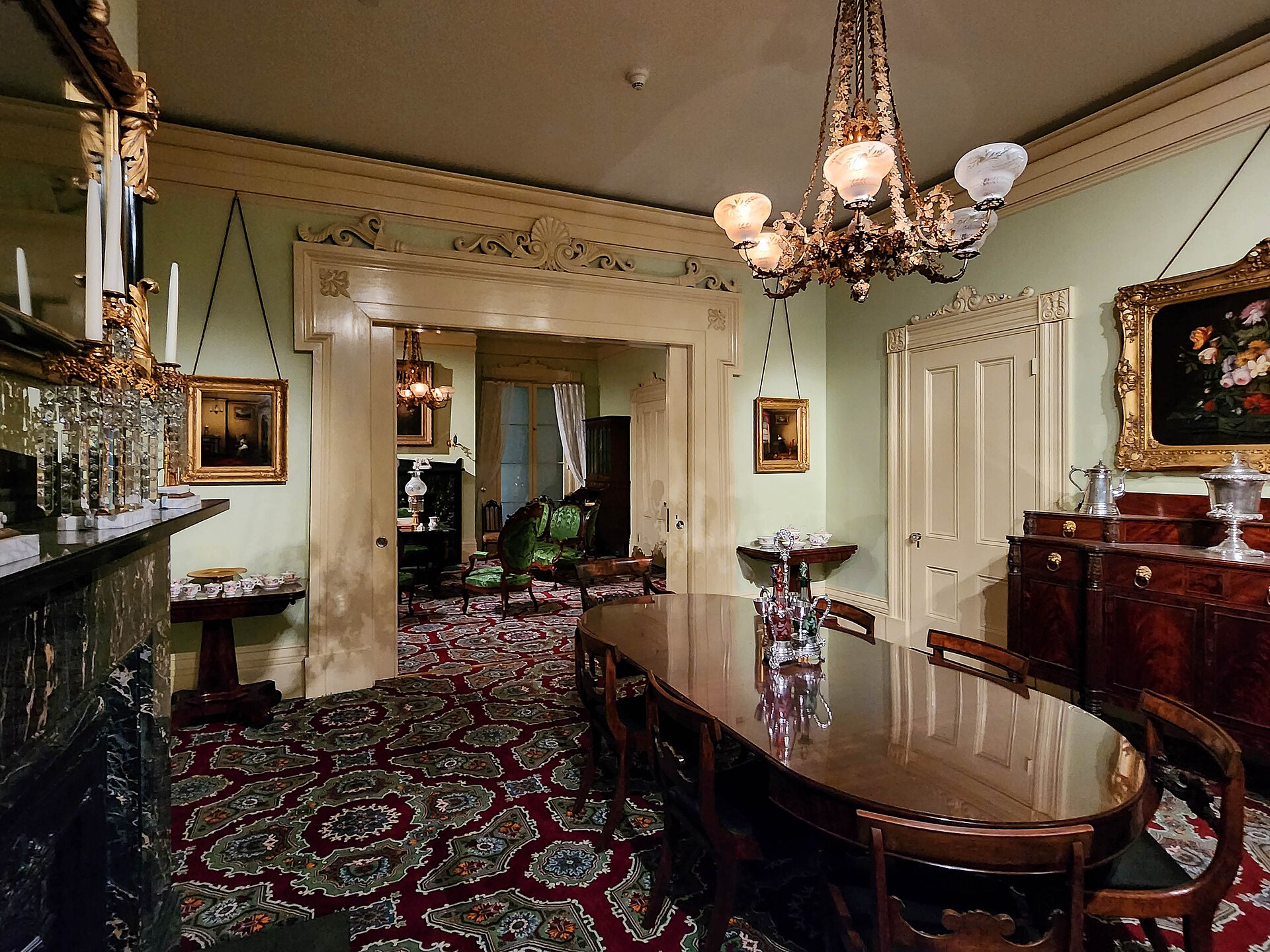
Photograph by Crisco 1492 · CC BY-SA 4.0 The Art of the Americas Wing: nineteenth-century American decorative arts period room
A furnished Victorian-era domestic interior, part of the same Art of the Americas Wing, with green-papered walls, an ornate gas chandelier, gilt-framed paintings and a marble-topped sideboard set for a formal dinner. These rooms sit alongside the wing's American Federal and Colonial Revival galleries and are rotated less often than the paintings around them because upholstery and wallpaper are light-sensitive in ways canvas is not.
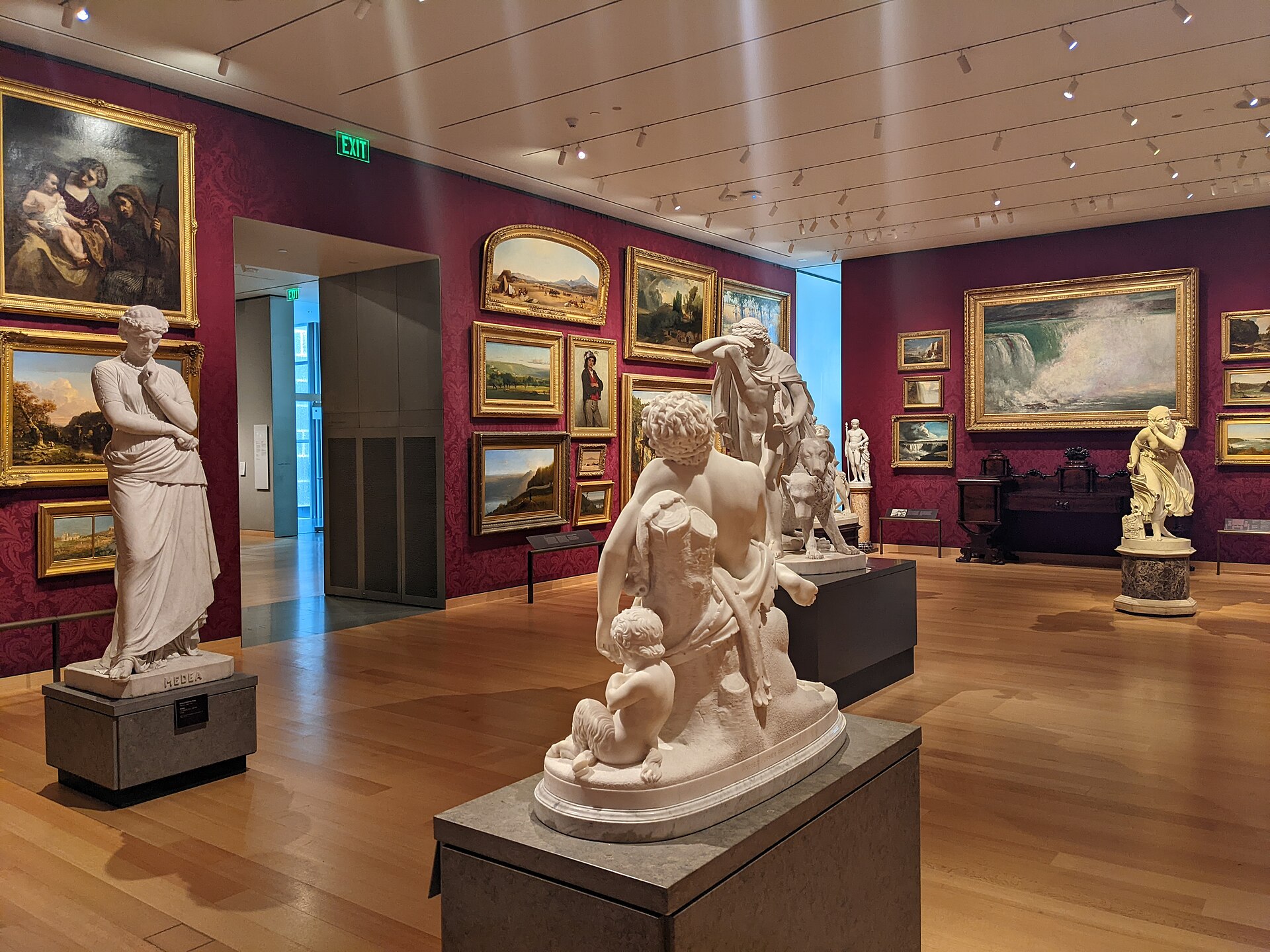
Photograph by Sintakso · CC BY-SA 4.0 The Art of the Americas Wing: American paintings and sculpture galleries
The nineteenth-century American painting and sculpture rooms of the same wing, red-walled, hung salon-style with Hudson River School landscapes and marble figure sculpture, including William Wetmore Story's Medea (about 1868-80, accession 1984.202). One floor below, the Carolyn A. and Peter S. Lynch Gallery (Gallery 132) holds two of this archive's own objects together in the same room: Copley's Watson and the Shark and Paul Revere's Sons of Liberty Bowl, each confirmed on view there directly from the museum's own object records on 13 August 2026. The suite around it, Art of the Americas: 1700-1800, was fully reinstalled and reopened to the public on 19 June 2026, its first comprehensive update since 2010, organised into eight themed spaces for the nation's 250th anniversary; the museum's own press materials describe the Sons of Liberty Bowl now set beside a newly added 1857 stoneware storage jar inscribed by the enslaved potter and poet David Drake, a pairing the museum frames as showing how the Liberty Bowl's own language of freedom excluded enslaved people such as Drake from it.
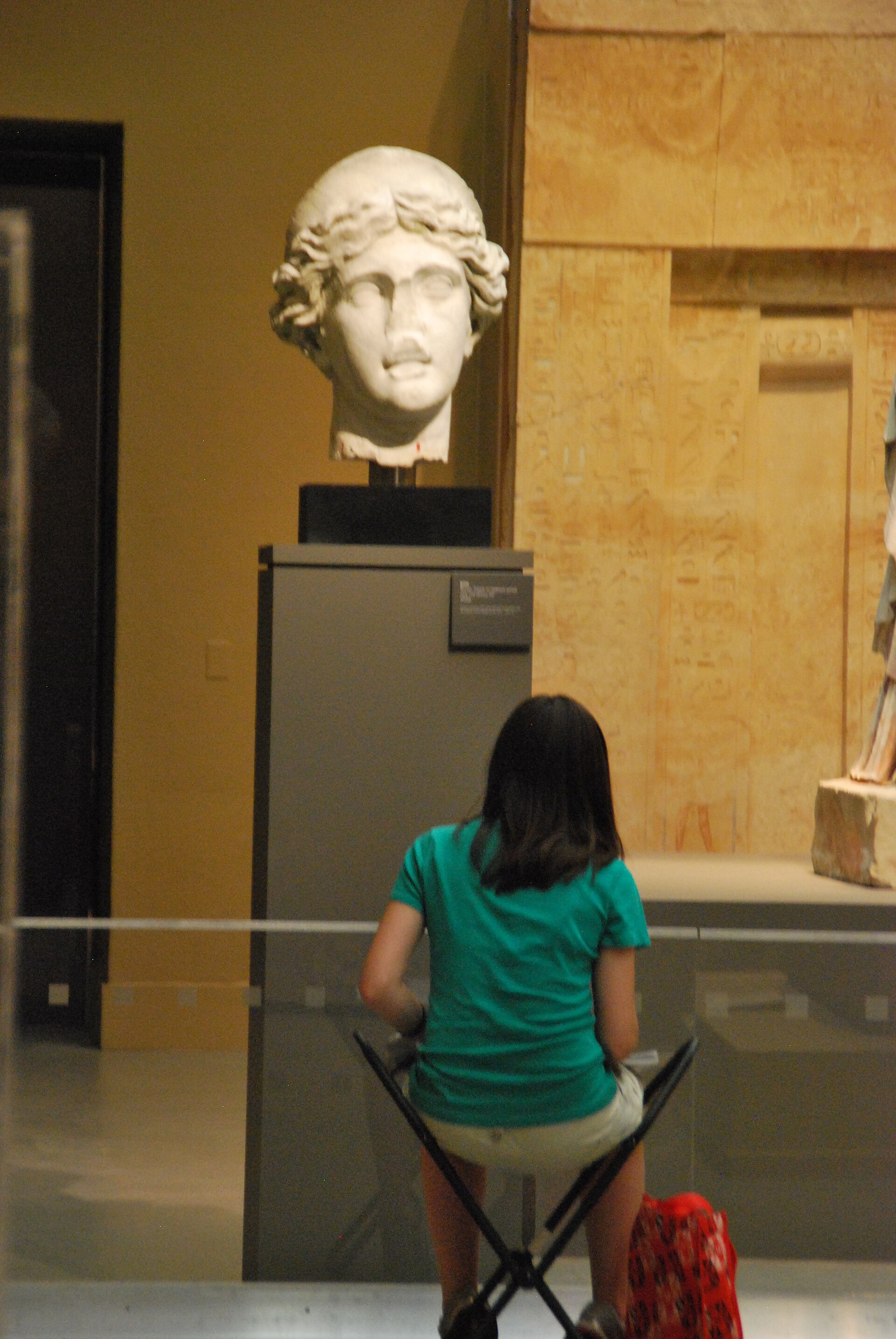
Photograph by Marcus Cyron · CC BY 3.0 Art of Ancient Egypt, Nubia, and the Near East
More than 65,000 objects, mainly excavated under George A. Reisner's Harvard University-Museum of Fine Arts Expedition between 1905 and 1942, spread across galleries 105A through 113A (Egypt), 172 (Nubian Art) and 110 (Ancient Near East). The Old Kingdom holdings, including the pair statue of King Menkaura and a queen and six sculpted reserve heads, are called by the museum the greatest outside Cairo; the Nubian collection, with Kerma pottery and colossal Napatan royal statues, is the largest and most important outside Khartoum.
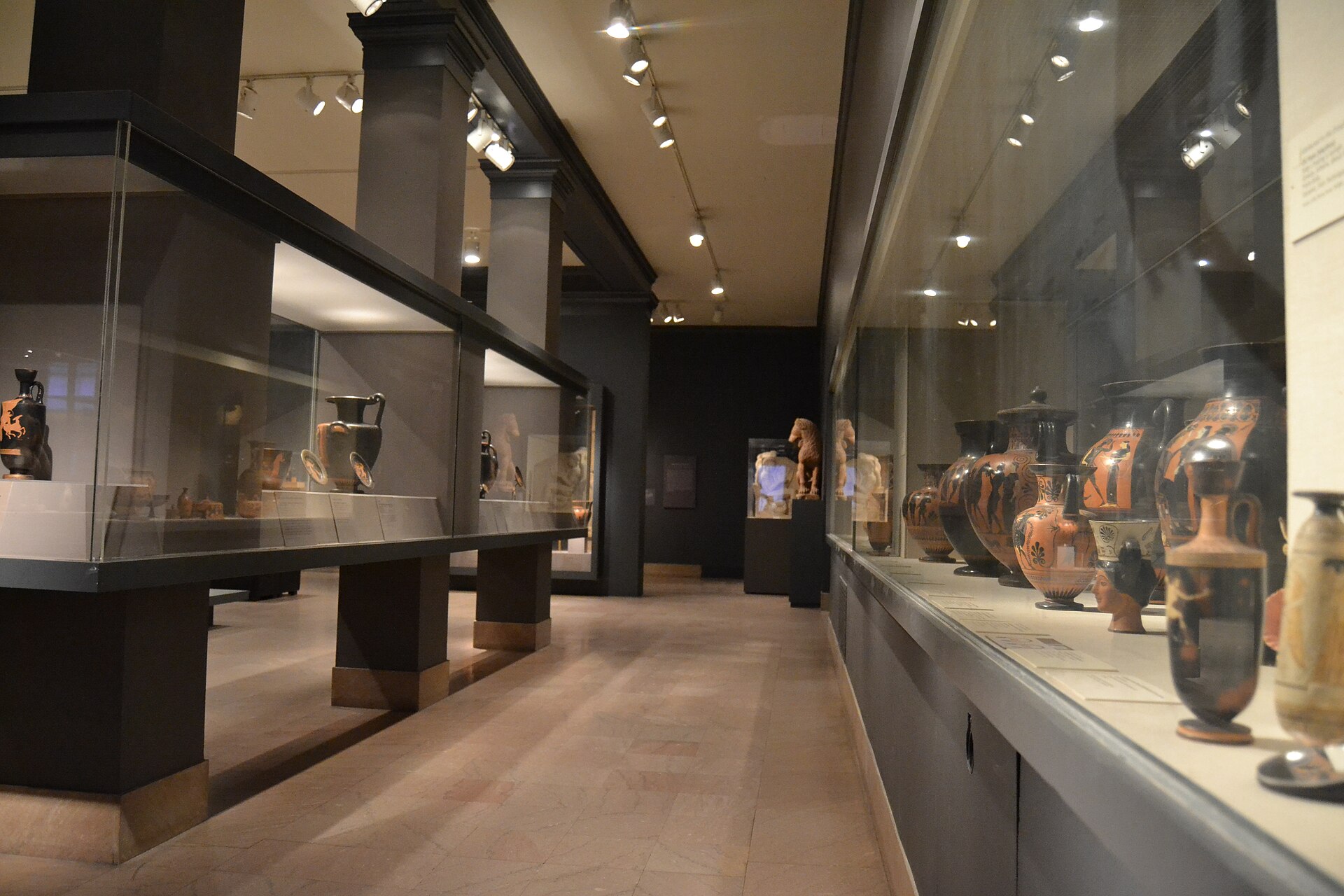
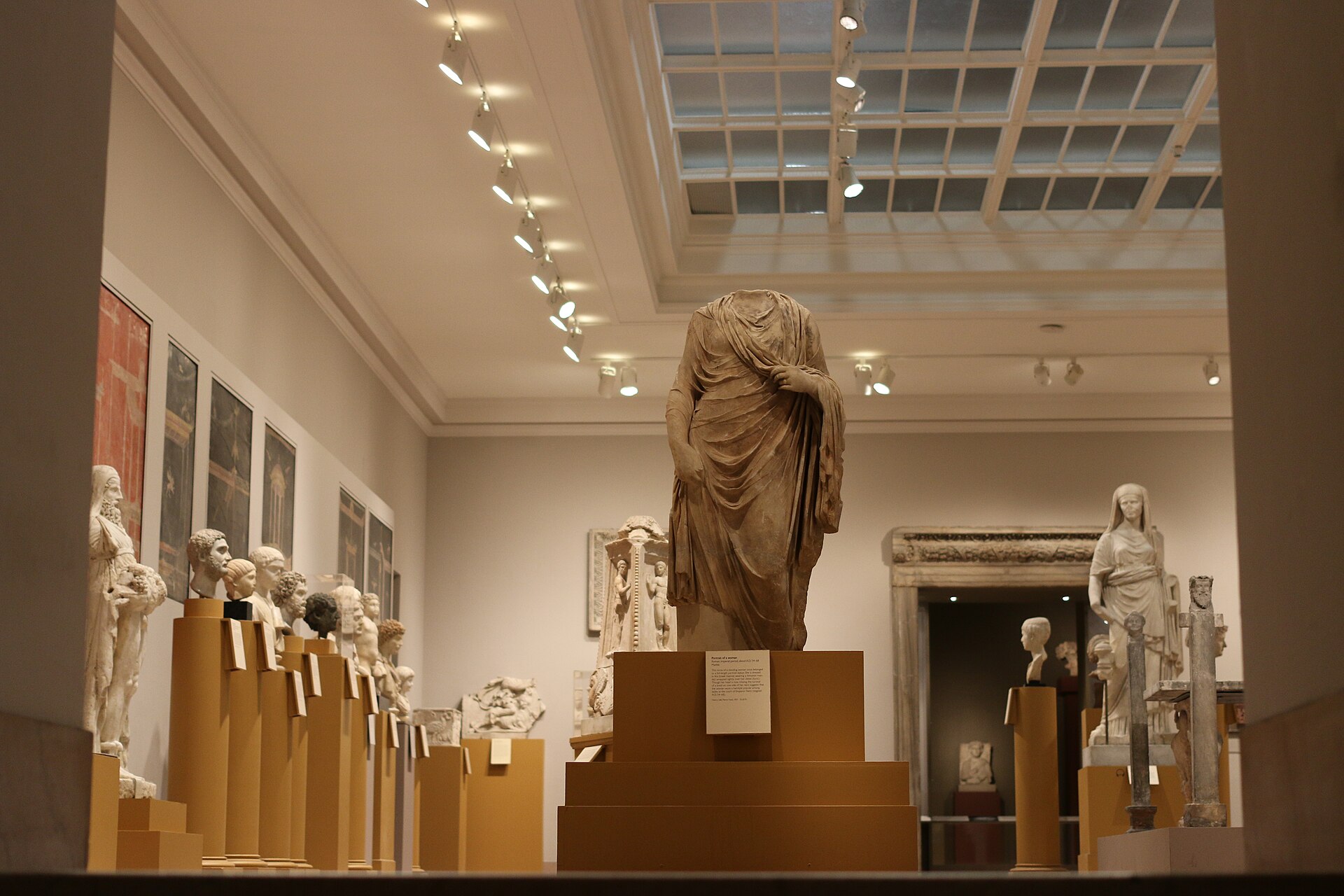
Photograph by Marcus Cyron · CC BY-SA 4.0 Art of Ancient Greece and Rome, the Behrakis Wing
Galleries 206 through 215, running from Roman portraiture and the Behrakis Gallery of Greek and Roman antiquities through Byzantine art, Early Greek art and the Krupp, Lubin and Ruettgers galleries devoted to daily life, the symposium and Greek theatre. Five of these galleries were rebuilt and reinstalled in December 2021. This is also the department that, in 2011, gave up the Weary Herakles torso for reunion with its Turkish other half, discussed below.
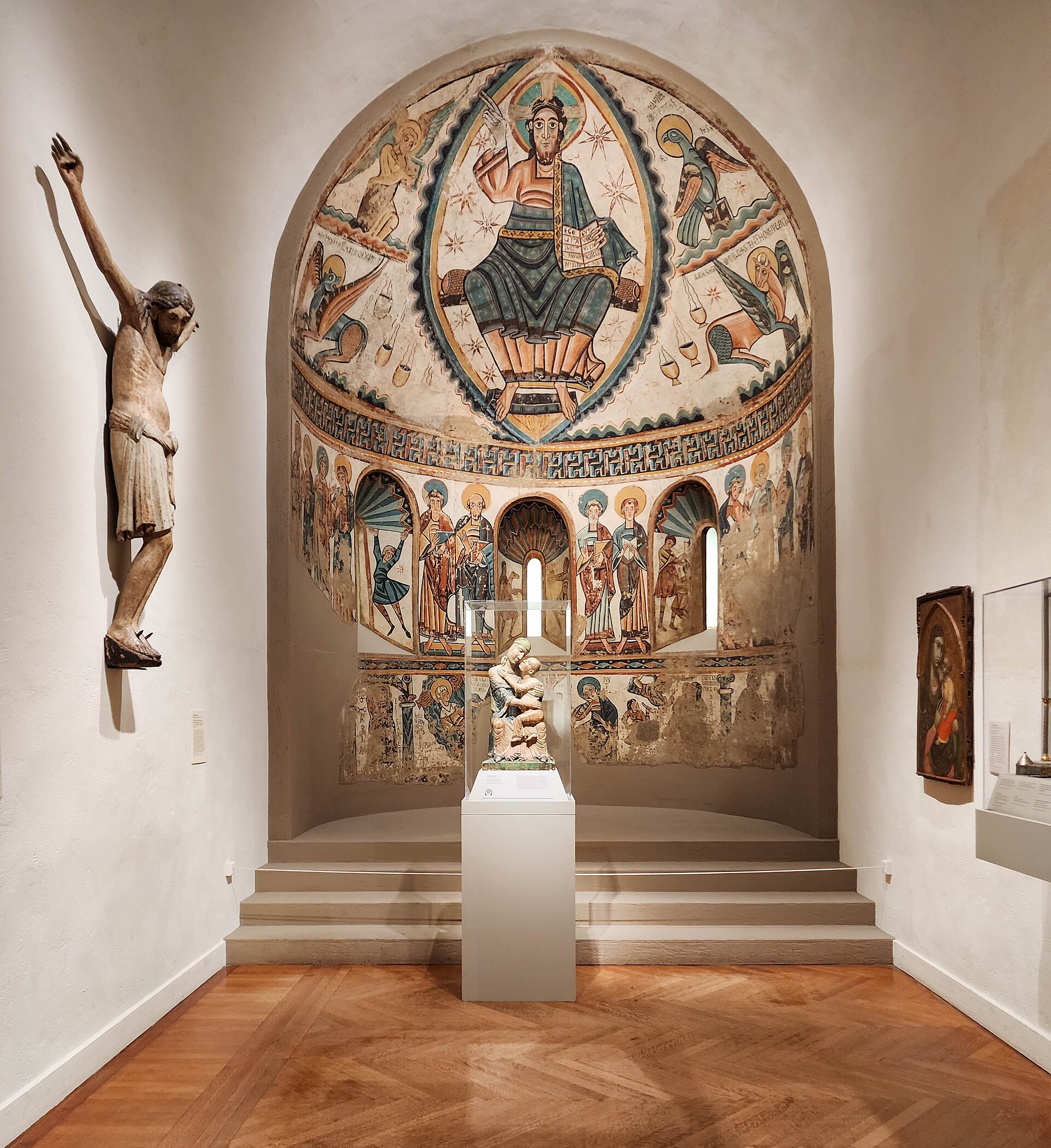
Photograph by Crisco 1492 · CC BY-SA 4.0 Art of Europe: the medieval galleries
Gallery 218 (Gothic) and the rooms around it, holding Romanesque and Gothic sculpture, stained glass, ivories and a reconstructed apse installation with painted vault decoration, a carved crucifix and an enthroned Christ in majesty. The department continues upstairs through the Renaissance galleries to the Koch Gallery (250) of large-scale Baroque and Grand Manner painting.
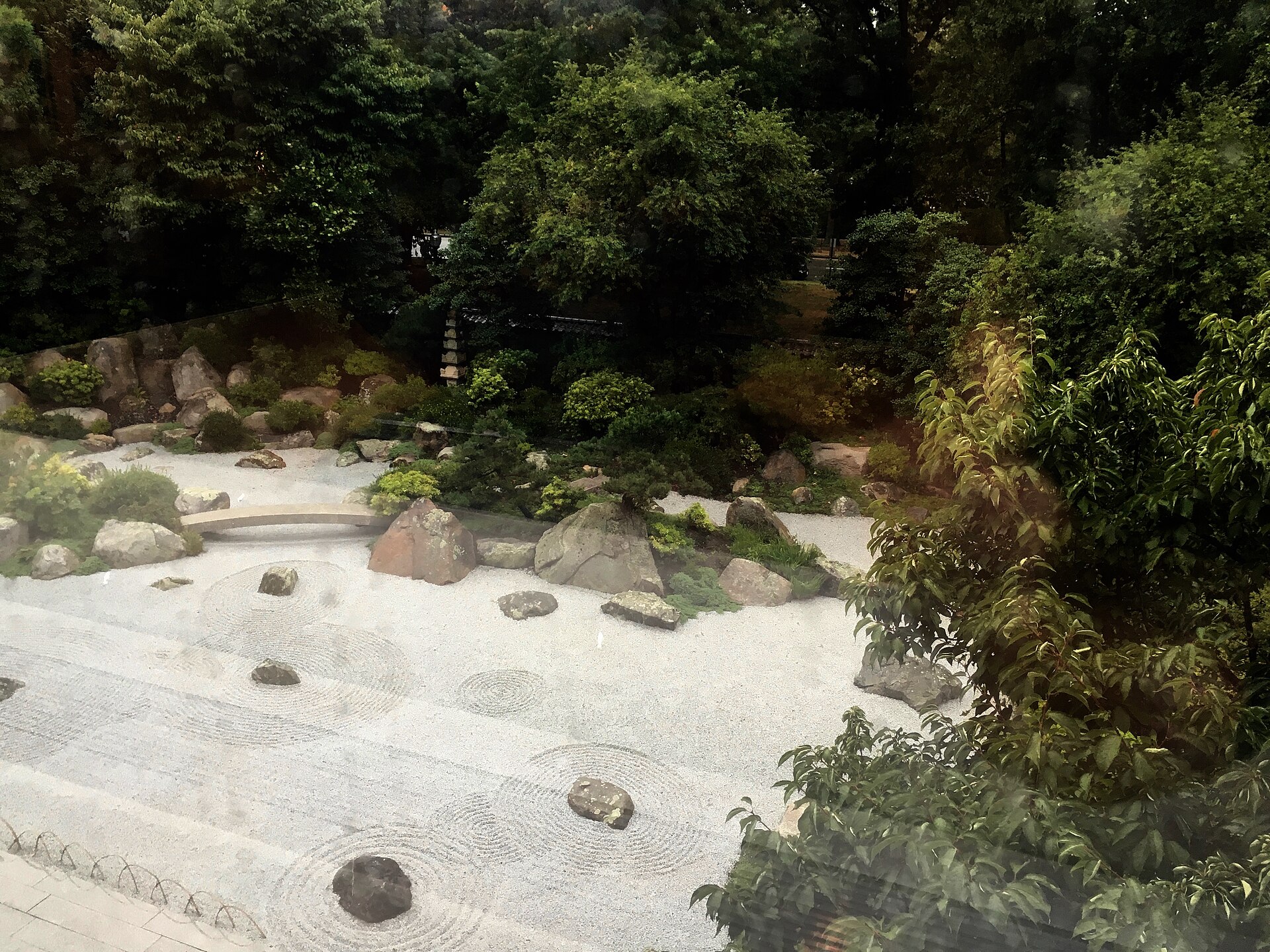
Photograph by MiguelHermoso · CC BY-SA 4.0 Tenshin-en, the Japanese garden
A walled karesansui (dry-landscape) garden on the museum's grounds, designed by Kinsaku Nakane and opened in 1988, with raked white gravel, standing stones and a small footbridge, named for Okakura Tenshin, the Japanese scholar who curated the museum's Asian collection in the early twentieth century. It is reachable from inside the building and is one of the few spaces here that is landscape rather than gallery.
Linde Family Wing for Contemporary Art
I. M. Pei's 1981 West Wing, renamed for the Lindes in 2008 and reopened in September 2011 as the museum's contemporary galleries (168, 237 and 246 among them), plus the Taste cafe, the Garden Cafeteria and, since a November 2022 public opening, the 22,000 square foot Conservation Center with six laboratories. No free-licence photograph of these galleries was located on Wikimedia Commons; the wing is real and current but this page carries no interior plate of it.
Center for Netherlandish Art
Six new galleries of Dutch and Flemish painting, including Gallery 242 (Art of the Netherlands in the Seventeenth Century), opened in November 2021 as a dedicated center rather than a single room, built around the museum's Rembrandt, Rubens and genre-painting holdings. No free-licence photograph of these specific galleries was located on Wikimedia Commons.
What to see first
Sons of Liberty Bowl
Paul Revere, Jr., 1768Silver, engraved with the names of the ninety-two Massachusetts representatives who refused to rescind the letter protesting the Townshend Acts, and with the names of the fifteen Sons of Liberty members who commissioned it. The museum's own collection text calls the Liberty Bowl, the Declaration of Independence and the Constitution the nation's three most cherished historical treasures. It was bought by the museum in 1949 partly with seven hundred donations from Boston schoolchildren. On view today in the Carolyn A. and Peter S. Lynch Gallery (Gallery 132), confirmed directly from the museum's own object record on 13 August 2026. Since the wing's 19 June 2026 reinstallation the bowl stands beside a newly added 1857 stoneware storage jar inscribed by the enslaved potter and poet David Drake, a pairing the museum itself uses to note that the bowl's language of liberty did not extend to the enslaved. This archive holds a record on it.11
Full record in this archiveMinister Kibi's Adventures in China (Kibi daijin nitto emaki)
Unknown painter of the Kyoto court circle, twelfth centuryFour handscrolls (accessions 32.131.1 through .4) recounting an unhistorical legend of a Japanese envoy outwitting the Tang court, among the great surviving works of Japanese narrative painting. Recorded by the museum as not currently on view, reconfirmed directly from the museum's own object record for scroll 1 on 13 August 2026. This archive holds a record on it.13
Full record in this archiveWatson and the Shark
John Singleton Copley, 1778Copley's first large-scale history painting, showing the 1749 shark attack on fourteen-year-old Brook Watson in Havana Harbor. This is the second full-scale version, which Copley kept in his own London studio; it hangs in the Carolyn A. and Peter S. Lynch Gallery (Gallery 132) alongside the Sons of Liberty Bowl, confirmed directly from the museum's own object record on 13 August 2026, within the Art of the Americas: 1700-1800 suite reinstalled 19 June 2026. The choice of a personal, non-classical, non-biblical subject for a history painting was itself unconventional in 1778 and helped establish Copley's reputation in England.10
Appeal to the Great Spirit
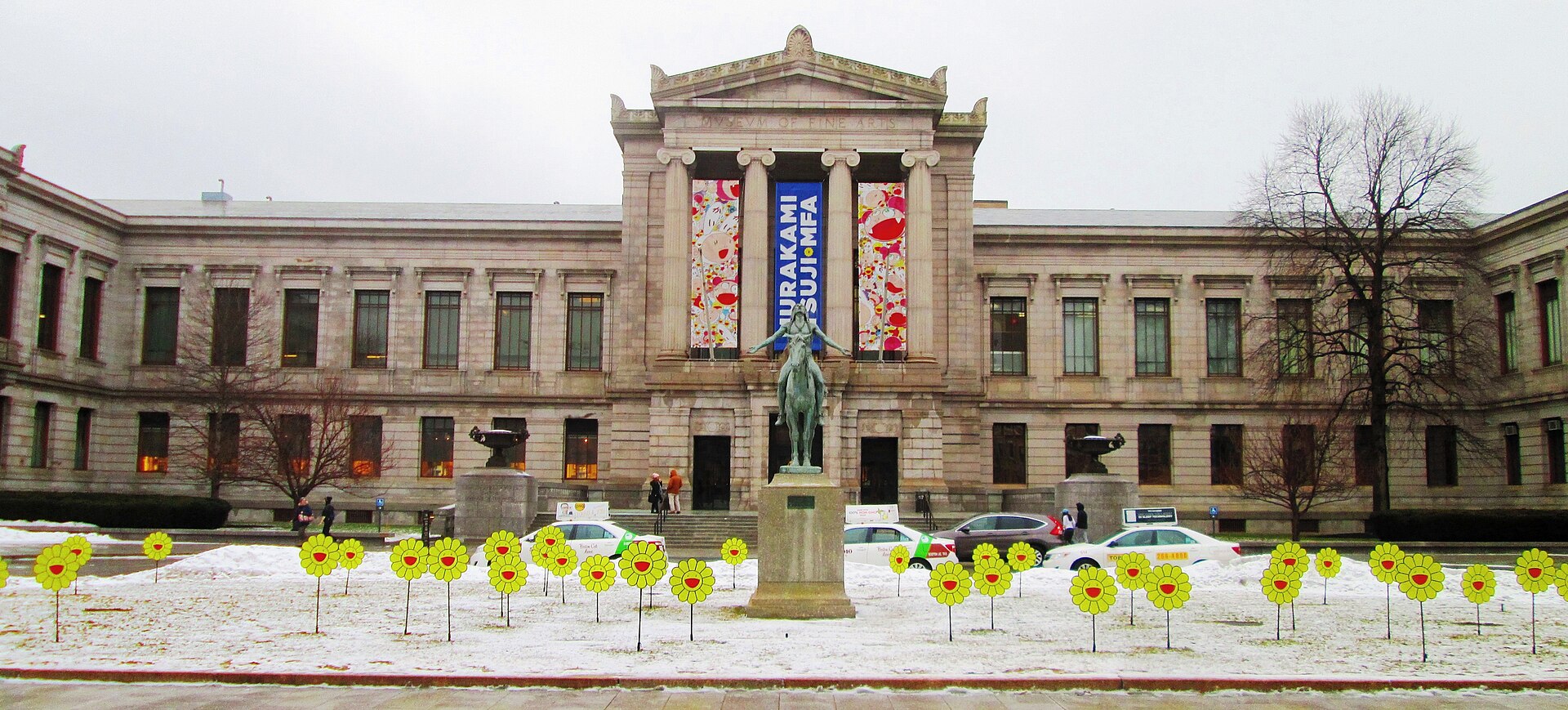
Cyrus E. Dallin, 1909The bronze equestrian on the plaza in front of the building, probably the most reproduced image associated with the museum. It is also the clearest instance on this page of a museum revising its own account of an icon: the museum's current label, written by curator Layla Bermeo and Tess Lukey (Aquinnah Wampanoag) in 2020, states plainly that the figure's regalia mixes elements from several unrelated Indigenous nations that are not authentic to any one of them, calls the result an invention, a white fantasy of Native culture, and notes that the sculpture stands on land whose original people, the Massachusett, go unnamed by it.9
Pair statue of King Menkaura and a queen
Egyptian, Old Kingdom, Dynasty 4, reign of Menkaura, about 2490 to 2472 BCEGreywacke, recovered by the Harvard University-Museum of Fine Arts Expedition under George Reisner. The museum's own department page calls its Old Kingdom holdings, this statue among them, the greatest collection outside Cairo.8
The painted cedar coffins of Governor Djehutynakht
Egyptian, Middle Kingdom, about 2010 to 1961 BCEAn inner and outer coffin from the tomb of a provincial governor, among the best-preserved painted wooden coffins to survive from the Middle Kingdom, again from the Reisner excavations, and central to the museum's Egyptian funerary galleries.8
Winged Isis pectoral
Nubian, Napatan period, reign of Amaninatakelebte, 538 to 519 BCEGold, from the same Harvard-Boston expedition, one of the pieces the museum points to for a Nubian collection it describes as the largest and most important outside Khartoum, built specifically to counter a long habit of treating Nubia as a footnote to Egypt.8
Medea
William Wetmore Story, about 1868 to 1880Marble, in the red-walled nineteenth-century American sculpture and painting galleries, by the Massachusetts-born, Rome-based sculptor better known for Cleopatra. Accession 1984.202. Worth naming because it is the object visible, wall label and all, in this page's own photograph of that gallery.12
Exhibitions on now
- On now15 Dec 2025 to 29 Nov 2026Confirmed 31 Aug 2026, 3 weeks ago
- On now17 May to 25 Oct 2026Confirmed 31 Aug 2026, 3 weeks ago
- On now12 Jun 2026 to 28 Feb 2027Confirmed 31 Aug 2026, 3 weeks ago
Three buildings, and a founding that took six years to open a door
The Museum of Fine Arts, Boston was incorporated in 1870, before it had a building of its own. Its first collection sat on the top floor of the Boston Athenaeum. It took six years to open to the public: the museum's first purpose-built home, designed by Sturgis and Brigham, opened at Copley Square on 4 July 1876, at Dartmouth and St. James Streets. That building lasted just over three decades. It closed in May 1909, and that November the museum opened its present Beaux-Arts building on Huntington Avenue, designed by the Boston architect Guy Lowell, on what the museum's own architectural history now states plainly are the historic homelands of the Massachusett people, a place that had long served the Massachusett as a site of meeting and exchange before European settlement.
The Huntington Avenue building was never finished as one campaign. The Evans Wing for Paintings opened in February 1915, completing the second section of Lowell's original 1907 master plan. In 1921 and 1925 the painter John Singer Sargent completed a mural program for the entrance Rotunda and the Colonnade beyond it, now named the Ruth and Carl J. Shapiro Rotunda and Colonnade, incorporating painted lunettes, sculpture and architectural ornament; the murals were restored and conserved in 1999 and remain the first thing most visitors see. The Decorative Arts Wing followed in November 1928. A 1966-70 addition by Hugh Stubbins and Associates, the George Robert White Wing, brought a conservation laboratory, library, restaurants and administrative offices; a 1976 addition came from the Architects Collaborative; and in July 1981 I. M. Pei's West Wing opened, with a large special-exhibition gallery, an auditorium, restaurants and shops. The Huntington Avenue Entrance itself was closed in 1990 and did not reopen until April 1995.
The most recent rebuilding began with a 1999 commission to Foster + Partners of London for a full site master plan, unveiled in February 2002, with construction starting in November 2005 and a fundraising campaign, Building the New MFA, that closed in September 2008 having raised 504 million dollars. That work delivered the State Street Corporation Fenway Entrance and the Jean S. and Frederic A. Sharf Visitor Center in June 2008, the same month Pei's former West Wing was renamed the Linde Family Wing for Contemporary Art; the Wing for the Art of the Americas, with the Ruth and Carl J. Shapiro Family Courtyard, opened to the public on 20 November 2010 with a free community day; and the Linde Family Wing itself reopened as dedicated contemporary galleries in September 2011, the same year the museum received a RIBA International Award for the whole project. Three further, smaller campaigns followed in the 2020s: the Center for Netherlandish Art and six new galleries of Dutch and Flemish painting opened in November 2021, the Behrakis Wing's ancient Greek, Roman and Byzantine galleries were rebuilt the following month, the 22,000 square foot Conservation Center opened to the public in November 2022, the Buddhist Temple Room and the Asian art galleries around it were completed in early 2023, and, most recently, the museum's Art of the Americas: 1700-1800 galleries were fully reinstalled and reopened on 19 June 2026, their first comprehensive update since the wing itself opened in 2010, timed to the nation's 250th anniversary. The State Street Corporation Fenway Entrance, opened with such ceremony in 2008, is as of this writing closed to the public again; only the Huntington Avenue Entrance and the Linde Family Wing Entrance are in regular use.
The Reisner excavations: an Egyptian and Nubian collection built by one long dig
Most encyclopedic museums assembled their ancient Egyptian holdings by purchase, a piece at a time, from dealers and other collections. The Museum of Fine Arts did something different. Between 1905 and 1942 the archaeologist George Andrew Reisner ran a joint Harvard University-Museum of Fine Arts Expedition that excavated across Egypt and Sudan for nearly four decades, and under the division-of-finds arrangements of the period a large share of what came out of the ground came directly to Boston. The result is a collection built by one sustained excavation program rather than a scattered acquisition history, and it shows: the museum's own department page calls its Old Kingdom holdings, among them the greywacke pair statue of King Menkaura and a queen and six sculpted royal reserve heads, the greatest collection outside Cairo, and its collection of Nubian material, including Kerma pottery, colossal Napatan royal statues and gold jewelry such as the winged Isis pectoral of the Napatan king Amaninatakelebte, the largest and most important outside Khartoum.
That same excavation history is also, on the museum's own account, a colonial one, structured entirely around excavation permits and division agreements negotiated with Egyptian and Sudanese authorities under British colonial administration rather than with fully sovereign governments choosing their own terms. Nubia in particular was, for most of the twentieth century, written into museum labels and popular history mainly as a corridor to Egypt rather than as its own civilization with its own kingdoms, a habit the museum's 2019 exhibition Ancient Nubia Now was built explicitly to correct: the museum's own framing of that show describes it as an attempt to rewrite past misinterpretations of Nubia's history and artistic achievements and to make the case for Nubia's relevance now, using the same Reisner-era objects that had for decades been the basis for the misinterpretation it was correcting. The painted cedar coffins of the Middle Kingdom provincial governor Djehutynakht, among the best-preserved painted wooden coffins to survive from that period, and the sarcophagus of Thutmose I from the Valley of the Kings, came from the same excavation program and sit in the same funerary galleries.
What the label now says about its own icon
Two objects in the Art of the Americas Wing carry the museum's own self-description of the American Revolution, and both are still on public view together in the Carolyn A. and Peter S. Lynch Gallery, Gallery 132, confirmed directly from the museum's own object records on 13 August 2026. Paul Revere's Sons of Liberty Bowl, silver, made in the summer of 1768 and engraved with the names of the ninety-two Massachusetts representatives who voted not to rescind their protest of the Townshend Acts, is described in the museum's own catalogue text as one of the nation's three most cherished historical treasures, ranked there beside the Declaration of Independence and the Constitution. It entered the collection in 1949 through a public subscription that included seven hundred donations from Boston schoolchildren. A few steps away hangs John Singleton Copley's Watson and the Shark of 1778, Copley's first large-scale history painting and the second full-scale version he made, this one kept in his own London studio for the rest of his life; its subject, a near-fatal 1749 shark attack on a fourteen-year-old cabin boy in Havana Harbor, was itself an unconventional choice for a history painting in an era when the genre was assumed to mean scripture or classical myth.
The surrounding suite, Art of the Americas: 1700-1800, was fully reinstalled and reopened to the public on 19 June 2026 during the museum's Juneteenth open house, its first comprehensive update since the wing opened in 2010, timed to the nation's 250th anniversary in 2026. More than 400 objects were rehung across eight themed spaces. The museum's own press materials describe the Sons of Liberty Bowl now set beside a newly displayed 1857 stoneware storage jar inscribed by the enslaved potter and poet David Drake, calling the two together an inscribed pair that shows how art can be used to resist authority; named reporting on the reinstallation (The Art Newspaper, the Boston Globe and WBUR, all read directly and cited below) frames the pairing as a deliberate correction, setting Revere's language of liberty against the fact that it excluded the enslaved. It is, on the evidence read for this record, the most direct instance since the 2020 relabeling of Appeal to the Great Spirit of the museum revising, rather than simply repeating, its own account of a treasured object, this time by changing what stands beside it rather than by changing a label alone.
The clearest single-object instance on this page remains, as before, the label itself: Cyrus E. Dallin's bronze Appeal to the Great Spirit, modeled in 1909 and probably the most reproduced image associated with the museum, printed on postcards, record labels and advertisements for more than a century. The museum's current label, an essay written by curator Layla Bermeo together with Tess Lukey, a member of the Aquinnah Wampanoag, in September 2020, does not treat the sculpture as a simple period curiosity. It states directly that the rider's headdress imitates Lakota featherwork and his necklace resembles Dine (Navajo) jewelry, that the loincloth and moccasins belong to no identifiable community, and that the amalgamation these many viewers have read as authenticity is, in the label's own words, an invention, a white fantasy of Native culture. It goes further: the figure is anonymous and unarmed, alone rather than part of any community, and embodies what the label calls the myth of Native people as a vanishing race, doomed to perish in the face of modernity; any reference to the Massachusett, whose homeland the museum's own building stands on, is notably absent from the sculpture itself. Dallin, the same label notes, was also a genuine advocate for Indigenous rights later in his life, chairing the Massachusetts branch of the Eastern Association of Indian Affairs in the 1920s; the museum's text holds both facts at once rather than resolving them into a simple verdict.
The ledger of return
A provenance research program running since 1998 has produced one of the more candid public records of any American encyclopedic museum, and it is worth reading in full rather than as a list of scandals settled and closed. On the Nazi-era side, the museum reached a March 2017 settlement with the estate of the Hamburg collector Emma Budge, a Jewish woman whose 1937 estate sale in Berlin took place under conditions of persecution even though she had specified the collection should not be sold within National Socialist Germany; the settlement let the museum keep seven pieces of eighteenth-century porcelain that had passed through a later owner's hands before reaching Boston. A June 2011 settlement resolved a claim from the heirs of the Jewish dealer Walter Westfeld, forced to close his Wuppertal gallery in 1936, over Eglon van der Neer's Portrait of a Man and Woman in an Interior. And in April 2023 the museum reached an agreement with the heirs of the dealers Paul Graupe and Arthur Goldschmidt, both driven out of Nazi Germany and both Jewish, over Adriaen van Ostade's Customers Conversing in an Interior, which had been sold in February 1941 by Goldschmidt, then interned, to Karl Haberstock, an agent buying for Adolf Hitler's planned museum; the resolution allows the painting to stay on view, donated at a future date by its current owners the Weatherbie family.
The antiquities record is longer still. In 2011 the museum deaccessioned its half of the Roman-era Weary Herakles torso and transferred it to Turkey, reuniting it with the lower half excavated at Perge in 1980; this archive's own record on that object, held elsewhere and not at this museum since, describes the same transfer independently. In September 2006 the museum returned thirteen antiquities to Italy and signed a cultural exchange agreement with the Italian Ministry of Culture; in December 2021 it returned nine further vessels tied to an investigation into the dealer Edoardo Almagia. Turkey received two fragmentary bronze sculptures from the looted site of Bubon in October 2023, and a looted gold and carnelian necklace, probably taken from a tomb near Kendirlik in 1976, in September 2024. In June 2014 the museum transferred eight Nigerian-origin objects, including Nok and Ife terracottas and material believed stolen from the Royal Palace in Benin City, to Nigeria's National Commission of Museums and Monuments.
The most recent chapter concerns the Kingdom of Benin directly, and it is unusual in its structure. The collector Robert Owen Lehman gave his trove of Benin art to the museum in 2013 and 2018, and the museum built a dedicated Benin Kingdom Gallery around it. In April 2025 the museum took the unusual step of closing that gallery and returning all but a small remainder of the collection to Lehman himself, because the museum had never owned the objects outright and so had no unilateral power to restitute them to Nigeria; three objects of what the museum calls inconclusive provenance remain in its own collection, with research into their removal from the Kingdom of Benin still open. Separately, in a ceremony at Nigeria House in New York on 3 July 2025, the museum restituted two objects it did own outright directly to the Oba of Benin's representatives: a sixteenth or seventeenth-century commemorative head and a sixteenth-century bronze relief plaque, both traceable to the collection of Augustus Pitt-Rivers and, before that, to the British force that occupied Benin City after the 1897 attack that is usually called the Benin Bronzes' origin story. The museum's director, Matthew Teitelbaum, said at the ceremony that he was pleased to deliver the works to Prince Aghatise Erediuwa on behalf of Oba Ewuare II, and that as custodian of the objects for twelve years it was gratifying to see them returned to their rightful owner. The museum's own current gallery listing, checked directly rather than assumed, no longer includes a Benin gallery at all.
Sixty thousand schoolchildren a year, and the day the museum apologised to one class
The museum states that it welcomes 60,000 schoolchildren annually, describing them as its future audience. On 16 May 2019 that relationship was tested in public. A seventh-grade class from the Helen Y. Davis Leadership Academy in Dorchester, on a field trip, went through a string of incidents first reported publicly by the school's principal, Arturo Forrest, to the Boston Globe two days later: a staff member's phrasing of the no-food, no-drink policy as no food, no drink, no watermelon; one patron reportedly telling a female student to pay attention in the museum so she would not end up a stripper, and another patron using a racial slur about the group; and a security-guard rotation pattern that left the students feeling singled out and followed through the galleries. The museum opened an investigation the same week, reviewing security footage of the group's entire three-hour visit and interviewing staff and visitors. Its own press release, issued 24 May 2019, confirmed some of what had been reported and explicitly declined to confirm one detail: it identified and banned the two patrons responsible for the racist comments and served them no-trespass letters; on the guards, it said the footage made it understandable, given normal patrol rotation, that the students felt followed, and called it unacceptable that they felt racially profiled and targeted, without describing the guards' movements as deliberate; and of the watermelon remark specifically, it said the staff member involved recalled saying only no food, no drink and no water bottles, and stated plainly that there is no way to definitively confirm or deny what was said or heard. Director Matthew Teitelbaum said the students left the museum feeling disrespected, harassed and targeted because of the color of their skin, called that unacceptable, and said he was deeply saddened that the museum had taken something from these students they would never get back. The museum committed to retraining frontline staff and security on how to engage with incoming school groups.
Set against that history, the terms on which any visitor, schoolchild or otherwise, gets in the door today are worth stating plainly rather than glossed as merely being like any museum's. General admission is not free: 30 dollars for an adult, 14 dollars for a youth aged 7 to 17, and free for a child of 6 or under, but the museum's own FAQ is explicit that every visitor, of any age, including an infant, must hold a ticket, even one priced at zero. Members are admitted free at every visit, but no member-independent free day or discounted evening is published on the museum's own hours-and-admission page as read for this record. The museum is closed every Tuesday, a day most of its Boston-area peers do not share, and stays open until 22:00 on Thursday and Friday against a 17:00 close the rest of the week. All of these figures were re-confirmed directly against the museum's own visit page on 13 August 2026 and are unchanged from this record's first research.
An endowment reported at 830 million dollars, and a 13 million dollar deficit
For the fiscal year ending 30 June 2025, the museum's own annual report records an operating deficit of 6 million dollars against a budgeted deficit of 5.4 million, a gap driven by expenses of 104.9 million dollars running 4.9 percent, or 4.9 million dollars, over a 100 million dollar budget, with unexpectedly high space and occupancy costs and increased professional-services spending named as the specific causes. Revenue reached 98.9 million dollars, an increase of 8.3 percent on the prior year, drawn roughly nine-tenths from three sources: the annual endowment distribution at about 35.4 percent of the total, audience-driven revenue such as admission and dining at 34.8 percent, and private support at 11.5 percent. Salaries and benefits, at 56.2 million dollars, made up 55.7 percent of all expenses. Attendance reached 1.05 million for the year, the museum's own report calls it the highest since the COVID-19 pandemic, helped by special exhibitions including Georgia O'Keeffe and Henry Moore and Van Gogh: The Roulin Family Portraits.
That relatively strong attendance year did not prevent a harder announcement seven months later. On 28 January 2026 the museum confirmed it would lay off 6.3 percent of its staff, 33 employees, as part of what it called a sweeping restructuring plan responding to a newly projected 13 million dollar deficit; even with the cuts, the museum itself put the resulting savings at only 5.4 million dollars. It called the reductions painful but necessary and said it was deeply grateful to the departing staff. UAW Local 2110, the union representing many of the affected employees, said it was deeply concerned about the impact on both the affected staff and those remaining, given workloads it described as already high, and called the cuts a blow to the institution as well as to the individuals losing their jobs; the union said it had learned of the layoffs only the day before the public announcement. It was the second such reduction in the museum's recent history, following the elimination of 113 full- and part-time positions in August 2020, half of them through voluntary early retirement. Reporting on the same announcement put the museum's endowment at 830 million dollars and noted that, even at 1.05 million visits, attendance remained well below the roughly 1.2 million the museum averaged before the pandemic, with membership numbers still down by more than 10,000 and expenses having climbed by more than 17 million dollars, outpacing the growth in revenue. That 830 million dollar figure comes from press reporting rather than from an audited figure published directly by the museum on the pages read for this record, a distinction carried into the open questions below.
What visitors say
We reproduce no visitor-review prose, so what follows draws on the museum's own published statements and named reporting. TripAdvisor recorded an aggregate of 4.8 out of 5 from 8,410 ratings, read in the page's own structured data on 6 August 2026; cited here as a tertiary datum, not as our own assessment. The pattern in the museum's own material is a large, genuinely encyclopedic collection, free of a general admission charge only for members, set against real financial strain: an operating deficit in the fiscal year ending June 2025, a further projected 13 million dollar deficit disclosed in January 2026, and a staff reduction of 6.3 percent announced the same month. The museum's own provenance pages are unusually candid for an institution of this size, listing objects it has returned to Italy, Turkey and Nigeria across nearly two decades and Nazi-era claims it has settled or is still researching. Its 2020 relabeling of Cyrus Dallin's Appeal to the Great Spirit, discussed above, and its June 2026 reinstallation of the 18th-century American galleries, which now sets Paul Revere's Sons of Liberty Bowl beside a storage jar by the enslaved potter David Drake, are the clearest examples on this page of a museum revising its own earlier account of a treasured object rather than leaving the old label standing.
What is praised, what is criticised
- Praised: an encyclopedic collection of close to 500,000 works, with Egyptian and Nubian holdings the museum itself, on the evidence of its own excavation history, calls the finest outside Cairo and Khartoum respectively
- Praised: free general admission for members at every visit, and the museum's own count of 60,000 schoolchildren welcomed annually
- Praised: the Sargent-muraled Rotunda and Colonnade at the head of the grand staircase, restored in 1999 and unchanged in character since
- Praised: the Art of the Americas Wing's period rooms, which put seventeenth-century New England furniture and Victorian domestic interiors on view rather than in storage
- Praised: late evening hours on Thursday and Friday, to 22:00, against a 17:00 close the rest of the week
- Praised: a provenance research program, running since 1998, that publishes its resolved and unresolved Nazi-era and antiquities cases rather than only its acquisitions
- Criticised: general admission is not free: 30 dollars for an adult, and every visitor of any age, including an infant, must hold a ticket even when its price is zero
- Criticised: closed every Tuesday, with no general free-admission day published on the museum's own hours-and-admission page as of 13 August 2026
- Criticised: an operating deficit of 6 million dollars in the fiscal year ending June 2025, against a budgeted 5.4 million, with expenses at 104.9 million dollars running 4.9 percent over budget
- Criticised: a further projected 13 million dollar deficit led the museum to lay off 6.3 percent of its staff in January 2026, the second such reduction since 113 positions were cut in August 2020; the union representing affected staff, UAW Local 2110, called the cuts a blow to the institution as well as to the employees
- Criticised: attendance of 1.05 million in fiscal 2025, the museum's own best since the pandemic, still sits below the roughly 1.2 million it averaged before it, and membership numbers remain down by more than 10,000
- Criticised: the Benin Kingdom Gallery, built around the Robert Owen Lehman collection, was closed in April 2025 and all but three objects returned to the donor because the museum did not own them outright; two further objects it did own outright were separately restituted to Nigeria in July 2025
- Criticised: in May 2019 a school group from the Davis Leadership Academy in Dorchester reported being told no food, no drink, no watermelon at the entrance, racist remarks from two patrons, and a guard rotation pattern that left them feeling singled out; the museum's own investigation confirmed and acted on the racist remarks and the students' sense of being followed, but said of the watermelon phrase specifically that there was no way to definitively confirm or deny what was said, and its director apologised directly to the students
Ratings on other platforms
TripAdvisor: 4.8 from 8,410 ratings, read 6 August 2026
A platform average is a tertiary source: it moves, it is not audited, and we quote no visitor's words.
Questions about Museum of Fine Arts, Boston
Where is Museum of Fine Arts, Boston?
465 Huntington Avenue, Boston, Massachusetts 02115, United States.
How much does it cost to visit?
Members: free; Adults: USD 30; Youths, 7 to 17: USD 14; Youths, 0 to 6: free. As confirmed 13 August 2026.
When is it open?
Sunday, Monday, Wednesday, Saturday 10:00-17:00; Thursday, Friday 10:00-22:00; Tuesday closed. Closed: Tuesday, every week. Closed New Year's Day, Patriots' Day, the Fourth of July, Thanksgiving, and Christmas. As confirmed 13 August 2026.
How do you get there?
Subway: Green Line E train to the Museum of Fine Arts stop, the Orange Line to the Ruggles stop, or the Commuter Rail (Zone 1A) to Ruggles. Fare information is on the MBTA website; Bus: The 39 bus to the Huntington Avenue at Ruggles Street or Louis Prang Street stop, or the 8, 19, 47 or CT2 buses to the Ruggles Street at Huntington Avenue stop; Car and parking: Self-parking at three museum-run facilities, the Huntington Lot, the Fenway Lot and the Museum Road Garage, all with entrances on Museum Road. The Huntington Lot is closest to the Huntington Avenue Entrance and has accessible spaces along the Huntington Avenue side; the Fenway Lot pairs with the level-entrance Linde Family Wing Entrance. The garage office, for parking assistance when planning a visit, is 617-369-3657; Entrances: The Huntington Avenue Entrance is the main entrance, fully accessible with ramps on both sides of the stairs and power-assist doors. The Linde Family Wing Entrance on Museum Road is reserved for visitors who require a level entrance. The State Street Corporation Fenway Entrance, opened in 2008, is currently closed to the public.
What should you see first?
Sons of Liberty Bowl (Paul Revere, Jr., 1768); Minister Kibi's Adventures in China (Kibi daijin nitto emaki) (Unknown painter of the Kyoto court circle, twelfth century); Watson and the Shark (John Singleton Copley, 1778); Appeal to the Great Spirit (Cyrus E. Dallin, 1909); Pair statue of King Menkaura and a queen (Egyptian, Old Kingdom, Dynasty 4, reign of Menkaura, about 2490 to 2472 BCE); The painted cedar coffins of Governor Djehutynakht (Egyptian, Middle Kingdom, about 2010 to 1961 BCE).
What we could not confirm
- The museum's own About page, read 6 August 2026, names Pierre Terjanian as the current Ann and Graham Gund Director. A statement from the museum dated 3 July 2025, concerning the Benin restitution, quotes Matthew Teitelbaum in that same role. The date of the transition between the two directors was not established from the sources read here, and was not re-checked in this 13 August 2026 pass, which was scoped to admission, hours, contact, open status and the two archive highlights.
- The Art Newspaper's account of the April 2025 Benin gallery closure gives the number of objects returned to donor Robert Owen Lehman in a way that leaves three or five objects retained by the museum stated inconsistently within the same piece (all but five, then all but three, of the collection); this page follows the article's own later, more specific figure of three objects with inconclusive provenance remaining, but the discrepancy in the source itself is not resolved.
- No MFA-published, audited endowment figure was read directly from the museum's own annual report pages in the course of this research; the 830 million dollar figure used above is Boston.com's, reporting on the Boston Globe's account, not a figure quoted from the museum's own financial statements.
- No free-licence photograph of the Linde Family Wing for Contemporary Art or the Center for Netherlandish Art galleries was located on Wikimedia Commons, so two of the ten wings recorded here carry no plate. No photograph of the reinstalled Art of the Americas: 1700-1800 galleries specifically (the Power and Resistance room or its David Drake pairing) was sought or found in this pass; the wing-level photograph already on this page was taken before the June 2026 reinstallation and shows the room's fabric rather than its post-reinstallation display.
- This page does not attempt a complete list of the museum's Nazi-era or antiquities provenance cases; the museum's own provenance pages list further objects still under research that are not named here.
Images
Sources
- 1Museum of Fine Arts, Boston, Visit: Hours and Admission. Daily opening hours, the Tuesday closure, holiday closures, the 30-minute-before-close last entry, adult and youth admission prices, the statement that every visitor including infants needs a ticket, the bag and coat-check FAQ, the Signature Shop, and dining and gallery-tour links. Fetched as raw HTML on 6 August 2026 and again on 13 August 2026; every figure unchanged on the re-fetch. mfa.org/visit
- 2Museum of Fine Arts, Boston, Getting Here. Street address with ZIP+4, main and TTY telephone numbers, the Huntington Avenue, Linde Family Wing and (closed) Fenway entrances, subway, bus and driving directions from all points of the compass, and parking. Fetched as raw HTML on 6 August 2026 and again on 13 August 2026; address, phone and entrance status unchanged on the re-fetch. mfa.org/visit/getting-here
- 3Museum of Fine Arts, Boston, About the MFA. Nearly 500,000 works, the founding phrase 'for all the people forever' is not used here but the museum's own framing of the collection is; footer street address and telephone; Director's Message credited to Pierre Terjanian, Ann and Graham Gund Director; mission adopted 2024; strategic plan 2017; sustainability statement 2019. Fetched as raw HTML on 6 August 2026. mfa.org/about
- 4Museum of Fine Arts, Boston, Architectural History. Full dated timeline: Copley Square opening 4 July 1876 and closure May 1909; the Guy Lowell Huntington Avenue building opening November 1909, on the historic homelands of the Massachusett people (the museum's own phrase); the Evans Wing 1915; Sargent's Rotunda (1921) and Colonnade (1925) murals, restored 1999; the School of the Museum of Fine Arts building 1927; the Decorative Arts Wing 1928; the George Robert White Wing 1970; I. M. Pei's West Wing 1981; the Huntington Avenue Entrance reopening 1995; the Foster + Partners masterplan 1999-2002; groundbreaking 2005; the Fenway Entrance and Sharf Visitor Center, and the West Wing's renaming to the Linde Family Wing for Contemporary Art, both June 2008; the Building the New MFA campaign concluding at 504 million dollars, September 2008; the Art of the Americas Wing and Shapiro Family Courtyard opening 20 November 2010; the Linde Family Wing for Contemporary Art's 2011 reopening and the RIBA International Award the same year; the Center for Netherlandish Art and six new galleries, November 2021; the Behrakis Wing renovation, December 2021; the Conservation Center's public opening, November 2022; the Buddhist Temple Room and Asian art renovation, early 2023. Fetched as raw HTML on 6 August 2026. mfa.org/about/architectural-history
- 5Museum of Fine Arts, Boston, Dining. New American Cafe, Taste, and Garden Cafeteria: locations, hours, and sample menus; the statement that diners pay regular museum admission. Fetched as raw HTML on 6 August 2026. mfa.org/visit/dining
- 6Museum of Fine Arts, Boston, Accessibility. Parking and entrance access, free wheelchairs and rollators, service-dog policy, restroom accessibility including the second-floor rotunda exception, gallery stools, sensory kits, EnChroma glasses, and the bag policy. Fetched as raw HTML on 6 August 2026. mfa.org/visit/accessibility
- 7Museum of Fine Arts, Boston, Collections (landing page). The 'nearly 500,000 works' figure and the list of named collection departments. Fetched as raw HTML on 6 August 2026. mfa.org/collections
- 8Museum of Fine Arts, Boston, Art of Ancient Egypt, Nubia, and the Near East. More than 65,000 objects; excavations under George A. Reisner, 1905 to 1942; the Old Kingdom collection (Menkaura pair statue and triad, the bust of Prince Ankhhaf, six reserve heads) called the greatest outside Cairo; the painted cedar coffins of Governor Djehutynakht; the Nubian collection called the largest and most important outside Khartoum, including the winged Isis pectoral; the 2019 exhibition Ancient Nubia Now, framed by the museum as an attempt to rewrite past misinterpretations of Nubia's history. Fetched as raw HTML on 6 August 2026. mfa.org/collections/ancient-egypt-nubia-and-the-near-east
- 9Museum of Fine Arts, Boston, collections object record, Appeal to the Great Spirit, Cyrus E. Dallin, 1909, accession 13.380. Full catalogue text and 2020 label essay by Layla Bermeo and Tess Lukey (Aquinnah Wampanoag), including the description of the figure's regalia as drawn from several unrelated Indigenous traditions and called 'an invention, a white fantasy of Native culture'; the statue's 1912-13 acquisition history; provenance. Read in the browser on 6 August 2026. collections.mfa.org/objects/37927/appeal-to-the-great-spirit
- 10Museum of Fine Arts, Boston, collections object record, Watson and the Shark, John Singleton Copley, 1778, accession 89.481. Medium, dimensions, on-view location, full catalogue essay identifying this as Copley's second full-scale version, kept in his own studio, and provenance from the artist's estate. Read in the browser on 6 August 2026 and re-fetched directly (via claude-in-chrome, after collections.mfa.org blocked a plain WebFetch with HTTP 403) on 13 August 2026: status reads ON VIEW, Carolyn A. and Peter S. Lynch Gallery (Gallery 132), unchanged. collections.mfa.org/objects/30998/watson-and-the-shark
- 11Museum of Fine Arts, Boston, collections object record, Sons of Liberty bowl, Paul Revere, Jr., 1768, accession 49.45. Full catalogue text including the description of the Liberty Bowl, the Declaration of Independence and the Constitution as the nation's three most cherished historical treasures, the 1949 purchase funded partly by donations from Boston schoolchildren, on-view location, inscriptions and full ownership chain. Read in the browser on 6 August 2026 and re-fetched directly (via claude-in-chrome, after collections.mfa.org blocked a plain WebFetch with HTTP 403) on 13 August 2026: status reads ON VIEW, Carolyn A. and Peter S. Lynch Gallery (Gallery 132), unchanged. collections.mfa.org/objects/39072/sons-of-liberty-bowl
- 12Museum of Fine Arts, Boston collections search, 'medea story': confirms William Wetmore Story's Medea, about 1868-80, accession 1984.202, among the collection's Medea-subject works. Read in the browser on 6 August 2026. collections.mfa.org/search/objects/*/medea%20story
- 13Museum of Fine Arts, Boston collections search, 'kibi daijin': confirms the four scrolls of Minister Kibi's Adventures in China (Kibi daijin nitto emaki), artist unknown, Japanese, 12th century, accessions 32.131.1 through 32.131.4. Read in the browser on 6 August 2026. Re-fetched directly on 13 August 2026 (via claude-in-chrome, after collections.mfa.org blocked a plain WebFetch with HTTP 403): the object record for scroll 1 (accession 32.131.1) reads NOT ON VIEW, unchanged. collections.mfa.org/search/objects/*/kibi%20daijin
- 14Museum of Fine Arts, Boston, Nazi-Era Provenance Research. Priority and transparency lists of works that changed hands in Europe 1933-45; the resolved Emma Budge estate porcelain claim (settled March 2017); the resolved Walter Westfeld / Eglon van der Neer claim (settled June 2011); the April 2023 agreement with the heirs of Paul Graupe and Arthur Goldschmidt over Adriaen van Ostade's Customers Conversing in an Interior, sold to a Hitler agent in 1941 and retained by the museum by agreement with the Weatherbie family. Fetched as raw HTML on 6 August 2026. mfa.org/collections/provenance/nazi-era-provenance-research
- 15Museum of Fine Arts, Boston, Antiquities and Archeological Material. The museum's post-2008 acquisition standard (documented outside the country of origin by 1970); the 2011 Weary Herakles transfer to Turkey and its reunion with the Perge lower half; the 2006 transfer of 13 antiquities to Italy; the 2021 transfer of 9 vessels to Italy following the Almagia investigation; the 2023 transfer of two Bubon bronze fragments to Turkey; the 2024 return of a looted gold and carnelian necklace to Turkey; the 2014 transfer of 8 Nigerian-origin objects, including Nok and Ife terracottas and Benin material, to Nigeria's National Commission of Museums and Monuments. Fetched as raw HTML on 6 August 2026. mfa.org/collections/provenance/antiquities-and-archeological-material
- 16Torey Akers, 'MFA Boston returns two works to Kingdom of Benin', The Art Newspaper, 3 July 2025. The July 2025 restitution ceremony at Nigeria House, New York, for a Commemorative Head and a Relief Plaque traced to the 1897 British Benin punitive expedition and the Pitt-Rivers collection; recorded that the museum had closed its Benin gallery in April 2025, returning most of the rest to donor Robert Owen Lehman since it did not own the collection outright; and quoted director Matthew Teitelbaum's quoted statement. Fetched as raw HTML on 6 August 2026; the quoted material was read in the raw bytes of the page, not summarised. theartnewspaper.com/2025/07/02/museum-fine-arts-boston-restitutes-benin-bronzes-nigeria
- 17Museum of Fine Arts, Boston, press release, 'Museum of Fine Arts, Boston, Announces Steps to Address Results of Investigation into Davis Leadership Academy Group Visit on May 16, 2019', 24 May 2019. The four reported incidents, director Matthew Teitelbaum's quoted apology, the no-trespass letters issued to two patrons, the retraining commitment, and the museum's own figure of 60,000 schoolchildren welcomed annually. Fetched as raw HTML on 6 August 2026; the quotation was read in the raw bytes of the page. mfa.org/news/update-may-2019
- 18Museum of Fine Arts, Boston, Annual Report 2025: Numbers. Fiscal year ended 30 June 2025: operating deficit of 6 million dollars against a budgeted 5.4 million; revenue of 98.9 million dollars, its composition by endowment distribution, audience-driven revenue and private support; expenses of 104.9 million dollars; attendance of 1.05 million, the museum's highest since the pandemic; salaries and benefits at 56.2 million dollars. Fetched as raw HTML on 6 August 2026. mfa.org/annual-report/annual-report-2025/numbers
- 19Beth Treffeisen, 'MFA is facing layoffs, cutting around 10% of jobs', Boston.com, 29 January 2026. The 6.3 percent staff reduction (33 employees), the projected 13 million dollar deficit, the museum's 'painful but necessary' language, the UAW Local 2110 union statement, the endowment reported at 830 million dollars, 2025 attendance over 1 million against a roughly 1.2 million pre-pandemic average, membership down more than 10,000, expenses up more than 17 million dollars, and the prior 2020 reduction of 113 positions. Fetched as raw HTML on 6 August 2026; quotations were read in the raw bytes of the page. boston.com/news/local-news/2026/01/29/mfa-is-facing-layoffs-cutting-around-10-of-jobs/
- 20TripAdvisor, Museum of Fine Arts attraction page. Aggregate rating of 4.8 out of 5 from 8,410 ratings, read from the page's own embedded structured data (schema.org AggregateRating) on 6 August 2026, together with the confirming street address and telephone number. TERTIARY, cited only as a platform datum. tripadvisor.com/Attraction_Review-g60745-d105257-Reviews-Museum_of_Fine_Arts-Boston_Massachusetts.html
- 21Wikidata, Museum of Fine Arts Boston (Q49133). Verified by label match against wbsearchentities and by claims: P31 art museum / museum / nonprofit organization, P17 United States, P131 Boston, P625 coordinates 42.339444, -71.094167 (the Huntington Avenue site, confirming this is the Boston institution and not the Museum of Fine Arts, Houston), P856 official website mfa.org, P571 inception 1870, no P576 dissolved date. TERTIARY, used only for machine identity and coordinates, never for a price or an opening hour. wikidata.org/wiki/Q49133
- 22Wikimedia Commons, Category:Museum of Fine Arts, Boston and its subcategories Interior of Museum of Fine Arts, Boston and Tenshin-en. Every plate on this page had its licence read per file from extmetadata.LicenseShortName and its wikitext, and its author read from extmetadata.Artist or the file's own Information template, on 6 August 2026, and every plate was downloaded at 960px and inspected by eye before use. commons.wikimedia.org/wiki/Category:Museum_of_Fine_Arts,_Boston
- 23Danny McDonald, 'MFA apologizes after students from Dorchester school subjected to racism during field trip', The Boston Globe, 22 May 2019. Names the Helen Y. Davis Leadership Academy's seventh-grade field trip and the school's Dorchester location; reports, per the school's principal Arturo J. Forrest, the 'no food, no drink, no watermelon' comment, a patron's comment to a female student about paying attention in the museum so she could avoid a career as a stripper, and a second patron's use of a racial slur about the group; also reports the pattern of security guards appearing to single out and follow students of color. These specifics, reported here as Forrest's account two days before the museum's own investigation concluded, are the source for language this page had previously carried without any citation. Fetched as raw HTML on 6 August 2026; the quoted material was read in the raw bytes of the page, not summarised. bostonglobe.com/metro/2019/05/22/mfa-apologizes-after-students-from-dorchester-school-subjected-racism-during-field-trip/TzYcdDirBvoDE81q65TOKN/story.html
- 24Cristela Guerra, 'Here's What The Students In The Racist MFA Incident Are Asking From The Museum', WBUR News, 25 June 2019. Reports the demand letter from Lawyers for Civil Rights on behalf of the Davis Leadership Academy students and staff, and states that the MFA's own investigation confirmed the students had been confronted by the two patrons responsible for the racist comments (one calling a student a 'stripper', the other using a racial slur), both of whom the museum banned. Fetched as raw HTML on 6 August 2026; the quoted material was read in the raw bytes of the page, not summarised. wbur.org/news/2019/06/25/mfa-racist-incident-students-lawyers-demands
- 25Museum of Fine Arts, Boston, Visit: Getting Here: Parking. The three self-parking options (Huntington Lot, Fenway Lot, Museum Road Garage), all with entrances on Museum Road; the Huntington Lot's HP spaces along the Huntington Avenue side; the Fenway Lot and Linde Family Wing Entrance as the level-entrance pairing; and the garage office telephone number, 617-369-3657, for parking assistance when planning a visit. Fetched as raw HTML on 6 August 2026. mfa.org/visit/getting-here/parking
- 26Museum of Fine Arts, Boston, press release, 'Museum of Fine Arts, Boston, to Commemorate Nation's 250th Anniversary with New Installations in Art of the Americas Galleries' (page slug 'america-at-250'). States the reinstalled Art of the Americas: 1700-1800 galleries hold more than 400 objects and opened to the public 19 June 2026, followed by an 'America at 250' celebration 20 June 2026; describes Watson and the Shark as welcoming visitors in 'the introductory space'; describes the Sons of Liberty Bowl and David Drake's 1857 ceramic jar as 'two inscribed objects in the center of this gallery' forming 'a powerful and poignant pair that demonstrates how art can be used to resist authority'. Fetched as raw HTML on 13 August 2026. mfa.org/press-release/america-at-250
- 27Museum of Fine Arts, Boston, gallery page, 'Art of the Americas: 1700-1800'. The museum's own current listing of the reinstalled suite's eight themed spaces (Power and Resistance, History and Mythmaking, Asian Styles in the Americas, Boston's World, Something's Brewing, Communities of Makers, Families at Home, Copley's Ambition) and its own gallery-highlight text for the Sons of Liberty Bowl and Watson and the Shark. Fetched as raw HTML on 13 August 2026. mfa.org/gallery/art-of-the-americas-1700-1800
- 28Museum of Fine Arts, Boston, article, 'Sons of Liberty Bowl' (page slug '2025/sons-of-liberty-bowl'). Confirms the reinstalled 18th-century Art of the Americas galleries and states the bowl stands 'front and center' in the new display, framed around the nation's 250th anniversary. Fetched as raw HTML on 13 August 2026. mfa.org/article/2025/sons-of-liberty-bowl
- 29The Art Newspaper, 'In museum first, MFA Boston pairs prized vessels by Paul Revere and enslaved artist David Drake', 15 June 2026. Reports the 20 June 2026 reinstallation of the 18th-century American galleries, the first major update since 2010; the pairing, in the opening gallery, of David Drake's 1857 storage jar with Revere's Sons of Liberty Bowl, both objects carrying maker inscriptions that play as audio recordings on approach; and chief curator Ethan Lasser's stated shift from 'stories of independence' to 'cultural exchange and interdependence'. Fetched as raw HTML (via WebFetch) on 13 August 2026. theartnewspaper.com/2026/06/15/museum-fine-arts-boston-david-drake-paul-revere-american-galleries
- 30WBUR News, 'MFA confronts history, heroes and destroyers in re-imagined American galleries', 19 June 2026. Confirms the 19 June 2026 reopening of the 18th-century Art of the Americas galleries; the Sons of Liberty Bowl displayed alongside David Drake's storage jar; and Thomas Sully's 'The Passage of the Delaware' newly paired with Alan Michelson's 2024 sculpture 'Hanodaga:yas (Town Destroyer)'. Fetched as raw HTML (via WebFetch) on 13 August 2026. wbur.org/news/2026/06/19/mfa-art-of-americas-galleries-reopen
- 31Murray Whyte, 'At the MFA, the past and present converge in a fractious moment', The Boston Globe, 2 July 2026. Critical review of the reinstalled American galleries; names the 'Copley's Ambition' room and describes Watson and the Shark as the painting visitors see first through the doors; describes further new pairings (Copley's Mary and Elizabeth Royall portrait with Joseph Savart's paintings of unnamed Black women from Guadeloupe; Joseph Pope's orrery with Julia Marden's Wampanoag Women's Outfit; David Drake's pottery near unfinished Gilbert Stuart portraits of George and Martha Washington); and praises the reinstallation's embrace of 'complication' over a heroic Revolutionary narrative. Fetched as raw HTML (via WebFetch) on 13 August 2026. bostonglobe.com/2026/07/02/arts/mfa-past-present-converge-in-a-fractious-moment/