Sudden Shower over Shin-Ohashi Bridge and Atake
Utagawa Hiroshige · 1857
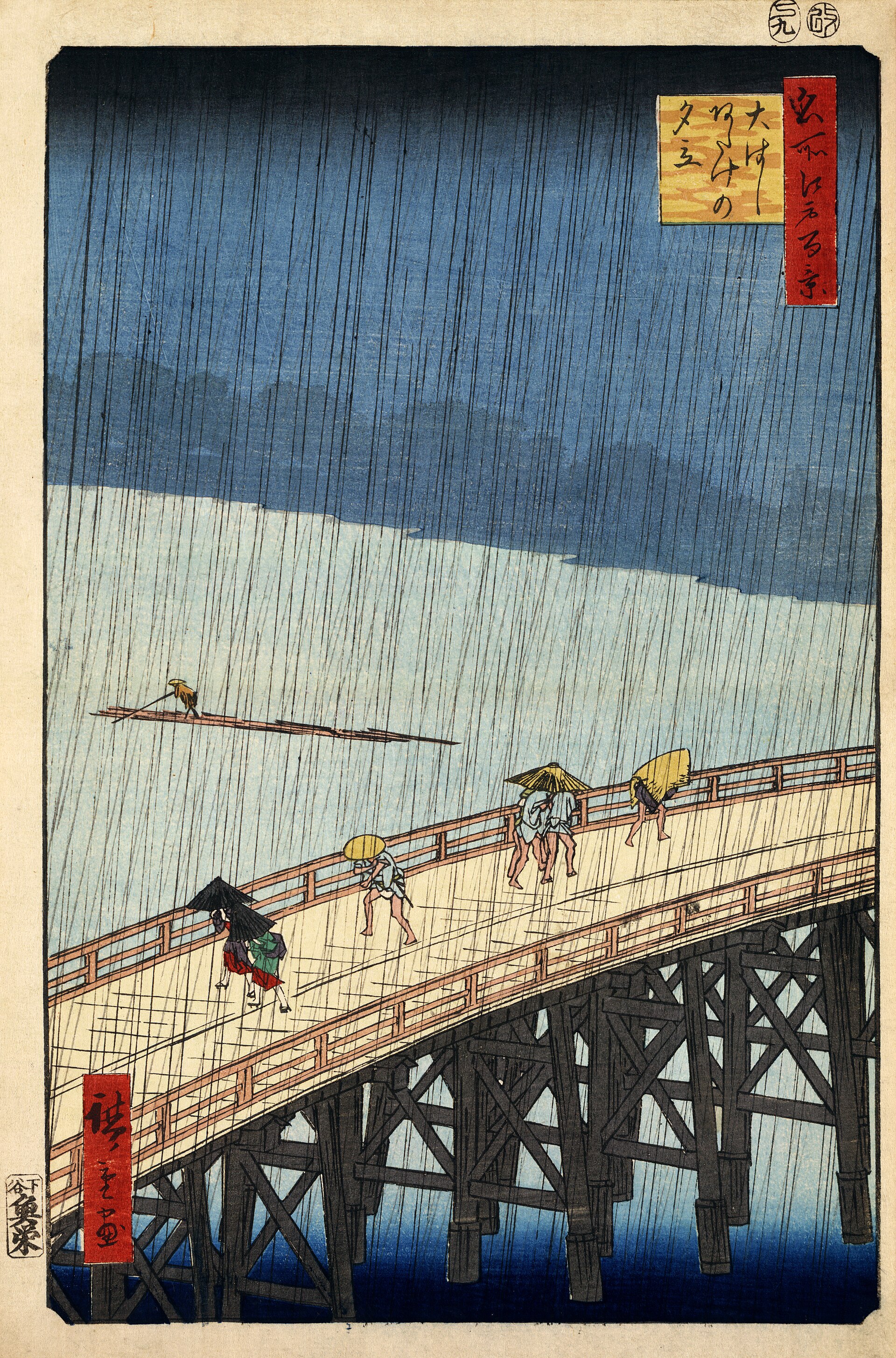
The object described in this record: the Library of Congress's impression, digitized from the original print. Digital ID jpd.02950.
| Artist | Utagawa Hiroshige |
|---|---|
| Date | 1857 |
| Medium | Woodblock print (nishiki-e); ink and color on paper, printed with bokashi (hand-graded) shading |
| Dimensions | 36.3 x 24.1 cm (sheet, this impression, per the Library of Congress catalog record). Other surviving impressions are recorded at slightly different sheet sizes because of trimming: 35.3 x 23.2 cm at the Cleveland Museum of Art and approximately 36 x 23.2 cm at the Brooklyn Museum. |
| Where it is now | Library of Congress, Prints and Photographs Division, Washington, D.C.last confirmed |
| Inventory number | Digital ID jpd.02950; LC Control Number 2009631889; Reproduction Number LC-DIG-jpd-02950; Call Number FP 2 - JPD, no. 1300, p. 33 (AA size) |
| Attribution | AcceptedAttribution to Hiroshige is not in dispute. Full note |
| Object type | |
| Period | Japanese, Edo period, Ansei era (1854-1860) |
| Cases | Has a provenance gap |
| Inscriptions | Series title cartouche reading Meisho Edo Hyakkei (One Hundred Famous Views of Edo) on a red ground; plate title cartouche reading Ohashi Atake no Yudachi; the publisher's seal of Uoya Eikichi; and the date and censor seals customary for prints issued in 1857. This sheet is catalogued at the Library of Congress as no. 52 in the series; the same print is numbered 58 by the Brooklyn Museum and the Art Institute of Chicago, and given series ordinal 53 in Wikidata's structured record. The numbering is not consistent across institutions; see Naming and catalogue history below. |
| Owners on record | 4 links3 documented, 1 unknown |
| Sources | 23 cited |
About this record Last verified · 23 sources cited · Change log
On this page 10 sections
ContentsClose
A woodblock sheet of 1857, no. 52 (or, depending on the institution, no. 53 or no. 58) in Hiroshige's series One Hundred Famous Views of Edo, showing pedestrians caught by a downpour on the Shin-Ohashi bridge over the Sumida River. This particular impression is held by the Library of Congress, catalogued within the Donald D. Walker collection of Japanese prints and digitized in 2005-06 with support from Japan's Nichibunken research institute. It is not the impression owned by the Van Gogh Museum, and it is not the impression Vincent van Gogh copied in oil in 1887; those are a separate, museum-accessioned sheet and a separate painting, both in Amsterdam.
The print is built from two difficult technical achievements: a field of fine parallel lines standing for driving rain, cut into the woodblock rather than added by hand, and a hand-wiped bokashi gradation that darkens the sky into a bruised, rolling cloud bank. Surviving impressions vary in state, from an early printing showing two boats on the river to later, corrected printings; this record cannot establish which state the Library of Congress sheet represents.
Its fame rests on two separate facts that are often run together: it is widely called the masterpiece of its series and one of the most reproduced Japanese prints in the West, and it was the specific composition Van Gogh chose to copy in oil in the autumn of 1887 as part of a documented, catalogued engagement with Hiroshige that ran to at least 78 prints in his own collection.
Provenance
Each link is graded. Documented: a cited source supports it. Disputed: the identification is argued but not established. Unknown: no owner for that span, and the gap is not smoothed into a narrative. The grades in the glossary.
- 1857 -Published by Uoya Eikichi, designed by Utagawa Hiroshigedocumented
Issued in 1857 as one sheet of the series One Hundred Famous Views of Edo (Meisho Edo Hyakkei), a project of 118 numbered views plus a title page, published serially between 1856 and 1858-59 and completed after Hiroshige's death by his successor Hiroshige II.113
- 1857 -Unknownunknown
No individual chain of ownership is documented for this specific sheet between its 1857 publication and its appearance in the Library of Congress's holdings. Hiroshige's designs were printed and sold in large numbers and reached Western collections in quantity after Japan's ports opened in the 1850s, but that general trade history is not evidence for this sheet's own path. No dealer, collector, or intermediate owner is named for it in the sources consulted.1
- Donald D. Walker collection of visual materialsdocumented
The Library of Congress's own catalog record states this impression forms part of visual materials from the Donald D. Walker collection. This is a named grouping distinct from the Library's much larger Crosby Stuart Noyes ukiyo-e collection (about 1,300 prints, drawings and illustrated books, assembled by the Washington Evening Star editor and owner of that name). No biographical information about Walker and no date for when his collection entered the Library appear in the record consulted.12
- - presentLibrary of Congress, Prints and Photographs Division, Washington, D.C.documented
Catalogued as LCCN 2009631889, Digital ID jpd.02950, Reproduction Number LC-DIG-jpd-02950, Call Number FP 2 - JPD, no. 1300, p. 33 (AA size). Descriptive cataloguing (title, subject headings, translated title) was compiled by Nichibunken-sponsored Edo-print specialists in 2005-06, part of a program in which Nichibunken (the International Research Center for Japanese Studies) funded scanning of 1,100 of the Library's ukiyo-e prints. Access to the original is restricted because the sheet is extremely fragile; researchers are directed to the digital image, which is the source of the Wikimedia Commons file used in this record.12
Prices realised
| Date | Sale | Estimate | Result | Note |
|---|---|---|---|---|
| 6 September 2023 | Sotheby's, London | GBP 30,000 - 50,000 | Hammer GBP 230,000 With premium GBP 292,100 with buyer's premium GBP | This is NOT the Library of Congress impression described in this record; it is a separate impression of the same print, offered as lot 13 in Freddie Mercury: A World of His Own - The Evening Sale. Provenance given at sale: from the collection of the musician Freddie Mercury (1946-1991), who wanted an impression from a 1977 Sotheby's sale that was withdrawn; his friend Mary Austin subsequently sourced this impression in Japan, and it became, in Sotheby's words, the highlight of Mercury's collection of woodblock prints. Recorded here to establish the market range for impressions of this print in the current trade; it has no bearing on the Library of Congress sheet's own history. |
| 15 September 2026 | Christie's, New York Hiroshige: Colors of the Four Seasons | The Alan Medaugh Collection, sale 25167 (sale id 31492), Rockefeller Center, live, 15 September 2026, lot 16 | USD 50,000 - 100,000 | Hammer USD 260,000 DERIVED, not published. Derived from 332,800 under the buyer's premium schedule in the Conditions of Sale the lot page links (LiveConditionsOfSale-NewYork-01Sept26.pdf): 28 per cent of hammer up to and including USD 2,000,000. 332,800 / 1.28 = 260,000, a round bidding figure. Label stays DERIVED. With premium USD 332,800 premium-inclusive, as printed on the house lot page ('Price realised USD 332,800') and carried in the sale's lot-search JSON (price_realised 332800). Read 2026-09-16 with the sale closed: is_auction_over true, 181 of 181 lots priced, sale total USD 6,991,616 on the house's results calendar, which is the sum of the 181 lot figures to the dollar. USD | This is NOT the Library of Congress impression described in this record; it is a separate impression of the same print. Catalogued by the house as: woodblock print from Meisho Edo hyakkei, signed Hiroshige ga, published by Uoya Eikichi, 9th month 1857, vertical oban 35.9 x 23.5 cm. Provenance as printed: Irma Grabhorn-Engel (1906-2003); Israel Goldman Japanese Prints, London; acquired from the above 2005 (by Alan Medaugh). Literature as printed: Van Gogh and Japan (Mercatorfonds, Van Gogh Museum, 2018), fig. 27; Hiroshige Nature and the City: Prints from the Alan Medaugh Collection (Ludion, 2023), plate 122A. Exhibited: Van Gogh and Japan, Van Gogh Museum, Amsterdam, 23 March-24 June 2018; World Debut Exhibition of the Irma Grabhorn-Engel Collection, Japan, October 1995-January 1996. The house's lot essay states that this impression, 'depicting two boats in the right background, is believed to be the first impression of the work' - that is the house's claim, recorded as such and not adopted. Top of the first 134 lots was lot 5, Kameido ume yashiki, USD 358,400; this lot was third in the sale. Lot page read 2026-09-16 at rung 1, HTTP 200, in full; lot-search JSON read the same day; the two agree. |
| 16 September 2026 | Bonhams, New York Fine Japanese & Korean Art, sale 31888, New York, 16 September 2026, 10:00 EDT, section 'A Private Collection of Japanese Prints', lot 816 | USD 12,000 - 20,000 | Hammer USD 19,000, read from the house's own page data (dHammerPrice 19000), not derived. Bonhams embeds hammer per lot; the visible copy prints only the total. Check: 28 per cent on the first USD 50,000 of hammer, the schedule printed on the lot page, gives 19,000 x 1.28 = 24,320 exactly. With premium USD 24,320 premium-inclusive, printed on the lot page as 'Sold for US$24,320 inc. premium' and carried in the page data as dHammerPremium 24320. Read 2026-09-16 at about 19:00 UTC while the sale was still running (lots 801-1088; at capture 145 sold, 12 bought in, 2 withdrawn, 129 not yet offered), so the sale-level figures are provisional and this lot's figure is final. USD | This is NOT the Library of Congress impression described in this record; it is a separate impression of the same print, sold the day after the Christie's impression above. Catalogued by the house as: oban tate-e, Ohashi Atake no yudachi from Meisho Edo hyakkei, signed Hiroshige ga, published by Uoya Eikichi, 36.2 x 23.8 cm. Provenance as printed: 'Previously sold at Christie's, Hong Kong, November 25, 2018, lot 493.' Two neighbouring lots from the same consignment sold in the same session: lot 818, Kameido umeyashiki, hammer USD 85,000, total USD 108,450 (estimate 75,000-95,000); lot 820, Hokusai, Gaifu kaisei ('Red Fuji'), hammer USD 190,000, total USD 241,800 (estimate 150,000-250,000). Lot page read 2026-09-16 at rung 1, HTTP 200, in full; sale listing pages read the same day; the two agree. |
Hammer is the price at which the bidding stopped; with premium adds the fee the house charges the buyer on top. Hammer price and buyer's premium in the glossary.
Technical evidence
| Attribution note | Attribution to Hiroshige is not in dispute. The sheet was published in 1857, during Hiroshige's lifetime, as part of his own series One Hundred Famous Views of Edo, under the publisher Uoya Eikichi, and carries the artist's design credit and the publisher's and date seals customary for the series. Hiroshige died in 1858 before the series was finished; a small number of the series' later plates were completed after his death by his successor, Hiroshige II, but this plate was published while Hiroshige was alive and is attributed to him without qualification. |
|---|---|
| Support | Single sheet of Japanese mulberry-fiber paper (washi), the standard support for nishiki-e (brocade-picture) prints of this period.117 |
| Format | Vertical oban nishiki-e (large-format color woodblock print), the format used throughout the series.1 |
| Dimensions, this impression | 36.3 x 24.1 cm sheet size, per the Library of Congress catalog record. Compare 35.3 x 23.2 cm at the Cleveland Museum of Art and approximately 36 x 23.2 cm at the Brooklyn Museum for other impressions; small differences of this kind are normal and reflect trimming, not different plates.178 |
| Pigment, sky and water | The dark blue used in the sky and river is consistent with Prussian blue (bero-ai in Japanese usage), an imported synthetic pigment that became cheap enough for large-scale color-woodblock printing once Chinese manufacture began around the late 1820s.17 |
| Shower lines | The rain is rendered as a field of fine, closely spaced parallel lines running in two directions, cut directly into the printing block as a carved design element rather than added after printing; regarded by specialists as one of the most technically demanding passages of carving in the series.814 |
| Bokashi gradation | Hand-graded ink application (bokashi) darkens the upper sky into a rolling cloud band and softens the water below the bridge. Later, heavier impressions add further bokashi along the bridge planking and to the left of the pilings that lighter, earlier-generation impressions lack.9 |
| Print state | A distinct early state of the blocks, called the Two Boats state by specialist dealers, shows two vessels on the river and an uncorrected blank gap in the piling; later states plug that gap with an added grey block and, in deluxe printings, add extra bokashi shading. This record could not establish which state the Library of Congress sheet represents; direct examination of the Commons digitization shows one boat, not two, but a full state determination was not attempted. See Print states in the narrative and Open questions.9 |
| Cataloguing and digitization | Descriptive cataloguing for the Library of Congress record (title, translated title, subject headings) was compiled in 2005-06 by Edo-print specialists working under a Nichibunken-sponsored program that also funded digitization of 1,100 of the Library's ukiyo-e prints, including this one.12 |
Images
The record in full
Chapter 1What it is
A single sheet of Japanese mulberry-fiber paper, printed in the vertical oban format standard for the series, showing a wooden bridge crossing a wide river under a driving downpour.
A single sheet of Japanese mulberry-fiber paper, printed in the vertical oban format standard for the series, showing a wooden bridge crossing a wide river under a driving downpour. Five pedestrians hurry across the bridge under umbrellas, wide straw hats, and a cloth thrown over the shoulders; a lone boatman poles a raft below. The far bank, the Atake district, is reduced to a low dark silhouette of trees and roofs seen through the rain. Two cartouches sit in the upper right: a red vertical strip carrying the series title, One Hundred Famous Views of Edo, and a yellow poem-card-shaped panel carrying the individual plate's title, Sudden Shower over Shin-Ohashi Bridge and Atake.
This impression measures 36.3 by 24.1 centimeters and is held by the Library of Congress's Prints and Photographs Division. It is one of an unknown but plainly large number of surviving impressions of the same design; this record is about that specific sheet, not about the print in the abstract, and every claim below that is not explicitly about this sheet is marked as being about a different impression.
Chapter 2The bridge and the district
The bridge shown is the Shin-Ohashi, literally the New Great Bridge, built across the Sumida River in 1693-94 downstream of the older Ohashi (later renamed Ryogoku Bridge), which gave it its name.
The bridge shown is the Shin-Ohashi, literally the New Great Bridge, built across the Sumida River in 1693-94 downstream of the older Ohashi (later renamed Ryogoku Bridge), which gave it its name. Wooden bridges of this kind and period were vulnerable to fire, flood and storm and needed frequent rebuilding; the Cleveland Museum of Art's catalog entry for its own impression of this print notes that the design was published in 1857, two years after the major Edo earthquake and fires of 1855, and specifically depicts the newly rebuilt bridge. Atake, the district visible on the far bank, was a name in ordinary use for that stretch of the Fukagawa side of the river in Hiroshige's own time; this record does not repeat a specific naval-etymology story for the name that could not be verified against a citable source.
The wider series to which this print belongs takes the destruction and rebuilding of Edo after 1855 as part of its implicit subject: a landscape series celebrating a city that had just proven, again, how easily it burned and flooded and how quickly it was put back together.
Chapter 3How the shower was made
The rain is not printed as a wash or an overlay.
The rain is not printed as a wash or an overlay. It is carved: a field of fine, dark, slightly irregular parallel lines running in two directions across the entire sheet, cut into the woodblock as a positive design element rather than applied afterward. Museum and dealer accounts of the print single this out as one of the most demanding passages of carving in the whole series, because the lines have to stay fine, close, and consistent across a large block without breaking or blurring, and because they have to read convincingly as rain rather than as a decorative pattern once printed over the landscape beneath them.
The sky is built the opposite way: not by carving detail into it but by removing it, through bokashi, a hand-graded application of ink or pigment wiped onto the printing block in varying strengths rather than printed at even saturation. On this sheet bokashi darkens the upper sky into a rolling, bruise-colored band of cloud, and a second application softens the water below the bridge and the underside of its roadway. Later, more heavily worked impressions of this print add further bokashi passages along the bridge planking and to the left of the pilings that are not present on lighter, earlier-generation impressions; see Print states below for how far that variation goes and what it means for a specific sheet.
Chapter 4Inside One Hundred Famous Views of Edo
The series comprises 118 numbered landscape views of the city, organized by season according to the traditional lunar calendar: spring runs roughly from plates 1 to 42, summer from 43 to 72, autumn...
The series comprises 118 numbered landscape views of the city, organized by season according to the traditional lunar calendar: spring runs roughly from plates 1 to 42, summer from 43 to 72, autumn from 73 to 98, and winter from 99 to 118, with a separate title page and table of contents making a nominal 119 sheets. It was published serially by Uoya Eikichi (the print seller's name is sometimes abbreviated Uoei on individual sheets) between 1856 and 1858-59. Hiroshige did not live to see it finished: he died in the autumn of 1858, and his principal pupil and adopted son-in-law, who took the professional name Hiroshige II, completed the small number of plates still outstanding, bringing the eventual total to 120 sheets including the posthumous addition.
Sudden Shower over Shin-Ohashi Bridge and Atake belongs to the summer section. It is routinely singled out, by curators and dealers rather than by any one canonical ranking, as the strongest single image in the series: a compact, almost abstract composition built from three simple registers, the driving rain across the whole sheet, the diagonal roadway of the bridge, and the dark trestle of pilings beneath it, with nothing extraneous competing for attention.
Chapter 5Naming and catalogue history
The print carries several titles depending on the cataloguer and the period of the catalogue: Sudden Shower over Shin-Ohashi Bridge and Atake and Ohashi Atake no Yudachi are the most common in...
The print carries several titles depending on the cataloguer and the period of the catalogue: Sudden Shower over Shin-Ohashi Bridge and Atake and Ohashi Atake no Yudachi are the most common in English-language use, with Evening Shower at Atake and the Great Bridge and Downpour at Ohashi Bridge, Atake also in circulation across museum records. More consequentially, its place in the series' own numbering is not settled between institutions: the Library of Congress catalogs this impression as no. 52, Wikidata's structured record for the print gives series ordinal 53, and the Brooklyn Museum and the Art Institute of Chicago both catalog their own impressions as no. 58. No source consulted for this record explains the discrepancy, and none of the three numbers should be treated as more authoritative than the others without checking against a scholarly catalogue raisonne of the series, such as Henry Smith's or Matthi Forrer's.
This kind of drift matters for exactly the reason this archive exists: a title or a number copied uncritically from one museum record to another, without checking whether it agrees with the next museum's record for what is supposed to be the same print, is how two different objects quietly become confused with each other, or how the same object gets treated as two.
Chapter 6Print states
Ukiyo-e sheets from a popular design were printed from the same blocks across multiple print runs, sometimes years apart, and specialists distinguish between states of the blocks themselves as well...
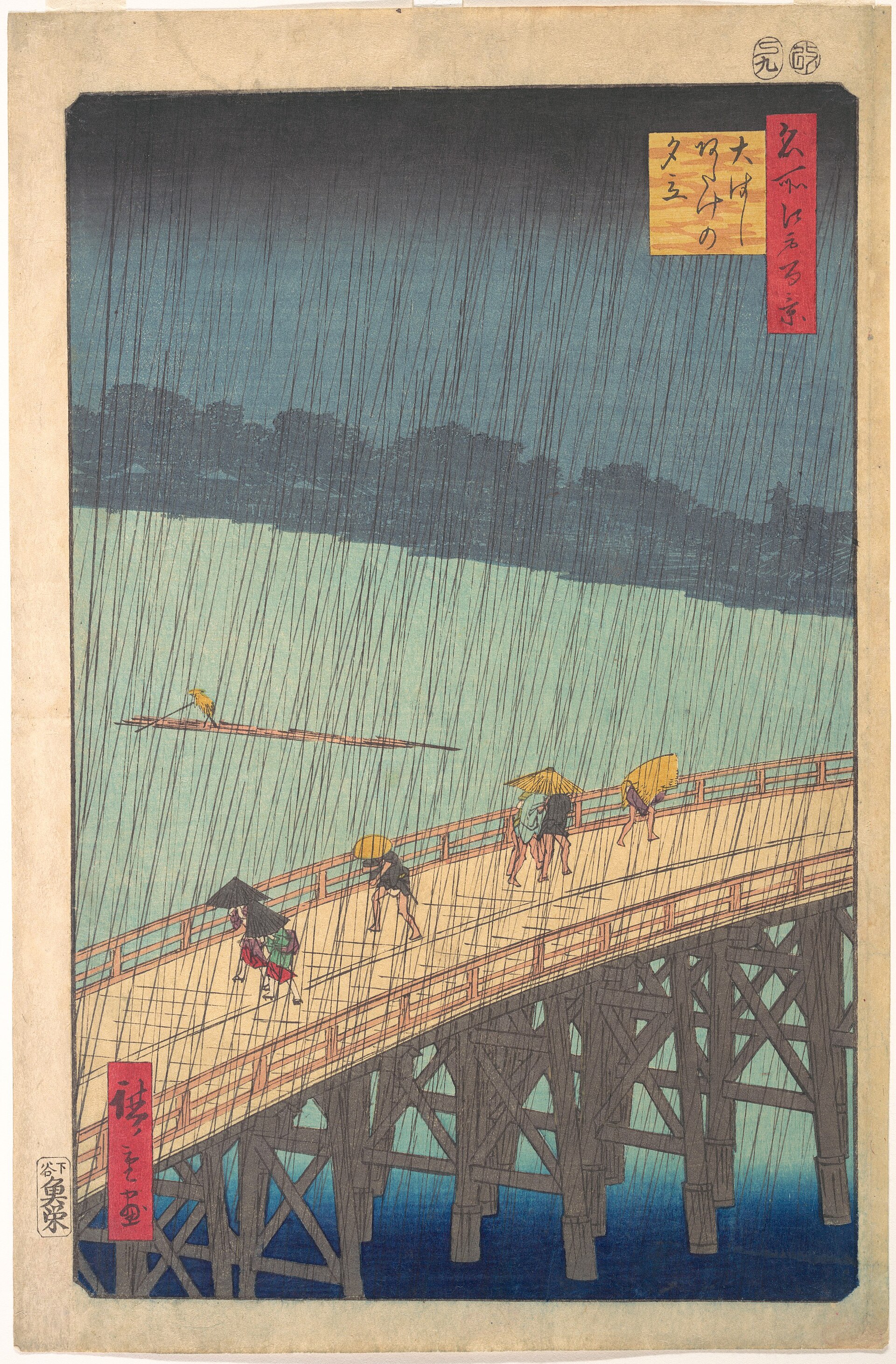
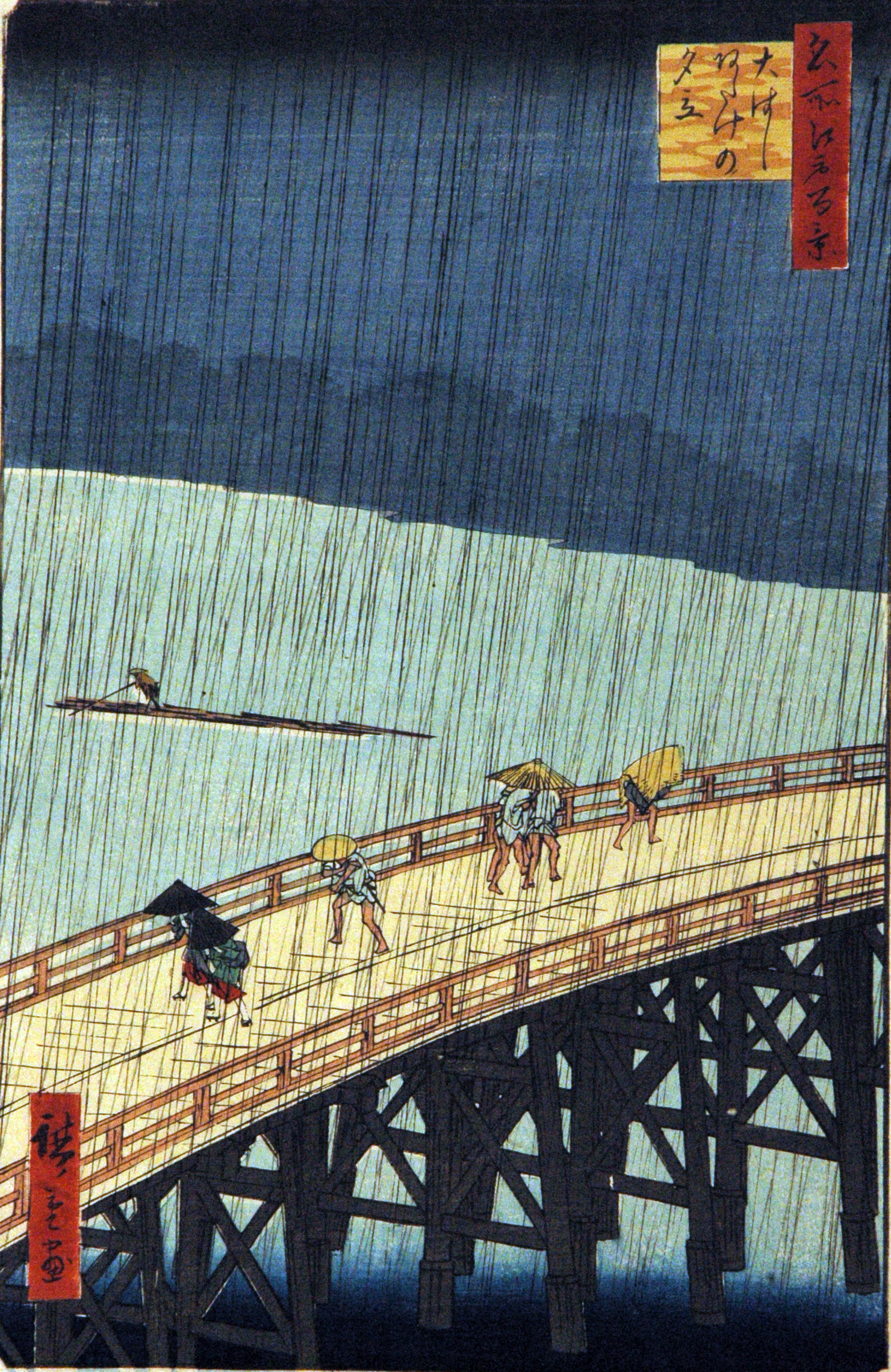
Ukiyo-e sheets from a popular design were printed from the same blocks across multiple print runs, sometimes years apart, and specialists distinguish between states of the blocks themselves as well as between individual impressions pulled from a given state. For this print, the Japanese print dealer Scholten Japanese Art describes a recognized early state, sometimes called the Two Boats state because two vessels are visible on the river rather than the single raftsman seen in most later impressions, along with a small carving flaw in the piling structure left as a blank triangular gap. That flaw was later corrected with a grey printing block plugging the gap, which appears in both standard and what dealers call deluxe later impressions; deluxe impressions in turn add further bokashi shading, in the storm clouds along the top margin, on the bridge planking, and in the water to the left of the bridge, that plainer standard impressions lack.
Examining the Library of Congress digitization directly for this record shows a single boatman on a raft, not two boats, which suggests this impression does not represent the earliest Two Boats state. This record stops there deliberately: distinguishing a standard printing from a deluxe one, or dating a printing relative to others, requires close physical examination of the block-plug repair and the cartouche coloring by someone qualified to make that call, and no such examination of this specific sheet was available to this record. Which generation of printing the Library of Congress impression represents is recorded as an open question rather than guessed at.
Chapter 7This impression: the Library of Congress sheet
The Library of Congress catalogs this print under the Japanese title Ohashi atake no yudachi, with the English title Sudden shower over Shin-Ohashi bridge and Atake as a translated heading, assigned...
The Library of Congress catalogs this print under the Japanese title Ohashi atake no yudachi, with the English title Sudden shower over Shin-Ohashi bridge and Atake as a translated heading, assigned Library of Congress Control Number 2009631889 and Digital ID jpd.02950. Its physical location within the Library's holdings is recorded as call number FP 2 - JPD, no. 1300, page 33, within an album described in the catalog as Gajo iccho. The catalog record states that the sheet forms part of two overlapping groupings: the Library's general Japanese prints and drawings holdings, and a named subset described as visual materials from the Donald D. Walker collection. Access to the physical sheet is restricted because, in the Library's own words, the material is extremely fragile, and researchers are directed to the digital surrogate, which is the ultimate source of the Wikimedia Commons file used as this record's lead image.
The descriptive cataloguing for this sheet, meaning the title, subject headings and translated title as they now appear in the online record, was compiled in 2005-06 by Edo-print specialists working under a program sponsored by Nichibunken, Japan's International Research Center for Japanese Studies, which funded the scanning of 1,100 of the Library's ukiyo-e holdings. That is a documented fact about when the sheet was described for the online catalog; it is not evidence of when the Library first acquired it, and no acquisition date for this specific sheet, or for the Walker collection generally, appears in the record consulted. The Library's largest single ukiyo-e holding, the roughly 1,300-piece collection assembled by the Washington Evening Star editor and owner Crosby Stuart Noyes, is a separate grouping from the Walker material and is not the source of this particular sheet.
Chapter 8Van Gogh's copy, and why it is not this print
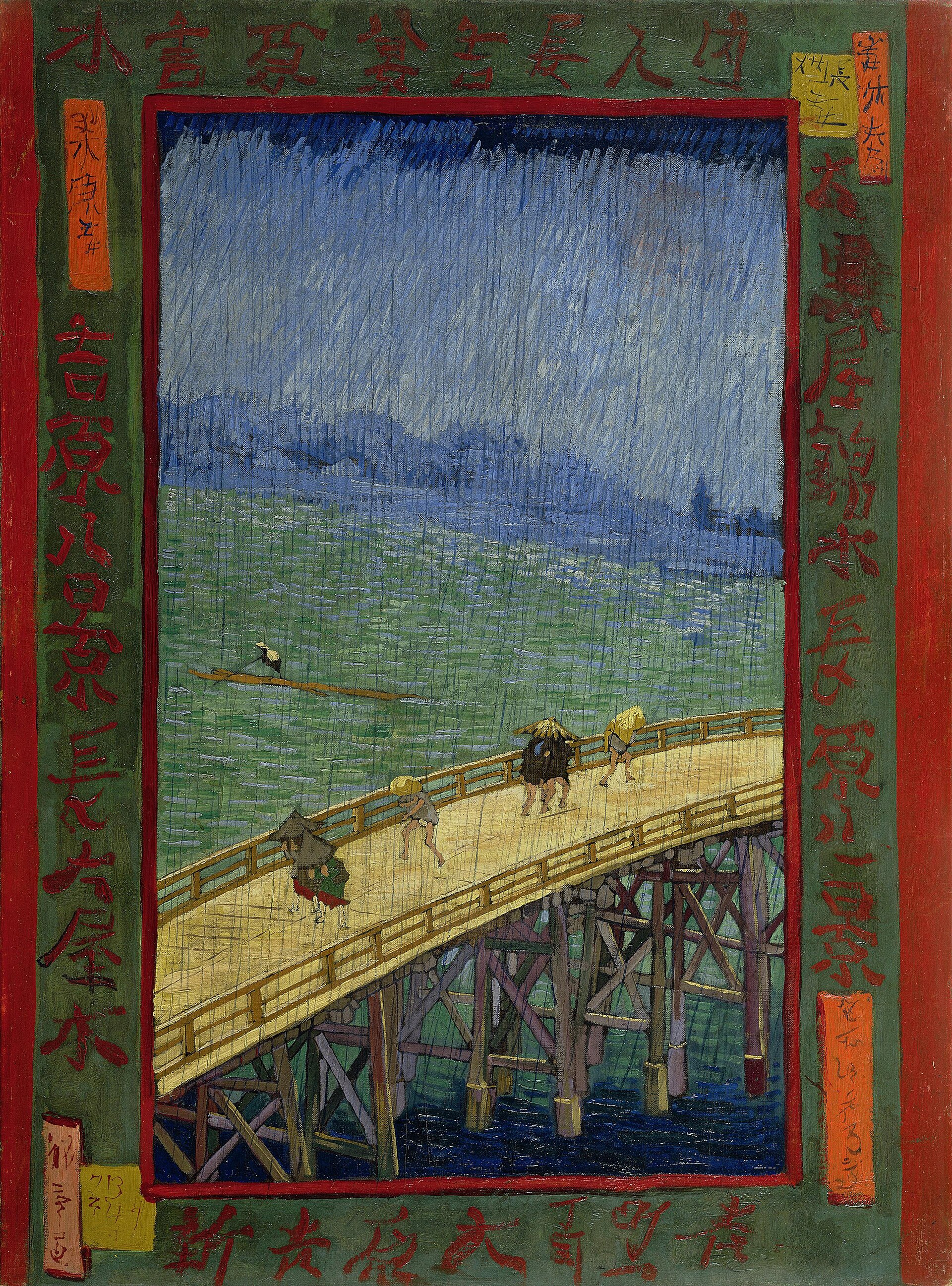
In October or November of 1887, working in Paris, Vincent van Gogh painted an oil-on-canvas copy of this composition, now known as Bridge in the Rain (after Hiroshige) and held by the Van Gogh Museum...
In October or November of 1887, working in Paris, Vincent van Gogh painted an oil-on-canvas copy of this composition, now known as Bridge in the Rain (after Hiroshige) and held by the Van Gogh Museum in Amsterdam. He kept the print's proportions but widened the sheet to leave a border, which he filled with Japanese characters copied, not translated, from other prints in his collection; he intensified the color relative to the woodblock original and rendered the rain as long, loaded brushstrokes rather than carved lines. Technical examination reported by the British Museum in connection with its 2025 exhibition Hiroshige: Artist of the Open Road found a pencil tracing mark on the print Van Gogh owned that lines up precisely with his transfer of the composition to canvas, physical evidence that he worked directly from that sheet rather than from memory or a secondary reproduction.
The print Van Gogh traced from was his own copy, one of a documented collection of at least 78 Hiroshige prints among more than six hundred Japanese prints he bought in Paris between 1886 and 1888, mostly from the dealer Siegfried Bing at an average price the Art Newspaper describes as about 15 centimes each, not much more than a cup of coffee at the time. The great majority of that collection, including his own impression of this design, survives today at the Van Gogh Museum, cataloged separately from his oil paintings and licensed on non-commercial terms that place it outside this archive's scope; it is a different physical object, at a different institution, from the Library of Congress sheet that is the subject of this record. The oil painting itself, having been made by an artist who died in 1890, is old enough to be in the public domain and is illustrated here strictly as documentation of that reception story, not as an image of this print.
Chapter 9Beyond Van Gogh: reception in the West
Van Gogh's copy is the best-documented single instance of this print's influence, but it was not isolated.
Van Gogh's copy is the best-documented single instance of this print's influence, but it was not isolated. Writers on Japonisme have connected the bridge-in-rain composition, with its extreme cropping, its scattered small figures, and its use of a strong diagonal against a nearly abstract field, to work by James McNeill Whistler in the 1870s, to the etcher Felix Buhot's treatment of figures sheltering from weather under umbrellas, and to Auguste-Louis Lepere's use of high horizons and washes of blue. Hiroshige's prints more broadly, produced serially and cheaply enough to circulate through the Paris print trade after Japan's ports opened in the 1850s, are one of the primary channels, alongside Hokusai's, through which the compositional vocabulary of ukiyo-e reached Impressionist and Post-Impressionist painters. The critic Laura Cumming later named this specific print among the ten best skies in art, a modern judgment rather than a period one, and one instance of the print continuing to be singled out from within a series that most viewers encounter, if at all, only through this single sheet.
None of this reception history is about the Library of Congress impression specifically. It is about the design, which circulated in enough impressions, in enough Western hands, to make that kind of broad influence possible in the first place; the individual sheet described in this record is one surviving instance of that circulation, not its origin point.
Chapter 10Materials: an imported blue
The deep, near-black blue used in this print's sky and river is very likely Prussian blue, known in Japan as bero-ai (a rendering of Berlin, the city associated with the pigment's European...
The deep, near-black blue used in this print's sky and river is very likely Prussian blue, known in Japan as bero-ai (a rendering of Berlin, the city associated with the pigment's European manufacture). Prussian blue reached Japan as an import, initially expensive enough to be reserved mainly for painting, and became available cheaply enough for large-scale woodblock printing only once Chinese manufacture of the pigment began around the end of the 1820s. Its intensity, fine particle size and lightfastness let printmakers of Hiroshige's generation build the saturated night skies, water, and storm clouds that Prussian blue is now closely associated with in ukiyo-e, including in this print's rain-darkened sky. It is a small, specific instance of a much larger pattern in nineteenth-century Japanese printmaking: the era's most characteristic visual effects were made possible by imported industrial chemistry, not by anything unique to indigenous materials.
Chapter 11The market for this print
The Library of Congress sheet is a library holding with no recorded sale history of its own in the sources available to this record.
The Library of Congress sheet is a library holding with no recorded sale history of its own in the sources available to this record. Other impressions of the same design have sold at public auction, most notably a sheet from the collection of the musician Freddie Mercury, sold at Sotheby's in London on 6 September 2023 as part of the Freddie Mercury: A World of His Own sale. Against a published estimate of GBP 30,000 to 50,000, it hammered at GBP 230,000 and totaled GBP 292,100 with buyer's premium, a result Sotheby's and the press covering the sale attributed to Mercury's own well-documented enthusiasm for Japanese art and to the print's standing as one of the most sought-after single sheets in the whole One Hundred Famous Views of Edo series. That sale is recorded here to establish a current market range for outstanding impressions of this design; the impression sold was, by the auction house's own account, sourced by Mercury's friend Mary Austin in Japan after an earlier one he wanted failed to reach him at a 1977 Sotheby's sale, a chain of ownership with nothing in common with the Library of Congress sheet beyond depicting the same design.
The artist
Ando Tokutaro, known professionally as Utagawa Hiroshige (also written Ando Hiroshige)
Hiroshige's authorship of this print is not in question in the way an Old Master attribution can be; it was published under his name, by a named publisher, within his own lifetime. What is less commonly stated plainly is that his last and most ambitious project outran his life: he died before One Hundred Famous Views of Edo was finished, and the series was completed by another hand working under his name. This dossier covers the documented facts of his life and career, ending with the print series this object belongs to and the poem he is said to have left behind.
Related works
| Work | Relation | Where it is |
|---|---|---|
| Bridge in the Rain (after Hiroshige) Vincent van Gogh | Oil-on-canvas copy of this composition, painted 1887 after a different, Van-Gogh-owned impression of the same print A different medium, a different institution, and a different physical impression from the one pictured in this record. See Van Gogh's copy, and why it is not this print above. | Van Gogh Museum, Amsterdam |
| Flowering Plum Tree (after Hiroshige), also known as Plum Park in Kameido Vincent van Gogh, after Hiroshige's Plum Park in Kameido (no. 30 in the same series) | The other plate from One Hundred Famous Views of Edo that Van Gogh copied in oil in 1887, alongside this one Documents the same episode of Van Gogh's engagement with the series; not the print pictured in this record. | Van Gogh Museum, Amsterdam |
| Sudden Shower over Shin-Ohashi Bridge and Atake (impression) Utagawa Hiroshige | A separate impression of the same 1857 print Released by the Met under CC0. Used in this record's gallery as clearly-captioned comparanda, not as the object described. | Metropolitan Museum of Art, New York |
| Sudden Shower over Shin-Ohashi Bridge and Atake (impression) Utagawa Hiroshige | A separate impression of the same 1857 print Used in this record's gallery as clearly-captioned comparanda, not as the object described. | San Diego Museum of Art, accession 1957.247 |
| Sudden Shower over Shin-Ohashi Bridge and Atake (impression) Utagawa Hiroshige | A separate impression of the same 1857 print Gift of Alan, Donald and David Winslow from the estate of William R. Castle. Not illustrated in this record; cited to show how many independently provenanced impressions of this design are held across Western public collections. | National Museum of Asian Art, Smithsonian Institution, accession F1994.29 |
Open questions
- Which print state does the Library of Congress impression represent: the early 'Two Boats' state described by specialist dealers, or one of the later standard or deluxe states with the corrected grey-block piling repair? This record's own examination of the digitization shows a single boatman, which argues against the earliest state, but a full determination requires physical or close photographic examination against published connoisseurship criteria that was not available for this record.
- Why does this print carry different sequence numbers across institutions (no. 52 at the Library of Congress, series ordinal 53 in Wikidata's structured data, no. 58 at the Brooklyn Museum and the Art Institute of Chicago)? No source consulted explains the discrepancy or identifies which numbering, if any, reflects the original 1857 publication sequence.
- When and from whom did the Library of Congress acquire this specific impression? The catalog record places it within 'the Donald D. Walker collection of visual materials' but gives no acquisition date and no biographical information about Walker.
- What was the original print run for this specific plate? General statements that Hiroshige's designs were printed in large numbers are not sheet-specific, and no source consulted gives a print-run figure for this design.
- Does the change from two boats to a single raftsman across print states carry any documented meaning, or is it purely a production correction with no further significance? Not addressed in the literature consulted.
- What value, if any, was placed on this specific sheet before it entered the Library of Congress's collection? No purchase price, gift valuation, or insurance figure for this individual impression appears in the sources reviewed.
Questions about this object
What is Sudden Shower over Shin-Ohashi Bridge and Atake?
Sudden Shower over Shin-Ohashi Bridge and Atake is a print, dated 1857. Medium: Woodblock print (nishiki-e); ink and color on paper, printed with bokashi (hand-graded) shading.
Who made Sudden Shower over Shin-Ohashi Bridge and Atake, and is the attribution settled?
The attribution to Utagawa Hiroshige is recorded here as accepted. Attribution to Hiroshige is not in dispute. The sheet was published in 1857, during Hiroshige's lifetime, as part of his own series One Hundred Famous Views of Edo, under the publisher Uoya Eikichi, and carries the artist's design credit and the publisher's and date seals customary for the series. Hiroshige died in 1858 before the series was finished; a small number of the series' later plates were completed after his death by his successor, Hiroshige II, but this plate was published while Hiroshige was alive and is attributed to him without qualification.
Where is Sudden Shower over Shin-Ohashi Bridge and Atake now?
Library of Congress, Prints and Photographs Division, Washington, D.C. Inventory number Digital ID jpd.02950; LC Control Number 2009631889; Reproduction Number LC-DIG-jpd-02950; Call Number FP 2 - JPD, no. 1300, p. 33 (AA size). Last confirmed 30 August 2026. Held in the Library's Fine Prints: Japanese, pre-1915 digital collection. The Library's own catalog record states the sheet forms part of visual materials from the Donald D. Walker collection, a named grouping within the Library's Japanese prints and drawings holdings, distinct from the larger Crosby Stuart Noyes collection that anchors most of the Library's ukiyo-e holdings. No date or circumstance for the transfer to the Library is given in the record consulted.
What has Sudden Shower over Shin-Ohashi Bridge and Atake sold for?
Hammer GBP 230,000; with premium, GBP 292,100 with buyer's premium. Sotheby's, London, 2023-09-06.
What is still unknown about Sudden Shower over Shin-Ohashi Bridge and Atake?
Which print state does the Library of Congress impression represent: the early 'Two Boats' state described by specialist dealers, or one of the later standard or deluxe states with the corrected grey-block piling repair? This record's own examination of the digitization shows a single boatman, which argues against the earliest state, but a full determination requires physical or close photographic examination against published connoisseurship criteria that was not available for this record.
Sources
- 1Library of Congress, Prints and Photographs Division, catalog record for Ohashi atake no yudachi / Sudden shower over Shin-Ohashi bridge and Atake (LCCN 2009631889, Digital ID jpd.02950). web.archive.org/web/...
- 2Library of Congress, About this Collection: Fine Prints, Japanese, pre-1915. Accessed via the Internet Archive's Wayback Machine copy for the same access reason as source 1. web.archive.org/web/...
- 3Wikimedia Commons, File:Hiroshige, Sudden shower over Shin-Ohashi bridge and Atake, 1857.jpg, including (license, credit, description) via the Commons API. commons.wikimedia.org/wiki/...
- 4Wikimedia Commons, File:Ohashi Atake no yudachi ... MET DP123602.jpg, CC0, credited as donated by the Metropolitan Museum of Art, via the Commons API. commons.wikimedia.org/wiki/...
- 5Wikimedia Commons, File:Sudden Shower over Shin-Ohashi Bridge and Atake (5758870781).jpg, public domain, credited to the San Diego Museum of Art via Flickr Commons, accession 1957.247. commons.wikimedia.org/wiki/...
- 6Wikimedia Commons, File:Vincent van Gogh - Brug in de regen- naar Hiroshige - Google Art Project.jpg, public domain. commons.wikimedia.org/wiki/...
- 7Brooklyn Museum, Sudden Shower Over Shin-Ohashi Bridge and Atake (Ohashi Atake no Yudachi), No. 58 from One Hundred Famous Views of Edo, accession 30.1478.58, Gift of Anna Ferris. brooklynmuseum.org/opencollection/...
- 8Cleveland Museum of Art, Sudden Shower over Shin-Ohashi Bridge and Atake, from One Hundred Famous Views of Edo, accession 1921.318, Gift of J. H. Wade. clevelandart.org/art/...
- 9Scholten Japanese Art, Dark and Stormy (dealer note on print states of Sudden Shower at Atake - Ohashi Bridge: the early 'Two Boats' state, the grey-block repair to the piling, and standard versus deluxe later impressions). scholten-japanese-art.com/darkandstormy_07.php
- 10Sotheby's, Freddie Mercury: A World of His Own - The Evening Sale (2023), lot 13, Utagawa Hiroshige, Sudden Shower over Shin-Ohashi Bridge and Atake. sothebys.com/en/...
- 11The Art Newspaper, 'They want it all: Freddie Mercury collection smashes expectations at Sotheby's' (7 September 2023), for the hammer price and premium on the Hiroshige lot and the sale's overall total. theartnewspaper.com/2023/...
- 12The Art Newspaper, 'Van Gogh's love of Hiroshige, the Japanese master of the landscape' (1 August 2025), on Van Gogh's documented collection of at least 78 Hiroshige prints, his purchases from Siegfried Bing in Paris, and the British Museum's 2025 exhibition Hiroshige: Artist of the Open Road. theartnewspaper.com/2025/...
- 13Wikipedia, 'One Hundred Famous Views of Edo'. en.wikipedia.org/wiki/...
- 14Wikipedia, 'Sudden Shower over Shin-Ohashi Bridge and Atake'. en.wikipedia.org/wiki/...
- 15Wikipedia, 'Hiroshige'. en.wikipedia.org/wiki/...
- 16Ota Memorial Museum of Art (Otakinen Museum), 'Did Utagawa Hiroshige die of an infectious disease?', on the 1858 Edo cholera epidemic and the uncertain evidence for whether it caused Hiroshige's death. otakinen-museum.note.jp/n/...
- 17Artelino, 'Aizuri-e Japanese Woodblock Prints and Prussian Blue', on the introduction and adoption of imported Prussian blue (bero-ai) pigment in Edo-period woodblock printing. artelino.com/articles/...
- 18National Museum of Asian Art (Smithsonian), 'Friday Fave: Hiroshige's Sudden Shower', noting the Freer Gallery's own impression (F1994.29, gift of Alan, Donald and David Winslow from the estate of William R. Castle) as a further, separately provenanced example of the print. asia-archive.si.edu/friday-fave-hiroshiges-sudden-shower
- 19Christie's, 'Lot 16, Utagawa Hiroshige, Ohashi Atake no yudachi - Hiroshige: Colors of the Four Seasons, The Alan Medaugh Collection, sale 25167, 15 September 2026'. Sale, lot, estimate, premium-inclusive price USD 332,800, dimensions, the Grabhorn-Engel to Goldman to Medaugh provenance, literature, exhibitions and the house's first-impression claim. Accessed 2026-09-16. christies.com/en/...
- 20christies.com, web page cited for the Christie's, New York sale of 2026-09-15. christies.com/en/...
- 21Christie's, 'Live Conditions of Sale, New York, 1 September 2026'. The 28 per cent buyer's premium behind the DERIVED hammer of USD 260,000. Accessed 2026-09-16. christies.com/pdf/...
- 22Bonhams, 'Lot 816, Utagawa Hiroshige, Ohashi Atake no yudachi - Fine Japanese & Korean Art, sale 31888, 16 September 2026'. Sale, lot, estimate, 'Sold for US$24,320 inc. premium', the hammer of USD 19,000 in the page data, dimensions and the Christie's Hong Kong 2018 provenance line. Accessed 2026-09-16. bonhams.com/auction/...
- 23bonhams.com, web page cited for the Bonhams, New York sale of 2026-09-16. bonhams.com/auction/...

,_from_the_series_One_Hundred_Famous_Views_of_Edo_(Meisho_Edo_hyakkei)_MET_DP123602.jpg)
.jpg)

Last verified · Published
Change log
30 August 2026 - Record created at the house standard: researched narrative, technical evidence, maker dossier, graded provenance chain, prices with hammer and premium separated, related works, open questions and sources.
24 September 2026 - Prices realised revised by the auction watch of 2026-09-16: the 2026-09-15 Christie's, New York row added; the 2026-09-16 Bonhams, New York row added.