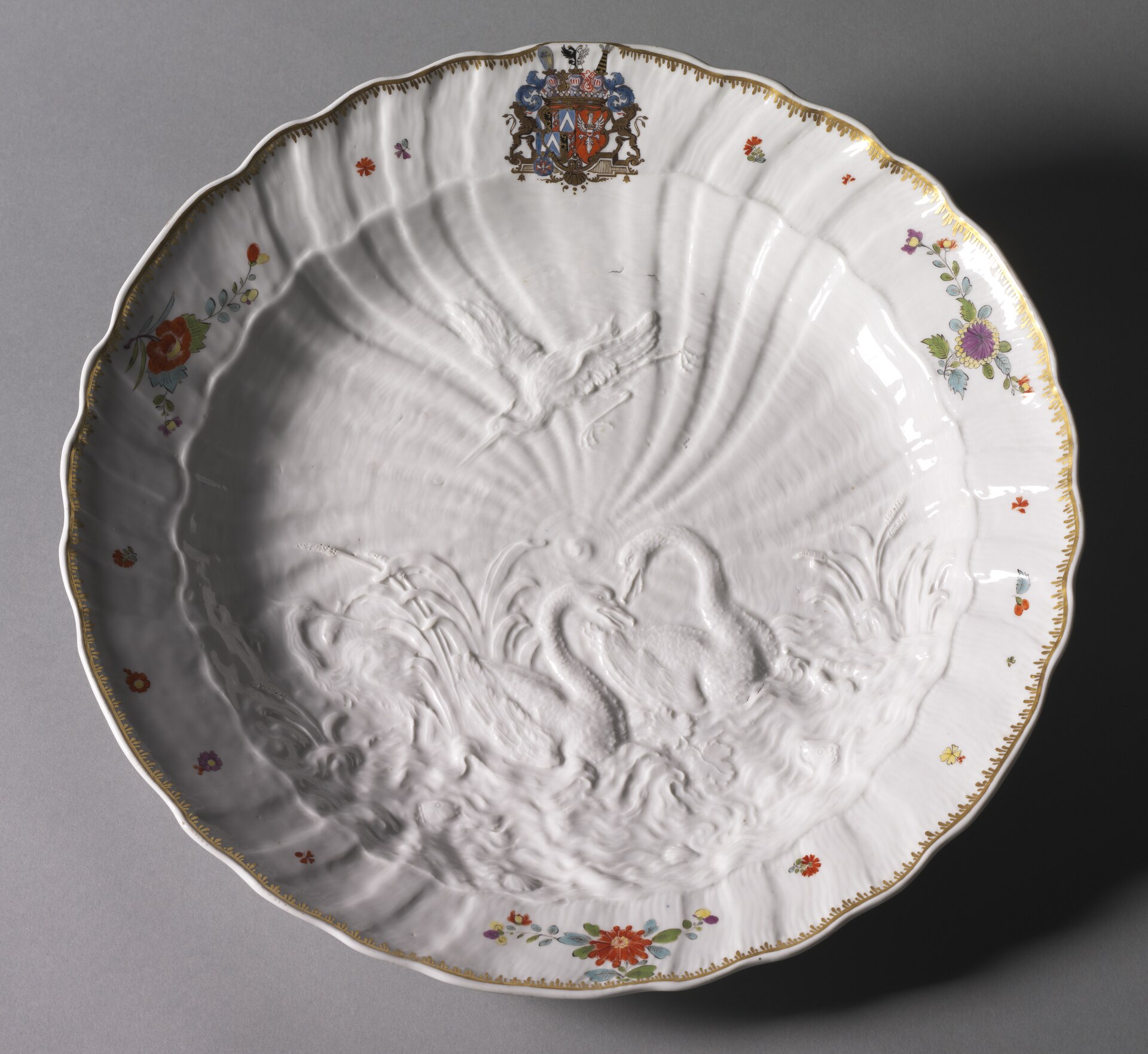
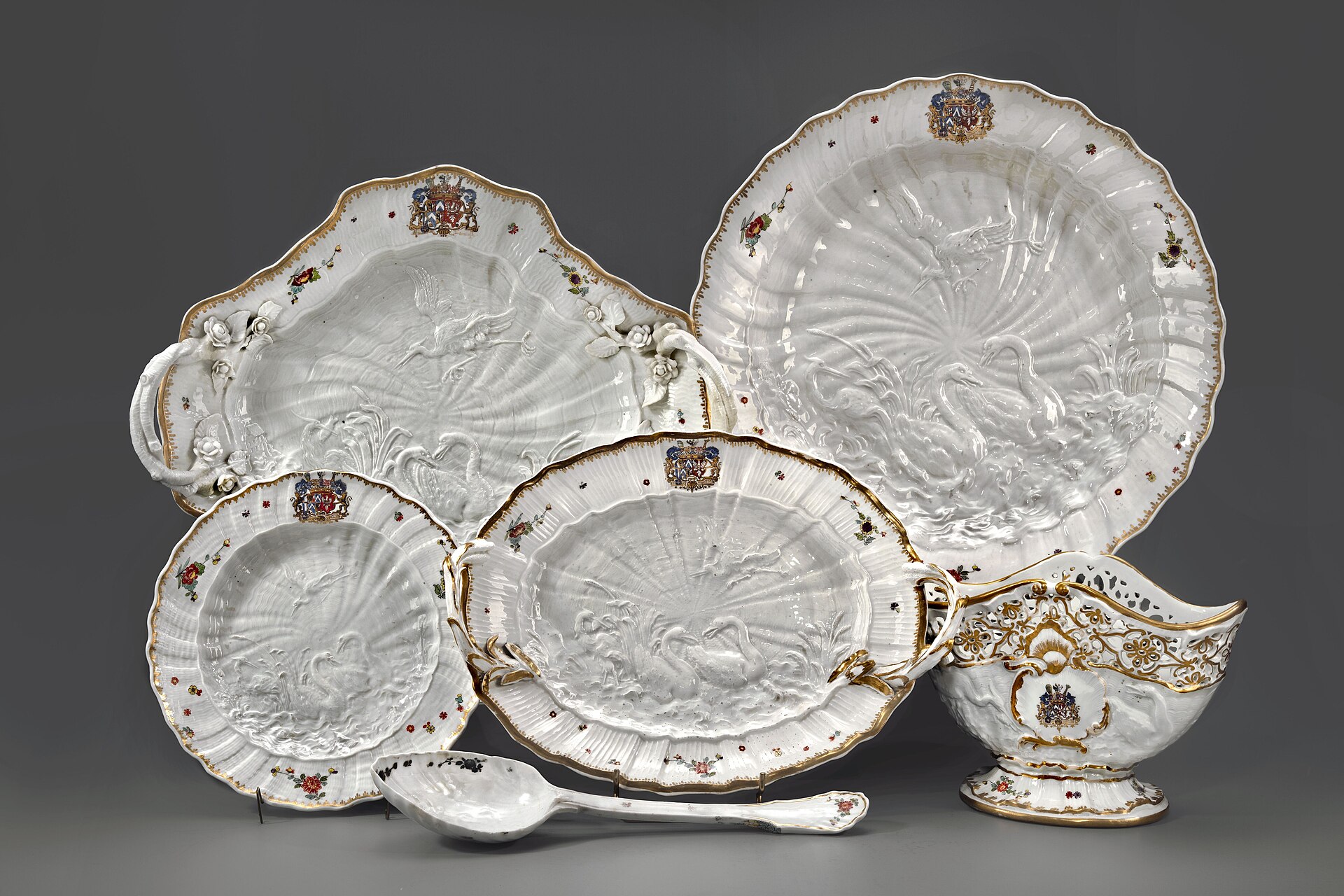
Plate from the Swan Service
c. 1737-1741 · Hard-paste porcelain
Cleveland Museum of Art, Cleveland, Ohio
 German (Saxon) · 1706-1775
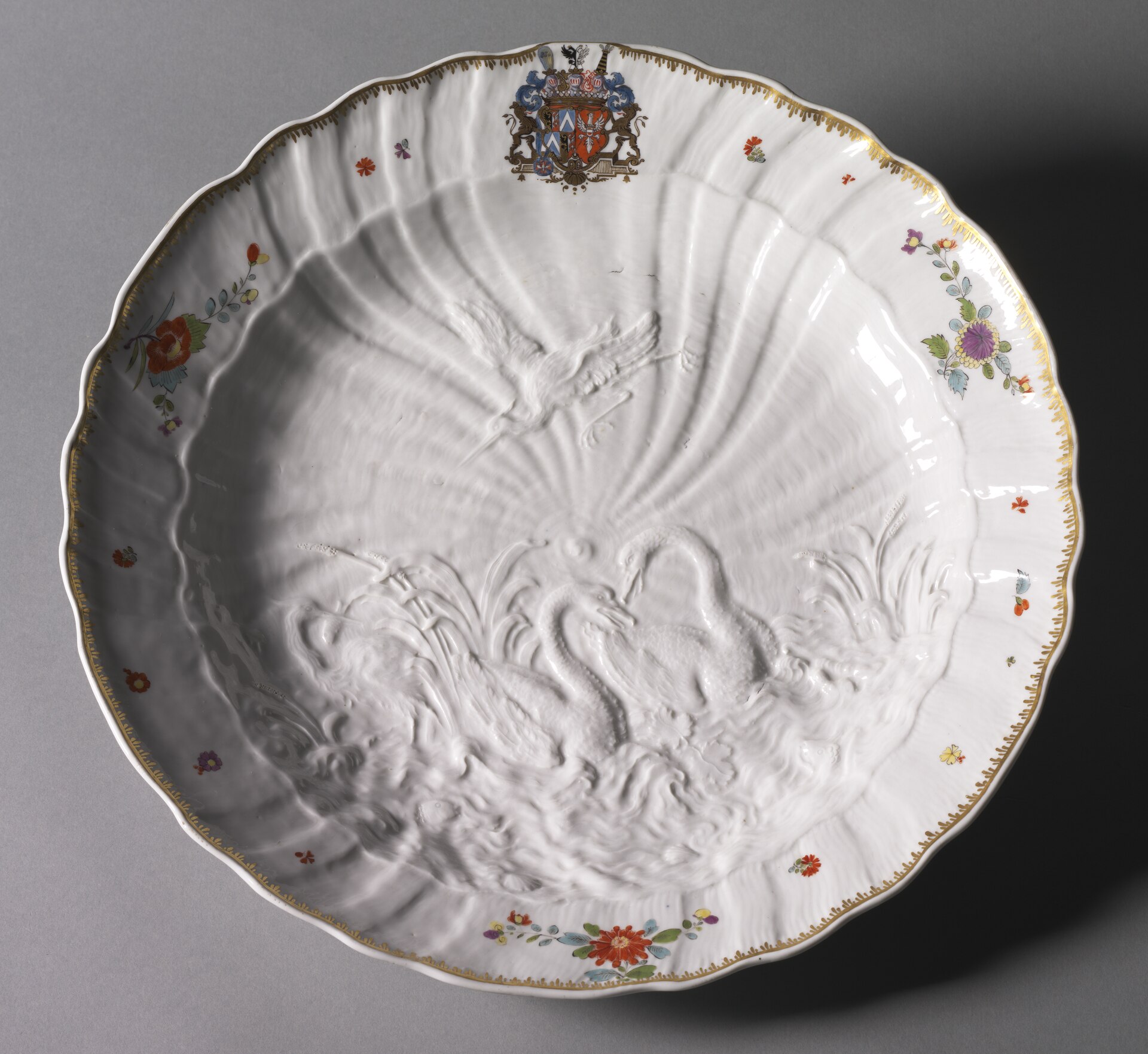
Plate from the Swan Service One of more than 2,200 pieces made for Heinrich von Bruhl between 1737 and 1742, the surviving core of Kaendler's largest single commission. No verified portrait. No securely identified likeness of this maker is known under a free licence. We do not publish a face we cannot verify.
Cleveland Museum of Art, accession 1951.103| Full name | Johann Joachim Kaendler (also written Kandler in period English sources), appointed court sculptor to Augustus II on 22... |
|---|---|
| Worked as | Sculptor, Porcelain modeller (Modellmeister), Arcanist, Court commissioner |
| Born | 15 June 1706 · Fischbach, near Arnsdorf, Electorate of Saxony |
| Died | 18 May 1775 · Meissen. Buried at St Afra's Abbey, Meissen |
| Nationality | German (Saxon) |
| Movement | Late Baroque to Rococo |
| In this archive | 1 artwork |
| Sources | 36 cited |
| Last verified |
About this page 1 artwork in the archive · Last verified · 36 sources cited
Johann Joachim Kaendler is filed under sculptor, and for forty-four years his actual job was closer to creative director of a state factory. From 1733, when he succeeded Johann Jacob Kirchner as Modellmeister of the Meissen porcelain manufactory, almost every figure, service and centrepiece the factory produced passed through his hands or his approval before it went to mould. He did not sign his work, and neither did the assistants who worked beside him under his name. What survives instead is a factory's own paper trail: monthly work reports in which Kaendler and three named colleagues, Johann Friedrich Eberlein, Johann Gottlieb Ehder and Peter Reinicke, logged what each of them had modelled that month. A modern edition of those reports catalogues nearly a thousand models made under Kaendler's direction between 1731 and 1748 alone. Almost none of them can be assigned to one pair of hands with certainty beyond what the reports themselves say.
The thing a reader is least likely to already know is that Kaendler's first major commission nearly failed as a matter of physics. Augustus the Strong wanted a porcelain menagerie, animals and birds modelled life size in a material that had never been built at that scale. The pieces cracked, slumped and split in the kiln for years before the factory judged porcelain unsuitable for large sculpture and Kaendler's reputation was made instead on the cabinet-scale figures, tableware and table fountains that followed. The menagerie is where his name starts. It is not where it was secured.
Born 15 June at Fischbach, near Arnsdorf in the Electorate of Saxony.1
Appointed court sculptor by Augustus II on 22 June and sent to Meissen as a modeller under Johann Jacob Kirchner.1
Succeeds the resigning Kirchner as Modellmeister, chief modeller, of the Meissen manufactory.1
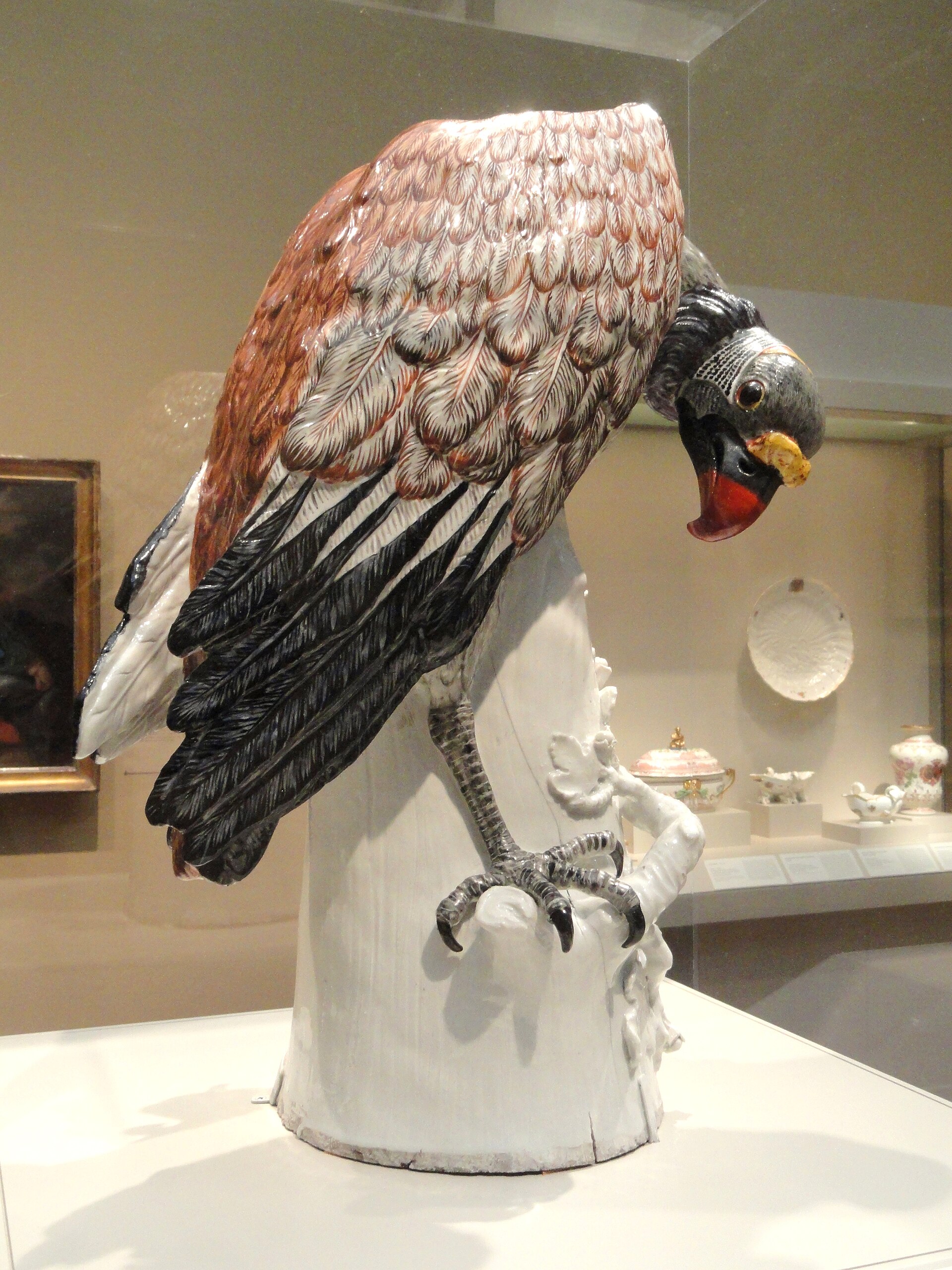
By the year of Augustus the Strong's death, more than thirty bird models and almost forty animal models had been made for the Japanisches Palais menagerie, many by Kaendler.8
Johann Friedrich Eberlein hired as Kaendler's principal colleague in the modelling workshop.33
Kaendler's work reports first record a crinoline figure of a lady, in December, one of his earliest cabinet-scale figures.15
Sample plates made for what becomes the Swan Service, commissioned as a wedding gift from Augustus III to Heinrich von Bruhl.2
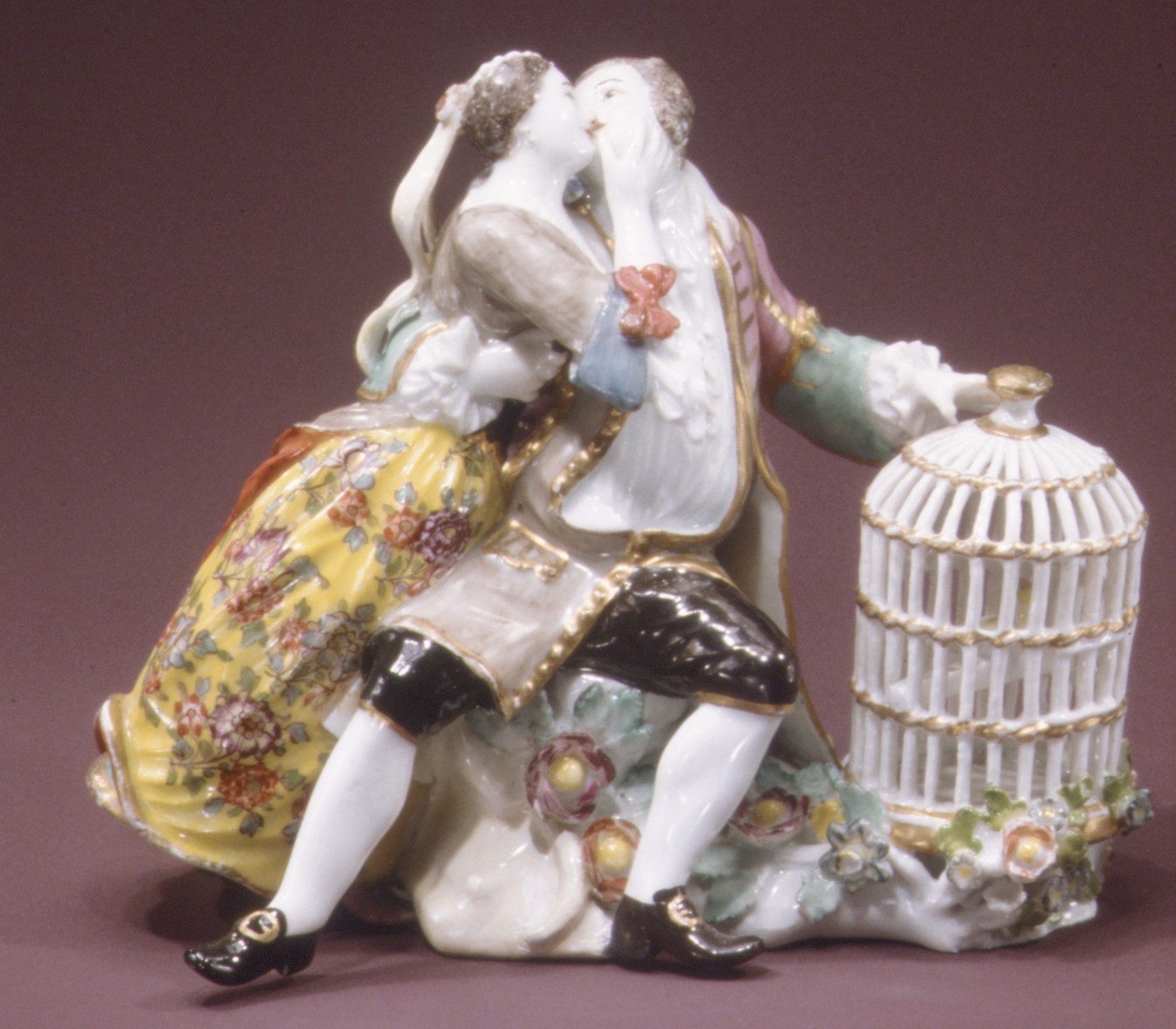
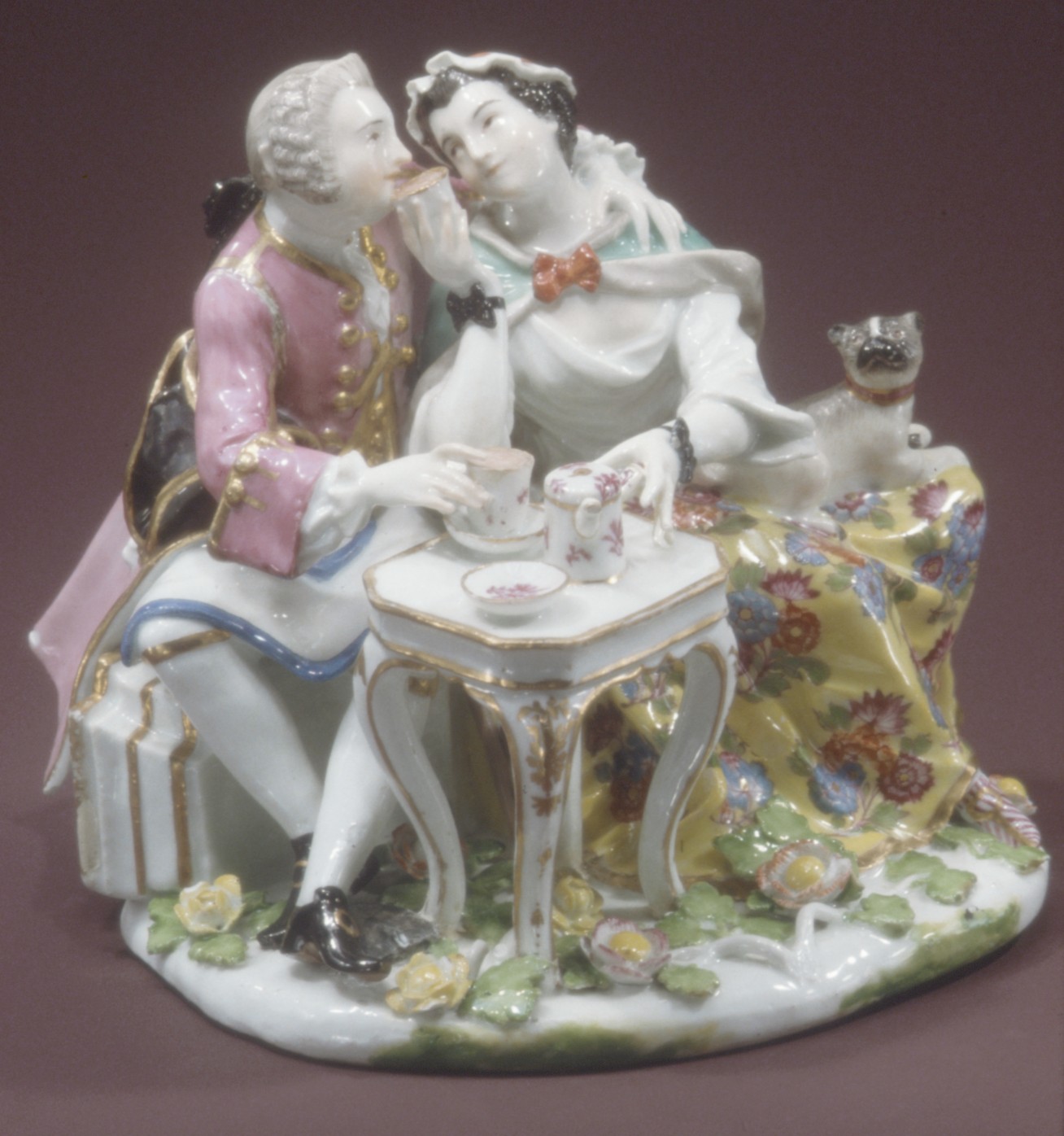
The Metropolitan Museum dates its Lovers with a Birdcage group to December of this year, on stylistic and factory grounds.3
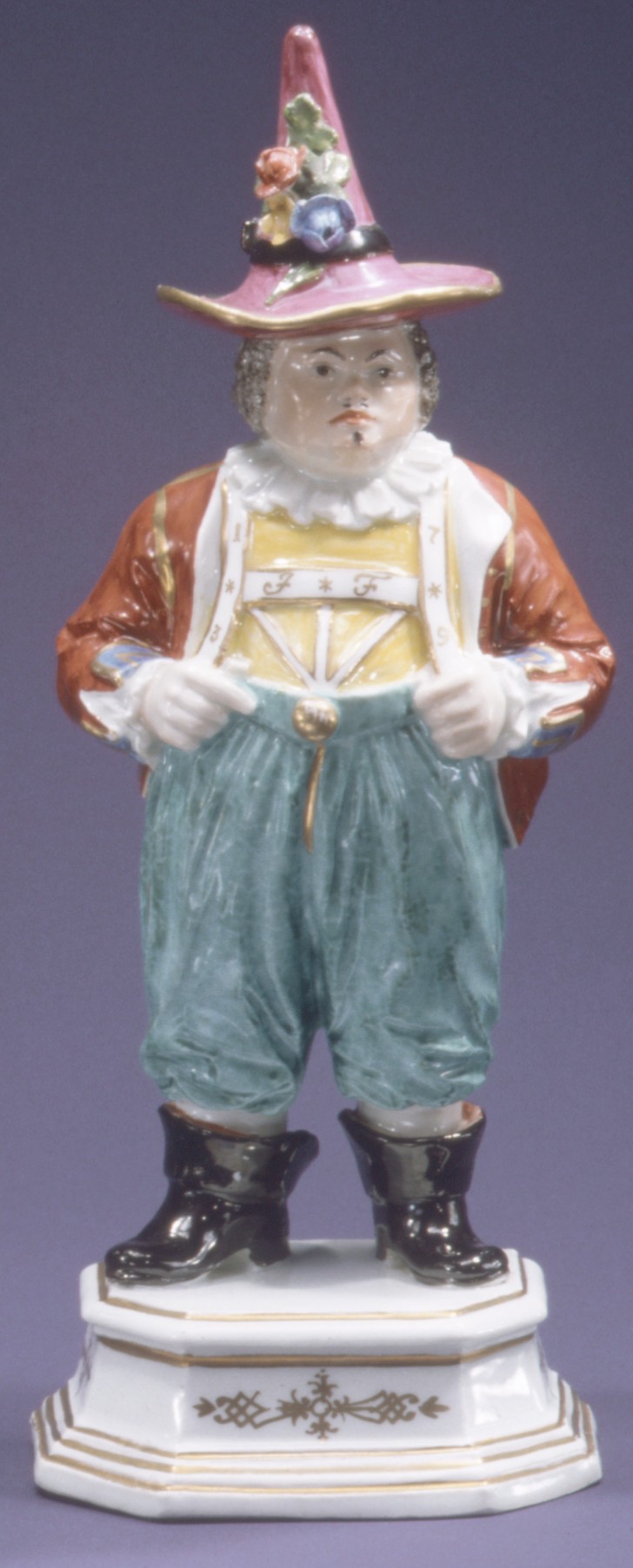
Models The Court Jester Joseph Frohlich, a portrait in porcelain of a real court jester serving Augustus the Strong.5
A comparable Lovers with a Birdcage group sold at Bonhams in 2024 was catalogued as first documented in Kaendler's work reports in March of this year, a dating that does not match the Metropolitan Museum's 1737 date for the same model.15
Most shapes of the Swan Service completed, with delivery continuing piecemeal; a third modeller, Johann Gottlieb Ehder, joins the project from about 1741.2
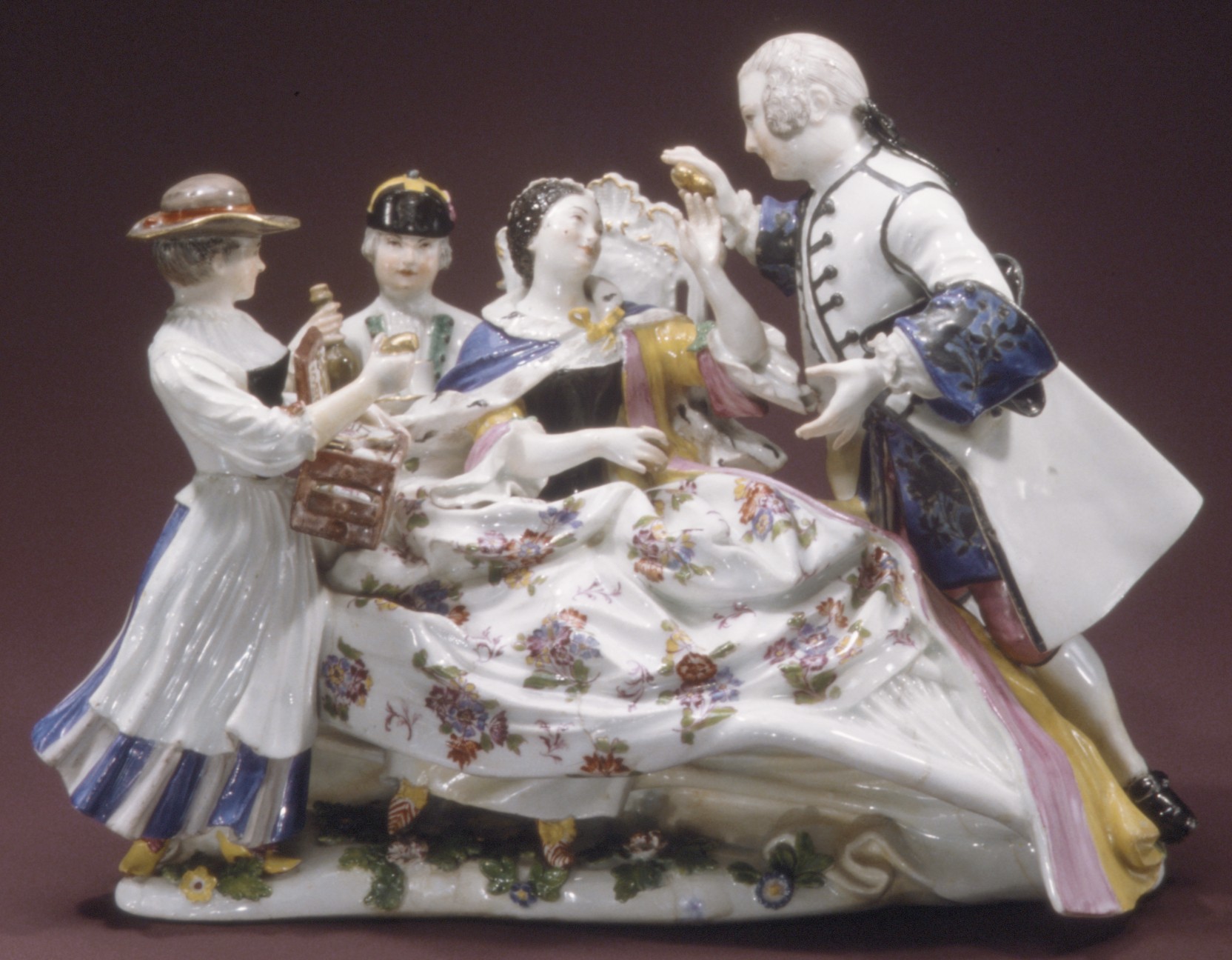
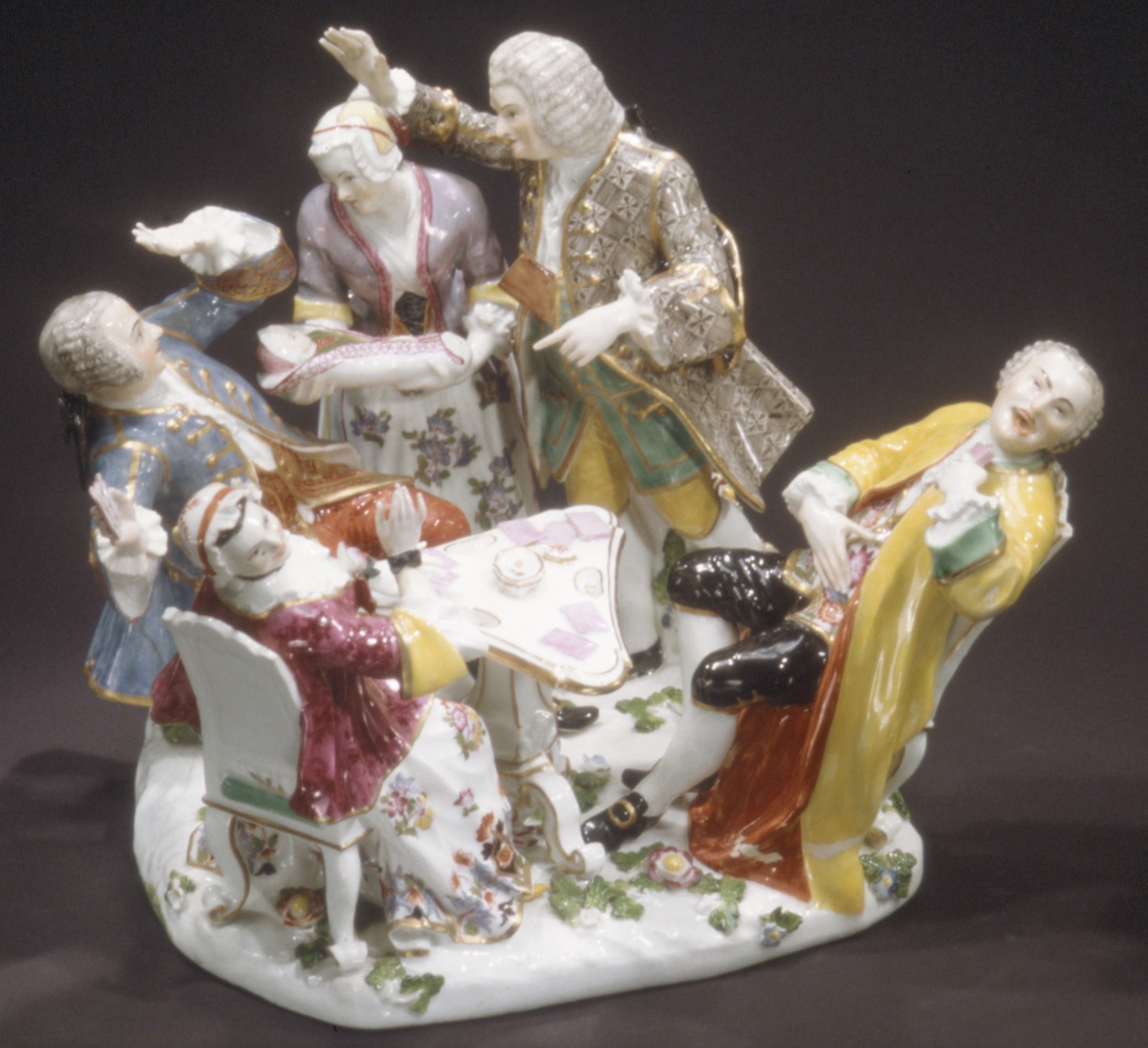
Models a Satirical Group, now in the Metropolitan Museum, read in the literature as courtly commentary staged through stock theatrical roles.6
Models a figure of a nobleman in Masonic dress in September, paired several years later with a Lady of the Mopsorden.22
Models the Triumph of Amphitrite table fountain for Heinrich von Bruhl, with Eberlein, Ehder and Reinicke, used at a royal wedding feast on 11 January 1747.14
Eberlein dies; in the same year Augustus III appoints Kaendler Hofcommissar, court commissioner.133
Johann Gottlieb Ehder dies.34
The French sculptor Michel Victor Acier joins Meissen; the specialist literature describes him and Kaendler as stylistic opponents.31
Peter Reinicke, Kaendler's last surviving principal workshop assistant, dies.35
Kaendler dies at Meissen on 18 May, in debt despite extensive property, and is buried at St Afra's Abbey. Acier becomes the manufactory's leading designer.131
Soviet forces burn Schloss Pforten, destroying most of the surviving Swan Service; some pieces are reported used afterward as targets by soldiers.2
The Soviet Union returns the bulk of the Dresden Porzellansammlung's holdings, taken as war trophies in 1945, to museums in East Germany.27
Ulrich Pietsch publishes the first complete edition of Kaendler's Arbeitsberichte, the monthly work reports underlying most modern attribution.18
The Victoria and Albert Museum begins a research and 3D-scanning programme on the Triumph of Amphitrite fountain, completing new porcelain replacement parts by 2014.14
The exhibition Magnificence of Rococo: Kaendler's Meissen Porcelain Figures opens at Wawel Royal Castle, Krakow, with a catalogue by Alfredo Reyes and Claudia Bodinek.19
The Merkle Collection of Meissen porcelain sells at Bonhams Cornette de Saint Cyr in Paris in two parts, 17 April and 31 October, totalling more than EUR 1.5 million.1617
Kaendler-attributed Meissen trades regularly at the specialist European ceramics sales of Bonhams, Christie's and Sotheby's, and prices have risen sharply against estimate in recent years. The clearest recent evidence is the two-part sale of the Merkle Collection at Bonhams Cornette de Saint Cyr in Paris in 2024, which totalled more than EUR 1.5 million across both parts. Bonhams' press releases give prices realized inclusive of buyer's premium without a separate hammer figure, but the individual lot pages for the two top results consulted here do publish the underlying estimate and hammer price, and the hammer and premium are stated separately below wherever that lot-level data was available.
| Date | Sale | Work | Result | Note |
|---|---|---|---|---|
| 31 October 2024 | Bonhams Cornette de Saint Cyr | Group of fighting harlequins, circa 1740 | Hammer 350,000 With premium 94,900 EUR | Hammer price and premium taken from the lot page's own published estimate and price data (estimate EUR 200,000-300,000, hammer EUR 350,000, price realized EUR 444,900 inclusive of premium), not back-calculated. The most expensive Kaendler lot across both parts of the Merkle Collection sale. Part II of the sale totalled EUR 617,700. |
| 17 April 2024 | Bonhams Cornette de Saint Cyr | Group of lovers with a birdcage, circa 1745 | Hammer 135,000 With premium 36,850 EUR | Hammer price and premium taken from the lot page's own published estimate and price data (estimate EUR 40,000-60,000, hammer EUR 135,000, price realized EUR 171,850 inclusive of premium), not back-calculated. Documented in Kaendler's work reports from March 1741 per the lot catalogue; provenance includes an anonymous Christie's London sale of 3 November 1997. |
Hammer is the price at which the bidding stopped; with premium adds the fee the house charges the buyer on top. Hammer price and buyer's premium in the glossary.
| Institution | City | Holdings | Note |
|---|---|---|---|
| Metropolitan Museum of Art | New York | Multiple Kaendler-attributed figures from the Jack and Belle Linsky Collection, including Lovers with a Birdcage, The Trinket Seller, The Court Jester Joseph Frohlich, Couple Drinking Chocolate and a Satirical Group. | All catalogued by the Met as public domain and available in the museum's open access programme. |
| Art Institute of Chicago | Chicago | The King Vulture (1734), from the Japanisches Palais menagerie project, and a plate from the Swan Service. | Catalogued as CC0 in the museum's open access programme. |
| Cleveland Museum of Art | Cleveland | A plate from the Swan Service, accession 1951.103. | Already the subject of a separate Iconotheca record. |
| Victoria and Albert Museum | London | The Triumph of Amphitrite table fountain, modelled jointly with Eberlein, Ehder and Reinicke for Heinrich von Bruhl, recently restored and reconstructed. | On display in the Europe 1600-1815 galleries. |
| Staatliche Kunstsammlungen Dresden, Porzellansammlung | Dresden | The principal collection of eighteenth-century Meissen porcelain and the factory's own archive underlying modern Kaendler scholarship. | Evacuated during the Second World War; the bulk of what the Red Army removed in 1945 was returned to Dresden by 1958. |
| Rijksmuseum | Amsterdam | Pieces from the Swan Service. | |
| Germanisches Nationalmuseum | Nuremberg | A charger from the Swan Service. | |
| National Museum in Warsaw | Warsaw | A group of Swan Service pieces. |
Kaendler trained as a sculptor in Dresden under Johann Benjamin Thomae, the court sculptor and altar carver, before Augustus II appointed him court sculptor on 22 June 1731 and installed him at...
Kaendler trained as a sculptor in Dresden under Johann Benjamin Thomae, the court sculptor and altar carver, before Augustus II appointed him court sculptor on 22 June 1731 and installed him at Meissen as a modeller under Johann Jacob Kirchner, who had run the factory's modelling shop since 1727. Kirchner resigned in 1733 and Kaendler succeeded him as Modellmeister, a title he held for the remaining forty-two years of his life.
The office was not a decorative one. As Modellmeister, Kaendler had design authority over the whole of Meissen's figural output: every new model, whether for a dinner service, a single figure or a large commission, required his approval before a mould was cut, and he personally supervised the mould-making and the quality of the finished pieces coming out of the kiln. In 1749 Augustus III raised him to Hofcommissar, court commissioner, the highest rank he reached in the court hierarchy. He kept the modelling post itself until his death in 1775.
No porcelain figure that left the Meissen factory under Kaendler carries his signature.
No porcelain figure that left the Meissen factory under Kaendler carries his signature. The one plausible exception cited in the secondary literature, the Triumph of Amphitrite table fountain for Heinrich von Bruhl, is itself credited jointly to Kaendler, Eberlein, Ehder and Reinicke in the Victoria and Albert Museum's own catalogue entry, which records no signature on the piece and instead describes Kaendler modelling the figures, Eberlein refining the Amphitrite model and casting most of the moulds, Ehder modelling architectural sections and Reinicke adding relief decoration late in the project. Any claim that a single Kaendler work is uniquely signed should be treated as unverified until a primary catalogue confirms it.
What actually grounds attribution is the factory's own administration. Kaendler and his three principal workshop employees kept monthly work reports, the Arbeitsberichte, recording what each man had modelled and when. Ulrich Pietsch's 2002 edition of these reports is the first complete transcription of them and catalogues close to a thousand models from between 1731 and 1748 across all three assistants plus Kaendler himself. Auction houses now routinely cite a specific month in the Taxa, the factory's internal pricing and inventory ledger, as the documentary basis for dating and attributing an individual model, in place of a signature that was never there.
This produces real, unresolved attribution problems on individual pieces. The Metropolitan Museum dates its Lovers with a Birdcage group to December 1737 on stylistic and factory grounds, while a comparable example sold at Bonhams in 2024 was catalogued as first documented in Kaendler's work reports in March 1741. Both figures are the same model. The two dates are seven years apart and neither institution's catalogue entry reconciles the discrepancy in the material available here; it is recorded as a gap, not resolved by guesswork.
Kaendler did not work alone, and the standard modern account does not pretend otherwise.
Kaendler did not work alone, and the standard modern account does not pretend otherwise. Johann Friedrich Eberlein (1696-1749) was hired in 1735 and worked as Kaendler's closest colleague, modelling figures and the relief borders on services in his own right as well as assisting on joint commissions. Johann Gottlieb Ehder (1716/17-1750) worked mainly as Kaendler's assistant. Peter Reinicke joined the factory in 1743 and both assisted Kaendler on figure series and modelled independently, credited in the trade literature with elephants and other animals, Turks, Chinese figures, saints and some of the commedia dell'arte characters under his own name.
All three assistants died before Kaendler: Eberlein in 1749, Ehder in 1750, Reinicke in 1768. Kaendler therefore outlived the workshop that made his mid-career output possible, and spent his final decade working alongside a very different figure, the French sculptor Michel Victor Acier, who joined Meissen in 1764. The specialist literature describes Kaendler and Acier as stylistic opponents rather than collaborators, Kaendler representing the late Baroque manner Acier's generation was already treating as outdated. Acier became the factory's leading designer after Kaendler's death in 1775, though the sources consulted here do not establish a precise date on which he formally took over the modelling post.
Around 1728 Augustus the Strong conceived of replicating the animal kingdom in porcelain for the long gallery of the Japanisches Palais in Dresden, the Baroque palace he was converting into a...
Around 1728 Augustus the Strong conceived of replicating the animal kingdom in porcelain for the long gallery of the Japanisches Palais in Dresden, the Baroque palace he was converting into a showcase for his Asian and Meissen ceramics. By 1733, the year he died, more than thirty different bird models and almost forty animal models had been made, many of them by Kaendler, who worked from live and stuffed specimens, including animals kept at the royal menagerie at Moritzburg, to get the anatomy and bearing right.
The material fought him. Porcelain shrinks by roughly a sixth between modelling and the finished piece, and a figure built at life size, assembled from as many as forty or fifty separate moulded parts, is liable to crack, slump or split across two separate firings, an initial firing at around 900 degrees Celsius followed by the glaze firing at around 1,400 degrees. Many of the surviving Japanisches Palais animals show firing cracks and repairs from exactly this cause. The factory and its patron eventually accepted that porcelain, at least with the technology available in the 1730s, was not a workable material for large-scale sculpture, and the menagerie project wound down as a going concern even as individual animal models remained in Kaendler's output for the rest of his career at a more modest scale.
The project was never only technical. As the Art Institute of Chicago's own catalogue entry for one of Kaendler's vultures puts it, the porcelain animals were the most vivid expression of Augustus's wish, as elector and king, to possess and rule over the natural world. A private zoo rendered permanent and incorruptible in the material that had made Saxony the first place in Europe able to manufacture true porcelain was a claim about princely power as much as a collection.
Heinrich von Bruhl, first minister of Saxony under Augustus III, received the Swan Service as a wedding gift from the king on his marriage in November 1737.
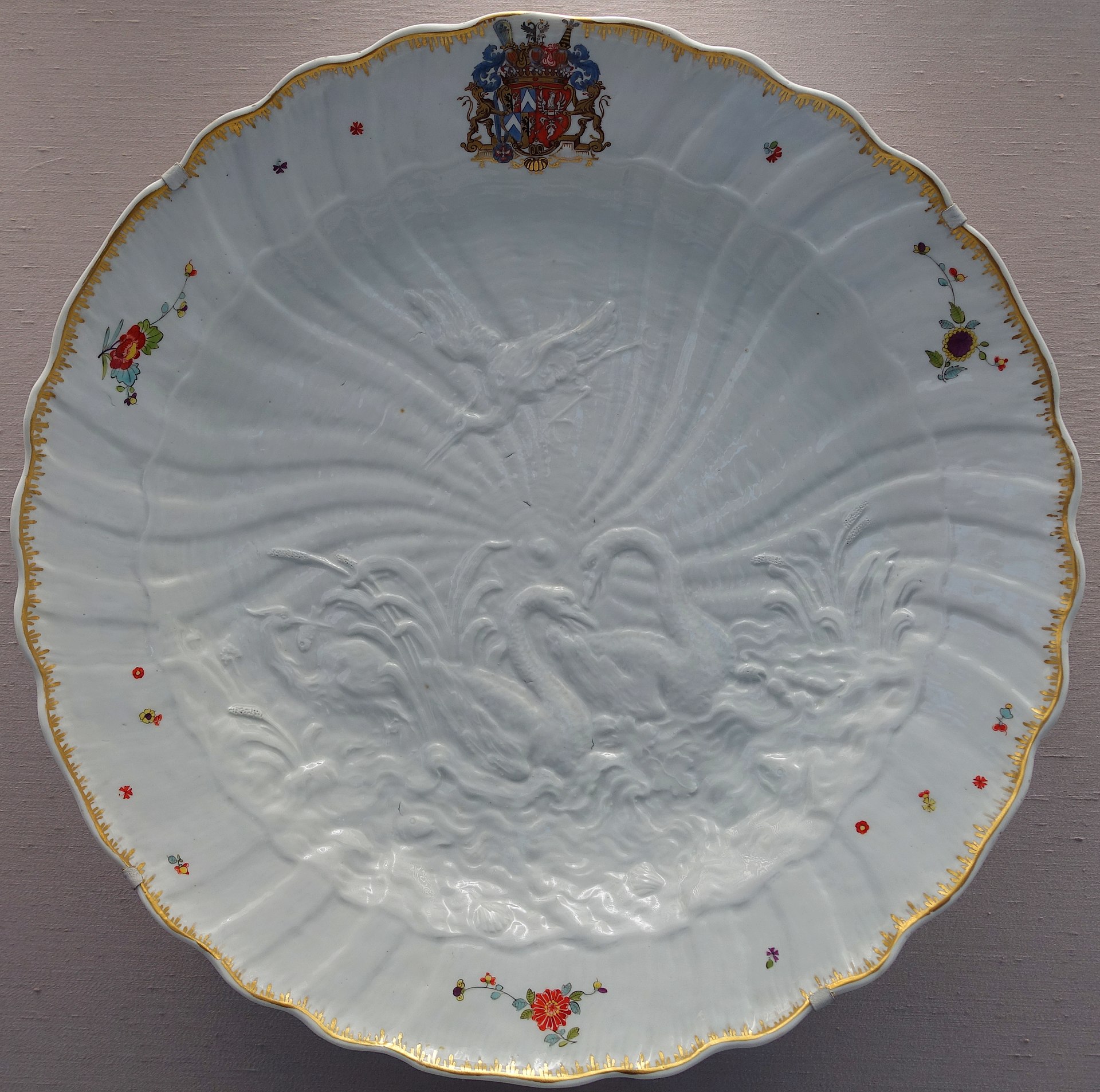
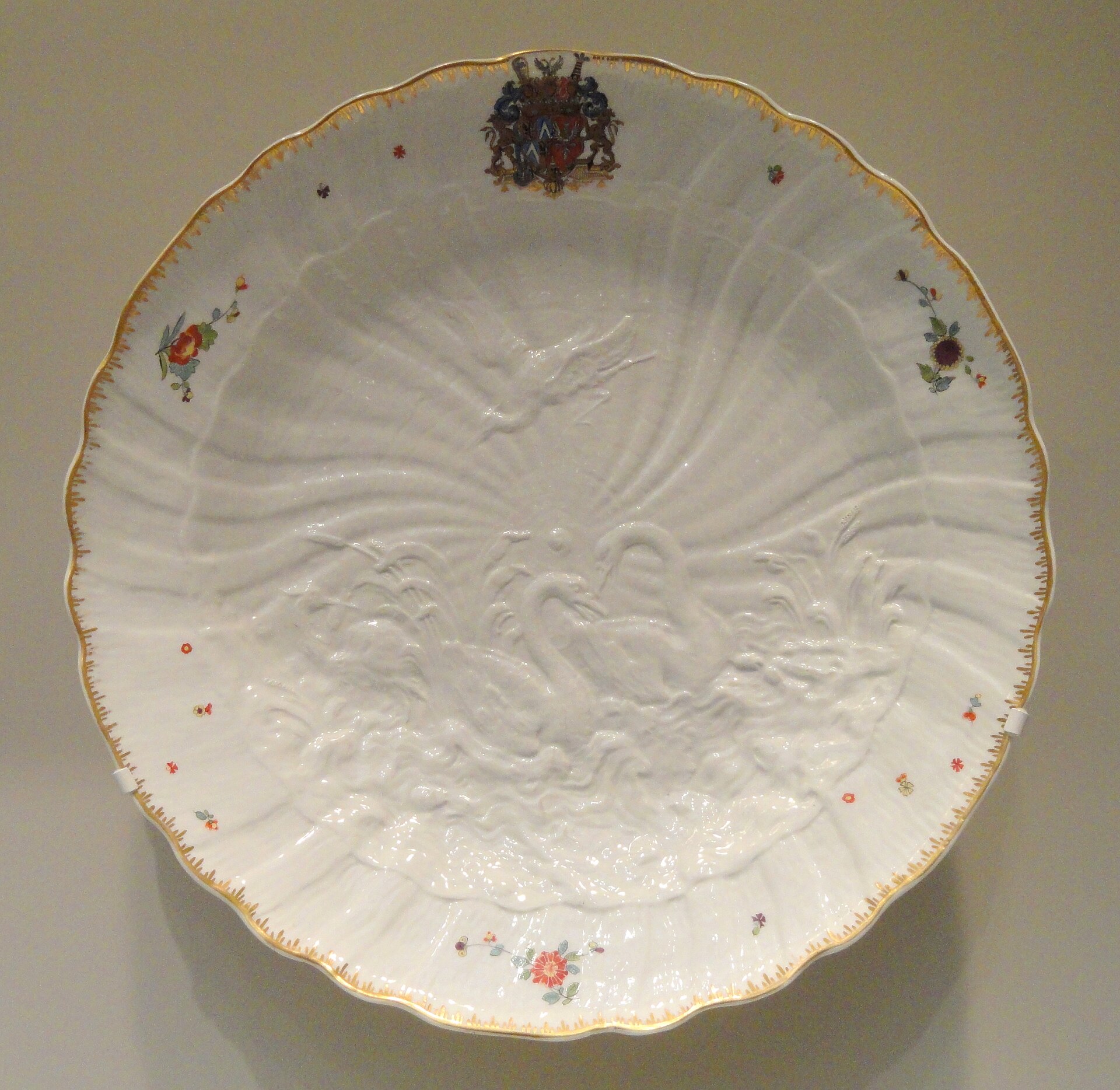
Heinrich von Bruhl, first minister of Saxony under Augustus III, received the Swan Service as a wedding gift from the king on his marriage in November 1737. Sample plates were made that year, mould production began in December, and by 1741 most of the service's shapes were complete; delivery continued piecemeal into 1742, by which point a third modeller, Johann Gottlieb Ehder, had joined Kaendler and Eberlein on the project. The finished service ran to more than 2,200 individual pieces, plates, tureens, candelabra, teapots, cups and wall sconces among them, making it the largest porcelain service made anywhere up to that date.
The decorative programme plays on Bruhl's own name: Bruhl means a damp, marshy place in German, and the service's recurring motif is a pair of swans among bulrushes with a crane in flight above, worked alongside shells and figures of the sea deities Glaucus and Galatea. It is a service designed, quite literally, around its owner's surname, a piece of courtly wit built into the tableware itself rather than a later reading imposed on it.
Most of the service was destroyed in 1945 when Soviet forces burned Schloss Pforten, the Silesian palace where it was then kept; some surviving pieces are reported to have been used afterward by soldiers as targets in improvised clay-pigeon shooting. What survived is now dispersed across museums including the Cleveland Museum of Art, the Art Institute of Chicago, the Rijksmuseum in Amsterdam, the Germanisches Nationalmuseum in Nuremberg and the National Museum in Warsaw, alongside pieces that continue to appear on the auction market. A complete accounting of what exactly was lost at Pforten against what had already left the service through earlier sales has not been published in the sources consulted here, and is recorded as an open question rather than estimated.
From 1736 Kaendler began producing the small cabinet figures that made Meissen porcelain a fixture of European dining tables rather than a princely curiosity: the crinoline groups, named for the wide...
From 1736 Kaendler began producing the small cabinet figures that made Meissen porcelain a fixture of European dining tables rather than a princely curiosity: the crinoline groups, named for the wide skirts fashionable at the Saxon court, and figures drawn from commedia dell'arte, the Italian improvised theatre whose stock characters, Harlequin, Pantalone, Columbine, were staples of court entertainment across Germany. Many of these were made as stock items for the factory's warehouse rather than to a specific commission, and became Meissen's most commercially successful line of the middle of the century.
Some figures had specific living subjects. The Court Jester Joseph Frohlich, modelled in 1739 and now in the Metropolitan Museum's collection, portrays a real court jester in the service of Augustus the Strong, a documented court employee rendered in porcelain in his professional character rather than an anonymous comic type. The genre allowed contemporary satire as well as portraiture: a Satirical Group modelled around 1742, also at the Met, belongs to a category of Kaendler figures understood in the trade and museum literature as commentary on courtiers, professions or current scandal, staged through stock theatrical roles that could be read two ways at once by an audience that knew the joke.
Kaendler modelled a figure of a Lady of the Mopsorden, the Order of the Pug, around 1745, conceived as a pair to a figure of a nobleman in Masonic dress that he had modelled in September 1743.
Kaendler modelled a figure of a Lady of the Mopsorden, the Order of the Pug, around 1745, conceived as a pair to a figure of a nobleman in Masonic dress that he had modelled in September 1743. The Mopsorden was a real Catholic society, founded after Pope Clement XII's 1738 bull banning Freemasonry, that mimicked Masonic ritual with a pug as its emblem of loyalty and admitted women as members, who were required to bark and scratch at the lodge door as part of initiation. The Masonic figure depicts a specific and documented courtly fashion for lodge membership among Saxon and German nobility in the 1740s, not a generic costume invented for the porcelain trade.
What is documented is the subject matter and the date each figure was modelled. What is not documented, in any source consulted for this page, is that Kaendler himself belonged to either society. The figures depict his patrons and their social world; nothing found here supports treating them as evidence of Kaendler's own beliefs or memberships, and that distinction is deliberate rather than an oversight.
Meissen never stopped making from Kaendler's original moulds after his death, and a nineteenth or twentieth-century casting from an eighteenth-century Kaendler model is a documented, legitimate...
Meissen never stopped making from Kaendler's original moulds after his death, and a nineteenth or twentieth-century casting from an eighteenth-century Kaendler model is a documented, legitimate Meissen product, not a fake, but it is not the same object as a piece made and painted in Kaendler's own working lifetime, and the two are routinely confused on the market. Dating rests on several converging kinds of evidence rather than any single test.
The clay itself changed sources and composition over time. Meissen's kaolin came principally from a deposit at Colditz from 1710 and from the Heidelsberg mine at Aue, on land belonging to the Schnorr von Carolsfeld family and known in the trade as Schnorr's Earth, from shortly afterward; a 2020 archaeometric study of body, glaze and enamel compositions in early Meissen porcelain found that the titanium level in the glaze, relative to the body, is measurably higher before about 1730 because Colditz clay alone was used for the glaze at that date, giving a datable chemical signature independent of style or mark.
The crossed-swords mark itself carries period information: swords from the earlier eighteenth century are painted with long, thin, slightly tapered blades in a lighter, thinner application of cobalt blue than later marks, and a mark style inconsistent with a figure's paste and modelling quality, an eighteenth-century figure carrying a mark style that only came into use decades later, is read in the trade as evidence of later manufacture rather than as a fake outright. Paste colour, the handling of faces, and the specific palette of enamels used also vary by period and are treated by specialists as corroborating, not standalone, evidence.
The Paris firm of Edme Samson et Cie, active from the mid nineteenth century, is the most documented producer of deliberate reproductions and copies of Meissen porcelain, including...
The Paris firm of Edme Samson et Cie, active from the mid nineteenth century, is the most documented producer of deliberate reproductions and copies of Meissen porcelain, including Kaendler-attributed models, sold into a market hungry for eighteenth-century figures. Samson's own paste is described in the specialist literature as harder and greyer than Meissen's creamier body and, unlike genuine Meissen paste, does not show the reddish iron impurities that Meissen's clay sometimes reveals where the glaze is thin. Samson's underglaze cobalt blue behaves differently under the glaze than Meissen's, typically running darker and less controlled, and on the crossed-swords mark itself the blades are usually broader and crossed at a wider angle, close to sixty degrees against Meissen's closer to forty-five, with the blue tending to bleed at the edges under magnification.
Samson did originally mark some of its wares, commonly with an S, but the mark was removable and was frequently removed by dealers before resale, which is why the technical tells in the paste and the glaze, rather than the presence or absence of a mark, are what specialists rely on. An obvious vent hole, needed during firing on some Samson reproductions and not always disguised afterward, is treated as one further warning sign rather than as proof on its own.
The most substantial recent test of the market for Kaendler-attributed Meissen was the two-part sale of the Merkle Collection at Bonhams Cornette de Saint Cyr in Paris in 2024.
The most substantial recent test of the market for Kaendler-attributed Meissen was the two-part sale of the Merkle Collection at Bonhams Cornette de Saint Cyr in Paris in 2024. Part I, on 17 April, totalled EUR 948,450 against a pre-sale high estimate of EUR 594,800 across fifty-five lots; Part II, on 31 October, totalled EUR 617,700. Bonhams' own published figures for individual lots are prices realized inclusive of buyer's premium; the house did not separately publish hammer prices for these lots in the material available here, and that gap is recorded rather than filled by back-calculating from the published premium schedule.
The single most expensive Kaendler lot across both parts was a group of fighting harlequins, circa 1740, which made EUR 444,900 in Part II. In Part I, a group of lovers with a birdcage, modelled by Kaendler and documented in his work reports from March 1741, made EUR 171,850 against a EUR 40,000-60,000 estimate; a crinoline figure of a lady, first recorded in Kaendler's work reports in December 1736, made EUR 127,400 against a EUR 20,000-30,000 estimate; a group of Pantalone and Columbine made EUR 82,950; and a Masonic crinoline group of lovers, formerly in the Paul Schnyder von Wartensee collection, made EUR 75,330.
A secondary trade source reports a standing auction record since 2013 for a pair of Kaendler-attributed Meissen magpies at USD 311,150 at Christie's New York; this figure could not be independently confirmed against a Christie's primary listing in the sources available here and is flagged accordingly rather than presented as verified.
Kaendler died at Meissen on 18 May 1775, still in post as Modellmeister after forty-four years, and was buried at St Afra's Abbey in the town where he had worked his whole career.
Kaendler died at Meissen on 18 May 1775, still in post as Modellmeister after forty-four years, and was buried at St Afra's Abbey in the town where he had worked his whole career. He owned multiple properties and a vineyard, and by his own reputation collected art and porcelain on a scale, some 150 services are attributed to him in the secondary literature, that outran his income: he died in debt despite his standing as the manufactory's most senior artistic figure and a court commissioner since 1749. No probate inventory or will has been located in the sources consulted for this page, and the precise scale of the debt is recorded here as unverified rather than quantified.
Leadership of Meissen's design passed to Michel Victor Acier, the younger French sculptor who had joined the factory in 1764 as, by most accounts, Kaendler's stylistic opposite. The transition marks a real break in the factory's output, from Kaendler's late Baroque and Rococo figures toward the plainer, more sentimental Neoclassicism Acier's generation favoured, a shift in taste rather than a simple handover of one man's models to another.
Sculptor; Porcelain modeller (Modellmeister); Arcanist; Court commissioner. 1706-1775; at Meissen from 1731 until his death, chief modeller from 1733.
Born 15 June 1706, Fischbach, near Arnsdorf, Electorate of Saxony; died 18 May 1775, Meissen. Buried at St Afra's Abbey, Meissen.
Edme Samson et Cie, Paris, mid nineteenth century onward. The most documented producer of deliberate reproductions and copies of Meissen figures, including Kaendler-attributed models, sold into a market for eighteenth-century porcelain. Samson porcelain paste lacks the reddish iron impurities Meissen clay sometimes shows through a thin glaze, and the glaze itself often shows a distinctive greenish hue where it has pooled; Samson's underglaze cobalt blue, where it occurs, usually reads darker than on genuine Meissen pieces.
Metropolitan Museum of Art (New York); Art Institute of Chicago (Chicago); Cleveland Museum of Art (Cleveland); Victoria and Albert Museum (London); Staatliche Kunstsammlungen Dresden, Porzellansammlung (Dresden); Rijksmuseum (Amsterdam).
Kaendler-attributed Meissen trades regularly at the specialist European ceramics sales of Bonhams, Christie's and Sotheby's, and prices have risen sharply against estimate in recent years. The clearest recent evidence is the two-part sale of the Merkle Collection at Bonhams Cornette de Saint Cyr in Paris in 2024, which totalled more than EUR 1.5 million across both parts.
What proportion of the nearly one thousand models catalogued in Kaendler's Arbeitsberichte represent his own hand, as against a named assistant working under his supervision, is not resolved model by model in the sources consulted; the factory's records establish who logged the work, not whose hand actually shaped each piece.
The Staffordshire Hoard is 4,600 pieces, or just under 4,000, or around 700, or more than 600, depending on which official page...
11 min read
For a dispersed set, being complete is an event with a date and a duration.
9 min read
Last verified
One artwork and its story every Tuesday, with the picture: who owned it, what it made, and what closes soon in the exhibition calendar. No promotion, and nothing we cannot cite.
We send one email to confirm the address and keep nothing else. Every letter carries a one-click unsubscribe. How we handle your data.


